絵でわかる日本語
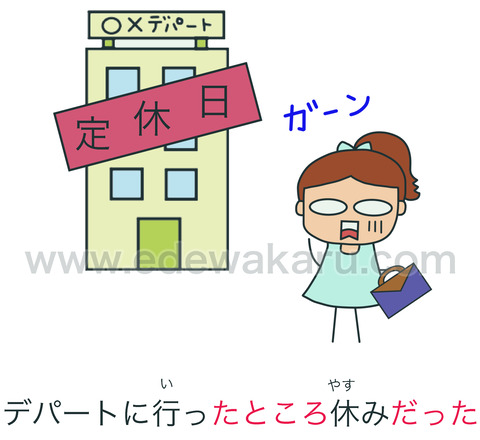
Meaning
〜したら・・・した
〜したら・・・だった
〜したら・・・とわかった
How to use it
動詞[た形]+ところ・・・た
Explanation
「〜たところ・・・た」は
発見の意味を表す
文型で「〜たら・・・た」と同じ意味です。
「〜たら・・・た」よりも驚きの気持ちが強調されます
😊この文型はすでに発生したことを表すものですから、後ろには必ず「た形」がきます。「〜たところ・・・た」と覚えるといいですね😉
【「ところ」シリーズ】
〜たところ〜た
〜たところで〜ない
〜ていたところだ
〜といったところだ・〜というところだ
〜ところ(Nのところ)
〜ところだ(V辞書形+ところだ)
〜ところだ(ている+ところだ)
〜ところだ(Vた+ところだ)
〜ところまで来る
In context 3 examples
デパートに行ったところ休みだった
→デパートに行ったら休みだった上司に電話したところ不在だった
→上司に電話したら不在だったお医者さんにみてもらったところ何も問題はなかった
→お医者さんにみてもらったら何も問題はないとわかった
IMABI
Ichidan Verbs 一段活用動詞
Read this IMABI lesson ↗Explanation
Ichidan Verbs 一段活用動詞
Japanese verb classes differ in how they conjugate. More specifically, what defines a verb’s class is its bases. Endings themselves do not necessarily change based on verb class.
In this lesson, we will look at the ichidan verb class, commonly also known as “ru-verbs” given how all these verbs end in /ru/ in their basic form. This class constitutes roughly half of all verbs.
Before we get into new content, let’s recap important terminology.
Verb: A word that describes an action, state, or occurrence. It may constitute the predicate at the end of a sentence or be part of a noun-predicate when used as a participle/modifier.
Predicate: The part of a sentence that makes a statement about the subject.
Intransitive Verb: A verb that only takes a subject and does not take an object. Abbreviated in definitions as “intr.”
Transitive Verb: A verb that takes both a subject and an object. Abbreviated in definitions as “trans.”
Auxiliary: An ending that helps construct verbal conjugations.
Object: A noun that is directed by the main verb of the sentence.
Direct Object: A word that receives the action of the main verb of the sentence.
Case Particle: A particle that denotes a particular grammatical function/case.
Base: One of the six forms that a verb may take which is then followed by endings (auxiliaries, etc.).
Terminal/Predicative Form: Known in Japanese as the 終止形, it marks the end of a complete sentence/the predicate.
Attributive Form: Known in Japanese as the 連体形, it is used to make a verb, adjective, etc. into a modifier that goes directly before a noun.
Basic Form: The basic form of any given phrase. It is utilized in plain speech and in many grammatical circumstances. The basic form encompasses both the predicative and the attributive forms in the context of verbs and adjectives.
Continuative Form: Known in Japanese as the 連用形, it is used with endings pertaining to actions being carried out.
The Basic/Non-Past Form
一段活用動詞の基本形・非過去形
The plain1 non-past form requires no conjugation for verbs, but it does correspond to two conjugational bases: the predicative form (終止形) and the attributive form (連体形). While these forms are identical for Ichidan verbs, they refer to separate ways to use a verb. Collectively, they are referred to as the basic form (基本形).
MeaningBasic Form Meaning Basic Form
To see見るTo borrow借りる
To wear着るTo remember覚える
①To get up
②To happen 起きるTo exist (animate objects)いる
To eat食べるTo open (trans.)開ける
To answer答えるTo close (door, etc.)閉める
Whereas adjectives require context to be interpreted in the future tense, verbs are more likely to be interpreted either way (plain or future) in the non-past form. Furthermore, there are no morphological distinctions between the “present tense,” the “future tense,” and the “infinitive form2.” The infinitive form in English refers to the base form of a verb, and it is used in the chart above to define the Japanese verbs—marked by the use of “to.” This is often referred to as the “dictionary form” (辞書形) from a practical standpoint.
Various factors such as readily perceivable contexts, most likely topics (if not present already), or even the nature of the verb itself may result in some, all, or only one reasonable interpretation on the grounds of tense or whether the statement is just like the English indicative form.
1. 映画を見る。
i. (I) watch movies.
ii. (I) will watch (a) movie(s).
iii. To watch movies.
2. 浴衣を着る。
To wear a yukata.
3. 毎朝起きる。
i. (I) get up every morning.
ii. To get up every morning.
4. 鳥がいる。
There is a bird.
5. 毎日野菜を食べる。
i. To eat vegetables every day.
ii. (I) eat vegetables every day.
Exs. 1-5 are examples of the “predicative form” because the verb is the predicate, and it is at the end of the sentence. Meanwhile, Ex. 6 is an example of a verb being used in its attributive form, as the verb is before a noun to modify its meaning.
6. 食べる野菜
Vegetables that (I/one) eat(s)/will eat
The Polite Non-Past Form w/ ~ます
非過去の丁寧形 (~ます)
Conjugating verbs into polite speech involves the auxiliary verb ~ます. One way or another, it finds itself in every conjugation in all formal (polite, respectful, humble) speech registers. With the introduction of this ending, we must learn the verb base it attaches to as well as what bases of ~ます we need to make other conjugations in polite speech.
~ます attaches to the “continuative form” (連用形). As ~ます in its basic form is understood to be non-past, it fits this base’s definition of being matched with endings pertaining to actions being carried out. To form this base with Ichidan verbs, all you do is drop the final ~る, then you just add ~ます.
Meaning Basic Form Continuative Form +-~ます
To think考えるKangaeru → Kangae 考えます
To fall (intr.)落ちるOchiru → Ochi落ちます
To close up/shut閉じるTojiru → Toji閉じます
To lose負けるMakeru → Make負けます
To show見せるMiseru → Mise見せます
7. ドアを閉じます。
I’ll close the door.
8. ちょっと考えます。
I’ll think about it.
9. 教科書を借ります。
I’ll borrow the textbook.
Basic Form: Predicative vs. Attributive w/ ~ます
非過去形「~ます」の終止形・連体形との使い分け
Previously, we learned how です does not possess an attributive form, which prevents copular, adjectival, and adjectival-noun polite forms from directly modifying nouns. Although verbs use the auxiliary ~ます to become polite, it does, incidentally, have both a predicative form (終止形) and an attributive form (連体形). However, its attributive form is rarely used because of a convention found in Modern Standard Japanese grammar dictating that politeness need only be marked at the end of a sentence. This results in Ex. 10b being ungrammatical to the majority of speakers.
10a. よく借りる教科書 〇
10b. よく借ります教科書 X/△
Textbook(s) that I often borrow
~ます only appears before nouns in extremely formal speech, and said nouns are almost always dummy nouns which serve grammatical functions as opposed to referring to a specific entity. At this point in your studies, it is more than safe to assume that “~ます + noun” ought to be treated as a grammatical error.
The Plain Past Form w/ ~た
常体語における過去形(~た)
To conjugate Ichidan verbs into the past tense in plain speech, all you do is conjugate it into its continuative form (連用形) by dropping the final ~る and add the auxiliary verb ~た, which we learned already marks the past tense for other parts of speech.
MeaningBasic Form Continuative Form + –ta た
To find (trans.)見つけるMitsukeru → Mitsuke見つけた
To collect集めるAtsumeru → Atsume集めた
To get used to慣れるNareru → Nare慣れた
To collapse倒れるTaoreru → Taore倒れた
Grammar Note: Because the predicative form (終止形) and attributive form (連体形) of the auxiliary verb ~た are identical, past tense clauses can directly modify any noun phrase.
11. あの絵を見た。
I saw that picture/painting.
12. さっきあの店で見た絵はすごかったです。
The painting/picture I saw earlier at that shop was amazing.
13. 切手を集めた。
I collected stamps.
14. クマを見つけた。
I found the bear.
15. だいぶ慣れた。
I’ve gotten fairly used to it.
Grammar Note: Perfect tenses such as the perfect past used here in the English translation – “have gotten used to” – do not exist in Japanese, and so both “past tense” and “perfect past tense” fall under the use of ~た in Japanese.
The Polite Past Form w/ ~ました
丁寧語における過去形(~ました)
The continuative form of ~ます (まし~) is combined with ~た to create ~ました, the polite past form of verbs. From this process, the concept of Japanese conjugation behaving like a chain becomes clear. Take a verb, put it into whatever base is needed, attach an ending, and continue attaching endings as needed.
Ex. Miru (to see) → Miru → Mi– → Mimasu → Mimashi– → Mimashita (saw).
Below are more examples of verbs conjugated with ~ました.
MeaningBasic Form → Continuative Form + ~ました
To get 得る → E-得ました
To increase (intr.)増える → Fue-増えました
To plant植える → Ue-植えました
To mix (trans.)混ぜる → Maze-混ぜました
To line up (trans.)並べる → Narabe-並べました
Grammar Note: Although the auxiliary verb ~た possesses a fully functional attributive form (連体形), because of the tendency to only mark politeness once at the end of the sentence, ~ました is rarely used directly before nouns. In typical everyday polite speech, this is considered a grammatical error.
16. 木を植えました。
I planted a tree.
17. 肩を並べました。
We lined up shoulders.
18. 人口が増えました。
The population increased/grew.
19. 調味料を混ぜました。
I mixed in spices.
20a. 混ぜた調味料 〇
20b. 混ぜました調味料 X
Spice(s) that I mixed
The Plain Negative Form w/ ~ない
常体語における否定形(~ない)
To make the negative form in plain speech for verbs, you must conjugate the verb into a base known as the irrealis form (未然形) and follow it with the auxiliary ~ない. The irrealis form (未然形) is used to indicate actions/events that have not occurred yet, and so the negative form is a perfect application of this.
To form the irrealis base (未然形) with Ichidan verbs, all you have to do is drop the final ~る This is identical to the continuative form (連用形), but this WILL NOT be the case with all the other verb classes.
MeaningBasic Form → Irrealis Form+ ~ない
To break (intr.)壊れる → Koware-壊れない
To bathe in浴びる → Abi-浴びない
To get wet濡れる → Nure-濡れない
To get off降りる → Ori-降りない
To seem/appear見える → Mie-見えない
Grammar Note: Because the auxiliary adjective ~ない conjugates as an adjective, its predicative form (終止形) and attributive form (連体形) are fully functional.
Grammar Note: To remember how the attributive form (連体形) functions with verbal phrases, whether it is of the negative form or some other conjugation, is that it plays the role of “who/what/where/when” when following a noun to mark the start of the modifier. This is not so obvious because of how the Japanese word order is opposite.
21. 引き戸が壊れない。
The sliding door won’t break.
22. シャワーを浴びない。
To not/will not take a shower.
23. 負けない。
I/we won’t lose.
24. 足が濡れないよ。
(Your) feet won’t get wet.
25. シャワーを浴びない子は意外と多い。
There are surprisingly a lot of kids who don’t shower.
The Polite Negative Forms
(~ません or ~ないです)
丁寧語における否定形(~ません・ないです)
There are two possible negative forms in polite speech. The difference in politeness between the two is that Method 1 is deemed politer and more formal.
Method 1: Attach the politeness marking auxiliary ~ます to the continuative form (連用形) of the verb, then attach the auxiliary verb ~ん3 to the irrealis form (未然形) of ~ます: ませ~ + ~ん.
Method 2: Attach the negative marking auxiliary ~ない to the irrealis form (未然形) of the verb, then attach the politeness marking auxiliary4 ~です to the terminal/predicative form (終止形) of ~ない (ない~).
Method 1: ~ません (Proper Polite Form)
MeaningBasic Form → Continuative Form +~ません
To change (trans.)変える → Kae-変えません
To admit/recognize認める → Mitome-認めません
To investigate調べる → Shirabe-調べません
To sleep寝る → Ne-寝ません
To attach付ける → Tsuke-付けません
Method 2: ~ないです (Casual Polite Form)
Meaning Basic Form → Irrealis Form + ~ないです
To clear up/be sunny晴れる → Hare–晴れないです
To be popular モテる → Mote-モテないです
To leak漏れる → More-漏れないです
To feel感じる → Kanji-感じないです
To swell腫れる → Hare-腫れないです
Grammar Notes:
①Although ~ません does possess an attributive form (連体形), its use is incredibly rare in modern speech. As such, for practical purposes, its placement before generic nominal phrases is considered ungrammatical.
②As for ~ないです, its use before nouns is impossible because ~です does not have an attributive form (連体形).
26. 今夜寝ません。
I won’t sleep tonight.
27. 何も感じません。
I don’t feel anything.
28. (お)肉は食べません。
I don’t/won’t eat meat.
29. 神を信じません。
I don’t believe in God/gods.
30. 内容は漏れないです。
(The) content won’t leak.
31. 魚は食べないです。
I don’t eat fish.
The Plain Negative Past Form w/ ~なかった
常体語における過去の否定形(~なかった)
To create the negative past form in plain speech, the auxiliary ~ない must be conjugated into its past tense form. Connecting ~ない to the verb itself is no different than as with the non-past tense, attaching to the irrealis form (未然形).
To conjugate ~ない into the past tense, first use its continuative form (なかっ~) and attach the past tense marker ~た: ~なかった.
Meaning Basic Form → Irrealis Form +~なかった
To disappear消える → Kie–消えなかった
To forget忘れる → Wasure–忘れなかった
To throw away捨てる → Sute–捨てなかった
To exceed超える → Koe–超えなかった
To believe信じる → Shinji–信じなかった
32. 消えなかった証拠
Evidence that didn’t disappear
33. 彼はごみを捨てなかった。
He didn’t throw away the trash.
34. 忘れなかったよ。
I didn’t forget.
The Polite Negative Past Forms (~ませんでした or ~なかったです)
丁寧語における過去の否定形(~ませんでした・なかったです)
The polite negative forms for Ichidan verbs are created in very familiar ways. In fact, you learned them already with the copular verbs. The only difference is learning how to conjugate the start of the conjugation chain with Ichidan verbs! As was the case with marking non-past negation, there are two methods to mark past tense negation in polite speech.
Method 1: Attach the politeness marking auxiliary ~ます to the continuative form (連用形) of the verb, then attach the auxiliary verb ~ん to the irrealis form (未然形) of ~ます (ませ~). Then, attach ~でした to the attributive form (連体形) of ~ん (ん~).
Method 2: Attach the negative marking auxiliary ~ない to the irrealis form (未然形) of the verb, then attach the past tense marking auxiliary ~た to the continuative form (連用形) of ~ない (なかり5~). Then, attach です to the terminal/predicative form (終止形) of ~た (た~).
Method 1: ~ませんでした (Proper Polite Form)
MeaningBasic Form → Continuative Form+ ~ませんでした
To begin/start (trans.)始める → Hajime-始めませんでした
To leave/exit出る → De-出ませんでした
To finish (trans.)終える → Oe-終えませんでした
To throw投げる → Nage-投げませんでした
To lower (trans.)下げる → Sage-下げませんでした
Method 2: ~なかったです (Casual Polite Form)
MeaningBasic Form → Irrealis Form + ~なかったです
To run away逃げる → Nige–逃げなかったです
To hurt (trans.)傷つける → Kizutsuke–傷つけなかったです
To carry forward (trans.)進める → Susume–進めなかったです
To compile纏める → Matome–纏めなかったです
To cool down (intr.)冷める → Same–冷めなかったです
Grammar Note: The negative-past polite forms do not directly modify nouns because no form of です–including でした–possesses an attributive form (連体形).
35. 話題を変えませんでしたよ。
I didn’t change the topic.
36. ピザを食べませんでした。
I didn’t eat pizza.
37. なかなか焦げませんでした。
It wouldn’t quite get charred.
38. 特に調べませんでした。
I didn’t particularly check/investigate it.
39a. 食べなかったピザ 〇
39b. 食べませんでしたピザ X
The pizza I didn’t eat
40. 今日は晴れなかったです。
It didn’t clear up today.
41. コイは逃げなかったです。
The koi fish didn’t swim away.
42. お風呂はなかなか冷めなかったです。
The bath didn’t quite cool down.
Previous Lesson
Next Lesson
“Plain” refers to “plain speech,” which is the opposite of “polite speech.” Polite speech is always marked somehow in verbal constructions. Thus, the “plain (non-marked) form” of a verb may be referred to as its 普通形, and the “polite (marked) form” of a verb may be referred to as its 丁寧形. ↩︎
The “infinitive form” is the base form of a verb, and it is the English equivalent to the concept of the 基本形, although the latter’s grammatical capacity is far larger than the former. ↩︎
The original negative auxiliary verb in Japanese is ~ず, which itself is believed to be a combination of the continuative form of the negative marking morpheme /n/ and the verb す (to do). When the terminal/predicative form and the attributive form of most parts of speech merged together, this merger also affected ~ず, becoming rendered as ~ぬ before contracting to ~ん. ↩︎
The politeness marking auxiliary verb ~です should not be confused for when です is used as the polite copula verb. ↩︎
As we learned in Lesson 14, when ~た follows the かり-continuative form (連用形), the base becomes contracted. So, for ~ない, this means its continuative base なかり becomes なかっ. ↩︎
In context 45 examples
映画を見る。
i. (I) watch movies.
浴衣を着る。
To wear a yukata.
毎朝起きる。
i. (I) get up every morning.
鳥がいる。
There is a bird.
毎日野菜を食べる。
i. To eat vegetables every day.
食べる野菜
Vegetables that (I/one) eat(s)/will eat
ドアを閉じます。
I’ll close the door.
ちょっと考えます。
I’ll think about it.
教科書を借ります。
I’ll borrow the textbook.
よく借りる教科書 〇
Textbook(s) that I often borrow
よく借ります教科書 X/△
Textbook(s) that I often borrow
あの絵を見た。
I saw that picture/painting.
さっきあの店で見た絵はすごかったです。
The painting/picture I saw earlier at that shop was amazing.
切手を集めた。
I collected stamps.
クマを見つけた。
I found the bear.
だいぶ慣れた。
I’ve gotten fairly used to it.
木を植えました。
I planted a tree.
肩を並べました。
We lined up shoulders.
人口が増えました。
The population increased/grew.
調味料を混ぜました。
I mixed in spices.
混ぜた調味料 〇
Spice(s) that I mixed
混ぜました調味料 X
Spice(s) that I mixed
引き戸が壊れない。
The sliding door won’t break.
シャワーを浴びない。
To not/will not take a shower.
負けない。
I/we won’t lose.
足が濡れないよ。
(Your) feet won’t get wet.
シャワーを浴びない子は意外と多い。
There are surprisingly a lot of kids who don’t shower.
今夜寝ません。
I won’t sleep tonight.
何も感じません。
I don’t feel anything.
(お)肉は食べません。
I don’t/won’t eat meat.
神を信じません。
I don’t believe in God/gods.
内容は漏れないです。
(The) content won’t leak.
魚は食べないです。
I don’t eat fish.
消えなかった証拠
Evidence that didn’t disappear
彼はごみを捨てなかった。
He didn’t throw away the trash.
忘れなかったよ。
I didn’t forget.
話題を変えませんでしたよ。
I didn’t change the topic.
ピザを食べませんでした。
I didn’t eat pizza.
なかなか焦げませんでした。
It wouldn’t quite get charred.
特に調べませんでした。
I didn’t particularly check/investigate it.
食べなかったピザ 〇
The pizza I didn’t eat
食べませんでしたピザ X
The pizza I didn’t eat
今日は晴れなかったです。
It didn’t clear up today.
コイは逃げなかったです。
The koi fish didn’t swim away.
お風呂はなかなか冷めなかったです。
The bath didn’t quite cool down.
Godan Verbs 五段活用動詞
Read this IMABI lesson ↗Explanation
Godan Verbs 五段活用動詞
In this lesson, we will learn about the godan verb class, commonly known as “u-verbs” due to all such verbs ending in /-u/. Although the means by which these verbs conjugate is no different than ichidan verbs, the bases of godan verbs look very different. In addition to this, sound changes occur with certain conjugations. Half of all verbs fall into this class, so learning these rules will be crucial.
Before we get into new content, let’s recap on important terminology we have discussed thus far which will be relevant to the overall topic of this lesson.
Verb: A word that describes an action, state, or occurrence. It may constitute the predicate at the end of a sentence or be part of a noun-predicate when used as a participle/modifier.
Predicate: The part of a sentence that makes a statement about the subject.
Intransitive Verb: A verb that only takes a subject and does not take an object. Abbreviated in definitions as “intr.”
Transitive Verb: A verb that takes both a subject and an object. Abbreviated in definitions as “trans.”
Auxiliary: An ending that helps construct verbal conjugations.
Object: A noun that is directed by the main verb of the sentence.
Direct Object: A word that receives the action of the main verb of the sentence.
Case Particle: A particle that denotes a particular grammatical function/case.
Base: One of the six forms that a verb may take which is then followed by endings (auxiliaries, etc.).
Terminal/Predicative Form: Known in Japanese as the Shūshikei 終止形, it marks the end of a complete sentence/the predicate.
Attributive Form: Known in Japanese as the Rentaikei 連体形, it is used to make a verb, adjective, etc. into a modifier that goes directly before a noun.
Basic Form: The basic form of any given phrase is utilized in plain speech and in many grammatical circumstances. The basic form encompasses both the predicative and the attributive forms in the context of verbs and adjectives.
Godan Verb: The Japanese name for this class relates to how all five vowels are present among the bases of said verbs, which is in contrast to ichidan verbs which only display one vowel in all their bases.
The Basic/Non-Past Form
五段活用動詞の基本形・非過去形
As we previously learned, the non-past tense of a verb stands for either the present tense or future tense, but it also corresponds to the English “infinitive form (the “to” or “dictionary” form)” of verbs. While no conjugation occurs to make the non-past in plain speech, the basic form (基本形) and its two iterations—the predicative form (終止形) and the attributive form (連体形)—are still in play.
Godan verbs differ from ichidan verbs by the stem ending in a consonant as opposed to a vowel. There are 9 possible consonants that can end the stem, each constituting a sub-type within godan verbs.
Sub-Type Meaning Basic FormStem
K-Type カ行 to write書くkak-
G-Type ガ行 to swim泳ぐoyog–
S-Type サ行 to talk/speak話すhanas–
T-Type タ行 to win勝つkat–
N-Type ナ行 to die死ぬshin–
B-Type バ行 to choose選ぶerab–
M-Type マ行 to read読むyom–
R-Type ラ行 to change (intr.)変わるkawar–
W-Type ワ行 to buy買うkaw–
The Japanese naming convention for the 9 sub-types refers to the first mora of each type’s respective “row” in the Table of 50 Sounds (五十音図).
There are a few anomalies that can be gleaned from this chart.
The first thing to take note of is the existence of /w/ in the stems of w-type godan verbs. The /w/ does surface in some conjugations, but it is thought that at one point, it would have appeared in all the bases of these verbs1.
The second thing to take note of is that the verb /shinu/ meaning “to die” is the only verb in Standard Japanese that ends in /nu/. As such, its conjugations will always be specifically noted out of necessity, not out of a need to sound morbid.
1. 小説を書く。
To write a novel.
2. いつか死ぬ。
To one-day die.
3. 世界が変わる。
The world will change.
4. 美味しい食べ物を買う。
To buy delicious food.
The Polite Non-Past Form w/ ~ます
非過去の丁寧形 (~ます)
It is time to learn how the auxiliary verb ~ます works with godan verbs. Although it always attaches to the “continuative form” (連用形), this base looks different with godan verbs. This is because each base of a godan verb corresponds to a different vowel that follows the stem to form it. To create the continuative form, the stem is followed by /i/.
Sub-TypeStem + /i/ =Continuative Form+ -~ますMeaning
K-Typekak– + /i/ → kaki–書きます(does/will) write
G-Typeoyog– + /i/ → oyogi–泳ぎます(does/will) swim
S-Typehanas– + /i/ → hanashi–話します(does/will) talk
T-Typekat– + /i/ → kachi–勝ちます(does/will) win
N-Typeshin– + /i/ → shini–死にます(does/will) die
B-Typeerab– +/i/ → erabi–選びます(does/will) choose
M-Typeyom– + /i/ → yomi–読みます(does/will) read
R-Typekawar– + /i/ → kawari–変わります(does/will) change (intr.)
W-Typekaw– + /i/ → kai–買います(does/will) buy
Grammar Note: Remember that the attributive form of ~ます is not grammatical in basic polite speech, and so it cannot be placed before a noun.
5. 私はいつもパチンコで勝ちます。
I always win at pachinko.
6. 日本が変わります。
Japan will change.
7. スペイン語を話します。
I speak Spanish.
8. よくマンガを読みます。
I often read manga.
9. 全員死にます。
Everyone dies/will die.
The Plain Past Form w/ ~た
常体語における過去形(~た)
To form the past tense in plain speech for godan verbs, the past tense marking auxiliary verb ~た still attaches to the continuative form (連用形)2, but the final consonant of the stem often irregularly undergoes a sound change. The sound change that occurs depends on the sub-type.
■K-Type Godan Verbs
With the verb in its continuative form, drop the /k/ in the stem, then add ~た.
Basic FormConjugation ProcessPlain Past Tense w/ ~た
kaku 書く (to write)kaki → + – /ta/ → kaita書いた (wrote)
■G-Type Godan Verbs
With the verb in its continuative form, drop the /g/ in the stem, then add ~だ.
~た becomes voiced to compensate for /g/ being voiced.
Basic FormConjugation ProcessPlain Past Tense w/ ~た
泳ぐ (to swim)oyogi– + – /ta/ → oyoita → oyoida泳いだ (swam)
■S-Type Godan Verbs
With the verb in its continuative form, add ~た. No irregularity occurs.
Basic FormConjugation ProcessPlain Past Tense w/ ~た
話すhanashi– + – /ta/ → hanashita話した (spoke)
■N/B/M-Type Godan Verbs
With the verb in its continuative form, drop the /i/ which makes said continuative form3, then add ~だ. The final consonant of the stem—[n~b~m]—becomes [n] to match the articulation of /d/.
Basic FormConjugation ProcessPlain Past Tense w/ ~た
死ぬshini + -/ta/ → shin.ta → shin.da死んだ (died)
選ぶerabi + -/ta/ → erab.ta → eran.da選んだ (chose)
読むyomi + -/ta/ → yom.ta → yon.da読んだ (read)
■T/R/W-Type Godan Verbs
With the verb in its continuative form, drop the /i/ which makes said continuative form4, then add ~た. In turn, the final consonant of the stem—[t~r~w]—becomes っ to match the articulation of [t].
Basic Form Conjugation ProcessPlain Past Tense w/ –ta た
勝つkati– + – /ta/ → kat.ta勝った
変わるkawari– + – /ta/ → kawar.ta → kawat.ta変わった
買うka(w)i– + – /ta/ → kaw.ta → kat.ta買った
To familiarize yourself with these conjugation rules, consider the following verbs.
Sub-TypeBasic Form Plain Past Tense w/ ~た
K-Type聞く (to listen/hear)聞いた (listened/heard)
G-Type急ぐ (to hurry)急いだ (hurried)
S-Type貸す (to lend)貸した (lent)
T-Type待つ (to wait)待った (waited)
N-Type死ぬ (to die)死んだ (died)
B-Type遊ぶ (to play)遊んだ (played)
M-Type休む (to rest)休んだ (rested)
R-Type売る (to sell)売った (sold)
W-Type歌う (to sing)歌った (sang)
K-Type※行く (to go)行った※ (went)
W-Type※言う (to say)言った※ (said)
※ The verb 行く is irregular, as it conjugates like a t/r/w-type godan verb: 行いた5 X → 行った 〇.
※ The verb 言う is irregular not because of how ~た combines with it, but because of how both いった and ゆった are valid pronunciations, with the latter being indicative of casual speech.
10. アニソンを歌った。
I sang an anime song.
11. 悪口を言った人
Person who said slander
12. バターを売った。
I sold butter.
13. お金を貸した。
I lent money.
14. その黄色い鳥が死んだ。
That yellow bird died.
15. 図書館に行った。
I went to the library.
16. うわさを聞いた。
I heard a rumor.
17. 学校を休んだ。
I took off from school.
The Polite Past Form w/ ~ました
丁寧語における過去形(~ました)
Conjugating godan verbs into the past tense in polite speech is far easier than in plain speech because ~ます conjugates with ~た, resulting in ~ました, which as a whole still follows the continuative form (連用形) normally.
Sub-TypeBasic FormPlain Tense w/ ~ました
K-Type書く (to write)書きました (wrote)
G-Type嗅ぐ (to smell)嗅ぎました (smelled)
S-Type直す (to fix)直しました (fixed)
T-Type打つ (to hit/type)打ちました (hit/typed)
N-Type死ぬ (to die)死にました (died)
B-Type運ぶ (to transport)運びました (transported)
M-Type進む (to advance) (intr.)進みました (advanced) (intr.)
R-Type凍る (to freeze) (intr.)凍りました (froze) (intr.)
W-Type思う (to think)思いました (thought)
K-Type*行く (to go)行きました (went)
W-Type*言う (to say)言いました (said)
18. 好きな香りを嗅ぎました。
I smelled a scent that I like.
19. タイプミスを直しました。
I fixed the typo(s).
20. 祖母は去年死にました。
My grandmother died last year.
21. 竹を運びました。
I carried/transported bamboo.
22. 同じことを思いました。
I thought the same thing.
The Plain Negative Form w/~ない
常体語における否定形(~ない)
To create the plain negative form with godan verbs, the auxiliary ~ない follows the irrealis form (未然形), which is made by following the stem with the vowel /a/. As for w-type godan verbs, /w/ is pronounced because /wa/ is a valid mora.
Sub-Type Basic Form Irrealis Form Plain Negative w/ ~ない
K-Type働く (to work) Hataraka-働かない (does/will not work)
G-Type嗅ぐ (to smell)Kaga-嗅がない (does/will not smell)
S-Type直す (to fix)Naosa-直さない (does/will not fix)
T-Type撃つ (to shoot)Uta-撃たない (does/will not shoot)
N-Type死ぬ (to die)Shina-死なない (does/will not die)
B-Type叫ぶ (to shout)Sakeba-叫ばない (does/will not shout)
M-Type噛む (to bite)Kama-噛まない (does/will not bite)
R-Type帰る (to go home)Kaera-帰らない (does/will not go home)
W-Type思う (to think)Omowa-思わない (does/will not think)
K-Type*行く (to go)Ika-行かない (does/will not go)
W-Type*言う (to say)Iwa-言わない (does/will not say)
Irregularity Note: Though not shown in the chart above, there is one r-type godan verb that is irregular with the auxiliary adjective ~ない: the verb ある, meaning “there is…” in contexts with inanimate entities. In the plain negative form, ない simply replaces ある altogether, in which it translates as “there is not…” Consequently, あらない does not exist.
23. 今夜は帰らない。
I won’t go home tonight.
24. うちの猫は、人には絶対に噛まない。
My cat doesn’t ever bite people.
25. 何も言わない。
I won’t say anything.
26. 風邪薬は風邪を治さない。
Cold medicine won’t cure a cold.
The Polite Negative Forms
(~ません or ~ないです)
丁寧語における否定形(~ません・ないです)
Godan verbs possess the same two polite negative form constructions as ichidan verbs. The only difference is how their bases look. With that, the methods are summarized as follows:
Method 1: Attach the politeness marking auxiliary ~ます to the continuative form (連用形) of the verb—which ends in /i/—then attach the auxiliary verb ~ん to the irrealis form (未然形) of ~ます (ませ~).
Method 2: Attach the negative marking auxiliary ~ない to the irrealis form (未然形) of the verb—which ends in /a/—then attach the politeness marking auxiliary ~です to the terminal/predicative form (終止形) of ~ない (ない~).
Method 1: ~ません (Proper Polite Form)
Sub-TypeBasic FormPolite Negative (Politer)
K-Type書く (to write)書きません (doesn’t/won’t write)
G-Type泳ぐ (to swim)泳ぎません (doesn’t/won’t swim)
S-Type示す (to show)示しません(doesn’t/won’t show)
T-Type勝つ (to win)勝ちません (doesn’t/won’t win)
N-Type死ぬ (to die)死にません (doesn’t/won’t die)
B-Type喜ぶ (to rejoice)喜びません (doesn’t/won’t rejoice)
M-Type畳む (to fold)畳みません (doesn’t/won’t fold)
R-Type掘る (to dig)掘りません (doesn’t/won’t dig)
W-Type習う (to review)習いません (doesn’t/won’t review)
K-Type*行く (to go)行きません (doesn’t/won’t go)
W-Type*言う (to say)言いません (doesn’t/won’t say)
Method 2: ~ないです (Casual Polite Form)6
Sub-Type Basic Form Polite Negative (Casual)
K-Type動く (to move) (intr.) 動かないです (doesn’t/won’t move) (intr.)
G-Type泳ぐ (to swim) 泳がないです (doesn’t/won’t swim)
S-Type刺す (to stab) 刺さないです (doesn’t/won’t stab)
T-Type 立つ (to stand) 立たないです (doesn’t/won’t stand)
N-Type死ぬ (to die) 死なないです (doesn’t/won’t die)
B-Type学ぶ (to learn) 学ばないです (doesn’t/won’t learn)
M-Type飲む (to drink) 飲まないです (doesn’t/won’t drink)
R-Type祈る (to pray) 祈らないです (doesn’t/won’t pray)
W-Type吸う (to smoke) 吸わないです (doesn’t/won’t smoke)
K-Type*行く (to go)行かないです (doesn’t/won’t go)
W-Type*言う (to say)言わないです (doesn’t/won’t say)
27. 夫がまったく働きません。
My husband won’t work at all.
28. 僕は死にません! (Male speech)
I won’t die!
29. 私はまだ帰りません。
I’m not going home yet.
30. 匂いもたまらない7です。
I can’t get enough of the smell.
31. 明日は行かないです。
I’m not going tomorrow.
32. 包丁はあんまり使わないですね。
I don’t often use kitchen knives, you see.
The Plain Negative Past Form (~なかった)
常体語における過去の否定形(~なかった)
To conjugate a godan verb into its negative past form, first conjugate the verb into its irrealis form (未然形) ending in the vowel /a/ and attach ~なかった, which as we have learned is the combination of the negative auxiliary adjective ~ない and the past tense auxiliary verb ~た.
Sub-Type Basic FormPlain Negative Past (Casual)
K-Type聞く (to hear/listen)聞かなかった (didn’t hear/listen)
G-Type嗅ぐ (to smell)嗅がなかった (didn’t smell)
S-Type離す (to separate)離さなかった (didn’t separate)
T-Type立つ (to stand)立たなかった (didn’t stand)
N-Type死ぬ (to die)死ななかった (didn’t die)
B-Type並ぶ (to line up) (intr.)並ばなかった (didn’t line up)
M-Type噛む (to bite)噛まなかった (didn’t bite)
R-Type切る (to cut)切らなかった (didn’t cut)
W-Type戦う (to fight)戦わなかった (didn’t fight)
K-Type*行く (to go)行かなかった (didn’t go)
W-Type*言う (to say)言わなかった (didn’t say)
33. ワニが動かなかった。
The crocodile didn’t move.
34. とどめを刺さなかった。
I didn’t put an end to it.
35. ハリー・ポッターは死ななかった。
Harry Potter didn’t die.
36. 爪を噛まなかった。
I didn’t bite my nails
The Polite Negative Past Forms
(~ませんでした or ~なかったです)
丁寧語における過去の否定形(~ませんでした・なかったです)
As there is nothing irregular with how the polite marker auxiliary ~ます behaves with godan verbs, you are already familiar with the principles behind how the polite negative forms are created with them.
Method 1: Attach the politeness marking auxiliary ~ます to the continuative form (連用形) of the verb—which ends in /i/—then attach the auxiliary verb ~ん to the irrealis form (未然形) of ~ます (ませ~). Then, attach ~でした to the attributive form (連体形) of ~ん (ん~).
Method 2: Attach the negative marking auxiliary ~ない to the irrealis form (未然形) of the verb—which ends in /a/—then attach the past tense marking auxiliary ~た to the continuative form (連用形) of ~ない (なかり~). Then, attach です to the terminal/predicative form (終止形) of ~た (た~).
Method 1: ~ませんでした (Proper Polite Form)
Sub-TypeBasic FormPolite Negative-Past (Politer)
K-Type描く (to draw)描きませんでした (didn’t draw)
G-Type泳ぐ (to swim)泳ぎませんでした (didn’t swim)
S-Type話す (to talk/speak)話しませんでした (didn’t talk/speak)
T-Type待つ (to wait)待ちませんでした (didn’t wait)
N-Type死ぬ (to die)死にませんでした (didn’t die)
B-Type呼ぶ (to call)呼びませんでした (didn’t call)
M-Type読む (to read)読みませんでした (didn’t read)
R-Type触る (to touch)触りませんでした (didn’t touch)
W-Type笑う (to laugh)笑いませんでした (didn’t laugh)
K-Type*行く (to go)行きませんでした (didn’t go)
W-Type*言う (to say)言いませんでした (didn’t say)
Method 2: ~なかったです (Casual Polite Form)
Sub-TypeBasic FormPolite Negative Past Form (Casual)
K-Type届く (to arrive) (intr.)届かなかったです (didn’t arrive) (intr.)
G-Type泳ぐ (to swim)泳がなかったです (didn’t swim)
S-Type殺す (to kill)殺さなかったです (didn’t kill)
T-Type立つ (to stand)立たなかったです (didn’t stand)
N-Type死ぬ (to die)死ななかったです (didn’t die)
B-Type呼ぶ (to call)呼ばなかったです (didn’t call)
M-Type読む (to read)読まなかったです (didn’t read)
R-Type蹴る (to kick)蹴らなかったです (didn’t kick)
W-Type会う (to meet)会わなかったです (didn’t meet)
K-Type*行く (to go)行かなかったです (didn’t go)
W-Type*言う (to say)言わなかったです (didn’t say)
37. 薬を飲みませんでした。
I didn’t take (the) medicine.
38. 商品が届きませんでした。
Items didn’t arrive.
39. カニは死にませんでした。
The crab didn’t die.
40. タバコを吸いませんでした。
I didn’t smoke.
41. 彼女は本を読まなかったです。
She didn’t read the book.
42. 誰も死ななかったです。
No one died.
43. あまり話さなかったです。
I didn’t talk/speak much.
Previous Lesson
Next Lesson
Because [wi], [wu], [we], [wo] are no longer valid morae and must be rendered as [i], [u], [e], and [o] wherever /w/ would otherwise appear, it is logical to instead state that the /w/ is still there but silent. ↩︎
The continuative form of all verbs is formed by attaching /i/ to the stem. In the case of godan verbs, this is very apparent as their stems end in consonants, and we recognize the continuative form of the verb for ending in /i/. This technicality helps distinguish the stem sound changes from cases of base irregularity. ↩︎
The omission of /i/ in the continuative form of n/b/m-type godan verbs is a case of base irregularity, and it is this base irregularity which triggers the final consonant in the stem of these verbs to then assimilate in articulation with the [t] in ~た, but [t] becomes [d] becomes of the nasality of [n~b~m]. ↩︎
The omission of /i/ in the continuative form of t/r/w-type godan verbs is also a case of base irregularity. The appearance of っ can be viewed as a simplification of what would otherwise result in consonant clusters. While consonant clusters are not allowed, geminate consonants are, which is why the final consonant in the stem of these verbs is said to assimilate in articulation with the [t] in ~た. ↩︎
In some dialects, 行いた does exist, but this is not an accepted form in Standard Japanese. ↩︎
As opposed to its appearance with copular/adjectival structures, ~ないです with verbs, despite its proliferate usage in colloquial Japanese, is deemed unnatural to approximately 1 out 3 people. However, this figure is rapidly decreasing, and using it should not hinder your speech from sounding ungrammatical among friends. That being said, though, with it still being a colloquialism, it is not deemed proper in writing, even among those who use it in conversation regularly. The same can be said for ~なかったです with verbs. ↩︎
堪(たま)る literally means “to endure,” and when used in the negative, it describes a situation the speaker does not resist because it is so irresistible. ↩︎
In context 43 examples
小説を書く。
To write a novel.
いつか死ぬ。
To one-day die.
世界が変わる。
The world will change.
美味しい食べ物を買う。
To buy delicious food.
私はいつもパチンコで勝ちます。
I always win at pachinko.
日本が変わります。
Japan will change.
スペイン語を話します。
I speak Spanish.
よくマンガを読みます。
I often read manga.
全員死にます。
Everyone dies/will die.
アニソンを歌った。
I sang an anime song.
悪口を言った人
Person who said slander
バターを売った。
I sold butter.
お金を貸した。
I lent money.
その黄色い鳥が死んだ。
That yellow bird died.
図書館に行った。
I went to the library.
うわさを聞いた。
I heard a rumor.
学校を休んだ。
I took off from school.
好きな香りを嗅ぎました。
I smelled a scent that I like.
タイプミスを直しました。
I fixed the typo(s).
祖母は去年死にました。
My grandmother died last year.
竹を運びました。
I carried/transported bamboo.
同じことを思いました。
I thought the same thing.
今夜は帰らない。
I won’t go home tonight.
うちの猫は、人には絶対に噛まない。
My cat doesn’t ever bite people.
何も言わない。
I won’t say anything.
風邪薬は風邪を治さない。
Cold medicine won’t cure a cold.
夫がまったく働きません。
My husband won’t work at all.
僕は死にません! (Male speech)
I won’t die!
私はまだ帰りません。
I’m not going home yet.
匂いもたまらない7です。
I can’t get enough of the smell.
明日は行かないです。
I’m not going tomorrow.
包丁はあんまり使わないですね。
I don’t often use kitchen knives, you see.
ワニが動かなかった。
The crocodile didn’t move.
とどめを刺さなかった。
I didn’t put an end to it.
ハリー・ポッターは死ななかった。
Harry Potter didn’t die.
爪を噛まなかった。
I didn’t bite my nails
薬を飲みませんでした。
I didn’t take (the) medicine.
商品が届きませんでした。
Items didn’t arrive.
カニは死にませんでした。
The crab didn’t die.
タバコを吸いませんでした。
I didn’t smoke.
彼女は本を読まなかったです。
She didn’t read the book.
誰も死ななかったです。
No one died.
あまり話さなかったです。
I didn’t talk/speak much.
Tense I: The Auxiliary Verb -TA
Read this IMABI lesson ↗Explanation
Tense I: The Auxiliary Verb -TA
In its basic understanding, the auxiliary verb -TA stands for the past tense, especially when it is in a mono-clausal sentence (a sentence with a single clause) in isolation from other grammatical circumstances. This can be demonstrated with the following examples.
1a. 私わたしはきのう、登山とざんをしました。〇
1b. 私わたしはきのう、登山とざんをします。X
I mountain climbed yesterday.
2a. 細こまかいことは明日発表あすはっぴょうします。〇
2b. 細こまかいことは明日発表あすはっぴょうしました。X
I will announce the fine details tomorrow.
These sentences demonstrate a basic understanding of what non-past and past tense are in Japanese, but they ignore the other varied nuances and situations that both forms can represent. This is because mono-clausal sentences like these only make up a small percentage of the complexity that can be found in the language.
Whenever you read a book or listen to speakers talk, you will notice that -TA and -RU/U (the morphemes used in the ‘non-past’ form) alternate from one to the other, and you’ll also notice that they often deviate far away from the concept of tense-agreement found in English. One grammatical circumstance that negates the notion that these endings are fixated to one tense is the creation of conditionals.
3. ドアを開あけたら、必かならず閉しめてください。
If you open the door, please make sure to close it.
4. ドアを開あけると、コウモリが入はいってきた。
When I opened the door, a bat came inside.
Seeing as how the tense in both the dependent clauses of 3 and 4 are the same in English, the fact that there is this dichotomy between -TA and -RU/U is perplexing. Never will you see 開けるら, and never will you see 開けたと. One way to explain this is that Japanese makes a distinction between foreground and background circumstances. When something happens/is so in the background, it usually or must take -RU/U. This means that for 4, the door opening is a pretext for the bat having entered the home. The door is presumably open when the bat enters, and so that clause takes -RU. The bat entering is at the foreground of the sentence and thus takes -TA. In 3, the action of having opened the door is at the foreground when you get to closing it back shut. Therefore, it takes -TA. These examples demonstrate a need to analyze these endings far more closely.
First, we will study the individual usages of -TA. Then, in the next lesson we’ll study the individual usages of -RU/U. By doing so, you’ll see how they both heavily reflect the speaker’s intent rather than follow concrete rules, which inevitably means that context must be looked at. Instead of having the decision between the two be mechanical based on a handful of criteria, deciding between the two often relies on a feel for the situation–pragmatics. As we study these forms, think about the dynamics that could change how you interpret them–time, voice (narrator versus self), state, etc.
Notation Note: For this lesson and the one that follows, the forms -RU/U, -TA, -TE IRU, and -TE ITA will be Romanized as such due to the technical nature of the discussion at hand. Although this lesson focuses on -TA, it also makes note usages of these other forms due to their similarities.
Terminology Note:
1. A morpheme is a meaningful unit of language that cannot be further divided.
2. The copula is also treated as being grammatically equal to -RU/U. All references to -RU/U, therefore, will also apply to it. The non-past forms of adjectives also count as being in the -RU/U form.
Etymology of -TA
The auxiliary verb -TA comes from the conjunctive particle てcombined with the existential verb あり (Modern ある). At this time, it took the form たり and served to either show completion or continuation. Meaning, it was equivalent to either てしまった or てある・ている. Both these two meanings survive in their respective capacities in Modern Japanese. The large reason for why -TA has taken on so many meanings was that there were several other endings for aspect that collapsed into -TA over time.
-TA attaches to the 連用形 of conjugatable parts of speech. The bases of -TA—both classical and modern—are shown below:
The Bases 活用形 Classical 古文 Modern 現代語
Irrealis 未然形 たら たろ
Continuative 連用形 たり たり
Terminal 終止形 たり た
Attributive 連体形 たる た
Realis 已然形
Hypothetical 仮定形 たれ たら
Imperative 命令形 たれ た
As implied by the chart, the particle たり is the continuative form (連用形れんようけい) of -TA. Also, the particle たら is treated as the hypothetical form (仮定形かていけい) of -TA. Additionally, note how -TA has an imperative form. This will be one of the many usages discussed.
Usages of -TA
1. The most basic meaning of -TA is to demonstrate a situation that has happened (past tense) or has been completed (perfect tense) in the past. The nature of the act/event must be assessed by the context at hand to determine whether -TA denotes a past and/or perfect tense interpretation.
1a. In English, the past tense is made by adding –(e)d to the base form of the verb. Its function is to talk about the past. The “past simple” form is simply the verb + -(e)d and nothing more. The “past continuous/progressive” form, which denotes a continuing action which began in the past, involves the pattern “was + verb + -ing.”
i. I worked. → 私わたしは働はたらきました。(Past Simple)
ii. I was working. → 私わたしは働はたらいていました。 (Past Continuous)
Both -TA and -TE ITA can indicate past events/states whose duration was long. However, -TA does not explicitly denote duration of a past event.
5. 生徒せいとたちが実験じっけんを行おこないました。 (Past Simple)
The students conducted an experiment.
6. 大雨洪水警報おおあめこうずいけいほうが発表はっぴょうされた。(Past Simple + Passive)
A storm-flood warning was announced.
7. 私わたしも話はなしていました。 (Past Continuous/Progressive)
I was also speaking.
8a. 彼かれが戦争せんそうに対たいする思おもいを語かたった。
8b. 彼が戦争に対する思いを語っていました。
He spoke of his thoughts towards war. (9a)
He was speaking of his thoughts towards war. (9b)
1b. The perfect tenses are created by using the appropriate tense of the auxiliary verb “to have”—or “got”—plus the past participle of a verb.
iii. I have worked. → 働はたらいたことがあります。(Present Perfect)
iv. I had worked. → (かつて)働はたらいていました。(Past Perfect/Pluperfect)
v. I will have worked. → それまでに働はたらいたでしょう。(Future Perfect)
The present perfect is used to denote a past event that has occurred and been completed in the past yet has consequences in the present. In iii., the present consequence is that one has a work history. Similarly, the present progressive perfect is used to denote an action that has occurred up to the present and may continue.
9. アメリカ政府せいふが北朝鮮きたちょうせんに対たいして挑発行為ちょうはつこういをやめるよう改あらためて求めた。(Present Perfect)
The American government has once again requested that North Korea stop its provocations.
10. 受取人うけとりにんが既すでに死亡しぼうしていた場合ばあい (Present Perfect)
In the case the recipient has already died/is already deceased
11. 彼はその秘密ひみつをずっと隠かくしていた! (Present Progressive Perfect)
He has been hiding that secret the whole time!
12 うまく成長せいちょうしたね。
You’ve sure grown, huh.
13. 彼女かのじょは背せが高たかくなった。 (Simple Past/Present Perfect)
She became tall/has become tall.
14.いつの間まにか声こえが低ひくくなった。(Present Perfect)
My voice got deep before I knew it.
-TE IRU may also express the present perfect if the state the action brings about is ongoing. This, though, can and is most often expressed with -TA when modifying nouns.
15. 停電ていでんが広ひろい範囲はんいで発生はっせいしている。
A blackout has occurred over a wide extent (and is still ongoing).
16. 不思議ふしぎな形かたちをした建物たてものが並ならんでいる。
Buildings in mysterious shapes are lined up.
The past perfect/pluperfect is used to denote a past event that had already been completed prior to a point in time which is referred to. In iv., the point in time when the speaker had worked is prior to “now” or an unspecified “then.” Although iv. utilizes -TE ITA, the past perfect can still be reworded to use -TA like in Ex. 17.
17. 過去かこに一回いっかいは働はたらいたことがあります。
I had worked once in the past.
18. 乗のっていた3人にんが死亡しぼうした。(Pluperfect/Past Continuous)
The three people who were/had been riding died.
19. 安全あんぜんバーの鉄製てつせいの棒ぼうが根元付近ねもとふきんで折おれていたことが分わかりました。 (Pluperfect/Present Perfect)
It has been discovered that the metal rod near the base of the safety bar had/has been broken.
Sentence Note: Because it is likely that the rod is still not fixed as it is piece of evidence, the present perfect interpretation is also valid.
The future perfect is a verb form used to describe an event that is expected/planned to happen before a future point in time. This is usually denoted by -TA + でしょう, but the form is not limited to this for the future perfect (Ex. 20). The future progressive perfect also exists with -TE IRU, which indicates an event that is expected/planned to happen in the future whose effects are forecast to continue even after the event realizes.
20. 健太けんたが結婚けっこんした自分じぶんを想像そうぞうしてみた。
Kenta imagined himself as a married man.
2. Utilizing the past tense (in English translation), -TA may denote a situation that occurred under certain circumstances in the past. The circumstance may in fact be that it was in the past that one “would/used to” do something. With states, this would be interpreted as a repetitive situation in the past. With actions, this would be interpreted as habitual repetition.
21. あの頃ころは幸しあわせだった。
I used to be happy in those days.
22. あの頃ころは良よかった。
Those were the good old days.
23. かつてあの店みせに行いきました。
I once would/used to go to that store.
24a. 若わかい頃ころ、町まちの墓地ぼちをよく歩あるいたものだ。
24b. 若わかい頃ころ、町まちの墓地ぼちをよく歩あるいたものだった。
I frequently used to walk the town’s cemetery when I was young. (24a)
He/she used to walk the town’s cemetery when he/she was young. (24b)
Grammar Note: “Used to” is frequently expressed with a verb in the -TA form while preceded by the adverb よく and followed by ものだ. The addition of ものだ gives a matter-of-fact nuance to the statement. The matter-of-fact being so in one’s interpretation of the past calls for the copula to be in the non-past form, but when switching from first person to third person, ものだった is used. This is because another person’s past situation cannot be stated at the same emotional level as would be the case with ものだ.
25. あの頃ころは、よく見みに行いっていました。
Those days, I used to always go to see it.
Grammar Note: The use of ものだ is not a requirement to bring about the meaning of “used to” as has been shown to be the case in Ex. 22. In this example, -TE ITA is demonstrated to also hold this function without the intervention of ものだ. The difference is that the “matter-of-fact” nuance is lost. Translation-wise, the use of -TE ITA in conjunction with よく brings about a non-literal interpretation of “always.”
26. 学校がっこうから帰かえるとすぐに宿題しゅくだいを済すませた。
I would immediately finish my homework when I got home from school.
27. 歯はを磨みがくとよく出血しゅっけつしました。
I would often bleed when I brushed my teeth.
28. ジムに行いくとよく声こえをかけられました。
I would often be called out by someone when I went to the gym.
29. 買かい物ものデートに行いくと、よく彼女かのじょと喧嘩けんかしてしまいました。
I would often end up getting into arguments with my girlfriend when(ever) we went on shopping dates.
3. -TA may express a sudden recalling of a future event/plan that the speaker has already recognized as being definite. Many of the realizations we have in our daily lives involve things we already know about. Those facts may just be floating in the back of our minds until for some reason we remember about them and freak out. In the bigger picture, -TA can be viewed as denoting the point in time at which the speaker recognizes something to have already happened (Usages 1-2, 6-7) or recognize as being the case (Usages 3-5).
30. あ、明日試験あしたしけんがあった!
Ah, I have an exam tomorrow!
31. 明日仕事あしたしごとだった。。。
I have work tomorrow…
32. 今日きょうは締切日しめきりびだった!
Today’s the deadline!
33. あ、忘わすれてた!
Oops, I’d forgotten!
4. In the same vein, -TA may also show sudden discovery of a certain state that has been and is still so. This form of discovery also implies that the speaker thinks he/she should have known about the discovery. In this sense, discovery is being treated semantically like remembering. This usage is also referred to as “Discovery Present” and is closely tied to present progressive perfect form.
34. ここだった!
It’s here!
So it was here!
35. え、東京とうきょうにいたの?
What, you’re in Tokyo?
36. あ、引ひき出だしに{あった・入ってた}!
Ah, it’s in the drawer!
Ah, it was in the drawer!
37. あ、そこにいたの!
There you are!
38. そう、ここにいたよ。
Yep, I’m here.
Yep, I was here along.
Contrast Note: If -RU/U were switched out in these sentences, they would still be grammatical. However, they would lose the indirect report feel because there would no longer be an implied admission that the speaker ought to have known.
5. Another usage of -TA is to request for confirmation of a fact from the listener. It may also be used in a rhetorical sense of confirmation. This usage is frequently employed in 敬語けいご to add another layer of formality when asking questions. It’s important to note that the use of a past tense marker for seeking confirmation can also be seen in English.
39. 失礼しつれいですが、どちら様さまでしたか。
I apologize for asking, but who were you again?
40. お名前なまえはなんと仰いましたか。
What was your name?
41. 判子はんこをお持もちでしたね。
You had your seal, correct?
42. 同席どうせきされた方かたはどなたでしたか。
Who was it that you sat with?
43. 彼女かのじょ、何歳なんさいだ(った)っけ。
How old was she?
44. 次つぎは私わたしの番ばんでしたか。
Next turn was mine, was it.
45. 今日きょうは月曜日げつようびでしたね。
Today’s Monday, huh.
6. -TA may also be used to denote a proclamation, assertion, and or realization of a situation that has not realized; however, the situation is treated as if it has. This usage cannot be used with time expressions because it already has an implied sense of urgency for the statement to be taken seriously.
46. よし、買かった!
Alright, I’m buying it!
47. もうやめた。
I quit.
48. もう諦あきらめた!
I give up!
49. じゃあ、頼たのみましたよ。
Alright, well, I’m counting on you.
50. よし、これで勝かった!
Alright, I’ll win with this!
7. -TA may be used to express an urgent/immediate command. This is the imperative usage of -TA mentioned earlier. How this works grammatically is that the speaker presses the listener so much to do something immediately that it’s as if it’s already been completed. Though not literally possible, this reflects the hyperbolic origin of this grammar point.
51. どいた、どいた!
Step back, step back!
52. 子供は帰った、帰った!
Kids go home, go home!
53. ちょっと待まった!
Wait right there!
54. さあ、どんどん歩あるいた歩あるいた!
Well, get to walking!
55. 座すわった、座すわった!
Sit, sit!
In context 59 examples
私わたしはきのう、登山とざんをしました。〇
I mountain climbed yesterday.
私わたしはきのう、登山とざんをします。X
I mountain climbed yesterday.
細こまかいことは明日発表あすはっぴょうします。〇
I will announce the fine details tomorrow.
細こまかいことは明日発表あすはっぴょうしました。X
I will announce the fine details tomorrow.
ドアを開あけたら、必かならず閉しめてください。
If you open the door, please make sure to close it.
ドアを開あけると、コウモリが入はいってきた。
When I opened the door, a bat came inside.
生徒せいとたちが実験じっけんを行おこないました。 (Past Simple)
The students conducted an experiment.
大雨洪水警報おおあめこうずいけいほうが発表はっぴょうされた。(Past Simple + Passive)
A storm-flood warning was announced.
私わたしも話はなしていました。 (Past Continuous/Progressive)
I was also speaking.
彼かれが戦争せんそうに対たいする思おもいを語かたった。
He spoke of his thoughts towards war. (9a)
彼が戦争に対する思いを語っていました。
He spoke of his thoughts towards war. (9a)
アメリカ政府せいふが北朝鮮きたちょうせんに対たいして挑発行為ちょうはつこういをやめるよう改あらためて求めた。(Present Perfect)
The American government has once again requested that North Korea stop its provocations.
受取人うけとりにんが既すでに死亡しぼうしていた場合ばあい (Present Perfect)
In the case the recipient has already died/is already deceased
彼はその秘密ひみつをずっと隠かくしていた! (Present Progressive Perfect)
He has been hiding that secret the whole time!
彼女かのじょは背せが高たかくなった。 (Simple Past/Present Perfect)
She became tall/has become tall.
いつの間まにか声こえが低ひくくなった。(Present Perfect)
My voice got deep before I knew it.
停電ていでんが広ひろい範囲はんいで発生はっせいしている。
A blackout has occurred over a wide extent (and is still ongoing).
不思議ふしぎな形かたちをした建物たてものが並ならんでいる。
Buildings in mysterious shapes are lined up.
過去かこに一回いっかいは働はたらいたことがあります。
I had worked once in the past.
乗のっていた3人にんが死亡しぼうした。(Pluperfect/Past Continuous)
The three people who were/had been riding died.
安全あんぜんバーの鉄製てつせいの棒ぼうが根元付近ねもとふきんで折おれていたことが分わかりました。 (Pluperfect/Present Perfect)
It has been discovered that the metal rod near the base of the safety bar had/has been broken.
健太けんたが結婚けっこんした自分じぶんを想像そうぞうしてみた。
Kenta imagined himself as a married man.
あの頃ころは幸しあわせだった。
I used to be happy in those days.
あの頃ころは良よかった。
Those were the good old days.
かつてあの店みせに行いきました。
I once would/used to go to that store.
若わかい頃ころ、町まちの墓地ぼちをよく歩あるいたものだ。
I frequently used to walk the town’s cemetery when I was young. (24a)
若わかい頃ころ、町まちの墓地ぼちをよく歩あるいたものだった。
I frequently used to walk the town’s cemetery when I was young. (24a)
あの頃ころは、よく見みに行いっていました。
Those days, I used to always go to see it.
学校がっこうから帰かえるとすぐに宿題しゅくだいを済すませた。
I would immediately finish my homework when I got home from school.
歯はを磨みがくとよく出血しゅっけつしました。
I would often bleed when I brushed my teeth.
ジムに行いくとよく声こえをかけられました。
I would often be called out by someone when I went to the gym.
買かい物ものデートに行いくと、よく彼女かのじょと喧嘩けんかしてしまいました。
I would often end up getting into arguments with my girlfriend when(ever) we went on shopping dates.
あ、明日試験あしたしけんがあった!
Ah, I have an exam tomorrow!
明日仕事あしたしごとだった。。。
I have work tomorrow…
今日きょうは締切日しめきりびだった!
Today’s the deadline!
あ、忘わすれてた!
Oops, I’d forgotten!
ここだった!
It’s here!
え、東京とうきょうにいたの?
What, you’re in Tokyo?
あ、引ひき出だしに{あった・入ってた}!
Ah, it’s in the drawer!
あ、そこにいたの!
There you are!
そう、ここにいたよ。
Yep, I’m here.
Another usage of -TA is to request for confirmation of a fact from the listener. It may also be used in a rhetorical sense of confirmation. This usage is frequently employed in 敬語けいご to add another layer of formality when asking questions. It’s important to note that the use of a past tense marker for seeking confirmation can also be seen in English.
I apologize for asking, but who were you again?
失礼しつれいですが、どちら様さまでしたか。
I apologize for asking, but who were you again?
お名前なまえはなんと仰いましたか。
What was your name?
判子はんこをお持もちでしたね。
You had your seal, correct?
同席どうせきされた方かたはどなたでしたか。
Who was it that you sat with?
彼女かのじょ、何歳なんさいだ(った)っけ。
How old was she?
次つぎは私わたしの番ばんでしたか。
Next turn was mine, was it.
今日きょうは月曜日げつようびでしたね。
Today’s Monday, huh.
よし、買かった!
Alright, I’m buying it!
もうやめた。
I quit.
もう諦あきらめた!
I give up!
じゃあ、頼たのみましたよ。
Alright, well, I’m counting on you.
よし、これで勝かった!
Alright, I’ll win with this!
どいた、どいた!
Step back, step back!
子供は帰った、帰った!
Kids go home, go home!
ちょっと待まった!
Wait right there!
さあ、どんどん歩あるいた歩あるいた!
Well, get to walking!
座すわった、座すわった!
Sit, sit!
Bunpro Grammar Reference
Usage 1
Meaning
る - Verbs (Past tense)
How to use it
Examples:
食べる̶ + た
見る̶ + た
寝る̶ + た
Examples:
食べる̶ + ました
見る̶ + ました
寝る̶ + ました
Nuance
The past form of a single-conjugation verb, in either its polite or casual variant.
Explanation
To make the past form of a る-Verb in Japanese, just like all other conjugations of る-Verbs, you will need to remove the る first. After this, all you need to do is add the auxiliary verb た (casual), or ました (polite).
ドアを開ける。
I open the door.
ドアを開ける。
I open the door.
ドアを開ける。
I open the door.
Fun Fact
ました is actually just ます conjugated with た on the end of it, so it is two (2) auxiliary verbs, not just one. This means that only た gives the meaning of 'past' to a word, while ます keeps its regular role of making the verb more polite.
When た is added to verbs (or any other word), it can have one of three possible meanings.
Past: 過去 - Happened at some point in the past. (Did/Was)
Completion: 完了 - An action that has finished 'happening'. (Done)
Continuation: 存続 - A new state of something that is continuing. (Has been done)
たかしは1994年に生まれた。
Takashi was born in 1994. (An example of past)
今朝、テストを受けた。
I took the test this morning. (An example of completion)
彼の名前を忘れた。
I forgot his name, and still can't remember. (An example of continuation)
Nuance · 日本語
カジュアルな場合でも丁寧な場合でも、活用の仕方が一つしかない動詞を過去形にした物。
In context 19 examples
- 疲れた。
疲れました。I was tired.
- たかしは1994年に生まれた。
Takashi was born in 1994. (An example of past)
- ドアを開けました。
I opened the door.
- 今朝、テストを受けた。
I took the test this morning. (An example of completion)
- 彼の名前を忘れた。
I forgot his name, and still can't remember. (An example of continuation)
- ドアを開けた。
I opened the door.
- ドアを開ける。
I open the door.
- 早く起きた。
早く起きました。I woke up early.
- シャワーを浴びた。
シャワーを浴びました。I took a shower.
- 昨日、テレビを見た。
昨日、テレビを見ました。I watched TV yesterday.
- 日本で寿司を食べた。
日本で寿司を食べました。I ate sushi in Japan.
- ひらがなとカタカナを覚えた。
ひらがなとカタカナを覚えました。I remembered hiragana and katakana.
- 彼女はリンクと別れた。
彼女はリンクと別れました。She broke up with Link.
- この本を借りた。
この本を借りました。I borrowed this book.
- はるなは電気をつけた。
はるなは電気をつけました。Haruna turned on the lights.
- パスワードを忘れた。
パスワードを忘れました。I forgot the password.
- レストランに出かけた。
レストランに出かけました。I went out to a restaurant.
- 山田先生はメガネをかけた。
山田先生はメガネをかけました。Yamada Sensei put on glasses.
- 先生は子供に教えた。
先生は子供に教えました。Sensei taught children.
Usage 2
Meaning
う - Verbs (Past tense)
How to use it
Examples:
[る5]Verb → 座る̶ + った
[う]Verb → 歌う̶ + った
[つ]Verb → 打つ̶ + った
[く]Verb → 歩く̶ + いた
[ぐ]Verb → 泳ぐ̶ + いだ
[ぬ]Verb → 死ぬ̶ + んだ
[ぶ]Verb → 飛ぶ̶ + んだ
[む]Verb → 休む̶ + んだ
[す]Verb → 話す̶ + した
Exceptions:
行く → 行った
する → した
くる → きた
問う → 問うた
請う → 請うた
Examples:
[る5]Verb → 座る̶ + りました
[う]Verb → 歌う̶ + いました
[つ]Verb → 打つ̶ + ちました
[く]Verb → 歩く̶ + きました
[ぐ]Verb → 泳ぐ̶ + ぎました
[ぬ]Verb → 死ぬ̶ + にました
[ぶ]Verb → 飛ぶ̶ + びました
[む]Verb → 休む̶ + みました
[す]Verb → 話す̶ + しました
Exceptions:
行く → 行きました
する → しました
くる → きました
問う → 問いました
請う → 請いました
Nuance
The past form of a multi-conjugation verb, in either its polite or casual variant.
Explanation
To make the past form of a う-Verb in Japanese, just like all other conjugations of う-Verbs, you will need to change the last kana, before adding the auxiliary verb た (casual), or ました (polite). This change in kana is a bit different to other conjugations of う-Verbs, so let's take a look at them for the casual form.
5キロ走った。5キロ走りました。
I ran 5 kilometers. (Example of a verb ending in る)
新しいペンを買った。新しいペンを買いました。
I bought a new pen. (Example of a verb ending in う)
昨日は駅で5分待った。昨日は駅で5分待ちました。
I waited for 5 minutes at the station yesterday. (Example of a verb ending in つ)
ノートに名前を書いた。ノートに名前を書きました。
I wrote my name on the notebook. (Example of a verb ending in く)
テイラーは池で泳いだ。テイラーは池で泳ぎました。
Taylor swam in the pond. (Example of a verb ending in ぐ)
去年、ペットの金魚が死んだ。去年、ペットの金魚が死にました。
My pet goldfish died last year. (Example of a verb ending in ぬ)
冷蔵庫を台所に運んだ。冷蔵庫を台所に運びました。
I carried the refrigerator to the kitchen. (Example of a verb ending in ぶ)
庭をフェンスで囲んだ。庭をフェンスで囲みました。
I surrounded my yard with a fence. (Example of a verb ending in む)
電気を消した。電気を消しました。
I turned off the lights. (Example of a verb ending in す)
As can be seen in these examples, the changes consist of った, いた, いだ, んだ, した (the same as the changes for て form, but using た instead). For the conjugations using だ in place of た, this is simply a sound change in the language that happened over the course of history, to make words easier/smoother to say. It is not the auxiliary verb だ.
For the polite past form of う-Verbs, the change in sound is far more consistent. This only requires a change from the う sound, to the い sound within the same column (from う to い, or from く to き, for example).
新しい漢字を習いました。
I learned a new kanji.
車が動きました。
The car moved.
When た is added to verbs (or any other word), it can have one of three possible meanings.
Past: 過去 - Happened at some point in the past. (Did/Was)
Completion: 完了 - An action that has finished 'happening'. (Done)
Continuation: 存続 - A new state of something that is continuing. (Has been done)
昨日、カラオケで歌を歌った。
I sang a song at karaoke yesterday. (An example of past)
今、コーヒーを頼んだ。
I ordered coffee (just) now. (An example of completion)
乗った自転車が壊れた。
The bike I rode broke, and is still broken. (An example of continuation)
Caution
With う-Verbs, there are a few verbs that are exceptions to the regular conjugation rules. Please check the structure guide for these.
Nuance · 日本語
カジュアルな場合でも丁寧な場合でも、活用の仕方が複数ある動詞を過去形にした物。
In context 28 examples
- 昨日、本を読んだ。
昨日、本を読みました。I read a book yesterday.
- 車が動きました。
The car moved.
- 新しいペンを買った。新しいペンを買いました。
I bought a new pen. (Example of a verb ending in う)
- 昨日は駅で5分待った。昨日は駅で5分待ちました。
I waited for 5 minutes at the station yesterday. (Example of a verb ending in つ)
- ノートに名前を書いた。ノートに名前を書きました。
I wrote my name on the notebook. (Example of a verb ending in く)
- 電気を消した。電気を消しました。
I turned off the lights. (Example of a verb ending in す)
- 新しい漢字を習いました。
I learned a new kanji.
- 乗った自転車が壊れた。
The bike I rode broke, and is still broken. (An example of continuation)
- 昨日、カラオケで歌を歌った。
I sang a song at karaoke yesterday. (An example of past)
- 5キロ走った。5キロ走りました。
I ran 5 kilometers. (Example of a verb ending in る)
- 今、コーヒーを頼んだ。
I ordered coffee (just) now. (An example of completion)
- テイラーは池で泳いだ。テイラーは池で泳ぎました。
Taylor swam in the pond. (Example of a verb ending in ぐ)
- 庭をフェンスで囲んだ。庭をフェンスで囲みました。
I surrounded my yard with a fence. (Example of a verb ending in む)
- 去年、ペットの金魚が死んだ。去年、ペットの金魚が死にました。
My pet goldfish died last year. (Example of a verb ending in ぬ)
- 冷蔵庫を台所に運んだ。冷蔵庫を台所に運びました。
I carried the refrigerator to the kitchen. (Example of a verb ending in ぶ)
- 牛乳を飲んだ。
牛乳を飲みました。I drank milk.
- ロンドンへ飛んだ。
ロンドンへ飛びました。I flew to London.
- 私たちのチームは勝った!
私たちのチームは勝ちました!Our team won!
- メアリーは日本に帰った。
メアリーは日本に帰りました。Mary returned to Japan.
- ゆいはクッキーを買った。
ゆいはクッキーを買いました。Yui bought cookies.
- 彼は学校へ行った。
彼は学校へ行きました。He went to school.
- 勇者が死んだ!
勇者が死にました!The hero died!
- タイガさんはりゅうじさんと話した。
タイガさんはりゅうじさんと話しました。Taiga spoke with Ryuuji.
- 大学にカフェがあった。
大学にカフェがありました。There was a cafeteria at the university.
- 昨日、すばらしいニュースを聞いた。
昨日、すばらしいニュースを聞きました。Yesterday, I heard amazing news.
- コートを脱いだ。
コートを脱ぎました。I took off my coat.
- 行く → 行った
Went
- 行く → 行きました
Went
Usage 3
Meaning
Verb modified noun, Relative clause
How to use it
Verb[た](*) + Noun
Verb[ている](*) + Noun
(*) Only verbs in short (plain) form can modify nouns. Do not use polite-ます.
Nuance
A structure used to create a noun phrase to show that (B) is something that did or is doing (A).
Explanation
In Japanese, if you want to describe something or someone that is performing an action, one of the ways you can do this is through a relative clause. A relative clause is when two phrases are joined into one sentence, rather than two individual sentences. The た (plain-past), or ている (continuous) form of verbs are usually used.
たかしさんは東京に住んだ男。
Takashi-san is a man that lived in Tokyo.
貴方が食べたハンバーガー。
The hamburger that you ate.
田中さんが飲んでいるコーヒー。
The coffee that Tanaka-san is drinking.
道で寝ている犬。
A dog that is sleeping on the road.
る-Verbs and う-Verbs follow their regular conjugation rules when making a relative clause. In the first example, we can see that 'Takashi-san is a man that lived in Tokyo', is one sentence, rather than 'Takashi-san is a man. He lived in Tokyo'. In English, words like 'that', and 'which' are used to create a relative clause. However, seeing as though these words do not exist in Japanese, the first phrase is simply attached to the noun.
Caution
The ます (polite) forms of verbs may not be used when making a relative clause.
たかしさんは東京に住んでいました男。
Takashi-san is a man who lived in Tokyo. (Unnatural Japanese)
Nuance · 日本語
(B)が(A)をやった、又は(A)をおこなっているということを表す名詞句を作るために使われる構造。
In context 17 examples
- 洗った服。
Washed clothes.
- 道で寝ている犬。
A dog that is sleeping on the road.
- たかしさんは東京に住んだ男。
Takashi-san is a man that lived in Tokyo.
- 田中さんが飲んでいるコーヒー。
The coffee that Tanaka-san is drinking.
- 貴方が食べたハンバーガー。
The hamburger that you ate.
- たくさん勉強をした生徒。
A student who studied a lot.
- 日本に住んでいる外国人。
A foreigner living in Japan.
- 友達から借りたペン。
A pen borrowed from a friend.
- 私が作った椅子。
A chair I made.
- 先生が教えた文法。
Grammar taught by a teacher.
- それは、あの店が売ったお弁当でしょう。
That is a bento box that was sold by that store over there, right?
- 掃除をした人。
A person who cleaned.
- アメリカから来た外国人。
A foreigner who came from America.
- 買いに行った飲み物。
A drink I went to buy.
- 東から来た風。
A wind that came from the east.
- 結婚する前に言った言葉。
Words they said before marriage.
- たかしさんは東京に住んでいました男。
Takashi-san is a man who lived in Tokyo. (Unnatural Japanese)
NINJAL 日本語文型データベース
Meaning
[1] 〜の動作や出来事をきっかけに、あることが起こったことを表します。
[2] ~の動作をすることで、その前から続いていた状態に気づいたと言いたいときに使います。話し手が新しく気づいたり、偶然に発見したりしたことを言います。
[3] ~しているときに、予期していなかった出来事が起こったことを述べるときに使います。
[4] 話し手以外の人がある動作の後にすぐ続けてほかの動作をしたことを観察して、描写するときに使います。
How to use it
Vると~た
Vていると〜た
Notes
[1] 「~と」の後には、話し手の意志的な行為を表さない文がきます。
[2] 「〜と」の前後の主語は異なります。
「〜と」の後には、少し意外感のある状態を表す文がくることが多いです。「あった・いた・~ていた・~てあった・~だった」などの形や形容詞文が多いです。話し手の意志的な行為を表す文はきません。
[3] 「と」の前の動詞は「〜ている」の形になります。
「〜と」の前後の主語はふつう異なります。
「〜と」の前の部分の主語は話し手であることが多いです。「〜と」の後には少し意外感のある出来事を表す文がくることが多いです。話し手の意志的な行為を表す文はきません。
[4] 「〜と」の前後の文の主語は同じで、ふつう話し手以外です。
In context 22 examples
薬を飲むと、たちまち眠くなった。
ブレーカーを落とすと、電気がいっせいに消えた。
玄関を開けると、うちの犬が飛びついてきた。私の帰りを待っていたのだ。
「どうしたの?」と声をかけると、その子は突然泣き出した。
ガラス戸が汚れていましたが、クリーナーを吹きかけてひと拭きすると、たちまちきれいになりました。
空を見上げると、星が輝いていた。
2週間ぶりにパソコンのメールボックスを開くと、未読メールがたくさんたまっていた。
最終バスで帰宅すると、テーブルの上に夕飯が用意してあった。
海に向かう電車がトンネルを抜けると、そこは大海原だった。
洞窟の中を突き進むと、約1000年前の仏像があった。
駅に着くと、友人が改札口で待っていました。
窓から外を眺めていると、珍しい鳥が飛んできた。
教室で旅行のガイドブックを見ていると、友達が話しかけてきた。
昼ごろ、玄関の前で近所の人と立ち話をしていると、子どもが学校から帰ってきた。
新聞を読んでいると、気になる見出しが目に入った。
テレビを見ていると、突然地震速報の画面に切り替わった。
グランドでサッカーをしていると、急に雷が鳴りはじめました。
祖父はご飯を食べ終わると、すぐ寝室に行ってしまった。
先生は教室に入ってくると、挨拶もしないですぐ授業を始めた。
彼は深くお辞儀をすると、鳴り止まない拍手の中、舞台から去って行った。
その男は立ち止まると、かばんから手帳を取り出して何か熱心にメモし始めた。
「ちょっと待ってて」と言って立ちあがると、弟は小さい箱を持って戻ってきました。