日本語文型辞典 英語版
Meaning
Expresses a limit or bound of time, space, degree, or amount. The forms in
(2)
and
(4)
are used to modify nouns and are idiomatic. 限りのある/ない can also be used. 数限りない in
(5)
is idiomatic and is used with countable nouns to indicate a large number. 数限りなく can also be used.
b. かぎりなくNにちかい
Means something is almost exactly like the thing expressed by the noun.
Attaches to nouns expressing time, frequency, or space and indicates a limit. In the case of space, only この場, その場, あの場 are used. Example
(1)
means “until the end of this year” and
(4)
means “on only that occasion.”
b. ...かぎり[Nのかぎり][V-るかぎり]
Means “to the utmost limit” or “all.” 力の限り, 命の限り and ぜいたくの限り in
(1)
-
(3)
, all of which attach to nouns, are idiomatic expressions. 見渡す限り in
(6)
is an idiomatic expression which means the entire range of what one can see. When かぎり attaches to a verb, it often attaches to its potential form V-れる.
Attaches to verbs expressing awareness or perception, such as 見る (to see), 聞く (to listen) and 調べる (to research). Means evaluating something based on the range of one’s knowledge or experience. かぎりで and かぎりでは are also used.
b. V-る/V-ている かぎり
B:おまえ、そんなこと言ってる限り、いつまでたってもうまくならないぞ。
So long as you keep on saying that, you won’t ever get any better.
Means “as long as that state continues.” Used to express a condition. Followed by an expression of the situation that will arise under that condition. Implies that if the condition changes, the situation might change too.
c. V-ないかぎり
Means “unless something happens.” Expresses a condition. Followed by an expression of the situation that will arise under that condition. Implies that if the condition changes, the situation might change too.
How to use it
1. かぎりa. かぎりが ある/ない
2. ...かぎり〈limit, bounds〉a. Nかぎり
3. かぎり〈limits〉a. V-る/V-ている/V-た かぎり
In context 31 examples
資源には限りがある。無駄遣いしてはいけない。
Resources are limited. You must not waste them.
限りある資源を大切にしよう。
We should value limited resources.
宇宙の広がりには限りがないように思える。それが魅力だ。
The expanse of outer space seems to be without limits. That is its fascination.
宇宙には限りない魅力がある。
Space holds an unlimited fascination.
パソコンには数限りない機種があるため、どれを選んだらいいのか、選択に困る。
There are countless types of computers, so it is hard to know which one to choose.
その着物は限りなく白に近い紫だった。
The color of that kimono was an extremely pale purple bordering on white.
その真珠のネックレスは限りなく本物に近い偽物で、見ただけでは偽物であることがわからない。
That fake pearl necklace is so realistic that you can’t tell it’s an imitation only by looking at it.
キムさんの日本語の発音は限りなく日本人に近いが、注意して聞くとやはり韓国語の影響が残っている。
Kim-san’s pronunciation is almost like that of a Japanese, but if you listen carefully, there’s still some influence of Korean.
彼女は今年限りで定年退職することになっている。
She’s scheduled to retire at the end of this year.
その演劇の公演は、今週限りで打ち切られる。
Performances of the play will be discontinued at the end of this week.
勝負は1回限りだ。たとえ負けても文句は言うな。
There is only one chance to win or lose. Don’t complain even if you lose.
あの人はその場限りの思いつきの意見しか言わない人だ。
He is a person who always says whatever pops into his head, just to suit the occasion.
今の話はこの場限りで忘れてください。
After you leave, please forget what we just spoke about here.
力の限り戦ったのだから負けても悔いはない。
I played as hard as I could, so I have no regrets about losing.
選手たちは優勝をかけて命の限り戦ったが、惜しくも敗れてしまった。
The players gave it their all to win but unfortunately lost.
あの大統領は、権力の絶頂にあった頃ぜいたくの限りを尽くしていたそうだ。
I heard that the president indulged in a life of luxury at the peak of his power.
難民たちは持てる限りの荷物を持って逃げてきた。
The refugees fled with as many bags as they could take away.
できる限りの努力はした。あとは結果を待つだけだ。
I gave it everything I had. Now all I can do is to wait for the result.
そこは見渡す限り(の)桜の花だった。
There were cherry blossoms as far as we could see.
私の知る限り、彼は絶対そんなことをするような人ではない。
As far as I know, he is definitely not the kind of person to do such a thing.
私が聞いている限りでは、全員時間どおりに到着するということだが。
As far as I know, everyone should be here on time.
私の見た限りで「樹神」という姓の人は、電話帳に2軒しか載っていなかった。
As far as I can tell from the phone book, there are only two families with the surname of “Kotama.”
この植物は、私が今まで調べた限りでは、まだ日本では発見されていないようだ。
As far as I can tell from my research, this plant does not seem to have been found in Japan yet.
この山小屋にいる限りは安全だろう。
As long as we are in this mountain hut, we should be safe.
プロである限り、その大会への出場資格はない。
Since you’re a professional, you don’t have the qualifications to enter the competition.
あいつが意地を張っている限りは、絶対にこっちも頭を下げないつもりだ。
So long as he continues to be stubborn, I have no intention of apologizing to him.
A:英会話なんか、ちょっと本気でやりさえすればすぐに上達するさ。
You know, for English conversation, if you just get a little serious about it, you can quickly improve.
練習しない限り、上達もありえない。
Without practice, there’s no chance of improvement.
あいつが謝ってこない限り、こっちも折れるつもりはない。
Unless he apologizes to me, I won’t give in to him.
絶対にやめようと自分で決心しない限り、いつまでたっても禁煙なんかできないだろう。
Unless you yourself pledge to quit smoking, you’ll never be able to do it.
今の法律が変わらない限り、結婚したら夫婦はどちらか一方の姓を名乗らなければならない。
Until the present law changes, either the husband or wife will have to take the other’s surname when they get married.
くらべてわかる日本語表現文型辞典
Meaning
意味1:Aの間はBだ。Aという限定された範囲のうちはBが成立している。AだからBだ。
意味2:「Aかぎりだ」「AかぎりでB」の形で。長く続いていたこと(もの)の最後をAで表す。
意味3:Aは自分の感覚・知覚、得た情報の及ぶ範囲を示し、Aの範囲においてBの判断ができる。
意味4:Aという事実を前提に、Bで覚悟を迫ったり、決意を述べたりする。
意味5:「Aかぎり(の)B」の形で。Aできる範囲内のすべてが(で)B。
How to use it
AかぎりB(AかぎりはB/Aかぎりだ/AかぎりでB/AかぎりのB)
接続1:
[動詞-る形/ている]かぎり
[名詞-である]かぎり
接続2:
[名詞-∅]かぎり
接続3:
[動詞]かぎり
接続4:
[動詞-た形]かぎり
接続5:
[動詞-る形]かぎり
[名詞-の]かぎり
Explanation
【対比1】
「AからにはB」(意味1,2 P.69,70)
「A以上B」(意味1,2,3 P.32)
「AからにはB」はAを根拠にその内容を相手に迫っていく、あるいは自分の中で強く自覚するという主観的な文に使うことが多い。「A以上B」はAが成立したら半ば自動的にBになるという客観的な文に使われることが多い。
○ここにいるかぎり、安全だ。(今はAの条件があるからBだが、AからはずれればBは成立しなくなるというニュアンス)
○ここにいる以上、安全だ。(だから当然Bだ。)
○ここにいるからには、安全だ。(ほかでもないAだから絶対Bだと、Bを強める。話し手の視点はBにある。)
これらの文は、表している意味に違いはないが、ニュアンスは違う。
【対比2】
「Aに限りB」(意味1 P.221)
「Aに限りB」はBが適用されるのはAだけであるという意味で、「Aかぎりだ」は長く続いたこと(もの)の最後がAだという意味である。
○本日に限り無料。(無料は今日だけ)
○バーゲンセールは本日かぎりだ。(本日でバーゲンが終わる)
【対比3】
「AたところB」(意味2 P.120)
【対比4】
「A以上B」(意味1 P.31)
「AからにはB」(意味1,2 P.69,70)
Aが「~なかった」という形の場合、「A以上B」「AからにはB」では言えるが「AかぎりB」では置き換えられない。
○手続きをしなかったからには、入学は認められない。
○手続きをしなかった以上、入学は認められない。
×手続きをしなかったかぎり、入学は認められない。
Bで覚悟を迫ったり、決意を述べない文は「AかぎりB」では言えない。
○大雪が降ったからには、今日のゴルフは無理だ。
○大雪が降った以上、今日のゴルフは無理だ。
×大雪が降ったかぎり、今日のゴルフは無理だ。
Notes
【注意2】
・Aは「時」を表すことばがよく使われる。
【注意5】
・Aには可能の表現を使うことが多い。
・「Aのかぎりを尽くす」は存分に、精一杯したという慣用的表現。
○彼女はぜいたくのかぎりを尽くして、世界中の宝石を買い集めた。
○知恵と力のかぎりを尽くして、ゲームを戦い抜いた。
In context 20 examples
夢があるかぎり、科学技術は進歩するだろう。
酒をやめないかぎり、この病気は治らない。
規則を守っているかぎり、罰せられることはない。
社会人であるかぎりは、自分の行動に責任を持つべきだ。
学生でいられるのも今日かぎりだ。
この映画の上映は今週かぎりだ。
今年かぎりでこのコースは終了します。
この商品は入荷しません。在庫かぎりです。
遠くから見たかぎり、トイレとは思えないような美しいトイレが多い。
長い間会っていないが、電話で声を聞くかぎり、元気そうだった。
辞書で調べたかぎりでは、この単語にこんな意味はないんだけどなあ。
私の知っているかぎり、彼はうそをついたことがなかった。
この話を聞いたかぎりは、生かしてはおけない。
僕は約束したかぎり、必ず守るよ。
ご注文いただいたかぎり、代金はお支払い願います。
一度引き受けたかぎりは、最後まで責任をもってやりとげます。
彼は力のかぎり叫び続けた。
見渡すかぎり一面の銀世界だ。
各自、思いつくかぎりのアイデアを口々に発表した。
今の医学ででき得るかぎりの手はつくした。
IMABI
Limit
Read this IMABI lesson ↗Explanation
Limit: ~限り, ~を限りに, ~限りでは, ~に限って, ~に限らない, & ~とは限らない
限り is a rather complicated noun. Although it means “limit” and understanding it is no problem for most students, similar looking structures with it cause problems.
限り
~かぎり shows up in a lot of expressions, but what comes before it must be taken into account. Although particles may be a pain to get used to, you should still love them.
1. ~かぎり: This shows a parameter of a certain condition. Before ~かぎり, you may see nouns, adjectives, and verbs.
1. 保証ほしょうの限りではない。
It is not in the warranty.
2. 目の届とどく限り、晴れ渡わたっている。
The sky is clear as far as the eye can see.
3. 可能な限り、薬を飲まないようにしています。
I’m trying as best I can to not take the medicine.
4. できる限りのことをするのも無理なのだ。
Doing as much as possible is also no good.
5. 法律ほうりつの及およぶ限り厳密げんみつに処しょすべきだ。
It should be strictly dealt with to the full extent of the law.
6. 今年も能力の限り、お役に立てるよう働くことを誓ちかいます。
I vow to work to be of benefit [to X] to the best of my ability this year as well.
7. 外は豪雪ごうせつでも、部屋のなかにいるかぎりは真夏日まなつびのようだ。
Even if there is heavy snowfall outside, for as long as you’re inside the room, it’s like a hot summer day.
読み物: A Passage from 心 by 夏目漱石
8. 次の日私は先生の後あとにつづいて海へ飛び込こんだ。そうして先生といっしょの方角ほうがくに泳いで行った。二丁ちょうほど沖おきへ出ると、先生は後ろを振ふり返って私に話し掛かけた。広い蒼あおい海の表面に浮ういているものは、その近所に私ら二人より外ほかになかった。そうして強い太陽の光が、眼めの届く限り水と山とを照らしていた。私は自由と歓喜かんきに充みちた筋肉を動かして海の中で躍おどり狂くるった。先生はまたぱたりと手足の運動を已やめて仰向あおむけになったまま浪なみの上に寝た。私もその真似まねをした。青空の色がぎらぎらと眼を射いるように痛烈つうれつな色を私の顔に投なげ付つけた。「愉快ゆかいですね」と私は大きな声を出した。
漢字 Notes:
1. 蒼い is a very literary spelling for blue. And, you may also encounter 碧い in similar contexts. 蒼い is a rather dull “blue”, and it is often used in contexts where one “is blue in the face”. 碧い is used when “blue” may have anywhere from a light to dark green hue to it.
2. ~掛ける is usually spelled as ~かける in everyday writing.
3. Rather than using 満ちる, 充ちる has the added nuance of inundation. 満ちる is over all the most important spelling due to the fact that 充 does not have the reading み(ちる) listed in the 常用漢字表.
4. 躍る differs from 踊る in the sense that the latter is “dance” in a rhythmic sense whereas the former is just jumping up and down.
5. 已む specifically describes a phenomenon, action, or condition that has continued for some time stopping completely. It is generally replaced with 止む except in literal situations like this when the writer wishes to make this nuance clear.
6. 浪 specifically refers to ripples in water or water rising up.
The next day, I followed Sensei into the ocean. I then swam in the same direction as him. After going over a hundred meters offshore, Sensei turned around to talk to me. It was only us floating atop the surface of the wide, blue sea. The strong sunlight made the water and mountains glow for as far as one could see. I madly danced around in the waves with my muscles full of joy and freedom. Sensei, again, suddenly froze his arms and legs and lay flat on his back asleep on the waves, and so I mimicked him. The blue sky cast a scathing light into my eyes as if to pierce them out. “How pleasant!”, I yelled out.
Questions:
1. Find an example where a Japanese item is naturalized for the English translation.
2. Why might liberties in translation be needed with this passage?
~ない限り, which is an application of above, can be translated as “until” in contexts like below.
9. 君が考えを改あらためないかぎり、うまくいかない。
Until you rethink yourself, things won’t go well.
10. あいつは、あまりにも疲れていないかぎり、夜遅くまでIMABIを編集へんしゅうするそうだ。
That guy seems to edit IMABI up into the night unless he’s too tired.
11. 汚水おすいを飲まないかぎり大丈夫ですよ。
So long as you don’t drink filthy water, you should be fine.
After adjectives at the end of a sentence, ~かぎりだ shows the speaker’s emotions with what is being said not being simply about the nature of things, but the matter at hand doesn’t extend beyond a certain limit.
12. 誰からも連絡がなく、寂さびしいかぎりだ。
It’s just very lonely that I don’t get contact from anyone.
Another thing that this form can do that the two below cannot is be followed with a volitional expression.
13. 生きている限り歌おう。
I’ll sing until I die.
As a suffix after temporal phrases in the form of ~かぎりで, it express deadline.
14. 来月末限りで辞任するつもりだ。
I plan to resign at the end of next month.
2. ~を限りに, when used with time phrases, explicitly states when will be the last time that one does something. With non-temporal phrases, it shows some sort of physical limitation.
15. 彼は声の限りに叫さけんだ。
He screamed to the top of list lungs.
16. 今日を限りに酒は飲みません。
I will not drink alcohol from this day forward!
17. これを限りにお前とは縁えんを切る。
From here on I break my ties with you.
18. 今年の年末を限りに期限が切れる。
The term/period/deadline will expire at the end of this year.
3. ~限りでは: Verbs of cognition such as 知る, 見る, 聞く, 読む, etc. come before, and the following clause deals with a judgment. In totality, this construction means “as far as…”.
19. 知られる限りでは依然行方不明いぜんゆくえふめい。 (Headline)
[X] is/are still missing as far as is known.
20. 私の知っている限りでは、彼はそんなことをする人ではありません。
As far as I know, he is not the kind of person to do something like that.
4. ~に限って: This raises a time, person, or thing to mean “insofar/unless”. This is used a lot with とき.
21. あたしが出かけるときにかぎって、雨が降るのよ。(女性語)
It doesn’t rain unless I go out [somewhere].
22. 我わが社しゃの社員に限って、そのような不正はするはずがない。
Insofar as our company’s workers, we have no reason to do such illegality.
23. 読みたいときに限って、アクセスできない。
I can’t access it insofar as to when I want to read it.
As one would expect, this phrase has a negative form, ~に限らない. This means that something is not yet decided. Of course, in formal/written situations, you can see it as ~に限らず.
24. 怠なまけたがるのは、子供に限ったことじゃない。
Wanting to slack off is not limited to just kids.
25. 対象はアメリカ人に限りません。
Our target is not limited to Americans.
26. 韓国語を勉強している学生は、東アジア専攻に限りません。
Students who study Korean are not limited to East Asian majors.
5. ~とは限らない may resemble ~に限らない, and the best of students mix them up. However, because of the particle と, no part of speech limitations exists. ~とは限らない means “not necessarily”. This phrase is frequently used to speak against stereotypes.
27. 日本人がみんな勉強ばかりしているとは限らない。
It’s not necessarily the case that all Japanese people do nothing but study.
28. アメリカ人は、必ずしも日本人より背が高いとは限らない。
Americans are not necessarily taller than Japanese people.
29. テキサスの人がみんな必ずバーベキューばかり食べるとは限らない。
All Texans don’t necessarily eat just barbecue.
30. 念ねんを入れたからっていい仕上しあがりになるとは限らない。
Because we paid attention to detail, it’s (now) a good finish.
In context 41 examples
~かぎり: This shows a parameter of a certain condition. Before ~かぎり, you may see nouns, adjectives, and verbs.
It is not in the warranty.
保証ほしょうの限りではない。
It is not in the warranty.
目の届とどく限り、晴れ渡わたっている。
The sky is clear as far as the eye can see.
可能な限り、薬を飲まないようにしています。
I’m trying as best I can to not take the medicine.
できる限りのことをするのも無理なのだ。
Doing as much as possible is also no good.
法律ほうりつの及およぶ限り厳密げんみつに処しょすべきだ。
It should be strictly dealt with to the full extent of the law.
今年も能力の限り、お役に立てるよう働くことを誓ちかいます。
I vow to work to be of benefit [to X] to the best of my ability this year as well.
外は豪雪ごうせつでも、部屋のなかにいるかぎりは真夏日まなつびのようだ。
Even if there is heavy snowfall outside, for as long as you’re inside the room, it’s like a hot summer day.
次の日私は先生の後あとにつづいて海へ飛び込こんだ。そうして先生といっしょの方角ほうがくに泳いで行った。二丁ちょうほど沖おきへ出ると、先生は後ろを振ふり返って私に話し掛かけた。広い蒼あおい海の表面に浮ういているものは、その近所に私ら二人より外ほかになかった。そうして強い太陽の光が、眼めの届く限り水と山とを照らしていた。私は自由と歓喜かんきに充みちた筋肉を動かして海の中で躍おどり狂くるった。先生はまたぱたりと手足の運動を已やめて仰向あおむけになったまま浪なみの上に寝た。私もその真似まねをした。青空の色がぎらぎらと眼を射いるように痛烈つうれつな色を私の顔に投なげ付つけた。「愉快ゆかいですね」と私は大きな声を出した。
蒼い is a very literary spelling for blue. And, you may also encounter 碧い in similar contexts. 蒼い is a rather dull “blue”, and it is often used in contexts where one “is blue in the face”. 碧い is used when “blue” may have anywhere from a light to dark green hue to it.
The next day, I followed Sensei into the ocean. I then swam in the same direction as him. After going over a hundred meters offshore, Sensei turned around to talk to me. It was only us floating atop the surface of the wide, blue sea. The strong sunlight made the water and mountains glow for as far as one could see. I madly danced around in the waves with my muscles full of joy and freedom. Sensei, again, suddenly froze his arms and legs and lay flat on his back asleep on the waves, and so I mimicked him. The blue sky cast a scathing light into my eyes as if to pierce them out. “How pleasant!”, I yelled out.
~掛ける is usually spelled as ~かける in everyday writing.
The next day, I followed Sensei into the ocean. I then swam in the same direction as him. After going over a hundred meters offshore, Sensei turned around to talk to me. It was only us floating atop the surface of the wide, blue sea. The strong sunlight made the water and mountains glow for as far as one could see. I madly danced around in the waves with my muscles full of joy and freedom. Sensei, again, suddenly froze his arms and legs and lay flat on his back asleep on the waves, and so I mimicked him. The blue sky cast a scathing light into my eyes as if to pierce them out. “How pleasant!”, I yelled out.
Rather than using 満ちる, 充ちる has the added nuance of inundation. 満ちる is over all the most important spelling due to the fact that 充 does not have the reading み(ちる) listed in the 常用漢字表.
The next day, I followed Sensei into the ocean. I then swam in the same direction as him. After going over a hundred meters offshore, Sensei turned around to talk to me. It was only us floating atop the surface of the wide, blue sea. The strong sunlight made the water and mountains glow for as far as one could see. I madly danced around in the waves with my muscles full of joy and freedom. Sensei, again, suddenly froze his arms and legs and lay flat on his back asleep on the waves, and so I mimicked him. The blue sky cast a scathing light into my eyes as if to pierce them out. “How pleasant!”, I yelled out.
躍る differs from 踊る in the sense that the latter is “dance” in a rhythmic sense whereas the former is just jumping up and down.
The next day, I followed Sensei into the ocean. I then swam in the same direction as him. After going over a hundred meters offshore, Sensei turned around to talk to me. It was only us floating atop the surface of the wide, blue sea. The strong sunlight made the water and mountains glow for as far as one could see. I madly danced around in the waves with my muscles full of joy and freedom. Sensei, again, suddenly froze his arms and legs and lay flat on his back asleep on the waves, and so I mimicked him. The blue sky cast a scathing light into my eyes as if to pierce them out. “How pleasant!”, I yelled out.
已む specifically describes a phenomenon, action, or condition that has continued for some time stopping completely. It is generally replaced with 止む except in literal situations like this when the writer wishes to make this nuance clear.
The next day, I followed Sensei into the ocean. I then swam in the same direction as him. After going over a hundred meters offshore, Sensei turned around to talk to me. It was only us floating atop the surface of the wide, blue sea. The strong sunlight made the water and mountains glow for as far as one could see. I madly danced around in the waves with my muscles full of joy and freedom. Sensei, again, suddenly froze his arms and legs and lay flat on his back asleep on the waves, and so I mimicked him. The blue sky cast a scathing light into my eyes as if to pierce them out. “How pleasant!”, I yelled out.
浪 specifically refers to ripples in water or water rising up.
The next day, I followed Sensei into the ocean. I then swam in the same direction as him. After going over a hundred meters offshore, Sensei turned around to talk to me. It was only us floating atop the surface of the wide, blue sea. The strong sunlight made the water and mountains glow for as far as one could see. I madly danced around in the waves with my muscles full of joy and freedom. Sensei, again, suddenly froze his arms and legs and lay flat on his back asleep on the waves, and so I mimicked him. The blue sky cast a scathing light into my eyes as if to pierce them out. “How pleasant!”, I yelled out.
君が考えを改あらためないかぎり、うまくいかない。
Until you rethink yourself, things won’t go well.
あいつは、あまりにも疲れていないかぎり、夜遅くまでIMABIを編集へんしゅうするそうだ。
That guy seems to edit IMABI up into the night unless he’s too tired.
汚水おすいを飲まないかぎり大丈夫ですよ。
So long as you don’t drink filthy water, you should be fine.
誰からも連絡がなく、寂さびしいかぎりだ。
It’s just very lonely that I don’t get contact from anyone.
生きている限り歌おう。
I’ll sing until I die.
来月末限りで辞任するつもりだ。
I plan to resign at the end of next month.
~を限りに, when used with time phrases, explicitly states when will be the last time that one does something. With non-temporal phrases, it shows some sort of physical limitation.
He screamed to the top of list lungs.
彼は声の限りに叫さけんだ。
He screamed to the top of list lungs.
今日を限りに酒は飲みません。
I will not drink alcohol from this day forward!
これを限りにお前とは縁えんを切る。
From here on I break my ties with you.
今年の年末を限りに期限が切れる。
The term/period/deadline will expire at the end of this year.
~限りでは: Verbs of cognition such as 知る, 見る, 聞く, 読む, etc. come before, and the following clause deals with a judgment. In totality, this construction means “as far as…”.
[X] is/are still missing as far as is known.
知られる限りでは依然行方不明いぜんゆくえふめい。 (Headline)
[X] is/are still missing as far as is known.
私の知っている限りでは、彼はそんなことをする人ではありません。
As far as I know, he is not the kind of person to do something like that.
~に限って: This raises a time, person, or thing to mean “insofar/unless”. This is used a lot with とき.
It doesn’t rain unless I go out [somewhere].
あたしが出かけるときにかぎって、雨が降るのよ。(女性語)
It doesn’t rain unless I go out [somewhere].
我わが社しゃの社員に限って、そのような不正はするはずがない。
Insofar as our company’s workers, we have no reason to do such illegality.
読みたいときに限って、アクセスできない。
I can’t access it insofar as to when I want to read it.
怠なまけたがるのは、子供に限ったことじゃない。
Wanting to slack off is not limited to just kids.
対象はアメリカ人に限りません。
Our target is not limited to Americans.
韓国語を勉強している学生は、東アジア専攻に限りません。
Students who study Korean are not limited to East Asian majors.
~とは限らない may resemble ~に限らない, and the best of students mix them up. However, because of the particle と, no part of speech limitations exists. ~とは限らない means “not necessarily”. This phrase is frequently used to speak against stereotypes.
It’s not necessarily the case that all Japanese people do nothing but study.
日本人がみんな勉強ばかりしているとは限らない。
It’s not necessarily the case that all Japanese people do nothing but study.
アメリカ人は、必ずしも日本人より背が高いとは限らない。
Americans are not necessarily taller than Japanese people.
テキサスの人がみんな必ずバーベキューばかり食べるとは限らない。
All Texans don’t necessarily eat just barbecue.
念ねんを入れたからっていい仕上しあがりになるとは限らない。
Because we paid attention to detail, it’s (now) a good finish.
DoJG 日本語文法辞典(全集)
Usage 1
Meaning
As long as; as far as; while; to the extent; until; unless
How to use it
(i) Vinformal | 限り | |
| 見る限り | As far as someone sees |
| 調べた限り | As long as someone examined |
| 読まない限り | As long as someone does not read; until someone reads |
| 出来る限り | As long as someone can do; to the extent someone can do |
(ii) Nounで | {ある/ない}限り | |
| 学生である限り | As long as someone is a student; while someone is a student |
| 日本人でない限り | As long as someone is not Japanese; unless someone is Japanese |
Explanation
A conjunction which expresses the idea "as long as (a certain condition is met)" or "as long as (= to the extent)".
In context 13 examples
私がここにいる限り心配は無用です。
As long as I am here, you don't have to worry.
田中さんが来ない限りこの会議は始められない。
As long as Mr. Tanaka is not here (literally: does not come), we cannot begin this meeting.
これが事実である限り彼は有罪を免れないだろう。
As long as this is the fact, he probably cannot escape being found guilty.
今の状態が続く限りプロジェクトは始められない。
As long as the present situation continues, we cannot start out project.
この事件に関する限り彼は無実だ。
As long as this incident is concerned, he is innocent.
私の知っている限り彼は正直者です。
As far as I know, he is an honest man.
その書類は私が読んだ限り誤りはなかった。
As far as I read, the document contained no errors.
教育者である限りそんなことは口にすべきではない。
While you are an educator, you shouldn't say things like that.
この試験に通らない限り上級クラスに入れません。
Until you pass this exam, you cannot enrol in the advanced class.
事態が変わらない限り今以上の援助は不可能です。
Until the situation changes (literally: As long as the situation doesn't change), we cannot provide additional support.
アメリカ人でない限りこの仕事には就けない。
Unless you are an American, you cannot be employed for this job.
私達は力の続く限り漕いだ。
We rowed as long as our strength lasted (literally: to the extent that our strength lasted).
出来る限りやってみます。
I will try my best (literally: try to do as long as I can do).
Usage 2
Meaning
The last; only until; from ~ on; limited to; only
How to use it
(i) Vinformal | 限り | |
| 見る限り | As far as someone sees |
| 調べた限り | As long as someone examined |
| 読まない限り | As long as someone does not read; until someone reads |
| 出来る限り | As long as someone can do; to the extent someone can do |
(ii) Nounで | {ある/ない}限り | |
| 学生である限り | As long as someone is a student; while someone is a student |
| 日本人でない限り | As long as someone is not Japanese; unless someone is Japanese |
Explanation
限り (2) A suffix which expresses the idea of "(last) only until" or "limited".
In context 8 examples
今度限りで彼のパーティーには行かないつもりだ。
This is the last time I am going to any of his parties.
切符は一人二枚限りです。
Tickets are limited to two per person.
この映画館は今月限りで閉館されます。
This movie house is open only until the end of this month.
今日限りで酒も煙草もやめます。
From today on I will give up both drinking and smoking.
セールは明日限りです。
Tomorrow is the last day of the sale.
その場限りの約束はしない方がいい。
You'd better not make an empty promise (literally: a promise limited to the moment).
貸し出しは一回三冊限りです。
Check-out is limited to three books at a time.
書き直しは一回限りです。
You can rewrite only once. (literally: Rewriting is limited to one time.)
どんなときどう使う 日本語表現文型辞典
Usage 1
Meaning
(range of conditions) so long as
How to use it
〔普通形〕(現在形だけ)(ナAな・ナAである/Nである)+かぎり(は)
Explanation
かぎり(は)〈条件の範囲〉
~の状態が続く間は
体が丈夫なかぎり、思いきり社会活動をしたいものだ。
日本がこの憲法を守っているかぎりは、平和が維持されると考えていいだろうか。
小川氏がこの学校の校長でいるかぎり、校則は変えられないだろう。
A:そろそろ会議を始めませんか。
B:あの部屋は今、別の会議をやっているから、それが終わらないかぎり使えないんですよ。
「~かぎり…」の形で、「~」の状態が続いている間は「…」の状態が続く、と言いたいときに使う。「かぎり」の前後には時間的に幅のある表現が来る。
Expressions of temporal breadth are used before and after かぎり when indicating that the state continuing before かぎり also continues after it.
Usage 2
Meaning
as much as possible
How to use it
Vる/Nの+かぎり
Explanation
かぎり〈限界〉
~の限界ぎりぎりまで
「限界まで~する」と言いたいときの表現。慣用表現として ❹ のような例もある。
Do something to the limit. Sometimes used as idiom, as in sentence ❹ .
In context 4 examples
何かわたしがお手伝いできることがあったら言ってください。できるかぎりのことはいたしますから。
昔この辺りは見渡すかぎり田んぼだった。
さあ、いよいよあしたは入学試験だ。力のかぎりがんばってみよう。
わたしたちのチームが負けそうになったので、みんなあらんかぎりの声を出して応援した。
絵でわかる日本語
Usage 1
Read this source entry ↗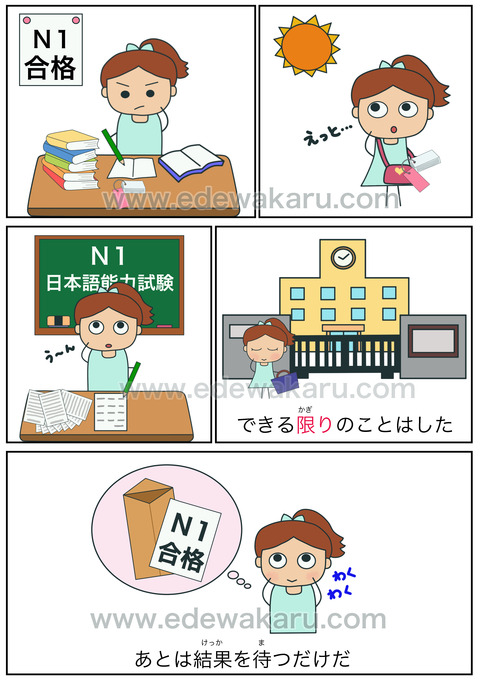
Meaning
〜の限界まで
〜のすべてを使って〜
How to use it
動詞[辞書形]+限り
動詞[可能形・可能動詞]+限り
名詞[辞書形]+の限り
Explanation
「〜限り」は[限界]を表す文型で「〜の限界まで」「〜のすべてを使って〜」という意味で使用されます。この文型は「A限りB」の形で、
「A」を限界いっぱいまで使って「B」をする
と言いたい時に使います😊「〜限り」には慣用表現(かんようひょうげん)がいくつかあります。
[「〜限り」を使った慣用表現]
・
力の限り
→能力・体力を全部使う
・
命の限り
→力を全部使う
・
贅沢の限りを尽くす
→最高に贅沢にする
・
見渡す限り
→見渡せるすべての範囲
「限り」がつく文型はたくさんありますので、しっかりと区別をして覚えておきましょう😉
【「限る」シリーズ】
〜限り(限界)
〜限り
〜限りだ
〜限りで・N限りのN(限定)
〜限りでは(範囲)
限りなく〜に近い
〜とは限らない
〜ない限り
〜に限ったことではない
〜に限らず(〜も)
〜に限る
〜を限りに
In context 5 examples
できる限りのことはした。あとは結果を待つだけだ
→自分ができることはすべてした。あとは結果を待つだけだ彼女は声の限り「助けて〜!」と叫んだ
→彼女はとても大きな声で「助けて〜!」と叫んだ彼は、持てる限りの荷物を持ってくれた
→彼は、持てる限界までの荷物を持ってくれた明日の試合は命の限り戦うぞ!
→明日の試合は、力を出し切って戦うぞ(復習:〜きる)見渡す限りの星空が広がっている
→見渡す範囲すべてに星空が広がっている(復習:〜ている(結果の状態))
Usage 2
Read this source entry ↗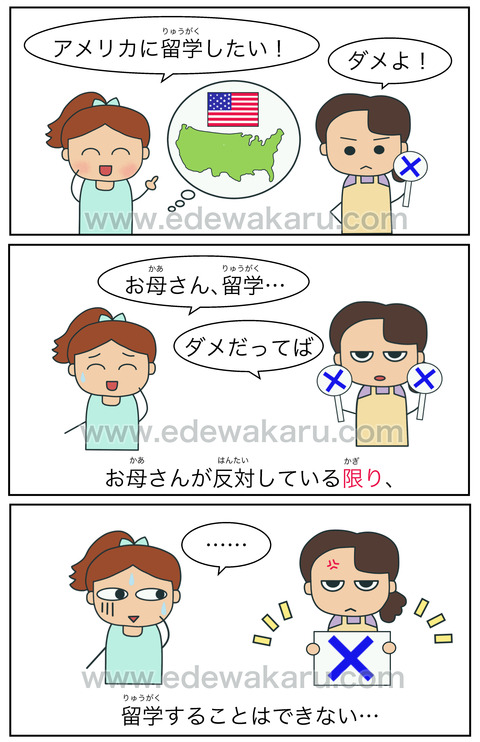
Meaning
〜する間はずっと〜
〜の状態が続く間はずっと〜
〜の状態が続く間は絶対に〜
How to use it
動詞[辞書形・ている形]+限り
い形容詞[ーい]+限り
な形容詞[ーな・である]+限り
名詞[辞書形]+である限り
Explanation
「〜限り」は「〜の状態が続く間はずっと〜」「〜の状態が続く間は絶対に〜」という意味を表す文型です。「A限りB」の形で、「Aの条件ではBだ」と言いたい時に使われます。この文型には、
「Aの条件が変わるとBの状態も変わるかもしれない」
という意味を込めて使われます😮
(復習:〜を込めて・〜を込めた)
[例]
お母さんが反対している
限り、留学することができない
【A】お母さんが反対している
【B】留学するとができない
→
お母さんが「賛成」したら、留学できるかもしれない
「〜限り」は
「〜ない限り」
と一緒に覚えておきましょう😀
(復習:〜ない限り)
【「限る」シリーズ】
〜限り(限界)
〜限り
〜限りだ
〜限りで・N限りのN(限定)
〜限りでは(範囲)
限りなく〜に近い
〜とは限らない
〜ない限り
〜に限ったことではない
〜に限らず(〜も)
〜に限る
〜を限りに
In context 5 examples
お母さんが反対している限り、留学することができない
→お母さんが反対している間は絶対に留学することができない(復習:〜ている(結果の状態))タバコを吸い続ける限り、病気は治らないよ
→タバコを吸い続ける間は、ずっと病気は治らないよ元気な限り、仕事を続けたい
→元気でいる間は、ずっと仕事を続けたい学生である限り、しっかり勉強しなければいけない
→学生でいる間はずっと、しっかり勉強しなければいけないここにいる限り安全だよ
→ここにいる間は、ずっと安全だよ
日本語文型辞典
Meaning
a. かぎりが ある/ない
時間・空間やものごとの程度・数量などの限界や限度があるという意味を表す。②④は名詞を修飾するときの形で、慣用句。「限りのある/ない」とも言う。⑤「数限りない」も慣用句で名詞を修飾し、数えられるものの場合に用いて、その数がとても多いことを表す。「数限りなく」の形でも用いられる。
b. かぎりなくNにちかい
名詞が表すものとひじょうに近い、ほとんど同じ、という意味を表す。
a. Nかぎり
時間・回数・空間を表す名詞に付いて、それが限度であることを表す。空間の場合は「この場/その場/あの場」の表現しか用いられない。①は「今年までで」、④は「その場だけの」の意味。
b. …かぎり
「最高限度・極限まで」、「すべて」の意味。名詞に付く①から③は「力の限り」「命の限り」「ぜいたくの限り」で医用句。⑥は「見覆す限り」で「見渡せるすべての範囲」の意味の慣用句。動詞の場合は可能を表す「V-れる」に付くことが多い。
a. V-る/V-ている/V-た かぎり
「見る・聞く・調べる」などの認識を表す動詞に付く。「自分の知識・経験の範囲内で判断すれば」という意味。「かぎりで」、「かぎりでは」と言うこともある。
b. V-る/V-ている かぎり
「その状態が続いているあいだは」という意味で、条件の範囲を述べるのに用いる。後ろにはその条件で成り立つ状態を述べる表現が続く。もしその条件が変化したら、そこで成り立つ状態も変化する可能性があるということを含意する。
c. V-ないかぎり
「そのことがらが起こらないあいだは」という意味で、条件の範囲を述べるのに用いる。後ろにはその条件で成り立つ状態を述べる表現が続く。もしその条件が変化したら、そこで成り立つ状態も変化する可能性があるということを合意する。
How to use it
かぎリ
…かぎり【限度】
Nのかぎり
V-るかぎり
かぎり【範囲】
In context 31 examples
資源には限りがある。無駄遣いしてはいけない。
限りある資源を大切にしよう。
宇宙の広がりには限りがないように思える。それが魅力だ。
宇宙には限りない魅力がある。
ワープロには数限りない機種があるため、どれを選んだらいいのか、選択に困る。
その着物は限りなく白に近い紫だった。
その真珠のネックレスは限りなく本物に近い偽物で、見ただけでは偽物であることがわからない。
キムさんの日本語の発音は限りなく日本人に近いが、注意して聞くとやはり韓国語の影響が残っている。
彼女は今年限りで定年退職することになっている。
その演劇の公演は、今週限りで打ち切られる。
勝負は1回限りだ。たとえ負けても文句は言うな。
あの人はその場限りの思いつきの意見しか言わない人だ。
今の話はこの場限りで忘れてください。
力の限り戦ったのだから負けても悔いはない。
選手たちは優勝をかけて命の限り戦ったが、惜しくも敗れてしまった。
あの大統領は、権力の絶頂にあった頃ぜいたくの限りを厚くしていたそうだ。
難民たちは持てる限りの荷物を持って逃げてきた。
できる限りの努力はした。あとは結果を待つだけだ。
そこは見渡す限り(の)桜の花だった。
私の知る限り、彼は絶対そんなことをするような人ではない。
私が聞いている限りでは、全員時間どおりに到着するということだが。
私の見た限りで「樹神(こたま)」という姓の人は、電話帳に2軒しか載っていなかった。
この植物は、私が今まで調べた限りでは、まだ日本では発見されていないようだ。
この山小屋にいる限りは安全だろう。
プロである限り、その大会への出場資格はない。
あいつが意地を張っている限りは、絶対にこっちも頭を下げないつもりだ。
A:英会話なんか、ちょっと本気でやりさえすればすぐに上達するさ。
B:おまえ、そんなこと言ってる限り、いつまでたってもうまくならないぞ。練習しない限り、上達もありえない。
あいつが謝ってこない限り、こっちも折れるつもりはない。
絶対にやめようと自分で決心しない限り、いつまでたっても禁煙なんかできないだろう。
今の法律が変わらない限り、結婚したら夫婦はどちらか一方の姓を名乗らなければならない。
毎日のんびり日本語教師
Usage 1
Read this source entry ↗How to use it
動辞形+限り/限りで/限りでは/限りだと
動ている形+限り/限りで/限りでは/限りだと
動た形+限り/限りで/限りでは/限りだと
Explanation
「見る」「聞く」「調べる」「知る」等の知覚的な動詞に接続し、自分が知っている情報の範囲内を表します。
後項では自分が知っている情報に基づいた判断が述べられますが、その範囲外については何も知らないということも暗示します。
Notes
「限る」シリーズ
In context 8 examples
予告編を見る限りでは、なかなか面白そうな映画だ。
メニューを見た限りでは美味しそうだったが、実際はそうでもなかった。
話を聞いた限りだと、相手の方に非があると思う。
医者から聞いている限りでは、糖尿病で間違いないらしい。
私が調べた限りでは、見つかりませんでした。
私の知る限り、知り合いに育休を取った男性は一人もいない。
知っている限りのことを教えます。(我会告诉你我所知道的一切。)
人の死は、私の知っている限り避けられないことである。
Usage 2
Read this source entry ↗How to use it
動辞形+限り(は)
動ている形+限り(は)
イ形容詞+限り(は)
ナ形容詞語幹+な/である+限り(は)
名詞+の/である+限り(は)
動ない形+ない限り(は)
Explanation
ある状態が継続している期間を表します。
前項で述べる状態が継続している間は後項が成り立ちます。前項が成り立たなければ、後項は必ずしも必要ではありません。
Notes
「限る」シリーズ
In context 10 examples
ここに居る限り、台風にも地震にも脅かされることはないだろう。
生きている限り、必ず希望は訪れる。
男である限り、”性欲”という呪縛からは逃れられない。
たとえ親でも教師でも、人間である限り、その行いが絶対に正しいとは限らない。
上層部が無能な限り、この会社は何も変わらない。
何か特別な理由等がない限りは、決して休んではいけません。
相手から連絡がない限り、私から連絡することはない。
強い確信がない限り、彼を変に疑うようなことはいえない。
よほどのことがない限り、行けたら行く。
この問題を解決しない限り、先には進めない。
Usage 3
Read this source entry ↗How to use it
動辞形+限り
動可能形+限り
名詞+の限り
Explanation
全力で物事を行うことを表します。
「声を限りに/声の限り(に)」「力を限りに/力の限り(に)」などの慣用的な表現もあります。
Notes
「限る」シリーズ
In context 5 examples
君にはできる限り協力したいと思っている。(我想竭尽全力协助你。)
自由を得るためなら、命の限り戦う。(为了获得自由拼命苦战。)
もし次チャンスがあるなら、持てる限りの力で挑みたい。
今やるべきこと、思いつく限りのことをノートに書き出した。
やれる限りのことはやった。あとは結果を待つだけだ。