Bunpro Grammar Reference
Meaning
To emphasize '~only', Nothing but
How to use it
Noun + だけしか + ない
Noun + だけしか + ありません
Nuance
A strong expression highlighting that only (A) and nothing but (A) exists. Sometimes with the nuance of pity.
Explanation
だけしか is a combination of two adverbial particles, だけ 'only', and しか 'nothing but'. This structure primarily follows nouns, before part (B) of the sentence will have a corresponding ない based word.
彼は野菜だけしか食べられません。
He can only eat vegetables.
土曜日だけしか空いてる日がないから、出来たら土曜日がいい。
I have no days except for Saturdays that are free, so if possible, it would be better if it was a Saturday.
この中ではタケシだけしか下手じゃない。他はみんな結構うまい。
In this group, Takeshi is the only one that isn't good. Everyone else is considerably skilled.
何でこのコップだけしか500円ではないの?
Why is this cup the only one that is not 500yen?
Despite all of these possibilities, it should be noted that だけしか~ない is an expression that appears with negative verbs, far more than any of the other combinations.
私は日本語だけしか話せないです。
I can only speak Japanese.
Fun Fact
だけしか may appear as though it is saying 'only' twice, but each particle has its own specific nuance. These nuances are as follows:
だけ - Removes one thing (from within a group), and presents it as the 'only' thing that fits a certain criteria.
しか - Highlights something that exists by itself as not having any alternatives.
Due to this, each meaning compounds together, with だけ saying 'just this', while しか adds 'and only this!'. Reversing the order and putting しか before だけ would not work, as the sequence of selection needs to be logical.
日曜日しかだけ休みが取れない。
I can take only breaks on Sunday. (Unnatural Japanese)
日曜日だけしか休みが取れない。
I can only take breaks on Sunday. (Natural Japanese)
Nuance · 日本語
(A)以外のものは存在していないということを強調する表現。時には哀れみのニュアンスを込めて使われることもある。
Explanation · 日本語
「だけしか」は、「だけ」と「しか」という二つの副助詞を合わせた文法です。主に名詞のあとで使われます。文の後半 (B) には、否定文が続きます。
彼は野菜だけしか食べられません。
He can only eat vegetables.
土曜日だけしか空いてる日がないから、出来たら土曜日がいい。
I have no days except for Saturdays that are free, so if possible, it would be better if it was a Saturday.
この中ではタケシだけしか下手じゃない。他はみんな結構うまい。
In this group, Takeshi is the only one that isn't good. Everyone else is considerably skilled.
何でこのコップだけしか500円ではないの?
Why is this cup the only one that is not 500yen?
この文法の使い方はいくつかありますが、ほとんどの場合は、「だけしか〜ない」の形で、動詞などの否定形に付いて使われます。
私は日本語だけしか話せないです。
I can only speak Japanese.
豆知識
「だけしか」は、限定を表す助詞をただ二回繰り返したように見えるかもしれません。しかし、それぞれの助詞が持つニュアンスは異なります。
だけ - いくつかある中から、一つだけ取り出して、それが唯一のものだと示す。
しか - それだけが存在していて、ほかに代わりはないことを表す。
そのため、この二つが合わさると、「それが唯一で、それ以外にはない」という限定の意味がより強くなります。「だけしか」はまず唯一のものを挙げてから、それ以外にないことを表すので、順番を変えて「しかだけ」と言うことはできません。
日曜日しかだけ休みが取れない。
I can take only breaks on Sunday. (Unnatural Japanese)
日曜日だけしか休みが取れない。
I can only take breaks on Sunday. (Natural Japanese)
In context 19 examples
- この時間、医師は一人だけしかいません。
At this time of day, there is only one doctor present.
- 彼は野菜だけしか食べられません。
He can only eat vegetables.
- 土曜日だけしか空いてる日がないから、出来たら土曜日がいい。
I have no days except for Saturdays that are free, so if possible, it would be better if it was a Saturday.
- この中ではタケシだけしか下手じゃない。他はみんな結構うまい。
In this group, Takeshi is the only one that isn't good. Everyone else is considerably skilled.
- 何でこのコップだけしか500円ではないの?
Why is this cup the only one that is not 500yen?
- 私は日本語だけしか話せないです。
I can only speak Japanese.
- 椅子はここにあるものだけしかありません。
The chairs here are the only chairs.
- 私には従兄弟が一人だけしかいません。
I only have one cousin.
- 僕は日本語だけしかできません。
I can only speak Japanese.
- 現金は今1000円だけしかありません。
I only have 1000 yen in cash.
- 少しだけしかありませんが、お菓子を食べませんか?
I only have a few, but would you like some snacks?
- 風の音だけしか聞こえません。
I can't hear anything but the sound of the wind.
- あの先生は人の表面だけしか見ない人だ。
That teacher is a person who only judges people by their outward appearance.
- 命は一人に一つだけしかありません。
Each person has but only one life.
- せっかく並んだのに、欲しいものはこれだけしか買えませんでした。
Even though I went through all the trouble of getting in line, these are the only things I could buy out of what I wanted.
- ミシェル:「一度だけしか言わないので、ちゃんと聞いてください。」
Michelle: 'Listen very carefully, I will only say this once.'
- 握手会に行ったのに、声優の後ろ姿だけしか見えませんでした。
Although I went to a handshake event, I saw nothing but the voice actress' back.
- 日曜日しかだけ休みが取れない。
I can take only breaks on Sunday. (Unnatural Japanese)
- 日曜日だけしか休みが取れない。
I can only take breaks on Sunday. (Natural Japanese)
絵でわかる日本語
Meaning
〜しかない
How to use it
名詞[辞書形]+だけしか〜ない
数量詞+だけしか〜ない
Explanation
「〜だけしか〜ない」は「〜しかない」を強調した文型です。数が少ないことを不満に思ったり、残念に思う気持ちを表す場合に使われます。
[例]
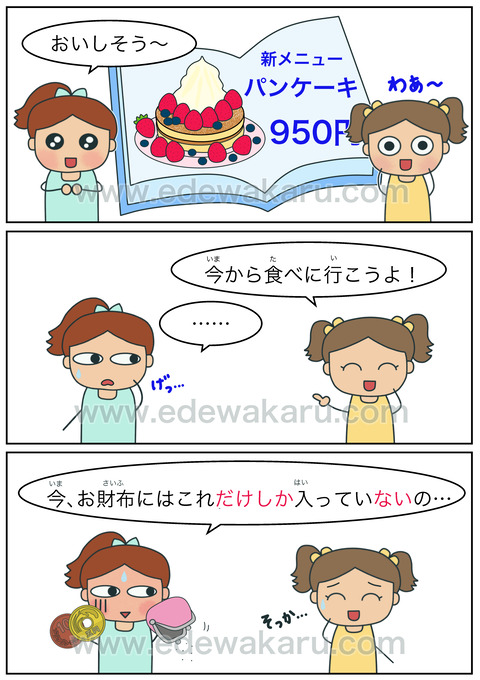
①今、お財布にはこれ
だけしか
入ってい
ない
の…
→入っているお金が少なくて残念だと思う気持ち
②あの店のカレーは辛すぎて、1口
だけしか
食べられ
なかった
→全部食べたかったが、1口しか食べられなくて残念だったという気持ち
③昨日は2時間
だけしか
寝られ
なかった
んだ
→2時間しか眠れなかったと不満に思っている気持ち
④1個
だけしかない
よ〜
→3個ではなく1個しかなくて残念だと思う気持ち
⑤残業で、見たかったドラマは半分
だけしか
見られ
なかった
→全部見たかったが、半分しか見られなくて残念だという気持ち
「だけ」がつく文型はたくさんありますので、復習をしておきましょう😊
In context 5 examples
A:ケーキを食べに行こうよ!B:ごめん…今、お財布にはこれだけしか入っていないの…
あの店のカレーは辛すぎて、1口だけしか食べられなかった
A:眠そうだねB:昨日は2時間だけしか寝られなかったんだ
母:冷蔵庫からたまごを3個出してくれる?娘:1個だけしかないよ〜
残業で、見たかったドラマは半分だけしか見られなかった