くらべてわかる日本語表現文型辞典
Meaning
Aをしようと思うが、心理的にどうしても出来ない。
How to use it
A₁にA₂ない
[動詞-る形]に[動詞-可能]ない
Explanation
【対比1】
「A₁たくてもA₂ない」(意味1 P.113)
「A₁たくてもA₂ない」は、希望しているができないという意味。「A₁にA₂ない」は、希望しているが心理的にできないという意味。したがって、「A₁にA₂ない」から「A₁たくてもA₂ない」への置き換えは可能だが、逆はできないものもある。
○停電しているので好きな番組が見たくても見られない。
×停電しているので好きな番組が見るに見られない。
「AとしてもB(A₁ようとしてもA₂ない)」(意味5 P.179)
「A₁ようにもA₂ない」(意味1 P.322)
Notes
【注意1】
・慣用的に使うこともある。
○ボーナスを全額、盗られちゃったのだから、泣くに泣けない。
○怒るに怒れない ○笑うに笑えない ○言うに言えない
In context 4 examples
犯人が拳銃を持っていたから、逃げるに逃げられなかったんだ。
退社時間を過ぎても上司が仕事をしていたら、帰るに帰れない。
こんな点数じゃ、見せるに見せられないじゃないか。
人から土産にもらう飾り物は、捨てるに捨てられなくて困ってしまう。
絵でわかる日本語
Usage 1
Read this source entry ↗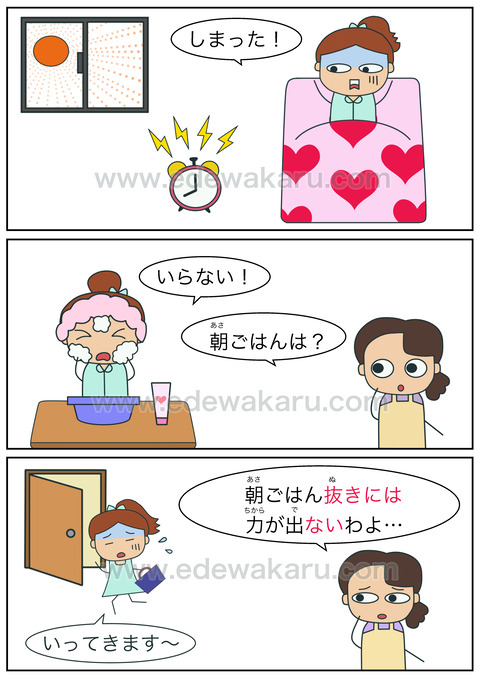
Meaning
〜なければ〜ない
〜を考えなければ〜ない
〜を入れないでは〜ない
How to use it
名詞[辞書形]+抜きには〜ない
名詞[辞書形]+抜きでは〜ない
名詞[辞書形]+抜きにしては〜ない
Explanation
「A抜きにBない」は「AがなければBはない」「Aを考えなければBはない」という意味を表す文型です。「AがなければBは不可能だ」というのを強調したい時に使われます。「B」には「〜ない」「〜できない」「〜得ない」など、
否定形・否定表現(ひていひょうげん)
がきます。 また「〜抜きに〜ない」は「〜抜きでは〜ない」「〜を抜きにしては〜ない」にチェンジすることができます😊
[例]
朝ごはん
抜きには
力が出
ない
わよ!
=朝ごはん
抜きでは
力が出
ない
わよ!
=朝ごはん
抜きにしては
力が出
ない
わよ!
「抜く・抜き」がつく文型はいくつかあります。混乱しないように、区別して覚えておくといいと思います。
【関連文型】
In context 6 examples
娘:遅刻しそうだから、ごはんいらない母:朝ごはん抜きには力が出ないわよ…
→朝ごはんを食べなければ、力が出ないわよ…彼女の活躍抜きには、チームは優勝しなかっただろう
→彼女の活躍がなければ、チームは優勝しなかっただろう両親の協力抜きには留学できなかったと思う
→両親の協力がなければ留学できなかったと思うこれは重大なことなので、社長の意見抜きには決めかねる
→社長の意見がなければ決めかねる先生のご指導抜きには、N1には合格できませんでした
→先生のご指導がなければ、N1には合格できませんでした寿司抜きには、日本料理を語れない
→寿司を入れなければ、日本料理は語れない
Usage 2
Read this source entry ↗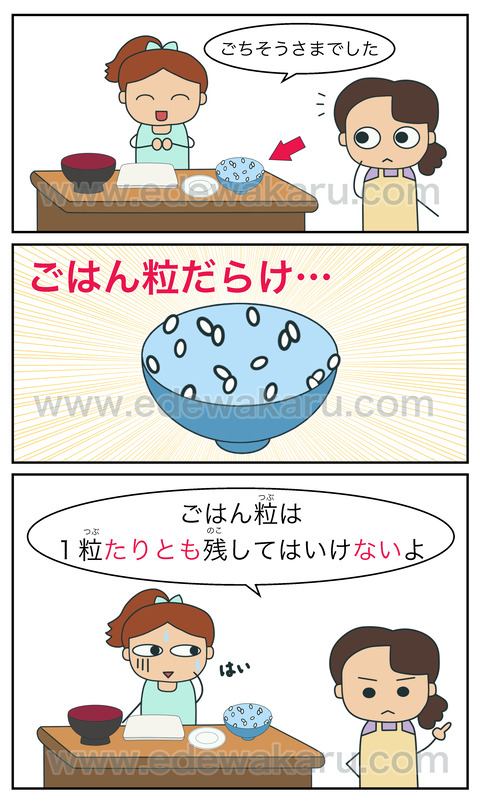
Meaning
1〜も〜ない
〜であっても、絶対に〜ない
How to use it
1+助数詞+たりとも〜ない
名詞[辞書形]+たりとも〜ない
Explanation
「1〜たりとも〜ない」は「1〜も〜ない」という意味を表す文型です。「1〜も〜ない」を強調して言いたい時に使われますが、かたい言い方ですので、あまり会話では使われません😅日常会話では「1〜も〜ない」を使うのが一般的です。
ほとんどの場合は「1〜たりとも〜ない」というように「1」と一緒に使われます。
後ろには「〜するな」「〜てはいけない」など、禁止・命令などの表現がよくきます😀
【上級レベルの人へ】
「何人たりとも」は慣用表現です。とてもかたい表現ですから、普段の会話では使うと不自然に聞こえますので、聞いてわかればOKです😉
「何人たりとも」→誰でも例外なく
書き言葉的な表現ですが、N1を受ける人はしっかりと覚えておきましょう😊
In context 3 examples
ごはん粒は1粒たりとも残してはいけないよ!
→ごはん粒は1粒も残してはいけないよ!明日は試験だ。1日たりとも無駄にはできない
→明日は試験だ。1日も無駄にはできない試合中は1分たりとも油断するな!
→試合中は1分も油断するな!
Usage 3
Read this source entry ↗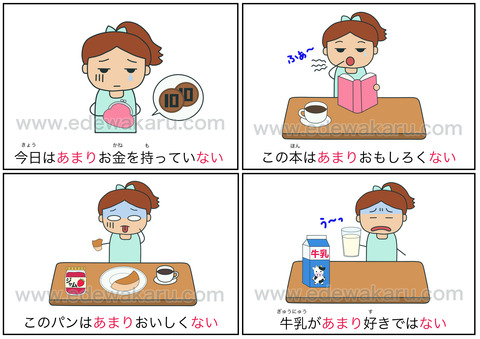
Meaning
程度が高くない
頻度が高くない
量が多くない
How to use it
あまり+動詞[ない形]
あまり+い形容詞[ーくない]
あまり+な形容詞[ーではない]
Explanation
「あまり〜ない」は「程度や頻度が高くない」「量が多くない」という意味を表す文型です。後ろには
否定形
がきます。形容詞に使う場合は「程度が高くない」という意味で、動詞に使うと「程度が高くない・量が多くない」という意味になります😮
[例]
①今日は
あまり
お金を持ってい
ない
→持っているお金の
量が多くない
【「持つ」は動詞】
②この本は
あまり
おもしろく
ない
→「おもしろい」の
程度が高くない
【「おもしろい」は形容詞】
③このパンは
あまり
おいしく
ない
→「おいしい」の
程度が高くない
【「おいしい」は形容詞】
④牛乳が
あまり
好きでは
ない
→「好き」の程度が高くない
【「好き」は形容詞】
⑤最近忙しいので、
あまり
テレビを
見なくなった
→テレビを見る
頻度が高くない
【「見る」は動詞】
⑥このカレーは
あまり
辛く
ない
→「辛い」の
程度が高くない
【「辛い」は形容詞】
⑦お酒が
あまり
飲め
ない
→飲める
量が多くない
【「飲む」は動詞】
「あまり〜ない」はN5の文型ですが、日常会話(にちじょうかいわ)でも、とてもよく使われます😊N2の文型「〜あまり」とは区別して覚えておきましょう。
(復習:〜あまり)
In context 7 examples
今日はあまりお金を持っていない(復習:〜ている(結果の状態))
この本はあまりおもしろくない
このパンはあまりおいしくない
牛乳があまり好きではない
最近忙しいので、あまりテレビを見なくなった
このカレーはあまり辛くない
お酒があまり飲めない
Usage 4
Read this source entry ↗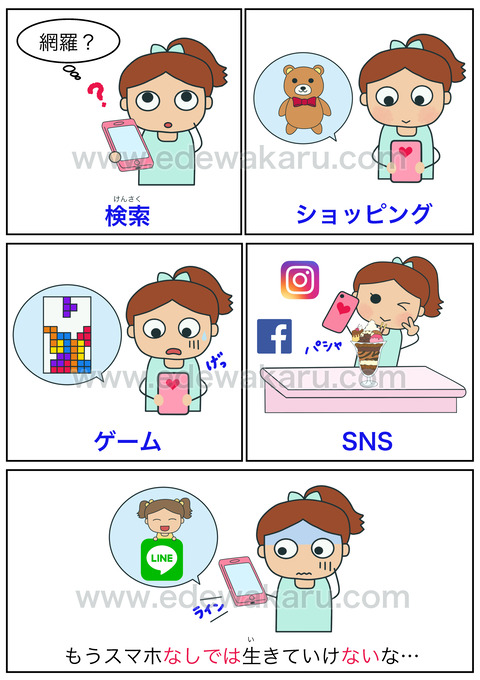
Meaning
〜がなかったら、〜できない
〜がない状態では、〜することができない
How to use it
名詞[辞書形]+なしでは〜ない
名詞[辞書形]+なしには〜ない
Explanation
「AなしではBない・AなしにはBない」は「AがなかったらBできない」「Aがない状態ではBすることができない」という意味の文型です。
「Aがどうしても必要だ」
ということを強調したい時に使われます。【B】には「〜ない」「〜できない」など、否定形が入ります。
「〜なしでは〜ない」は「〜なしには〜ない」にチェンジすることができます。
また、
【A】に人が入る場合は「Aがいなくては〜ない」「Aがいなければ〜ない」という形もあります。
[例]
社長
なしでは
会議を始められ
ない
=社長
なしには
会議を始められ
ない
=社長
がいなくては
会議を始められ
ない
=社長
がいなければ
会議を始められ
ない
N1に「〜なしに」「〜なくしては〜ない」という文型もありますので、一緒に覚えておきましょう😊
In context 5 examples
もうスマホなしでは生きていけないな…
→もうスマホがなかったら、生きていけないな…辞書なしでは、英語の本が読めない
→辞書がなかったら、英語の本が読めない彼なしではチームは優勝できなかった
→彼がいなかったら、チームは優勝できなかった社長なしでは会議が始められない
→社長がいなかったら、会議が始められない両親の援助なしでは留学することはできなかっただろう
→両親の援助がなかったら、留学することはできなかっただろう
Usage 5
Read this source entry ↗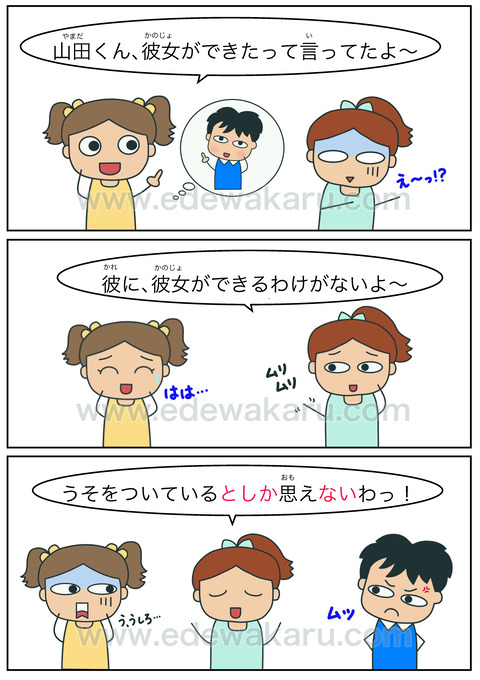
Meaning
絶対に〜だ
〜だけだ
How to use it
動詞・形容詞・名詞[普通形]+としか〜ない
Explanation
「AとしかBない」は[強調]を表す文型で、「絶対にAだ」「ただAだけだ」という意味です。他の可能性はなく、「絶対にAだ」と強く主張する場合に使われます。「B」には「言う」「思う」「考える」などの
[可能形]の否定形
が入り、「言えない」「思えない」「考えられない」となります。
「〜としか〜ない」は、会話でもよく使われますので覚えておきましょう😉
In context 5 examples
A:山田くん、彼女ができたって言ってたよ〜B:彼に彼女ができるわけないよ!うそをついているとしか思えないわ
→絶対にうそをついていると思うわA:こんな時間になっても彼女から連絡がこないなんておかしいねB:うん。事故にでもあったとしか思えないね…
→きっと事故にでもあったんだわA:明日のイベントは行われますか?B:今のところ、わからないとしか言えませんね
→わからないと答えられるだけですA:彼、今回のテスト100点だったんだって!B:え!?カンニングしたとしか考えられない!!
→絶対にカンニングしたんだと思う!!床に足跡がついている…泥棒が入ったとしか考えられない
→絶対に泥棒が入ったんだと思う
Usage 6
Read this source entry ↗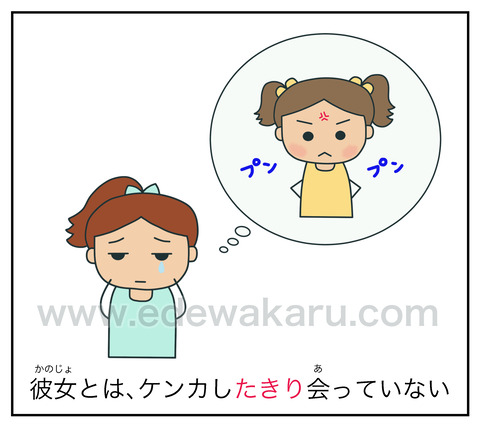
Meaning
〜したのが最後で、その後ずっと…ない
How to use it
動詞[た形]+きり〜ない
Explanation
「〜たり…ない」は「〜したのが最後で、その後ずっと…ない」という意味を表す文型です。この文型はほとんどの場合、
話者の不安な気持ちや残念だと思う気持ち、心配しているようすを強調したい時に使われます
😀
【余裕がある人へ】
「〜たきり…ない」を使う時に
「〜たっきり…ない」
というように「っ」を入れる人もいますが、意味は同じです😊
[例]
彼女とは、ケンカをし
たっきり
会ってい
ない
また、「これっきり」「それっきり」「あれっきり」という言い方もあるというのを覚えておきましょう😀
[例]
日本には5年前に旅行に行きましたが、
それっきり
行っていません
会話でもよく使う文型ですのでしっかりと覚えておきましょう😉
In context 3 examples
彼女とは、ケンカしたきり会っていない
→彼女とは、ケンカしたのが最後で、その後ずっと会っていない娘はアメリカに行ったきり帰ってこない
→娘はアメリカに行ったのが最後で、その後帰ってこない日本には5年前に旅行に行ったきり行っていない
→日本には5年前に旅行に行ったのが最後で、その後ずっと行っていない
Usage 7
Read this source entry ↗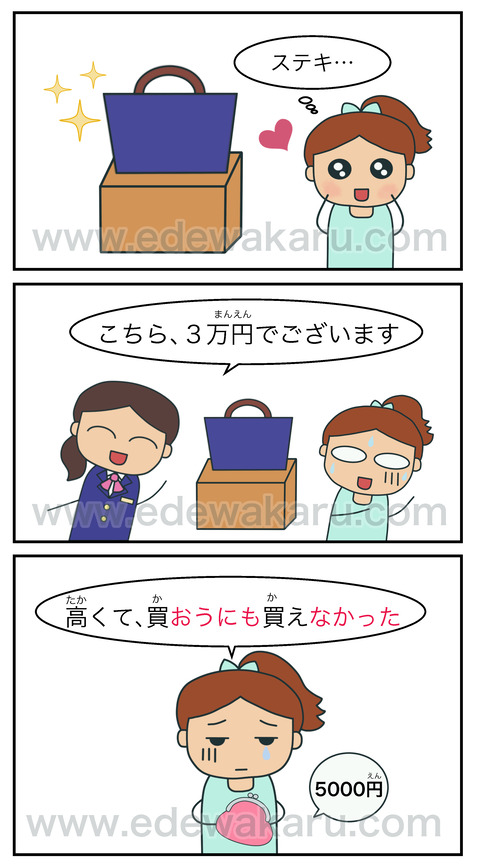
Meaning
〜しようと思っても〜できない
How to use it
動詞[意向形]+にも〜ない
Explanation
「〜ようにも〜ない」は「〜しようと思っても〜できない」という意味を表す文型です。どうしてもできない場合などに使います😊 後ろには「〜ない」がくる場合と「可能形の否定形」がくる場合があります😮
「可能形の否定形」がくる場合は同じ動詞を繰り返して使うと覚えておきましょう
😉
[「〜ない」がくる場合]
高くて、買
おうにも
お金が
ない
帰
ろうにも
電車が
ない
[「可能形の否定形」がくる場合]
高くて、買
おうにも
買え
ない
電車がなくて、帰
ろうにも
帰れない
In context 3 examples
高すぎて、買おうにも買えなかった
→高すぎて、買おうと思っても買えなかった買おうにもお金がなかったんです
→買おうと思っても、お金がなかったんです終電がなくなったので、帰ろうにも帰れない
→終電がなくなったので、帰ろうと思っても帰れない
Usage 8
Read this source entry ↗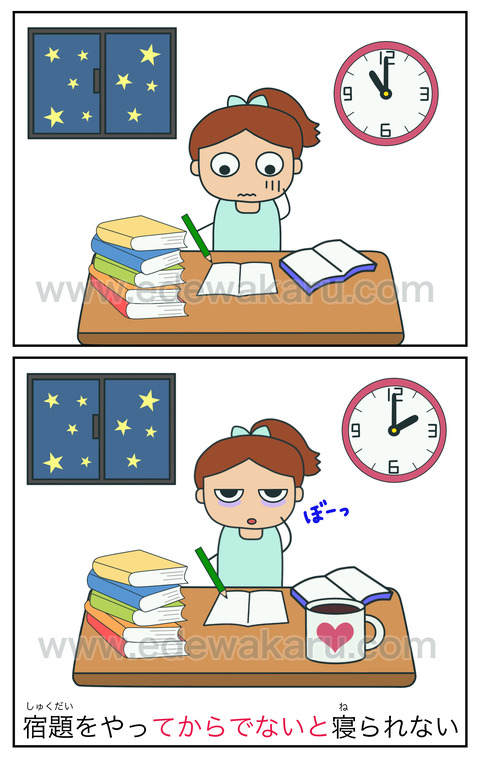
Meaning
〜た後でないと〜できない
How to use it
動詞[て形]+からでないと〜ない
Explanation
「〜てからでないと〜ない」は「〜た後でないと〜できない」という意味を表す文型です。「AてからでないとBない」の形で、
「A」をしないと、「B」をするのは不可能だ
と言いたい時に使います😊また「〜てからでないと〜ない」は「〜てからでなければ〜ない」「〜てからでなかったら〜ない」にもチェンジすることができます😮
[例]
宿題をやっ
てからでないと
寝られない
宿題をやっ
てからでなければ
寝られない
宿題をやっ
てからでなかったら
寝られない
「〜てからでないと〜ない」は会話でもよく使いますので、しっかりと覚えておきましょう😉
【「から」シリーズ】
〜から〜にかけて
〜からする・〜からある・〜からの
〜からといって・〜からって
〜からなる
〜からには
〜てからでないと〜ない
〜てからというもの
In context 4 examples
宿題をやってからでないと寝られない
→宿題をやった後でないと寝られない仕事が終わってからでないと帰れない
→仕事が終わった後でないと帰れないお母さんに相談してからでないと決められない
→お母さんに相談した後でないと決められない(復習:相談する・相談にのる)社長に聞いてからでないと答えられません
→社長に聞いた後でないと答えられません
Usage 9
Read this source entry ↗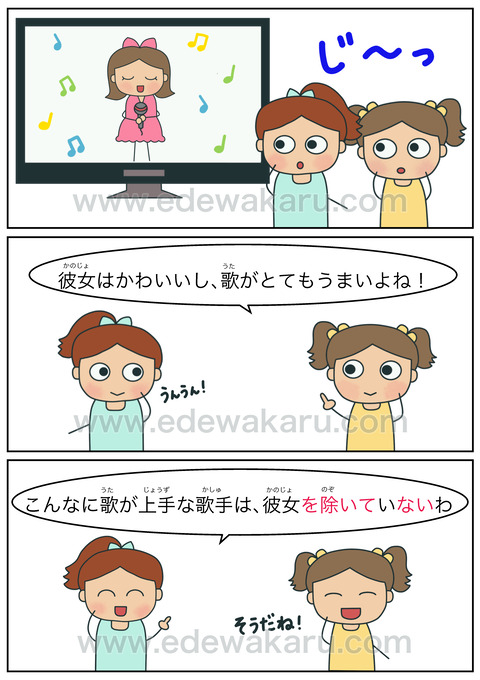
Meaning
〜以外に〜できる人はいない
〜以外に適当なものはない
How to use it
名詞[辞書形]+を除いて〜ない
In context 5 examples
A:彼女はかわいいし、歌がとてもうまいよね!B:うん!こんなに歌が上手な歌手は、彼女を除いていないわ
→彼女以外に歌が上手に歌える人はいない彼を除いて、あれほど勉強ができる人はいない
→彼以外に、あれほど勉強ができる人はいない田中さんを除いて、この仕事を任せられる人はいるまい…
→田中さん以外に、この仕事を任せられる人はいない彼女:この式場を除いて、結婚式をするのに最適な場所はないわ!彼氏:そうだね。じゃあ、ここに決めよう!
→この式場以外に、結婚式をするのに最適な場所はないわ!彼女:あなたを除いて頼める人はいなかったの彼氏:ほかならぬ君のためなら何でもするさ
→あなた以外に頼める人はいなかったの【説明】「Aを除いて〜ない」は「A以外に、〜できる人はいない」「A以外にふさわしいものはない」という意味の文型です。「A」を高く評価する文型で、「 A以外に適当な[人・もの・こと]はない」「Aのほかに、同じくらいすばらしい[人・もの・こと]はない」と言いたい時に使われます。「〜を除いて、ほかに〜ない」という形もよく使われます。[例]こんなに歌が上手な歌手は、彼女を除いていないわ=こんなに歌が上手な歌手は、彼女を除いてほかにいないわ類似文型に「〜をおいて」がありますので、一緒に覚えておきましょう。【関連文型】
Usage 10
Read this source entry ↗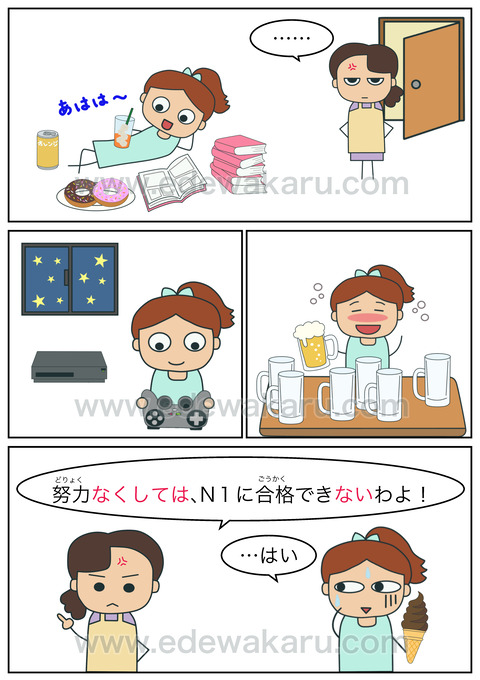
Meaning
〜がなければ〜ない
〜がなければ〜できない
How to use it
動詞[辞書形]+ことなくしては
名詞[辞書形]+なくしては
Explanation
「AなくしてはBない」は「AがなければBない」「AがなければBできない」という意味の文型です。これは「Aがなかったら、Bは成立しない」と言いたい時に使う文型で、「A」がとても重要だということを強調します。「〜なくしては」の「は」は、省略されることもあります。「A」に動詞が入る場合は
「V辞+ことなくしては〜ない」
になります。
[例]
努力する
ことなくしては、N1に合格できないわよ
「〜なくしては〜ない」は「〜なしでは〜ない・〜なしには〜ない」よりかたい言い方です。「〜なしでは〜ない・〜なしには〜ない」の復習をしておきましょう😊
In context 5 examples
努力なくしては、N1には合格できないわよ
→努力がなければ、N1には合格できないわよみんなの協力なくしては、成功できなかっただろう
→みんなの協力がなければ、成功はできなかっただろう親の援助なくしては大学には行けない
→親の援助がなければ大学には行けない話し合いなくしては、問題は解決しないと思います
→話し合いがなければ、問題は解決しないと思います彼なくしては、今回の試合には勝てなかっただろう
→彼がいなければ、今回の試合には勝てなかっただろう
Usage 11
Read this source entry ↗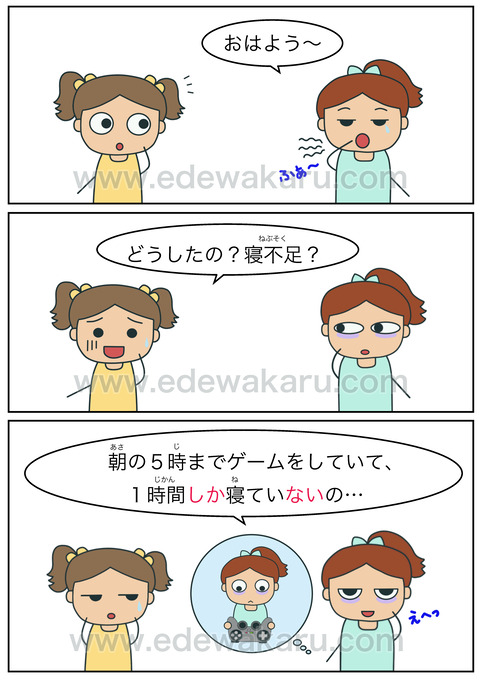
Meaning
〜以外は〜ない
〜以上は〜ない
How to use it
名詞[辞書形]+しか〜ない
Explanation
「AしかBない」は「A以外はBない」「A以上はBない」という意味の文型です。「B」には否定表現(ひていひょうげん)が入ります。
「〜だけしか〜ない」
は、さらに強調した言い方です。
[例]
朝はコーヒー
しか
飲ま
ない
→朝はコーヒー
だけしか
飲ま
ない
日本語
しか
話せ
ない
→日本語
だけしか
話せ
ない
「〜しか〜ない」は、会話でもよく使いますので復習をしておきましょう😉
【関連記事】
In context 6 examples
A:どうしたの?寝不足?B:朝の5時までゲームをしていて、1時間しか寝ていないの
→1時間以上寝ていないのA:今日の朝ごはんは何を食べたの?B:朝はコーヒーしか飲まないのA :え!?お腹が空かないの?
→コーヒー以外は飲まないのA:カラオケに行かない?B:ごめん、今100円しか持っていないの
→財布には100円以上入っていないのどが痛くて、水しか飲めない…
→水以外飲めない私は日本語しか話せません
→日本語以外話せません何か食べようと思ったが、冷蔵庫には水しか入っていなかった
→水以外入っていなかった
Usage 12
Read this source entry ↗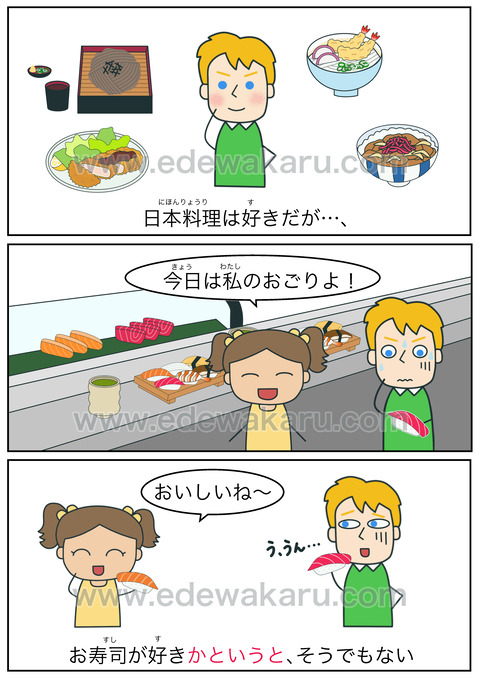
Meaning
実際は〜ではない
実は〜ではない
How to use it
動詞・形容詞・名詞[普通形]+かというと〜ない
動詞・形容詞・名詞[普通形]+かといえば〜ない
Explanation
「Aかというと〜ない」は「実際はAではない」「実はAではない」という意味の文型です。「〜だからAだと思うのが当然だが、実際はAではない」「普通に考えるとAだと思われがちだが、実はAではない」と言いたい時に使われます。
[例]
①日本料理が好きだが、寿司が好き
かというと、そうでもない
→日本料理が好きだから、お寿司も好きだと思われるのが当然だが、お寿司は好きではない
②高いものをプレゼントしたら彼女が喜ぶ
かというと、そうではないこともある
→高いものをプレゼントしたら彼女が喜ぶと思うのが普通だが、そうではないこともある
③お金持ちが幸せ
かというと、そういうわけでもなさそうだ
→普通に考えるとお金持ちは幸せだと思われがちだが、実際はそうではない
④歌がうまければ誰でも歌手になれる
かというと、そうとは限らない
→歌がうまければ歌手になれると思うのが普通だが、そうとは限らない
⑤仕事はとても大変だが、辞めたい
かというと、そんなことはない
→仕事が大変だと辞めたいと思っていると思われがちだが、そんなことはない
「〜かというと〜ない」は「〜とは限らない」「〜わけではない」「〜というものではない」などとよく使われますので、一緒に覚えておきましょう😉
【関連文型】
In context 5 examples
日本料理は好きだが、寿司が好きかというと、そうでもない
高いものをプレゼントしたら彼女が喜ぶかというと、そうではないこともある
お金持ちが幸せかというと、そういうわけでもなさそうだ
歌がうまければ誰でも歌手になれるかというと、そうとは限らない
仕事はとても大変だが、辞めたいかというと、そんなことはない
Usage 13
Read this source entry ↗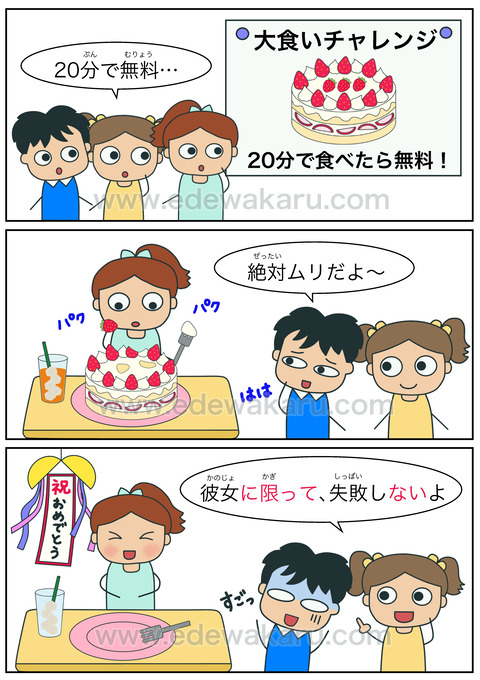
Meaning
〜だけは絶対〜ない
〜だけは〜ないと信じている
How to use it
名詞[辞書形]+に限って
Explanation
「〜に限って〜ない」は「〜だけは、絶対に〜ない」という意味を表す文型です。これは「〜だけは、絶対に〜ないから、悪い結果にはならない」という気持ちを込めて使われる文型です。
(復習:〜を込めて・〜を込めた)
「〜に限って」がつく文型は他にもありますので、復習をしておきましょう😀
【「限る」シリーズ】
〜限り(限界)
〜限り
〜限りだ
〜限りで・N限りのN(限定)
〜限りでは(範囲)
限りなく〜に近い
〜とは限らない
〜ない限り
〜に限ったことではない
〜に限って①(悪いことの発生)
〜に限って②(いつもと違う)
〜に限って〜ない
〜に限らず(〜も)
〜に限る
〜を限りに
In context 6 examples
彼女に限って失敗しないよ
→彼女だけは絶対に失敗しないよお母さんに限って、うそをつくはずがないよ
→お母さんだけは、絶対にうそをつくはずがないよ(復習:〜はずがない)あの子(こ)に限って、0点を取るはずがない
→あの子だけは、絶対に0点を取るはずがない口がかたい田中さんに限って、秘密を言ってしまうことはないと思うよ
→田中さんだけは、絶対に秘密を言ってしまうことはないよ(復習:口がかたい)(復習:〜ことはない②(全面否定))うちの娘に限って、そんな悪いことをするわけがありません
→うちの娘だけは、絶対にそんな悪いことをするわけがありません(復習:〜わけがない)彼に限って、ドタキャンするなんてありえないわ!
→彼だけは、絶対にドタキャンなんてしないと信じているわ!(復習:ドタキャン)(復習:〜など・〜なんか・〜なんて)(復習:〜得る・〜得ない)
Usage 14
Read this source entry ↗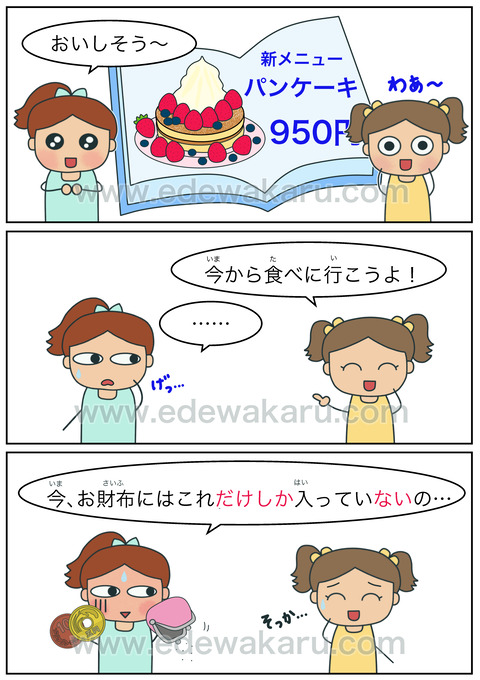
Meaning
〜しかない
How to use it
名詞[辞書形]+だけしか〜ない
数量詞+だけしか〜ない
Explanation
「〜だけしか〜ない」は「〜しかない」を強調した文型です。数が少ないことを不満に思ったり、残念に思う気持ちを表す場合に使われます。
[例]
①今、お財布にはこれ
だけしか
入ってい
ない
の…
→入っているお金が少なくて残念だと思う気持ち
②あの店のカレーは辛すぎて、1口
だけしか
食べられ
なかった
→全部食べたかったが、1口しか食べられなくて残念だったという気持ち
③昨日は2時間
だけしか
寝られ
なかった
んだ
→2時間しか眠れなかったと不満に思っている気持ち
④1個
だけしかない
よ〜
→3個ではなく1個しかなくて残念だと思う気持ち
⑤残業で、見たかったドラマは半分
だけしか
見られ
なかった
→全部見たかったが、半分しか見られなくて残念だという気持ち
「だけ」がつく文型はたくさんありますので、復習をしておきましょう😊
In context 5 examples
A:ケーキを食べに行こうよ!B:ごめん…今、お財布にはこれだけしか入っていないの…
あの店のカレーは辛すぎて、1口だけしか食べられなかった
A:眠そうだねB:昨日は2時間だけしか寝られなかったんだ
母:冷蔵庫からたまごを3個出してくれる?娘:1個だけしかないよ〜
残業で、見たかったドラマは半分だけしか見られなかった
Usage 15
Read this source entry ↗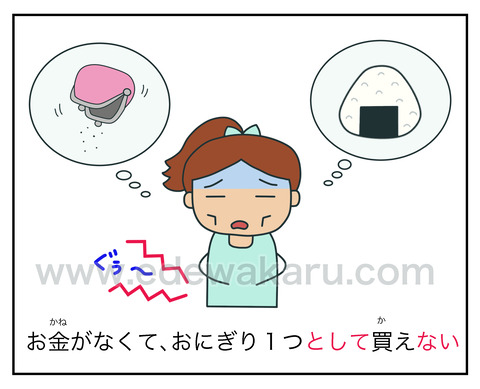
Meaning
1〜も〜ない
全然〜ない
How to use it
1+助数詞+として〜ない
Explanation
「1〜として…ない」は「1〜も…ない」というように「全然〜ない」というのを強調する文型です。「〜として」の部分は強調の「〜も」にチェンジができます。ですから、
「1〜も…ない=1〜も…ない」
と覚えてしまってOKです😉
1匹
として
釣れない→1匹
も
釣れない
1つ
として
買えない→1つ
も
買えない
1人
として
いない→1人
も
いない
【補足説明】
この文型はほとんどの場合「1」と一緒に使用されますが、
「誰一人として」「何一つとして」「どれ一つとして」
という慣用表現もあります😮また、これらの場合は
「として」を省略することもできます
😀
彼に賛成する人は
誰一人として
いなかった
彼に賛成する人は
誰一人
いなかった
彼に賛成する人は
誰も
いなかった
彼に賛成する人は
一人も
いなかった
上の例文は全て同じ意味です😄「〜として…ない」は書き言葉的ですので、会話では「1人も…ない」を使うのが一般的です😊
【余裕のある人へ】
「〜として…ない」は「1」と使う場合・慣用表現を使う以外に「2」が使われる場合もあります😮「1〜しかない」「他には〜ない」という意味を表す表現です。
こんなすばらしい作品はこの世に2つとしてない
→こんなすばらしい作品はこの世に1つしかない
彼ほどケチな人は2人としていないよ…
→あんなにケチな人は彼1人しかいないよ…
あまり聞きなれない文型かもしれませんが、N1の「〜たりとも…ない」の類似文型ですのでしっかりと覚えておきましょう😌「〜たりとも…ない」との違いはまた次回説明します😅
In context 4 examples
お金がなくて、おにぎり1つとして買えない
→お金がなくて、おにぎり1つも買えない1日中釣りをしているが、魚は1匹として釣れない
→1日中釣りをしているが、魚は1匹も釣れない明日は日本語能力試験だ。1分として無駄にはできない
→明日は日本語能力試験だ。1分も無駄にはできない4人も子供がいると、1日としてゆっくりできる日はない
→4人も子供がいると、1日もゆっくりできる日はない
Usage 18
Read this source entry ↗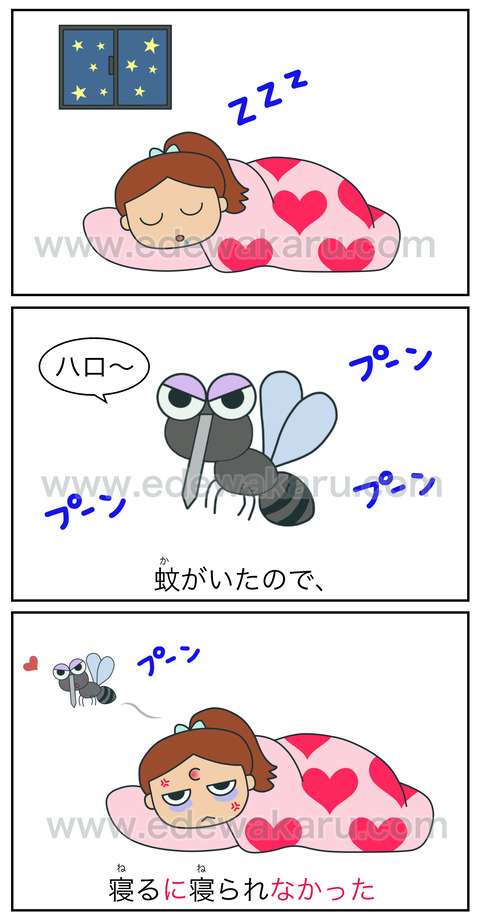
Meaning
〜たいのに〜できない
How to use it
動詞[辞書形]+に+動詞[可能否定形]
Explanation
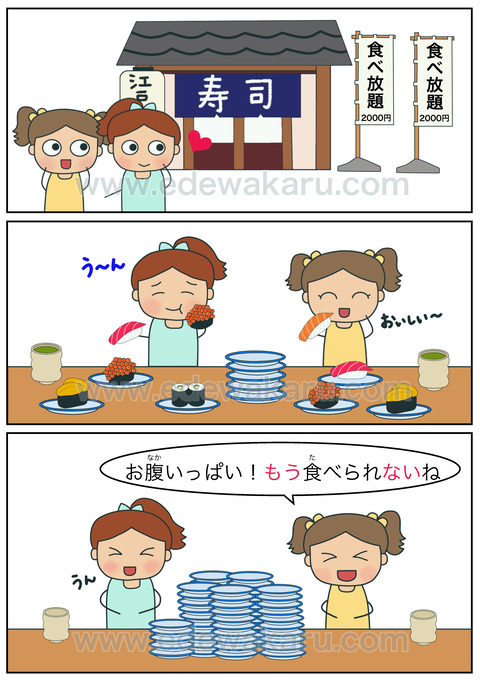
「〜に〜ない」は「〜たいのに〜できない」という意味を表す文型です。
この文型は「何か理由があって、〜たいのに〜できない」というように、理由があるからできないということを表します
😮後ろには可能否定形(かのうひていけい)がきて、同じ動詞を繰り返すと覚えておきましょう😀
[例]
寝る
に
寝られない
買う
に
買えない
また、この文型にはいくつか慣用表現(かんようひょうげん)がありますので暗記しておきましょう😉
[慣用表現]
・
泣くに泣けない
(なくになけない)
【意味】すごくつらい
・
言うに言えない
(いうにいえない)
【意味】言葉では表現できない
・
引くに引けない
(ひくにひけない)
【意味】今さら引き下がれない
似ている文型がいくつかありますが、「〜に〜ない」は「理由があって、〜たいのに〜できない」と覚えておくといいと思います。慣用表現は少し難しいですが、N1を受ける人は必ず覚えておきましょう😀
(復習:テストをするvsテストを受ける)
In context 4 examples
蚊がいたので寝るに寝られなかった
→蚊がいたので寝たいのに寝られなかったお金がないので、買うに買えなかった
→お金がないので、買いたいのに買えなかった上司が残業しているので、帰るに帰れなかった
→上司が残業しているので、帰りたいのに帰れなかったスマホをなくして、泣くに泣けない気持ちになった
→スマホをなくして、泣きたいくらいつらい気持ちになった
IMABI
Ichidan Verbs 一段活用動詞
Read this IMABI lesson ↗Explanation
Ichidan Verbs 一段活用動詞
Japanese verb classes differ in how they conjugate. More specifically, what defines a verb’s class is its bases. Endings themselves do not necessarily change based on verb class.
In this lesson, we will look at the ichidan verb class, commonly also known as “ru-verbs” given how all these verbs end in /ru/ in their basic form. This class constitutes roughly half of all verbs.
Before we get into new content, let’s recap important terminology.
Verb: A word that describes an action, state, or occurrence. It may constitute the predicate at the end of a sentence or be part of a noun-predicate when used as a participle/modifier.
Predicate: The part of a sentence that makes a statement about the subject.
Intransitive Verb: A verb that only takes a subject and does not take an object. Abbreviated in definitions as “intr.”
Transitive Verb: A verb that takes both a subject and an object. Abbreviated in definitions as “trans.”
Auxiliary: An ending that helps construct verbal conjugations.
Object: A noun that is directed by the main verb of the sentence.
Direct Object: A word that receives the action of the main verb of the sentence.
Case Particle: A particle that denotes a particular grammatical function/case.
Base: One of the six forms that a verb may take which is then followed by endings (auxiliaries, etc.).
Terminal/Predicative Form: Known in Japanese as the 終止形, it marks the end of a complete sentence/the predicate.
Attributive Form: Known in Japanese as the 連体形, it is used to make a verb, adjective, etc. into a modifier that goes directly before a noun.
Basic Form: The basic form of any given phrase. It is utilized in plain speech and in many grammatical circumstances. The basic form encompasses both the predicative and the attributive forms in the context of verbs and adjectives.
Continuative Form: Known in Japanese as the 連用形, it is used with endings pertaining to actions being carried out.
The Basic/Non-Past Form
一段活用動詞の基本形・非過去形
The plain1 non-past form requires no conjugation for verbs, but it does correspond to two conjugational bases: the predicative form (終止形) and the attributive form (連体形). While these forms are identical for Ichidan verbs, they refer to separate ways to use a verb. Collectively, they are referred to as the basic form (基本形).
MeaningBasic Form Meaning Basic Form
To see見るTo borrow借りる
To wear着るTo remember覚える
①To get up
②To happen 起きるTo exist (animate objects)いる
To eat食べるTo open (trans.)開ける
To answer答えるTo close (door, etc.)閉める
Whereas adjectives require context to be interpreted in the future tense, verbs are more likely to be interpreted either way (plain or future) in the non-past form. Furthermore, there are no morphological distinctions between the “present tense,” the “future tense,” and the “infinitive form2.” The infinitive form in English refers to the base form of a verb, and it is used in the chart above to define the Japanese verbs—marked by the use of “to.” This is often referred to as the “dictionary form” (辞書形) from a practical standpoint.
Various factors such as readily perceivable contexts, most likely topics (if not present already), or even the nature of the verb itself may result in some, all, or only one reasonable interpretation on the grounds of tense or whether the statement is just like the English indicative form.
1. 映画を見る。
i. (I) watch movies.
ii. (I) will watch (a) movie(s).
iii. To watch movies.
2. 浴衣を着る。
To wear a yukata.
3. 毎朝起きる。
i. (I) get up every morning.
ii. To get up every morning.
4. 鳥がいる。
There is a bird.
5. 毎日野菜を食べる。
i. To eat vegetables every day.
ii. (I) eat vegetables every day.
Exs. 1-5 are examples of the “predicative form” because the verb is the predicate, and it is at the end of the sentence. Meanwhile, Ex. 6 is an example of a verb being used in its attributive form, as the verb is before a noun to modify its meaning.
6. 食べる野菜
Vegetables that (I/one) eat(s)/will eat
The Polite Non-Past Form w/ ~ます
非過去の丁寧形 (~ます)
Conjugating verbs into polite speech involves the auxiliary verb ~ます. One way or another, it finds itself in every conjugation in all formal (polite, respectful, humble) speech registers. With the introduction of this ending, we must learn the verb base it attaches to as well as what bases of ~ます we need to make other conjugations in polite speech.
~ます attaches to the “continuative form” (連用形). As ~ます in its basic form is understood to be non-past, it fits this base’s definition of being matched with endings pertaining to actions being carried out. To form this base with Ichidan verbs, all you do is drop the final ~る, then you just add ~ます.
Meaning Basic Form Continuative Form +-~ます
To think考えるKangaeru → Kangae 考えます
To fall (intr.)落ちるOchiru → Ochi落ちます
To close up/shut閉じるTojiru → Toji閉じます
To lose負けるMakeru → Make負けます
To show見せるMiseru → Mise見せます
7. ドアを閉じます。
I’ll close the door.
8. ちょっと考えます。
I’ll think about it.
9. 教科書を借ります。
I’ll borrow the textbook.
Basic Form: Predicative vs. Attributive w/ ~ます
非過去形「~ます」の終止形・連体形との使い分け
Previously, we learned how です does not possess an attributive form, which prevents copular, adjectival, and adjectival-noun polite forms from directly modifying nouns. Although verbs use the auxiliary ~ます to become polite, it does, incidentally, have both a predicative form (終止形) and an attributive form (連体形). However, its attributive form is rarely used because of a convention found in Modern Standard Japanese grammar dictating that politeness need only be marked at the end of a sentence. This results in Ex. 10b being ungrammatical to the majority of speakers.
10a. よく借りる教科書 〇
10b. よく借ります教科書 X/△
Textbook(s) that I often borrow
~ます only appears before nouns in extremely formal speech, and said nouns are almost always dummy nouns which serve grammatical functions as opposed to referring to a specific entity. At this point in your studies, it is more than safe to assume that “~ます + noun” ought to be treated as a grammatical error.
The Plain Past Form w/ ~た
常体語における過去形(~た)
To conjugate Ichidan verbs into the past tense in plain speech, all you do is conjugate it into its continuative form (連用形) by dropping the final ~る and add the auxiliary verb ~た, which we learned already marks the past tense for other parts of speech.
MeaningBasic Form Continuative Form + –ta た
To find (trans.)見つけるMitsukeru → Mitsuke見つけた
To collect集めるAtsumeru → Atsume集めた
To get used to慣れるNareru → Nare慣れた
To collapse倒れるTaoreru → Taore倒れた
Grammar Note: Because the predicative form (終止形) and attributive form (連体形) of the auxiliary verb ~た are identical, past tense clauses can directly modify any noun phrase.
11. あの絵を見た。
I saw that picture/painting.
12. さっきあの店で見た絵はすごかったです。
The painting/picture I saw earlier at that shop was amazing.
13. 切手を集めた。
I collected stamps.
14. クマを見つけた。
I found the bear.
15. だいぶ慣れた。
I’ve gotten fairly used to it.
Grammar Note: Perfect tenses such as the perfect past used here in the English translation – “have gotten used to” – do not exist in Japanese, and so both “past tense” and “perfect past tense” fall under the use of ~た in Japanese.
The Polite Past Form w/ ~ました
丁寧語における過去形(~ました)
The continuative form of ~ます (まし~) is combined with ~た to create ~ました, the polite past form of verbs. From this process, the concept of Japanese conjugation behaving like a chain becomes clear. Take a verb, put it into whatever base is needed, attach an ending, and continue attaching endings as needed.
Ex. Miru (to see) → Miru → Mi– → Mimasu → Mimashi– → Mimashita (saw).
Below are more examples of verbs conjugated with ~ました.
MeaningBasic Form → Continuative Form + ~ました
To get 得る → E-得ました
To increase (intr.)増える → Fue-増えました
To plant植える → Ue-植えました
To mix (trans.)混ぜる → Maze-混ぜました
To line up (trans.)並べる → Narabe-並べました
Grammar Note: Although the auxiliary verb ~た possesses a fully functional attributive form (連体形), because of the tendency to only mark politeness once at the end of the sentence, ~ました is rarely used directly before nouns. In typical everyday polite speech, this is considered a grammatical error.
16. 木を植えました。
I planted a tree.
17. 肩を並べました。
We lined up shoulders.
18. 人口が増えました。
The population increased/grew.
19. 調味料を混ぜました。
I mixed in spices.
20a. 混ぜた調味料 〇
20b. 混ぜました調味料 X
Spice(s) that I mixed
The Plain Negative Form w/ ~ない
常体語における否定形(~ない)
To make the negative form in plain speech for verbs, you must conjugate the verb into a base known as the irrealis form (未然形) and follow it with the auxiliary ~ない. The irrealis form (未然形) is used to indicate actions/events that have not occurred yet, and so the negative form is a perfect application of this.
To form the irrealis base (未然形) with Ichidan verbs, all you have to do is drop the final ~る This is identical to the continuative form (連用形), but this WILL NOT be the case with all the other verb classes.
MeaningBasic Form → Irrealis Form+ ~ない
To break (intr.)壊れる → Koware-壊れない
To bathe in浴びる → Abi-浴びない
To get wet濡れる → Nure-濡れない
To get off降りる → Ori-降りない
To seem/appear見える → Mie-見えない
Grammar Note: Because the auxiliary adjective ~ない conjugates as an adjective, its predicative form (終止形) and attributive form (連体形) are fully functional.
Grammar Note: To remember how the attributive form (連体形) functions with verbal phrases, whether it is of the negative form or some other conjugation, is that it plays the role of “who/what/where/when” when following a noun to mark the start of the modifier. This is not so obvious because of how the Japanese word order is opposite.
21. 引き戸が壊れない。
The sliding door won’t break.
22. シャワーを浴びない。
To not/will not take a shower.
23. 負けない。
I/we won’t lose.
24. 足が濡れないよ。
(Your) feet won’t get wet.
25. シャワーを浴びない子は意外と多い。
There are surprisingly a lot of kids who don’t shower.
The Polite Negative Forms
(~ません or ~ないです)
丁寧語における否定形(~ません・ないです)
There are two possible negative forms in polite speech. The difference in politeness between the two is that Method 1 is deemed politer and more formal.
Method 1: Attach the politeness marking auxiliary ~ます to the continuative form (連用形) of the verb, then attach the auxiliary verb ~ん3 to the irrealis form (未然形) of ~ます: ませ~ + ~ん.
Method 2: Attach the negative marking auxiliary ~ない to the irrealis form (未然形) of the verb, then attach the politeness marking auxiliary4 ~です to the terminal/predicative form (終止形) of ~ない (ない~).
Method 1: ~ません (Proper Polite Form)
MeaningBasic Form → Continuative Form +~ません
To change (trans.)変える → Kae-変えません
To admit/recognize認める → Mitome-認めません
To investigate調べる → Shirabe-調べません
To sleep寝る → Ne-寝ません
To attach付ける → Tsuke-付けません
Method 2: ~ないです (Casual Polite Form)
Meaning Basic Form → Irrealis Form + ~ないです
To clear up/be sunny晴れる → Hare–晴れないです
To be popular モテる → Mote-モテないです
To leak漏れる → More-漏れないです
To feel感じる → Kanji-感じないです
To swell腫れる → Hare-腫れないです
Grammar Notes:
①Although ~ません does possess an attributive form (連体形), its use is incredibly rare in modern speech. As such, for practical purposes, its placement before generic nominal phrases is considered ungrammatical.
②As for ~ないです, its use before nouns is impossible because ~です does not have an attributive form (連体形).
26. 今夜寝ません。
I won’t sleep tonight.
27. 何も感じません。
I don’t feel anything.
28. (お)肉は食べません。
I don’t/won’t eat meat.
29. 神を信じません。
I don’t believe in God/gods.
30. 内容は漏れないです。
(The) content won’t leak.
31. 魚は食べないです。
I don’t eat fish.
The Plain Negative Past Form w/ ~なかった
常体語における過去の否定形(~なかった)
To create the negative past form in plain speech, the auxiliary ~ない must be conjugated into its past tense form. Connecting ~ない to the verb itself is no different than as with the non-past tense, attaching to the irrealis form (未然形).
To conjugate ~ない into the past tense, first use its continuative form (なかっ~) and attach the past tense marker ~た: ~なかった.
Meaning Basic Form → Irrealis Form +~なかった
To disappear消える → Kie–消えなかった
To forget忘れる → Wasure–忘れなかった
To throw away捨てる → Sute–捨てなかった
To exceed超える → Koe–超えなかった
To believe信じる → Shinji–信じなかった
32. 消えなかった証拠
Evidence that didn’t disappear
33. 彼はごみを捨てなかった。
He didn’t throw away the trash.
34. 忘れなかったよ。
I didn’t forget.
The Polite Negative Past Forms (~ませんでした or ~なかったです)
丁寧語における過去の否定形(~ませんでした・なかったです)
The polite negative forms for Ichidan verbs are created in very familiar ways. In fact, you learned them already with the copular verbs. The only difference is learning how to conjugate the start of the conjugation chain with Ichidan verbs! As was the case with marking non-past negation, there are two methods to mark past tense negation in polite speech.
Method 1: Attach the politeness marking auxiliary ~ます to the continuative form (連用形) of the verb, then attach the auxiliary verb ~ん to the irrealis form (未然形) of ~ます (ませ~). Then, attach ~でした to the attributive form (連体形) of ~ん (ん~).
Method 2: Attach the negative marking auxiliary ~ない to the irrealis form (未然形) of the verb, then attach the past tense marking auxiliary ~た to the continuative form (連用形) of ~ない (なかり5~). Then, attach です to the terminal/predicative form (終止形) of ~た (た~).
Method 1: ~ませんでした (Proper Polite Form)
MeaningBasic Form → Continuative Form+ ~ませんでした
To begin/start (trans.)始める → Hajime-始めませんでした
To leave/exit出る → De-出ませんでした
To finish (trans.)終える → Oe-終えませんでした
To throw投げる → Nage-投げませんでした
To lower (trans.)下げる → Sage-下げませんでした
Method 2: ~なかったです (Casual Polite Form)
MeaningBasic Form → Irrealis Form + ~なかったです
To run away逃げる → Nige–逃げなかったです
To hurt (trans.)傷つける → Kizutsuke–傷つけなかったです
To carry forward (trans.)進める → Susume–進めなかったです
To compile纏める → Matome–纏めなかったです
To cool down (intr.)冷める → Same–冷めなかったです
Grammar Note: The negative-past polite forms do not directly modify nouns because no form of です–including でした–possesses an attributive form (連体形).
35. 話題を変えませんでしたよ。
I didn’t change the topic.
36. ピザを食べませんでした。
I didn’t eat pizza.
37. なかなか焦げませんでした。
It wouldn’t quite get charred.
38. 特に調べませんでした。
I didn’t particularly check/investigate it.
39a. 食べなかったピザ 〇
39b. 食べませんでしたピザ X
The pizza I didn’t eat
40. 今日は晴れなかったです。
It didn’t clear up today.
41. コイは逃げなかったです。
The koi fish didn’t swim away.
42. お風呂はなかなか冷めなかったです。
The bath didn’t quite cool down.
Previous Lesson
Next Lesson
“Plain” refers to “plain speech,” which is the opposite of “polite speech.” Polite speech is always marked somehow in verbal constructions. Thus, the “plain (non-marked) form” of a verb may be referred to as its 普通形, and the “polite (marked) form” of a verb may be referred to as its 丁寧形. ↩︎
The “infinitive form” is the base form of a verb, and it is the English equivalent to the concept of the 基本形, although the latter’s grammatical capacity is far larger than the former. ↩︎
The original negative auxiliary verb in Japanese is ~ず, which itself is believed to be a combination of the continuative form of the negative marking morpheme /n/ and the verb す (to do). When the terminal/predicative form and the attributive form of most parts of speech merged together, this merger also affected ~ず, becoming rendered as ~ぬ before contracting to ~ん. ↩︎
The politeness marking auxiliary verb ~です should not be confused for when です is used as the polite copula verb. ↩︎
As we learned in Lesson 14, when ~た follows the かり-continuative form (連用形), the base becomes contracted. So, for ~ない, this means its continuative base なかり becomes なかっ. ↩︎
In context 45 examples
映画を見る。
i. (I) watch movies.
浴衣を着る。
To wear a yukata.
毎朝起きる。
i. (I) get up every morning.
鳥がいる。
There is a bird.
毎日野菜を食べる。
i. To eat vegetables every day.
食べる野菜
Vegetables that (I/one) eat(s)/will eat
ドアを閉じます。
I’ll close the door.
ちょっと考えます。
I’ll think about it.
教科書を借ります。
I’ll borrow the textbook.
よく借りる教科書 〇
Textbook(s) that I often borrow
よく借ります教科書 X/△
Textbook(s) that I often borrow
あの絵を見た。
I saw that picture/painting.
さっきあの店で見た絵はすごかったです。
The painting/picture I saw earlier at that shop was amazing.
切手を集めた。
I collected stamps.
クマを見つけた。
I found the bear.
だいぶ慣れた。
I’ve gotten fairly used to it.
木を植えました。
I planted a tree.
肩を並べました。
We lined up shoulders.
人口が増えました。
The population increased/grew.
調味料を混ぜました。
I mixed in spices.
混ぜた調味料 〇
Spice(s) that I mixed
混ぜました調味料 X
Spice(s) that I mixed
引き戸が壊れない。
The sliding door won’t break.
シャワーを浴びない。
To not/will not take a shower.
負けない。
I/we won’t lose.
足が濡れないよ。
(Your) feet won’t get wet.
シャワーを浴びない子は意外と多い。
There are surprisingly a lot of kids who don’t shower.
今夜寝ません。
I won’t sleep tonight.
何も感じません。
I don’t feel anything.
(お)肉は食べません。
I don’t/won’t eat meat.
神を信じません。
I don’t believe in God/gods.
内容は漏れないです。
(The) content won’t leak.
魚は食べないです。
I don’t eat fish.
消えなかった証拠
Evidence that didn’t disappear
彼はごみを捨てなかった。
He didn’t throw away the trash.
忘れなかったよ。
I didn’t forget.
話題を変えませんでしたよ。
I didn’t change the topic.
ピザを食べませんでした。
I didn’t eat pizza.
なかなか焦げませんでした。
It wouldn’t quite get charred.
特に調べませんでした。
I didn’t particularly check/investigate it.
食べなかったピザ 〇
The pizza I didn’t eat
食べませんでしたピザ X
The pizza I didn’t eat
今日は晴れなかったです。
It didn’t clear up today.
コイは逃げなかったです。
The koi fish didn’t swim away.
お風呂はなかなか冷めなかったです。
The bath didn’t quite cool down.
Godan Verbs 五段活用動詞
Read this IMABI lesson ↗Explanation
Godan Verbs 五段活用動詞
In this lesson, we will learn about the godan verb class, commonly known as “u-verbs” due to all such verbs ending in /-u/. Although the means by which these verbs conjugate is no different than ichidan verbs, the bases of godan verbs look very different. In addition to this, sound changes occur with certain conjugations. Half of all verbs fall into this class, so learning these rules will be crucial.
Before we get into new content, let’s recap on important terminology we have discussed thus far which will be relevant to the overall topic of this lesson.
Verb: A word that describes an action, state, or occurrence. It may constitute the predicate at the end of a sentence or be part of a noun-predicate when used as a participle/modifier.
Predicate: The part of a sentence that makes a statement about the subject.
Intransitive Verb: A verb that only takes a subject and does not take an object. Abbreviated in definitions as “intr.”
Transitive Verb: A verb that takes both a subject and an object. Abbreviated in definitions as “trans.”
Auxiliary: An ending that helps construct verbal conjugations.
Object: A noun that is directed by the main verb of the sentence.
Direct Object: A word that receives the action of the main verb of the sentence.
Case Particle: A particle that denotes a particular grammatical function/case.
Base: One of the six forms that a verb may take which is then followed by endings (auxiliaries, etc.).
Terminal/Predicative Form: Known in Japanese as the Shūshikei 終止形, it marks the end of a complete sentence/the predicate.
Attributive Form: Known in Japanese as the Rentaikei 連体形, it is used to make a verb, adjective, etc. into a modifier that goes directly before a noun.
Basic Form: The basic form of any given phrase is utilized in plain speech and in many grammatical circumstances. The basic form encompasses both the predicative and the attributive forms in the context of verbs and adjectives.
Godan Verb: The Japanese name for this class relates to how all five vowels are present among the bases of said verbs, which is in contrast to ichidan verbs which only display one vowel in all their bases.
The Basic/Non-Past Form
五段活用動詞の基本形・非過去形
As we previously learned, the non-past tense of a verb stands for either the present tense or future tense, but it also corresponds to the English “infinitive form (the “to” or “dictionary” form)” of verbs. While no conjugation occurs to make the non-past in plain speech, the basic form (基本形) and its two iterations—the predicative form (終止形) and the attributive form (連体形)—are still in play.
Godan verbs differ from ichidan verbs by the stem ending in a consonant as opposed to a vowel. There are 9 possible consonants that can end the stem, each constituting a sub-type within godan verbs.
Sub-Type Meaning Basic FormStem
K-Type カ行 to write書くkak-
G-Type ガ行 to swim泳ぐoyog–
S-Type サ行 to talk/speak話すhanas–
T-Type タ行 to win勝つkat–
N-Type ナ行 to die死ぬshin–
B-Type バ行 to choose選ぶerab–
M-Type マ行 to read読むyom–
R-Type ラ行 to change (intr.)変わるkawar–
W-Type ワ行 to buy買うkaw–
The Japanese naming convention for the 9 sub-types refers to the first mora of each type’s respective “row” in the Table of 50 Sounds (五十音図).
There are a few anomalies that can be gleaned from this chart.
The first thing to take note of is the existence of /w/ in the stems of w-type godan verbs. The /w/ does surface in some conjugations, but it is thought that at one point, it would have appeared in all the bases of these verbs1.
The second thing to take note of is that the verb /shinu/ meaning “to die” is the only verb in Standard Japanese that ends in /nu/. As such, its conjugations will always be specifically noted out of necessity, not out of a need to sound morbid.
1. 小説を書く。
To write a novel.
2. いつか死ぬ。
To one-day die.
3. 世界が変わる。
The world will change.
4. 美味しい食べ物を買う。
To buy delicious food.
The Polite Non-Past Form w/ ~ます
非過去の丁寧形 (~ます)
It is time to learn how the auxiliary verb ~ます works with godan verbs. Although it always attaches to the “continuative form” (連用形), this base looks different with godan verbs. This is because each base of a godan verb corresponds to a different vowel that follows the stem to form it. To create the continuative form, the stem is followed by /i/.
Sub-TypeStem + /i/ =Continuative Form+ -~ますMeaning
K-Typekak– + /i/ → kaki–書きます(does/will) write
G-Typeoyog– + /i/ → oyogi–泳ぎます(does/will) swim
S-Typehanas– + /i/ → hanashi–話します(does/will) talk
T-Typekat– + /i/ → kachi–勝ちます(does/will) win
N-Typeshin– + /i/ → shini–死にます(does/will) die
B-Typeerab– +/i/ → erabi–選びます(does/will) choose
M-Typeyom– + /i/ → yomi–読みます(does/will) read
R-Typekawar– + /i/ → kawari–変わります(does/will) change (intr.)
W-Typekaw– + /i/ → kai–買います(does/will) buy
Grammar Note: Remember that the attributive form of ~ます is not grammatical in basic polite speech, and so it cannot be placed before a noun.
5. 私はいつもパチンコで勝ちます。
I always win at pachinko.
6. 日本が変わります。
Japan will change.
7. スペイン語を話します。
I speak Spanish.
8. よくマンガを読みます。
I often read manga.
9. 全員死にます。
Everyone dies/will die.
The Plain Past Form w/ ~た
常体語における過去形(~た)
To form the past tense in plain speech for godan verbs, the past tense marking auxiliary verb ~た still attaches to the continuative form (連用形)2, but the final consonant of the stem often irregularly undergoes a sound change. The sound change that occurs depends on the sub-type.
■K-Type Godan Verbs
With the verb in its continuative form, drop the /k/ in the stem, then add ~た.
Basic FormConjugation ProcessPlain Past Tense w/ ~た
kaku 書く (to write)kaki → + – /ta/ → kaita書いた (wrote)
■G-Type Godan Verbs
With the verb in its continuative form, drop the /g/ in the stem, then add ~だ.
~た becomes voiced to compensate for /g/ being voiced.
Basic FormConjugation ProcessPlain Past Tense w/ ~た
泳ぐ (to swim)oyogi– + – /ta/ → oyoita → oyoida泳いだ (swam)
■S-Type Godan Verbs
With the verb in its continuative form, add ~た. No irregularity occurs.
Basic FormConjugation ProcessPlain Past Tense w/ ~た
話すhanashi– + – /ta/ → hanashita話した (spoke)
■N/B/M-Type Godan Verbs
With the verb in its continuative form, drop the /i/ which makes said continuative form3, then add ~だ. The final consonant of the stem—[n~b~m]—becomes [n] to match the articulation of /d/.
Basic FormConjugation ProcessPlain Past Tense w/ ~た
死ぬshini + -/ta/ → shin.ta → shin.da死んだ (died)
選ぶerabi + -/ta/ → erab.ta → eran.da選んだ (chose)
読むyomi + -/ta/ → yom.ta → yon.da読んだ (read)
■T/R/W-Type Godan Verbs
With the verb in its continuative form, drop the /i/ which makes said continuative form4, then add ~た. In turn, the final consonant of the stem—[t~r~w]—becomes っ to match the articulation of [t].
Basic Form Conjugation ProcessPlain Past Tense w/ –ta た
勝つkati– + – /ta/ → kat.ta勝った
変わるkawari– + – /ta/ → kawar.ta → kawat.ta変わった
買うka(w)i– + – /ta/ → kaw.ta → kat.ta買った
To familiarize yourself with these conjugation rules, consider the following verbs.
Sub-TypeBasic Form Plain Past Tense w/ ~た
K-Type聞く (to listen/hear)聞いた (listened/heard)
G-Type急ぐ (to hurry)急いだ (hurried)
S-Type貸す (to lend)貸した (lent)
T-Type待つ (to wait)待った (waited)
N-Type死ぬ (to die)死んだ (died)
B-Type遊ぶ (to play)遊んだ (played)
M-Type休む (to rest)休んだ (rested)
R-Type売る (to sell)売った (sold)
W-Type歌う (to sing)歌った (sang)
K-Type※行く (to go)行った※ (went)
W-Type※言う (to say)言った※ (said)
※ The verb 行く is irregular, as it conjugates like a t/r/w-type godan verb: 行いた5 X → 行った 〇.
※ The verb 言う is irregular not because of how ~た combines with it, but because of how both いった and ゆった are valid pronunciations, with the latter being indicative of casual speech.
10. アニソンを歌った。
I sang an anime song.
11. 悪口を言った人
Person who said slander
12. バターを売った。
I sold butter.
13. お金を貸した。
I lent money.
14. その黄色い鳥が死んだ。
That yellow bird died.
15. 図書館に行った。
I went to the library.
16. うわさを聞いた。
I heard a rumor.
17. 学校を休んだ。
I took off from school.
The Polite Past Form w/ ~ました
丁寧語における過去形(~ました)
Conjugating godan verbs into the past tense in polite speech is far easier than in plain speech because ~ます conjugates with ~た, resulting in ~ました, which as a whole still follows the continuative form (連用形) normally.
Sub-TypeBasic FormPlain Tense w/ ~ました
K-Type書く (to write)書きました (wrote)
G-Type嗅ぐ (to smell)嗅ぎました (smelled)
S-Type直す (to fix)直しました (fixed)
T-Type打つ (to hit/type)打ちました (hit/typed)
N-Type死ぬ (to die)死にました (died)
B-Type運ぶ (to transport)運びました (transported)
M-Type進む (to advance) (intr.)進みました (advanced) (intr.)
R-Type凍る (to freeze) (intr.)凍りました (froze) (intr.)
W-Type思う (to think)思いました (thought)
K-Type*行く (to go)行きました (went)
W-Type*言う (to say)言いました (said)
18. 好きな香りを嗅ぎました。
I smelled a scent that I like.
19. タイプミスを直しました。
I fixed the typo(s).
20. 祖母は去年死にました。
My grandmother died last year.
21. 竹を運びました。
I carried/transported bamboo.
22. 同じことを思いました。
I thought the same thing.
The Plain Negative Form w/~ない
常体語における否定形(~ない)
To create the plain negative form with godan verbs, the auxiliary ~ない follows the irrealis form (未然形), which is made by following the stem with the vowel /a/. As for w-type godan verbs, /w/ is pronounced because /wa/ is a valid mora.
Sub-Type Basic Form Irrealis Form Plain Negative w/ ~ない
K-Type働く (to work) Hataraka-働かない (does/will not work)
G-Type嗅ぐ (to smell)Kaga-嗅がない (does/will not smell)
S-Type直す (to fix)Naosa-直さない (does/will not fix)
T-Type撃つ (to shoot)Uta-撃たない (does/will not shoot)
N-Type死ぬ (to die)Shina-死なない (does/will not die)
B-Type叫ぶ (to shout)Sakeba-叫ばない (does/will not shout)
M-Type噛む (to bite)Kama-噛まない (does/will not bite)
R-Type帰る (to go home)Kaera-帰らない (does/will not go home)
W-Type思う (to think)Omowa-思わない (does/will not think)
K-Type*行く (to go)Ika-行かない (does/will not go)
W-Type*言う (to say)Iwa-言わない (does/will not say)
Irregularity Note: Though not shown in the chart above, there is one r-type godan verb that is irregular with the auxiliary adjective ~ない: the verb ある, meaning “there is…” in contexts with inanimate entities. In the plain negative form, ない simply replaces ある altogether, in which it translates as “there is not…” Consequently, あらない does not exist.
23. 今夜は帰らない。
I won’t go home tonight.
24. うちの猫は、人には絶対に噛まない。
My cat doesn’t ever bite people.
25. 何も言わない。
I won’t say anything.
26. 風邪薬は風邪を治さない。
Cold medicine won’t cure a cold.
The Polite Negative Forms
(~ません or ~ないです)
丁寧語における否定形(~ません・ないです)
Godan verbs possess the same two polite negative form constructions as ichidan verbs. The only difference is how their bases look. With that, the methods are summarized as follows:
Method 1: Attach the politeness marking auxiliary ~ます to the continuative form (連用形) of the verb—which ends in /i/—then attach the auxiliary verb ~ん to the irrealis form (未然形) of ~ます (ませ~).
Method 2: Attach the negative marking auxiliary ~ない to the irrealis form (未然形) of the verb—which ends in /a/—then attach the politeness marking auxiliary ~です to the terminal/predicative form (終止形) of ~ない (ない~).
Method 1: ~ません (Proper Polite Form)
Sub-TypeBasic FormPolite Negative (Politer)
K-Type書く (to write)書きません (doesn’t/won’t write)
G-Type泳ぐ (to swim)泳ぎません (doesn’t/won’t swim)
S-Type示す (to show)示しません(doesn’t/won’t show)
T-Type勝つ (to win)勝ちません (doesn’t/won’t win)
N-Type死ぬ (to die)死にません (doesn’t/won’t die)
B-Type喜ぶ (to rejoice)喜びません (doesn’t/won’t rejoice)
M-Type畳む (to fold)畳みません (doesn’t/won’t fold)
R-Type掘る (to dig)掘りません (doesn’t/won’t dig)
W-Type習う (to review)習いません (doesn’t/won’t review)
K-Type*行く (to go)行きません (doesn’t/won’t go)
W-Type*言う (to say)言いません (doesn’t/won’t say)
Method 2: ~ないです (Casual Polite Form)6
Sub-Type Basic Form Polite Negative (Casual)
K-Type動く (to move) (intr.) 動かないです (doesn’t/won’t move) (intr.)
G-Type泳ぐ (to swim) 泳がないです (doesn’t/won’t swim)
S-Type刺す (to stab) 刺さないです (doesn’t/won’t stab)
T-Type 立つ (to stand) 立たないです (doesn’t/won’t stand)
N-Type死ぬ (to die) 死なないです (doesn’t/won’t die)
B-Type学ぶ (to learn) 学ばないです (doesn’t/won’t learn)
M-Type飲む (to drink) 飲まないです (doesn’t/won’t drink)
R-Type祈る (to pray) 祈らないです (doesn’t/won’t pray)
W-Type吸う (to smoke) 吸わないです (doesn’t/won’t smoke)
K-Type*行く (to go)行かないです (doesn’t/won’t go)
W-Type*言う (to say)言わないです (doesn’t/won’t say)
27. 夫がまったく働きません。
My husband won’t work at all.
28. 僕は死にません! (Male speech)
I won’t die!
29. 私はまだ帰りません。
I’m not going home yet.
30. 匂いもたまらない7です。
I can’t get enough of the smell.
31. 明日は行かないです。
I’m not going tomorrow.
32. 包丁はあんまり使わないですね。
I don’t often use kitchen knives, you see.
The Plain Negative Past Form (~なかった)
常体語における過去の否定形(~なかった)
To conjugate a godan verb into its negative past form, first conjugate the verb into its irrealis form (未然形) ending in the vowel /a/ and attach ~なかった, which as we have learned is the combination of the negative auxiliary adjective ~ない and the past tense auxiliary verb ~た.
Sub-Type Basic FormPlain Negative Past (Casual)
K-Type聞く (to hear/listen)聞かなかった (didn’t hear/listen)
G-Type嗅ぐ (to smell)嗅がなかった (didn’t smell)
S-Type離す (to separate)離さなかった (didn’t separate)
T-Type立つ (to stand)立たなかった (didn’t stand)
N-Type死ぬ (to die)死ななかった (didn’t die)
B-Type並ぶ (to line up) (intr.)並ばなかった (didn’t line up)
M-Type噛む (to bite)噛まなかった (didn’t bite)
R-Type切る (to cut)切らなかった (didn’t cut)
W-Type戦う (to fight)戦わなかった (didn’t fight)
K-Type*行く (to go)行かなかった (didn’t go)
W-Type*言う (to say)言わなかった (didn’t say)
33. ワニが動かなかった。
The crocodile didn’t move.
34. とどめを刺さなかった。
I didn’t put an end to it.
35. ハリー・ポッターは死ななかった。
Harry Potter didn’t die.
36. 爪を噛まなかった。
I didn’t bite my nails
The Polite Negative Past Forms
(~ませんでした or ~なかったです)
丁寧語における過去の否定形(~ませんでした・なかったです)
As there is nothing irregular with how the polite marker auxiliary ~ます behaves with godan verbs, you are already familiar with the principles behind how the polite negative forms are created with them.
Method 1: Attach the politeness marking auxiliary ~ます to the continuative form (連用形) of the verb—which ends in /i/—then attach the auxiliary verb ~ん to the irrealis form (未然形) of ~ます (ませ~). Then, attach ~でした to the attributive form (連体形) of ~ん (ん~).
Method 2: Attach the negative marking auxiliary ~ない to the irrealis form (未然形) of the verb—which ends in /a/—then attach the past tense marking auxiliary ~た to the continuative form (連用形) of ~ない (なかり~). Then, attach です to the terminal/predicative form (終止形) of ~た (た~).
Method 1: ~ませんでした (Proper Polite Form)
Sub-TypeBasic FormPolite Negative-Past (Politer)
K-Type描く (to draw)描きませんでした (didn’t draw)
G-Type泳ぐ (to swim)泳ぎませんでした (didn’t swim)
S-Type話す (to talk/speak)話しませんでした (didn’t talk/speak)
T-Type待つ (to wait)待ちませんでした (didn’t wait)
N-Type死ぬ (to die)死にませんでした (didn’t die)
B-Type呼ぶ (to call)呼びませんでした (didn’t call)
M-Type読む (to read)読みませんでした (didn’t read)
R-Type触る (to touch)触りませんでした (didn’t touch)
W-Type笑う (to laugh)笑いませんでした (didn’t laugh)
K-Type*行く (to go)行きませんでした (didn’t go)
W-Type*言う (to say)言いませんでした (didn’t say)
Method 2: ~なかったです (Casual Polite Form)
Sub-TypeBasic FormPolite Negative Past Form (Casual)
K-Type届く (to arrive) (intr.)届かなかったです (didn’t arrive) (intr.)
G-Type泳ぐ (to swim)泳がなかったです (didn’t swim)
S-Type殺す (to kill)殺さなかったです (didn’t kill)
T-Type立つ (to stand)立たなかったです (didn’t stand)
N-Type死ぬ (to die)死ななかったです (didn’t die)
B-Type呼ぶ (to call)呼ばなかったです (didn’t call)
M-Type読む (to read)読まなかったです (didn’t read)
R-Type蹴る (to kick)蹴らなかったです (didn’t kick)
W-Type会う (to meet)会わなかったです (didn’t meet)
K-Type*行く (to go)行かなかったです (didn’t go)
W-Type*言う (to say)言わなかったです (didn’t say)
37. 薬を飲みませんでした。
I didn’t take (the) medicine.
38. 商品が届きませんでした。
Items didn’t arrive.
39. カニは死にませんでした。
The crab didn’t die.
40. タバコを吸いませんでした。
I didn’t smoke.
41. 彼女は本を読まなかったです。
She didn’t read the book.
42. 誰も死ななかったです。
No one died.
43. あまり話さなかったです。
I didn’t talk/speak much.
Previous Lesson
Next Lesson
Because [wi], [wu], [we], [wo] are no longer valid morae and must be rendered as [i], [u], [e], and [o] wherever /w/ would otherwise appear, it is logical to instead state that the /w/ is still there but silent. ↩︎
The continuative form of all verbs is formed by attaching /i/ to the stem. In the case of godan verbs, this is very apparent as their stems end in consonants, and we recognize the continuative form of the verb for ending in /i/. This technicality helps distinguish the stem sound changes from cases of base irregularity. ↩︎
The omission of /i/ in the continuative form of n/b/m-type godan verbs is a case of base irregularity, and it is this base irregularity which triggers the final consonant in the stem of these verbs to then assimilate in articulation with the [t] in ~た, but [t] becomes [d] becomes of the nasality of [n~b~m]. ↩︎
The omission of /i/ in the continuative form of t/r/w-type godan verbs is also a case of base irregularity. The appearance of っ can be viewed as a simplification of what would otherwise result in consonant clusters. While consonant clusters are not allowed, geminate consonants are, which is why the final consonant in the stem of these verbs is said to assimilate in articulation with the [t] in ~た. ↩︎
In some dialects, 行いた does exist, but this is not an accepted form in Standard Japanese. ↩︎
As opposed to its appearance with copular/adjectival structures, ~ないです with verbs, despite its proliferate usage in colloquial Japanese, is deemed unnatural to approximately 1 out 3 people. However, this figure is rapidly decreasing, and using it should not hinder your speech from sounding ungrammatical among friends. That being said, though, with it still being a colloquialism, it is not deemed proper in writing, even among those who use it in conversation regularly. The same can be said for ~なかったです with verbs. ↩︎
堪(たま)る literally means “to endure,” and when used in the negative, it describes a situation the speaker does not resist because it is so irresistible. ↩︎
In context 43 examples
小説を書く。
To write a novel.
いつか死ぬ。
To one-day die.
世界が変わる。
The world will change.
美味しい食べ物を買う。
To buy delicious food.
私はいつもパチンコで勝ちます。
I always win at pachinko.
日本が変わります。
Japan will change.
スペイン語を話します。
I speak Spanish.
よくマンガを読みます。
I often read manga.
全員死にます。
Everyone dies/will die.
アニソンを歌った。
I sang an anime song.
悪口を言った人
Person who said slander
バターを売った。
I sold butter.
お金を貸した。
I lent money.
その黄色い鳥が死んだ。
That yellow bird died.
図書館に行った。
I went to the library.
うわさを聞いた。
I heard a rumor.
学校を休んだ。
I took off from school.
好きな香りを嗅ぎました。
I smelled a scent that I like.
タイプミスを直しました。
I fixed the typo(s).
祖母は去年死にました。
My grandmother died last year.
竹を運びました。
I carried/transported bamboo.
同じことを思いました。
I thought the same thing.
今夜は帰らない。
I won’t go home tonight.
うちの猫は、人には絶対に噛まない。
My cat doesn’t ever bite people.
何も言わない。
I won’t say anything.
風邪薬は風邪を治さない。
Cold medicine won’t cure a cold.
夫がまったく働きません。
My husband won’t work at all.
僕は死にません! (Male speech)
I won’t die!
私はまだ帰りません。
I’m not going home yet.
匂いもたまらない7です。
I can’t get enough of the smell.
明日は行かないです。
I’m not going tomorrow.
包丁はあんまり使わないですね。
I don’t often use kitchen knives, you see.
ワニが動かなかった。
The crocodile didn’t move.
とどめを刺さなかった。
I didn’t put an end to it.
ハリー・ポッターは死ななかった。
Harry Potter didn’t die.
爪を噛まなかった。
I didn’t bite my nails
薬を飲みませんでした。
I didn’t take (the) medicine.
商品が届きませんでした。
Items didn’t arrive.
カニは死にませんでした。
The crab didn’t die.
タバコを吸いませんでした。
I didn’t smoke.
彼女は本を読まなかったです。
She didn’t read the book.
誰も死ななかったです。
No one died.
あまり話さなかったです。
I didn’t talk/speak much.
The Intensifier ~ない
Read this IMABI lesson ↗Explanation
The Intensifier ~ない
Previously, our understanding of how negation works in terms of the morphology became greatly expanded by learning about the traditional auxiliary ~ず and how it manifest in Modern Japanese. In this lesson, our attention will be directed instead towards the morpheme –nai, which for the purpose of this lesson will be spelled italicized in romanization as such so that we can examine its complex etymological relation with an array of words as well as for an array of similar effects.
To get our feet wet slightly with what is to come, consider the following phrases which all utilize –nai but not in the same way.
Phrase意味Use of –nai
行かないNot go–nai after the 未然形 of a verb to render it in the negative form as an auxiliary verb.
良くないNot good–nai after the ku-連用形 of an adjective as a supplementary adjectival ending to denote the adjective’s negative form.
つまらないBoring–nai after the 未然形 of a verb to make an adjective.
いけないShould not–nai after the 未然形 of the potential form (可能形) of a verb to make an adjective.
勿体ないA waste–nai (無い) as in the negative of ある conjoined to another morpheme in an inseparable compound expression.
違いないWithout a doubt–nai (無い) as in the negative of ある conjoined to another morpheme in a separable compound expression.
忙しないRestless–nai after the stem of an adjectival root as an intensifier.
少ないFew/nai/ unrelated to any recognizable morphemic rendering of the aforementioned –nai.
Putting aside other possible interpretations of these example words, there is one commonality that they all share: the resulting expressions made with –nai are viewed as one word, which brings on its own grammatical consequences that will also need to be examined.
Verb + –nai → Adjective
This subset of –nai expressions is represented by many phrases such as すまない (sorry) learned early on in Japanese curriculums, but little attention is given to how they function. While it is true that the meaning of a “verb + –nai” resultant adjective are still derived from the literal combination of the main verb and the negative auxiliary ~ない, the resultant meanings are often quite idiomatic, and it is that quality which makes it evident that the phrases ought to be viewed as independent adjectives in their own right.
As mentioned in the introductory table, such adjectives are all derived by attaching –nai to the 未然形 of affected verbs, with some examples deriving from their potential forms.
1. つまらないことで喧嘩した。 (From 詰まる “to be at a loss”)
(We) fought over tedious things.
2. くだらない奴はいつかやられてしまう。 (From 下る “to be less than”)
Worthless chaps will eventually get what they deserve.
3. このままじゃいけないことは分かってるけど、好きだから別れたくない。 (From いける “to be permissible”)
I get that it can’t stay like this, but I don’t want to break up with (them) because I like (them).
4. 産む・産まないにかかわらず、思いがけない1妊娠に悩む方ならどなたでも相談できます。
If you are someone struggling with an unexpected pregnancy, regardless of whether you do or do not give birth, anyone may consult (with us).
5. お互い意にそぐわない2任務に就いているようですな。
We appear to be serving a function incongruent with our wishes.
6. 皆さんに迷惑をおかけしてしまって居た堪れない3気持ちでいっぱいです。
My heart is full of unbearable lament for the trouble I have caused everyone.
7. 手に負えない4猫がやってきたとき、獣医はどう対処すればいい?
When an unmanageable cat arrives, how show the veterinarian handle it?
8. レビヤタンもターニーンも、底知れない海に住む伝説的な巨獣として恐れられていた。
Both the Leviathan and the Tannin were feared as these legendary massive beasts which lived in the bottomless sea.
Any potential literal interpretation would not be viewed as adjectives and would require context to be taken as the negative form of the verb involved. In such situations in which an expression with –nai ought to be taken literally, the word itself will usually be written in Kanji, which is not so much the case for their idiomatic adjectival interpretations.
9. 謝るだけでは済まない。
Apologizing alone won’t cut it.
10. お部屋の加湿をしっかり行い、就寝中に鼻が詰まらないようにしましょう。
Be sure to properly humidify your room and make sure that your nose does not clog up while you are sleeping.
11. 要は坂を下らないといけないことです。
The point is you must go down the slope.
Inseparable Compounds
The next subset of –nai expressions to look at are those that function as single-word adjectives whose initial morpheme(s) is not the 未然形 of a verb. These phrases can be further characterized by whether –nai is often spelled in Kanji. Some breakdowns are often obscured by spelling.
12. この人幼い5な。
This person sure is immature.
13. 一人の男が、椅子に凭れてだらしなく6寝そべっている。
One man is reclining on a chair, slovenly stretched out asleep.
14. 味気ない7かもしれないが、スパイシーな政治に飽き飽きした国民の味覚テストには合格する。
This may be tasteless (of me to say), but I passed the taste test of our citizens who are tired of spicy politics.
15. プライドが高いタイプの人が、仕事などで情けない状況に陥ったとき、どのようにして立ち直るんだろうか?
How do people who have a lot of pride recover when they find themselves in a pathetic situation at work or elsewhere?
16. 自分がつまらない人間に思えて遣る瀬8無い気持ちになってしまった。
I ended up having these wretched emotions over seeing myself as this unimportant person.
17. それによって顧客の心に揺るぎない忠誠心を根付かせることができる。
Thereby, you can ingrain unwavering loyalty into the hearts of your customers.
18. 全くもって不甲斐9ない結果となってしまった。
The results ended up being utterly worthless.
19. 硝子の球なんかガラス屋へ行けば訳ない10じゃないか。
Couldn’t you just as easily find a glass ball by going to a glass shop?
From 『吾輩は猫である』by 夏目漱石.
20. 絶対的な正義を求めれば必ず、果てしない戦争を招く。
If you seek absolute justice, you will certainly beckon endless war.
21. 事故現場の残骸は見るに忍びない。
The wreckage at the site of the accident painful to look at.
As for when –nai may be seen written in Kanji as 無い, this is largely based on to what degree speakers still recognize –nai as being the negative form of ある and as a separate morpheme from what precedes it. If those criteria are met, then it is a matter of preference, with Kanji being preferred in highly formal, stylized writing.
Separable Compounds
Meanwhile, there are examples of adjectival compounds made with –nai in which the morpheme boundary is more clearly recognized, and in such instances, intervening particles such as が・の are commonplace, while for other examples, the substitution of –nai for the polite ありません may also be possible though often controversially.
■Intervening が・の in when –nai is in the 連体形
When these adjectival compounds made with –nai allow for intervening が・の for emphatic effect, they seemingly no longer function as a single word but instead as a typical case of noun + a predicate constituted by –nai. Indeed, this is observable for even some of the example words previously shown (Ex. 20 vs. Ex. 23).
22. 他愛11(の)ない会話も全てが愛しい。
Even everything about (our) silly conversations are dear (to me).
23. 果てし(の)ない戦争状態であった。
It was a boundless state of war.
■-nai → ありません
Much change has occurred with the acceptance of switching out –nai for ありません in these grammaticalized single-word adjectives made with –nai, even since the turn of the 21st century. First, let’s look at the following chart which ranks example phrases based on the acceptance of their use with ありません.
Meaning–nai–arimasen
Inexcusable申し訳ない ◎申し訳ありません ◎
Undoubtable違いない ◎違いありません ◎
Unavoidable仕方ない ◎仕方ありません 〇
Endless果てしない ◎果てしありません ?
Unseemlyみっともない ◎みっともありません △
Outrageousとんでもない ◎とんでもありません X
Impossible/unthinkableあられもない12 ◎あられもありません XX
The array of acceptance seen from this small sample of words presents several other questions, but first, let’s consider why 申し訳ありません and 違いありません are particularly accepted by all speakers unlike the rest.
One thing that can be said about these words is how their definitions may be easily altered to reflect a grammatical breakdown in which –nai is the predicate as opposed to the phrase as a whole. Meaning, rather than treating 申し訳ありません as “inexcusable,” one would treat it as “there is/have no excuse.”
24. 楽しみにされていた方々には申し訳(が)ありません。
We apologize to everyone who was looking forward (to this).
25. 私は訳もなく泣けてきて仕方(が)ありませんでした。
It couldn’t be helped that I found myself crying for no reason.
Following this logic at first glance seems unproblematic for 仕方ない, given how 仕方がありません is accepted – with 仕方 being treated as the subject “use” to bring about the sense of “there is no use.” Yet, the lower ranking of 〇 > ◎ is made by viewing all its usages in totality. It is also possible to see 仕方ない used in the sense of “hopeless” when referring to people, and in that circumstance, the substitution of ない for ありません is not as acceptable.
26. 僕のことを仕方ない人だなあと笑い飛ばしているのだろうか。
Are (they) trying to laugh me off as some hopeless person?
Even so, if the issue at hand is whether or not one should use ありません to create the polite negative form of an adjectivalized phrase, then alternative solutions would need to be proposed so that words such as みっともない and とんでもない may still somehow be represented in politer speech registers.
The primary solution by speakers is to follow these adjectives with a nominalizer -の・こと・もの – then add です, but this also unintentionally hinges on the intuition that です following the 終止形 of adjectives is ungrammatical, which has all but entirely been lost in modern speech, and also downplays other outstanding grammatical circumstances which would warrant the use of a particular nominalizer (Exs. 27-28). On the one hand, simply adding です is, in practice, not frowned upon at all provided that a nominalizer need not be necessary.
27. 家の愚痴を言うことはみっともないことなんですよね。
Idly complaining about one’s household is a shameful thing to do, you see?
28. どんな言い訳でもみっともないのですが、「やろうと思った」という言い訳はよりみっともないのです。
Any matter of excuse would be shameful, but the excuse of “I thought about doing it” is all the more shameful.
29. 食事中に音を立てるのはみっともないです。
Making noise while eating is indecent.
Here, then, lies the problem: what is –nai on the basis of part of speech, and how does that matter here? If a speaker can perceptualize –nai as being separate from the preceding morpheme and internalizes –nai to be the negative form of ある as opposed to possessing an “un-“-like function in an adjectival phrase, one will expect that said speaker will accept the use of ありません.
30. 人類文化向上のための未踏の境は果てしありません。
(These) unexplored frontiers which serve to promote the culture of mankind are endless.
One caveat, however, exists, which not only prevents the switching out of –nai for ありません but also the grander utilization of the adjective as a fully functioning adjective. If a –nai adjective becomes lexicalized as a fixed expression, it may then go on to become a 連体詞 of sorts, with usually only its 連用形 functionality remaining. Such is the case for あられもない, which is labeled as being especially incorrect (XX) with ありません.
31. あいつは今、あられもない姿を晒していると聞いているぞ。
I hear that that guy is currently exposing himself indecently at this moment.
When Morphology becomes subjective
As for why みっともありません, and similar examples as seen above, appear on occasion, though less controversially than the likes of とんでもありません (see below) do truly hinge on this notion of whether –nai is divisible in the mind of the speaker from the rest of the phrase. If any morphological clue can be had to make that happen, all the better. The mild acceptance of みっともありません, must then be attributable to such a dynamic. Indeed, it can be attributed to the contraction 見たくもない → みっともない at play being readily obvious, especially to speakers of Western Japanese dialects. Though, to play the devil’s advocate, corrupted word forms due to the supposed loss of understanding its morphological roots beg to differ as to how obvious this sound change is.
32. 人間の糟
かすから牛と馬が出来て、牛と馬の糞から猫が製造されたごとく考えるのは、自分の無智に心付かんで高慢な顔をする教師などにはありがちの事でもあろうが、はたから見てあまり見っともいい者じゃない。
Thinking that cows and horses are made up of the junk left by people and that cats are constructed from the excrement of cows and horses may very well be common among stuck-up teachers who, ignorant of their ignorance, objectively are of no real importance when judged from the outside.
From 『吾輩は猫である』by 夏目漱石.
The Grammaticality of とんでも{ありません・ございません}
What, then, ought to be said of とんでもありません? It, as well as the humble form とんでもございません, are used by a growing majority of speakers, forcing scholars to reconsider why and how it came about.
The argument that both forms are ungrammatical due to とんでもない being lexicalized as an adjective is historically substantiated only to the extent that at one point one could say the average person viewed とんでもない as a single word with no clear understanding of its etymological and/or morphological breakdown. This can be retrospectively verified by how although it is likely the case that とん derives from 途, in what manner it became incorporated into とんでもない remains unclear13, and even so, this is not its only possible origin14.
Yet, while the actual etymology of the phrase is at question, its morphological breakdown is not so much in question. Regardless of what とん literally stands for, も is clearly the particle も and ない is clearly –nai. When a speaker does view the substitution of ありません・ございません as being valid, –nai‘s existence as the polite negative form of ある is most certainly at play. However, if とんでもない instead derives from とんだ, that would render –nai as the intensifier suffix –nai, the mysterious overarching focus of the lesson to be discussed next, rendering these new polite forms invalid.
Another aspect yet mentioned is the semantic argument for why とんでも{ありません・ございません} are valid as opposed to the syntactical argument against their validity. Though the core definition of とんでもない is “outrageous” in a rather negative tone, when used as an interjection, it is often used in the sense of “oh, it’s nothing/don’t mention it/not at all!” and just as how the English equivalents are used, the expression is clearly used lightheartedly to reject that something is such a big deal. Some may argue that depicting a scenario serious to the listener as not being so goes against the grain in terms of how honorific speech should be carried out. Nonetheless, the sheer lack of malice intent, if not the extension of relief had by the speaker to the listener by using this phrase, prevents this from being a practical excuse against their use.
This, though, causes us to view とんでもない in terms of what the circumstance at hand is. If it is being used in its literal interpretation of “outrageous/unthinkable,” the grammaticality of とんでも{ありません・ございません} significantly drops. If とんでもない is being used in response to being thanked, the grammaticality of とんでも{ありません・ございません}is much higher, but the purportedly grammatical sound replacements とんでもないこと{です・でございます} score less in naturalness these days than them.
With all this in mind, provided that it can be reasonably understood that とんでも{ありません・ございません}are being used as a fixed, polite response to being thanked, it appears as though it will continue to gain support as the years go by.
33. いいえ、とんでもありません!これも先生方のご指導の賜物です!
No, don’t mention it! This, too, is the fruit of my teachers’ instruction!
34. とんでもございません。いかなる時でも喜んでご主人様の望みにお応えいたします。
This is no bother at all. If you, master, so desire at any moment, I shall gladly meet your wishes.
The Suffix –nai
At long last, we shall now direct our attention to the suffix –nai, which at first glance seemingly has no etymological ties to the other meanings of –nai discussed so far. This is presumably true, which is evident from various word pairs in which the one with –nai is clearly the most emphatic.
The most classic example of this is 忙(せわ)しい vs 忙(せわ)しない. While both forms mean “restless,” there is an odd difference between the two. 忙しい is more objective than 忙しない, though the consequence in nuance by this may vary wildly between speakers.
35. セスはせわしい人だね。
Seth sure is a busybody.
36. 帰宅途中の車や人が忙しなく行き来していた。
Cars, people, and the like in transit home hurriedly came and went.
Another great example is 切なる vs 切ない. 切なる means “earnest,” and it is an example of a 連体詞 derived from an adjective in Classical Japanese which did not retain its conjugational capacity, thus why る has never been dropped. Meanwhile, it has also maintained its emphatic form 切ない, which instead translates to “heartrending/suffocating,” which notably has strong negative undertones.
37. 被造物は、実に、切なる思いで神の子たちの出現を待ち望んでいる。
For the creation waits in eager expectation for the children of God to be revealed.
From “Romans 8:19.”
38. 男性でも恋をすると切ない気持ちでモヤモヤしたり、四六時中相手のことを思い浮かんだりするんですか?
Do men also feel pint-up with heartrending feelings and think about their partner at every waking moment?
Now, let’s look at how –nai may appear to be both an intensifier and the negation marker –nai by considering the difference between 滅相な and 滅相もない. Both iterations translate as “absurd,” with 滅相 deriving from a Buddhist expression referring to the “stage at which one disappears = dies” used metaphorically here as an absurd situation which ought not be the case at present. If –nai were to be viewed as the negation marker –nai, 滅相もない could be viewed as rather ironically meaning “anything but absurd (it’s so absurd),” but the simpler and more likely take is that –nai is the intensifier –nai given that there is no true semantic difference between the two forms.
39. そんな滅相な話は信じられません。
I cannot possibly believe such an absurdity!
40. お礼をいただくなんて滅相もないことです。
How absurd it would be of me to accept thanks.
Next, let’s look at an array of phrases created with the intensifier –nai, which for whatever reason, do not have an accompanying word pair that excludes it. Note, that, due to the affinity this suffix has with the negative marker –nai, some words which are already negative in implication will be perceived very emphatically so.
41. ご好意のほど誠に忝く存じます。
I sincerely thank you for your kind favor.
42. 主人公は呆気なく死んでしまった。
The protagonist ended up dying all too soon.
43. 由利子のあどけない頬が忽ち紅くなった。
Yuriko’s cherubic cheeks instantly turned red.
44. このようにはしたない姿で大変申し訳ありません。
I truly apologize for my disgraceful appearance that you see.
Even given all the oddities that we have seen throughout this lesson, more are still out there, with Ex. 45 being a primary example of how the negation marker –nai, conversely, appears to be synonymous with the intensifier –nai due to there being no true difference in meaning other than the angle from which the danger is described.
45a. 法廷速度を守らないのは危険極まる行動だ。
45b. 法廷速度を守らないのは危険極まりない行動だ。
Not obeying the speed limit is an extremely dangerous behavior.
The thought behind 極まりない is describing the extent to which the situation is true cannot possibly be described, but 極まる itself already indicates a situation which has already reached an extreme.
Even still, there are some phrases whose etymology remain enigmas, and in the case of words like えげつない meaning ” vulgar/nasty,” whether the –nai itself is derived from the negation marker –nai or the intensifier –nai may never be known definitively15.
46. 会社で不正やえげつない行為を繰り返している人がいます。
There is this person at my job who repeatedly commits improper and nasty conduct.
One Final Oddity
Though the intensifier –nai is not etymologically related to negation auxiliaries, there is one case of the latter ultimately becoming interpreted as the former: that being the word 怪しからん. Though literally a negative form of the Classical Japanese adjective 怪し・異(け)し meaning “to be strange,” 怪しからん quickly took on the meaning of “monstruous/outrageous/scandalous,” which is an empathetic validation of the affirmative as opposed to actual negation.
47. 親切に扱ってくれた人の不満をほざくなんて怪しからん。
How outrageous it is to complain about those who’ve treated you so kindly!
参照
「とんでもありません(とんでもございません)」という言い方は,とんでもない?
Deriving from 思いをかける meaning “to have deep feelings for.” ↩︎
The base verb そぐう, written in Kanji as 類う, is hardly used outside of its negative form, which is internalized by natives today as an adjective. ↩︎
居た堪れない originates from 居る (to be) + 堪る (to endure) with an epenthetic た, but while the modern form utilizes the potential form of this construct, the traditional rendition is actually 居た堪らない, which although fallen out of use may still be encountered, as the two forms were used interchangeably throughout the Edo Period. ↩︎
Though made up of several morphemes, this expression cannot be used in another form of the verb itself, and it is restricted to adjectival morphology. ↩︎
The combination of 長(おさ)+-nai with /wosa/, the base morpheme being used, with a presumed original meaning of “age.” One thing that is often overlooked about this expression is that it can either mean “young” or “the state of acting childish.” ↩︎
だらし in this expression is an metathesized rendition しだら, which itself has an unknown etymology, which may also explain its various implications as to how one is “loose/slovenly.” ↩︎
The spelling 味気ない is an example of Ateji, with the phrase deriving from its earlier form あづきなし, which had a base meaning of “for something to not turn out the way one thought.” Perhaps due to its Ateji spelling, rather than having a meaning of “uninspiring,” which is closest to its traditional usage, it is often used to mean “bland/savorless.” ↩︎
遣る in this expression pertains to clearing one’s mind with 瀬 being used metaphorically as the place in which one is channeling said thoughts. ↩︎
The more proper spelling of this word is 腑甲斐ない, indicating the lack of will in one’s guts. ↩︎
Not to be confused with わけがない, which is different at the predicate level. The adjective 訳無い ought to be viewed as meaning “easy” in the sense of being “meaninglessly” easy with no hassle involved. ↩︎
The spelling 他愛 is Ateji, with たわい itself being akin to “prudence/discretion.” たあい is viewed as a common mispronunciation based on the Ateji spelling. ↩︎
あられもない is a rare instance of the use of あられる, the potential form of ある (to be), combined with –nai to describe an unfathomable situation. ↩︎
Though most likely derived from the use of 途 seen in similar phrases such as 途方もない meaning “outrageous/preposterous,” 途 may also alternatively refer to “method” here. ↩︎
Alternatively, とんでもない may derive from とんだ, a 連体詞 derived from 飛んだ which also has the meaning of “outrageous.” ↩︎
えげつない potentially derives from an archaic dialectal form of 意気地なし (to be cowardice), but it may also derive from the Eastern Japanese dialect word えぐい meaning “harsh/biting.” ↩︎
In context 48 examples
つまらないことで喧嘩した。 (From 詰まる “to be at a loss”)
(We) fought over tedious things.
くだらない奴はいつかやられてしまう。 (From 下る “to be less than”)
Worthless chaps will eventually get what they deserve.
このままじゃいけないことは分かってるけど、好きだから別れたくない。 (From いける “to be permissible”)
I get that it can’t stay like this, but I don’t want to break up with (them) because I like (them).
産む・産まないにかかわらず、思いがけない1妊娠に悩む方ならどなたでも相談できます。
If you are someone struggling with an unexpected pregnancy, regardless of whether you do or do not give birth, anyone may consult (with us).
お互い意にそぐわない2任務に就いているようですな。
We appear to be serving a function incongruent with our wishes.
皆さんに迷惑をおかけしてしまって居た堪れない3気持ちでいっぱいです。
My heart is full of unbearable lament for the trouble I have caused everyone.
手に負えない4猫がやってきたとき、獣医はどう対処すればいい?
When an unmanageable cat arrives, how show the veterinarian handle it?
レビヤタンもターニーンも、底知れない海に住む伝説的な巨獣として恐れられていた。
Both the Leviathan and the Tannin were feared as these legendary massive beasts which lived in the bottomless sea.
謝るだけでは済まない。
Apologizing alone won’t cut it.
お部屋の加湿をしっかり行い、就寝中に鼻が詰まらないようにしましょう。
Be sure to properly humidify your room and make sure that your nose does not clog up while you are sleeping.
要は坂を下らないといけないことです。
The point is you must go down the slope.
この人幼い5な。
This person sure is immature.
一人の男が、椅子に凭れてだらしなく6寝そべっている。
One man is reclining on a chair, slovenly stretched out asleep.
味気ない7かもしれないが、スパイシーな政治に飽き飽きした国民の味覚テストには合格する。
This may be tasteless (of me to say), but I passed the taste test of our citizens who are tired of spicy politics.
プライドが高いタイプの人が、仕事などで情けない状況に陥ったとき、どのようにして立ち直るんだろうか?
How do people who have a lot of pride recover when they find themselves in a pathetic situation at work or elsewhere?
自分がつまらない人間に思えて遣る瀬8無い気持ちになってしまった。
I ended up having these wretched emotions over seeing myself as this unimportant person.
それによって顧客の心に揺るぎない忠誠心を根付かせることができる。
Thereby, you can ingrain unwavering loyalty into the hearts of your customers.
全くもって不甲斐9ない結果となってしまった。
The results ended up being utterly worthless.
硝子の球なんかガラス屋へ行けば訳ない10じゃないか。
Couldn’t you just as easily find a glass ball by going to a glass shop?
絶対的な正義を求めれば必ず、果てしない戦争を招く。
If you seek absolute justice, you will certainly beckon endless war.
事故現場の残骸は見るに忍びない。
The wreckage at the site of the accident painful to look at.
他愛11(の)ない会話も全てが愛しい。
Even everything about (our) silly conversations are dear (to me).
果てし(の)ない戦争状態であった。
It was a boundless state of war.
楽しみにされていた方々には申し訳(が)ありません。
We apologize to everyone who was looking forward (to this).
私は訳もなく泣けてきて仕方(が)ありませんでした。
It couldn’t be helped that I found myself crying for no reason.
僕のことを仕方ない人だなあと笑い飛ばしているのだろうか。
Are (they) trying to laugh me off as some hopeless person?
家の愚痴を言うことはみっともないことなんですよね。
Idly complaining about one’s household is a shameful thing to do, you see?
どんな言い訳でもみっともないのですが、「やろうと思った」という言い訳はよりみっともないのです。
Any matter of excuse would be shameful, but the excuse of “I thought about doing it” is all the more shameful.
食事中に音を立てるのはみっともないです。
Making noise while eating is indecent.
人類文化向上のための未踏の境は果てしありません。
(These) unexplored frontiers which serve to promote the culture of mankind are endless.
あいつは今、あられもない姿を晒していると聞いているぞ。
I hear that that guy is currently exposing himself indecently at this moment.
人間の糟
いいえ、とんでもありません!これも先生方のご指導の賜物です!
No, don’t mention it! This, too, is the fruit of my teachers’ instruction!
とんでもございません。いかなる時でも喜んでご主人様の望みにお応えいたします。
This is no bother at all. If you, master, so desire at any moment, I shall gladly meet your wishes.
セスはせわしい人だね。
Seth sure is a busybody.
帰宅途中の車や人が忙しなく行き来していた。
Cars, people, and the like in transit home hurriedly came and went.
被造物は、実に、切なる思いで神の子たちの出現を待ち望んでいる。
For the creation waits in eager expectation for the children of God to be revealed.
男性でも恋をすると切ない気持ちでモヤモヤしたり、四六時中相手のことを思い浮かんだりするんですか?
Do men also feel pint-up with heartrending feelings and think about their partner at every waking moment?
そんな滅相な話は信じられません。
I cannot possibly believe such an absurdity!
お礼をいただくなんて滅相もないことです。
How absurd it would be of me to accept thanks.
ご好意のほど誠に忝く存じます。
I sincerely thank you for your kind favor.
主人公は呆気なく死んでしまった。
The protagonist ended up dying all too soon.
由利子のあどけない頬が忽ち紅くなった。
Yuriko’s cherubic cheeks instantly turned red.
このようにはしたない姿で大変申し訳ありません。
I truly apologize for my disgraceful appearance that you see.
法廷速度を守らないのは危険極まる行動だ。
Not obeying the speed limit is an extremely dangerous behavior.
法廷速度を守らないのは危険極まりない行動だ。
Not obeying the speed limit is an extremely dangerous behavior.
会社で不正やえげつない行為を繰り返している人がいます。
There is this person at my job who repeatedly commits improper and nasty conduct.
親切に扱ってくれた人の不満をほざくなんて怪しからん。
How outrageous it is to complain about those who’ve treated you so kindly!
AIUEO JLPT Grammar
Usage 1
Meaning
This sentence pattern indicates that something is less than another thing in terms of degree.
How to use it
名詞ほど+否定文動詞ほど+否定文
Explanation · 日本語
この文型は、あるものが他のものと比べて程度が低いことを表す表現です。
In context 5 examples
彼女は私ほど数学が得意ではない。
She is not as good at math as I am.
この店は他の店ほど安くない。
This store is not as cheap as other stores.
この映画は前作ほど人気がない。
This movie is not as popular as the previous one.
この町は東京ほど賑やかではない。
This town is not as lively as Tokyo.
彼女は彼ほど友達が多くない。
She doesn’t have as many friends as he does.
Usage 2
Meaning
This sentence pattern is used to compare and express “〜 is the best at〜.” The pattern「AほどBが〜ない」emphasizes that A is the highest in a particular attribute of B.
How to use it
名詞ほど+否定文
Explanation · 日本語
この文型は、比較を行うときに、「〜が一番〜」の意味で使われます。「AほどBが〜ない」という形で、AがBの特定の属性において最も高い程度にあることを強調します。
In context 5 examples
彼女ほど美しい人はいない。
There is no one as beautiful as she is.
この問題ほど難しいものはないです。
There is no problem as difficult as this one.
それまで彼女ほど優しい人には会ったことがなかった。
I’ve never met anyone as kind as she is.
彼ほど努力している人を見たことがありません。
I had never met anyone as kind as her before.
この画家ほど芸術に情熱を持つ人はいないんです。
There is no artist as passionate about art as this painter.
文法
Meaning
"XはYほど〜ない"で、XもYも同じぐらい~であるが、比べるとXはYよりは程度が低いことを表す。
How to use it
N + ほど〜ない
In context 7 examples
トムさんはジョンさんほど背が高くないです。
( = どちらも背が高いが、ジョンさんの方が高い。)私がラーメンが好きだが、お好み焼きほど好きじゃありません。
( = どちらも好きだが、お好み焼きの方が好きです。)今年は去年ほど寒くないですね。
( = どちらの年も寒いが、去年の方が寒い。)中国はカナダほど大きくないです。
( = どちらも大きいが、カナダの方が大きい。)ジェシカさんは日本語が上手ですが、メアリーさんほどではありません。
( =どちらも日本語が上手だが、メアリーさんの方が上手です。)私の部屋は普通の人の部屋より広いけど、ジェームスさんの部屋ほど広くはありません。
( = 私の部屋もジェームさんの部屋も広いが、ジェームさんの部屋の方が広い。)トムさんはJLPT N1に合格したので、日本語を上手に話すが、スピーチコンテストで優勝したJLPT N2レベルのジェームスさんほど上手ではありません。
( =トムさんもジェースムさんも日本語が上手だが、ジェームスさんの方が上手だ。)
Bunpro Grammar Reference
Usage 1
Meaning
Will/Does/Do (not)
How to use it
Examples:
食べる̶ + ない
見る̶ + ない
寝る̶ + ない
Examples:
食べる̶ + ません
食べる̶ + ないです
見る̶ + ません
見る̶ + ないです
寝る̶ + ません
寝る̶ + ないです
Nuance
The negative form of a single-conjugation verb, in either its polite or casual variant.
Explanation
The negative form of る-Verbs are conjugated based on the same set of rules used for other forms of る-Verb conjugation (removal of る, followed by the addition of something else). In the case of negation, the additional component will be ない (casual), or ません (polite).
私は、肉を食べない。
I don't eat meat.
私は黒板が見えません。
I can't see the black board.
While the common translation of ない and ません is simply 'not', they actually have several possible nuances. These nuances are 'don't' (usually not), 'won't' (intentionally not), or 'can't' (unintentionally not).
私は人の名前を覚えない。
I can't remember people's names. (Unintentionally not)
私はプレゼントを開けません。
I won't open the present. (Intentionally not)
Both ない and ません are auxiliary verbs (ません is a conjugation of ます), meaning that they have their own set of conjugation rules.
A semi-polite form may also be used. This is constructed by using ない, and then simply adding です. です is used to mark politeness here, and ないです sounds less formal and stiff than ません.
映画は見ないです。
I don't watch movies.
Caution
The ない attached to make the negative form of adjectives is a different word, and therefore follows different conjugation rules. When attached to adjectives ない itself is an い-Adjective, and not an auxiliary verb.
Nuance · 日本語
カジュアルな場合でも丁寧な場合でも、活用の仕方が一つしかない動詞を否定形にした物。
In context 16 examples
- 寿司を食べない。
寿司を食べないです。
寿司を食べません。I don't eat sushi.
- 私は人の名前を覚えない。
I can't remember people's names. (Unintentionally not)
- 私は、肉を食べない。
I don't eat meat.
- 私は黒板が見えません。
I can't see the black board.
- 私はプレゼントを開けません。
I won't open the present. (Intentionally not)
- テレビを見ない。
テレビを見ないです。
テレビを見ません。I don't watch TV.
- お金を借りない。
お金を借りないです。
お金を借りません。I will not borrow money.
- パンを食べない 。
パンを食べないです。
パンを食べません。I don't eat bread.
- ホラー映画は見ない。
ホラー映画は見ないです。
ホラー映画は見ません。I don't watch horror movies.
- 早く起きない。
早く起きないです。
早く起きません。I don't wake up early.
- これは教えない。
これは教えないです。
これは教えません。I won't tell you this.
- ゾウは忘れない。
ゾウは忘れないです。
ゾウは忘れません。Elephants don't forget.
- 私は別れない。
私は別れないです。
私は別れません。I am not breaking up.
- 彼女はやめない。
彼女はやめないです。
彼女はやめません。She won't stop.
- 私は肉を食べない。
私は肉を食べないです。
私は肉を食べません。I will not eat meat.
- 映画は見ないです。
I don't watch movies.
Usage 2
Meaning
Will/Does/Do (not)
How to use it
Examples:
座る̶ + らない
歌う̶ + わない
歩く̶ + かない
話す̶ + さない
打つ̶ + たない
死ぬ̶ + なない
飛ぶ̶ + ばない
休む̶ + まない
泳ぐ̶ + がない
Exceptions:
ある → ない
Examples:
座る̶ + りません
座る̶ + らないです
歌う̶ + いません
歌う̶ + わないです
歩く̶ + きません
歩く̶ + かないです
話す̶ + しません
話す̶ + さないです
打つ̶ + ちません
打つ̶ + たないです
死ぬ̶ + にません
死ぬ̶ + なないです
飛ぶ̶ + びません
飛ぶ̶ + ばないです
休む̶ + みません
休む̶ + まないです
泳ぐ̶ + ぎません
泳ぐ̶ + がないです
Exceptions:
ある → ありません
ないです
Nuance
The negative form of a multi-conjugation verb, in either its polite or casual variant.
Explanation
The negative form of う-Verbs are conjugated based on the same set of rules used for other forms of う-Verb conjugation (changing the last kana, followed by the addition of something else). In the case of negation, the additional component will be ない (casual), or ません (polite).
彼女は川で泳がない。
She does not swim in rivers.
彼女は川で泳ぎません。
She does not swim in rivers.
As can be seen here, the kana change differs depending on whether ない or ません is being used. If ない will be used, the last kana will always change from the kana ending with a う sound, to the kana ending with an あ sound within the same row. If ません will be used, the change will be from the う sound kana to the い sound kana. The only exception to this rule are verbs that end in the kana う. Instead of changing to あ (the あ sound kana in the same row), う will become わ, when used with ない.
私はカラオケで歌を歌あない。
I don't sing songs at karaoke. (Incorrect conjugation using あ)
私はカラオケで歌を歌わない。
I don't sing songs at karaoke. (Correct conjugation using わ)
While the common translation of ない and ません is simply 'not', they actually have several possible nuances. These nuances are 'don't' (usually not), 'won't' (intentionally not), or 'can't' (unintentionally not).
私は泳ぎません。
I can't swim. (Unintentionally not)
今日はお酒を飲まない。
Today, I won't drink. (Intentionally not)
Both ない and ません are auxiliary verbs (ません is a conjugation of ます), meaning that they have their own set of conjugation rules.
A semi-polite form may also be used. This is constructed by using ない, and then simply adding です. です is used to mark politeness here, and ないです sounds less formal and stiff than ません.
ダチョウは飛ばないです。
Ostriches do not fly.
Caution
The ない attached to make the negative form of adjectives is a different word, and therefore follows different conjugation rules. The ない attached to adjectives is an い-Adjective itself, and not an auxiliary verb.
Nuance · 日本語
カジュアルな場合でも丁寧な場合でも、活用の仕方が複数ある動詞を否定形にした物。
In context 18 examples
- 私はカラオケで歌を歌あない。
I don't sing songs at karaoke. (Incorrect conjugation using あ)
- 私はカラオケで歌を歌わない。
I don't sing songs at karaoke. (Correct conjugation using わ)
- 彼女は川で泳がない。
She does not swim in rivers.
- 私は泳ぎません。
I can't swim. (Unintentionally not)
- 今日はお酒を飲まない。
Today, I won't drink. (Intentionally not)
- 彼女は川で泳ぎません。
She does not swim in rivers.
- お金はない。
お金はないです。
お金はありません。I don't have money.
- 車は持たない。
車は持たないです。
車は持ちません。I won't have a car.
- 木は歩かない。
木は歩かないです。
木は歩きません。Trees do not walk.
- トミーは話さない。
トミーは話さないです。
トミーは話しません。Tommy does not talk.
- ボールを打たない。
ボールを打たないです。
ボールを打ちません。to not hit a ball
- 今日は死なない!
今日は死なないです!
今日は死にません!I won't die today!
- ロボットは休まない。
ロボットは休まないです。
ロボットは休みません。Robots do not rest.
- ペンギンは飛ばない。
ペンギンは飛ばないです。
ペンギンは飛びません。Penguins don't fly.
- それは知らない。
それは知らないです。
それは知りません。I don't know that.
- 今日は帰らない。
今日は帰らないです。
今日は帰りません。I will not return today.
- ケーキはない。
ケーキはないです。
ケーキはありません。There is no cake.
- ダチョウは飛ばないです。
Ostriches do not fly.
Usage 3
Meaning
No more than, Not exceeding, As few as・as little as, Only
How to use it
Number + しか + Verb[ない]
Nuance
A phrase showing that the only things that exist are a specific number of (A).
Explanation
The adverbial particle しか is often compared to だけ, in that it also expresses 'only'. However, unlike だけ, しか can only be used in negative statements. Due to this, しか~ない is regularly translated as 'there's only (A)', or 'there's nothing but (A)'. しか~ない may be used to express numbers, or nouns. In this lesson we will examine numbers.
To use this construction, the number that you want to express as being 'all that exists' will go before しか, then しか will be followed by a verb in its ない, or ありません form.
今日は五キロしか走れない。
I can only run 5 km today.
今日は100円しか持っていない。
I have nothing but 100 yen on me.
今日はたくさんの宿題があるから2時間しか遊べない。
I have a lot of homework today, so I can only hang out for 2 hours.
Fun Fact
The main difference between しか and だけ, is that だけ suggests that (A) was 'chosen' from among a group where several other choices exist. しか on the other hand, implies that there are no other choices, and (A) is the only possibility/thing that exists.
冷蔵庫の中には色々な物が入っていたけど、リンゴだけを取り出した。
There were a lot of things in the refrigerator, but I just took out an apple.
冷蔵庫の中にはリンゴしかなかったから、リンゴを食べた。
Apples were all that was in the refrigerator, so I ate an apple.
Nuance · 日本語
ここに存在しているのは特定の数の(A)だけだということを表す表現。
In context 17 examples
- 彼女にはまだ1回しか会っていない。
I have met her no more than once.
- 今日はたくさんの宿題があるから2時間しか遊べない。
I have a lot of homework today, so I can only hang out for 2 hours.
- 今日は五キロしか走れない。
I can only run 5 km today.
- 今日は100円しか持っていない。
I have nothing but 100 yen on me.
- 計画書は1枚しか提出できない。
You can submit only one plan.
- 髪の毛が3本しか生えていない。
He has no more than three hairs on his head.
- 一ヶ月しか期間がないのに、あなたは変われるの?
You only have (the period of) one month. Can you change?
- 彼には1度しか勝っていない。
He has won no more than once.
- 半年で1回しか喧嘩しなかった。
In half a year, we fought no more than once.
- 研究したいけど48時間しかない。
I want to do some research, but I have no more than 48 hours.
- 5人しか見物客がいなくて寂しい。
It will be lonely with only five spectators.
- うちの研究室には本が10冊しかない。
There are no more than 10 books our laboratory.
- 2回しか経験していないのに、自信満々だね。
(You) have experienced (it) no more than twice, and yet (you) are brimming with confidence.
- お金持ちなのに現金は1000円しか持っていない。
Even though (they) are rich, (they) have no more than 1000 yen in cash.
- 先生が厳しすぎて、2節しか進まなかった。
The teacher is so strict that he advanced through no more than two paragraphs.
- 冷蔵庫の中には色々な物が入っていたけど、リンゴだけを取り出した。
There were a lot of things in the refrigerator, but I just took out an apple.
- 冷蔵庫の中にはリンゴしかなかったから、リンゴを食べた。
Apples were all that was in the refrigerator, so I ate an apple.
Usage 4
Meaning
Not~at all
How to use it
まったく + Phrase[ない]
Nuance
A slightly formal phrase which means in whole, but is primarily used with negative phrases to mean not at all.
Explanation
全く~ない is an expression that combines the adverb 全く, with a phrase that uses another word in its ない form. It is often translated as 'not at all (A)'. Literally, it is closer to 'completely not (A)', or 'entirely not (A)', coming from the kanji 全's meaning of 'whole'.
Like many other adverbs, まったく may be used at the beginning of a sentence, or directly before the word that it is describing as being 'not at all' (A).
この子は全く吠えないですよ。
This dog does not bark at all. (子(こ) may sometimes be used about pets, if it is obvious what is being discussed)
あんたに褒められても全く嬉しくない。
Even if I did get complimented by you, it wouldn't make me happy at all.
店員さんが「この扇風機は静かですよ」って言ったから買ったのに、全く静かじゃない。
The shopkeeper said 'This fan is very quiet', so I bought it. However, it was not quiet at all.
全く筋肉がないので私だけでは持てません。
I don't have any muscles at all, so I can't carry this by myself.
It is common to see this expression using both the kanji form, and plain hiragana form of 全く, so both should be learned early.
Caution
まったく is very similar to 全然, another grammar point that is used to highlight the complete lack of something. However, まったく tends to sound a little bit more serious, and is therefore more likely to be used in formal writing/situations. 全然 on the other hand is far more common in casual speech.
全く分からないので、手伝ってください。
I don't understand at all, so please help me.
全然わからない。手伝って。
I have no clue. Can you help me?
Nuance · 日本語
全体という意味を持つ少し丁寧な言葉だが、否定的なフレーズと一緒にさっぱりという意味で使われることが多い。
Explanation · 日本語
「全く〜ない」は、副詞の「全く」に否定の表現(動詞のナイ形など)を合わせた文法です。この文法は「すべて」を意味する漢字の「全」を含んでいて、(A) を完全に否定するときに使われます。
「まったく」は副詞なので、主に文の始まりや、「〜ない」の直前に置いて使います。
この子は全く吠えないですよ。
This dog does not bark at all. (子(こ) may sometimes be used about pets, if it is obvious what is being discussed)
あんたに褒められても全く嬉しくない。
Even if I did get complimented by you, it wouldn't make me happy at all.
店員さんが「この扇風機は静かですよ」って言ったから買ったのに、全く静かじゃない。
The shopkeeper said 'This fan is very quiet', so I bought it. However, it was not quiet at all.
全く筋肉がないので私だけでは持てません。
I don't have any muscles at all, so I can't carry this by myself.
「全く」は、漢字でもひらがなでも書かれます。どちらもよく使われるので、どちらにも慣れておきましょう。
注意点
「まったく」と「全然」はとても似ていて、どちらも「完全に〜ない」ことを表しますが、「まったく」の方が少しかたい表現で、文章やフォーマルな場面で使われることが多いです。「全然」は、くだけた会話でよく使われます。
全く分からないので、手伝ってください。
I don't understand at all, so please help me.
全然わからない。手伝って。
I have no clue. Can you help me?
In context 18 examples
- 彼は全く勉強しない。
He does not study at all.
- あんたに褒められても全く嬉しくない。
Even if I did get complimented by you, it wouldn't make me happy at all.
- この子は全く吠えないですよ。
This dog does not bark at all. (子(こ) may sometimes be used about pets, if it is obvious what is being discussed)
- 店員さんが「この扇風機は静かですよ」って言ったから買ったのに、全く静かじゃない。
The shopkeeper said 'This fan is very quiet', so I bought it. However, it was not quiet at all.
- 全く筋肉がないので私だけでは持てません。
I don't have any muscles at all, so I can't carry this by myself.
- 全く変化がない。
There is no change at all.
- 全く負けたことがない。
I have never lost. Ever.
- 全く学ぶつもりがない。
I have no intention of learning at all.
- 実は全く泳げないんです。
To be honest, I can't swim at all.
- 全く冒険する気がない。
I do not at all have the desire to go on an adventure.
- 全く見込みがないという意味ではない。
It doesn't mean there is no hope at all.
- 鑑定の結果、この絵には全く価値がないと判明した。
The result of the appraisal revealed that the painting was worth nothing at all.
- テストに全く知らない問題が出て困った。
I ran into trouble when I came across a question on the test that I didn't know at all.
- 全く問題ありません。好きなようにやってください。
No problem at all. Please do as you like.
- 全く心にもないお世辞を言うのはやめてください。
Please stop flattering me with empty praise. (Praise that isn't at all in from the heart)
- 全くやる気がない人と一緒に働くとか嫌だ。
I don't want to work with someone that isn't motivated at all.
- 全く分からないので、手伝ってください。
I don't understand at all, so please help me.
- 全然わからない。手伝って。
I have no clue. Can you help me?
Usage 5
Meaning
Is not as…as, Isn't... like..., Not to the extent of...
How to use it
Verb + ほど + Verb[ない](1)
Noun + ほど + Verb[ない](1)
(1) [い]Adjective[ない]、[な]Adjective + ではない、[な]Adjective + じゃない
Nuance
A grammar point that highlights the extent of (A) as insufficient to cause (B).
Explanation
Another expression that uses the noun ほど 'an extent' in Japanese, is ほど~ない. In the (A) part of a sentence, an extent will be highlighted, before the (B) part of the sentence will use ない to negate that extent, saying that it has not been reached. This phrase can be translated as 'it isn't like (A)', 'it's not to the point of (A)'. Literally it means 'if (A) is the extent, then (B) is not true'.
ほど will regularly be used after a verb or noun, while ない is more likely to be used after a verb, い-Adjective, or な-Adjective (as it is describing something about ほど).
今日は思ったほど暑くなかった。
Today wasn't as hot as I expected.
悩むほどの事じゃない。
It is nothing to worry about so much. (This is not as serious as you think it is)
自転車は車程速くないけど、健康にいいから自転車で会社に行っています。
Bicycles aren't as fast as cars, but it is good for my health, so I ride my bike to work.
この世にこのカレーほど辛い食べ物はない。
There is no food as spicy as this curry in the world.
While this grammar point may be used for expressing that an extent has not been reached, it is also frequently used for making comparisons between two things. In these cases, it states that 'the example/limit of (A) is something that cannot be reached/repeated by (B)'. This is similar to '(B) is not as ~ as (A)' in English.
お母さんほどケーキ作りが上手な人はどこにもいない。
There is no one in this world that is as good as my mom at baking cakes.
Nuance · 日本語
(A)の力だけでは(B)を引き起こすことはできないということを強調する文法。
Explanation · 日本語
「ほど〜ない」は、名詞の「ほど」を使った文法の一つです。文の (A) では、ある「程度」の高さ(たかさ)や強さを示します。そして、(B) では「ない」を使って、その程度には達していないことを表します。
「ほど」は動詞や名詞のあとによく使われます。「ない」は動詞やイ形容詞、ナ形容詞のあとに使われることが多いです。これは、「ない」が「ほど」で示された程度に届かない動作や状態を表すからです。
今日は思ったほど暑くなかった。
Today wasn't as hot as I expected.
悩むほどの事じゃない。
It is nothing to worry about so much. (This is not as serious as you think it is)
自転車は車程速くないけど、健康にいいから自転車で会社に行っています。
Bicycles aren't as fast as cars, but it is good for my health, so I ride my bike to work.
この世にこのカレーほど辛い食べ物はない。
There is no food as spicy as this curry in the world.
この文法は、二つの物事を比べるときにもよく使われます。この場合、「(A) と比べると、(B) はそのレベルには届かない」や「(B) は (A) のようにはなれない」のような意味になります。
お母さんほどケーキ作りが上手な人はどこにもいない。
There is no one in this world that is as good as my mom at baking cakes.
In context 17 examples
- 君の母程優しい人はいない。
There isn't anyone as nice as your mom.
- この世にこのカレーほど辛い食べ物はない。
There is no food as spicy as this curry in the world.
- 今日は思ったほど暑くなかった。
Today wasn't as hot as I expected.
- 悩むほどの事じゃない。
It is nothing to worry about so much. (This is not as serious as you think it is)
- お母さんほどケーキ作りが上手な人はどこにもいない。
There is no one in this world that is as good as my mom at baking cakes.
- 自転車は車程速くないけど、健康にいいから自転車で会社に行っています。
Bicycles aren't as fast as cars, but it is good for my health, so I ride my bike to work.
- 待って!あなたほど速く走れないんだ!
Wait! I can't run as fast as you!
- タイタニック程感動する映画はないわ。
There is no movie as touching as 'Titanic'.
- 思っていた程大変な仕事ではなかった。
The job was not as rough as I thought it would be.
- 宇宙では誰もがフリゾ程強くなかった。
There was no-one as strong as Frizo in the universe.
- 他の人を手伝うこと程いいことはないと思う。
I think that there is nothing as good as helping others.
- 人に褒めてもらえるかどうかはそれ程重要ではない。
It is not that important whether or not you can be praised by others.
- 東京程人口が多い都会はないと思う。
I think that there isn't another city with a large population like Tokyo's.
- 魔王さんは言われている程悪くないです。職場でクライアントに優しいし従業員たちの役に立つからです。
The Demon King is not as bad as they say. Because, at work, he is nice to clients and helpful to employees.
- トム・ソーヤくんほど元気な男の子を(私は)知らない。
I do not know a boy as lively as Tom Sawyer.
- 電車は飛行機程速くないけど、電車程安い乗り物はない。
Trains are not as fast as planes, but there isn't anything like a train when it comes to cheap transportation.
- 地図形式が持つ歪みから、ロシアは世界地図上に描かれている程大きくない。
Geographical features are distorted on maps so, Russia is not as large as it is depicted to be.
Usage 6
Meaning
Not really, Not particularly, It's not like...
How to use it
別に + Verb[ない]
別に + [い]Adjective[ない]
別に + [な]Adjective + ではない(1)
別に + Noun + ではない(1)
(1) じゃない
Nuance
An expression that shows that (A) is not really the case, or not exclusively the case.
Explanation
When paired with ない (either the い-Adjective or the auxiliary verb), the adverb 別に 'separately' changes slightly in definition to that of 特に 'especially'. Let's have a look at a few examples.
私は別に構わないけど、お父さんはそういうの気にするから、お父さんの前ではそういう事言わないでね。
I actually don't mind, but my dad cares a lot about things like that, so please don't say such things in front of him.
別に痛くないよ。少しチクってするだけ。
It's not really painful. It just stings a little.
あなたの事は別に嫌いではないよ。ただあなたと何について話せばいいか分からないだけ。
It's not that I don't like you at all. It's just that I don't know what to talk about with you.
パーティーってみんな言っているけど、別にそんなに大したものではないよ。
Everyone is calling it a party, but it is actually not that big of a deal.
This 'especially' nuance of 別に comes from 'separately' being negated. The literal meaning of 別に~ない is something like '(A) cannot be separated/differentiated'. This comes across as 'maybe it is a little (A), maybe a lot (A), but in any case, it cannot be said that it IS (A)'.
Caution
別に will quite often be paired with わけではない, as they both express uncertainty. However, it should never be paired with わけがない, as this would be combining a statement that removes certainty, with one that adds certainty.
別にケーキが嫌いというわけではない。今は食べたくないだけ。
It is not that I dislike cakes. I just don't want one right now.
別にケーキが嫌いというわけがない。今は食べたくないだけ。
It is not that I SO don't not like cakes. I just don't want any right now. (Grammatically correct, but very confusing for the listener)
Nuance · 日本語
特に(A)ではない、又は(A)ではなくてもいいということを表す表現。
Explanation · 日本語
副詞の「別に」が「ない」(イ形容詞または助動詞)と合わさると、「特に〜ない」のような意味になります。いくつか例を見てみましょう。
私は別に構わないけど、お父さんはそういうの気にするから、お父さんの前ではそういう事言わないでね。
I actually don't mind, but my dad cares a lot about things like that, so please don't say such things in front of him.
別に痛くないよ。少しチクってするだけ。
It's not really painful. It just stings a little.
あなたの事は別に嫌いではないよ。ただあなたと何について話せばいいか分からないだけ。
It's not that I don't like you at all. It's just that I don't know what to talk about with you.
パーティーってみんな言っているけど、別にそんなに大したものではないよ。
Everyone is calling it a party, but it is actually not that big of a deal.
この「別に」が持つ「特に」というニュアンスは、「別に」(意味:区別して、ほかに)を否定することから生まれています。「別に〜ない」は、「((A) かもしれないけど)それを特別に取り上げる必要はない」のようなニュアンスで使われます。
注意点
「別に」は「わけではない」と一緒に使われることがよくありますが、「わけがない」とは使われません。「わけではない」は不確かなニュアンスを含むので「別に」と合いますが、「わけがない」は断定の表現で、「別に」が持つ不確かさと矛盾してしまうためです。
別にケーキが嫌いというわけではない。今は食べたくないだけ。
It is not that I dislike cakes. I just don't want one right now.
別にケーキが嫌いというわけがない。今は食べたくないだけ。
It is not that I SO don't not like cakes. I just don't want any right now. (Grammatically correct, but very confusing for the listener)
In context 18 examples
- トムが悪いとは別にいっていないよ。
I'm not really saying that Tom is bad. (not particularly)
- 私は別に構わないけど、お父さんはそういうの気にするから、お父さんの前ではそういう事言わないでね。
I actually don't mind, but my dad cares a lot about things like that, so please don't say such things in front of him.
- 別に痛くないよ。少しチクってするだけ。
It's not really painful. It just stings a little.
- あなたの事は別に嫌いではないよ。ただあなたと何について話せばいいか分からないだけ。
It's not that I don't like you at all. It's just that I don't know what to talk about with you.
- パーティーってみんな言っているけど、別にそんなに大したものではないよ。
Everyone is calling it a party, but it is actually not that big of a deal.
- それは別に悪いことではないよ。
That's not particularly a bad thing.
- 別に夢がないわけではないよ。
It is not that I don't really have a dream.
- 私はそんなに音楽がうるさくても、別に気にしない。
Even if the music is that loud, I don't particularly care.
- 別に楽しくないわけではない。少し疲れているだけだ。
It is not like I am not particularly having fun. I am just a bit tired.
- 別に問題ない。時間が解決してくれるよ。
That's not particularly a problem. It will sort itself out in time.
- 別に深い意味はないですよ。考えすぎです。
No, I didn't mean anything in particular. You think too much.
- 別に何でもないです。気にしないでください。
It's nothing in particular. Don't worry about it.
- 別に自慢しているわけじゃない。事実を話しただけだ。
It is not like I am boasting. I just told you the truth. (not particularly)
- 別に怒っているわけではないですよ。元々ああいう顔なんです。
It is not like I am particularly angry. This is my neutral face expression.
- 別に君だけに言ったわけではない。みんなに言ったんだ。
It is not like I said it just to you. I said it to everyone. (not particularly)
- 別に自分が汗だらけになってもかまわないが、他の人の汗は嫌です。
I don't particularly mind being drenched in sweat, but I don't like other people's sweat.
- 別にケーキが嫌いというわけではない。今は食べたくないだけ。
It is not that I dislike cakes. I just don't want one right now.
- 別にケーキが嫌いというわけがない。今は食べたくないだけ。
It is not that I SO don't not like cakes. I just don't want any right now. (Grammatically correct, but very confusing for the listener)
Usage 7
Meaning
Not well or properly, Not much or enough, Barely, Hardly
How to use it
ろくに + (Negative) Phrase
Nuance
A grammar point highlighting that something is not satisfactorily, or hardly (A). (A) doesn't even reach ground level.
Explanation
When the adverb 陸に 'satisfactorily' appears in ない sentences, it indicates that (A) is 'not satisfactory', 'not enough', or 'not being done properly'. This grammar pattern appears at the beginning of phrases, before the (B) part of the sentence will include a ない word, often a verb in its potential form.
息子は英語をろくに話せないのに、アメリカにひとりで行くそうだ。大丈夫かな。
Apparently my son is going to the States, even though he can barely speak English. I hope he will be okay.
あの人はろくに仕事も出来ないのに、偉そうな態度をとるから会社中で嫌われている。
He is disliked by everyone in the company because he has an arrogant attitude even though he can barely do his job.
仕事が忙しすぎて、ここ最近、ろくに友達にも会えてない。
Because I am so busy, I barely have time to see my friends.
While ろくに will often appear in the kanji form, it is also common to see this structure in hiragana alone. Alternatively, 碌に may also sometimes be seen, but this particular kanji is ateji (a kanji used purely for its pronunciation, not its meaning).
近所のワンちゃんが朝までずっと吠えていたから、昨晩は陸に寝れなかった。
A dog in my neighborhood was barking until this morning so I barely got any sleep.
豆なんて碌に食べないのに、うちには豆の缶詰がいっぱいある。
I have a lot of canned beans at home even though I hardly eat them.
This particular grammar point often has the nuance of something that is being done without sufficient effort, or is half-baked.
Fun-fact
陸 comes from the kanji meaning 'land', and is used with the reading of ろく when the nuance is flatness, correctness, or seriousness.
Nuance · 日本語
あることが十分に、または全然(A)ではないということを強調する表現。(A)が基本のレベルまで上がって来ていない。
Explanation · 日本語
副詞の「陸に」は「ない」を含む否定形の文の中で使われ、「(A) は十分ではない」や「ちゃんと (A) できない」という意味を表します。この副詞は「ない」を含む文や節の始めの方に置かれます。「ない」と結びつく動詞は可能形になることが多いです。
息子は英語をろくに話せないのに、アメリカにひとりで行くそうだ。大丈夫かな。
Apparently my son is going to the States, even though he can barely speak English. I hope he will be okay.
あの人はろくに仕事も出来ないのに、偉そうな態度をとるから会社中で嫌われている。
He is disliked by everyone in the company because he has an arrogant attitude even though he can barely do his job.
仕事が忙しすぎて、ここ最近、ろくに友達にも会えてない。
Because I am so busy, I barely have time to see my friends.
「ろくに」は漢字で書かれることもありますが、ひらがなの方が一般的です。また、「碌に」という漢字もありますが、これは当て字(意味に関係なく、読み方だけを当てはめた漢字)です。
近所のワンちゃんが朝までずっと吠えていたから、昨晩は陸に寝れなかった。
A dog in my neighborhood was barking until this morning so I barely got any sleep.
豆なんて碌に食べないのに、うちには豆の缶詰がいっぱいある。
I have a lot of canned beans at home even though I hardly eat them.
この文法は「十分な努力をしていない」「能力が足りない」「中途半端だ」という否定的なニュアンスを含んで使われることが多いです。
豆知識
「陸」という漢字は、そのニュアンスが「安定した状態」や「平らな状態」であるときに「ろく」と読まれます。
In context 17 examples
- 陸に準備もしていないのに、ショップをオープンさせた。
Even though we had barely prepared, I had them open the shop. (hardly・not well/properly)
- 息子は英語をろくに話せないのに、アメリカにひとりで行くそうだ。大丈夫かな。
Apparently my son is going to the States, even though he can barely speak English. I hope he will be okay.
- あの人はろくに仕事も出来ないのに、偉そうな態度をとるから会社中で嫌われている。
He is disliked by everyone in the company because he has an arrogant attitude even though he can barely do his job.
- 仕事が忙しすぎて、ここ最近、ろくに友達にも会えてない。
Because I am so busy, I barely have time to see my friends.
- 近所のワンちゃんが朝までずっと吠えていたから、昨晩は陸に寝れなかった。
A dog in my neighborhood was barking until this morning so I barely got any sleep.
- 豆なんて碌に食べないのに、うちには豆の缶詰がいっぱいある。
I have a lot of canned beans at home even though I hardly eat them.
- 彼はケーキを焼くどころか、シンプルな料理さえ陸にできない。
Far from baking a cake, he can't even cook a simple meal properly. (hardly・not well)
- 毎日、うちの猫に起こされるせいで陸に寝られない。
Every day I am woken up by my cat, so I can't sleep well. (hardly・not properly)
- 陸に演技もできないのに、テレビドラマのオファーがきた。
I can hardly do a stage play, and yet I was offered a part in a television drama. (hardly/barely・not well)
- 陸に掃除もしないのに、なぜか洗剤をたくさん持っている。
Even though I barely clean, I have tons of detergent for some reason. (hardly・not well/properly)
- 陸に宣伝もせず店を始めたから、誰も来てくれない。
Since we opened our business without properly advertising, no one came. (hardly/barely・not well)
- 陸に稽古もせずステージに出て、悲惨なことになった。
I went on stage, not having properly prepared, and it was a disaster. (hardly/barely・not well)
- 陸に修行もせずに始めた蕎麦屋がなぜか大人気だ。
The soba restaurant that was started without proper training is somehow really popular. (hardly/barely・not well)
- 陸に知識もないのに田んぼに挑戦したが、やっぱり失敗した。
Even though I barely had any knowledge, I tried rice planting and inevitably failed. (hardly・not well/properly)
- 彼は陸に勉強もしていないのに、なぜか大学院にまで行けた。
Even though he hardly studies, he managed to make it into grad school somehow. (barely・not well/properly)
- 陸に体操もせず運動したから怪我をしてしまった。
Since I did not properly warm-up, I got injured when I exercised. (hardly/barely・not well)
- 英語を陸にしらないのに父が外国人のカップルに道を教えようとした。
Despite barely knowing any English, dad tried to give directions to a foreign couple. (hardly・not well/properly)
Usage 8
Meaning
Cannot even...if wants, Would like to...but cannot, Wants to...but cannot
How to use it
Verb[る](A) + に + Verb[できる][ない](A)
Nuance
A structure implying that one cannot (A) even if they wanted to. Even toward (A), (A) cannot possibly be done.
Explanation
に~ない is a construction which appears with repeating verbs in Japanese to indicate that one 'cannot (A) even if they want to', or 'due to some circumstances, can't (A)'. the case marking particle に will appear after a verb in its dictionary form, before the potential form of the same verb will be negated with ない. In this way, the more literal meaning is 'for (A), (A) is not possible'.
生徒が言った冗談は面白かったが内容が下品だったので笑うに笑えなかった。
The joke the student told was funny, but it was inappropriate so I could not laugh even if I wanted to.
本当は時間はあんまりなかったが、先輩に頼まれたから断るに断れなかった。
I actually didn't really have too much time, but since my senpai asked me I couldn't refuse even if I wanted to.
息子には明日までに滑り台を作ってあげると約束してしまったので、どんな忙しくても引くに引けない。
I promised my son that I would build him a slide by tomorrow, so I can't back out no matter how busy I am.
It will be important to keep in mind that する does not have a potential form, so できない will be used in the latter half of this expression when paired with する verbs.
最近は色々と悩み事が多くて、集中するにできない。
A lot has been on my mind recently that I haven't been able to concentrate even if I wanted to.
Additionally, ない may sometimes be replaced with other structures that convey negation, such as ず.
息子が一晩中泣いていて寝るに寝れず徹夜をしてしまった。
My son cried all night and because of that I couldn't sleep even if I wanted to and stayed up all night.
Caution
Occasionally, the dictionary form of a verb will be replaced with the auxiliary verb う or よう volitional forms, and will then be followed by にも. The potential form of the same verb coming before ない will remain the same.
昨日の練習で足の怪我をしてしまったので歩こうにも歩けない。
I couldn't walk even if I wanted to because I injured my foot in yesterday's practice.
今の仕事を辞めようと思っているが、次のところが見つからないから今の仕事を辞めようにも辞められない。
I'm thinking of quitting my current job, but I can't find another one, so I couldn't quit my current job even if I wanted to.
Although the meanings are the same between both of these, the dictionary form tends to highlight psychological circumstances for why one 'cannot (A)', while the volitional form highlights more concrete or physical circumstances.
Nuance · 日本語
(A)をしたくてもできないということを表す文法。(A)よりであっても、(A)はできない。
Explanation · 日本語
「に~ない」は、同じ動詞を二度使って「そうしたくても (A) できない」や「何らかの事情で (A) できない」を意味する文型です。この表現を使うときは、まず動詞の辞書形を置き、次に格助詞「に」、そして最初と同じ動詞の可能形を「ない」で否定した形を続けます。
生徒が言った冗談は面白かったが内容が下品だったので笑うに笑えなかった。
The joke the student told was funny, but it was inappropriate so I could not laugh even if I wanted to.
本当は時間はあんまりなかったが、先輩に頼まれたから断るに断れなかった。
I actually didn't really have too much time, but since my senpai asked me I couldn't refuse even if I wanted to.
息子には明日までに滑り台を作ってあげると約束してしまったので、どんな忙しくても引くに引けない。
I promised my son that I would build him a slide by tomorrow, so I can't back out no matter how busy I am.
スル動詞のように可能形がない動詞では、後半の動詞に「できない」を使います。
最近は色々と悩み事が多くて、集中するにできない。
A lot has been on my mind recently that I haven't been able to concentrate even if I wanted to.
また、後半の「ない」の代わりに「ず」のようなほかの否定表現が使われることもあります。
息子が一晩中泣いていて寝るに寝れず徹夜をしてしまった。
My son cried all night and because of that I couldn't sleep even if I wanted to and stayed up all night.
注意点
動詞の辞書形は、助動詞「う」や「よう」を使った意向形になることもあります。この場合は「に」ではなく「にも」が使われます。なお、後半の動詞は、変わらず可能形の否定形になります。
昨日の練習で足の怪我をしてしまったので歩こうにも歩けない。
I couldn't walk even if I wanted to because I injured my foot in yesterday's practice.
今の仕事を辞めようと思っているが、次のところが見つからないから今の仕事を辞めようにも辞められない。
I'm thinking of quitting my current job, but I can't find another one, so I couldn't quit my current job even if I wanted to.
動詞の形が辞書形でも意向形でも、文の意味に大きな違いはありません。ただし、辞書形を使うときは心理的な理由を表すことが多く、意向形を使うときはより具体的・物理的な理由を表す傾向があります。
In context 19 examples
- 親友から土下座をしながら頼まれては、断るに断れません。
Being requested something while my friend is on their hands and knees, I cannot refuse even if I want to.
- 息子が一晩中泣いていて寝るに寝れず徹夜をしてしまった。
My son cried all night and because of that I couldn't sleep even if I wanted to and stayed up all night.
- 生徒が言った冗談は面白かったが内容が下品だったので笑うに笑えなかった。
The joke the student told was funny, but it was inappropriate so I could not laugh even if I wanted to.
- 本当は時間はあんまりなかったが、先輩に頼まれたから断るに断れなかった。
I actually didn't really have too much time, but since my senpai asked me I couldn't refuse even if I wanted to.
- 息子には明日までに滑り台を作ってあげると約束してしまったので、どんな忙しくても引くに引けない。
I promised my son that I would build him a slide by tomorrow, so I can't back out no matter how busy I am.
- 最近は色々と悩み事が多くて、集中するにできない。
A lot has been on my mind recently that I haven't been able to concentrate even if I wanted to.
- 逃げるに逃げられない状況から救ってくれたのは、いつもは厳しい先輩だった。
The one who saved me from a situation that I wanted to escape from but could not, was my senpai who is always strict.
- 嫌われている上司が見事に転んでしまった。従業員が笑うに笑えない、という顔をしてた。
The boss that everyone hates had a spectacular fall. The employees' faces looked as though they wanted to laugh but were unable to.
- 「彼はどうして学校に戻ろうとしないのかな?」
「何があったか知らないけど、言うに言えない事情があるのかな。」'Why is he not willing to go back to school?' 'I'm not sure if something happened or not, but maybe he is in a situation where he cannot talk about it (even though he may want to).'
- 「彼女が断れば殺すと言って突然断るに断れない状態になった。」
'She said, 'If you refuse, I will kill you,' so the situation suddenly turned into one where I couldn't refuse even if I wanted.'
- 今日、会議があるけど、雪が積もって道が通行止めになったから行くに行けない。
I have a meeting today, but snow has piled up and the road is closed, so I can't go, even if I want to.
- ドラマ、女主人公:「なら、やめてよ。」
男性主人公:「引くに引けないんだ。俺は知り過ぎてるから、引いたらやられる。」TV drama, the female protagonist: 'If that's the case, then just stop!' Male protagonist: 'Even if I wanted to, I can't pull out. I know too much. If I stop now, I'll be done for.'
- お互いに意地を張って引くに引けない状態なのは分かりますが、それでは時間の無駄ですよ?
I understand that your stubbornness put you in a situation where even if you wanted to, you cannot fold, but doesn't that just make it a waste of time?
- 部長のその高圧的な態度のせいで、周りの従業員は部長に不満を言うに言えないでいる。
Due to that oppressive attitude of my boss, the surrounding employees cannot express their dissatisfaction to him even if they want to.
- 本当はモラハラの夫と一刻も早く離婚をしたいですが、実家にも帰るに帰れないのでどうにも出来ずにいます。
Honestly, I want to divorce from my psychologically abusive husband this very instant, but because I cannot return to my parent's house even if I wanted to, there's nothing that can be done.
- 中学生の頃、好きな子に告白して断られた。周りに人がいたから泣くに泣けない状況だった。
During my junior high school days, I confessed to a girl I liked and was rejected. There were some people nearby, so I was in a position where I could not cry even if I wanted to.
- 周りの人は「寝られる時に寝なさい」と言うが、ワンオペで育児をしていては常に寝るに寝られない状況なのだ。
The people around me say 'you should sleep when you're able to', but because I do all of the child rearing and housework, I am in the situation of never being able to sleep, even if I want to.
- 昨日の練習で足の怪我をしてしまったので歩こうにも歩けない。
I couldn't walk even if I wanted to because I injured my foot in yesterday's practice.
- 今の仕事を辞めようと思っているが、次のところが見つからないから今の仕事を辞めようにも辞められない。
I'm thinking of quitting my current job, but I can't find another one, so I couldn't quit my current job even if I wanted to.
Usage 9
Meaning
Cannot... even if one wants or tries, Would like but cannot, Wants or tries but cannot
How to use it
Verb1[おう] + にも + Verb1[できる][ない]
Verb[おう] + にも + (Reason) Phrase
Nuance
An expression emphasizing that even if someone wants to (A), they can't. Even with the strong will or intent to (A), it can't be done.
Explanation
When combined with either of the auxiliary verbs of volition, う or よう, にも~ない conveys that 'despite wanting to (A), it can't be done'. There are usually some circumstances as to why (A) cannot be done that are beyond the control of the speaker. The same verb will be repeated in both the volitional form and the negated potential form. This means that the literal meaning of this grammar pattern is 'Even if I went to (A), I can't (A)'. This 'went to' implies the 'attempt' or 'will' on behalf of the speaker.
もう夜遅いから電車もバスも走ってないし、全然タクシーも通らないし、帰ろうにも帰れない。
Since it is late at night, there aren't any trains or buses, and I haven't seen a taxi, so I can't go home even if I wanted to.
色々と仕事のことで悩んでいるから、毎晩寝ようにも寝れない。
I can't sleep even if I wanted to because I am worried about a lot of things regarding work.
昨日出てきた釣竿を買いたいけど、高いから買おうにも買えない。
I want to buy the new fishing rod that came out yesterday, but since it is expensive, I can't buy it even if I wanted to.
Caution
As opposed to the similar に~ない grammar point that pairs with verbs in dictionary form, ようにも~ない tends to refer more to physical reasons for why something cannot be done. に~ない on the other hand is often used to illustrate mental limitations.
行きたくないけど、先輩に誘われたら断るに断れない。
I don't want to go, but since my senpai invited me, I can't say no even if I wanted to. (Mental reason)
携帯を無くしてしまったから、上司に連絡しようにもできない。
Since I lost my phone, I can't call my boss even if I wanted to. (Physical reason)
Nuance · 日本語
誰かが(A)をしたくてもできないということを強調する表現。(A)に対する強い意思や意図があっても出来ない。
Explanation · 日本語
「にも~ない」は、「(A) しようとしても (A) できない」という意味を表す文型です。話し手には (A) がしたいという気持ちがあるのに、何らかの事情によってそれができないときによく使われます。この文型では同じ動詞が二回使われます。一つ目は意志を表す助動詞の「う」や「よう」が付いた意向形、二つ目はその動詞の可能形の否定形になります。
もう夜遅いから電車もバスも走ってないし、全然タクシーも通らないし、帰ろうにも帰れない。
Since it is late at night, there aren't any trains or buses, and I haven't seen a taxi, so I can't go home even if I wanted to.
色々と仕事のことで悩んでいるから、毎晩寝ようにも寝れない。
I can't sleep even if I wanted to because I am worried about a lot of things regarding work.
昨日出てきた釣竿を買いたいけど、高いから買おうにも買えない。
I want to buy the new fishing rod that came out yesterday, but since it is expensive, I can't buy it even if I wanted to.
注意点
「ようにも~ない」は、主に物理的な理由によって何かができないときに使われます。一方、似た表現の「に~ない」は動詞の辞書形と組み合わされ、心理的な理由から行動に移せないときによく使われます。
行きたくないけど、先輩に誘われたら断るに断れない。
I don't want to go, but since my senpai invited me, I can't say no even if I wanted to. (Mental reason)
携帯を無くしてしまったから、上司に連絡しようにもできない。
Since I lost my phone, I can't call my boss even if I wanted to. (Physical reason)
In context 17 examples
- 亡き妻の笑顔は忘れようにも忘れられない。
I cannot forget the smile of my late wife, even if I try to.
- 昨日出てきた釣竿を買いたいけど、高いから買おうにも買えない。
I want to buy the new fishing rod that came out yesterday, but since it is expensive, I can't buy it even if I wanted to.
- 色々と仕事のことで悩んでいるから、毎晩寝ようにも寝れない。
I can't sleep even if I wanted to because I am worried about a lot of things regarding work.
- もう夜遅いから電車もバスも走ってないし、全然タクシーも通らないし、帰ろうにも帰れない。
Since it is late at night, there aren't any trains or buses, and I haven't seen a taxi, so I can't go home even if I wanted to.
- プロジェクトについて心配するあまり、寝ようにも寝られない。
I am so worried about the project that I cannot sleep even if I try.
- 車がないのなら、運転しようにも運転できないでしょう?
If you don’t have a car, you couldn’t drive even if you wanted to, right?
- 風邪をひいて喉が痛すぎて、返事をしようにも出来ません。
I caught a cold, and my throat hurts so much, so I can’t reply even if try to.
- テーマパークには行きたいですが、骨折をしていて歩こうにも歩けないのです。
I want to go to a theme park, but I broke a bone and can’t walk even if I try to.
- 避難しようにも道が塞がっていて避難経路が確保できない。
Even if I tried to evacuate, the road is blocked so I can’t secure a route of evacuation.
- 子供が欲しいが、子供を作ろうにも相手がいないから作れない。
I want kids, but even if I do want to have them, I don’t have a partner, so I cannot.
- 美味しいものを食べようにも、胃が小さくなってしまってあまり食べられません。
Even if I try to eat nice things, my appetite shrunk, so I unfortunately can’t eat that much.
- 藤沼探偵:「彼が犯人だと思うけど、逮捕しようにも、証拠がないんだ。」
Detective Fujinuma: 'I think that he is the criminal, but even if I try to arrest him, I have no proof.'
- 「今日は実家に帰るはずだったけど、ここをでようにも、こんな吹雪じゃ道が通じないから無理だ。」
I was supposed to return home today, but even if I tried to leave, it is impossible in this snow storm.
- コメディ、語り手:「ペイン軍曹は戦おうにも相手がいなくて困っている。とっくにすべての敵を殺したからだ。」
Comedy, narrator: 'Sergeant Pain was greatly troubled because even though he wants to fight, there is no one to fight. He already killed them all a long time ago.'
- アクション映画、バスの運転手は警察官に:「時速が80キロを下回るとバスに隠された爆弾が爆発するから減速しようにもできないわ。」
Action movie, the bus driver to the policeman: 'If the speed falls below 80 km/h, the bomb hidden in the bus will explode, so I cannot slow down even though I want to!'
- 行きたくないけど、先輩に誘われたら断るに断れない。
I don't want to go, but since my senpai invited me, I can't say no even if I wanted to. (Mental reason)
- 携帯を無くしてしまったから、上司に連絡しようにもできない。
Since I lost my phone, I can't call my boss even if I wanted to. (Physical reason)
Usage 10
Meaning
Is not
How to use it
[い]Adjective[く̶な̶い̶]+ ない
[い]Adjective[く̶な̶い̶]+ ない + です
Nuance
A casual negative form of adjectives used in Kansai.
Explanation
In 関西弁, the conjunctive form of adjectives that interacts with ない can be altered slightly. This alteration results in く being dropped, and ない being connected directly to the adjective stem. This form of negative adjectives may be used with any structure that would usually have the く alteration when being conjugated (except ない itself).
ない continues to have the same role as it does in standard Japanese, stating that something is 'not (A)'.
As mentioned, this construction is used with words that conjugate via く, regardless of whether they are technically adjectives or not. This can be seen with the auxiliary verb たい, which conjugates like an い-Adjective, but is not one.
Caution
While へん is a very common way of expressing the negative in the Kansai region (with verbs), it may not be used with adjectives!
Notes
関西弁
Nuance · 日本語
形容詞をカジュアルな否定形にする関西流の文法。
In context 12 examples
- コーヒーは熱くなかったです。
コーヒーはあつなかったです。The coffee was not hot.
- なんか今日寒ない?
Don't you think it's kind of cold today?
- あんな田舎には住みたない。
I don't want to live in the countryside like that.
- この子凄ない?五歳なのに私より踊るのがうまい。
Isn't this kid impressive? He's only 5, but he can dance better than I can.
- 俺は見たないけど、タケルがそんなに見たいんなら俺も一緒に行くで。
I don't want to watch it, but if you want to watch it that much, I'll tag along.
- サッカーをしたくない。
サッカーをしたない。I don't want to play soccer.
- 運動したけど、暑くない。
運動したけど、あつない。I exercised but I'm not hot.
- この部屋は狭くない。
この部屋は狭ない。This room isn't narrow/small.
- 半袖で寒くないの?
半袖でさむないの?Aren't you cold with a t-shirt? (Aren't you cold just wearing a t-shirt).
- 寿司は辛くない。
寿司はからない。Sushi isn't spicy.
- このお茶冷たへん。
This tea isn't cold. (Unnatural)
- 何言ってるの、あんた全然太へんやんか。
What are you saying, you are not fat at all. (Unnatural)
Usage 11
Meaning
Not, Will not, Did not, Has not
How to use it
Verb[な̶い̶] + へん
Verb[な̶か̶っ̶た̶] + へんかった
Nuance
The negative form of verbs used in Kansai.
Explanation
Replacing ない, the auxiliary verb in standard Japanese that negates verbs, is へん in 関西弁. へん conjugates in the same way as ない, meaning that it connects to the conjunctive form of verbs. Like ない, へん may simply be translated as 'to not (A)'.
One of the primary differences to remember between ない and へん is that へん has an unchanging base, while the い in ない gets removed/changed depending on the conjugation type. This can be seen in the (casual) past negative form of verbs using へん.
Caution
へん is a replacement for the auxiliary verb ない, not the い-Adjective ない. This means that へん will not be used when negating い-Adjectives. However, へん may appear as a negative form of ある (written as あらへん). ある does not have a (casual) negative form in standard Japanese.
Notes
関西弁
Nuance · 日本語
関西で使われる、動詞の否定形。
In context 14 examples
- 毎日勉強をしなかった。
毎日勉強せえへんかった。I didn't study everyday.
- せっかく海に来たのに泳がへんの?
Even though we came all the way to the beach, you aren't going to swim?
- 欲しかったパソコンが売り切れてたから、買えなかった。
The computer that I wanted was out of stock, so I couldn't buy it.
- 欲しかったパソコンが売り切れてたから、買えへんかった。
The computer that I wanted was out of stock, so I couldn't buy it.
- これ食べへん。美味しくない。
I'm not going to eat this. It doesn't taste good.
- ここはゴミが多すぎない?
ここはゴミが多すぎへん?Don't you think that this place has too much garbage?
- サッカーをしない?
サッカーをせえへん?You don't play soccer?
- 遊びに行かないよ。
遊びにいかへんで。I'm not going to go hang out.
- これはお兄ちゃんが買ったピザだから、食べない方がいいよ。
これはお兄ちゃんが買ったピザやから、たべへん方がいいで。This is the pizza that older bro got, so it would be best not to eat it.
- 私は寿司 が好きではないので、食べない。
私は寿司 が好きではないので、たべへん。I don't like sushi, so I don't eat it.
- 彼は中学生かもしれない。
彼は中学生かもしれへん。He might be a middle schooler.
- 待ち合わせ時間に来ないかもしれない。
待ち合わせ時間に来うへんかもしれへん。I might not come on the agreed upon time.
- うちの犬は太ってるけど小さいから重くあらへんで。
Our dog is fat, but small so he's not heavy.
- このテスト全然難しくあらへんやんか。
This test was not hard at all.
日本語文型辞典
Usage 1
Meaning
基本情報説明否定表現を伴って否定の意を強めるとき使う。話しことば。最近はくだけた言い方で、否定を伴わない「ぜんぜんいい」のような言い方をすることもある。例文① テレビ、消そう。ぜんぜんおもしろくない。② なんだ、これ。ぜんぜんおいしくないぞ。塩が足りなかったかな。③ あの人、きょうはどうしたんだろう。全然しゃべらないね。④ A:どう、勉強進んでる?
B:だめ、だめ、全然だめ。
Usage 2
Meaning
基本情報説明「それほど、そんなに…ない」という意味。例文① 夕食はそうおいしくなかったが全部食べた。② 日本語はそうむずかしくないと思う。③ 松子は明るい感じの子でしたが、クラスではそう目立たない生徒でした。④ このあたりでは雪で学校が休みになるのはそうめずらしいことではない。
Usage 3
Meaning
ものや出来事に関して、「少しも…ない」「まったく…ない」と強く否定する意味を表す。人に関する場合には「だれひとり…ない」という形が用いられる。
「なに不自由なく」「なに不自由ない」などの慣用的に固定した表現で、不自由や不足がまったくなく、満たされた状態であることを表す。
How to use it
なにひとつ…ない
なに…ない
In context 10 examples
家が貧しかったので、ほしいものは、なにひとつ買ってもらえなかった。
あの大地震でも、家の中のものはなにひとつ壊れなかった。
こんなに一生懸命工夫したのに、まともな作品は何一つ作れていない。
この店には、私が買いたいと思うものは何一つない。
膨大な資料を調査してみたが、彼らの残した記録は何一つ見つからなかった。
みなさんにお伝えしなければならないような面白い事件は何一つ起こりませんでした。
彼は父から受け継いだ大きな家に住んで、なに不自由なく暮らしている。
この会は気のあった人たちの集まりだから、なに気兼ねなく自由に振る舞うことができる。
物質的には何不足ない生活をしているのだが、なぜか満たされない気持ちで日々を過ごしている。
祖父は孫たちに囲まれて、何不自由ない満たされた老後を送っている。
Usage 4
Meaning
「まったく…ない」「少しも…ない」と、強く否定する気持ちを表す。改まった表現に用いられる。話しことばでは「なにも…ない」の方がよく使われる。
強く否定する気持ちを表す。あらたまった表現に用いられる。話しことばでは「なんのNもV-ない」の方がよく使われる。
How to use it
なんらV-ない
なんらのNもV-ない
In context 6 examples
彼らがどう言おうと、私にはなんらかかわりのないことだ。
彼の話からは何ら得るところがなかった。
我々がこれほど努力しているのに、状況は何ら変わらない。
彼らの対応にはなんらの誠意も感じられない。
住民の生活に対しては何らの配慮もなされていない。
彼らからは何らの回答も得られなかった。
日本語文型辞典 英語版
Usage 1
Meaning
Means “not so much, not very....”
In context 4 examples
夕食はそうおいしくなかったが全部食べた。
Dinner wasn’t particularly good but I finished it anyway.
日本語はそうむずかしくないと思う。
I don’t think Japanese is that hard.
松子は明るい感じの子でしたが、クラスではそう目立たない生徒でした。
Matsuko was a cheerful girl, but she wasn’t a particularly outstanding student in the class.
このあたりでは雪で学校が休みになるのはそうめずらしいことではない。
It isn’t so unusual for schools in this area to close because of snow.
Usage 2
Meaning
Expresses the emphatic denial of a certain thing or event, in the sense of “not...in the least” or “not...at all.” When used to refer to people, this expression takes the form だれひとり...ない (no one at all).
Used in fixed, idiomatic expressions such as なに不自由なく (in ease and comfort) or なに不自由ない (lacking for nothing). Expresses a condition of absolute satisfaction, with no inconvenience or insufficiency.
How to use it
1. なにひとつ...ない
2. なに...ない
In context 10 examples
家が貧しかったので、ほしいものはなにひとつ買ってもらえなかった。
Since my family was poor, my parents never once bought me anything that I wanted.
あの大地震でも、家の中のものはなにひとつ壊れなかった。
Even in that big earthquake, not a single thing in the house broke.
こんなに一生懸命工夫したのに、まともな作品は何一つ作れていない。
Even though I’ve tried one thing after another, I haven’t been able to create a single decent piece.
この店には、私が買いたいと思うものは何一つない。
There’s nothing I want to buy in this store.
膨大な資料を調査してみたが、彼らの残した記録は何一つ見つからなかった。
I examined an enormous amount of material, but I couldn’t find even one record they had left behind.
みなさんにお伝えしなければならないような面白い事件は何一つ起こりませんでした。
Not one thing happened that was interesting enough for me to have to tell all of you about.
彼は父から受け継いだ大きな家に住んで、なに不自由なく暮らしている。
He lives in a big house he inherited from his father, so he’s well-off and lacks for nothing.
この会は気のあった人たちの集まりだから、なに気兼ねなく自由に振る舞うことができる。
Since this is a gathering of people who get along well with each other, I can behave freely and without constraint.
物質的には何不足ない生活をしているのだが、なぜか満たされない気持ちで日々を過ごしている。
Although I’m materially well-off and lack for nothing in daily life, somehow I spend every day with the feeling that I’m missing out on something.
祖父は孫たちに囲まれて、何不自由ない満たされた老後を送っている。
My grandfather is living a fulfilling and comfortable retirement, surrounded by his grandchildren.
日本語NET JLPT文法解説まとめ
Meaning
"XはYほど〜ない"で、XもYも同じぐらい~であるが、比べるとXはYよりは程度が低いことを表す。
How to use it
N + ほど〜ない
Explanation
X is not as ~ as Y.
In context 7 examples
トムさんはジョンさんほど背が高くないです。
私がラーメンが好きだが、お好み焼きほど好きじゃありません。
今年は去年ほど寒くないですね。
中国はカナダほど大きくないです。
ジェシカさんは日本語が上手ですが、メアリーさんほどではありません。
私の部屋は普通の人の部屋より広いけど、ジェームスさんの部屋ほど広くはありません。
トムさんはJLPT N1に合格したので、日本語を上手に話すが、スピーチコンテストで優勝したJLPT N2レベルのジェームスさんほど上手ではありません。
NINJAL 日本語文型データベース
Usage 1
Meaning
〜したい気持ちはあるが、心理的に抑制がかかって~できないと言いたいときに使います。
How to use it
VるにVない
Notes
2つの「〜」には、意志的な行為を表す同じ動詞がくることが多いです。
「~ない」は可能の形のナイ形です。
In context 6 examples
悩み事を母に話したいが、心配するだろうと思うと話すに話せない。
大事なプレゼンテーションで緊張しすぎた山田君は、変な言い間違いをしてしまいました。気の毒で、笑うに笑えませんでした。
出勤の時間になって子どもが泣き出した。家を出るに出られなかった。
飼い犬のシロが、大切な本を汚してしまった。かわいがっている犬のしわざなので、叱るに叱れなかった。
あの人が普段と変わった様子なのは明らかです。何か私たちに言うに言えない事情があるのでしょう。
実家の父と大げんかをして、涙が出そうになった。しかし、子どもの前では泣くに泣けなくて、我慢した。
Usage 2
Meaning
〜と比べて、話題となっている物事の程度が高くないと言いたいときに使います。話題として取り上げたものの程度の高さもある程度認めるが、より程度の高い〜があるという意味になります。
How to use it
V普通形+ほど~ない
Nほど~ない
Notes
「〜ほど」の後には、程度を表す形容詞や副詞などを含む否定文がくることが多いです。
In context 10 examples
忙しいときも、缶詰などを使えば、1から作るほど調理に手間がかからない。
専門用語を使って説明するのは、誰にでもわかる言葉で説明するほど難しくはない。
町の開発計画について調査したところ、我々が考えているほど容易ではないことがわかった。
今度のアルバイトは思っていたほど大変ではありませんでした。
この映画は評判がいいので見に行ったが、期待していたほど面白くなかった。
この町は首都圏ほど物価が高くない。
この店はさっきの店ほど込んでいないから、こちらで食べることにしよう。
来週は今週ほど気温が下がらないと予想されています。
「今度の部長もかなり厳しい方だそうですね」「ええ、でも前の部長ほど厳しくはないですよ」
僕も確かにわがままだけど、兄貴ほどじゃない。