文法
Meaning
①だぶん~だと思う / たぶん~だろう
②確認
③聞き手に対する驚きや非難など
In context 6 examples
黒田さんは忙しいって言ってたから、今日のパーティーには来ないんじゃない?
ハサミ?テーブルの上にあるんじゃない?ちゃんと探した?
あそこにいる人って、田中先生じゃない?
すごーい、やればできるじゃない?
ちょっと!危ないじゃない。こんなところでボール遊びはダメよ。
A:トムさんどこにいるか知らない?
B:さぁ。もう帰ったんじゃない?
Bunpro Grammar Reference
Usage 1
Meaning
Is not, Isn't
How to use it
[な]Adjective + では(1) + ない
Noun + では(1) + ない
(1)じゃ
[な]Adjective + では(1) + ありません(2)
Noun + では(1) + ありません(2)
(1)じゃ
(2) ないです
Nuance
A structure that negates either nouns or な-Adjectives.
Explanation
じゃない is the casual form of ではない. では is regularly contracted to じゃ in Japanese, so is worth remembering as its own structure. じゃない (casual), or ではない (semi-polite) are the structures used for creating the negative form of nouns and な-Adjectives.
These structures are simply added to the base form of the noun or な-Adjective.
これは食べ物じゃない。
This isn't food.
この携帯は便利じゃない。
This cell phone is not useful.
じゃ and では can also be used with the negative ます form of ある, to create the polite variant.
それは飲み物ではありません。
That is not a drink.
あなたの部屋は綺麗ではありません。
Your room is not clean.
ない is sometimes said/written as ね or ねえ. However, this is considered very casual, or even a bit rough. Accordingly, it is best avoided in most conversations.
俺は馬鹿じゃねえよ。
I'm not stupid.
Caution
じゃない is used very frequently to ask questions. This is similar to じゃないか, a grammar point covered in another lesson. However, the nuance difference is that じゃない as a question is a little bit more blunt, like 'isn't it?' in English. On the other hand, じゃないか is more like 'don't you think?'.
これは無理じゃない?
This is impossible, isn't it? (More direct statement)
これは無理じゃないか?
Don't you think this is impossible? (More direct question)
When じゃない is used as a question, it will usually be obvious, due to a rising tone.
Nuance · 日本語
名詞やナ形容詞を否定形にする構造。
In context 19 examples
- 犬じゃない。
It is not a dog.
- これは食べ物じゃない。
This isn't food.
- それは飲み物ではありません。
That is not a drink.
- あなたの部屋は綺麗ではありません。
Your room is not clean.
- この携帯は便利じゃない。
This cell phone is not useful.
- 俺は馬鹿じゃねえよ。
I'm not stupid.
- 先生じゃない。
I am not a teacher.
- 牛肉じゃないです。
It is not beef.
- この絵は、綺麗じゃありません。
This painting is not beautiful.
- 好きなスポーツは、サッカーではありません。
The sport that I like is not soccer.
- その動物は、魚ではないだろう。
That animal is not a fish, right?
- 昼ごはんは、パンじゃない。
Lunch is not bread.
- あの店は、静かではない.
That store is not quiet.
- テストは、金曜日じゃない。
The test is not on Friday.
- 私の嫌いな勉強は文法じゃない。
The study that I dislike is not grammar.
- 今、午前ではありません。
It is not morning right now.
- それは、砂糖じゃないでしょう。
That is not sugar, right?
- これは無理じゃない?
This is impossible, isn't it? (More direct statement)
- これは無理じゃないか?
Don't you think this is impossible? (More direct question)
Usage 2
Meaning
To be not, Am not, Are not, Is not
How to use it
[な]Adjective + ちゃう(1)
Noun + ちゃう(1)
(1)やない、とちゃう
Nuance
A Kansai way to negate phrases, or ask a negative question.
Explanation
The negative form of the auxiliary verb だ in Japanese frequently appears as じゃない (an abbreviation of ではない). In 関西弁 じゃない is often replaced by ちゃう. ちゃう itself is actually just an abbreviation of 違う, a common うverb meaning 'to differ'.
ちゃう may be used directly after either nouns, or な-Adjectives, to convey 'is not (A)'.
ちゃう may also appear in the past negative form. However, as it is a set expression (and not considered an actual conjugation of 違う), it will not be conjugated like a regular う - Verb, but will become ちゃうかった.
Fun Fact
じゃない may also be replaced with やない. やない being the 関西弁 equivalent of だ, with the い-Adjective ない attached to it. Like ちゃう, やない is used after nouns, or な-Adjectives.
When conjugating in the past negative form, やない follows the regular conjugation rules of ない, becoming やなかった.
Notes
関西弁
Nuance · 日本語
関西弁で表現を否定形にする際などネガティブな質問をする際に使われる表現。
In context 16 examples
- 私は犬が好きじゃない。
私は犬が好きちゃう。I do not like dogs.
- 今のエミの彼氏ちゃう。
Isn't that Emi's boyfriend?
- このドレス綺麗ちゃう?昨日買ったの。
Don't you think this dress is cute? I bought it yesterday.
- タロウのお父さん関西人ちゃうかった?
Taro, wasn't your father from the Kansai region?
- 先生にだまされた。テスト少しも簡単ちゃうかった。
The teacher tricked us. The test was not easy at all.
- 私は寿司 が好きじゃないので、食べない。
私は寿司 が好きちゃうので、食べへん。I do not like sushi, so I don't eat it.
- りんごじゃない。
りんごちゃう。It is not an apple.
- 難しくなるんじゃない?
難しくなるんちゃう?It will probably get hard, won't it?
- その帽子は娘の帽子じゃない。
その帽子は娘の帽子ちゃう。That hat is not my daughter's hat.
- 一人だけじゃない。
一人だけちゃう。It's not just one person.
- ここは、東京じゃない、京都だよ。
ここは、東京ちゃう、京都やで。It is not Tokyo here, it is Kyoto.
- 彼女はアメリカ人じゃない?
彼女はアメリカ人ちゃう?Isn't she American?
- あれ、ミオちゃんやない?
Hey, isn't that Mio chan?
- 見て見て、これ50%(パーセント)オフやった、お得やない?
Look look, this was 50% off, don't you think that's a good deal?
- あの人はさんまさんやなかった。ただのおっちゃんやった。
That person wasn't Sanma-san. It was just a middle aged guy.
- 便利そうだったから買ったのに、全然便利やなかった。
I bought this because it looked useful, but it was not useful at all.
絵でわかる日本語
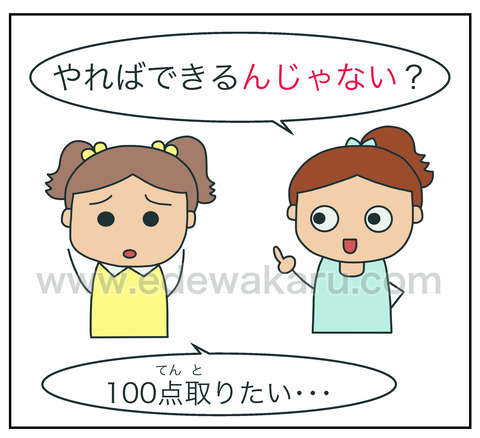
日本語文型辞典
Meaning
基本情報N/Na じゃない説明「ではない」のくだけた言い方。①は否定文で、「な」の部分が高く発音される。②は否定疑問文で上がりイントネーションになる。③は否定ではなく断定で、「じゃない」全体が下がりイントネーションになる。話しことば。男性も女性も使う。例文① A:雨?
B:いや、雨じゃない。② A:雨じゃない?
B:ええ、雨よ。③ あら、雨じゃない。せんたく物いれなくちゃ。参照⇾ではない
日本語文型辞典 英語版
Meaning
【じゃない】[N/Na じゃない]
B:いや、雨じゃない。
No, not rain.
B:ええ、雨よ。
Yes, it’s raining.
Casual way of saying ではない. Example
(1)
is a negative sentence, and the な is pronounced with a higher tone. Example
(2)
is a negative question with rising intonation. Example
(3)
is not negation but assertion, and the whole expression じゃない has falling intonation. Spoken language. Used by both men and women.
→
In context 3 examples
A:雨?
Rain?
A:雨じゃない?
Isn’t it raining?
あら、雨じゃない。せんたく物いれなくちゃ。
Wow, look at the rain! Gotta bring in the laundry!
日本語NET JLPT文法解説まとめ
Meaning
①だぶん~だと思う / たぶん~だろう
②確認
③聞き手に対する驚きや非難など
Explanation
① Probably think that... / Probably...
② Confirmation
③ Surprise or criticism towards the listener, etc.
In context 6 examples
黒田さんは忙しいって言ってたから、今日のパーティーには来ないんじゃない?
ハサミ?テーブルの上にあるんじゃない?ちゃんと探した?
あそこにいる人って、田中先生じゃない?
すごーい、やればできるじゃない。
ちょっと!危ないじゃない。こんなところでボール遊びはダメよ。
A:トムさんどこにいるか知らない?
Yokubi — The Common Grammar Guide (https://yoku.bi)
Explanation
っけ is used when the speaker has forgotten something or is trying to recall something they once knew. It is usually, although not exclusively, used as a question directed to oneself.
っけ is almost never used with non-nouns except in the past tense. When it is, other stuff (like explanatory んだ) is usually put in between.
Similar to っけ, there is also かな. It is usually pronounced with a rising intonation as a question, but just like っけ it is a self-directed one. It simply means the speaker is wondering or unsure or hesitant about something, similar to "I wonder" in English. Needless to say it comes from the union of the question particle か and the sentence ending particle な.
It often comes after the volitional form of a verb to indicate that the speaker is about to decide to do something.
かい is a "friendly" question marker, especially for masculine speakers. Outside of familiar conversation, it can come across as rude/too direct. It's not as common in real life as it is in media. In standard usage, it can only be used to ask yes/no questions.
Parallel to かい, there is also だい. The vibes are pretty much the same, but unlike かい, だい is used to ask questions that expect an actual answer.
じゃない can also be used to ask confirmation questions. Yes, when attached to nouns, it's identical to normal "is not". No, there's no way around it. If you are lucky, there will be a question mark after it.
Note how adding a copula after verbs and い adjectives is technically incorrect but this type of じゃない lives on its own and can show up after them. It's not negating the predicate, it's just adding a negative question nuance ("isn't it?") and behaves like a sentence-ending particle.
じゃん is a casual contraction of じゃない.
In context 1 examples
いいじゃない
It's fine, isn't it?