どんなときどう使う 日本語表現文型辞典
Meaning
cannot avoid; have no choice but
How to use it
Vない+ざるを+えない 例外 しない→せざるをえない
Explanation
どうしても~する必要がある/~しなければならない
1)そのことをしたくはないが、避けられない事情があるので「しかたなく~する」と言うときに使う。
2)「ざる」は古い言葉で「ない」という意味。「ざるをえない」は「ないわけにはいかない」より「しかたなく」という感じが強い。
2)ざる is old term meaning ない (not). Pattern ざるをえない has a stronger sense of しかたなく (must even though doesn't want to) than ないわけにはいかない(no way not to).
シ行ざるをえない
1)Used when situation cannot be avoided even though person involved does not want to do the action.
In context 4 examples
会社の上の人に命令された仕事なら、社員は嫌でもやらざるをえない。
会社が倒産したのは社長に責任があると言わざるをえない。
化学は好きではないが、必修だから取らざるをえない。
体調はあまりよくないが、今日は人手が足りないので働かざるをえない。
日本語文型辞典
Meaning
基本情報V-ざるをえない説明そうるすよりほかに選択肢がないという意味を表す。「V-するほかない」に言いかえられる。①②④のように圧力や状況の切迫のために、意に反してその行為を行うことを表す場合が多い。書きことば的。例文① 先生に言われたことだからやらざるをえない。② 先生に言われたことだからせざるをえない。③ あんな話を信じてしまうとは、我ながらうかつだったと言わざるを得ない。④ これだけ国際的な非難を浴びれば、政府も計画を白紙に戻さざるを得ないのではないか。
日本語文型辞典 英語版
Meaning
【ざるをえない】[V-ざるをえない]Formed by changing the ない in V-ない to ざる. However, する becomes せざるをえない.
Means that there is no other choice but to do a certain thing. Can be replaced by V-するほかない. Often used to show that someone is taking an action against his/her will because of pressure or the urgency of a situation, as in
(1)
,
(2)
, and
(4)
. Has the tone of written language.
In context 4 examples
先生に言われたことだからやらざるをえない。
Since the teacher told me to do it, I have to.
先生に言われたことだからせざるをえない。
Since the teacher told me to do it, I have no choice.
あんな話を信じてしまうとは、我ながらうかつだったと言わざるを得ない。
I have to say it was really careless of me to believe such a story!
これだけ国際的な非難を浴びれば、政府も計画を白紙に戻さざるを得ないのではないか。
Having been subjected to this much international criticism, I'd say the government has no choice but to go back to the drawing board with this plan.
くらべてわかる日本語表現文型辞典
Meaning
意味1:Aしかなく、(嫌だけれども)Aをしなければならないという話し手の不本意な気持ちを表す。
意味2:当然のように、Aという気持ち・感情になってしまう。感情を客観的に表そうとする表現である。
How to use it
Aざるをえない
[動詞-ない形]ざるをえない
Explanation
【対比1】
「Aずにいられない」(意味1 P.108)
「Aずに(は)いられない」は自分の感情を押さえることが出来ないという表現であり、「Aざるをえない」は積極的にAをしたいというのではなく、状況からの判断などでAをするしか方法がないという表現である。
○お腹が一杯だったが、彼女がせっかく作った料理なので食べざるをえない。
○腹ぺこのうえに大好物の寿司を出されては食べずにはいられない。
「Aなければならない」
「Aなければならない」はAをする義務や必要があるという意味で、「Aざるをえない」には話し手の嫌だという感情が含まれる。
○受験する人は10日までに願書を提出しなければならない。
×受験する人は10日までに願書を提出せざるをえない。
「Aわけにはいかない」(意味2 P.331)
「Aを余儀なくされる」(意味1 P.345)
【対比2】
「Aずにいられない」(意味2 P.109)
「Aずに(は)いられない」は個人的感情を直接的・主観的に表現するものであり、「Aざるをえない」は個人的感情を人間ならだれでもそうだろうということを踏まえて、間接的・客観的に表現するものである。
○6千円で買った絵が今では15万円と聞いたら、売らずにはいられないわ。みんなも売らざるをえないと思うだろ?
Notes
【注意1,2】
・「する」は「せざる」、「愛する…」は「愛さざる」となる。
In context 8 examples
犯人もこれだけ証拠が揃えば、犯行を認めざるを得ないだろう。
試験に落ちてしまった。進学はあきらめざるをえない。
ここまで病状が悪化していたら、入院せざるをえないだろう。
倒産しそうなのだから、ボーナスがなくても給料がもらえるだけで満足せざるをえない。
あんなに親切にしてもらって、感謝せざるをえませんよ。
家族か仕事かといわれたら、悩まざるをえない。
彼女の身の上話を聞いていると、同情せざるをえなかった。
孤児たちのつぶらな瞳を見ていると、守らざるをえない気持ちになる。
IMABI
~ざるを得ない & やむを得ない
Read this IMABI lesson ↗Explanation
~ざるを得ない & やむを得ない
There are two fascinating grammar points which utilize the verb 得る in its sense of “to be able to” but in a negative context ~ざるを得ない and やむを得ない.
~ざるを得ない
~ざるを得ない derives from the kundoku1 rendition of 不得不 , which literally renders the meaning of this structure as “cannot do by not…” This is yet another instance in Japanese grammar of a double negative (二重否定), which in this instance does result in an absolute positive (超全部肯定).
As for the native etymology employed, ~ざる is the primary 連体形 of the classical negative auxiliary verb ~ず, and it accordingly attaches to the traditional 未然形 of verbs if there is to be any discrepancy due to modern innovations.
Verb Class未然形+~ざるを得ない
一段 Stem + ∅認めざるを得ない
五段Stem + /a/行かざるを得ない
サ変(する)せせざるを得ない
カ変(来る)こ来(こ)ざるを得ない
The particle を, here, is traditionally viewed as being the case particle を2 marking the object of what cannot be done/attained. Though there is old-fashioned morphology utilized in this grammar pattern, it does get used quite often in the spoken language and written language.
As for how this grammar pattern translates into English, it is often translated as “to have no choice but to…” but it may also be translated as “to be compelled/obliged to…” Unlike similar grammar patterns like ~なければならない, ~ざるを得ない does not indicate that the agent (doer) ever had or has the intent of carrying out the action in question. In fact, there is a strong sense of reluctance and resignation. Also unlike ~なければならない, it can only be used with verbs of volition. It is also worth noting that the “agent” need not be the speaker.
1. 今季の結果を踏まえて大谷選手が世界一の野球選手だということを認みとめざるを得ない。
Based on the results of this season, (we) have no choice but to recognize that Ohtani is the best in the world.
2. 悪天候あくてんこうのため、我々われわれはコンサートを中止ちゅうしせざるを得ませんでした。
There was no other choice but to call off the concert due to the weather.
3. パソコンが壊れたら、新しいのを買わざるを得ない。
If my PC breaks, I’ll have no choice but to buy a new one.
4. 口臭云々よりは歯の痛みで歯医者はいしゃさんに行かざるを得ない状態です。
More so than mouth odor and so forth, it’s the tooth pain that has left me no choice but to go to the dentist.
5. 僕が引き受けざるを得ないじゃないか。
I guess I’m just going to be compelled to undertake it.
6. 外国に行くと、現地の人たちにとって自分が外国人であるということを意識せざるを得ない。
When you go to a foreign country, you are obliged to be conscious of the fact that you are a foreigner to the local people.
7a. 生徒が試験に失敗をすれば、教諭は責任を取らざるを得ない。
7b. 生徒が試験に失敗をすれば、教諭は責任を取らなければならない。
If the student fails an exam, the teacher has no choice but to take responsibility.
8. 社長からの命令なので、やらざるを得ません。
Since this is an order from the company president, I have no choice but to do it.
9. この問題はもう一度検討せざるを得ない。
We have no choice but to examine this problem one more time.
It is also worth noting that ~ざるを得ない may still be used with the passive form so long as the verb itself indicates volition, as the point of the grammar pattern itself is that the agent is compelled to do so, which contrasts with the essence of the verb involved.
10. 私の一番の恐怖、戦争が起きれば何もせずに殺されざるを得ないということだ。
My biggest fear is having to be killed from doing nothing if there were a war.
11. おでんは気温の高低に売れ行きが左右されざるを得ないものだ。
Oden is something whose sales are invariably controlled by the rise and fall of air temperature.
Although it may be tempting to attach negative adverbs like 何も or 全く to add a sense of “at all” to the sense of having to do something without the will to do so, these adverbs must agree with the negative element in the main clause, ~ざる encapsulates the verbal clause it is a part of into a subordinate clause, leaving 得ない as the predicate of the main clause, but no adverbial phrase of any sort can intervene between these two clauses. This problem is alleviated by using the grammar pattern ~ないわけにはいかない, which highlights a sense of responsibility to do something while also implying one’s reasoning for doing.
12a.「いまび」を勧められたからには、まったく読まないわけにはいかない。〇
12b. 「いまび」を勧められたからには、まったく読まざるを得ない。X
Given as how you have been suggested IMABI, you can’t afford not to read it.
In stiffer language, you may also see ~ざるを得まい, which uses the negative volitional auxiliary ~まい. This is generally not used in the spoken language.
13. 当然起こりうる現象と認めざるを得まい。
We are compelled to recognize it as a phenomenon capable of occurring naturally.
Orthography Note: A common misspelling of this grammar pattern by native speakers is ~ざる負えない.
やむを得ない
Meanwhile, the phrase やむを得ない derives from the kundoku rendition of 不得已, which literally renders the meaning of this structure as “cannot be stopped.” The verb やむ is the intransitive form of やめる, which can be seen used normally as in:
14. 雨がやんだ。
The rain has stopped.
Unlike ~ざるを得ない, やむを得ない is only used by the speaker to comment on the inevitable circumstance that is NOT pertaining to the speaker’s own actions. When translated into English, it is often rendered as “unavoidable/inevitable.” In the spoken language, it is usually replaced with phrases like 仕方がない.
Orthography Note: When spelled in Kanji, やむ is typically spelled as 已む in this grammar pattern, reflecting the Kanbun phrasing which brought it about. However, spelling it as 止む is not incorrect under the principle of simplifying its spelling to a common-use Kanji. It must also be noted that just as was the case before, this should never be spelled as やむ負えない.
15. 軍事的に劣勢だったので、やむを得なかったのだろう。
Since (they) were militarily inferior, (they) likely had no other choice.
16. やむを得ない理由のため、更新期間中に更新手続きをすることが困難な方は、その事実を証明する書面を提示する義務があるとご了承ください。
For those it may be difficult to go through the renewal process during the renewal people due to reasons which are unavoidable, (we) ask that you please acknowledge your responsibility to submit documentation proving that fact.
Kundoku 訓読 refers to the process of rendering Kanbun 漢文 (Classical Chinese texts written by Japanese authors) directly into Japanese. ↩︎
The case particle を also gave rise to a conjunctive particle rendition which is no longer used in Modern Japanese grammar. With this grammar point, it may arguably be interpreted as a bridging context between the case particle and conjunctive particle function of を, wherein [~ざる] may serve as a subordinate clause with [得ない] serving as the predicate of the main clause via its supplementary verb function with its head verb ellipsed, which would be the same verb as the dependent clause, thus rendering a literal translation of “while not doing X, X cannot be done.” However, because interpreting を as a case particle here requires no liberties in logic, this approach is not ultimately taken. ↩︎
In context 18 examples
今季の結果を踏まえて大谷選手が世界一の野球選手だということを認みとめざるを得ない。
Based on the results of this season, (we) have no choice but to recognize that Ohtani is the best in the world.
悪天候あくてんこうのため、我々われわれはコンサートを中止ちゅうしせざるを得ませんでした。
There was no other choice but to call off the concert due to the weather.
パソコンが壊れたら、新しいのを買わざるを得ない。
If my PC breaks, I’ll have no choice but to buy a new one.
口臭云々よりは歯の痛みで歯医者はいしゃさんに行かざるを得ない状態です。
More so than mouth odor and so forth, it’s the tooth pain that has left me no choice but to go to the dentist.
僕が引き受けざるを得ないじゃないか。
I guess I’m just going to be compelled to undertake it.
外国に行くと、現地の人たちにとって自分が外国人であるということを意識せざるを得ない。
When you go to a foreign country, you are obliged to be conscious of the fact that you are a foreigner to the local people.
生徒が試験に失敗をすれば、教諭は責任を取らざるを得ない。
If the student fails an exam, the teacher has no choice but to take responsibility.
生徒が試験に失敗をすれば、教諭は責任を取らなければならない。
If the student fails an exam, the teacher has no choice but to take responsibility.
社長からの命令なので、やらざるを得ません。
Since this is an order from the company president, I have no choice but to do it.
この問題はもう一度検討せざるを得ない。
We have no choice but to examine this problem one more time.
私の一番の恐怖、戦争が起きれば何もせずに殺されざるを得ないということだ。
My biggest fear is having to be killed from doing nothing if there were a war.
おでんは気温の高低に売れ行きが左右されざるを得ないものだ。
Oden is something whose sales are invariably controlled by the rise and fall of air temperature.
「いまび」を勧められたからには、まったく読まないわけにはいかない。〇
Given as how you have been suggested IMABI, you can’t afford not to read it.
「いまび」を勧められたからには、まったく読まざるを得ない。X
Given as how you have been suggested IMABI, you can’t afford not to read it.
当然起こりうる現象と認めざるを得まい。
We are compelled to recognize it as a phenomenon capable of occurring naturally.
雨がやんだ。
The rain has stopped.
軍事的に劣勢だったので、やむを得なかったのだろう。
Since (they) were militarily inferior, (they) likely had no other choice.
やむを得ない理由のため、更新期間中に更新手続きをすることが困難な方は、その事実を証明する書面を提示する義務があるとご了承ください。
For those it may be difficult to go through the renewal process during the renewal people due to reasons which are unavoidable, (we) ask that you please acknowledge your responsibility to submit documentation proving that fact.
DoJG 日本語文法辞典(全集)
Meaning
Cannot help -ing; cannot (help) but; have no choice but to ~; have to
How to use it
Vneg | ざるを得ない | |
| 食べざるを得ない | Someone cannot help eating something |
| 行かざるを得ない | Someone cannot help going there |
Exception | せざるを得ない | Someone cannot help doing something |
Explanation
An auxiliary indicating that there is no other choice but to do something.
In context 6 examples
それは高かったが、教科書だったから買わざるを得なかった。
It was a textbook so I had no choice but to buy it, although it was expensive.
日本へ行けば、日本の習慣に従わざるを得ない。
If you go to Japan you cannot help but adapt yourself to Japanese customs.
上司に飲みに行こうと言われれば、部下は行かざるを得ない。
If a subordinate is told by his superior to go out drinking he cannot help going with him.
これだけの人が拳銃で殺されているのだから、拳銃所持をより厳しくコントロールせざるを得ないと思う。
Because this many people have been murdered by guns, I feel that we cannot help but control possession of guns more strictly.
ジョンは一年で日本語がすらすら話せて、新聞が楽に読めるようになったのだから、語学の天才と言わざるを得ない。
Since John was able to speak Japanese fluently and read newspapers with ease in one year we cannot help calling him a genius of language learning.
日本は天然資源の乏しい国だから、経済発展のためには輸出に依存せざるを得ないのである。
Since Japan is a country lacking in natural resources, she cannot help relying on exports.
絵でわかる日本語
Meaning
(事情があって)〜しなければならない
How to use it
動詞[ない形]+ざるを得ない
Explanation
「〜ざるを得ない」は「(事情や理由があって)〜しなければならない」という意味を表す表現です
😊この文型は「
本当は〜したくないが、しかたなく〜しなければならない」というように、〜するしか選択肢がないというのを強調します😮 以前説明した「〜ないわけにはいかない」とほとんど意味は同じです😀
In context 5 examples
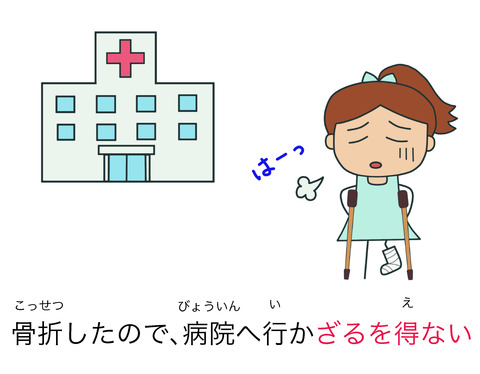
骨折したので、病院へ行かざるを得ない
→骨折したので、病院へ行かなければならない社長命令なので、やらざるを得ない
→社長命令なので、やらなければならない台風が上陸するらしいから、旅行はあきらめざるを得ないね…
→台風が上陸するらしいから、旅行はあきらめなければならないね…上司に誘われたら、参加せざるを得ないね
→上司に誘われたら、参加しなければならないね先生に言われたら、せざるを得ないよ
→先生に言われたら、しなければならないよ
毎日のんびり日本語教師
Meaning
~ほかない
How to use it
動ない形+ざるを得ない
Explanation
それ以外に他の方法や選択肢がないことを表します。本当はしたくないのに、何らかの要因によってしなければならなくなったというニュアンスがあります。
多くは書き言葉として用いられ、「する」は「せざるを得ない」となります。
Notes
似ている文法「【N3文法】~しかない」
In context 6 examples
彼のことは好きではないが、その実力は認めざるを得ない。
雨が降ったら中止せざるを得ない。
完膚なきまでに叩きのめされ、負けを認めざるを得ない。
今回の件で、さすがに彼の人間性を疑わざるを得ない。
世間は彼の行動に大バッシングを浴びせているが、誰しもその状況になったらそうせざるを得ないのではないだろうか。
早く終わらせたいが、この部分は危険が伴うので慎重にならざるを得ない。