日本語文型辞典
Meaning
基本情報V-るべからず説明禁止を表す。「べきでない」の文語形。その行為が「正しくない/望ましくない/よくない」ことを述べて「V-てはいけない」という意味を表す。かなり強い感じの禁止表現で、看板や掲示等に書かれることが多い。しかし、最近では「芝生に入ってはいけません」「芝生育成中」など、もっとやわらかい感じの表現が使われるようになってきている。看板や掲示によく使われる禁止表現には、ほかに「…禁止」「V-ることを禁ず」などがあるが、いずれもかなり強い調子の禁止表現である。かたい書きことば。話しことばでは使わない。例文① 落書きするべからず。② 芝生に入るべからず。③ 犬に小便させるべからず。
IMABI
Phrases Made w/ the Bases of ~べきだ
Read this IMABI lesson ↗Explanation
Phrases Made w/ the Bases of ~べきだ: ~べくもない, ~べからず・ざる, ~べく, ~べくして, & ~べし
Back in our first lesson on ~べきだ, we learned how it is an auxiliary verb pertaining to “obligation” but that its scope of use has been diminished substantially in Modern Japanese. Nonetheless, the auxiliary still holds on, with most of its bases still functional despite having become archaic.
In this lesson, we will go over various advanced grammar points which are derived from its other bases, and in doing so, we will view these other bases as being derived from ~べきだ’s predecessor ~べし.
The Extant Bases of ~べし
The auxiliary “verb/adjective” ~べきだ is etymologically1 better viewed as an “auxiliary adjective,” as it is merely slightly corrupted by the addition of the copula verb to its 連体形. While this did give rise to its new, modern 終止形 of ~べきだ, it also rendered certain other bases obsolete, notably its /-kari/ 連用形 and its 已然形, whose functionalities have been taken over by the copula built into ~べきだ.
Nonetheless, this lesson will be more so an introduction to ~べし as it pertains to Modern Japanese than it is a second installment of ~べきだ. As such, without further ado, the bases of ~べし are as follows:
未然形連用形終止形連体形已然形命令形
べから-べく-
(べかり-)べしべき-・
(べかる-) (べけれ- ) 〇
Orthography Note: ~べし can rarely be seen written in kanji as 可し.
While the modern ~べきだ heavily emphasizes duty and what is deemed appropriate, in the past, these usages all stimmed for an overarching notion of latent potential as well as natural course of events, with agency or the lack thereof among other factors dictating the exact nuance of the auxiliary. The loss of nuances attached to latent potential (潜勢), nuances which we will soon touch upon in their individual environments, is likely attributed to the inclusion of the declarative copula だ into the structure.
~べからず・べからざる
The 未然形 of ~べし, べから-, is heavily used in Modern Japanese with the classical negative auxiliary verb ~ず in the context of to-the-point negative imperatives. While not so common in the spoken language, this pattern is great for signage. Think “DO NOT TOUCH” or “KEEP OFF THE GRASS” as perfect environments for this grammar to be employed.
1. 触るべからず!
DO NOT TOUCH!
2. 芝に入るべからず!
KEEP OFF THE GRASS!
3. この橋、渡るべからず
DO NOT CROSS THIS BRIDGE!
4. 関係者以外、敷地内に入るべからず
NO UNAUTHORIZED PERSONS ARE ALLOWED TO ENTER THE PREMISES
5. 働かざる者は食うべからず
Those who do not work shall not eat
The auxiliary ~べし largely revolves around the notion of obligation, which is also anchored in place by the notion of “latent potential.” The things that ought to be the case are the things that one naturally can and should do. As it pertains to negative structures, we see that while still quite archaic, ~べからず can still be used to mean ~することができない, with a heavy emphasis on it naturally being the case that the agent cannot perform X. Moreover, this lack of “latent potential” is more likely to be seen as ~べからざる with X directly modifying a nominal phrase. Note that ざる‐ is simply the 連体形 of the auxiliary ~ず.
6. 予測すべからざる事態
A situation that one cannot predict
7. 許すべからざる罪
An unforgivable sin/crime
8. 現代社会では、スマホやインターネットなどは欠くべからざる存在となっている。
In the modern age, things such as smartphones and the Internet have become indispensable things (in our lives).
9. 遼平君は、我がチームには、欠くべからざる一員である。
Ryohei-kun is an integral member of our team.
10. 羽はねなければ空をも飛ぶべからず。
If one has no wings, one cannot fly through the skies.
Another pattern utilizing ~べからず worth noting is ~ざるべからず, which is akin to the modern ~なければならない to indicate obligation via a double negative construction. Of the two, ~ざるべからず places even heavier emphasis on the duty bore by the agent.
11. 天皇てんのうを重おもんぜざるべからず。
One must honor the emperor.
~べくもない
~べくもない is a combination of the /ku/-type 連用形 of ~べし followed by the adverbial particle も and the negative auxiliary ~ない. Together, the structure translates to “there is no way/it is possible” even if there is intention to make it happen. While we view the modern ~べきだ as pertaining solely to “obligation,” several other usages existed for its predecessor ~べし which have since fallen out of use. Of these, the indication of “potential,” albeit always with negative forms, was one of those now obsolete meanings. Granted, this sense of “potential” does derive from the underlining meaning of “obligation/strong resolve/appropriateness,” with negation facilitating the inability for said impetus to be set in motion.
12. 将来、東京大学の教授になろうなんて望むべくもない。
There’s no way that I could ever become something like a Tokyo University professor in the future.
13. そう聞いても、ザイダさんには想像するべくもない光景だった。
Though Zaida-san was hearing about it, the scene was one that she couldn’t have ever imagined.
14. セスは遼平を死ぬほど愛している、これは疑うべくもない。
Seth loves Ryohei to death; there is no doubt about that.
The closest structure to ~べくもない would be ~できるはずがない, which focuses on there being no means, whereas with ~べくもない, the focus would be on there being no chance of that resolve or circumstance ever coming to pass in a very emotionally charged fashion. One other major difference, however, is that ~べくもない can also be paired with non-volitional verbs to indicate the zero chance of something ever occurring.
15. 季節の推移はやむべくもない。
The changing of the seasons is inevitable.
~べく
The /ku/-type 連用形 of ~べし, ~べく attaches to verbs of volition, which serves as the initiative that the speaker feels determined/obligated to pursuit, with the predicate Y that follows being the means. As such, ~べく is quite similar to ~ために but with added emphasis on duty.
16. 早く帰るべく、準備じゅんびをし始めた。
I’ve become to make preparations so that I may get home early.
17. 我々は、将来を担うべく努力することを誓います。
We vow to endeavor to bear the future.
18. 国民を守るべく、研鑽を欠かさない。
(He) never falls short of improving (himself) so that (he) may protect (his) citizenry.
19. 作文嫌いを克服すべく、毎日、セス先生が掲げてきた「The Document Challenge」に挑むことにしています。
So that I may overcome my dislike of writing, I have decided to take on “The Document Challenge” which Seth-sensei has touted up to this point.
20. 筆者は最近、社長になるべく日夜努力を重ねている。
I (the person writing to you) have been recently working day and night to become a company president.
One set phrase which utilizes ~べく that is of considerable importance in formal settings, is the word しかるべく which roughly translates to “as one sees fit.” It combines しかり―a contraction of しかあり meaning “absolutely the case”―and ~べく.
21. しかるべく対応いたします。
I shall handle the matter as is appropriate.
~べくして
Utilizing the conjunctive particle して, ~べくして is most often used to indicate the necessity behind something that is predicted by the speaker to happen having happened. Incidentally, in this construction, the verb that precedes ~べくして will also be the same verb that follows it, leading to a translation for ~べくして of “it’s only natural that.” This meaning of a “natural course of events” is inherently tied to the latent potential hinted at in other structures (like in ~べくもない in the negative).
While this structure is largely used with intransitive verbs, the commonality behind all examples of this pattern does not lie in transitivity but rather in how “volition” does not play a part in the action occurring.
22. これは勝つべくして勝った試合です。
As for what you see here, this match was one that we were naturally going to win.
23. チャンスを掴める人は、掴むべくして掴んでいる。
Those who snag chances are those who naturally grab them (as they come along).
24. 起こるべくして起こった出来事だ。
What occurred is what would have naturally taken place.
25. 負けるべくして負けた。
It’s only natural that (we) lost.
Though not nearly as common and not touched on at all in the JLPT N1, ~べくして does have a rarely seen 逆接 nuance of “even if one can do X, (outcome Y is unfeasible).” This can also be adapted in a way so that the verb standing in as Y is marked by a negative form of ~べし to capitalize on this unfeasibility, which in the case of Ex. is to indicate a negative command of the vein of “should not.”
26. その教科書を読むべくして理解しがたい。
Even if you can read the textbook, it is difficult to understand.
27. この説せつは言うべくして行うべからず。
Even if you can say the theory, you shouldn’t carry it out.
~べし
Though clearly archaic, from the sense of obligation, the 終止形 ~べし may also indicate a forceful command related to duty. It is the affirmative rendition of ~べからず mentioned earlier.
28. 辞職すべし。
You should resign!
29. 培った力を存分に発揮すべし!
You must make full use of the strength/skills you’ve nurtured!
~ざるべし
When ~べし follows the negative auxiliary verb ~ず, ~べし follows its 連体形2, and in this context, ~べし simply denotes the meaning of “absolute certainty” that the predicates is NOT the case, as it is being paired with the negative.
30. この人々の深き志は、この海にも劣らざるべし。
The deep kindness of those here surely outmatches that of this sea (in its depth).
From the 『土佐日記』.
~べし is believed to be derived from the adjective 宜(うべ)し, with a likely meaning of “to be certain.” ↩︎
The 連体形 is employed instead of the 終止形 with ラ変-type conjugations. ↩︎
In context 30 examples
触るべからず!
DO NOT TOUCH!
芝に入るべからず!
KEEP OFF THE GRASS!
この橋、渡るべからず
DO NOT CROSS THIS BRIDGE!
関係者以外、敷地内に入るべからず
NO UNAUTHORIZED PERSONS ARE ALLOWED TO ENTER THE PREMISES
働かざる者は食うべからず
Those who do not work shall not eat
予測すべからざる事態
A situation that one cannot predict
許すべからざる罪
An unforgivable sin/crime
現代社会では、スマホやインターネットなどは欠くべからざる存在となっている。
In the modern age, things such as smartphones and the Internet have become indispensable things (in our lives).
遼平君は、我がチームには、欠くべからざる一員である。
Ryohei-kun is an integral member of our team.
羽はねなければ空をも飛ぶべからず。
If one has no wings, one cannot fly through the skies.
天皇てんのうを重おもんぜざるべからず。
One must honor the emperor.
将来、東京大学の教授になろうなんて望むべくもない。
There’s no way that I could ever become something like a Tokyo University professor in the future.
そう聞いても、ザイダさんには想像するべくもない光景だった。
Though Zaida-san was hearing about it, the scene was one that she couldn’t have ever imagined.
セスは遼平を死ぬほど愛している、これは疑うべくもない。
Seth loves Ryohei to death; there is no doubt about that.
季節の推移はやむべくもない。
The changing of the seasons is inevitable.
早く帰るべく、準備じゅんびをし始めた。
I’ve become to make preparations so that I may get home early.
我々は、将来を担うべく努力することを誓います。
We vow to endeavor to bear the future.
国民を守るべく、研鑽を欠かさない。
(He) never falls short of improving (himself) so that (he) may protect (his) citizenry.
作文嫌いを克服すべく、毎日、セス先生が掲げてきた「The Document Challenge」に挑むことにしています。
So that I may overcome my dislike of writing, I have decided to take on “The Document Challenge” which Seth-sensei has touted up to this point.
筆者は最近、社長になるべく日夜努力を重ねている。
I (the person writing to you) have been recently working day and night to become a company president.
しかるべく対応いたします。
I shall handle the matter as is appropriate.
これは勝つべくして勝った試合です。
As for what you see here, this match was one that we were naturally going to win.
チャンスを掴める人は、掴むべくして掴んでいる。
Those who snag chances are those who naturally grab them (as they come along).
起こるべくして起こった出来事だ。
What occurred is what would have naturally taken place.
負けるべくして負けた。
It’s only natural that (we) lost.
その教科書を読むべくして理解しがたい。
Even if you can read the textbook, it is difficult to understand.
この説せつは言うべくして行うべからず。
Even if you can say the theory, you shouldn’t carry it out.
辞職すべし。
You should resign!
培った力を存分に発揮すべし!
You must make full use of the strength/skills you’ve nurtured!
この人々の深き志は、この海にも劣らざるべし。
The deep kindness of those here surely outmatches that of this sea (in its depth).
AIUEO JLPT Grammar
Meaning
This sentence pattern conveys prohibition or disallowance in a classical style. While rarely used in modern Japanese, it appears in literature or formal expressions, emphasizing that specific actions are not permitted.
How to use it
動詞辞書形+べからず
Explanation · 日本語
この文型は、禁止や不許可を表す古語的な表現です。現代日本語ではあまり使われませんが、文学や格式のある表現において見ることがあります。特に、ある行動をしてはいけない、または許されないことを強調する場合に使用されます。
In context 5 examples
ここにゴミを捨てるべからず。
Do not throw garbage here.
人の道に外れる行為は許すべからざるものである。
Acts that deviate from the moral path must not be tolerated.
危険、立ち入るべからず。
Danger, do not enter.
ここでの喫煙は許すべからざることです。
Smoking here is something that must not be allowed.
この橋、渡るべからず。
Do not cross this bridge.
文法
Meaning
〜してはいけない
How to use it
V(辞書形)+ べからず
※「する」は「すべからず」と言うこともできる
Notes
①硬い表現。日常会話では使わない。
②ことわざ、掲示板、標識などに使われることがある。
In context 5 examples
この橋、渡るべからず。
関係者以外、敷地内に入るべからず。
やつを許すべからず。
初心忘るべからず。
働かざるもの食うべからず。
Bunpro Grammar Reference
Meaning
Do not, Must not, Should not, Cannot
How to use it
Verb + べからず
Exceptions:
する → す(1) + べからず
Verb + べからざる + Noun
which is generally limited to:
許すべからざる + Noun
ありうべからざる + Noun
欠くべからざる + Noun
(1) する
Nuance
A formal grammar point, emphasizing that (A) must not happen. It cannot be permissable that (A).
Explanation
べからず, and べからざる are two formal expressions used to convey the meaning of 'must not (A)', or 'ought not to (A)'. It is a combination of the helper-conjugation form of the auxiliary verb べし, べから, and the classical auxiliary verb ず 'not'. ざる itself is just the helper-conjugation form of ず, meaning that the nuance remains exactly the same. In this way, we can see that the literal meaning of 'ought not (A)' exhibits some sort of moral or logical obligation, as is true for all uses of べき derived patterns.
べからず and べからざる will be seen following verbs in their dictionary forms. べからざる will be followed by a noun, indicating that the noun is being modified by the phrase.
ことわざ:「初心忘れるべからず。」
Proverb: 'Do not forget beginner's humility.'
この施設内ではスケートボードなどのことをするべからず。
You must not skateboard or anything similar in this facility.
配達員を装って玄関のドアを開けさせるのは、許すべからざる行為だ。
Making someone open the door, by pretending to be a delivery person is an act that is not to be forgiven.
吸うべからざる場所でタバコを吸っているのを見られたら、1000円払うことになります。
If you are seen smoking in an area where you must not smoke, you will end up having to pay 1000 yen.
In modern Japanese, the meanings of both of these grammar patterns have shifted slightly from 'obligation', to simply having a strong nuance of 'don't (A)'. In addition to this, they will almost only ever be used on signs or notices.
Caution
The べからざる form that combines with nouns is usually only seen in a few set variations. These are 許すべからざる 'cannot be forgiven', ありうべからざる 'must not exist' (impossible), and 欠くべからざる 'must not be without'.
Nuance · 日本語
(A)が起こってはいけないということを強調する丁寧な表現。(A)であることが許されない。
Explanation · 日本語
「べからず」と「べからざる」は、「(A) をしてはならない」や「(A) をすべきでない」という意味で使われる硬い表現です。これは、助動詞「べし」の未然形「べから」(補助活用)に、文語の助動詞「ず」または「ず」の連体形「ざる」(補助活用)の組み合わせでできています。
「べからず」と「べからざる」の前には動詞の辞書形が付きます。「べからざる」の後には名詞が続き、その名詞を修飾します。
ことわざ:「初心忘れるべからず。」
Proverb: 'Do not forget beginner's humility.'
この施設内ではスケートボードなどのことをするべからず。
You must not skateboard or anything similar in this facility.
配達員を装って玄関のドアを開けさせるのは、許すべからざる行為だ。
Making someone open the door, by pretending to be a delivery person is an act that is not to be forgiven.
吸うべからざる場所でタバコを吸っているのを見られたら、1000円払うことになります。
If you are seen smoking in an area where you must not smoke, you will end up having to pay 1000 yen.
「べからず」と「べからざる」には「べし」が含まれるので、これらの文型はもともと道徳的・論理的に「してはならない」という義務を表すものでした。しかし、現代では、これらのニュアンスは「義務」から「(A) をするな」という強い禁止に変わっています。また、これらの表現はほとんどの場合、標識や掲示物に使われます。
注意点
「べからざる」は、限られた慣用的な言い回しの中で使われることがほとんどです。例えば、「許すべからざる」(意味:許してはいけない)「ありうべからざる」(意味:決してあってはならない)「欠くべからざる」(意味:なくてはならない)などがあります。
In context 16 examples
- 空気は生きるに欠くべからざるものだ。
Air is essential to life. (Must not lack air)
- 吸うべからざる場所でタバコを吸っているのを見られたら、1000円払うことになります。
If you are seen smoking in an area where you must not smoke, you will end up having to pay 1000 yen.
- 配達員を装って玄関のドアを開けさせるのは、許すべからざる行為だ。
Making someone open the door, by pretending to be a delivery person is an act that is not to be forgiven.
- ことわざ:「初心忘れるべからず。」
Proverb: 'Do not forget beginner's humility.'
- この施設内ではスケートボードなどのことをするべからず。
You must not skateboard or anything similar in this facility.
- ちゃんと稼いでいない人はご馳走など食うべからず。
Those who are not sufficiently earning should not eat treated food.
- 池の鯉に餌をあげるべからず!鯉が増え過ぎてしまいます!
Do not feed the koi in the pond! They will multiply too much!
- 公園の看板:「芝生にゴミ捨てるべからず」
A signboard at the park: 'Do not dump rubbish on the lawn'
- ブログ記事:「英語で上手にフォーマルな手紙を書くための『べし・べからず』集」
Blog post: 'Dos and Don'ts for writing a formal letter in English skillfully.'
- もろい歴史的建造物の手前の看板:「中に入るべからず」
A signboard in front of the fragile historic building: 'Do not enter inside'
- 小説:「さだおさんがなにゆえそのような許すべからざる大罪を犯したのか、ゆうささんは解できなかった。」
Novel: 'Yusa-san couldn't understand why did Sadao-san commit such an unpardonable crime.' (a crime that cannot be forgiven)
- 張り紙:「この橋は壊れています!渡るべからず!」
Poster: ‘This bridge is damaged! Do not cross!’
- 人の名前を忘るべからず。名前を忘れるのは最大の失礼に当たる。
You must not forget people’s names. Forgetting a name is equivalent to the height of rudeness.
- 看板:「作品に触れるべからず。触れた者は、即退場とすることにする。」
Notice board: ‘Do not touch the works. Those who do will be ejected from the premises immediately.’
- 立ち入り禁止の場所には入るべからず。入れば恐ろしいことが待ち受けているであろう…。
You must not enter places that you are forbidden from entering. If you do, there is likely something terrible awaiting you.
- 新年会、社長が新しい従業員に:「新しい年を迎え、諸君にひと言だけ言っておこう。『初心忘るべからず』。そうすれば真の精通への道は開けていくものだ。」
New year's party, company president to new employees: 'Greeting the new year, ladies and gentlemen, I would like to say few words. 'Do not forget beginner's humility'. That's how the road to real mastery will be open to you.'
DoJG 日本語文法辞典(全集)
Meaning
Shouldn’t; must not; ought not to ~; cannot; don’t ~
How to use it
(i) Vinformal nonpast | べからず | Exception: する→{す/する}べからず |
| 読むべからず | You shouldn’t read it |
| 食べるべからず | Don’t eat (it) |
| 盗作をす(る) べからず | You shouldn’t plagiarize |
(ii) Vinformal nonpast | べからざるNoun | Exception: する→すべからざる |
| あるべからざる状態 | A situation that shouldn’t exist |
| 必要欠くべからざるもの | An indispensable thing (literally: a thing that is necessary and that one cannot lack) |
| 否定すべからざる事実 | An undeniable fact |
Explanation
べからず・べからざる An auxiliary verb that indicates a strong prohibition.
In context 11 examples
芝生に入るべからず。
Keep off the lawn. (literally: Don't enter the lawn.)
原子力はエネルギー源として欠くべからざるものとなっている。
Atomic energy has become indispensable as a source of energy.
電車の中で携帯電話を使うべからず。
You ought not to use your cell phone in the train.
ここで犬に糞をさせるべからず。
Don't let your dog go (to the bathroom) here.
授業中に隣の者と私語をするべからず。
You shouldn't talk in class with your neighbours.
無用の者、入るべからず。
No trespassing. (literally: Don't enter if you aren't on business.)
虚言を吐くべからず。
Don't tell a lie.
インターネットを使う時の「べからず集」からいくつか引用してみよう。プライバシーを公開するべからず。怪しげなファイルに触れるべからず。インターネットの向こうに人間がいることを忘れるべからず。
Let me quote some of the Internet don'ts from this collection: Don't make private matters public. Don't touch suspicious-looking files. Don't forget that there are people on the other end of the Internet.
彼は学生として許すべからざる行為を行ったとして大学を退学させられた。
He was expelled from college because he committed an unpardonable act for a student.
この世の中には批判すべからざる学説はほとんどないと言ってよいだろう。
One could say that there are very few theories we cannot criticize.
奇跡とは一言にしていえば、起こり得べからざる事実が起こる場合のことである。
In a nutshell, a miracle is when an utterly unexpected and unlikely event happens.
どんなときどう使う 日本語表現文型辞典
Meaning
must not
How to use it
Vる+べからず(「する」は「すべからず」もある)W
Explanation
~してはいけない
1)禁止の言い方。古い書き言葉である。現在では、あまり見かけないが、掲示板、立て札などにたまに書かれていることがある。
2) ❸ はふつう「入ってはいけません」「入らないでください」などと書かれている。
2)Sentence ❸ is usually written, 入ってはいけません or 入らないでください.
1)Injunction. Old written form. Not often seen today, but sometimes written on bulletin boards and billboards.
In context 3 examples
録音中。ノックするべからず。
昔はよく立て札に「ここにごみを捨てるべからず」などと書いてあった。
(公園で)「芝生に入るべからず」
絵でわかる日本語
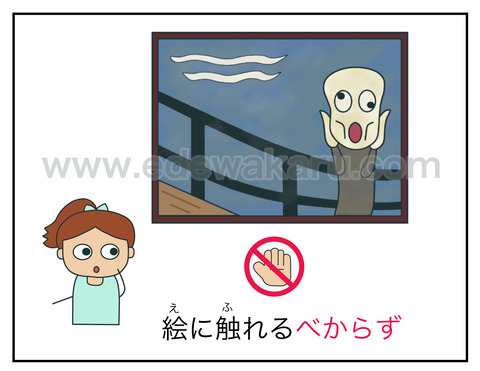
Meaning
〜てはいけない
〜するな
How to use it
動詞[辞書形]+べからず
Explanation
「〜べからず」は禁止や禁止命令を表す文型で「〜てはいけない」「〜するな」という意味で使用されます。この文型はとても強い禁止を表すもので、ほとんどの場合看板などに使用されます。
かたい書き言葉で会話で使われることはありません
😮
【余裕のある人へ】
「〜べからず」と一緒に覚えたほうがいいものに「〜べからざる」という形があります。いつも
「〜べからざる+名詞」の形で使用されます
😊意味は「〜てはならない・〜できない+名詞」という意味ですが、
この文型は慣用表現しか存在しませんので、暗記することをオススメします
😀
[「〜べからざる+N」の慣用表現]
①
許すべからざるN
→許すことができない
②
欠くべからざるN
→欠かすことができない・忘れてはいけない
③
あり得べからざるN
→あってはいけない・起こってはいけない
「〜べからず」「〜べからざる+N」は書き言葉でしか使用されませんので、テスト用に覚えておきましょう😀実際に会話で使うと侍みたいな会話になってしまいますので気をつけてくださいね😅
【「べき」がつく文型】
〜べからず・〜べからざる
〜べきだ
〜べきだった・〜べきではなかった
〜べく
〜べくして
〜べくもない
〜べし
In context 3 examples
絵に触れるべからず
→絵に触れるな・触れてはいけないエサを与えるべからず
→エサを与えてはいけない・与えるな立ち入るべからず
→立ちいってはいけない・入るな(立入禁止)
日本語文型辞典 英語版
Meaning
【べからず】[V-るべからず]
Indicates the prohibition of a certain action. It is a classical written language form of べきでない. It means that the action is not proper, desirable, or good and has the same meaning as the form V-てはいけない.
It is a forceful prohibition often used on signs or notice boards. In recent years, softer expressions such as 芝生に入ってはいけません or 芝生育成中 are more common.
Other phrases commonly used on signs or notice boards in order to stop people from taking certain actions include ...禁止 and V-ることを禁ず. All indicate strong prohibition and are very formal. They are not used in spoken language.
In context 3 examples
落書きするべからず。
No graffiti.
芝生に入るべからず。
Keep off the grass.
犬に小便させるべからず。
Do not use this area as a toilet for your dogs.
日本語NET JLPT文法解説まとめ
Meaning
〜してはいけない
How to use it
V(辞書形)+ べからず
※「する」は「すべからず」と言うこともできる
Explanation
must not
① This is a formal expression and is not used in everyday conversation.
② It is sometimes used in proverbs, notice boards, and signs.
①硬い表現。日常会話では使わない。
②ことわざ、掲示板、標識などに使われることがある。
In context 5 examples
この橋、渡るべからず。
関係者以外、敷地内に入るべからず。
やつを許すべからず。
初心忘るべからず。
働かざるもの食うべからず。
毎日のんびり日本語教師
Meaning
禁止
不得
不可
不要
~してはいけない
How to use it
動辞形+べからず
Explanation
禁止を表します。
主に看板や標識などの掲示に使われ、すべての人に対する禁止の呼びかけに使われます。
「する」は「するべからず」「すべからず」になる点に注意してください。
Notes
関連文法「【N3文法】~べき/べきだ/べきではない」
関連文法「【N3文法】~べきだった/べきではなかった」
関連文法「【N1文法】~べからざる」
似ている文法「【N1文法】~としてあるまじき/にあるまじき」
In context 14 examples
ここにゴミを捨てるべからず。
人をいじめる行為は許すべからず。(欺负人的行为不可原谅。)
働かざる者食うべからず(不劳动者不得食。)
初心忘るべからず(不要忘记初衷。)
工事中につき、立ち入るべからず。
この先、立ち入るべからず。
試験中は会話するべからず。
壁に落書きするべからず。(不要在墙上乱涂乱画。)
毛穴の汚れは溜めるべからず。
少年老い易く学成り難し、一寸の光陰軽んずべからず
食べ物は粗末にするべからず。
健康のためには睡魔に逆らうべからず。
危ない橋は渡るべからず。
この機会逃すべからず。
NINJAL 日本語文型データベース
Meaning
~という行為が適切ではない、望ましくない、認められないという意味を表します。固定された表現で、ことわざや格言(「初心忘るべからず」など)、標識・掲示などに使います。
How to use it
Vるべからず
In context 4 examples
この水は飲料水にあらず。飲むべからず。
私有地につき、立ち入るべからず。
ここで釣りをするべからず。
初心忘るべからず。