Bunpro Grammar Reference
Meaning
Was under the impression that, (Always) the thought used to think
How to use it
Verb + ものと思っていた
[い]Adjective + ものと思っていた
[な]Adjective + な + ものと思っていた
Noun + の + ものと思っていた
Verb + ものと思っていました
[い]Adjective + ものと思っていました
[な]Adjective + な + ものと思っていました
Noun + の + ものと思っていました
Nuance
A strong grammar point, expressing that someone was under the impression of (A). I had been thinking (A) was a thing.
Explanation
物と思う is made up of the noun 物 'thing', the case marking particle と, and the う-Verb 思う 'to think'. Regular translations include 'to believe that (A)', or 'to have confidence that (A)'. In a broader sense, this grammar pattern is just making use of one of the meanings of 物 as being something abstract that the speaker can reliably determine has all of the qualities of something concrete.
When 思う appears in the past tense as ものと思っていた, the most common translation is 'as I had believed was true of (A)', or 'I was under the impression that (A)'.
As もの is a noun, this pattern may follow any word in its attributive form.
え...まだ晩御飯食べてないの?てっきり帰りに食べてくるものと思っていたから、あなたの分は作ってないですよ。
What… You haven't eaten dinner yet? I was totally under the impression that you were going to grab something on the way back home, so I did not make anything for you.
私の母は猫が好きではないものと思っていたが、聞いてみたらただ猫アレルギーがあるそうだ。
I was under the impression that my mother did not like cats, but after asking her, I found out that it's just that she is allergic to them.
ゲートボールは老人しかやらないものと思っていたが、最近は若者の間で流行っているらしい。
I was under the impression that gateball was something only old people played, but it seems to be popular among young people these days.
As ものと思っていた highlights an impression of something that was true, contradictory statements will often appear in part (B) of the sentence following structures like が or けど.
Nuance · 日本語
誰かが(A)という印象を抱いていたことを表す文法。ずっと(A)だど信じ込んでいた。
Explanation · 日本語
「物と思う」は、名詞「物」と格助詞「と」、そして動詞「思う」が組み合わさった表現で、「(A) だと信じている」「(A) と確信している」といった意味で使われます。ここでの「物」は、話し手がそうだと信じて疑わない観念や認識を指しています。
「思う」が過去形の「ものと思っていた」になると、「(A) が本当だと信じていた」や「(A) と思い込んでいた」という意味になります。
「もの」は名詞なので、この文型は連体形の語の後に置かれます。
え...まだ晩御飯食べてないの?てっきり帰りに食べてくるものと思っていたから、あなたの分は作ってないですよ。
What… You haven't eaten dinner yet? I was totally under the impression that you were going to grab something on the way back home, so I did not make anything for you.
私の母は猫が好きではないものと思っていたが、聞いてみたらただ猫アレルギーがあるそうだ。
I was under the impression that my mother did not like cats, but after asking her, I found out that it's just that she is allergic to them.
ゲートボールは老人しかやらないものと思っていたが、最近は若者の間で流行っているらしい。
I was under the impression that gateball was something only old people played, but it seems to be popular among young people these days.
「ものと思っていた」は話し手が「(A) は正しい」と思い込んでいたことを強調する表現なので、その後には「が」や「けど」などが続き、文の後半 (B) には実際にはそうでなかったという逆説的な内容が来ることが多いです。
In context 15 examples
- てっきり漢字を学ぶのは退屈なものと思っていた。
I was under the impression that learning kanji would be boring. (But it is not)
- え...まだ晩御飯食べてないの?てっきり帰りに食べてくるものと思っていたから、あなたの分は作ってないですよ。
What… You haven't eaten dinner yet? I was totally under the impression that you were going to grab something on the way back home, so I did not make anything for you.
- 私の母は猫が好きではないものと思っていたが、聞いてみたらただ猫アレルギーがあるそうだ。
I was under the impression that my mother did not like cats, but after asking her, I found out that it's just that she is allergic to them.
- ゲートボールは老人しかやらないものと思っていたが、最近は若者の間で流行っているらしい。
I was under the impression that gateball was something only old people played, but it seems to be popular among young people these days.
- 犬は怖いものと思っていたけど、飼ってみたら思ったより優しかった。
I was under the impression that dogs were scary, but after I tried taking care of one, they turned out to be more gentle than I had thought.
- お母さんに怒られるものと思っていたが怒られず、拍子抜けした。
I was under the impression that my mum was angry, but she wasn’t angry, so it was an anticlimax.
- 子供の頃、森の中で迷った。てっきりこのまま死ぬものと思っていた。(が救われた)
When I was a child, I lost my way in the forest. I was under the impression that I would die like this. (But I was saved)
- 面接に合格するものと思っていたが不合格となり、愕然としている。
I was under the impression that I had passed the interview, but since I failed I am astounded.
- 雷に打たれて死ぬものと思っていたが、どうやら生き残ったようだ…。
I always used to think that if you got hit by lightning you would die, but it seems that they survived.
- ワンピースは若い子しか着られないものと思っていたが、意外と私でも着られる。
I always used to think that only young girls could wear dresses, but unexpectedly, even I can wear them.
- 強盗に殺されるものと思っていたが、意外にも強盗犯は傷一つすらつけてこなかった。
I was under the impression that you’d be killed when getting robbed, but unexpectedly, the robber didn’t even lay a scratch on me.
- 雨の日はついていないものと思っていましたが、雨の日は雨の日なりに楽しいことがあります。
I always used to think that rainy days were unlucky, but rainy days are fun in their own way.
- 小説、勇者:「ドラゴンは伝説のものと思っていたが…。」
小さいドラゴン:「ガオー!」Novel: 'I was under the impression that the dragons were things of legends.' Small dragon: 'Rarrrr!'
- 私は彼が拒否するものと思っていたが、予想とは逆に彼は賛成した。
I was under the impression that he would disagree, but contrary to expectations he agreed.
- A(エー):「彼女が負けたなんて驚いたな。きっと勝つものと思っていたけど。」
B(ビー):「わたしもそう思ってた。」A: 'Surprisingly, she lost. I was under the impression that she would win.' B: 'I thought so too.'
絵でわかる日本語
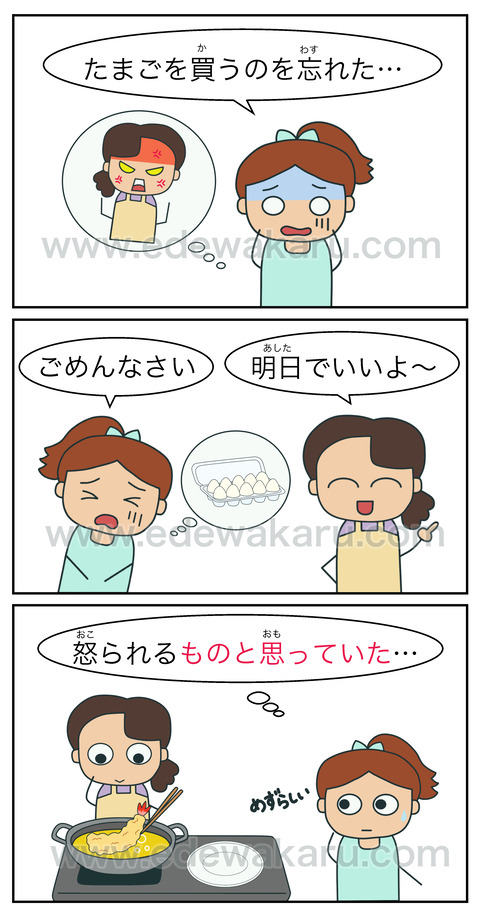
Meaning
絶対に〜だと思っていたが、違っていた
How to use it
動詞・形容詞[普通形]+ものと思っていた
Explanation
「〜ものと思っていた」は「絶対に〜だと思っていたが、実は違っていた」という意味を表す文型です。
自分が思ってたことや信じていたことが、実際はそうではなかったと言いたい時に使います😊
「〜とばかり思っていた」
はほとんど同じ意味で使われますが、
「〜ものと思っていた」は名詞には使わないと覚えておきましょう
😉
(復習:〜とばかり思っていた)
[例]
⭕️怒られる
ものと思っていた
⭕️怒られる
とばかり思っていた
⭕️雨が降る
ものと思っていた
⭕️雨が降る
とばかり思っていた
❌テストは明日
ものと思っていた
⭕️テストは明日だ
とばかり思っていた
「もの」シリーズの1つとして覚えておきましょう😀
(復習:〜として)
【「もの」シリーズ】
〜たいものだ・〜てほしいものだ
〜たものだ
〜たものではない
〜というもの(Nというもの)
〜ないものだろうか
〜ないものは〜ない
〜もの・〜んだもの
〜ものか
〜ものがある
〜ものだ(感慨)
〜ものだ(本来の性質・一般的な考え方)
〜ものだ・〜ものではない
〜もので・〜ものだから
〜ものと思っていた
〜ものなら
〜ものの
〜ものを
〜ようものなら
In context 5 examples
怒られるものと思っていた
→絶対に怒られると思っていたが、怒られなかった彼は日本語能力試験(にほんごのうりょくしけん)に合格したものと思っていた
→彼は日本語能力試験に合格したと思っていたが、合格していなかった今日は雨が降るものと思っていた
→今日は絶対に雨が降ると思っていたが、降らなかった日本語は難しいものと思っていた
→日本語は絶対に難しいと思っていたが、難しくなかった山田くんはパーティーに来ないものと思っていた
→山田くんはパーティーに絶対に来ないと思っていたが、来た