DoJG 日本語文法辞典(全集)
Meaning
For; per
Explanation
A particle which indicates a basic quantity, for each of which certain amount is associated.
In context 5 examples
この翻訳は一ページで二千円お払いします。
We will pay 2.000 yen per page for this translation.
このアルバイトは一時間で千円払ってくれます。
They will pay me 1,000 yen per hour for this part-time job.
昨日は一日で本を五百ページ読んだ。
Yesterday I read 500 pages in a day.
食べて飲んで、五人で、七万ぐらいでした。
We ate and drank and it cost us about 70,000 yen for five persons.
この林檎は一山で二百円です。
These apples are 200 yen for one pile.
日本語文型辞典
Usage 1
Meaning
話し手、あるいは聞き手の前の発言を受けて、そこから話を続けたり、相手に情報提供を求めたりする場合に用いる。「それで」が短くつまったもので、普通、話しことばで用いられる。たいていの場合、「それで」で言いかえができるが、⑤のように、依頼を切り出すような場合は、「そこで」との置きかえも可能。
⇾それで⇾そこで⇾そして⇾それから
⇾て⇾ていく
How to use it
で
…で
In context 7 examples
≪写真を見せながら≫これが、田中先生の奥さん。で、こっちが息子さんの孝君。
あしたからこち試験なんだ。で、この2、3日はほとんど寝てないんだ。
A:私には、ちょっと無理じゃないかと思うんですが。
B:で?どうだと言うの。A:今の仕事やめようと思っているんです。
B:ああ、そう。で、やめた後、どうするつもりなんだ。ようやく結婚式の日取りも決まりました。で、実は先生にお願いがあるのですが。
彼女は病気で寝ています。
ちょっと休んでいって下さい。
Usage 2
Meaning
基本情報NはNで説明「XはXで」と同じ名詞をくり返し用いて、他のものと対比しながらXについて述べるのに用いる。例文① 彼の言うことなど気にせず、君は君で自分が正しいと思ったことをやればいいのだ。② 姉はオリンピックで金メダルを取り、妹は妹で、初めて書いた小説が芥川賞を受賞した。③ タヌキは若い女に化け、キツネはキツネで立派な侍に変わった。
絵でわかる日本語
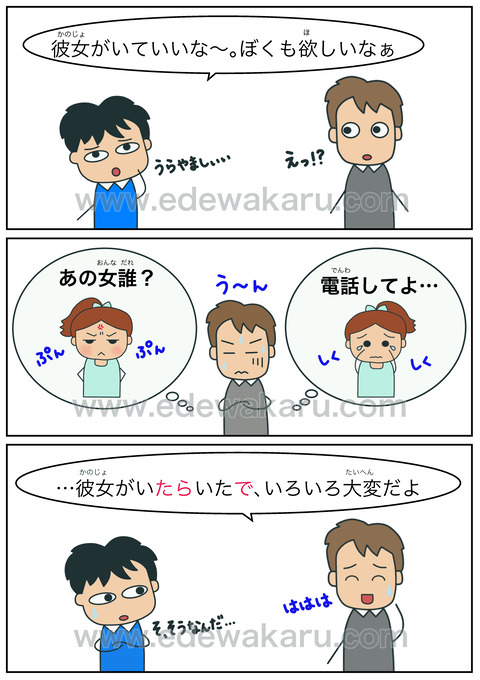
Meaning
〜た場合は、〜という問題がある
〜た場合でも、問題はない
How to use it
動詞・形容詞・名詞[た形]+たら〜で
動詞・形容詞・名詞[なかった形]+たら〜で
Explanation
「AたらAで」は「Aた場合は、〜という問題がある」「Aた場合でも、問題はない」という意味の文型です。「A」には同じ単語が入ります。
「Aた場合は、〜という問題がある」は「〜でも〜でも、どちらの場合でも問題がある」
と言いたい時に使われます。また
「Aた場合でも、問題ない」は「そんなに大きな問題ではない。大丈夫だ」
と言いたい時に使います。
[例]
①A:彼女がいていいな〜。ぼくも彼女が欲しいなぁ
B:い
たら
いた
で、いろいろ大変だよ…
→彼女がいても、いろいろ大変だよ…
「彼女がいないと悲しいが、いる場合でもいろいろ大変だ」
②N1に合格できなかっ
たら
できなかった
で、また次がんばればいいよ
→合格できなかったら、また次がんばればいいよ
「合格できないことは、そんなに大きな問題ではない」
③失敗し
たら
失敗した
で、その時考えよう
→失敗した場合は、その時考えよう
「失敗しても、そんなに大きな問題ではない」
④大学に合格し
たら
合格した
で、なにかとお金が必要になる
→合格した場合でも、なにかとお金が必要になる
「不合格では困るが、合格してもお金の問題はある」
⑤A:暑くて死にそう…やっぱり私は冬の方が好きだわ
B:冬になっ
たら
なった
で
「寒くて死にそう」っていうんだろ?
→冬になったら、「寒くて死にそう」っていうんだろ?
「夏でも冬でも、どちらの場合でも文句を言うんだろ?」
「な形容詞・名詞」の場合は「〜なら〜で」の方がよく使われます。
[例]
嫌だっ
たら
嫌だった
で、そう言えばよかったじゃない!
=嫌
なら
嫌
で、そう言えばよかったじゃない!
反対だっ
たら
反対
で、ちゃんと理由を説明しなさい
=反対
なら
反対
で、ちゃんと理由を説明しなさい
「〜たら〜で」は、覚えにくい文型の1つです。N1を受ける人はしっかりと復習をしておきましょう😊
In context 5 examples
A:彼女がいていいな〜。ぼくも彼女が欲しいなぁB:いたらいたで、いろいろ大変だよ…
N1に合格できなかったらできなかったで、また次がんばればいいよ
失敗したら失敗したで、その時考えよう
大学に合格したら合格したで、なにかとお金が必要になる
A:暑くて死にそう…やっぱり私は冬の方が好きだわB:冬になったらなったで「寒くて死にそう」っていうんだろ?
日本語NET JLPT文法解説まとめ
Meaning
手段・方法を表す。
Explanation
"by"
Indicates methods or means
In context 10 examples
YouTubeで日本語を勉強します。
箸でご飯を食べます。
手で寿司を食べます。
フォークとスプーンでステーキを食べます。
タブレットで映画を見ます。
自転車で学校に行きます。
タクシーでレストランに行きます。
鉛筆で手紙を書きます。
スマホで写真を撮ります。
はさみで紙を切ります。
日本語文型辞典 英語版
Usage 1
Meaning
B:で? どうだと言うの。
So? What is it that you want to say?
B:ああ、そう。で、やめた後、どうするつもりなんだ。
Is that so? And what do you intend to do afterwards?
Used when continuing a conversation or seeking to provide the listener with information, following an earlier statement of the speaker or the listener. Contracted form of それで, and is normally used in spoken language. In most cases, で can be replaced by それで, but when broaching a request, as in
(5)
, it can also be replaced by そこで.
→
【それで】、
【そこで】、
【そして】、
→
【て】、
How to use it
1. で
2. ...で
In context 7 examples
《写真を見せながら》これが、田中先生の奥さん。で、こっちが息子さんの孝君。
《while showing a photo》 This is Tanaka-sensei’s wife, and this is his son, Takashi-kun.
あしたから、試験なんだ。で、この2、3日はほとんど寝てないんだ。
I have exams starting tomorrow. So I have hardly slept these past two or three days.
A:私には、ちょっと無理じゃないかと思うんですが。
I think it might be just too much for me to handle...
A:今の仕事やめようと思っているんです。
I’m thinking of quitting the job I’m doing now.
ようやく結婚式の日取りも決まりました。で、実は先生にお願いがあるのですが。
(to a teacher) The date of the wedding is finally set. And I have a favor to ask you.
彼女は病気で寝ています。
She’s sleeping due to illness.
ちょっと休んでいって下さい。
Please go have a little rest.
Usage 2
Meaning
【は...で】[NはNで]
The pattern XはXで, created by repeating the same noun, is used to say something about X while comparing it with something else.
In context 3 examples
彼の言うことなど気にせず、君は君で自分が正しいと思ったことをやればいいのだ。
Don’t pay attention to anything he says; you should do whatever you yourself think is right.
姉はオリンピックで金メダルを取り、妹は妹で、初めて書いた小説が芥川賞を受賞した。
The older sister got a gold medal at the Olympic Games, and the younger sister, on the other hand, was awarded the Akutagawa Prize for her very first novel.
タヌキは若い女に化け、キツネはキツネで立派な侍に変わった。
The raccoon dog transformed itself into a young woman, and the fox turned into a great samurai.
文法
Meaning
手段・方法を表す。
In context 10 examples
YouTubeで日本語を勉強します。
箸でご飯を食べます。
手で寿司を食べます。
フォークとスプーンでステーキを食べます。
タブレットで映画を見ます。
自転車で学校に行きます。
タクシーでレストランに行きます。
鉛筆で手紙を書きます。
スマホで写真を撮ります。
はさみで紙を切ります。
Bunpro Grammar Reference
Usage 1
Meaning
At, In
How to use it
Place + で
Nuance
A particle which expresses the location in which an action takes place.
Explanation
で is a particle that has several different uses in Japanese. At its core, it is always used to highlight something that is 'required' to perform some sort of action. One of these uses relates to places, and translates roughly as 'at', or 'in' in English.
私はここでピザを食べる。
I eat pizza here. (At this place)
私は部屋で寝る。
I sleep in my room.
In these sentences, the place is considered essential for the action to be performed, or the result of the action to be achieved. This is unlike the particle に, which marks the location itself as being the destination or target of an action. Basically, で means (A) 'place' allows (B) 'action' to occur. While に means (A) 'place' is the target for (B) 'action' occurring.
彼は公園にいます。
He is at the park. (He is at the park, but the park isn't 'allowing' him to be there)
彼は公園でバーベキューをする。
He BBQs at the park. (Because there are barbecues at the park, it is allowing him to cook)
In the first example, we can see that に marks the place that the person exists during an action, but the action itself is not dependent on the place. In the second example, the action is considered dependent on being at that place, as there are possibly no barbeques in other areas.
Nuance · 日本語
ある行動が起こっている場所を表すときに使われる助詞。
In context 16 examples
- そこで寝る。
I sleep (at) there.
- 私は部屋で寝る。
I sleep in my room.
- 彼は公園にいます。
He is at the park. (He is at the park, but the park isn't 'allowing' him to be there)
- 私はここでピザを食べる。
I eat pizza here. (At this place)
- 彼は公園でバーベキューをする。
He BBQs at the park. (Because there are barbecues at the park, it is allowing him to cook)
- ホテルで寝る。
To sleep at the hotel.
- ここで曲がります。
To turn (at) here.
- 私はここでサッカーをする。
I play soccer (at) here.
- そこで泳ぎますか。
Will you swim (at) there?
- 教室で寝る。
I sleep in the classroom.
- ここでサラと文法を習う。
I learn grammar with Sara (at) here.
- ここで映画を見る。
I will watch a movie (at) here.
- レストランでお母さんとご飯を食べる。
I eat food with my mother at the restaurant.
- 図書館で日本語を学ぶ。
I learn Japanese at the library.
- 学校で給食を食べる。
I eat lunch at school.
- 古い家で新聞を読む。
To read a newspaper in an old house.
Usage 2
Meaning
With, By (using)
How to use it
Noun + で
Nuance
A particle which may be used to show the means or tool used to achieve something.
Explanation
で is a particle that has several different uses in Japanese. At its core, it is always used to highlight something that is 'required' to perform some sort of action/reach some kind of goal. One of these uses relates to 'things'. This comes across as 'by' or 'with' in English.
車で空港へ行く。
I go to the airport by car. (Required to reach a goal)
電車で行く。
I go by train. (Required to reach a goal)
In these sentences, the item is considered essential for the action to be performed. While other items may be used, で simply highlights the one that was chosen.
で is also used when groups of people perform actions together, this is something that many people learning Japanese have trouble with initially (because と may also be used as 'with' for people). However, the use of で is actually the same as this by/with, meaning that the speaker considers the group as the tool used for performing the action.
みんなでレストランに行く。
I go to the restaurant with everyone. (Being with everyone is what allows/gives purpose to the action)
来年は皆でハワイに行く。
I will go to Hawaii with everyone next year. (Being with everyone is what allows/gives purpose to the action)
The difference between と and で as 'with', is that で is used when everyone in the group has the same objective/end goal. と is used when each person is performing the action toward each other, not toward an external objective.
家族全員で沖縄へ行く。
I will go to Okinawa with everyone in my family. (Being with everyone is what allows/gives purpose to the action)
お母さんとご飯を食べる。
I eat with my mom. (Being together is the objective, eating is just what is happening while being together)
Nuance · 日本語
何かを達成するために使われる手段や道具を示すために使用される助詞。
In context 18 examples
- バスで行く。
I go by bus.
- 来年は皆でハワイに行く。
I will go to Hawaii with everyone next year. (Being with everyone is what allows/gives purpose to the action)
- 車で空港へ行く。
I go to the airport by car. (Required to reach a goal)
- お母さんとご飯を食べる。
I eat with my mom. (Being together is the objective, eating is just what is happening while being together)
- 電車で行く。
I go by train. (Required to reach a goal)
- 家族全員で沖縄へ行く。
I will go to Okinawa with everyone in my family. (Being with everyone is what allows/gives purpose to the action)
- みんなでレストランに行く。
I go to the restaurant with everyone. (Being with everyone is what allows/gives purpose to the action)
- バスで学校に行く。
I go to school by bus.
- 自転車で、いいです。
By bicycle is fine.
- 自転車で。
By bicycle.
- 電車で来ますか。
Are you coming by train?
- タクシーでいいですか。
Is by taxi okay?
- 車で病院に行く。
To go to the hospital by car.
- バスで帰る。
To go home by bus.
- 自転車で学校に行く。
To go to school by bicycle.
- バスで行くかタクシーで行くか分かりますか。
Do you know if you are going by bus or by taxi?
- 新幹線で東京へ行く。
To go to Tokyo by Shinkansen (bullet train).
- 飛行機で帰る。
To go home by airplane.
Usage 3
Meaning
And... (Conjunctive)
How to use it
[い]Adjective[い̶] + く + て
おもしろい̶ + く + て
新しい̶ + く + て
[な]Adjective + で
しずか + で
好き + で
Noun + で
先生 + で
仕事+ で
Exceptions:
いい→よくて
Nuance
A casual, simple conjunctive form used in a similar way to and in English.
Explanation
The て form of an い-Adjective, or で form of a noun (or な-Adjective) is exactly the same as the て form of a verb, in that it carries the meaning of 'and', and is used for linking. It will allow us to list multiple qualities/traits of something.
For い-Adjectives, we will need to change the last い to く (the form used for conjugation), and then simply add て.
For nouns and な-Adjectives, we will need to add で to the base form (not な or だ).
このパソコンは新しくて早い。
This computer is new and fast.
あの自転車は便利で軽い。
That bicycle is useful and light.
音楽を作るのは仕事で趣味だ。
Making music is both work, and my hobby.
It should be noted that て and で are different structures here. て is the same conjunction particle that is used with verbs (meaning that い-Adjectives are similar to verbs), while で is actually a form of だ that is used for conjugation. It is the same で as the one that is used in the formal version of だ, である. Which we will learn later.
Caution
Like other て forms (ている 1, ている 2, and ている 3), the て (or で) form of other words can have several possible meanings. These meanings are as follows.
Linking - Like 'and' in English.
Reasons - Like 'with (A)', or 'because of (A)' in English.
Manner - Like 'to do (B) in an (A) way' in English.
あの人は綺麗で優しい。
That person is beautiful and nice.
大雨でバスが止まりました。
The bus stopped with rain. (With rain as the reason)
私はご飯を急いで食べる。
I eat food in a hurry.
Caution
As with all other conjugations of いい, remember that it will be よくて, and not いくて.
Nuance · 日本語
英語のandのように使われるカジュアルで飾らない接続詞。
In context 18 examples
- 新しい → 新しくて
New → New and...
- あの自転車は便利で軽い。
That bicycle is useful and light.
- 音楽を作るのは仕事で趣味だ。
Making music is both work, and my hobby.
- このパソコンは新しくて早い。
This computer is new and fast.
- 大きい → 大きくて
Big → Big and...
- 嫌い → 嫌いで
Dislike → Dislike and...
- 静か → 静かで
Quiet → Quiet and...
- 病気 → 病気で
Disease → Disease and...
- 暑い → 暑くて
Hot (weather) → Hot and...
- かわいい → かわいくて
Cute → Cute and...
- 好き → 好きで
Liking → Liking and...
- 暇 → 暇で
Unoccupied → Unoccupied and...
- 仕事 → 仕事で
Work → Work and...
- いい → よくて
Good → Good and...
- 寒い → 寒くて
Cold (weather) → Cold and...
- あの人は綺麗で優しい。
That person is beautiful and nice.
- 大雨でバスが止まりました。
The bus stopped with rain. (With rain as the reason)
- 私はご飯を急いで食べる。
I eat food in a hurry.
Usage 4
Meaning
And..., Both and (Conjunctive)
How to use it
[い]Adjective[い̶] + く + て
[な]Adjective + で + Phrase
Noun + で + Phrase
Nuance
A casual, simple conjunctive form used to list several characteristics of (A).
Explanation
The て form of an い-Adjective, or で form of a noun (or な-Adjective) is exactly the same as the て form of a verb, in that it carries the meaning of 'and', and is used for linking.
Building on from the adjective +て, noun + で grammar point, instead of linking adjectives, adjective + て + (B) is used for linking an adjective to an entire phrase. With this construction, the phrase is simply added after て (with い-Adjectives), or で (with nouns and な-Adjectives), without any extra consideration for the phrase following it (this means that the (B) phrase will behave as if it was its own sentence).
田中さんの犬は大きくて遊ぶのが好きです。
Tanaka-san's dog is big and likes playing.
マサミは綺麗で水泳が趣味です。
Masami is beautiful, and swimming is her hobby.
トミーは漫画家でたまに学校で国語を教えている。
Tommy is a cartoonist, and occasionally teaches the national language at school.
As with adjective +て, noun + で, it should be noted that て and で are different structures here. て is the same conjunction particle that is used with verbs (meaning that い-Adjectives are similar to verbs), while で is actually a form of だ that is used for conjugation. It is the same で as the one that is used in the formal version of だ, である. Which we will learn later.
Caution
Like other て forms (ている 1, ている 2, and ている 3), the て (or で) form of other words can have several possible meanings. These meanings are as follows.
Linking - Like 'and' in English.
Reasons - Like 'with (A)', or 'because of (A)' in English.
Manner - Like 'to do (B) in an (A) way' in English.
このスマホは新しくて速い。
This phone is new and fast. (Linking)
このアイスクリームは甘くて美味しい。
This ice cream is delicious because it is sweet. (Reasons)
声を出して話してください。
Please project when you speak. (Manner)
Caution
As with all other conjugations of いい, remember that it will be よくて, and not いくて.
Nuance · 日本語
(A)の複数の特徴を挙げるために使われるカジュアルで飾らない接続詞。
In context 18 examples
- りさは背が高くてかわいいです。
Risa is tall and cute.
- 田中さんの犬は大きくて遊ぶのが好きです。
Tanaka-san's dog is big and likes playing.
- マサミは綺麗で水泳が趣味です。
Masami is beautiful, and swimming is her hobby.
- トミーは漫画家でたまに学校で国語を教えている。
Tommy is a cartoonist, and occasionally teaches the national language at school.
- 静かで平和なところに住みたい。
I want to live in a quiet and peaceful place.
- ほろさんは親切で優しい。
Holo is kind and gentle.
- 「ルフィさんは明るくていい人ですよね。」
「そうですよ。」'Luffy is a bright and good-natured person, isn't he?' 'That's right.'
- 新田さんは悲しくて寂しかったんです。
Nitta was (used to be) sad and lonely.
- クエンティンさんは映画監督で俳優です。
Mr. Quentin is a movie director and actor.
- 強くて冷たい風が吹いている。
A strong and cold wind is blowing.
- ハリーの部屋は狭くて汚かった。
Harry's room was small and dirty.
- サーリーの部屋は汚くてハリーの部屋は綺麗です。
Sally's room is dirty, and Harry's room is tidy.
- シンプルで便利なスマホを買うつもりだよ。
I plan to buy a simple and convenient smartphone.
- 丸くて大きくて赤いリンゴが大好きですよ!
I love big, round, and red apples!
- 彼はアメリカの数学者で大学教授だった。
He was an American mathematician and a university professor.
- このスマホは新しくて速い。
This phone is new and fast. (Linking)
- このアイスクリームは甘くて美味しい。
This ice cream is delicious because it is sweet. (Reasons)
- 声を出して話してください。
Please project when you speak. (Manner)
Usage 5
Meaning
And・and so, Due to, Because of, Since, Conjunctive
How to use it
Verb[て]+ Phrase
[い]Adjective[て]+ Phrase
[な]Adjective + で + Phrase
Noun + で + Phrase
Exceptions:
いい → よくて + B
Nuance
A casual, simple conjunctive form indicating (A) as being the reason or cause of (B).
Explanation
One of the functions that the conjunction particle て performs in Japanese is very similar to 'since', or 'due to', in English. Phrases that use this particular (A) て (B) nuance of the て-form primarily express something that is beyond the control of the speaker in the (B) statement.
To use this grammar construction, pair the て-form of a verb or い-Adjective with the (B) phrase. In the case of nouns and な-Adjectives, で (the particle) will be used instead.
犯人が捕まって安心です。
I feel safe because the criminal got caught.
今日は宿題が多くて行けなかった。
I couldn't go today because I had a lot of homework.
田舎は静かで落ち着きます。
I can relax in the countryside because it is quiet.
虫歯で歯が痛い。
My tooth hurts because of a cavity.
Fun Fact
The 'because' nuance of て (or で) in this grammar construction is primarily influenced by the (B) phrase being something that is uncontrollable, rather than being a different meaning of the particles て, or で themselves. Literally the meaning is closer to the following:
(A) て 困る - Being troubled cannot be controlled, so (A) must have caused it.
(A) て 嬉しい - Being happy cannot be controlled, so (A) must have caused it.
(A) て 大変 - Having a problem cannot be controlled, so (A) must have caused it.
(A) て びっくり - Being surprised cannot be controlled, so (A) must have caused it.
(A) て 疲れている - Being worn-out cannot be controlled, so (A) must have caused it.
(A) て 心配 - Feeling anxiety cannot be controlled, so (A) must have caused it.
Many other words, such as the ones listed above will cause て (or で) to have a similar nuance. てすみません also uses this meaning of て, as すみません is a feeling that the speaker cannot control, relating to the situation being left unfinished.
Nuance · 日本語
(A)が(B)の理由、又は原因だということを示すときに使われるカジュアルな動詞の活用。
In context 16 examples
- 文字も小さすぎて読めないよ。
The characters are too small and I cannot read them. (I cannot read the characters because they are too small)
- 今日は宿題が多くて行けなかった。
I couldn't go today because I had a lot of homework.
- 虫歯で歯が痛い。
My tooth hurts because of a cavity.
- 犯人が捕まって安心です。
I feel safe because the criminal got caught.
- 田舎は静かで落ち着きます。
I can relax in the countryside because it is quiet.
- 部屋が綺麗でのんびりできます。
I can relax because the room is clean. (The room is clean and I can relax)
- メアリーがアメリカに帰って悲しいです。
Mary returned to the USA and I am sad. (I am sad because Mary returned to the USA)
- おとなしさんは病気で参加できませんでした。
Mr. Otonashi was sick and could not participate. (Mr. Otonashi was unable to participate due to being ill)
- おっちゃんのコンサートは雨で中止になった。
O-chan's concert has been canceled due to the rain.
- ルームメートがうるさくて全然勉強できない。
I cannot study at all because my roommate is noisy. (My roommate is noisy and I cannot study at all)
- たなかさんはベジタリアンだと聞いてびっくりしました。
I heard that Mr. Tanaka is vegetarian and it surprised me. (I was surprised because I heard that Mr. Tanaka is a vegetarian)
- 「お菓子をたくさん食べてお腹が痛いよ。」
'I ate many sweets and I have an upset stomach!' ('I have an upset stomach because I ate many sweets')
- 寝る前にブラックコーヒーを飲んで寝られないんだ。
I cannot sleep because I drank black coffee before going to bed. (I drank black coffee before going to bed, and cannot sleep)
- 勇者さまは5年前に、交通事故で死んだ。
The hero died due to a car accident 5 years ago. (The hero got into a car accident 5 years ago and died)
- 日本語能力試験に合格して嬉しかったです。
I passed the Japanese Language Proficiency Test, so I was glad.
- 先週、インフルエンザにかかって、仕事を休んだのです。
I was absent from work because I caught the flu last week. (I caught the flu last week and was absent from work)
Usage 6
Meaning
By, With, On, By means of, ~ing with
How to use it
Verb[て]+ Phrase
Noun + で + Phrase
Nuance
A casual, simple conjunctive form showing that (B) was done in the way of (A).
Explanation
The conjunction particle て, or the case marking particle で are often used to highlight when something is being 'used'. The thing being used does not necessarily need to indicate a tool, but can also indicate a circumstance/situation. In these cases, '(A) で (B)' translates as 'with/by means of (A), (B)'.
寝坊をしたので慌てて準備をした。
Since I overslept, I got ready in a flurry.
毎日泳いでトレーニングをしています。
I train by swimming every day.
父は車で仕事に行く。
My father goes to work by car.
私はハサミで野菜を切ります。
I cut my vegetables using scissors.
Fun Fact
With て (and で), the nuance is quite often that '(A) allowed/led to (B)'. This may be a simple sequence of events, or may be through the direct use of a tool/situation. The nuance that is being highlighted will always depend on the (B) phrase. Due to this, it is important to always read the (B) clause, before deciding what the speaker is trying to convey.
Nuance · 日本語
(B)が(A)のやり方で行われた、と言うことを示すカジュアルな活用。
In context 16 examples
- フライパンを使って、料理をします。
I am making a meal with a frying pan.
- 毎日泳いでトレーニングをしています。
I train by swimming every day.
- 父は車で仕事に行く。
My father goes to work by car.
- 私はハサミで野菜を切ります。
I cut my vegetables using scissors.
- 寝坊をしたので慌てて準備をした。
Since I overslept, I got ready in a flurry.
- 歩いて帰るつもりだよ。
I plan to come home on (by) foot.
- けいまくんは自転車に乗って学校に行っています。
Keima goes to school by (riding a) bike.
- 総理大臣は新幹線を利用して東京に戻りました。
The prime minister returned to Tokyo by (using the) shinkansen.
- 彼はあの船に乗ってアメリカに来た。
He came to the USA on that/by riding that ship.
- 「あのすみません、駅までどのくらいありますか。」
「駅はここから徒歩で5分くらいです。」'Excuse me, how far is the railway station?' 'The station is about 5 minutes on (by) foot from here.'
- 「毎日NHK(エヌエイチケー)ニュースを読んで日本語を勉強しています。」
'I study Japanese by reading NHK news every day.'
- 洗っていない手で目や鼻などを触ってはいけません。
You must not touch things like your eyes and nose with unwashed hands.
- 現代人は絵文字を使ってSNSやメールなどで感情を表すことができる。
Modern people can express emotions via social networking, mail, etc. by using emoji. (with)
- チャイムの音が聞こえた時、急いで服を着て下まで走った。
When I heard the sound of the door chime, I put clothes on in a hurry (with haste), and ran down the (stairs).
- 水と石鹸で手を丁寧に洗いましょう。
Let's wash hands carefully (thoroughly) with soap and water.
- お祖母さん:「はるこちゃん、どうやってスマホで写真をとるの?」
孫、はるこ:「こうやって。(撮り方を示す)」Grandmother: 'Haruko, how do I take photos with my smartphone?' Granddaughter, Haruko: 'Like this.' (Showing how to take photos)
Usage 7
Meaning
And, Then (Linking events)
How to use it
Examples:
[る1]Verb → 見る̶ + て
[る5]Verb → 座る̶ + って
[う]Verb → 歌う̶ + って
[つ]Verb → 打つ̶ + って
[く]Verb → 歩く̶ + いて
[ぐ]Verb → 泳ぐ̶ + いで
[ぬ]Verb → 死ぬ̶ + んで
[ぶ]Verb → 飛ぶ̶ + んで
[む]Verb → 休む̶ + んで
[す]Verb → 話す̶ + して
Exceptions:
行く → 行って
する → して
くる → きて
問う → 問うて
請う → 請うて
Nuance
A conjunctive verb pattern that lists events in a similar way to and in English.
Explanation
In Japanese, て is a very important conjunction particle that can be used with many different structures. When it is partnered with a verb, it has special conjugation rules, depending on whether it is being added to a る-Verb or a う-Verb. In the case of う-Verbs, it also depends on what the preceding kana is.
The most common translation in any situation is just 'and' or 'then', due to (B) being highlighted as something that happens/happened after (A).
山を登って休む。
To climb a mountain, then rest. (To climb a mountain, and rest)
食べて寝る。
To eat, then sleep. (To eat, and sleep)
In these examples, we can see that て basically means '(A) て (B)' = '(A) happened, then (B)'. However, this is only when it is linked to another verb.
Sometimes the て form appears as で. This is a change that happened throughout the course of history, in order to make sentences flow more smoothly. Despite this, there is no difference in meaning between て and で as a vocal change.
本を読んで返す。
To read a book, then return it. (て appearing as で)
遊んで帰る。
To play, then go home. (て appearing as で)
The easiest way to identify whether to use て or で is by looking at the preceding kana. If the plain (dictionary) form of the verb finishes in ぐ, ぬ, ぶ, or む, then で will be used. る-Verbs never use で.
Caution
There are several irregular verbs when it comes to て form conjugation. Let's look at an example of each one.
学校に行って勉強をする。
I go to school, then study.
ダイエットをして痩せる。
To go on a diet, then lose weight.
公園に来て遊ぶ。
To come to the park, then play.
答えを問うて書く。
To enquire about the answer, then write it down.
許可を請うて実行する。
To get permission, then act out.
Apart from these 5 verbs, the rules for て form conjugation are 100% consistent.
Nuance · 日本語
英語のandのように出来事を列挙するときに使われる接続詞。
In context 22 examples
- (食べる)→ 食べて
To eat → To eat and then.
- 山を登って休む。
To climb a mountain, then rest. (To climb a mountain, and rest)
- 本を読んで返す。
To read a book, then return it. (て appearing as で)
- 食べて寝る。
To eat, then sleep. (To eat, and sleep)
- 遊んで帰る。
To play, then go home. (て appearing as で)
- (洗う)→ 洗って
To wash → To wash and then.
- (返す)→ 返して
To return (an object) → To return (an object) and then.
- (歩く)→ 歩いて
To walk → To walk and then.
- (泳ぐ)→ 泳いで
To swim → To swim and then.
- (待つ)→ 待って
To wait → To wait and then.
- (読む)→ 読んで
To read → To read and then.
- (呼ぶ) → 呼んで
To call upon → To call upon and then.
- (行く) → 行って
To go → To go and then.
- (する) → して
To do → To do and then.
- (覚える)→ 覚えて
To memorize → To memorize and then.
- (聞く)→ 聞いて
To hear → To hear and then.
- (来る) → 来て
To come
- 学校に行って勉強をする。
I go to school, then study.
- ダイエットをして痩せる。
To go on a diet, then lose weight.
- 公園に来て遊ぶ。
To come to the park, then play.
- 答えを問うて書く。
To enquire about the answer, then write it down.
- 許可を請うて実行する。
To get permission, then act out.
Usage 8
Meaning
Emphasis (sentence ending particle)
How to use it
Verb + わ(1)
[い]Adjective + わ(1)
[な]Adjective + や + わ(1)
Noun + や + わ(1)
(1) で
Verb[ます] + わ
[い]Adjective + です + わ
[な]Adjective + です + わ
Noun + です + わ
Nuance
A sentence ending particle used in Kansai, used for emphasis and highlight information.
Explanation
The sentence ending particle よ in standard Japanese has 2 possible alternatives in 関西弁. These are わ, and で. わ and で are considered sentence ending particles themselves in 関西弁, and behave slightly differently to their standard Japanese counterparts. As replacements for よ, わ and で will express to the listener that something is being emphasized, or that new information is being conveyed.
Either で or わ may be used at the end of a sentence in which new information is being conveyed. However, when preceded by a noun or な-Adjective, the regular combination of だよ (or ですよ) will be replaced with either やわ, or やで (や being the 関西弁 equivalent of だ or です).
Caution
です is also regularly seen with わ, as it is not always replaced by や. Despite this, で (as a sentence ending particle) may not be used with です. This is the primary grammatical difference between で and わ that will need to be remembered.
Caution
In standard Japanese, わ is a sentence ending particle that is primarily used by women to add a slight nuance of emphasis, exclamation, or determination. The primary difference between the standard Japanese わ, and the 関西弁 わ is intonation. In 関西弁 わ is said with a falling tone (and may be used by men or women), while the standard わ is said with a rising tone (and is almost exclusively used by women).
Notes
関西弁
Nuance · 日本語
関西で情報や文全体を強調する際に使われる文末助詞。
In context 22 examples
- これはペンですよ。
これはペンですわ。This is a pen.
- この子こう見えてめっちゃ頭いいんやで。
Despite how this person looks, they are very smart.
- 前のトラックがデカすぎて信号が見えへんわ。
The truck in front of us is so big that I can't see the traffic lights.
- その鍋暑いで、気をつけや!
That pot is hot, be careful.
- 串カツはソースやろ。味噌カツは嫌いやわ。
Kushi-katsu should be sauce. I don't like miso-katsu. (Kushi-katsu should be eaten with sauce! I don't like miso-katsu.)
- この仕事をするのは私だよ。
この仕事をするのは私やで。The person who does this job is me.
- ここですよ。
ここやで。It's here!
- 本があるよ。
本があるで。A book is here! / There is a book!
- ひまな一日だよ。
ひまな一日やわ。It is such a quiet day. (A day full of free time)
- あの人はトムだよ。
あの人はトムやで。That person is Tom!
- 彼女は私の妹ですよ。
彼女は私の妹ですわ。She is my sister.
- 私は野菜が嫌いよ。
私は野菜が嫌いやわ。I dislike vegetables!
- 流石に無理ですわ。
As expected, it's impossible. (Standard declaration)
- 流石に無理やわ。
As expected, it's impossible. (Stating to someone)
- 流石に無理やで。
As expected, it's impossible. (Stating to someone)
- 流石に無理ですで。
As expected, it's impossible. (Unnatural)
- これは凄く便利ですわ。
This is very useful. (Standard declaration)
- これは凄く便利やわ。
This is very useful. (Stating to someone)
- これは凄く便利やで。
This is very useful. (Stating to someone)
- これは凄く便利ですで。
This is very useful. (Unnatural)
- お腹がいっぱい過ぎてもう食べられないわ。
I am so full and I can't any more. (Feminine)
- これ以上食えんわ。
I can't eat more than this. (I can't eat anymore)
Yokubi — The Common Grammar Guide (https://yoku.bi)
Usage 1
Explanation
Normally, で marks the "circumstance" or "means" behind an action, or the "location" where such action occurs.
で originally comes from contracting the compound particle にて. You may still see にて in old fashioned or formal writing or announcements.
で can function like a て form of だ, acting on nouns as it does on verbs. In this usage, it assumes the typical conjunction usage of て form as with verbs or adjectives.
Sometimes distinguishing between the case marker で particle (location, means, etc.) and the て form of だ conjunction is not always clear. What matters, however, is that the meaning of the sentence should still be clear. You shouldn't worry about pinpointing the exact dictionary definition for each particle you see used in a sentence. If you understand the meaning, that's good enough.
This brings us to the compound particle では. The は here can be considered the topic marker, but the meaning of では together is more than just the sum of its parts. This particular usage of では highlights that the statement after では applies to the context and circumstances of the noun marked by では.
This also extends to the state of being, as we already saw in [lesson 1](./Lesson1.md).
As a reminder, では is often contracted as じゃ. Some dialects may use different copulas from だ. Examples are や (often used in kansai dialect) and じゃ (often used by old men in fictional media to sound old fashioned). This じゃ is a contraction of something other than では. The usual では is not a copula.
In context 7 examples
刀で殺した
He killed with a katana
バスで来た
I came by bus
学校で働く
To work in a school
金属で出来ている
It is made of metal
中学生で一人暮らしはできない
To be a middle schooler and live alone is not possible
公園ではアイスが売られる
Ice cream is sold at the park.
私は学生ではない
I am not a student.
Usage 2
Explanation
から is not just the case particle "from". It also shows up as a conjunction, used to connect two sentences, where the thing after から is the outcome or result of the thing before から.
You can differentiate the conjuction から from the case particle から because the particle only comes after nouns and the conjunction after completed clauses. This means to attach the "because of" から to nouns and な adjectives, you must add だ (or です). It also can go directly after verbs and い adjectives (which the particle から cannot do).
A(だ)からB roughly means "It is B, because of A".
から can come at the beginning of a sentence in the form of だから. In this usage it can either be emphasis, or give an explanation for a previous statement.
ので acts like から. After nouns and な adjectives it becomes なので or ですので.
There are some nuance differences between から and ので but the gist is that から sounds more like a subjective opinion and ので feels more objective. For this reason, in polite contexts から can come across as pushy and ので is often preferred.
で can be used as a conjunction similar to "so". It establishes a weak cause \-\> effect relationship. で goes after nouns and な adjectives. For verbs and い adjectives they get conjugated in て form to achieve the same result.
This usage of で can also show up at the beginning of a statement to continue a previous statement, sometimes as それで:
そして is an interjection that essentially gives a sense of finality as the last element in a list of sequential statements (like "and in the end...") or a conclusive reason ("and so..."). It can sound formal.
In context 6 examples
暑いからプールに行きたいです
It's hot, so I want to go to the pool
だから、そんなこと言わないでください。
I'm telling you, please don't say that!
外は暑いので気をつけてください
It's hot outside, so please be careful.
大事なことなので、二回言いました。
It was an important thing, so I said it twice.
突然のことで、すぐに理解できなかった
It was sudden, so I couldn't immediately understand it.
それで、これからどうするの?
So, what are you going to do next?
NINJAL 日本語文型データベース
Usage 1
Meaning
[1] 2つの物事の状態を並列的に表すときや、対比的に表すときに使います。
「〜」がナ形容詞・名詞の場合の形です。
[2] 物事の原因・理由を表します。直感的、感覚的に判断した因果関係を示すときに使います。
「〜」がナ形容詞・名詞の場合の形です。
How to use it
na-Aで
Nで
Notes
[1] 「〜で」の前後の文の主語が違う場合は、対比的な関係を表します。
「〜で」の前後の文の主語が同じで形容詞が並ぶ場合は、プラスかマイナスかの同じ評価のものが並びます。
3つ以上の物事の状態をつなぐこともできます。
[2] 「〜で」の後には、感情、感謝、謝罪、不可能、体の状態、意図せず起こった結果などを表す文がきます。話し手の意向・希望を表す文や、相手への働きかけの文はきません。
「〜で」の前後の文の主語は、同じでも同じでなくてもいいです。
In context 22 examples
あの子はいつも元気で明るい。
この公園はきれいで静かです。
中川氏は何事にも熱心で、しかも冷静だった。
姉は料理が得意で、妹は片づけが上手です。私はどちらもだめです。
私は平日は暇で、週末は大忙しです。
あの方は中国の方で、この学校の校長です。
うちは3人きょうだいです。兄は25歳で、妹は18歳です。
私は関東地方出身で、妻は関西地方出身なので、味の好みが少し違う。
私は朝はパンで、昼は麺類で、夜はご飯です。
「ずいぶん大きいかばんだね」「うん、これはいつも持ち歩いているかばんで、仕事用なんだ」
この地方は一年中温暖で、過ごしやすい。
明日の試験のことが心配でよく眠れません。
友達と見に行った映画は思ったより退屈で、途中で寝てしまった。
「たかしがどうしてもハンバーグが食べたいって言うから作ったのに、一口食べたらもう要らないって。本当にわがままで困っちゃうよ」
「え? お金貸してくれないの? ケチだなあ」「ケチで悪かったね。お前は返してくれないからね」
仕事のストレスで、全く食欲がない。
この前の台風で、うちの塀が倒れてしまいました。
事故で電車が遅れているらしい。
今、結婚式の準備で忙しい毎日です。
メールアドレスの入力ミスでメールが届かなかったらしい。
バスが運休で困ってしまった。
以上、取り急ぎご報告申し上げます。乱筆で失礼しました。
Usage 2
Meaning
他のものと比べながら、「~」を取り上げて言うときに使います。
How to use it
NはNで
Notes
「~は~で」と同じ名詞を繰り返して使います。
In context 5 examples
秀才のお兄さんに憧れているのは分かります。それでも、あなたはあなたで良いところがありますよ。
毎日、仕事で忙しいが、休みの日は休みの日で家事で忙しい。
学生は忙しいというが、社会人は社会人で仕事が大変だ。
お金がないと苦労すると思われがちだが、金持ちは金持ちで苦労があるだろう。
カレーを作るのに失敗して甘くなってしまったが、これはこれでおいしい。
Usage 3
Meaning
状況が~であっても、想像した通りになっていないと言いたいにときに使います。
「〜」という条件が好ましい条件の場合、後には好ましくない状況や状態が続いて、意外な気持ちや残念な気持ちを表します。
「〜」という条件が好ましくない条件の場合、その条件に関係なくどんな状況や状態でも同じなので、大した問題ではないという意味を表します。
How to use it
Notes
「〜ば」の前と後には同じ言葉がきます。
In context 8 examples
お金があればあったで生じる苦労もある。
早く就職したかったが、就職すれば就職したで悩みがつきない。
子どもがずっとほしかったが、子どもが生まれれば生まれたで自分の時間がなくなってしまった。
自分の子どもの成長が楽しみだったが、大きくなればなったで学費の心配が出てきた。
パソコンをセールで思わず買ってしまったが、安ければ安いですぐに壊れてしまった。
暑いのは苦手だが、寒ければ寒いで布団から出られない。
新しい職場は家から近くなったが、近ければ近いで仕事も頼まれ、残業が増えてしまった。
この仕事は新人にはあまり担当させたくないが、ベテランだと経験が深ければ深いで融通が利かないこともある。
IMABI
The Conjunctive Particle て I: The Affirmative
Read this IMABI lesson ↗Explanation
The Conjunctive Particle て I: The Affirmative
The particle て is the most important conjunctive particle in Japanese, and the resulting conjugation known as the “te-form” (て形), is arguably the most important grammar structure in Japanese.
A conjunctive particle (接続助詞) is a particle that connects two clauses together. In the case of ~て, it most closely relates to “and/then” in sentences like:
i. I ate at a restaurant, and I thought to myself how expensive that place was.
ii. I studied Japanese for two hours, then I went to work.
iii. The cat scratched me, and I cried.
iv. I ate and swam.
v. The shirt was red, long, and had stains on the sleeves.
vi. The dog was a chihuahua and it was a tiny one at that.
The parts in bold correlate to how the particle ~て functions in compound sentences. It is never “and” between two nouns. That role is handled by parallel particles such as と and や. Rather, it connects clauses created with conjugatable parts of speech, such as verbs, adjectives, adjectival nouns, and the copula.
To make learning this particle easier, we will be learning the basics in the span of three lessons. In this first installment, we will learn how ~て is used in affirmative sentences. Next, we will learn about the two negative “te forms” that exist. Then, to conclude we will look more closely at how て ought to be interpreted.
Conjugating with the Particle て in the Affirmative
Conjugating with the particle ~て in the affirmative (a positive sentence) is actually really easy because you have learned about all the sound changes and exceptions made with it when you learned about the auxiliary verb ~た (past tense marker). This is because the two words are closely related.
To make things easier, we will study how the て形 is made with the various parts of speech it attaches to separately.
With Verbs: ~て・で
The particle て follows the continuative form (連用形) of verbs. To recap, this form is as follows for the four verb classes:
Ichidan (Stem + Ø)Godan (Stem + /i/)SahenKahen
Ex. Miru (to see): Mi–Ex. Kaku (to write): Kak– + /i/ → kaki– Shi–Ki–
Linguistic Note: Ø stands for naught, indicating that you do not place anything after the stem of ichidan verbs to create the continuative form (連用形). Some might argue, though, that /i/ does attach itself to them—as it does with the other verb classes—but because all ichidan verb stems end in either /i/ or /e/, it would naturally become absorbed by the stem, making this unclear.
To streamline the learning process, each verb class’ て形 will be studied separately. Every section will have its own set of verbs showcased with a sentence or two showing them in action. Because the て形 is best understood in context, we will shift to learning how to interpret it properly once we are done learning how to conjugate with it.
■Ichidan Verb + て
To conjugate an ichidan verb into the て形, all you have to do is drop the final /ru/ and add ~て. This line of thought does not contradict with using the “continuative form” (連用形) as all you are doing is swapping one affix (ending) for another.
In reality, Japanese grammar builds verb phrases from the stem onwards, but it is okay to dissect things from the end and go backwards if that makes it easier to remember how to conjugate.
Without further ado, let’s see the て形 of several useful ichidan verbs.
Basic Form Conjugation Processて形
見る (to see)Miru + -te → Mite見て
食べる (to eat)Taberu + -te → Tabete食べて
開ける (to open)Akeru + -te → Akete開けて
1. テレビを見て食事をする。
To watch TV and eat dinner.
2. ご飯を食べてすぐ寝ました。
I ate my meal, then went straight to bed.
3. ドアを開けて部屋を出て行った。
I opened the door, then left the room.
■Godan Verbs + て
The godan verb class is particularly harder to conjugate because of how the stem sometimes undergoes sound changes. Luckily, the same rules we learned for ~た apply to ~て.
Sub-TypeRule
K-TypeDrop the /k/ in the stem, attach /i/, then add て.
G-TypeDrop the /g/ in the stem, attach /i/, then add で.
※て becomes voiced to compensate for /g/ being voiced.
S-TypeConjugate to the continuative form, then add て.
N/B/M-TypeChange the /n/, /b/, or /m/ in the stem to [n], delete the /i/ in the base, then add で.
※て becomes voiced to compensate for /n/, /b/, /m/ being voiced.
T/R/W-TypeChange the /t/, /r/, or /w/ in the stem to a っ, delete the /i/ in the base, then add て.
To put this into perspective, we will look at these conjugation processes in action with several useful godan verbs.
TypeBasic FormConjugation Processて形
K聞く (to hear)Kik- + /i/ → Kiki → Kii- + /-te/聞いて
G泳ぐ (to swim)Oyog– + /i/ → Oyogi– → Oyoi– + /-te/ → [-de]泳いで
S話す (to talk)Hanas– /i/ → Hanashi– + /-te/話して
N死ぬ (to die)Shin– + /i/ → Shini + /-te/ → [-de]死んで
B呼ぶ (to call)Yob– + /i/ → Yoni + /-te/ → [-de]呼んで
M読む (to read)Yom– + /i/ → Yoni + /-te/ → [-de]読んで
T勝つ (to win)Kat– + /i/ → Kachi– → Kat– + /-te/勝って
R帰る (to return)Kaer– + /i/ → Kaeri– → Kaet– + /-te/帰って
W買う (to buy)Kaw– + /i/ → Kawi– → Kat– + /-te/買って
K※行く (to go)Ik– + /i/ → Iki– → It– + /-te/行って
W※言う (to say)Iw– + /i/ → Iwi– → It-/Yut– + /-te/言って
※The verb 行く is irregular and conjugates like a t/r/w-type godan verb with the particle て.
※The verb 言う is irregular not because of how て combines with it, but because of how the initial mora may be pronounced as /yu/ in casual speech.
4. わたしは昼ご飯を食べて、テレビを見て、音楽を聞いて、帰りました。
I ate lunch, watched TV, listened to music, and came home.
5. 試合に勝って勝負に負けた。
I won the match, then I lost the battle.
6. 野菜を買ってスープを作った。
I bought vegetables and made a soup.
7. 公園に行って遊びました。
I went to the park and had fun.
8. すぐに駅員さんに言って戻りました。
I immediately told the station staff, then I returned.
9. 自分だけが死んで、ほかの者はすべて生き残る。
Only you die, and all the others survive.
10. パパと話して決めた。
I talked to my dad and made the decision.
■Sahen & Kahen Verbs
Conjugating sahen and kahen verbs, a.k.a, する and 来る, is a matter of matching their continuative form (連用形) with the conjunctive particle て.
Basic Form Conjugation Process て形
するSuru → Shi-/ + –teして
来るKuru → Ki-/ + –teきて
11. 話を終えた後、1人の生徒が来て質問をした。
After finishing the talk, one student came and asked a question.
12. きょうは図書館で勉強してピザ屋さんで美味しいピザを食べました。
Today, I studied at the library and ate delicious pizza at a pizza place.
With Adjectives: ~くて
In Lesson 14, we learned that adjectives have two continuative forms (連用形). The basic one is formed by adding –ku to the stem. When the conjunctive particle て attaches to adjectives, it does so by following its ku-type continuative form1.
Basic FormKu-Type Continuative Formて形
新しい (new)新しく新しくて
“it’s new and…”
赤い (red)赤く赤くて
“it’s red and…”
大きい (big)大きく大きくて
“it’s big and…”
美しい (beautiful)美しく美しくて
“it’s beautiful and…”
13. そのリンゴは赤くて、大きいです。
The apple is red and big.
14. あの人は優しくて頭がいいです。
That person is kind and smart.
15. 世界は美しくて、面白い。
The world is beautiful and interesting.
16. 新しくて便利です。
It’s new and convenient.
With Adjectival Nouns/Copula
Knowing how to create the て形 of an adjectival noun is the same thing as knowing how to create the て形 of the copula because you need the copula to conjugate adjectival nouns in the first place. The continuative form of the copula だ is で, with ~て being voiced for the same principle that is for certain godan verbs.
Part of SpeechTerminal Formて形
Adjectival Noun簡単だ (it’s easy)簡単で (it’s easy and…)
Noun犬だ (it’s a dog)犬で・・・(it’s a dog and…)
17. 山田さんはきれいで優しいです。
Ms. Yamada is pretty and nice.
18. 日本語は簡単で、面白いです。
Japanese is easy and interesting.
19. あっちは犬でそっちは猫だよ。
That over there is a dog, and that there is a cat.
Meanings of ~て When Connecting Clauses
As stated in the introduction, the primary function of the conjunctive particle て is to connect two clauses to create a compound sentence. When it does so, the relationship between the two clauses can vary depending on the circumstances.
i. When ~て lists actions, actions occur in chronological order. This is why it may translate as “and (then).” However, tense is not inherent to ~て; thus, whether the sentence is in the present, past, or future tense is determined by the main clause.
20. スーパーで買い物をして料理を作りました。
I shopped at the supermarket, then I made food.
21. 魚を釣って食べた。
I caught a fish and ate it.
22. 銀座へ行って友達に会います。
I will go to Ginza and meet a friend.
If the agents (doers) of said actions are not the same in each ~て clause, then the actions are happening in tandem with each other.
23. 僕がポケモンをやってテイラー君がフォートナイトをやった。
I played Pokémon and Taylor played Fortnite.
ii. Oftentimes, there is a causal relationship between the two clauses. Meaning, the second clause happened consequently because of the first clause. In such situations, it is very similar to “and (so).”
24. ニュースを聞いて、びっくりした。
I was surprised by what I heard in the news.
25. 立ち止まって辺りを見回す。
To stop and look around.
26. この日本語の文章が複雑で、よく分かりませんでした。
This Japanese passage was complicated, and so I didn’t understand it well.
27. 彼は彼女の家に寄って、手紙を届けた。
He stopped by her house and delivered a letter.
In these situations, the causation is borne out by the sentence as a whole. To prove this, consider ニュースを聞いて in Ex. 24. Up to this point, the listener only knows that the speaker is talking about watching the news, and it is only once the speaker says that they are surprised that the relationship becomes clear: the news must have been noteworthy to cause such a reaction. This, though, is not the same thing, per se, as saying “I was surprised because I saw the news.”
28a. 健太君が猫に引っ掻かれて泣いた。
28b. 健太君が猫に引っ掻かれたので泣いた。
28a. Kenta-kun got scratched by a/the cat and cried.
28b. Kenta-kun cried because he got scratched by a/the cat.
iii. When the second clause is made possible by the actions of the first clause, the particle ~て can be viewed as showing method. The means, though, is not rendered as a noun like it would be with the case particle で2.
29. 物に火をつけて燃やす。
To light something on fire and burn it.
30. 魔法のメガネをかけて読んだ。
I read it by putting on magic glasses.
31. 皿洗い機に塩を入れてタコのぬめりを取りました。
I put salt in the dishwasher and removed the sliminess from the octopus.
iv. Especially with adjectives and adjectival nouns, ~て may list qualities. This usage is often used in tandem with the other usages, sometimes even in the same sentence. It is also possible for an infinitely long ~て description to modify a noun, as the final attributive form (連体形) is what glues it all to the noun.
32. 川田さんの家は新しくて、きれいですね。
Mrs. Kawada’s house is new and pretty, isn’t it?
33. 東京は賑やかで面白い。
Tokyo is lively and interesting.
34. このクラスは宿題が多くて、試験も難しかったです。
The class had a lot of homework, and the exams were difficult.
35. 風が強くて寒い日
A cold day in which the wind is strong
36. 太陽の光に反射して本当にきれいでした。
It was reflected by the sun’s light and was really pretty.
37. 軽くて{かっこいい・スマートな}ケータイがほしいです。
I want a light and stylish cell phone.
38. あれ、あの人は[札幌で女性を殺して海外に逃亡した]容疑者ではないか。
Huh, isn’t that person the suspect [who killed a woman in Sapporo and escaped overseas]?
v. An offshoot of ii., sometimes the second clause conflicts with the first clause to create a contradictory statement. This translates to “and (yet).” This usage is notably not the same as contradictory statements made with conjunctions like “but/yet” without an intervening “and,” which is to say that both actions are true and concurrent. In these contexts, the chronological effect て would normally have when connecting two clauses is not so much subsequential as the clauses are incidentally contrastive in nature.
39. 同じ状況でも男はわかっていて答えない。
Even in the same situation, men will know and yet won’t answer.
40. 見て見ぬふりをする。
To turn a blind eye.
Phrase Note: This set phrase is the best example of v. “Seeing” and yet “pretending not to see” is the literal meaning. The ~ぬ in this phrase is an older form of ~ない.
One could theoretically rewrite ~て out of these examples to be left with two (or more) independent clauses. Indeed, some meanings are lost if you do this. For instance…
41a. 母は手袋をはめて食器を洗い始めました。
My mother put on gloves and began washing the dishes.
41b. 母は手袋をはめました。そして、食器を洗い始めました。
My mother put on gloves. And, she began washing the dishes.
42a. 母はあとで手袋をはめて食器を洗います。
My mother will later wash the dishes wearing gloves.
42b. 母はあとで手袋をはめます。それから、食器を洗います。
My mother will put on gloves later. Then, she will wash the dishes.
If you were to take out ~て from these sentences and rewrite them into two separate sentences, you could not get the meaning of “method” from the context. The actions would be chronological, subsequential at best.
Yet, there is an array of sentences in which ~て attaches to what is inexplicably a dependent clause. In doing so, it usually marks the condition in which something occurs.
43. 投票は議会において行われました。
The vote was held in the Diet.
44. 「て形」の使い方について教えました。
I taught about the usages of the “te-form.”
In these situations, the verbs used with ~て often have lost their literal meanings to serve a more grammatical role. These usages will be studied individually from time to time as we progress.
Similarly, it is also possible to see the first verb conjugated with ~て joined to the next verb in a compound verb expression in which the first verb sets the tone and the second hits the nail on the head.
45. 真意を見て取る。
To grasp the real sense.
46. 選挙に打って出る。
To make one’s debut in an election.
47. 急いで取って返す。
To hurry and return.
The Polite ~まして & ~でして
In very polite speech, largely in the spoken language, it is possible to see ~て attached to the auxiliary verbs ~ます and ~です.
Part of Speech + ~まして/~でして
Ichidan Verbs見る (to see) → 見まして
Godan Verbs行く (to go) → 行きまして
Sahenする (to do) → しまして
Kahen来る (to come) → 来まして
Adjectives新しい (to be new) → 新しゅうございまして※
Adjectival Nouns簡単だ (to be easy) → 簡単でして
Nouns + Copula事故だ (to be an accident) → 事故でして
※Forcing this grammar onto adjectives is possible, but it requires more advanced grammar that has only been hinted at so far. So for now, we will not be looking at any example sentences utilizing it.
These politer て形 do not have the same versatility in usages as the standard て形. They cannot appear in set phrases (like in Ex. 40), situations in which ~て fuses two verbs (like in Exs. 45-47), or before a noun within a complex modifier (like in Exs. 35, 38).
48. アメリカのシアトルに引っ越してまいりまして早1か月!
It’s been a quick first month since I’ve moved to Seattle, U.S.A!
Grammar Note: 引っ越してまいる serves as the humble version of 引っ越してくる, which means “to move,” which is another example of ~て creating a compound verb.
49. 事故で電車が遅れまして10分遅刻します。
The train was late due to an accident, and (so) I’ll be 10 minutes late.
50. ただいま品切れでしてすみません。
I’m sorry, it’s out of stock right now.
51. 状況を見ましてご連絡いたします。
I’ll look over the matter and get back to you.
The copula です, whether it be as a standalone verb or an auxiliary verb, has other politer forms3 that can also be conjugated into the て形. So as not to delve into too much honorific speech, we will leave off with just these two examples.
52. 本日は休みでございまして申し訳ございません。(Humble)
I am so sorry; I/we are off today.
53. 中村先生は、皆さんがよく御存知の、大変ご高名な先生でありまして、私も尊敬する獣医さんであります。(Quite Honorific)
Nakamura Sensei is a renowned doctor whom everyone knows well and a veterinarian whom I also respect.
Verb Deletion
One final grammatical feature of the conjunctive particle て that we will touch on is what happens when the same verb is being repeated over. Of course, there is nothing wrong with listing out separate iterations of the same kind of action with it, but Japanese actually allows you to drop the ~て and its verb altogether, leaving only the final iteration for the end of the sentence.
54a. ランス君はフランスへ行って、セス君は日本へ行って、サム君は中国へ行きました。
54b. ランス君はフランスへ、セス君は日本へ、サム君は中国へ行きました。
54c. ランス君はフランス、 セス君は日本、サム君は中国へ行きました。
Lance went to France, Seth went to Japan, and Sam went to China.
As this example demonstrates, even the preceding case particle can be omitted. The prerequisite for this, of course, is that everything is internally phrased and structured the same way.
Previous Lesson
Next Lesson
In literary language, you may see the kari-type continuative form for adjectives, albeit uncontracted, creating ~くあって. ↩︎
Etymologically, this is the usage of て via にて which gave rise to the particle で to indicate means. ↩︎
These forms are most appropriate in the spoken language, as they are avoided in careful writing due to a rule of thumb that politeness marking in the form of auxiliary verbs need only be done once in the main clause. ↩︎
In context 59 examples
テレビを見て食事をする。
To watch TV and eat dinner.
ご飯を食べてすぐ寝ました。
I ate my meal, then went straight to bed.
ドアを開けて部屋を出て行った。
I opened the door, then left the room.
わたしは昼ご飯を食べて、テレビを見て、音楽を聞いて、帰りました。
I ate lunch, watched TV, listened to music, and came home.
試合に勝って勝負に負けた。
I won the match, then I lost the battle.
野菜を買ってスープを作った。
I bought vegetables and made a soup.
公園に行って遊びました。
I went to the park and had fun.
すぐに駅員さんに言って戻りました。
I immediately told the station staff, then I returned.
自分だけが死んで、ほかの者はすべて生き残る。
Only you die, and all the others survive.
パパと話して決めた。
I talked to my dad and made the decision.
話を終えた後、1人の生徒が来て質問をした。
After finishing the talk, one student came and asked a question.
きょうは図書館で勉強してピザ屋さんで美味しいピザを食べました。
Today, I studied at the library and ate delicious pizza at a pizza place.
そのリンゴは赤くて、大きいです。
The apple is red and big.
あの人は優しくて頭がいいです。
That person is kind and smart.
世界は美しくて、面白い。
The world is beautiful and interesting.
新しくて便利です。
It’s new and convenient.
山田さんはきれいで優しいです。
Ms. Yamada is pretty and nice.
日本語は簡単で、面白いです。
Japanese is easy and interesting.
あっちは犬でそっちは猫だよ。
That over there is a dog, and that there is a cat.
スーパーで買い物をして料理を作りました。
I shopped at the supermarket, then I made food.
魚を釣って食べた。
I caught a fish and ate it.
銀座へ行って友達に会います。
I will go to Ginza and meet a friend.
僕がポケモンをやってテイラー君がフォートナイトをやった。
I played Pokémon and Taylor played Fortnite.
ニュースを聞いて、びっくりした。
I was surprised by what I heard in the news.
立ち止まって辺りを見回す。
To stop and look around.
この日本語の文章が複雑で、よく分かりませんでした。
This Japanese passage was complicated, and so I didn’t understand it well.
彼は彼女の家に寄って、手紙を届けた。
He stopped by her house and delivered a letter.
健太君が猫に引っ掻かれて泣いた。
28a. Kenta-kun got scratched by a/the cat and cried.
健太君が猫に引っ掻かれたので泣いた。
28a. Kenta-kun got scratched by a/the cat and cried.
物に火をつけて燃やす。
To light something on fire and burn it.
魔法のメガネをかけて読んだ。
I read it by putting on magic glasses.
皿洗い機に塩を入れてタコのぬめりを取りました。
I put salt in the dishwasher and removed the sliminess from the octopus.
川田さんの家は新しくて、きれいですね。
Mrs. Kawada’s house is new and pretty, isn’t it?
東京は賑やかで面白い。
Tokyo is lively and interesting.
このクラスは宿題が多くて、試験も難しかったです。
The class had a lot of homework, and the exams were difficult.
風が強くて寒い日
A cold day in which the wind is strong
太陽の光に反射して本当にきれいでした。
It was reflected by the sun’s light and was really pretty.
軽くて{かっこいい・スマートな}ケータイがほしいです。
I want a light and stylish cell phone.
あれ、あの人は[札幌で女性を殺して海外に逃亡した]容疑者ではないか。
Huh, isn’t that person the suspect [who killed a woman in Sapporo and escaped overseas]?
同じ状況でも男はわかっていて答えない。
Even in the same situation, men will know and yet won’t answer.
見て見ぬふりをする。
To turn a blind eye.
母は手袋をはめて食器を洗い始めました。
My mother put on gloves and began washing the dishes.
母は手袋をはめました。そして、食器を洗い始めました。
My mother put on gloves. And, she began washing the dishes.
母はあとで手袋をはめて食器を洗います。
My mother will later wash the dishes wearing gloves.
母はあとで手袋をはめます。それから、食器を洗います。
My mother will put on gloves later. Then, she will wash the dishes.
投票は議会において行われました。
The vote was held in the Diet.
「て形」の使い方について教えました。
I taught about the usages of the “te-form.”
真意を見て取る。
To grasp the real sense.
選挙に打って出る。
To make one’s debut in an election.
急いで取って返す。
To hurry and return.
アメリカのシアトルに引っ越してまいりまして早1か月!
It’s been a quick first month since I’ve moved to Seattle, U.S.A!
事故で電車が遅れまして10分遅刻します。
The train was late due to an accident, and (so) I’ll be 10 minutes late.
ただいま品切れでしてすみません。
I’m sorry, it’s out of stock right now.
状況を見ましてご連絡いたします。
I’ll look over the matter and get back to you.
本日は休みでございまして申し訳ございません。(Humble)
I am so sorry; I/we are off today.
中村先生は、皆さんがよく御存知の、大変ご高名な先生でありまして、私も尊敬する獣医さんであります。(Quite Honorific)
Nakamura Sensei is a renowned doctor whom everyone knows well and a veterinarian whom I also respect.
ランス君はフランスへ行って、セス君は日本へ行って、サム君は中国へ行きました。
Lance went to France, Seth went to Japan, and Sam went to China.
ランス君はフランスへ、セス君は日本へ、サム君は中国へ行きました。
Lance went to France, Seth went to Japan, and Sam went to China.
ランス君はフランス、 セス君は日本、サム君は中国へ行きました。
Lance went to France, Seth went to Japan, and Sam went to China.
The Particle で I
Read this IMABI lesson ↗Explanation
The Particle で I
This lesson will be about yet another crucial particle in Japanese: で. Many students confuse it with the particle に because of overlap that they have, but with what you will learn in this lesson, you will have a good founding knowledge for distinguishing them properly.
The Case Particle で: “At”1
The particle で and the particle に both roughly translate as “at/in” when expressing the location of an action. With で, however, there is no deep connection implied between the action and the place of said action as there is with に. The best example of this contrast can be seen with the concept of “to work.”
1a. ここで働いています。
I’m working here.
1b. ここに勤めています。
I work here.
1a implies that you are only working somewhere. Perhaps you are a side hand or you are working at a temporary job. Your focus is on the labor and not being a part of the establishment. 1b, on the other hand, implies that you have been at the establishment as an employee for a length of time and that you view yourself as a part of that workplace. While neither 1a nor 1b utilizes “at” or “in,” they remain the closest words in English to them.
に relates to states of being, whereas で just relates to occurrences. This is why に is used frequently paired with verbs such as ある (to be (inanimate things)), いる (to be (animate things)), and 勤める (to work for) and で is used frequently paired with verbs such as 働く (to work), 会う (to meet), etc.
2. 学校で勉強します。
I’ll study at school.
3. 図書館で勉強しました。
I studied at the library.
4. 駅前で買い物(を)する。
To shop in front of the train station.
5. 事務所でお客さんに電話をかけます。
I will make a call at the office to the customer.
6. 彼女は海【で 〇・に X】泳いだ。
She swam in the sea.
Particle Note: 海に泳ぐ is incorrect to the majority of speakers. When you use で, you are specifying the location of swimming. Otherwise, you would say 海を泳ぐ to mean “to swim through the sea.”
7. 子供たちが庭で遊んでいる。
The children are playing in the garden.
8. 北海道で地震がありました。
There was an earthquake in Hokkaido.
9. お金の両替はどこでできますか。
Where (at) can I exchange money?
The Grammaticality of ~に働く
Due to the nature of に indicating an existential presence to an action, ~に働く is generally felt to be a grammatical mistake. If, though, the speaker uses 働く in a more casual sense to refer to their profession/occupation, ~に働く may be heard, although this is not advised.
10. うちはとある店に働いてます。(△)
I’m working at this certain store.
The Case Particle で: “With” (Method2)
Another major meaning of the particle で which it does not share with the particle に3 is indicating the method/means by which something is done. This may translate into English depending on the sentence as “with,” “in,” “by,” or other related prepositions for the same general meaning.
11. 日本語で話してください。
Please speak in Japanese.
12. いまびというウェブサイトで日本語を勉強しています。
I’m studying Japanese with a website called IMABI.
13. ステレオで音楽を聴くのが好きです。
I like listening to music with a stereo.
14. 彼は早口で喋った。
He spoke [rapidly/in a rapid manner].
15. 着物で結婚式に行きます。
I will go to the wedding in a kimono.
16. 雨の日(に)はバスで学校に行きますか。
Do you go to school by bus on rainy days?
17. 紙でカモを作ったよ。
I made a duck out of paper.
18. 地下鉄で行きます。
I(‘ll) go by subway.
19. このCDを3千円で買った。
I bought this CD for three thousand yen.
20. もはやデパートで働いていませんよ。
I no longer work at the department store.
21. ナイフで肉を切りました。
I cut the meat up with a knife.
22. 店の新聞でその記事を読みました。
I read that article in a newspaper in the store.
23. これは電気で動きます。
This works with electricity.
24. お茶は要りません。水でけっこうです。
I don’t need/want tea. I’m fine with water.
25. いつも(お)箸で食べます。
I always eat with chopsticks.
Culture Note: Never put chopsticks vertically into food or pass food from one’s chopsticks directly to another person, as these mannerisms conjure up imagery of handling cremated remains. Instead, place food on a plate before passing it. Mismatched chopsticks are also frowned upon, and so is pointing chopsticks at someone regardless if it is meant as a threat or not.
Previous Lesson
Next Lesson
This case is known formally as the “locative case,” which is also used in relation to the particle に with the nature of the verb determining how the case is understood. ↩︎
This case is known formally as the “instrumental case.” ↩︎
In Classical Japanese, the particle に could indicate “method,” but this function has been completely lost in Modern Japanese. ↩︎
In context 26 examples
ここで働いています。
I’m working here.
ここに勤めています。
I work here.
学校で勉強します。
I’ll study at school.
図書館で勉強しました。
I studied at the library.
駅前で買い物(を)する。
To shop in front of the train station.
事務所でお客さんに電話をかけます。
I will make a call at the office to the customer.
彼女は海【で 〇・に X】泳いだ。
She swam in the sea.
子供たちが庭で遊んでいる。
The children are playing in the garden.
北海道で地震がありました。
There was an earthquake in Hokkaido.
お金の両替はどこでできますか。
Where (at) can I exchange money?
うちはとある店に働いてます。(△)
I’m working at this certain store.
日本語で話してください。
Please speak in Japanese.
いまびというウェブサイトで日本語を勉強しています。
I’m studying Japanese with a website called IMABI.
ステレオで音楽を聴くのが好きです。
I like listening to music with a stereo.
彼は早口で喋った。
He spoke [rapidly/in a rapid manner].
着物で結婚式に行きます。
I will go to the wedding in a kimono.
雨の日(に)はバスで学校に行きますか。
Do you go to school by bus on rainy days?
紙でカモを作ったよ。
I made a duck out of paper.
地下鉄で行きます。
I(‘ll) go by subway.
このCDを3千円で買った。
I bought this CD for three thousand yen.
もはやデパートで働いていませんよ。
I no longer work at the department store.
ナイフで肉を切りました。
I cut the meat up with a knife.
店の新聞でその記事を読みました。
I read that article in a newspaper in the store.
これは電気で動きます。
This works with electricity.
お茶は要りません。水でけっこうです。
I don’t need/want tea. I’m fine with water.
いつも(お)箸で食べます。
I always eat with chopsticks.
The Particle で II
Read this IMABI lesson ↗Explanation
The Particle で II
This lesson will finish our coverage on the most fundamental uses of the particle で. They are really different from the one’s you’ve already learned. So, try not to confuse them with each other! This lesson will conclude with an exercise that will challenge you to use all your knowledge of the combined four uses covered in this lesson and the previous lesson on で.
The Particle で Continued
1. で shows the basis of an action/event not of one’s volition–”due to”. It’s used with nouns that indicate things such as natural phenomena, events, illnesses, etc. The verb should not show any will of someone. This is because nothing and no one can cause natural phenomena.
1. 彼は心不全しんふぜんで死んだ。
He died due to heart failure.
2. 被害者ひがいしゃは出血多量しゅっけつたりょうで死にました。
The victim died from loss of blood.
3. その火事かじはマッチでの火遊ひあそびが原因げんいんで起おこりました。
The fire was caused by playing with matches.
4. 武士ぶしは怪我けがで死んだ。
The warrior died from his wounds.
5. 学校はクリスマスで休みになりました。
The school has closed for Christmas/the holidays.
6. 寒さで震ふるえる。
To shake from the cold.
7. 私は宿題で忙しいです。
I’m busy with homework.
8. 喜よろこびで我われを忘れました。
I forgot myself from joy.
Pronoun Note: 我 is used here like a set phrase. Normally, you just don’t get to use 我 whenever you want.
9. 悲しい気持ちでいっぱいです。〇/△
I’m filled with sad emotions.
Naturalness Note: Not all speakers like this phrase, but 〇〇(という)気持ちでいっぱい is becoming very common these days. Speakers who find this phrase unnatural would replace it with something like 悲しいです or とても悲しく思っています.
2. で shows an extent which may create juncture. Juncture deals with a point in time or place. However, it is not definite in nature as the particle に. This does not mean phrases like 一秒で are impossible. The purpose of に is to show exact time. Think of the difference as “The ice fully melted in 3 hours, 4 minutes, and 32 seconds” vs “The ice fully melted in three hours”. Juncture could also be used to show at what point something happens. The vagueness of this comment is on purpose. For instance, you’d use で to show at what temperature something boils or melts.
Translation isn’t really important to focus on, but it usually translates to “at” or “for”. As for other specific instances this で can be used in, it can show summation, which helps with stating prices like in Ex. 15 (this sentence would be said by say a person who knows you rather than a clerk).
Examples
10. 世界せかいで一番高い山はエベレストです。
The tallest mountain in the world is Mount Everest.
11. 母は二十歳はたちで結婚けっこんした。
My mother got married at age 20.
12. 明日でお別わかれだ。
I leave you tomorrow.
13. 自分で考えてください。
Please think for yourself.
14. チームで担当たんとうするのが好すきじゃない。
I don’t like managing with the team.
15. 全部ぜんぶで500円ですよ。
It’s 500 yen with everything.
16. 10時で閉店へいてんです。
We will close at 10.
17a. 彼は百歳で亡なくなりました。
17b. 彼は享年きょうねん100歳さいでした。
He passed away at 100 years old.
18. 水は0℃どで凍こおる。
Water freezes at 0℃.
19. 一秒で分かった!
I found out in a second!
The Conjunction で
The conjunction で is a contraction of それで, which utilizes usage 4 from above from the sense of juncture (connecting sentences) in a sense related to reasoning. This makes it very similar to the particle ので, which may also be found starting a sentence in なので. The use of なので in this manner is relatively new, and a lot of people think it is wrong. So, keep this in mind as well.
However, unlike で, the speaker is not intending on simply responding and or trying to change the topic. なので is “so” as in “so, this happened” because of what is stated before it.
20. で、君は大丈夫だいじょうぶ?
So, are you alright?
21. 皆みなその法案ほうあんに同意どういしませんでした。なので、政治家せいじかは代案だいあんを出だしました。
Everyone didn’t agree to the bill. So, the politicians proposed an alternative plan.
22. で、どうなったん(っ)すか。(Colloquial)
So, what happened?
In context 25 examples
で shows the basis of an action/event not of one’s volition–”due to”. It’s used with nouns that indicate things such as natural phenomena, events, illnesses, etc. The verb should not show any will of someone. This is because nothing and no one can cause natural phenomena.
He died due to heart failure.
彼は心不全しんふぜんで死んだ。
He died due to heart failure.
被害者ひがいしゃは出血多量しゅっけつたりょうで死にました。
The victim died from loss of blood.
その火事かじはマッチでの火遊ひあそびが原因げんいんで起おこりました。
The fire was caused by playing with matches.
武士ぶしは怪我けがで死んだ。
The warrior died from his wounds.
学校はクリスマスで休みになりました。
The school has closed for Christmas/the holidays.
寒さで震ふるえる。
To shake from the cold.
私は宿題で忙しいです。
I’m busy with homework.
喜よろこびで我われを忘れました。
I forgot myself from joy.
悲しい気持ちでいっぱいです。〇/△
I’m filled with sad emotions.
で shows an extent which may create juncture. Juncture deals with a point in time or place. However, it is not definite in nature as the particle に. This does not mean phrases like 一秒で are impossible. The purpose of に is to show exact time. Think of the difference as “The ice fully melted in 3 hours, 4 minutes, and 32 seconds” vs “The ice fully melted in three hours”. Juncture could also be used to show at what point something happens. The vagueness of this comment is on purpose. For instance, you’d use で to show at what temperature something boils or melts.
世界せかいで一番高い山はエベレストです。
The tallest mountain in the world is Mount Everest.
母は二十歳はたちで結婚けっこんした。
My mother got married at age 20.
明日でお別わかれだ。
I leave you tomorrow.
自分で考えてください。
Please think for yourself.
チームで担当たんとうするのが好すきじゃない。
I don’t like managing with the team.
全部ぜんぶで500円ですよ。
It’s 500 yen with everything.
10時で閉店へいてんです。
We will close at 10.
彼は百歳で亡なくなりました。
He passed away at 100 years old.
彼は享年きょうねん100歳さいでした。
He passed away at 100 years old.
水は0℃どで凍こおる。
Water freezes at 0℃.
一秒で分かった!
I found out in a second!
で、君は大丈夫だいじょうぶ?
So, are you alright?
皆みなその法案ほうあんに同意どういしませんでした。なので、政治家せいじかは代案だいあんを出だしました。
Everyone didn’t agree to the bill. So, the politicians proposed an alternative plan.
で、どうなったん(っ)すか。(Colloquial)
So, what happened?
The Particles て, して, & で
Read this IMABI lesson ↗Explanation
第026課: The Particles て, して, & で
This lesson is about three important conjunctive particles in Classical Japanese. Be cautious of what they follow and how they are used because everything is not like now.
て, して, & で
Both てand してfollow the 連用形. して is often seen after ず and auxiliaries and so is て. They can show sequential ordering and imply reasoning in a causal relationship. In Modern Japanese して can still show an existing condition–の状況で. This is often seen with adjectives. て had this function too. Just as in Modern Japanese, て can be seen in the middle of the 連用形 and a supplementary verb to connect the two together.
1. 珠匣 見諸戸山矣 行之鹿齒 面白四手 古昔所念 (原文)
玉櫛笥たまくしげ見諸戸山みもろとやまを行きしかばおもしろくしていにしへ思ほゆ
When you go through Mimoroto Mountain, it seems to be like the mystic, distant ages of the gods.
From the 万葉集.
Word Note: 玉櫛笥 is an epithet attached to Mimoroto Mountain, which is in 奈良県 with the modern spelling of 御室処山.
2. 住まずして誰たれかさとらむ。
Without living there, who would understand?
From the 方丈記.
3. 老いらくの命のあまり長くして君にふたたび別れぬるかな。
In my old age that has become too long, it seems that I have parted from your majesty again.
From the 千載集.
4. 或は露落ちて花殘れり。
Sometimes, the dew falls and the flowers remain.
From the 方丈記.
5. あはずして今宵こよひ明けなば春の日の長くや人をつらしと思はん。
If we don’t meet and this evening turns to dawn, I’ll probably think of you as a cold person for a long time, as long as a spring day.
From the 古今和歌集.
6. 六月みなづきのころ、あやしき家に夕顔ゆふがほの白く見えて、蚊遣火ふすぶるもあわれなり。
About the sixth month, the yugao (flower) appears white in poor residences and the smoldering of the mosquito burners is also very moving.
From the 徒然草.
7. 目二破見而 手二破不所取 月内之 楓如 妹乎奈何責 (原文)
目には見て手には取らえぬ月の内の桂のごとき妹をいかにせむ
What ever shall you do, you who can’t hold onto and draw near like the katsura trees on the moon that one can see yet can’t obtain.
From the 万葉集.
8.中将ちうじやう病いと重くしてわづらひける。
The middle captain was in pain being severely ill.
From the 大和物語.
9. 春過而 夏来良之 白妙能 衣乾有 天之香来山 (原文)
春過ぎて夏来るらし白しろたへの衣乾したり天の香具山
It appears that spring has passed and summer has come because Mount Kaguyama is said to dry pure white clothing in summer.
From the 万葉集.
10. 説法せつぽふいみじくして、みな人なみだを流しけり。
Since the sermon was so powerful, everyone shed tears.
From the 徒然草.
11. これを皇子聞きて、「ここらの日ごろ思ひわび侍る心は、今日なん落ちゐぬる」とのたまひて、返し、わが袂今日乾ければわびしさのちぐさの数も忘られぬべしとのたまふ。
The prince upon hearing this said, “for a long time my heart has been bitter, and today it is at rest”, and in ode to this he said, “and (the feelings towards Princess Kaguya and my wet sleeves from the sea), it has dried today, so the endless number of pain I have naturally forgotten”.
From the 竹取物語.
Translation Note: Always remember that things are deleted out because of the context of the overall piece. It is reiterated in translation as to not make the sentence sound disjoint.
When used with the negative or a sentence with negative implication, て and して may show a concession, which is only an application of the reasoning function stated above.
12. 都の人は、ことうけのみよくて、實まことなし。
Though the people of the capital are good at just accepting things, they don’t have sincerity.
From the 徒然草.
奈良時代: A Case Particle て?
The ancient dialects of 東国方言 in the 奈良時代 did noticeably use て as a case particle with the same function(s) of と and can be found extremely rarely in the 万葉集. This, though, is a matter of regional vowel sound changes in words and not suggestive of the origins of the conjunctive particle て begin discussed here. The one example in question comes from it being used after the 命令形 of a verb used with the citation function.
13. 知々波々我 可之良加伎奈弖 佐久安<例弖> 伊比之氣等<婆>是 和須礼加祢<豆>流 (原文)
父母が頭かき撫なで幸さくあれて言ひし言葉けとばぜ忘れかねつる
My parents caressed my head and told me to be able-bodied, and that I just cannot forget.
From the 万葉集. This is evidence that during the 奈良時代 in 東国, o-sounds often changed to e-sounds. Thus, this explains ぜ being used rather than ぞ・そ and why 言葉 was けとば instead of ことば. Therefore, we can assume with certainty that this is the reason why と → て in this example. Try not to think of the Modern Japanese contraction of という → (っ)て as the contraction of this for much of Classical Japanese was actually てふ, which would have eventually become pronounced as ちょう by no later than the 1700s.
It is also important to note that we would not have such examples of these ancient dialects had it not been for 防人(さきもり) existing from this region. Thus, the poet was actually being stationed as a protector and he is referring to his parents telling him to be safe and strong in order for him to eventually come safely home.
~ずて
~ずて = ~ないで. The grammar is quite parallel. ~ずて can be then contracted to the conjunctive particle で. Therefore, don’t mistake it for something is.
14. 君ならで誰にか見せん。
If not to you, to whom would I show?
From the 古今和歌集.
15. 老いもせず死にもせずして
Without knowing aging or death
From the 難波の浦島五郎の物語.
16. 麻都我延乃 都知尓都久麻弖 布流由伎乎 美受弖也伊毛我 許母里乎流良牟 (原文)
松が枝の土に着くまで降る雪を見ずてや妹が隠こもり居をるらむ。
Dear, how could you not see the snow that has reached the pine branches and be indoors?
From the 万葉集.
17. さらに潮に濡れたる衣をだに脱ぎかへなでなん、こちまうで来つる。
Without even changing his clothes completely soaked in sea water, he visited here.
From the 竹取物語.
18. 橘之 蔭履路乃 八衢尓 物乎曽念 妹尓不相而 三方沙弥 (原文)
橘たちばなの蔭かげ踏む路みちの八衢やちまたに物をぞ念おもふ妹いもにあはずて
Not meeting you, I worry as if I were going back and forth on a fork in the road covered by tachibana.
From the 万葉集.
19. 丹生乃河 瀬者不渡而 由久遊久登 戀痛吾弟 乞通來祢 (原文)
丹生の河瀬は渡らずてゆくゆくと恋痛し吾が背いで通ひ來ね
Oh brother, I have an earnest yearning; come here hastily without crossing the Nyuu Rapids.
From the 万葉集.
20. 難波潟みじかき葦のふしのまも逢はでこの世をすぐしてよとや
Just a node length of a Naniwa reed away would be fine, yet you say you’ll spend this life without me?
From the 新古今和歌集.
~ては
Similar to its usage in ~てはいけない in Standard Japanese, ~ては was used to make a conditional statement under preceding conditions. Aside from this, it is used in the pattern XてはYては in which X and Y stand for verbs meaning “constantly…and…”.
21. さりともうち捨ててはえ行きやらじ。
Even so, if you abandon me, you will not probably be able to go (to the other world).
From the 源氏物語.
22. 月満ちては欠け、物盛りにしては衰ふ。
The moon constantly becomes full and fades, and as such things constantly flourish and deteriorate.
From the 徒然草.
23. これぞ求め得てさうらふ。
I sought and found this.
From the 徒然草.
History
て comes from the 連用形 of the perfective つ. When this function was lost, て was then able to show connection between phrases. て, as would be expected due to its origin, is thought to establish that in a sequence that the continuative statement it modifies is completed.
24. もろとんにしもわらいてき。
We laughed together (about it).
From the 蜻蛉日記.
25. はや船出してこの浦を去りね。
Hurry and take out your boat and leave this shore!
From the 源氏物語.
What all can て follow?
In looking at the various usages of て, it’s hard to say that all of its usages truly come from the auxiliary つ and that all of them truly are conjunctive particle usages. For instance, what do you call it when it attaches to adverbs such as かくて (このように), などて (なぜ), and さて.
Word Note: なぜ is the result of a contraction of などて.
This leads to the question of what does て actually attach to. For the て that attaches to the 連用形 of a conjugatable part of speech (verbs, adjectives, auxiliaries), it not only attaches to just these things but it can subsequently follow something with continuative modifying words. This is what leads to the problem of going so far as to say that there are indeed usages that can’t be called conjunctive anymore. It is suffice to say that the course of modernization of these various usages is remarkable.
Examples
26. 乎等賣良我 多麻毛須蘇婢久 許能尓波尓 安伎可是不吉弖 波奈波知里都々 (原文)
をてめらが裳裾もすそびくこの庭に秋風吹きて花は散りつつ
The flowers scatter constantly by the blowing autumn wind in this yard in which young women play as they hold up the hems of their skirts.
From the 万葉集.
27. 池めいて窪くぼまり水漬ける所あり。
There is a place where like a lake the earth sinks and water soaks in.
From the 土佐日記.
28. やまとうたは人の心を種としてよろづのことのはとぞなれりける。
Waka is akin to the source of a person’s heart and thence from it is an endless amount of words.
From the 古今和歌集.
In the first two examples, it is without a doubt that we are dealing with the conjunctive て. Although it is not necessarily wrong to say the same for として, the verbal quality of し from す essentially gets fossilized and the whole expression is best thought of as a separate particle of its own. This is why we treat it as a compound particle expression today.
て VS して
When following adjectives as well as the particles と and に, て was used and is still used a lot. However, して was far more prevalent in 漢文・訓読 styled writing. The fact that these expressions still exist with huge overlap with just differences on when and why they’re used today is still evidence of how they were so interchangeable in Classical Japanese.
Sound Changes
Sound changes become more common as time progresses and first show up in the 平安時代. When followed by マ行バ行四段動詞, it would get voiced and be preceded by the 撥音, ん. Ex. 飛ぶ → 飛びて → 飛んで. This sound change would eventually extend to ナ変動詞 in the 室町時代.
活用 時代 音便現象
マ行四段動詞 平安時代~現代日本語 読む + て → 読みて → 読んで
バ行四段動詞 平安時代~現代日本語 喜ぶ + て → 喜びて → 喜んで
ナ変動詞 室町時代~現代日本語 死ぬ + て → 死にて → 死んで
往ぬ + て → 往にて → 往んで
Grammar Notes:
1. In the 江戸時代, くて begins to sometime take the form くって, and this is still occasionally done in Modern Japanese.
2. て would follow the k-drop changes of the 連用形 for adjectives but not for the かり-stem bases!
活用 時代 音便現象
ク形容詞 平安時代~現代日本語(方言のみ) 固く + て → 固くて → 固うて
シク形容詞 平安時代~現代日本語(方言のみ) 新しい + て → 新しくて → 新しうて
形容詞 江戸時代~現代日本語 新しい + て → 新しくて → 新しく(つ・っ)て
Pronunciation Notes:
1. The resultant combination of あう → おー even today in certain dialects, and likewise いう sounds as ゆう.
2. Remember that the 促音 spelling wasn’t standardized until Modern times.
Examples
29. その返事かへりごとはなくて、屋の上に飛ぶ車を寄せて
Having no response, he approached the cart flying to the top of the building…
From the 竹取物語.
30. 三寸さんずんばかりなる人、いとうつくしうてゐたり
A percent of just three sun was sitting in a very cute figure.
From the 竹取物語.
31. 内輪の茶書こそ。。。。おもしろくッていいけれど
Our tea ceremony book is certainly…….interesting, but…
From 滑・ハ笑人
形容動詞: に+て & と+して
Also note that the combination に+て, with this に being the 連用形 of the copula なり, would give rise to the case particle で with the same functions it has today. You also see this for ナル形容動詞. For タル形容動詞, though, you must use として–と being the 連用形 of the copula たり–instead of とて.
32. 殿とのも渡り給へる程にて、「かくなむ」と女別当御覧ぜさす。
Genji too when he came, saying “in these circumstances”, met with the head lady.
From the 源氏物語.
33. 南を望めば、海漫々かいまんまんとして、雲の波、煙けぶりの浪深く、北をかへりみれば、また山岳の峨々ががたるより、
百尺の瀧水りうすいみなぎり落ちたり。
When you gaze to the south, the sea spans endlessly, the clouds undulate, the (volcano) smoke deeply heaves, and when you look back to the north, again from the steep mountain you can see water flowing down from a big waterfall.
From the 平家物語.
Historical Note: At the end of the 室町時代, にて began being contracted to で, and にても would become でも, and just like today, では would become じゃ. The original forms from then on became part of the literary language. The conjunctive で that arose in phrases like それで (thereupon) was here to stay by the 江戸時代.
と+て
34. 「のたまひしに違はましかば」とて、この花ををりてまうできたるなり。
Thinking that it was contrary to what (Princess Kaguya) had said, he dressed up and came to her.
From the 竹取物語.
In context 38 examples
珠匣 見諸戸山矣 行之鹿齒 面白四手 古昔所念 (原文)
住まずして誰たれかさとらむ。
Without living there, who would understand?
老いらくの命のあまり長くして君にふたたび別れぬるかな。
In my old age that has become too long, it seems that I have parted from your majesty again.
或は露落ちて花殘れり。
Sometimes, the dew falls and the flowers remain.
あはずして今宵こよひ明けなば春の日の長くや人をつらしと思はん。
If we don’t meet and this evening turns to dawn, I’ll probably think of you as a cold person for a long time, as long as a spring day.
六月みなづきのころ、あやしき家に夕顔ゆふがほの白く見えて、蚊遣火ふすぶるもあわれなり。
About the sixth month, the yugao (flower) appears white in poor residences and the smoldering of the mosquito burners is also very moving.
目二破見而 手二破不所取 月内之 楓如 妹乎奈何責 (原文)
中将ちうじやう病いと重くしてわづらひける。
The middle captain was in pain being severely ill.
春過而 夏来良之 白妙能 衣乾有 天之香来山 (原文)
説法せつぽふいみじくして、みな人なみだを流しけり。
Since the sermon was so powerful, everyone shed tears.
これを皇子聞きて、「ここらの日ごろ思ひわび侍る心は、今日なん落ちゐぬる」とのたまひて、返し、わが袂今日乾ければわびしさのちぐさの数も忘られぬべしとのたまふ。
The prince upon hearing this said, “for a long time my heart has been bitter, and today it is at rest”, and in ode to this he said, “and (the feelings towards Princess Kaguya and my wet sleeves from the sea), it has dried today, so the endless number of pain I have naturally forgotten”.
都の人は、ことうけのみよくて、實まことなし。
Though the people of the capital are good at just accepting things, they don’t have sincerity.
知々波々我 可之良加伎奈弖 佐久安<例弖> 伊比之氣等<婆>是 和須礼加祢<豆>流 (原文)
君ならで誰にか見せん。
If not to you, to whom would I show?
老いもせず死にもせずして
Without knowing aging or death
麻都我延乃 都知尓都久麻弖 布流由伎乎 美受弖也伊毛我 許母里乎流良牟 (原文)
さらに潮に濡れたる衣をだに脱ぎかへなでなん、こちまうで来つる。
Without even changing his clothes completely soaked in sea water, he visited here.
橘之 蔭履路乃 八衢尓 物乎曽念 妹尓不相而 三方沙弥 (原文)
丹生乃河 瀬者不渡而 由久遊久登 戀痛吾弟 乞通來祢 (原文)
難波潟みじかき葦のふしのまも逢はでこの世をすぐしてよとや
Just a node length of a Naniwa reed away would be fine, yet you say you’ll spend this life without me?
さりともうち捨ててはえ行きやらじ。
Even so, if you abandon me, you will not probably be able to go (to the other world).
月満ちては欠け、物盛りにしては衰ふ。
The moon constantly becomes full and fades, and as such things constantly flourish and deteriorate.
これぞ求め得てさうらふ。
I sought and found this.
もろとんにしもわらいてき。
We laughed together (about it).
はや船出してこの浦を去りね。
Hurry and take out your boat and leave this shore!
乎等賣良我 多麻毛須蘇婢久 許能尓波尓 安伎可是不吉弖 波奈波知里都々 (原文)
池めいて窪くぼまり水漬ける所あり。
There is a place where like a lake the earth sinks and water soaks in.
やまとうたは人の心を種としてよろづのことのはとぞなれりける。
Waka is akin to the source of a person’s heart and thence from it is an endless amount of words.
In the 江戸時代, くて begins to sometime take the form くって, and this is still occasionally done in Modern Japanese.
て would follow the k-drop changes of the 連用形 for adjectives but not for the かり-stem bases!
The resultant combination of あう → おー even today in certain dialects, and likewise いう sounds as ゆう.
Examples
Remember that the 促音 spelling wasn’t standardized until Modern times.
Examples
その返事かへりごとはなくて、屋の上に飛ぶ車を寄せて
Having no response, he approached the cart flying to the top of the building…
三寸さんずんばかりなる人、いとうつくしうてゐたり
A percent of just three sun was sitting in a very cute figure.
内輪の茶書こそ。。。。おもしろくッていいけれど
Our tea ceremony book is certainly…….interesting, but…
殿とのも渡り給へる程にて、「かくなむ」と女別当御覧ぜさす。
Genji too when he came, saying “in these circumstances”, met with the head lady.
南を望めば、海漫々かいまんまんとして、雲の波、煙けぶりの浪深く、北をかへりみれば、また山岳の峨々ががたるより、
「のたまひしに違はましかば」とて、この花ををりてまうできたるなり。
Thinking that it was contrary to what (Princess Kaguya) had said, he dressed up and came to her.