Bunpro Grammar Reference
Meaning
~ Known as ~ is, ~ Called ~ is, ~ Means ~, Because
How to use it
Phrase + というのは(1) + (Definition) Phrase(2)
(1) とは、って
(2) (Reason) Phrase
Nuance
A structure that presents the thing referred to as (A), before defining it further.
Explanation
というのは is a phrase that combines the case marking particle と, the う - Verb 言う, and the nominalizing particle combination のは. Together, they are usually translated as 'the ~ known as ~ is ~', or 'the ~ called ~ is ~'. Sometimes, it can even simply be '~ means ~'. In essence, というのは is just a way to turn an entire phrase into a noun, before explaining that noun further. This explanation of (A) will either be to give a definition of it, or to give a reason for it.
To use というのは, attach it to the end of a phrase that you would like to indicate as being something that will be explained further '(A)', and then follow it with your definition/reason, '(B)'.
筋肉と言うのは、鍛えないとすぐになくなる。
(The thing known as) Muscles need to be trained, or you lose them quickly.
警察というのは市民を犯罪から守らなければいけません。
(Things known as) Police need to protect the citizens from crime.
Caution
Unlike というのは, which is mainly used to strongly present facts, or highlight points of discussion, replacement of は with the adverbial particle も can be used either as a rebuttal or as an extension of the original statement. This is when someone wants to show that (B) has equal weight when compared to (A). It may also be used to give the reason or cause for (A).
今週末は遊べなくなっちゃった。というのも、義理の両親が来ることになったからだ。
It looks like I won’t be able to hangout this weekend. The reason for this is because it has been decided for my in-laws to come.
今年も大会で優勝することができた。というのも、コーチが頑張ってくれたからだ。
We were able to win the competition again this year. The reason for this is because the coach worked so hard (for us).
Caution
というのは is sometimes used at the beginning of a new sentence, when the speaker wants to add extra information about what has already been said. In these situations, the translation is similar to 'what I mean to say is ~', or 'because of that, ~'.
差別になることを言ってはいけません。というのは、私達はみんな同じ人間だからです。
You shouldn't say anything that could be taken as discriminatory. What I mean to say is, we're all human.
あなたが言った事を否定するつもりで言っていません。というのは、私はそれが間違っていると思ったから言ったのです。
I don't mean to disprove what you just said. What I mean is that, I said what I said because I personally thought that it was wrong.
Caution
というのは is regularly abbreviated as とは, or って. This can be a little bit hard to identify in casual speech, but the '(B) explains (A)' concept will still almost always apply, so should be identified that way.
おかずとはなんですか。
What are side dishes?
あの人が70歳とは信じられない。
I can't believe that person is 70. (70 years old, as I know it)
夢って簡単に諦められないよね。
Dreams are so hard to give up. (Dreams as we know them)
法律ってほんとうに必要なのか。
Are laws actually necessary? (Laws as we know them)
Nuance · 日本語
(A)と呼ばれるものを提示し、それについて詳しく説明する時に使われる表現。
Explanation · 日本語
「というのは」は、格助詞の「と」と五段動詞の「言う」、そして前の文を名詞化する助詞の組み合わせ「のは」からできた文法です。「というのは」は、前に述べられたことの内容を言い換えたり、説明するときに使われます。意味は、「(A) と呼ばれるそれは (B) だ」や「(A) の名前で知られているそれは (B) だ」などです。(B) に入るのは、(A) の意味や特徴、理由などです。
「というのは」は、これから説明したい語や文(A) のあとに付けて使います。そのあとに意味や理由の (B) を述べます。
筋肉と言うのは、鍛えないとすぐになくなる。
(The thing known as) Muscles need to be trained, or you lose them quickly.
警察というのは市民を犯罪から守らなければいけません。
(Things known as) Police need to protect the citizens from crime.
注意点
「というのは」は、主に事実をはっきりと伝えたいときや、話の中で重要なポイントをはっきりさせたいときに使われます。また、「というのは」の「は」を副助詞「も」に変えた、「というのも」という形も使われます。これは「(B) は (A) と同じ程度に大事だ」や「(B) が (A) の理由だ」というような意味を表します。
今週末は遊べなくなっちゃった。というのも、義理の両親が来ることになったからだ。
It looks like I won’t be able to hangout this weekend. The reason for this is because it has been decided for my in-laws to come.
今年も大会で優勝することができた。というのも、コーチが頑張ってくれたからだ。
We were able to win the competition again this year. The reason for this is because the coach worked so hard (for us).
注意点
「というのは」は、話し手が前に述べたことに説明を加えるときに、文の最初に使うこともできます。この場合、「その理由は〜」や「私が言いたいことは〜」のような意味になります。
差別になることを言ってはいけません。というのは、私達はみんな同じ人間だからです。
You shouldn't say anything that could be taken as discriminatory. What I mean to say is, we're all human.
あなたが言った事を否定するつもりで言っていません。というのは、私はそれが間違っていると思ったから言ったのです。
I don't mean to disprove what you just said. What I mean is that, I said what I said because I personally thought that it was wrong.
注意点
くだけた会話では、「というのは」が略されて、「とは」や「って」の形で使われることが多いです。会話で「とは」や「って」と耳にしても、それが「というのは」を略した形だと、すぐにはわからないかもしれません。しかし、省略されても「(B) が (A) を説明する」という働きは変わりません。文脈から判断するようにしましょう。
おかずとはなんですか。
What are side dishes?
あの人が70歳とは信じられない。
I can't believe that person is 70. (70 years old, as I know it)
夢って簡単に諦められないよね。
Dreams are so hard to give up. (Dreams as we know them)
法律ってほんとうに必要なのか。
Are laws actually necessary? (Laws as we know them)
In context 22 examples
- 雪というのは、自然現象です。
(The thing called) Snow is a natural phenomenon.
- 筋肉と言うのは、鍛えないとすぐになくなる。
(The thing known as) Muscles need to be trained, or you lose them quickly.
- 警察というのは市民を犯罪から守らなければいけません。
(Things known as) Police need to protect the citizens from crime.
- 人生というのは儚いものだな。
(The thing known as) Life is such a fleeting thing, isn't it?
- 働くというのは大変なことだ。
(The thing known as) work is a hard thing.
- 子供というのはかわいいものだな。
(The thing known as) Children are cute.
- 習慣というのは恐ろしいものだ。
(The thing known as) Habit is such a scary thing.
- 自販機というのは、自動販売機のことだ。
Jihanki (vending machine) means jidouhanbaiki (vending machine). (the thing called... is)
- 外国語というのは、母国語以外の言語。
Foreign language means a language other than your native language. (the thing called... is)
- お金というのは、良くも悪くも力がある。
(The thing known as) Money is powerful, both in good and bad ways.
- 時間というのはあっと言う間に過ぎてゆくものだ。
(The thing known as) Time passes by before you even know it.
- 頼みというのは結局、お金を貸してほしいということなの?
So what you really mean by your request is that you want to borrow money? (the thing called... is)
- 親というのはいつでも子供のことを思うものだ。
(Those who are known as) Parents generally think about their children all the time.
- 失敗というのは、成功の始まりだ。
(The thing known as) Failure is where success begins.
- 今週末は遊べなくなっちゃった。というのも、義理の両親が来ることになったからだ。
It looks like I won’t be able to hangout this weekend. The reason for this is because it has been decided for my in-laws to come.
- 今年も大会で優勝することができた。というのも、コーチが頑張ってくれたからだ。
We were able to win the competition again this year. The reason for this is because the coach worked so hard (for us).
- 差別になることを言ってはいけません。というのは、私達はみんな同じ人間だからです。
You shouldn't say anything that could be taken as discriminatory. What I mean to say is, we're all human.
- あなたが言った事を否定するつもりで言っていません。というのは、私はそれが間違っていると思ったから言ったのです。
I don't mean to disprove what you just said. What I mean is that, I said what I said because I personally thought that it was wrong.
- おかずとはなんですか。
What are side dishes?
- あの人が70歳とは信じられない。
I can't believe that person is 70. (70 years old, as I know it)
- 夢って簡単に諦められないよね。
Dreams are so hard to give up. (Dreams as we know them)
- 法律ってほんとうに必要なのか。
Are laws actually necessary? (Laws as we know them)
DoJG 日本語文法辞典(全集)
Usage 1
Meaning
Mean; the meaning of ~ is; what ~ means is
How to use it
(i) Noun/Adjective な stem | というのは | |
| マンションというのは | What manshon means is ~ |
| 独創的というのは | Dokusouteki means ~ |
(ii) {VP/AP/Sentence}informal | というのは | |
| 「首を切る」というのは | What kubi wo kiru (literally to cut one’s head off) means is ~ |
| 「溺れる者はわらをもつかむ」というのは | What oboreru mono wa wara wo mo tsukamu (literally a drowning person cluthes even at a straw) means is ~ |
(iii) のことだ | | |
| 買取のアパートのことだ | ~ means an apartment for purchase |
(iv) Verb/Adjective | ことだ | The same as the relative clause formation rules |
| (何かをするのが)易しいことだ | ~ means ‘easy to do something’ |
| (何かが)大好きなことだ | ~ means ‘to like someone a lot’ |
| (何かが上手に)なることだ | ~ mean ‘to become skilful in something’ |
(v) {VP/AP/Sentence}informal | ということだ | |
| 細かい所ばかりを見て全体を見ないということだ | ~ means that one sees only details and does not see the whole |
Explanation
というのは~ことだ A structure which is used in interpreting, explaining, or defining a word, a phrase, or a sentence.
In context 10 examples
パソコンというのはパーソナル・コンピュータのことだ。
Pasokon means personal computer.
過労死というのは働き過ぎがもとで死ぬ(という)ことだ。
Karoushi means to die from overwork.
「足が出る」というのは出費が予定していたより多くなる(という)ことだ。
Ashi ga deru (literally: a foot sticks out) means that an expense exceeds the amount budgeted.
「猿も木から落ちる」というのは上手な人でも時には失敗することがあるということだ。
Saru mo ki kara ochiru (literally: even monkeys fall from trees) means that even a skilful person sometimes makes a mistake.
マイカーというのは個人が持っている車のことだ。
Maikaa (literally: my car) means a car owned by an individual.
裏口入学というのは試験を受けないで学校に入ることだ。
Uraguchi-nyuugaku (literally: entering school through the back door) means to enter a school without taking an entrance exam.
「口が軽い」というのは人に言ってはいけないことをすぐ言ってしまう(という)ことだ。
Kuchi ga karui (literally: one's mouth is light) means easily telling others things one shouldn't.
「頭を絞る」というのはいいアイディアを出そうとして一生懸命考える(という)ことだ。
Atama wo shiboru (literally: squeeze one's head) means to think hard to get good ideas.
「猫の額のような」というのは場所がとても狭い(という)ことだ。
Neko no hitai no youna (literally: like a cat's forehead) means that a place is very small (as in a very small yard).
「花より団子」というのは綺麗なものより食べられる団子の方がいい、外観より実質の方を取るということだ。
Hana yori dango (literally: dumplings rather than blossoms) means that edible dumplings are better than pretty but inedible blossoms; i.e., one should take substance over appearance.
Usage 2
Meaning
(I’m saying this) because; the reason (why I’m saying this) is that; by ~ I mean that; what I mean is that
How to use it
(i) Sentence1。 | と言うのは、Sentence2。 | |
| 行けないかもしれない。と言うのは同じ日に試験があるんだ。 | I may not be able to go because I have an exam on the same day |
(ii) Sentence1。Word/Phrase | と言うのは、Sentence2。 | Where Word/Phrase is taken from S1 |
| 今ならできる。今ならと言うのは来月になると忙しくなるからだ。 | I could do it (if it’s) now. I’m saying "(If it’s) now" because I’m going to be busy next month |
Explanation
A phrase that introduces the reason for what has just been said.
In context 8 examples
来月の旅行は取りやめます。と言うのは、同じ頃に大事なお客が来ることになったんです。
We are cancelling next month's trip. I'm saying this because it turns out that we're going to have an important guest around the same time.
今まで読めていた画像ファイルがほとんど読めなくなってしまいました。ほとんどと言うのは、少しですが読めるファイルもあるのです。
Almost all the image files that I have been able to read until now have become unreadable. I say ""almost"" because, even though there are only a few, there are files that are still readable.
社長に直接話してみたらどうですか。と言うのは、実は社長も以前そういうアイディアについて話していたことがあるんです。
Why don't you talk to the (company) president (about it)? I'm saying this because he was talking about a similar idea before.
もう少し詳しく話してもらえませんか。と言うのは、私も少し前、同じような男から同じような被害に遭ったんです。
Could you talk about it a little more in detail? (Because) I also ran into similar trouble with the same kind of man a little while ago.
それは一度専門家に調べてもらった方がいいでしょう。と言うのは、素人が勝手に直すと、知らないうちに部品を傷めてしまう可能性があるからです。
I think it's better to have it checked out by an expert, because if an amateur tries to fix it himself, he could damage a part without knowing it.
最近のパソコン用OSの普及で視覚障害者が困っている。と言うのは、これらのOSは画像中心で文字情報が少なく、文字を音声で読ませる方法があまり使えないからだ。
People with vision problems are having trouble with the spread of the latest operating systems for personal computers because these operating systems are image-oriented with little word-based information, so there's not much of a chance to use software that reads words aloud.
これらのゲームは、より正確に言えば、「一人用ゲーム」というより「一人でもできるゲーム」と言うべきでしょう。と言いますのは、これらのゲームはやり方によっては二人以上でもできるからです。
To be more accurate, these games should be called ""games that can also be played alone"" rather than ""games for one person."" What I mean is, depending on how you play them, these games can be played by two or more people.
あの提案書はたぶん通ると思う。たぶんと言うのは、審査委員の中に一人だけ反対するかもしれないのがいるんだ。
I think that proposal will probably be approved. I say ""probably"" because there is one person on the review committee who might oppose it.
絵でわかる日本語
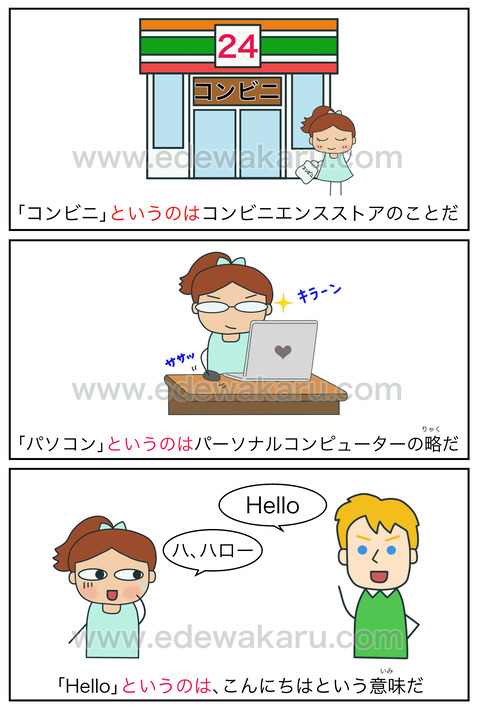
Meaning
説明・定義を表す
How to use it
動詞・形容詞・名詞[普通形]+というのは
動詞・形容詞・名詞[普通形]+とは
Explanation
「〜というのは」意味や内容の説明・定義を表す文型です。「〜というのは」の後ろには「〜のことだ」「〜という意味だ」など、よく使われる表現がいくつかありますので、一緒に覚えておきましょう😊
[「〜というのは」と一緒によく使う表現]
・
〜というのは+〜のことだ
・
〜というのは+〜という意味だ
・
〜というのは+〜の略だ
また定義・説明を表す場合は、「〜というのは」は「〜とは」にチェンジすることができます
😮日常会話(にちじょうかいわ)では「〜というのは」の方がよく使われます。
【驚き・信じられないという気持ち】を表すN1の「〜とは」と区別して覚えておきましょう。
(復習:〜とは(驚き))
[例]
①「コンビニ」
というのは
コンビニエンスストアのことだ
=「コンビニ」
とは
コンビニエンスストアのことだ
②「パソコン」
というのは
パーソナルコンピューターの略だ
=「パソコン」
とは
パーソナルコンピューターの略だ
「〜というのは」は口語形の「〜って」を使って表すこともできます
😊(復習:〜って(主題・定義))
[例]
「コンビニ」
って
コンビニエンスストアのことだ
「コンビニ」
っていうのは
コンビニエンスストアのことだ
「コンビニ」
ってのは
コンビニエンスストアのことだ
上の例は全部同じ意味です😄
この文型は言葉の意味を説明したりする時にとてもよく使いますので、しっかりと覚えておきましょう😉
In context 4 examples
「コンビニ」というのはコンビニエンスストアのことだ
→「コンビニ」はコンビニエンスストアのことだ「パソコン」というのはパーソナルコンピューターの略だ
→「パソコン」はパーソナルコンピューターの略だ「Hello」というのは「こんにちは」という意味だ
→「Hello」は「こんにちは」という意味だA:「マック」って何? (復習:〜って(主題・定義))B:「マック」というのは「マクドナルド」のことだよ
→「マック」は「マクドナルド」のことだよ
日本語文型辞典
Meaning
文を受け、前の文で述べられたことがらの原因・理由について説明したり、話し手の判断の根拠を後から付加的に述べるような場合に用いる。後に続く文は「…からだ/のだ」などで終わることが多い。「なぜなら」と似ているが、「なぜなら」が明確な因果関係がある場合に使われるのに対し、「というのは」は事情を付加的に説明する場合であれば、必ずしもはっきりとした因果関係がなくても使うことができる。また、「なぜなら」は書きことばで、「というのは」は話しことばで用いられることが多い。
「…ということは…(ということ)だ」と同義。
⇾ということ3
単語、語句、文の意味の定義、説明、解釈を示す表現。
How to use it
というのは
…というのは…ということだ
…というのまNのことだ
In context 7 examples
駅前の開発計画が急に取りやめになった。というのは、地域住民の強硬な反対で、マスコミまでが騒ぎだしたからだ。
申しわけありませんが、来週お休みをいただけないでしょうか。というのは、国から母が突然訪ねてくることになったんです。
A:あしたのご都合はいかがですか。
B:あしたはちょっと都合が悪いんです。というのは、東京に出かけることになっているものですから。レイさんが「少し遅くなる」というのは、一時間は遅れるということだ。
この地方全体で雨が一時間に10センチ降るというのは、洪水が起こるということだ。
パソコンというのはパーソナルコンピューターのことだ。
十五夜というのは、満月の出る夜のことだ。
日本語文型辞典 英語版
Meaning
B:あしたはちょっと都合が悪いんです。というのは、東京に出かけることになっているものですから。
Tomorrow is not really convenient for me. It’s because I am already scheduled to go to Tokyo.
This expression links to the preceding sentence and is used to explain the cause or reason for the situation described in that sentence, or to add a supplementary statement of the rationale for the speaker’s judgment, etc. The subsequent sentence, which starts with というのは, often ends with expressions such as からだ or のだ.
Although というのは is similar to なぜなら, なぜなら is used in cases of an obvious cause-effect relationship, while というのは does not necessarily require a clear cause-effect relationship when it is used to provide a supplementary explanation about a certain situation. Also, なぜなら is a written language expression, while というのは is most often used in spoken language.
This expression is synonymous with ということは...(ということ)だ.
→
3
Used to present a definition, explanation, or interpretation of the meaning of a word, phrase, or sentence.
How to use it
1. というのは
2. ...というのは...ということだ
3. ...というのはNのことだ
In context 7 examples
駅前の開発計画が急に取りやめになった。というのは、地域住民の強硬な反対で、マスコミまでが騒ぎだしたからだ。
The development plans for the area in front of the station were suddenly canceled. The reason for this was the stubborn opposition of local residents, which led to a furor in the mass media.
申しわけありませんが、来週お休みをいただけないでしょうか。というのは、国から母が突然訪ねてくることになったんです。
I am really sorry, but could I possibly have some time off next week? I’m asking this because my mother will be making an unexpected trip here from my hometown.
A:あしたのご都合はいかがですか。
How is your schedule tomorrow?
レイさんが少し遅くなるというのは一時間は遅れるということだ。
That Ray-san is going to be slightly delayed means he’ll be an hour late.
この地方全体で雨が一時間に10 センチ降るというのは、洪水が起こるということだ。
A rainfall of ten centimeters in just one hour over this entire region means that there will be floods.
パソコンというのはパーソナルコンピューターのことだ。
Pasokon means a personal computer.
十五夜というのは、満月の出る夜のことだ。
The term juugoya refers to a night with a full moon.
毎日のんびり日本語教師
How to use it
名詞+というのは+名詞+のことだ
名詞+とは+名詞+のことだ
名詞句+というのは+名詞句+ということだ
名詞句+とは+名詞句+ということだ
Explanation
単語や言葉について定義付けしたり、したりする文法です。
Notes
特になし
In context 6 examples
就活とは、就職活動のことだ。(“就活”是指就职活动。)
コンビニというのは、コンビニエンスストアのことだ。(所谓的“コンビニ”,就是便利店。)
満月とは、少しも欠けることなく全面が輝いて見える月のことである。
良い教師とは、学生のことを理解してあげられる教師のことだ。
名大というのは、名古屋大学のことだ。(名大就是名古屋大学。)
「馬には乗ってみよ人には添うてみよ」とは、何でも体験してみなければ分からないということだ。
IMABI
と Combination Particles IV
Read this IMABI lesson ↗Explanation
と Combination Particles IV
というのに という{の・こと}は とは{いえ・いいながら・いうもの}
というのに
というのに means “(al)though (that)”.
1. 彼女、何日も食くってないっていうのに、健康そうに見えたな。(ちょっと乱暴)
While she hadn’t eaten in days, she looked healthy.
Word Note: Remember that 食う is the vulgar form of 食べる.
2. 砂漠さばくはほとんど雨が降らないというのに、少数の植物は何とか生き永らえられるようだ。
While deserts receive almost no rain, it looks like a few plants are somehow able to manage to live there.
足が痛いくせに競走して勝ったんだ。
Even though his legs hurt, he ran and won!
彼女はもう大人のくせに、母親にまだ洗濯してもらってるそうだぞ。(Masculine)
Even though she’s already an adult, she still has her mother do the laundry!
やめろ。この間も傷ついたくせに。
Stop it! You got hurt just the other day, remember?
くせに VS ながら VS つつ
Question: It appears that these three expressions are interchangeable? If they aren’t, what is different about them?
Answer: There is one usage of ながら and つつ that is very similar to くせに and にもかかわらず.
As we learned in Lesson 55, the particle ながら can be used to show two opposing things happening simultaneously. For example, “despite hardship he achieved great things”. The two clauses should be similar in this matter. This is based on situations. For the most part, つつ is the same as ながら. It is not constructive as ながら is in expressions, but it is also used in patterns like つつある.
However, くせに・にもかかわらず simply shows that one moreover takes a contrary move. So, this usage is not grounds to use these expressions interchangeable. As mentioned, there is much more to ながら and つつ, and even in contrasting they’re not exactly the same.
という{の・こと}は
~ということは means “that means” and ~というのは means “the reason that”. Both are placed at the beginning of a sentence. In slang ~ということは may contract to ~ってことは. In extreme slang the entire phrase can be shortened to ~つうか.
10. ということは、まだ出張から帰ってないのだろう。
That means he probably hasn’t returned home from his business trip yet.
11. というのは、友達に騙だまされたことがあるからです。
The reason for that is that he has been deceived by his friends before.
12. というのも、新しい事業を始めたから。
The reason for that was that he started a new business.
と{はいえ・いうものの・いいながら}
~とはいえ/いいながら/いうものの means “even though”. The exact meanings are slightly different. The first emphasizes contrast with what “can be said”, the second is like “while though”, and the last is like “although…say”. They can more or less be translated as “even though” in English.
13. 梅雨つゆ・ばいうとはいえ、晴れる日もある。
Even though one may call it the rainy season, there are still also clear days.
Culture Note: The 梅雨 lasts from June to July. ばいう is a 書き言葉 reading.
14. 美味しいとはいいながら、まずいものも結構含まれている。
Though (this) may be delicious, there are bad things included as well.
15. まだ若いとはいうものの彼女はかなりの経験がある。
Even though she is young, she is quite experienced.
In context 8 examples
彼女、何日も食くってないっていうのに、健康そうに見えたな。(ちょっと乱暴)
While she hadn’t eaten in days, she looked healthy.
砂漠さばくはほとんど雨が降らないというのに、少数の植物は何とか生き永らえられるようだ。
While deserts receive almost no rain, it looks like a few plants are somehow able to manage to live there.
ということは、まだ出張から帰ってないのだろう。
That means he probably hasn’t returned home from his business trip yet.
というのは、友達に騙だまされたことがあるからです。
The reason for that is that he has been deceived by his friends before.
というのも、新しい事業を始めたから。
The reason for that was that he started a new business.
梅雨つゆ・ばいうとはいえ、晴れる日もある。
Even though one may call it the rainy season, there are still also clear days.
美味しいとはいいながら、まずいものも結構含まれている。
Though (this) may be delicious, there are bad things included as well.
まだ若いとはいうものの彼女はかなりの経験がある。
Even though she is young, she is quite experienced.
どんなときどう使う 日本語表現文型辞典
Meaning
a…is…
How to use it
N+というのは
Explanation
~は
1)ある語句の意味や定義を言うときに使う。「~というのは…ことだ・…ものだ・…という意味だ」という形を取ることが多い。「とは」と同じ意味・用法だが、「とは」より話し言葉的である。
2)くだけた会話では「っていうのは・って」という形になる。
1)Explains meaning or definition of phrase. Often in patterns ~というのは…ことだ,…ものだ…という意味だ. More colloquial than とは, but has same meaning and usage.
2)In informal speech becomes っていうのは, or って.
In context 4 examples
教育ママというのは自分の子どもの教育に熱心な母親のことです。
「いたしかたがない」というのはどういう意味ですか。
パソコンで「上書き保存」というのは訂正した文書を保存するという意味です。
A:空梅雨って何ですか。B:空梅雨っていうのは、ほとんど雨が降らない梅雨のことだよ。