AIUEO JLPT Grammar
Meaning
This sentence pattern expresses a result or situation contrary to expectations, predictions, or intentions. It often includes the speaker’s surprise or emotion in response to an unexpected event, and is used even in formal settings.
How to use it
名詞に+反して名詞に+反し
Explanation · 日本語
この文型は、期待や予測、意図などと反対の結果や状況を表す表現です。話し手の驚きや、予想外の出来事に対する感情を含む場合が多く、フォーマルな場面でも使われます。
In context 5 examples
予想に反して、試験は非常に簡単だった。
Contrary to expectations, the exam was very easy.
期待に反して、試合は引き分けに終わった。
Contrary to expectations, the match ended in a draw.
天気予報に反し、今日は一日中雨が降っている。
Contrary to the weather forecast, it’s been raining all day today.
契約書に反して、相手側は納期を守らなかった。
Contrary to the contract, the other party did not meet the deadline.
医者の忠告に反して、彼はまだタバコをやめない。
Contrary to the doctor’s advice, he still hasn’t quit smoking.
文法
Meaning
〜とは反対に、逆に
How to use it
N + に反して
N1 + に反する + N2
Notes
[よく一緒に使われる言葉]
予想、期待、意図
In context 10 examples
予想に反して、試験はとても難しかった。
専門家の予想に反して、景気は回復し始めた。
両親の意に反して、彼らは結婚した。
両親の期待に反して、彼は大学へ行かずアルバイトとして働いている。
周囲の反対意見に反して、マンション建設が進められた。
彼は校則に反して、こっそりタバコを吸っていた。
留学生は日本の法律に反して、長時間アルバイトをすると退学となり、国へ帰らなければいけません。
それは法律に反することなので、私にはできません。
私の希望に反して、海外支社への転勤を命じられた。
期待に反する判決だったので、被告は控訴することにした。
Bunpro Grammar Reference
Meaning
Go against, Contrary to
How to use it
Noun + に反し(て)
Noun + に反する + Noun
Nuance
A formal expression used when highlighting something that opposes, goes against, or is contrary to (A).
Explanation
に反して, a combination of に and the て-form of 反する 'to oppose', or 'to go against', is a construction in Japanese that is used to present counter opinions or arguments in relation to the previous statement. Common translations include 'contrary to (A), (B)', and 'going against (A), (B)'.
に反して will appear after nouns, before expressing some opposing or contrasting point. Alternatively, に反する may be used when directly modifying the following noun.
彼らは会社のルールに反して交際をしているらしい。
I heard that they are dating, which goes against the company rules.
予想に反してクライアントの反応がいまいちだったので、最初からやり直さなきゃいけない。
Contrary to our expectations, the client's response was not good, so we had to start over from the beginning.
私は上司の指示に反することはできません。
I cannot do anything that goes against my supervisor's instructions.
Unlike に対して, に反して will often be used when a prediction does not match the actual reality of a situation.
予想に反して早く終える事ができた。
Contrary to our expectations, we were able to finish early. (Natural Japanese)
予想に対して早く終える事ができた。
Contrary to our expectations, we were able to finish early. (Unnatural Japanese)
に反して is a fairly formal grammar pattern, so will be found mostly in literature, official documents, or speeches.
Nuance · 日本語
(A)に逆らう、(A)の逆、(A)に歯向かうということを強調する丁寧な表現。
Explanation · 日本語
「に反して」は「に」と「反する」のテ形の組み合わせで、前の意見に対する反論や対立する主張を述べるときに使われます。この表現は「(A) とは反対に (B)」「(A) とは違って (B)」のような意味で使われます。
「に反して」は名詞の後に置かれ、その後にはその名詞と対比、対立する内容が続きます。また、名詞を直接修飾する場合は「に反する」という形が使われます。
彼らは会社のルールに反して交際をしているらしい。
I heard that they are dating, which goes against the company rules.
予想に反してクライアントの反応がいまいちだったので、最初からやり直さなきゃいけない。
Contrary to our expectations, the client's response was not good, so we had to start over from the beginning.
私は上司の指示に反することはできません。
I cannot do anything that goes against my supervisor's instructions.
「に反して」は予想や期待と現実が一致しないときに使われることが多く、この点で「に対して」とは異なります。
予想に反して早く終える事ができた。
Contrary to our expectations, we were able to finish early. (Natural Japanese)
予想に対して早く終える事ができた。
Contrary to our expectations, we were able to finish early. (Unnatural Japanese)
「に反して」はかなり硬い文型なので、文学作品や公的な文書、スピーチの中で使われることが多いです。
In context 17 examples
- 神様の教えに反するようなことをしてはいけません。
I cannot do things that go against God's doctrine.
- 私は上司の指示に反することはできません。
I cannot do anything that goes against my supervisor's instructions.
- 彼らは会社のルールに反して交際をしているらしい。
I heard that they are dating, which goes against the company rules.
- 予想に対して早く終える事ができた。
Contrary to our expectations, we were able to finish early. (Unnatural Japanese)
- 予想に反して早く終える事ができた。
Contrary to our expectations, we were able to finish early. (Natural Japanese)
- 予想に反してクライアントの反応がいまいちだったので、最初からやり直さなきゃいけない。
Contrary to our expectations, the client's response was not good, so we had to start over from the beginning.
- 彼は法律に反して、大学に裏口入学した。
Going against the law, he bought his way into university.
- うちのチームは予想に反して、 昨年優勝したチームに勝ったよ!
Contrary to expectations, our team beat the team that won the race last year!
- モラルに反してまで成り上がった彼を、羨ましいとは思いません。
I am not envious of he, who even went against morality to move up in the world.
- 予想に反してものすごい売行きで、社員一同驚いている。
Contrary to expectations there was a huge (sales) demand, surprising all of the staff.
- ルールに反して、遠足に1000円以上のお菓子を持って来た子がいる。
Going against the rules, there were some kids that brought snacks on the excursion in excess of 1000 yen.
- 叔父さんの忠告に反してまで進めたプロジェクトだから、失敗するわけにはいきません。
Since it is a project that goes against my uncle's advice, I cannot afford to fail.
- 社長の意向に反してでも、人として正しい決定をすべきだ。
Even if it goes against the manager's ideas, people should do what is right.
- 父母の意志に反して、故郷を離れて首都に引っ越したんだ。
Contrary to the will of my parents, I left my hometown and moved to the capital.
- 他の古代帝国が崩壊したのに反し、アトランティスは現代まで存在している。
Contrary to other ancient empires that have collapsed, Atlantis still exists.
- ある子どもは毎日勉強していても悪い成績をとる。それに反して他の子どもは全然勉強をしていなくても良い成績をとる。
Contrary to some children receiving bad grades even if they study every day, others get good grades even if they do not study at all.
- 魔法の存在は常識に反することだが、作家の想像力のおかげで、私たちは本や映画で楽しむことができる。
The existence of magic goes against common sense, but thanks to the rich imagination of authors, we can dive into the world of magic through movies and books.
DoJG 日本語文法辞典(全集)
Usage 1
Meaning
Against; contrary to; in contrast to; in violation of; while; whereas
How to use it
(i) Noun | に反して | |
| 予想に反して | Contrary to expectation |
(ii) Sinformal | のに反して | Connection rules: the same as のだ |
| よく勉強するのに反して | In contrast to the fact that someone studies hard |
(iii) Demonstrative Pronoun | に反して | |
| これに反して | In contrast to this |
(iv) Noun | に反するNoun | |
| 予想に反する結果 | A result which is contrary to someone’s expectation |
Explanation
に反して/反する Contrary to or in contrast to.
In context 10 examples
今年の東京国際マラソンは大方の予想に反して無名の選手が優勝した。
Contrary to the majority's expectations, an unknown runner won the Tokyo International Marathon this year.
我が社はテレビの売れ行きが伸びているのに反してオーディオ製品の売れ行きが下がっている。
In our company, in contrast to the increase in sales of TV sets, the sales in audio products are decreasing.
S1:日本ではいい大学に入るのは難しいが卒業するのは易しいと言われている。S2:これに反して、アメリカではいい大学でも入学が比較的易しいが卒業するには相当勉強しなければならない。
S1: It is said that to enter good universities in Japan is difficult but to graduate from them is easy. S2: In contrast to this, in America even good universities are relatively easy to enter, but students must study quite hard to graduate from them.
妙子は意に反する結婚を押しつけられた。
Taeko was forced to marry. (literally: A marriage which was against Taeko's will was forced upon her.)
浩は両親の期待に反して高校を出てからコックになった。
Contrary to his parents' wishes, Hiroshi became a chef after finishing high school.
彼は自分の意思に反して賄賂を受け取ってしまった。
He was forced to accept a bribe. (literally: He received a bribe against his will.)
この規則に反して従業員を働かせた場合は一か月の営業停止になる。
Your business will be suspended for one month if you work your employees in violation of these rules.
奥村さんのうちはご主人が無口なのに反して奥さんが人一倍のおしゃべりだ。
In Okumura's family, whereas the husband is quite, the wife is very talkative.
日本での初等教育は生徒に知識を与えることに主眼が置かれている。これに反して、アメリカでは生徒の創造性や個性を伸ばすことに重点が置かれている。
The principle consideration of elementary education in Japan is to provide students with knowledge. In America, in contrast (to this), emphasis is put on increasing students' creativity and individual talents.
今回の選挙は一般の予想に反する結果に終わった。
The election this time ended up with results which were against the general prediction.
Usage 2
Meaning
Against; contrary to; in contrast to; in violation of; while; whereas
How to use it
(i) Noun | に反して | |
| 予想に反して | Contrary to expectation |
(ii) Sinformal | のに反して | Connection rules: the same as のだ |
| よく勉強するのに反して | In contrast to the fact that someone studies hard |
(iii) Demonstrative Pronoun | に反して | |
| これに反して | In contrast to this |
(iv) Noun | に反するNoun | |
| 予想に反する結果 | A result which is contrary to someone’s expectation |
Explanation
に反して/反する Contrary to or in contrast to.
どんなときどう使う 日本語表現文型辞典
Meaning
contrary to
How to use it
N+に反して
Explanation
~とは反対に
1)「Nに反して」の形で、Nには、予想・期待・意図などの言葉が来ることが多い。結果はそれらとは異なると言いたいときに使う。
2)より口語的な言い方として、「とは違って・とは反対に」などに言い換えることができる。
3)後に名詞が来るときは ❸ のように「に反するN」という形になる。
1)Often nouns such as 予想 (expectations), 期待 (expectations),意図 (intentions) are used.Shows results are contrary to expectations.
2)Inter-changeable with more colloquial expressions とは違って orとは反対に.
3)When followed by a noun, becomes に反する N, as in sentence ❸ .
In context 3 examples
予想に反して試験はとても易しかったです。
親の期待に反し、結局、彼は高校さえ卒業しなかった。
今回の選挙は、多くの人の予想に反する結果に終わった。
絵でわかる日本語
Meaning
〜とは違って
〜とは反対に
How to use it
名詞[辞書形]+に反して
Explanation
「〜に反して」は「〜とは違って」「〜とは反対に」という意味を表す文型です。
【予想】や【期待】が結果と違うと言いたい時に使われます😊
話し手が「意外だ」という気持ちを強調する場合
に使われます。使用される単語はほとんど決まっていますので、いくつか暗記しておきましょう😀
[「〜に反して」と一緒によく使う単語]
・予想に反して
・期待に反して
・予測に反して
・希望に反して
・規則に反して
・法律に反して
・〜の意思に反して
・〜の意に反して など
また
「Nに反する〜」「〜に反したN」
という形もあると覚えておきましょう😊
[例]
彼は法律
に反して、計画を実行した
彼は法律
に反する
計画を実行した
【Nに反する〜】
彼は法律
に反した
計画を実行した
【〜に反したN】
「〜に反して」はかたい言い方ですので、聞いてわかるようにしておきましょう😉
In context 4 examples
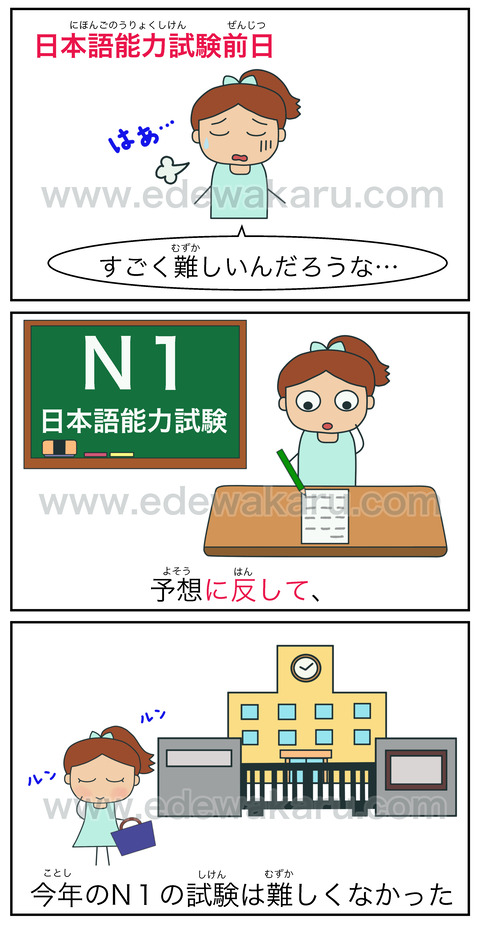
予想に反して、今年のN1の試験は難しくなかった
→予想とは違って、今年のN1の試験は難しくなかった予測に反して、今年の夏は涼しかった
→予想とは違って、今年の夏は涼しかった彼女は両親の期待に反して、進学しなかった
→彼女は両親の期待とは反対に、進学しなかったみんなの希望に反して、まったく人が集まらなかった
→みんなの希望とは反対に、まったく人が集まらなかった(復習:まったく〜ない)
くらべてわかる日本語表現文型辞典
Meaning
意味1:Aと合わない、つながらない現実のBを示す。
意味2:Aに従わないでB。Aの通りにしないでB。
How to use it
Aに反してB(Aに反したB/Aに反しB)
[名詞-∅]に反して
Explanation
【対比1】
「Aに対してB」(意味2 P.244)
「Aに対してB」は対立する二つの事柄を併記する。「Aに反してB」は現実が予想・願望などと異なることを示す。
○私の楽観的な予想に反して、現実はあまりに厳しかった。
×私の楽観的な予想に対して、現実はあまりに厳しかった。
【対比2】
「Aに対してB」(意味1 P.244)
「Aに対してB」は対象を示す。「Aに反してB」は反発する、従わないという意味である。
○彼がみんなの前でとった態度に対して、非難が巻き起こった。
×彼がみんなの前でとった態度に反して、非難が巻き起こった。
○田中さんの意見に対して、山田さんは意見を述べた。(山田さんの意見の対象は田中さんの意見)
○田中さんの意見に反して、山田さんは意見を述べた。(山田さんの意見は田中さんの意見に反する)
Notes
【注意2】
・Aは「人」ではなく、人の意見・考え・気持ちなど。Aは影響力のあるもので、BはAに釣り合うような重要な事柄。
○社長の意向に反して、彼はA社と取り引きをした。
×子供の意見に反して、母はチャンネルをかえた。
In context 8 examples
見かけに反して、彼は心優しい人だった。
客が押し寄せるだろうという予想に反して、空席が目立った。
政府の意図に反して、物価はそれほど下がらなかった。
ファッションだといって、季節に反した服装をしている若者が多い。
上司の命令に反し、独断で仕事を進めた。
父の遺言に反して、土地を手放さざるをえなかった。
規則に反した行為は厳しく取り締まる。
飛行機は重力に反して空を飛んでいるのだ。
日本語NET JLPT文法解説まとめ
Meaning
〜とは反対に、逆に
How to use it
N + に反して
N1 + に反する + N2
Explanation
contrary to
In context 10 examples
予想に反して、試験はとても難しかった。
専門家の予想に反して、景気は回復し始めた。
両親の意に反して、彼らは結婚した。
両親の期待に反して、彼は大学へ行かずアルバイトとして働いている。
周囲の反対意見に反して、マンション建設が進められた。
彼は校則に反して、こっそりタバコを吸っていた。
留学生は日本の法律に反して、長時間アルバイトをすると退学となり、国へ帰らなければいけません。
それは法律に反することなので、私にはできません。
私の希望に反して、海外支社への転勤を命じられた。
期待に反する判決だったので、被告は控訴することにした。
毎日のんびり日本語教師
How to use it
名詞+に反して/に反し
名詞+に反する
Explanation
予想、予測などの未来を予測する語について結果がそれらの予測と逆であることや、意志や期待に背くことを表します。
「反する」はルールや規則などに違反するという意味もあります。
Notes
特になし
In context 8 examples
大方の予想に反し、彼は金メダルを獲得した。
3000円の値が張る定食は期待に反して不味かった。
人の直感に反しているが、その正しさは数式が証明している。
このようなやり方は今の時代の流れに反している。
彼の行動はスポーツ精神に反する。(他的行为与体育精神相反。)
その端正な顔立ちに反し、性格は最悪。
その見た目に反して優しい人だった。
優しい人ほど自分の意志に反し、他人のためにと色々考えてしまう。
NINJAL 日本語文型データベース
Meaning
〜と全く違う結果や反対の結果になることを表すときに使います。
How to use it
Nに反して
Notes
「〜」には「予想・期待・意」など、意図や予想を表す名詞がきます。
In context 5 examples
親の期待に反して、兄は曾祖父の代から続いている和菓子屋は継がずにサラリーマンになりました。
予想に反して、発売されたその新商品の売れ行きは伸びなかった。
東京本社で働きたいという夫の希望に反して、海外赴任の辞令が下りてしまった。
健太は経済的な事情から、自分の意志に反して学校をやめなければならなかった。
意見が対立すると話が進まない。だから、私は自分の意に反して彼女の意見に同意することもよくある。
IMABI
Compare/Contrast
Read this IMABI lesson ↗Explanation
Compare & Contrast: ~に比べて, ~に引き換え, ~に反して,~にもまして, & ~ないまでも
The patterns in this lesson deal with compare and contrast. Although not near as similar to each other as topics in other lessons, you still need to pay attention to detail so that you don’t confuse them with each other.
~{に・と}比べて
The verb 比べる means “to compare,” and because it is the quintessential verb for establishing comparisons, it is heavily used with the standard marking function of both the case particle に and the case particle と, and the choice between the two rests in how they differ in directionality.
XをYと比べる compares X and Y on an even playing field regardless of whether the comparison is contrastive, resulting in a more formal tone. As for XをYに比べる, Y is viewed as the standard for which the contrast that follows is based. Imagine with と that X and Y are brought together and compared side by side (X→←Y), while with に, the direction of focus is pointed at Y (X→Y). Consequently, because the focus is pointed at Y with に, it carries an implication about the merits of the comparison, which is not had with と.
Instead of seeing this grammar point rendered in the て form, you may also see it without て in formal speech (連用形中止法), or you may even see 比べると or any other conditional provided that you account for the unique layer of nuancing provided by said conditional grammar pattern – with 比べると being neutral but to the point.
1. 外は暑いが、それに比べて中は寒い。
It’s hot outside, but, moreover, in contrast, it’s cold inside.
2. この本は昨日読んだのと比べると全くつまらない。
This book compared to the one I read yesterday is completely boring.
3. 彼は妹と比べて若く見えました。
He looked younger beside his younger sister.
4. 今年は去年に比べ、雪の量りょうが多い。
In contrast to last year, there has been a lot of snowfall this year.
5. 欧米諸国の薬剤費が全体の一〇~ニ〇%にとどまっているのに較べて異常な数値だ。
(That) is a bizarre figure in comparison to the pharmaceutical costs of Western countries being confined to 10~20% of their total (costs).
Orthography Note: In formal writing, you may also see the verb 比べる spelled as 較べる.
~に引き換え vs ~と引き換えに
The verb 引き換える has two definitions, each which produces two unique grammar structures which hinge on how に and と differ as standard markers.
The pattern ~に引き換え follows nouns or nominalized expressions to indicate a sharp contrast, one that is both subjective and pertaining to a good vs. bad judgment call by the speaker.
When following nominalized expressions, the nominalizer of choice is the particle の, as is to be expected due to the highly subjective nature of this pattern.
6. 健太の住んでいるマンションは新しくて、広い。それに引き換え、僕のところは古くて狭いし、駅からも遠いよ。
The apartment that Kenta is living at is new and wide. By contrast, my place is old, small, and also far from the train station.
7. 同じ年の人に引き換え、彼はとても頭がよくて、たくさんの素晴らしい偉業いぎょうを成し遂とげました。
In sharp contrast to people of his same age, he is very smart and has made a lot of wonderful achievements.
8. 惑星わくせいの大きさに引き換え、冥王星めいおうせいはとても小さい。
In sharp contrast to the size of a planet, Pluto is very small.
When a contrast is not subjectively charged and the contrast being made is neutral in nature, ~に引き換え will not be the natural word choice. Instead, something like ~に対して would need to be used to enforce neutrality.
9. 整備して明るくなった竹林にはタケノコが生えているのに{対して 〇・引き換え X}、まだ整備していないところは竹が密生して暗く、タケノコが生えていない。
In bamboo forest areas that have gotten brighter from (the light fixtures) we set up, bamboo shoots are growing, whereas in areas where we have not set up (light fixtures), with the bamboo so dense and it being so dark, bamboo shoots are not growing.
The pattern ~と引き換えに means “in exchange for,” and from this we can gather how there is always a difference in directionality between に and と. In Exs. 6-8, we can envision a shift from one expectation, which we will call X, to some other reality, which we will call Y. This X → Y directionality is a fundamental property of に. Meanwhile, the directionality of と is X→←Y, and in this context of “exchange,” factors X and Y merely swap places. Similarly to ~に引き換えに, though, ~と引き換えに often remains highly subjective and emotionally charged, especially when Y is a situation (not restricted to nouns) as opposed to a concrete noun.
10. あいつはわずかなお金と引き換えに、自分の友達を裏切った。
That guy betrayed his own friends in exchange for a measly amount of money.
11. 犯人は人質と引き換えに大金を要求してきた。
The criminal came demanding for a large sum of money in exchange for the hostage(s).
~に反して
The verb 反する may be defined as “to be contrary/go against/violate,” and it is often seen in the pattern Xに反してY to indicate that “Y is contrary to/against X.”
12. 予想よそうに反して成功するのはいつもいいことでしょう。
Succeeding against one’s expectations is always a good thing isn’t it?
13. 神の意に反して人間は互たがいに殺害している。
Against the will of God, humans are slaying each other.
14. 2006年に反して、2007年のステンレス鋼スクラップの貿易では、欧州が輸出を増し、東南アジアが輸入を増した。
Contrary to (the expectation set by) 2006, Europe increased its exports and Southeast Asia increased its imports in the 2007 stainless steel scrap market.
15. 大方の期待に反してサービスの展開が遅れている。
the extending of services is delayed contrary to most expectations.
Note that although this verb is often seen in the て form, it is not limited to it. You may see it as the main verb, modifying another noun in the 連体形, or even see て dropped via 連用形中止法.
16. 我々の期待に反していた。
It was contrast to our expectations.
17. これは直感に反しているが、正しい主張だ。
This may be contrary to intuition, but it is the correct assertion.
18. スポーツ精神に反する卑劣な行為であります。
(It) is a contemptible act contrary to sportsmanship.
19. アメリカの4月の耐久財受注は前の月から減少するとの市場予想に反し、0.7%増加しました。
Durable goods manufacture’s orders for America in April increase 0.7% contrary to market expectation which foresaw a decline from the previous month.
Some learners confuse the purpose of the 連用形 and 連体形 with this construction, but it is important to note how the components of the sentence in relation to ~に反する are not the same. In the case of the 連用形, Y is a verbal expression, whereas in the case of the 連体形, Y is another noun.
20. 国防長官こくぼうちょうかんは事実に反する報告をしました。
The Secretary of Defense made a report contradictory to the facts.
21. 予想に反した1結果が出ると「なぜだろう?」という探究心が生まれ、ますます学ぶ意欲が湧いてきます。
The inquisitive mind is borne from the question of “why?” from getting results contrary to one’s expectations, which brings about all the more ambition to study.
~にもまして
~にもまして, which attaches to nouns including interrogatives, indicates that a current extent builds on a previous/aforementioned one. If a comparison does not have it that both reference points share the same quality to start out with, the use of ~にもまして becomes unnatural and would need to be replaced with something else like the particle より.
22. 今年は去年にもまして暑さが厳しい。
The heat is far more severe than even last year.
23. 最近は以前にもまして物覚えが悪くなった。
Recently, my memory has gotten worse than it was even before.
24. テイラー君は病気がちなセス先生{にもまして X・より 〇}体力があります。
Taylor-kun has more stamina than Seth Sensei, who has a tendency of getting sick.
25. 遼平君は何にも増してマルガリータが好きだ。
Ryо̄hei-kun loves margaritas above all else.
26. 今日はいつにも増して暑い。
Today is hotter than it usually is.
As indicated by the Kanji spelling in Ex. 26, the 増して in this expression derives from the verb 増す meaning “to increase.”
~ないまでも
The pattern ~ないまでも indicates that V1, though not exactly reaching the extent the speaker would prefer, it still reaches the threshold with which V2 is carried out.
27. 毎週とはいわないまでも、せめて月に1回は映画館に行きたい。
Not that it’d have to be every week, but I’d like to at least go to the movies once a month.
28. 快晴かいせいとはいかないまでも、雨は降らないでほしい。
Not that I won’t go if it doesn’t turn out to be clear weather, but I’d like it to not rain.
The use of ~た emphasizes that the realization at hand (the results), which is contrary to the expectation that the speaker had, has occurred as such and remains the case. ↩︎
In context 28 examples
外は暑いが、それに比べて中は寒い。
It’s hot outside, but, moreover, in contrast, it’s cold inside.
この本は昨日読んだのと比べると全くつまらない。
This book compared to the one I read yesterday is completely boring.
彼は妹と比べて若く見えました。
He looked younger beside his younger sister.
今年は去年に比べ、雪の量りょうが多い。
In contrast to last year, there has been a lot of snowfall this year.
欧米諸国の薬剤費が全体の一〇~ニ〇%にとどまっているのに較べて異常な数値だ。
(That) is a bizarre figure in comparison to the pharmaceutical costs of Western countries being confined to 10~20% of their total (costs).
健太の住んでいるマンションは新しくて、広い。それに引き換え、僕のところは古くて狭いし、駅からも遠いよ。
The apartment that Kenta is living at is new and wide. By contrast, my place is old, small, and also far from the train station.
同じ年の人に引き換え、彼はとても頭がよくて、たくさんの素晴らしい偉業いぎょうを成し遂とげました。
In sharp contrast to people of his same age, he is very smart and has made a lot of wonderful achievements.
惑星わくせいの大きさに引き換え、冥王星めいおうせいはとても小さい。
In sharp contrast to the size of a planet, Pluto is very small.
整備して明るくなった竹林にはタケノコが生えているのに{対して 〇・引き換え X}、まだ整備していないところは竹が密生して暗く、タケノコが生えていない。
In bamboo forest areas that have gotten brighter from (the light fixtures) we set up, bamboo shoots are growing, whereas in areas where we have not set up (light fixtures), with the bamboo so dense and it being so dark, bamboo shoots are not growing.
あいつはわずかなお金と引き換えに、自分の友達を裏切った。
That guy betrayed his own friends in exchange for a measly amount of money.
犯人は人質と引き換えに大金を要求してきた。
The criminal came demanding for a large sum of money in exchange for the hostage(s).
予想よそうに反して成功するのはいつもいいことでしょう。
Succeeding against one’s expectations is always a good thing isn’t it?
神の意に反して人間は互たがいに殺害している。
Against the will of God, humans are slaying each other.
2006年に反して、2007年のステンレス鋼スクラップの貿易では、欧州が輸出を増し、東南アジアが輸入を増した。
Contrary to (the expectation set by) 2006, Europe increased its exports and Southeast Asia increased its imports in the 2007 stainless steel scrap market.
大方の期待に反してサービスの展開が遅れている。
the extending of services is delayed contrary to most expectations.
我々の期待に反していた。
It was contrast to our expectations.
これは直感に反しているが、正しい主張だ。
This may be contrary to intuition, but it is the correct assertion.
スポーツ精神に反する卑劣な行為であります。
(It) is a contemptible act contrary to sportsmanship.
アメリカの4月の耐久財受注は前の月から減少するとの市場予想に反し、0.7%増加しました。
Durable goods manufacture’s orders for America in April increase 0.7% contrary to market expectation which foresaw a decline from the previous month.
国防長官こくぼうちょうかんは事実に反する報告をしました。
The Secretary of Defense made a report contradictory to the facts.
予想に反した1結果が出ると「なぜだろう?」という探究心が生まれ、ますます学ぶ意欲が湧いてきます。
The inquisitive mind is borne from the question of “why?” from getting results contrary to one’s expectations, which brings about all the more ambition to study.
今年は去年にもまして暑さが厳しい。
The heat is far more severe than even last year.
最近は以前にもまして物覚えが悪くなった。
Recently, my memory has gotten worse than it was even before.
テイラー君は病気がちなセス先生{にもまして X・より 〇}体力があります。
Taylor-kun has more stamina than Seth Sensei, who has a tendency of getting sick.
遼平君は何にも増してマルガリータが好きだ。
Ryо̄hei-kun loves margaritas above all else.
今日はいつにも増して暑い。
Today is hotter than it usually is.
毎週とはいわないまでも、せめて月に1回は映画館に行きたい。
Not that it’d have to be every week, but I’d like to at least go to the movies once a month.
快晴かいせいとはいかないまでも、雨は降らないでほしい。
Not that I won’t go if it doesn’t turn out to be clear weather, but I’d like it to not rain.