AIUEO JLPT Grammar
Meaning
This sentence pattern is used to describe an attempt to do something that was thwarted due to missed opportunities or circumstances. It conveys the inability to carry out an intended action because of timing or other factors.
How to use it
動詞ます形+そびれる
Explanation · 日本語
この文型は、何かをしようとしたが、機会を逃してできなかったことを表す表現で、何かをしようとしたものの、タイミングや状況によって実行できなかったことを説明するときに使用されます。
In context 5 examples
朝寝坊して、電車に乗りそびれた。
I overslept and missed the train.
仕事が終わらず、映画を見に行きそびれた。
I couldn’t finish my work and missed the movie.
結局、タイミングを逃して、告白しそびれました。
In the end, I missed the timing and couldn’t confess.
彼にお礼を言いそびれてしまった。
I missed the chance to thank him.
話そうと思っていたけど、忙しくて話しそびれたんです。
I wanted to talk, but I was too busy and missed the chance.
絵でわかる日本語
Meaning
(〜ようと思っていたのに)〜できなかった
How to use it
動詞[ます形]+そびれる
Explanation
「〜そびれる」は「〜しようと思っていたのに、〜できなかった」という意味の文型です。何か理由があって、「したかったこと」や「しなければいけなかったこと」ができなかったと言いたい時に使われます。
[例]
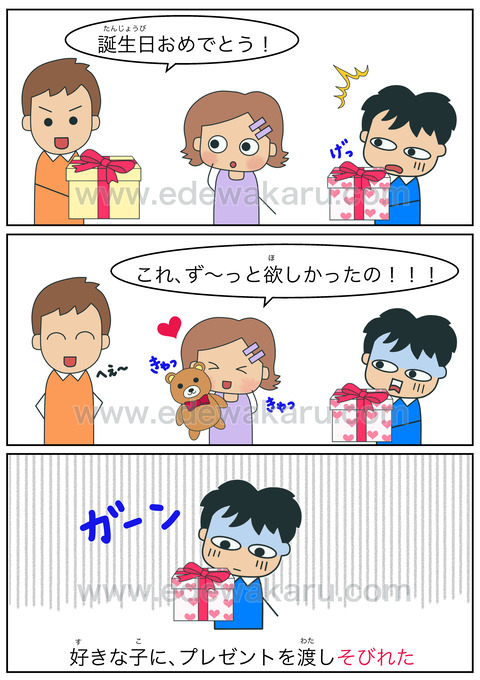
①好きな子に、プレゼントを渡し
そびれた
→プレゼントを渡そうと思っていたが、友達が先に渡したので渡せなかった
②急いでいたので、たまごを買い
そびれてしまった
→たまごを買おうと思っていたが、急いでいたので買えなかった
③残業だったので、見たかったドラマを見
そびれてしまった
…
→ドラマを見ようと思っていたが、残業だったので見ることができなかった
④寝坊して、朝ごはんを食べ
そびれてしまった
→朝ごはんを食べようと思っていたが、寝坊したので食べなかった
⑤娘:お父さんに、留学してもいいか聞いといてくれた?
母:なんだか昨日はとても疲れてたみたいで、聞き
そびれちゃった
の
娘:じゃあ、今日聞いてみてね
→聞きたかったが、疲れている様子だったので聞けなかった
「〜そびれる」は、勉強する機会が少ない文型です。上級レベルの人は覚えておきましょう😉
【文法リスト】
In context 5 examples
好きな子に、プレゼントを渡しそびれた
急いでいたので、たまごを買いそびれてしまった
残業だったので、見たかったドラマを見そびれてしまった…
寝坊して、朝ごはんを食べそびれてしまった
娘:お父さんに、留学してもいいか聞いといてくれた?母:なんだか昨日はとても疲れてたみたいで、聞きそびれちゃったの娘:じゃあ、今日聞いてみてね
毎日のんびり日本語教師
Meaning
~しようと思っていたけど、機会がなくてできない
How to use it
動ます形+そびれる
Explanation
すべきことやしようと思っていたことが何らかの理由でできなかったことを表します。
Notes
似た文型に「動ます形+忘れる」があります。
①
宿題をし忘れた。
頭の中から宿題の存在を完全に忘れたので宿題をしなかった。文字通り忘れていた。
②
宿題をしそびれた。
(没有写完作业。)
宿題をしなければならないという事はずっと分かっていたが、何か他の用事等があって宿題をする時間がなく、結局宿題をしなかった。忘れていたのではなく、機会がなくてできなかった。
似ている文法「~損なう/損ねる/損じる」
「~そびれる」:しようと思っていたけど機会を失いできなかった。
「~損なう/損ねる/損じる」:したけどやり方を間違える等して失敗した。
In context 8 examples
買い物に行きそびれたせいで、冷蔵庫に何もない。
質問しようと思ったけど、緊張で言いそびれてしまった。
なんだかよく分からないうちにプレゼントを渡しそびれてしまった。
バスが混んでて降りそびれてしまった。
お風呂入って、洗濯してたら見たい番組見そびれた。
せっかく買ったお土産を渡しそびれた。
年末に家族が次から次へとインフルエンザに感染し初詣に行きそびれた。
遅刻して飛行機に乗りそびれた。
NINJAL 日本語文型データベース
Meaning
〜しようと思っていたが、結局機会を逃して〜しないまま終わってしまうことを表します。
How to use it
Notes
「〜」には、「言う・返す・(手紙を)出す」など、意志的な行為を表す動詞がきます。
In context 5 examples
パーティーのとき知人を見かけたが、すぐに帰ってしまったようで、挨拶をしそびれた。
先生「ああ、大事なことを言いそびれるところでした。来週はテストがあります」
手紙を出しそびれて、かばんの中に入れたまま一日持ち歩いてしまった。
昨日は、帰りが遅くなることを連絡しそびれてしまって、親に心配をかけた。
今度の説明会で知りたいことを聞きそびれないように、あらかじめ質問リストを作っておこう。
IMABI
Miss out
Read this IMABI lesson ↗Explanation
Miss out: ~残す, ~漏らす, ~損なう, ~そびれる, ~損じる, & ~逃す
In this lesson, we will learn about even more compound verb endings. As the title indicates, all of these endings are in reference to missing out on doing something.
~残す
残のこす means “to save/leave”. In compound verbs it builds upon this meaning to show that “something important was not done before leaving”. 残る, the intransitive form, can similarly appear with some words to imply a sense of “being left” in a certain state.
1. その仕事はやり残したんです。
I left the work undone.
2. ソーダを残しておいて。
Save me some soda.
3. 動物の数え方は食べ残る部分からきたと思われる。
It is believed that the method of counting animals comes from the parts left over after eating (them).
4. 食べ残りを排水口に捨てない方がいいと聞いたんですが、本当ですか。
I heard that it is best not to put scraps in the disposal, but is this true?
5. お客さんが食べ残しを持ち帰って体調を崩した場合、飲食店はどのような責任があるのですか。
In the case a customer brings home left overs and gets ill, does the food establishment have any responsibility?
Word Note: 食べ残り and 食べ残し both exist, but the former refers to scraps that aren’t suitable for eating later. The latter is “leftovers”. As a society, Japanese people don’t like for there to be leftovers. Businesses are weary of customers getting sick from leftovers and customers feel a responsibility not to order more than they can eat. Nonetheless, more places in Japan are beginning to add guidelines as to how to make sure leftovers can be taken home safely.
6. 食べ残したご飯を翌日に食べるようにすればよいのでは?
Wouldn’t it be good to try to eat left over meals the next day?
7. 食べ残して捨てるのはもったいないです。
Throwing away what you have left over from eating is wasteful.
8. 飲み残したワインを味を落とさないで保存する方法はありますか。
How do you preserve left over wine without losing its taste?
9. 耐乏生活に生き残る。
To live through austerity.
~漏らす
漏もらす means “to leak” and is in compound verbs to show that one ends up not doing something important due to carelessness.
10. 必要なことを言い漏らす。
To end without saying something necessary.
11. うっかりして年月日ねんがっぴを書き漏らした。
I carelessly forgot to write down the date.
12. 大事なところを聞き漏らした。
I failed to listen to a crucial part.
Contrast Note: The last word is not exactly the same as 聞き逃す, which implies that you didn’t listen to the entire thing.
~損なう・~そびれる・~損じる・~逃す
損そこなう means “to spoil/ruin” and what happens is always the subject’s fault. In compounds it shows what one missed out on doing, and it may be interchangeable with the suffix ~そびれる. Another similar ending is ~損そんじる which may show that one misses out on or fails in doing something. ~逃のがす is also possible.
漢字 Note: 損なう is often left in かな.
13. ボールを捕とり損そこなう。
To miss the ball.
14a. 彼の言ったことを聞き損なった。
14b. 彼の言ったことを聞きそびれた。(More natural)
I missed out on what he said.
Variant Note: 聞きそびれた would have been a better choice in the sentence above. This is because 聞きそこなう can also mean “mishear”.
15a. 健康を害そこなった。
15b. 健康を損なった。(Normal spelling)
15c. 健康を害した。(Alternative phrase)
He ruined his health.
16. 急せいては事ことを仕損しそんじる。(ことわざ)
Haste makes waste.
Literally: Rushing fails things.
Orthography Note: 仕損じる means “to blunder”. It is often spelled as し損じる, but it can also be seldom spelled as 為損じる. 為る is actually how you would spell する as in “to do” in 漢字. The normal spelling 仕損じる is actually 当て字.
17. 手紙を書き損じた。
I made a mistake in writing the letter.
18. 言い損ずる。 (Old-fashioned)
To miss out saying.
Word Note: The following is normally 言い損なう or 言い損ねる.
Variant Note: Remember that ~じる and ~ずる are variants of each other and that both are voiced forms of する. ~ずる is typically rarer and more formal.
19a. 遊ぶ機会を{逸した・逃してしまった}のは残念です。(Most natural)
19b. 遊びそこねたのは残念です。(OK)
It’s a shame that he missed out on playing.
20. 死に損なって生き恥をさらす。
To fail to die and live on with one’s shame exposed.
21. 寝坊ねぼうしたとき、学校に来る前に何をしそびれましたか。
What did you not do when you came to school after having overslept?
22. 演説えんぜつを聞き逃のがす。
To fail to listen to the speech.
23. 見逃してしまうよ。
You’re missing it/you’re going to miss it!
Orthography Note: For the meaning of “ruin”, 損なう may also be written as 害う. However, because this is not a reading in the 常用漢字表, unversed speakers will not know how it is read and assume it is an error. As such, it is best to only recognize it for when it does show up in literature.
Speech Style Note: ~損ずる is the same as ~損じる etymologically, but the latter is slightly less literary but still unlikely to be used in the spoken language.
In context 27 examples
その仕事はやり残したんです。
I left the work undone.
ソーダを残しておいて。
Save me some soda.
動物の数え方は食べ残る部分からきたと思われる。
It is believed that the method of counting animals comes from the parts left over after eating (them).
食べ残りを排水口に捨てない方がいいと聞いたんですが、本当ですか。
I heard that it is best not to put scraps in the disposal, but is this true?
お客さんが食べ残しを持ち帰って体調を崩した場合、飲食店はどのような責任があるのですか。
In the case a customer brings home left overs and gets ill, does the food establishment have any responsibility?
食べ残したご飯を翌日に食べるようにすればよいのでは?
Wouldn’t it be good to try to eat left over meals the next day?
食べ残して捨てるのはもったいないです。
Throwing away what you have left over from eating is wasteful.
飲み残したワインを味を落とさないで保存する方法はありますか。
How do you preserve left over wine without losing its taste?
耐乏生活に生き残る。
To live through austerity.
必要なことを言い漏らす。
To end without saying something necessary.
うっかりして年月日ねんがっぴを書き漏らした。
I carelessly forgot to write down the date.
大事なところを聞き漏らした。
I failed to listen to a crucial part.
ボールを捕とり損そこなう。
To miss the ball.
彼の言ったことを聞き損なった。
I missed out on what he said.
彼の言ったことを聞きそびれた。(More natural)
I missed out on what he said.
健康を害そこなった。
He ruined his health.
健康を損なった。(Normal spelling)
He ruined his health.
健康を害した。(Alternative phrase)
He ruined his health.
急せいては事ことを仕損しそんじる。(ことわざ)
Haste makes waste.
手紙を書き損じた。
I made a mistake in writing the letter.
言い損ずる。 (Old-fashioned)
To miss out saying.
遊ぶ機会を{逸した・逃してしまった}のは残念です。(Most natural)
It’s a shame that he missed out on playing.
遊びそこねたのは残念です。(OK)
It’s a shame that he missed out on playing.
死に損なって生き恥をさらす。
To fail to die and live on with one’s shame exposed.
寝坊ねぼうしたとき、学校に来る前に何をしそびれましたか。
What did you not do when you came to school after having overslept?
演説えんぜつを聞き逃のがす。
To fail to listen to the speech.
見逃してしまうよ。
You’re missing it/you’re going to miss it!