日本語文型辞典
Meaning
基本情報説明ある状況に対して、怒りや同情などの感情を感じないではいられないという意味を表す。抑えようとしてもそのような感情をもってしまうというときに使う。かたい書きことば。例文① 思いがけない事故で家族を失った方々には同情を禁じえません。② 戦場から切々と訴えかける手紙に涙を禁じえない人も多いだろう。③ 母の死を知らず無邪気に遊んでいる子供にあわれみを禁じえなかった。④ この不公平な判決には怒りを禁じえない。⑤ 期待はしていなかったが、受賞の知らせにはさすがに喜びを禁じ得なかった。
日本語文型辞典 英語版
Meaning
Means that a person cannot help but feel emotions such as anger and compassion in response to a certain situation. Used where such a feeling is held in spite of attempts to repress it. Formal, written expression.
In context 5 examples
思いがけない事故で家族を失った方々には同情を禁じえません。
I cannot help but sympathize with people who have unexpectedly lost their families in accidents.
戦場から切々と訴えかける手紙に涙を禁じえない人も多いだろう。
Many people must be moved to tears at the poignant letters of appeal from the battlefield.
母の死を知らず無邪気に遊んでいる子供にあわれみを禁じえなかった。
I couldn’t help but feel compassion for the children who innocently played, unaware of their mother’s death.
この不公平な判決には怒りを禁じえない。
I cannot help but feel anger at this unfair sentence.
期待はしていなかったが、受賞の知らせにはさすがに喜びを禁じ得なかった。
I hadn’t expected it but I couldn’t help but be delighted at the notification that I had won a prize.
IMABI
Can’t Help III
Read this IMABI lesson ↗Explanation
Can’t Help III: ~ないではすまない, ~ないではおかない, ~を余儀なく[される・させる], & ~を禁じ得ない
These are even more difficult phrases dealing with not being able to help one’s emotions, etc. Not only do you need to try to separate these in your mind from the phrases found in the two previous lessons about this topic, but you’re going to have to pay even more attention to the differences among these patterns.
~{ないで・ずに}はすまない
Also seen as ~ずにはすまない, which is more formal but can still be found used in the spoken language, is used to show that if one thinks from a societal point of view with a given circumstance, doing something is simply and certainly unavoidable. It is difficult to use, however, when you think that you have to do something from personal emotion. Given that the phrase is stiff, this should be understandable.
1. 人の心を傷つけてしまったなら、謝らずにはすまない。
If you are to hurt someone’s heart, you can’t avoid apologizing.
2. 借金をせずにはすむまい。(古風で、硬い言い方)
You can’t get by without borrowing money.
3. 親に知られたら叱られないではすまないよ。
If your parents found out, you won’t be able to avoid getting scolded.
The non-double negative form above result in ~ないで済すむ, which means “to get by without…”. Just as in English, this implies a good thing because you got away without doing something. 済む itself may show that something is done.
4. 済んだことだ。
It’s finished.
5. 済んだのですか。
Is it over?
6. 金を払わないで済みました。
I got by without paying for it.
7. 気づかれずに済む。
To escape attention.
8. 彼が怪我けがをせずに済んでよかった。
I’m glad that he got by without injury.
9. 冗談じょうだんですまない。
To go beyond a joke. (Shows guilt)
10. 済んだことは元もとに戻もどらない。
What’s done cannot be undone.
11. 蜂を見つけたら、ゆっくり離れたほうがいい。体に止まっても振り払わずにじっとしていれば刺されずに済むよ。
If you are to find a bee, it’s best to separate oneself from it slowly. Even if it lands on you, you can leave without being stung if you stay still.
12. もう一つは、犯行後、同じように夜を待ち、普通の道を河内長野方面に向かって歩いたかもしれないことだ。これは車道以外に近道の旧道もあるので、ここを歩けば夜間は誰にも見られずに済む。
Another possibility is that (the criminal) waited just like that for night after the crime and walked down a regular road toward Kawachi-Nagano. This could go without being seen by anyone at night walking through here because there are also old shortcuts aside from the roadway.
From 二重葉脈 by 松本清張.
~{ないで・ずに}はおかない
Also seen as ~ずにはおかない, this pattern is used to show that one will certainly happen naturally or that you won’t allow something to stay not being done. It shows strong resolution. The situation where one won’t allow for something deals with first person. However, the first situation deals with subjects outside of first person, which includes inanimate things.
13. あの話はやはり嘘だったと、絶対に白状はくじょうさせないではおかないぞ。
If that was indeed a lie, I will absolutely not stand without making (that person) confess.
14. 彼女が歌ったのは聞く人の心を揺ゆさぶらずにはおかない。
What she had sung will surely move the hearts of those who hear.
~を余儀なく[される・させる]
余儀 よぎ means “another way/problem” and 余儀ない expresses “out of one’s control”. So, ~を余儀なくされる, shows that one had to do something that was not of one’s will and there was no other choice to get around it. You are essentially driven into a corner in a certain situation. This can also be seen in the causative as ~を余儀なくさせる. Usually the subject of sentences with ~を余儀なくされる is usually human, but the subject of sentences with ~を余儀なくさせる is usually not human but a something.
15. 悪天候のため試合の中止を余儀なくされました。
Bad weather made us postpone the match.
16. アメリカの圧力が貿易ぼうえき自由化を余儀なくさせた。
American pressure made free trade unavoidable.
17. 暴風雨で遠足は延期を余儀なくされた。
We had to put off the field trip due to fierce rain.
18. {余儀ない・やむを得ない}事情で欠席しました。
I was absent due to an uncontrollable situation.
19. 辞任を余儀なくされる。
To become out of one’s control to resign.
~を禁じ得ない
Although most dictionaries will just tell you this is the same as ~ないではいられない, this is not enough information to help you get a question right about it on the JLPT. Like all the other phrases in this series, this phrase describes not being able to withhold emotions, but this portrays an image of not being able to restrain emotions that have sprung up due to the circumstances. This phrase attaches to nouns that imply emotion. Sentences with it are usually first person.
20. 涙を禁じえなかった。
I couldn’t hold back the tears.
21. 犯人の供述を聞き、犯行動機はんこうどうきの身勝手みがってさに怒いかりを禁じ得なかった。
I couldn’t withhold my anger at the selfishness of the motive from listening to the criminal’s affidavit.
22. 同情の念を禁じえない。
I can’t hold back sympathy
23. 残された子犬を見て、涙を禁じ得なかった。
I couldn’t hold back the tears from looking at the puppy that was left.
In context 23 examples
人の心を傷つけてしまったなら、謝らずにはすまない。
If you are to hurt someone’s heart, you can’t avoid apologizing.
借金をせずにはすむまい。(古風で、硬い言い方)
You can’t get by without borrowing money.
親に知られたら叱られないではすまないよ。
If your parents found out, you won’t be able to avoid getting scolded.
済んだことだ。
It’s finished.
済んだのですか。
Is it over?
金を払わないで済みました。
I got by without paying for it.
気づかれずに済む。
To escape attention.
彼が怪我けがをせずに済んでよかった。
I’m glad that he got by without injury.
冗談じょうだんですまない。
To go beyond a joke. (Shows guilt)
済んだことは元もとに戻もどらない。
What’s done cannot be undone.
蜂を見つけたら、ゆっくり離れたほうがいい。体に止まっても振り払わずにじっとしていれば刺されずに済むよ。
If you are to find a bee, it’s best to separate oneself from it slowly. Even if it lands on you, you can leave without being stung if you stay still.
もう一つは、犯行後、同じように夜を待ち、普通の道を河内長野方面に向かって歩いたかもしれないことだ。これは車道以外に近道の旧道もあるので、ここを歩けば夜間は誰にも見られずに済む。
Another possibility is that (the criminal) waited just like that for night after the crime and walked down a regular road toward Kawachi-Nagano. This could go without being seen by anyone at night walking through here because there are also old shortcuts aside from the roadway.
あの話はやはり嘘だったと、絶対に白状はくじょうさせないではおかないぞ。
If that was indeed a lie, I will absolutely not stand without making (that person) confess.
彼女が歌ったのは聞く人の心を揺ゆさぶらずにはおかない。
What she had sung will surely move the hearts of those who hear.
悪天候のため試合の中止を余儀なくされました。
Bad weather made us postpone the match.
アメリカの圧力が貿易ぼうえき自由化を余儀なくさせた。
American pressure made free trade unavoidable.
暴風雨で遠足は延期を余儀なくされた。
We had to put off the field trip due to fierce rain.
{余儀ない・やむを得ない}事情で欠席しました。
I was absent due to an uncontrollable situation.
辞任を余儀なくされる。
To become out of one’s control to resign.
涙を禁じえなかった。
I couldn’t hold back the tears.
犯人の供述を聞き、犯行動機はんこうどうきの身勝手みがってさに怒いかりを禁じ得なかった。
I couldn’t withhold my anger at the selfishness of the motive from listening to the criminal’s affidavit.
同情の念を禁じえない。
I can’t hold back sympathy
残された子犬を見て、涙を禁じ得なかった。
I couldn’t hold back the tears from looking at the puppy that was left.
DoJG 日本語文法辞典(全集)
Meaning
Cannot hold; cannot hold back; cannot keep back; cannot help ~ing; cannot keep ~ from ~ing
How to use it
(i) Noun | を禁じ得ない | |
| 喜びを禁じ得ない | Cannot keep back one’s joy |
(ii) Vinformal nonpastの | を禁じ得ない | |
| 足が震えるのを禁じ得ない | Cannot keep someone’s legs from trembling |
Explanation
A phrase that is used when one cannot control emotions or reactions caused by emotions.
In context 8 examples
このような無責任な行いに対して怒りを禁じ得ない。
I cannot hold back my anger at such an irresponsible deed.
その感動的な光景を見て、涙がこみ上げてくるのを禁じ得なかった。
Seeing the moving scene, I could not keep my tears from welling up.
24年の苦悩と空白の後、ついに実現した家族との再会に、周囲の者も涙を禁じ得なかった。
(Seeing) the family reunited, an occasion that finally became reality after twenty-four years of agony and separation, people around them couldn't help but cry, too.
その美しい早春の風景画に作者の温かい郷土愛を感じ、深い感動を禁じ得なかった。
Looking at the beautiful early spring landscape painting, I felt the painter's love for his homeland, and couldn't help but be moved profoundly.
出版社による無神経な個人写真の扱い方に、驚きと憤りを禁じ得ない。
I can't hold back my surprise and anger at the publisher's thoughtless way of treating those personal photos.
大統領の声明は、せっかく第一歩を踏み出した両国の平和統一の働きに水を差すのではないかという疑問を禁じ得ない。
I cannot keep myself from wondering if the president's announcement will pour cold water on the two nations' hard-won first step toward peaceful unification.
長い間憧れていた人に会う瞬間が近づいて、次第に動悸が速まるのを禁じ得なかった。
As the moment approached when I was to meet with the person I'd admired for a long time, I could not stop my heart from beating faster and faster.
この業界の救いようのない保守性に、深いため息が出るのを禁じ得なかった。
(Looking at) this industry's hopeless conservatism, I couldn't help but let out a deep sigh.
どんなときどう使う 日本語表現文型辞典
Meaning
can't help but
How to use it
N+を禁じ得ないFW
Explanation
~を抑えることができない
1)ものごとの様子や事情を見て、心の中から自然にそのような気持ちが起こってきて意志の力では「抑えることができない」と言いたいときに使う。「同情・怒り・笑い」などの言葉につく。
2)硬い言葉で、日常会話ではあまり使わない。
3)3人称に使うときは ❸ のように文末に「そうだ・ようだ」をつける必要がある。
1)Feelings naturally arise after seeing some situation, or condition, and cannot be suppressed through volitional power. Appends to words such as 同情 (sympathy), 怒り (anger), 笑い (laughter), etc.
3)When using in third person is neces-sary for sentence endings to take そうだ or ようだ, as in sentence ❸ .
2)For-mal; not often used in daily conversation.
In context 3 examples
兄の建てたばかりの家が地震で壊れてしまった。同情を禁じ得ない。
今回の県知事の不正行為は、税金を納めている県民として怒りを禁じ得ない。
戦争で子どもを亡くした彼女の話を聞いて、小林氏は涙を禁じ得なかったそうだ。
絵でわかる日本語
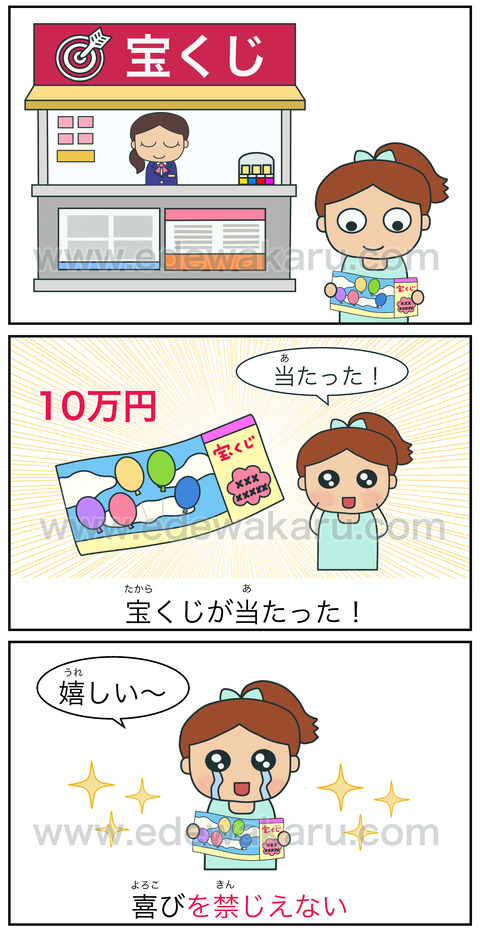
Meaning
〜を我慢できない
〜の気持ちを抑えられない
How to use it
名詞[辞書形]+を禁じえない
Explanation
「〜を禁じえない」は「〜の気持ちを抑えられない」「〜の気持ちを我慢できない」という意味を表す文型です。
この文型は
感情を表す名詞
に使われ、その気持ちが抑えられないと言いたい時に使われます😊
「〜を禁じ得ない」というように「得ない」が漢字で書かれていることもあります
😮よく使われる名詞をいくつか覚えておくといいと思います😉
(復習:〜ことがある)
[「〜を禁じえない」とよく使われる名詞]
・喜び
・驚き
・悲しみ
・怒り
・笑い
・涙
・感謝
・同情
・失望
・戸惑い
・恐怖 など
「〜を禁じえない」はとてもかたい言い方ですので、日常会話使われることはほとんどありません
😅N1を受ける人はテストのためにしっかりと覚えておきましょう😀
In context 4 examples
宝くじが当たった!喜びを禁じえない
→宝くじが当たった!喜びたい気持ちを抑えられないN1に満点で合格したとは…驚きを禁じえない
→N1に満点で合格したとは…驚く気持ちを抑えられない(復習:〜とは(定義・説明))またドタキャンされた…怒りを禁じえない
→またドタキャンされた…怒りたい気持ちを抑えられない(復習:ドタキャン)大好きな歌手が引退するなんて悲しみを禁じえない
→大好きな歌手が引退するなんて悲しい気持ちを抑えられない(復習:〜なんて(感情))
くらべてわかる日本語表現文型辞典
Meaning
Aという感情を強く感じていることを、控えめに述べる表現。Aは感情を表す名詞である。
How to use it
Aを禁じえない
[名詞-∅]を禁じえない
Notes
【注意1】
・硬い慣用的表現なので、すべての感情表現につくわけではない。主に悪い感情。
In context 4 examples
彼女の生い立ちには、同情を禁じえない。
彼が裏で不正を働いているのでは、という疑いを禁じえなかった。
あなたの仕事ぶりには、正直なところ失望を禁じえません。
我々は優秀な仲間を失ったことに、深い悲しみを禁じえません。
毎日のんびり日本語教師
How to use it
名詞+を禁じ得ない
Explanation
感情に関する名詞に接続して、その感情が心から湧いてきて抑えられない様子を表します。
驚き、怒り、恐怖、同情、疑問、違和感、涙、畏怖の念、焦燥、戦慄、笑い、興奮、悲しみ、戸惑いなど…
Notes
特になし
In context 14 examples
まさかの結果に驚きを禁じ得ない。
この映画のラストシーンは涙を禁じ得ない。
彼の身勝手な行動に怒りを禁じ得ない。
あのグループが突然解散するとは、ファンでなくても驚きを禁じえない。
笑ってる場合ではないが、どうにも笑いを禁じ得ない。
この社会に絶望を禁じ得ない。
こんな人が国会議員であることに驚きを禁じ得ない。
完全勝利に喜びを禁じ得ない。
自分の収入の少なさに笑いを禁じえない。
薄給で働かされる彼らに同情を禁じえない。
この不吉な兆しに恐怖を禁じえない。
あの人の食べ方は汚くて生理的な嫌悪感を禁じえない。
15年前の事件の真相に驚きを禁じえない。
怒られてもへらへらしている様子に怒りを禁じえない。