AIUEO JLPT Grammar
Meaning
This sentence pattern is used when the speaker is making a judgment or conclusion based on information or experiences gained within a limited range. It indicates that the speaker’s conclusions are based on a specific set of data or conditions.
How to use it
動詞辞書形+限りでは動詞た形+限りでは動詞て形+いる限りでは
Explanation · 日本語
この文型は、特定の範囲内で得た情報や経験に基づいて、何かを判断したり、結論を出したりするときに使われる表現で、ある範囲に限定された情報を元にしているというニュアンスがあります。
In context 5 examples
調査した限りでは、その問題に大きな影響はないようです。
Based on my investigation, it seems that issue does not have a significant impact.
見た限りでは、このレポートは非常に良く書かれています。
From what I’ve seen, this report is very well written.
この資料を読んだ限りでは、新しい規則に大きな変更はないようです。
From what I’ve read in these materials, there don’t seem to be major changes to the new regulations.
私が知る限りでは、彼はまだその会社に勤めています。
As far as I know, he is still working at that company.
彼女の話を聞いた限りでは、その計画にはいくつかの課題があるようです。
From what I’ve heard from her, it seems there are several challenges with the plan.
どんなときどう使う 日本語表現文型辞典
Meaning
as far as can be deduced from…
How to use it
Vる・Vた/Nの+かぎりでは
Explanation
~の範囲のことに限れば
ある判断をするための情報の範囲を限定する。情報を得る行為(見る・聞く・調べる、など)の言葉に接続する。
Delimits range of information needed to make certain judgment. Connects to words that indicate actions attaining information, such as 見る, 聞く, or 調べる.
In context 3 examples
この売り上げ状況のグラフを見るかぎりでは、わが社の製品の売れ行きは順調だ。
ちょっと話したかぎりでは、彼はいつもとまったく変わらないように思えた。
今回の調査のかぎりでは、この問題に関する外国の資料はあまりないようだ。
絵でわかる日本語
Meaning
〜の範囲で言うと
〜の範囲内で判断すると
How to use it
動詞[辞書形]+限りでは
動詞[ている形]+限りでは
動詞[た形]+限りでは
Explanation
「〜限りでは」は「〜の範囲で言うと」という意味の文型です。ほとんどの場合は
【見る】【知っている】【聞く】【調べる】【覚えている】
などの動詞に使われ、「自分が知っていることや、経験の範囲内で言うと〜」と言いたい時に使用します。 「〜限りでは」と、よく一緒に使われる文型を覚えておきましょう😀
[「〜限りでは」とよく使われる文型]
・〜限りでは+
〜そうだ
・〜限りでは+
〜らしい
・〜限りでは+
〜ようだ
・〜限りでは+
〜はずだ
・〜限りでは+
〜みたいだ
(復習:〜みたいだ(五感推量))
「〜限りでは」は「限るシリーズ」の1つとして覚えておきましょう😉
【「限る」シリーズ】
〜限り(限界)
〜限り
〜限りだ
〜限りで・N限りのN(限定)
〜限りでは(範囲)
限りなく〜に近い
〜とは限らない
〜ない限り
〜に限ったことではない
〜に限らず(〜も)
〜に限る
〜を限りに
In context 5 examples
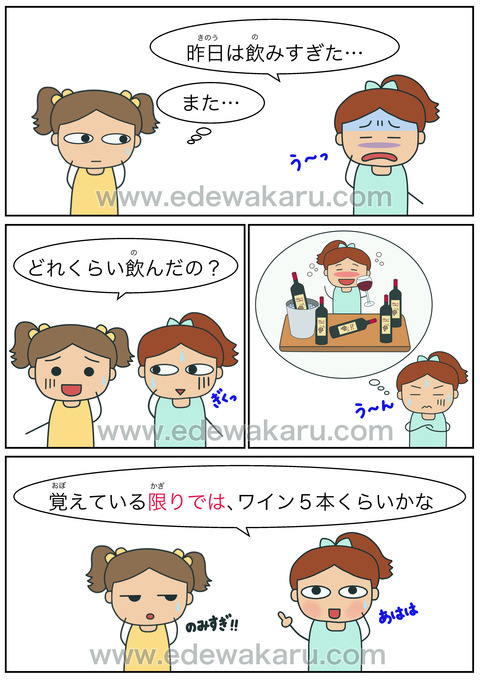
A:昨日は飲みすぎた…B:どれくらい飲んだの?A:覚えている限りでは、ワイン5本くらいかな
→自分が覚えている範囲で言うと、ワイン5本くらいかな(復習:〜すぎる)(復習:〜かな・〜かしら(文法))(復習:〜かな・〜かしら(口語形))ニュースで見た限りでは、今年の冬は寒くなるそうだ
→ニュースで見た範囲で言うと、今年の冬は寒くなるそうだA:パーティーには何人くらい来るの?B:聞いた限りでは、20人は来るらしいよ〜
→私が聞いた範囲で言うと、20人は来るらしいよ〜(復習:「何人」の読み方は?)(復習:〜らしい(推量))A:山田くんって兄弟がいるの?B:私が知る限りでは、お兄ちゃんがいるそうだよ
→私が知っている範囲内で言うと、お兄ちゃんがいるそうだよ(復習:〜って(主題・定義))(復習:〜そうだ(伝聞))医者:私が診た限りでは、かぜのようですね
→私が診た範囲で判断すると、かぜのようですね(復習:〜ようだ(五感推量))
IMABI
Limit
Read this IMABI lesson ↗Explanation
Limit: ~限り, ~を限りに, ~限りでは, ~に限って, ~に限らない, & ~とは限らない
限り is a rather complicated noun. Although it means “limit” and understanding it is no problem for most students, similar looking structures with it cause problems.
限り
~かぎり shows up in a lot of expressions, but what comes before it must be taken into account. Although particles may be a pain to get used to, you should still love them.
1. ~かぎり: This shows a parameter of a certain condition. Before ~かぎり, you may see nouns, adjectives, and verbs.
1. 保証ほしょうの限りではない。
It is not in the warranty.
2. 目の届とどく限り、晴れ渡わたっている。
The sky is clear as far as the eye can see.
3. 可能な限り、薬を飲まないようにしています。
I’m trying as best I can to not take the medicine.
4. できる限りのことをするのも無理なのだ。
Doing as much as possible is also no good.
5. 法律ほうりつの及およぶ限り厳密げんみつに処しょすべきだ。
It should be strictly dealt with to the full extent of the law.
6. 今年も能力の限り、お役に立てるよう働くことを誓ちかいます。
I vow to work to be of benefit [to X] to the best of my ability this year as well.
7. 外は豪雪ごうせつでも、部屋のなかにいるかぎりは真夏日まなつびのようだ。
Even if there is heavy snowfall outside, for as long as you’re inside the room, it’s like a hot summer day.
読み物: A Passage from 心 by 夏目漱石
8. 次の日私は先生の後あとにつづいて海へ飛び込こんだ。そうして先生といっしょの方角ほうがくに泳いで行った。二丁ちょうほど沖おきへ出ると、先生は後ろを振ふり返って私に話し掛かけた。広い蒼あおい海の表面に浮ういているものは、その近所に私ら二人より外ほかになかった。そうして強い太陽の光が、眼めの届く限り水と山とを照らしていた。私は自由と歓喜かんきに充みちた筋肉を動かして海の中で躍おどり狂くるった。先生はまたぱたりと手足の運動を已やめて仰向あおむけになったまま浪なみの上に寝た。私もその真似まねをした。青空の色がぎらぎらと眼を射いるように痛烈つうれつな色を私の顔に投なげ付つけた。「愉快ゆかいですね」と私は大きな声を出した。
漢字 Notes:
1. 蒼い is a very literary spelling for blue. And, you may also encounter 碧い in similar contexts. 蒼い is a rather dull “blue”, and it is often used in contexts where one “is blue in the face”. 碧い is used when “blue” may have anywhere from a light to dark green hue to it.
2. ~掛ける is usually spelled as ~かける in everyday writing.
3. Rather than using 満ちる, 充ちる has the added nuance of inundation. 満ちる is over all the most important spelling due to the fact that 充 does not have the reading み(ちる) listed in the 常用漢字表.
4. 躍る differs from 踊る in the sense that the latter is “dance” in a rhythmic sense whereas the former is just jumping up and down.
5. 已む specifically describes a phenomenon, action, or condition that has continued for some time stopping completely. It is generally replaced with 止む except in literal situations like this when the writer wishes to make this nuance clear.
6. 浪 specifically refers to ripples in water or water rising up.
The next day, I followed Sensei into the ocean. I then swam in the same direction as him. After going over a hundred meters offshore, Sensei turned around to talk to me. It was only us floating atop the surface of the wide, blue sea. The strong sunlight made the water and mountains glow for as far as one could see. I madly danced around in the waves with my muscles full of joy and freedom. Sensei, again, suddenly froze his arms and legs and lay flat on his back asleep on the waves, and so I mimicked him. The blue sky cast a scathing light into my eyes as if to pierce them out. “How pleasant!”, I yelled out.
Questions:
1. Find an example where a Japanese item is naturalized for the English translation.
2. Why might liberties in translation be needed with this passage?
~ない限り, which is an application of above, can be translated as “until” in contexts like below.
9. 君が考えを改あらためないかぎり、うまくいかない。
Until you rethink yourself, things won’t go well.
10. あいつは、あまりにも疲れていないかぎり、夜遅くまでIMABIを編集へんしゅうするそうだ。
That guy seems to edit IMABI up into the night unless he’s too tired.
11. 汚水おすいを飲まないかぎり大丈夫ですよ。
So long as you don’t drink filthy water, you should be fine.
After adjectives at the end of a sentence, ~かぎりだ shows the speaker’s emotions with what is being said not being simply about the nature of things, but the matter at hand doesn’t extend beyond a certain limit.
12. 誰からも連絡がなく、寂さびしいかぎりだ。
It’s just very lonely that I don’t get contact from anyone.
Another thing that this form can do that the two below cannot is be followed with a volitional expression.
13. 生きている限り歌おう。
I’ll sing until I die.
As a suffix after temporal phrases in the form of ~かぎりで, it express deadline.
14. 来月末限りで辞任するつもりだ。
I plan to resign at the end of next month.
2. ~を限りに, when used with time phrases, explicitly states when will be the last time that one does something. With non-temporal phrases, it shows some sort of physical limitation.
15. 彼は声の限りに叫さけんだ。
He screamed to the top of list lungs.
16. 今日を限りに酒は飲みません。
I will not drink alcohol from this day forward!
17. これを限りにお前とは縁えんを切る。
From here on I break my ties with you.
18. 今年の年末を限りに期限が切れる。
The term/period/deadline will expire at the end of this year.
3. ~限りでは: Verbs of cognition such as 知る, 見る, 聞く, 読む, etc. come before, and the following clause deals with a judgment. In totality, this construction means “as far as…”.
19. 知られる限りでは依然行方不明いぜんゆくえふめい。 (Headline)
[X] is/are still missing as far as is known.
20. 私の知っている限りでは、彼はそんなことをする人ではありません。
As far as I know, he is not the kind of person to do something like that.
4. ~に限って: This raises a time, person, or thing to mean “insofar/unless”. This is used a lot with とき.
21. あたしが出かけるときにかぎって、雨が降るのよ。(女性語)
It doesn’t rain unless I go out [somewhere].
22. 我わが社しゃの社員に限って、そのような不正はするはずがない。
Insofar as our company’s workers, we have no reason to do such illegality.
23. 読みたいときに限って、アクセスできない。
I can’t access it insofar as to when I want to read it.
As one would expect, this phrase has a negative form, ~に限らない. This means that something is not yet decided. Of course, in formal/written situations, you can see it as ~に限らず.
24. 怠なまけたがるのは、子供に限ったことじゃない。
Wanting to slack off is not limited to just kids.
25. 対象はアメリカ人に限りません。
Our target is not limited to Americans.
26. 韓国語を勉強している学生は、東アジア専攻に限りません。
Students who study Korean are not limited to East Asian majors.
5. ~とは限らない may resemble ~に限らない, and the best of students mix them up. However, because of the particle と, no part of speech limitations exists. ~とは限らない means “not necessarily”. This phrase is frequently used to speak against stereotypes.
27. 日本人がみんな勉強ばかりしているとは限らない。
It’s not necessarily the case that all Japanese people do nothing but study.
28. アメリカ人は、必ずしも日本人より背が高いとは限らない。
Americans are not necessarily taller than Japanese people.
29. テキサスの人がみんな必ずバーベキューばかり食べるとは限らない。
All Texans don’t necessarily eat just barbecue.
30. 念ねんを入れたからっていい仕上しあがりになるとは限らない。
Because we paid attention to detail, it’s (now) a good finish.
In context 41 examples
~かぎり: This shows a parameter of a certain condition. Before ~かぎり, you may see nouns, adjectives, and verbs.
It is not in the warranty.
保証ほしょうの限りではない。
It is not in the warranty.
目の届とどく限り、晴れ渡わたっている。
The sky is clear as far as the eye can see.
可能な限り、薬を飲まないようにしています。
I’m trying as best I can to not take the medicine.
できる限りのことをするのも無理なのだ。
Doing as much as possible is also no good.
法律ほうりつの及およぶ限り厳密げんみつに処しょすべきだ。
It should be strictly dealt with to the full extent of the law.
今年も能力の限り、お役に立てるよう働くことを誓ちかいます。
I vow to work to be of benefit [to X] to the best of my ability this year as well.
外は豪雪ごうせつでも、部屋のなかにいるかぎりは真夏日まなつびのようだ。
Even if there is heavy snowfall outside, for as long as you’re inside the room, it’s like a hot summer day.
次の日私は先生の後あとにつづいて海へ飛び込こんだ。そうして先生といっしょの方角ほうがくに泳いで行った。二丁ちょうほど沖おきへ出ると、先生は後ろを振ふり返って私に話し掛かけた。広い蒼あおい海の表面に浮ういているものは、その近所に私ら二人より外ほかになかった。そうして強い太陽の光が、眼めの届く限り水と山とを照らしていた。私は自由と歓喜かんきに充みちた筋肉を動かして海の中で躍おどり狂くるった。先生はまたぱたりと手足の運動を已やめて仰向あおむけになったまま浪なみの上に寝た。私もその真似まねをした。青空の色がぎらぎらと眼を射いるように痛烈つうれつな色を私の顔に投なげ付つけた。「愉快ゆかいですね」と私は大きな声を出した。
蒼い is a very literary spelling for blue. And, you may also encounter 碧い in similar contexts. 蒼い is a rather dull “blue”, and it is often used in contexts where one “is blue in the face”. 碧い is used when “blue” may have anywhere from a light to dark green hue to it.
The next day, I followed Sensei into the ocean. I then swam in the same direction as him. After going over a hundred meters offshore, Sensei turned around to talk to me. It was only us floating atop the surface of the wide, blue sea. The strong sunlight made the water and mountains glow for as far as one could see. I madly danced around in the waves with my muscles full of joy and freedom. Sensei, again, suddenly froze his arms and legs and lay flat on his back asleep on the waves, and so I mimicked him. The blue sky cast a scathing light into my eyes as if to pierce them out. “How pleasant!”, I yelled out.
~掛ける is usually spelled as ~かける in everyday writing.
The next day, I followed Sensei into the ocean. I then swam in the same direction as him. After going over a hundred meters offshore, Sensei turned around to talk to me. It was only us floating atop the surface of the wide, blue sea. The strong sunlight made the water and mountains glow for as far as one could see. I madly danced around in the waves with my muscles full of joy and freedom. Sensei, again, suddenly froze his arms and legs and lay flat on his back asleep on the waves, and so I mimicked him. The blue sky cast a scathing light into my eyes as if to pierce them out. “How pleasant!”, I yelled out.
Rather than using 満ちる, 充ちる has the added nuance of inundation. 満ちる is over all the most important spelling due to the fact that 充 does not have the reading み(ちる) listed in the 常用漢字表.
The next day, I followed Sensei into the ocean. I then swam in the same direction as him. After going over a hundred meters offshore, Sensei turned around to talk to me. It was only us floating atop the surface of the wide, blue sea. The strong sunlight made the water and mountains glow for as far as one could see. I madly danced around in the waves with my muscles full of joy and freedom. Sensei, again, suddenly froze his arms and legs and lay flat on his back asleep on the waves, and so I mimicked him. The blue sky cast a scathing light into my eyes as if to pierce them out. “How pleasant!”, I yelled out.
躍る differs from 踊る in the sense that the latter is “dance” in a rhythmic sense whereas the former is just jumping up and down.
The next day, I followed Sensei into the ocean. I then swam in the same direction as him. After going over a hundred meters offshore, Sensei turned around to talk to me. It was only us floating atop the surface of the wide, blue sea. The strong sunlight made the water and mountains glow for as far as one could see. I madly danced around in the waves with my muscles full of joy and freedom. Sensei, again, suddenly froze his arms and legs and lay flat on his back asleep on the waves, and so I mimicked him. The blue sky cast a scathing light into my eyes as if to pierce them out. “How pleasant!”, I yelled out.
已む specifically describes a phenomenon, action, or condition that has continued for some time stopping completely. It is generally replaced with 止む except in literal situations like this when the writer wishes to make this nuance clear.
The next day, I followed Sensei into the ocean. I then swam in the same direction as him. After going over a hundred meters offshore, Sensei turned around to talk to me. It was only us floating atop the surface of the wide, blue sea. The strong sunlight made the water and mountains glow for as far as one could see. I madly danced around in the waves with my muscles full of joy and freedom. Sensei, again, suddenly froze his arms and legs and lay flat on his back asleep on the waves, and so I mimicked him. The blue sky cast a scathing light into my eyes as if to pierce them out. “How pleasant!”, I yelled out.
浪 specifically refers to ripples in water or water rising up.
The next day, I followed Sensei into the ocean. I then swam in the same direction as him. After going over a hundred meters offshore, Sensei turned around to talk to me. It was only us floating atop the surface of the wide, blue sea. The strong sunlight made the water and mountains glow for as far as one could see. I madly danced around in the waves with my muscles full of joy and freedom. Sensei, again, suddenly froze his arms and legs and lay flat on his back asleep on the waves, and so I mimicked him. The blue sky cast a scathing light into my eyes as if to pierce them out. “How pleasant!”, I yelled out.
君が考えを改あらためないかぎり、うまくいかない。
Until you rethink yourself, things won’t go well.
あいつは、あまりにも疲れていないかぎり、夜遅くまでIMABIを編集へんしゅうするそうだ。
That guy seems to edit IMABI up into the night unless he’s too tired.
汚水おすいを飲まないかぎり大丈夫ですよ。
So long as you don’t drink filthy water, you should be fine.
誰からも連絡がなく、寂さびしいかぎりだ。
It’s just very lonely that I don’t get contact from anyone.
生きている限り歌おう。
I’ll sing until I die.
来月末限りで辞任するつもりだ。
I plan to resign at the end of next month.
~を限りに, when used with time phrases, explicitly states when will be the last time that one does something. With non-temporal phrases, it shows some sort of physical limitation.
He screamed to the top of list lungs.
彼は声の限りに叫さけんだ。
He screamed to the top of list lungs.
今日を限りに酒は飲みません。
I will not drink alcohol from this day forward!
これを限りにお前とは縁えんを切る。
From here on I break my ties with you.
今年の年末を限りに期限が切れる。
The term/period/deadline will expire at the end of this year.
~限りでは: Verbs of cognition such as 知る, 見る, 聞く, 読む, etc. come before, and the following clause deals with a judgment. In totality, this construction means “as far as…”.
[X] is/are still missing as far as is known.
知られる限りでは依然行方不明いぜんゆくえふめい。 (Headline)
[X] is/are still missing as far as is known.
私の知っている限りでは、彼はそんなことをする人ではありません。
As far as I know, he is not the kind of person to do something like that.
~に限って: This raises a time, person, or thing to mean “insofar/unless”. This is used a lot with とき.
It doesn’t rain unless I go out [somewhere].
あたしが出かけるときにかぎって、雨が降るのよ。(女性語)
It doesn’t rain unless I go out [somewhere].
我わが社しゃの社員に限って、そのような不正はするはずがない。
Insofar as our company’s workers, we have no reason to do such illegality.
読みたいときに限って、アクセスできない。
I can’t access it insofar as to when I want to read it.
怠なまけたがるのは、子供に限ったことじゃない。
Wanting to slack off is not limited to just kids.
対象はアメリカ人に限りません。
Our target is not limited to Americans.
韓国語を勉強している学生は、東アジア専攻に限りません。
Students who study Korean are not limited to East Asian majors.
~とは限らない may resemble ~に限らない, and the best of students mix them up. However, because of the particle と, no part of speech limitations exists. ~とは限らない means “not necessarily”. This phrase is frequently used to speak against stereotypes.
It’s not necessarily the case that all Japanese people do nothing but study.
日本人がみんな勉強ばかりしているとは限らない。
It’s not necessarily the case that all Japanese people do nothing but study.
アメリカ人は、必ずしも日本人より背が高いとは限らない。
Americans are not necessarily taller than Japanese people.
テキサスの人がみんな必ずバーベキューばかり食べるとは限らない。
All Texans don’t necessarily eat just barbecue.
念ねんを入れたからっていい仕上しあがりになるとは限らない。
Because we paid attention to detail, it’s (now) a good finish.