絵でわかる日本語
Usage 1
Read this source entry ↗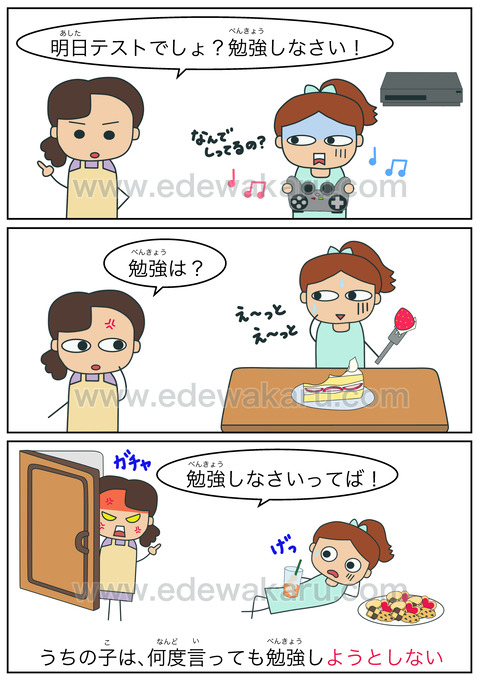
Meaning
全然〜する様子がない
How to use it
動詞[意向形]+としない
動詞[意向形]+ともしない
Explanation
「〜ようとしない」は「まったく〜する様子がない」という意味の文型です。「しなければいけないことや、するつもりだったことを全然しない」と言いたい時に使われます。
「〜ようともしない」は、「〜ようとしない」を強調した言い方です。
[例]
娘は、何度言っても勉強し
ようとしない
→娘は、何度言っても勉強し
ようともしない
「〜ようとする」の復習をしておきましょう😊
【関連記事】
In context 5 examples
うちの娘は、何度言っても勉強しようとしない
→まったく勉強する様子がないA:彼女にちゃんと説明した?B:うん。でも、ぼくの話を聞こうとしないんだ…
→全然ぼくの話を聞かないんだ…母:お父さんを起こしてきてくれる?娘:嫌だよ…だって、起こしても起きようとしないんだもん
→起こしても全然起きないんだもん彼は、昨日何があったのか話そうとしない
→昨日何があったのか、まったく話さない山田くんったら、みんなに迷惑をかけたのに謝ろうとしないのよ
→まったく謝る様子がない
Usage 2
Read this source entry ↗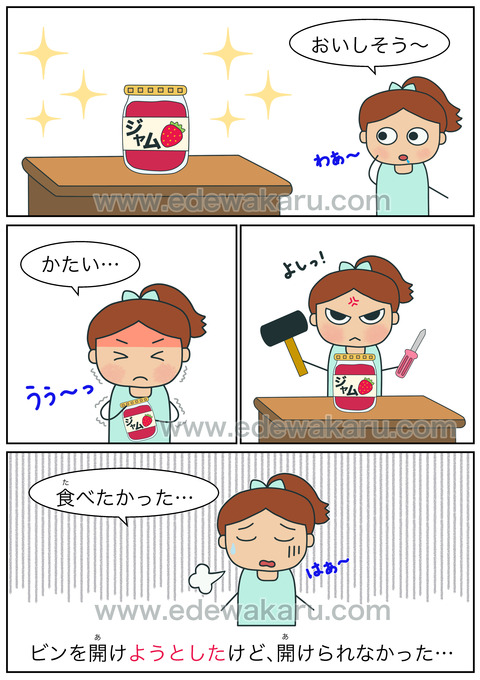
Meaning
〜しようと努力する
〜しようとがんばっている
How to use it
動詞[意向形]+ようとする
Explanation
「〜ようとする」は「〜しようと努力する」という意味の文型です。「〜を実現させるためにがんばっている」と言いたい時に使われます😊
(復習:〜ために(目的))
[例]
①ビンを
開け
ようとした
が、開けられなかった
→ビンを
開ける努力をした
が、開けられなかった
②彼女は卒業したら、アメリカに
留学しようとしている
→アメリカに
留学するために努力している
③納豆を
食べようとした
けど、無理だった…
→
がんばって
納豆を
食べてみようと思った
が、無理だった
④コーヒーを飲みすぎて、
寝ようとしても
寝られない
→
寝ようと努力している
が、寝られない
⑤A:うちの社長は、社員全員の名前を
覚えようとしている
んだって
→社員全員の名前を
覚える努力をしている
んだって
「〜ようとする」にはいくつか意味がありますので、復習をしておきましょう😀
(復習:〜ようとする(直前・無意志動詞))
(復習:〜ようとする(直前・意志動詞))
In context 5 examples
ビンを開けようとしたけど、開けられなかった
彼女は卒業したら、アメリカに留学しようとしている
納豆を食べようとしたが、無理だった…
コーヒーを飲みすぎて、寝ようとしても寝られない…
A:うちの社長は、社員全員の名前を覚えようとしているんだってB:すごいね〜(復習:〜って(伝聞))
Usage 3
Read this source entry ↗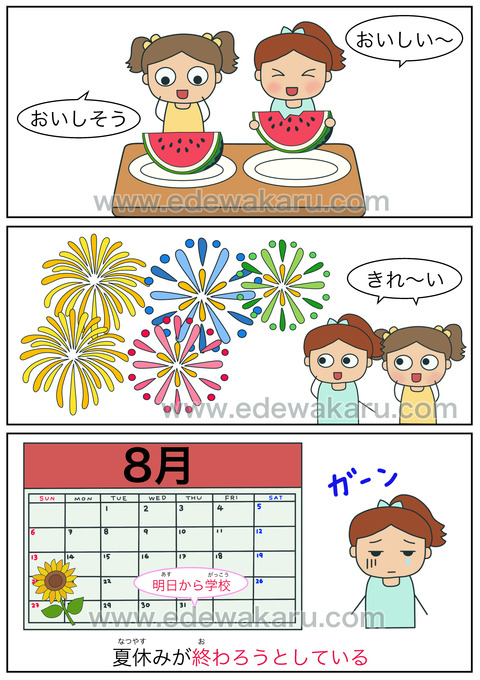
Meaning
もうすぐ〜になる
〜が始まる直前
〜が終わる直前
How to use it
動詞[意向形]+ようとする
Explanation
「〜ようとする」は【無意志動詞】と一緒に使うと「もうすぐ〜になる(状態)」という意味になります。これは、「〜が始まる直前」「〜が終わる直前」 というように
「変化する直前」
を表す文型です。ほとんどの場合は
「〜ようとしている」
の形で使われます😊
[例]
①夏休みが
終わろうとしている
→夏休がもうすぐ終わる
②太陽が
沈もうとしている
→もうすぐ太陽が沈む
③桜の花が
咲こうとしている
→桜の花がもうすぐ咲く
④野球の試合が
始まろうとしている
→野球の試合がもうすぐ始まる
⑤時計が3時を
指そうとしている
→もうすぐ時計が3時を指す
*もうすぐ3時になるという意味
「無意志動詞+ようとする」は
書き言葉的
で、会話ではあまり使われません😅小説などではよく使用されますので、上級レベルの人は覚えておきましょう😉
In context 5 examples
夏休みが終わろうとしている
太陽が沈もうとしている
桜の花が咲こうとしている
野球の試合が始まろうとしている
時計が3時を指そうとしている
Usage 4
Read this source entry ↗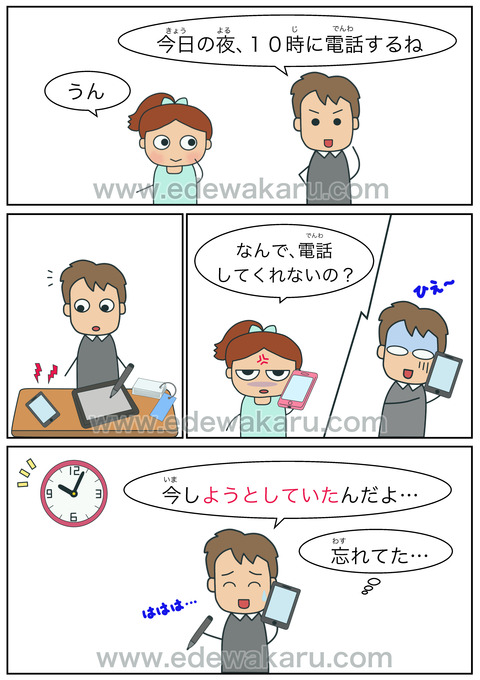
Meaning
〜する直前の場面を表す
How to use it
動詞[意向形]+ようとする
Explanation
「意志動詞+ようとする」は【動作が始まる直前の場面】を表す文型です。多くの場合
「〜ようとしたら〜」「〜ようとした時〜」「〜ようとしたところ〜」
などの形が使われます😮
[例]
①彼女:なんで電話してくれないの?
彼氏:ごめん、今し
ようとしていたん
だよ
→電話をする直前に彼女から電話がかかってきた
【電話をする直前の場面】
②
帰ろうとしたら、先生に呼ばれた
→帰る直前に先生に呼ばれた
【帰る直前の場面】
③ごはんを
食べようとした時、お客さんが来た
→ごはんを食べる直前に、お客さんが来た
【ごはんを食べる直前の場面】
④お風呂に
入ろうとしていたら、電話がかかってきた
→お風呂に入る直前、電話がかかってきた
【お風呂に入る直前の場面】
⑤遊びに
行こうとしたら、お母さんに手伝ってと言われた
遊びに行く直前、お母さんに手伝ってと言われた
【遊びに行く直前の場面】
「〜ようとする」には、「無意志動詞+ようとする」もありますので一緒に覚えておきましょう😉
(復習:〜ようとする(直前・無意志動詞))
(復習:〜ようとする(試み))
In context 4 examples
彼女:なんで電話してくれないの?彼氏:ごめん、今しようとしていたんだよ
ごはんを食べようとした時、お客さんが来た
お風呂に入ろうとしていたら、電話がかかってきた
遊びに行こうとしたら、お母さんに手伝ってと言われた
どんなときどう使う 日本語表現文型辞典
Meaning
just when about to, try to
How to use it
Vよう+とする
Explanation
意志動詞につながり、 ❶ ❷ は、そうしようと思って、そのことを始める直前の状態にいることを表す。 ❸ ~ ❺ は、そうしようと思って、がんばっていることを表す。
Links to verbs of volition. Sentences ❶ and ❷ describe state in which speaker is about to begin action. Sentences ❸ to ❺ describe people trying hard to accomplish an action.
In context 5 examples
どうも遅くなりました。会社を出ようとしたとき、社長に呼ばれたんです。
おふろに入ろうとしたとき、電話のベルが鳴った。
おばあさんが道を渡ろうとしていますが、車が多くて渡れません。
あの子はきらいな野菜をいっしょうけんめい食べようとしています。
けさ、6時に起きようとしましたが、起きられませんでした。
日本語NET JLPT文法解説まとめ
Meaning
① ~しようと思って、そのことを始める直前の状態であることを表す
② 〜しようと努力している様子を表す。
How to use it
V(意向形)+ ようとする
Explanation
try to / attempt to do
① Indicates the state just before starting something, with the intention of doing it.
② Indicates the appearance of making an effort or attempting to do something.
In context 12 examples
帰ろうとしたら、上司に呼ばれてしまいました。
おばあさんが道を渡ろうとしていたから、手伝ってあげた。
お風呂に入ろうとしたら、電話が掛かってきた。
タクシーを降りようとした時、財布がないことに気がついた。
棚の上の物を取ろうとして、椅子から落ちてしまった。
寝ようとしたら、マンションの警報が鳴った。
ゲームをしようとしたら、親が帰ってきて、結局できなかった。
ごめん、ごめん、今連絡しようとしていたんだよ。
冷蔵庫にあったプリンをこっそり食べようとしたら、母が帰ってきた。
ジェームさんは今年、日本の会社に就職しようとしているらしい。
彼は勇気を振り絞って、彼女に告白しようとしたが、言葉が詰まってしまった。
今日は早く寝ようとしたが、思ったより眠れなかった。
AIUEO JLPT Grammar
Meaning
This sentence pattern expresses trying something or doing something just before it happens.
How to use it
動詞意向形と+する
Explanation · 日本語
この文型は、何かを試みる、または直前の行動を表すときに使われる表現です。
In context 5 examples
彼がサッカーをしようとすると、雨が降ってきた。
He tried to play soccer, but it started to rain.
彼は部屋を掃除しようとしたが、疲れてやめた。
He tried to clean his room, but he got tired and stopped.
彼女は旅行に行こうとしたが、天気が悪くてやめた。
She tried to go on a trip but canceled because of bad weather.
彼は電話をしようとしなかった。
He didn't try to call.
学生たちは先生に質問しようとしました。
The students tried to ask the teacher a question.
文法
Meaning
① ~しようと思って、そのことを始める直前の状態であることを表す
② 〜しようと努力している様子を表す。
How to use it
V(意向形)+ ようとする
In context 10 examples
帰ろうとしたら、上司に呼ばれてしまいました。
おばあさんが道を渡ろうとしていたから、手伝ってあげた。
お風呂に入ろうとしたら、電話が掛かってきた。
タクシーを降りようとした時、財布がないことに気がついた。
棚の上の物を取ろうとして、椅子から落ちてしまった。
寝ようとしたら、マンションの警報が鳴った。
ゲームをしようとしたら、親が帰ってきて、結局できなかった。
ごめん、ごめん、今連絡しようとしていたんだよ。
冷蔵庫にあったプリンをこっそり食べようとしたら、母が帰ってきた。
ジェームさんは今年、日本の会社に就職しようとしているらしい。
IMABI
Try II
Read this IMABI lesson ↗Explanation
Try II: ~ようにする & ~ようとする
The pattern ~ようにする, when used in the sense of “to try…” – Usage I discussed in this lesson – is often confused with ~ようとする, which indicates active execution of an agent’s willpower to do something. Putting aside their different morphology, many learners confuse these patterns due to how they are often so similarly translated.
Previously in Try I: ~てみる・みたい・みせる, we learned how ~てみる is used to denote a trial at doing something.
i. 和牛を食べてみる?
Care to try wagyu?
Even before we get started, it is important to understand that “trial-based” attempts are not what either ~ようにする and ~ようとする describe. It may be inevitable at first to get stuck on the word “try” popping up to describe all three patterns, but learning what sorts of scenarios “try” can cover and how those scenarios are handled in Japanese is the point of this second installment.
~ようにする
As a recap, ~ようにする, as it pertains to habitual behavior, denotes a serious attempt on the part of the agent to perform/bring to fruition some conduct/behavior. Whether the action itself is a one-off occasion or will successfully result in habitual change depends on the context, but the take away is that attempt(s) are being taken. Not only that, but there is some benefit to be gained by the agent if said change holds.
Affirmative連体形 + ~ようにするto try to…
Negative未然形 + ~ないようにするto try not to…
As can be deduced from how this pattern connects to verbal predicates, it must be noted that ~ようにする itself attaches to the 連体形. This is because よう derives from 様 which literally means “condition” and still functions as a noun. In the case of the verbal element being negative before よう, that phrase is still in the 連体形, but to simplify things1, the learner is reminded that ~ない attaches to the 未然形 of verbs.
1. お肉を食べないようにしています。
I am trying not to eat meat.
2. 毎朝歯を磨くようにしています。
I am trying to brush my teeth every morning.
3. 遅れないようにしてください。
Please try not to be late.
4. 無理しないようにしてくださいね。
Try not to push yourself, okay.
Incidentally, it is not impossible for ~ようにする to be combined with ~てみる, especially when “try to…” for the former is stilted toward “make sure to…”
5a. 後で見てみますね。
5b. 後で見てみるようにしますね。
5a. I’ll check it out later.
5b. I’ll make sure to check it out later.
“To check it out” makes it clear that the act of 見る pertains to giving something the chance at being watched. From a plain reading of the text, Ex. 5a is a direct, affirmative statement, whereas Ex. 5b avoids this direct statement and pivots to only promising that “make sure to…,” which is why the pattern ~ようにする is still often translated as “to try…” because if the effort does not hold (habitual nature hinging on whether the situation at hand is a one-off scenario), then the agent is not actually doing said thing – hitting on the possibility that the agent could be lying. But, as any of us have surely experienced in any language that we speak, lying is always possible, and so tonality would be crucial in telling whether the agent is going to make sure, and if it does sound sincere, then the nuance layer of “effort (努力)” would make sense.
~ようとする
Before even delving into how ~ようとする differs semantically from ~ようにする, let’s go over the most blatant difference: that being the ~よう is not even the noun 様 and that this pattern will look different depending on the 未然形 of the verb that it attaches to.
What we are actually looking at here is the volitional auxiliary ~(よ)う attaching to verbs which is then followed by the citation particle と used in tandem with a citation verb, which in this instance, する fills that role – something to keep in mind when we see instances of it being replaced with other verbs. So, without further ado, let’s recap how to conjugate with ~(よ)う in the context of this pattern.
Verb ClassExample未然形+~(よ)うとする
一段 食べるtabe– 食べようとする
五段 飲むnomo2– 飲もうとする
サ変 するshi–3 しようとする
カ変 来るko- 来(こ)ようとする
Understanding What “Try…” Means
At its basic understanding, ~(よ)うとする indicates a volitional attempt in motion at completing said action. Thus, the action is in the present and cannot be construed as a continuous effort, which is a stark difference between it and ~ようにする.
6a. バッタを食べるようにしている。
6b. バッタを食べようとしている。
6c. バッタを食べてみた。
6a. I’m trying to eat grasshoppers.
6b. I’m trying to eat the grasshopper(s).
6c. I tried eating grasshopper.
With this grotesque example, we see how both patterns can take ~ている but that the duration implied is completely different. Ex. 6a suggests going on a grasshopper diet, whereas Ex. 6b. depicts a single yet ongoing attempt to eat whatever grasshopper(s) have been presented to the agent. We can also distinguish Ex. 6b from Ex. 6c, which is a mere trial of grasshoppers taste, by honing in one what the exercise of volition implied by ~(よ)う truly entails. With this volitional auxiliary, the goal “eating the grasshopper(s)” is firmly rooted, and the agent is exerting their freewill to complete said goal.
7. ワインを飲もうとしました。
I tried to drink (the) wine.
Like, ~ようにする, however, the attempt may still fail with ~(よ)うとする, but if the attempt fails, that is simply the end of that single attempt. Meaning, there is nothing implied that the effort is being perpetuated.
8. 起きようとしましたが、起きられませんでした。
I tried/attempted to get up, but I couldn’t.
Interrupted Attempts: “Just about to…”
In some contexts, the attempt onset by ~(よ)うとする can be interrupted. This is made apparent when it constitutes a dependent clause that is then followed by what ends up happening instead. This is an extension of the logic behind what happens when such attempts fail like in Ex. 8 but with a new context being introduced. This usage can be translated on the lines of “just about to…”
9. 朝ご飯を食べようとした時、電話がかかってきました。
Just when I was going to eat breakfast, I got a telephone call.
Because of the phone call, the act of “eating breakfast” could not actually come into fruition. The agent only got so far as to set the process in motion – perhaps putting fork and spoon in hand – only to be interrupted. This aspect restriction on the nature of V1 with ~(よ)うとする crucial to proper understanding.
10. エレベーターに乗ろうとした時、後ろから走ってきた男に押おされたんです。
Just as I was about to get onto the elevator, I was pushed by a man who came running from behind.
11. その後、店で財布を出そうとしたけれど、何もなかったんです。
After that, just as I tried to take out my wallet in the store, nothing was in it.
Restrictions on ~(よ)うとする
Providing that ~(よ)うとする, without any added morphology, pertains to the onset of an attempt in the sense that the agent is setting themselves out to complete said action. Yet, because failure is possible, in the non-past tense at least, the action at hand has not actually occurred, although it is fair to say that it is right before possible success. To put that back into perspective, let’s go back to our grasshopper eating example.
6b’. バッタを食べようとする。
To try/attempt to eat the grasshopper(s).
What if the grasshoppers are still very much flying around? The agent would have to potentially go through some serious hurdles before the grasshoppers gets into their mouth.
Imagine if you are in the planning stage. When you are planning to attempt to do something, the thought of that attempt is still there, but then that needs to be accounted for as a thought, and the ongoing nature of that thought would need to be accounted for by ~ている. With all that in mind, we get Ex. 12.
12a. 日本へ留学しようとします。X
12b. 日本へ留学しようと思っています。〇
Intended: I will try to study abroad in Japan.
⇒I am thinking about studying abroad in Japan.
What if something spurs that desire to attempt something? In that moment in which the thought hit you mind, you might get something like:
13. それじゃ、一回だけ行ってみようと思います。
In that case, I think I’ll try/attempt going just once.
Here, we actually see ~てみる used in tandem with ~(よ)うと to capture this reactionary thought about the agent being comfortable contemplating whether they will go about doing said action, which is the volitional aspect.
Incidentally, there is nothing preventing us from combining the notion of trial and announcing one’s volition to bring about said trial. Thus, we go back to grasshoppers.
6c’. バッタを食べてみようと思う。
6c”. バッタを食べてみようと思っています。
6c’. I think I’ll try eating a grasshopper.
6c”. I’m thinking/planning on trying to eat a grasshopper.
It may go without saying at this point, but it is also worth noting how the English translations we have seen so far exhibit an equal degree of complexity in how similar structures combine.
Next, in Ex. 14a, there are two grammatical issues. The first issue is that すぐ and ~(よ)とする contradict each other. If the pattern in the non-past only captures the onset before it gets to happen, throwing “immediately/right away” into the mix would just be bizarre, as the ungrammatical state of the English translation confirms. The second is the use of ~んですか. Granted that there was some conversation about Tomoko’s itinerary, we would still need a basis for her desired quick departure to be tied to some bigger picture, which unfortunately cannot be grasped, making ~んですか’s use sound unnecessarily obtuse.
14a. 友子、すぐ出かけようとするんですか。X
14b. 友子、すぐ出かけようとしていますか。〇
Intended: Is she trying to leave immediately?
14a. Is she to immediately be about to leave? X
14b. Is she trying/aiming to leave immediately?
In the following examples, in addition to the typical translation of the pattern as “try to…,” other clearer alternatives are provided so that you may get a better sense at what is exactly the agent(s) are doing.
15. 蟻ありが自分よりも大きな食べ物を巣すの方へ運ぼうとしていますよ。
The ants are trying/attempting to carry food that is larger than themselves to their hill.
16. 大学院に進むため、留学しようとしていたんです。
I was trying/aiming to go abroad to get into graduate school.
17. 僕は氷が張はるくらい寒いところにある川に氷の裂さけ目から落ちてしまった犬を助けようとしたのです。
I tried/aimed to save a dog that had fallen from an ice crack into a river in an area that was cold with ice.
Non-First Person Volition
Excluding personification, narration, and similar literary devices in which non-first person volition is ascertainable without inference, making such statements are deemed unnatural in Japanese discourse. This principle also applies to ~(よ)うとする, as it fundamentally pertains to volition being executed.
18. 日が昇のぼり、男の顔を照らそうとする。男は目を覚さまし、起き上がろうとする。そのとき、鋭するどく刺さすような胸の痛みを感じた。まぶしい。男は太陽が怖かった。何とかして歩こうとする赤ちゃんの姿が、微笑ほほえましかった。
The sun rose and shined on the man’s face. The man opened his eyes and tried to get up. Then, he felt a sharp pain in his chest. He was dizzy. The man was afraid of the sun. For some reason the figure of his baby trying to walk was pleasing.
In Ex. 18, there are three instances of third-person statements of volition utilizing ~(よ)うとする, but because it is clearly narration, the author has control over the thoughts and actions of the characters, thus not violating the aforementioned principle.
19. どうして、わざわざ、そんなところへ行こうとするんだ!?やめとけ。
Why are you trying to take the efforts to go to such a place!? Quit it.
Asking about the volition of someone else does not violate the notion of affirmatively stating their volition. You are confirming it. Thus, second-person volition in question format is valid for this structure.
No Overt Agent ⇒ Foreboding Event
When ~(よ)うとする is used with verbs of non-volition, it instead, shows foreboding of a situation, as if there were an active agent at play. This is often figuratively employed with natural phenomenon.
20. 稲妻いなずまが走って、雷が鳴り、今にも雨が降り出そうとしていたんだよ。
Lightning was striking, thunder was roaring, and it was going to rain at any moment.
In the case of Ex. 21, the passive form of 食う (to eat) is used in combination with ~(よ)うとする. While the alligator is an agent, the passivization process causes the phrase to sound more like an imminent reality. In other words, while we know the alligator is very eager about eating the guy, that is not what is being focused on, as the attention is on the guy’s actions throughout this harrowing time.
21. ワニに食くわれようとして、目が覚めたが、恐怖きょうふのあまり、身みが強張こわばっていた。
About to be eaten by an alligator, his eyes opened, but his body was rigid out of fear.
The unsimplified iteration of the chain of conjugation when the embedded clause contains ~ない is: Verb未然形 + ない連体形 + ようにする. ↩︎
The realization of the /o/-ending 未然形 with the volitional auxiliary ~う due to sound change /a.u/ → /o:/ is why 五段 verbs are named as such – all five vowels are represented in their bases. ↩︎
The sound changes which led to しよう, and thus an irregular 未然形 of する are as follows: せむ → せん → せう → しよう. It is worth noting that at the stage in which せう would have been written down, /se/ was rendered as [she] in many dialects. As such, if /e.u/ already triggered the sound change /ɔː/ before eventually becoming /o:/, an intermediary not captured well by the kana syllabary, せう → しよう is not as big of a jump as it might seem. ↩︎
In context 26 examples
お肉を食べないようにしています。
I am trying not to eat meat.
毎朝歯を磨くようにしています。
I am trying to brush my teeth every morning.
遅れないようにしてください。
Please try not to be late.
無理しないようにしてくださいね。
Try not to push yourself, okay.
後で見てみますね。
5a. I’ll check it out later.
後で見てみるようにしますね。
5a. I’ll check it out later.
バッタを食べるようにしている。
6a. I’m trying to eat grasshoppers.
バッタを食べようとしている。
6a. I’m trying to eat grasshoppers.
バッタを食べてみた。
6a. I’m trying to eat grasshoppers.
ワインを飲もうとしました。
I tried to drink (the) wine.
起きようとしましたが、起きられませんでした。
I tried/attempted to get up, but I couldn’t.
朝ご飯を食べようとした時、電話がかかってきました。
Just when I was going to eat breakfast, I got a telephone call.
エレベーターに乗ろうとした時、後ろから走ってきた男に押おされたんです。
Just as I was about to get onto the elevator, I was pushed by a man who came running from behind.
その後、店で財布を出そうとしたけれど、何もなかったんです。
After that, just as I tried to take out my wallet in the store, nothing was in it.
日本へ留学しようとします。X
Intended: I will try to study abroad in Japan.
日本へ留学しようと思っています。〇
Intended: I will try to study abroad in Japan.
それじゃ、一回だけ行ってみようと思います。
In that case, I think I’ll try/attempt going just once.
友子、すぐ出かけようとするんですか。X
Intended: Is she trying to leave immediately?
友子、すぐ出かけようとしていますか。〇
Intended: Is she trying to leave immediately?
蟻ありが自分よりも大きな食べ物を巣すの方へ運ぼうとしていますよ。
The ants are trying/attempting to carry food that is larger than themselves to their hill.
大学院に進むため、留学しようとしていたんです。
I was trying/aiming to go abroad to get into graduate school.
僕は氷が張はるくらい寒いところにある川に氷の裂さけ目から落ちてしまった犬を助けようとしたのです。
I tried/aimed to save a dog that had fallen from an ice crack into a river in an area that was cold with ice.
日が昇のぼり、男の顔を照らそうとする。男は目を覚さまし、起き上がろうとする。そのとき、鋭するどく刺さすような胸の痛みを感じた。まぶしい。男は太陽が怖かった。何とかして歩こうとする赤ちゃんの姿が、微笑ほほえましかった。
The sun rose and shined on the man’s face. The man opened his eyes and tried to get up. Then, he felt a sharp pain in his chest. He was dizzy. The man was afraid of the sun. For some reason the figure of his baby trying to walk was pleasing.
どうして、わざわざ、そんなところへ行こうとするんだ!?やめとけ。
Why are you trying to take the efforts to go to such a place!? Quit it.
稲妻いなずまが走って、雷が鳴り、今にも雨が降り出そうとしていたんだよ。
Lightning was striking, thunder was roaring, and it was going to rain at any moment.
ワニに食くわれようとして、目が覚めたが、恐怖きょうふのあまり、身みが強張こわばっていた。
About to be eaten by an alligator, his eyes opened, but his body was rigid out of fear.