IMABI
Defining Parameter
Read this IMABI lesson ↗Explanation
Defining Parameter: ~を始め(として), ~を皮切りに(して), ~に至るまで, ~をもって, & ~といったところだ
Defining the beginning and limitation of a parameter is something that people do all the time. These phrases, although not an exhaustive list of phrases in Japanese that fit this description, will allow you to become even more sophisticated in how you can articulate yourself in this regard.
~を始め(として)
As you should know, 始める means “to start”. をはじめ = “starting with”. It may also be expanded to をはじめとして, which is a bit more poignant.
1. 社長を始め、社員一同です。
Starting with the company president, all employees are present.
2. 日本の会社を始めとして、沢山の企業が業績悪化しています。
Starting with Japanese companies, a lot of businesses are in a downturn.
3. 彼は中国語を始め、日本語と韓国語にも堪能ですよ。
Starting with Chinese, he is also proficient in Japanese and Korean.
4. 春になると、桜をはじめとして、いろんな花が咲きます。
When it becomes spring, starting with cherry blossoms, various flowers blossom.
~を皮切りに(して)
皮切 かわきり means the “outset of things” and is used in the speech modal を皮切りに(して)・を皮切りとして to show that starting with X, you do something in succession. This pattern shouldn’t really be used with natural phenomena or bad things. What follows should be similar in nature, and it is especially used in situations where you want to clearly state such a chain of events.
5. 冗談じょうだんを皮切りに演説をする。
To give a speech by starting out with a joke.
6. 公演を皮切りに各地かくちで演奏会えんそうかいを開きました。
They opened up concerts in various/every place(s) as the start out of their public performance.
7. 今月6日の東京公演を皮切りにして、全国ツアーを予定しております。
We are planning to do a nationwide tour starting with a Tokyo performance on the sixth of this month.
8. 塩川さんの発言を皮切りにして、みんなが次々に意見を言った。
Starting with Shiokawa’s remarks, everyone said their opinions one after another.
9. カリフォルニアへの旅行を皮切りとして、国外をあちこち旅行しています。
Starting with a trip to California, I’m traveling all over outside the country.
~に至るまで
~に至るまで shows that a certain matter’s extent reaches a surprising state. As you will see in the examples, this speech modal attaches to nouns.
Examples
10. 今度の出張のスケジュール表ひょうは綿密めんみつすぎる!起床時間から飛行機内の食事開始時間に至るまで書いてあるよ。
This business trip’s schedule is too detailed! It has written on it the time from when we wake up to the time we start eating in the plane.
11. 畑中先生には卒業後の進路はもちろん、恋愛れんあいの悩なやみに至るまで何でも相談している。
My path after graduation is one thing, but I’m also consulting about everything to even love problems with Hatanaka Sensei.
12. 外国で暮らすことになったので、ベッドから台所用品だいどころようひんに至るまでみんなリサイクルショップに売った。
As it’s been decided that I live abroad, I sold everything from my bed to kitchen utensils to the recycling shop.
13. 今に至るまで作られている。
Even until now they are being made.
14. 頭から足先に至るまでのほぼ全身がびしょ濡ぬれだよ。
Basically my entire body is soaked from head to toe.
15. その大都市の学校はもちろんのこと、小さな分校に至るまで、統一されたカリキュラムで教育が行われている。
Of course, as far as that big city’s schools, education is done with a unified curriculum to even the smallest campus.
16. 彼は頭の上から爪先つまさきに至るまで全身泥まみれになった。
His entire body became covered in mud from the top of his head to his tiptoes.
Usage Note: This construction is not used in reference to animals. It is always used with something concerning humans.
More About 至る
至る means “to reach…”. It may follow the 連体形 or stem of する to show that something has finally reached a certain condition. ~に至って(は) and に至ると focus on something as the topic by raising an extreme example. Lastly, 至って as an adverb means “very” or “extremely”.
17. 中国語はもちろん、英語に至ってはからきしだめだよ。
Not to mention Chinese, reaching English is completely hopeless.
18. 年老いたとはいえ、至って健康です。
Although he has aged, he is extremely healthy.
19. 実施じっしするに至った状況を説明します。
I’ll explain the situation that’s led to this being implemented.
~をもって
Though only the first usage relates to the topic of this lesson, as this phrase has other important usages to know about, they will also be discussed at this time.
1. ~をもって marks the end of things, and is not used in daily conversation and it is very formal and official-like.
20. 本日の営業は10時をもって閉店致します。
Today’s business will close at 10 o’ clock.
21. 当店は10月末日をもちまして閉店させていただきました。長い間のご利用ありがとうございました。
This store will close at the end of October. Thank you for your long use (of our store).
22. 以上をもちまして本日の演説大会は終了いたします。
With this being the end, today’s speech convention is concluded.
23. 今期をもって私は退職するつもりでございます。
At the end of this term, I plan to retire.
24. 展覧会てんらんかいはこの時点を以って閉会とします。
We have decided to close this exhibition with/at this occasion.
It can also show a basis for something or object of judgment.
25. 一事いちじを以って人を判断するなかれ。(Archaic)
Do not judge a man by one action.
26. やつを以って嚆矢こうしとす。(Set phrase; archaism)
To hit the enemy as the aim with an arrow to signal the start of the battle.
27. 非人ひにんをもって任にんじるは悪し。(Archaic; classical)
It is bad to pose as a hinin.
Historical Note: A 非人 was a person of the lowest rank of society.
2. In でもって meaning “furthermore”. This is still used in formal writing.
28. 美人で以って頭も良い女
A woman who is a beautiful person, and furthermore smart
3. In まったくもって, a stronger version of まったく. Although more literary, it’s still possible to hear it used in the spoken language.
29. 宮城県は全くもって困った地方だね。
Miyagi Prefecture is a completely troubled region, isn’t it?
4. Older usages of this include being used as a conjunction to mean “thereupon” and as an equivalent to the case particle で to show means of action.
30. 以って瞑めいすべし。
Thereupon you should sleep.
31. 手紙を以って皇帝こうていを通達つうたつす。
To notify the Emperor with a letter.
~といったところだ
~といったところだ is used to say that at the most, something isn’t that high. It can be after nouns or verbs. It should only be used with phrases that concern a low number/amount.
41. せいぜい1泊で温泉に行くといったところでしょうか。
How about at the most going to an onsen for a night?
42. 私の睡眠すいみん時間は4時間といったところです。
My sleeping time is just at most four hours.
In context 37 examples
社長を始め、社員一同です。
Starting with the company president, all employees are present.
日本の会社を始めとして、沢山の企業が業績悪化しています。
Starting with Japanese companies, a lot of businesses are in a downturn.
彼は中国語を始め、日本語と韓国語にも堪能ですよ。
Starting with Chinese, he is also proficient in Japanese and Korean.
春になると、桜をはじめとして、いろんな花が咲きます。
When it becomes spring, starting with cherry blossoms, various flowers blossom.
冗談じょうだんを皮切りに演説をする。
To give a speech by starting out with a joke.
公演を皮切りに各地かくちで演奏会えんそうかいを開きました。
They opened up concerts in various/every place(s) as the start out of their public performance.
今月6日の東京公演を皮切りにして、全国ツアーを予定しております。
We are planning to do a nationwide tour starting with a Tokyo performance on the sixth of this month.
塩川さんの発言を皮切りにして、みんなが次々に意見を言った。
Starting with Shiokawa’s remarks, everyone said their opinions one after another.
カリフォルニアへの旅行を皮切りとして、国外をあちこち旅行しています。
Starting with a trip to California, I’m traveling all over outside the country.
今度の出張のスケジュール表ひょうは綿密めんみつすぎる!起床時間から飛行機内の食事開始時間に至るまで書いてあるよ。
This business trip’s schedule is too detailed! It has written on it the time from when we wake up to the time we start eating in the plane.
畑中先生には卒業後の進路はもちろん、恋愛れんあいの悩なやみに至るまで何でも相談している。
My path after graduation is one thing, but I’m also consulting about everything to even love problems with Hatanaka Sensei.
外国で暮らすことになったので、ベッドから台所用品だいどころようひんに至るまでみんなリサイクルショップに売った。
As it’s been decided that I live abroad, I sold everything from my bed to kitchen utensils to the recycling shop.
今に至るまで作られている。
Even until now they are being made.
頭から足先に至るまでのほぼ全身がびしょ濡ぬれだよ。
Basically my entire body is soaked from head to toe.
その大都市の学校はもちろんのこと、小さな分校に至るまで、統一されたカリキュラムで教育が行われている。
Of course, as far as that big city’s schools, education is done with a unified curriculum to even the smallest campus.
彼は頭の上から爪先つまさきに至るまで全身泥まみれになった。
His entire body became covered in mud from the top of his head to his tiptoes.
中国語はもちろん、英語に至ってはからきしだめだよ。
Not to mention Chinese, reaching English is completely hopeless.
年老いたとはいえ、至って健康です。
Although he has aged, he is extremely healthy.
実施じっしするに至った状況を説明します。
I’ll explain the situation that’s led to this being implemented.
~をもって marks the end of things, and is not used in daily conversation and it is very formal and official-like.
Today’s business will close at 10 o’ clock.
本日の営業は10時をもって閉店致します。
Today’s business will close at 10 o’ clock.
当店は10月末日をもちまして閉店させていただきました。長い間のご利用ありがとうございました。
This store will close at the end of October. Thank you for your long use (of our store).
以上をもちまして本日の演説大会は終了いたします。
With this being the end, today’s speech convention is concluded.
今期をもって私は退職するつもりでございます。
At the end of this term, I plan to retire.
展覧会てんらんかいはこの時点を以って閉会とします。
We have decided to close this exhibition with/at this occasion.
一事いちじを以って人を判断するなかれ。(Archaic)
Do not judge a man by one action.
やつを以って嚆矢こうしとす。(Set phrase; archaism)
To hit the enemy as the aim with an arrow to signal the start of the battle.
非人ひにんをもって任にんじるは悪し。(Archaic; classical)
It is bad to pose as a hinin.
In でもって meaning “furthermore”. This is still used in formal writing.
A woman who is a beautiful person, and furthermore smart
美人で以って頭も良い女
A woman who is a beautiful person, and furthermore smart
In まったくもって, a stronger version of まったく. Although more literary, it’s still possible to hear it used in the spoken language.
Miyagi Prefecture is a completely troubled region, isn’t it?
宮城県は全くもって困った地方だね。
Miyagi Prefecture is a completely troubled region, isn’t it?
Older usages of this include being used as a conjunction to mean “thereupon” and as an equivalent to the case particle で to show means of action.
Thereupon you should sleep.
以って瞑めいすべし。
Thereupon you should sleep.
手紙を以って皇帝こうていを通達つうたつす。
To notify the Emperor with a letter.
せいぜい1泊で温泉に行くといったところでしょうか。
How about at the most going to an onsen for a night?
私の睡眠すいみん時間は4時間といったところです。
My sleeping time is just at most four hours.
DoJG 日本語文法辞典(全集)
Meaning
Starting with ~ ending with ~; from ~ to ~
Explanation
から~に至るまで A structure that expresses a wide range of things.
In context 6 examples
スミスさんは週刊誌から学術書に至るまで、幅広い日本語が読める。
Mr. Smith can read Japanese widely, ranging from weekly magazines to scholastic books.
その新聞記者は首相の公の生活から私生活に至るまで、何でも知っている。
That newspaper reporter knows everything about the premier, ranging from his public life to his private life.
私が日本へ行った時、友人の山田さんは空港への出迎えからホテルの予約に至るまで、実に親切にしてくれた。
When I went to Japan, my friend Mr. Yamada was very kind to me. He did everything from picking me up at the airport to making the hotel reservation for me.
その女の人は私に家族のことから自分の悩みに至るまで、細かに話した。
That lady told me everything in detail, starting with her family and ending with the worries of her life.
社長が現れた時には、守衛から副社長に至るまで、門の前で待っていた。
When the president of the company arrived, everyone from the guards to the vice-president was waiting in front of the gate.
ルーシーは靴から帽子に至るまで、緑の装束だった。
Lucy was dressed in green, from her shoes to her hat.
どんなときどう使う 日本語表現文型辞典
Meaning
even
How to use it
N+に至るまでW
Explanation
~までも
「ものごとの範囲がそんなことにまで達した」と言いたいときに使う。上限を強調して表すのであるから、極端な意味の名詞に接続する。
Things come to such a pass. Emphasis on upper limits. Follows nouns signifying extremes.
In context 3 examples
警察の調べは厳しかった。現在の給料から過去の借金の額に至るまで調べられた。
中山氏は山田さんに関心があるのだろうか。山田さんの休日の行動に至るまで詳しく知りたがった。
身近なごみ問題から国際経済の問題に至るまで、面接試験の質問内容は実にいろいろだった。
絵でわかる日本語
Meaning
〜から〜まで
〜までも
How to use it
名詞[辞書形]+に至るまで
Explanation
「〜に至るまで」は「(〜から)〜まで」という意味で【範囲】を表す文型です。この文型は「範囲が大きい」という意味で、ほとんどの場合は
「〜から〜に至るまで」
の形で使われます。
「〜から〜までの全ての範囲で〜」
と言いたい時に使用します。
[例]
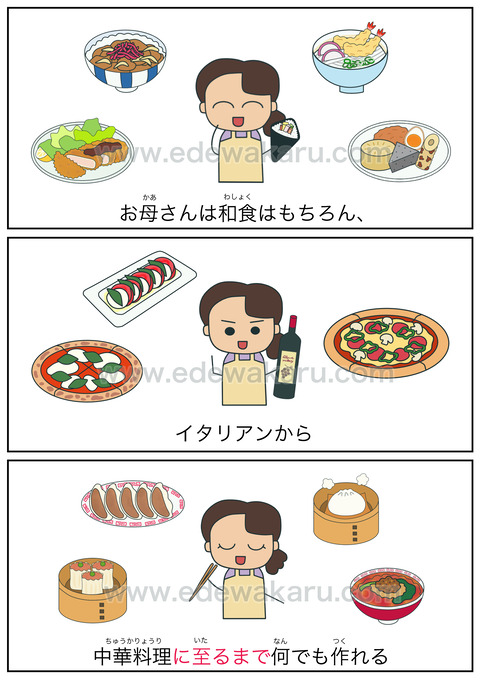
①お母さんは和食はもちろん、イタリアン
から
中華料理
に至るまで
何でも作れる
→和食から中華料理まで、作れる料理の範囲は広い
②あの映画は子供
から
大人
に至るまで、みんなに人気だ
→子供から大人まで、広い範囲の人に人気だ
③あのコンビニでは、食べ物
から
服
に至るまで
何でも買うことができる
→食べ物から服まで、買えるものの範囲が広い
④昨日は、北海道
から
九州
に至るまで
大雨が降った
→北海道から九州まで、広い範囲で大雨が降った
⑤ゲリラ豪雨のせいで、服
から
バッグの中
に至るまで
ずぶ濡れになってしまった
→服からバッグの中まで、全部がずぶ濡れになってしまった
「〜に至るまで」はかたい言い方ですので
【書き言葉】
として使われると覚えておきましょう😀
【「まで」がつく文型】
〜たまでだ・〜たまでのことだ
〜たらそれまでだ・〜ばそれまでだ
〜ないまでも
〜に至るまで
〜までして
〜までだ・〜までのことだ(V辞+までだ)
〜までに
〜までになる
〜までもない
In context 5 examples
お母さんは和食はもちろん、イタリアンから中華料理に至るまで何でも作れる
あの映画は子供から大人に至るまで、みんなに人気だ
あのコンビニでは、食べ物から服に至るまで何でも買うことができる(復習:〜ことができる(可能))
昨日は、北海道から九州に至るまで大雨が降った
ゲリラ豪雨のせいで、服からバッグの中に至るまでずぶ濡れになってしまった(復習:ゲリラ豪雨)(復習:〜てしまう(完了・状態))*「ずぶ濡れ」とは「服などがすごく濡れてしまう」という意味です
毎日のんびり日本語教師
How to use it
名詞+に至るまで
動辞形+に至るまで
Explanation
時間や場所などの語につき、その範囲の始点から終点の間にある全ての物事を表します。
前件に「~から」が呼応することがあります。
「~に至る」はある状態に達することを表します。これに終点を表す格助詞「まで」を組み合わせることで、ある状態に達するまでの過程、その範囲全てを指すようになっています。
「~に至るまで」と終点の「~まで」は似ています。
「~まで」は直線的な範囲にも円状の範囲にも使えます。
〇 ここからあそこ
まで
歩いていきましょう。 (直線的な範囲)
〇 東京
まで
飛行機で3時間かかります。 (直線的な範囲)
〇 頭からつま先
まで
ずぶ濡れだ。 (円状の範囲)
「~に至るまで」は円状の範囲には使えます。直線的な範囲には使いにくいです。
✕ ここからあそこ
に至るまで
歩いていきましょう。 (直線的な範囲)
✕ 東京
に至るまで
飛行機で3時間かかります。 (直線的な範囲)
〇 頭からつま先
に至るまで
ずぶ濡れだ。 (円状の範囲)
Notes
「至る」シリーズ
In context 12 examples
現在に至るまで、この事件の全容は解明されていない。
旅行中空き巣に入られ、貴金属類から家具に至るまで根こそぎ持って行かれた。
主要国首脳会議の開催で大通りはもちろん、住宅街に至るまで大規模な厳戒警備態勢が敷かれた。
一度目標を定めたら、後はそこに至るまで地道に一歩一歩進んでいくだけだ。
鬱病の完治に至るまで数年程掛かりました。
付き合うに至るまで紆余曲折があった。
何事も、答えに至るまでの道筋がみな必ずしも同じとは限らない。
古人の教えが現代に至るまで長い年月伝わってきている。(古人的教诲一直流传到现代。)
頭からつま先に至るまでずぶ濡れだ。(从头到脚都湿透了。)
この作品はキャラクターのデザインから物語、その背景に至るまで精巧に描かれている。副詞「至って(很/最/非常)」としての用法もあります。
こんなにも緊迫した状況でも、彼は至って冷静だった。在这么紧迫的情况下,他却极其冷静。
私はいたって普通の人間です。我是一个非常普通的人。