Bunpro Grammar Reference
Meaning
Unable to, Cannot
How to use it
Verb[stem]+ えない
Verb[stem]+ えません
Nuance
A formal phrase which focuses on not having, or not gaining the possibility to do (A).
Explanation
得る is a る-Verb that has the meaning of 'to gain' or 'to acquire'. When attached to the conjunctive form of verbs, it takes on the nuance of 'for (A) to be possible', or 'able to (A)'. In addition to this, when 得る is combined with ない, that nuance switches to 'unable to (A)', or 'cannot (A)'.
この個人情報は、本人以外は知り得ない情報だ。
This personal information is something that nobody apart from the person in question can know.
10年後の自分なんて、想像し得ません。
Something like me 10 years in the future, I cannot imagine it.
Compared to できない, meaning that the potential to do something does not exist, 得ない means something closer to 'there is no possibility that (A) can be done', or 'the possibility to do (A) has not been gained'.
Caution
得る may be seen as either える or うる. The primary difference between the two being that うる is a relatively old form that is often seen only in literature, and almost never spoken. Despite this, うる is never used in the negative form with ない.
そんな大きな災害は起こりえないと思います。
I think that it's impossible for a disaster that big to happen. (Natural Japanese)
そんな大きな災害は起こりうないと思います。
I think that it's impossible for a disaster that big to happen. (Unnatural Japanese)
Fun-fact
得る is far more formal/bookish than できる. However, there are several set phrases that are very common in daily speech that use this particular grammar point, such as あり得る 'possible', and あり得ない 'impossible'.
まあ、それもあり得るかもしれないけど...
Well, that is possible, but…
田中さんはすごく頭がいいから、不合格になるなんて絶対あり得ない。
Tanaka-san is very smart, so it is absolutely impossible for him to fail.
Nuance · 日本語
(A)の可能性が存在していない、又は手に入れることができないということに焦点を当てる丁寧な表現。
Explanation · 日本語
「得る」は「手に入れる」や「自分のものにする」という意味の一段動詞です。これが動詞の連用形とくっつくと、「(A) できる」や「(A) の可能性がある」という意味を表します。また、「得る」と動詞の連用形が「ない」に結びつくと、「(A) は不可能だ」や「(A) の可能性はない」という否定的な意味になります。
この個人情報は、本人以外は知り得ない情報だ。
This personal information is something that nobody apart from the person in question can know.
10年後の自分なんて、想像し得ません。
Something like me 10 years in the future, I cannot imagine it.
「できない」と比較すると、「できない」は何かの実行が不可能であることを表しますが、「得ない」は「(A) ができる/起こる可能性はない」や「(A) はありえない」というニュアンスに近いです。
注意点
「得る」の読み方には「える」と「うる」の二つがあります。「うる」は比較的古い言い方で主に書き言葉として使われ、話し言葉としては「える」の方がよく使われます。ただし、否定形の「得ない」は必ず「えない」と読まれ、「うない」とはなりません。
そんな大きな災害は起こりえないと思います。
I think that it's impossible for a disaster that big to happen. (Natural Japanese)
そんな大きな災害は起こりうないと思います。
I think that it's impossible for a disaster that big to happen. (Unnatural Japanese)
豆知識
「得る」は「できる」よりもずっと硬い文学的な表現ですが、「あり得る」や「あり得ない」のように、日常生活の中でよく使われる「得る」を使った定型表現もあります。
まあ、それもあり得るかもしれないけど...
Well, that is possible, but…
田中さんはすごく頭がいいから、不合格になるなんて絶対あり得ない。
Tanaka-san is very smart, so it is absolutely impossible for him to fail.
In context 18 examples
- そこまで大きな地震は起こり得ない。
An earthquake of that magnitude cannot occur.
- この個人情報は、本人以外は知り得ない情報だ。
This personal information is something that nobody apart from the person in question can know.
- 10年後の自分なんて、想像し得ません。
Something like me 10 years in the future, I cannot imagine it.
- 本来、水と油は混ざり得ない。
Naturally, you cannot mix water and oil.
- そんなことはほとんど起こり得ないと思います。
I think that there is a good chance that such a thing cannot happen.
- 私がその夢を叶えることはあり得ない。
It is not possible for me to achieve that dream.
- 君の話術を持ってしても、説得し得ないだろう。
Even if I had your skill in conversation, I probably couldn't persuade them.
- 過去に犯罪を犯した人は、信頼し得ない。
A person that has committed a crime in the past is unable to be trusted.
- 無知な彼女が選挙で勝つことなど、あり得ない。
That she, who is ignorant, would do something like win in the election is unbelievable.
- 彼は専門家だから、偽物を買うなんてということは、絶対あり得ない。
Since he is an expert, that means that it is impossible that he would do something like buy a fake.
- 太陽がなければ地球の生命は存在し得ない。
If there was no sun, life on Earth could not exist.
- 彼の失礼な態度を見て、人としてあり得ないと思った。
Seeing his rude attitude, I thought that it was unbelievable as a person.
- 健康な父が脳梗塞になることは、予測し得なかった。
I was unable to predict that my healthy father would suffer from a stroke.
- 二次元のキャラクターは実際に存在し得ないからこそ、人々の目に魅力的に映るのだ。
It is precisely because two dimensional characters cannot exist in reality, that they fascinate people.
- そんな大きな災害は起こりえないと思います。
I think that it's impossible for a disaster that big to happen. (Natural Japanese)
- そんな大きな災害は起こりうないと思います。
I think that it's impossible for a disaster that big to happen. (Unnatural Japanese)
- まあ、それもあり得るかもしれないけど...
Well, that is possible, but…
- 田中さんはすごく頭がいいから、不合格になるなんて絶対あり得ない。
Tanaka-san is very smart, so it is absolutely impossible for him to fail.
絵でわかる日本語
Meaning
〜可能性がある / 〜可能性がない
〜できる / 〜できない
How to use it
動詞[ます形]+得る
動詞[ます形]+得ない
Explanation
「〜得る・〜得ない」は「〜可能性がある・〜可能性がない」または「〜できる・〜できない」という意味で使用される文型です。まず気をつけなければいけないのは読み方です😮
「うる」「える」
と2つ読み方がありますが、使い分けが必要です😨
「得る」→
う
る・
え
る
「得ます」→
え
ます
「得ない」→
え
ない
「得ません」→
え
ません
「得た」→
え
た
「得ました」→
え
ました
つまり、「得る」のみが「うる・える」と2つ読み方がありますが、その他は「え」と読まなければいけないということです😊(復習:〜ということだ)
また、この文型は
ただ「能力」を表す場合には使えないということを覚えておいてください
😌
⭕️彼女は日本語が
話せる
❌彼女は日本語が
話し得る
「能力」を表す場合には「〜ことができる」「可能形」を使うようにしてください。
「〜得る・〜得ない」は書き言葉的ですが、「あり得ない=あるはずがない」は会話でもとてもよく使われます😊みなさんも日常会話で使ってみてくださいね😉
In context 4 examples
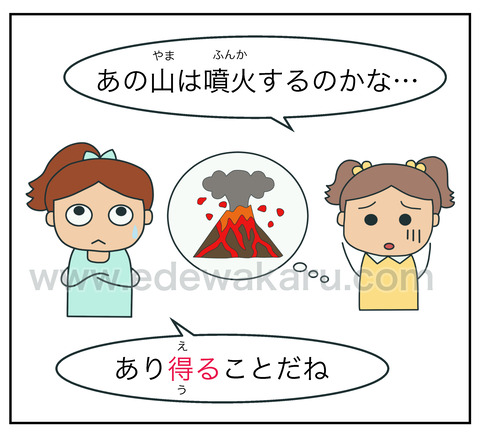
A:あの山は噴火するのかな…(復習:〜かな・〜かしら)B:あり得ることだね→噴火する可能性があるね
彼が負けるなんてあり得ないよ!
→彼が負けるなんてあるはずがないよ!事故は誰にでも起こり得ることだ
→事故は誰にでも起こる可能性があることだお酒やタバコは病気の原因になり得ます
→お酒やタバコは病気の原因になる可能性があります
毎日のんびり日本語教師
How to use it
動ます形+得ない
Explanation
状況的に不可能であることを表します。
能力可能は表せません。
可能形「~れない/られない」が可能性がないことを表す場合、お互いに言い換えることができます。
◯日本語を話せない。
✕日本語を話し得ない。
「~得ない」は比較的硬い表現ですが、「ありえない」は口語としても頻繁に使われます。
Notes
関連文法「【N2文法】~得る」
In context 14 examples
あんなひどいことを言っておいて、今さら謝るなんてありえない。
世の中には到底理解し得ない人間がいっぱいいる。(世界上有很多人无法理解。)
私に想像し得ない世界が身近に広がっている。
彼の企みは到底実現し得ないだろう。(他的企图终究无法实现吧。)
人の気持ちは他人には理解し得ない。(别人的心情别人无法理解。)
現実的に達成し得ない目標を設定すべきではない。(不应该设定不现实达成的目标。)
無償の愛なんて存在し得ない。(无偿的爱是不可能存在的。)
おでんはおかずにはなり得ない。
同じ人間なんて存在しえない。
役に立たない人間なんていない。生きてる価値が無いなんて絶対にあり得ない。
人間はこの世の真理には到達し得ない。
恋は治療し得ない病である。
僕の気持ちは、他人には到底理解し得ないものです。
宇宙って私たちが想像しえない速度で膨張してるらしい。
NINJAL 日本語文型データベース
Meaning
〜の状況になる可能性がないことを表します。
硬い言い方ですが、「あり得ない」は慣用的な言い方として、くだけた会話でも使います。
How to use it
Notes
「〜得る」の否定形ですが、読み方は「えない」だけです。
In context 8 examples
命あるものは水と空気なしでは生存し得ない。
宇宙人がいる? あり得ないよ、そんなこと。
彼はどうも優柔不断だ。いい指導者にはなり得ないだろう。
アインシュタインの「相対性理論」は、発表当時は3人の科学者しか理解し得なかったというエピソードがある。
そんないい加減な説明ではとうてい誰も納得し得ないでしょう。
この道路建設計画の実現は、当面期待し得ないと私は考えております。
今後、必要な電力が十分に供給し得なくなるということは考えられません。
1969年、アメリカのアポロ11号の着陸船イーグル号は、どこの国もなしえなかった月面着陸に成功した。