DoJG 日本語文法辞典(全集)
Meaning
That
Explanation
って (2) A colloquial quotation marker.
In context 3 examples
ジェーンは踊らないって。
Jane said that she wouldn't dance / They say that Jane won't dance.
今晩は雪が降るって。
They say it's going to snow tonight.
僕も行こうかって思いました。
I wondered if I should go there, too.
日本語文型辞典
Meaning
くだけた会話で使う表現。「NというN」の縮まった形。「キアリーっていう作家」「なんていう人」のように「NっていうN」の形でも使う。話し手が知らない、あるいは聞き手が知らないだろうと考えられるものごとについて述べるときに使う。疑問詞「何」のあとでは「って」ではなく、「なんて」になる。
そのことを話題として取り上げて、定義や意味について述べたり、評価を与えたりするのに使う。くだけた会話の表現。定義や意味について述べる場合は、かたい書きことばで、「Nとは」に当たる。また、⑧のように動詞を用いた句の場合は、「Vのは…だ」に対応する話しことばの表現。
a. …って
文を引用する「と」に対応するくだけた会話の表現。あらたまった会話以外では、広く用いられ、男性、女性の別なく使う。①は「かれはすぐ来るといっていますよ。」の意味。③④のように、あとの部分を省略して、聞いたことなどを伝える表現としても使う。
相手のいったことをくりかえして、詰問に対して応酬したり、反問したりするのに用いる。くだけた会話の表現。「…というのは」という表現に対応することが多い。
「のだ/んだ」と、【引用】の「って」が結び付いた形。人から聞いて得た情報であること(伝聞)を表す。⑤~⑧は上昇調で、聞いたことを持ち出して聞き手に確認の問いかけをする表現。男女の別なく、くだけた会話で使う。「なのだって/のだって」はほとんど使わず「んだって」「んですって」になることが多い。「んですって」はおもに女性が使うが、「です」が入っていても目上に対しては使えず、「あの人は先生なんだそうです」のように言う。
⇾たって
How to use it
NってN
…って【主題】
Nって
Aって
V(の)って
…って【引用】
…って
んだって【伝聞】
N/Na なんだって
A/V んだって
…たって
In context 33 examples
これ、キアリーって作家の書いた本です。
A:留守の間に人が来ましたよ。
B:なんて人?佐川さんって人に会いました。友達だそうですね。
駅前のベルって喫茶店、入ったことある?
(誤) なんって人。
(正) なんて人。
WHOって、何のことですか。
ヒアリングって、何のことですか。
ゲートボールって、どんなスポーツですか。
赤井さんって、商社に勤めているんですよ。
山田課長って、ほんとうにやさしい人ですね。
うわさって、こわいものです。
若いって、すばらしい。
都会でひとりで暮らす(の)って、大変です。
反対する(の)って、勇気のいることです。
どちらかひとつに決める(の)って、むずかしい。
かれはすぐ来るっていってますよ。
それで、もうすこし待ってくれっていったんです。
A:お母さん、きょうは、いやだって。
B:じゃあ、いつならいいの。A:電話して聞いてみたけど、予約のキャンセルはできないって。
B:ああ、そう。A:これ、どこで貰ったの。
B:どこって、マニラだよ。A:もうこの辺でやめてほしいんだが。
B:やめろって、一体どういうことですか。あの人、先生なんだって。
山田さん、お酒、きらいなんだって。
あの店のケーキ、おいしいんだって。
鈴木さんがあす田中さんに会うんだって。
A:あの人、先生なんだって?
B:うん、英語の先生だよ。A:山田さん、お酒、きらいなんだって?
B:ああ、そう言ってたよ。A:あの店のケーキ、おいしいんだって?
B:いや、それほどでもないよ。A:鈴木さんがあす田中さんに会うんだって?
B:うん、約束してるんだって。そんなこと、したってむだだ。
そんなこと、言ったって、いまからもどれないよ。
ここから呼んだって、聞こえないだろう。
絵でわかる日本語
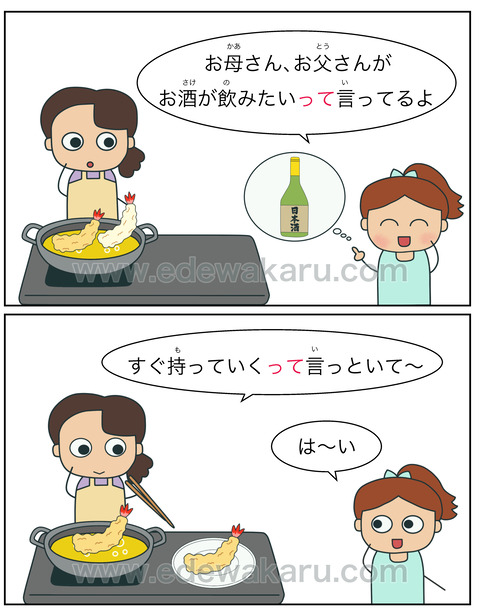
どんなときどう使う 日本語表現文型辞典
Usage 1
Meaning
who; what; that
How to use it
Vる(の)/イAい/ナA/N+ってS
Explanation
って〈主題〉
~とは/~というのは
ものごとの定義、意味について説明するときの言い方。くだけた話し言葉。書き言葉では ❶ は「PCとは」 ❷ は「~というのは」という意味になる。
Defines something or explains its meaning. Informal. In written speech, sentence ❶ would be p.c.とは. Sentence ❷ would be というのは.
In context 3 examples
A:PCって何ですか。B:パソコンのことですよ。
A:子どもを持つのって、大変ですか。B:ええ。でも、うれしいことも多いですよ。
昔「大きいことっていいことだ」という言葉があった。
Usage 2
Meaning
(hearsay) they say that
How to use it
〔普通形〕+ってS
Explanation
って〈伝聞〉
~ということだ
妹:天気予報では、午後から晴れるって。
1)伝聞・引用の「と」が「って」に変形したもの。「と言っている・と書いてある」などの動詞の部分が省略されたと考えられる。日常生活で広く使われている。
2) ❶ は「休みだそうだ」の意味。 ❶ ~ ❸ は下降調。
1)The と of hearsay or quotation abbreviates to って. The と言っている (saying) or と書いてある (is written) that follows と has been omitted. Widely used in daily conversation.
2)Sentence ❶ means: 休みだそうだ.Sentences ❶ to ❸ are said with falling intonation.
In context 4 examples
A:来週の授業は休みだって。B:ほんと。よかった。
兄:今日の天気はどう?
後藤さんは明日来られないって。
A:これいくらで買ったの。B:お姉さんにもらったんだけど、2,000円だったんだって。
Usage 3
Meaning
named
How to use it
N+ってS
Explanation
って〈名前〉
1)「~ってN」の形で話し言葉で、よく知らない人や物や場所などの名を言うときの言い方。
2)「~ってN」とも「~っていうN」とも言う。
3)書き言葉では「NというN」である。
1)In form って N is spoken expression.Tells names of little known people, things, or places.
2)Forms~って N and~っていう N are also used.
3)Written form is N という N.
In context 3 examples
伊藤さん、チャヤさんって人から電話がありましたよ。
「ミラノ」っていうイタリア料理の店、知ってる?
これは村上春樹って作家が書いた『海辺のカフカ』っていう小説です。
日本語NET JLPT文法解説まとめ
Meaning
人や物の名前をいう時に使う表現。
話し言葉。「〜っていう」とも言える。
書き言葉は「〜という」。
How to use it
N + って
Explanation
named / called
In context 8 examples
リュウさん、さっき田中さんって人が探してたよ。
これはたこ焼きっていう食べ物だよ。
夏目漱石って人が書いた本を読んだんけど、とても難しくてわからなかった。
マルイっていうデパートに行ったことある?
みんなの日本語っていう教科書が一番有名だよね。
ナルトっていう漫画が面白いらしいよ。
anelloっていう鞄が最近、人気があるらしいね。
これはじゃんけんっていうゲームだよ。
日本語文型辞典 英語版
Meaning
B:なんて人?
What was his name?
Used in informal conversation. Contracted form of NというN. Also used in the form NっていうN, as in キアリーっていう作家 and なんていう人. Used for things that the speaker doesn’t know, or things that the listener is thought not to know. Becomes なんて, rather than って, after the interrogative 何.
(×)なんって人。
What’s he called?
(○)なんて人。
What’s he called?
Used when raising something as a topic and describing its definition or meaning, or assessing it. Used in informal spoken language. When describing a definition or meaning, as in
(1)
-
(3)
, it is the spoken language equivalent of Nとは. When a verb is used in the phrase, as in
(8)
, it is the spoken language equivalent of Vのは...だ.
B:じゃあ、いつならいいの。
So when will it be OK?
B:ああ、そう。
Is that so?
The colloquial equivalent of とused for quoting sentences. Used widely except in formal conversation, regardless of whether the speaker is a man or a woman.
(1)
means “He’s saying he’ll be here soon.” Also used for conveying what the speaker has heard by abbreviating the latter half of the sentence, as in
(3)
and
(4)
.
B:どこって、マニラだよ。
In Manila, of course.
B:やめろって、一体どういうことですか。
Quit here? What on earth are you talking about?
Used as a retort to question the listener by repeating what was said. Colloquial expression. ...というのはis often used as formal equivalent.
B:うん、英語の先生だよ。
Yes, an English teacher.
B:ああ、そう言ってたよ。
Yes, he said so.
B:いや、それほどでもないよ。
No, not especially.
B:うん、約束してるんだって。
Yes, they have an appointment, apparently.
This is a combination of のだ/んだ and the quotation って. Expresses that something is information acquired by hearing it from someone else.
(5)
-
(8)
, with a rising tone at the end of the sentence, are expressions used for asking the listener to confirm what the speaker has heard. Both men and women use it in informal speech. なのだって/のだって are almost never used; they usually become んだって and んですって.
んですってis normally used by women. Note that in this case even though です is used, it cannot be used when speaking to a person of higher status. For example, あの人は先生なんだそうです should be used instead of ...先生なんですって.
→
How to use it
1. NってN
2. ...って〈topic, theme〉[Nって][Aって][V(の)って]
3. ...って〈quotation〉a. ...って
4. ...って
5. んだって〈hearsay〉[N/Na なんだって][A/V んだって]
6. ...たって
In context 31 examples
これ、キアリーって作家の書いた本です。
This is a book written by a writer named Carey.
A:留守の間に人が来ましたよ。
Someone visited in your absence.
佐川さんって人に会いました。友達だそうですね。
I met someone named Sagawa-san. Apparently she’s your friend.
駅前のベルって喫茶店、入ったことある?
Have you been to a cafe called Bell in front of the station?
WHOって、何のことですか。
What’s “WHO”?
ヒアリングって、何のことですか。
What does “hearing” mean?
ゲートボールって、どんなスポーツですか。
What kind of sport is gateball?
赤井さんって、商社に勤めているんですよ。
That Akai-san—she works at a trading company.
山田課長って、ほんとうにやさしい人ですね。
You know Yamada-kacho, the section chief—he’s really a kind person, isn’t he?
うわさって、こわいものです。
A rumor is a scary thing.
若いって、すばらしい。
Youth is wonderful.
都会でひとりで暮らす(の)って、大変です。
Living alone in a large city is hard.
反対する(の)って、勇気のいることです。
Disagreeing requires courage.
どちらかひとつに決める(の)って、むずかしい。
It’s difficult to decide on only one of them.
かれはすぐ来るっていってますよ。
He’s saying he’ll come here soon.
それで、もうすこし待ってくれっていったんです。
That’s why I asked him to wait for a little longer.
A:お母さん、きょうは、いやだって。
Mother, I don’t want to go today.
A:電話して聞いてみたけど、予約のキャンセルはできないって。
I called them and asked, but they said they can’t cancel the reservation.
A:これ、どこで買ったの。
Where did you buy this?
A:もうこの辺でやめてほしいんだが。
I’d really like you to quit here.
あの人、先生なんだって。
That person is a teacher apparently.
山田さん、お酒、きらいなんだって。
Yamada-san apparently doesn’t like drinking.
あの店のケーキ、おいしいんだって。
They say the cakes at that bakery are really good.
鈴木さんがあす田中さんに会うんだって。
Apparently Suzuki-san is meeting Tanaka-san tomorrow.
A:あの人、先生なんだって?
I hear he’s a teacher, right?
A:山田さん、お酒、きらいなんだって?
So I hear Yamada-san doesn’t like drinking?
A:あの店のケーキ、おいしいんだって?
I hear the cake in that shop is really good, right?
A:鈴木さんがあす田中さんに会うんだって?
So Suzuki-san is meeting Tanaka-san tomorrow?
そんなこと、したってむだだ。
It won’t work.
そんなこと、言ったって、いまからもどれないよ。
You say so, but I can’t go back now.
ここから呼んだって、聞こえないだろう。
He can’t hear us even if we call him from here.
Bunpro Grammar Reference
Usage 1
Meaning
Casual quotation
How to use it
Quote + って + Verb
Nuance
A casual replacement for a particle which is used for making quotations.
Explanation
って is a casual variation of the と particle that is used for quoting something. This use is called 引用 in Japanese, which basically translates to 'reference', or 'citation'. って is almost exclusively used after direct quotations, and will be followed by a verb indicating what type of communication was used. 言った, 思った, 聞いた, for example.
「行ってきます」ってママが言った。
Mom said, 'I'll be back soon'.
「それは危ないよ」って先生が言った。
The teacher said, 'That is dangerous'.
Just like with と, the verb that comes after って is frequently omitted. This is even more true for って, as many things are omitted in casual language.
トムは「今日休む」って。
Tom said he was going to take the day off today.
Caution
Although often heard, due to って being very casual, it can be considered unnatural to use in sentences that also use the です or ます polite structures. However, if the conversation is formal but friendly (like between a senpai and a kouhai), most people would consider it normal.
Nuance · 日本語
誰かが言ったことをカジュアルに示すときに使われる助詞。
In context 15 examples
- 「乾杯!」って言いたい。
I want to say, 'Kanpai!'
- 「行ってきます」ってママが言った。
Mom said, 'I'll be back soon'.
- トムは「今日休む」って。
Tom said he was going to take the day off today.
- 「それは危ないよ」って先生が言った。
The teacher said, 'That is dangerous'.
- 先生は「おはよう!」って言った。
The teacher said, 'Good morning!'
- 「明日は雨が降りますか」って聞いた。
I asked, 'Is it going to rain tomorrow?'
- 彼は「晩ごはんを捨てた」って言った。
He said, 'I threw away my dinner'.
- 「何時からですか」って聞いた。
I asked, 'What time is it from?'
- お母さんは「危ない!」って言った。
My mother said, 'That's dangerous!'
- あの人が「あなたは綺麗ではない」って言っていました。
That person said, 'You aren't beautiful'.
- 「北海道から新幹線で来た」って言った。
He said, 'I came from Hokkaido by bullet train'.
- 漢字で「しょうゆ」って書いて。
Please write 'shoyu' in kanji.
- 「明日は雨」って書いた。
I wrote, 'Tomorrow will be rainy'.
- 私は「ここでは遊ばない!」って言った。
I said, 'I don't play here!'
- 彼は「彼女は綺麗な人だ」って言った。
He said, 'She is a beautiful person'.
Usage 2
Meaning
As for, Speaking of, Casual は (Sentence topic marker)
How to use it
Sentence topic + って
Nuance
A casual way of marking the general topic of a sentence.
Explanation
Although って can be used as a casual quotation marker in Japanese (replacing と), it is also frequently used as a casual topic marker (replacing は). This is something that occurs primarily in spoken language, and will come directly after the sentence topic, in exactly the same way as the adverbial particle は usually would.
私って皆に嫌われている?
Am I disliked by everyone?
トマトって野菜なの?フルーツなの?
Are tomatoes vegetables? Are they fruits?
Nuance · 日本語
文の大まかな話題をカジュアルに示す方法。
Explanation · 日本語
「って」は引用を表す「と」のくだけた表現ですが、それだけでなく、話題を示す「は」のくだけた表現にもなります。この「って」は、主に会話の中で使われます。「は」と同じように、文の話題を示す名詞のあとに置かれます。
私って皆に嫌われている?
Am I disliked by everyone?
トマトって野菜なの?フルーツなの?
Are tomatoes vegetables? Are they fruits?
In context 14 examples
- このパスタって美味しいよね。
As for the pasta, it is delicious, don't you think?
- 私って皆に嫌われている?
Am I disliked by everyone?
- トマトって野菜なの?フルーツなの?
Are tomatoes vegetables? Are they fruits?
- あの人って誰?
As for that person, who is it?
- 先生って優しいね。
As for the teacher, she is nice, don't you think?
- ギターって弾けますか?
As for guitar, can you play it?
- 冬って寒いけど、雪は綺麗だ。
As for winter, it is cold, but snow is pretty.
- 明日って何曜日なの?
As for tomorrow, which day of the week is it?
- 北海道っていいところですか?
As for Hokkaido, is it a nice place?
- スマホって高くないですか?
As for smartphones, they are expensive, aren't they?
- 豆腐の木綿と絹ごしってどう違うの?
As for 'momen' and 'kinugoshi' tofu, how do they differ?
- 仕事って大変なことが多いですね。
As for work, it is full of difficult things, don't you think?
- 諺って覚えた方がいいんですか。
As for kotowazas (proverbs), would it be better to memorize them?
- 日本語の勉強って難しいな。
As for studying Japanese, it is hard.
文法
Meaning
人や物の名前をいう時に使う表現。
話し言葉。「〜っていう」とも言える。
書き言葉は「〜という」。
How to use it
N + って
In context 8 examples
リュウさん、さっき田中さんって人が探してたよ。
これはたこ焼きっていう食べ物だよ。
夏目漱石って人が書いた本を読んだんけど、とても難しくてわからなかった。
マルイっていうデパートに行ったことある?
みんなの日本語っていう教科書が一番有名だよね。
ナルトっていう漫画が面白いらしいよ。
anelloっていう鞄が最近、人気があるらしいね。
これはじゃんけんっていうゲームだよ。
Yokubi — The Common Grammar Guide (https://yoku.bi)
Explanation
There are two basic types of relative clause. The first is the kind that modifies a noun, which we already learned in [Lesson 14](../../Section1/Part1/Lesson14.md). The second is an embedded clause, often called a "quote", like the underlined part of "He said that the war would end soon".
って and と, called quotation markers, often assume the role of marking such embedded clauses.
In English we distinguish between direct and indirect quotes through punctuation. For example:
The same concept does not apply to Japanese where the distinction between a direct and indirect quote is more blurry. While quotation markers (like 「 」) exist and can help identify direct quotes, they aren't required and you will see both direct and indirect quote show up "freely" in text just marked by a simple って or と.
The embedded clause inside quotes needs to be a "complete" statement, so if the quote ends with a な-adjective or noun, it needs to end with だ. There are some exceptions and usages that may drop this rule, but in the majority of situations you need to make sure だ is there or the sentence will sound wrong.
When it comes to quotes, って is essentially a colloquial version of と.
As you can see from the second example, the verb ("said", "thought", etc) can be often dropped if it's obvious from context and tone.
In some usages って can also take the role of topic, similar to は. In these cases it's not really a quote. It's just an alternative topic marker.
The construction という (often slurred as っていう or even っつう) is so commonly used that it has acquired additional meanings on top of its literal "I/they said".
It can be used to "glue" together pieces of sentences in a manner that makes them flow better and feel less awkward. It is hard to provide a comprehensive explanation for all these cases, but you will see it often enough that it's better to acquire a "feel" for it via exposure instead. Sometimes the という does not add any meaning at all, so don't try to put it into English if you can't.
It can be used to provide a definition or describe a quality. This usage is similar to である but has a slightly different nuance.
It can also be used to provide emphasis by repetition in some set expressions:
In context 3 examples
ダメだって言ったでしょ!
I said no, didn't I?
何だって?
What did you say?
田中さんっていい人だね
Tanaka-san is a good person
NINJAL 日本語文型データベース
Usage 1
Meaning
[1] 聞いたり読んだりした言葉を直接引用して、1文の中に入れるときに使います。
「〜と」が音声的に変化した形です。
[2] 聞いたり読んだり思ったりした内容を引用して、1文の中に入れるときに使います。
「〜と」が音声的に変化した形です。
How to use it
「…」って
V普通形(命令形・禁止形も含む)+って
i-A普通形+って
na-A普通形+って(「na-Aだ」→「na-Aって」の形になることもある)
N普通形+って(「Nだ」→「Nって」の形になることもある)
Notes
[1] 聞いたり読んだりした言葉をそのまま「 」に入れて書きます。
ふつう「言う・聞く・書く」などの伝達に関する動詞を使いますが、その動詞を省略することもあります。
[2] ふつう「言う・書く・思う」などの伝達や思考に関する動詞を使いますが、その動詞を省略することもあります。
In context 34 examples
今日こそは「好きです」って彼に言おう。
「お母さん、郵便屋さんが『はんこ、押してください』って」「はい、はい、わかりました」
ハイキングの途中、弟は山道で転んで「痛い、痛い」って泣いてた。かわいそうだった。
子どもに「今日のお弁当どうだった?」って聞いたら、「おいしかった」って言ってたから、安心した。
「シロが『外に出たい』ってさっきから吠えているよ」「えっ、お母さん、犬の言葉がわかるの?」
「『明日はさわやかな天気でしょう』って天気予報で言ってたよ」
スーパーの広告に「鶏肉、大安売り」って書いてあるから、晩ご飯は鶏肉料理にしようかな。
道で、知らない人に「こんにちは」って挨拶されたから、「こんにちは」って返事をした。
「この鳥は、仲間を集めるときに『ジジジジ』って鳴くんだって」
諦めなければいつかきっと夢はかなうって信じてる。
「さくらデパートで猫の写真展をやってるって。ほら、ここに書いてある」「わあ、行ってみようよ」
沢井さんからのメールには、今日の会には参加できないって書いてあったけど、理由は何だろう。
「ソフィアさんはもう国へ帰ったって聞いたけど、本当?」「本当だよ。先週の月曜日に」
頼んでおいたアロマオイルがABCデパートでは見つからなかったって、夫から連絡が来た。
「親が6時には起きろっていつも言うんだ」「え、そんなに早く?」
妻「もう! 今日はお酒は飲むなって言ったのに」夫「ごめん、上司の誘いだったから断れなかったんだ」
「隣の部屋がうるさいってフロントに文句を言おうか。これじゃゆっくり休めないよね」
朝起きたときは寒いって思ったけど、意外に暖かい一日だった。
夏休みには海外に行きたいって親に頼んでみよう。
私は甘いものは食べたくないって言ってるのに、母がまた甘いお菓子を買ってきた。
「友達が先週富士山に登ってきたんだって。頂上はすごく寒かったって。でも景色は素晴らしかったって」
「この計算は正しくなかったって今気がつきました。すみません。すぐに訂正します」
「先生の声、とても素敵だって学生たちみんな言ってます」「それは、ありがとう」
引率教師「ハイキングの途中、雷が落ちたんですが、うちの生徒たちはみんな無事だって本部に伝えてください」
「フルマラソンなんて私には絶対無理って思ってたけど、練習したら走れたよ」
明日は雨が強くなりそうって天気予報で言ってた。
介護士の資格試験は簡単じゃないって聞いたけど、挑戦してみようかな。
亡くなった祖母は、自分は幸せだったっていつも言ってました。
結婚したばかりのころは生活が楽じゃなかったって母が話していた。
「中川さんの言っていることはうそだって言えるんですか」「いや、うそじゃないかもしれないね」
届いた郵便物に料金不足って書いてあった。確かに30円不足だった。
部長「明日学校は休みだけど、練習は休みじゃないってみんなに伝えておいて」部員「はい、わかりました。すぐ伝えます」
隣のクラスの今日の欠席者は5人だったって聞いたけど、ずいぶん多かったんだなあ。
「かずみさんの住所は中山町じゃなかったって。この間送った物、戻ってきたらしいよ」
Usage 2
Meaning
[1] 話し手または聞き手がよく知らない人・もの・場所などの名前を言うときに使います。
「~というN」が音声的に変化した形です。
質問の文では「何て」の形になります。
[2] Nの情報内容を表すときに使います。
「~というN」が音声的に変化した形です。
How to use it
N1ってN2
V普通形(命令形・禁止形も含む)ってN
i-A普通形+ってN
na-A普通形+ってN(「na-Aだ」→「na-A+って」の形になることもある)
N1普通形+ってN2(「Nだ」→「N1+ってN2」の形になることもある)
その他
Notes
[2] Nには、「話・うわさ・報告・回答・伝言・メール・知らせ・手紙・考え・意味」など、伝達や思考に関係がある意味の名詞がきます。
In context 29 examples
「この花、色がいいね」「これはマユミって花。私と同じ名前なの」
母「さっき、あずさって子がこれ持ってきたよ」子「ふーん、何だろう」
「東北地方の恐山って所、知ってますか」「いや、初めて聞く地名です」
「あの店のきみしぐれってお菓子がおいしいから食べてみて」
「これは何て曲?」「ベートーベンの『田園』って曲。私、好きなの」
「福田さんが仕事をやめるってうわさ、本当?」「さあ、知らない」
昨日テレビで、宇宙には果てがないって話をやってました。
「お父さん、さっき美知子から、道が混んでいてホテルに1時までに着かないって連絡があったよ」
母がけがをしたって知らせが入ってびっくりした。
「国の弟から進学はしなかったってメールが来たんだ。人生にはいろんな道があるって返事を出したよ」
「お母さんからすぐに予約をしろって電話があったけど、あのレストラン、そんなに人気があるの?」
このドアを開けるなって貼り紙があると、逆に開けたくなるなあ。
あの2人、最近仲が悪いって話だけど、私はそうは思わない。
別れた人からもう一度会いたいって連絡が来た。どうしようかな。
スピーチの前はだれでも緊張する。でも、失敗しても恥ずかしくないって気持ちでやれば、きっとうまくいく。
この俳優、最近雰囲気が変わってびっくりした。でも、前のほうがよかったって意味じゃなくて、今の雰囲気もいいと思う。
「昨日の日本語能力試験、どうだった?」「うーん、そんなに難しくなかったって印象だけど、結果が出るまでは安心できないなあ。」
この映画の主人公の考え方はちょっと変だってコメントを読んだ。同感だ。
「ニュースで大地震があったって聞いたけど、国のご家族は大丈夫だったの?」「うん、さっきみんな無事って知らせが来て、ほっとしたよ」
「来週には東京の桜が満開になりそうって記事があるんだけど、この辺の桜はまだまだだね」
主婦の仕事も楽じゃないって言葉、多くの人が深く共感すると思う。
みんなが、課長はきのう飲みすぎてふらふらだったって話をしていた。
店に来た客にアンケートをお願いしたら、店員があまり親切じゃなかったって回答があった。
「林君は今、ABC社の社長だって話だよ」
彼女から、もうこれが最後ってメッセージが来た。何を怒ってるんだろう。
あの人は、努力は人に見せるものじゃないって考えを持ってるみたいです。
放火の犯人は子どもだったってニュースにはびっくりした。
お客様から、届いた商品が注文した色じゃなかったってクレームが来た。すぐ調べてみないと。
「今日の会は5時からって伝言、聞いた?」「うん、聞いたよ」
IMABI
The Particles って, たって, & だって
Read this IMABI lesson ↗Explanation
The Particles って, たって, & だって
In this lesson we will learn about the particles って, たって, and だって which are necessary in improving your colloquial Japanese skills.
The Particle って
The Case Particle って: Colloquial Citation
This is a very important feature of casual Japanese. The particle と is very frequently seen as って in spoken Japanese. Although it originally came from the contraction of という, it has since taken on と’s function as a citation particle.
1. 難しいって思った。
I thought it was difficult.
2. 負けたよって言われてもなあ。
Even if you would have said you lost.
3. お母さんにどうぞよろしくって伝えてくださいね。
Please say nice to meet you to her mother.
4. 田中さんって知ってる?
Do you know Mr. Tanaka?
気にしなくてもいいってことだ。
It’s nothing you may need to be worried about.
“…の…の(と)” is used to list things in contrast or emphatically and “…の…ないの(って)” shows excess. As is noted, sometimes using it may be uncommon or even old-fashioned.
5. 何なんのかんのと文句もんくをつける。
To complain of what and that.
6. 死ぬの生きるのと大騒おおさわぎだ。
Dying and living is all turmoil.
7. うるさいのなんのって、耳が聞こえなくなったほどだ。
It’s so loud to the point I’ve lost my hearing.
8. 無職むしょくになるの、離婚りこんするの、散々さんざんな目にあったな。(Not so common)
Becoming unemployed and divorced, I’ve met a lot of terrible things hasn’t it!
9. 寒いの暑いのと言っていないで、ジョギングは毎朝まいあさしなさい。
Don’t complain about it being hot or cold, you must go jogging every day.
10. 痛いたいの痛くないのと、飛とび上あがってしまったよ。(古い言い方)
It hurt so bad I accidentally jumped up.
The Adverbial Particle って: Emphatic
It takes up the subject with slight exclamation and is equivalent to というのは. It’s also used in repeating what someone said.
11. オレって、なんてバカなんだ。
I’m such an idiot.
12. 誰かに出会える時っていつもこうだ。
Meeting someone is always the same way.
13. したくないって、どういう意味だ。
You don’t want to do it, what do you mean?
14. 誰が{殺人・殺人者・人殺し・犯人}かって、あいつに決まってるよ。
It’s settled that who the, um, murderer is that guy over there.
Word Note: 殺人者 is a rather formal word and not used much in actual conversation, although it is common in books. 人殺し is a graphic word that bring images of the bloody crime scene. So, it is considered a sensitive word and often avoided. 犯人, although it only means “criminal”, it is the most likely word to use in this situation, and most people would realize automatically that the sentence is about murder anyways.
The Final Particle って: All of the Above
15. すぐ帰れってさ。
He said like to hurry home.
16. 間に合うだろうって。
They said they would probably make it on time.
With a high intonation, it shows confirmation.
17. 離婚するんですって。
You’re getting divorced?
18. 病気だったんですってねー。
It was sickness, right?
In a downward intonation, it passes down an assertion strongly. It is often used to (re)assure someone like in Ex. 19.
19. 大丈夫だって。
It’s OK.
20. きっと合格するって。
I’ll surely pass.
The Conjunctive Particle って
1. When used with ~た.
Even if you; no matter how.
っていい, ってかまわない, and って差し支つかえない to show permission.
21a. どう叫んだって、聞こえない。(Less common)
21b. どれほど叫んだって聞こえない。
Even if you somehow shout, he can’t hear.
22. どう見えたって、校長は校長だ。
No matter how you look at it, the principal is the principal.
23. やったっていいじゃん。
Isn’t it OK to do it?
Grammar Note: When used with ん, って is often changed to て. It’s also common as ってー.
The Particle たって
For the most part, たって is ~た + って. However, there is one usage of たって that makes it unique.
The Conjunctive Particle たって
Often with a 促音そくおん, it is used as a colloquial variant of the phrase といっても meaning “even if you say that”. There are several set expressions that accompany this.
Tense Meaning
Non-past Even though (pronoun)…
Past Even if you (past tense verb)…
Volitional Even if (pronoun) going to…
Adjectives Even if you…
24. ハワイに行こうったって、どこも満員だよ。
Even if we’re going to Hawaii, everywhere is full.
25. 無くったって、生きてはゆけるだろう?
Even if you don’t have it, wouldn’t you still go on living?
26. そうだと思ったとしても、そうと決まったわけじゃないだろ。
Even if you thought that, that doesn’t mean that it’s supposed to still occur that way you know.
Grammar Note: Of course, there are some situations in which たって would be unnatural.
The Particle だって
At times だって is merely a combination of だ and って or the voiced version of the particle だって. However, だって is also seen in unique situations.
The Adverbial Particle だって
1. It presents something with an added feeling of rebuttal in response to an assumption and is equivalent to もまた–“even (does)”.
27. 犬だってそれくらい分かるだろう!?
Even a dog should understand that!?
28. 僕だって辛つらいのだ。
Even I’m bitter (about it).
29. 乞食こじきにだって言い分ぶんはある。
Even a beggar has one’s say.
2. “AだってBだって” arranges like things with the hint that other things are applicable as well.
30. 学校だって、大学だって、同じところじゃないか。
Isn’t it the same place, whether it’s school or college?
31. ペットを飼うなら犬だって猫だって同じようなもんじゃないか。
If you’re going to raise a pet, isn’t a dog or cat the same?
32. イルカだってクジラだって哺乳類なんだよ。
Whether a dolphin or a whale, it’s still a mammal.
33. 子どもだって大人だって遊びたいときは思いっきり遊ぶんだよ。
Whether a kid or an adult, when people want to play, they play with all their heart.
34. 宝石だって着物だって買う。
To buy things whether it is jewelry or clothing.
3. With a feeling of rebuttal and attached to a phrase showing high value, it strengthens the meaning of a sentence and is equivalent to さえも meaning “even also”.
35. うそ(だ)、決定的な証拠だってあるぞ。
Lie, there’s even definitive evidence.
36. クラスにはピアニストだっているよ。
There’s even a pianist in the classroom.
4. Attached to a phrase showing the “smallest” of something and followed by a negative expression, it is used to show complete negation.
37. いとこにとってはこんな大学は一日だって我慢がまんできないだろう。
My cousin wouldn’t last in this kind of a college for even a day.
38. 僅わずかだって許されない。
Not even a little bit will be forgiven.
5. Attached to an interrogative, it is used to mean “all without exception”, and is equivalent to “interrogative + でも”.
39. いつだっていいさ。
Anytime is good.
40. 誰だってそんなこと{は・を}したく(は)ないね。
Nobody wants to do a thing like that.
6. 何だって asks for a reason with a feeling of criticism–why”.
41. 何だってそんなことをしたんだ。
Why did you do even such a thing as that?
The Final Particle だって
1. Directly quotes the words of someone of which one thought to be unsuitable and is equivalent to だと.
42. 彼は、金を貸さなかったんだって。
He said, I didn’t lend any money.
43. 知らなかったんだって。
You didn’t know?
44. 遊びたくないだって?
You don’t want to play?
Phrase Note: This usage is a contraction of だとて.
2. のだって quotes what someone said.
45. あの田中さん、行いきたくないんだって。
Mr. Tanaka says he don’t want to go.
46. あいつは来るんだって。
He’s coming?
3. Asks about the information of something passed down when attached to a phrase of question or doubt.
47. 何だって?
What was it?
48. 食費はいくらって?
How much was the food expenses?
Variant Note: だって may be changed to ですって in polite context.
In context 57 examples
難しいって思った。
I thought it was difficult.
負けたよって言われてもなあ。
Even if you would have said you lost.
お母さんにどうぞよろしくって伝えてくださいね。
Please say nice to meet you to her mother.
田中さんって知ってる?
Do you know Mr. Tanaka?
何なんのかんのと文句もんくをつける。
To complain of what and that.
死ぬの生きるのと大騒おおさわぎだ。
Dying and living is all turmoil.
うるさいのなんのって、耳が聞こえなくなったほどだ。
It’s so loud to the point I’ve lost my hearing.
無職むしょくになるの、離婚りこんするの、散々さんざんな目にあったな。(Not so common)
Becoming unemployed and divorced, I’ve met a lot of terrible things hasn’t it!
寒いの暑いのと言っていないで、ジョギングは毎朝まいあさしなさい。
Don’t complain about it being hot or cold, you must go jogging every day.
痛いたいの痛くないのと、飛とび上あがってしまったよ。(古い言い方)
It hurt so bad I accidentally jumped up.
オレって、なんてバカなんだ。
I’m such an idiot.
誰かに出会える時っていつもこうだ。
Meeting someone is always the same way.
したくないって、どういう意味だ。
You don’t want to do it, what do you mean?
誰が{殺人・殺人者・人殺し・犯人}かって、あいつに決まってるよ。
It’s settled that who the, um, murderer is that guy over there.
すぐ帰れってさ。
He said like to hurry home.
間に合うだろうって。
They said they would probably make it on time.
離婚するんですって。
You’re getting divorced?
病気だったんですってねー。
It was sickness, right?
大丈夫だって。
It’s OK.
きっと合格するって。
I’ll surely pass.
When used with ~た.
Even if you; no matter how.
どう叫んだって、聞こえない。(Less common)
Even if you somehow shout, he can’t hear.
どれほど叫んだって聞こえない。
Even if you somehow shout, he can’t hear.
どう見えたって、校長は校長だ。
No matter how you look at it, the principal is the principal.
やったっていいじゃん。
Isn’t it OK to do it?
ハワイに行こうったって、どこも満員だよ。
Even if we’re going to Hawaii, everywhere is full.
無くったって、生きてはゆけるだろう?
Even if you don’t have it, wouldn’t you still go on living?
そうだと思ったとしても、そうと決まったわけじゃないだろ。
Even if you thought that, that doesn’t mean that it’s supposed to still occur that way you know.
It presents something with an added feeling of rebuttal in response to an assumption and is equivalent to もまた–“even (does)”.
Even a dog should understand that!?
犬だってそれくらい分かるだろう!?
Even a dog should understand that!?
僕だって辛つらいのだ。
Even I’m bitter (about it).
乞食こじきにだって言い分ぶんはある。
Even a beggar has one’s say.
“AだってBだって” arranges like things with the hint that other things are applicable as well.
Isn’t it the same place, whether it’s school or college?
学校だって、大学だって、同じところじゃないか。
Isn’t it the same place, whether it’s school or college?
ペットを飼うなら犬だって猫だって同じようなもんじゃないか。
If you’re going to raise a pet, isn’t a dog or cat the same?
イルカだってクジラだって哺乳類なんだよ。
Whether a dolphin or a whale, it’s still a mammal.
子どもだって大人だって遊びたいときは思いっきり遊ぶんだよ。
Whether a kid or an adult, when people want to play, they play with all their heart.
宝石だって着物だって買う。
To buy things whether it is jewelry or clothing.
With a feeling of rebuttal and attached to a phrase showing high value, it strengthens the meaning of a sentence and is equivalent to さえも meaning “even also”.
Lie, there’s even definitive evidence.
うそ(だ)、決定的な証拠だってあるぞ。
Lie, there’s even definitive evidence.
クラスにはピアニストだっているよ。
There’s even a pianist in the classroom.
いとこにとってはこんな大学は一日だって我慢がまんできないだろう。
My cousin wouldn’t last in this kind of a college for even a day.
僅わずかだって許されない。
Not even a little bit will be forgiven.
Attached to an interrogative, it is used to mean “all without exception”, and is equivalent to “interrogative + でも”.
Anytime is good.
いつだっていいさ。
Anytime is good.
誰だってそんなこと{は・を}したく(は)ないね。
Nobody wants to do a thing like that.
何だって asks for a reason with a feeling of criticism–why”.
Why did you do even such a thing as that?
何だってそんなことをしたんだ。
Why did you do even such a thing as that?
Directly quotes the words of someone of which one thought to be unsuitable and is equivalent to だと.
He said, I didn’t lend any money.
彼は、金を貸さなかったんだって。
He said, I didn’t lend any money.
知らなかったんだって。
You didn’t know?
遊びたくないだって?
You don’t want to play?
のだって quotes what someone said.
Mr. Tanaka says he don’t want to go.
あの田中さん、行いきたくないんだって。
Mr. Tanaka says he don’t want to go.
あいつは来るんだって。
He’s coming?
何だって?
What was it?
食費はいくらって?
How much was the food expenses?