AIUEO JLPT Grammar
Meaning
This sentence pattern is used in a special occasion or important situation to start or carry out something. It is mainly used in formal contexts.
How to use it
動詞辞書形に+際して名詞に+際して
Explanation · 日本語
この文型は、ある特別な機会や重要な場面において、何かを始めたり行ったりするときに使われる表現です。主にフォーマルな文脈で使われます。
In context 5 examples
ご入学に際しまして、いくつかの注意事項があります。
There are several points to note upon your enrollment.
契約を締結するに際して、細部まで確認が必要です。
It’s necessary to confirm every detail when signing the contract.
転職に際して、今までの経験が役に立ちました。
My past experience was helpful when changing jobs.
退職に際し、多くの同僚から励ましの言葉をもらいました。
I received many words of encouragement from colleagues when I retired.
留学に際して、不安な気持ちを抱くのは当然です。
It’s natural to feel anxious when studying abroad.
文法
Meaning
〜するときに / 〜に先立ち
特別な何かをする始めるときに使う言葉。
How to use it
V(辞書形) + に際して
N(する動詞) + に際して
Notes
①硬い表現
②これから起こることに対して使う。
In context 5 examples
お二人の門出に際して、お祝いの言葉を申し上げます。
入居に際しての注意事項を説明します。
面接に際して、しっかりと練習しておいた方がいいですよ。
当サイトを利用するに際して、まず利用規約をご一読ください。
入国に際して、税関で荷物の検査を受けた。
Bunpro Grammar Reference
Meaning
On the occasion of, At the time of
How to use it
Noun + に際し(て)
Verb[る]+ に際し(て)
Noun + に際しての + Noun
Nuance
A formal grammar point highlighting the unique, uncommon occasion of (A), often in relation to some form of preparation.
Explanation
Like 際に 'on the occasion of (A)', に際して will be used to show some particular occasion, and is used most frequently in regard to one-off events, or chance occurrences. However, unlike 際に, に際して is a combination of に, and the て-form of 際する, which is a verb that usually has the meaning of 'to come to pass'.
Despite the more literal translation of 'when (A) comes to pass', に際して will often just be interpreted as 'on the occasion of (A)', or 'at the time of (A)'. This is a formal grammar pattern that is seen connected either to nouns, or verbs in their dictionary form.
新しいプロジェクトを始めるに際して、新しいグループリーダーを決めた。
On the occasion of starting a new project, we chose a new leader.
クレジットカードを申し込むに際して、運転免許証が必要です。
On the occasion of signing up for a credit card, you will need your driver's license.
引越しに際して、いらなくなった家具を全部捨てた。
At the time of my move, I threw out all the furniture I don't use anymore.
Caution
While there are many similarities between 際に and に際して, a few key differences exist. The first being that に際して is primarily used when (B) is something that will be done before (A), or when presented with the situation of (A). However, in the case of 際に, the nuance is more specifically 'on the occasion of (A)', marking the exact point in time, rather than the approach to that time.
面接でくるに際して印鑑と運転免許証をお持ちください。
Please bring your stamp and driver's license at the time of your interview.
面接でくる際には印鑑と運転免許証をお持ちください。
When you come to your interview, please bring your stamp and driver's license.
Following on from this example, because に際して highlights the approach to a specific situation, it will never appear connected to verbs in the past tense. 際に, on the other hand, frequently appears with verbs in the past tense, as it can highlight the 'occasion' of an action being complete.
ホームページから登録されたに際して、確認のためこちらからメールを送信することがあります。
On the occasion where you have registered using our website, we may send you an email for confirmation. (Unnatural Japanese)
ホームページから登録された際には、確認のためこちらからメールを送信することがあります。
On the occasion where you have registered using our website, we may send you an email for confirmation. (Natural Japanese)
Nuance · 日本語
(A)という独特、または変わっている状況を強調する丁寧な文法。準備に関して使われることが多い。
Explanation · 日本語
「〜ときに」を表す「際に」と同様に、「に際して」も特定の時を示す文型で、一度きりの出来事や機会、状況についてよく使われます。「際に」との違いは、「に際して」は「に」と動詞「際する」のテ形の組み合わせであることです。
「に際して」の文字通りの意味は「(A) という事態に出合って」ですが、実際には「(A) のときに」や「(A) の前に」のような意味で使われます。これは硬い表現で、名詞や動詞の辞書形と一緒に使われます。
新しいプロジェクトを始めるに際して、新しいグループリーダーを決めた。
On the occasion of starting a new project, we chose a new leader.
クレジットカードを申し込むに際して、運転免許証が必要です。
On the occasion of signing up for a credit card, you will need your driver's license.
引越しに際して、いらなくなった家具を全部捨てた。
At the time of my move, I threw out all the furniture I don't use anymore.
注意点
「際に」と「に際して」はよく似ていますが、大きく違う点もあります。まず、「に際して」は (A) の前に (B) を行う場合や、(A) という出来事が迫っている状況で使われることが多いです。一方で「際に」は (A) という特定の時点を明確に指すニュアンスが強いです。
面接でくるに際して印鑑と運転免許証をお持ちください。
Please bring your stamp and driver's license at the time of your interview.
面接でくる際には印鑑と運転免許証をお持ちください。
When you come to your interview, please bring your stamp and driver's license.
また、「に際して」は、特定の状況に近づいていることを示すため、過去形の動詞とは使われません。一方で、「際に」は過去形の動詞と一緒に使われ、動作が完了した「時」や「機会」を示すことがよくあります。
ホームページから登録されたに際して、確認のためこちらからメールを送信することがあります。
On the occasion where you have registered using our website, we may send you an email for confirmation. (Unnatural Japanese)
ホームページから登録された際には、確認のためこちらからメールを送信することがあります。
On the occasion where you have registered using our website, we may send you an email for confirmation. (Natural Japanese)
In context 19 examples
- 応援に際して守ってほしいルールがあります。
On the occasion of supporting (someone), there are some rules that I would like you to follow.
- 新しいプロジェクトを始めるに際して、新しいグループリーダーを決めた。
On the occasion of starting a new project, we chose a new leader.
- 引越しに際して、いらなくなった家具を全部捨てた。
At the time of my move, I threw out all the furniture I don't use anymore.
- クレジットカードを申し込むに際して、運転免許証が必要です。
On the occasion of signing up for a credit card, you will need your driver's license.
- 移転に際して必要なものがあれば言ってね。
On the occasion of being transferred, let me know if there is anything that (you) need.
- 「受験に際しての注意事項」をよくお読みください。
Please, read the 'points to keep in mind at the time of the exam' carefully.
- 車を追い越すに際して気をつけるべきことがある。
At the time of passing another vehicle, you should take necessary precautions.
- 独立するに際して、先輩のご意見をいただけませんか?
May I get your (senpai's) opinion at the time of becoming independent?
- アンテナの取り付けに際しての注意事項をお伝えいたします。
I will disclose the important points at the time of the installation of the antennae.
- 温泉を掘るに際して必要なことを全て教えてください。
At the time of digging out an onsen, please tell me everything that I need (to know).
- 大会の開会式に際して準備をしています。
I am preparing for the occasion of the opening ceremony for the convention.
- 会館を借りるに際して必要な手続きをしてもらえますか?
Could I please have you handle the necessary arrangements at the time of renting the assembly hall?
- 契約延長に際して、いくつか契約内容に変更がありますのでご確認ください。
On the occasion of a contract extension, please check the contents for things that have changed.
- このたび初めての本の出版に際して、家族や友人に感謝申し上げたいと思います。
On the occasion of publishing my first book, I would like to thank my family and my friends.
- ローレンス様とのご契約に際しまして、当方の契約書に誤りがございましたことをお詫び申し上げます。
Mr. Lawrence, at the time of setting up a contract with you, there were errors in the agreement on our side and I would like to sincerely apologize.
- 面接でくるに際して印鑑と運転免許証をお持ちください。
Please bring your stamp and driver's license at the time of your interview.
- 面接でくる際には印鑑と運転免許証をお持ちください。
When you come to your interview, please bring your stamp and driver's license.
- ホームページから登録されたに際して、確認のためこちらからメールを送信することがあります。
On the occasion where you have registered using our website, we may send you an email for confirmation. (Unnatural Japanese)
- ホームページから登録された際には、確認のためこちらからメールを送信することがあります。
On the occasion where you have registered using our website, we may send you an email for confirmation. (Natural Japanese)
絵でわかる日本語
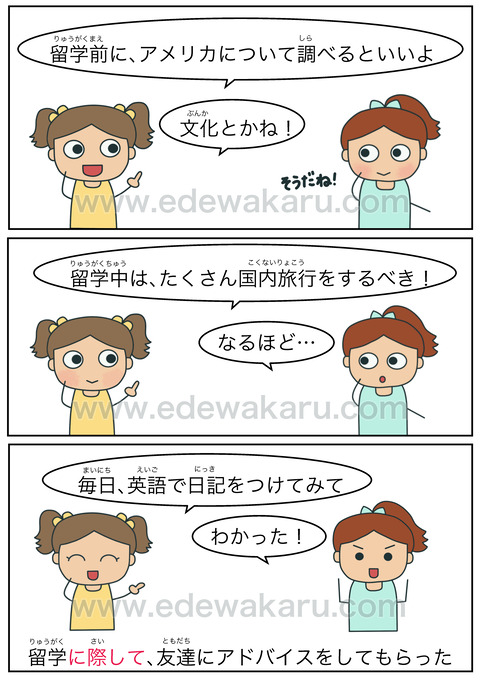
Meaning
〜する前に〜する
〜する時に〜する
〜を始める時に〜する
How to use it
動詞[辞書形]+に際して
名詞[辞書形]+に際して
Explanation
「Aに際してB」は「Aする前にBする」「Aする時にBする」「Aを始める時にBする」という意味の文型です。「Aという特別な機会にBする」と言いたい時に使われます。後ろに名詞がくる場合は
「〜に際しての+名詞」
になります。かたい言い方です。「〜に際して」の「て」は省略することができます。
「〜に際し」
は「〜に際して」よりも、さらにかたい言い方です。
[例]
友達に、留学
に際しての
アドバイスをもらった
似ている文型に「〜にあたって」と「〜に先立って」がありますので、一緒に覚えておきましょう😉
【類似文型】
In context 5 examples
留学に際して、友達にいろいろアドバイスをしてもらった
→留学前に、友達にいろいろアドバイスをしてもらった海外旅行をするに際して、パスポートを取りに行ってきた
→海外旅行をする前に、パスポートを取りに行ってきた会社の面接に際して、先輩に気をつけるべきことを教えてもらった
→会社の面接に行く前に、先輩に気をつけるべきことを教えてもらった私たちの結婚に際してステキなプレゼントをいただき、ありがとうございました
→結婚する時にステキなプレゼントをいただき、ありがとうございました卒業に際して、先生からお祝いの言葉をいただいた
→卒業する時に、先生からお祝いの言葉をいただいた
日本語文型辞典
Meaning
基本情報NにさいしてV-るにさいして説明ある出来事の機会に、という意味を表す。名詞を修飾するときは⑤のように「N/V-るにさいしてのN」となる。書きことば的。例文① お別れに際して一言ご挨拶を申し上げます。② 今回の初来日に際して、大統領は通商代表団を伴ってきた。③ この度の大規模なアジア現代美術展を開催するに際して、各国の多数のアーティストの協力と参加を得られたことには大きな意義がある。④ 長年の懸案であった平和条約を締結するに際して、両国はお互いの歴史認識を深め合う意義を改めて認識すべきである。⑤ 今回の会議参加に際しての最大の懸案事項はやはり安全保障問題であろう。
くらべてわかる日本語表現文型辞典
Meaning
Aという場面・機会を目前にして、B。
How to use it
Aに際してB(Aに際しB)
[動詞-る形]に際して
[名詞-∅]に際して
Explanation
【対比1】
「Aに臨んでB」(意味1 P.253)
「Aに臨んでB」はAが大きな意味のある場面で使われるが、「Aに際しB」にはそのような制約はない。
○みなさん、食事に際して祈りを捧げましょう。
×みなさん、食事に臨んで祈りを捧げましょう。
また、「Aに際してB」はAの前にBという時間の流れとなるが「Aに臨んでB」はAという場面でBとなる。
○彼は面接に臨んで、はっきりと自分の意見を述べた。
×彼は面接に際して、はっきりと自分の意見を述べた。
「A際にB」(意味1 P.99)
「AにあたりB」(意味1 P.212)
In context 4 examples
結婚するに際して、お互いの財産目録を作った。
法廷で証言するに際して、まず宣誓が求められる。
出発に際して、積み荷を再度点検する。
ご予約に際し、身分証明書の提示をお願いいたしております。
日本語NET JLPT文法解説まとめ
Meaning
"〜するときに / 〜に先立ち"
特別な何かをする始めるときに使う言葉。
How to use it
V(辞書形) + に際して
N(する動詞) + に際して
Explanation
"Upon (doing something)" / "Prior to (doing something)"
Used to indicate the moment or action just before starting something special or specific.
①硬い表現
②これから起こることに対して使う。
In context 5 examples
お二人の門出に際して、お祝いの言葉を申し上げます。
入居に際しての注意事項を説明します。
面接に際して、しっかりと練習しておいた方がいいですよ。
当サイトを利用するに際して、まず利用規約をご一読ください。
入国に際して、税関で荷物の検査を受けた。
NINJAL 日本語文型データベース
Meaning
〜という特別なことをするとき、または特別なことの直前に、何かをすると言いたいときに使います。
改まったスピーチや文書などでは「〜につきまして」の形になることもあります。
How to use it
Vるに際して
Nに際して
Notes
「〜に際して」の後には、意志的な行為を表す文がくることが多いです。
In context 11 examples
事業を始めるに際して、産業支援センターでビジネスプランや資金面などの相談をした。
特産品を活かしたまちづくりを進めていくに際して、地元企業との連携を図っていくことが重要になります。
このセミナーでは、株式投資を行うに際して必要な知識を得ることができる。
提携企業と正式な契約を締結するに際しては、この書式で契約書を作成することになる。
離婚後に、子どもの親権を父母のどちらに与えるか。離婚の原因を生じさせた側かどうかは、その決定に際しての基準とはされていない。
期末試験の実施に際して、いくつか注意点があります。
当クラブ入会に際してよくあるご質問を、Q&A形式でまとめました。
第三者による住民票の請求に際しては、本人との関係、請求理由などがわかる書類の提出が必要です。
この資料には生命保険のご契約に際しての大切な事柄が記載されておりますので、必ずお読みください。
ドラマ「明日」では、初の主役を演じますね。ご出演に際しての意気込みを聞かせていただけますか。
以上、簡単ではございますが、私の議長就任に際しましてのご挨拶とさせていただきます。
IMABI
Occasion
Read this IMABI lesson ↗Explanation
Occasion: ~うえで, ~際に, ~折に, ~際して, ~に当たって, ~に先立って, ~を前に(して), ~を控えて, ~に臨んで, & ~に面して
There are several phrases in Japanese that relate to “on the occasion of”, but never are so many phrases in Japanese completely interchangeable. They do look similar. Writing style and nuances aid in distinguishing them. Don’t worry, though. Even if you get a lot of red after reading this lesson, at least your paper will be decorated.
~(の)うえで
~(の)うえで attaches to the 連体形 of verbs or to nouns to give a meaning of “on the occasion of”. Following it, a discussion concerning a point of concern is expected. Giving an explanation of a circumstance, it shows opinion/thought on an issue. When giving a meaning of ~ときに, ~際に and ~に際して become possible as well.
1. 研究を続けるうえで、中国に留学したほうがいいと判断した。
I have concluded that it is best for me to study abroad in China on the basis of continuing my studies.
2. 時間を守るということは、仕事{をする}うえで最低限さいていげんのマナーである。
Being punctual in the process of work is the minimum of manner.
From 中級日本語文法と教え方のポイント by 市川保子いちかわやすこ.
3. 住宅ローンを利用したいと思っているのですが、借りる{うえで・際(に)は・に際しては}どのようなことに注意し たらよいでしょうか。
I want to utilize a home loan, but on the occasion of borrowing, what sort of things would be good to pay attention to?
From 中級日本語文法と教え方のポイント by 市川保子いちかわやすこ.
~(の)際に
~(の)際(に) is like above in that it means “on the occasion of”. 際 grammatically behaves like any other noun. It is a rather hard and ceremonious phrase, and it has the nuance of coping well when encountering a particular incident.
4. 就任の際には、是非式に参加してください。
By all means, please participate in the ceremony on inauguration.
5. イースト菌はパンを膨ふくらませる際の作用剤さようざいだ。
Yeast is an agent that makes bread rise.
6. 地震の際はガスの元栓もとせんを閉めること。(Stern; 年齢的にも立場的にも上の人の言い方)
In case of an earthquake, turn off the gas at the main outlet.
~際に VS ~折に
~際に Shows a limit to one extraordinary time than other situations.
~折に Shows an opportunity that happens by a stroke of luck.
Remember that ~際に is used a lot as a formal version of ~とき, being used a lot in polite commands ~折に is very respectful and used a lot in letters and in set phrases such as 折りに触れて (on opportunity). If used in the spoken language, the speaker is most certainly old. Neither are appropriate in regular-place situations like ~とき is in the spoken language. Consider the following examples.
7. 出発の際に点呼てんこをとるから、全員、遅れないように、集合すること。
Since I will take roll call on our departure, everyone fall in so as to not be late!
8. お暇いとまな折にでも、お読みいただけましたら、幸甚こうじんに存じます。(手紙文)
I would be so obliged if you were to read this even during your spare time.
9. ひとしお残暑ざんしょの厳しき折、くれくれもご自愛くださいますように。(手紙文)
All the more in this heat of late summer, be sure to take good care of yourself.
Citation Note: These last three examples are from 日本語類義表現 使い分け辞典 by 泉原省二.
10. 一昨日、古本屋に寄った{際・折りに}、注文しておきましたわよ。
I ordered it [when/on the opportunity of] [I stopped/stopping] by at the old book store two days ago.
11. 見ない{〇とき・X 際・X 折}も、テレビを消してね。
Turn off the TV even when you’re not watching it.
~に際して
~に際して has the nuance of “in facing a certain circumstance, on the occasion of that…”. It is rather formal and is often used in the preface of a salutation message. Having said this, though, there are instances where it can be interchanged with ~際に. In such a case, you are merely switching out something that is more so just a very formal fashion of saying ~とき.
Formality Note: Of course, there are the variants ~に際し ~に際しまして
12. 出発に際して、一言ご挨拶申し上げます。
I will give a word of salutations when we depart.
13. 入学{に際して・の際に}寄附金きふきんが要ると聞いているんですが、本当ですか。
We have been hearing that a donation is needed on admission, but is that true?
14. この度の震災に際しまして
On the occasion of this earthquake disaster
Grammar Note: ~うえで is more “static” in showing abstract static processes than even ~に際して. You will see later in this lesson how static versus dynamic makes in comparing these phrases with ~に当たって. In this sense, ~うえで is perfect in situations where one is giving an explanation to the listener.
15a. 協議書きょうぎしょを交かわすに際して、互恵平等ごけいびょうどうの原則を確認しておきたい。
15b. 協議書を交わすうえで、互恵平等の原則を確認しておきたい。
On exchanging agreements, I want to confirm the principles of mutual impartiality.
From 日本語類義表現 使い分け辞典 by 泉原省二.
16.
ドアを開けると、吉田は部下を従えて、妙に媚びるような表情で立っていた。
「昨日の被疑者マルヒなんですが、森井さんじゃないと、話したくないと言い張っとるんです」
挨拶もそこそこに、吉田は昨日の青年について語り始めた。彼は、事情聴取に際して、是非とも勲に会いたいと言っているのだという。
「冗談じゃない、俺はもう警察とは無関係の人間だ」
「ところが、被害者マルガイにも来てもらってるんですけど、そっちの方も、そうなんです。『あのおじさんになら話す』ってね」
When he opened the door, Yoshida with his men was standing with a look like he was trying to oddly curry favor.
“About yesterday’s suspect, he insisted that if it’s not Mr. Morii, he wouldn’t want to talk.”
With some salutations, Yoshida began to talk about the youth from yesterday. He, on the occasion of the police interview, [the suspect] said that he by all means wanted to meet with Isao.
“No joke, I’m no longer a person involved with the police anymore”
“On the contrary, we’ve had the victim come too, and that person’s the same, “If it’s the old man, I’ll talk”.
警察隠語 Police Lingo
This passage from 冷たい誘惑 by 乃南アサ introduces some rather interesting police jargon. 被疑者 and 被害者 are typically read as ひぎしゃ and ひがいしゃ respectively, but the author decided to use the police terminology instead, given that one speaker is a current officer and the other is an ex-officer. Aside from these words, there are several other words used by policemen that are of benefit of you to know, especially if you like watching Japanese cop films.
警察用語 一般語 警察用語 一般語 警察用語 一般語
ヤサ 家 害者 被害者 PM 警察官
PC パトカー タタキ 強盗 レツ 共犯者
アカイヌ 放火 H ヘロイン シャブ 覚醒剤
飛ぶ 逃げる デカ 刑事 ハコ 交番
For more words, see http://sumim.no-ip.com/wiki/1167.
~に当たって
There is also interchangeability with ~に際して and ~に当たって in situations when A is positively received. For instance, just like the first example with ~に際して, you can also see something like the following.
17. 開会に{あたって・あたりまして・際し・際しまして}、一言ご挨拶申し上げます。
On the occasion of opening session, I will give a word of salutations.
18. 年頭に{あたって・際して}の今年の抱負は、何よりも禁煙、ただ禁煙あるのみ。
My ambition for this year marking the beginning of it is above all is not smoking, simply no smoking.
Usage Warning: A sentence like the last one would not be used in the spoken language. Due to the formality and direct tone of the speech modals, such phrases would be limited to journals or soliloquies where such statements are expected.
However, their exact meanings cause them to not be 100% interchangeable.
Aにあたって(の) The time right before A starts/Before the realization of a basis time B
Aに際して(の) The same time as A starts/The same time as the basis time B
For this comparison, more grammar-study terms are used to show the full implications of these two speech modals. The first simply states that there is a time that coincides with A. This time precedes A, and B is some defined time to happen and is not realized. However, with ~に際して these time are in unison.
Consider the examples we’ve seen with them. So, even when they’re interchangeable, this clear distinction holds. So, consider the example when giving salutations at departure.
19. 出発に際して一言ご挨拶申し上げます。
Allow me to say a few words as I/we depart.
You can vision the people leaving still giving their farewells as they, say, drive off or board a plane. Now, what would you end up saying if you rephrased it with に当たって?
20. 出発に当たって一言ご挨拶申し上げます。
Allow me to say a few words in lieu of my/our departure.
After all, there are very similar situations using words like 開会 where they are interchangeable. So, one would think that 出発 would be OK as well. It would, but you then describe a situation more like giving farewells right before departure. However, there are instances where one or the other is only right because of this minor detail.
21. 受刑者じゅけいしゃは、処刑しょけいに際し、牧師ぼくしに懺悔ざんげすることが許されている。→ にあたり X
Convicts are allowed to repent to a pastor on their execution.
From 日本語類義表現 使い分け辞典 by 泉原省二.
漢字 Note: 懺 is not a 常用漢字.
22. 明日の試合出場にあたって、チーム全員はすでに一丸いちがんとなっている。
All of the team members are in a body for the occasion of the game appearance tomorrow.
From 日本語類義表現 使い分け辞典 by 泉原省二.
Formality Note: As to be expected, ~に当たり (literary) and ~に当たりまして (very respectful) exist.
Another thing to note is that ~にあたって is dynamic whereas ~に際して is static. ~にあたって comes from 当たる, so a meaning of “coping/grasping with” is hidden. 際, which is also read as きわ in other instances, refers to when you have no choice but to put up with an extraordinary time of some sort.
23. 実験にあたっては、事故を起こさないように注意してください。
Please be careful to not cause an accident on the experiment.
From 日本語類義表現 使い分け辞典 by 泉原省二.
24. 実験に際しては、事故の起こらないように注意してください。
Please be careful to make sure that an accident is not caused during the experiment.
From 日本語類義表現 使い分け辞典 by 泉原省二.
Notice how the implications of these sentences change. The first sounds like the speaker is giving a verbal warning before a potentially risky experiment, but the second sounds like it is a more indirect yet important advice written down for during the experiment.
More Examples
25. 話の終わりに当たって、皆様方のご協力に感謝いたします。
Lastly, I want to thank all of you for your cooperation.
26. 発電所の建設に当たって多くの障害しょうがいに出くわす。
To meet many difficulties in building a power plant.
27. この施設しせつを利用するに当たって注意すべきこと!
You must be careful when utilizing this facility!
28. 別れに際して泣いた。
I cried at our parting.
29. 妻の死に際して
On the death of my wife
Phrase Note: ~に当たらない, on the other hand, is similar to “no” as in not hitting a certain degree.
30. 拒絶きょぜつは驚くに当たらなかった。
The refusal was not a surprise.
31. 驚くには当たらないと言わぬばかりに。
As if to say there is no use getting alarmed.
~に当たって VS ~うえで
~うえで is extremely indicative of the written language, which is not a characteristic of ~にあたって. For reiteration, ~うえで is used when stating a situation where “an important A, in the course from before you start it and till it ends, B may occur” and there is a “point of interest/necessary condition” that follows (the B).
Take the first example sentence of this lesson into second consideration.
32. 研究を続けるうえで、中国に留学したほうがいいと判断した。
I have concluded that it is best for me to study abroad in China on the basis of continuing my studies.
The event A is “continuing one’s studies”. The B can’t be just a statement of explanation. Rather, it must be a point of concern: 注意点、問題点, 重要ポイント, 必要条件, etc.
Style Note: As far as the distinction between 話し言葉 and 書き言葉 in regards to this usage of ~うえで, it’s not that it is a complete 0%/100% divide. In circumstances such as speaking to a professor, more literary expressions are common as there is an academic atmosphere. This, though, blurs the divide.
33.
A: 先生、論文を書くうえで、どのようなことに注意したらいいでしょうか。
B: まず、今までにどこまで研究されているかをしっかり摑つかむことだね。
From 中級日本語文法と教え方のポイント.
Here, Student A asks what to pay attention to in [writing his/her dissertation] (A). The 問題点 of writing the dissertation is the B (necessary condition/important contingency). The professor responds by stating that first he/she needs to fully grasp what he/she has studied up to that point. Other important things to notice in the dialogue are underlined.
34. 実験する{〇 にあたって・X/△ うえで}、危険物きけんぶつの扱あつかいには、十分に注意してください。(話し言葉)
On the experiment, be careful enough in the treatment of hazards.
From 日本語類義表現 使い分け辞典 by 泉原省二.
35. 実験するうえで、下記かきの薬品やくひんの取り扱いには、特に注意してください。(書き言葉)
On the experiment, pay special attention to the handling of the following chemicals.
From 日本語類義表現 使い分け辞典 by 泉原省二.
Although the first sentence meets the grammatical needs of using ~うえで, it is very unnatural at best because of style conflict. When rephrased to fix this, the unnaturalness goes away. Another major grammatical difference is that ~うえで is not limited to special circumstances like ~に際してand ~に当たって are. In such case, ~うえで becomes the only option, and as a consequence, is even common in the spoken language in this regard.
36. 数のうえでは圧倒的あっとうてきな状態だ。
It’s an overwhelming situation concerning the numbers.
37. 十分に事件を勘案かんあんしたうえで返事します。
I will reply after sufficiently considering the matter.
38. 年齢を重ねていくうえで、忘れてならないのは、友への感謝であろう。
As you age, what one must not forget is admiration towards friends.
From 日本語類義表現 使い分け辞典 by 泉原省二.
~に先立って
Just as with ~にあたって, you can see ~に先立って in situations such as the following.
39. 開会に先立ちまして、一言ご挨拶申し上げます。
In advance of the opening of session, I will give a word of salutations.
From 日本語類義表現 使い分け辞典 by 泉原省二.
Aに先立ってB gives a meaning of “carrying out B in the stage before the start of A, which is important and different than the norm”. Thus, it is seen a lot in speeches and articles. It is only used in situations where there is a “temporal ranking” of some sort. There is some sort of ritual order being expressed between A and B. Thus, the time before A and B is comparatively much larger than when using ~に当たって.
Given the meaning of 先立つ, to precede, it can be used to refer to the passing of someone when used in the passive.
40. 最愛の妻に先立たれた。
I was died on by my beloved wife.
Nuance Note: The translation has a more morbid tone that the original.
~を前に(して) & ~を控えて
These phrases are quite similar to each other, and they are even interchangeable when expressing a situation right before an event. However, they differ in two crucial aspects.
B~を前に(して)A Marks the realistic moment before the beginning of an event.
B~を控えてA Marks a psychological moment before with relative disregard to time.
Both are indicative of the written language and both describe a third person. If the speaker becomes the subject, then the speaker becomes the object of description.
Base Note: The 連体形 of these phrases are ~を前にした and ~を控えた respectively.
41. 筆記試験を終え、面接試験を{まえにした・控えた}応募者おうぼしゃは緊張きんちょうした面持ちだ。
Finishing the written examination, the applicants have a nervous face before the interview examination.
From 日本語類義表現 使い分け辞典 by 泉原省二.
42. 期末試験を控えて学生は忙しそうだ。
The students seemed busy with the final exam at hand.
The next sentence demonstrates that 控える doesn’t have to be used like above. It also has the meaning of “to hesitate/hold off”. Interchanging it, then, with ~を前に is then solely dependent on the logicality of the events and time.
43. 入試を一年後に{〇 控えて・X 前に(して)}ようやく世間並せけんなみの受験生じゅけんせいらしくなった。
After of holding off the entrance exam, I have finally become like a normal examinee.
From 日本語類義表現 使い分け辞典 by 泉原省二.
There are also instances when they are used with place, in which they are never interchangeable and therefore may even appear in the same sentence.
44. 彼の新居は、海岸をまえに、後ろに山脈さんみゃくを控えた高台に位置していた。
His new home was placed on top of an overlook with mountain chains close in the back and the shore before it.
~に臨んで & ~に面して
To finish off this lesson, consider the following speech modals: ~に臨んで, ~に面して.
Aに臨んで On the occasion of participation in a positive/negative A…
Aに面して On the occasion of an extreme, negative situation A faced…
They are basically interchangeable in emergency situations. Aに臨んで, however, shows that one is participating in an event A, whether it being present in that scene, going to such place, or forwarding oneself on.
Oppositely, ~に面して shows that one is suddenly or passively faced with a situation. So, with crisis situations concerning things like war, failure, etc., it is often the case that the former would demonstrate a strong person in spite of the crisis and the latter would give images of a weak person in the upset.
Base Note: The 連体形 of these phrases are ~に臨んだ and ~に面した respectively.
45. 母親の急死に{臨んで・面して}、それまで仲のよかった兄たちは、諍いさかいを始めた。
In facing our mother’s sudden death, my older brothers who had been cordial up till then began a quarrel.
46. 経済的危機に{〇面しても、X臨んでも}、冷静に適切な行動のとれる人を尊敬しています。
I respect those that take the appropriate actions calmly even while facing economic crisis.
47. 第一試合に{〇臨んで・X面して}、緊張を隠しきれなかった。
I couldn’t completely hide my nervousness in facing the first match.
48. 緊急事態に{臨めば臨む・面すれば面する}ほど、非凡ひぼんな力を発揮はっきする者がいる。
There are people that exercise extraordinary abilities the more they face state of emergencies.
49. 難に臨んで遽にわかに兵へいを鋳いる
Literally: To cast soldiers hastily in facing a crisis.
Phrase Note: This is a set phrase coming from the concept of making weapons quickly after a war has started. In a practical sense, it refers to situations where one doesn’t make it in time even if you hurriedly prepare after an incident has started.
In the location sense, the difference is from the speaker’s position. With the former, you are looking down at a vast space from above. With the latter, you are seeing before one’s eyes a space expanding on the front sides. So, no matter if you interchange them, the speaker’s visual position and the vertical direction of the scenery is different. Note, though, that when deviating from pinpointing direction, のぞむ is spelled as 望む to signify actually looking down.
50. そのホテルは、瀬戸内海海に臨んで、高台に立っている。
The hotel faces the Seto Inland Sea and stands on the height.
51. その高層ビルは、海に面して、遊歩道に立っている。
The high rise building faces the ocean and stands on the boardwalk.
52. 街を望む。
To look down at the street/town.
In context 50 examples
研究を続けるうえで、中国に留学したほうがいいと判断した。
I have concluded that it is best for me to study abroad in China on the basis of continuing my studies.
時間を守るということは、仕事{をする}うえで最低限さいていげんのマナーである。
Being punctual in the process of work is the minimum of manner.
住宅ローンを利用したいと思っているのですが、借りる{うえで・際(に)は・に際しては}どのようなことに注意し たらよいでしょうか。
I want to utilize a home loan, but on the occasion of borrowing, what sort of things would be good to pay attention to?
就任の際には、是非式に参加してください。
By all means, please participate in the ceremony on inauguration.
イースト菌はパンを膨ふくらませる際の作用剤さようざいだ。
Yeast is an agent that makes bread rise.
地震の際はガスの元栓もとせんを閉めること。(Stern; 年齢的にも立場的にも上の人の言い方)
In case of an earthquake, turn off the gas at the main outlet.
出発の際に点呼てんこをとるから、全員、遅れないように、集合すること。
Since I will take roll call on our departure, everyone fall in so as to not be late!
お暇いとまな折にでも、お読みいただけましたら、幸甚こうじんに存じます。(手紙文)
I would be so obliged if you were to read this even during your spare time.
ひとしお残暑ざんしょの厳しき折、くれくれもご自愛くださいますように。(手紙文)
All the more in this heat of late summer, be sure to take good care of yourself.
一昨日、古本屋に寄った{際・折りに}、注文しておきましたわよ。
I ordered it [when/on the opportunity of] [I stopped/stopping] by at the old book store two days ago.
見ない{〇とき・X 際・X 折}も、テレビを消してね。
Turn off the TV even when you’re not watching it.
出発に際して、一言ご挨拶申し上げます。
I will give a word of salutations when we depart.
入学{に際して・の際に}寄附金きふきんが要ると聞いているんですが、本当ですか。
We have been hearing that a donation is needed on admission, but is that true?
この度の震災に際しまして
On the occasion of this earthquake disaster
協議書きょうぎしょを交かわすに際して、互恵平等ごけいびょうどうの原則を確認しておきたい。
On exchanging agreements, I want to confirm the principles of mutual impartiality.
協議書を交わすうえで、互恵平等の原則を確認しておきたい。
On exchanging agreements, I want to confirm the principles of mutual impartiality.
開会に{あたって・あたりまして・際し・際しまして}、一言ご挨拶申し上げます。
On the occasion of opening session, I will give a word of salutations.
年頭に{あたって・際して}の今年の抱負は、何よりも禁煙、ただ禁煙あるのみ。
My ambition for this year marking the beginning of it is above all is not smoking, simply no smoking.
出発に際して一言ご挨拶申し上げます。
Allow me to say a few words as I/we depart.
出発に当たって一言ご挨拶申し上げます。
Allow me to say a few words in lieu of my/our departure.
受刑者じゅけいしゃは、処刑しょけいに際し、牧師ぼくしに懺悔ざんげすることが許されている。→ にあたり X
Convicts are allowed to repent to a pastor on their execution.
明日の試合出場にあたって、チーム全員はすでに一丸いちがんとなっている。
All of the team members are in a body for the occasion of the game appearance tomorrow.
実験にあたっては、事故を起こさないように注意してください。
Please be careful to not cause an accident on the experiment.
実験に際しては、事故の起こらないように注意してください。
Please be careful to make sure that an accident is not caused during the experiment.
話の終わりに当たって、皆様方のご協力に感謝いたします。
Lastly, I want to thank all of you for your cooperation.
発電所の建設に当たって多くの障害しょうがいに出くわす。
To meet many difficulties in building a power plant.
この施設しせつを利用するに当たって注意すべきこと!
You must be careful when utilizing this facility!
別れに際して泣いた。
I cried at our parting.
妻の死に際して
On the death of my wife
拒絶きょぜつは驚くに当たらなかった。
The refusal was not a surprise.
驚くには当たらないと言わぬばかりに。
As if to say there is no use getting alarmed.
実験する{〇 にあたって・X/△ うえで}、危険物きけんぶつの扱あつかいには、十分に注意してください。(話し言葉)
On the experiment, be careful enough in the treatment of hazards.
実験するうえで、下記かきの薬品やくひんの取り扱いには、特に注意してください。(書き言葉)
On the experiment, pay special attention to the handling of the following chemicals.
数のうえでは圧倒的あっとうてきな状態だ。
It’s an overwhelming situation concerning the numbers.
十分に事件を勘案かんあんしたうえで返事します。
I will reply after sufficiently considering the matter.
年齢を重ねていくうえで、忘れてならないのは、友への感謝であろう。
As you age, what one must not forget is admiration towards friends.
開会に先立ちまして、一言ご挨拶申し上げます。
In advance of the opening of session, I will give a word of salutations.
最愛の妻に先立たれた。
I was died on by my beloved wife.
筆記試験を終え、面接試験を{まえにした・控えた}応募者おうぼしゃは緊張きんちょうした面持ちだ。
Finishing the written examination, the applicants have a nervous face before the interview examination.
期末試験を控えて学生は忙しそうだ。
The students seemed busy with the final exam at hand.
入試を一年後に{〇 控えて・X 前に(して)}ようやく世間並せけんなみの受験生じゅけんせいらしくなった。
After of holding off the entrance exam, I have finally become like a normal examinee.
彼の新居は、海岸をまえに、後ろに山脈さんみゃくを控えた高台に位置していた。
His new home was placed on top of an overlook with mountain chains close in the back and the shore before it.
母親の急死に{臨んで・面して}、それまで仲のよかった兄たちは、諍いさかいを始めた。
In facing our mother’s sudden death, my older brothers who had been cordial up till then began a quarrel.
経済的危機に{〇面しても、X臨んでも}、冷静に適切な行動のとれる人を尊敬しています。
I respect those that take the appropriate actions calmly even while facing economic crisis.
第一試合に{〇臨んで・X面して}、緊張を隠しきれなかった。
I couldn’t completely hide my nervousness in facing the first match.
緊急事態に{臨めば臨む・面すれば面する}ほど、非凡ひぼんな力を発揮はっきする者がいる。
There are people that exercise extraordinary abilities the more they face state of emergencies.
難に臨んで遽にわかに兵へいを鋳いる
Literally: To cast soldiers hastily in facing a crisis.
そのホテルは、瀬戸内海海に臨んで、高台に立っている。
The hotel faces the Seto Inland Sea and stands on the height.
その高層ビルは、海に面して、遊歩道に立っている。
The high rise building faces the ocean and stands on the boardwalk.
街を望む。
To look down at the street/town.