くらべてわかる日本語表現文型辞典
Meaning
意味1:Aをしないで放っておくことは許さない、必ずAするぞという強い意志を表す。
意味2:Aにならないことはない。必ずAの状態になる。
How to use it
Aないではおかない(Aずにはおかない)
[動詞-ない形]ないではおかない
Explanation
【対比1】
「Aないではすまない」(意味2 P.193)
「Aないではすまない」はAのままでは気がすまない、収まらないと自身の感情に視点があるが、「Aないではおかない」は自身の意志が向かう対象に視点があり、対象に対して何かするぞという強い意志を表す。
○5時間も並んだんだ。チケットが手に入らないではすまないぞ。
×5時間も並んだんだ。チケットが手に入らないではおかないぞ。
In context 8 examples
彼はどんな些細な疑問も解決しないではおかない。
姉は言葉遣いに厳しく、細かいことも注意しないではおかない性格だ。
弟は勝ち気で、何か言われたらかならず、言い返さないではおかない。
宿題を忘れた者には、罰を与えないではおかない。
赤ちゃんパンダの遊ぶ姿は、人々をひきつけないではおかないものだ。
和太鼓の響きは体の芯に熱いものを感じさせずにはおかない。
彼の撮った写真は見るものの心を動かさずにはおかなかった。
両国の政治的緊張は周りの国々に影響を与えずにはおかなかった。
日本語文型辞典
Meaning
基本情報V-ないではおかない説明他動詞の否定形や自動詞の使役「V-させる」の否定形に続いて、外部からの強い力によって、本人の意志にはかかわらずそのような状態や行動が引き起こされるという意味を表す。本来、書きことばの表現なので、「せずにはおかない」の形をとるほうが一般的である。例文① この作品は、読む者の胸を打たないではおかないだろう。② 彼女の言動は、どこか私を苛立たせないではおかないものがある。③ 彼女とのこと、白状させないではおかないぞ。
絵でわかる日本語
Usage 1
Read this source entry ↗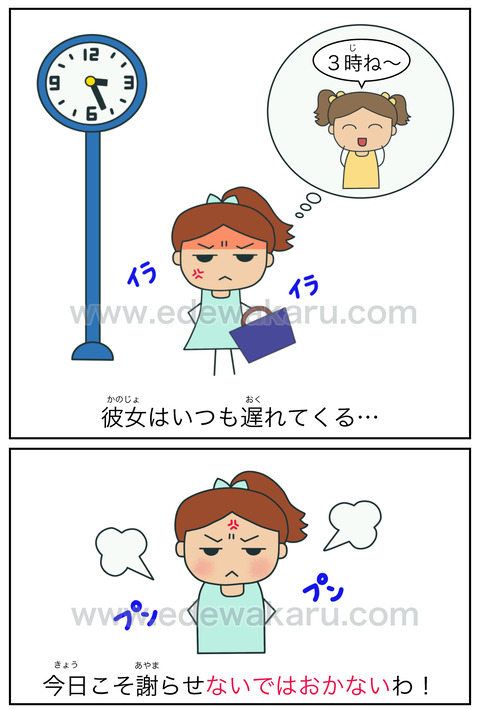
Meaning
絶対に〜してやる
〜しない状態だと許せない
How to use it
動詞[ない形]+ないではおかない
動詞[ない形]+ずにはおかない
Explanation
「〜ないではおかない」は「絶対に〜してやる」というように、強い決意を表す文型です。これは、
相手に対して「〜しないと許せない、絶対に〜してやる」と言いたい時に使います
😊「A ないではおかない」の形で「A」には動作性の動詞が入ります。また
「〜ないではおかない」は「〜ずにはおかない」にチェンジすることができ、「〜しないではおかない」は「〜せずにはおかない」となります
😮
[例]
彼女はいつも遅れてくる…今日こそ謝らせ
ないではおかない
わ!
=今日こそ謝らせ
ずにはおかないわ!
彼には本当にひどいことをされた。仕返しをし
ないではおかない
=⭕️仕返しをせ
ずにはおかない
=❌仕返しをしずにはおかない
「〜ないではおかない・〜ずにはおかない」はとても複雑な文型の1つです。【自然に〜にさせる】という意味を表す「〜ないではおかない・〜ずにはおかない」と一緒に覚えておくといいと思います😉
(復習:〜ないではおかない・〜ずにはおかない①(自然に〜させる))
(復習:〜ておく)
In context 4 examples
彼女はいつも遅れてくる…今日こそ謝らせないではおかないわ!
→彼女はいつも遅れてくる…今日こそ絶対に謝らせてやるわ!(復習:〜こそ)彼には本当にひどいことをされた。仕返しをしないではおかない
→彼には本当にひどいことをされた。絶対に仕返しをしてやる練習試合(れんしゅうじあい)はAチームにやられっぱなしだった…今回は攻撃しないではおかないぞ
→今回は絶対に攻撃してやるぞ(復習:〜っぱなし)あいつには顔から火が出る思いをさせられた。次に会った時は殴らないではおかない
→次に会った時は絶対に殴ってやる(復習:顔から火が出る)
Usage 2
Read this source entry ↗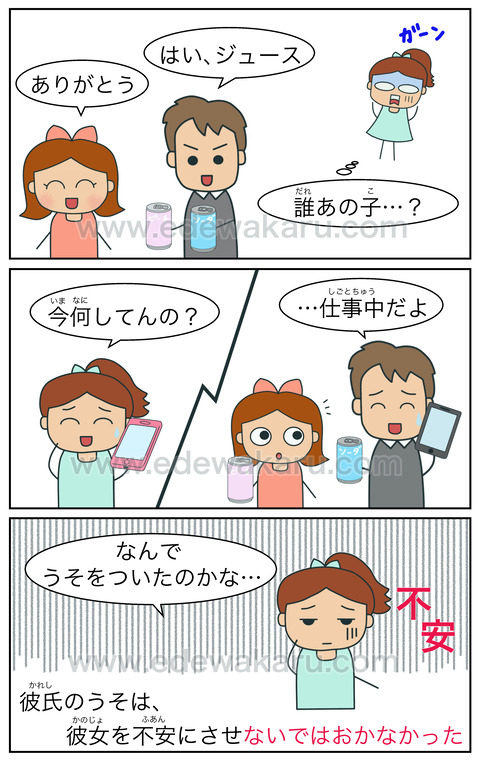
Meaning
自然に〜させてしまう
自然に〜の状態にする
How to use it
動詞[ない形]+ないではおかない
動詞[ない形]+ずにはおかない
Explanation
「〜ないではおかない」は「自然に〜させてしまう」「自然に〜の状態にする」という意味を表す文型です。
これは【気持ちや感情を表す動詞】と一緒に使い、
「(Bの意志に関係なく)AはBを〜という気持ちにさせる」
と言いたい時に使います😊他の文型と混乱しがちですが、「AはBを〜ないではおかない=AはBを(自然に)〜という気持ちにさせる」と覚えておきましょう😀ほとんどの場合、感情を表す動詞と使う時は「感情を表す動詞+使役形」の形で使われます😮
(復習:〜がちだ)
[例]
①彼氏のうそは、彼女を
不安にさせないではおかなかった
【感情を表す動詞】不安にする→不安にさせる(使役形)
②あの映画は、みんなを
感動させないではおかなかった
【感情を表す動詞】感動する→感動させる(使役形)
③山田くんの言動は、社長を
怒らせないではおかないだろう
【感情を表す動詞】怒る→怒らせる(使役形)
④あの政治家の発言は、国民を
困惑させないではおかなかった
【感情を表す動詞】困惑する→困惑させる(使役形)
また
「〜ないではおかない」は「〜ずにはおかない」にチェンジすることができます
😉
[例]
彼氏のうそは、彼女を不安にさせ
ないではおかなかった
=彼氏のうそは、彼女を不安にさせ
ずにはおかなかった
彼女の行動は、彼氏に不信感を与え
ないではおかなかった
=彼女の行動は、彼氏に不信感を与え
ずにはおかなかった
「〜ないではおかない・〜ずにはおかない」は、似ている文型がいくつかありますので混乱しないようにしましょう😊
In context 5 examples
彼氏のうそは、彼女を不安にさせないではおかなかった
→彼氏のうそは、彼女を不安にさせてしまったあの映画は、みんなを感動させないではおかなかった
→あの映画は、みんなを感動させた山田くんの言動は、社長を怒らせないではおかないだろう
→山田くんの言動は、社長を怒らせてしまうだろうあの政治家の発言は、国民を困惑させないではおかなかった
→あの政治家の発言は、国民を困惑させた彼女の行動は、彼氏に不信感を与えないではおかなかった
→彼女の行動は、彼氏に不信感を与えてしまった
日本語文型辞典 英語版
Meaning
【ないではおかない】[V-ないではおかない]
Used after the negative form of a transitive verb or the negative causative form of an intransitive verb (V-させない). Expresses that a certain state or action will be brought about by a strong external force, regardless of the intention of the person concerned. Since this is essentially a written expression, it usually takes the form せずにはおかない.
In context 3 examples
この作品は読む者の胸を打たないではおかないだろう。
This piece cannot but move the reader’s heart.
彼女の言動はどこか私を苛立たせないではおかないものがある。
There is something in her behavior that cannot but irritate me.
彼女とのこと、白状させないではおかないぞ。
I’m not going to let you get off without confiding in me about your girlfriend.
AIUEO JLPT Grammar
Meaning
This sentence pattern emphasizes that a particular situation or action is inevitable.
How to use it
動詞ない形では+おかない動詞ない形+ずには+おかない
Explanation · 日本語
この文型は、ある状況や行動が必然的に起こることを強調する表現です。
In context 5 examples
この映画は涙を流さずにはおかない作品だ。
This movie will undoubtedly bring you to tears.
彼の勇敢な行動は、誰も感動させずにはおかないだろう。
His brave actions will inevitably move everyone.
彼の言動は、周囲を不安にさせないではおかない。
His behavior will undoubtedly cause anxiety in those around him.
この事件は、世間を騒がせないではおかないだろう。
This incident will inevitably cause a stir in society.
彼の発言は、議論を巻き起こさずにはおかないだろう。
His remarks will undoubtedly spark a debate.
IMABI
Can’t Help III
Read this IMABI lesson ↗Explanation
Can’t Help III: ~ないではすまない, ~ないではおかない, ~を余儀なく[される・させる], & ~を禁じ得ない
These are even more difficult phrases dealing with not being able to help one’s emotions, etc. Not only do you need to try to separate these in your mind from the phrases found in the two previous lessons about this topic, but you’re going to have to pay even more attention to the differences among these patterns.
~{ないで・ずに}はすまない
Also seen as ~ずにはすまない, which is more formal but can still be found used in the spoken language, is used to show that if one thinks from a societal point of view with a given circumstance, doing something is simply and certainly unavoidable. It is difficult to use, however, when you think that you have to do something from personal emotion. Given that the phrase is stiff, this should be understandable.
1. 人の心を傷つけてしまったなら、謝らずにはすまない。
If you are to hurt someone’s heart, you can’t avoid apologizing.
2. 借金をせずにはすむまい。(古風で、硬い言い方)
You can’t get by without borrowing money.
3. 親に知られたら叱られないではすまないよ。
If your parents found out, you won’t be able to avoid getting scolded.
The non-double negative form above result in ~ないで済すむ, which means “to get by without…”. Just as in English, this implies a good thing because you got away without doing something. 済む itself may show that something is done.
4. 済んだことだ。
It’s finished.
5. 済んだのですか。
Is it over?
6. 金を払わないで済みました。
I got by without paying for it.
7. 気づかれずに済む。
To escape attention.
8. 彼が怪我けがをせずに済んでよかった。
I’m glad that he got by without injury.
9. 冗談じょうだんですまない。
To go beyond a joke. (Shows guilt)
10. 済んだことは元もとに戻もどらない。
What’s done cannot be undone.
11. 蜂を見つけたら、ゆっくり離れたほうがいい。体に止まっても振り払わずにじっとしていれば刺されずに済むよ。
If you are to find a bee, it’s best to separate oneself from it slowly. Even if it lands on you, you can leave without being stung if you stay still.
12. もう一つは、犯行後、同じように夜を待ち、普通の道を河内長野方面に向かって歩いたかもしれないことだ。これは車道以外に近道の旧道もあるので、ここを歩けば夜間は誰にも見られずに済む。
Another possibility is that (the criminal) waited just like that for night after the crime and walked down a regular road toward Kawachi-Nagano. This could go without being seen by anyone at night walking through here because there are also old shortcuts aside from the roadway.
From 二重葉脈 by 松本清張.
~{ないで・ずに}はおかない
Also seen as ~ずにはおかない, this pattern is used to show that one will certainly happen naturally or that you won’t allow something to stay not being done. It shows strong resolution. The situation where one won’t allow for something deals with first person. However, the first situation deals with subjects outside of first person, which includes inanimate things.
13. あの話はやはり嘘だったと、絶対に白状はくじょうさせないではおかないぞ。
If that was indeed a lie, I will absolutely not stand without making (that person) confess.
14. 彼女が歌ったのは聞く人の心を揺ゆさぶらずにはおかない。
What she had sung will surely move the hearts of those who hear.
~を余儀なく[される・させる]
余儀 よぎ means “another way/problem” and 余儀ない expresses “out of one’s control”. So, ~を余儀なくされる, shows that one had to do something that was not of one’s will and there was no other choice to get around it. You are essentially driven into a corner in a certain situation. This can also be seen in the causative as ~を余儀なくさせる. Usually the subject of sentences with ~を余儀なくされる is usually human, but the subject of sentences with ~を余儀なくさせる is usually not human but a something.
15. 悪天候のため試合の中止を余儀なくされました。
Bad weather made us postpone the match.
16. アメリカの圧力が貿易ぼうえき自由化を余儀なくさせた。
American pressure made free trade unavoidable.
17. 暴風雨で遠足は延期を余儀なくされた。
We had to put off the field trip due to fierce rain.
18. {余儀ない・やむを得ない}事情で欠席しました。
I was absent due to an uncontrollable situation.
19. 辞任を余儀なくされる。
To become out of one’s control to resign.
~を禁じ得ない
Although most dictionaries will just tell you this is the same as ~ないではいられない, this is not enough information to help you get a question right about it on the JLPT. Like all the other phrases in this series, this phrase describes not being able to withhold emotions, but this portrays an image of not being able to restrain emotions that have sprung up due to the circumstances. This phrase attaches to nouns that imply emotion. Sentences with it are usually first person.
20. 涙を禁じえなかった。
I couldn’t hold back the tears.
21. 犯人の供述を聞き、犯行動機はんこうどうきの身勝手みがってさに怒いかりを禁じ得なかった。
I couldn’t withhold my anger at the selfishness of the motive from listening to the criminal’s affidavit.
22. 同情の念を禁じえない。
I can’t hold back sympathy
23. 残された子犬を見て、涙を禁じ得なかった。
I couldn’t hold back the tears from looking at the puppy that was left.
In context 23 examples
人の心を傷つけてしまったなら、謝らずにはすまない。
If you are to hurt someone’s heart, you can’t avoid apologizing.
借金をせずにはすむまい。(古風で、硬い言い方)
You can’t get by without borrowing money.
親に知られたら叱られないではすまないよ。
If your parents found out, you won’t be able to avoid getting scolded.
済んだことだ。
It’s finished.
済んだのですか。
Is it over?
金を払わないで済みました。
I got by without paying for it.
気づかれずに済む。
To escape attention.
彼が怪我けがをせずに済んでよかった。
I’m glad that he got by without injury.
冗談じょうだんですまない。
To go beyond a joke. (Shows guilt)
済んだことは元もとに戻もどらない。
What’s done cannot be undone.
蜂を見つけたら、ゆっくり離れたほうがいい。体に止まっても振り払わずにじっとしていれば刺されずに済むよ。
If you are to find a bee, it’s best to separate oneself from it slowly. Even if it lands on you, you can leave without being stung if you stay still.
もう一つは、犯行後、同じように夜を待ち、普通の道を河内長野方面に向かって歩いたかもしれないことだ。これは車道以外に近道の旧道もあるので、ここを歩けば夜間は誰にも見られずに済む。
Another possibility is that (the criminal) waited just like that for night after the crime and walked down a regular road toward Kawachi-Nagano. This could go without being seen by anyone at night walking through here because there are also old shortcuts aside from the roadway.
あの話はやはり嘘だったと、絶対に白状はくじょうさせないではおかないぞ。
If that was indeed a lie, I will absolutely not stand without making (that person) confess.
彼女が歌ったのは聞く人の心を揺ゆさぶらずにはおかない。
What she had sung will surely move the hearts of those who hear.
悪天候のため試合の中止を余儀なくされました。
Bad weather made us postpone the match.
アメリカの圧力が貿易ぼうえき自由化を余儀なくさせた。
American pressure made free trade unavoidable.
暴風雨で遠足は延期を余儀なくされた。
We had to put off the field trip due to fierce rain.
{余儀ない・やむを得ない}事情で欠席しました。
I was absent due to an uncontrollable situation.
辞任を余儀なくされる。
To become out of one’s control to resign.
涙を禁じえなかった。
I couldn’t hold back the tears.
犯人の供述を聞き、犯行動機はんこうどうきの身勝手みがってさに怒いかりを禁じ得なかった。
I couldn’t withhold my anger at the selfishness of the motive from listening to the criminal’s affidavit.
同情の念を禁じえない。
I can’t hold back sympathy
残された子犬を見て、涙を禁じ得なかった。
I couldn’t hold back the tears from looking at the puppy that was left.