AIUEO JLPT Grammar
Meaning
This sentence pattern emphasizes that if basic matters or prerequisites cannot be fulfilled, more challenging things are even less likely to be achievable. It is often used in negative contexts.
How to use it
動詞のは+おろか名詞は+おろか
Explanation · 日本語
この文型は、基本的な事柄や前提が当然できない場合に、それ以上に難しいことができないことを強調する表現です。多くの場合、否定的な内容を表現するときに使われます。
In context 5 examples
仕事はおろか、日常生活も困難だ。
Let alone work, even daily life is difficult.
彼は敬語はおろか、普通の言葉遣いさえ知らない。
He doesn’t even know how to use polite language, let alone honorifics.
走ることはおろか、歩くことさえ難しい。
Let alone running, even walking is difficult.
新しい服を買うのはおろか、今持っている服を着る機会さえない。
Let alone buying new clothes, I don’t even have the chance to wear the ones I have.
車はおろか、自転車さえ買うお金がない。
Let alone a car, I don’t even have the money to buy a bicycle.
文法
Meaning
〜は当然として
How to use it
V(辞書形)+ のはおろか
N + はおろか
Notes
①後ろはマイナスのことがくる。そのため否定形が多い。
②硬い表現
③「〜さえ・〜までも、〜も」といった言葉と一緒によく使われる。
In context 8 examples
ジェームスさんは1年日本語を勉強したのに、漢字はおろか、ひらがなさえ書くことができない。
彼は今のままでは進学はおろか、卒業さえもできない。
この会社には複合機はおろか、パソコンさえない。
私の家の周辺にはデパートはおろか、コンビニもない。
20年生きてきたが、海外はおろか、自分の住む県から出たことすらない。
足を怪我してしまい、走ることはおろか、歩くことさえ難しい。
事故で記憶を失った彼女は、住所はおろか、名前すら覚えていなかった。
私の国では正社員の仕事はおろか、アルバイトも探すのが難しい。
Bunpro Grammar Reference
Meaning
Let alone, Much less, Needless to say, Not to mention, Not only but also
How to use it
Noun (A) + はおろか + Noun (B) + さえ(1)
(1)も、まで、すら
Nuance
A formal grammar point, implying much less (A), (B). Alienating the topic of (A), (B). Often negative.
Explanation
は疎か is an expression that works similarly to はもちろん 'of course (A), but (B)' in Japanese. 疎か itself is a な-Adjective that means 'negligent', or 'alienation'. However, this use of 疎か is not seen much in modern Japanese, and the word will mainly be used in set expressions where it doesn't behave exactly as a な-Adjective usually would. Despite this, the meaning of 'alienation', or 'completely removed from' is kept in はおろか, as it simply means 'completely putting aside (A), (B)'.
Common translations include 'let alone (A), (B)', and 'it's needless to say that (A), when (B)'. (B) and (A) will usually be things that fall into the same category, where (B) is considered the far more obvious of the two. Due to this obviousness, (B) will often be immediately followed by the adverbial particle さえ. This shows that (B) is the noteworthy minimum extent.
彼は掃除はおろか、料理さえできない。
He can't even cook, let alone clean.
私はスーパーはおろか、コンビニさえもないど田舎に住んでいる。
I live in a very rural area where there isn't a convenience store, let alone a supermarket.
父はパソコンはおろか、スマホさえも使うことができない。
My father can't use a smartphone, let alone a computer.
Alternatively, さえ may be exchanged with other adverbial particles that fill a similar purpose such a も, すら, or まで. In most cases, は疎か sentences tend to have a fairly negative nuance.
Nuance · 日本語
(A)どころか(B)でもないということを表す丁寧な文法。(A)という話題を除いて(B)。否定的に使われることが多い。
Explanation · 日本語
「は疎か」は「(A) はもちろん (B) も」や「(A) どころか (B) も」といった意味で使われる表現です。「疎か」はもともと「いい加減」といった意味を持つナ形容詞ですが、現代でナ形容詞として使われることはほとんどありません。その代わり、「疎か」は主に決まった言い回しの中で、ナ形容詞としての本来の働きとは異なる形で使われます。
この表現では、通常、(A) と (B) に同じ種類の事柄が入ります。このとき、(A) はより難しいことや特別なこと、(B) は基本で当たり前と見なされるようなことになります。また、(B) の直後には副助詞「さえ」が使われることが多く、(B) が最低限の基準であることを強調します。
彼は掃除はおろか、料理さえできない。
He can't even cook, let alone clean.
私はスーパーはおろか、コンビニさえもないど田舎に住んでいる。
I live in a very rural area where there isn't a convenience store, let alone a supermarket.
父はパソコンはおろか、スマホさえも使うことができない。
My father can't use a smartphone, let alone a computer.
なお、「さえ」は、「も」「すら」「まで」など、同じような意味を持つ他の副助詞と入れ替えることもできます。また、ほとんどの場合、「は疎か」を使った文は否定的なニュアンスを持っています。
In context 15 examples
- 「ルームメイトはオムライスは疎か、おにぎりさえ作れない。」
'My roommate cannot even make onigiri, let alone omurice.'
- 彼は掃除はおろか、料理さえできない。
He can't even cook, let alone clean.
- 私はスーパーはおろか、コンビニさえもないど田舎に住んでいる。
I live in a very rural area where there isn't a convenience store, let alone a supermarket.
- 父はパソコンはおろか、スマホさえも使うことができない。
My father can't use a smartphone, let alone a computer.
- 掃除機をかけることは疎か、彼はゴミ拾いさえしない。
Let alone turning on the vacuum cleaner, he won’t even pick up the trash.
- パスタは疎かお米さえ食べるのをやめていたら痩せました。
Let alone pasta, when I stopped eating even rice, I lost weight.
- 貴重品は疎か、身につけていた服まで奪われてしまった。
Not to mention my valuables, even the clothes off my back were stolen.
- 今月の生活は疎か、今日でさえ生きていけるか分かりません。
Much less living this month, I am not really even sure if I can live today.
- フランス語は疎か英語も話せないのにフランスへ行こうとしています。
Let alone French, despite not even knowing English, I am planning on going to France.
- 「最近、痔が痛み出したなぁ。座ってるのは疎か、歩くのも痛いぞ。」
'Recently my hemorrhoids have been so painful. It even hurts to walk, much less sit.'
- 小説: 「敵は疎か味方からも恐れられ、『バーサーカー』と言われるようになった。」
Novel: Feared not only by enemies but also by her allies, she came to be called 'berserker'.
- 彼は太りすぎて、座っているときは疎か寝ている時でさえ呼吸が辛そうだ。
He is so overweight that, let alone when he is sitting, he struggles to breathe even when he is sleeping.
- 今や都会の夜空には天の川は疎か、星すら見えなくなってしまった。
Nowadays even the stars have stopped being visible in the night sky of the city, much less the Milky Way.
- 彼はアクションアドベンチャーの有名な本をシリーズで執筆したが、実は祖国は疎か、故郷すら出たことがないという。
It is said that although he wrote a famous action-adventure series, he has never left his hometown, let alone motherland.
- 日本語の文字と中国語の文字の区別は疎か、ロシア語の文字との区別さえつかない人も少なくない。
There are quite a few people who cannot tell the difference between Japanese characters and Russian characters, let alone Japanese Characters and Chinese characters.
DoJG 日本語文法辞典(全集)
Meaning
Let alone; not only ~ (but also ~); not to mention; to say nothing of; never mind; much less
How to use it
Noun1 | はおろかNoun2{も/でも/さえ/すら/まで} | |
| ひらがなはおろか漢字{も/でも/さえ/すら/まで} | Even (in) kanji, let along (in) hiragana |
Explanation
A phrase that is used when something is not only true with one thing or person, but also with another thing or person that is less expected or understandable.
In context 8 examples
最近は大学生はおろか、中学生でもかなりの者が海外旅行を経験している。
Never mind college students, these days even junior and senior high school students often have experienced traveling abroad.
アメリカでは、隣町まで100マイル、途中ガソリンスタンドはおろか、民家さえないという場所がたくさんある。
In America there are many places where the next town is 100 miles away and there are no houses, let alone a gas station, in between.
ハリス氏は日本の現代文学はおろか、古典にまで通じている。
Mr. Harris is quite familiar with classics of Japanese literature, to say nothing of (his knowledge of) modern Japanese literature.
「近くて遠い」。この表現は日本との国交がない北朝鮮はおろか、韓国との関係を指すのにもよく使われてきた。
Near yet far. This phrase has often been used to describe Japan's relationship not only with North Korea, with which it has no diplomatic relations, but with South Korea as well.
英語を話すのが好きなだけで、英米の文学はおろか日本の文学もろくに読んでいない学生が英米学専攻に入ってくると悲惨だ。
It'll be a tragedy if a student who has barely even read any Japanese literature, much less British or American literature, signs up to major in English literature just because he or she likes to speak English.
企業は今、セキュリティのための支出を増やさなければ、セキュリティの強化はおろか、維持さえも難しくなっているという。
It is said that it has become more difficult for businesses to maintain security, let alone enhance it, without increasing their security expenses.
このサイトは検索はおろか、本の内容紹介までしてくれるので非常に便利だ。
Not only does this website let you search (for books), it also gives a summary of the (searched) books' contents, so it's very convenient.
戦争はおろか食糧難すら経験したことがない者が、口先だけて戦争を議論しているのは笑止だ。
It is laughable that those people who have never even experienced a food shortage, much less a war, make glib arguments about war.
どんなときどう使う 日本語表現文型辞典
Meaning
not to mention
How to use it
N(+助詞)+はおろか
Explanation
~は普通としても
1)「~は当然として、程度がもっと上の事柄も」という意味。
2)「も・さえ・まで」などの強調の言葉といっしょに使って、話者の驚きや不満の気持ちを表す。
3)相手への働きかけ(命令・禁止・依頼・勧誘など)の文には使わない。
2)Used with words of emphasis such asも, さえ, or まで; expresses speaker's surprise or dis-satisfaction.
1)Naturally one thing occurs, but actually level is far more drastic.
3)Not used in sentences that make appeals (commands, injunctions, requests, solicitations), etc.toward listener.
In context 4 examples
わたしのうちにはビデオはおろかテレビもない。
今度の天災のために、家の中の物はおろか家まで失ってしまった。
この地球上には、電気、ガスはおろか、水道さえない生活をしている人々がまだまだたくさんいる。
木村さんは会計の仕事をしているが、会計学についてはおろか、法律一般の知識もないらしい。
絵でわかる日本語
Meaning
〜はもちろん、〜も
〜は当然として、〜も
How to use it
動詞[辞書形]+の+はおろか
名詞[辞書形]+はおろか
Explanation
「AはおろかB」は「Aはもちろん、Bも〜」という意味の文型です。後ろには
よくないこと
がきますので、ほとんどの場合は否定形が使われます。「B」には「A」よりも【程度がすごいもの】や【程度がひどいもの】が入ると覚えておきましょう。
[例]
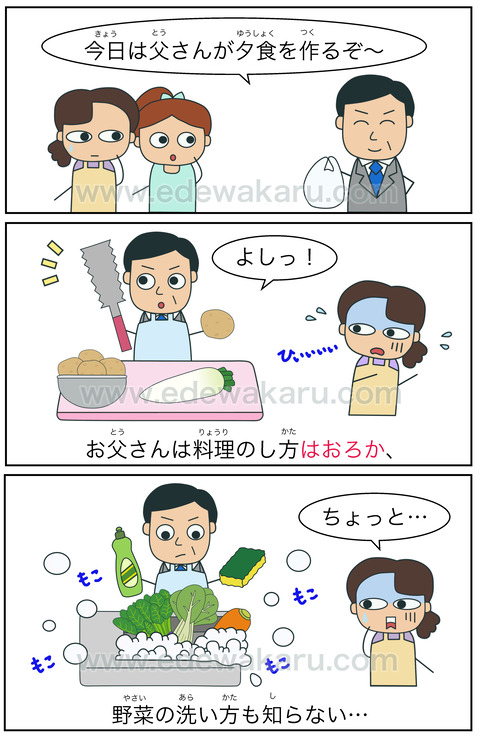
①お父さんは料理のし方
はもちろん、野菜の洗い方も知らない
【A】料理のし方
【B】野菜の洗い方
→野菜の洗い方を知らないことは料理のし方を知らないよりもひどい
②この村にはスーパー
はおろか、コンビニすらない
【A】スーパー
【B】コンビニ
→スーパーよりもコンビニがないことの方がひどい
③マイクは日本人と結婚したのに、漢字
はおろか
ひらがなさえ読めない
【A】漢字
【B】ひらがな
→漢字が読めないよりひらがなが読めない方がひどい
④のどが痛くて、ジュース
はおろか
水を飲むこともできない
【A】ジュース
【B】水
→ジュースが飲めない状態より水が飲めない状態の方がひどい
⑤このアパートにはお風呂
はおろか、トイレもない
【A】お風呂
【B】トイレ
→お風呂がないことより、トイレがないことの方がひどい
⑥足の骨が折れてしまったので、歩くの
はおろか
立つことさえできない
【A】歩く
【B】立つ
→歩くことができないことより、立つこともできない方が骨折の状態がひどい
「〜はおろか」とよく一緒に使われる文型を復習しておきましょう。
[「〜はおろか」とよく使われる文型]
・〜はおろか+
〜も
・〜はおろか+
〜さえ
・〜はおろか+
〜すら
・〜はおろか+
〜まで
「〜はおろか」はかたい言い方です。N1を受ける人はしっかりと覚えておきましょう。
In context 6 examples
お父さんは料理のし方はおろか、野菜の洗い方も知らない
→お父さんは料理のし方はもちろん、野菜の洗い方も知らないこの村にはスーパーはおろか、コンビニすらない
→この村にはスーパーはもちろん、コンビニすらないマイクは日本人と結婚したのに、漢字はおろかひらがなさえ読めない
→漢字はもちろん、ひらがなさえ読めないのどが痛くて、ジュースはおろか水を飲むこともできない
→ジュースはもちろん、水も飲むこともできないこのアパートにはお風呂はおろか、トイレもない
→お風呂はもちろん、トイレもない足の骨が折れてしまったので、歩くのはおろか立つことさえできない
→歩くのはもちろん、立つことさえできない
日本語文型辞典
Meaning
基本情報Nはおろか説明「XはおろかYさえ/も/すら-ない」のように否定表現と共に使うことが多い。もちろんのこと、言うまでもなくの意味で、程度の軽いものをXで示し、Yを強調するのに使う。古めかしくかたい文体で使う。話しことばでは「…どころか」を使う。例文① 私は、海外旅行はおろか国内旅行さえ、ほとんど行ったことがない。② 吉井さんはアレルギーがひどくて、卵はおろかパンも食べられないそうだ。③ この学生には単位は出せません。今学期はレポートはおろか出席さえしていないんです。④ 発見されたとき、その男の人は住所はおろか名前すら記憶していなかったという。⑤ もし歩いていてピストルを突きつけられたら絶対に逆らわないでお金を渡しなさい。さもないと金はおろか命までなくすことになるよ。⑥ 戦争も末期になると、青年はおろか妻子ある中年の男まで戦場に送り込まれた。
日本語文型辞典 英語版
Meaning
【はおろか】[Nはおろか]
Often used with a negative expression, in the pattern XはおろかYさえ/も/すら...ない. Means that something is a matter of course or goes without saying. Used to emphasize Y by first presenting X, which has a lower degree of something. Used in formal, old-fashioned styles. In spoken Japanese, ...どころか is used instead.
In context 6 examples
私は、海外旅行はおろか国内旅行さえ、ほとんど行ったことがない。
I’ve hardly ever traveled in this country, much less abroad.
吉井さんはアレルギーがひどくて、卵はおろかパンも食べられないそうだ。
Since Yoshii-san has terrible allergies, she can’t even eat bread, let alone eggs.
この学生には単位は出せません。今学期はレポートはおろか出席さえしていないんです。
I can’t give this student credit for this course. Not only has he never turned in a paper, he’s never even been to class.
発見されたとき、その男の人は住所はおろか名前すら記憶していなかったという。
I heard that when that man was found, he couldn’t even remember his name, let alone his address.
もし歩いていてピストルを突きつけられたら絶対に逆らわないでお金を渡しなさい。さもないと金はおろか命までなくすことになるよ。
If someone points a gun at you on the street, you must give up your money without resisting. Otherwise, you will lose not only your money but also your life.
戦争も末期になると、青年はおろか妻子ある中年の男まで戦場に送り込まれた。
Towards the end of the war, not only young men but also middle-aged men with wives and children were sent to the front.
くらべてわかる日本語表現文型辞典
Meaning
Aはもちろん、BもC。BがCであることを強調して述べるためにAを引き合いに出す文。
How to use it
AはおろかB(もC)(AはおろかBすら/AはおろかBさえ)
[動詞]+こと+はおろか
[名詞-∅]はおろか
Explanation
【対比1】
「AばかりでなくB(もC)」(意味1 P.279)
「(Xは)AばかりでなくB(もC)」は、Aだけではない。BもC、AもBもCという意味で、後文に命令形などの意思表現が使える。
○勉強ばかりでなく運動もしろ/運動もしよう/運動もしたほうがいい。
×勉強はおろか運動もしろ/運動もしよう/運動もしたほうがいい。
「AばかりかBも」(意味1 P.277)
「AばかりかBも」は、Aだけで十分(満足・不満足)なのに、そのうえBもという意味。「AはおろかB(もC)」にはAだけで十分という意味はない。
○子どもばかりか妻まで殺されてしまった。
×子どもはおろか妻まで殺されてしまった。
また、「AはおろかB(もC)」には、Aを引き合いに出すという意味があるが、「AばかりかBも」はAもBもという意味で、Aを引き合いに出す意味はない。
○1万円はおろか、100円も持っていない。
×1万円ばかりか、100円も持っていない。
「AどころかBも」(意味1,3 P.168,169)
In context 4 examples
このソースには添加物はおろか水も含まれていません。
日本はおろか、世界中さがしても、こんなにおいしい食べ物はない。
あの人は漢字はおろか、ひらがなすら書けない。
私は酒を飲むことはおろか、匂いを嗅ぐだけでも気分が悪くなる。
日本語NET JLPT文法解説まとめ
Meaning
〜は当然として
How to use it
V(辞書形)+ のはおろか
N + はおろか
Explanation
①後ろはマイナスのことがくる。そのため否定形が多い。
②硬い表現
③「〜さえ・〜までも、〜も」といった言葉と一緒によく使われる。
In context 8 examples
ジェームスさんは1年日本語を勉強したのに、漢字はおろか、ひらがなさえ書くことができない。
彼は今のままでは進学はおろか、卒業さえもできない。
この会社には複合機はおろか、パソコンさえない。
私の家の周辺にはデパートはおろか、コンビニもない。
20年生きてきたが、海外はおろか、自分の住む県から出たことすらない。
足を怪我してしまい、走ることはおろか、歩くことさえ難しい。
事故で記憶を失った彼女は、住所はおろか、名前すら覚えていなかった。
私の国では正社員の仕事はおろか、アルバイトも探すのが難しい。
毎日のんびり日本語教師
How to use it
名詞+はおろか+名詞+も/すら/さえ/まで+~ない
動詞普通形+の+はおろか+名詞+も/すら/さえ/まで+~ない
Explanation
Aはおろか、Bも~ない
Aはおろか、Bすら~ない
Aはおろか、Bさえ~ない
Aはおろか、Bまで~ない
「Aはおろか、Bも~ない」の形でよく使われます。
後件ではマイナスの評価が述べられ、否定的な表現が来ます。後件で取り上げるものは前件よりも程度が高くなければいけません。
「も」「すら」「さえ」「まで」などがよく呼応します。
Notes
特になし
In context 16 examples
正社員はおろか、アルバイトすらなかなか見つからない。
読んだことはおろか、見たことさえない。
ここは田舎すぎて、コンビニはおろか飲食店すらない。
休憩はおろか、トイレに行く時間さえも取れない。
事業を継続することはおろか、軌道に乗せることさえもできていない。
休みの日は家はおろか布団からも出ずにごろごろしていた。
ここ数年インフルエンザはおろか、風邪さえも引いたことがない。
賠償はおろか謝りすらしていない。
海外はおろか、隣県にも行ったことがない。
この辺りはコンビニはおろか個人商店すら無い。
明日のデート、服はおろか髪型も香水もまだ決まっていない。
髪の毛はもちろん、ヒゲはおろか鼻毛までも白髪になってきた。
両親はおろか、祖父母も大学を出ていない。
今回のオリンピック、世界新記録はおろか五輪新記録もほとんど出ていない。
47都道府県の位置はおろか、名前さえも正しく言えない。
このキノコは食べるのはおろか、触ることさえ危険である。
IMABI
Addition
Read this IMABI lesson ↗Explanation
Addition: ~に加えて, ~にとどまらず, ~もさることながら, ~はおろか, ~はもちろん, ~はもとより, ~ともあれ
When a speaker feels obligated to mention yet another thing into the mix, that is usually done so with negative connotation, and it is this that will be the theme of this lesson.
~に加えて
The transitive verb 加える roughly translates to “to add,” but it may also be translated as “to count (someone) in,” “to deal (damage),” “or even “to gather (speed).”
1. 料理に胡椒こしょうは一つまみも加える必要はない。
There is no need to add a pinch of pepper to a dish.
2. お茶に砂糖を加える。
To mix sugar in the tea.
3. 圧力を加える。
To add pressure.
咥える should not, however, be confused with the homophonous transitive verb 咥える・銜える, which means “to put in one’s mouth,” although they are etymologically tied.
4. 子供は指を銜くわえる嫌いがある。
Children have the tendency to have their fingers in their mouth.
Perhaps the most important use of this verb is its appearance in the phrase ~に加えて meaning “in addition to.” It is used a lot in enumerating negative situations.
5. 彼女は日本語に加えて、英語もあまり分からないみたいだね。
In addition to Japanese, it looks like she barely understands English.
6. イギリスに加えて、フランスもドイツも多文化主義の非を鳴らしています。
In addition to England, France and Germany are also denouncing multiculturalism.
7. そのことに加えて、彼は自分の名前を忘れたよ!
In addition to that, he also forgot his own name!
8. 5日のニューヨーク株式市場かぶしきしじょうは、東京市場で株価が大幅おおはばに値下がりしたことに加えて、アメリカが景気を下支したざさえするために行っている量的緩和りょうてきかんわの縮小しゅくしょう時期など、アメリカの金融きんゆう政策に対する不安から幅広い銘柄めいがらに売り注文が広がりました。
As for the New York Stock Exchange on the fifth, selling orders have spread in a wide range of brands from worries towards American financial policies such as the quantitative easing curtailment period America is carrying out in order to backup the economy in addition to the large drop in prices due to the Tokyo Exchange.
From NHK.
~にとどまらず
The speech modal ~にとどまらず attaches to nouns which can be perceived as some sort of parameter/level/stage with which the following clause indicates an extension of said parameter.
10. マスメディアによる情報というものは、今や一国にとどまらず、世界中に伝わる。
Information by the media doesn’t stay in one country now; it travels the world.
11. 農作物は、台風に襲われた直後にとどまらず、一年中その影響を受ける。
Crops don’t just receive the effects directly after being hit by a typhoon; they feel the impact throughout the year.
12. 彼女は成功にとどまらず、社会貢献に尽力した。
She not only stopped at success, but she also labored as a contribution to society.
Though ~にとどまらず usually attaches itself to nouns, it can on occasion follow the 連体形 of verbs, but in doing so, it is not used with static verbs, as such verbs do not agree with the concept of extending parameters.
13. 一人の人間の明るさは、場を明るくするにとどまらず、周囲の人々に心身の活力をも与えるものである。
The brightness of a person not only brightens up the area, but also it gives energy to the hearts and minds of the surrounding people.
14. 更に執刀した岡山大学病院の大藤剛宏医師は手術後の記者会見で「中葉を使った移植は男の子1人を助けるにとどまらず、これまで助けることができなかった子どもたちに光が当たるという意義がある」と話しました。
In addition, Dc. Oto Takahiro of Okayama University Hospital who did the surgery in a press conference afterwards said that “the transplant using the middle lobe [of the lung] does not just save this one boy, but it gives light to other children that have not been able to be helped till now”.
From the NHK article 『生体肺移植の男児 容体安定』 on 2013年7月2日
When used with adjectives/adjectival noun predicates, the nature of the situation must be in some state of transition to account for an extension of the parameter being described to remain grammatical. So, although adjectival expressions may literally be static by definition, they can be implemented in dynamic circumstances.
As this pattern follows the 連体形, but because it is also generally restricted to rather stiff written language, we can expect it to follow the である-連体形 for adjectival nouns, but as for adjectives1, we find that the particle だけ (only) is placed in between the adjective (though still in the 連体形) and ~に留まらず.
15. あの法令は単に違憲であるにとどまらず、ネットのおかげで実効性も失われて久しい。
That ordinance is not only simply unconstitutional, but thanks to the Internet, it has lost its effectiveness for quite some time.
16. 健康に良いだけにとどまらず、シジミは旨味成分もたくさん含まれています。
Freshwater clams are not just good for your health, but they also contain lots of umami components.
Though not grammatically necessary and in some sense redundant, the particle だけ can generally be seen used with this pattern in general, resulting in ~だけにとどまらず.
17. 弊社は社会貢献だけにとどまらず、様々な活動を展開しております。
Our company is not limiting itself to just contributing to society but is expanding its reach into all sorts of activities.
Orthography Note: Though not typically written in Kanji, its Kanji spelled is ~に留まらず.
~もさることながら
The pattern ~もさることながら follows nouns deemed to obviously be of a certain quality (most often positive), and that the following clause adds to the worth/validity of said statement. This, in turn, is translated into English as “it goes without saying that…”
18. 中華料理ちゅうかりょうりは味あじもさることながら、健康けんこうにいいですよ。
It goes without saying that Chinese food is tasty, but it’s also good for you.
19. 彼女は人柄もさることながら、その頭の働きの良さで周囲の人をぐいぐいと引っ張っていくんですよ。
Her personality goes without saying, and her great mind pulls those around towards her.
Orthography Note: The full Kanji spelling of this pattern is 然る事乍ら.
Grammar Note: 然る is an old-fashioned 連体詞 derived from the Classical Japanese verb 然り, which has the meaning of “to be said/some thing” in a very vague sense, and if it were directly translated into something in Modern Japanese, it would be closest to そういう or とある, which results in it directly equating to “such.” Given how affirming the noun-predicate is, we see that the particle ながら attaches itself to state that the two clauses of the sentence are concurrently in agreeance to that effect.
~はもちろん・もとより・おろか
~はもちろん(のこと)is used when juxtaposing two predicates as being “as matter of fact.” The first clause which it attaches to must be a nominal(ized) phrase, but what follows after it is typically a verbal/adjectival which affirms the first predicate.
In the examples that follow, we can see how the literal meaning of もちろん, that being “of course,” can be taken literally here. To truly understand how this pattern works regarding nuance, though, let’s posit that the first clause is X and the second clause is Y. In the mind of the speaker, X is mentioned first as it has the highest relevance or the highest recognition of being obvious, whereas Y adds to what is obvious or fully expected given knowledge of the situation. Y may at times be far more impressive than Y, but the reason why X is mentioned first is because it has the most relevance.
Speech Style Note: While ~はもちろん is largely used in the written language, whenever it is utilized in the spoken language, it is often rendered as ~もちろんのこと, which grammatically allows for said dependent clause to more clearly function as a noun-predicate that is more parallel in structure to predicate Y.
20. 彼は英語はもちろん、スペイン語も韓国語もできます。
Not to mention English, he can also speak Spanish and Korean.
21 あの子は書くのはもちろん、読むこともできない。
That kid can’t even read, let alone write.
22. 彼は、母語はもちろん(のこと)、他にも7つの言語も話せますよ。
Not only his native language, but he can also speak seven other languages.
23. 彼は修士を得るのはもちろん、入学さえできない。
He can’t even enter college, let alone receive a master’s degree.
Now, whenever Y is not something that cannot be deemed obvious given the situation at hand, ~はもちろん becomes ungrammatical, and it would need to be replaced with something broader such as ~だけでなく.
24. この米には、もみ{だけでなく 〇・はもちろん X}、砂まで入ってるのよ。
Not only is there husks in this rice, there’s even sand in it.
While it may be intrinsically obvious that someone who excels in his main language does indeed have mastery in other languages like in Ex. 22, there is nothing intrinsic about rice being contaminated with all sorts of things.
~はもとより
The nuance spin that ~はもとより provides is that it quality X is “principally” so. Meaning, based on principle, X is that standard which is both most pertinent and obvious in nature, and then Y builds onto that execution of standard. Just as with ~はもちろん(のこと), X is a nominal(ized) phrase, while Y is usually a verbal/adjectival predicate which expands on that notion.
25. 彼女は料理はもとより食器も洗ってくれます。
She not only cooks, but she also washes the dishes.
26. 彼は英語はもとより、スペイン語も韓国語もできます。
Not to mention English, he can also speak Spanish and Korean.
27. 低賃金、劣悪な労働条件、一方的な首切りなどの経済・労働問題はもとより、各種の人道的問題までも引き起こしている。
They are not only suffering from low wages, cases of poor working condition, and economic and labor problems such as one-sided layoffs, they are also troubled to the extent of various forms of discrimination.
28. 地方ごとに、味はもとより、料理の仕方も違ってきますね。
With each region, not to mention flavor, but even cooking methods differ, don’t they?
~はおろか
The word おろか indicates that the noun in the dependent clause X is negligible in how bad Y is obviously true.
29. 一ドルはおろか一セントも持ってないよ。
I don’t have a cent, let alone a dollar!
30. 父はおろか、僕の犬でさえ反対したようだ。
Not to mention my father, even my dog seemed to object.
31. 僕はバイオリンはおろか、ギターも弾けないんだ。
I can’t even play the guitar, much less a violet.
32. あの子は話すのはおろか、足も動かせません。
That child can’t even move her legs, let alone speak.
漢字 Notes: The Kanji spellings of these phrases are as follows:
①おろか → 疎か
②もちろん → 勿論
③もとより →【元・固・素】より.
~ともあれ
~ともあれ is an adverbial phrase that means “never mind/putting aside.” It is also seen in 何はともあれ meaning “in any case.” Grammatically speaking, あれ is the 已然形 of the existential verb ある, which means that as a whole, this adverbial phrase pinpoints the noun in said dependent clause X is already obviously an established issue, but that Y is the ‘real’ problem at hand.
33. 中国語はともあれ、問題は日本語の勉強なんだぞ。
Never mind Chinese, the problem is my Japanese studies!
34. 何はともあれ、後でしよう。
In any case, let’s do (this) later.
In older language, the き-連体形 of adjectives does become valid with this grammar structure.
i. 良き素材で醸されたお酒は香味や余韻の良きにとどまらず、飲み手にはその格に相応しい陶酔感をもたらします。
Sake brewed with excellent ingredients not only has superb flavor and aftertaste, as it provides a level of intoxication befitting of its worth to the consumer. ↩︎
In context 32 examples
料理に胡椒こしょうは一つまみも加える必要はない。
There is no need to add a pinch of pepper to a dish.
お茶に砂糖を加える。
To mix sugar in the tea.
圧力を加える。
To add pressure.
子供は指を銜くわえる嫌いがある。
Children have the tendency to have their fingers in their mouth.
彼女は日本語に加えて、英語もあまり分からないみたいだね。
In addition to Japanese, it looks like she barely understands English.
イギリスに加えて、フランスもドイツも多文化主義の非を鳴らしています。
In addition to England, France and Germany are also denouncing multiculturalism.
そのことに加えて、彼は自分の名前を忘れたよ!
In addition to that, he also forgot his own name!
5日のニューヨーク株式市場かぶしきしじょうは、東京市場で株価が大幅おおはばに値下がりしたことに加えて、アメリカが景気を下支したざさえするために行っている量的緩和りょうてきかんわの縮小しゅくしょう時期など、アメリカの金融きんゆう政策に対する不安から幅広い銘柄めいがらに売り注文が広がりました。
As for the New York Stock Exchange on the fifth, selling orders have spread in a wide range of brands from worries towards American financial policies such as the quantitative easing curtailment period America is carrying out in order to backup the economy in addition to the large drop in prices due to the Tokyo Exchange.
マスメディアによる情報というものは、今や一国にとどまらず、世界中に伝わる。
Information by the media doesn’t stay in one country now; it travels the world.
農作物は、台風に襲われた直後にとどまらず、一年中その影響を受ける。
Crops don’t just receive the effects directly after being hit by a typhoon; they feel the impact throughout the year.
彼女は成功にとどまらず、社会貢献に尽力した。
She not only stopped at success, but she also labored as a contribution to society.
一人の人間の明るさは、場を明るくするにとどまらず、周囲の人々に心身の活力をも与えるものである。
The brightness of a person not only brightens up the area, but also it gives energy to the hearts and minds of the surrounding people.
更に執刀した岡山大学病院の大藤剛宏医師は手術後の記者会見で「中葉を使った移植は男の子1人を助けるにとどまらず、これまで助けることができなかった子どもたちに光が当たるという意義がある」と話しました。
In addition, Dc. Oto Takahiro of Okayama University Hospital who did the surgery in a press conference afterwards said that “the transplant using the middle lobe [of the lung] does not just save this one boy, but it gives light to other children that have not been able to be helped till now”.
あの法令は単に違憲であるにとどまらず、ネットのおかげで実効性も失われて久しい。
That ordinance is not only simply unconstitutional, but thanks to the Internet, it has lost its effectiveness for quite some time.
健康に良いだけにとどまらず、シジミは旨味成分もたくさん含まれています。
Freshwater clams are not just good for your health, but they also contain lots of umami components.
弊社は社会貢献だけにとどまらず、様々な活動を展開しております。
Our company is not limiting itself to just contributing to society but is expanding its reach into all sorts of activities.
中華料理ちゅうかりょうりは味あじもさることながら、健康けんこうにいいですよ。
It goes without saying that Chinese food is tasty, but it’s also good for you.
彼女は人柄もさることながら、その頭の働きの良さで周囲の人をぐいぐいと引っ張っていくんですよ。
Her personality goes without saying, and her great mind pulls those around towards her.
彼は英語はもちろん、スペイン語も韓国語もできます。
Not to mention English, he can also speak Spanish and Korean.
彼は、母語はもちろん(のこと)、他にも7つの言語も話せますよ。
Not only his native language, but he can also speak seven other languages.
彼は修士を得るのはもちろん、入学さえできない。
He can’t even enter college, let alone receive a master’s degree.
この米には、もみ{だけでなく 〇・はもちろん X}、砂まで入ってるのよ。
Not only is there husks in this rice, there’s even sand in it.
彼女は料理はもとより食器も洗ってくれます。
She not only cooks, but she also washes the dishes.
彼は英語はもとより、スペイン語も韓国語もできます。
Not to mention English, he can also speak Spanish and Korean.
低賃金、劣悪な労働条件、一方的な首切りなどの経済・労働問題はもとより、各種の人道的問題までも引き起こしている。
They are not only suffering from low wages, cases of poor working condition, and economic and labor problems such as one-sided layoffs, they are also troubled to the extent of various forms of discrimination.
地方ごとに、味はもとより、料理の仕方も違ってきますね。
With each region, not to mention flavor, but even cooking methods differ, don’t they?
一ドルはおろか一セントも持ってないよ。
I don’t have a cent, let alone a dollar!
父はおろか、僕の犬でさえ反対したようだ。
Not to mention my father, even my dog seemed to object.
僕はバイオリンはおろか、ギターも弾けないんだ。
I can’t even play the guitar, much less a violet.
あの子は話すのはおろか、足も動かせません。
That child can’t even move her legs, let alone speak.
中国語はともあれ、問題は日本語の勉強なんだぞ。
Never mind Chinese, the problem is my Japanese studies!
何はともあれ、後でしよう。
In any case, let’s do (this) later.