AIUEO JLPT Grammar
Meaning
This sentence pattern expresses performing another action incidentally while carrying out a primary one. It conveys the meaning of adding a secondary activity to the main purpose and is frequently used in daily conversation.
How to use it
動詞ます形+がてら名詞+がてら
Explanation · 日本語
この文型は、ある行動をするついでに、別の行動も行うことを表す表現です。主な目的の行動に加えて、他の行動も同時に行うという意味を持ち、日常会話でもよく使われます。
In context 5 examples
散歩がてら、近くのカフェに寄ってきた。
I stopped by the nearby café while taking a walk.
買い物がてら、友達に会いに行った。
I went to see my friend while shopping.
休憩がてら、煙草を吸った。
I took a break and smoked a cigarette.
休みがてら、家の掃除をした。
I cleaned the house while taking a break.
外出がてら、銀行に寄った。
I stopped by the bank while I was out.
文法
Meaning
〜を兼ねて / 〜のついでに
後件には「行く」や「散歩する」のように移動に関係する動詞がよく使われる。「ついで」よりも少し硬い表現である。
How to use it
V(ます形)ます + がてら
する動詞のN + がてら
In context 4 examples
散歩がてら、ちょっとコンビニまで行ってきます。
毎日車で出勤しているが、今日は運動がてら自転車で行くことにする。
帰省がてら、地元に新しくできたデパートに行くつもりだ。
お花見がてら、公園を散歩しよう。
Bunpro Grammar Reference
Meaning
On the occasion of, While … as well, While … (one is) at it, During, Along the way
How to use it
Verb[stem]+ がてら
Noun + がてら,
Nuance
A formal particle, indicating that something is being done on the same occasion as (A).
Explanation
がてら is a neologism that is used in the same way as an adverbial particle in modern Japanese, and will connect to the conjunctive form of verbs, and to nouns. It is similar to ながら in that it will be translated as 'while (A), (B)', 'during (A), (B)', or 'on the occasion of (A)'.
When (A) is a noun, it will almost always be a noun that signifies some sort of physical movement.
弟を駅から迎えがてらに、今夜の夕飯の買い物をしに行く。
I will go grocery shopping for tonight's dinner on my way to pick up my brother as well.
友達の家に行きがてら、近くの神社にお参りに行った。
While going to my friend's house, I went to pray at the shrine nearby as well.
ワンちゃんの散歩がてらに、ペットショップにいってくる。
While taking my dog on a walk, I am going to go to the pet store as well.
運動がてらに会社まで自転車で行くことにした。
On the occasion of exercising, I decided to ride the bicycle to work.
Unlike ながら, がてら focuses more on (A) being a good opportunity which can be utilized or taken advantage of in order to do (B).
Fun Fact
がてら is a vocal change of がてり, which originally comes from an abbreviation of the conjunctive form of 糅つ, かて 'to mix together', and あり. So かてあり was abbreviated to かてり, which then went through sound changes to がてり and がてら. However, the 'being mixed together' meaning is still kept in the modern day nuance of this grammar point.
Nuance · 日本語
(A)をするついでに何かをするということを表す丁寧な接続詞。
Explanation · 日本語
「がてら」は、現代日本語で副助詞のような働きをする造語で、動詞の連用形や名詞に接続して使われます。「ながら」と似た意味を持ち、「(A) と並行して (B)」「(A) のついでに (B)」「(A) の機会に (B)」といった意味で使われます。
(A) が名詞の場合は、「散歩」や「運動」など、身体的な動作を表す名詞であることがほとんどです
弟を駅から迎えがてらに、今夜の夕飯の買い物をしに行く。
I will go grocery shopping for tonight's dinner on my way to pick up my brother as well.
友達の家に行きがてら、近くの神社にお参りに行った。
While going to my friend's house, I went to pray at the shrine nearby as well.
ワンちゃんの散歩がてらに、ペットショップにいってくる。
While taking my dog on a walk, I am going to go to the pet store as well.
運動がてらに会社まで自転車で行くことにした。
On the occasion of exercising, I decided to ride the bicycle to work.
「ながら」とは異なり、「がてら」には、(B) を行うためのよい機会や口実として (A) を捉え、その機会を活用するというニュアンスが強いという特徴があります。
豆知識
「がてら」は、もともと「糅つ」(意味:混ぜ合わせる)の連用形「かて」と「あり」が結びついた「かてあり」という形から生まれたものです。これが縮まって「かてり」、さらに音が変化して「がてり」、最終的に「がてら」となりました。このように、形は変わっていますが、「混ぜ合わせる」という本来の意味は、今でも「(A) と (B) を兼ねる」というこの文法のニュアンスの中に残っています。
In context 16 examples
- 「帰りがてら手紙出してくるね。」
I'll post the letter on my way home as well.
- 弟を駅から迎えがてらに、今夜の夕飯の買い物をしに行く。
I will go grocery shopping for tonight's dinner on my way to pick up my brother as well.
- 友達の家に行きがてら、近くの神社にお参りに行った。
While going to my friend's house, I went to pray at the shrine nearby as well.
- ワンちゃんの散歩がてらに、ペットショップにいってくる。
While taking my dog on a walk, I am going to go to the pet store as well.
- 運動がてらに会社まで自転車で行くことにした。
On the occasion of exercising, I decided to ride the bicycle to work.
- 「イノシシの散歩がてら、ちょっとコンビニまで行ってきます。」
'While taking a walk with my pet wild boar, I will go to the convenience store as well.'
- 「お花見がてら、公園を散歩しよう。」
'Let's take a walk in the park while viewing the cherry blossoms as well.'
- 回顧録:「ヒースロー空港への移動がてら、観光スポットを訪れた。」
Memoir: 'I visited some tourist attractions on my way to Heathrow Airport as well.'
- 友達との話:「じゃあ買い物がてら、紅葉を見に行かないか?」
Chat between friends: 'So, why don't we view the autumn leaves while shopping as well?'
- 広告:「観光の後には休憩がてら立ち寄ってみてはいかがでしょうか。」
Restaurant advertisement: 'How about you drop by while taking a break after sightseeing (as well)?'
- 帰省がてら懐かしい喫茶店やゲームセンター、よく行っていた海岸へ足を運ぶつもりだ。
I plan to make my way to a nostalgic coffee shop and game center along the way home, and the beach that I used to often go to as well.
- 運動がてらバス停を二つ手前で降りて、残りの距離を早歩きで歩く事にしました。
On the occasion of exercising, I decided to hop off the bus two stops before my place and quickly walk the remaining distance.
- 気分転換のためにお散歩がてら、近所の神社に立ち寄る事にした。
For a change of pace, while taking a stroll, I decided to stop at a neighborhood shrine as well.
- 鬱になってしまったので、療養がてら仕事を長期的に休む決断をしました。
Since I became depressed, while I was recuperating I decided to take a long-term break from work as well.
- 不倫相手からの「仕事がてら、また家に泊まりにきたら?」というメールを夫に見られてしまった。
The message from the person that I was cheating with that said 'while you're at work, why don't you come stay at my place as well?' was unfortunately seen by my husband.
- 勉強がてら音楽を聴いていたら、いつの間にか勉強は一切せずに音楽だけ聴いていた事に気づきました。
When I was listening to music on the occasion of doing some study, I suddenly realized that I had not done any study at all, but was just listening to music.
どんなときどう使う 日本語表現文型辞典
Meaning
take the opportunity to; on the same occasion
How to use it
Vます/する動詞のN+がてら
Explanation
~を兼ねて
1)「~がてら、…」の形で、「一つの行為をするときに二つの目的を持たせてする」という意味。また「一つのことをすると、結果として二つのことができる」などの意味にも使う。
2)「…」には、「歩く・行く」など移動に関係のある動詞がよく使われる。
2)Verbs of movement, such as 歩く or 行く, often follow.
1)Accomplishing two objectives via one action. Can also mean to produce two results by doing a single action.
In context 4 examples
月1回のフリーマーケットをのぞきがてら、公園を散歩してきた。
散歩がてら、ちょっと郵便局まで行ってきます。
買い物がてら新宿へ行って、展覧会ものぞいて来よう。
駅まで30分ほどかかるが、天気のいい日は運動がてら歩くことにしている。
絵でわかる日本語
Meaning
〜する時間を使って〜する
〜しながら〜する
How to use it
動詞[ます形]+がてら
名詞[辞書形]+がてら
Explanation
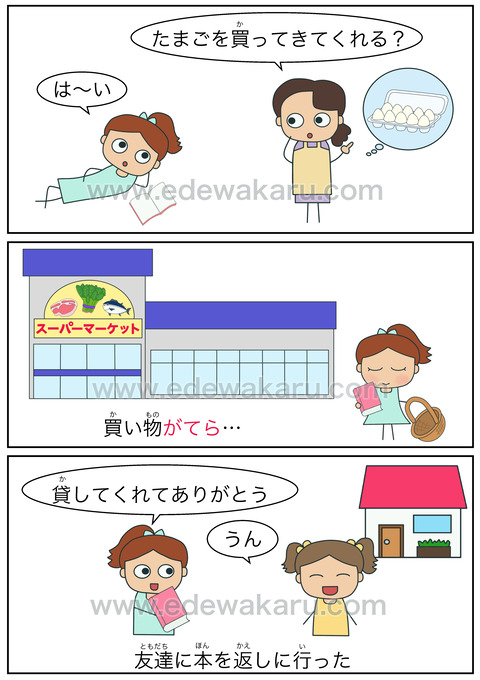
「AがてらB」は「Aする時間を使ってBする」「AしながらBする」という意味を表す文型です。名詞を使う場合は、動作を表す名詞が使われます😮
「Aをすることで、Bもできる」と言いたい時に使いますので、主となる動作は「A」だと覚えておきましょう
😀「AついでにB」は「Aする機会を使ってBする」という意味の文型ですので、一緒に覚えておきましょう。
(復習:〜ついでに)
[例]
買い物
がてら、友達に本を返しに行った
=買い物の
ついでに、友達に本を返しに行った
また
「〜がてら」は【同時並行動作(どうじへいこうどうさ)】を表すこともできる
と覚えておきましょう。この場合は「〜ついでに」にはチェンジできませんので注意してください😨
[例]
勉強
がてら
音楽をきく
→音楽をきき
ながら
勉強をする
(復習:〜ながら(同時進行動作))
→❌勉強の
ついでに
音楽をきく
「〜がてら」はかたい言い方です。会話では「〜ながら」「〜ついでに」の方がよく使われます
😊N1を受ける人はテストのためにしっかりと覚えておきましょう。
(復習:〜ために(目的))
In context 4 examples
買い物がてら友達に本を返しに行った
→買い物する時間を利用して、友達に本を返しに行ったまた、ご旅行がてら遊びに来てくださいね
→また、旅行する機会がある時は遊びに来てくださいね勉強がてら音楽をきく
→音楽をききながら勉強をする散歩がてら話をする
→話をしながら散歩をする
日本語文型辞典
Meaning
基本情報NがてらR-がてら説明動作を表す名詞や動詞の連用形に付く「XがてらY」の形で、「XをかねてYをする」という意味を表す。Yをすることで結果的にXもできることになるという状況で用いられることが多い。「…をかねて」「…かたがた」とも言う。例文① 買い物がてら、その辺をぶらぶらしない?② 散歩がてら、パンを買いに行こう。③ 引っ越してきてから2週間ほどの間、私は運動がてら近所の町を歩き回った。④ 彼は映画評論家なので、仕事がてらよくアジアの映画を見ることがあるそうだ。⑤ 京都においでの節は、お遊びがてらぜひ私どものところへもお立ち寄りください。
日本語文型辞典 英語版
Meaning
【がてら】[Nがてら][R-がてら]
Attaches to a noun that expresses an action or a verb stem. Used in the form XがてらY and means “combining action X with another action Y.” Often used when doing X results in being able to do Y. XをかねてY and XかたがたY are also used to express the same meaning.
In context 5 examples
買い物がてら、その辺をぶらぶらしない?
While we’re shopping, why don’t we take a stroll around the place?
散歩がてら、パンを買いに行こう。
Let’s go buy some bread on our walk.
引っ越してきてから2週間ほどの間、私は運動がてら近所の町を歩き回った。
In the two weeks since I moved here, I’ve walked around the neighborhood partly for exercise.
彼は映画評論家なので、仕事がてらよくアジアの映画を見ることがあるそうだ。
He is a movie critic, so he often watches Asian movies as part of his work.
京都においでの節は、お遊びがてらぜひ私どものところへもお立ち寄りください。
When you visit Kyoto, please do stop by at our house as well.
くらべてわかる日本語表現文型辞典
Meaning
意味1:Aの機会を利用してBをする。Aが主目的である。
意味2:Aという目的でB。AはBの場所で達成される目的である。BはAの目的場所へ向かうという意味だが、Aの達成だけでなくそれ以外の目的も含んでいる。
How to use it
AがてらB
[動詞-ます形]がてら
[名詞-∅]がてら
Explanation
【対比1】
「AついでにB」(意味1 P.132)
「AがてらB」は移動を伴う文に使われるが、「AついでにB」にはこの制約がない。
○顔を洗うついでに、歯をみがいた。
×顔を洗いがてら、歯をみがいた。
移動を伴う文でも「AがてらB」はAとBが同じ場所で達成されることではないが、「AついでにB」は同じ場所でもよい。
○手紙を出しに郵便局へ行ったついでに、年賀はがきを買ってきた。
×手紙を出しに郵便局へ行きがてら、年賀はがきを買ってきた。(年賀はがきを郵便局以外の場所で買うのならいい)
【対比2】
「AをかねてB」(意味1 P.335)
「AをかねてB」はAとBの主・副の関係が弱く、同じ程度の力を持つ目的である。
○林さんの見舞いがてら、山田さんの病室にも寄ってきた。(林さんの見舞いが第一の目的で、山田さんの見舞いもした)
○林さんの見舞いをかねて、山田さんの病室にも寄ってきた。(病院へは林さんと山田さんの二人を見舞うためにいった)
Notes
【注意1】
・Aは移動動詞でなくても、移動の意味が含まれる。
○買い物(へ行き)がてら、新しいマンションを見にいった。
In context 8 examples
父を駅まで迎えに行きがてら、ビデオを借りてきた。
図書館の庭の桜がきれいなので、本を返しがてら花見をしてきた。
毎朝、散歩しがてら、朝刊を買うのが父の日課です。
部長を見舞いがてら、会議の報告をしてきた。
涼みがてら、夜の町に出た。
母の見舞いがてら、実家に帰った。
休養がてら、温泉に行った。
孫の顔を見がてら、東京を訪れた。
日本語NET JLPT文法解説まとめ
Meaning
"〜を兼ねて / 〜のついでに"
後件には「行く」や「散歩する」のように移動に関係する動詞がよく使われる。「ついで」よりも少し硬い表現である。
How to use it
V(ます形)ます + がてら
する動詞のN + がてら
Explanation
"to take the opportunity"
Used to indicate doing something while also taking the opportunity to do something else.
In the latter part, verbs related to movement, such as "行く" or "散歩する" are often used. It is a slightly more formal expression than "ついで."
In context 4 examples
散歩がてら、ちょっとコンビニまで行ってきます。
毎日車で出勤しているが、今日は運動がてら自転車で行くことにする。
帰省がてら、地元に新しくできたデパートに行くつもりだ。
お花見がてら、公園を散歩しよう。
毎日のんびり日本語教師
Meaning
~のついでに
How to use it
動ます形+がてら
名詞+がてら
Explanation
【 A 】がてら【 B 】
前件のついでに後件の動作を行うことを表します。
「ついで」よりも硬い表現です。
多くの場合、行く、寄る、向かうなどの移動動詞を伴います。
Notes
特になし
In context 12 examples
勉強がてら音楽を聴く。
買い物がてら友人の家に立ち寄る。
帰省がてら故郷を満喫する。
週末にはドライブがてら、新しい水族館に行ってみようと思う。
お仕事がてら、東京観光にいらして下さい。
散歩がてら買い物してきました。
ダイエットがてら食費切り詰める。
休憩がてら間食を取る。
シャワーしがてらお風呂掃除する。
運動がてら電車使わずに自転車で通勤する。
換気がてら窓を開けて外の空気を吸う。
気分転換がてら豪遊する。
NINJAL 日本語文型データベース
Meaning
移動を伴う〜の機会を利用して、他の行為をすると言いたいときに使います。また、〜という目的で、他の移動を伴う行為をすると言いたいときにも使います。
How to use it
Notes
「〜」には主要な動作、「〜がてら」の後には主要ではない動作がきます。
In context 10 examples
うちに遊びに来た友達を駅まで送りがてら、晩ご飯の材料を買って帰ろう。
「部長に書類を届けがてら、今後のスケジュールについて少し相談してくるよ」
図書館に本を返しに行きがてら、併設の資料館の特別展示を見てきた。
部屋で受験勉強をしている子どもの様子を見がてら、夜食を持って行った。
ランチを食べる店を探しがてら、町を散策した。
散歩がてら、コンビニにお菓子を買いに行った。
出張がてら、その土地の味を楽しんでいる。
「山の紅葉がだいぶ色づいてきたみたいだよ。週末、ドライブがてら見に行ってみようよ」
仕事中ちょっと疲れたので、休憩がてら屋上に上がってみた。
忘年会の候補の居酒屋に、下見がてら飲みに行った。
IMABI
Incidental
Read this IMABI lesson ↗Explanation
Incidental: がてら, かたがた, かたわら, & ついで
All of these items have a common theme, but don’t let this confuse you! Pay attention to how these items are exactly used, and see if you can come up with a chart to differentiate them. Then, compare your chart to the one that ends this lesson.
がてら
~がてら either attaches to the 連用形 of a verb or to a noun. ~がてら shows that while you’re doing something, you’re also taking the opportunity to do something else. So, whatever it attaches to, there should be some sense of movement implied.
~がてら is primarily used with nouns that express an action of movement such as walking or shopping. Unlike ~ながら, ~がてら doesn’t indicate that two things are simultaneous. In both cases, though, the two actions are happening in the same time period.
~がてら shows that things are happening in a relatively close time span. This is rather old-fashioned, so you probably will not see it often. However, it does show up in writing and the JLPT 1, so you still need to know what it is.
Examples
1. 散歩がてら友達と話し合う。
While taking a walk, I talk with my friend.
2. 散歩がてら買い物に行く。
While taking a walk, I go shopping.
3. 駅に行きがてら郵便局に立ち寄ります。
While going to the train station, I’ll drop by the post office.
4. 教会に行きがてら、おじさんの家に寄ってきた。
While I went to church, I went to visit my uncle (on the way).
5. 散歩がてらちょっとピーマンを買いに行ってきます。
I’ll get some peppers on my walk.
6. 外に行きがてら、手紙を出してきてくれない?
Can’t you send out this letter as you go outside?
7. 友だちを駅まで送りがてら本を返してきた。
I returned a book back to my friend while I sent him to the train station.
8. 運動がてら犬の散歩に出かけたっけ。
You said you took the dog on a walk in exercising?
Grammar Note: When using a noun that can be made verbs by adding する, you shouldn’t attach がてら to the 連用形. So, rather than ever saying 運動しがてら, simply use 運動がてら.
9. 暖かい日の午過ひるすぎ食後の運動がてら水仙の水を易かえてやろうと思って洗面所へ出て、水道の栓せんを捩ねじっていると、その看護婦が受持の室へやの茶器を洗いに来て、例の通り挨拶あいさつをしながら、しばらく自分の手にした朱泥しゅでいの鉢はちと、その中に盛り上げられたように膨ふくれて見える珠根たまねを眺めていたが、やがてその眼を自分の横顔に移して、この前御入院の時よりもうずっと御顔色が好くなりましたねと、三カ月前の自分と今の自分を比較したような批評をした。
Past noon on a warm day, I thought about watering the daffodil on going to exercise and went to the washroom, and when I had twisted the water nob, the nurse had come to wash the tea utensils of the room she was in charge of, and as she gave regular greetings, she gazed at the reddish-brown pot in my hand and the bulbs that seemed swollen up like they had been piled in there, but she finally moved her glance to my profile and gave the comment, “Your complexion has really improved lately since you came in the hospital”, which seemed to be a comparison of me now and three months ago.
From 変な音 by 夏目漱石. 暖かい日の午過(ひるすぎ)食後の運動がてら水仙の水を易(か)えてやろうと思って洗面所へ出て、水道の栓(せん)を捩(ねじ)っていると、その看護婦が受持の室(へや)の茶器を洗いに来て、例の通り挨拶(あいさつ)をしながら、しばらく自分の手にした朱泥(しゅでい)の鉢(はち)と、その中に盛り上げられたように膨(ふく)れて見える珠根(たまね)を眺めていたが、やがてその眼を自分の横顔に移して、この前御入院の時よりもうずっと御顔色が好くなりましたねと、三カ月前の自分と今の自分を比較したような批評をした。Past noon on a warm day, I thought about watering the daffodil on going to exercise and went to the washroom, and when I had twisted the water nob, the nurse had come to wash the tea utensils of the room she was in charge of, and as she gave regular greetings, she gazed at the bulbs, which looked swollen up like they had been piled in the flower pot that I held in my hand, but she finally moved her glance to my face and gave the comment, “Your complex has really improved lately since you came in the hospital”, which seemed to be a comparison of me now and three months ago.
Fr
Some usages of ~がてら, given that it has passed its heyday, may be questionable. If it is a situation seemingly not completely within one’s free will, it can sound unnatural. In the following case, it would be natural if the meeting is most important to you and you just had to go on a 出張 for your own comfort.
10a. イギリスへの出張がてら、地球環境会議に出席しました。
10b. イギリスへの出張(の)ついでに、地球環境会議に出席しました。
On the occasion of going on a business trip to England, I attended a global environment meeting.
To reiterate, if there isn’t a sense of moving, ~がてら becomes ungrammatical and you would have to use something else like ついでに (see below) or rephrase the sentence entirely.
11a. 食事がてらこの間話していた映画でも見に行こう。〇
11b. 食事がてらこの間話していた映画でも見よう。X
Let’s go see the movie we’ve been talking about recently while out to dinner.
12. 散歩がてら(に)行って来よう。
I’ll come by way of going on a walk.
Particle Note: You can also rarely see がてらに. This explicitly establishes a sense of direction/movement.
かたがた
~かたがた: attaches to nouns. “Previously” or “on the occasion/same time as”. It is mainly used with verbs related to movement such as 行く. Essentially, you do a certain thing on the occasion of tending to another prerogative. As you will see, this is typically only used in 敬語 in the form of あいさつ文. It can still be used in the sense of ~がてら by older speakers, which still makes it old-fashioned.
13. お礼かたがたご機嫌伺いをしてきましょう。
Let’s go come and make an inquiry on good times for their previous gratitude to us.
14. 見舞いかたがた手伝いに行った。
On the occasion of inquiring on (him), I went to give some help.
15. お近くにお越しの節は、お遊びかたがた、お立ち寄りください。
Please stop by when you are near while on your excursion.
16. ご挨拶かたがたお宅に伺います。
I will come to your house as I give my salutations.
17. 散歩かたがた
On the same time as my walk
Usage Note: This suffix is normally replaced with something like ついでに in the spoken language.
漢字 Note: かたがた may also rarely be written as 旁(々).
かたわら
Literally meaning “beside”, 傍ら is after the 連体形 of verbs or the nominal form of a verb to show simultaneous action and is equivalent to “一方で…と同時に”. 傍ら is often used with time frames that are much broader. This pattern implies that the first action is the primary action and the second is something that is also occurring in parallel with the first.
If you were to turn this into a verbal expression, they would all turn to “連用形+ながら”. かたわら is used a lot in the written language whereas ~ながら would be used in the spoken language. The former is used a lot in regard to protagonists in describing their lifestyle backgrounds in novels. If a description was given for a character to only appear once, ~ながら would be used. The pattern Xは動詞+人の+かたわらで is also literary, and it is used in describing condition, but it is only describing place of activity. In this manner, the distance between X and A (動詞+人) is like the following with the right being larger: そば → 隣 → 横 → かたわら.
Examples
18. 道のかたわらで
Beside the road
19. 彼女は高校の数学の教師の傍ら、バレーボール部の監督かんとくをしています。
While she is a high school mathematics teacher, she is at the same time the volleyball department manager.
20. 私はスペイン語を習う傍ら、韓国語を習うことにしました。
Alongside Spanish, I have also decided to study Korean.
21a. 先生たちのかたわらで、彼らの相談事そうだんごとに耳を傾けていた。X
21b. 先生たちのそばで、彼らの相談事に耳を傾けていた。
I was listening to the side of the teachers discussing things.
22. 傍らに人なきがごとし。(Set Phrase)
Act outrageously as if no one is around.
ついで
Written as 次いで, ついで is a conjunction meaning “subsequently”. Written as 序で, ついで is a noun meaning “opportunity”. Building on this, 序でに means “incidentally”.
23. 序でに一言ひとこと言っておく。
To incidentally give a word about something in advance.
24. 開会式が終わりました。次いで、競技きょうぎに移ります。
The opening ceremony ended. Subsequently/afterwards, we’ll move to the events.
25. 「一瞬いっしゅんの塵ちり」という歌に次いで「ヴェロニカ」というのは僕の好きな歌だよ。
After the song, “Dust of a Moment”, my favorite song is called, “Velonica”.
26. 序でがあったら、これを渡わたしておいてください。
If you have a chance, please send this to him.
~ついでに is somewhat interchangeable with ~がてら. However, they’re not exactly the same. 「A-る・た・動作名詞(の)+ついでにB」 shows that the speaker does/wants to end up doing B as well in the case that A–a daily task, chore, duty, or obligation–has to be done. Using ~がてら has no such requirements. Rather, ~がてら is more like saying “Aというせっかくの機会だから、Bもしてみよう”.
27a. 図書館へ本を返しに行くついでに、ジョギングする。
27b. 図書館へ本を返しに行きがてら、ジョギングする。
I’ll go jogging while I go return the book/books to the library.
28a. 周りの景色を楽しむついでに、山を下りた。X
28b. 周りの景色を楽しみがてら、山を下りた。〇
On the occasion of enjoying the surrounding scenery, I descended down the mountain.
When ついでに shows ordinariness, の may be dropped with 動作名詞 in the spoken language. Don’t do this in writing unless you’re writing a dialogue.
29. 登山ついでに、いろんな写真を撮ってみたよ。
I took all sorts of pictures when going mountain climbing.
Although context is crucial, there are instances when it doesn’t have to be used with a 動作名詞, but the conditions mentioned above still apply.
30a. お風呂がてら、浴槽よくそうを洗っておいて。X
30b. お風呂ついでに、浴槽を洗っておいて。 〇
30c. お風呂のついでに、浴槽を洗っておいて。〇
When you get a bath, be sure to wash the tub.
31. 居間の壁かべのついでに、家の外壁がいへきも塗ぬる。
To paint the outside of the house on the occasion of (painting) the living room walls.
32a. 彼女を見舞まうついでに、定期健診けんしんを受けてくる。
32b. 彼女を見舞いがてら、定期健診を受けてくる。
I’ll get my regular medical check up on the occasion that I see her.
When reversed, only ついでに is possible because it’s something you have an obligation for. In this situation, the order of events is unclear. It’s also unclear whether the two events are happening in the same place or not. If in the same place, then the speaker would be taking the checkup in the midst of going to see about her.
It’s thought to be that the two events are taking place at basically same time. However, when strictly speaking, taking the latter action as the standard point of time, one can express whether or not it is before, after, or at the same time as A. On the other hand, がてら limits interpretations to just getting both down during the time you’re at the same hospital/facility.
When the non-past tense is used before ついでに, A and B can either be happening at the same time or B happens before A. When the past tense is used before ついでに, B happens after A.
33. 友達の家へ行くついでに、海岸で泳いだ。
I swam in the ocean on the occasion of going to my friend’s house.
Note: The swimming can be simultaneous to going to your friend’s house or before.
34a. こっちへ来るついでに、土産みやげを買ってきてほしいんだけど。
34b. こっちへ来たついでに、土産を買ってきてほしいんだけど。X
You want someone as they are to come over to get a souvenir. Why on Earth would you want a souvenir from your own place anyway? Is that even a possible usage of the word 土産? No! In reality, speakers, even when B is after A, will use the non-past with ついでに because of the previous statement that the two actions are usually deemed as happening basically at the same time. This practical interchangeability, though, is in regards to 瞬間動詞.
35. 花瓶かびんを壊すついでに、それらの皿も壊しといてくれないか?
While you destroy the vase, can’t you also break those plates?
Consider the following where the opposite situation holds: flipping them potentially makes ついでに ungrammatical. It just so happens that the following sentences don’t have this problem as both directions are logical. The meanings of these phrases are summarized below, so don’t think that all of these mean the same things.
36a. 実家に帰るついでに遊んできた。〇
36b. 実家に帰ったついでに遊んできた。〇
36c. 実家に帰りがてら、遊んできた。〇
36d. 遊ぶついでに、実家に帰ってきた。〇
36e. 遊んだついでに、実家に帰ってきた。△
36f. 遊びがてら、実家に帰ってきた。〇
がてら VS ついでに VS かたわら VS かたがた VS ながら
Hopefully you’ve seen a lot of differences and overlap between these phrases. So, to summarize, here is a chart to act as your cheat sheet on how to distinguish.
Phrase Characteristics of A Importance Time Ordering Period
A+ながら+B Ordinary A≦B Same time One scene
A+かたわら+B Ordinary A>B Parallel Long time
A+かたがた+B Unordinary A=B Same time Short time
A+ついでに+B Obligatory A>B Before or after or same Short time
A+がてら+B Pleasure 不明 Same time Short distance
In context 50 examples
散歩がてら友達と話し合う。
While taking a walk, I talk with my friend.
散歩がてら買い物に行く。
While taking a walk, I go shopping.
駅に行きがてら郵便局に立ち寄ります。
While going to the train station, I’ll drop by the post office.
教会に行きがてら、おじさんの家に寄ってきた。
While I went to church, I went to visit my uncle (on the way).
散歩がてらちょっとピーマンを買いに行ってきます。
I’ll get some peppers on my walk.
外に行きがてら、手紙を出してきてくれない?
Can’t you send out this letter as you go outside?
友だちを駅まで送りがてら本を返してきた。
I returned a book back to my friend while I sent him to the train station.
運動がてら犬の散歩に出かけたっけ。
You said you took the dog on a walk in exercising?
暖かい日の午過ひるすぎ食後の運動がてら水仙の水を易かえてやろうと思って洗面所へ出て、水道の栓せんを捩ねじっていると、その看護婦が受持の室へやの茶器を洗いに来て、例の通り挨拶あいさつをしながら、しばらく自分の手にした朱泥しゅでいの鉢はちと、その中に盛り上げられたように膨ふくれて見える珠根たまねを眺めていたが、やがてその眼を自分の横顔に移して、この前御入院の時よりもうずっと御顔色が好くなりましたねと、三カ月前の自分と今の自分を比較したような批評をした。
Past noon on a warm day, I thought about watering the daffodil on going to exercise and went to the washroom, and when I had twisted the water nob, the nurse had come to wash the tea utensils of the room she was in charge of, and as she gave regular greetings, she gazed at the reddish-brown pot in my hand and the bulbs that seemed swollen up like they had been piled in there, but she finally moved her glance to my profile and gave the comment, “Your complexion has really improved lately since you came in the hospital”, which seemed to be a comparison of me now and three months ago.
イギリスへの出張がてら、地球環境会議に出席しました。
On the occasion of going on a business trip to England, I attended a global environment meeting.
イギリスへの出張(の)ついでに、地球環境会議に出席しました。
On the occasion of going on a business trip to England, I attended a global environment meeting.
食事がてらこの間話していた映画でも見に行こう。〇
Let’s go see the movie we’ve been talking about recently while out to dinner.
食事がてらこの間話していた映画でも見よう。X
Let’s go see the movie we’ve been talking about recently while out to dinner.
散歩がてら(に)行って来よう。
I’ll come by way of going on a walk.
お礼かたがたご機嫌伺いをしてきましょう。
Let’s go come and make an inquiry on good times for their previous gratitude to us.
見舞いかたがた手伝いに行った。
On the occasion of inquiring on (him), I went to give some help.
お近くにお越しの節は、お遊びかたがた、お立ち寄りください。
Please stop by when you are near while on your excursion.
ご挨拶かたがたお宅に伺います。
I will come to your house as I give my salutations.
散歩かたがた
On the same time as my walk
道のかたわらで
Beside the road
彼女は高校の数学の教師の傍ら、バレーボール部の監督かんとくをしています。
While she is a high school mathematics teacher, she is at the same time the volleyball department manager.
私はスペイン語を習う傍ら、韓国語を習うことにしました。
Alongside Spanish, I have also decided to study Korean.
先生たちのかたわらで、彼らの相談事そうだんごとに耳を傾けていた。X
I was listening to the side of the teachers discussing things.
先生たちのそばで、彼らの相談事に耳を傾けていた。
I was listening to the side of the teachers discussing things.
傍らに人なきがごとし。(Set Phrase)
Act outrageously as if no one is around.
序でに一言ひとこと言っておく。
To incidentally give a word about something in advance.
開会式が終わりました。次いで、競技きょうぎに移ります。
The opening ceremony ended. Subsequently/afterwards, we’ll move to the events.
「一瞬いっしゅんの塵ちり」という歌に次いで「ヴェロニカ」というのは僕の好きな歌だよ。
After the song, “Dust of a Moment”, my favorite song is called, “Velonica”.
序でがあったら、これを渡わたしておいてください。
If you have a chance, please send this to him.
図書館へ本を返しに行くついでに、ジョギングする。
I’ll go jogging while I go return the book/books to the library.
図書館へ本を返しに行きがてら、ジョギングする。
I’ll go jogging while I go return the book/books to the library.
周りの景色を楽しむついでに、山を下りた。X
On the occasion of enjoying the surrounding scenery, I descended down the mountain.
周りの景色を楽しみがてら、山を下りた。〇
On the occasion of enjoying the surrounding scenery, I descended down the mountain.
登山ついでに、いろんな写真を撮ってみたよ。
I took all sorts of pictures when going mountain climbing.
お風呂がてら、浴槽よくそうを洗っておいて。X
When you get a bath, be sure to wash the tub.
お風呂ついでに、浴槽を洗っておいて。 〇
When you get a bath, be sure to wash the tub.
お風呂のついでに、浴槽を洗っておいて。〇
When you get a bath, be sure to wash the tub.
居間の壁かべのついでに、家の外壁がいへきも塗ぬる。
To paint the outside of the house on the occasion of (painting) the living room walls.
彼女を見舞まうついでに、定期健診けんしんを受けてくる。
I’ll get my regular medical check up on the occasion that I see her.
彼女を見舞いがてら、定期健診を受けてくる。
I’ll get my regular medical check up on the occasion that I see her.
友達の家へ行くついでに、海岸で泳いだ。
I swam in the ocean on the occasion of going to my friend’s house.
こっちへ来るついでに、土産みやげを買ってきてほしいんだけど。
こっちへ来たついでに、土産を買ってきてほしいんだけど。X
花瓶かびんを壊すついでに、それらの皿も壊しといてくれないか?
While you destroy the vase, can’t you also break those plates?
実家に帰るついでに遊んできた。〇
実家に帰ったついでに遊んできた。〇
実家に帰りがてら、遊んできた。〇
遊ぶついでに、実家に帰ってきた。〇
遊んだついでに、実家に帰ってきた。△
遊びがてら、実家に帰ってきた。〇