AIUEO JLPT Grammar
Meaning
This sentence pattern expresses disappointment about an undesired outcome resulting from the non-occurrence of an action or situation. It is used to convey regret, dissatisfaction, or disappointment when the expected result did not happen.
How to use it
動詞+ものを形容詞+ものを形容動詞な+ものを
Explanation · 日本語
この文型は、ある行動や状況が起きなかったことで、残念な結果になったことを表現する文法です。話し手が期待していた結果とは異なることが起こり、そのことに対して後悔や不満、失望を表現するときに使われます。
In context 5 examples
電話をしてくれれば、迎えに行ったものを。
If you had called, I would have come to pick you up.
もっと早く教えてくれれば、間に合ったものを。
If you had told me earlier, we would have made it on time.
一言言ってくれれば、手伝ったものを。
If you had just said something, I would have helped you.
もう少し冷静に話し合っていれば、誤解は解けたものを。
If we had discussed it more calmly, we could have cleared up the misunderstanding.
もっと時間があれば、準備ができたものを。
If I had more time, I could have prepared.
文法
Meaning
〜すれば、そうならかなったのに
How to use it
V(普通形)+ ものを
イA(普通形)+ ものを
ナA(普通形)+ ものを (ナAな + ものを)
Notes
①話し手の不満や後悔などの気持ちが含まれる。
②「ものを」の後ろが省略される場合もある。
In context 6 examples
先輩が貴重な時間を使って丁寧に教えてくれているものを、「わかりにくい」だの「教えるのが下手」だの、どうして彼は文句ばかり言っているのだろう。
結局、二人は別れることになったそうだ。あのとき、彼が素直に謝っていればよかったものを。
お金が無いなら、言ってくれたらよかったものを。
黙っていればバレなかったものを、どうして言っちゃうかなあ。
もっと早く病院へ行けばひどくならなかったものを、「寝ていれば治る」とか言うからこんなことになるのよ。
やめておけばよかったものを、「大丈夫、大丈夫」とか言って食べるからお腹を壊すんだよ。
Bunpro Grammar Reference
Meaning
But, Although, If only, I wish I had
How to use it
Verb[ば](1) + Verb + ものを(2)
Verb[ば](1) + [い]Adjective + ものを(2)
Verb[ば](1) + [な]Adjective + な + ものを(2)
Verb[ば](1) + Noun + の + ものを(2)
(1) Verb[たら]、Verb + と
(2) ものを
Nuance
A strong phrase, meaning if only (A), presenting (A) as an object of desire. The thing which is (A), if only it had occured.
Explanation
ものを is a grammar point that functions in a similar way to のに in that it will express that (A) is something that was desired, despite (B) being the actual result. However, it is primarily used when the speaker is trying to convey their displeasure at the result of (B), due to (A) being something that by all means should have happened.
ものを will be translated as 'if only (A)', or '(A), but (B)'. Despite being a construction of もの and the adverbial particle を, ものを is often considered as a standalone conjunction particle. It can be seen following verbs or い-Adjectives in their standard form, or な-Adjectives followed by な.
もっと早くに歯医者に行けば歯を抜かずに済んだものを...
If you went to the dentist earlier, they wouldn't have had to remove your tooth, but…
目を合わせなかったら止められなかったものを、なんで警察なんかと目を合わせちゃうんだ。
If only you didn't make eye contact with the police, we wouldn't have been stopped, so why did you have to go and make eye contact with them?
アレルギーなどがあったなら、さきに言ってくれればいいものを...
If you had an allergy, you should have let me know beforehand, but…
「手伝って」って言えばいいものを、一人でやるからこう言う目に遭うんだよ。
If you have just asked for help, but because you did it alone, it ended up like this.
みんなでやれば簡単なものを...
It would have been easy if we all worked on it together, but…
道具を使えば楽なものを、わざわざ自分の力でやろうとするから怪我をするんだよ。
It would have been easier if you used tools, but because you went out of your way to try it without any tools, you ended up getting hurt.
As can be seen in the above examples, ものを is almost always preceded by hypothetical structures such as ば at some point leading up to its use.
Caution
ものを will often be seen at the end of sentences, with what would have come after it being left unspoken. In these cases, the important information is still there, as the (A) part of the sentence will always highlight what the ideal result was. Because of this, it can be safely assumed that the speaker is just frustrated that (A) didn't happen.
素直に認めていればいいものを...
I should have just been honest, but… (I should have just been honest, but instead I continued to lie)
Fun Fact
The adverbial particle を is often used this way in Japanese, where no specific action is linked to it. In these situations it usually just indicates an ideal or goal to which the method of achieving it (the verb that would usually be attached to を) is omitted. ものを can be thought of as an extension of this in literally meaning 'to that which was (A)', with 'I wish it had happened' being unsaid.
政治ポスター: 「日本を前へ。」
Political poster: Japan forward. (Verb omitted but obvious from context, the positive improvement of Japan)
Nuance · 日本語
(A)が理想の結果だということを前提にして、もし(A)であったらということを強く表す表現。もし(A)ということが起こったら。
Explanation · 日本語
「ものを」は「のに」と似た機能を持つ文法で、「実際は (B) だけど、本当は (A) がよかった」といった意味を表す表現です。特に、本来は何がなんでも (A) になるべきだったのに、(B) という結果になってしまったことに対する話し手の不満を伝えるときによく使われます。
「ものを」は「もの」と副助詞「を」の組み合わせではありますが、単独の接続助詞として扱われることもあります。この表現は、動詞やイ形容詞の普通形、「な」を伴うナ形容詞の後ろに置かれます。
もっと早くに歯医者に行けば歯を抜かずに済んだものを...
If you went to the dentist earlier, they wouldn't have had to remove your tooth, but…
目を合わせなかったら止められなかったものを、なんで警察なんかと目を合わせちゃうんだ。
If only you didn't make eye contact with the police, we wouldn't have been stopped, so why did you have to go and make eye contact with them?
アレルギーなどがあったなら、さきに言ってくれればいいものを...
If you had an allergy, you should have let me know beforehand, but…
「手伝って」って言えばいいものを、一人でやるからこう言う目に遭うんだよ。
If you have just asked for help, but because you did it alone, it ended up like this.
みんなでやれば簡単なものを...
It would have been easy if we all worked on it together, but…
道具を使えば楽なものを、わざわざ自分の力でやろうとするから怪我をするんだよ。
It would have been easier if you used tools, but because you went out of your way to try it without any tools, you ended up getting hurt.
上記の例からもわかるように、「ものを」の前には基本的に、「ば」などの仮定を表す語句が置かれます。
注意点
「ものを」は、文末で使われることもよくあります。「ものを」がこのように使われるときは、(A) が実現しなかったことに対して話し手が苛立ちを感じていることを表しています。「ものを」の後に続く言葉は省略されていますが、この文で重要なのは (A) の部分にある「こうなってほしかった」という理想的な結果です。そのため、「ものを」以下が省略されても文の意味は十分に伝わります。
素直に認めていればいいものを...
I should have just been honest, but… (I should have just been honest, but instead I continued to lie)
豆知識
日本語では、副助詞「を」が、その後に具体的な動作を伴わずに使われることがよくあります。このとき、「を」は理想や目標を示しており、本来その後に来るはずの動詞(それを達成する方法)は省略されています。「ものを」もこれと同じで、「本当はそうなってほしかったのに」という気持ちを込めた表現です。そのため、「ものを」はこのような「を」の使い方の延長にあると言えるでしょう。
政治ポスター: 「日本を前へ。」
Political poster: Japan forward. (Verb omitted but obvious from context, the positive improvement of Japan)
In context 20 examples
- 「嫌いなものがあったなら、そう言ってくれればいいものを...」
'If there was something you didn't like, you should have said so, but…'
- みんなでやれば簡単なものを...
It would have been easy if we all worked on it together, but…
- もっと早くに歯医者に行けば歯を抜かずに済んだものを...
If you went to the dentist earlier, they wouldn't have had to remove your tooth, but…
- 目を合わせなかったら止められなかったものを、なんで警察なんかと目を合わせちゃうんだ。
If only you didn't make eye contact with the police, we wouldn't have been stopped, so why did you have to go and make eye contact with them?
- アレルギーなどがあったなら、さきに言ってくれればいいものを...
If you had an allergy, you should have let me know beforehand, but…
- 道具を使えば楽なものを、わざわざ自分の力でやろうとするから怪我をするんだよ。
It would have been easier if you used tools, but because you went out of your way to try it without any tools, you ended up getting hurt.
- 「手伝って」って言えばいいものを、一人でやるからこう言う目に遭うんだよ。
If you have just asked for help, but because you did it alone, it ended up like this.
- 父は息子に言う:「RINEでメッセージをしてくれたら迎えに行ってあげたもんを...」
Father speaking to his son: 'If you had messaged me on Rine, I would have picked you up, but… (you didn't).'
- 犯罪コメディ映画、トニー:「まったく、ボリス、おとなしく死んでおればいいものを...」
Crime comedy movie, Tony: 'Dear God, Boris, it would have been good if you had just shut up and died, but…'
- 「もっと早くタバコをやめれば健康問題なしに済んだものを、手遅れになってしまった。」
'If I had quit smoking much earlier I would have ended up without any health problems, but now it is too late.'
- 「彼が君に謝ったのなら許すべきものを、子供じゃあるまいし、無視するなんてひどすぎるよ。」
'You are not a child! If he is apologizing, you should forgive him, but ignoring him is too cruel!'
- 素直に従っていればいいものを、反抗的な態度をとったために仕事を首になった。
I wish I had just obediently complied, but due to my insubordinate behavior, I got fired.
- 一人で自殺すればいいものを周りの人を巻き込んで自殺するなんて、身勝手が過ぎる。
If only they had just killed themselves, but to involve all of the surrounding people in their suicide, it is far too selfish.
- 日頃から片付けをしていれば直ぐに片付いたものを、サボっていたために業者に頼む羽目になった。
If only I had habitually tidied, then I could have cleaned straight away, but since I have been neglecting it, I am in the bind of having to request a professional.
- 機嫌が悪いなら早く寝ればいいものを、起きていたために家族に八つ当たりしてしまった。
I wish that I had gone to sleep early due to my poor mood, but because I was unfortunately awake, I took it out on my family.
- 早く病院へ行っていれば治療が出来たものを、行かなかったために彼女の体は治療が不可能なほど弱っていました。
If she had gone to the hospital early, it could have been handled with therapy, but because she didn't, her body had become weak to the extent that treatment was not possible.
- かみやま:「その不良学生が僕の鉛筆を食わなかったら入学試験を受けていたはずのもんを...(食ったから、受けられなかった)」
Kamiyama: 'If that delinquent hadn't eaten my pencil, I would have taken the school entrance exam for sure, but… (He has eaten it, so I couldn't)'
- 不満があるのならその都度言ってくれればいいものを、君が溜めておくから喧嘩になってしまったじゃないか...。
If you have complaints, it would have been fine if you told me at those times, but it becomes a fight because you let it get all pent up, doesn't it?
- 素直に認めていればいいものを...
I should have just been honest, but… (I should have just been honest, but instead I continued to lie)
- 政治ポスター: 「日本を前へ。」
Political poster: Japan forward. (Verb omitted but obvious from context, the positive improvement of Japan)
DoJG 日本語文法辞典(全集)
Meaning
Although; but
How to use it
(i) Vconditionalば{Adjectiveい/Vpotential}informal | ものを | |
VconditionalばAdjectiveな stem | {な/だった}ものを | |
| 行けば{いい/よかった}ものを | Someone should go/should have gone there but |
| 注意すれば{安全な/安全だった}ものを | Someone would be/would have been safe if he were/had been attentive |
| 勉強すれば{行ける/行けた}ものを | Someone could go/could have gone there, if he/she studied/had studied |
(ii) Vinformal pastら~ | Vinformalものを | |
| あったら{食べる/食べた}ものを | Someone would/could have eaten something if it were/had been there |
(iii) Vinformal pastら~ | {いい/よかった}ものを | |
| 行ったら{いい/よかった}ものを | It would be/would have been good if someone went/had gone there |
Explanation
A disjunctive coordinate conjunction expressing the meaning of "although" with the speaker’s strong feeling of discontent
In context 8 examples
彼は日本語を続けて勉強すればいいものを、1年間やっただけでやめてしまった。
Although he should have continued studying Japanese, he quit after only one year.
すぐ医者に診てもらったら簡単に治っていたものを、手遅れになってしまった。
Had I gone to the doctor right away, I would have gotten better easily, but I acted too late.
ゴルフかなんかして少しリラックスすればいいものを、父は週末でも会社の仕事を家でやっている。
My father should play golf or something and relax a little bit, but he brings work home from the office even on weekends.
あのくだらない小説はちょっと読んだだけでやめればよかったものを、なんと最後まで読んでしまった。全くの時間の浪費だった。
I should have stopped reading that cheap novel after a few pages, but believe it or not, I read it to the very end. It was an utter waste of time.
居留守を使えばいいものを、彼女は気が弱いのでそうもできず、いやいや人に会うことになってしまうのだ。
She doesn't have to answer the door, but she doesn't have the nerve to resist and ends up talking to people even though she doesn't want to.
私のことが嫌いなら嫌いだともっと早くはっきり言ってくれたらよかったものを。
He should have told me much earlier that he didn't like me (literally: if in fact he didn't like me).
時間があったらいろいろな外国旅行ができたものを、いつも忙しく働いてきたので、外国はどこにも行っていない。
Had I the time, I could have made trips to various foreign countries, but because I've been so busy working I have never been overseas.
父があと1年生きていてくれたら私の結婚式に出てもらえたものを、私がぐずぐずしていたばかりに、父に私の晴れ姿を見てもらえず、とても残念です。
Had my father lived one year longer, he could have attended my wedding ceremony, but just because I was indecisive for so long, I couldn't give him the chance to see me in my wedding dress. I feel so sorry!
どんなときどう使う 日本語表現文型辞典
Meaning
even though…how could
How to use it
〔普通形〕(ナAな)+ものを(Nにつく形はない)
Explanation
~のに
1)期待とは違ってしまった現実を悔やんだり、不満に思ったりしたときに使う。
2)不審・不満・恨み・非難・後悔などの気持ちを込めて言うことが多い。
3) ❹ のように、後の文が省略される場合も多い。
1)Vexation or dissatisfaction about reality that differs from expectations.
2) Often describes such emotions as suspicion, dissatisfaction, bitterness, criticism, regret, etc.
3) Clause following pattern is often omitted, as in sentence ❹ .
In context 4 examples
先輩があんなに親切に言ってくれるものを、彼はどうして断るのだろう。
知っていれば教えてあげたものを。わたしも知らなかったんです。
夏の間にもう少し作業を進めていればよかったものを。怠けていたものだから、今になって、締め切りに追われて苦しんでいる。
あのとき、薬さえあれば彼の命は助かったものを。
絵でわかる日本語
Meaning
〜のに
How to use it
動詞・形容詞[普通形]+ものを
Explanation
「〜ものを」は「〜のに」という意味を表す文型です。この文型は
「〜していたら、〜のに」というように、 実際に行われなかったことに対して【不満】【非難】【後悔】【残念だ】という気持ちを表す時に使用されます
😮「〜のに」よりも、相手に対して【不満】【非難】【恨み】の気持ちを表す場合によく使われます😨
[例]
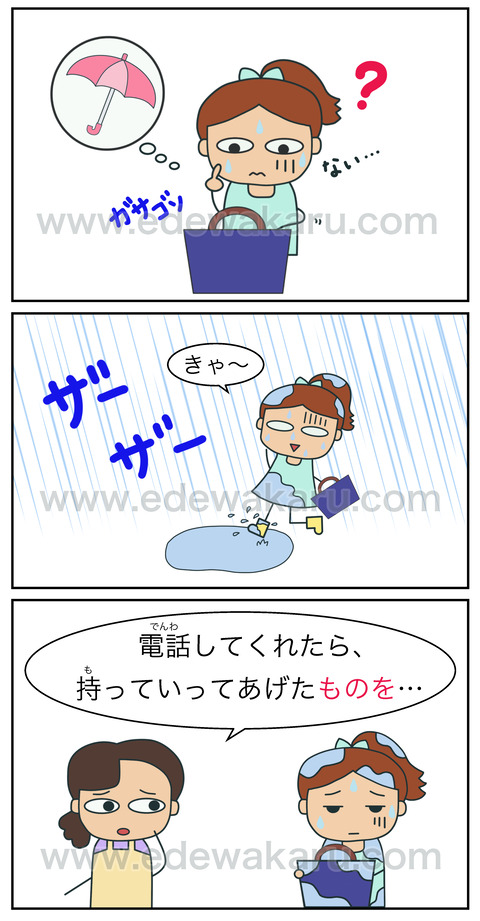
①電話してくれたら、持っていってあげた
ものを
→電話してくれたら持っていってあげたのに、
電話をしなかったから持っていってあげられなかったんだ
【
「残念だ」
という気持ち】
②ちゃんと勉強していたら、合格できた
ものを
→ちゃんと勉強していたら合格できたのに、
しなかったから合格できなかった
【
「後悔」「残念だ」
という気持ち】
「もの」シリーズ
はたくさんありますので、日本語能力試験(にほんごのうりょくしけん)を受ける人は、しっかりと復習をしておきましょう😉
【「もの」シリーズ】
〜たいものだ・〜てほしいものだ
〜たものだ
〜たものではない
〜というもの(Nというもの)
〜ないものだろうか
〜ないものは〜ない
〜もの・〜んだもの
〜ものか
〜ものがある
〜ものだ(感慨)
〜ものだ(本来の性質・一般的な考え方)
〜ものだ・〜ものではない
〜もので・〜ものだから
〜ものと思っていた
〜ものなら
〜ものの
〜ものを
〜ようものなら
In context 4 examples
電話をしてくれたら、持っていってあげたものを…
→電話をしてくれたら、持っていってあげたのに…ちゃんと勉強していたら合格できたものを…
→ちゃんと勉強していたら合格できたのに…教えてくれたら、手伝いに行ったものを
→教えてくれたら、手伝いに行ったのに早く寝たらよかったものを、遅くまで起きていたから遅刻したんだよ
→早く寝たらよかったのに、遅くまで起きていたから遅刻したんだよ
日本語文型辞典
Meaning
「のに」とだいたい同じ意味だが、①~③のように思わしくない結果が生じたことに対して不満の意をこめて用いられることが多い。
「…すれば悪い結果にならなかっただろうが、そうしなかったから、よくない結果になってしまった」という意味を表す。恨みや非難の気持ちをこめて使うことが多い。
How to use it
…ものを
…すればいいものを
In context 9 examples
黙っていればわからないものを、彼はつい白状してしまった。
本来ならば長兄が会社を継ぐはずのものを、その事故のせいで次兄が継ぐことになってしまつた。
知らせてくれたら、すぐ手伝いに行ったものを、何も言わないとはみずくさい人だ。
場所が場所なら大事故となるものを、この程度のけがですんでよかったと思いなさい。
すぐに医者に行けばいいものを、がまんしていたから、ひどくなってしまったのだ。
そこで引き返せばいいものを、まっすぐ行ったものだから、山に迷い込んでしまった。
そのまま逃げだせばいいものを、うろうろしていたので彼は結局警官に捕まってしまった。
部屋が火につつまれたときすぐ逃げればよかったものを、ペットを助けに行ったばかりに逃げ遅れて死んでしまった。
わたしに話してくれればいいものを、どうして、ひとこと言ってくれなかったんですか。
日本語文型辞典 英語版
Meaning
Means broadly the same as のに, but is often used to express dissatisfaction in relation to a disappointing result having arisen, as in examples
(1)
-
(3)
.
Means “if (you) had done... probably nothing bad would have resulted from it but, because (you) didn’t, the result was not good.” It is often used to express feelings of regret or of blame.
How to use it
1. ...ものを
2. ...すればいいものを
In context 9 examples
黙っていればわからないものを、彼はつい白状してしまった。
If he’d kept quiet they wouldn’t have known, but against his better judgment, he confessed.
本来ならば長兄が会社を継ぐはずのものを、その事故のせいで次兄が継ぐことになってしまった。
By all rights, the eldest brother should have taken over the company, but because of that accident, the second eldest did.
知らせてくれたら、すぐ手伝いに行ったものを、何も言わないとはみずくさい人だ。
If I had only been told, I would have gone to help, but her not saying anything shows how standoffish she is.
場所が場所なら大事故となるものを、この程度のけがですんでよかったと思いなさい。
Consider yourself lucky to have escaped with such (minor) injuries since it could have been a serious accident had it taken place elsewhere.
すぐに医者に行けばいいものを、がまんしていたから、ひどくなってしまったのだ。
I should have gone straight to the doctor’s, but I put up with it and it got really bad.
そこで引き返せばいいものを、まっすぐ行ったものだから、山に迷い込んでしまった。
I should have retraced my steps at that point, but I went straight on and ended up lost in the mountains.
そのまま逃げだせばいいものを、うろうろしていたので彼は結局警官に捕まってしまった。
He should have run away, but he wandered around and in the end was caught by the police.
部屋が火につつまれたときすぐ逃げればよかったものを、ペットを助けに行ったばかりに逃げ遅れて死んでしまった。
When the room was engulfed by flames he should have quickly escaped, but he went back in to save his pet, couldn’t get out, and died in the fire.
わたしに話してくれればいいものを、どうして、ひとこと言ってくれなかったんですか。
You should have spoken to me, so why didn’t you say a single word about it?
くらべてわかる日本語表現文型辞典
Meaning
もしAならばBなのだが、実際はそうではないということを、悔しく残念に思ったり、相手を責めたりする気持ちを表す。
How to use it
AばBものを
[動詞-ば形]+[動詞]ものを
[動詞-ば形]+[イ形-普]ものを
[動詞-ば形]+[ナ形-な/である/だった/ではない]ものを
Explanation
【対比1】
「Bのに」
「Bのに」には、「雨が降ったらいいのに」のように願望を表したり、「5時までに帰るって言ってたのに」のように逆接を表したりするものがあるが、「Bものを」と同様に残念な気持ちを表す用法もある。しかし、「Bものを」は硬い言葉なので、大げさな表現になるのに対して、「Bのに」はやわらかい口語表現。
Notes
【注意1】
・「ものを」の後には「Aでない(なかった)のでBにならない(ならなかった)」が省略されている。
In context 4 examples
怪我さえしなければ、あんな奴に負けないものを。
もう少し早く知らせてくれれば、間に合ったものを。
消火器が1本でもあれば、火を消し止められたものを。
勉強すれば、もっと成績があがるものを。
日本語NET JLPT文法解説まとめ
Meaning
〜すれば、そうならなかったのに
How to use it
V(普通形)+ ものを
イA(普通形)+ ものを
ナA(普通形)+ ものを (ナAな + ものを)
Explanation
If (subject) had (done something), (something) wouldn't have happened.
①話し手の不満や後悔などの気持ちが含まれる。
②「ものを」の後ろが省略される場合もある。
① The speaker's feelings of dissatisfaction or regret are included.
② The part following "ものを" may be omitted.
In context 6 examples
先輩が貴重な時間を使って丁寧に教えてくれているものを、「わかりにくい」だの「教えるのが下手」だの、どうして彼は文句ばかり言っているのだろう。
結局、二人は別れることになったそうだ。あのとき、彼が素直に謝っていればよかったものを。
お金が無いなら、言ってくれたらよかったものを。
黙っていればバレなかったものを、どうして言っちゃうかなあ。
もっと早く病院へ行けばひどくならなかったものを、「寝ていれば治る」とか言うからこんなことになるのよ。
やめておけばよかったものを、「大丈夫、大丈夫」とか言って食べるからお腹を壊すんだよ。
毎日のんびり日本語教師
How to use it
動詞普通形+ものを
イ形普通形+ものを
ナ形普通形+ものを
名詞普通形+ものを
ナ形語幹+な+ものを
名詞+な+ものを
Explanation
既に発生したことに対して「あの時こうしていれば良かったのに」という仮説や可能性について述べる文型です。(反事実条件文)
不満、後悔、残念などのニュアンスを持ち、その事柄の結果に対して不満を感じているときによく用います。
仮定表現と組み合わせた「~ばいいものを」や「~たらいいものを」はよく使われます。
「のに」に言い換えることができますが、「のに」よりも硬い表現です。
後件は省略可で、「~ものを。」で文を終わらせることができます。
Notes
特になし
In context 8 examples
車で行けばいいものを、歩いて行くからそんなことになるんだ。
薬を飲めばすぐ治るものを、意地張って飲まないから悪化したんだ。
教えてくれたらすぐ助けに行ったものを。
連絡してくれればいいものを、一人でやるなんて大変だったろうに。
手を貸してもらえばすぐ片付いたものを。
眠くなったら寝ればいいものを、彼女は「寝たら休みが終わっちゃう」と言って無理やり起きている。
一人で死ねばいいものを、犯人は近くの通行人まで犠牲にして自殺した。
明日に備えて早く寝たらいいものを。
NINJAL 日本語文型データベース
Meaning
〜で仮定したことが実現すれば問題がなかったのに、実際はそうではなかったため残念な結果になったことを表します。
How to use it
V普通形+ものを
i-A普通形+ものを
na-A普通形+ものを(ただし、「na-Aだ」→「na-Aな+ものを」)
N普通形+ものを(ただし、「Nだ」→「Nの+ものを・Nな+ものを」は、あまり使わない)
Notes
「〜」には、実際とは異なる理想の状態を仮定する文がきます。ふつう「〜ば・〜ても」などの仮定表現を使います。「〜ものを」の後には、残念な結果を説明する文や話し手の不満を表す文がきます。
「〜ものを。」の形で、文末にも使います。
In context 16 examples
イベント会場まで本来なら30分で行けるものを、最短ルートを知らなかったので1時間もかかってしまった。
何もしなければ目立たないものを、服にあいた穴を自分で直そうとして、かえって変になった。
病院の開院時間なんて、インターネットで調べればすぐわかったものを。
反対方向の電車に乗ってしまった。きちんと行き先を確認すれば間違えなかったものを。
熱があるなら休めばいいものを、佐藤さんは仕事がたまるのが嫌だからと無理に出社してきたらしい。
賞味期限内に食べればおいしいものを、いつまでも食べずにおいておくから、味が悪くなってしまうのだ。
上着を着れば寒くないものを、そんな薄着で我慢していたら、風邪を引くだろう。
急ぎの買い物でないなら、セールの期間に買えば安かったものを。
休みの初めに宿題を終わらせてしまえば、今ごろつらくなかったものを。ぎりぎりになってやろうとするから大変なんだよ。
「新幹線で行けば楽なものを。あんなに遠くまで車を運転して行くの?」
この大学なら、努力すれば合格も不可能ではないものを。あの子はあまり努力する気がないのだろう。
家族4人、何事もなければ十分幸せだったものを、父が株に手を出して大損してしまったので、家を売って引っ越さなければならなくなった。
このミスがなければ作業はそれほど大変ではなかったものを。修正のために徹夜になってしまった。
経験者でなければ今回の採用対象ではないものを、知人の娘だからと社長は無理を言って採用したがっている。
惜しい。この問題さえ間違えなければ、満点だったものを。
もう少し早い時間に出発していれば、電車はこれほどひどい混み具合ではなかったものを。
IMABI
Combination Particles with もの
Read this IMABI lesson ↗Explanation
第030課: Combination Particles with もの
Just like in Modern Japanese, there are combination particles with もの and they are all conjunctive particles. The particles to be discussed in this lesson are ものを, ものから, ものの, and ものゆゑ(に).
ものを, ものから, ものの, ものゆゑ(に)
Although some have come and gone or changed in nuance, back in Classical Japanese, these four combination particles did the same thing. So, don’t let this be a reason to be confused. All of these particles follow the 連体形. they all may show a concession based on existing conditions. So, they mean “although”. Though ものを and ものの survive today with modified nuances, you have to think in more simplistic terms for this. That should be easy enough to do.
1. 鳴く声も聞こえぬものの悲しきは忍びに燃ゆる蛍なりけり。
Although I couldn’t hear their cries, the sad things were the fireflies hidden and burning.
From the 詞花集.
2. 都出でて君に会はむと来しものを来しかひもなく別れぬるかな。
Although I left the capital, there was no avail in thinking about meeting you, and we ended up parting.
From the 土佐日記.
3. いつはりと思ふ物から今さらにたがまことをか我はたのまむ
Although I think that (that person’s word) is a lie, who’s truth am I to entrust in now?
From the 古今和歌集.
4. 頼まぬものの恋ひつつぞ経る。
Though I rely on you, I pass time longing for you.
From the 伊勢物語.
5. 空蝉うつせみの世の人ごとのしげければわすれぬもののかれぬべらなり。
The rumors of the world are so annoying; though I’ll never forget, I may naturally leave them behind.
From the 古今和歌集.
6. 雖念 知僧裳無跡 知物乎 奈何幾許 吾戀渡 (原文)
思へどもしるしも無しと知るものを何かここだく我が恋ひ渡る
Although I think of you to know avail, why is that I still long for you like this?
From the 万葉集.
7. 春の野に若菜つまむと来しものを散りかふ花に道はまどひぬ。
I came for young greens in the spring field, but scattering flowers blew and obscured my path.
From the 古今和歌集.
8. 将来云毛 不来時有乎 不来云乎 将来常者不待 不来云物乎 (原文)
来むと言ふも 来ぬ時あるを 来じと言ふを 来むとは待たじ 来じと言ふものを
You say you’ll come and don’t, but I wait not for you to say you won’t since you may as you won’t.
From the 万葉集.9. 和我由恵尓 於毛比奈夜勢曽 秋風能 布可武曽能都奇 安波牟母能由恵 (原文)
我が故に思ひな痩せそ秋風の吹かむその月逢はむものゆゑ
Please don’t grow thin thinking of me as I shall moon which the autumn wind does blow.
From the 万葉集.
10. 毎年尓 来喧毛能由恵 霍公鳥 聞婆之努波久 不相日乎於保美 毎年謂之等之乃波 (原文)
年のはに 来鳴くものゆゑ 霍公鳥ほととぎす 聞けばしのはく 逢はぬ日を多み
Every year when I hear the cries of the cuckoo as they come singing, I get this unexplainable feeling. There are too many days I can’t meet them.
From the 万葉集.
11. 月は在明にて光をさまれるものから、不二の峰幽かに見えて。
The moon was that of dawn, and since the light was in check, Mount Fuji’s peak appeared faint.
From the 奥の細道.
12. ふるさとにあらぬ物からわがために人の心のあれてみゆらむ。
You may say a man’s heart is not in his hometown, but why is it that his heart goes to ruin for me?
From the 古今和歌集.
Historical Note:
1. ものを is a combination of the noun もの and the interjectory–not the case particle–を. This explains why even in Modern Japanese it can be seen as a final particle showing a concessive exclamatory statement. Though not normally the case anymore, it did at one point become a causal connector similar to the conjunctive が during the 江戸時代. Nowadays, it shows concession with a sense of the speaker’s discomfort and or dissatisfaction.
13. よど河のよどむとひとは見るらめど流れてふかき心あるものを。
(You probably think that I haven’t been coming and going a while),
although just like that Yodo River’s current is deep I too in my heart think much of you with no end.
From the 古今和歌集.
14. 雀の子を、犬君いぬきが逃しつる、伏籠ふせごの中に、こめたりつるものを。
Inuki let the baby sparrow escape even though I had kept it in the cage!
From the 源氏物語.
15. かたみこそ今はあだなれこれなくばわするる時もあらましものを。
This memento is a resentment that has hurt me even up till now. If I just didn’t have it, I would have time to forget that person.
From the 古今和歌集.
2. ものから came into existence during the 奈良時代 was one of the first phrases where から became a true conjunctive particle. As から became used even more heavily in the spoken language, it eventually made people confused to the point that it turned into a particle with similar meaning to ので. Today you would just use から or ので.
16. 心をぞわりなき物と思ひぬる見るものからや恋しかるべき。
I thought that emotion was irrational. Since I’ve met you, I feel such longing; is this supposed to be?
From the 古今和歌集.
3. ものの got to survive unscathed into Modern Japanese. It’s not used frequently, but you see it often in literature.
4. ものゆゑ(に) has such a good ring to it, yet the only place it has is in 古典. It too could be used to show reason like から. In fact, it can be seen doing this way back in the 万葉集.
In context 19 examples
鳴く声も聞こえぬものの悲しきは忍びに燃ゆる蛍なりけり。
Although I couldn’t hear their cries, the sad things were the fireflies hidden and burning.
都出でて君に会はむと来しものを来しかひもなく別れぬるかな。
Although I left the capital, there was no avail in thinking about meeting you, and we ended up parting.
いつはりと思ふ物から今さらにたがまことをか我はたのまむ
Although I think that (that person’s word) is a lie, who’s truth am I to entrust in now?
頼まぬものの恋ひつつぞ経る。
Though I rely on you, I pass time longing for you.
空蝉うつせみの世の人ごとのしげければわすれぬもののかれぬべらなり。
The rumors of the world are so annoying; though I’ll never forget, I may naturally leave them behind.
雖念 知僧裳無跡 知物乎 奈何幾許 吾戀渡 (原文)
春の野に若菜つまむと来しものを散りかふ花に道はまどひぬ。
I came for young greens in the spring field, but scattering flowers blew and obscured my path.
将来云毛 不来時有乎 不来云乎 将来常者不待 不来云物乎 (原文)
毎年尓 来喧毛能由恵 霍公鳥 聞婆之努波久 不相日乎於保美 毎年謂之等之乃波 (原文)
月は在明にて光をさまれるものから、不二の峰幽かに見えて。
The moon was that of dawn, and since the light was in check, Mount Fuji’s peak appeared faint.
ふるさとにあらぬ物からわがために人の心のあれてみゆらむ。
You may say a man’s heart is not in his hometown, but why is it that his heart goes to ruin for me?
ものを is a combination of the noun もの and the interjectory–not the case particle–を. This explains why even in Modern Japanese it can be seen as a final particle showing a concessive exclamatory statement. Though not normally the case anymore, it did at one point become a causal connector similar to the conjunctive が during the 江戸時代. Nowadays, it shows concession with a sense of the speaker’s discomfort and or dissatisfaction.
(You probably think that I haven’t been coming and going a while),
よど河のよどむとひとは見るらめど流れてふかき心あるものを。
(You probably think that I haven’t been coming and going a while),
雀の子を、犬君いぬきが逃しつる、伏籠ふせごの中に、こめたりつるものを。
Inuki let the baby sparrow escape even though I had kept it in the cage!
かたみこそ今はあだなれこれなくばわするる時もあらましものを。
This memento is a resentment that has hurt me even up till now. If I just didn’t have it, I would have time to forget that person.
ものから came into existence during the 奈良時代 was one of the first phrases where から became a true conjunctive particle. As から became used even more heavily in the spoken language, it eventually made people confused to the point that it turned into a particle with similar meaning to ので. Today you would just use から or ので.
I thought that emotion was irrational. Since I’ve met you, I feel such longing; is this supposed to be?
心をぞわりなき物と思ひぬる見るものからや恋しかるべき。
I thought that emotion was irrational. Since I’ve met you, I feel such longing; is this supposed to be?
ものの got to survive unscathed into Modern Japanese. It’s not used frequently, but you see it often in literature.
ものゆゑ(に) has such a good ring to it, yet the only place it has is in 古典. It too could be used to show reason like から. In fact, it can be seen doing this way back in the 万葉集.