AIUEO JLPT Grammar
Meaning
This sentence pattern has the limited meaning of only the connected noun.
How to use it
名詞+きり
Explanation · 日本語
この文型は、接続された名詞だけという限定の意味を持ちます。
In context 5 examples
一度きりの人生、悔いのないように生きたい。
You only live once, so I want to live without regrets.
彼と二人きりで話したい。
I want to talk to him alone.
彼女とは一か月前に会った。それきり、連絡はしていない。
I met her a month ago and haven't had any contact since.
彼女は一人きりで旅行に出かけた。
She went on a trip all by herself.
その一回きり、一度も成功していない。
That was the only time, and it has never been successful.
Bunpro Grammar Reference
Meaning
Only, Just, Since
How to use it
Verb[た] + きり(1)
Noun + きり
これ(2) + きり(1)
Number + Counter + きり(1)
(1) っきり
(2) それ
Nuance
A phrase that expresses the first and last time or limit for something as the cutoff point.
Explanation
As an adverbial particle, きり may convey that 'upon (A)', where (A) is usually a verb, that action was the 'first and last time'. This is frequently translated as 'only', 'just', or 'since'. きり comes from the う - Verb 切る 'to cut'. きり is often used after the plain past form of verbs, with nouns, or with counters. Let's look at verbs first.
昨日、晩ご飯食べたきり何も食べてないから、めちゃお腹が空いた。
I haven't eaten anything since last night, so I am extremely hungry.
お祖母ちゃんは去年病気で倒れて、寝たきりになった。
Grandma got sick last year, and has become bedridden. (Can only sleep)
With verbs, きり is primarily used to show that (A) occurring was all that was required for (B). Usually, this results in some permanent consequence, or permanent change of opinion. In almost every situation, (A) is something that has only happened once, and きり can be interpreted as 'ever since'.
When it comes to the use of きり with nouns or counters, it will express that something is happening with (A) as the limit 'nothing more, nothing less'. In other words, (A) is all that will be included in some particular situation/action.
一人きりになれる時間が欲しい。
I want some time where I can be alone.
彼とは一度きりしか会えていない。
I was only able to meet him once.
二人っきりの時間はいいね!
A time just for the two of us is nice, isn't it!
Caution
きり may also be seen as っきり or キリ. There is no specific change in nuance, but っきり is the most common casual form.
Nuance · 日本語
何かの最初で最後の時間、又は何かの限度を切り口として時点を表す表現。
Explanation · 日本語
「きり」は、五段動詞「切る」から生まれた表現です。動詞の過去形や名詞、または数詞のあとに付いて、その出来事や数量だけに限る副助詞として働きます。まずは、動詞と一緒に使う「きり」の例を見てみましょう。
昨日、晩ご飯食べたきり何も食べてないから、めちゃお腹が空いた。
I haven't eaten anything since last night, so I am extremely hungry.
お祖母ちゃんは去年病気で倒れて、寝たきりになった。
Grandma got sick last year, and has become bedridden. (Can only sleep)
「きり」を動詞と一緒に使う場合は、主に「(A) が一度起こってから、その状態が続いている」ことを意味します。
「きり」が名詞や数詞と一緒に使われる場合は、「(A) だけ」で、それ以上でもそれ以下でもないことを表します。
一人きりになれる時間が欲しい。
I want some time where I can be alone.
彼とは一度きりしか会えていない。
I was only able to meet him once.
二人っきりの時間はいいね!
A time just for the two of us is nice, isn't it!
注意点
「きり」は「っきり」や「キリ」と表現されることもあります。この場合も特にニュアンスは変わりません。ただし、くだけた場面では「っきり」がよく使われます。
In context 17 examples
- やっと二人っきりになれたね。
It is finally just the two of us.
- お祖母ちゃんは去年病気で倒れて、寝たきりになった。
Grandma got sick last year, and has become bedridden. (Can only sleep)
- 一人きりになれる時間が欲しい。
I want some time where I can be alone.
- 彼とは一度きりしか会えていない。
I was only able to meet him once.
- 昨日、晩ご飯食べたきり何も食べてないから、めちゃお腹が空いた。
I haven't eaten anything since last night, so I am extremely hungry.
- 二人っきりの時間はいいね!
A time just for the two of us is nice, isn't it!
- 寂しい時、一人っきりで泣く。
When I am sad, I cry alone. (just/only myself)
- 父がついに寝たきりになってしまった。
My dad has become completely bedridden (only/just sleeps).
- 彼女とは喧嘩したっきり会っていません。
I haven't seen my girlfriend since we had a fight.
- チャンスは一度きりしかないから緊張する。
I am nervous because I have only one chance.
- その店に一回行ったきり、行っていない。
I went to that store just once and haven't gone again.
- 5年前に会ったきりだから、また会いたいですね。
It has been five years since we last met, so I want to see you again.
- 一度習ったきりだから、やり方を忘れてしまいました。
I have forgotten how to do it because I had only learned it once.
- 3年前に飲んだっきり薬を飲む機会がない。
Since I took medicine three years ago, I have not had the chance to take it (again). (only)
- 「また後で電話します」と言ったきり全然連絡がありません。
There has been absolutely no word from them since they said that they would get back to me.
- それっきり彼は部屋から出なくなった。
Since that, he reached the point where he would not come out of his room. (just/only)
- 朝ご飯を食べたっきり何も食べていないから、お腹がすいている。
I haven't had anything since I ate breakfast, so I'm hungry.
DoJG 日本語文法辞典(全集)
Meaning
Since; only
How to use it
(i) Vinformal past | (っ) きり | |
| 出た(っ) きり(帰らない) | (someone has never returned) since he left home |
| 買った(っ) きり(使わない) | (someone has never used something) since he bought it |
(ii) Noun | きり | Where Noun=noun of time |
| 今日きり | Only today |
| 今週きり | Only this week |
| 今年きり | Only this year |
(iii) Demonstrative Pronoun | (っ) きり | |
| これ(っ) きり | Only this much/only this time |
| それ(っ) きり | (only that much/only that time); since then |
| あれ(っ) きり | (only that much/only that time); since then |
(iv) Number+Counter | (っ) きり | |
| 二人(っ) きり | Only two (students, etc.) |
| 三枚(っ) きり | Only three (CDs, etc.) |
| 四本(っ) きり | Only four (pencils, etc.) |
Explanation
(っ)きり A conjunction indicating that since something occurred, nothing has happened and the resultant situation remains unchanged; a particle indicating a strict limitation in terms of number/quantity.
In context 12 examples
山下氏は1964年に日本を出た(っ)きり日本には一度も帰っていない。
Mr. Yamashita hasn't returned to Japan even once since he left in 1964.
ソウルにいるのも今夜きりです。
This is my last night (literally: the only night left) in Seoul.
彼女とは十年以上も前にパリで会ったきりで、その後どうしているのか、全然知らない。
I haven't seen her since we met in Paris more than 10 years ago and I have no idea how she's been doing since then.
小学校六年の時に別れたっきりの同級生に気づかれるなんて、ひょっとして私って小学校の時から顔が変わってないんだろうか。
My classmate, whom I hadn't seen since we left 6th grade, recognized me. I wonder if I look the same as I did in elementary school (literally: my face has not changed since my grade school days).
フロイトの本はずいぶん前に読んだっきりなので、内容のほとんどは忘れてしまいました。
It's been a long time since I read Freud's books, so I've forgotten almost all of the content.
父は雪の日に倒れて、腰の骨を折ってから、寝たきりになってしまった。
My father fell on a snowy day and broke his hip, and since then he's been lying in bed.
それっきりなの?もっとたくさんちょうだい。
Is this all (literally: only this much)? Give me more, please.
もう会うのはこれっきりにしましょう。
Let's make this the last (literally: only) time we see each other.
十年前に別れて二人はそれきりだった。
The two parted 10 years ago and have never seen each other since.
彼からはあれっきり何も連絡がないの?
You haven't heard anything from him since then?
夏休みも今日一日きりで終わっちゃうね。
Today is the last day (literally: the only day left) of summer vacation, isn't it?
私は母と二人っきりで暮らしています。
I live alone with my mother.
どんなときどう使う 日本語表現文型辞典
Meaning
from the time…haven't…since
How to use it
Vた+きり
Explanation
~して、そのままずっと
1)多くの場合、「Vたきり、~ない」の形で、後の文には次に予想されることが起こらない状態が続いているという文が来る。
2) ❸ の「会ったっきり」は口語。
2)Phrase 会ったっきり (saw once and only once) in sentence ❸ is colloquial.
1)Used in the negative in many cases. Phrase following indicates some state expected next does not occur.
In context 3 examples
子どもが朝、出かけたきり、夜の8時になっても帰って来ないので心配です。
田中さんは10年前にブラジルへ行ったきり、そのままブラジルに定住してしまったらしい。
彼女には去年1度会ったっきりです。その後手紙ももらっていません。
絵でわかる日本語
Meaning
〜だけ
それだけ
How to use it
名詞[辞書形]+きり
Explanation
「〜きり」は「〜だけ」という意味を表す文型です。ほとんどの場合、数量詞について「〜だけ」と言いたい時に使います😊また、例文④のように「これ」「それ」「あれ」にも使うことができます。また、
会話では「〜っきり」というように、「っ」を入れて使うのが一般的です
😮
[例]
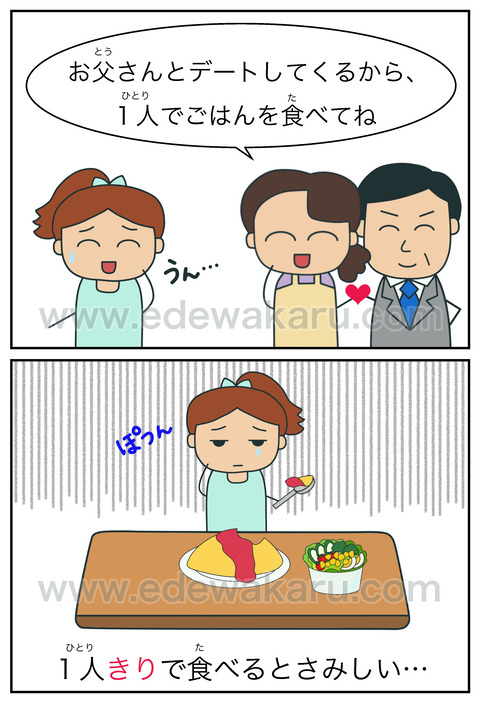
①1人
っきり
で食べるとさみしい
②1度
っきり
しか会ったことがない
③これ
っきり
のお金では何も買えないよ…
「〜きり」「〜っきり」にはいくつかの意味があります😮しっかりと区別して覚えておきましょう😉
(復習:〜たきり〜ない)
In context 4 examples
1人きりで食べるとさみしい…
→1人で食べるとさみしい…彼と2人きりで映画を見に行ったの
→彼と2人だけで映画を見に行ったの山田くんには1度きりしか会ったことがない
→山田くんには1度だけしか会ったことがないこれきりのお金では何も買えないよ…
→これだけのお金では何も買えないよ…
日本語文型辞典
Meaning
基本情報説明話しことばでは「っきり」となることが多い。
名詞に付いて、「それだけ」と範囲を限定するのに用いる。「これ」「それ」「あれ」に付くときは「これっきり」「それっきり」「あれっきり」となることが多い。
動詞の連用形に付いて、ほかのことをしないでずっとそれだけをする、という意味を表す。
多く「たきり、…ない」の形で使われる。それを最後として、次に予想される事態が起こらないことを意味する。「これっきり」「それっきり」「あれっきり」ということもある。
How to use it
Nきり
R-きり
V-たきり…ない
In context 8 examples
ふたりきりで話しあった。
のこったのは私ひとりきりだった。
見て。残ったお金はこれ(っ)きりよ。
彼女は3人の子供の世話にかかりきり(で)、自分の時間もろくにない。
熱を出した子供をつき(っ)きりで看病した。
彼は卒業して日本を出ていったきり、もう5年も帰ってこない。
あの方とは一度お会いしたきり(で)、その後、会っていません。
(例) あの方とは一度お会いしましたが、それ(っ)きり会っていません。
日本語文型辞典 英語版
Meaning
【きり】In spoken language, this often changes toっきり.
Attaches to a noun and delimits a range, with the sense of “only that.” When used withこれ, それ, and あれ, these tend to become これっきり, それっきり, and あれっきり.
きり attaches to a verb stem and expresses doing only one thing all the time without doing anything else.
Often used in the pattern たきり、...ない. Expresses that it is the last time something happened and it hasn’t happened since then. これっきり, それっきり, and あれっきり are also used .
(例)あの方とは一度お会いしましたが、それ(っ)きり会っていません。
I met her only once and I haven’t seen her since.
How to use it
1. Nきり
2. R-きり
3. V-たきり...ない
In context 7 examples
ふたりきりで話しあった。
We discussed the matter just between the two of us.
のこったのは私ひとりきりだった。
I was the only one who stayed behind.
見て。残ったお金はこれ(っ)きりよ。
Look. This is all the money that’s left.
彼女は3人の子供の世話にかかりきり(で)、自分の時間もろくにない。
She has hardly any free time, because she spends every moment caring for her three children.
熱を出した子供をつき(っ)きりで看病した。
I was constantly by my child’s side when he had a fever.
彼は卒業して日本を出ていったきり、もう5年も帰ってこない。
He hasn’t come back for five years since he graduated and left Japan.
あの方とは一度お会いしたきり(で)、その後、会っていません。
I met her only once and I haven’t seen her since.
日本語NET JLPT文法解説まとめ
Meaning
"〜してから、そのままずっと"
ある行為が行われてから、その後繰り返されていないことを表す。
How to use it
V(た形) + きり
Explanation
Indicates that an action has been done once and has not been repeated since.
In context 14 examples
息子は今日、出かけたきり、夜になっても帰ってこないのでとても心配です。
彼女とは別れたきり、一度も会っていない。
田中さんは5年前にマレーシアへ行ったきり、そのままマレーシアに定住してしまった。
ジョンさんは30分前にトイレに入ったきり、全然出てきません。
5年前に海外旅行をしたきり、一度も海外へ行っていない。
鈴木さんと昨日、電話したきり会っていない。
昨日の夜ご飯を食べたきり、今日は何も食べていない。
父は病気で寝たきりになってしまった。
大学時代のクラスメイトとは卒業したきり会っていない。
今度、二人きりで食事しない?
明日、国へ帰るので日本での生活もあと一日きりだ。
一度きりの人生をどう生きるかは個人の自由だ。
海外へは一度きりしか行ったことがない。
クリスマスの夜に一人きりは寂しいなあ。
毎日のんびり日本語教師
How to use it
①名詞+きり/っきり
②動ます形+きり/っきり
Explanation
名詞に接続すると「~だけ」、動ます形に接続すると「全力で/完全に/ずっと」の意味を表します。
Notes
慣用句①「とびっきり/とびきり」 程度が抜群に良いこと。
慣用句②「寝たきり」 常時ベッドで寝ている状態。
慣用句③「思いっきり/思いきり」 満足できるまでするさま。思う存分。
似ている文法「~たきり~(ない)/~たっきり~(ない)」
In context 10 examples
部屋で何日もずっと籠りっきりで作業していた。
友人が事故で寝たきりになってしまった。(朋友因事故卧床不起。)
休みをもらったから思いっきり遊びたい。
人生は一度っきり。(人生只有一次。)
成人にもなって家事でもなんでも親に頼りっきりなのは良くない。
親に任せっきりにしないで家事ができるようになるのが今年の目標だ。
こんな珍しい経験は一度っきりだろう。
妻に育児を任せっきりにしていたのを反省している。
雰囲気のいい場所で二人っきりになった。
何でもネットの情報に頼りっきりなのはどうかと思います。
NINJAL 日本語文型データベース
Meaning
〜した後、当然起こると予想されることが起こらない状態が続くと言いたいときに使います。
「これきり・それきり・あれきり」は慣用的な言い方です。
How to use it
Vたきり
Nきり
Notes
否定的な意味の文が多いです。
「〜きり」の後には、起こると予想されることが起こっていない状態を表す文がきます。
In context 8 examples
もう昼過ぎだが、昨晩食事をしたきり、何も食べていない。
高木さんとは卒業式の日に会ったきり、一度も会っていない。今何をしているかも知らない。
私が「何かあったの」と聞くと、弟は「うん」と言ったきり、口を閉ざしてしまった。
富士山は約300年前に噴火したきり、現在まで大規模な噴火は起きていない。
真美は「さよなら」と言って部屋を出て行ったきり、戻ってこなかった。
「このメンバーではもうこれきり一緒に仕事をすることはないと思うけど、これからもお互い頑張りましょう」
途中までジグソーパズルをやって、それきり放置してある。
今度の飲み会のこと、詳しくはまた後で知らせるってあのとき山田さんに言われたけど、あれきり何の連絡もないな。
IMABI
The Particles やら, なり, & きり
Read this IMABI lesson ↗Explanation
The Particles やら, なり, & きり
In this lesson we will learn about the adverbial particles やら, なり, and きり. Some of them have usages that have different classifications. So, always be careful.
The Particle やら
The Adverbial Particle やら
This particle is rather interesting. Some phrases such as どうやら shown below in sentences are used all of the time. However, when used to list things vaguely (usage 2), it is not so common and generally mainly found in books. Despite this, it is not impossible to hear someone say it every now and then because it is more emphatic than typical means of expression.
Shows uncertainty
やら lists things very vaguely and emphatically. May be rude as it should not be used in reference to someone above you.
とやら shows obscurity without any particularity.
Examples
1a. 雨が降るのやら降らないのやらよく分からない。
1b. 雨が降るのか降らないのかよく分からない。(もっと一般的な言い方)
I don’t know whether it’s going to rain or not rain.
2. どうやら留守るすのようです。
It looks like they’re somehow not at home.
3. えっと、英之とやらだったかな。(ちょっと失礼な言い方)
Uh, it was a person called Hideyuki.
4. どうやら一荒れ来そうだ。
It looks like we’re going to have a storm.
5. モウリさんはどうやら置いてきたものが多いらしかった。わたしは、一つか二つしか、置いてきたものはない。その一つ二つでさえ持て余しているのだから、モウリさんの疲れかたをや、だろう。
Mouri somehow seemed to have come with a lot of things. As for me, I’ve only came with one or two things. Since even those one or two things are hard to deal with, I guess you could say that’s her way of fatigue.
From 溺レる by 川上弘美.
Particle Note: をや is a combination of the case particle を and the adverbial particle や. It is more common in things like 漢文訓読. It is often seen with いわんや (Let alone)、~において~をや. The phrase itself is a rhetorical device used to add a sense of lament. So, with the example, the author chose it to give the impression that the speaker might get fatigued thinking about his partner’s things.
The Final Particle やら
Questions oneself with a sense of uncertainty. This is rarely used nowadays. The variant patterns in the first example apply for the second as well, but they are meant to show you how this has been absorbed by other speech patterns.
6a. 彼は勝った(の)やら。 (May sound old to some)
6b. 彼は勝った(の)かな(あ) (一般的な言い方)
6c. 彼は勝ったのかしら。 (Feminine)
6d. 彼は勝ったんだろうか。 (Somewhat masculine)
I wonder if he won.
7. 行ったやら。 (古風)
I wonder if he went.
8. 私もどれほど安堵あんどしましたことやら。 (Literary)
Oh how I was relieved too.
From 光の雨 by 立松和平.
The Particle なり
The Adverbial Particle なり
1. In “AなりBなり” meaning “either…or…”. B may be a question word hinting at other options. This is normally replaced by other things. In this case, though, it’s not necessarily old-fashioned.
9a. 俺なりあんたやりが行かなきゃ。(Masculine)
9b. 俺かあんたが行かなきゃ。(Masculine)
Either I or you have to go.
10. 大だいなり小しょうなり欠点はある。
There is either a fault in being big or in being small.
Sentence Note: Ex. 10 is more common as it is a common expression.
11a. フランスなりどこなりへ引っ越したらいい。
11b. フランスかどこかに引っ越したらいい。(Better choice)
It would be nice to move to France or somewhere.
2. A more literary variant of ~なければ~ほど.
12. 「なんで君はある金全部を使ってしまうの」とユキヲは言うのだが、どうやって金の始末をうまくすればいいのか、私には見当もつかないのだ。少なければ少ないなりに、多ければ多いなりに、私はいつでもぴたりと使いきってしまう。体が、あり金にあわせて伸のびたり縮ちぢんだりするような感じだった。
Yukio asks “why do you end up using all the money?”, but I can’t guess on how to dispose of the money well. Whether it be less or more, I always completely use it up. I felt as if my body stretched and contracted with [how much] money I had.
From 溺レる by 川上弘美.
3. Shows an example with the implication of the possibility of other options.
13.
Aくん「どこか海外に行きたいかな。」
Bくん「なんか西洋の空気を感じたいな。」
Aくん「じゃ、ヨーロッパへなり行きましょう。」
A: I kind of want to go overseas.
B: I’d like to feel the West and what not.
A: Let’s go to somewhere like Europe.
14. 運動するなりしてみてはどうか。
How about trying to drive or something?
なりと
This is a very interesting combination particle that has several usages. In its first usage, it sets up something as a bare minimal condition, making it essentially a humble でも. This usage, though, has become quite old-fashioned. Some exceptions to this include 何なりと which is used frequently.
15. 何なりとお申し付けを
Whatever I instruct…
16. よろしかったらお茶なりと召めし上がってください。
If it’s all right, please have something like tea.
17. どうなりと好きにせよ! (Rude , old-style command)
Do what you’d like!
Speech Note: Using something humble like this in a command results in a rather rude command.
~なりと may also be seldom seen abbreviated as ~なと. However, this is out of use in mainstream Japanese and is viewed to be dialectical.
18. 「まことに申し訳ございません。お腹が減ったでしょうから、どうぞ、これなと召し上がって下さい。いずれあとから主人がご挨拶に参ります」
“I sincerely apologize. I’m sure you are hungry, so please have this. The owner will come by to greet you sometime later.”
From 翳った旋舞 by 松本清張.
In other contexts, it can show that one may choose voluntarily, but this doesn’t always have to be in nice contexts. It can also be used in the pattern AなりとBなりと and function just like なり above. It may be seen as なと, which is somewhat dialectical and very old-fashioned, and なりとも.
19. 死ぬなり(と)生きるなり(と)勝手にしろ。
Whether you die or live, do whatever you want.
20. 願わくは一言なりとも知らせてほしゅうございます。(すごく古い言い方)
I wish to be informed at least one word.
The Conjunctive Particle なり
After the 連体形 of a verb, it shows that something is done as soon as something else is done. So right when someone does something, they do something next in sequence to the first action. The subject is normally third person, and the subject is the same in both clauses. The second part has a little sense of unexpected strong will.
21a. 宿題を済ませるなり、すぐに彼らはインターネットを使った。
21b. 宿題を済ませるとすぐに彼らはインターネットを使った。(More natural)
They used the Internet as soon as they finished their homework.
22. 彼は帰るなり、トイレに行った。
He went to the bathroom as soon as he got home.
23. 社長は入ってくるなり、大声で怒鳴どなりました。
As soon as the company president came in, he shouted in a big voice.
After the past tense, it shows a situation that is still in play as another action begins. There shouldn’t be any movement involved by the individual.
24. 机の椅子に座ったなり、眠ってしまった。
I feel sleep in my desk chair.
The Suffix ~なり
~なり may attach to nouns to give a meaning of “like”. It may attach itself to nominal phrases or the 連体形 of adjectives to show the means by which something is done like. It may also be after the 連用形 of verbs to be like the phrase ~まま (as is).
25. 彼は親の言いなりになった。
He did as his parents told (and never changed).
26. 道なりに行く。
To go along the road.
27. 私なりに努力します。
I will put effort into it a way that suits me.
28. 体を弓なりに反そらす。
To lean one’s body back in an arch-like shape.
The Adverbial Particle きり
きり is generally used to limit things. In this sense, it is just like だけ. The sense of limitation is stronger. Consider this. だけ comes from 丈. But, きり comes from 切り. With this alone, you can see how they would have slightly different nuances.
きり may also follow ~た followed by a negative expression to refer to something that has not surpassed a limit meaning “after doing…”. It may also be in 丸まるっきり which means “at all” in a negative potential expression.
Variant Notes:
1. きり may be seen as っきり a lot in the spoken language.
2. ぎり is an old-fashioned variant.
Etymology Note: This particle comes from the noun 切り, which means “limit” in this instance.
Examples
29. 二人きりで話しましょう。
Let’s talk just the two of us.
30. たった二人きりで国を征服せいふくした。
The two of them conquered the country.
31. 寝たきりになる。
To become confined to continuously lying down.
32. {座りっきりで・座ったまま(で)・座りっぱなしで}仕事を続ける母はいつも肩が凝こっている。
My mother, who continuously sits while working, is stiff in the shoulders.
33. 中国に行ったきり、彼の行方ゆくえが分からない。
After going to China, we don’t know his whereabouts.
34. まるっきり飲めない。
I can’t drink at all.
35. もうこれ(っ)きりだよ。
Make this the last time.
36. 俺の手元にあるのは1円これきりだぞ。(男性語)
This is my very last yen.
Literally: The last thing in my hands is just this yen.
37. 二階の彼女の―そして彼のともなる部屋は、通りに向いた窓際に、安い塗ぬり薬ぐすりの匂においがする粗末そまつな机があるきりで、その外は灰色の壁かべと押入れの襖ふすまだけだった。
Near the window in her room on the second floor–the room he and she had together–facing the street, there was just a crude desk with the smell of cheap ointment, and aside from that there was only a gray wall and the closet fusuma.
From 死体紹介人 by 川端康成.
37. 「父や母は忙しいからたまにきり来ないだろうがね。よかったら君も泊りがけに来たまえ」 (ちょっと古風)
“But my mom and dad don’t come but occasionally because they’re busy. If it’s alright, come stay over”.
From 友情 by 武者小路実篤.
Grammar Notes:
1. たまにきり is an instance where this particle can be seen with an adverb, but in today’s speech, the phrase would be replaced with たまにしか.
2. ~たまえ is now old-fashioned and normally used by middle aged men and older in various situations, of which none are polite to say. However, given that the book in which this sentence is from was published in 1920, the users would be of the same generation. This is a clear instance of a generational shift.
In context 50 examples
雨が降るのやら降らないのやらよく分からない。
I don’t know whether it’s going to rain or not rain.
雨が降るのか降らないのかよく分からない。(もっと一般的な言い方)
I don’t know whether it’s going to rain or not rain.
どうやら留守るすのようです。
It looks like they’re somehow not at home.
えっと、英之とやらだったかな。(ちょっと失礼な言い方)
Uh, it was a person called Hideyuki.
どうやら一荒れ来そうだ。
It looks like we’re going to have a storm.
モウリさんはどうやら置いてきたものが多いらしかった。わたしは、一つか二つしか、置いてきたものはない。その一つ二つでさえ持て余しているのだから、モウリさんの疲れかたをや、だろう。
Mouri somehow seemed to have come with a lot of things. As for me, I’ve only came with one or two things. Since even those one or two things are hard to deal with, I guess you could say that’s her way of fatigue.
彼は勝った(の)やら。 (May sound old to some)
I wonder if he won.
彼は勝った(の)かな(あ) (一般的な言い方)
I wonder if he won.
彼は勝ったのかしら。 (Feminine)
I wonder if he won.
彼は勝ったんだろうか。 (Somewhat masculine)
I wonder if he won.
行ったやら。 (古風)
I wonder if he went.
私もどれほど安堵あんどしましたことやら。 (Literary)
Oh how I was relieved too.
In “AなりBなり” meaning “either…or…”. B may be a question word hinting at other options. This is normally replaced by other things. In this case, though, it’s not necessarily old-fashioned.
Either I or you have to go.
俺なりあんたやりが行かなきゃ。(Masculine)
Either I or you have to go.
俺かあんたが行かなきゃ。(Masculine)
Either I or you have to go.
大だいなり小しょうなり欠点はある。
There is either a fault in being big or in being small.
フランスなりどこなりへ引っ越したらいい。
It would be nice to move to France or somewhere.
フランスかどこかに引っ越したらいい。(Better choice)
It would be nice to move to France or somewhere.
A more literary variant of ~なければ~ほど.
Yukio asks “why do you end up using all the money?”, but I can’t guess on how to dispose of the money well. Whether it be less or more, I always completely use it up. I felt as if my body stretched and contracted with [how much] money I had.
「なんで君はある金全部を使ってしまうの」とユキヲは言うのだが、どうやって金の始末をうまくすればいいのか、私には見当もつかないのだ。少なければ少ないなりに、多ければ多いなりに、私はいつでもぴたりと使いきってしまう。体が、あり金にあわせて伸のびたり縮ちぢんだりするような感じだった。
Yukio asks “why do you end up using all the money?”, but I can’t guess on how to dispose of the money well. Whether it be less or more, I always completely use it up. I felt as if my body stretched and contracted with [how much] money I had.
運動するなりしてみてはどうか。
How about trying to drive or something?
何なりとお申し付けを
Whatever I instruct…
よろしかったらお茶なりと召めし上がってください。
If it’s all right, please have something like tea.
どうなりと好きにせよ! (Rude , old-style command)
Do what you’d like!
「まことに申し訳ございません。お腹が減ったでしょうから、どうぞ、これなと召し上がって下さい。いずれあとから主人がご挨拶に参ります」
“I sincerely apologize. I’m sure you are hungry, so please have this. The owner will come by to greet you sometime later.”
死ぬなり(と)生きるなり(と)勝手にしろ。
Whether you die or live, do whatever you want.
願わくは一言なりとも知らせてほしゅうございます。(すごく古い言い方)
I wish to be informed at least one word.
宿題を済ませるなり、すぐに彼らはインターネットを使った。
They used the Internet as soon as they finished their homework.
宿題を済ませるとすぐに彼らはインターネットを使った。(More natural)
They used the Internet as soon as they finished their homework.
彼は帰るなり、トイレに行った。
He went to the bathroom as soon as he got home.
社長は入ってくるなり、大声で怒鳴どなりました。
As soon as the company president came in, he shouted in a big voice.
机の椅子に座ったなり、眠ってしまった。
I feel sleep in my desk chair.
彼は親の言いなりになった。
He did as his parents told (and never changed).
道なりに行く。
To go along the road.
私なりに努力します。
I will put effort into it a way that suits me.
体を弓なりに反そらす。
To lean one’s body back in an arch-like shape.
きり may be seen as っきり a lot in the spoken language.
ぎり is an old-fashioned variant.
二人きりで話しましょう。
Let’s talk just the two of us.
たった二人きりで国を征服せいふくした。
The two of them conquered the country.
寝たきりになる。
To become confined to continuously lying down.
{座りっきりで・座ったまま(で)・座りっぱなしで}仕事を続ける母はいつも肩が凝こっている。
My mother, who continuously sits while working, is stiff in the shoulders.
中国に行ったきり、彼の行方ゆくえが分からない。
After going to China, we don’t know his whereabouts.
まるっきり飲めない。
I can’t drink at all.
もうこれ(っ)きりだよ。
Make this the last time.
俺の手元にあるのは1円これきりだぞ。(男性語)
This is my very last yen.
二階の彼女の―そして彼のともなる部屋は、通りに向いた窓際に、安い塗ぬり薬ぐすりの匂においがする粗末そまつな机があるきりで、その外は灰色の壁かべと押入れの襖ふすまだけだった。
Near the window in her room on the second floor–the room he and she had together–facing the street, there was just a crude desk with the smell of cheap ointment, and aside from that there was only a gray wall and the closet fusuma.
「父や母は忙しいからたまにきり来ないだろうがね。よかったら君も泊りがけに来たまえ」 (ちょっと古風)
“But my mom and dad don’t come but occasionally because they’re busy. If it’s alright, come stay over”.
たまにきり is an instance where this particle can be seen with an adverb, but in today’s speech, the phrase would be replaced with たまにしか.
~たまえ is now old-fashioned and normally used by middle aged men and older in various situations, of which none are polite to say. However, given that the book in which this sentence is from was published in 1920, the users would be of the same generation. This is a clear instance of a generational shift.
文法
Usage 1
Meaning
"〜してから、そのままずっと"
ある行為が行われてから、その後繰り返されていないことを表す。
How to use it
V(た形) + きり
In context 9 examples
息子は今日、出かけたきり、夜になっても帰ってこないのでとても心配です。
彼女とは別れたきり、一度も会っていない。
田中さんは5年前にマレーシアへ行ったきり、そのままマレーシアに定住してしまった。
ジョンさんは30分前にトイレに入ったきり、全然出てきません。
5年前に海外旅行をしたきり、一度も海外へ行っていない。
鈴木さんと昨日、電話したきり会っていない。
昨日の夜ご飯を食べたきり、今日は何も食べていない。
父は病気で寝たきりになってしまった。
大学時代のクラスメイトとは卒業したきり会っていない。
Usage 2
Meaning
〜だけ
How to use it
N + きり
Notes
数量詞について「〜だけ」と言いたい時に使う。「これ」「それ」「あれ」にも使うことができる。
In context 5 examples
今度、二人きりで食事しない?
明日、国へ帰るので日本での生活もあと一日きりだ。
一度きりの人生をどう生きるかは個人の自由だ。
海外へは一度きりしか行ったことがない。
クリスマスの夜に一人きりは寂しいなあ。