DoJG 日本語文法辞典(全集)
Meaning
Make someone/something do something; cause someone/something to do something; let someone/something do something; allow someone/something to do something; have someone/something do something; get someone/something to do something.
How to use it
(i) Group 1 verbs | Vnegative せる | |
| 話させる | Cause to talk |
(ii) Group 2 verbs | Vstem させる | |
| 食べさせる | Cause to eat |
(iii) Irregular verbs | 来る→来させる | Cause to come |
| する→させる | Cause to do |
Explanation
Cause someone/something to do something or cause something to change its state.
In context 8 examples
鈴木さんは娘を・に大学へ行かせた・行かせました。
Mr. Suzuki made/let his daughter go to college.
父は妹にピアノを習わせた・習わせました。
My father made (or let) my younger sister learn to play the piano.
久子は私を困らせた。
Hisako made me have trouble. / Hisako caused me trouble.
このゲームはジムに勝たせようと思う。
I think I'll let Jim win this game.
友達は私にチップを払わせた。
My friend made me leave (lit pay) a tip.
アンダーソンさんは子供達に好きなだけアイスクリームを食べさせた。
Mr. Anderson let his children eat as much ice cream as they liked.
私は冷蔵庫でミルクを凍らせた。
I made milk freeze (I froze milk) in the refrigerator.
それは私にさせてください。
As for that, let me do it.
日本語文型辞典
Usage 1
Meaning
基本情報説明使役を表す。「V-させる」のVが五段活用の動詞の場合は、「行く⇾行かせる」「飲む⇾飲ませる」のように、辞書形の末尾をア段に変えて「せる」を付ける。一段活用の場合は、「食べる⇾食べさせる」のように、語幹「食べ」に「させる」を付ける。「する」は「させる」、「来る」は「こさせる」になる。話しことばでは「行かす」「飲ます」「食べさす」などの形が使われることもある。使役文の基本的な意味は、ある人の命令や指示に従って他の人間がある行動をすることであるが、実際に使用される場合には、「強制」「指示」「放任」「許可」など一般に使役と考えられているよりも幅広い意味を表わす。例文(例) 1。【強制】犯人は銀行員に現金を用意させた。
2。【指示】社長は秘書にタイプを打たせた。
3。【放任】疲れているようだったので、そのまま眠らせておいた。
4。【許可】社長は給料を前借りさせてくれた。
5。【放置】風呂の水をあふれさせるな。
6。【介護】子供にミルクを飲ませる時間です。
7。【自責】子どもを事故で死なせてしまった。
8。く原因】フロンガスが地球を温暖化させている。
a. NがNにNをV-させる
強制・指示・放任など、さまざまな意味を表す。他動詞を使った文「NがNをV(他動詞)」を使役の文「NがNにNをV-させる」に変えたもの。他動詞文の主語「Nが」は「Nに」となる。
b. NがN を/に V-させる
強制・指示・放任など、さまざまな意味を表す。自動詞を使った文「NがV(自動詞)」を使役の文「NがNを/にV-させる」に変えたもの。自動詞文の主語「Nが」は「Nを」になることが多いが、「Nに」となることもある。
c. NがNをV-させる【人】
「人が…するように仕向ける」「人が…する原因となる」という意味を表す。「泣く・笑う・怒る」など自分で行動を制御できない自動詞を用いた使役文。「NがV(自動詞)」の主語「Nが」は、使役文では「Nを」となる。⑤は意図的に仕向けたり、その原因となったりしたわけではないが、保護する立場なのに引き起こしてしまった事態として自分を責める気持ちが表されている。
d. NがNをV-させる【物】
「物が…するように仕向ける」「物が…する原因となる」という意味を表す。「凍る」「湿る」のように対応する他動詞がない自動詞を、他動詞と同じように使う用法。⑤⑥の「目を輝かせる/光らせる」ぼ慣用句的な表現。
使役の表現と「あげる」「やる」などを組み合せて、許可や放任を表す。
使役の表現と「おく」を組み合せて、放任を表す。
使役の表現と「ください」「いただけますか」などの依頼の表現を組み合せて、許可を求める意味を表す。③のように丁寧な申し出としても使われる。
使役の表現と「もらう」「くれる」などを組み合せて、許可・放任などを恩恵として受けとめているという意味を表す。③④は、あいさつなどの前置きに使われる慣用的な表現で、その行為をすることを光栄に思っているという意味が含まれる謙譲表現。
「XがYにV-させる」という使役文をYの視点から言い換えた受身文で、「YがXにV-させられる」となったもの。Xに強制されて行動するという意味で、Yが「迷惑だ・いやだ」を思っている場合に使う。「行く」「読む」など五段活用の動詞の場合は、「行かせられる」「読ませられる」の代わりに「行かされる」「読まされる」となることが多い。
How to use it
V-させる
V-させてあげる【許可】
V-させておく【放任】
V-させてください【許可求め】
V-させて もらう/くれる【恩恵】
V-させられる【使役受身】
NがNにVさせられる
In context 40 examples
教師が学生に本を読ませた。
犯人は銀行員に現金を用意させた。
A:機械がまた故障なんですが…。
B:申し訳ありません。すぐに係りの者を伺わせます。山田はひどい奴だ。旅行中ずっと僕に運転させて、自分は寝てるんだよ。
子どもを買い物に行かせた。
社長は、まず山田をソファーにかけさせて、しばらく世間話をしてから退職の話を切りだした。
最近は小学生を塾に通わせる親が多い。
大きな契約だから、新入社員に行かせるのは心配だ。
彼は、いつも冗談を言ってみんなを笑わせる。
就職試験を受けなかったために、父をすっかり怒らせてしまった。
私は子供の頃は乱暴で、近所の子をよく泣かせていた。
二年も続けて落第して母をがっかりさせた。
厳しくしつけすぎて、息子をすっかりいじけさせてしまった。
子どもを交通事故で死なせてからというもの、毎日が失意のどん底であった。
シャーベットは、果汁を凍らせて作ります。
打撲の痛みには、タオルを水で湿らせて冷やすとよい。
貿易の不均衡が日米関係を悪化させている。
金融不安が、日本の経済状態を悪化させる原因となっている。
子供達は目を輝かせて話に聞き入っている。
猫は目を光らせて暗闇に潜んでいる。
そんなにこの仕事がやりたいのなら、やらせてあげましょう。
従業員たちもずいぶんよく働いてくれた。2、3日休みをとらせてやってはどうだろう。
きのうの晩、ずいぶん遅くまで勉強をしていたようだから、もう少し休ませてあげましょう。
甘えて泣いているだけだから、そのまま泣かせておきなさい。
注意したってどうせ人の言うことなんか聞こうとしないんだ。勝手に好きなことをさせておけばいいさ。
夕方になると急に冷え込みますから、あんまり遅くまで遊ばせておいてはいけませんよ。
申し訳ありませんが、今日は少し早く帰らせてください。
A:だれか、この仕事を引き受けてくれませんか。
B:ぜひ、私にやらせてください。A:私が御馳走しますよ。
B:いや、いつも御馳走になってばかりですので、ここは、私に払わせてください。少し考えさせていただけますか。
期日については、こちらで決めさせていただけるとありがたいのですが…。
両親が早く亡くなったので、姉が働いて私を大学に行かせてくれた。
金婚式のお祝いに、子ども達にハワイに行かせてもらった。
≪結婚式のスピーチ≫新婦の友人を代表して、一言ご挨拶させていただきます。
≪パーティーで≫では、優越ではございますが、乾杯の音頭をとらせていただきます。
きのうは、お母さんに3時間も勉強させられた。
先輩に無理に酒を飲まされた。
この歳になって、海外に転勤させられるとは思ってもみなかった。
山下さんは、毎日遅くまで残業させられているらしい。
きのうのサッカーの試合は、逆転につぐ逆転で最後までハラハラさせられた。
Usage 2
Meaning
基本情報NをしてV-させる説明Nにはほとんどの場合ひとを表す名詞が来る。「…に…させる」「…を…させる」とおなじ意味だが、「をして」を使うと、それをさせることがむずかしい相手にそれをさせる、という意味の時が多い。古めかしくかたい言い方。例文① あのきびしい先生をして「もう教えることは何もない」と言わせたのだから、あなたはたいしたものだよ。② あのわからず屋の親をして「うん」と言わせるには、ちょっとやそっとの作戦ではむりだよ。③ あのがんこ者をしてその気にさせたのだから、誠意のたいせつさをわかいあなたに教えられた気がする。
絵でわかる日本語
Usage 1
Read this source entry ↗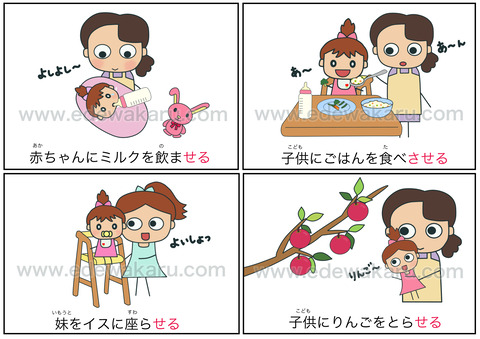
Meaning
〜に〜をしてあげる
〜が〜するのを手伝ってあげる
How to use it
動詞I[ない形]+せる
動詞Ⅱ[ない形]+させる
する→させる
来る→来させる
Explanation
「AはBにCさせる」は動詞の使役形で「AはBがCするのを手伝う」「AはBにCてあげる」という意味で使われます。「B」には[赤ちゃん・子供・病気の人]などが入り、自分ではCすることができない「B」の手伝いをしてあげると言いたい時に使用します。
使われる動詞や場面はほとんど決まっています
ので例文を暗記しておくといいと思います😉
[例]
①赤ちゃんにミルクを飲ま
せる
【A】お母さん
【B】赤ちゃん
【C】ミルクを飲む
→赤ちゃんは自分でミルクが飲めないので、お母さんが飲むのを手伝う
②子供にごはんを食べ
させる
【A】お母さん
【B】子供
【C】ごはんを食べる
→子供は自分でごはんを食べられないので、お母さんが食べるのを手伝う
③妹をイスに座ら
せる
【A】私
【B】妹
【C】イスに座る
→妹は自分でイスに座れないので、座るのを手伝ってあげる
④子供にりんごをとら
せる
【A】お母さん
【B】子供
【C】りんごをとる
→子供は自分ではりんごがとれないので、取るのを手伝ってあげる
⑤娘にスプーンを持た
せる
【A】お母さん
【B】娘
【C】スプーンを持つ
→娘はスプーンの持ち方を知らないので、お母さんが持ち方を教えてあげる
⑥妹に靴をはか
せる
【A】私
【B】妹
【C】靴をはく
→妹は自分では靴がはけないので、私が手伝ってあげる
⑦病気のお母さんにごはんを食べ
させてあげる
【A】私
【B】お母さん
【C】ごはんを食べる
→お母さんは病気で自分ではごはんが食べられないので、食べるのを手伝う
この用法は勉強する機会があまりありませんが、使役形の用法の1つとして覚えておきましょう😊
【使役形シリーズ】
In context 7 examples
赤ちゃんにミルクを飲ませる
子供にごはんを食べさせる
妹をイスに座らせる
子供にりんごをとらせる
娘にスプーンを持たせる
妹に靴をはかせる
病気のお母さんにごはんを食べさせてあげる
Usage 2
Read this source entry ↗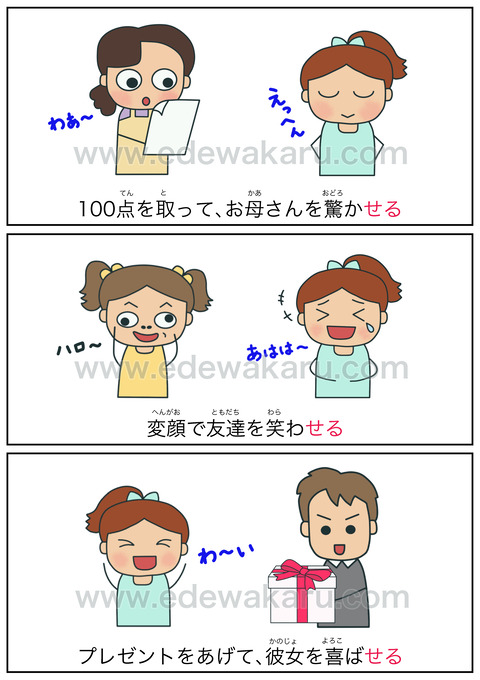
Meaning
〜が原因で、相手に〜という感情が発生する
How to use it
動詞I[ない形]+せる
動詞Ⅱ[ない形]+させる
する→させる
来る→来させる
Explanation
「〜せる・〜させる」は動詞の使役形で【感情の原因】を表します。「AはBをCさせる」の形で使われ、「Aが原因になって、BがCする」という意味になります。「C」には感情を表す動詞が入ります。
[例]
①100点を取って、お母さんを驚か
せる
【A】100点
【B】お母さん
【C】驚く
→100点を取ったので、お母さんが驚いた
②変顔で、友達を笑わ
せる
【A】変顔
【B】友達
【C】笑う
→変顔をしたので、友達が笑った
③プレゼントをあげて、彼女を喜ば
せる
【A】プレゼントをあげる
【B】彼女
【C】喜ぶ
→プレゼントをあげたので、彼女が喜んだ
④お皿を割って、お母さんを怒ら
せた
【A】お皿を割る
【B】お母さん
【C】怒る
→お皿を割ったので、お母さんが怒った
⑤兄はおもちゃを壊して、弟を泣か
せる
【A】兄がおもちゃを壊す
【B】弟
→兄がおもちゃを壊したので、弟がないた
⑥娘はお母さんを心配
させた
【A】娘
【B】お母さん
→娘の事で、お母さんが心配した
⑦妹は一晩中泣き通して、お母さんを困ら
せた
【A】妹が一晩中泣き通した
【B】お母さん
→妹が一晩中泣き通したので、お母さんは困った
⑧A:デートをドタキャンしたら彼女が泣いたんだ…
B:彼女のことを悲しま
せたらだめだ
よ!
【A】デートをドタキャンしたこと
【B】彼女
→彼氏がドタキャンしたので、彼女が悲しんだ
【使役形】には、たくさんの用法がありますので復習をしておきましょう😀
【使役形シリーズ】
In context 8 examples
100点を取って、お母さんを驚かせる
変顔で、友達を笑わせる
プレゼントをあげて、彼女を喜ばせる
お皿を割って、お母さんを怒らせた
おもちゃを壊して、弟を泣かせる
娘はお母さんを心配させた
妹は一晩中(ひとばんじゅう)泣き通して、お母さんを困らせた
A:デートをドタキャンしたら彼女が泣いちゃったんだ…B:彼女のことを悲しませたらだめだよ!
Usage 3
Read this source entry ↗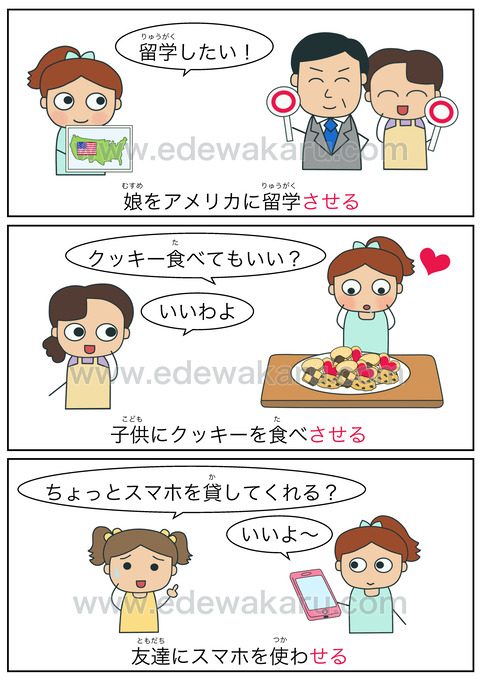
Meaning
相手に許可する
そのままにしておく
How to use it
動詞I[ない形]+せる
動詞Ⅱ[ない形]+させる
する→させる
来る→来させる
Explanation
「〜せる・〜させる」は動詞の使役形で【許可・放任】を表します。相手がすることを許可したり、相手がしていることをそのままの状態にしている時に使います。【放任】を表す場合は
「〜させておく」
という形がよく使われます。
[例]
①娘をアメリカに留学
させる
→留学することを【許可】
②子供にクッキーを食べ
させる
→クッキーを食べることを【許可】
③友達にスマホを使わ
せる
→自分のスマホを使うことを【許可】
④1日1時間だけゲームを
させる
→1時間だけゲームをすることを【許可】
⑤妻:あの子、大学をやめたいって言ってるの
夫:じゃあ、やめ
させればいい
と思うよ
→大学をやめることを【許可】
⑥娘に好きなケーキを買わ
せた
→好きなケーキを買うことを【許可・放任】
⑦A:山田くんが文句を言っているよ…
B:言わ
せておけばいい
よ
→山田くんが文句を言っていることを【放任】
⑧社員:店長、今日は頭が痛いので帰ら
せてください
→帰ることを許可してください【許可】
⑨疲れているみたいだったので、そのまま眠ら
せておいた
→寝ている状態のままにしておく【放任】
【使役形】にはたくさん意味がありますので、復習をしておきましょう😊
【使役形シリーズ】
In context 9 examples
娘をアメリカに留学させる
子供にクッキーを食べさせる
友達にスマホを使わせる
1日1時間だけゲームをさせる
妻:あの子、大学をやめたいって言ってるの夫:じゃあ、やめさせればいいと思うよ
娘に好きなケーキを買わせた
A:山田くんが文句を言っているよ…B:言わせておけばいいよ
社員:店長、今日は頭が痛いので帰らせてください店長:いいよ。お大事にね
疲れているみたいだったので、そのまま眠らせておいた
Usage 4
Read this source entry ↗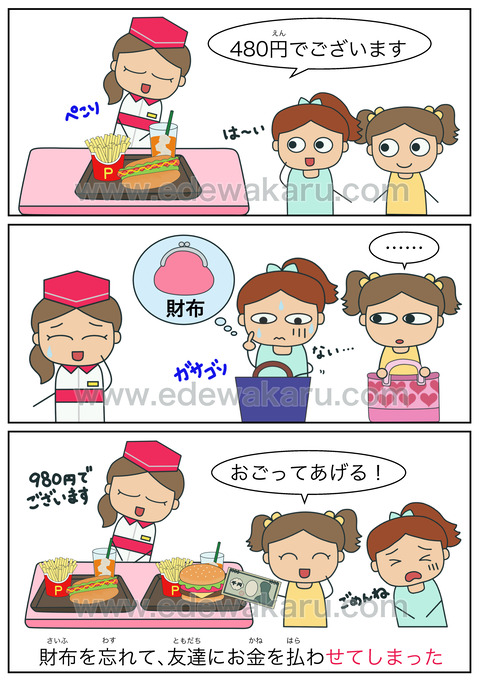
Meaning
(〜するつもりはなかったが)〜が〜しなければいけない状況にしてしまった
(〜するつもりはなかったが)〜が〜という状況になってしまった
How to use it
動詞I[ない形]+せる
動詞Ⅱ[ない形]+させる
する→させる
来る→来させる
Explanation
「〜せる・〜させる」は動詞の使役形で「自分が悪かった」「自分のせいで〜した」というように【責任】の気持ちを表します。ほとんどの場合「AはBにCさせてしまった」「AはBをCさせてしまった」の形が使われ、「〜する意志はなかったが、Aの不注意でBがCする状況になってしまった」[予想外の〜で、BがCする状況になってしまった]という意味になります。「BがCという状況になってしまったのは、Aの責任だ」と言いたい時に使われる用法です。多くの場合は後悔する気持ちを表します。
[例]
①財布を忘れて、友達にお金を払わ
せてしまった
【A】私
【B】友達
【C】お金を払う
→不注意で財布を忘れ、友達がお金を払う状況になってしまった
②電車が遅れて、彼氏を待た
せてしまった
【A】私
【B】彼氏
【C】待つ
→電車が遅れて、彼氏が待つという状況になってしまった
*電車が遅れたのは自分のせいではないが、彼氏を待たせたのは自分の責任だと思っている
③水をあげるのを忘れて、花を枯れ
さ
せてしまった
【A】私
【B】花
【C】枯れる
→私の不注意で、花が枯れるという状況になってしまった
④事故でペットを死な
せてしまった
【A】私
【B】ペット
【C】死ぬ
→私の不注意で事故が起こり、ペットが死ぬという状況になってしまった
*ペットが死んだのは、自分の責任だと思っている
⑤私の不注意で、子供にケガを
させてしまった
【A】私
【B】子供
【C】ケガをする
→私の不注意で、子供がケガをするという状況になってしまった
ちなみに、日常会話(にちじょうかいわ)でよく使われる
「お待たせしました」「お待たせいたしました」
はこの用法です😊「使役形」にはたくさん用法がありますので、復習をしておきましょう😀
【使役形シリーズ】
In context 5 examples
財布を忘れて、友達にお金を払わせてしまった
電車が遅れて、彼氏を待たせてしまった
水をあげるのを忘れて、花を枯れさせてしまった
事故でペットを死なせてしまった
私の不注意で、子供にケガをさせてしまった
Usage 5
Read this source entry ↗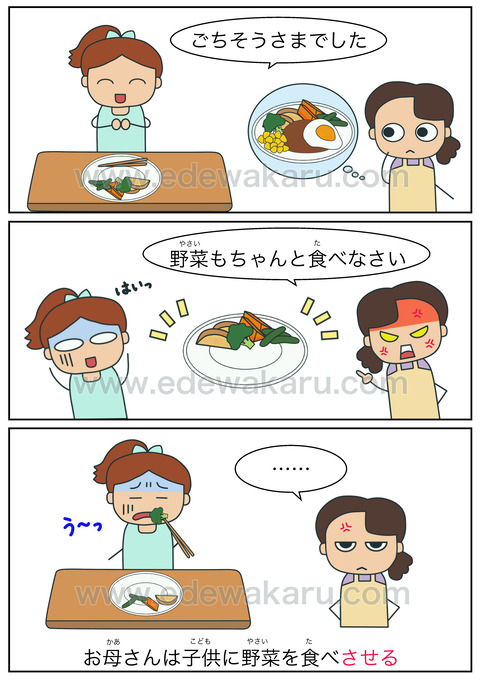
Meaning
相手に強制する
相手に指示する
How to use it
動詞I[ない形]+せる
動詞Ⅱ[ない形]+させる
する→させる
来る→来させる
Explanation
「〜せる・〜させる」は動詞の使役形で【強制・指示】を表します。相手に何かを強制したり、指示したりする場合に使われます。「親→子供」「先生→学生」「上司→部下」などのように、目上の人から目下の人に使われます。
[例]
①お母さんは子供に野菜を食べ
させる
→子供は野菜を食べたくないが、お母さんが食べるように強制
②先生は山田くんに例文を読ま
せた
→先生は山田くんに例文を読むように指示
③上司は部下にお酒を飲ま
せた
→部下はお酒を飲みたくないが、上司は飲むように強制
④お母さんは娘を買い物に行か
せた
→娘は買い物に行きたくないが、お母さんが行くように強制
⑤お父さんは子供に宿題を
させる
→子供は宿題をしたくないが、お父さんがするように強制
⑥先生は彼女を立た
せた
→先生は彼女に立つように指示
⑦姉は妹に部屋を掃除
させた
→妹は掃除したくないが、姉が掃除するように強制
【使役形】は初級文法ですが意味もたくさんあり、複雑です。会話でもよく使われますので、しっかりと復習をしておきましょう😊
【使役形シリーズ】
In context 7 examples
お母さんは子供に野菜を食べさせる
先生は山田くんに例文を読ませた
上司は部下にお酒を飲ませた
お母さんは娘を買い物に行かせた
お父さんは子供に宿題をさせる
先生は彼女を立たせた
姉は妹に部屋を掃除させた
Usage 6
Read this source entry ↗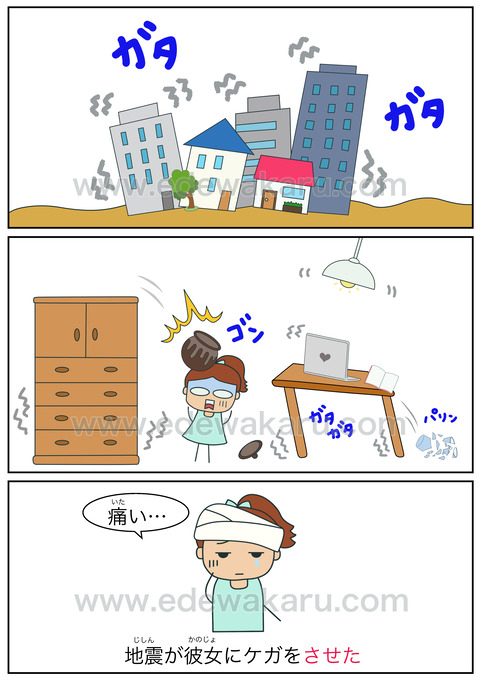
Meaning
〜が原因で〜になる
How to use it
動詞I[ない形]+せる
動詞Ⅱ[ない形]+させる
する→させる
来る→来させる
Explanation
「〜せる・〜させる」は「〜が原因で〜になる」という意味で、使役形の【原因】を表す用法です。「AがBにCさせる」「AがBをCさせる」の形で使われ、「Aが原因で、Cが起こる」と言いたい時に使います。「A」には【原因】、「C」には【結果】が入ります。
[例]
①地震が彼女にケガを
させた
【A】地震
【B】彼女
【C】ケガをする
→地震が原因で、彼女がケガをした
②先生のおかげで、娘をN1に合格
させる
ことができました
【A】先生
【B】娘
【C】N1に合格する
→先生のおかげで、娘がN1に合格した
③大雪が電車の到着を遅れ
させた
【A】大雪
【B】電車の到着
【C】遅れる
→大雪が原因で、電車の到着が遅れた
④お金の貸し借りが、あの2人の関係を悪く
させた
【A】お金の貸し借り
【B】あの2人
【C】関係を悪くする
→お金の貸し借りが原因で、あの2人の関係が悪くなった
【原因】を表す「〜せる・〜させる」は、他の使役形の用法よりもかたい言い方です。
【原因】を表す使役形には【感情の原因】を表すものもあります
ので、一緒に覚えておきましょう😊
【使役形シリーズ】
In context 4 examples
地震が彼女にケガをさせた
先生のおかげで、娘をN1に合格させることができました
大雪が電車の到着を遅れさせた
お金の貸し借りが、あの2人の関係を悪くさせた*「貸し借り」とは、お金を貸したり借りたりすることです
Usage 7
Read this source entry ↗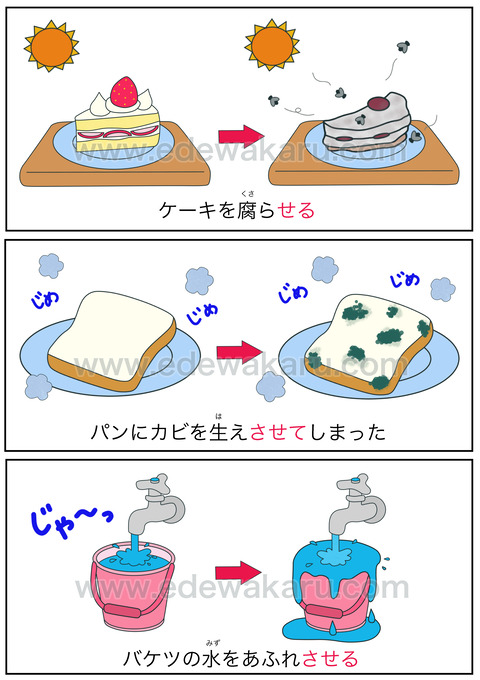
Meaning
〜を放置して、〜の状態にする
How to use it
動詞I[ない形]+せる
動詞Ⅱ[ない形]+させる
する→させる
来る→来させる
Explanation
「〜せる・〜させる」は動詞の使役形で【放置】の意味を表します。「AをBさせる」の形で、「Aをそのままにしておいて、Bの状態にする」と言いたい時に使います。
[例]
①ケーキを腐ら
せる
【A】ケーキ
【B】腐る
→ケーキを冷蔵庫に入れずそのままにしておいたら腐った
*[自責]でもOK
②パンにカビを生え
させて
しまった
【A】パン
【B】カビが生える
→パンを放置して、カビが生えた状態にしてしまった
*[自責]でもOK
③バケツの水をあふれ
させる
【A】水
【B】あふれる
→水を出したままにしたら、あふれた
*[自責]でもOK
④冷蔵庫でプリンを固まら
せる
【A】プリン
【B】固まる
→プリンを冷蔵庫に入れたままにしておくと固まる
⑤ジュースを凍ら
せて
飲むとおいしいよ〜
【A】ジュース
【B】凍る
→冷凍庫に入れて凍った状態のジュースはおいしいよ
使役形にはたくさん意味がありますので、復習をしておきましょう😊
【使役形シリーズ】
In context 5 examples
ケーキを腐らせる
パンにカビを生えさせてしまった
バケツの水をあふれさせる
冷蔵庫でプリンを固まらせる
ジュースを凍らせて飲むとおいしいよ〜
どんなときどう使う 日本語表現文型辞典
Usage 1
How to use it
巻末の活用表参照
Explanation
させる〈誘発の使役〉
induce to ❶ ジム:……その人は本当は……おばけだったのです……。
子どもたち:キャーッ、こわあい……。
→ジムはおばけの話をして、子どもたちをこわがらせました。
先生:むずかしい質問ばかりして、わたしを困らせないでください。
1)「あることが直接的な原因で、結果として外の人の心理的な変化や感情的な動作を引き起こす」という意味。
2)ほかに、「泣く・驚く・喜ぶ・悲しむ・安心する・怒る」などの感情を伴う動詞がよく使われる。
2)Also used with other emotive verbs such as 泣く, 驚く, 喜ぶ, 悲しむ, 安心する, and 怒る.
1)Something is a direct cause of a psychological change in someone or draws out an emotional response.
In context 4 examples
よしおさんはいつもおもしろい話をして、みんなを笑わせます。
花子さんはオリンピックの選手になって、両親をびっくりさせました。
いつも親や先生を泣かせていた太郎は、今は3人の子の親です。
リー:先生、この問題は……。
Usage 2
Meaning
ended up making
How to use it
巻末の活用表参照
Explanation
させる〈責任の使役〉
B(パソコンの上にお茶をこぼした人):あ、大丈夫です。……どうもお騒がせしました。
1)「自分が原因で相手を好ましくない状況に置いてしまって、責任を感じている」という意味。「Vさせてしまう」の形でよく使う。
2) ❹ ❺ はあいさつのように使う決まった表現である。
1)Speaker feels responsible for being the cause of some adverse situation arising for someone else. Often used in pattern Vさせてしまう.
2)Also used in idioms, as in sentences ❹ and ❺ .
In context 5 examples
水をあげるのを忘れてしまって、ペットの小鳥を死なせてしまいました。
肉を冷蔵庫に入れたまま、何日も使わなかったので、くさらせてしまいました。
わたしのためにお金を使わせてしまって申し訳ありません。
(待ち合わせで遅れた人)どうもお待たせしました。
A:だいじょうぶですか。手伝いましょうか。
Usage 3
Meaning
to cause
How to use it
巻末の活用表参照
Explanation
させる〈他動詞化の使役〉
1)ある状態になるとき、その状態を起こす主体に焦点を当てて述べたいが、対となる他動詞がないため、自動詞を使役の形にして他動詞として用いる使い方。
2) ❹ のように、「向上する・発展する・進歩する・完成する・実現する」などの本来自動詞である漢語の動詞にもこのような用法が見られる。
2)Can also be seen in Chinese-derived intransitive verbs such as 向上する (improve), 発展する (develop), 進歩する (advance), 完成する(complete), and 実現する (realize).
1)Used when speaker wishes to focus on main component of some condition that has arisen. There is no transitive verb; a corresponding intransitive verb is used in its causative form to act as transitive verb.
In context 4 examples
(天気予報)関東地方の上に雲がかかっていますが、これは雨を降らせる雲ではありません。
この寺の「あじさい」は、梅雨の季節になると美しい花を咲かせて人々を楽しませてくれます。
子どもたちは歌やダンスがある楽しい劇を、目を輝かせて見ていました。
木村先生は子どもたちの文章を書く能力を向上させようと、日々努力しています。
Usage 4
Meaning
make to do
How to use it
巻末の活用表参照
Explanation
させる〈強制の使役〉
普通、目上の人が目下の人にある行為を強制したり、勧めたりするときに使う。目上の人に頼む場合には使わない。
◆ × 後輩は先輩に先生の住所を調べさせました。
→○後輩は先輩に先生の住所を調べてもらいました。
Usually used when a social superior compels or persuades a social inferior to do an action. Not used to ask something of social superiors.
In context 5 examples
部屋が汚いので、お父さんは子どもに部屋をそうじさせました。
仕事がたくさんあるので、社長は社員に日曜日も仕事をさせました。
先生は学生にA社の辞書を勧めて買わせました。
先生は子どもたちに運動場を走らせました。
子どもがあまり外で遊ばないので、親は子どもを野球クラブに入らせました。
Usage 5
Meaning
let
How to use it
巻末の活用表参照
Explanation
させる〈許可・恩恵の使役〉
B:どうぞ。
母:楽しそうに遊んでいるから、もう少し遊ばせておきましょうよ。
1)人が希望していることを許すという意味。また、働きかける人の好意を表す。だれがその行為をするのかに注意する。
◆ ちょっと読ませてください。(「わたし」が読む)
2)❽のように、「Vさせておく」の形で、その行為を続けることを許すという意味もある。
1)Indicates granting permission to someone to do what they wish. It also indicates good will on the part of the person making the appeal. Note person doing action.
In context 8 examples
子どもが読みたいと言ったので、お父さんは子どもに昔のまんがを読ませました。
あのお母さんは、子どもがやりたいと言っても、ゲームをやらせません。
おいしいいちごですね。正夫にも食べさせたいです。大好きだから。
A:あ、新しい雑誌ですね。ちょっと読ませてください。
その女の人は立って、わたしの母をすわらせてくれました。
アルバイトで、わたしはいろいろ勉強させてもらって、よかったと思っています。
先生はわたしに学生時代の話をいろいろ聞かせてくださいました。
父:たかし、遊びはもうやめて、おふろに入りなさい。
日本語文型辞典 英語版
Usage 1
Meaning
【させる】Expresses causation. When the verb in V-させる is a Group 1 verb, the vowel in the final syllable of the dictionary form changes from -u to -a and then せる is attached, as in 行く→行かせる and 飲む→飲ませる. For Group 2 verbs such as 食べる, させる is attached to the stem 食べ and the conjugation pattern is 食べる→食べさせる. The causative form of する is させる, and 来る becomes こさせる. In spoken language, the forms 行かす, 飲ます, 食べさす, and so on may also be used.
A causative sentence essentially conveys the meaning that one person orders or directs another person to do something. However, in actual usage the causative form expresses a broader range of meaning, including coercion, instruction, non-interference, permission, and so on.
(例1)〈強制〉犯人は銀行員に現金を用意させた。
〈coercion〉The criminal made the bank clerk prepare the cash.
(例2)〈指示〉社長は秘書にタイプを打たせた。
〈instruction〉The company president had the secretary do the typing.
(例3)〈放任〉疲れているようだったので、そのまま眠らせておいた。
〈non-interference〉Since she seemed to be tired, I let her sleep.
(例4)〈許可〉社長は給料を前借りさせてくれた。
〈permission〉The president let me have an advance on my salary.
(例5)〈放置〉風呂の水をあふれさせるな。
〈neglect〉Don’t let the bathwater overflow.
(例6)〈介護〉子供にミルクを飲ませる時間です。
〈care〉It’s time to give the child some milk.
(例7)〈自責〉子どもを事故で死なせてしまった。
〈self-reproach〉It’s my fault that my child died in the accident.
(例8)〈原因〉フロンガスが地球を温暖化させている。
〈cause〉Chlorofluorocarbon is causing global warming.
B:申し訳ありません。すぐに係りの者を伺わせます。
We apologize for the inconvenience. We will send the person in charge over immediately.
Expresses a variety of meanings, such as coercion, instruction, and non-interference. The causative sentence NがNにNをV-させる is derived from a sentence with a transitive verb NがNを(transitive) V. The subject Nが of the transitive sentence becomes Nに.
b. NがN を/に V-させる
Expresses a variety of meanings, such as coercion, instruction, and non-interference. The causative sentence NがNを/にV-させる is derived from a sentence with an intransitive verb Nが(intransitive) V. The subject Nが of the intransitive sentence often becomes Nを, but may sometimes become Nに.
c. NがNをV-させる〈person〉
Means “induce someone to do...” or “be the cause of someone doing....” In this pattern, the causative sentences use intransitive verbs that express an action that a person cannot control, such as 泣く (cry), 笑う (laugh), and 怒る (get angry). The subject Nが in Nが (intransitive) V becomes Nを in the causative sentence. Example
(5)
expresses a sense of self-reproach on the part of the speaker, because even though the incident in question was not intentional and s/he was not the direct cause, the child was under his/her care when the incident took place.
d. NがNを V-させる〈thing〉
Means “induce something to do...” or “be the cause of something doing....” In this usage, the causative form of an intransitive verb without a corresponding transitive verb, such as 凍る (freeze) or 湿る (become moist/wet), is used the same way as a transitive verb. 目を輝かせる and 目を光らせる in
(5)
and
(6)
are idiomatic expressions.
A causative expression combined with あげる, やる, etc. indicates permission or non-interference.
A causative expression combined with おく indicates non-interference.
B:ぜひ、私にやらせてください。
Please let me do it!
B:いや、いつも御馳走になってばかりですので、ここは、私に払わせてください。
Thank you, but since you always treat me, please let me pay here.
A causative expression combined with an expression of request, such as ください or いただけますか, indicates a request for permission. As in
(3)
, this pattern is also used to make a polite offer.
A causative expression combined with もらう (receive) or くれる (give), etc. shows that the speaker views being allowed or left to do something as a kind of favor.
(3)
and
(4)
are idiomatic expressions used as introductory remarks in speeches, etc. They are humble expressions that imply the speaker’s gratitude or sense of honor at being asked to undertake a certain task.
A causative sentence with the form XがYにV-させる is rephrased from Y’s point of view to create the form YがXにV-させられる, which is a passive sentence. It means that Y is forced by X to do something against his/her will, and that Y thinks this action is bothersome or objectionable. With Group I verbs such as 行く and 読む, the causative passive form tends to become 行かされる and 読まされる (instead of 行かせられる and 読ませされる).
How to use it
1. V-させるa. NがNにNを V-させる
2. V-させてあげる〈permission〉
3. V-させておく〈non-interference〉
4. V-させてください〈request for permission〉
5. V-させて もらう/くれる〈favor〉
6. V-させられる〈causative passive〉[NがNにVさせられる]
In context 40 examples
教師が学生に本を読ませた。
The teacher made the students read the book.
犯人は銀行員に現金を用意させた。
The criminal made the bank clerk prepare the cash.
A:機械がまた故障なんですが...。
The machine is out of order again....
山田はひどい奴だ。旅行中ずっと僕に運転させて、自分は寝てるんだよ。
Yamada is a horrible person. When we were traveling, he made me drive all the way while he just slept.
子どもを買い物に行かせた。
I had the children go shopping.
社長は、まず山田をソファーにかけさせて、しばらく世間話をしてから退職の話を切りだした。
The company president first had Yamada sit on the sofa and then, after making small talk for a little while, he broached the subject of retirement.
最近は小学生を塾に通わせる親が多い。
Many parents send their elementary school-aged children to juku (cram schools) these days.
大きな契約だから、新入社員に行かせるのは心配だ。
Since it’s a big contract, I’m worried about letting a new employee go on her own.
彼は、いつも冗談を言ってみんなを笑わせる。
He is always telling jokes and making everyone laugh.
就職試験を受けなかったために、父をすっかり怒らせてしまった。
The fact that I didn’t take the employment test made my father very angry.
私は子供の頃は乱暴で、近所の子をよく泣かせていた。
When I was a child I was wild and unruly, and often made the children in my neighborhood cry.
二年も続けて落第して母をがっかりさせた。
I disappointed my mother by flunking a grade two years in a row.
厳しくしつけすぎて、息子をすっかりいじけさせてしまった。
I brought my son up so strictly that he became utterly intimidated.
子どもを交通事故で死なせてからというもの、毎日が失意のどん底であった。
From the time I lost my child in a traffic accident, I have been in the depths of despair every day.
シャーベットは、果汁を凍らせて作ります。
Sherbet is made by freezing fruit juice.
打撲の傷みには、タオルを水で湿らせて冷やすとよい。
To ease the ache of a bruise, it’s good to cool it with a wet towel.
貿易の不均衡が日米関係を硬化させている。
The trade imbalance is putting a strain on Japan-US relations.
金融不安が、日本の経済状態を悪化させる原因となっている。
Financial instability is causing the economic situation in Japan to deteriorate.
子供達は目を輝かせて話に聞き入っている。
The children are listening intently to the story, their eyes sparkling.
猫は目を光らせて暗闇に潜んでいる。
The cat is lurking in the darkness, its eyes sharp.
そんなにこの仕事がやりたいのなら、やらせてあげましょう。
If you want to do this job so much, I will let you do it.
従業員たちもずいぶんよく働いてくれた。2、3日休みをとらせてやってはどうだろう。
The employees have worked extremely hard. Why don’t we let them have a few days off?
きのうの晩、ずいぶん遅くまで勉強をしていたようだから、もう少し休ませてあげましょう。
She seems to have been up quite late studying last night, so let’s let her sleep a little while longer.
甘えて泣いているだけだから、そのまま泣かせておきなさい。
He’s just crying like a spoilt baby, so leave him be and let him cry.
注意したってどうせ人の言うことなんか聞こうとしないんだ。勝手に好きなことをさせておけばいいさ。
It doesn’t matter what advice other people give her, she won’t listen anyway. Just let her do whatever she wants.
夕方になると急に冷え込みますから、あんまり遅くまで遊ばせておいてはいけませんよ。
When evening comes it gets cold all of a sudden, so you shouldn’t let them play outside too late.
申し訳ありませんが、今日は少し早く帰らせてください。
I’m very sorry, but please let me go home a little early today.
A:だれか、この仕事を引き受けてくれませんか。
Is there anyone who will take this job on?
A:私が御馳走しますよ。
This will be my treat.
少し考えさせていただけますか。
Could you give me some time to think it over?
期日については、こちらで決めさせていただけるとありがたいのですが...。
We would appreciate it if you would let us decide on the deadline....
両親が早く亡くなったので、姉が働いて私を大学に行かせてくれた。
Since both of my parents passed away when I was young, my older sister worked to put me through college.
金婚式のお祝いに、子ども達にハワイに行かせてもらった。
To celebrate our golden wedding anniversary, our children gave us a trip to Hawaii.
《結婚式のスピーチ》新婦の友人を代表して、一言ご挨拶させていただきます。
《wedding speech》On behalf of the friends of the bride, I would like to say a few words.
《パーティーで》では、僭越ではございますが、乾杯の音頭をとらせていただきます。
《at a party》Now, if you will allow me, I would like to propose a toast.
きのうは、お母さんに3時間も勉強させられた。
Yesterday, I was forced by my mother to study for three whole hours.
先輩に無理に酒を飲まされた。
I was forced to drink alcohol by a senior student.
この歳になって、海外に転勤させられるとは思ってもみなかった。
At my age, I certainly didn’t expect to be transferred overseas.
山下さんは、毎日遅くまで残業させられているらしい。
Apparently Yamashita-san is being forced to work overtime until late every day.
きのうのサッカーの試合は、逆転につぐ逆転で最後までハラハラさせられた。
Yesterday’s soccer game kept me on pins and needles right up to the end, with one reversal after another.
Usage 2
Meaning
【をして...させる】[NをしてV-させる]
In most cases N is a noun which represents a person. Means the same as ...に...させる and ...を...させる. When をして is used, usually means “making an unlikely person to undertake something denoted by V.. It is an old-fashioned, formal expression.
In context 3 examples
あのきびしい先生をして「もう教えることは何もない」と言わせたのだから、あなたはたいしたものだよ。
For that strict teacher to have said to you “I have nothing more to teach you,” you must really be something.
あのわからず屋の親をして「うん」と言わせるには、ちょっとやそっとの作戦ではむりだよ。
Ordinary tactics and strategies won’t work when it comes to persuading such stubborn parents to say “yes.”
あのがんこ者をしてその気にさせたのだから、誠意のたいせつさをわかいあなたに教えられた気がする。
Since you managed to make that stubborn person change his mind, I feel that at your young age, you’ve learned the importance of being sincere.
IMABI
The Causative I: ~させる & ~せる
Read this IMABI lesson ↗Explanation
The Causative I: ~させる & ~せる
The auxiliary verbs ~させる and ~せる create what is known as the “causative form” (使役形), which equates to “A (the subject) makes/lets an agent (X) do a certain action (Y).”
Before we look at what “causation” means and the grammatical restrictions had with it in Japanese, know that unlike many languages including English and Korean, the verb 作る meaning “to make (something)” is not used to mean “to make” as in the causative form, which pertains to someone making someone else do something.
1a. Xを怒る作る X
1b. Xを怒らせる 〇
Literally: To make X be angry.
To anger X.
The notion of the causative form – “A makes X do Y” – is often confused with the grammar pattern “XをYにする,” which is used to show that “A makes/has something (X) be a certain way (Y).”
2. 音楽が小さくなった。
The music(‘s volume) got smaller/quieter.
3. 音楽を小さくした。
(I) turned down the music.
4. 彼に音楽を小さくさせた。
I made him turn down the music.
The Causative Auxiliaries ~させる & ~せる
「使役形」の助動詞、~させる・せる
The causative form (使役形) is used with both transitive and intransitive verbs alike, but as we shall see, this does present the question of how the “person being made to the act” and the object of said verb are denoted via particles.
These auxiliaries both follow the 未然形 of verbs and they both exhibit 一段 conjugation. They differ only by what verb classes they follow. As shown below, both these auxiliaries have dialectal1 五段-conjugating variants: ~さす and ~す.
Verb Class Auxiliary Example Auxiliary Example
一段 ~させる 食べさせる ~さす 食べさす
五段 ~せる 行かせる ~す 行かす
する ~せる させる ~す さす
来る ~させる 来させる ~さす 来さす (X/△)
The 一段-conjugating auxiliaries ~させる・せる are not restricted in the way their 五段-conjugating auxiliaries ~さす・す are, which is due to their corrupted etymology2.
ClassVerb使役形
終止形・連体形Neg. Past
一段見る
(to see)見させる
見さす (X/△)見させない見させた ◎
見さした
五段言う
(to say)言わせる◎
言わす言わせない言わせた◎
言わした
五段死ぬ
(to die)死なせる
死なす死なせない死なせた ◎
死なした
五段微笑む
(to smile)微笑ませる◎
微笑ます微笑ませない微笑ませた◎
微笑ました
サ変する
(to do)させる
さす(X/△)させないさせた◎
さした
カ変来る
(to come)来(こ)さす(X/△)来(こ)させない来させた ◎
来さした
Although the copula (either in noun-predicates or in adjectival-noun predicates) and adjectives are not directly modified by these causative auxiliaries, the pattern XをYにする can be rendered in the causative form as “AがXにZをY[にさせる].” While X is still the agent of Y, Z is the object of the resulting action. In this scenario, に serves to mark who the subject allocates the task.
ExampleCausative
名詞+だ馬鹿だ
(to be an idiot)馬鹿にさせる
(A makes X make Y out to be an idiot)
形容詞新しい
(to be new)新しくさせる
(A has X make Y be new)
形容動詞(+だ)簡単だ
(to be easy)簡単にさせる
(A makes X make Y be easy)
The Causative w/ Transitive Verbs
When using transitive verbs in the causative, the direct object is marked with を. Meanwhile, the agent allocated/made to carry out the predicate by the subject of the sentence is marked with に.
5. 弟にゴミを出させる。
I make my younger brother take out the trash.
6. 太郎君にカメを殺させる。
To make Taro-kun kill a turtle.
7. 母は弟に犬にエサをやらせた。
My mom made my little brother feed the dog.
Sentence Note: The first に marks the brother as the person being made to do the action (the actual agent of the action) and the second に marks the dog as the recipient of the food (indirect object).
The Causative W/ Intransitive Verbs
When using intransitive verbs in the causative, the choice between を and に for marking the agent (the one being made to do the action = 被使役者) appears less clear-cut.
Most resources fail to address the semantic factors that compel speakers to use one particle over the other.
As for when the particle を is chosen, its use may imply a compelling/overbearing force, and when the agent happens to be an emotion-less/inanimate entity (非情物), its use becomes obligatory.
8. 友達を怒らせる。
To anger a friend.
9. 風が木を揺らせていた。
The wind shook the tree(s).
10. ネズミを死なせる。
To make the rat die.
を is also expected in situations in which, as we saw with “AがXにZをY[にさせる],”
the direct object is being acted upon by someone being made to act by the subject, as opposed to the subject simply having the direct object be a certain way.
In this scenario, Y is simply an intransitive verb + ~させる・せる.
11a. (Aが)心を乱れさせる。
11b. (Aが)心を乱す。
11a. (For A) to have… mess with (someone’s) mind.
11b. (For A) to mess with (one’s/someone’s) mind.
The choice of に over を may indicate the subject’s recognition of the will of the person being made to do something, rendering an interpretation of “to let” as opposed to being viewed as meaning “to make.”
12. 父親は子ども{を ◎・に} プールで泳がせてあげました。
The father let his child swim in the pool.
13. 今回は山本{を・に}行かせましょうか。
Next time, let’s [have/let] Yamamoto go.
When another function of に is in use, or such function is implied in context, the use of に becomes unnatural.
14. 子ども{を 〇・に X}ベンチに座らせる。
To make the/a child(ren) sit on the bench.
15. 子ども{を 〇・に 〇/△}座らせる。
To make the/a child(ren) sit.
16. 先生は吉田さん{を ◎・に 〇}そこへ座らせました。
The teacher [had/let] Yoshida-san sit there.
17. 毎朝犬に公園を散歩させます。
I let my dog walk through the park every morning.
18. 子供{を 〇・に △/X}おつかいに行かせる。
To make/let a kid go do an errand.
19. 親は子供{を 〇・に △/X}買い物に行かせた。
The parent made/had his/her child(ren) go shopping.
20. ワンちゃんに道の内側を歩かせる。
To make the dog walk inside the road.
Though the particle を is not used in Ex. 20 to mark a direct object, the particle に is used to mark the 被使役者 so as to avoid the doubling of を, but it can also be said that に adds a sense of directionality behind the subject’s coaxing of the agent.
Yet, with verbs such as 答える (to answer) in which the object is marked by に as opposed to を due to the strong sense of directionality behind the action, and with the substance of “the answer” being felt as the true direct object left unspoken, we see that in Ex. 21, it is both natural and obligatory to mark the agent with に despite there now being two に in the same clause. To help visualize why this is, consider also the paraphrasing of Ex. 21 which allows for を to be used.
21. 先生は、学生に[質問に答え=質問を解答]させる。
The teacher made/had his/her students answer (to) the questions.
22. 先生は学生を帰らせました。
The teacher sent his/her students home.
23. 毎朝犬{を ◎・に}散歩させます。
I [walk the dog/let the dog go on a walk] every morning.
24. 妹を大阪に来させるつもりだ。
I intend on making my younger sister come to Osaka.
25. 気分が悪そうなので生徒{を・に}先に帰らせた。
Since the student seemed to feel bad, I [had/let] him/her go home earlier.
26a. 人に立たせる。
26b. 人を立たせる
26a. To make someone have…stand.
26b. To make a person stand.
Causative Vs ~て{もらう・いただく}
When you say you had someone do something for you, instead of using the causative, you use ~てもらう・~ていただく. With expressions concerning emotions, those things are not in your control to cause. So, using them with the causative is fine. So, you can say something like 母を心配させた. This is because the causative does not have to be intentional. ~てもらう・~ていただく always are.
27. 先生に推薦状すいせんじょうを書いていただきました。(You didn’t make the teacher do it.)
I had my teacher write me a letter of recommendation.
28. 先生に推薦状を書かせました。(Not for your benefit at all)
I made the teacher write a letter of recommendation.
Also note that the use of に is different. In the first sentence it shows from whom you received the action. In the second sentence it marks who was forced to do the action.
29. 笑わせないでください。
Please don’t make me laugh.
30. 人を酔よわせる。
To intoxicate a person.
31. 方言は日本語をより美しくて、素晴らしい言語として成り立たせていると思います。
I think that dialects serve to make Japanese as a more beautiful and wonderful language.
32. 母が妹に掃除そうじさせたのにがらがらと笑ったんだ。
I laughed so hard about my mom making my younger sister wash the dishes.
33. でも、父が僕に空手を習わせたのは嫌だったよ。
But, I hated that my dad made me take karate.
34. 僕にもやらせてもらえない(か)?
Could you let me play it?.
35. 森林を焼けさせる。
To have/let the forests burn.
36. 祖母を休ませました。
We made our grandmother take a rest.
37. 弟は野菜が嫌きらいだが、母は弟に毎日野菜を食べさせるつもりだ。
My younger brother hates vegetables, but my mother plans to make him eat them every day.
38. 今働き始めたら、それだけ早く済ませるだろう。
If we were to start working now, the quicker we would probably finish.
39. 何と言っても金が世よの中を動かすのさ。
No matter what, money makes the world go round.
40. 演出家えんしゅつかは助言じょげんを与あたえるため度々たびたびリハーサルを中断ちゅうだんさせた。
The producer interrupted rehearsals frequently in order to give advice.
41.
A. あなたが、日本語の先生だったら、学生に何をさせますか。
B. 日本語の先生だったら、学生に{日本語で書かれた本 ◎・日本語の本・和書}を読むようにさせるでしょう。
A. If you were a Japanese teacher, what would you make your students do?
B. If I were a Japanese teacher, I’d make my students try to read Japanese words.
42.
A. あなたが、社長になったら、秘書に何をさせますか。
B. 週ごとに報告書を書かせるでしょう。
A. If you were a company president, what would you make your secretary do?
B. I would make (the secretary) write a report a week.
43.
A. 頭のいいロボットがいたら、何をさせますか。
B. 掃除をさせるでしょう。
A. If you had a smart robot, what would you make it do?
B. I’d make it do my laundry.
44.
A. 親になったら、子供に何をさせてあげますか。
B. 日本語と韓国語かんこくごを習わせてあげるでしょう。
A. When you become a parent, what would you have your children do?
B. I would have (them) study Japanese and Korean.
45.
A. 結婚したら、相手に何をさせてあげますか。
B. ハワイに旅行させてあげるでしょう。
A. When you’re married, what would you have your partner do?
B. I’d take him/her on a trip to Hawaii.
Unconcern or Let
“Making” someone do something and “letting” someone do something are very similar, as we have seen. In Japanese, context largely plays a role in determining whether the causative indicates “coercion (make)” vs. “approval (let),” especially in the case of transitive verbs in which を・に do not exhibit interchangeability.
As for intransitive verbs for which overlap is observed, we have seen how a compelling force is attached to を, whereas a recognition of the agent’s will often renders a “to let” interpretation. However, when the agent’s emotional status cannot be ascertained or is nonexistence, the difference between “to make” and “to let” is also consequentially nonexistent.
46. 昼に全生徒{を ◎・に △}帰らせました。 (Intransitive Causative = Compelling Force)
I let all of my students go home at noon.
47. お風呂ふろの水を溢あふれさせてしまったの!(Intransitive Causative = Emotionless Agent)
I accidentally let the water in the tub overflow!
48. 育て方を間違えて子供をいじけさせるのは親の最悪の悪夢だ。(Transitive Causative)
Incorrectly raising up one’s child and having that child grow perverse is a parent’s worst nightmare.
49. ちょっと考えさせてください。(Transitive Causative)
Please let me think about it.
50. 車を使わせてください。(Transitive Causative)
Please let me use your car.
~させて{もらう・いただく}
When paired with ~てもらう・ていただく, the speaker humbly takes permission to do something. Rather than simply saying “I will do something,” you are saying that you are taking it upon yourself, but you are aware of the person/people responsible for allowing you to even do it in the first place. This is why ~させていただきます is becoming ever more common in honorifics.
51. 会議を始めさせていただきます。(謙譲語)
I shall be commencing the meeting.
When the causative form is paired with ~てあげる・やる, ~てくれる, ~てもらう, the sense of permission becomes clear and distinguishable from the “make” definition.
52. 先生は学生{を・に}トイレに行かせてあげた。
The teacher let the student go to the restroom.
53. 父は僕に車を運転させてくれた。
My dad let me drive the car.
54.
A. 子供の時、皆の両親は、何をさせてくれませんでしたか。
B. 子供の時、一人で遊ばせてくれませんでした。
A. As a child, what did everyone’s parents not let them do?
B. When I was a child, I wasn’t allowed to play alone.
55.
A. 高校の時、皆の両親は、何をさせてくれませんでしたか。
B. {酒・アルコール}を飲ませてくれませんでした。
A. In high school, what did everyone’s parents not let them do?
B. They wouldn’t let me drink.
Though not considered ‘standard,’ this alternation to the conjugation norm is incredibly common in colloquial speech. ↩︎
The 五段-conjugating ~さす・す are corruptions of the Classical Japanese renditions of the 一段-conjugating ~させる・せる, whose 終止形 would have been rendered as ~さす・す. This corruption is only valid for the 連用形, which in turn provides 言わせた・言わした (made…say) as possible forms, albeit with the latter sounding dialectal. Another contending issue as to why 見さす is marked as unnatural/incorrect is that 見さす may be interpreted as 見る + the supplementary verb ~止(さ)す to mean “to pause watching.” ↩︎
In context 51 examples
Xを怒る作る X
Literally: To make X be angry.
Xを怒らせる 〇
Literally: To make X be angry.
音楽が小さくなった。
The music(‘s volume) got smaller/quieter.
音楽を小さくした。
(I) turned down the music.
彼に音楽を小さくさせた。
I made him turn down the music.
弟にゴミを出させる。
I make my younger brother take out the trash.
太郎君にカメを殺させる。
To make Taro-kun kill a turtle.
母は弟に犬にエサをやらせた。
My mom made my little brother feed the dog.
友達を怒らせる。
To anger a friend.
風が木を揺らせていた。
The wind shook the tree(s).
ネズミを死なせる。
To make the rat die.
(Aが)心を乱れさせる。
11a. (For A) to have… mess with (someone’s) mind.
(Aが)心を乱す。
11a. (For A) to have… mess with (someone’s) mind.
父親は子ども{を ◎・に} プールで泳がせてあげました。
The father let his child swim in the pool.
今回は山本{を・に}行かせましょうか。
Next time, let’s [have/let] Yamamoto go.
子ども{を 〇・に X}ベンチに座らせる。
To make the/a child(ren) sit on the bench.
子ども{を 〇・に 〇/△}座らせる。
To make the/a child(ren) sit.
先生は吉田さん{を ◎・に 〇}そこへ座らせました。
The teacher [had/let] Yoshida-san sit there.
毎朝犬に公園を散歩させます。
I let my dog walk through the park every morning.
子供{を 〇・に △/X}おつかいに行かせる。
To make/let a kid go do an errand.
親は子供{を 〇・に △/X}買い物に行かせた。
The parent made/had his/her child(ren) go shopping.
ワンちゃんに道の内側を歩かせる。
To make the dog walk inside the road.
先生は、学生に[質問に答え=質問を解答]させる。
The teacher made/had his/her students answer (to) the questions.
先生は学生を帰らせました。
The teacher sent his/her students home.
毎朝犬{を ◎・に}散歩させます。
I [walk the dog/let the dog go on a walk] every morning.
妹を大阪に来させるつもりだ。
I intend on making my younger sister come to Osaka.
気分が悪そうなので生徒{を・に}先に帰らせた。
Since the student seemed to feel bad, I [had/let] him/her go home earlier.
人に立たせる。
26a. To make someone have…stand.
人を立たせる
26a. To make someone have…stand.
先生に推薦状すいせんじょうを書いていただきました。(You didn’t make the teacher do it.)
I had my teacher write me a letter of recommendation.
先生に推薦状を書かせました。(Not for your benefit at all)
I made the teacher write a letter of recommendation.
笑わせないでください。
Please don’t make me laugh.
人を酔よわせる。
To intoxicate a person.
方言は日本語をより美しくて、素晴らしい言語として成り立たせていると思います。
I think that dialects serve to make Japanese as a more beautiful and wonderful language.
母が妹に掃除そうじさせたのにがらがらと笑ったんだ。
I laughed so hard about my mom making my younger sister wash the dishes.
でも、父が僕に空手を習わせたのは嫌だったよ。
But, I hated that my dad made me take karate.
僕にもやらせてもらえない(か)?
Could you let me play it?.
森林を焼けさせる。
To have/let the forests burn.
祖母を休ませました。
We made our grandmother take a rest.
弟は野菜が嫌きらいだが、母は弟に毎日野菜を食べさせるつもりだ。
My younger brother hates vegetables, but my mother plans to make him eat them every day.
今働き始めたら、それだけ早く済ませるだろう。
If we were to start working now, the quicker we would probably finish.
何と言っても金が世よの中を動かすのさ。
No matter what, money makes the world go round.
演出家えんしゅつかは助言じょげんを与あたえるため度々たびたびリハーサルを中断ちゅうだんさせた。
The producer interrupted rehearsals frequently in order to give advice.
昼に全生徒{を ◎・に △}帰らせました。 (Intransitive Causative = Compelling Force)
I let all of my students go home at noon.
お風呂ふろの水を溢あふれさせてしまったの!(Intransitive Causative = Emotionless Agent)
I accidentally let the water in the tub overflow!
育て方を間違えて子供をいじけさせるのは親の最悪の悪夢だ。(Transitive Causative)
Incorrectly raising up one’s child and having that child grow perverse is a parent’s worst nightmare.
ちょっと考えさせてください。(Transitive Causative)
Please let me think about it.
車を使わせてください。(Transitive Causative)
Please let me use your car.
会議を始めさせていただきます。(謙譲語)
I shall be commencing the meeting.
先生は学生{を・に}トイレに行かせてあげた。
The teacher let the student go to the restroom.
父は僕に車を運転させてくれた。
My dad let me drive the car.
Bunpro Grammar Reference
Usage 1
Meaning
To make/let/have (somebody do something)
How to use it
Examples:
[る1]Verb → 見る̶ + させる
[る5]Verb → 座る̶ + らせる
[う]Verb → 歌う̶ + わせる
[く]Verb → 歩く̶ + かせる
[す]Verb → 話す̶ + させる
[つ]Verb → 打つ̶ + たせる
[ぬ]Verb → 死ぬ̶ + なせる
[ぶ]Verb → 飛ぶ̶ + ばせる
[む]Verb → 休む̶ + ませる
[ぐ]Verb → 泳ぐ̶ + がせる
Exceptions:
する→させる
くる→ こさせる
Examples:
[る1]Verb → 見る̶ + させます
[る5]Verb → 座る̶ + らせます
[う]Verb → 歌う̶ + わせます
[く]Verb → 歩く̶ + かせます
[す]Verb → 話す̶ + させます
[つ]Verb → 打つ̶ + たせます
[ぬ]Verb → 死ぬ̶ + なせます
[ぶ]Verb → 飛ぶ̶ + ばせます
[む]Verb → 休む̶ + ませます
[ぐ]Verb → 泳ぐ̶ + がせます
Exceptions:
する→させます
くる→ こさせます
Nuance
An auxiliary verb that is used when someone either lets or makes someone do (A).
Explanation
In order to express that someone was 'made to do', or 'let do' something, the auxiliary verbs せる and させる will be used. The meaning that せる and させる will convey (when attached to a verb) is called 使役 (causative, employment, or using) in Japanese.
A common misconception is that せる and させる are standard conjugations of each verb. However, these auxiliary verbs should be thought of as having their own meaning, in a similar way to how たい, ない, だ, です, and other auxiliaries each have their own meanings.
In order to use these grammar structures, remove the る from る-Verbs, and then add させる. For う-Verbs, change the last kana to the あ sound kana from within the same column (except for う, which becomes わ), and then add せる (る becomes ら, む becomes ま, く becomes か, etc.).
息子に野菜を食べさせる。
I make my son eat vegetables.
友達にトマトを育てさせる。
I make my friend grow tomatoes.
忘年会で先輩たちが後輩に歌を歌わせた。
At the end of year party, the seniors made the juniors sing a song.
友達が私の携帯を壊したので、新しいのを買わせます。
Since my friend broke my phone, I will make them buy me a new one.
As usual, する and 来る have special conjugation rules. する will be replaced completely by させる (in a similar way to how できる completely replaces する in the 'potential' form). 来る will become 来させる.
嫌な仕事は後輩にさせる。
I make my juniors do the work that I don't want to do.
親を心配させることは、してはいけない。
You should not do anything that would make your parents worry.
夜遅くに会社に来させるのはよくない。
It is not good to make people come to the company late at night.
犬を呼んで、こっちに来させる。
To call the dog and make it come here.
Caution
With causative, either に, or を can mark the doer of the action that せる, or させる is linked to (not が). This is because the actual 'doer' of the action is considered to be the person that is making/letting someone perform that action. に will usually imply that someone was 'let' do something, while を implies 'make'.
誰かに心配をさせる。
To let someone worry about you.
誰かを心配させる。
To make someone worry about you.
Fun Fact
Because the actual 'doer' in causative verb sentences will be marked with が (as is always the case), the literal translation of せる and させる is closer to the following:
(A) が (B) に楽しませる - For (A) to cause fun 'in' (B).
(A) が (B) を楽しませる - For (A) to cause fun 'through' (B).
It is these standard meanings of the particles に (a location) and を (a target) that will create the 'let', or 'make' nuance when using せる, or させる.
Nuance · 日本語
誰かに(A)をやらせる、又は(A)をやることの許可を与えるということを表す助動詞。
In context 22 examples
- お兄ちゃんが妹を泣かせた。
My older brother made my younger sister cry.
- 息子に野菜を食べさせる。
I make my son eat vegetables.
- 夜遅くに会社に来させるのはよくない。
It is not good to make people come to the company late at night.
- 犬を呼んで、こっちに来させる。
To call the dog and make it come here.
- 忘年会で先輩たちが後輩に歌を歌わせた。
At the end of year party, the seniors made the juniors sing a song.
- 嫌な仕事は後輩にさせる。
I make my juniors do the work that I don't want to do.
- 親を心配させることは、してはいけない。
You should not do anything that would make your parents worry.
- 友達にトマトを育てさせる。
I make my friend grow tomatoes.
- 友達が私の携帯を壊したので、新しいのを買わせます。
Since my friend broke my phone, I will make them buy me a new one.
- 学校に行きたくない子を行かせる。
(Someone) makes the kid who doesn't want to go to school go.
- 友達を朝4時に起こして、帰らせた。
I woke my friend up at four in the morning and made him go home.
- 私は生徒に勉強することを楽しませます。
I make/let students enjoy studying.
- 友達を無理やりお化け屋敷に行かせたから、怒られた。
I was yelled at because I insistently made my friend go to a haunted house.
- 10年間スポーツをさせたから、うちの子は健康だ。
I made my child do sports for 10 years, so she is healthy.
- 子供に色々なことをさせる必要がある。
It is necessary to make/let children do many things.
- 今日は声が出ないから、自分のクラスにビデオを見させた。
I lost my voice today, so I let/made my class watch a video.
- 彼が凄い嫌と言っているが、このパーティーに来させた。
He is very bitter about it, but I made him come to this party.
- 友達がだんだん太ってきたから、運動させた。
Because my friend had gradually gotten fatter, I got him to work out.
- 赤ちゃんはまだ自分で食べることが出来ないから、食べさせなきゃいけない。
Babies cannot eat on their own, so we have to make them eat.
- お客さんが早めに来たから、息子に部屋を綺麗にさせてよかった。
The guests came early, so I am glad that I made my son clean his room.
- 誰かに心配をさせる。
To let someone worry about you.
- 誰かを心配させる。
To make someone worry about you.
Usage 2
Meaning
To make someone do something (causative)
How to use it
Examples:
[る1]Verb → 見る̶ + さす
[る⁵]Verb → 座る̶ + らす
[う]Verb → 歌う̶ + わす
[く]Verb → 歩く̶ + かす
[す]Verb → 話す̶ + さす
[つ]Verb → 打つ̶ + たす
[ぬ]Verb → 死ぬ̶ + なす
[ぶ]Verb → 飛ぶ̶ + ばす
[む]Verb → 休む̶ + ます
[ぐ]Verb → 泳ぐ̶ + がす
Exceptions:
する→さす
くる→ こさす
Nuance
The Kansai version of a grammar point that is used when someone either lets or makes someone do something.
Explanation
The auxiliary verbs せる and させる will be modified in 関西弁, creating a new form that interacts with the indeterminate form of verbs. In the case of う - Verbs, this is the form that interacts with ない, not the form that interacts with う. In standard Japanese, the せる and させる forms are referred to as 'causative' (someone/thing is made to perform an action). This meaning stays the same in the Kansai dialect.
The kansai form of せる will be す (with う - Verbs), while させる will become さす (with る - Verbs, する, and くる).
Caution
These short forms of せる and させる are 'preferred' in the Kansai dialect, but are not a requirement. The standard forms may still occasionally be heard.
Notes
関西弁
Nuance · 日本語
誰かに何かをさせてあげる、又は誰かに何かをさせるということを表す文法を関西弁にしたもの。
In context 11 examples
- これを見させる。
これをみさす。To make someone watch.
- 赤ちゃんにベビーフードを食べさす。
I make the baby eat baby food.
- 息子を一人で買い物に行かすと無駄遣いをする。
If you make my son go shopping alone, he spends money frivolously.
- 迎えに来さすの?歩いた方が早ない?
You're going to make them pick us up? Isn't it faster to walk home?
- 私は疲れたらすぐ妻に運転さす。
When I get tired, I make my wife drive.
- 毎日勉強させる。
毎日勉強さす。I make him study everyday.
- 漢字を覚えさせる。
漢字をおぼえさす。I make them memorize kanji.
- 何をさせる?
何をさす?What are you going to make them do?
- 毎日テレビを見させる。
毎日テレビをみさす。To make someone watch TV everyday.
- 英語を書かせる。
英語をかかす。To make someone write English.
- 犬の世話をさせる。
犬の世話をさす。To make someone take care of the dog.