くらべてわかる日本語表現文型辞典
Meaning
意味1:話し手以外の決定によってAという事態が決められる。
意味2:結果的にAと解釈・判断されることを表す。
意味3:本当はAではないが、Aという状態と考えられる。
How to use it
Aことになる(Aたことになる)
接続1:
[動詞-る形]ことになる
[動詞-る形]+という+ことになる
[動詞-ない形]ないことになる
[動詞-ない形]ない+という+ことになる
[名詞-∅]+という+ことになる
接続2:
[動詞]ことになる
[名詞]+という+ことになる
接続3:
[動詞-た形]ことになる
Explanation
【対比1】
「Aことにする」(意味1 P.93)
「Aことにする」は話し手自身の決定を表す。
○このバスは降りる際に、お金を払うことになっている。
×このバスは降りる際に、お金を払うことにしている。
ただし、話し手の決定ということを強く出さずに、あいまいな表現として、「Aことにする」の代わりに「Aことになる」を使うときもある。
○彼と結婚することになりました。(結婚することにしました)
「Aことになる」(意味3 P.95)
【対比3】
「Aことになる」(意味1 P.94)
Aがル形の場合は決められていたこと、タ形の場合は事実とは異なることを表す。
○この計画書では、工事は15日で終わることになっている。
○この計画書では、工事は15日で終わったことになっている。
In context 12 examples
駅構内では禁煙ということになっている。
社長の意向でその会合には私が出席することになるだろう。
首相は相手国の大臣と貿易問題について話し合うことになっている。
百貨店の撤退により、駅前再開発は白紙に戻ることになった。
あの人は父の姉の子どもだから、従兄弟ということになる。
結果が陽性なら、インフルエンザに感染していることになる。
明細によると、先月は60時間も携帯電話で話したことになる。
今日も晴れた。これで1カ月も雨が降っていないことになる。
昨日のことは私は知らなかったことになっているからね。
ここで謝ってしまえば、あなたが盗んだことになるわよ。
彼女は戸籍のうえでは、死んだことになっていた。
彼は出張に行ったことになっているが、実はゴルフに行っていたことを私は知っている。
DoJG 日本語文法辞典(全集)
Usage 1
Meaning
It will be decided that ~; come about ~; be arranged that ~; turn out that ~
How to use it
Vinformal nonpast | ことに {なる/なった} | |
| 話すことに {なる/なった} | It will be decided/it has been decided that someone will talk |
| 食べることに {なる/なった} | It will be decide/it has been decided that someone will eat |
Explanation
An event takes place as if spontaneously, irrespective of the speaker's volition.
Usage 2
Meaning
End up (with); cause; come to mean that
How to use it
Vinformal nonpast | ことに {なる/なった} | |
| 話すことに {なる/なった} | It will be decided/it has been decided that someone will talk |
| 食べることに {なる/なった} | It will be decide/it has been decided that someone will eat |
Explanation
A phrase which indicates that an action or event leads to a certain situation or logical conclusion.
In context 11 examples
これ以上聞くのは彼を余計に苦しめることになる。
Asking more than this will cause him to suffer too much.
今これをしておかなかったら後で大変なことになる。
If we don't do this now, we will end up with an awful situation later.
この手形が落ちなければ会社は倒産ということになる。
If we cannot have this draft cashed, our company will end up in bankruptcy.
こんな結果になったということは我々の準備に手落ちがあったことになる。
Ending up with such a result means that there was something wrong with our preparation.
今回何も起こらなかったということはこのシステムで大丈夫だということになる。
The fact that nothing happened this time means that the system is alright (literally: the situation is alright with this system).
今怠けていると試験の時ひどいことになるよ。
If you don't work now, you'll end up with a terrible situation when you take the exam.
そんなことをしたら二度と人前に出られないことになる。
If I / you do such a thing, I / you will end up not being able to appear in public again.
A社が百万円寄付してくれれば合計一千万円に達することになる。
If Company A donates one million yen, the total sum will become (literally: end up with) ten million yen.
すべてがうまくいけば来年卒業ということになります。
If everything goes well, (it means that) I will graduate next year.
葉書が戻って来たということは彼はもうこの住所には住んでいないことになる。
That the postcard came back means that he doesn't live at this address any longer.
これが一キロ二千円ということはこちらの方が高いということになる。
That this costs 2,000 yen a kilo means that this is more expensive.
日本語文型辞典
Meaning
将来の行為について、なんらかの決定や合意がなされたり、ある結果になることを表す。「…ことにする」が、だれが決定・決意したのかがはっきりしているのに比べ、この「ことになる」はそれが明瞭ではなく、自然に、なんとなく、ひとりでに、そういう結論・結果になる、というような意味あいをつたえる。①②④のように「ことになった」という夕形で使うことが多い。同じ意味の「こととなる」は、よりあらたまった、書きことば的表現。
言いかえたり、ほかの視点から見たり、本質を指摘したりするときに使う。
How to use it
…ことになる【決定】
Nということになる
V-る (という)ことになる
V-ない (という)ことになる
…ことになる【言いかえ】
Nということになる
V-る (という)ことになる
V-ない (という)ことになる
In context 8 examples
こんど大阪支社に行くことになりました。
ふたりでよく話し合った結果、やはり離婚するのが一番いいということになりました。
よく話し合った結果、やはり離婚ということになりました。
亡くなった山田さんは形式ばったことがきらいな人だったから、葬式などはしないことになりそうだな。
この問題は、細部については両政府の次官級協議にゆだねられることになった。
4年も留学するの?じゃあ、あの会社には就職しないことになるの?
りえさんはわたしの母の妹のこどもだから、わたしとりえさんはいとこどうしということになる。
これまで10年前と4年前に開いているので、これで日本での開催は3回目ということになる。
絵でわかる日本語
Meaning
〜に決まる
〜という結果になる
How to use it
動詞[辞書形]+ことになる
動詞[ない形]+ことになる
Explanation
「〜ことになる」は「〜に決まる」「自然に〜という結果になる」という意味を表す文型です。
「〜こととなる」は「〜ことになる」よりも、少しかたい言い方だと覚えておきましょう
😀この文型は
【学校や会社、グループなど周囲の決定】【前の状態・決定からの変化】
を表したい時に使います😮
[例]
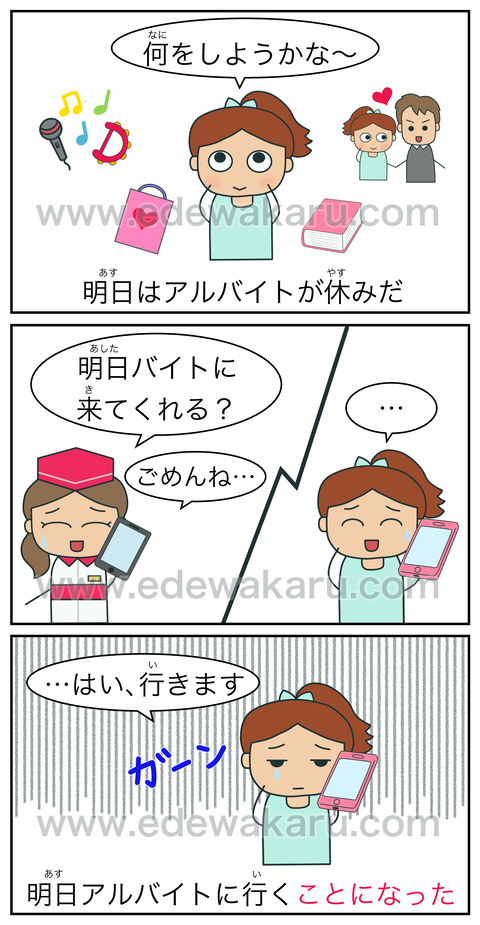
①明日アルバイトに行く
ことになった
【「店長」の決定】
【前の状態からの変化】
以前:休み
現在:休みではない
②大阪に出張する
ことになった
【「会社」の決定】
③試験で辞書を使ってもいい
ことになった
【前の状態からの変化】
以前:辞書を使ってはダメ
現在:辞書を使ってもいい
④アメリカに引っ越す
ことになった
【「会社」「両親」の決定】
*自分で決めた場合は「〜ことにする」を使用
[例]アメリカに引っ越す
ことにした
(復習:〜ことにする)
⑤グループのリーダーになる
ことになった
【「グループ」の決定】
⑥車で会社に行ってはいけない
ことになった
【「会社」の決定】
【前の状態からの変化】
以前:車で行ってもいい
現在:車で行ってはいけない
「〜こと」がつく文型はとてもたくさんありますので、しっかりと区別をして覚えておきましょう😉
【「こと」シリーズ】
〜こと(命令)
〜ことか
〜ことから
〜ことがある
〜ことができる(可能)
〜ことができる(能力)
〜ことこの上ない
〜ことだ・〜ないことだ
〜ことだから
〜ことだし
〜ことで(Nのことで)
〜こととて
〜ことなしに
〜ことなく
〜ことに
〜ことにしている
〜ことにする
〜ことになっている
〜ことになる・〜こととなる
〜ことには
〜ことは〜が①(形容詞・名詞)
〜ことは〜が②(動詞)
〜ことはない
〜ことはならない
〜たことがある(経験)
〜だこと!
(〜は)〜てのこと
〜ても〜すぎることはない
〜ということだ
〜とのことだ
〜ないこともない
〜ないことには
〜なかったことがある
In context 5 examples
明日アルバイトに行くことになった
→明日アルバイトに行くという結果になった大阪に出張することになった
→大阪に出張すると決まった試験で辞書を使ってもいいことになった
→試験で辞書を使ってもいいと決まったアメリカに引っ越すことになった
→アメリカに引っ越すことに決まったグループのリーダーになることになった
→グループのリーダーになることに決まった
日本語NET JLPT文法解説まとめ
Meaning
"〜することに決まる"
①自分の意志に関係なく予定や計画が決まることを表す。
②自分の意志で決めたことを婉曲的に言いたい時にも使う。
How to use it
V(辞書形)+ことになる
V(ナイ形)+ことになる
Explanation
something has been decided
① It indicates events or plans being determined regardless of one's will.
② It's also used when one wants to express something decided by their own will indirectly.
・「〜こととなる」という言い方もあるが、「〜ことになる」よりも少し硬い。
・自分の意志で決めたこと言う場合は「〜ことにする」を使う。
In context 14 examples
来月から長期で中国へ出張することになった。
システムメンテナンス作業のため年末は出勤することになりました。
親から国へ帰ってくるように言われ、来月帰ることになりました。
次のプレゼンテーションは私が担当することになった。
僕たち、来年の春に結婚することになりました。
妻とは話し合いの末、離婚することになった。
しばらく、入院することになったので、後はよろしく頼みます。
海外転勤が決まったんですが、英語が全く話せなにので、3ヶ月語学研修を受けることになりました。
来年から、転勤でタイに住むことになりました。
田中さんが休みなので、私が発表することになった。
授業中に辞書の代わりとして、スマホを使ってもいいことになった。
システムの変更作業で年末出社することになった。
多数決の結果、次の生徒会長は僕がすることになった。
教授が紹介してくれたおかげで、行きたかったの会社で働けることになった。
日本語文型辞典 英語版
Meaning
Means that some kind of decision or agreement was made concerning a future action, and a certain result will follow. In contrast to ...ことにする, which specifies who made the decision or resolution, ことになるconveys the meaning that the conclusion or result in question will be obtained naturally, unintentionally, and of its own accord. Often used in the ta-form ことになった, as in
(1)
,
(2)
, and
(4)
. こととなる, which has the same meaning, is a more formal expression used in written language.
Used to paraphrase, to look at something from a different perspective, or to point out the true nature of something.
How to use it
1. ...ことになる〈decision〉[Nということになる][V-る (という)ことになる][V-ない (という)ことになる]
2. ...ことになる〈restatement〉[Nということになる][V-る (という)ことになる][V-ない (という)ことになる]
In context 8 examples
こんど大阪支社に行くことになりました。
It’s been decided that I am to go to the Osaka branch office.
ふたりでよく話し合った結果、やはり離婚するのが一番いいということになりました。
After a long discussion between the two of us, we came to the conclusion that, as we had suspected, divorce was the best solution.
よく話し合った結果、やはり離婚ということになりました。
After a long discussion, the decision, as expected, was to divorce.
亡くなった山田さんは形式ばったことがきらいな人だったから、葬式などはしないことになりそうだな。
As the late Yamada-san was a person who disliked ceremony, it looks like that there won’t be a funeral or anything.
この問題は、細部については両政府の次官級協議にゆだねられることになった。
Regarding this issue, it was decided that the details were to be left to vice-minister level consultations between the two governments.
4年も留学するの? じゃあ、あの会社には就職しないことになるの?
You’re going to study abroad for four years? So, you’re not going to get a job at that company after all?
りえさんはわたしの母の妹のこどもだから、わたしとりえさんはいとこどうしということになる。
Rie-san is the child of my mother’s sister, so that makes Rie-san and me cousins.
これまで 10 年前と4年前に開いているので、これで日本での開催は3回目ということになる。
It was held here ten years ago and four years ago, so that makes this the third time for it to be held in Japan.
AIUEO JLPT Grammar
Meaning
This sentence pattern expresses a result, decision, or natural consequence, often used when the speaker is not directly involved in the decision.
How to use it
動詞辞書形+ことに+なる動詞ない形+ことに+なる
Explanation · 日本語
この文型は、物事の結果や決定、あるいは自然な成り行きを表す表現です。話者がその決定や結果に直接関与していない場合に使われることが多いです。
In context 5 examples
来月から東京で働くことになる。
I ended up working in Tokyo from next month.
試験に合格しなかったので、もう一度受けることになりました。
I didn’t pass the exam, so I ended up having to take it again.
天気が悪かったので、旅行をキャンセルすることになった。
The weather was bad so we had to cancel the trip.
症状が改善しなかったので、病院に行くことになった。
The symptoms didn’t improve, so we ended up going to the hospital.
私は一緒に行くことになりませんでした。
I didn't end up going with them.
Bunpro Grammar Reference
Meaning
It will end up being, It is the result of, It has been decided that
How to use it
Verb + ことになる
[い]Adjective + ことになる
[な]Adjective + な + ことになる
Verb + ことになります
[い]Adjective + ことになります
[な]Adjective + な + ことになります
Nuance
A grammar point which expresses that something will end up being the thing which is (A), or result in (A).
Explanation
ことになる is an expression that combines the nominalizing use of こと (creating a noun-phrase), with the case marking particle に, and the う - Verb なる 'to become'. This expression can be translated as 'to become (A)', but has the nuance that someone/thing caused (A) to become that way. Due to this, it may also be translated as 'it has been decided that (A)', or 'it will end up being (A)'.
ことになる is primarily used with verbs and い-Adjectives in their attributive form. It may also be used with な-Adjectives followed by な.
なんでも後回しにしているとあとから苦労することになる。
If you wait until it is too late, you are going to end up regretting it.
そんなことをしたらとんでもないことになるよ。
If you do something like that, it is going to become a huge deal.
出来るだけ早く治療をしないと、後から大変なことになる。
If you don't treat it soon, it is going to end up being a bigger issue.
The 'it has been decided that (A)' meaning only applies to verbs, as only verbs will be enacted by someone/thing.
Fun Fact
This structure is a good example of why なる is often viewed as the intransitive form of する. する conveys that someone is performing an action (transitive), while なる implies that something is the result of an action (intransitive). This is why the (A) phrase in ことになる is usually determined to have been decided/performed by someone else, while still focusing on exactly 'what' (A) became.
Nuance · 日本語
ある物が最終的には(A)というものに変化する、又は(A)を引き起こすということを表す文法。
Explanation · 日本語
「ことになる」は、名詞を作る「こと」と格助詞の「に」、そして五段動詞の「なる」を合わせた表現です。何かが、ある状態や結果になることを表します。この表現は、主に自分の意思とは関係しないところで、物事が決まるようなときに使われます。
「ことになる」は、主に、動詞やイ形容詞の連体形と一緒に使われます。また、「な」が付いたナ形容詞に使われることもあります。
なんでも後回しにしているとあとから苦労することになる。
If you wait until it is too late, you are going to end up regretting it.
そんなことをしたらとんでもないことになるよ。
If you do something like that, it is going to become a huge deal.
出来るだけ早く治療をしないと、後から大変なことになる。
If you don't treat it soon, it is going to end up being a bigger issue.
「ことになる」は「(A) に決まる」という意味で、ほかの誰かの判断や決定を表すこともあります。この意味になるのは、動詞と一緒に使うときです。
豆知識
「ことになる」は、「なる」が「する」の自動詞だと言われる理由が見える、良い例でしょう。「ことになる」は、自分の判断を表す「ことにする」と違って、ほかの誰かの判断を表すときによく使われるからです。「なる」の文の焦点は、「どのような結果になったか」にあります。
In context 15 examples
- どうしてこんな事になったの?意味がわからないよ。
Why did it end up like this? I don't get it.
- なんでも後回しにしているとあとから苦労することになる。
If you wait until it is too late, you are going to end up regretting it.
- そんなことをしたらとんでもないことになるよ。
If you do something like that, it is going to become a huge deal.
- 出来るだけ早く治療をしないと、後から大変なことになる。
If you don't treat it soon, it is going to end up being a bigger issue.
- 大変な事になったぞ。何か作戦を考えなければ。
We ended up getting in trouble. We have to figure out a plan.
- 私が会議に出る事になった。
It was decided that I will attend the meeting.
- 連絡がなければ、僕が仕事に行く事になります。
If we do not hear anything, I will end up going to work.
- 困った事になったな。もう電池が切れそうだ。
I ended up in a jam. It seems that my battery is about to die.
- 来年引っ越す事になった。
It was decided that we will move next year.
- 震災のため、アメリカに帰らなければならない事になりました。
It was decided that I must return to America because of the earthquake.
- 結局僕がおごる事になった。みんな後輩だから。
I ended up paying. Since I'm the oldest.
- インフルエンザにかかってしまったので、今日の大会に出れない事になった。
Since I got the flu I ended up being unable to attend today's tournament.
- この前のように風邪を引いたら、また入院する事になるよ。
If you catch a cold like the last time, you will end up going to the hospital again.
- 急に出張する事になって、準備が大変だ。
It has suddenly been decided that I will go on a business trip and I am having trouble getting ready for it.
- 明日が雨ならば、1週間降り続く事になる。
If it rains tomorrow, it will end up being a week straight of rain.
文法
Meaning
"〜することに決まる"
①自分の意志に関係なく予定や計画が決まることを表す。
②自分の意志で決めたことを婉曲的に言いたい時にも使う。
How to use it
V(辞書形)+ことになる
V(ナイ形)+ことになる
Notes
・「〜こととなる」という言い方もあるが、「〜ことになる」よりも少し硬い。
・自分の意志で決めたこと言う場合は「〜ことにする」を使う。
In context 14 examples
来月から長期で中国へ出張することになった。
システムメンテナンス作業のため年末は出勤することになりました。
親から国へ帰ってくるように言われ、来月帰ることになりました。
次のプレゼンテーションは私が担当することになった。
僕たち、来年の春に結婚することになりました。
妻とは話し合いの末、離婚することになった。
しばらく、入院することになったので、後はよろしく頼みます。
海外転勤が決まったんですが、英語が全く話せなにので、3ヶ月語学研修を受けることになりました。
来年から、転勤でタイに住むことになりました。
田中さんが休みなので、私が発表することになった。
授業中に辞書の代わりとして、スマホを使ってもいいことになった。
システムの変更作業で年末出社することになった。
多数決の結果、次の生徒会長は僕がすることになった。
教授が紹介してくれたおかげで、行きたかったの会社で働けることになった。
IMABI
Expressions with こと
Read this IMABI lesson ↗Explanation
Expressions with こと
The nominalizer こと appears in many grammatical structures, and in all the structures showcased in this lesson, it has no interchangeability with the nominalizer の. So, as you go through each structure, this will be a great opportunity to better internalize these two nominalizers and how they are fundamentally different.
~ことがある: Experience(S) One Has
When こと follows a verbal predicate, either in the non-past form or the past form, it indicates experiences one has. The difference tense plays determines whether said experience is one that one “(often) has” or “has had.”
Vnon-past + ~ことがあるagent (often) does/experiences doing…
Vpast + ~ことがあるagent has/have done… (before)
In practice, ~たことがある is more practically translated as “has/have…” as in having done something before—an experience that is unequivocally in the past as an experience had. Meaning, this pattern may not be used to reflect the present perfect use of “have” like in “I have done my work,” in which the speaker may be referring to actions that they have just completed. ~たことがある should also NOT be misconstrued as a wordier replacement of plain past tense, either.
i. きのう、日本語を勉強したことがある。X
Intended: Yesterday, I studied Japanese.
ii. 仕事をやったことがある。??
Intended: I have done my work.
Actual Meaning: I have done a job.
iii. 営業事務の仕事をやったことがある。
I have worked in sales administration (before).
Particle Note: Whether が, は, も, or no particle at all is used in this structure is ultimately determined by the intended nuancing of the statement. With the particle は, the experience (being) had is being contrasted with other scenarios. With the particle も, the experience (being) had is in addition to other stated experiences. No particle being used is indicative of casual speech in which case the added nuances provided by は・も are not relevant as well as が’s own exhaustive-listing nuancing being irrelevant.
While it may go without saying, this construct can be used in negative sentences, in which case ある conjugates to its respective negative forms.
iv. 北京ダックを食べたことがない。
I have not had Peking duck (before).
It must also be noted that Vnon-past before こと may also be in the negative, and it is even possible for ある to be in the negative in tandem. However, each scenario is distinctly different.
v. それほど頻繁に食べることはないかもしれませんが、高塩分の食品の摂取量が多いと、胃癌リスクが高まりますよ。
Although you may not eat them that frequently, high intake of salty foods will increase your risk of stomach cancer.
vi. 鶏肉は、食べないことはないですが、あまり好きではありませんね。
While it’s not that I don’t ever eat chicken, I don’t really care for it.
While conjugating verbs into plain/polite and affirmative/negative forms should not be problematic by this point, here are the relevant forms of ある with the structure ~ことがある.
PlainPolite
Affirmative~ことがある~ことがあります
Negative~ことがない~ことがないです
~ことがありません
Past※~ことがあった~ことがありました
Negative Past※~ことがなかった~ことがなかったです
~ことがありませんでした
※While Japanese does not exhibit tense agreement, there are instances in which the pattern ~ことがある utilizes ~た for both the verb こと attaches to and ある, or even just the past tense marker on ある itself (see Exs. 14-17).
1. 富士山に登った1こともありますか。
Have you also climbed Mt. Fuji before?
2. マシュマロ入りのホットチョコレートを飲んだことがありますか。
Have you ever had hot chocolate with marshmallows?
3. 雲が多くなる時間2もあるが、雨が降ることはない。
There are times when it gets cloudy, but it will never rain.
4. 夏場でも鍋物を食べることがある。
Even during summertime, I (often) have hotpot.
5. 映画では同じようなアイデアが何度も繰り返し使われることが多い3ので、似たようなシーンを別の映画で見かけることがあるかもしれない。
In movies, similar ideas are used over and over again a lot, so you may often encounter similar scenes (to what you have seen) in other films.
6. 久しぶりに訪れた場所で道に迷うことがあります。
I often get lost when I visit places I haven’t been in a while.
7. 基本的に引き篭もっているのですが、休日に母と買い物に行くことがある。
I basically stay at home, but sometimes I go shopping with my mother on the weekends.
8. 「香港に行ったことがあるの?」「一度行ったことがあるよ。」
“Have you been to Hong Kong before?” “I’ve been there once.”
9. 歯磨きをしないで寝たことがありますか。
Have you ever gone to sleep without brushing your teeth?
10. ラーメンを食べたことある?
Have you ever had ramen?
11. 歌舞伎を観たことはありますか。
Have you seen kabuki before?
12. 外国人に日本語を教えたことがあります。
I have taught Japanese to foreigners before.
13. あまり気にすることはないよ。
There really isn’t anything to worry about.
As for when ~たことがあった is used, an experience “that had been had, or “had not been had” in the negative, is mentioned as a retelling of the past. At times, this could be done as an attempt to confirm such event occurred, either to oneself or to whoever might be listening.
14. この場所で子供のころ、よく遊んだんだよ。あの滑り台の上から飛び降りて怪我をしたことがあったな。
I used to play here a lot as a kid. I once jumped off the top of that slide and got hurt.
15. 娘の父親は東京の江戸川区で育って幼稚園へ通ったことがあったが、母親の私のほうは、幼稚園へ行かなかった。
My daughter’s father grew up in Edogawa Ward, Tokyo, and had gone to kindergarten, but I, her mother, did not go to kindergarten.
Similarly, Vnon-past+ ~ことがあった is used when the speaker is retelling common occurrences, or lack thereof when in the negative, from the past.
16. 母だって子守唄を歌うことがあっただろうが、思い出せない。
I’m sure my mother of all people sometimes sang lullabies to me, but I can’t remember.
17. 毎年きっと1冊か2冊、ときには三冊も四冊も出版することがあった。
Ever year, I would publish one or two books, sometimes three or four.
Insofar, we have only see situations in which the verb used with ~ことがある indicates the volition of an agent (doer). However, When there is no agent, the structure ought to be interpreted as indicating what “may (often) be the case.”
18. 届出に不備などがあると加入手続きが遅れることがあるのでご注意ください。
Please note that if there are any issues in your filing, the enrollment process may be delayed.
19. 何か相手の気に入らないことがあったとしか思えませんね。
The only thing I can think of is that there must’ve been something that didn’t bode well with the other person.
~ことがある w/ Adjectival Predicates
One leap away from non-volitional verbs would be adjectival predicates. In fact, adjectives and adjectival nouns may also be used with ~ことがある for describing having (had) experiences in a certain situation, tense dynamics permitting. Arguably more care must be taken to ensure that the context is not best described with the past tense, however, as the context at had must still be understood as “experience(s) in which such a state is/was so” as opposed to simply stating that “something was so.” The latter situation would be within the domain of the past tense.
20. この先、楽しいことがあるとは思えません。
I just can’t see there being anything fun to be had in the future.
21. アボカドの熟成の見極めは難しいですねえ。私も切ってみたら、すごく硬かったことがあります。
It sure is hard to judge the ripeness of an avocado, huh. I once cut into one that was really hard.
22. ときどき大変なこともあるけど、ポジティブに考えるようにしているよ。
It can be hard at times, but I try to think positively.
23. 単品だと500円なんだけど、以前はもうちょっと安かったことがあったの。
It’s 500 yen à la carte, sure, but I had bought it a little cheaper than that in times past.
24. 怖そうな人でも優しいこともあるんだよ。
Even scary people are sometimes nice.
25. 北多摩は神奈川県だったことがある。
Kita Tama has once been (in) Kanagawa Prefecture.
NON-REMODELED CONTENT BELOW
~ことにする・こととする: To decide.
26. あいつを忘れることにしただけさ。(Very colloquial)
I’ve just decided to just forget that guy.
27. 私はお酒を飲むのをやめることとしました。 (Slightly formal)
I have decided to quit drinking liquor.
~ことにしている shows that one makes a routine of doing something or that one is determined/has a strong commitment to doing something.
28. 毎日カルピスを飲むことにしています。
I’ve made it a rule to drink Calpis every day.
29. 英語では話さないことにしています。
I’ve made it a rule not to speak in English.
~ことになる・こととなる: To be decided
30. 今年日本に行くことになりました。
It has been decided that I will go to Japan this year.
31. 新製品は5月10日に発表することになりました。
It has been decided that we will announce the new product on May 10th.
山を登る, while grammatically valid, does not mean the same thing as 山に登る. In this scenario, を functions as a transition marker, indicating that the mountain is not, per se, what is being climbed, but a point along one’s hiking journey. ↩︎
This example exemplifies are こと in this pattern may be replaced with similar yet concrete nouns like 時間・時 (time). ↩︎
This example exemplifies two things: that the pattern ~ことがある can be used with passive verbs and that ある can be replaced with similar words such as 多い (for there to be a lot of…). With this in mind, [高塩分の食品の摂取量] from v. may also be viewed as a paraphrasing of [Verb + ~こと]. ↩︎
In context 31 examples
富士山に登った1こともありますか。
Have you also climbed Mt. Fuji before?
マシュマロ入りのホットチョコレートを飲んだことがありますか。
Have you ever had hot chocolate with marshmallows?
雲が多くなる時間2もあるが、雨が降ることはない。
There are times when it gets cloudy, but it will never rain.
夏場でも鍋物を食べることがある。
Even during summertime, I (often) have hotpot.
映画では同じようなアイデアが何度も繰り返し使われることが多い3ので、似たようなシーンを別の映画で見かけることがあるかもしれない。
In movies, similar ideas are used over and over again a lot, so you may often encounter similar scenes (to what you have seen) in other films.
久しぶりに訪れた場所で道に迷うことがあります。
I often get lost when I visit places I haven’t been in a while.
基本的に引き篭もっているのですが、休日に母と買い物に行くことがある。
I basically stay at home, but sometimes I go shopping with my mother on the weekends.
「香港に行ったことがあるの?」「一度行ったことがあるよ。」
“Have you been to Hong Kong before?” “I’ve been there once.”
歯磨きをしないで寝たことがありますか。
Have you ever gone to sleep without brushing your teeth?
ラーメンを食べたことある?
Have you ever had ramen?
歌舞伎を観たことはありますか。
Have you seen kabuki before?
外国人に日本語を教えたことがあります。
I have taught Japanese to foreigners before.
あまり気にすることはないよ。
There really isn’t anything to worry about.
この場所で子供のころ、よく遊んだんだよ。あの滑り台の上から飛び降りて怪我をしたことがあったな。
I used to play here a lot as a kid. I once jumped off the top of that slide and got hurt.
娘の父親は東京の江戸川区で育って幼稚園へ通ったことがあったが、母親の私のほうは、幼稚園へ行かなかった。
My daughter’s father grew up in Edogawa Ward, Tokyo, and had gone to kindergarten, but I, her mother, did not go to kindergarten.
母だって子守唄を歌うことがあっただろうが、思い出せない。
I’m sure my mother of all people sometimes sang lullabies to me, but I can’t remember.
毎年きっと1冊か2冊、ときには三冊も四冊も出版することがあった。
Ever year, I would publish one or two books, sometimes three or four.
届出に不備などがあると加入手続きが遅れることがあるのでご注意ください。
Please note that if there are any issues in your filing, the enrollment process may be delayed.
何か相手の気に入らないことがあったとしか思えませんね。
The only thing I can think of is that there must’ve been something that didn’t bode well with the other person.
この先、楽しいことがあるとは思えません。
I just can’t see there being anything fun to be had in the future.
アボカドの熟成の見極めは難しいですねえ。私も切ってみたら、すごく硬かったことがあります。
It sure is hard to judge the ripeness of an avocado, huh. I once cut into one that was really hard.
ときどき大変なこともあるけど、ポジティブに考えるようにしているよ。
It can be hard at times, but I try to think positively.
単品だと500円なんだけど、以前はもうちょっと安かったことがあったの。
It’s 500 yen à la carte, sure, but I had bought it a little cheaper than that in times past.
怖そうな人でも優しいこともあるんだよ。
Even scary people are sometimes nice.
北多摩は神奈川県だったことがある。
Kita Tama has once been (in) Kanagawa Prefecture.
あいつを忘れることにしただけさ。(Very colloquial)
I’ve just decided to just forget that guy.
私はお酒を飲むのをやめることとしました。 (Slightly formal)
I have decided to quit drinking liquor.
毎日カルピスを飲むことにしています。
I’ve made it a rule to drink Calpis every day.
英語では話さないことにしています。
I’ve made it a rule not to speak in English.
今年日本に行くことになりました。
It has been decided that I will go to Japan this year.
新製品は5月10日に発表することになりました。
It has been decided that we will announce the new product on May 10th.
どんなときどう使う 日本語表現文型辞典
Usage 1
Meaning
(decision) has been decided that
How to use it
Vる・Vない+ことになる
Explanation
ことになる〈決定〉
1)あることが自分の意志に関係なく決まることを表す。
2) ❹ のように、自分の意志で決めたことでも、婉曲的に言いたいときに使うこともある。
1)Something has been decided independent of speaker's volition.
2)Can also be used euphemistically when it is speaker who has decided something, as in sentence ❹ .
In context 7 examples
入社式でスピーチをすることになったので、何を話そうか考えています。
町の料理教室には中学生以上の子どもも参加できることになりました。
1丁目のスーパーがなくなることになって、町の人は困っている。
わたしは秋に、結婚することになりました。
これからは社員もここには駐車できないことになりました。
今年は町のスケート大会は行わないことになりました。
会場の都合で、講演後の交流会は行われないことになりました。
Usage 2
Meaning
will end up
How to use it
Vの〔普通形〕+ことになる
Explanation
ことになる〈結局〉
つまり、そうなる
1)「ある事情や状況から考えて、当然そうなる」と言いたいときに使う。
2) ❸ ❹ は、好ましくない結果になることを警告したりする使い方。 ❶ ❷ は「わけだ」とほとんど同じ意味。
2)In sentences ❸ and ❹ admonishes against likelihood of undesirable result. In sentences ❶ and ❷ has nearly same meaning as わけだ (means that…).
In context 4 examples
この事故でけがをした人は、女性3人、男性4人の合わせて7人ということになる。
彼の話を信用すれば、彼は出張中だったのだから、そのとき東京にはいなかったことになる。
今、遊んでばかりいると、試験の前になって悔やむことになりますよ。
あの人にお金を貸すと、結局返してもらえないことになるので貸したくない。
毎日のんびり日本語教師
Meaning
~することに決まる
How to use it
動詞辞書形+ことになる/こととなる
動詞ない形+ことになる/こととなる
Explanation
他人による判断や客観的な決定、自然の成り行きなどによって物事が決まったときに用いる文法です。
自治体や会社、学校などによる決定などによく使われます。
「~ことになる」は口語としてよく使われ、「~こととなる」はやや硬く書き言葉でも使われます。
話者自身の主観的判断には使うことはできません。また、この文型は「~ことになった/ことになりました」の形で用いられることが非常に多いです。
Notes
似た文型に「~ことにする/こととする」があります。
こちらは話し手自身の意志や判断による主観的な決定に用いられます。
In context 5 examples
明日突然出社することになった。(明天突然决定让我去上班了)
本日をもちましてサービスを終了させていただくこととなりました。(本服务于今日截止。)
彼女と付き合うことになって嬉しい。(我很高兴能和她交往)
厳正なる選考の結果、今回は採用を見合わせて頂くことになりました。
癌のため余命1カ月と診断され、自宅で療養することとなった。