AIUEO JLPT Grammar
Meaning
This sentence pattern is used to highlight unique characteristics or qualities specific to a person, place, or situation. It emphasizes something special that only that subject possesses.
How to use it
名詞+ならでは
Explanation · 日本語
この文型は、ある特定の人や場所、状況などに特有の特徴や良さを表す表現です。その対象でなければできないこと、またはその対象にしかない特別なものを強調するときに使われます。
In context 5 examples
これは京都ならではの伝統的な工芸品です。
This is a traditional craft unique to Kyoto.
彼女ならではの視点で描かれたこの作品は、非常にユニークだ。
This work, created from her unique perspective, is truly one-of-a-kind.
この味は、地元ならではの食材を使っているからこそ出せるものだ。
This flavor can only be achieved using ingredients unique to this region.
この服は、手作りならではの温かみを感じる。
This clothing has a warmth that only handmade items can provide.
この景色は、北海道ならではの広大さと美しさが感じられる。
This scenery reflects the vastness and beauty unique to Hokkaido.
文法
Meaning
〜特有の / 〜でなければできないその特徴が他ではあまり見られない、そのことは他の人ではできないといった意味を表す。
How to use it
N + ならでは
In context 6 examples
納豆は日本ならではの食べ物だ。
臭豆腐は台湾ならではの食べ物だ。
日本ならではの雰囲気を味わたいなら、京都に行くといいでしょう。
このバッグショップの鞄は手作りならではの味わいが魅力だ。
私は旅行するとき、その土地ならではの食べ物を食べるのが好きだ。
キムさんの作文は彼ならではの面白さがある。
Bunpro Grammar Reference
Meaning
Unique to, Only, Impossible if not, Expected only of
How to use it
More common patterns:
Noun + ならでは + の + Noun
Noun + ならでは + だ。
Less common patterns:
Noun + ならでは + Verb[できる][ない]+ Noun
More common patterns:
Noun + ならでは + の + Noun
Noun + ならでは + です。
Less common patterns:
Noun + ならでは + Verb[できる][ない]+ Noun
Nuance
A hypothetical expression indicating that, in general, if it's (A), then (B). Not possible if not (A). Often showing high evaluation of (A).
Explanation
ならでは is a construction which indicates that something is 'unique to (A)', or 'impossible if not (A)'. While ならでは is usually considered as its own standalone word, it is actually just a combination of the negative-conjunctive form of the the classical copula なり, ならで, with the addition of the adverbial particle は.
ならでは will follow nouns, and the sentence will then usually go on to say what the thing is that is unique to (A).
味噌カツは名古屋ならではの食べ物です。
Misokatsu is a food unique to Nagoya.
アメリカならではの観光地といったらどこを連想しますか。
Where do you think is a tourist attraction that is unique to the States?
この祭りはこの地域ならではの祭りです。
This festival is unique to this area.
As seen in the above examples, ならでは will only be used when something is being evaluated positively. As a result of this, it is very common to see in advertising and slogans.
Caution
ならでは may be seen directly before the auxiliary verb だ. In these cases, the thing that is unique to (A) will have been expressed earlier in the sentence, or will be obvious from context.
こんな綺麗な作品を作れるのは、藤田さんならではだ。
Only you, Fujita-san, can create such an amazing piece.
車なしで生活できるのは都会ならではだ。
Only in the city can one live without a car.
Based on the history of ならでは, the structure being the negative-conjunctive form of the copula なり means that it is basically identical in meaning of the more modern でなくては 'if it isn't (A)'.
Nuance · 日本語
一般的に(A)であれば(B)であるということを示す仮定表現。(A)でなければ可能ではない。(A)を高く評価することが多い。
Explanation · 日本語
「ならでは」は「(A) に特有の」や「(A) でなければできない」といった意味を持つ表現です。これは文語の助動詞「なり」の否定連用形「ならで」に副助詞の「は」が付いてできたものですが、通常、一つの単語として扱われます。
「ならでは」は名詞の後に付き、その後に「(A) に特有なもの」についての説明が続きます。
味噌カツは名古屋ならではの食べ物です。
Misokatsu is a food unique to Nagoya.
アメリカならではの観光地といったらどこを連想しますか。
Where do you think is a tourist attraction that is unique to the States?
この祭りはこの地域ならではの祭りです。
This festival is unique to this area.
上記の例からわかるように、「ならでは」はそれが肯定的に評価されているときに使われます。そのため、広告や標語などによく使われます。
注意点
「ならでは」の直後に助動詞「だ」が来ることもあります。この場合は文の前半ですでに「(A) に特有なもの」が示されているか、文脈から読み取れるようになっています。
こんな綺麗な作品を作れるのは、藤田さんならではだ。
Only you, Fujita-san, can create such an amazing piece.
車なしで生活できるのは都会ならではだ。
Only in the city can one live without a car.
「ならでは」の成り立ちを考えると、この表現が持つ意味は現代で使われる「でなくては」とほぼ同じだと言えるでしょう。
In context 17 examples
- このクリーミーで且つ重くない絶品のカルボナーラは地元の名店ならではだ。
This exquisite, creamy, and moreover light carbonara is expected only of a famous shop in our region.
- 味噌カツは名古屋ならではの食べ物です。
Misokatsu is a food unique to Nagoya.
- アメリカならではの観光地といったらどこを連想しますか。
Where do you think is a tourist attraction that is unique to the States?
- この祭りはこの地域ならではの祭りです。
This festival is unique to this area.
- 食品広告:「おばあさんの手作りならではなかなか出せない味だ。」
Food product advertisement: 'Unique flavor that can only be found in grandma's homemade cooking.' (unique to)
- 求人のサイト、求人情報:「小さいカフェならではの良さが溢れています。」
Job search website, job information: 'The charm unique to a small cafe is overflowing.'
- 広告ポスター:「沖縄ならではの、普段は見られない透明度の高い青い海は必見だ。」
A poster ad: 'The extremely clear blue waters that can usually only be seen in Okinawa are a must-see.' (unique to)
- 求人のサイト、店員コメント:「こうした社風の良さは当社ならではだと思います。」
Job search website, employee comment: 'I think that the good quality of our corporate culture is unique to this company.'
- 僕は海外へ旅行に行く時は必ずその土地ならではの料理を食べるようにしています。
When going on an overseas trip, without fail, I try to eat the cuisine unique to that region.
- 雪山で遭難するという絶体絶命な状況でもユーモアを欠かさないのは父ならではだ。
Even in a desperate, life-or-death situation like being stranded on a snowy mountain, not losing his sense of humor is something only my father would do.
- 私が通う大学は少人数ならではの実践的な英語教育で人気が高まっています。
As for the university that I go to, with a small number of students unique to it, it is becoming popular for its practical English education.
- 新年に年賀状を送り合うという日本ならではの文化は、インターネットの登場を機に衰退し続けている。
The culture of sending new year's cards to each other on New Year, unique to Japan, is something that has been waning since the appearance of the internet.
- 折角日本へ旅行をしに行くのなら、神社やお寺、アニメをコンセプトにしたカフェ等の日本ならではの場所へ行きたいです。
If I'm going to put in the effort to go to Japan, then I want to go to places that are expected only of Japan like shrines, temples, and cafes that have been styled after anime.
- 本のおすすめ記事:「そのようなマンガやアニメなどの小ネタっぽいライトノベルを書き上げるのはさすが西尾維新先生ならではです。」
A book recommendation article: 'The one who can write a light novel filled with small joke references to manga and anime is unique to Nishio Ishin.'
- お茶の広告:「ハイクオリティな紅茶ならではの味わい!〇〇(まるまる)紅茶ティーバッグ30バッグ入」
「すっきりと香り高く澄み切った味です!」Tea advertisement: 'A flavor only possible with high-quality black tea! XX tea bags, 30 bags included.' 'A serene, refreshing, and aromatic taste!'
- こんな綺麗な作品を作れるのは、藤田さんならではだ。
Only you, Fujita-san, can create such an amazing piece.
- 車なしで生活できるのは都会ならではだ。
Only in the city can one live without a car.
DoJG 日本語文法辞典(全集)
Meaning
Impossible if it’s not ~; only possible with/by/at/etc.; not possible with/by/at/etc. other ~; very difficult with/by/at/etc. any other ~ but; you can expect only/at/from/etc.; unless
How to use it
(i) NP1 | ならではのNP2 | |
| この店ならではのサービス | Service you can expect only at this shop |
(ii) NP | ならではだ | |
| 学生ならではだ | Impossible unless someone is a student |
(iii) NP | ならではVpotential negativeない | |
| 彼ならではできない | Only he can do something (literally: something cannot be done by anyone else but him) |
Explanation
ならでは(の)A phrase indicating something is "impossible if it’s not X".
In context 10 examples
丸山博士の講演は、一流の科学者ならではの示唆に富む内容だった。
Dr. Maruyama's lecture was rich with suggestion, the likes of which could only be heard from a first-class scientist (like himself).
四季を通じて美しい景色が楽しめるのはこの地ならではだ。
Only here can we enjoy beautiful scenery through all four seasons.
女性ならではできない仕事や役割もあるはずだ。
There also must be jobs and roles that only women can perform (literally: that cannot be done unless you are a woman).
この大学の法律図書館には、この大学ならではの充実した資料が揃っている。
The law library of this university houses a rich collection of documents, the likes of which do not exist at other institutions.
プロショップならではの品揃え。人気商品を特別価格でお求めいただけます。
We have a range of products that would only be available at a shop for pros. Popular items are available at special prices.
このマンションは都心の住居ならではの便利さと快適さをお約束します。
These condominiums promise the kind of convenience and comfort you can enjoy only in dwellings at the heart of the city.
興味がわいたら、その分野を徹底して勉強してみる時間があるというのは学生ならではだ。
It is only because they are students (literally: It is not possible unless they are students) that they have the time to thoroughly pursue fields they find they have an interest in.
近郊にはゴルフコースが数多く、仕事帰りにハーフを回れるのは、緯度が高く日没の遅いカナダならではだ。
There are many golf courses near Canadian cities, and, uniquely in Canada, where the sun sets late because of the high latitude, people play a half round on their way home from work.
産地直送ならでは味わえない本場のおいしさをお届けいたします。
We deliver delicious taste from the source, a taste you could not enjoy if we did not ship directly from the site of production.
日本最高峰の富士山は、毎年夏の登山シーズンになると約20万人が山頂を目指す。登山者が長蛇の列をつくる光景は富士山ならでは見られないものである。
In the summer climbing season every year, roughly 200,000 people aim for the summit of Mt. Fuji, the highest mountain in Japan. The long line of climbers is a scene that can't be seen anywhere but at Mt. Fuji.
どんなときどう使う 日本語表現文型辞典
Meaning
if not; unless
How to use it
N+ならでは
Explanation
~でなければ不可能な
「~ならでは」の形で「~以外では不可能だ、ただ~だけができる」と感心するときの言い方。「~ならではの」の「の」は、「見られない・できない」などの動詞の代わりである。
Impressed that something would be impossible otherwise, or only N is capable of doing something. The の in ならではの substitutes for verbs 見られない, できない, etc.
In context 3 examples
この絵には子どもならでは表せない無邪気さがある。
この祭りこそは京都ならではの光景です。
これは芸術的才能のある山本さんならではの作品だと思います。
絵でわかる日本語
Meaning
〜だけが持っているすばらしい〜
〜だけが持っている特有の〜
〜以外にはできない〜
〜でなければ〜できない
How to use it
名詞[辞書形]+ならでは
名詞[辞書形]+ならではの+名詞
Explanation
「〜ならでは」は「〜だけが持っている、すばらしい〜」という意味を表す文型です。ほとんどの場合は「〜ならではの+名詞」の形で使われます😀
こ
の文型は高い評価を表すなど、いいことに使います
😊
[例]
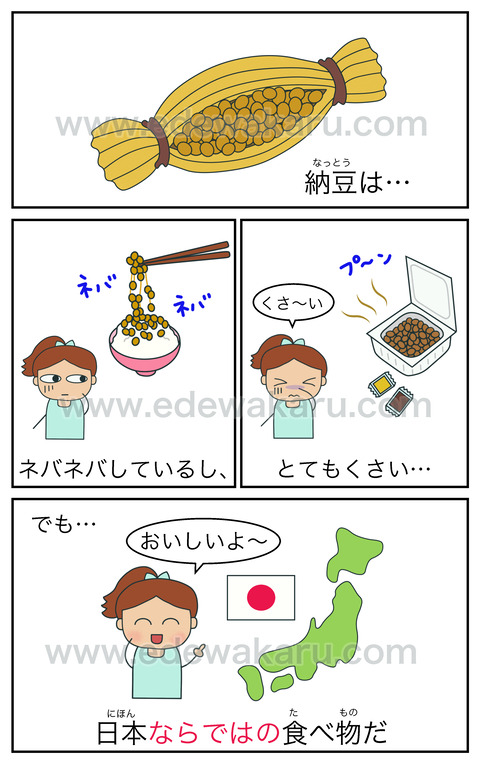
納豆は日本
ならではの
食べ物だ
→納豆は、くさいしネバネバしているが、
日本でしか食べることのできない特有の食べ物だ
「くさい」も「ネバネバしている」もマイナスのことですが、
「〜ならでは」を使うと「くさいしネバネバしているけれど、日本でしか食べられない、特別な食べ物だ」というように、「納豆」に対していい評価を表しています
😮
【補足説明】
「〜ならでは」には「〜ならでは〜ない」という形もあります。
[例]
納豆は日本
ならではの
食べ物だ
納豆は日本
ならでは
味わうことができ
ない
食べ物だ
「〜ならでは」はお店や会社、商品などのいいところを紹介するときに使われる文型です😄レストランに行った時などにポスターや広告に使われているのを見る機会があるかもしれませんね😉(復習:〜など・〜なんか・〜なんて)
In context 4 examples
納豆は日本ならではの食べ物(食べ物)だ
→納豆は日本だけが持っている特有の食べ物だ日本ならではの観光地へ行ってみたい
→日本にしかないすばらしい観光地へ行ってみたいこのカフェならではの味(復習:「カフェ」と「コーヒー」) (復習:「味」と「におい」)
→このカフェでしか食べることのできない味この文化はこの国ならではのものだ
→この文化はこの国特有のものだ
日本語文型辞典
Meaning
基本情報Nならでは説明人物や組織などを表す名詞を受けて「Nだからこそこれほどすばらしい」「N以外にはできない」「Nでなければあり得ない」といった意味を表す。「NならではのN」のような形で用いられることが多いが「Nならでは…ない」の形もある。Nについての高い評価を表し、店や会社などの広告・宣伝のキャッチフレーズでよく使われる。例文① 親友ならではの細かい心遣いが嬉しかった。② 二枚目俳優ならではの端正な顔立ちをしていた。③ 当店ならではのすばらしい料理をお楽しみください。④ あの役者ならでは演じられないすばらしい演技だった。
日本語文型辞典 英語版
Meaning
【ならでは】[Nならでは]
With a noun showing a person or an organization, ならでは expresses the meaning of “just because it is N (a person, a thing), it is that wonderful,” “only N can do that,” or “N is the only one which makes that possible.” Often appears in the pattern NならではのN, but also appears in Nならでは...ない. ならでは expresses a high opinion of N and is used in catch phrases for a shop or company advertisement.
In context 4 examples
親友ならではの細かい心遣いが嬉しかった。
I was so happy to receive such careful attention that only such a close friend could give.
二枚目俳優ならではの端正な顔立ちをしていた。
He had the fine features you’d expect of a nimaime (matinee idol).
当店ならではのすばらしい料理をお楽しみください。
Please enjoy our house specialties.
あの役者ならでは演じられないすばらしい演技だった。
It was just like that actor to give such a brilliant performance.
日本語NET JLPT文法解説まとめ
Meaning
"〜特有の / 〜でなければできない"
その特徴が他ではあまり見られない、そのことは他の人ではできないといった意味を表す。
How to use it
N + ならでは
Explanation
"unique to / characteristic of / only possible with"
Used to express that something is unique or characteristic of a particular person, place, or thing.
In context 6 examples
納豆は日本ならではの食べ物だ。
臭豆腐は台湾ならではの食べ物だ。
日本ならではの雰囲気を味わたいなら、京都に行くといいでしょう。
このバッグショップの鞄は手作りならではの味わいが魅力だ。
私は旅行するとき、その土地ならではの食べ物を食べるのが好きだ。
キムさんの作文は彼ならではの面白さがある。
IMABI
Exception
Read this IMABI lesson ↗Explanation
Exception: ~をのぞいて, ~をおいて, & ~ならでは
These phrases limit things as exceptions in their own unique ways.
~のぞいて
After a noun phrase of some sort, ~除いて is used to mean “except…” and is often left in ひらがな. It is a general phrase and will differ with the emotive power of the following grammar point ~をおいて. The verb 除く can mean “to remove/exclude”, and “exclude” can also be expressed with the verb 除外じょがいする, which is of the vein of “to set aside/rule out”.
1. 一隻いっせきを除いて艦船かんせんは全部沈しずんだ。
Except for one vessel, all of the carriers sank.
2. きのう、暑かったことをのぞいて、僕らは楽しいときを過ごした。
Yesterday, except it being hot, we had a good time.
3. 私は除いてください。
Please include me out.
4. 私は報道記者と政治家を除く全ての人々が平等であると信じている。
I believe it in the equality of all people except reporters and politicians.
5. 北部をのぞいて、お天気はよかったですよ。
The weather was good except in the north.
6. わたしを除いて全ての人がそれを知っていたそ。
Except me, it seems that everyone knew about it.
7. 女性は調査対象ちょうさたいしょうから除外することになった。
It was decided that women were to be taken out of the inquiry subjects.
Variant Note: In more formal literary fashion, this can also be seen as ~のぞき.
8. 政府の規制改革会議きせいかいかくかいぎが全面的ぜんめんてきな解禁かいきんを求めている、インターネットを使った市販薬しはんやくの販売について、菅官房長官かんかんぼうちょうかんや田村厚生労働大臣たむらこうせいろうどうだいじんら関係4閣僚かくりょうは、副作用ふくさようのリスクの評価が終わっていない、ごく一部の市販薬を除き、大半たいはんを解禁する方向で調整ちょうせいを進める見通しです。
In regards to the all-round band lift of the sale of over-the-counter drugs using the internet that a government regulation reform meeting is seeking, Chief Cabinet Secretary Kan, Prime Minister Tamura of the Ministry of Health, Labor and Welfare, and four other bureaucrats in connection are forecast to further the coordination in the direction of lifting the ban in large part with exception to a small amount of over-the-counter drugs of which the evaluation of side-effect risks is not over.
From NHK on June 4, 2013.
Warning Note: Do not confuse this with the verb 覗く, which means to “to peep/take a look at” and has the same pronunciation.
~をのぞいて VS ~以外
This is very similar to ~以外. One thing to notice, though, is that ~以外 is a suffix, and as seen below, the phrase is more affirmative and somewhat more formal sounding.
9. 九州以外のどこも地震が発生した。
With exception of Kyushu, earthquakes occurred everywhere.
10. これ以外に方法はありませんよ。
There is no method other than this.
~をおいて
~をおいて means “apart from”. This phrase is used to highly evaluate something or someone. So, it’s a good thing. There is always something like ほかに…(い)ない after it. When you are generally saying “aside from”, use ~を除いて. Like ~除いて, ~をおいて is used after noun phrases.
This phrase originally showed a meaning of “without emphasizing A as something important, one treats A as being useless and throws it out/places it to the side/separates it apart/removes it. In this sense, Aをおいてほかに(い)ない becomes a double negative expression, which then makes it an extremely powerful affirmative statement of A being number one.
In Japanese it is usually the case that very powerful expressions are kept in the written language, and although this is the case for をおいて, in rather formal situations, it can be used to declare one’s top recommendation. It doesn’t necessarily have to be in formal situations; however, as the first example sentence demonstrates clearly.
Examples
11. 君をおいて適任者てきにんしゃはいないぞ!
Apart from you there’s no responsible person!
12. 頼れるのは彼女をおいてほかにない。
There is no one to rely apart from her.
13. これをおいてほかに方法はなかった。
There was no way but this.
14. それはさておき・それはさておいて
Aside from that
15. 九州と四国を除いてそこかしこで東日本大震災は多数の死者を出して大災害が発生する結果となりました。
Apart from Kyushu and Shikoku, no matter where there are many deaths and major catastrophes have occurred in the Tohoku-Kanto Earthquake Catastrophe.
~別 VS ~をおいて
The following paraphrases with 別 is used rather than ~をおいて because the situation is not one of pointing out as the best but something that should be treated separately.
16a. 震度7 は別として、釜石市には津波が押し寄せました。
16b. 震度7度の地震とは別に、津波が釜石市を襲おそった。
Apart from a 7 earthquake, Kamaishi City got flooded by a tsunami.
Word Note: The 震度 system is on a different scale than the Richter scale.
~ならでは
~ならでは is one of those instances where classical grammar holds on strong. The なら in this expression, like the particle なら comes from the 未然形 of the Classical Japanese copular verb なり. It is then followed by a classical usage of で, which is not related to the contraction of にて. In this case, it is the contraction of ~ずて, which is equivalent to ~なくて. は, here, is here for contrastive purposes. If the pattern were translated into something solely Modern Japanese, it would be equivalent to ~でなくては・~でなければ.
This pattern is used to express the brilliance/wonderfulness of something by claiming that only it is as such. In the unabbreviated state of a sentence with it, a complementing verbal/adjectival phrase follows, but this can be omitted out if that phrase is being used as an attribute by replacing it with の, giving ~ならではの, which is the more common form of the pattern.
The entire phrase, which is “AならではBない(C )” is, then, equivalent to expressions such as “AであってはじめてB” and “AだからこそB”. In the case that A is a commonplace noun, ~ならでは is of the sense of the former coming from the position of societal wisdom/common sense. However, when A is particular, it shows that only A can do C.
Examples
17. 君ならではできないことだよ!
Without you, this cannot be done!
18. それ、中国の方ならでは{できない・の}ものの考え方ですよ。
That is only a matter of thought possibly by a person from China.
19. それって、大阪弁ならでは{ありえない・の}人当たりのよさですね。
That is charm only that of Osaka Dialect, isn’t it?
20. 社長しゃちょうならではの発想はっそうですね。
This can only be a conception of the company president, isn’t it?
21. この教科書きょうかしょならではの特徴とくちょうです。
This is a characteristic only in this textbook.
22. 50年続いた老舗ならでは出せないこの味の良さ!
The goodness of this flavor that only an old shop for 50 years can offer!
23. この体験は沖縄ならではですよ。
This experience can only be in Okinawa!
Grammar Note: As you can see, another exceptional thing about ~ならでは is that it can be followed by ~です with the rest of the pattern omitted.
24. さすが一流レストランのシェフならでは{出せない・の}味ですね。
This is as expected flavor that can only be from a first rate restaurant chef.
Phrase Note: さすが, which is an adverb that shows something as something to be expected, is frequently used with ~ならでは.
In context 25 examples
一隻いっせきを除いて艦船かんせんは全部沈しずんだ。
Except for one vessel, all of the carriers sank.
きのう、暑かったことをのぞいて、僕らは楽しいときを過ごした。
Yesterday, except it being hot, we had a good time.
私は除いてください。
Please include me out.
私は報道記者と政治家を除く全ての人々が平等であると信じている。
I believe it in the equality of all people except reporters and politicians.
北部をのぞいて、お天気はよかったですよ。
The weather was good except in the north.
わたしを除いて全ての人がそれを知っていたそ。
Except me, it seems that everyone knew about it.
女性は調査対象ちょうさたいしょうから除外することになった。
It was decided that women were to be taken out of the inquiry subjects.
政府の規制改革会議きせいかいかくかいぎが全面的ぜんめんてきな解禁かいきんを求めている、インターネットを使った市販薬しはんやくの販売について、菅官房長官かんかんぼうちょうかんや田村厚生労働大臣たむらこうせいろうどうだいじんら関係4閣僚かくりょうは、副作用ふくさようのリスクの評価が終わっていない、ごく一部の市販薬を除き、大半たいはんを解禁する方向で調整ちょうせいを進める見通しです。
In regards to the all-round band lift of the sale of over-the-counter drugs using the internet that a government regulation reform meeting is seeking, Chief Cabinet Secretary Kan, Prime Minister Tamura of the Ministry of Health, Labor and Welfare, and four other bureaucrats in connection are forecast to further the coordination in the direction of lifting the ban in large part with exception to a small amount of over-the-counter drugs of which the evaluation of side-effect risks is not over.
九州以外のどこも地震が発生した。
With exception of Kyushu, earthquakes occurred everywhere.
これ以外に方法はありませんよ。
There is no method other than this.
君をおいて適任者てきにんしゃはいないぞ!
Apart from you there’s no responsible person!
頼れるのは彼女をおいてほかにない。
There is no one to rely apart from her.
これをおいてほかに方法はなかった。
There was no way but this.
それはさておき・それはさておいて
Aside from that
九州と四国を除いてそこかしこで東日本大震災は多数の死者を出して大災害が発生する結果となりました。
Apart from Kyushu and Shikoku, no matter where there are many deaths and major catastrophes have occurred in the Tohoku-Kanto Earthquake Catastrophe.
震度7 は別として、釜石市には津波が押し寄せました。
Apart from a 7 earthquake, Kamaishi City got flooded by a tsunami.
震度7度の地震とは別に、津波が釜石市を襲おそった。
Apart from a 7 earthquake, Kamaishi City got flooded by a tsunami.
君ならではできないことだよ!
Without you, this cannot be done!
それ、中国の方ならでは{できない・の}ものの考え方ですよ。
That is only a matter of thought possibly by a person from China.
それって、大阪弁ならでは{ありえない・の}人当たりのよさですね。
That is charm only that of Osaka Dialect, isn’t it?
社長しゃちょうならではの発想はっそうですね。
This can only be a conception of the company president, isn’t it?
この教科書きょうかしょならではの特徴とくちょうです。
This is a characteristic only in this textbook.
50年続いた老舗ならでは出せないこの味の良さ!
The goodness of this flavor that only an old shop for 50 years can offer!
この体験は沖縄ならではですよ。
This experience can only be in Okinawa!
さすが一流レストランのシェフならでは{出せない・の}味ですね。
This is as expected flavor that can only be from a first rate restaurant chef.