AIUEO JLPT Grammar
Meaning
This sentence pattern is used to express using a pretext to carry out another action. It conveys a nuance of leveraging a stated reason to achieve an ulterior motive, often highlighting unfavorable intentions.
How to use it
名詞に+かこつけて
Explanation · 日本語
この文型は、何かを口実にして別のことを行う場合に使われる表現です。表面上はある理由や目的を掲げているものの、実際にはその理由を利用して別の本当の目的を達成しようとするニュアンスを持ちます。多くの場合、相手に対して好ましくない行動や意図を指摘する際に使われます。
In context 5 examples
彼は体調が悪いのにかこつけて、会議を欠席した。
He used feeling unwell as an excuse to skip the meeting.
彼は勉強にかこつけて、部屋に閉じこもってゲームをしている。
He’s using studying as an excuse to stay in his room and play games.
彼女は風邪にかこつけて、デートを断った。
She used having a cold as an excuse to cancel the date.
彼は取材にかこつけて、無料でイベントに参加した。
He used the interview as an excuse to attend the event for free.
彼は仕事の都合にかこつけて、旅行を断った。
He used work obligations as an excuse to cancel the trip.
文法
Meaning
〜を表向きの理由にして / 〜を口実にして
How to use it
N + にかこつけて
Notes
後件には、知られると非難を受ける事柄がが続くことが多い。
In context 9 examples
風邪にかこつけて、学校を休んでゲームをした。
最近、夫は出張にかこつけて、他の女性にあっている気がする。
接待にかこつけて夜遅くまで飲みに行った。
ハロウィンにかこつけて、馬鹿騒ぎする若者が多すぎる。
息子は病気にかこつけて、勉強もせずにゲームばかりしている。
あの上司は酒の勢いにかこつけて、体を触ろうとするから気をつけて。
営業にかこつけて、よくカフェで本を読んでいる。
彼女は国際交流にかこつけて、かっこいい外国人のイケメンを探している。
海外出張にかこつけて、ヨーロッパを楽しんできた。
Bunpro Grammar Reference
Meaning
In the name of, Using the excuse of, To use as a pretext of, Under the guise or pretense of
How to use it
Noun + にかこつけて
Verb + の(1) + にかこつけて
(1) こと
Nuance
A structure indicating that something is being done with the excuse of (A), or under the pretense of (A). Consigning it as (A), (B).
Explanation
に託けて is a structure based on the case-marking particle に, and the る-Verb 託ける ‘to consign as’, or ‘to label as’. As this translation doesn’t exhibit the same nuance well in English all the time, it is commonly interpreted as ‘in the name of (A)’, or ‘under the pretense of (A)’.
に託けて will be used after nouns, or verbs that have been nominalized with の.
病院に行くというのに託けて仕事を休んだ。
I took a day off work under the pretense of going to the hospital.
彼の家に忘れ物をしたというのに託けて彼のところにもう一度行く。
I will go to his place again under the pretense that I left something at his place.
彼女はいつも何かにかこつけて僕の家に来ようとする。本当にやめてほしい。
She always tries to come to my place under the pretense of something. I really want her to stop.
風邪にかこつけて、授業を休んで一日中テレビを見ながらダラダラしていた。
Using the pretext of a cold, I skipped class and loafed around and watched TV all day.
Caution
Despite the common interpretations, the original meaning of ‘to consign’ works just as well in terms of meaning ‘labeling it as (A)’. This is due to に託けて being used primarily for criticism of surface-level excuses used to fulfill an ulterior motive.
靴ひもを結ぶのに託けて落ちていた財布をこっそりと拾った。
I sneakily picked up the wallet that was on the ground, labeling it as tying my shoelace.
あいつは出張に託けて、また釣りに行っているに違いない。
I bet he has gone fishing again, consigning it as a business trip.
Nuance · 日本語
(A)を理由に、又は(A)を前提に何かが行われているということを示す表現。(A)として受け入れ、(B)。
Explanation · 日本語
「に託けて」は、格助詞「に」と、一段動詞「託ける」をもとにした文型です。「託ける」には、「任せる」や「何かを表向きの理由にする」といった意味があり、この文型は「(A) を口実にして」や「関係ない (A) を理由として」といった意味で使われます。
「に託けて」は、名詞の後、または「の」によって名詞化された動詞の後に置かれます。
病院に行くというのに託けて仕事を休んだ。
I took a day off work under the pretense of going to the hospital.
彼の家に忘れ物をしたというのに託けて彼のところにもう一度行く。
I will go to his place again under the pretense that I left something at his place.
彼女はいつも何かにかこつけて僕の家に来ようとする。本当にやめてほしい。
She always tries to come to my place under the pretense of something. I really want her to stop.
風邪にかこつけて、授業を休んで一日中テレビを見ながらダラダラしていた。
Using the pretext of a cold, I skipped class and loafed around and watched TV all day.
注意点
多くの場合、「に託けて」は、表に出している理由と、本当の目的が違うときに、それを批判する場面で使われます。
靴ひもを結ぶのに託けて落ちていた財布をこっそりと拾った。
I sneakily picked up the wallet that was on the ground, labeling it as tying my shoelace.
あいつは出張に託けて、また釣りに行っているに違いない。
I bet he has gone fishing again, consigning it as a business trip.
In context 19 examples
- 「花子ったら部活動に託けて、部室に潜り込んでひとり遊んでばかりいるよ。」
'Speaking of Hanako, she sneaks into the club room under the pretense of club activity and just lazes around.'
- 病院に行くというのに託けて仕事を休んだ。
I took a day off work under the pretense of going to the hospital.
- 彼の家に忘れ物をしたというのに託けて彼のところにもう一度行く。
I will go to his place again under the pretense that I left something at his place.
- 彼女はいつも何かにかこつけて僕の家に来ようとする。本当にやめてほしい。
She always tries to come to my place under the pretense of something. I really want her to stop.
- 風邪にかこつけて、授業を休んで一日中テレビを見ながらダラダラしていた。
Using the pretext of a cold, I skipped class and loafed around and watched TV all day.
- 人(私も含めて)はお菓子が大好きで何かに託けていつも買ってしまうのではないだろうか。
I think that people (myself included) love sweets and will always buy them under some pretext.
- 武田:「田中さんったら出張に託けてパリを観光するつもりね。」
田中さん:「いやいや、そんなこと。」Takeda: 'Tanaka-san, you're planning to go sightseeing in Paris using the pretense of a business trip, aren't you?' Tanaka: 'No no, nothing like that.'
- A(エー):「あすかさんと会いたいけどどうしたらいい?」
B(ビー):「プリントを渡すというのに託けて家に行ったらどう?」A: 'I want to meet with Asuka, but what should I do?' B: 'How about going to her house under the pretext of intending to give her printouts?'
- 風邪に託けて、仕事を休んで一日中コーラを飲んだりゲームをしてしまった。
Using the pretext of a cold, he took some time off work, drank coke, and played games all day long.
- 姉の見舞いに託けて実家に帰った。そして、仲違いしていた両親と仲直りすることができた。
Under the pretext of visiting my ill sister, I returned home. And I was able to reconcile with my parents, whom I had been at odds with.
- 誕生日祝いという名目に託けて 、私たちは五つ星の温泉旅館に泊まりました。
Using the excuse of a birthday celebration, we stayed at a 5-star onsen resort.
- 留学に託けて外国人の彼女をゲットしようとした友達は撃沈して帰ってきました。
Using the excuse of studying abroad, my friend who tried to get a foreign girlfriend crashed and burned, and then returned home.
- 息子が父に:「アドバイスに託けて過去の栄光について語るの、やめてくれない?」
A son to his father: ‘Could you please stop talking about your past glories under the pretense of advice?’
- 彼氏はクリスマスとかバレンタインデーとかに託けて物をねだってくるから困ります。
My boyfriend pesters me for things in the name of Christmas and Valentine’s day, so it’s a bother.
- 同僚に忠告する:「あの上司は酒に酔った勢いに託けて口説こうとしてくるから、気をつけてね。」
Advising a colleague: ‘That boss uses the excuse of being merrily drunk in order to come making advances, so be careful.’
- 暴徒化したデモに託けて近辺の店から商品を盗もうとするなんて、奴らはなんて卑怯なんだ!
Something like stealing products from surrounding shops under the pretext of what had turned into a riot, they’re such cowards.
- 独り言:「私ったら、家族の誕生日や友達の誕生日、結婚記念日とか色々なイベントに託けてケーキを買っちゃうんだから…。」
Talking to oneself: ‘Oh me…, always buying cake under the pretense of various events like my family or friends’ birthdays and wedding anniversaries.’
- 靴ひもを結ぶのに託けて落ちていた財布をこっそりと拾った。
I sneakily picked up the wallet that was on the ground, labeling it as tying my shoelace.
- あいつは出張に託けて、また釣りに行っているに違いない。
I bet he has gone fishing again, consigning it as a business trip.
絵でわかる日本語
Meaning
〜を嘘の理由にして
〜を口実にして
How to use it
名詞[辞書形]+にかこつけて
Explanation
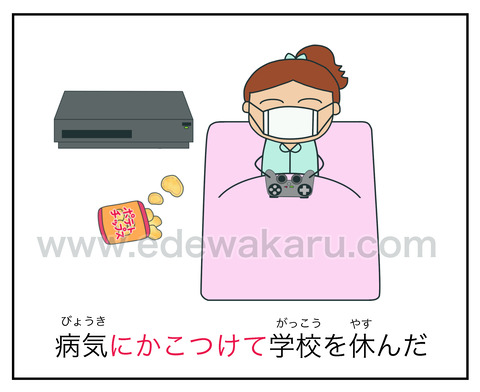
「〜にかこつけて」は「〜を口実にして…する」という意味で、人を騙してよくないことをする時に使われる文型です😅
「〜は直接的な原因・理由ではないが、〜を理由にして…する」というような意味です。ですから、例文①では学校を休むほどの病気ではないのに、「病気だから」という理由で学校を休み、家でごろごろ(復習:「ごろごろ」)したりゲームをしたりしている様子が想像できます😑
[比較]
病気
で
学校を休んだ→本当に原因は病気
病気
にかこつけて
学校を休んだ→ 学校を休むほどの病気ではないが、ゲームをするために休んだ
「〜にかこつけて」は本当の理由は言わずに、相手を騙して何かよくない事をするという時に使いますので、使う場面や場合に気をつけましょう😊
In context 3 examples
病気にかこつけて学校を休んだ
→病気だと嘘をついて学校を休んだ出張にかこつけて観光を楽しむ
→出張を口実にして観光を楽しむ接待にかこつけて遅くまで飲んできた
→接待を口実にして遅くまで飲んできた
日本語文型辞典
Meaning
基本情報Nにかこつけて説明ことがらを表す名詞を受けて、「それが直接の理由や原因でもないのにそれを口実にして」という意を表す。例文① 仕事にかこつけてヨーロッパ旅行を楽しんできた。② 病気にかこつけて仕事もせずにぶらぶらしている。③ 接待にかこつけて上等な酒を思いっきり飲んできた。
日本語文型辞典 英語版
Meaning
【にかこつけて】[Nにかこつけて]
With a noun expressing a thing/state/event, expresses the meaning of “under the pretext of doing something even though it is not a direct reason or cause.”
In context 3 examples
仕事にかこつけてヨーロッパ旅行を楽しんできた。
I enjoyed traveling Europe under the pretext of being on a business trip.
病気にかこつけて仕事もせずにぶらぶらしている。
She is lazing around without working under the pretext of being sick.
接待にかこつけて上等な酒を思いっきり飲んできた。
I drank all the quality liquor I wanted under the pretext of entertaining a business acquaintance.
日本語NET JLPT文法解説まとめ
Meaning
〜を表向きの理由にして / 〜を口実にして
How to use it
N + にかこつけて
Explanation
"using 〜 as a pretext / under the pretense of 〜"
後件には、知られると非難を受ける事柄が続くことが多い。
The following clause often contains something that, if known, would be subject to criticism.
In context 9 examples
風邪にかこつけて、学校を休んでゲームをした。
最近、夫は出張にかこつけて、他の女性にあっている気がする。
接待にかこつけて夜遅くまで飲みに行った。
ハロウィンにかこつけて、馬鹿騒ぎする若者が多すぎる。
息子は病気にかこつけて、勉強もせずにゲームばかりしている。
あの上司は酒の勢いにかこつけて、体を触ろうとするから気をつけて。
営業にかこつけて、よくカフェで本を読んでいる。
彼女は国際交流にかこつけて、かっこいい外国人のイケメンを探している。
海外出張にかこつけて、ヨーロッパを楽しんできた。
毎日のんびり日本語教師
Meaning
~を理由にして
~を利用して
How to use it
名詞+にかこつけて
名詞+を口実に(して)
Explanation
前件が後件の口実であることを表します。
前件の理由を利用した本来の目的ではない別の動作を後件で述べます。表向きの理由は別にあり、前件で述べられたものは口実に過ぎません。
前件の理由はただ口実にしているだけで嘘ではありません。
主に他者を批判する場面で使います。
Notes
特になし
In context 10 examples
人の誕生日にかこつけてケーキをたらふく食べる。
暴動にかこつけて店から金品を盗み取る。
出張にかこつけて観光を楽しんできた。
性差にかこつけて不当な権利を主張する。(以性别差距为借口趁机要求了许多不当的权利。)
妻に内緒で、いつも出張にかこつけて各地の温泉旅館を巡っている。
病気にかこつけて授業を欠席し、家でずっとゲームしていた。
あの男は酒の勢いにかこつけて、やたらと触ってくるから気をつけて。
寒さにかこつけて欲しかった服をたくさん買った。
オリンピックにかこつけて亡命する。
緊急事態宣言を口実にしてデートの回数を減らし、徐々にフェードアウトして自然消滅させたい。
IMABI
Fault: ~せいで & ~にかこつけて
Read this IMABI lesson ↗Explanation
Fault: ~せいで & ~にかこつけて
This lesson is all about ways in Japanese to give an excuse/reason in ways we have yet to see thus far in the curriculum.
~せいで
~せいで means “since/because of/due to” in the sense of blame. If you use this pattern with something that is generally perceived as being a good thing, it will sound strange and usually unnatural. You would have to do some explaining. The way to express this in a positive fashion is by using のおかげ(さま)で, which doesn’t always have to be used in a positive situation. The point is that at least it can.
Examples
1. 妹のせいで、父に叱られた。
I was scolded by my dad because of my little sister.
2. 俺のせいにすんな。(ちょっと失礼)
Don’t blame me.
3. 津波のせいで食糧不足になった。
We got into a food shortage due to the tsunami.
4. 病気のせいで、パーティーに行けなかった。
I didn’t come to the party due to an illness.
5. 休みなのに強風と花粉のせいで家から出れない。(Casual)
Although I’m on a break, due to strong winds and pollen, I can’t leave the house.
6a. 彼が失敗したのは怠惰のせいだ。
6b. 彼が失敗したのは怠けたからだ。(More natural)
He failed because of his laziness.
7. 雨のせいで、遅刻した。
I arrived later due to the rain.
8. 彼は疲労のせいで、眠いというよりも疲れているのです。
He is less sleepy than tired due to his fatigue.
~(の)せいか
As the adverbial particle か shows uncertainty, it shows in translation when used with せい.
9. 天気のせいか、気分が悪い。
I don’t know if it’s because of the weather, but I feel bad.
10. 山田さんは、試験ができなかったせいか今日は元気がありません。
Mr. Yamada isn’t well today apparently because he did bad on his exam.
11.
小林:ちょっと元気がないみたいけど、どうかしたの?
出口: うん、食中たりのせいかお腹が痛いんだ。
Kobayashi: You look a little bad; what’s wrong?
Deguchi: Yeah, I think my stomache’s hurting because of food poisoning.
12.
中田:どうかしたの。
川崎:うん、昨日の晩風邪を引いたせいか頭が痛くて。。。
中田:じゃ、早く帰って寝たら?
Nakada: What’s wrong?
Kawasaki: My head is hurting cause I might have gotten a cold last night.
Nakada: Well, how about getting home quickly and sleep?
~に託けて
The 一段 verb 託ける means “to use as an excuse” and ~に託けて is often translated as “under (the excuse of)”.
13.宗教しゅうきょうの名に託かこつけてコンキスタドーレスはアステックの帝国を攻せめ滅ぼした。
The Spanish Conquistadors attacked and utterly destroyed the Aztec Empire under the name of religion.
14. 彼は雪に託けて仕事をサボった。
He skipped work under the excuse of snow.
In context 13 examples
妹のせいで、父に叱られた。
I was scolded by my dad because of my little sister.
俺のせいにすんな。(ちょっと失礼)
Don’t blame me.
津波のせいで食糧不足になった。
We got into a food shortage due to the tsunami.
病気のせいで、パーティーに行けなかった。
I didn’t come to the party due to an illness.
休みなのに強風と花粉のせいで家から出れない。(Casual)
Although I’m on a break, due to strong winds and pollen, I can’t leave the house.
彼が失敗したのは怠惰のせいだ。
He failed because of his laziness.
彼が失敗したのは怠けたからだ。(More natural)
He failed because of his laziness.
雨のせいで、遅刻した。
I arrived later due to the rain.
彼は疲労のせいで、眠いというよりも疲れているのです。
He is less sleepy than tired due to his fatigue.
天気のせいか、気分が悪い。
I don’t know if it’s because of the weather, but I feel bad.
山田さんは、試験ができなかったせいか今日は元気がありません。
Mr. Yamada isn’t well today apparently because he did bad on his exam.
宗教しゅうきょうの名に託かこつけてコンキスタドーレスはアステックの帝国を攻せめ滅ぼした。
The Spanish Conquistadors attacked and utterly destroyed the Aztec Empire under the name of religion.
彼は雪に託けて仕事をサボった。
He skipped work under the excuse of snow.