日本語文型辞典
Usage 1
Meaning
基本情報N/Na だそうだA/V そうだ説明普通体の節に続いて、自分が直援得たことではなくどこかから入った伝聞情報だということを表す。否定や過去の形にはならない。例文① あの人は留学生ではなくて技術研修生だそうだ。② 今年の冬は暖かいそうだ。③ 昔はこのあたりは海だったそうだ。④ そのコンサートには1万人の若者がつめかけたそうだ。⑤ 米が値上がりしているそうだ。⑥ 新聞によると今年は交通事故の死者が激増しているそうだ。⑦ 担当者の話によると新製品の開発に成功したそうだ。⑧ うわさでは大統領が辞任するそうだ。⑨ 予報では台風は今夜半に紀伊半島に上陸するそうだ。⑩ パンフレットによるとこの寺はこ百年前に建てられたのだそうだ。例文(誤) 今年の冬は寒いそうではない。例文(正) 今年の冬は寒くないそうだ。例文(誤) 去年の冬は寒いそうだった。例文(正) 去年の冬は寒かったそうだ。説明新聞やうわさなど、情報源を表すときは、⑥~⑩のように「…では」「…によると」などの表現を伴う。「みたいだ」「らしい」との違いについては【みたいだ】2 を参照。
Usage 2
Meaning
基本情報NaそうだA-そうだR-そうだ説明 ナ形容詞と同じ活用で、「そうにV」「そうなN」と活用する。否定形の場合、「Naそうではない」「A-そうではない」と言うことはできるが、「R-そうではない」という形はほとんど用いられない。代わりに「R-そうもない/そうにない/そうにもない」を用いる。
a. …そうだ
話し手が見たり聞いたりしたりしたことから判断した様態を表す。④の「いい」は「よさそう」、⑤の「ない」は「なさそう」となる。⑦⑧のように「さも」「いかにも」などの副詞を伴って強調することがある。「きれいだ」「赤い」など、見ただけですぐに分かるものには使わないのが普通。
また、⑨⑩のように「一見」「ちょっと見たところ」などを伴ったときは、実際にはそうではないという文が続くことが多い。「みたいだ」とのちがいについては【みたいだ】2 を参照。
b. …そうにみえる
外見からはそういうふうに見えるという意味。
c. …そうにしている
感情や感覚を表す形容詞に付いて、そのような様子で動作をしているという意味を表す。「…そうだ」と言いかえられるが、何らかの動作をしているという意味は失われる。
a. R-そうだ
「なる」「落ちる」などの意志を表さない動詞や「書ける」「眠れる」などの可能を表す「V-れる」に付いて、そのような出来事が起こる可能性が大きいという判断を表す。また、次のように「もうちょっとで」「今にも」などを伴って事態が切迫している感じを表すことがある。
⑦⑧は程度がひどいことを比喩的に表す慣用的な言い方。
b. R-そうになる
話し手のコントロールが及ばない現象が起こる直前の状況になる、という意味を表す。①~④のように過去のことがらについて述べることが多い。また、「あやうく」「あわや」などを伴って事態が切迫している感じを表すことがある。
①③は「V-るところだ」に言いかえられる。
c. R-そうもない
「R-そうもない」「R-そうにない」「R-そうにもない」の形で、そのような出来事が起こる可能性が少ないという意味を表す。
第三者の意志的な行為を表す動詞に付いて、そのような出来事が起こる可能性が大きいという判断を表す。【生起の可能性1】の「そうだ」とは違って、話し手自身のことについては使わないのが普通。
意志的な行為を表す動詞に付いて、意志に反してそうなるのではないかと恐れる気持ちを表す。自分自身の行為について述べることが多い。
How to use it
…そうだ【様態】
Naそうだ
A-そうだ
Naそうにみえる
A-そうにみえる
Naそうにしている
A-そうにしている
R-そうだ【生起の可能性1】
R-そうにない
R-そうだ【生起の可能性2】
R-てしまいそうだ
In context 49 examples
その映画はおもしろそうだ。
彼女はいつもさびしそうだ。
おいしそうなケーキが並んでいる。
今日は傘を持って行った方がよさそうだ。
あの人はお金がなさそうだ。
久しぶりに彼に会ったが、あまり元気そうではなかった。
子供は人形をさも大事そうに箱の中にしまった。
いかにも重そうな荷物を持っている。
彼は一見まじめそうだが実は相当な遊び人だ。
このおもちゃはちょっと見たところ丈夫そうだが、使うとすぐに壊れてしまう。
(誤) 彼女はきれいそうだ。
(正) 彼女はきれいに見える。
誕生パーティーで彼女はいかにもしあわせそうに見えた。
彼は若そうに見えるが来年は60才になる。
なんだか気分が悪そうに見えますが大丈夫ですか。
その問題はむずかしそうに見えたがやってみるとそうでもなかった。
彼女はいつもはずかしそうにしている。
先生はお元気そうにしておられたので、安心しました。
その人はコートも着ずに寒そうにしていた。
その子はいやそうにして遊び場からひとり離れて座っていた。
星が出ているから明日は天気になりそうだ。
今年は雨が多いから、桜はすぐに散ってしまいそうだ。
服のボタンがとれそうだ。
反対運動は全国に広がりそうな気配だ。
今日中に原稿が書けそうだ。
今夜は涼しいからぐっすり眠れそうだ。
暑くて死にそうだ。
ジェット壊の音がうるさくて、気が変になりそうだ。
(例) あの古い家はもうちょっとで倒れそうだ。
その子は今にも泣き出しそうな顔をしていた。道が凍っていて、何度もころびそうになった。
車にぶつかりそうになって、あわてて道の端にとびのいた。
びっくりして持っていたグラスを落としそうになった。
私には子供のころ犬にかまれそうになった記憶がある。
私には、くじけそうになるといつもはげましてくれる友がいる。
(例) 山で遭襲して、あやうく命を失いそうになった。
この本は売れそうもない。
仕事は明日までには終わりそうもない。
雨は夜に入っても止みそうになかった。
一人のカではとうてい出来そうにもない。
民家はちょっとやそっとでは壊れそうもないほど頑丈な造りだった。
社長は歳をとってはいるが、元気だからなかなか辞めそうにもない。
あの様子では二人はもうじき結婚しそうだ。
彼はもう10日も無断で休んでいる。どうも会社を辞めそうだ。
彼女は熱心にパンフレットを見ていたから、誘ったら会員になりそうだ。
あんなに叱ったら、あの子は家出しそうな気がします。
(誤) 私は会社をやめそうだ。
おいしいから全部食べてしまいそうだ。
1度やめていたタバコをまた吸ってしまいそうだ。
警察のきびしい尋問を受けたら、組織の秘密をしゃべってしまいそうな気がする。
絵でわかる日本語
Usage 1
Read this source entry ↗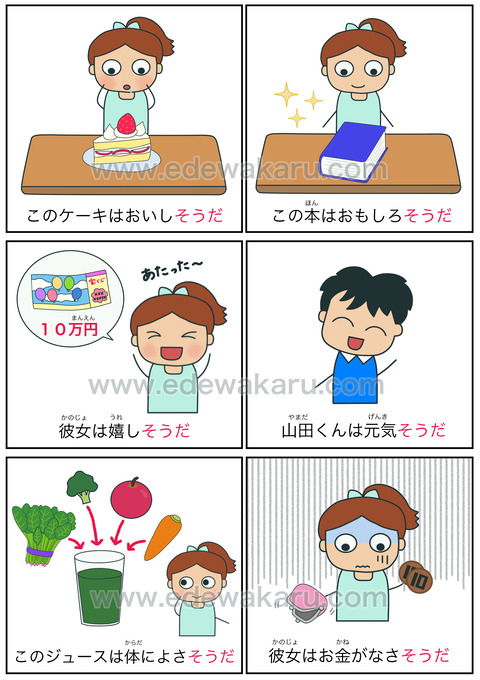
Meaning
(見て)〜と感じる
(見て)〜と思える
How to use it
動詞[ます形]+そうだ
い形容詞[ーい]+そうだ
な形容詞[ーな]+そうだ
Explanation
「〜そうだ」は「(見て)〜と感じる」という意味の文型です。この文型は【見て感じたこと】や【今の様子】を言う時に使われます。ほとんどの場合は形容詞に使われますが、状態性(じょうたいせい)の動詞を使うこともあります😊また「〜そうだ」は「〜そうに+動詞」「〜そうな+名詞」の形もあります😮
(復習:〜ことがある)
[例]
彼女はおいし
そうに
ケーキを食べる
おいし
そうな
ケーキ
【注意しましょう①】
「いい」「ない」を使う場合は注意が必要です😨
(例文⑤⑥)
[いい]
❌いそうだ
⭕️
よさそうだ
[ない]
❌なそうだ
⭕️
なさそうだ
【注意しましょう②】
「〜そうだ」は、見てすぐわかる時には使うことができません😬
[例]
❌彼女はかわいそうだ
⭕️彼女はかわいい
❌彼は背が高そうだ
⭕️彼は背が高い
❌彼女は美人そうだ
⭕️彼女は美人だ
❌彼は太っていそうだ
⭕️彼は太っている
(復習:〜ている(結果の状態))
「〜そうだ」の【否定形】については、また次回載せます😉「〜そうだ」は複雑ですが、とても大切な文型ですので、しっかりと復習をしておきましょう😀
【関連記事】
In context 6 examples
このケーキはおいしそうだ
この本はおもしろそうだ
彼女は嬉しそうだ
山田くんは元気そうだ
このジュースは体によさそうだ
彼女はお金がなさそうだ
Usage 2
Read this source entry ↗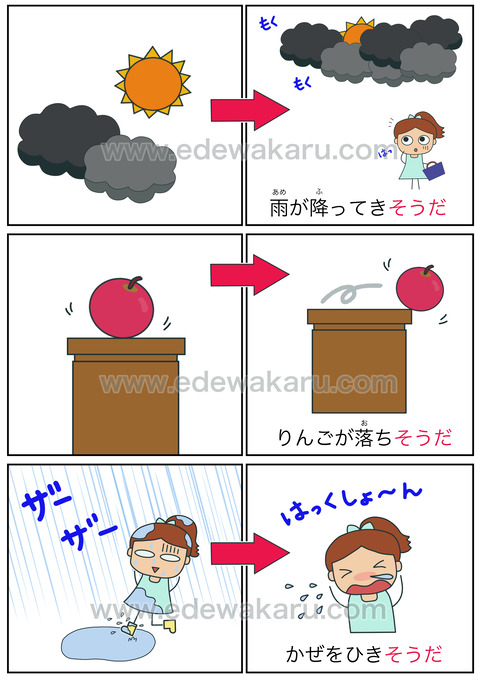
Meaning
〜が起こる可能性がある
〜が起こるかもしれない
もうすぐ〜が起こる
How to use it
動詞[ます形]+そうだ
Explanation
「〜そうだ」は「もうすぐ〜が起こるかもしれない」という意味を表す文型です。何かが起こる直前の状態や、何かが起こる可能性があると言いたい時に使います😊この文型は
【無意志動詞】
や
【可能形】
に使われて「〜が起こる可能性がある」という意味になると覚えておきましょう。
【中級〜上級レベルの人へ】
日常会話(にちじょうかいわ)などで「死にそうだ」というのを聞いたことがある人がいると思います。実はこれは、この文法が使われています😮「死にそうだ」というのは、「もうすぐ死ぬ可能性がある」という意味で使われているのではなく、「すごく〜だ」と程度を強調する場合に使われます😊
[例]
今日は暑くて
死にそうだ
→今日は
すごく
暑い
お腹がすいて
死にそうだ
→
すごく
お腹がすいた
「〜そうだ」には、いくつか意味がありますので、しっかりと区別をして覚えておきましょう😀
【関連記事】
In context 6 examples
雨が降ってきそうだ
→もうすぐ雨が降る可能性がある(復習:〜てくる(発生・開始))りんごが落ちそうだ
→もうすぐりんごが落ちるかもしれない(復習:落ちる・落とす①)(復習:落ちる・落とす②)かぜをひきそうだ
→かぜをひく可能性ある今日中にレポートが書けそうだ
→今日中にレポートが書き上げることができるかもしれない(復習:〜中)(復習:〜上げる)台風のせいで、木が倒れそうだ
→台風のせいで、木が倒れるかもしれない(復習:〜せいで・〜せいか)もうすぐ朝ごはんができそうだ
→もうすぐ朝ごはんができるかもしれない
Usage 3
Read this source entry ↗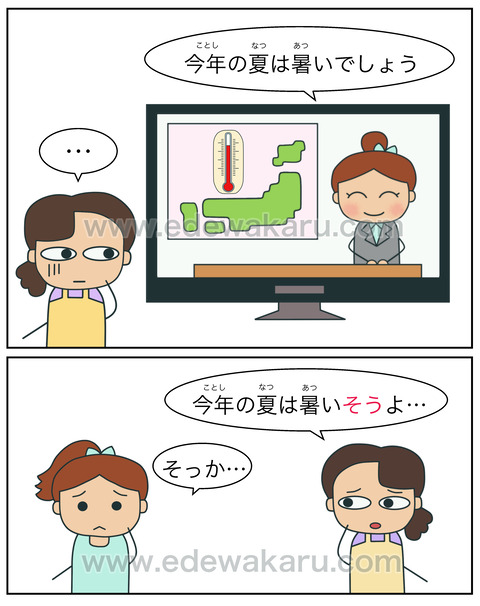
Meaning
伝聞を表す
How to use it
動詞[普通形]+そうだ
形容詞[普通形]+そうだ
名詞[普通形]+そうだ
*な形容詞・名詞の[現在肯定形]に使う場合は「
ーだそうだ」になる
例:きれいだ
そうだ
学生だ
そうだ
Explanation
「〜そうだ」は【伝聞】を表す文型です。誰かに聞いたり、何かを見たりして得た情報を相手に伝える時に使います😊この文型は、いつも「〜そうだ」の形で使われますので「〜そうだった」や「〜そうではなかった」などの形はありませんので注意しましょう😨
[例]
❌明日は雨が降るそうではない
⭕️明日は雨が降らない
そうだ
❌昨日は雨が降るそうだった
⭕️昨日は雨が降った
そうだ
❌昨日は雨が降るそうではなかった
⭕️昨日は雨が降らなかった
そうだ
【N3以上を受ける人へ】
伝聞の「〜そうだ」は、情報源(じょうほうげん)を表す「〜によると」「〜によれば」とよく一緒に使われます。
(復習:〜によると・〜によれば)
[例]
ニュース
によると、今年の夏は暑い
そうだ
天気予報
によると、明日は雨が降る
そうだ
お母さん
によると、うちのお父さんは、若い時はイケメンだった
そうだ
「〜そうだ」は初級で勉強する文型ですが、たくさん意味があり、似ている文型も多いのでとても複雑です😨初級の文型はとても重要ですので、しっかりと復習しておくといいと思います😉
(復習:〜ている(いつもの状態))
(復習:〜ておく)
In context 5 examples
今年の夏は暑いそうだ
明日は雨が降るそうだ
彼女はりんごが好きじゃないそうだ(復習:〜ちゃ・〜じゃ)
山田くんは昨日のパーティーに来なかったそうだ
うちのお父さんは、若い時はイケメンだったそうだ(復習:イケメン)
Usage 4
Read this source entry ↗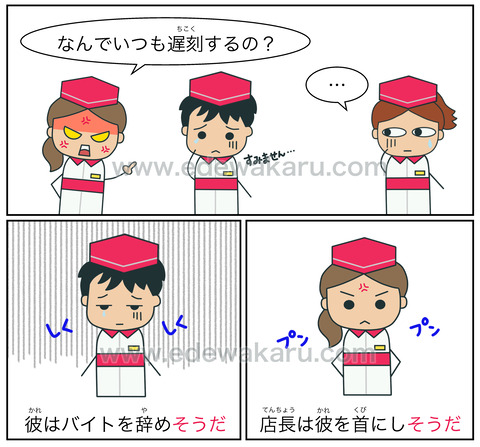
Meaning
〜は〜する可能性がある
〜は〜するかもしれない
How to use it
動詞[ます形]+そうだ
Explanation
「AはBそうだ」は「AはBするかもしれない」という意味を表す文型です。この文型は、第三者の「A」が「B」する可能性があると判断した時に使われます😊「B」には
意志動詞
が使用されます。
話者のことには使えない
と覚えておきましょう😨
[例]
⭕️彼はバイトを辞め
そうだ
【第三者のことはOK】
❌私はバイトを辞め
そうだ
【話者のことには使えない】
「〜そうだ」にはたくさん意味がありますので、区別をして覚えておきましょう😉
(復習:〜そうだ(可能性))
(復習:〜そうだ(伝聞))
(復習:〜そうだ(様態))
In context 5 examples
彼はバイトを辞めそうだ
→彼はバイトを辞める可能性がある店長は彼を首にしそうだ
→店長は彼を首にするかもしれない(復習:首にする・首になる)お金が貯まったら、彼女は家を買いそうだ
→お金が貯まったら、彼女は家を買う可能性があるあのカップルは別れそうだ
→あのカップルは別れるかもしれない彼は花子ちゃんに告白しそうだ
→彼は花子ちゃんに告白する可能性がある
どんなときどう使う 日本語表現文型辞典
Usage 1
Meaning
it appears that
How to use it
イAい/ナA+そうだ 例外 いい→よさそうだ・ない→なさそうだ
Explanation
そうだ〈様子〉
1)話す人が見た様子や印象を言いたいときの表現。ナ形容詞のように活用する。(そうな+名詞/そうに+動詞など)
2)見て客観的にすぐわかることには使わない。
◆ × わあ、汚そうなへやですね。
3)名詞につながる形はない。
◆ × あの人は病気そうです。
1)Expresses appearances seen or impressions of speaker. Conjugates like ナ-adjectives (そうな + noun/ そうに + verb)
◆ × わあ、汚そうなへやですね。
◆ × あの人は病気そうです。
2)Not used for things that can be understood objectively at a glance.
3)Never appended to nouns.
In context 5 examples
きのうは母の日だったので、花をプレゼントしました。母はとてもうれしそうでした。
妹はケーキを食べたそうな顔をしています。
たろうちゃんは健康そうで、かわいい赤ちゃんです。
このカレーライスはあまり辛くなさそうだ。
ねこがソファの上で気持ちよさそうに寝ています。
Usage 2
Meaning
about to
How to use it
Vます+そうだ
Explanation
そうだ〈直前〉
B:あ、本当だ。すぐつけます。
様子を見て、もうすぐ何かが起こると思ったときの言い方。 ❺ のように、否定の形はふつう「そうもない」を使う。
Used when it seems like something is about to occur. Negative form usually becomes そうもない, as in sentence ❺ .
In context 5 examples
A:あ、シャツのボタンが取れそうですよ。
あ、あんなに黒い雲が出ている。雨が降りそうだ。かさを持っていこう。
女の子は泣きそうな顔で、「さよなら」と言った。
窓から風が入ってきて、ケーキの上のろうそくが消えそうになりました。
今年は寒い日が続いたので、桜はまだ咲きそうもありません。
Usage 3
Meaning
it's said that; I hear that
How to use it
〔普通形〕+そうだ
Explanation
そうだ〈伝聞〉
1)話す人が聞いたり、読んだりして得た情報を伝えるときの言い方。情報の出所は「…によると」「…によれば」「…では」などで表す。
2)「そうだ」には否定や過去や疑問の形はない。
◆ × 暑いそうではない。/ × きれいだそうでした。
3)「そうだ」の前には「だろう・らしい・ようだ」は使えない。
◆ × 天気予報によると、あしたは大雨が降るだろうそうです。
1)Conveys information speaker learned aurally or from reading. Source of information is indicated by によると , によれば, or では.
◆ × 暑いそうではない。/ × きれいだそうでした。
3)Cannot use だろう, らしい, or ようだ before そうだ.
◆ × 天気予報によると、あしたは大雨が降るだろうそうです。
2)Cannot be used with negatives, past tenses, or interrogatives.
In context 5 examples
テレビの天気予報によると、あしたは大雨が降るそうです。
兄の電話によると、きのう元気な男の子が生まれたそうです。
新聞によれば、この町にも新しい空港ができるそうだ。
友だちの手紙では、今年のスペインの夏はあまり暑くないそうだ。
おじいさんの話によると、おばあさんは若いころきれいだったそうです。
Usage 4
Meaning
it seems that
How to use it
Vます/イAい/ナA+そうだ
Explanation
そうだ〈予想・判断〉
例外 いい→よさそうだ・ない→なさそうだ
話す人の判断・推量・予測・予感を言いたいときの言い方。 ❺ のように、動詞の否定の形はふつう「そうもない」を使う。
Expresses speaker's judgment, guesses, predictions, or premonitions. Negative of verb form usually becomes そうもない.
In context 5 examples
今年の夏は暑くなりそうです。
このパソコンソフトならわたしにも使えそうです。
この店には、ちょうどいいのがなさそうだから、ほかの店をさがしてみます。
体のためによさそうなことをいろいろやっています。
わたしはこの試合には勝てそうもない。
毎日のんびり日本語教師
How to use it
①伝聞
名詞+だそう/だったそう
ナ形語幹+なそうだ/だそうだ
イ形普通形+そうだ
動詞普通形+そうだ
②様態
イ形語幹+そうだ
ナ形語幹+そうだ
動ます形+そうだ
(~そうに+動詞)
(~そうな+名詞)
Explanation
2つの意味があります。それぞれ接続が違うので注意してください。
①伝聞
伝聞の助動詞です。自分が直接得た情報ではなく、他者から聞いたことを表します。
前件には「~によると」「~によれば」などの情報の根源を示す内容が呼応しやすいです。
②様態
様態の助動詞です。話者が見たり聞いたりしたものから推測される主観的な判断(可能性)を述べます。「美しい」「可愛い」「カッコいい」「赤い」等、一見して分かるような語には接続できません。
様態の用法の時は、以下の例外に注意してください。
例外
~そう
良い
良さそう(よさそう)
無い
無さそう(なさそう)
Notes
「~そう」シリーズ
In context 16 examples
天気予報によると、明日は雨だそうだ。
このお店、持ち帰りは自由だそうだ
お隣さん、子どもがもうすぐ生まれるそうだ。
医者によると、 とても難しい手術だったそうだ。
Aくん昨日事故に遭ったそうだ。だから今日休んでいるみたい。
今回の試験の合格率は15%だったそうだ。
隣町は大雨だったそうだが、こっちは快晴だった。
そこの洋食屋さん、ネットで人気で美味しいそうだ。
不思議そうに首を傾げた。(不可思议地歪着头。)
猫ちゃん頭を撫でられて気持ちよさそうだ。
ストレスが溜まってそうな顔をしている。(一副压力很大的样子。)
自信無さそうに「私はできない」と言った。
涙が出そうになった。(我快要流泪了。)
去勢手術をしたばかりだけど、大丈夫そうで安心した。
金魚が元気そうに泳いでいる。(金鱼很有精神地游着。)
隣の人の食べてるもの、めちゃくちゃ美味しそう。
日本語文型辞典 英語版
Meaning
【そうだ1】[N/Na だそうだ][A/V そうだ]
Follows a plain-form clause and indicates that the information in question is not the speaker’s direct knowledge, but indirect information obtained from another source (i.e. hearsay). Cannot take a negative or past-tense form.
(×)今年の冬は寒いそうではない。
They don’t say winter will be cold this year.
(○)今年の冬は寒くないそうだ。
They say winter won’t be cold this year.
(×)去年の冬は寒いそうだった。
Winter last year was apparently cold.
(○)去年の冬は寒かったそうだ。
Apparently winter last year was cold.
When the source of information, such as a newspaper or a rumor, is indicated, expressions like ...では or ...によると are used, as in
(6)
-
(10)
. See みたいだ (Usage 2) for the difference between そうだ and みたいだ/らしい.
【そうだ2】[Na そうだ][A-そうだ][R-そうだ]Has the same conjugation as na-adjectives and so changes to そうにV and そうなN. When it is used in the negative form, it is possible to say Na そうではない and A-そうではない, but R-そうではない is hardly ever used. R-そうもない/そうにない/そうにもない are used instead.
Expresses the speaker’s judgment regarding a state of affairs, based on something s/he has seen, heard, or done. いい becomes よさそう, as in
(4)
, and ない becomes なさそう, as in
(5)
. ...そうだ is sometimes accompanied by adverbs such as さも or いかにも for emphasis, as in
(7)
and
(8)
. It is usually not used to refer to attributes that can easily be identified by sight alone, such as きれいだ or 赤い.
(×)彼女はきれいそうだ。
She seems pretty.
(○)彼女はきれいに見える。
She looks pretty.
Also, when used with 一見 or ちょっと見たところ, as in
(9)
and
(10)
, it is often followed by a clause that indicates “but this is not actually the case.”
Seeみたいだ (Usage 2) for the difference between そうだ and みたいだ.
b. ...そうにみえる[Na そうにみえる][A-そうにみえる]
Means that something looks a certain way, based on outside appearance.
c. ...そうにしている[Na そうにしている][A-そうにしている]
Attaches to adjectives that express a feeling or sensation and means that an action is being performed with a particular demeanor or manner. Can be replaced by そうだ, but then the meaning that some kind of action is being performed is lost.
Used to express the judgment that there is a strong possibility an event could occur. Attaches to verbs that do not express intention, such as なる and 落ちる, as well as to V-れる verbs that express potential, such as 書ける and 眠れる. When accompanied by expressions such as もうちょっとで or 今にも, as below, it expresses the feeling that a situation is imminent or urgent.
(例)あの古い家はもうちょっとで倒れそうだ。
That old house looks like it’s about to fall down.
(例)その子は今にも泣き出しそうな顔をしていた。
The child looked like he was about to burst into tears.
Examples
(7)
and
(8)
are idiomatic expressions that express the degree of severity of the situation in a figurative way.
b. R-そうになる
Means that a situation beyond the speaker’s control comes very close to occurring. Often used to describe past events, as in
(1)
-
(4)
above. Sometimes used with adverbs such as あやうく (barely, narrowly) and あわや (nearly, on the verge of), in which case it conveys the sense that a situation is pressing or urgent.
(例)山で遭難して、あやうく命を失いそうになった。
I had a mishap in the mountains and nearly lost my life.
In
(1)
and
(3)
, R-そうになる can be replaced by V-るところだ.
c. R-そうもないR-そうにない
Means that a certain event is not likely to happen. Used in the forms R-そうもない, R-そうにない, and R-そうにもない.
Attaches to verbs that express the intentional act of a third person, and expresses the judgment that there is a strong possibility such an action or event will occur. Unlike そうだ (Usage 2), this そうだ is not usually used to refer to the speaker.
(×)私は会社をやめそうだ。
It looks as if I’m going to quit the company.
Used with verbs that express an intentional act and expresses a feeling of fear or concern that something may happen against one’s will. Often used to describe one’s own acts/actions.
How to use it
1. ...そうだ〈appearance, manner〉a. ...そうだ[Na そうだ][A-そうだ]
2. R-そうだ〈possibility of occurrence 1〉a. R-そうだ
3. R-そうだ〈possibility of occurrence 2〉
4. R-てしまいそうだ
In context 54 examples
あの人は留学生ではなくて技術研修生だそうだ。
Apparently he’s not an international student, he’s a technical trainee.
今年の冬は暖かいそうだ。
They say winter will be warm this year.
昔はこのあたりは海だったそうだ。
I’ve heard that this area was all sea in the past.
そのコンサートには1万人の若者がつめかけたそうだ。
Apparently 10,000 young people thronged to the concert.
米が値上がりしているそうだ。
They say the cost of rice is going up.
新聞によると今年は交通事故の死者が激増しているそうだ。
According to the newspaper, deaths caused by traffic accidents are showing a sudden increase this year.
担当者の話によると新製品の開発に成功したそうだ。
According to the person in charge, we have succeeded in the development of the new product.
うわさでは大統領が辞任するそうだ。
Rumor has it that the president is going to resign.
予報では台風は今夜半に紀伊半島に上陸するそうだ。
According to the forecast, the typhoon will make landfall on the Kii Peninsula tonight at midnight.
パンフレットによるとこの寺は二百年前に建てられたのだそうだ。
According to the brochure, this temple was built two hundred years ago.
その映画はおもしろそうだ。
That movie looks interesting.
彼女はいつもさびしそうだ。
She always seems lonely.
おいしそうなケーキが並んでいる。
Delicious-looking cakes are lined up all in a row.
今日は傘を持って行った方がよさそうだ。
It would probably be better to take along an umbrella today.
あの人はお金がなさそうだ。
That person seems to have no money.
久しぶりに彼に会ったが、あまり元気そうではなかった。
I saw him for the first time in a long while, and he didn’t look very well.
子供は人形をさも大事そうに箱の中にしまった。
The child tucked the doll into the box as if it were very precious.
いかにも重そうな荷物を持っている。
He’s carrying a very heavy-looking piece of luggage.
彼は一見まじめそうだが実は相当な遊び人だ。
On the surface he looks like a serious person, but he’s really quite a playboy.
このおもちゃはちょっと見たところ丈夫そうだが、使うとすぐに壊れてしまう。
At first glance this toy looks sturdy, but it breaks right away when you use it.
誕生パーティーで彼女はいかにもしあわせそうに見えた。
She looked very happy at the birthday party.
彼は若そうに見えるが来年は60才になる。
He looks young, but next year he’ll be sixty.
なんだか気分が悪そうに見えますが大丈夫ですか。
You don’t look well. Are you all right?
その問題はむずかしそうに見えたがやってみるとそうでもなかった。
The question looked hard, but after I tried answering it, it wasn’t so bad.
彼女はいつもはずかしそうにしている。
She always seems shy.
先生はお元気そうにしておられたので、安心しました。
Our teacher was looking well, so I was relieved.
その人はコートも着ずに寒そうにしていた。
That person, not even wearing a coat, looked cold.
その子はいやそうにして遊び場からひとり離れて座っていた。
The child was sitting alone away from the playground, looking annoyed.
星が出ているから明日は天気になりそうだ。
The stars are out, so tomorrow will probably be sunny.
今年は雨が多いから、桜はすぐに散ってしまいそうだ。
It’s been raining a lot this year, so the cherry blossoms will likely fall quickly.
服のボタンがとれそうだ。
A button on my (suit) is about to come off.
反対運動は全国に広がりそうな気配だ。
It looks like the opposition movement will probably spread all over the country.
今日中に原稿が書けそうだ。
I’ll probably be able to finish the manuscript sometime today.
今夜は涼しいからぐっすり眠れそうだ。
It’s cooler tonight so I think I’ll be able to sleep really well.
暑くて死にそうだ。
This heat is killing me.
ジェット機の音がうるさくて、気が変になりそうだ。
The noise from the jet planes is about to drive me crazy.
道が凍っていて、何度もころびそうになった。
The road was icy and I nearly fell down several times.
車にぶつかりそうになって、あわてて道の端にとびのいた。
I was about to be hit by a car, so I frantically jumped over to the side of the road.
びっくりして持っていたグラスを落としそうになった。
I was surprised and nearly dropped the glass I was holding.
私には子供のころ犬にかまれそうになった記憶がある。
I remember nearly being bitten by a dog when I was a child.
私には、くじけそうになるといつもはげましてくれる友がいる。
I have friends who always encourage me when I am about to lose heart.
この本は売れそうもない。
This book probably won’t sell.
仕事は明日までには終わりそうもない。
It doesn’t look like I’ll be finished this work before tomorrow.
雨は夜に入っても止みそうになかった。
Even after nightfall, the rain showed no sign of letting up.
一人の力ではとうてい出来そうにもない。
This doesn’t at all seem like something one person can do alone.
民家はちょっとやそっとでは壊れそうもないほど頑丈な造りだった。
Traditional Japanese-style houses were so well-built that it would take a lot to make them collapse.
社長は歳をとってはいるが、元気だからなかなか辞めそうにもない。
The company president is getting older, but since he’s in good health, it doesn’t look like he’ll be quitting any time soon.
あの様子では二人はもうじき結婚しそうだ。
Judging from the way things are going, those two will probably get married very soon.
彼はもう10日も無断で休んでいる。どうも会社を辞めそうだ。
He’s been off work without notice for ten days already. It looks as if he’s going to quit the company.
彼女は熱心にパンフレットを見ていたから、誘ったら会員になりそうだ。
Since she was looking at the pamphlet so intently, she’d probably become a member if someone asked her to join.
あんなに叱ったら、あの子は家出しそうな気がします。
If you scold him so much, I have a feeling he’s likely to run away from home.
おいしいから全部食べてしまいそうだ。
It’s delicious, so I just might finish it all.
1度やめていたタバコをまた吸ってしまいそうだ。
Even though I quit smoking, I feel like I might be about to start again.
警察のきびしい尋問を受けたら、組織の秘密をしゃべってしまいそうな気がする。
If I get grilled by the police, something tells me I’ll end up giving away all the organization’s secrets.
AIUEO JLPT Grammar
Usage 1
Meaning
This sentence pattern is used to convey information or news heard from others, indicating that the source of the information is a third party. Additionally, 「〜らしい」and 「〜みたい」can also be used to express hearsay, but these are more colloquial and often include the speaker’s subjective interpretation.
How to use it
普通文+そうだ
Explanation · 日本語
この文型は、他人から聞いた情報やニュースを伝えるときに使われる表現で、情報源が第三者であることを示します。また、「〜らしい」や「〜みたい」も伝聞を表すときに使われますが、これらは口語的であり、話し手の主観が含まれることが多いです。
In context 5 examples
あのレストランは美味しいそうだよ。
I heard that restaurant is delicious.
新しいプロジェクトが始まるそうです。
I heard that a new project will start.
その映画はとても感動的だそうです。
I heard that the movie is very touching.
明日は雪が降るそうだね。
I heard that it will snow tomorrow.
この本は勉強に役立つそうです。
I heard that this book is useful for studying.
Usage 2
Meaning
This sentence pattern is used to express the speaker’s subjective judgment about a state or condition based on appearance or situation.
How to use it
動詞ます形+そうだ形容詞語幹+そうだ形容動詞語幹+そうだ
Explanation · 日本語
この文型は、見た目や状況から推測して、ある状態や様子を表す表現で、話し手の主観的な判断に基づいて状況を述べるときに使います。
In context 5 examples
このケーキは美味しそうだね。
This cake looks delicious.
お母さんは元気そうですね。
Your mother looks healthy.
雨が降りそうです。
It looks like it will rain.
この契約はうまくいきそうです。
It looks like this contract will go well.
りんごが落ちそうだ。
The apple is going to fall.
Bunpro Grammar Reference
Meaning
I heard that, It is said that
How to use it
Verb + そう + だ
[い]Adjective + そう + だ
Noun + だ + そう + だ
[な]Adjective + だ + そう + だ
Verb + そう + です
[い]Adjective + そう + です
Noun + だ + そう + です
[な]Adjective + だ + そう + です
Nuance
An expression that highlights how (A) seems to be, based on what someone has heard.
Explanation
The auxiliary verb そうだ has two primary functions in Japanese. It can convey one of the following things:
Hearsay: 伝聞 - Highlighting things that have been heard from other people.
Appearance: 様態 - Highlighting the way that things 'appear', or 'seem'.
The appearance nuance is covered in another lesson, so we will focus on hearsay in this grammar point. When used to repeat statements that have been heard from other people/sources, そうだ (or そうです) will be paired with the plain form of a verb or い-Adjective, or a noun/な-Adjective followed by だ.
この種類の鳥はよく鳴くそうだ。
I heard that this bird chirps a lot.
次の患者さんは酷い事故にあったそうです。
I heard that the next patient was in a bad accident.
あそこから見る夕日は綺麗だそうです。
I heard that the sunset that you can see from there is beautiful.
先輩は明日も仕事だそうだ。
I heard that senpai will be working tomorrow.
そうだ always implies that the speaker is not 100% certain about the validity of the information that they are conveying. Due to this, it does not sound as confident as other expressions, like ようだ.
Caution
In order to avoid confusion between the そうだ that is used for repeating information, and the そうだ that is used for making observations, the following differences will need to be memorized.
Verbs -
降るそうだ - Unaltered verb, そうだ that is repeating information.
降りそうだ - Conjunctive form, そうだ that is used for making observations.
い-Adjectives -
寒いそうだ - Unaltered adjective, そうだ that is repeating information.
寒そうだ - い removed, そうだ that is used for making observations.
Nouns and な-Adjectives -
綺麗だそうだ - だ is used before そうだ. This is repeating information.
綺麗そうだ - No だ between the な-Adjective and そうだ. This is making an observation.
Nuance · 日本語
誰かが聞いたことから、(A)がどう見えるかを強調するために使われる表現。
Explanation · 日本語
助動詞の「そうだ」には、主に二つの使い方があります。
1.伝聞 - 他の人から聞いたことを伝える。
2.様態 - 見てわかる物事の様子を表す。
ここでは、伝聞の使い方を学びましょう(様態の使い方は別のレッスンで扱います)。伝聞の「そうだ」または「そうです」は、他人やどこかの情報源から聞いたことを、ほかの誰かに伝えるときに使います。これは、動詞やイ形容詞の普通形、または「だ」を付けた名詞やナ形容詞と一緒に使います。
この種類の鳥はよく鳴くそうだ。
I heard that this bird chirps a lot.
次の患者さんは酷い事故にあったそうです。
I heard that the next patient was in a bad accident.
あそこから見る夕日は綺麗だそうです。
I heard that the sunset that you can see from there is beautiful.
先輩は明日も仕事だそうだ。
I heard that senpai will be working tomorrow.
「そうだ」には、話し手がその情報を100%(パーセント)確かだとは思っていないニュアンスがあるため、「ようだ」などの表現よりも、自信がないときに使われます。
注意点
聞いた話を伝える伝聞の「そうだ」と、目で見て判断する様態の「そうだ」には、活用に以下の違いがあります。
動詞 -
降るそうだ:辞書形 + そうだ → 伝聞
降りそうだ:連用形 + そうだ → 様態
イ形容詞 -
寒いそうだ:辞書形 + そうだ → 伝聞
寒そうだ:「い」を取った語幹 + そうだ → 様態
名詞とナ形容詞 -
綺麗だそうだ:「だ」+ そうだ → 伝聞
綺麗そうだ:「だ」を取った語幹 + そうだ → 様態
In context 16 examples
- 美味しいそうだから、たくさん買った。
I heard they taste good, so I bought a bunch.
- この種類の鳥はよく鳴くそうだ。
I heard that this bird chirps a lot.
- 次の患者さんは酷い事故にあったそうです。
I heard that the next patient was in a bad accident.
- あそこから見る夕日は綺麗だそうです。
I heard that the sunset that you can see from there is beautiful.
- 先輩は明日も仕事だそうだ。
I heard that senpai will be working tomorrow.
- トムの彼女は女優だそうだ。
I heard that Tom's girlfriend is an actress.
- あの方は親切だそうです。
I heard that that person is kind.
- 来週から気温が下がるそうだ。
I heard that from next week the temperature is going to drop.
- 今晩雨が降るそうだ。
I heard it will rain tonight.
- あの人は怒ったら怖いが、普段は優しいそうだ。
That person is scary when he/she gets angry, but I heard that he/she is usually kind.
- 彼らは来月、ずっと行きたがっていたアメリカに旅行に行くそうだ。
I heard that they will go to America next month, the place they had been wanting to go to for a long time.
- 寒くなるそうだから、僕の上着を貸してあげよう。
I heard it's going to get cold, so I will lend you my jacket.
- これは明日のテストに出るそうだ。覚えておこう。
I heard that this will be on the test tomorrow. I should memorize it.
- あと一つの課題をクリアすれば、この仕事はうまくいくそうだ。
I heard that if I complete one more task, I will do well at this job.
- 点数が伸びれば、あのチームは合格ラインに到達するそうだ。
I heard that that team is going to reach a passing grade if they get more points.
- ぶんぽうちゃんは11時ぐらいにここに来るそうだ。
I heard that Bunpou-chan will come around 11 o'clock.
NINJAL 日本語文型データベース
Usage 1
Meaning
聞いたり読んだりして得た情報を伝える伝聞の言い方です。情報源がはっきりしているときに使います。
「~によると、〜によれば、~の話では」などの形で情報源を示すことがあります。
How to use it
V普通形+そうだ
i-A普通形+そうだ
na-A普通形+そうだ
N普通形+そうだ
その他
Notes
過去形や否定形の文、疑問文にはしません。
「〜」には「~だろう・~らしい・~ようだ」などの推量を表す文はきません。
In context 21 examples
ニュースによると、ガソリンが値上がりするそうだ。
「今日、太田さんは、来られないそうですよ。さっき連絡がありました」
今度の台風で、農作物に深刻な被害が出たそうだ。
今年の正月、リーさんは国へ帰れなかったそうです。
「部長は少し遅れるそうなので、そろそろミーティングを始めましょうか」
今年の冬はいつもの年より暖かいそうだ。
友達の話では、駅前のスイミングクラブは評判があまりよくないそうだ。
父「ゆりは今日は出かけたくないそうだよ」母「あら、そうなの」
この前の飲み会、とても楽しかったそうで、よかったですね。私は行けなくて残念でした。
不動産屋によれば、少し前まではこの辺りの土地の値段はそれほど高くなかったそうだ。
「山田さんは甘いものが好きだそうだよ。お土産はあの店のケーキにしたらどうかな」
駅前の電気屋はとても親切だそうだから、掃除機の修理はあの店に頼もう。
先生のお話では、週末に先生のお宅に伺っても迷惑ではないそうだ。
隣のうちのおじいさんが高齢者施設に入った。初めに1000万円必要だったそうだ。
田村さんが保育園で働き始めたころ、男性の保育士はまだあまり一般的ではなかったそうです。
店長によると、このあたりのラーメン屋ではうちの店が人気ナンバーワンだそうだ。
松田さんのお宅では息子さん2人が留学中だそうで、奥さんが寂しがっていた。
「大阪は雨じゃないそうだよ。さっきの電話で知子おばちゃんが言ってた」
この公園は昔、小学校の校庭だったそうです。
「げん君のお父さんは昔、力士だったそうだよ。あまり強い力士じゃなかったそうだけど……」
ゆき子が昨日電話で嘆いていた。子どもたちの好き嫌いが多いのだそうだ。
Usage 2
Meaning
[1] 外見の様子を表す言い方です。外見からいかにも〜のように感じられると想像したことを表します。
また、「うれしい・痛い・眠い・〜たい」など感情・感覚を表す形容詞は、主語が第三者の場合、直接使えないので、「~そうだ」をつけて使います。
[2] 様子から判断して、もうすぐ何かが起こる、または、もうすぐ変化すると言いたいときに使います。
[3] いろいろな状況から~だろうと予想したことを表します。総合的に判断した推量・予感・可能性などを言うときに使います。
How to use it
Notes
[1] 客観的に見てすぐわかるようなことや、推測の余地のないことには使えません。「〜」は形容詞が多いですが、動詞でも「持っている・知っている」など、状態を表すものは使えます。
「~そうな・~そうで・~そうに」のように、ナ形容詞と同じ形に変化します。
[2] 「~」は、主に「切れる・壊れる」などの瞬間動詞です。
「~そうな・~そうで・~そうに」のように、ナ形容詞と同じ形に変化します。
[3] 「~」が動詞の場合、「かかる・見つかる」などの意志を表さない動詞や「できる・帰れる」などの可能性を表す動詞がきます。
「~そうな・~そうで・~そうに」のように、ナ形容詞と同じ形に変化します。
In context 40 examples
あの人はお金がありそうだ。ブランド品ばかり持っている。
「高橋さんのあの顔。会社の大事なことを何か知っていそうですよね」
白石さんは最近、何だか悩み事がありそうな様子だ。
公園のベンチに忘れ物があった。大切なものが入っていそうなバッグだったので、すぐに交番に届けた。
「このランチセット、おいしそうだね。私はこれにする」
「弟さん、頭、よさそうね」「え、そう思う?」
友達の子どもにおもちゃを買って行った。とてもうれしそうだったので、私もうれしかった。
昼ご飯は終わったが、子どもがまだ何か食べたそうだったので、バナナを食べさせた。
猫が、いかにもほしそうな顔をして、魚を見ている。
「わあ、暖かそうなセーターですね」「ええ、とても暖かいですよ」
3人の女性が楽しそうにおしゃべりしながら山道を登って行った。
子どもたちは珍しそうにセミの脱皮を観察していた。
あの窓口の女の人、何だか意地悪そうだなあ。
昨日、竹下さんのお見舞いに行ったが、思ったより元気そうだった。
面接で話したら真面目そうな学生だったので、アルバイトに来てもらうことにした。
あのおじさん、親切そうに見えるけど、本当は何を考えているかわからない。
精密検査を受けた母は、心配そうに医者の話を聞いていた。
美幸は外国で家庭をもった。先月訪ねていったら、幸せそうに暮らしていた。
あ、シャツのボタンがとれそうだ。今、気がついてよかった。
もうすぐ塩がなくなりそうだから、買っておかないと。
子どもがボタン電池を今にも口に入れそうだったので、慌てて止めた。
きつく叱ったら、息子は今にも泣きだしそうな顔をして私を見た。
強い風が吹いて、庭の木の枝が折れそうになった。
このパソコンの修理にはちょっと時間がかかりそうだ。
「その仕事なら私にもできそうです。私にやらせてください」
この店はいろいろな色とサイズのシャツがそろっているから、ちょうどいいのが見つかりそうだ。
明日は早く帰れそうでよかった。見たい番組があるんだ。
三井さんは将来大物になりそうな人です。決断力と行動力があります。
この本は小学生向けと書いてあるから、うちの4歳の子には難しそうです。
中井さんは今週は都合が悪そうだから、送別会は来週がいいと思う。
私が国際交流クラブに入ったのは、いろいろな国の友達ができて楽しそうだと思ったからです。
ポスターを作るためにデザインを募集して、一番よさそうなものを選んだ。
「最近美術に興味があるんだ。面白そうな展覧会があったら、教えてね」
先生「これは宿題。少しレベルの高い問題も入っているから、難しそうな問題は、やらなくてもいいよ」
「林さんにパーティーの幹事を頼むのは無理そうですよ。最近忙しいと言っていましたから」
このお菓子、妹が好きそうだから、買って帰ろう。
この店の会員になると割引があるらしいが、手続きが面倒そうだったので、入会しなかった。
電子レンジを買いに店に行ったらいろいろなのがあった。使い方がいちばん簡単そうなのを選んだ。
カタログを見て、災害時に必要そうな物を選んで買っておいた。
ほかにも道があるのに、どうしてわざわざ危険そうな道を選ぶんですか。
IMABI
Seem: ~そうだ
Read this IMABI lesson ↗Explanation
Seem: ~そうだ
The auxiliary ~そうだ derives from the word 様(さま)meaning “appearance,” and just as this literal interpretation would suggest, this auxiliary is used to indicate conjecture. It does so in two uniquely different grammatical scenarios:
①Following the 連用形 and/or stem to indicate that something “seems” to be.
②Following the 終止形 to indicate the speaker “heard” that something is so.
For the purpose of this lesson, we will narrow our focus to just the first scenario.
To Look/Seem So: ~そうだ
~そうだ indicates that something “seems” a certain way based on the speaker’s own intuition as to the nature, quality, or perceived likelihood. How this ending ultimately translates depends on what part of speech is at play.
■With Adjectives/Adjectival Nouns
When paired with adjectives/adjectival nouns, ~そうだ indicates the speaker’s intuition on the state of being of what is being discussed.
Unlike other auxiliary verbs, ~そうだ attaches itself to the stem (語幹) of adjectives/adjectival nouns as opposed to one of their conjugational bases.
Part of SpeechBasic Form (基本形)+~そうだ
Adjectives忙しい (to be busy)忙しそうだ (to seem busy)
Adjectival Nouns簡単だ (to be easy)簡単そうだ (to seem easy)
Grammar Note: To express “it seems to be,” でありそうだ is used – the combination of the 連用形 of である, the uncontracted form of だ, and ~そうだ.
Depending on the context, it may be more natural to translate ~そうだ as “to look” as opposed to “to seem.” With this ending, the speaker indicates there is more than enough reason to suggest the claim, meaning it is not limited to just outward appearance, even if how the situation looks is what prompts the remark.
1. このお化け屋敷は怖そうだ。
This haunted house looks scary.
2. うわあ、美味しそう!
Wow, it looks delicious!
Grammar Note: It is very common to see だ omitted, especially in exclamatory sentences such as this one.
Strangely, there are two adjectives1 which conjugate irregularly with ~そうだ, exhibiting what is known as “さ-insertion.”
Basic Form (基本形)+~さそうだ
良い (to be good/fine)よさそうだ (to seem fine)
無い (to not be/have)なさそうだ (to seem to not be/have)
3. 今日は調子がよさそうだね。
You look good today.
4. 使う機会がなさそうだ。
There doesn’t appear to be a chance to use it.
5. 隣人の犬はなんて可哀相(だ)!
The neighbor’s poor dog!
Meaning Note: The combination of かわいい (cute) and ~そうだ does not produce the meaning of “seems cute,” but rather “poor/pitiful/pathetic,” which itself is a relic of how the adjective itself once referred to a sight which one dare not look at lest one wanted to end up the same way. As for why かわいそうだ is written in Kanji, 可哀相・可哀想 are interchangeable Ateji spellings.
Though not irregular as far as conjugating goes, you may also see ~たそうだ, which utilizes ~たい to indicate desire to do something. Thus, ~たそうだ indicates what it seems like someone is wanting to do.
6. なんだよ、何か言いたそうだな。
What’s the matter? It seems like you wanna say something, huh?
7. 飼い主さんから、「吐きたそうにしている」と見えても、実は咳であるということがよくあります。
Even when it looked like (the pet) was seemingly trying to puke (up something) from (the perspective of) the owner, often times, it’s really just coughing.
■With Verbs
When paired with verbs, ~そうだ indicates that one has a feeling that an action is about to occur, and this feeling comes from one’s own intuition/knowledge base. Whenever a speaker is compelled to use this ending, the likelihood of the guess that they are making will actually come to pass is rather high2, that is unless the speaker is being sarcastic (see Ex. 6).
Basic Form (基本形)+~そうだ
降る (to rain)降りそうだ (to seem like will rain)
落ちる (to fall/drop)落ちそうだ (to seem like will fall)
死ぬ (to die)死にそうだ (to seem like will die)
8. 今日は暑くて死にそうだよ。
Today is so hot I feel like I’m about to die.
9. 古い鳥居は今にも倒れそうだ。
The old torii looks like it might fall down at any moment.
10. 当分の間、今回の熱波は居据りそうだ。
It seems as though this current heat wave will persist for the time being.
11. 廊下の電気が消えそうだ。
The hallway light(s) seem like they are going to go out.
12. もうすぐ桜の花が咲きそうだよ。
It seems that the cherry blossoms will bloom soon.
13. 戦争が起こりそうだ。
It seems as though a war might happen.
14. 彼は100歳まで生きられそうだ。
It seems like he’ll make it to 100.
Grammar Note: Here, we see that ~そうだ can be used in conjunction with the ~られる potential form. The same can also be said of できる.
13. 試験に合格できそうだ。
It seems like (I) might be able to pass the exam.
In fact, ~そうだ can be used with all sorts of conjugations – the passive, causative, etc., just to name a few.
14. この事件は、日米関係を大きく改善させそうだ。
This incident seems like it will greatly improve Japanese-American relations.
15. ダイビングをしていた男性がクジラに飲み込まれそうになった事件が起きた。
An incident occurred in which a man who that was diving seemed like he was about to get swallowed by a whale.
Conjugating ~そうだ
As with any ending, ~そうだ has its own conjugations. Although it might seem safe to assume that knowing the various forms of だ would be enough, ~そうだ manages to have its own peculiarities. First, let’s look at its regular, most basic conjugations.
Polite Non-Past~そうです
Plain Past~そうだった
Polite Past~そうでした
16. マレーシアは、今日は天気がよさそうです。
The weather seems nice today in Malaysia.
17. もうしばらく続きそうです。
It seems like it will continue for a little longer.
18. このステーキは美味しそうです!
This steak looks delicious.
19. まだ使えそうだったのに壊れてしまった。
Even though it looked like it could still be used, it ended up breaking.
20. 昨日は寒くて雪が降りそうでしたが、雨でした。
Yesterday, it was so cold it seemed like it would snow, but it rained.
21. バランスが崩れて、一瞬倒れそうだった。
I lost my balance, and for a moment, it seemed like I was going to fall down.
22. 今ならまだ間に合いそうです。
(I/we) can still make it time if (we go) now.
23a. 忙しそうですね。
You seem/look busy.
23b. 忙しいようです。
(He/she) seems to be busy.
Nuance Note: ~そうだ indicates an intuitive judgment, whereas ~ようだ indicates an objective yet not entirely conclusive assessment based on what is presented.
■The Conjugational Bases of ~そうだ
Aside from the basic conjugations shown so far, it is also important to know more specifically what the bases are, which will allow you to use this ending to its full potential.
未然形連用形終止形連体形仮定形命令形
そうだろそうだっ
そうで
そうにそうだそうなそうなら〇
With proper knowledge of how these bases work, you may not need to look at each of these forms individually, but let’s do so anyway, just so we can see how those individual base functions match up with ~そうだ.
Use of the 未然形: そうだろ
The 未然形 is used in only one construction, and that is with the auxiliary ~う. However, when used with copular expressions such as ~そうだ, it does not express volition (let’s), but rather that something “will probably happen/be so.” How to exactly interpret ~そうだろう depends a lot on intonation and whether the speaker is turning the statement into a question. Translations include “seem,” “probably,” or “right?”
Speech Register Note: The polite version of ~そうだろう is ~そうでしょう. Note that it is also possible to see う dropped in either form in more casual speech.
24. そんなに普段の私は怖そうだろうか?
Is my normal self really that scary?
25. 受かりそうだろうが落ちそうだろうが突っ込むしかじゃないか?
Whether it seems you’re gonna pass it or fail it, you just gotta dive right into it, no?
26. このスケジュールで進行は大丈夫そうでしょうか?
Does our progress seem okay with this schedule?
27. 高熱な上に重い鞄を持っているので今にも倒れそうだろうに、健次君はいつも通りの笑顔で「またね」と言ってきた。
Even though he seemed like he might collapse at any moment because of how he was holding a heavy bag on top of having a high fever, Kenji-kun came up to me to say, “see ya,” with a smile on his face as he always does.
use of the 連用形: そうだっ・そうで・そうに
The three possible 連用形 of ~そうだ each match up with a specific function that the copula だ may have in this base.
▽The そうだっ 連用形 is only used with the past tense ~た.
28. 売れそうだったけど、意外と売れなかったよ。
It seems like it’d sell well, but it surprisingly didn’t.
The そうで 連用形 is used when connecting a clause containing ~そうだ as a dependent clause to an independent clause.
29. 壊れそうで怖い。
I’m scared it might break.
Literally: It looks like it will break, and I’m scared of that.
30. 彼氏がすごく忙しそうでどう声をかけたらいいか迷っています。
My boyfriend seems super busy, and I’m at a loss as to how I should reach out to him.
Speech Register Note: The polite て form ~そうでして does exist, but it is very indicative of the spoken language in uber-polite speech.
31. 取引先にご同行願えますか?ちょっと専門的な質問をされそうでして・・・
Could I have you please accompany me when I go to my client? I have a feeling they’re going to ask some technical questions…
The そうに 連用形 is used when transforming this grammar point into an adverb, which translates into English as “as if/look.”
32. 店員さんたちが忙しそうに片づけをしていました。
The workers looked busy as they were tiding up.
33. 忙しそうにしている人は、忙しそうに見える様にしているだけだ。
People who look as if they are busy are only making themselves appear to be busy.
34 仕方なく一成は受話器を置いた。初老の守衛が怪訝そうにしているので、すぐにその場を立ち去ることにした。
Kazunari reluctantly put the phone receiver down. The middle-aged security guard was giving a questioning look, so Kazunari swiftly decided to leave the area.
From 白夜行 by 東野圭吾.
35. ゆっくり朝ご飯を食べていたら、遅刻しそうになった。
Having been eating my breakfast slowly, it seemed like (I) was going to be late.
Use of the 終止形
The 終止形, simply put, is the form used at the end of a clause, but specifically either an independent clause at the end of a sentence, or a dependent clause that is followed by specific conjunction particles such as が and けれど.
Speech Register Note: The polite forms ~そうですが・そうですけれど are valid, but they are avoided in the written language for the same reason ~そうでして is, which is politeness in prescriptive grammar need only be marked in the final conjugation of the sentence. Nonetheless, speakers do sense a need to make every aspect of their speech as formal as possible when having conversations with people of far higher status.
36. 薬飲み終わりそうだが、治ってないので、内科(に)行こうかなと思って。
It looks like I’m about to finish my medicine, but since I haven’t gotten better, I’m thinking about seeing a physician.
37. 皆さん、本当に仲が良さそうですけれど、本来ならば商売敵ですよね?
Everyone seems like they really get along so well, but by all rights, aren’t you all business rivals?
38. アメリカの長期金利上昇はまだまだ続きそうだ。
The hiking of America’s long-term interest rate seems like it will continue for a long while.
Use of the 連体形
The 連体形 そうな is used when directly modifying a noun.
39. 難しそうな本だ。
It’s a difficult-looking book.
40. 由紀子は興味なさそうな顔をして話を聞いていた。
Yukiko was listening to (him/her/them) talk with a disinterested look on her face.
41. 赤ちゃんは泣き出しそうな顔をしていた。
The baby looked like it was about to burst out crying.
Use of the 仮定形
The 仮定形 そうなら utilizes the particle なら. In fact, the particle なら is the 仮定形 of the copula. Generally speaking, you will not see anything attached to this base except ば on occasion, although ならば3 is technically the uncontracted rendition.
42. 好きな相手の心が離れていきそうなら、このポイントに気をつけると、うまく行く!
If it seems like the heart of the one you love is drifting away from you, you’ll get on the right track if you pay attention to these points!
43. 「死ぬほど部活やめたいです。どうしたらいいですか。」「今すでに死にそうならば、迷うことなく辞めてはどうでしょうか。」
“I’m dying to quit my club. What should I do?” “If you already feel now like you’re going to die, then without hesitation, what say you do quit?”
There are, of course, other hypothetical forms: ~そうだったら4 and ~そうであれば5. Note that, ~そうだと6 would not be interpreted as a hypothetical.
Of these three hypothetical forms shown, ~そうなら is the most neutral in tone, especially when giving suggestions. ~そうだったら7 sounds lighter/more colloquial in tone when giving suggestions. Naturally, ~そうであれば, being the wordiest, is the most stiff/formal in tone, which adds a sense of direction to a suggestion.
44. 大変そうだったら、こっち(で)やるよ?
If it seems too much, I’ll do it for ya, y’know?
45. 厳しそうであれば、どちらか片方でも描いていただけると嬉しいです。
If (schedule-wise) it seems too tight, I’d still be happy with you just illustrating one or the other.
The Negative Forms of ~そうだ
Having seen various conjugations, it may seem strange that the negative forms of ~そうだ have not been showcased aside from its appearance with ない. This is because where to place the negation in the structure is not to just one spot. First, consider the difference between the two sentences in English.
i. The dog seems not so happy.
ii. The dog does not seem to be so happy.
Japanese grammar poses the same dilemma. The shifting of where the negation element is placed produces a minimal change in nuancing. As for Japanese, though, this shifting inevitably causes significant structural change. When you place negation first, you get ~なそうだ or ~なさそうだ depending on how ない is being used, but when you place negation last, you get ~そうで(は)ない, ~そうにない, or even そう(に)もない.
The difference between ~なそうだ and ~なさそうだ is convoluted at best. As a standalone adjective, the insertion of さ is both accepted and the norm.
46. 裁判で勝ったけど、相手にはお金がなさそう・・・
I won in court, but the other side doesn’t seem to have money…
When it forms the negative form of adjectives, ない displays a highly degree of independence than when it forms the negative form of verb. This can be proven from several angles. One, as a true auxiliary, ~ない ought to follow the 未然形, but it only does so with verbs. In the case of adjectives/adjectival nouns, the 連用形 is used adverbially8 to modify ない, and not the other way around. This allows for adverbial particles like は・も to be inserted in between, which is notably not possible with verbs.
47. このビデオゲームは面白く(は・も)なさそうだ。
This video game looks uninteresting.
Because ない can be viewed as a separate word when with adjectives/adjectival nouns, ~なさそうだ is viewed as being correct and expected here. There are a handful of phrases such as 情けない (pathetic), though, in which ない is viewed as being fused with the preceding noun, which results in さ being dropped, but the form with さ remains the correct form.
In actual practice, さ appears wherever ~ない does, including with verbs and even adjectives that happen to end in ない but not for negation – ex. 少ない → 少なそうだ 〇/少なさそうだ △.
48. 成瀬はつまらなさ9そうに言った。
Naruse said in a disappointed tone.
From 顔に降りかかる雨 by 桐野夏生.
49. 雨が降らなそうです。
It seems as though it will not rain.
50. 誰も知らなそうだ。
It seems that no one knows.
51. お肌には優しくなさそうです。
It doesn’t seem too good for (literally “nice to”) your skin.
52. 最近彼氏が楽しくなさそうで辛い。
I’m having a tough time with my boyfriend not seeming happy as of late.
The placing of the negation element first in this construct actually lessens its role in the sentence, which is parallel to the consequence of moving “not” after “seem” as we saw in i. In fact, in many circumstances, one can make the argument that this is not the most ‘natural’ means, and the same can be said in Japanese.
It often takes just the right balancing of emphasis to get ~なそうだ, in particular, to sound natural. The form ~そうではない10, which places negation last, is far more emphatic, as is demonstrated by Exs. 53-54.
Politeness Note: In polite speech registers, ない still manifests as either ないです or ありません.
53. 全然面白くなさそうなゲームのCMが大量に流されていますが、どう見ても全く面白そうではありません。
There are tons of commercials being aired for this game that looks totally uninteresting, but no matter how I look at it, it just doesn’t look interesting one bit.
54. 彼は誠実そうでも優しそうでもない。
He doesn’t even seem loyal or nice.
55. デート行きそうじゃない?11
Don’t (they) look like they’re gonna go on a date?
It would be remiss of us not to go over the negative past forms. So long as the nuancing is worked out properly, both~な(さ)そうだだった and ~そうではなかった may be seen.
Politeness Note: Likewise, ~な(さ)そうでした and ~そうではなかったです・そうではありませんでした are their polite negative past forms.
56. 公演デビューをした猫だけど、まったく楽しそうではなかった。
So, about that cat that made its public debut, it did not seem happy at all.
57. 風邪じゃなさそうでした12。
It didn’t seem to be a cold/(He/she) didn’t seem to have a cold.
As for ~そうにない・そうもない・そうにもない,13 these negative forms appear when making it clear that one thinks a certain outcome is just not going to happen, and this opinion is, of course, based on the speaker’s own judgment/assessment of the matter at hand. Sentences with these forms are clearly in regard to the future.
58. このままだと、帰れそうにもない。
At this rate, there is no way that [I/we] will be able to go home.
59. 景気は依然として好転しそうにない。
It still appears that there is no improvement in sight for the economy.
60. 会議は始まりそうもないなあ。
It doesn’t seem like the meeting will ever start.
61. 忙しすぎて、今年の同窓会には参加できそうにない。
I’m just so busy, it doesn’t look like I’ll be able to attend this year’s reunion.
~て(い)そうだ
The last conjugation that we will look at is ~ていそうだ. Whenever ~ている is combined with ~そうだ, it must only be interpreted as indicating a current state. Note that い is frequently dropped in casual speech.
62. このカメラは壊れていそうだ。
This camera seems broken.
63. きょう二人で練習したんですけど、(川野君が)疲れてそうな感じでした。
The two of us practiced today, but (Kawano-kun) gave off this sense that he was tired.
64. 小次郎君てさ、冬でも半袖とか着て、「全然平気です」って顔してそうだね。
Kojiro-kun seems like that kinda guy who’d wear short-sleeves even in winter and still have that face of “I’m totally fine.”
As to why a speaker would choose this phrasing over utilizing ~ようだ or みたいだ, the point being made is a subjective one – functionality in Ex. 62 – as opposed to just seeming to be outwardly broken.
~そな
Though not terribly common, the 連体形 may be seen contracted as ~そな. This is not a recent phenomenon, showing up just as soon as the ending itself did, which goes against the common logic of colloquial contractions having to be new fads just not accepted yet. Watch out as you listen to pop songs and casual conversations, as you will hear it from time to time.
65. パッとフラッと消えちゃいそな次の瞬間を残そうか
How about we save that next moment where it seems like we might just suddenly and aimlessly disappear?
From 『ワールズエンド・ダンスホール』by wowaka.
~そー
In casual writing, long vowels may frequently be spelled with ー, and ~そうだ is no exception to this norm. It is, though, only seen when だ is omitted because the point of using ー is to indicate a dragging out of the vowel.
66. 狂っちゃいそー!
I feel like I might lose it!
It may seem tempting to stipulate that さ is inserted in this manner with adjectives whose stem is mono-syllabic; however, other such adjectives do not exhibit this irregularity – 濃い (to be thick) → 濃そうだ 〇・濃さそうだ X. ↩︎
In fact, ~そうだ is often described as a euphemized declarative statement (婉曲化した断定表現). ↩︎
Perhaps due to no longer being used productively in the spoken language, ならば has a rather poetic tone, or if it is used in speech, the speaker would be attempting to sound more serious without having to sound too harsh. ↩︎
だったら involves the copula + the 未然形 of ~た: たら. たら is then analyzed as a conjunctive particle in its own right, but it still may be on rare occasions followed by ~ば, resulting in ~たらば, though this is not common in standard speech. What is slightly more common, however, is the form ~たなら(ば), which is viewed as the uncontracted form of the particle たら. ↩︎
であれば involves using the uncontracted form of だ – である – and attaching the particle ば to its 仮定形. Naturally, since である is more formal than だ, likewise, であれば is more formal than なら(ば). ↩︎
The particle と would be interpreted with its citation function, as と-hypothetical statements require a 100% cause-and-effect relationship, which is incongruent with how ~そうだ functions. ↩︎
Although たら is frequently used with いい・よかった to express “if it were only,” this grammar point does not match well with ~そうだ because ~そうだ is an observation made before finding out for sure. To get around this, you would have to use ~そうに見えたら{いい・よかった}. ↩︎
With adjectives using ~く(は・も)ない and adjectival nouns using ~で(は・も)ない, it might seem strange that the latter does not use the に 連用形, but the で iteration is still etymologically tied to に – ultimately being a contraction of にて – and its gerund-like property fits well with the adjectival noun class. However, as is evident from ~そうにない, the presence of [にない] is more than plausible, albeit in a restricted fashion. See 7 below. ↩︎
つまらない means “boring,” and although it translates as an adjective, it is nonetheless the negative form of the intransitive verb つまる in the idiomatic sense of “to end up.” ↩︎
When to drop は, contract では to じゃ, or insert も to produce ~そうでもない are all matters concerning the proper use of these particles and understanding their role in fine-tuning the tone of the sentence. ↩︎
In this sentence, ~なそうだ would be incorrect because the negative is not being used literally. ↩︎
Because ~そうだ cannot directly attach itself to nouns, this means that ~そうではない is not valid in this sentence. Therefore, with copular sentences such as this, only ~ではなさそうだ and its variants are valid. ↩︎
The use of に adds a bit of objectiveness to the tone of the sentence which would otherwise be lacking with ~そうだ. When も is used, the likelihood of the situation not occurring is even less probable in the mind of the speaker. Combined, にも is the slightly more composed rendition when these two nuances are put together. It must also be noted that the grammatical role に specifically has here is marking what state of progress an action/effect is in. ↩︎
In context 68 examples
このお化け屋敷は怖そうだ。
This haunted house looks scary.
うわあ、美味しそう!
Wow, it looks delicious!
今日は調子がよさそうだね。
You look good today.
使う機会がなさそうだ。
There doesn’t appear to be a chance to use it.
隣人の犬はなんて可哀相(だ)!
The neighbor’s poor dog!
なんだよ、何か言いたそうだな。
What’s the matter? It seems like you wanna say something, huh?
飼い主さんから、「吐きたそうにしている」と見えても、実は咳であるということがよくあります。
Even when it looked like (the pet) was seemingly trying to puke (up something) from (the perspective of) the owner, often times, it’s really just coughing.
今日は暑くて死にそうだよ。
Today is so hot I feel like I’m about to die.
古い鳥居は今にも倒れそうだ。
The old torii looks like it might fall down at any moment.
当分の間、今回の熱波は居据りそうだ。
It seems as though this current heat wave will persist for the time being.
廊下の電気が消えそうだ。
The hallway light(s) seem like they are going to go out.
もうすぐ桜の花が咲きそうだよ。
It seems that the cherry blossoms will bloom soon.
戦争が起こりそうだ。
It seems as though a war might happen.
彼は100歳まで生きられそうだ。
It seems like he’ll make it to 100.
試験に合格できそうだ。
It seems like (I) might be able to pass the exam.
この事件は、日米関係を大きく改善させそうだ。
This incident seems like it will greatly improve Japanese-American relations.
ダイビングをしていた男性がクジラに飲み込まれそうになった事件が起きた。
An incident occurred in which a man who that was diving seemed like he was about to get swallowed by a whale.
マレーシアは、今日は天気がよさそうです。
The weather seems nice today in Malaysia.
もうしばらく続きそうです。
It seems like it will continue for a little longer.
このステーキは美味しそうです!
This steak looks delicious.
まだ使えそうだったのに壊れてしまった。
Even though it looked like it could still be used, it ended up breaking.
昨日は寒くて雪が降りそうでしたが、雨でした。
Yesterday, it was so cold it seemed like it would snow, but it rained.
バランスが崩れて、一瞬倒れそうだった。
I lost my balance, and for a moment, it seemed like I was going to fall down.
今ならまだ間に合いそうです。
(I/we) can still make it time if (we go) now.
忙しそうですね。
You seem/look busy.
忙しいようです。
(He/she) seems to be busy.
そんなに普段の私は怖そうだろうか?
Is my normal self really that scary?
受かりそうだろうが落ちそうだろうが突っ込むしかじゃないか?
Whether it seems you’re gonna pass it or fail it, you just gotta dive right into it, no?
このスケジュールで進行は大丈夫そうでしょうか?
Does our progress seem okay with this schedule?
高熱な上に重い鞄を持っているので今にも倒れそうだろうに、健次君はいつも通りの笑顔で「またね」と言ってきた。
Even though he seemed like he might collapse at any moment because of how he was holding a heavy bag on top of having a high fever, Kenji-kun came up to me to say, “see ya,” with a smile on his face as he always does.
売れそうだったけど、意外と売れなかったよ。
It seems like it’d sell well, but it surprisingly didn’t.
壊れそうで怖い。
I’m scared it might break.
彼氏がすごく忙しそうでどう声をかけたらいいか迷っています。
My boyfriend seems super busy, and I’m at a loss as to how I should reach out to him.
取引先にご同行願えますか?ちょっと専門的な質問をされそうでして・・・
Could I have you please accompany me when I go to my client? I have a feeling they’re going to ask some technical questions…
店員さんたちが忙しそうに片づけをしていました。
The workers looked busy as they were tiding up.
忙しそうにしている人は、忙しそうに見える様にしているだけだ。
People who look as if they are busy are only making themselves appear to be busy.
ゆっくり朝ご飯を食べていたら、遅刻しそうになった。
Having been eating my breakfast slowly, it seemed like (I) was going to be late.
薬飲み終わりそうだが、治ってないので、内科(に)行こうかなと思って。
It looks like I’m about to finish my medicine, but since I haven’t gotten better, I’m thinking about seeing a physician.
皆さん、本当に仲が良さそうですけれど、本来ならば商売敵ですよね?
Everyone seems like they really get along so well, but by all rights, aren’t you all business rivals?
アメリカの長期金利上昇はまだまだ続きそうだ。
The hiking of America’s long-term interest rate seems like it will continue for a long while.
難しそうな本だ。
It’s a difficult-looking book.
由紀子は興味なさそうな顔をして話を聞いていた。
Yukiko was listening to (him/her/them) talk with a disinterested look on her face.
赤ちゃんは泣き出しそうな顔をしていた。
The baby looked like it was about to burst out crying.
好きな相手の心が離れていきそうなら、このポイントに気をつけると、うまく行く!
If it seems like the heart of the one you love is drifting away from you, you’ll get on the right track if you pay attention to these points!
「死ぬほど部活やめたいです。どうしたらいいですか。」「今すでに死にそうならば、迷うことなく辞めてはどうでしょうか。」
“I’m dying to quit my club. What should I do?” “If you already feel now like you’re going to die, then without hesitation, what say you do quit?”
大変そうだったら、こっち(で)やるよ?
If it seems too much, I’ll do it for ya, y’know?
厳しそうであれば、どちらか片方でも描いていただけると嬉しいです。
If (schedule-wise) it seems too tight, I’d still be happy with you just illustrating one or the other.
裁判で勝ったけど、相手にはお金がなさそう・・・
I won in court, but the other side doesn’t seem to have money…
このビデオゲームは面白く(は・も)なさそうだ。
This video game looks uninteresting.
成瀬はつまらなさ9そうに言った。
Naruse said in a disappointed tone.
雨が降らなそうです。
It seems as though it will not rain.
誰も知らなそうだ。
It seems that no one knows.
お肌には優しくなさそうです。
It doesn’t seem too good for (literally “nice to”) your skin.
最近彼氏が楽しくなさそうで辛い。
I’m having a tough time with my boyfriend not seeming happy as of late.
全然面白くなさそうなゲームのCMが大量に流されていますが、どう見ても全く面白そうではありません。
There are tons of commercials being aired for this game that looks totally uninteresting, but no matter how I look at it, it just doesn’t look interesting one bit.
彼は誠実そうでも優しそうでもない。
He doesn’t even seem loyal or nice.
デート行きそうじゃない?11
Don’t (they) look like they’re gonna go on a date?
公演デビューをした猫だけど、まったく楽しそうではなかった。
So, about that cat that made its public debut, it did not seem happy at all.
風邪じゃなさそうでした12。
It didn’t seem to be a cold/(He/she) didn’t seem to have a cold.
このままだと、帰れそうにもない。
At this rate, there is no way that [I/we] will be able to go home.
景気は依然として好転しそうにない。
It still appears that there is no improvement in sight for the economy.
会議は始まりそうもないなあ。
It doesn’t seem like the meeting will ever start.
忙しすぎて、今年の同窓会には参加できそうにない。
I’m just so busy, it doesn’t look like I’ll be able to attend this year’s reunion.
このカメラは壊れていそうだ。
This camera seems broken.
きょう二人で練習したんですけど、(川野君が)疲れてそうな感じでした。
The two of us practiced today, but (Kawano-kun) gave off this sense that he was tired.
小次郎君てさ、冬でも半袖とか着て、「全然平気です」って顔してそうだね。
Kojiro-kun seems like that kinda guy who’d wear short-sleeves even in winter and still have that face of “I’m totally fine.”
パッとフラッと消えちゃいそな次の瞬間を残そうか
How about we save that next moment where it seems like we might just suddenly and aimlessly disappear?
狂っちゃいそー!
I feel like I might lose it!
Hearsay: ~そうだ
Read this IMABI lesson ↗Explanation
Hearsay: ~そうだ
In the previous lesson on ~そうだ, we learned that it has two broad functions:
①Following the 連用形 and/or stem to indicate that something “seems” to be.
②Following the 終止形 to indicate the speaker “heard” that something is so.
To distinguish which function of ~そうだ is being referenced throughout this lesson, its first meaning of “seems…” will be called Function 1 and its second meaning of “hear/heard that…” will be called Function 2. Now, let’s get started!
Conjugating w/ Function 2 ~そうだ
The first thing that you will notice about the conjugation power of Function 2 is that it is effectively nonexistent when compared with Function 11, and because it only follows the 終止形, this greatly simplifies how it attaches to words.
未然形連用形終止形連体形仮定形命令形
Function 1そうだろそうだっ
そうで
そうにそうだそうなそうなら〇
Function 2〇そうでそうだ〇〇〇
As we can see from the bases alone, Function 2 CANNOT be conjugated for tense or aspect, with only the て form being available primarily to connect clauses. Function 2 cannot even be used in a question. Although you are free to swap out the copula だ for any of its other variants2, you cannot conjugate them further.
Now, as for what Function 2 FOLLOWS, it may follow the 終止形 of ANY conjugatable part of speech.
Plain Speech (ex.)Polite Speech (ex.)
Verbs降るそうだ
hear that it will rain降るそうです
hear that it will rain
Adjectives忙しいそうだ
hear that… is busy忙しいそうです
hear that… is busy
Adjectival Nouns簡単だそうだ
hear that… is easy簡単だそうです
hear that… is easy
Noun + Copula雨だそうだ
hear that it is rain (coming)雨だそうです
hear that it is rain (coming)
~ない知らないそうだ
hear that… doesn’t know知らないそうです
hear that… doesn’t know
~た増えたそうだ
heard that… increased増えたそうです
heard… that increased
~ている続けているそうだ
hear that… is continuing…続けているそうです
hear that… is continuing…
~なかった分からなかったそうだ
heard that… didn’t understand分からなかったそうです
heard that… didn’t understand
Passive開かれるそうだ
hear that… (event) will be held開かれるそうです
hear that… (event) will be held
Causative学ばせるそうだ
hear that… will make… learn学ばせるそうです
hear that… will make… learn
~たい行きたいそうだ
hear that… wants to go行きたいそうです
hear that… wants to go
The Grammaticality of ~そう(だ)
One slight grammatical difference in the usage of だ that can be made between Function 1 and Function 2 is that the final だ should not be dropped, even in casual speech, with Function 2. People point to potential misunderstandings that may occur due to this. Consider the following:
ExampleIntended MeaningPotential Misinterpretation
人気だそうHear… is popular人気出そう
let’s get popular
手を入れたそうHeard… put their hand in手を入れたそう(にしている)
Acting like… wants to put their hand in
Although the counterargument to these examples is that listening to the context would make the intended meaning obvious, leaving room for misinterpretation is at best bad writing/speech.
However, if ~そうだ is followed by a final particle such as よ or ね, the final だ may be omitted, provided that the speech style is both casual and feminine in nature.
1. 今年は去年よりも結構暑いそうよ・・・
I hear that this year’s gonna be far hotter than last year…
Comparing ~らしい & ~そうだ
~らしい and Function 2 of ~そうだ both indicate hearsay, but the consequence as to what happens if the speaker is wrong feels different depending on which ending is used. Compare the following:
2. セス君が日本人と付き合っているそうだよ。
I hear that Seth is dating a Japanese person.
3. セス君が日本人と付き合っているらしいよ。
Seth is apparently dating a Japanese person.
Although both sentences are relaying hearsay about Seth’s love life, the speaker gives off a somewhat indifferent tone in Ex. 3. In Ex. 2, the speaker gives off the sense that the news is of valuable and that it was taken from a very reliable source, potentially from Seth himself.
Comparatively speaking, ~そうだ gives off a stronger impression than ~らしい that the statement is true. In fact, ~らしい still leaves the door open to the situation not being authenticated. Ironically, this means as for which is more objective, that award goes to ~らしい, because it is not interjecting as much emotional confidence.
Next, let’s compare two considerably more complicated statements.
4.(天気予報によると)台風が関東地方に接近しているらしく、どうやら明日昼頃に東京都に直撃するらしい。
(According to the weather report), a typhoon is apparently approaching the Kanto Region, and it will apparently directly hit Tokyo Prefecture around noon tomorrow.
5. 天気予報によると台風が関東地方に接近しているそうで、確かに風が強くなってきている。明日中に東京に直撃する{らしい 〇・そうだ △/〇・って◎}。
I heard, according to the weather report, that a typhoon is approaching the Kanto Region, and the wind is certainly getting stronger. They say that it will directly hit Tokyo sometime tomorrow.
Although the source is not normally mentioned with ~らしい when mentioning hearsay, its use in Ex. 4 makes the speaker sound rather distant towards the situation and to the source. Now, if the source were omitted, both bits of information need not be or felt to be hearsay so much so as they would be objective yet not 100% vetted statements.
As for Ex. 5, the speaker is more involved and feels compelled to get the word out about the typhoon approaching Tokyo. Now, because the second sentence sounds more like a direct quote, using a means of quotation would be most natural than repeating the use of ~そうだ. Although not wrong, repeating ~そうだ does not add clarity to the state of mind of the speaker or the statement itself, as both hearsay comments could have been said as one statement then followed by the visual observation. Furthermore, because the hearsay ~そうだ represents can be visual, oral, or both3, switching up the modal expression would at least allow the speaker to express their feelings better. By using ~らしい instead in the second sentence, we as the listeners can deduce that the typhoon hitting Tokyo is the conclusion that the speaker made from both what the speaker gathered from the news report and from what is happening outside, whereas ~そうだ can only clue us into the trajectory being what they heard about.
6. きのう地震があったそうだ。
I heard there was an earthquake yesterday.
7. きのう地震があったらしい。
There was apparently an earthquake yesterday.
8. きのう地震があったようだ。
It looks like there was an earthquake.
In Ex. 6, the speaker was nowhere near the earthquake. They could have seen and/or heard the damage on the news, but they themselves could not have been witness to it. In Ex. 7, however, the speaker has seen/heard evidence to suggest that an earthquake occurred for themselves. Further context could aid in telling whether comments from the neighborhood – a.k.a hearsay – helped lead the speaker to that conclusion, but what is certain is that the speaker is making a fairly objective observation. Because the sentence is in the past tense, though, it would be unfair to conclude that the speaker is indifferent to the situation with the earthquake already having taken place. Ex. 8, meanwhile, does not indicate hearsay, only the observation that it looks like an earthquake might have occurred.
The sentences shown so far do indeed show that there is interchangeability between ~らしい and ~そうだ, but the impression given will be different, sometimes majorly, and it will be that change in perspective that, if harnessed, will enable you to distinguish them in your own speech.
Example Sentences
9. 「あれ、田中先生は?」「あ、きのう入院したそうですよ」
“Huh, (where is) Tanaka Sensei?” “Ah, (s)he was hospitalized yesterday, I heard.”
10. 延期の理由は詳細不明の病気だそうです。
(People) are saying that the reason for the postponing was (the person in question) was ill with an undisclosed illness.
11. 噂によれば、二人は離婚するそうです。
Rumor has it that the two are getting a divorce.
12. 羅生門はいい映画だそうです。
They say that Rashomon is a good movie.
Culture Note: 羅生門 is a very popular crime scene movie in Japan from the 1950s created by the renowned producer 黒澤明.
13. シンガポールで地震があったそうだ。
I heard that there was an earthquake in Singapore.
14. 天気予報では今日は雨が降らないそうです。
I heard it’s not going to rain today from the weather report.
15. ケイトさんは日本語があまり上手じゃないそうですが、それは本当なのでしょうか。
I hear that Kate isn’t that good at Japanese, but is that really true?
16. スタッフも英語力が鈍らないように勉強しているそうです。
I hear that even the staff studies so that their English doesn’t get rusty.
17. 「あの人は子供の欲しいものは何でも買ってやるそうですよ」「よっぽど甘やかしているんでしょう」
“I hear that person always buys whatever her kids want.” “(They) must really be spoiling (the kid), huh.”
18. テレビ局が来月からタガログ語の番組を放送するそうです。
I hear that the TV network will air a Tagalog program starting next month.
Ultimately, Function 2 is just an offshoot of Function 1, made possible by ~そうだ’s overall ability to show how something seems to be. The true difference, putting hearsay aside, is one of tense. With Function 1, the state/action is already in progress, is about to happen, or was about to happen (provided ~そうだ itself is conjugated into the past). With Function 2, the/state action either seemingly will occur or seemingly has occurred. In fact, in Early Modern Japanese, it was possible to see the 終止形 used instead of the 連用形 to indicate a seemingly imminent event provided that the sentence was of a firsthand account, usually the speaker referring to oneself. ↩︎
By variants, geographical variants as well as speech-register variants are all being referenced – ex. や, じゃ, です, である, でございます, etc. ↩︎
Note that although the information composing the hearsay may have been visually or orally obtained, the medium is always through another person. Whereas for ~らしい the range of information being called upon is far larger and not limited to people, thus why it is not always necessarily indicating hearsay. ↩︎
In context 18 examples
今年は去年よりも結構暑いそうよ・・・
I hear that this year’s gonna be far hotter than last year…
セス君が日本人と付き合っているそうだよ。
I hear that Seth is dating a Japanese person.
セス君が日本人と付き合っているらしいよ。
Seth is apparently dating a Japanese person.
(天気予報によると)台風が関東地方に接近しているらしく、どうやら明日昼頃に東京都に直撃するらしい。
(According to the weather report), a typhoon is apparently approaching the Kanto Region, and it will apparently directly hit Tokyo Prefecture around noon tomorrow.
天気予報によると台風が関東地方に接近しているそうで、確かに風が強くなってきている。明日中に東京に直撃する{らしい 〇・そうだ △/〇・って◎}。
I heard, according to the weather report, that a typhoon is approaching the Kanto Region, and the wind is certainly getting stronger. They say that it will directly hit Tokyo sometime tomorrow.
きのう地震があったそうだ。
I heard there was an earthquake yesterday.
きのう地震があったらしい。
There was apparently an earthquake yesterday.
きのう地震があったようだ。
It looks like there was an earthquake.
「あれ、田中先生は?」「あ、きのう入院したそうですよ」
“Huh, (where is) Tanaka Sensei?” “Ah, (s)he was hospitalized yesterday, I heard.”
延期の理由は詳細不明の病気だそうです。
(People) are saying that the reason for the postponing was (the person in question) was ill with an undisclosed illness.
噂によれば、二人は離婚するそうです。
Rumor has it that the two are getting a divorce.
羅生門はいい映画だそうです。
They say that Rashomon is a good movie.
シンガポールで地震があったそうだ。
I heard that there was an earthquake in Singapore.
天気予報では今日は雨が降らないそうです。
I heard it’s not going to rain today from the weather report.
ケイトさんは日本語があまり上手じゃないそうですが、それは本当なのでしょうか。
I hear that Kate isn’t that good at Japanese, but is that really true?
スタッフも英語力が鈍らないように勉強しているそうです。
I hear that even the staff studies so that their English doesn’t get rusty.
「あの人は子供の欲しいものは何でも買ってやるそうですよ」「よっぽど甘やかしているんでしょう」
“I hear that person always buys whatever her kids want.” “(They) must really be spoiling (the kid), huh.”
テレビ局が来月からタガログ語の番組を放送するそうです。
I hear that the TV network will air a Tagalog program starting next month.