AIUEO JLPT Grammar
Meaning
「なん」is an interrogative word used to ask about the nature of objects or things. Like “なに,” it is written as “何” in kanji. “なん” has a more abstract meaning and is used when inquiring about situations, backgrounds, or attributes, often with a lighter nuance. In contrast, “なに” has a stronger nuance of asking about specific objects or content, focusing on the object itself. Similar to "what” in English.
Explanation · 日本語
「なん」は、物や事柄の性質について尋ねるときに使われる疑問詞で、「なに」と同様、漢字は「何」と書きます。「なん」は、少し抽象的な意味合いを持ち、状況や背景、属性を尋ねる際に使われることが多く、より軽いニュアンスがあります。一方、「なに」は、より具体的な物や内容について尋ねるニュアンスが強く、対象そのものに焦点が当たります。
In context 5 examples
なんという本ですか?
What kind of book is it?
なんの話をしているの?
What are you talking about?
なんと答えましたか?
What did you answer?
なんですか、それは?
What is that?
これはなんですか?
What is this?
絵でわかる日本語
Meaning
数量が多いことを表す
How to use it
なん+助数詞+も
Explanation
「なん+助数詞+も」は数量や回数が多いことを表す文型です。
「何」は「なに」ではなく「なん」と読む
と覚えておきましょう😊
【中級〜上級レベルの人へ】
余裕がある人は
「なん+助数詞+となく」
と一緒に覚えておきましょう。
(復習:なん〜となく(なん+助数詞+となく))
[例]
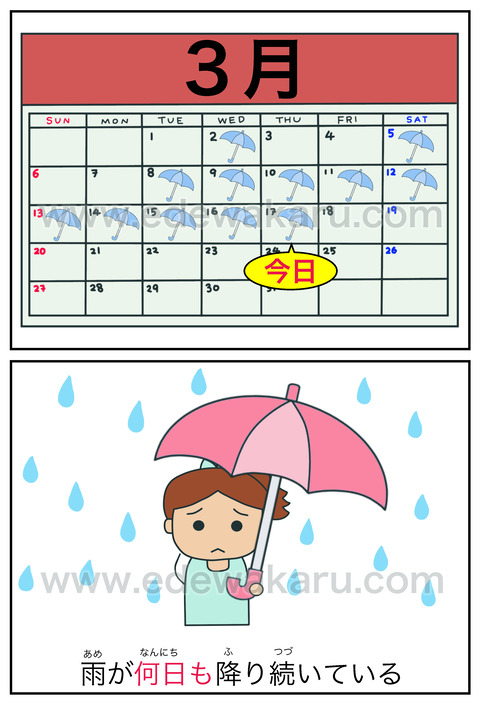
①雨が
何日も
降り続いている
=雨が
何日となく
降り続いている
②
何回も
北海道へ行ったことがある
=
何回となく
北海道へ行ったことがある
「なん+助数詞+も」は会話でもよく使いますので、しっかりと覚えておきましょう😉
In context 3 examples
雨が何日も降り続いている
→雨が降り続いている日が長い留学していたので、アメリカに何人も友達がいます
→留学していたので、アメリカにたくさん友達がいる(復習:「何人」の読み方は?)デパートで、何年も会っていなかった友達に会った
→デパートで、長い間会っていなかった友達に会った
IMABI
What & When
Read this IMABI lesson ↗Explanation
What & When
In this lesson, we will take a second yet closer look at the words for “what” and “when.” This time, we will look at how to express these words outside of polite speech, in which case some variation will have to be taken into consideration.
What?
“What?” in plain speech is なんだ. なに is rendered as なん because /ni/ assimilates to /n/ for ease of pronunciation. For both Ex. 1 and Ex. 2, the speaker is likely male, as it is rare for female speakers to utilize such direct, coarse tones.
1. 何なんだ?
What (do you want/is it)?
2. 何なんだよ!
What the heck?!
While Ex. 2 also shows irritation, which is amplified with the use of the particle よ, it is also evident that the question is largely rhetorical.
Of course, なん is the form of 何 used in polite speech, as です, which follows it, starts with the consonant /d/.
3. 趣味しゅみは何なんですか。
What are your hobbies?
4. お仕事しごとは何なんですか。
What is your job?
5. 神かみの王国おうこくとは何なんですか。
What is “God’s kingdom”?
It must be duly noted that なんだ is NOT limited to coarse male speech. Instead, you will see it used in the written language, especially when making philosophical questions. You can imagine sentences like Ex. 6 being spoken in slightly dramatic soliloquies.
6. 人間にんげんとは何なんだ?
What is mankind?
Another neat phrase that utilizes なん instead of なに is なんぞや. This utilizes archaic grammar, and so using it is done so to be dramatic.
7. 我われ1とは何なんぞや。
What am I?
In the speech of children and/or female speakers, なに tends to be dragged out, resulting in な~に, but this is not common in male speech. You may also encounterなんなの?, which adds more emphasis to getting an explanation.
Of course, it is worth noting that 何 is a noun, and as a noun, it may be used with case particles or used as the predicate as we have seen. As the predicate, however, it is rarely followed by the particle か. When it is, the question sounds rhetorical and/or narrative.
8. お土産みやげは何なにがいいですか。
What would be good for souvenirs?
9. あれって何なに?
What is that?
10. 津波つなみとは何なにか。
What is a tsunami?
With adverbial particles, なに may optionally undergo fortification in pronunciation, becoming rendered as なんに, and this is particularly so with も.
11. いや、な(ん)にもない。
Oh, no, it’s nothing.
12. 何なんにでも成なれるよ。
You can become anything.
In compounds, なん and なに are used differently2. なん is used with counter phrases to mean “how many…?” while なに is used to mean “what kind of…?”
13. 全部ぜんぶで何色なんしょくありますか。
In total, how many colors are there?
14. デンマークの国旗こっきは、22色使しょくつかわれている。
As for the national flag of Denmark, two colors are used.
15. 何色なにいろのペンキを買かったらいいですか。
What color paint should I buy?
16. 何色なにいろに見みえますか。
What color does it look like?
17. 日本にほんには全部ぜんぶで何県なんけん3ありますか。
In total, how many prefectures are there in Japan?
18. 竹島たけしまは何県なにけんにありますか。
What prefecture is Takeshima in?
19. 何部なにぶに所属しょぞくしてるの?
What club/department do you belong to?
20. 何部なんぶくらい作つくればいいですか。
About how many copies should I make?
21. 彼かれは何人なにじんですか。
What nationality is he?
22. 兄弟きょうだいは何人なんにんいますか。
How many siblings do you have?
なにで vs なんで
One rather difficult challenge presented by “what” that confuses students is the difference between なにで and なんで. The use of the particle で here is used to show means/method/composition. In this sense, なにで is almost always the reading used.
23. 口紅くちべにの色いろはなにで決きまる?
What determines the color of lipstick?
24. このジュースってなにで作つくったの?
What did you make this juice with?
25. 爪つめは何なにで出来できているの?
What are nails made of?
26. 入試にゅうしに出でる漢字かんじは、なにで勉強べんきょうすればいいですか。
What should I use to study with for the Kanji that appear in the entrance exam?
27. 構文こうぶんは何なにで勉強べんきょうすればいいんでしょうか。
What should I use to study with for sentence structure?
Pronunciation Note: なにで may still alternatively be heard pronounced as なんで. However, most speakers avoid this, as なんで typically means “why?”
28.
坂井さかい:「定村さだむらさん、いつ横浜支社よこはまししゃに行いきますか。」
定村さだむら:「水曜日すいようびに行いきます。」
坂井さかい:「{なにで・なんで}行いきますか。」
定村さだむら:「飛行機ひこうきで行きます。」
Sakai: Mr. Sadamura, when will you be going to the Yokohama office?
Sadamura: I’m going on Wednesday.
Sakai: [By what means/how] will you be going?
Sadamura: I’m going by plane.
There is a caveat to using なにで over the usual どうやって, and that it refers to the means of which an action is carried out.
29. なにで来きたの?
What did you use to get here?
30. どうやって来きたの?
How did you come?
Sentence Note. In Ex. 30, the question is open-ended enough for the listener to respond with something like “by camouflaging myself,” which would be an inappropriate response to Ex. 31.
31. なにを使つかって来きたの?
What did you use to come here?
Sentence Note: In Ex. 31, the question is out-of-place as a typical question one would ask in Japanese, but if you were to ask this to someone, you would inevitably get a smart-alecky reply on the lines of “by using my legs.”
In the same vein of thought, even when a verb primarily used for movement is used in a different sense, なにで・なんで can be seen, again, with なにで being most preferred.
32. さて、何で行いきますか。
Alright, what will we go with?
When
The three expressions that you will need to pay most attention to not confuse are いつ (when?), 何時 (what time?), and 何時間 (how many hours?).
33. いつ寝ねますか。
When do you go to sleep?
34. 何時間寝なんじかんねますか。
How many hours do you sleep?
35. 何時なんじに寝ねますか。
What time do you go to sleep?
36. 会議かいぎはいつ終おわりますか。
When does the meeting end?
37. 今日きょうは何時なんじに帰かえるの?
What time will you return home today?
38. 人類じんるいが火星かせいに行ぎょうけるようになるのはいつだろうか。
When will mankind become able to go to Mars, I wonder?
39. いつの間まにか眠ねむり込こんでいた。
I had fallen asleep before I knew it.
Phrase Note: いつの間にか is a set phrase meaning “before one knows it.”
Aside from these three basic expressions, there also exists いつ頃 (about when?) and いつなんどき (at any moment). いつなんどき is a highly emphatic form which is seldom used in literal questions. なんどき is an old-fashioned reading of 何時.
40. いつ頃完成ごろかんせいしますか。
About when will it be completed/you will complete it?
41. 今いま、何なんどきですか。はい、ラーメンどきよ!
What time is it? It’s ramen time!
Sentence Note: Ex. 41 is a line to an old ramen commercial. Here, なんどき is used to ask “what time is it” as in “what’s supposed to be going on?”
42. いつなんどき必要ひつようになるかも分からない。
I also have no clue when it’ll become needed.
43. (いつ)なんどき事故じこに遭あわないとも限かぎらない。
It is not necessarily the case that you will never get into an accident.
44. 水分補給すいぶんほきゅうはいつなんどきでも忘わすれないでください。
Don’t ever forget to be hydrated.
我 is the original word meaning “I” in Japanese, and it still manages to be used in set phrases. ↩︎
There is one exception in particular that must be noted, which is 何曜日 (what day of the week?). Although its traditional reading is なにようび, it is most frequently pronounced as なんようび. ↩︎
Most people will answer this question by giving the number of prefectures that are 県, excluding those that are 都道府. ↩︎
In context 43 examples
何なんだ?
What (do you want/is it)?
何なんだよ!
What the heck?!
趣味しゅみは何なんですか。
What are your hobbies?
お仕事しごとは何なんですか。
What is your job?
神かみの王国おうこくとは何なんですか。
What is “God’s kingdom”?
人間にんげんとは何なんだ?
What is mankind?
我われ1とは何なんぞや。
What am I?
お土産みやげは何なにがいいですか。
What would be good for souvenirs?
あれって何なに?
What is that?
津波つなみとは何なにか。
What is a tsunami?
いや、な(ん)にもない。
Oh, no, it’s nothing.
何なんにでも成なれるよ。
You can become anything.
全部ぜんぶで何色なんしょくありますか。
In total, how many colors are there?
デンマークの国旗こっきは、22色使しょくつかわれている。
As for the national flag of Denmark, two colors are used.
何色なにいろのペンキを買かったらいいですか。
What color paint should I buy?
何色なにいろに見みえますか。
What color does it look like?
日本にほんには全部ぜんぶで何県なんけん3ありますか。
In total, how many prefectures are there in Japan?
竹島たけしまは何県なにけんにありますか。
What prefecture is Takeshima in?
何部なにぶに所属しょぞくしてるの?
What club/department do you belong to?
何部なんぶくらい作つくればいいですか。
About how many copies should I make?
彼かれは何人なにじんですか。
What nationality is he?
兄弟きょうだいは何人なんにんいますか。
How many siblings do you have?
口紅くちべにの色いろはなにで決きまる?
What determines the color of lipstick?
このジュースってなにで作つくったの?
What did you make this juice with?
爪つめは何なにで出来できているの?
What are nails made of?
入試にゅうしに出でる漢字かんじは、なにで勉強べんきょうすればいいですか。
What should I use to study with for the Kanji that appear in the entrance exam?
構文こうぶんは何なにで勉強べんきょうすればいいんでしょうか。
What should I use to study with for sentence structure?
なにで来きたの?
What did you use to get here?
どうやって来きたの?
How did you come?
なにを使つかって来きたの?
What did you use to come here?
さて、何で行いきますか。
Alright, what will we go with?
いつ寝ねますか。
When do you go to sleep?
何時間寝なんじかんねますか。
How many hours do you sleep?
何時なんじに寝ねますか。
What time do you go to sleep?
会議かいぎはいつ終おわりますか。
When does the meeting end?
今日きょうは何時なんじに帰かえるの?
What time will you return home today?
人類じんるいが火星かせいに行ぎょうけるようになるのはいつだろうか。
When will mankind become able to go to Mars, I wonder?
いつの間まにか眠ねむり込こんでいた。
I had fallen asleep before I knew it.
いつ頃完成ごろかんせいしますか。
About when will it be completed/you will complete it?
今いま、何なんどきですか。はい、ラーメンどきよ!
What time is it? It’s ramen time!
いつなんどき必要ひつようになるかも分からない。
I also have no clue when it’ll become needed.
(いつ)なんどき事故じこに遭あわないとも限かぎらない。
It is not necessarily the case that you will never get into an accident.
水分補給すいぶんほきゅうはいつなんどきでも忘わすれないでください。
Don’t ever forget to be hydrated.
Bound Particles
Read this IMABI lesson ↗Explanation
第031課: Bound Particles
Bound particles (係助詞) might as well be called emphatic particles. Most of them have become adverbial and or final particles. Their functions range from emphatic to interrogative usages, and this is often determined by careful attention to context.
Bound particles require that the final verb phrase in their clause to be in a particular form. Most require the final verb phrase to be in the 連体形 because, as we’ve seen, that can make verbs function as nominalized phrases in Classical Japanese.
Though the particles discussed in this lesson may not be exhaustive in accounting for all such particles in Classical Japanese, it will enable you to have a decent understanding of the some times very complex grammar rules that go with them.
The particles to be discussed are the following:
Particle The Fixed Base Function(s) Final Usages?
は 終止形 Topic Marker Yes
も 終止形 Parallel listing Yes
や(は) 連体形 Doubt/question Yes
か(は) 連体形 Doubt/question Yes
ぞ 連体形 Emphasis Yes
なむ・なん 連体形 Emphasis Yes
こそ 已然形 Strong emphasis Yes
Grammar Note: These particles have such a strong role in binding sentences in a certain form that even in their absence, when other elements that would be used in concert with them are showing doubt or a rhetorical question, as is an important usage for particles like ぞ, なむ, や, and か, the sentence may still be seen bound in the 連体形. No wonder the 終止形 and 連体形 merged.
は
The particle は is as you should certainly know is extremely important in Modern Japanese. However, there was a point in time where it was not used, and it has taken centuries for the がVSは rivalry to get to its present form. In fact, the thing that rivaled は, which shows known information, was も, which could present new information. Where did this particle come from? It likely has origin with the particle ば, but it is certain that by the 平安時代 its usages had become greatly varied and increasingly more complex.
So, we know that it marks the topic. This topic is emphasized and often made distinct from other things, which is why we still often translate it into English with “as for”. This topic is what the explanation/predicate is going to be about. It can be used with parallel items to show comparison and or contrast. Of course, it still has the role of highlighting the negative.
As you saw from above, it can also be used with other bound particles, and it can also be used as a final particle. That’s right. Although modern orthography changes doesn’t make this obvious, the adverbial は and final particle わ of Modern Japanese are from the same thing. When it comes at the end, the verb has to go to the 連体形,which is the common trait for bound particles.
Grammar Note: Remember from previous lessons that は can attach to an adjective 連用形 or -ず to create a hypothetical situation, and ず+は often makes ず(ん)ば. Also remember that を+は = をば.
Examples
1. 古京はすでに荒れて、新都はいまだ成らず。
The old capital has already been ravaged, and the new capital has still not been materialized.
From the 方丈記.
2. 人妻尓 言者誰事 酢衣乃 此紐解跡 言者孰言 (原文)
人妻に言ふは誰たが言ことさ衣のこの紐解けと言ふは誰が言
Who calls for me, a married woman? Who says I untie the cords of my cloth and sleep together?
From the 万葉集.
3. 其願空しかるべくは、道にて死ぬべし。
If such a request proves hopeless, I shall die en route!
From the 平家物語.
4. なにもなにも小さきものはみなうつくし。
Of everything small things are particularly adorable.
From the 枕草子.
5. まろ格子上かうしげずば道なくてげにえ入いり来ざらまし。
If I hadn’t raised the lattice, there would’ve been no path and I would have not been able to come.
From the 源氏物語.
6. 法師ばかり羨ましからぬものはあらじ。
There is probably no less enviable than a monk.
From the 徒然草.
7. 火に焼かむに焼けずはこそ真まことならめ
When we try to burn it by fire and it cannot burn, it’s definitely the real thing.
From the 竹取物語.
8. かの花は失せにけるは。
That flower has ended up disappearing!
From the 枕草子.
9. とまらしなよもの時雨のふるさとゝなりにしならの霜のくちはゝ (原文)
とまらじな四方の時雨の古郷となりにしならの霜の朽ち葉は
It won’t stop. In Nara the showers pour every which way, and the oak leaves fall and rot in the dew.
From the 院百首.
Word Note: [降る里 and 古里] and [奈良 and 楢] are overlapped together respectively.
10. 古里となりにし奈良の都にも色はかはらず花は咲きけり。
Even in the old capital Nara, without change in color, the flowers had bloomed.
From the 古今和歌集.
11. 悪所に落ちては死にたからず。
We don’t want to die falling into a bad spot.
From the 平家物語.
12. 居明而 君乎者将待 奴婆珠能吾黒髪尓 霜者零騰文 (原文)
居明かして君をば待たむ烏珠ぬばたまの吾が黒髪に霜は降るとも
I will wait as is till dawn, no matter if the dew falls into my black hair.
From the 万葉集.
Base Note: Although we say that it is paired with the 終止形, there are sentences with it that are in the 命令形, where it is cut off in the 連用形, or ends in a nominal (体言止め). This is all still the case in Modern Japanese.
も
The particle も is like “too/also” and can show listing of things that are new information. Or, it shows that what it follows is not limited in the situation to it alone. In being such, も can be seen in adverbial phrases showing an outer limit or minimal desire, which it still does today.
13. 山川 水陰生 山草 不止妹 所念鴨 (原文)
山河の水陰みかげに生ふる山菅やますげの止やまずも妹がおもほゆるかも
Like the mountain sedge growing on the waterside in the mountain, I think of you nonstop.
From the 万葉集.
14. 限りなく遠くも来にけるかな。
How far we have come endlessly!
From the 伊勢物語.
15. 熟田津尓 船乗世武登 月待者 潮毛可奈比沼 今者許藝乞菜 (原文)
熟田津に船乗りせむと月待てば潮もかなひぬ、今は漕ぎ出でな
The tide too has improved while I waited for the moon while boarding in Nikita Harbor. I now sail!
From the 万葉集.
16. 長き御世にもあらなん
May (she) have long life!
From the 源氏物語.
17. 月だにも雲のいづくに夏の夜のやみはあやなし曙の空。
Even the moon somewhere in the clouds colors the darkness of the summer night–daybreak.
From 順徳院.
18. 京極の屋の南むきに、今も二本侍るめり。
There are apparently two trees still on the south side of the Kyogoku residence.
From the 徒然草.
19. 花ちれる水のまにまにとめくれば山には春もなくなりにけり。
When the flowers scattered afloat the river, spring ended went away in the mountains.
From the 古今和歌集.
も can be very emotive, and it was used as a final particle in the 奈良時代.
20. 冨等登藝須 奈保毛奈賀那牟 母等都比等 可氣都々母等奈 安乎祢之奈久母 (原文)
霍公鳥 なほも鳴かなむ 本つ人 かけつつもとな 吾を音し泣くも
Oh cuckoo cry still; I think of the person passed away and in that vestige I cry and weep.
From the 万葉集.
21. 樂浪乃 國都美神乃 浦佐備而 荒有京 見者悲毛 (原文)
楽浪の 国つ御神の うらさびて 荒れたる都 見れば悲しも
The heart of the kami of Sasanami has withered, and the ravaged capital ruins are sad to behold.
From the 万葉集.
When in もぞ and もこそ, it can show that something can’t be–するといけない.
22. 烏などもこそ、見つくれ。
It must not be that something like a crow would find it.
From the 源氏物語.
23. 玉の緒よ 絶えなば絶えね ながらへば 忍ぶることの 弱りもぞする。
If this life shall cease, may it cease. If I live on like this, my secret love will be known to all.
From the 新古今和歌集.
や(は)
や(は) can show doubt and (rhetorical) question. When in the middle of a sentence it no doubts binds the final verb in the 連体形. However, as will be evident in the examples, the 終止形 can indeed be used when や is in the final position of a clause.
24. 龍田河もみぢみだれて流るめり渡らば錦なかや絶えなむ
The Tatsuda River seems to flow with colored leaves. If I cross, the brocade may be severed in half.
From the 古今和歌集.
25. 忘哉 語 意遣 雖過不過 猶戀
忘るやと物語りして心遣り過ぐせど過ぎずなほ恋ひにけり
Wondering if I would forget, I avert my mind with gossip, but I still can’t go by my love (for you).
From the 万葉集.
26. 冬ながら空より花の散りくるは雲のあなたは春にやあるらむ。
As for flowers falling from the sky while it’s winter, does that mean spring is beyond the clouds?
From the 古今和歌集.
27. 宵のまに身を投げはつる夏虫は燃えてや人に逢ふと聞きけむ。
I wonder if the summer bugs that burned in the night heard they could meet their loved ones by throwing themselves into the flames?
From the 伊勢物語.
28. 秋の田の穂の上を照らす稲妻の光の間にも我や忘るる。
I will not forget you even when lightning brightens the tops of the ears of rice in the autumn field.
From the 古今和歌集.
29. さくら花春くははれる年だにも人の心に飽かれやはせぬ。
Cherry blossom, even in years when spring is long, would you scatter without having satisfied man? Bloom to your heart’s desire!
From the 古今和歌集.
Grammar Note: やは…~ぬ = Why don’t you… (showing want of the speaker as well)
30. 光やあると見るに、蛍ばかりの光だになし。
When she looked wondering if there were light, there wasn’t even the light of a firefly.
From the 竹取物語.
31. 古 人尓和礼有哉 樂浪乃 故京乎 見者悲寸 (原文)
古の 人に我れあれや 楽浪の 古き都を 見れば悲しき
Aren’t I not a person of the old; when I look at the old capital of Sasanami, I’m sad without reason.
From the 万葉集.
Grammar Note: や can also be after 已然形 to show a rhetorical question directed at oneself.
32. うちはへて春はさばかりのどけきを花の心や何いそぐらむ
Although spring is calm like this every day, why do the hearts of the flowers hurry and try to scatter?
From the 後撰和歌集.
Word Note: うちはえて comes from a verb with the meaning of stringing along a rope and is used here adverbially to express continuing to be so.
33. 多知之奈布 伎美我須我多乎 和須礼受波 与能可藝里尓夜 故非和多里奈無 (原文)
立ちしなふ君が姿を忘れずは世の限りにや恋い渡りなむ。
Without forgetting your great appearance will certainly go on loving you all my life.
From the 万葉集.
Grammar Note: This なむ is the 未然形 of the auxiliary ~ぬ + the volitional auxiliary ~む.
34. 保等登藝須 許々尓知可久乎 伎奈伎弖余 須疑奈<无>能知尓 之流志安良米夜母 (原文)
霍公鳥 ここに近くを 来鳴きてよ 過ぎなむ後に 験あらめやも
Cuckoo come cry closer. Now that after you pass by, is this not an omen?
From the 万葉集.
Grammar Note: ~めやも is a combination of the auxiliary ~む, which shows conjecture in this pattern, and the bound particles や and も. The pattern is used to rhetorically bring up conjecture or well with an added sense of exclamation and is equivalent to ~だろうか、いや、そんなことはないなあ.
Variant Note: This can be seen as やも in the 奈良時代.
35. 士也母 空応有 萬代尓 語続可 名者不立之而 (原文)
士やも 空しかるべき 万代に 語り継ぐべき 名は立てずして
Should a man end in vain? Without his name passed down for generations?
From the 万葉集.
Warning Note: Do not confuse this with the interjectory particle や.
か(は)
The bound particle か(は) may also show doubt and (rhetorical) question. かは was also originally かも in the 奈良時代. When in the middle or at the end of a sentence, it requires that the final verb be in the 連体形.
36. 幾世へてのちか忘れむ散りぬべき野辺の秋萩みがく月夜を
Will you forget years later? (Show) the moonlit night upon the autumn clover covered field.
From the 後撰和歌集.
37. いづれの山か天に近き。
Which mountain is closest to the heavens?
From the 竹取物語.
38. 何をか奉らむ。
What shall I give you?
From the 更級日記.
39. 安之我良乃 夜敝也麻故要弖 伊麻之奈波 多礼乎可伎美等 弥都々志努波牟 (原文)
足柄の 八重山越えて いましなば 誰れをか君と 見つつ偲はむ
When you pass over the eight folds of mountains in Ashigara, who will we look at to remember you?
From the 万葉集.
40. くひなのたたくなど、心細からぬかは。
At such times when the marsh hen knocks, are people free of uncertainty?
From the 徒然草.
41. 何事ぞや。童べと、腹だち給へるか。
What happened? Did you quarrel with the children?
From the 源氏物語.
ぞ
The particle ぞ is quite emphatic as it is in Modern Japanese and originally started out as そ. It often shows anxiety and when it is at the end of a sentence, depending on the context, it can either show a strong declaration or a strong question. It is often at the end of a sentence preceded by the citation particle と with a verb such as 言ふ implying that the said verb is there in the 連体形 as it would otherwise stipulate given that it is a bound particle.
Particle Note: ぞ frequently follows case, adverbial, and conjunctive particles to emphasize their roles.
Examples
42. 人はいさ心もしらずふるさとは花ぞ昔の香ににほひける
You know not the feelings of others, but at home, the flowers smell the same as in the past.
From the 古今和歌集.
43. みな鎧の袖をぞぬらしける。
Everyone wet the sleeves of their armor!
From the 平家物語.
44. なく雁のねをのみぞ聞くをぐら山霧たちはるる時しなければ
All I hear are the cries of geese! That’s because the mist never clears at Mount Ogura.
From the 新古今和歌集.
45. 吉野なる夏実の川の川淀に鴨ぞ鳴くなる山影にして
In the pool of the Natsumi River in Yoshino, the ducks are singing hidden in the mountain’s shadow.
From the 万葉集.
46. 門よくさしてよ。雨もぞ降る。
Close the gate well! It might rain!
From the 徒然草.
47. 見る人もなき山里の桜花ほかの散りなむのちぞ咲かまし。
Cherry blossoms, in the mountain village with no one to see you, if you could bloom after all else has, that would be good…
From the 古今和歌集.
48. 人所見 表結 人不見 裏紐開 戀日太 (原文)
人に見ゆる上は結びて人に見えぬ下紐したひも開けて恋こふる日ぞ多き
Doing the cord of the coat that people can see but opening the cord of the underclothes that people can’t see, the days that I long are many!
From the 万葉集.
49. あれは、何ものぞ。
Who is that?
From the 平家物語.
50. 川霧のふもとをこめて立ちぬれば空にぞ秋の山は見えける。
Since the river midst has shrouded the base, the mountain of autumn appeared to float in the sky.
From 宇治拾遺物語.
51. 飼ひける犬の、暗けれど主を知りて飛び付きたりけるとぞ。
They say that the dog that he had raised, though it was dark, knew his master jumped on him.
From the 徒然草.
52. 恋しとはたが名づけけむことならむ死ぬとぞただに言ふべかりける。
“Longing” is surely a word someone named. “To ie”, though, should have never been coined.
From the 古今和歌集.
Historical Note: ぞ actually started out as a final particle but acquired bound particle usages in becoming more emphatic.
なむ・なん
The particle なむ・なん shows emphasis and like ぞ it can be after the citation と with a verb in the 連体形 abbreviated such as 言ふ. The particle first started out in the form なも. It quickly became associated with casual speech and was frequently used in dialogues and stories.
53. 橋を八つわたせるによりてなむ八橋といひける。
It is exactly because they laid eight bridges that they call it Eight Bridges.
From the 伊勢物語.
54. 物なん心ぼそくおぼゆる。
Everything seems so depressing.
From the 竹取物語.
55. もののあはれも知らずなりゆくなん、浅ましき。
Sure enough, one becomes no longer aware of the pathos of things. How base!
From the 徒然草.
56. ただ今なむ、聞きつけ侍る。
I heard about it just now!
From the 源氏物語.
Particle Note: Although the bound particle なむ is rarely seen at the end of a sentence, when it is, it should not be confused with the desiderative final particle なむ, which means “I wish that…” and attaches to the 未然形. Perhaps it is this exact confusion that resulted in it rarely being at the end. When no verb is at the end of a sentence, though, it appears. After all, the source of confusion, connecting to a verb, is deleted.
57. 舞人を宿せる仮屋より出で来たりけるとなん。
Sure enough, it’s said that (the fire) came from the temporary dwelling housing the dancers.
From the 方丈記.
こそ
こそ creates strong emphasis and when in the middle of the sentence it binds the end into the 已然形. It’s often at the end of a sentence, but it is normally not directly preceded by a verb, so the form that is preceded by it is determined from the rest of the sentence. This can get tricky, which is the lovely trait that bound particles have when they’re not in the middle of a sentence.
Like the others, it can be at the end of a sentence where the final verb is dropped, leaving it to imply the verb that is dropped. It can also show hailing after a person’s name. This is just an application of its overall use of showing strong emphasis. This, strong emphasis, though, may at times show a concession. This can be determined when the two clauses, the one with こそ and the one that follows, seem to be counter to each other. You wouldn’t, then, interpret the particle as meaning “certainly” but “although”. Even still, the same degree of emphasis is maintained.
Exercises
58. 大かた、萬のしわざは止めて、暇あるこそ、めやすく、あらまほしけれ。
It is generally desirable and seemly to quit one’s myriad of doings and have leisure.
From the 徒然草.
59. さらにこそ信ぜられね。
I absolutely cannot believe it!
From the 大鏡.
60. みつ潮のながれひる間を逢ひがたみみるめの浦に夜をこそ待て。
Since meeting is hard until the tide dries, I will wait through the night to meet you at Mirume Bay.
From the 古今和歌集.
61. 敵にあふてこそ死にたけれ。悪所に落ちては死にたからず。
We want to die facing the enemy! We don’t want to die falling in a bad spot.
From the 平家物語.
62. これは龍のしわざにこそありけれ。
This was definitely the doing of a dragon.
From the 竹取物語.
In context 62 examples
古京はすでに荒れて、新都はいまだ成らず。
The old capital has already been ravaged, and the new capital has still not been materialized.
人妻尓 言者誰事 酢衣乃 此紐解跡 言者孰言 (原文)
其願空しかるべくは、道にて死ぬべし。
If such a request proves hopeless, I shall die en route!
なにもなにも小さきものはみなうつくし。
Of everything small things are particularly adorable.
まろ格子上かうしげずば道なくてげにえ入いり来ざらまし。
If I hadn’t raised the lattice, there would’ve been no path and I would have not been able to come.
法師ばかり羨ましからぬものはあらじ。
There is probably no less enviable than a monk.
火に焼かむに焼けずはこそ真まことならめ
When we try to burn it by fire and it cannot burn, it’s definitely the real thing.
かの花は失せにけるは。
That flower has ended up disappearing!
とまらしなよもの時雨のふるさとゝなりにしならの霜のくちはゝ (原文)
古里となりにし奈良の都にも色はかはらず花は咲きけり。
Even in the old capital Nara, without change in color, the flowers had bloomed.
悪所に落ちては死にたからず。
We don’t want to die falling into a bad spot.
居明而 君乎者将待 奴婆珠能吾黒髪尓 霜者零騰文 (原文)
山川 水陰生 山草 不止妹 所念鴨 (原文)
限りなく遠くも来にけるかな。
How far we have come endlessly!
熟田津尓 船乗世武登 月待者 潮毛可奈比沼 今者許藝乞菜 (原文)
長き御世にもあらなん
May (she) have long life!
月だにも雲のいづくに夏の夜のやみはあやなし曙の空。
Even the moon somewhere in the clouds colors the darkness of the summer night–daybreak.
京極の屋の南むきに、今も二本侍るめり。
There are apparently two trees still on the south side of the Kyogoku residence.
花ちれる水のまにまにとめくれば山には春もなくなりにけり。
When the flowers scattered afloat the river, spring ended went away in the mountains.
冨等登藝須 奈保毛奈賀那牟 母等都比等 可氣都々母等奈 安乎祢之奈久母 (原文)
樂浪乃 國都美神乃 浦佐備而 荒有京 見者悲毛 (原文)
烏などもこそ、見つくれ。
It must not be that something like a crow would find it.
玉の緒よ 絶えなば絶えね ながらへば 忍ぶることの 弱りもぞする。
If this life shall cease, may it cease. If I live on like this, my secret love will be known to all.
龍田河もみぢみだれて流るめり渡らば錦なかや絶えなむ
The Tatsuda River seems to flow with colored leaves. If I cross, the brocade may be severed in half.
忘哉 語 意遣 雖過不過 猶戀
冬ながら空より花の散りくるは雲のあなたは春にやあるらむ。
As for flowers falling from the sky while it’s winter, does that mean spring is beyond the clouds?
宵のまに身を投げはつる夏虫は燃えてや人に逢ふと聞きけむ。
I wonder if the summer bugs that burned in the night heard they could meet their loved ones by throwing themselves into the flames?
秋の田の穂の上を照らす稲妻の光の間にも我や忘るる。
I will not forget you even when lightning brightens the tops of the ears of rice in the autumn field.
さくら花春くははれる年だにも人の心に飽かれやはせぬ。
Cherry blossom, even in years when spring is long, would you scatter without having satisfied man? Bloom to your heart’s desire!
光やあると見るに、蛍ばかりの光だになし。
When she looked wondering if there were light, there wasn’t even the light of a firefly.
古 人尓和礼有哉 樂浪乃 故京乎 見者悲寸 (原文)
うちはへて春はさばかりのどけきを花の心や何いそぐらむ
Although spring is calm like this every day, why do the hearts of the flowers hurry and try to scatter?
多知之奈布 伎美我須我多乎 和須礼受波 与能可藝里尓夜 故非和多里奈無 (原文)
保等登藝須 許々尓知可久乎 伎奈伎弖余 須疑奈<无>能知尓 之流志安良米夜母 (原文)
士也母 空応有 萬代尓 語続可 名者不立之而 (原文)
幾世へてのちか忘れむ散りぬべき野辺の秋萩みがく月夜を
Will you forget years later? (Show) the moonlit night upon the autumn clover covered field.
いづれの山か天に近き。
Which mountain is closest to the heavens?
何をか奉らむ。
What shall I give you?
安之我良乃 夜敝也麻故要弖 伊麻之奈波 多礼乎可伎美等 弥都々志努波牟 (原文)
くひなのたたくなど、心細からぬかは。
At such times when the marsh hen knocks, are people free of uncertainty?
何事ぞや。童べと、腹だち給へるか。
What happened? Did you quarrel with the children?
人はいさ心もしらずふるさとは花ぞ昔の香ににほひける
You know not the feelings of others, but at home, the flowers smell the same as in the past.
みな鎧の袖をぞぬらしける。
Everyone wet the sleeves of their armor!
なく雁のねをのみぞ聞くをぐら山霧たちはるる時しなければ
All I hear are the cries of geese! That’s because the mist never clears at Mount Ogura.
吉野なる夏実の川の川淀に鴨ぞ鳴くなる山影にして
In the pool of the Natsumi River in Yoshino, the ducks are singing hidden in the mountain’s shadow.
門よくさしてよ。雨もぞ降る。
Close the gate well! It might rain!
見る人もなき山里の桜花ほかの散りなむのちぞ咲かまし。
Cherry blossoms, in the mountain village with no one to see you, if you could bloom after all else has, that would be good…
人所見 表結 人不見 裏紐開 戀日太 (原文)
あれは、何ものぞ。
Who is that?
川霧のふもとをこめて立ちぬれば空にぞ秋の山は見えける。
Since the river midst has shrouded the base, the mountain of autumn appeared to float in the sky.
飼ひける犬の、暗けれど主を知りて飛び付きたりけるとぞ。
They say that the dog that he had raised, though it was dark, knew his master jumped on him.
恋しとはたが名づけけむことならむ死ぬとぞただに言ふべかりける。
“Longing” is surely a word someone named. “To ie”, though, should have never been coined.
橋を八つわたせるによりてなむ八橋といひける。
It is exactly because they laid eight bridges that they call it Eight Bridges.
物なん心ぼそくおぼゆる。
Everything seems so depressing.
もののあはれも知らずなりゆくなん、浅ましき。
Sure enough, one becomes no longer aware of the pathos of things. How base!
ただ今なむ、聞きつけ侍る。
I heard about it just now!
舞人を宿せる仮屋より出で来たりけるとなん。
Sure enough, it’s said that (the fire) came from the temporary dwelling housing the dancers.
大かた、萬のしわざは止めて、暇あるこそ、めやすく、あらまほしけれ。
It is generally desirable and seemly to quit one’s myriad of doings and have leisure.
さらにこそ信ぜられね。
I absolutely cannot believe it!
みつ潮のながれひる間を逢ひがたみみるめの浦に夜をこそ待て。
Since meeting is hard until the tide dries, I will wait through the night to meet you at Mirume Bay.
敵にあふてこそ死にたけれ。悪所に落ちては死にたからず。
We want to die facing the enemy! We don’t want to die falling in a bad spot.
これは龍のしわざにこそありけれ。
This was definitely the doing of a dragon.
Bunpro Grammar Reference
Meaning
Some, Several, A few
How to use it
何 + Counter + か
いく + Counter + か
いくつか
Nuance
A common phrase used when exactly what amount of (A) is uncertain, so a rough estimate of several or some is given.
Explanation
The expression なん + counter + か in Japanese is a way of highlighting an uncertain number of something, and comes across similarly to 'some', 'several', or 'a few' in English. Literally, the meaning is much closer to 'what + counter + I wonder?', as it shows the speaker's uncertainty about the number.
そこには何回か行ったことがあると思う。
I think I have been there several times.
ごめん、紙を何枚かちょうだい。
Sorry, may I have some paper?
In addition to なん; いく, from the kanji 幾 (how many/much) may be used as part of this construction. While both are fairly common, 幾 is more common as part of set expressions, like 幾ら (how much) and 幾つ (how many/old), while なん is more common for counting specific things, like people.
この車はいくらですか?
How much is this car?
マリちゃんは幾つになったの?
How old did Mari-chan turn?
Both 何 and 幾 are regularly seen in plain hiragana and their kanji forms, so it is worth remembering both.
Caution
Despite having the same kanji as 何, なん will almost always be used to count things, while なに will be used to identify things.
いらない本を何冊か妹にあげた。
I gave several books that I didn't need to my sister.
お前は何者だ!
Who are you! (What kind of person are you)
Nuance · 日本語
(A)の正確な量が不明な時などに、いくつあるか、という大体の量の目安をつけるために使われる表現。
In context 18 examples
- このアニメのなん話かを見たと思う。
I think I have seen a few episodes of this anime.
- この車はいくらですか?
How much is this car?
- マリちゃんは幾つになったの?
How old did Mari-chan turn?
- ごめん、紙を何枚かちょうだい。
Sorry, may I have some paper?
- そこには何回か行ったことがあると思う。
I think I have been there several times.
- 昨日なん台かの車が盗まれたらしい。
I heard that several (some) cars were stolen yesterday.
- 選手のなん人かが負傷した。
Some athletes were wounded.
- なん冊かの本が山のように床に積まれていた。
Some books were piled on the floor like a mountain.
- なん本かの高級な木の幹を製材所に届けた。
I sent some high grade tree trunks to the sawmill.
- 彼はなん匹かの猫を撫でるように命じられた。
He was ordered to pet several (some) cats.
- 彼らの写真をなん枚か撮れてよかった。
I am glad that I was able to take a few photos of them.
- 彼女はいくつかの言語をペラペラ話せるようになった。
She reached a point where she could speak in several languages fluently.
- 紙をなん枚か持って行かなくちゃいけない。
I need to bring a few sheets of paper.
- なん回か電話が鳴ったけど、少しも構わない。
The phone rang several (a few) times, but I don't give a damn about it.
- あたしでもときどきなん本かの花とかもらいたいわよ。
Even I want to get some flowers or something from time to time!
- このビルのなん階かはもう使用されているみたい。
It seems like a few floors of this building are already being utilized.
- いらない本を何冊か妹にあげた。
I gave several books that I didn't need to my sister.
- お前は何者だ!
Who are you! (What kind of person are you)