文法
Meaning
〜すること(しないこと)を、相手に助言する表現。
そうしなかったら悪いことが起こると助言や忠告をするときに使う。
How to use it
V(た形) + ほうがいい
V(ナイ形) + ほうがいい
In context 15 examples
疲れているとき、早く寝たほうがいいよ。
大切な試験の日は早く家を出たほうがいい。
健康のために、できるだけ運動したほうがいい。
肉だけじゃなく、野菜も食べたほうがいいですよ。
毎日、少しずつ単語を覚えたほうがいいよ。
君はもっと勉強したほうがいいよ。
熱があるから、今日はゆっくり休んだほうがいいよ。
習ったことは、その日のうちに復習したほうがいいよ。
悪いことをしたら、素直に謝ったほうがいいよ。
ここらへんは滑りやすいから、気をつけたほうがいいよ。
いくら考えてもわからないなら、先生に相談したほうがいいよ。
これはちょっとグロテスクな映画なので、苦手なら見ないほうがいいよ
今日は雨が降るらしいから、傘を持っていったほうがいいよ。
そっちは危ないから行かないほうがいいよ。
そのプリン、たぶん賞味期限が切れてるから食べないほうがいいよ。
DoJG 日本語文法辞典(全集)
Meaning
Had better do something
How to use it
Vinformal past | ほうがいい | |
| 話したほうがいい | Had better talk |
| 食べたほうがいい | Had better eat |
Explanation
It is strongly suggested that someone do something.
In context 4 examples
日本語の本を読んだほうがいい・いいです。
You'd better read Japanese books.
野菜も食べたほうがいいよ。
You'd better eat vegetables, too.
もう帰ったほうがいいですか。
Had I better go home now?
和子はもっと英語を勉強したほうがいいね。
Kazuko had better study English harder.
絵でわかる日本語
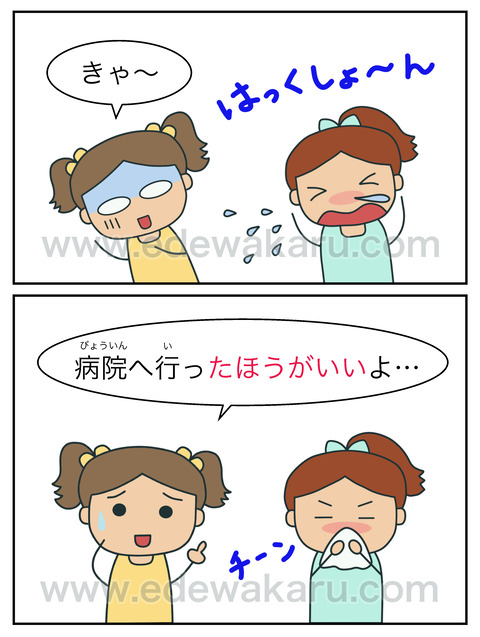
Meaning
〜するべきだ
How to use it
動詞[辞書形]+ほうがいい
動詞[た形]+ほうがいい
動詞[ない形]+ほうがいい
Explanation
「〜ほうがいい」は相手に「〜するべきだ」というように、忠告やアドバイスをする時に使う文型です。【辞書形】を使う場合と【た形】を使う場合はほとんど同じ意味ですが、「〜たほうがいい」の形の方がよく使われると思います😊また
【なかった形】には使いませんので気をつけましょう
😮
[例]
⭕️行く
ほうがいい
よ
⭕️行った
ほうがいい
よ
⭕️行かないほうがいいよ
❌行かなかったほうがいいよ
「〜ほうがいい」は初級で勉強する文型ですが、日常会話(にちじょうかいわ)でとてもよく使います。しっかりと復習しておきましょう😉
In context 4 examples
病院へ行ったほうがいいよ
→病院へ行くべきだよ(復習:〜べきだ)お肉だけじゃなくて、野菜も食べたほうがいいよ
→お肉だけじゃなくて、野菜も食べるべきだよ(復習:〜ちゃ・〜じゃ)今日は傘を持ってったほうがいいかな…
→今日は傘を持っていくべきかな…(復習:〜てく)(復習:〜かな・〜かしら(口語形))(復習:〜かな・〜かしら(文法))彼は口が軽いから教えないほうがいいよ
→彼は口が軽いから教えるべきではないよ(復習:口が軽い)
毎日のんびり日本語教師
How to use it
動た形+ほうがいい
動ない形+ほうがいい
名詞+の+ほうがいい
い形容詞原形+ほうがいい
な形容詞+な+ほうがいい
(動辞形+ほうがいい)
Explanation
話者の主観的な判断によるアドバイスや提案を表す文法です。したがって目上の人に使うことはできません。
稀に動辞形にも接続することもありますが(7)、動詞の場合は基本的に動た形あるいは動ない形に接続されます。
前にはよく比較の「~より」が呼応します。
Notes
似ている文法「~ほうがよかった」
似ている文法「~ほうがましだ」
In context 10 examples
体調が悪いなら休んだ方がいい。
危ないから下手に触らないほうがいい。(很危险所以不要随意触摸比较好。)
健康のためにタバコは止めたほうが良い。
澄ましているよりも笑顔のほうがいいよ。
健全な育成のために、親は子供を束縛せず自由にさせたほうがいい。
将来の選択肢は多い方がいい。
明日は忙しいので、今日行くほうがいいです。
恋人にするなら年下よりも年上のほうがいい。
国家間で争うよりも当然平和なほうがいい。
神様なんていないほうがいい。
NINJAL 日本語文型データベース
Meaning
聞き手に〜するように勧めたり、忠告したりするときに使います。〜しなければ悪い結果になるかもしれないという意味で言うことが多いです。
How to use it
Vたほうがいい/Vないほうがいい
Notes
文末を言い切る形は忠告の意味合いが強くなるので、立場が上の人に使うと失礼に感じられます。「〜と思います・〜かもしれません・〜そうですよ」などの表現を使って、間接的な表現にすれば、立場が上の人にも使えます。
In context 8 examples
山登りをする前に、ちゃんとルートを確認しておいたほうがいいですよ。
若いときは、いろいろなことにチャレンジしたほうがいいと思う。
「夕方から降るって。傘を持っていったほうがよさそうだよ」
「まだコスト面の問題が十分解決されていませんよね。新商品の発売はしばらく見合わせたほうがいいんじゃないでしょうか」
疲れているときはあまり無理をしないほうがいい。
「体に悪いから、あまりお酒を飲みすぎないほうがいいよ」
光の刺激で眠れなくなるので、寝る前はパソコンやスマートフォンの画面をあまり見ないほうがいいそうです。
「このヨーグルト、賞味期限が1週間前なんだけど、食べても大丈夫かな」「悪くなっているかもしれないから食べない方がいいんじゃない?」
IMABI
Best That
Read this IMABI lesson ↗Explanation
Best That: ~方 Patterns & ~に越したことはない
For some reason, students are compelled to use the word 方 excessively.
Best/Better That
方がいい means “best to…” and with verbs, you should use the past tense, and with adjectives or the negative, you should use the non-past tense. However, this can still be used with the non-past of verbs, and いい can be replaced with phrases like 賢明だ (wise).
~方がいい is used in the written and spoken language. It is often used in daily conversation, but it is often used by Japanese learners when giving suggestions/advice, which may lead some Japanese to smirk.
Non-past +方がいい is primarily used with one’s in-group as it is used a lot in situations where you are giving direct advice on what is best to do. Past+方がいい is felt to be more euphemistic and is often used towards one’s out-group. However, some people have personal preferences for one or the other.
1. 今すぐ行った方がいいです。
It’d be best to go right now.
2. 寝た方がいい。
It’s best to sleep.
3. よく考えた方がいい。
You’d better think that over.
4. 泳ぐ前に、日焼ひやけ止どめを塗ぬった方がいいよ。
It’s best to put on sunblock before swimming.
5. 卵たまごは食べない方がいい。 (Contrasting and or highlighting)
It’s best to not eat eggs.
6. {ほとんどの}わずかな店みせしか開いていないから、今食品を買った方がいい。
Since there are only but a few stores that are open, it’s best to buy food now.
7. 彼はそこへ行った方がよい。
It is best for him to go there.
8. 毎日運動した方がいい。
It’s best to exercise every day.
Nuance Note: Even when there is not a second reference mentioned, this pattern implies a comparison between things. It may sound pushy depending on the context as it can be used to impose your will/thought. When you want to make a simple suggestion, you can use ~たらいい.
Again, other things than just いい may also appear in this fashion.
9. 当人に会って直接に話し合った方が効果こうかはあると思います。
I think that it is effective to meet with the said person and directly talk together (about it).
Non-Past + 方がいい
It is also worth noting that when you use the pattern “Non-past+方がいい”, there could be several things that are good to do in the said situation, but you pick one as an example of being good.
10. 折りにふれて想起そうきするほうがいい。
Occasionally, it is good to call it to mind.
~がよい
~がよい can create a suggestion bordering on a command, and it uses older grammar by just directly following verbs without the need of a nominalizer like の.
11. そうするがよい。
You had better do it.
~方: How to…
Following the stem of a verb, ~方かた means “how to…”. Sometimes this may not show up in translation. For instance, 読み方 may very well be able to be translated as “how to read,” but it can also be sufficiently translated as “reading” depending on context.
12. 弟の笑い方が気に食わねー。(Slang)
I can’t stand the way my little brother smiles.
13. 日本語の書き方をよく知っていますか。
Do you know how to write Japanese well?14. 行き方が全く分からない。
I don’t know the way to go at all.
15. どの読み方を使うべきかは分かりません。
I don’t know which reading I’m supposed to use.
16. 本当に酷ひどい言い方だよ。
That’s a hideous way to talk.
17. しかたがありません。(Set Phrase)
It can’t be helped.
18. 簡単な覚え方を教えてくださいませんか。
Could you teach me an easy way to remember?
~に越したことはないが
~に越こしたことはない(が) means “can never…too much” and is used in giving common sense advice. The verb 越す has meanings all related to the idea of “surpassing”. This phrase is used to show that nothing beats doing X. So, when young people use it in certain situations, it can make them sound arrogant.
If turned into ~に越したことはなかった, you end up showing regret. This is because you recognize what was the best thing to do, but you didn’t do it. This directly follows verbs and adjectives, but for adjectival nouns, the copula is either as である or not there at all (which is most common).
19. 傘かさを持つに越したことはない。
It’s always best to have an umbrella.
20. 貯金をするに越したことはなかったが、ちょっと生活を楽しむことができた。
Nothing would have beat saving, but I got to enjoy life a little.
21. 用心ようじんに越したことはないが、そんな服装を着るなんて派手はですぎるじゃない?
You can never be too careful, but isn’t wearing an outfit like that too showy?
In context 20 examples
今すぐ行った方がいいです。
It’d be best to go right now.
寝た方がいい。
It’s best to sleep.
よく考えた方がいい。
You’d better think that over.
泳ぐ前に、日焼ひやけ止どめを塗ぬった方がいいよ。
It’s best to put on sunblock before swimming.
卵たまごは食べない方がいい。 (Contrasting and or highlighting)
It’s best to not eat eggs.
{ほとんどの}わずかな店みせしか開いていないから、今食品を買った方がいい。
Since there are only but a few stores that are open, it’s best to buy food now.
彼はそこへ行った方がよい。
It is best for him to go there.
毎日運動した方がいい。
It’s best to exercise every day.
当人に会って直接に話し合った方が効果こうかはあると思います。
I think that it is effective to meet with the said person and directly talk together (about it).
折りにふれて想起そうきするほうがいい。
Occasionally, it is good to call it to mind.
そうするがよい。
You had better do it.
弟の笑い方が気に食わねー。(Slang)
I can’t stand the way my little brother smiles.
日本語の書き方をよく知っていますか。
どの読み方を使うべきかは分かりません。
I don’t know which reading I’m supposed to use.
本当に酷ひどい言い方だよ。
That’s a hideous way to talk.
しかたがありません。(Set Phrase)
It can’t be helped.
簡単な覚え方を教えてくださいませんか。
Could you teach me an easy way to remember?
傘かさを持つに越したことはない。
It’s always best to have an umbrella.
貯金をするに越したことはなかったが、ちょっと生活を楽しむことができた。
Nothing would have beat saving, but I got to enjoy life a little.
用心ようじんに越したことはないが、そんな服装を着るなんて派手はですぎるじゃない?
You can never be too careful, but isn’t wearing an outfit like that too showy?
日本語NET JLPT文法解説まとめ
Meaning
〜すること(しないこと)を、相手に助言する表現。
そうしなかったら悪いことが起こると助言や忠告をするときに使う。
How to use it
V(た形) + ほうがいい
V(ナイ形) + ほうがいい
Explanation
"had better"
Express an advice or recommendation.
Used to advise or giving warning that something bad will happen if you don't.
In context 22 examples
疲れているとき、早く寝たほうがいいよ。
大切な試験の日は早く家を出たほうがいい。
健康のために、できるだけ運動したほうがいい。
肉だけじゃなく、野菜も食べたほうがいいですよ。
毎日、少しずつ単語を覚えたほうがいいよ。
君はもっと勉強したほうがいいよ。
熱があるから、今日はゆっくり休んだほうがいいよ。
習ったことは、その日のうちに復習したほうがいいよ。
悪いことをしたら、素直に謝ったほうがいいよ。
ここらへんは滑りやすいから、気をつけたほうがいいよ。
いくら考えてもわからないなら、先生に相談したほうがいいよ。
これはちょっとグロテスクな映画なので、苦手なら見ないほうがいいよ。
今日は雨が降るらしいから、傘を持っていったほうがいいよ。
そっちは危ないから行かないほうがいいよ。
そのプリン、たぶん賞味期限が切れてるから食べないほうがいいよ。
タバコは吸いすぎないほうがいいよ。
無理をしないほうがいいですよ。
あまり冷たいものは飲まないほうがいいですよ。
水で冷やしたほうがいいですよ。
ここで、その話はしないほうがいいよ。
その椅子は汚れているから、座らないほうがいいよ。
部屋を掃除したほうがいいですよ。