文法
Meaning
もし〜のようなことをしたら万一〜のようなことをしたら、大変なことが起こるということを表す。
How to use it
V(意向形) + ものなら
In context 4 examples
彼女との記念日を忘れようものなら、1週間は口を利いてもらえないだろう。
浮気がバレようものなら、離婚は免れないだろう。
このプロジェクトを失敗しようものなら、私はこの会社を辞職せざるを得ないだろう。
この先生の授業で、宿題を忘れようものなら、どれだけ叱られるかわからない。
DoJG 日本語文法辞典(全集)
Meaning
If ~ happen to; if ~ at all; if ~ choose to
How to use it
Vvolitional | ものなら | |
| 聞こうものなら | If someone asks at all |
| 食べようものなら | If someone eats something at all |
Explanation
A conjunctive phrase that presents an undesirable hypothetical situation.
In context 9 examples
山野氏は非常に時間に厳しい人で、面会時間に5分も遅れようものなら以後二度と会ってはもらえない。
Mr. Yamano is very strict about time; if you happen to be even five minutes late for an appointment with him, he won't meet with you again.
私はタバコの煙に特に敏感で、近くで吸われようものならもう何事にも集中できなくなってしまう。
I'm particularly sensitive to cigarette smoke, so when someone is smoking nearby, I cannot concentrate on anything.
ニューヨークでは信号が青に変わって一秒でも発進が遅れようものなら、すかさず後ろからクラクションを鳴らされる。
In New York, if you happen to take even a second to move (your car) forward after the traffic light turns green, the driver behind you honks at you immediately.
この島は、晴れていれば散歩や海水浴などが楽しめるが、雨に降られようものなら何もやることがなくなる。
On this island, you can have fun walking and swimming in the ocean on sunny days, but if it happens to rain, there's nothing to do.
この飛行機は前の座席との間隔が極端に狭いので、私のように大きい人間は、前の人に椅子を倒されようものなら、文字通り身動きできなくなってしまう。
The seats in this airplane have an extremely small amount of space between them, so if someone in the seat ahead chooses to lean back, large people like me are stuck (literally: are in a situation in which they literally cannot move).
最近頻繁にやってくる訪問販売は頭痛の種です。断っても簡単には帰りませんし、うっかり家の中に入れようものなら買うまで帰りません。
The frequent visits of door-to-door salesmen these days are a real headache. The salesmen won't leave even if you say ""no thanks,"" and if you happen to let them in the house by mistake, they won't leave until you buy (their products).
花粉症の季節にうっかりバイクで出かけようものなら、走行中にくしゃみ連発でフルフェイスのヘルメットの中は悲惨な状態になる。
If you happen to go out on a motorcycle in pollen season (literally: pollen allergy season) by mistake, you'll keep sneezing and be miserable inside your full-face helmet.
この魚は猛毒を持っていて、間違ってそのトゲに刺されようものなら、患部が大きく腫れ上がってしまう。
This fish is very poisonous, and if you happen to be stung, that area will swell a lot.
田村さんは最近漢方医学に凝っていて、うっかりそのことを聞こうものなら、たっぷり一時間はその効用を聞くはめになる。
Ms. Tamura has taken up (studying) Chinese medicine recently and if you ask her about it by mistake, you will end up listening to (her talk about) its effects for a full hour.
どんなときどう使う 日本語表現文型辞典
Meaning
if something like that were to happen, then
How to use it
Vよう+ものなら
Explanation
もし~のようなことをしたら/もし~のようなことになったら
「万一そんなことになったら大変な事態になる」という意味の、いくらか誇張した言い方。
Overstatement predicts dire results if something were to happen.
In context 3 examples
この学校は規則が厳しいから、断らずに欠席しようものなら、大変だ。
彼のような責任感のない人が委員長になろうものなら、この委員会の活動はめちゃくちゃになる。わたしは反対だ。
彼はこの仕事に人生をかけている。もし失敗しようものなら、彼は2度と立ち直れないだろう。
絵でわかる日本語
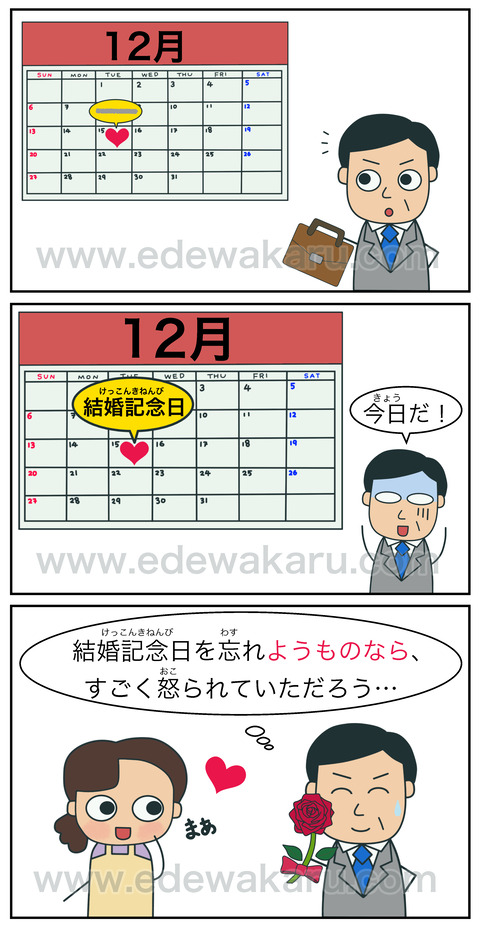
Meaning
もし〜をしたら、大変なことになる
How to use it
動詞[意向形]+ものなら
Explanation
「〜ようものなら」は「もし〜したら、大変なことになる」という意味を表す文型です。
後ろには「大変なことが起こる」「とても悪い結果になる」というように、
必ず悪いこと
がきます😨
【心配】【不安】【こわいと思う気持ち】
などが表されることがとても多いです。
[例]
①結婚記念日を忘れ
ようものなら、
妻にすごく怒られる
【こわいと思う気持ち】
②また遅刻をし
ようものなら、
首になっちゃうよ
【心配】【不安】
③バイトばかりしてい
ようものなら、
N1に合格できない
【心配】【不安】
④彼女にそんなことを言
おうものなら、
すごく泣くだろう
【不安】
「〜ようものなら」は「〜ものなら」とは全くに違う文型として区別をして覚えておきましょう😀
(復習:まったく)
(復習:〜ものなら+〜たい/〜て欲しい/〜てみろ)
【「もの」シリーズ】
〜たいものだ・〜てほしいものだ
〜たものだ
〜たものではない
〜というもの(Nというもの)
〜ないものだろうか
〜ないものは〜ない
〜もの・〜んだもの
〜ものか
〜ものがある
〜ものだ(感慨)
〜ものだ(本来の性質・一般的な考え方)
〜ものだ・〜ものではない
〜もので・〜ものだから
〜ものと思っていた
〜ものなら
〜ものの
〜ものを
〜ようものなら
In context 4 examples
結婚記念日(けっこんきねんび)を忘れようものなら、すごく怒られていただろう
→もし結婚記念日を忘れていたら、すごく怒られていただろうまた遅刻をしようものなら、首になっちゃうよ
→もしまた遅刻をしたら、首になっちゃうよ(復習:「首になる」「首にする」)(復習:〜ちゃう・〜じゃう)バイトばかりしていようものなら、N1に合格できない
→もしバイトしてばかりいたら、N1に合格できない(復習:〜てばかりいる・〜てばかりだ)彼女にそんなことを言おうものなら、すごく泣くだろう
→もし彼女にそんなことを言ったら、すごく泣くだろう
くらべてわかる日本語表現文型辞典
Meaning
意味1:Aは仮定であり、もしAをしたら、大変な結果Bになってしまう。
意味2:Aという状態になれば、いつもすぐBと反応する、Bという状態になる。
How to use it
AようものならB
[動詞-意向形]ものなら
In context 8 examples
テスト中にカンニングでもしようものなら、退学だ。
社長に逆らおうものなら、会社をクビにされてしまう。
門限を過ぎて帰ろうものなら、父に怒鳴りつけられたものだ。
大雨が降ろうものなら、この山はたちまち崩れてしまうだろう。
受験生のいる家では「滑る」という言葉を言おうものなら、家族全員の顔色が変わる。
お婆ちゃんは孫がくしゃみでもしようものなら、すぐ厚着をさせる。
女房は「大売出し」というチラシを目にしようものなら、財布を握り締めて飛んでいく。
決められた日以外にごみを捨てようものなら、管理人がうるさい。
日本語NET JLPT文法解説まとめ
Meaning
"もし〜のようなことをしたら"
万一〜のようなことをしたら、大変なことが起こるということを表す。
How to use it
V(意向形) + ものなら
Explanation
This expresses that if you were to do something like that, something serious would happen.
In context 4 examples
彼女との記念日を忘れようものなら、1週間は口を利いてもらえないだろう。
浮気がバレようものなら、離婚は免れないだろう。
このプロジェクトを失敗しようものなら、私はこの会社を辞職せざるを得ないだろう。
この先生の授業で、宿題を忘れようものなら、どれだけ叱られるかわからない。
毎日のんびり日本語教師
How to use it
動意向形+ものなら
動意向形+もんなら
Explanation
仮定条件です。
前件の条件が満たされた場合、極めて深刻な事態になることを表します。
「もんなら」は口語。
Notes
似ている文法「【N2文法】~ものなら/もんなら」
In context 14 examples
このことが彼女にバレようものなら何をされるか分からない。
あの先生に少しでも盾突こうものなら、その何十倍も怒られる。
彼はあの時、気軽に声をかけようものなら物凄い剣幕で睨まれそうなくらいだった。
うちの猫は少しでもちょっかいを出そうものなら、すぐ噛まれる。(我家的猫如果稍微逗它一下就咬人。)
二度寝しようものなら、それからまた数時間は起きられない。
このチームから誰か一人でも欠けようものなら、途端にうまくいかなくなる。
戦場では、少しでも人の心が残っていようものなら必ず死ぬ。
彼がこっちの真似をしようものなら、徹底抗戦するつもりだ。
連日35度越え、外に出ようものなら干からびてしまう。
超大型の台風が来ていて、一歩でも外に出ようものなら命の保証はないくらいだ。
子供がニートにでもなろうものなら親は大変です。
少しでも彼を怒らせようものなら、すぐ手を出したり物を投げてくる。
車で行こうものなら片道15時間かかる。
浮気をしようものならもう無理です。
IMABI
~(よ)うにも & ~(よ)うものなら
Read this IMABI lesson ↗Explanation
~(よ)うにも & ~(よ)うものなら
In past lessons, we have learned about the auxiliary ~(よ)う and how it is used to mark volition, supposition, and with both properties implicated when followed by the conjunctive particles が・と(も). Incidentally, there are other patterns which utilize the auxiliary ~(よ)う in conditionals, each with its unique relationship between Situation A (the conditional) and Situation B (the main clause). The ones to be introduced in this lesson are:
~(よ)うにも
~(よ)うものなら
As for the bases of the auxiliary ~(よ)う, it only possesses two:
終止形(yo)u
連体形(yo)u
The 終止形 is utilized in ~(よ)うにも and the 連体形 is utilized in ~(よ)うものなら.
~(よ)うにも
The contrastive conditional relationship established by ~(よ)うにも is:
Even if the agent were to try to execute Situation A, Situation B prevents/conflicts with said execution of Situation A.
Because of this relationship, the main clause (Situation B) must be in the negative with a form of ~ない, and the predicate itself is most often the same verb as Situation A but in its potential negative form.
1. 家出をしようにも、お金がないよ。
Even if (you) were to run away, (you) don’t have any money.
2. スマホが壊れているので、友達に連絡を取ろうにも取れない。
My smartphone is broken, so I can’t contact my friends even if I were to try to.
3. 終電を逃してしまい、帰ろうにも帰れない。
I missed the last train, so I can’t get back home even if were to try to.
4. 昨日飲みすぎて、頭がガンガンするから、起きようにも起きられない。
I drank too much yesterday and my head is pounding, so I can’t get up even if I were to try.
5. 忙しくて休もうにも休めない。
I’m so busy that I can’t take a break even if were to try to.
6. 断ろうにも断れず、テイラー君にお金を貸してしまった。
Unable to refuse even if I were to try to, I lent money to Taylor-kun.
7. プールの中で歩こうにも中々抵抗ていこうで歩けない。
Even if you walk inside a pool, you can’t quite walk even with significant resistance.
8. 歌を歌おうにも高音こうおんが出にくい。
Even if I try to sing the song, it’s hard to reach the high tones.
9. 急ごうにも急げる体でもない。
I’m not in the physical condition to be able to hurry.
10. 履歴書りれきしょを書こうにも電話番号の記入は必須ひっすだから、携帯が無いと履歴書を作れない。
Even if I were to write a resume, because phone number is a required field, if I don’t have a cellphone, I can’t make a resume.
11. 今から就職活動しようにも、やりたい事もないし資格とかも持っていない。
Even if I were to start looking for a job now, there’s nothing I want to do or really have the qualifications for.
12. 塾じゅくで学んだ事を復習させようにも、ほとんど時間が確保出来ない。
Even if I were to have (the students) review what they’ve learned in cram school, I could not secure hardly any time.
~にも~ない
The pattern ~(よ)うにも utilizes the conjunctive particle に, which is why this pattern is structurally like other contrastive conditional patterns, and it just so happens that the conjunctive particle に may appear after the volitional form (意向形) or the non-past form of a verb. The difference in nuance is as follows:
V1 (Non-Past) + ~に V1 (Potential Negative)Emotionally based contexts where the realization of Situation B is deemed not possible, and so no attempt is even made in the first place.
V1 (Volitional) + ~にも V1 (Potential Negative)Situation B shown impossible even with an attempt made to make it happen.
These patterns hinge on the presence of volition in respect to V1, which would indicate that the latter part of the grammar, ~にも V1 (Potential Negative), behaves the same. Thus, we are looking at the same pattern with the addition of the auxiliary ~(よ)う adding its layer of modality into the dynamic – changing the execution of V1 as something deemed out of reach (in an emotionally charged context no less) to something that is proven to be out of reach through the execution of the agent’s volition.
13. 売るに売れないものだ。
It’s something I can’t sell even if I wanted to.
14. 今朝からずっと雨で、行くに行けない。
It’s been raining ever since this morning, and so I just can’t go.
15.ドリンクが来ないと歌うに歌えないですよね。
You really can’t sing if your drink doesn’t come, huh.
16. 行くに行けない雰囲気になった。
The atmosphere became one that I couldn’t go.
17. 帰るに帰れないかもなあ。
Looks like I/we can’t go home…
18. トイレに行くに行けない状況になった時は、精神的にかなりきつい。
It’s psychologically very tense whenever you’re in a situation you can’t go to the restroom.
19. 泣くに泣けない凡ぼんミスだった。
It was a trivial mistake too bitter to cry about.
20. 越こすに越されぬ1大きな川
A river impossible to traverse
Aspect-wise, the non-past tense sets the speaker(=agent)’s mind to a theoretical timeline in which the agent is to carry it out, the circumstances prevent it from being a reality, removing the agent’s control from the equation. This holds true for when the volitional form is used, too, however, as the tense of the dependent clause does not change. What does change is that the agent’s execution of their control still means nothing.
~(よ)うものなら
The conditional relationship established by ~(よ)うものなら is:
Provided that Situation A does come to pass, Situation B occurs, and as for Situation B, it is a very dire consequence.
This grammar point utilizes the suppositional nuance of ~(よ)うものなら.
21. 先生に厚かましくも口答えをしようものなら、大目玉を食らうだろう。
Should you ever have the nerve to talk back to your teacher, you will surely get scolded severely.
22. 火事になろうものなら、大変だぞ。
It would be a grave situation should there be a fire.
~ものなら
Without the layer of nuance provided by ~(よ)う , ~ものなら after the non-past form of a verb creates the following conditional relationship:
Situation A is an action that the speaker really wishes were possible, and Situation B is the same action in whatever capacity the speaker(=agent) would execute it.
The verbal predicate preceding ~ものなら is almost always in its potential form. The use of the nominalizer もの, as opposed to the other nominalizers, is what adds a sense of tangibleness to the preceding verbal predicate it nominalizes.
23. もし過去に戻れるものなら、戻って現在を変えたい。
If I could go back in time, I would go back and change the present.
24. 会えるものなら、天国の愛犬にもう一度会いたいです。
If I could, I would like to see my beloved dog in heaven again.
25. 住めるものなら、大きな家に住みたいです。
If I could, I would like to live in a big house.
26. 言えるものなら言いたいけど、今はまだ言えないよ。
I wish I could say, but I’m unable to yet.
27. できるものなら、今すぐ帰国したいぐらいです。
If I could, I would like to go back to my country right here and now.
If the statement is directed at someone else, then ~ものなら takes on a provocative tone, implying that the listener(=potential agent) has no chance of actually being able to do said action.
28. 掴つかめるものなら、掴んでごらん。
If you think you can grab it, go right ahead.
29. ひとりで行けるものなら、行ってみなさい。
If you think you can go alone, go ahead and try to.
In casual conversation, ~ものなら often manifests as ~もんなら.
30. 浮気できるもんなら、してみろ。
If you (think) you can cheat, go ahead and do it.
31. 寝れるもんなら寝てみろや。
If you (think) you can sleep, go ahead and try.
越されぬ is, in fact, an old-fashioned potential negative form of the verb 越す. Prior to the emergence of the potential form for 五段 verbs, potential was marked by the auxiliary ~れる for 五段 verbs. ↩︎
In context 31 examples
家出をしようにも、お金がないよ。
Even if (you) were to run away, (you) don’t have any money.
スマホが壊れているので、友達に連絡を取ろうにも取れない。
My smartphone is broken, so I can’t contact my friends even if I were to try to.
終電を逃してしまい、帰ろうにも帰れない。
I missed the last train, so I can’t get back home even if were to try to.
昨日飲みすぎて、頭がガンガンするから、起きようにも起きられない。
I drank too much yesterday and my head is pounding, so I can’t get up even if I were to try.
忙しくて休もうにも休めない。
I’m so busy that I can’t take a break even if were to try to.
断ろうにも断れず、テイラー君にお金を貸してしまった。
Unable to refuse even if I were to try to, I lent money to Taylor-kun.
プールの中で歩こうにも中々抵抗ていこうで歩けない。
Even if you walk inside a pool, you can’t quite walk even with significant resistance.
歌を歌おうにも高音こうおんが出にくい。
Even if I try to sing the song, it’s hard to reach the high tones.
急ごうにも急げる体でもない。
I’m not in the physical condition to be able to hurry.
履歴書りれきしょを書こうにも電話番号の記入は必須ひっすだから、携帯が無いと履歴書を作れない。
Even if I were to write a resume, because phone number is a required field, if I don’t have a cellphone, I can’t make a resume.
今から就職活動しようにも、やりたい事もないし資格とかも持っていない。
Even if I were to start looking for a job now, there’s nothing I want to do or really have the qualifications for.
塾じゅくで学んだ事を復習させようにも、ほとんど時間が確保出来ない。
Even if I were to have (the students) review what they’ve learned in cram school, I could not secure hardly any time.
売るに売れないものだ。
It’s something I can’t sell even if I wanted to.
今朝からずっと雨で、行くに行けない。
It’s been raining ever since this morning, and so I just can’t go.
ドリンクが来ないと歌うに歌えないですよね。
You really can’t sing if your drink doesn’t come, huh.
行くに行けない雰囲気になった。
The atmosphere became one that I couldn’t go.
帰るに帰れないかもなあ。
Looks like I/we can’t go home…
トイレに行くに行けない状況になった時は、精神的にかなりきつい。
It’s psychologically very tense whenever you’re in a situation you can’t go to the restroom.
泣くに泣けない凡ぼんミスだった。
It was a trivial mistake too bitter to cry about.
越こすに越されぬ1大きな川
A river impossible to traverse
先生に厚かましくも口答えをしようものなら、大目玉を食らうだろう。
Should you ever have the nerve to talk back to your teacher, you will surely get scolded severely.
火事になろうものなら、大変だぞ。
It would be a grave situation should there be a fire.
もし過去に戻れるものなら、戻って現在を変えたい。
If I could go back in time, I would go back and change the present.
会えるものなら、天国の愛犬にもう一度会いたいです。
If I could, I would like to see my beloved dog in heaven again.
住めるものなら、大きな家に住みたいです。
If I could, I would like to live in a big house.
言えるものなら言いたいけど、今はまだ言えないよ。
I wish I could say, but I’m unable to yet.
できるものなら、今すぐ帰国したいぐらいです。
If I could, I would like to go back to my country right here and now.
掴つかめるものなら、掴んでごらん。
If you think you can grab it, go right ahead.
ひとりで行けるものなら、行ってみなさい。
If you think you can go alone, go ahead and try to.
浮気できるもんなら、してみろ。
If you (think) you can cheat, go ahead and do it.
寝れるもんなら寝てみろや。
If you (think) you can sleep, go ahead and try.
NINJAL 日本語文型データベース
Meaning
もし~たら、必ず大変な事態になると言いたいときに使います。
How to use it
V(よ)うものなら
Notes
「〜(よ)うものなら」の後には、マイナスイメージの少し極端な事態を表す動詞文がきます。
In context 5 examples
雪山では、一歩でも足を踏みはずそうものなら命を落とすことになる。くれぐれも気をつけたほうがいい。
運転するならぜったい酒は飲むな。一口でも飲もうものなら事故を起こす危険性がすごく高くなるんだから、気をつけろ。
体の抵抗力が弱い子どもや高齢者は、インフルエンザにかかろうものなら、肺炎になってしまうかもしれない。
有名人は大変だ。私生活の問題をマスコミに知られようものなら大スキャンダルになる。
座禅の修業は厳しかった。うっかり居眠りしようものなら棒で強くたたかれた。