日本語文型辞典
Meaning
どんな動作をしながら行くのか、またはどんな手段で行くのかを表す。
⇾てくる1
話し手から遠ざかることを表す。
ある行為をしてから行くことを表す。どこかに行くことを前提としてある行為をすることを表すのであって、行くこと自体よりも行く前の行為の方に重点がある。
ある時点を基準にして、それより先に向かって変化が進展し続けたり行為を続けたりすることを表す。
存在していたものがなくなったり、話し手の視界から遠ざかったりすることを表す。
How to use it
V-ていく【移動時の様意】
V-ていく【遠ざかる移動】
V-ていく【継起】
V-ていく【継続】
V-ていく【消滅】
In context 23 examples
学校まで走っていこう。
重いタイヤを転がしていった。
時間がないからタクシーに乗って行きましょう。
トラックは急な坂道をゆっくり登っていった。
あの子は、友達とけんかして、泣きながら帰っていった。
ブーメランは大きな弧を描いて彼のもとに戻って行きました。
船はどんどん遠くに離れて行く。
あと少しだからこの仕事をすませていきます。
A:じゃ、失礼します。
B:そんなこと言わないで、ぜひうちでご飯を食べていって下さいよ。疲れたからここで休んでいくことにしましょう。
叔母の誕生日だから、途中でプレゼントに花を貰って行きました。
結婚してからも仕事は続けていくつもりです。
今後もわが社の発展のために努力していくつもりだ。
日本ではさらに子供の数が減少していくことが予憑される。
見ている間にもどんどん雪がつもっていく。
その映画で評判になって以来、彼女の人気は日増しに高まっていった。
当分この土地で生活していこうと思っている。
この学校では、毎年五百名の学生が卒業していく。
見てごらん、虹がどんどん消えていくよ。
小さいボートは木の葉のように渦の中に沈んでいった。
毎日交通事故で多くの人が死んでいく。
仕事についても3ヶ月ぐらいで辞めていく人が多いので困っている。
英語の単語を覚えようとしているが、覚えたはしから忘れていく。
絵でわかる日本語
Usage 1
Read this source entry ↗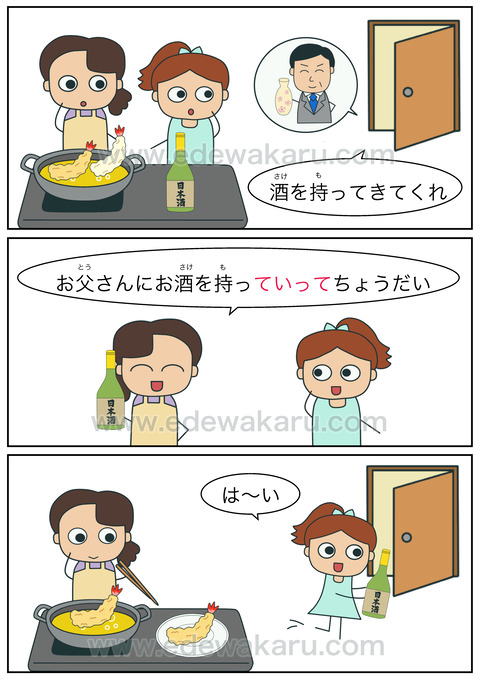
Meaning
〜しながら遠くに行く
〜という手段で遠ざかる
How to use it
動詞[て形]+ていく
Explanation
「〜ていく」は人・物・動物が、[ある状態を続けた状態]や[ある動作を続けた状態]で遠ざかると言いたい時に使います。「どんな動作をした状態で遠くに行くか」や「どんな手段で遠ざかるか」を表します。
[例]
①母:お父さんにお酒を持っ
ていって
ちょうだい
→「ビールを持つ」という状態を続けて行く
②A:映画館まで歩い
ていく?
B:今日は雨だから、タクシーに乗っ
ていこう
→「タクシーに乗る」という手段を使って行く
③毎日学校までバスに乗っ
ていきます
→「バスに乗る」という手段を使って行く
④北海道へは、飛行機に乗っ
ていく
つもりです
→「飛行機に乗る」という手段を使って行く
⑤あの島まで、泳い
でいって
みよう
→「泳ぐ」という手段を使って行く
この「〜ていく」の反対は【移動時の状態を表す「〜てくる」】ですので、一緒に覚えておきましょう。
また、「〜ていく」にはたくさん意味がありますので復習しておきましょう😊
【「〜ていく」を使う文型】
In context 5 examples
母:お父さんにお酒を持っていってちょうだい娘:は〜い
A:映画館まで歩いていく?B:今日は雨だから、タクシーに乗っていこう
毎日学校までバスに乗っていきます
北海道へは、飛行機に乗っていくつもりです
あの島まで泳いでいってみよう
Usage 2
Read this source entry ↗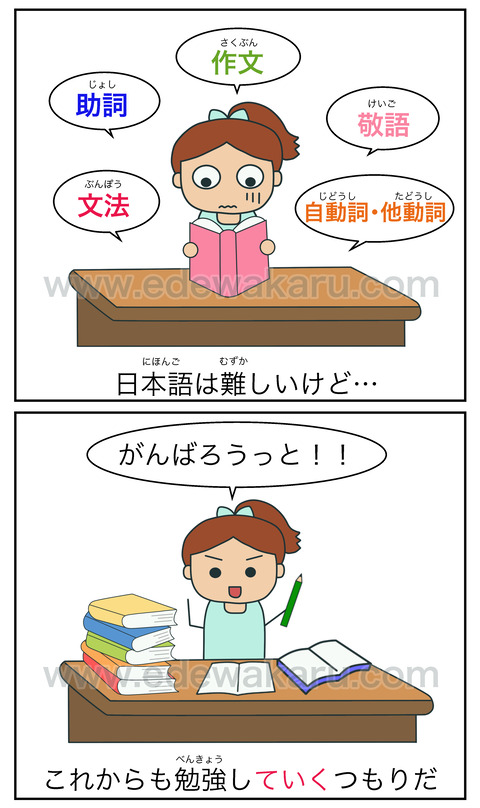
Meaning
現在から未来への継続を表す
How to use it
動詞[て形]+いく
Explanation
「〜ていく」は現在から未来への継続を表す文型です。「【今】から【未来】まで〜を続ける」と言いたい時に使います。未来についての意志を表す文型ですから、後ろには「〜つもりだ」「〜ようと思っている」「〜予定だ」などがよくきます。
[「〜ていく」と一緒によく使う文型]
・〜ていく+つもりだ
・〜ていく+予定だ
・〜ていく+ようと思っている
この文型は継続を表す決まった動詞にしか使いません😅
[継続の「〜ていく」によく使う動詞]
・続ける→続けていく
・生活する→生活していく
・暮らす→暮らしていく
・努力する→努力していく
・育てる→育てていく など
また、例文④のように
「〜てくる」は【過去→現在】を表します。つまり「〜てくる」は「過去→現在」
😊(復習:〜ということだ)
[例]
小学生の時からピアノを習っ
てきた
【過去→今】
これからもピアノを続け
ていく
つもりだ【今→未来】
「〜ていく」にはいくつか意味がありますので、区別して覚えておきましょう😉
・〜ていく(継起)
・〜ていく(消滅)
・〜ていく(変化の進行)
初級の文法ですが、会話でもとてもよく使いますのでがんばって覚えてくださいね😀
In context 4 examples
これからも日本語を勉強していくつもりだ
→これからも続けて日本語を勉強するつもりだ結婚しても仕事を続けていこうと思っている
→結婚しても仕事を続けようと思っている私はアメリカが大好き。ずっとこの国で生活していくつもりだ
→ずっとこの国で生活を続けるつもりだ小学生(しょうがくせい)の時からピアノを習ってきた。これからも続けていくつもりだ
→これからもピアノを続けるつもりだ
Usage 3
Read this source entry ↗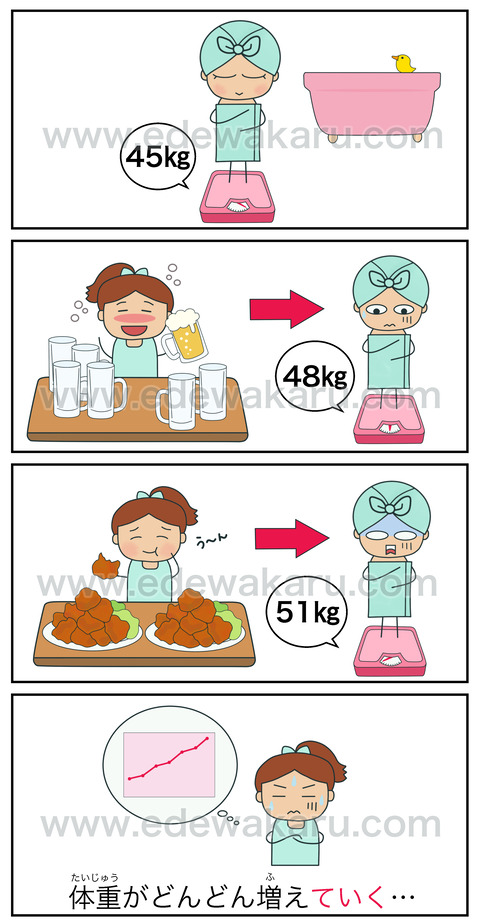
Meaning
変化が進行し続けることを表す
How to use it
動詞[て形] +いく
Explanation
「〜ていく」は「変化した状態が進行している」時に使われる文型です。何かの状態や状況が変化しいて、その変化がまだ続いていると言いたい時によく使われます😊
[例]
①体重がどんどん増え
ていく
→
「45㎏」から「48㎏」、そして「51㎏」と体重の変化が続いている
②成績が悪くなっ
ていった
→
「90点」から「60点」、そして「40点」と成績の変化が続いた
「〜ていく」いろいろな意味があります😮
①変化の進行
②消滅
(復習:〜ていく(消滅))
③継続
④移動
全部初級で勉強しますが、とても大切です。会話でもよく使いますので、上手に使えるようにがんばって覚えてくださいね😀
In context 4 examples
体重がどんどん増えていく…
→体重がどんどん増え続けているバイトしてばかりいたので、成績が悪くなっていった
→バイトばかりしていたので、成績が悪くなり続けた(復習:〜てばかりいる・〜てばかりだ)雨が強くなっていく
→雨が強くなり続けている「少子化」とは子供の数が減っていくことです
→「少子化」とは子供の数が減り続けることです(復習:〜とは(定義・説明))
Usage 4
Read this source entry ↗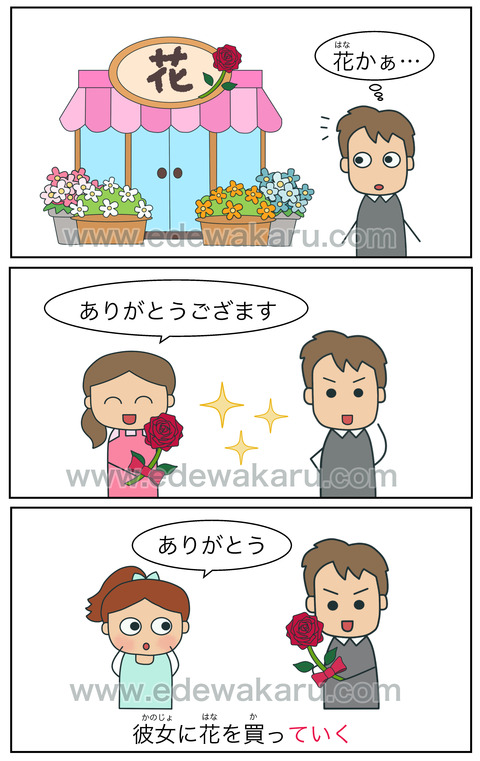
Meaning
〜てから行く
How to use it
動詞[て形]+ていく
Explanation
「〜ていく」は「〜てから行く」という意味を表す文型です。「どこかに行く前に何かをしてから行く」と言いたい時に使用します。
「〜てくる(継起)」
と一緒に覚えておきましょう。
(復習:〜てくる(継起))
[例]
①彼女に花を買っ
ていく
→彼女に花を買っ
てから
デートに
行く
②今日は、ちょっとビールを飲ん
でいこう
→ちょっとビールを飲ん
でから
家に帰る
③A:今日はうちでごはんを食べ
ていってくださいね
→うちでごはんを食べ
てから
帰ってくださいね
④あそこのカフェで休憩し
ていこう
→カフェで休憩し
てから
(目的地に)
行こう
【上級レベルの人へ】
「〜ていく」の話し言葉は「〜てく」です。日本語能力試験(にほんごのうりょくしけん)に出る口語形ではありませんが、覚えておくといいと思います😉
(復習:〜てく)
[例]
彼女に花を買っ
ていく
=彼女に花を買っ
てく
「〜ていく」を使う文型はたくさんありますので、復習をしておきましょう。
(復習:〜ていく(継続))
(復習:〜ていく(消滅))
(復習:〜ていく(変化の進行))
In context 4 examples
彼女に花を買っていく
今日は、ちょっとビールを飲んでいこう
A:今日はうちでごはんを食べていってくださいねB:ありがとうございます
A:疲れたね…B:うん。あそこのカフェで休憩していこう(復習:「カフェ」と「コーヒー」)
Usage 5
Read this source entry ↗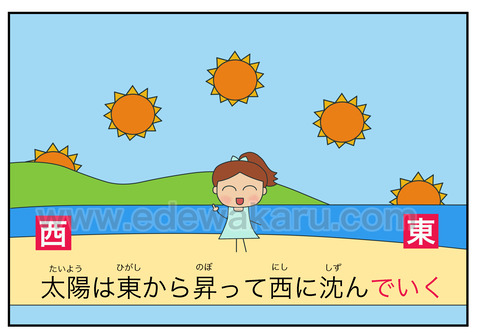
Meaning
あったものがなくなる
〜が消える
How to use it
動詞[て形]+いく
Explanation
「〜ていく」にはたくさんの意味がありますが、今回の「〜ていく」は「あったものがなくなる」「〜が消えてしまう」というように「消滅」を表します。これは、
存在していたものが、なくなってしまったり、いなくなってしまったり、また見えなくなる時に使われる文型です
😊
[例]
①太陽は西に
沈んでいく
→見えていた太陽が
沈んで見えなくなる
②たくさんの人が
死んでいく
→生きていた(存在していた)人が
死んでいなくなる
③400人が卒業し
ていった
→400人が卒業して学校から
いなくなる
④覚えたそばから忘れ
ていく
→覚えて頭の中にあった単語が
消えてしまう
「〜ていく」には【消滅】以外に、【継続】【移動】などの意味もありますので、しっかりと区別して覚えておきましょう😀【継続】【移動】はまた次回説明します😉
【上級レベルの人へ】
N4の文法が日常会話で上手に使えると、日本語がとてもうまく聞えます😊普段日本人は、N1の文法より、N4、N3の文法や単語をよく使って会話をしています😮今回のような初級レベルの文法をしっかりと復習をして自然に使えるようにがんばってくださいね😀
In context 4 examples
太陽は東から昇って西に沈んでいく
→太陽は東から昇って西に沈んで見えなくなる毎日、事故や病気でたくさんの人が死んでいく
→毎日、事故や病気でたくさんの人が死んでいなくなる今年は400人の学生が卒業していった
→今年は400人の学生が卒業していなくなった単語を覚えたそばから忘れていく…(復習:〜そばから)
→単語を覚えたそばから忘れてしまう
Usage 6
Read this source entry ↗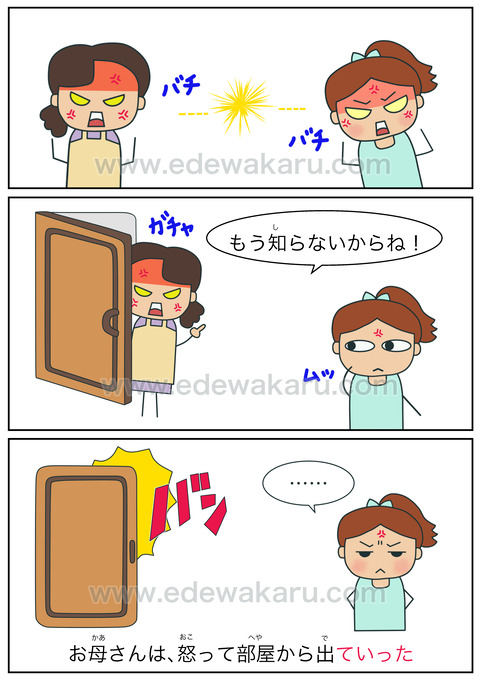
Meaning
話し手から遠ざかることを表す
How to use it
動詞[て形]+ていく
Explanation
「〜ていく」は[遠ざかる移動]を表す文型で、【人・物・動物】が話し手がいるところから、遠くに移動することを表します。
[例]
①お母さんは、怒って部屋から出
ていった
→部屋から出て、「私」がいるところから遠くへ行った
②カラスは「カーカー」と鳴きながら、山へ帰っていった
→「私」の近くから、山の方へ行った
③彼は30キロもある荷物を1人で運んでいった
→荷物を運びながら、「私」がいるところから遠くへ行った
④今すぐここから出
ていけ!
→ここから出て、「私」がいるところから遠くに行け
⑤彼女は、泣きながら部屋に入っていった
→泣きながら、「私」がいるところから遠くにある部屋に入った
この「〜ていく」は【近づく移動を表す「〜てくる」】の反対ですので、一緒に覚えておきましょう。
また、「〜ていく」にはたくさん意味がありますので復習をしておきましょう😀
【「〜ていく」がつく文型】
In context 5 examples
お母さんは、怒って部屋から出ていった
カラスは「カーカー」と鳴きながら、山へ帰っていった
彼は30キロもある荷物を1人で運んでいった
今すぐここから出ていけ!
彼女は、泣きながら部屋に入っていった
日本語NET JLPT文法解説まとめ
Meaning
① 今を基準とした、今後の推移や変化を表す。
② Vの方向が話し手から離れていくことを表す。
How to use it
V(て形) + いく
Explanation
① Used to show, based on the present situation, how things will change in the future.
② Used to indicate that the direction of V is away from the speaker.
In context 10 examples
今はまだ日本語があまり話せないかもしれませんが、だんだん話せるようになっていきますよ。
今後も、日本に旅行する外国人が増えていくと思います。
あ〜、食べる量を減らしているのに、体重がどんどん増えていく。
子供は少しずつ、色々なことができるようになっていくものだ。
バイトが忙しくで、どんどん成績が悪くなっていった。
AIの登場により、今後ますます仕事の仕方は変わっていくでしょう。
きちんとゴミを捨てたり、リサイクルをしないと、これからもどんどん海が汚れていくと思います。
息子は帰ってくると、リビングに鞄を置いて、急いで階段を上っていった。
ボールを投げると、ポチはボールに向かって、走っていった。
トムさんは急に怒り出して、教室を出ていった。
毎日のんびり日本語教師
Meaning
7つの用法があります。
①[移動時の状態]…着去/…去
③[動作の継続(未来へ)]…下去
④[少しずつ遠ざかる]逐渐远去
⑤[状態変化の進展]…下去
⑥[消失]消失不见
⑦[こちらからの一方的な動作]…去/…过去
(1)移動時の状態
(1) 教室まで歩いて
いく。
(走到教室去。)
(2) 天気が悪いからバスに乗って
いき
ましょう。
(3) タイヤがパンクしたので、自転車を引っ張って
いった。
(4) 川をカヌーでゆっくり下って
いく。
(乘独木舟在河上慢慢地往下走。)
移動に関する動詞に接続して、どのような動作で、どのような手段で移動が行われたかを表します。
(2)順次的動作
(5) 先にこの仕事をすませて
いき
ます。
(6) 遠慮せずに泊まって
いって
ください。
(7) とりあえずここで休憩して
いこう。
順次的動作の用法の時、「~ていく」は文字通り「~てから行く」という意味です。
(26)ではまず仕事を終わらせて、そして行くという物事の順序を表します。
必ず意志動詞に接続して、その動作が完全に終わった後に「行く」が行われます。
(3)動作の継続(未来へ)
(8) 以後も変わらず努力して
いく。
(以后也要一如既往地努力下去。)
(9) 就職しても趣味のマラソンは続けて
いく
つもりだ。
(10) これからもここで生きて
いく。
意志動詞に接続して、その動作がその後も将来にかけて継続することを表します。
(4)少しずつ遠ざかる
(11) 心はどんどん離れて
いった。
(12) アリは自らの巣に戻って
いきました。
(蚂蚁回到了自己的窝里。)
(13) 授業が終わると学生はすぐに帰って
いきました。
対象が話し手から徐々に離れることを表します。
物理的な距離のみならず、(32)のように精神的な距離でも使うことができます。
(5)状態変化の進展
(14) 高齢者人口は今後もどんどん増えて
いく。
(高龄人口今后也会不断增加。)
(15) 雪が積もって
いく。
(16) これからますます寒くなって
いく
だろう。
無意志動詞に接続して、変化が進行していることを表します。
どんどん、だんだんなどの副詞と呼応して用いられることが多いです。
(6)消失
(17) 太陽が地平線に沈んで
いった。
(太阳落在地平线上。)
(18) 覚えたそばから忘れて
いく。
(刚记住就忘了。)
(19) 学生が卒業して
いく
のは寂しくてたまらない。
(学生毕业后寂寞得不得了。)
無意志動詞に接続して、元々存在していた物事が話し手の視界から消えることを表します。
最後は完全に消えて見えなくなります。
どんどん、だんだんなどの副詞と呼応して用いられることが多いです。
(7)こちらからの一方的な動作
(20) 道行く人に次から次へと声をかけて
いく。
(21) 手当たり次第に聞いて
いこう。
話し手から、あるいは話し手が見ている人から他の対象に対して一方的な動作が行われることを表します。
How to use it
動て形+いく
Notes
関連文法「【N4文法】~てくる」
日本語文型辞典 英語版
Meaning
Expresses the method of going or what action is taken while going.
→
1
Expresses that something is going or moving away from the speaker.
B:そんなこと言わないで、ぜひうちでご飯を食べていって下さいよ。
Don’t say that. Please eat with us and then leave.
Means “going somewhere after doing a certain action.” Expresses a certain action done with the assumption of going somewhere, but the action has more weight than the subsequent act of going.
Expresses that a change is progressing or that an action is continuing beyond a certain point in time.
Expresses that something that existed has disappeared or become more distant from the speaker.
How to use it
1. V-ていく〈manner at time of movement〉
2. V-ていく〈movement away from something〉
3. V-ていく〈successive events〉
4. V-ていく〈duration〉
5. V-ていく〈disappearance〉
In context 23 examples
学校まで走っていこう。
Let’s run (all the way) to school.
重いタイヤを転がしていった。
I rolled a heavy tire.
時間がないからタクシーに乗って行きましょう。
We have no time, so let’s go by taxi.
トラックは急な坂道をゆっくり登っていった。
The truck climbed slowly up the steep road.
あの子は、友達とけんかして、泣きながら帰っていった。
That kid had a fight with his friend and went home crying.
ブーメランは大きな弧を描いて彼のもとに戻って行きました。
The boomerang traced a large circle and returned to where he was.
船はどんどん遠くに離れて行く。
The ship is going farther and farther away.
あと少しだからこの仕事をすませていきます。
There’s just a little more left to do, so I’ll finish this job and then go.
A:じゃ、失礼します。
I’ll leave now.
疲れたからここで休んで行くことにしましょう。
I’m tired, so let’s rest here and then go on.
叔母の誕生日だから、途中でプレゼントに花を買って行きました。
Because it’s my aunt’s birthday, I bought some flowers on my way.
結婚してからも仕事は続けていくつもりです。
I intend to continue working after I get married.
今後もわが社の発展のために努力していくつもりだ。
We intend to continue making efforts for the development of our company.
日本ではさらに子供の数が減少していくことが予想される。
It is expected that in Japan the number of children is going to decrease even more.
見ている間にもどんどん雪がつもっていく。
The snow is accumulating more and more even as I watch it.
その映画で評判になって以来、彼女の人気は日増しに高まっていった。
Since becoming famous for that film, her popularity was increasing by the day.
当分この土地で生活して行こうと思っている。
I’m thinking of living in this place for some time to come.
この学校では、毎年五百名の学生が卒業していく。
Five hundred students graduate from this school every year.
見てごらん、虹がどんどん消えていくよ。
Look, the rainbow is disappearing little by little.
小さいボートは木の葉のように渦の中に沈んでいった。
The small boat sank like a leaf into the whirlpool.
毎日交通事故で多くの人が死んでいく。
Many people die in traffic accidents every day.
仕事についても3ヶ月ぐらいで辞めていく人が多いので困っている。
It’s a problem because a lot of people quit work after only about three months.
英語の単語を覚えようとしているが、覚えたはしから忘れていく。
I’m trying to memorize English vocabulary, but I forget it as soon as I learn it.
AIUEO JLPT Grammar
Meaning
「〜ていく」is used to express an action continuing from the present to the future or moving away. In colloquial speech, it can be shortened to 「〜てく」.
How to use it
動詞て形+いく動詞て形+く
Explanation · 日本語
「〜ていく」は、ある動作がこれから続いていくこと、または遠ざかる動作を表す表現です。口語では「〜ていく」が「〜てく」に短縮されることがあります。
In context 5 examples
このプロジェクトを成功させるために努力していきます。
We will continue to work hard to make this project a success.
皆さんの成長を見守っていきます。
I will continue to watch over your growth.
この技術はこれからも進化していくでしょう。
This technology will continue to evolve from now on.
どうやって進めていく予定ですか?
How do you plan to proceed?
これからもずっと一緒に歩んでく。
We will continue to walk together from now on.
Bunpro Grammar Reference
Meaning
To ~ and go, To go on, To start
How to use it
Verb[て]+ いく
Verb[て]+ いきます
Nuance
A phrase used when a specific event will go on to occur, or continue to intensify.
Explanation
This grammar construction is a mix of the conjunction particle て, and the verb 行く 'to go'. To use this grammar point, you will need to attach て to any verb, and then follow it with いく.
This nuance is usually that '(A) happened and then went', or 'will happen, and then go'. In other words, it will depend on whether いく is in present, or past tense.
今日はうちで食べていく?
Do you want to go and eat at my place today? (Literally 'will you', but comes across more as an invitation in casual Japanese)
今晩は雨が降ると聞いたから、傘を持って行った。
Because I heard that it was going to rain tonight, I took an umbrella.
ていく can be used when representing time, or when representing a physical place. When representing a physical place, it is more likely that the kanji structure, 行く will be used. However, this is not a set rule, and depends on the writer.
When used in relation to time, the nuance is usually that something has already started/is about to start, and then will continue to progress in the same way.
毎日ゴルフの練習をしたらだんだんと上手くなっていく。
When you practice golf everyday, you will gradually get better.
This is the opposite of てくる, which indicates that something has finally reached a certain state, after progressing in that way for some time.
Fun Fact
When compared to English, ていく is very similar to the phrase 'to go on to (A)', in relation to time. It focuses on the fact that the speaker is required to make some type of journey to arrive at a specific point. For example, 'She went on to become a doctor after university'.
Nuance · 日本語
特定の事象が継続して発生する、又はどんどん増す場合に用いられる表現。
In context 15 examples
- 大きい音で、鳥が飛んでいく。
With a loud noise, the birds will fly away. (fly and go)
- 毎日ゴルフの練習をしたらだんだんと上手くなっていく。
When you practice golf everyday, you will gradually get better.
- 今日はうちで食べていく?
Do you want to go and eat at my place today? (Literally 'will you', but comes across more as an invitation in casual Japanese)
- 今晩は雨が降ると聞いたから、傘を持って行った。
Because I heard that it was going to rain tonight, I took an umbrella.
- これを先生に持っていってください。
Please take this to the teacher. (hold and go)
- 友達にプレゼントを買っていく。
I am going to buy a present and take it to my friend. (buy and go)
- 大丈夫!お弁当を持っていくから。
It's okay! Because I will take a lunch (bento) with me. (hold and go)
- 今日はテストを受けるから鉛筆を持っていく。
Because I am going to take a test today, I will take a pencil. (hold and go)
- 何か食べていってください。
Please eat something before you go. (eat and go)
- お医者さんに行って、薬をもらっていくね。
I am going to go to the doctor and get some medicine. (receive and go)
- 車で行くのは危険なので、電車に乗っていってください。
It is dangerous to go by car, so please take a train. (ride and go)
- 服を買って、お祖母さんに持っていく。
I'm going to buy clothes and take them to grandma. (hold and go)
- 車に乗る前に、朝ごはんを必ず食べていく。
Before getting in the car, I make sure to eat breakfast and then go.
- 今から日本語の勉強をし始めたら、だんだん上手になっていくよ。
If you start studying Japanese now, you will go on to become more proficient.
- どんどんお金が貯まっていくのを見るのが好き。
I like to see my money go on to accumulate steadily.
文法
Meaning
① 今を基準とした、今後の推移や変化を表す。
② Vの方向が話し手から離れていくことを表す。
How to use it
V(て形) + いく
In context 10 examples
今はまだ日本語があまり話せないかもしれませんが、だんだん話せるようになっていきますよ。
今後も、日本に旅行する外国人が増えていくと思います。
あ〜、食べる量を減らしているのに、体重がどんどん増えていく。
子供は少しずつ、色々なことができるようになっていくものだ。
バイトが忙しくで、どんどん成績が悪くなっていった。
AIや5Gの登場により、今後ますます仕事の仕方は変わっていくでしょう。
きちんとゴミを捨てたり、リサイクルをしないと、これからもどんどん海が汚れていくと思います。
息子さんは帰ってくると、リビングに鞄を置いて、急いで階段を上っていった。
ボールを投げると、ポチはボールに向かって、走っていった。
トムさんは急に怒り出して、教室を出ていった。
Yokubi — The Common Grammar Guide (https://yoku.bi)
Explanation
We already touched briefly on the concept of directionality in [Lesson 11](../../Section1/Part1/Lesson11.md) with the giving auxiliary verbs てあげる, てもらう, and てくれる. Let's now dig a bit deeper into this concept and introduce two more auxiliaries: ていく and てくる.
When not used with an auxiliary sense, Vていく and Vてくる simply mean what they spell: "To do V, and then go/come somewhere". However, when used as auxiliaries, their meaning deepens and becomes more than the sum of its parts.
Auxiliary ていく roughly means that some event is ongoing and will "keep going" in a direction away from the speaker, either in place or time (present \-\> future). ていく can be contracted as てく.
Likewise, auxiliary てくる means that some event was ongoing and has continued approaching from away towards the speaker, either in place or time (past \-\> present), and might even go further.
Both ていく and てくる are incredibly nuanced in usage and this lesson doesn't even begin to scratch the surface of the complexity of it, especially when you throw different tenses into the mix.
Let's just look at examples and then we can move on. You will pick up some of the nuances and common phrasings with more experience.
Some verbs **require** to be paired with an auxiliary verb of directionality to make some of the sentences grammatical. For example the verb 引っ越す means "to move (house/residence)", but unlike English it doesn't have an actual connotation of "movement" or dynamism to it. When you want to use it in the sense of "I just moved here" and highlight a state transition, you must use an auxiliary verb of direction. Other verbs like 送る and 歩く work in a similar way.
In context 1 examples
それはどんどんと大きくなっていく。
That keeps gradually getting larger and larger
NINJAL 日本語文型データベース
Usage 1
Meaning
[1] ある時点(主に現在)からある時点以後への一方向の変化を表します。突然の変化ではなく、だんだん変化することを言います。
[2] ある時点(主に現在)からある時点以後への行為の継続を表します。
[3] それまで存在していたものがなくなったり、話し手から見えなくなったりすることを表します。話し手から離れる感じを特に表したいときに使います。
How to use it
Vていく
Notes
[1] 「〜」には、「なる・増える・進む」など、変化を表す動詞がきます。
[2] 「〜」には、「続ける・頑張る・見る」など、継続的な行為を表す動詞がきます。
[3] 「~」には、「消える・沈む」など、なくなる・見えなくなるという意味の動詞がきます。
In context 16 examples
どんなものも、買ったときは新品でもだんだん古くなっていく。
これから子どもが成長していくのが楽しみだ。
両国の理解がさらに進んでいくことを心から祈っています。
このまま日本の人口が減っていけば、さらにいろいろな問題が起こるだろう。
夕方から雨と風が次第に強くなっていくでしょう。お出かけの方は傘をお持ちください。
この授業では、グローバル化と文化の継承の問題について考えていきます。
プリンの材料は、卵2個、砂糖80グラム、牛乳400ccです。それでは、作り方を見ていきましょう。
「ぜひ御社で、これまでの経験を生かして頑張っていきたいと思っております」
こんな少ない給料では食べていけないので、転職したい。
大学に入ってから始めたテニスを、卒業後も続けていこうと思っている。
写真の技術は、19世紀に登場し、その後急速に発展していった。
太陽が西の海に沈んでいきます。
結婚の約束をしたその人は、何も言わずに私のもとを去っていった。
この会社は、新しく入る人も多いが、辞めていく人も多い。
人間の脳は、要らなくなった情報をどんどん忘れていくようにできている。
機械化が進んだために失われていった手仕事の技術を、現代に復活させようとしている人たちがいる。
Usage 2
Meaning
[1] 行く手段や行くときの状態・動作を表します。
[2] ある場所で〜の動作をしてから、どこかへ行くことを表します。動作をする場所は、今いる場所の場合も別の場所の場合もあります。
[3] 話し手から遠ざかる方向への動きであることを表します。
How to use it
Vていく
Notes
[2] 「~」には、「買う・作る・勉強する」など、動作を表す動詞がきます。
[3] 「〜」には、「飛ぶ・流れる・引越しする」など、事物の移動を表す動詞がきます。
In context 18 examples
私は帽子が好きで、どこへ行くときにも帽子をかぶって行く。
2キロぐらいの距離なら、バスに乗らないで、歩いて行きます。
今度のパーティー、何を着て行ったらいいかな。
「病院へ行くの、ひとりで大丈夫? 心配だったら、ついて行ってあげようか」
「せきが出るなら、マスクをして行ったほうがいいよ」
夏休みは忙しくて、子どもたちをどこへも連れていかなかった。
会社の近くには店がないので、毎日家でお弁当を作って行く。
「たくさん歩いて疲れましたね。ちょっとこのベンチで休んで行きませんか」
外国へ行くなら、簡単な挨拶の言葉ぐらいは勉強して行ったほうがいい。
誰かがうちの前にごみを捨てて行ってしまって、迷惑だ。
「駅まで一緒に行きませんか」「あ、私、この銀行でお金をおろして行くから、先に行ってて」
明日は友達の家でホームパーティーがある。ワインを買って行こう。
「町を観光するなら、荷物は駅前のコインロッカーに入れていくといいですよ」
山に降った雨が川の水となって、海へ流れていく。
北の国へ向かって、渡り鳥が海を渡って行った。
強い風が吹いて、かぶっていた帽子が飛んで行ってしまった。
「カワイイ」「オタク」など、日本から海外に伝わっていった言葉もいろいろある。
弟が玄関にお弁当を忘れて家を出たのに気がついて、母は急いで後を追いかけていった。
IMABI
~ていく & ~てくる
Read this IMABI lesson ↗Explanation
~ていく & ~てくる
These patterns are a little easier than the ones from the last lesson, but these are easier to confuse with each other. So, 注意してください!
~ていく & ~てくる
行く (to go) and 来る (to come) with て creates constructions that are not as straightforward as one would expect. What dictates the usage of ~ていく and ~てくる is highly context driven. It’s rather impossible for even the best linguists to properly define all of the possible situations these phrases can be used in. “Highly context driven” refers to the fact that how you interpret them is not just determined by the transitivity of the verb phrase but by what exactly it is “semantically”.
Categorical properties of what exactly the verb means is very important to keep in mind, and this also means that you can’t just assume that English and Japanese match perfectly on a word-by-word basis. Usually, even this is never the case. After all, the two languages are NOT related to each other.
When physical action is involved, ~ていく and ~てくる show action away and action towards the speaker’s current location respectively. In this case, the verbs are typically written in 漢字, but this is not always the case. At times, these phrases result in sentences that do not sound quite like anything one would say in English. In such cases, think really hard about the real world context in which they are used to better understand the semantic properties at work.
1. ちょっと出かけて来ます。
I’m going out for a bit (and will come back).
2. 公園に歩いて行った。
I went to the park by foot.
Grammar Note: Remember that some て phrases act like adverbs in Japanese, which then can then like in this sentence equate to a prepositional phrase, in this case 歩いて = by foot.
3. 朝ご飯を食べて行きました。
I went having eaten breakfast.
4. 行って来ます。
I’m going and coming back.
Usage Note: The above phrase is used when leaving your residence, knowing that you will be coming back. Though the plain form is acceptable with those you are close to, given its status as a set phrase, the polite form is also used without any repercussions.
5.台所だいどころからいすを取とってきます。
I’m going to get a chair from the kitchen.
6. 10分もすれば、帰ってくる。
If I have but 10 minutes, I’ll come home.
When there is no physical motion involved, ~ていく indicates disappearance whereas ~てくる indicates a process of emergence. Both can show a process of change or continuation, but they are different in this manner. ~ていく would indicate something that will change and continue on into the future whereas ~てくる would represent that has been happening for something and extends to the present.
7. ミルズさんは日本語がうまくなってきましたね。
Mr. Mills has been getting better in Japanese, hasn’t he?
8. 君の英語はきっと上手うまくなっていくでしょう。(Familiar)
Your English will surely get better!
9. 自分勝手じぶんかってに選択せんたくしたい欲よくは、必かならず消えていくのであろう。
Your desire to want to selfishly choose will surely disappear.
10. 囚人達しゅうじんたちは洞窟どうくつからぞろぞろと出てきた。
The prisoners came filtering out of the cave. 11. その木は、芽が出てきた。
The tree has begun to sprout. 12. 最後の希望が消えていく。
There goes our last hope.
Inception
~てくる can also indicate the inception of a process. As this section will show, understanding this can get really tricky. So, pay attention to detail and be open to differences between Japanese and English grammar.
13a. 雪が降ふってきた。
13b. 雪が降り始めた。
It started to snow.
~てくる・~ていく Interchangeability
Tense can be problematic in making ~てくる and ~ていく seem interchangeable. The semantic differences between the verbs of these phrases and differences in the main verbs used are important. For instance, the fact that 消える is used below is very important.
14. 暖炉の火が消えて{きた・いく}。
The fire in the fireplace is about to go out.
The first option indicates inception of a change. The status of the fire gets changed, and the process is “going out”. With ~た, you indicate that the process has just started. A strong wind, cutting off of fuel source, or lots of water put on it would determine how quickly it goes out. Nevertheless, the English can be used in the same situations. The second option indicates a process of disappearance. The flame will shortly start to fade and then go out. In a real world situation, it would be very hard to tell all these details, especially because these judgments are all subjective to what the speaker feels.
When considering the English equivalent, you should be able to see how it could be used for both. For brevity, more literal/less natural English equivalents are not shown. With the information given thus far, you should be able to construct more literal interpretations at your own will.
Consider a less puzzling example. Here we have a sentence in reference to the weather. This,again, is an important detail to keep in mind.
15. 段々暑くなって{くる・いく}。
It will become gradually hotter.
In this case, you could say that the former indicates an inception of a process that is to happen. It’s more vivid and doesn’t feel that it’s going to take long for this change to occur. Once it has become quite hotter, it could just reach a point and stay that way. The latter option doesn’t imply this. Rather, the latter shows a slower, gradual change that will occur and continue on that way. So, even if both sentences were used in the context of the temperature reaching 100F, with the latter, it could just continue to steadily get higher.
More Examples
Variant Note: It is also important to realize that ~ていく is often contracted to ~てく in casual speech in the same way ~ている is contracted to ~てる. Be sure to recognize it in different conjugations. For example, ~てった = ~ていった. However, this contraction is avoided in conjugations in which it might get confused with ~てくる. For instance, ~ていきなさい would accidentally become ~てきなさい if you dropped い.
16. 独ひとりで子供こどもを育そだててきました。
I have brought up my children alone.
17. 帰ってくるまでここで待っててね。(Casual)
Just wait here until I come back.
18. 先生が入はいってくるのを待つ。
To wait for the teacher to come in.
19. 氷がどんどんと迫せまってきた。
The ice steadily approached and came (here).
20. 彼は新聞を持ってくるのを忘れた。
He forgot about bringing the newspaper.
21. 寒くなってきたみたいだ。
It looks like it’s becoming colder.
22. ガスが(回まわって)来きた。
Gas came.
Word Note: 回る in this context emphasizes the circulation of gas.
23. カーテンの後うしろから近づいてくるなんてこわい。
Approaching from behind the curtain like that is scary.
24. 時が矢やのように過すぎていきました。
Time started to pass by like an arrow.
25. 彼は雨の中を駅まで歩いていきました。
He walked to the station through the rain.
26. 持ってきてください。
Please bring it.
27. 持っていってください。
Please take it (away).
28. ペン一本も持ってきませんでした。
I didn’t bring a single pen.
29. プレゼントに銀ドルを持っていきました。
I took a silver dollar as a gift.
30. ちょっとお金を忘れてきちゃった。貸してくれない。(Casual)
I forgot to bring some money. Could you lend me some?
31. 雪が降ってきたかと思うともうやんだ。
Just as I thought it had started to snow, it had already stopped.
Phrase Note: かと思うと = “just as I thought”.
32. 彼を連つれてきてください。
Please bring him.
33. 彼を連れていきなさい。
Take him away.
34. 今夜は岡田さんを連れてきました。
I brought Mr. Okada along tonight.
35. シネコンに行くんだったら、僕も連れて行ってくれない。
If you’re going to the cinema complex, can’t you take me along too?
Word Note: Notice the contrast in definitions between 連れて[いく・くる] and 持って[いく・くる]
36. 彼が東京を発たってから五日後に私は帰ってきた。
I came back home after five days after he left Tokyo.
37.{日常にちじょう・日々}の生活問題せいかつもんだいが{重かさなってくる・積つみ重なる}でしょう。
Normal daily life problems will pile on.
38. ヒマワリの種をまいてから、一週間とたたないうちに芽が出てきました。
After I planted the sunflower seeds, they sprouted in no less than a week.
39. 彼女は先月神戸に(引っ)越こしていきました。
She moved to Kobe last month.
40. これからも頑張っていきたいと思います。
I’d like to continue to do my best from now on.
41a. 彼が私の部屋へやに飛とび込こんできました。
41b. He rushed into my room.
~ていく → ゆく
~ゆく may seldom follow the stem of verbs in a poetic fashion. This is in fact the original form the pattern took, which is why it is deemed poetic/nostalgic. ~てゆく also exists, which is quite nostalgic and is very common in songs and literature.
42. 大事な思い出も記憶から消え(て)ゆくのであろう。
Even important memories will slip from your memory.
43. 花燃えゆく。
Flowers, burn away.
44. 死にゆく。
To be dying.
なってくる VS なっていく
Although the previous information may be sufficient enough to make the differences between these two phrases easy enough to ascertain, given that they are still often misunderstood, it’s best to go through this as an independent point of discussion. First, consider the following.
48. こちらも、こんなに寒くなって{きた・いったX}のですから、そちらは、これからますます寒くなって{いく・くるX}ことでしょうね。
Since it has become cold like this here, it will definitely get steadily cold there after this.
This is a wonderful example of how the two can even be seen in the same complex sentence but yet have zero interchangeability. The first part states the change that it has become cold and still is cold at the speaker’s location. In saying so, the speaker makes a conjecture that it will get cold somewhere else away from the speaker. These distinctions are crucial to keep in mind. Here are some more sentences to consider.
49a. 10月だ。故郷は、もう寒くなってきただろうか。 〇
49b. 10月だ。故郷は、もう寒くなっていっただろうか。X
It’s October. Hasn’t it already gotten cold at our hometown?
50. 5月も半ばだから、そろそろ暑くなってくるね。梅雨が明けると、それこそ、ますます暑くなってくるんだろうけど。
Since it’s already the middle of May, it should be getting hot soon, right? Once the rainy season lifts, that alone should make it get hotter gradually.
51. 6ヶ月もダイエット続けてるのに、太ってくばかりで、ちっともやせてこないんだよ。
Although I’ve been on this diet for 6 months, I’ve only continued to gain and haven’t gotten a bit skinnier!
Though the last may be harder to follow from the free translation, it would be a great mistake to change the speech modals to one or the other. When used with intransitive verbs that express change, you are showing a natural change of events by a given process. When you use ~ていく, you say that at the time the change starts, there will continue to be change from that point onward. ~てくる gives a more punctual feel to the instant of change. So, ~ていった would be like “had been getting…” whereas ~てきた would be like “got”.
In context 48 examples
ちょっと出かけて来ます。
I’m going out for a bit (and will come back).
公園に歩いて行った。
I went to the park by foot.
朝ご飯を食べて行きました。
I went having eaten breakfast.
行って来ます。
I’m going and coming back.
台所だいどころからいすを取とってきます。
I’m going to get a chair from the kitchen.
10分もすれば、帰ってくる。
If I have but 10 minutes, I’ll come home.
ミルズさんは日本語がうまくなってきましたね。
Mr. Mills has been getting better in Japanese, hasn’t he?
君の英語はきっと上手うまくなっていくでしょう。(Familiar)
Your English will surely get better!
自分勝手じぶんかってに選択せんたくしたい欲よくは、必かならず消えていくのであろう。
Your desire to want to selfishly choose will surely disappear.
囚人達しゅうじんたちは洞窟どうくつからぞろぞろと出てきた。
雪が降ふってきた。
It started to snow.
雪が降り始めた。
It started to snow.
暖炉の火が消えて{きた・いく}。
The fire in the fireplace is about to go out.
段々暑くなって{くる・いく}。
It will become gradually hotter.
独ひとりで子供こどもを育そだててきました。
I have brought up my children alone.
帰ってくるまでここで待っててね。(Casual)
Just wait here until I come back.
先生が入はいってくるのを待つ。
To wait for the teacher to come in.
氷がどんどんと迫せまってきた。
The ice steadily approached and came (here).
彼は新聞を持ってくるのを忘れた。
He forgot about bringing the newspaper.
寒くなってきたみたいだ。
It looks like it’s becoming colder.
ガスが(回まわって)来きた。
Gas came.
カーテンの後うしろから近づいてくるなんてこわい。
Approaching from behind the curtain like that is scary.
時が矢やのように過すぎていきました。
Time started to pass by like an arrow.
彼は雨の中を駅まで歩いていきました。
He walked to the station through the rain.
持ってきてください。
Please bring it.
持っていってください。
Please take it (away).
ペン一本も持ってきませんでした。
I didn’t bring a single pen.
プレゼントに銀ドルを持っていきました。
I took a silver dollar as a gift.
ちょっとお金を忘れてきちゃった。貸してくれない。(Casual)
I forgot to bring some money. Could you lend me some?
雪が降ってきたかと思うともうやんだ。
Just as I thought it had started to snow, it had already stopped.
彼を連つれてきてください。
Please bring him.
彼を連れていきなさい。
Take him away.
今夜は岡田さんを連れてきました。
I brought Mr. Okada along tonight.
シネコンに行くんだったら、僕も連れて行ってくれない。
If you’re going to the cinema complex, can’t you take me along too?
彼が東京を発たってから五日後に私は帰ってきた。
I came back home after five days after he left Tokyo.
{日常にちじょう・日々}の生活問題せいかつもんだいが{重かさなってくる・積つみ重なる}でしょう。
Normal daily life problems will pile on.
ヒマワリの種をまいてから、一週間とたたないうちに芽が出てきました。
After I planted the sunflower seeds, they sprouted in no less than a week.
彼女は先月神戸に(引っ)越こしていきました。
She moved to Kobe last month.
これからも頑張っていきたいと思います。
I’d like to continue to do my best from now on.
彼が私の部屋へやに飛とび込こんできました。
41b. He rushed into my room.
大事な思い出も記憶から消え(て)ゆくのであろう。
Even important memories will slip from your memory.
花燃えゆく。
Flowers, burn away.
死にゆく。
To be dying.
こちらも、こんなに寒くなって{きた・いったX}のですから、そちらは、これからますます寒くなって{いく・くるX}ことでしょうね。
Since it has become cold like this here, it will definitely get steadily cold there after this.
10月だ。故郷は、もう寒くなってきただろうか。 〇
It’s October. Hasn’t it already gotten cold at our hometown?
10月だ。故郷は、もう寒くなっていっただろうか。X
It’s October. Hasn’t it already gotten cold at our hometown?
5月も半ばだから、そろそろ暑くなってくるね。梅雨が明けると、それこそ、ますます暑くなってくるんだろうけど。
Since it’s already the middle of May, it should be getting hot soon, right? Once the rainy season lifts, that alone should make it get hotter gradually.
6ヶ月もダイエット続けてるのに、太ってくばかりで、ちっともやせてこないんだよ。
Although I’ve been on this diet for 6 months, I’ve only continued to gain and haven’t gotten a bit skinnier!