DoJG 日本語文法辞典(全集)
Usage 1
Meaning
And; -ing
How to use it
(i) Group 1 verbs | | |
すverbs | 話す→話して | Someone talks and |
くverbs | 歩く→歩いて | Someone walks and |
Exception | 行く→行って | Someone goes and |
ぐverbs | 泳ぐ→泳いで | Someone swims and |
む/ぶ/ぬverbs | 飲む→飲んで | Someone drinks something and |
| 遊ぶ→遊んで | Someone plays and |
| 死ぬ→死んで | Someone dies and |
つ/う/るverbs | 待つ→待って | Someone waits and |
| 買う→買って | Someone buys something and |
| 取る→取って | Someone takes something and |
(ii) Group 2 verbs | Vstemて | |
| 食べて | Someone eats something and |
(iii) Irregular verbs | 来る→来て | Someone comes and |
| する→して | Someone does something and |
(iv) Adjective い | Adjective い stem くて | |
| 高くて | Something is expensive and |
(v) Adjective な | Adjective な stem で | |
| 静かで | Something is quiet and |
(vi) Noun+copula | Nで | |
| 先生で | Someone is a teacher and |
Explanation
The て form ending of verbs and い-type adjectives (The て form ending of な-type adjectives and the て form of the copula is で.)
In context 7 examples
私はコートを脱いでハンガーにかけた。
Taking off my coat, I hung it on a hanger.
ワインを飲み過ぎて頭が痛い。
I've drunk too much wine and have a headache.
私の部屋は狭くて暗い。
My room is small and dark.
このスープは辛くて飲めない。
This soup is salty (or (spicy) hot) and I can't drink it.
私はテニスが大好きでよく友達とする。
I love tennis and often play with my friends.
ゆみ子は今大学三年で専攻は日本文学です。
Yumiko is a junior at college now and her major is Japanese literature.
伊藤先生は今週病気で、かわりに村田先生が教えた。
Professor Itou was ill this week and Professor Murata taught for him.
Usage 2
Meaning
And; since; having done something
How to use it
(i) Group 1 verbs | | |
すverbs | 話す→話して | Someone talks and |
くverbs | 歩く→歩いて | Someone walks and |
Exception | 行く→行って | Someone goes and |
ぐverbs | 泳ぐ→泳いで | Someone swims and |
む/ぶ/ぬverbs | 飲む→飲んで | Someone drinks something and |
| 遊ぶ→遊んで | Someone plays and |
| 死ぬ→死んで | Someone dies and |
つ/う/るverbs | 待つ→待って | Someone waits and |
| 買う→買って | Someone buys something and |
| 取る→取って | Someone takes something and |
(ii) Group 2 verbs | Vstemて | |
| 食べて | Someone eats something and |
(iii) Irregular verbs | 来る→来て | Someone comes and |
| する→して | Someone does something and |
(iv) Adjective い | Adjective い stem くて | |
| 高くて | Something is expensive and |
(v) Adjective な | Adjective な stem で | |
| 静かで | Something is quiet and |
(vi) Noun+copula | Nで | |
| 先生で | Someone is a teacher and |
Explanation
After/since a point in time at which something takes place.
In context 6 examples
こちらにいらっしゃってもう何年になりますか。
How long have you been here / how many years it is since you came here?
二人は結婚して二年後に離婚した。
The couple got married and two years later they got divorced.
会社を辞めてもう久しい。
It has been a long time since I quit the company.
この島を訪れてもう何年になるだろうか。
I wonder how many years have already passed since I last visited this island.
この会社で働き始めてこれで四年になります。
It's been four years since I began to work at this company.
この町に来てまだ一週間目です。
It's my first week in this town.
日本語文型辞典
Usage 1
Meaning
基本情報N/Na でA-くてV-て説明名詞とナ形容詞には「で」がつく。イ形容詞では「くて」。「ない」には「なくて」「ないで」の2つの形がある。動詞の場合、辞書形がグ・ヌ・ブ・ムで終るものは「で」、それ以外は「て」となる。例文① 朝ご飯を作って、子供を起こした。② しっかり安全を点検して、それからかぎをかけた。③ まず、買い物をして、それから、映画を見て、帰って来た。④ 電話をかけて、面会の約束をとりつけて、会いに行った。⑤ 山田さんがやめて、高田さんが入った。⑥ びっくりして、口もきけなかった。⑦ 着物を着て、出掛けた。⑧ 地下鉄ははやくて安全だ。⑨ 外が真っ暗でこわかった。⑩ めずらしい人から手紙をもらってうれしかった。説明前の節と後ろの節をゆるやかに結びつけるのに用いる。③④のように「…て」を二つ以上使うこともできる。行為を表す文を連結する場合は、連続的に起こることを述べる。①、②など。また、文脈によって対比的に使ったり、軽い理由を表したり、行為の手段や付随する状況を表すこともある。形容詞など属性や状態を表す文では、ふたつの属性を並べる場合や、「…て」の部分が軽く理由を表す場合がある。⑩のように動作性の表現のあとに形容詞などの状態性の文がくると軽く理由を表す表現になることが多い。いくつかの行為や状態が交代して起こる場合、また時間の順とかかわりなく述べる場合は、「て」ではなく、「たり」を用いる。
Usage 2
Meaning
基本情報NaでNaでA-くてA-くてV-てV-て説明同一の動詞や形容詞をくりかえすことによって、程度を強調する。会話で用いるのが普通。例文① 連絡がいつまで待っても来ないので、不安で不安で仕方がなかった。② お土産を買い過ぎたので、トランクが重くて重くて腕がしびれそうだった。③ はじめて着物を着たら、帯がきつくてきつくて何も食べられなかった。④ 走って走ってやっと間に合った。⑤ 一晩中飲んで飲んで、飲みまくった。
絵でわかる日本語
Usage 1
Read this source entry ↗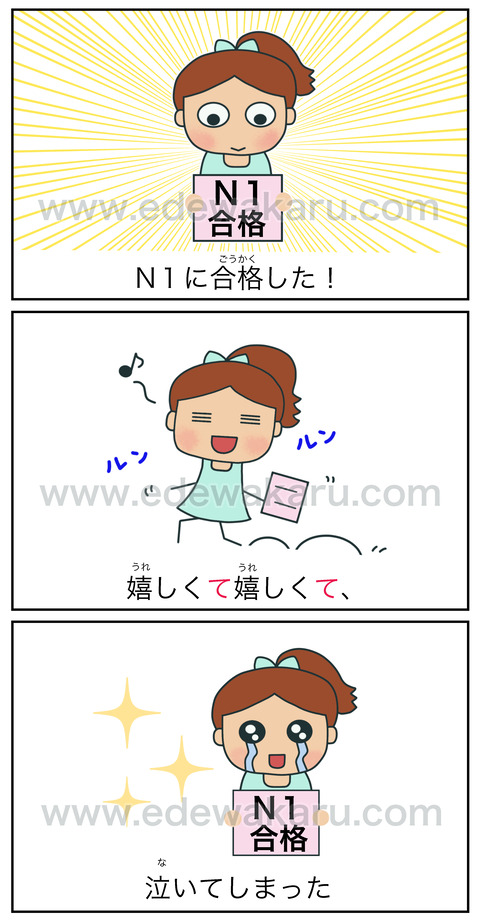
Meaning
とても〜
How to use it
動詞[て形]+動詞[て形]
い形容詞[ーい]くて+い形容詞[ーい]くて
な形容詞[ーな]で+な形容詞[ーな]で
Explanation
「〜て〜て」は「とても〜」という意味を表す文型です。「すごく〜」と強調したい時に使います。動詞・形容詞に使いますが、
「感情を表すもの」
か
「体に感じることを表すもの」
にしか使用できません😨「〜がる・〜がっている」の用法に少し似ていますね😀
(復習:〜がる・〜がっている②)
[例]
①嬉しく
て
嬉しく
て
【感情を表す単語】
②重く
て
重く
て
【体に感じることを表す単語】
③痛く
て
痛く
て
【体に感じることを表す単語】
④腹が立っ
て
腹が立っ
て
【感情を表す単語】
他にも
「残念で残念で」「悔しくて悔しくて」「悲しくて悲しくて」「楽しみで楽しみで」
などがよく使われます😊
(復習:〜など・〜なんか・〜なんて)
強調文型の1つとして覚えておくといいと思います😉
(復習:〜として)
In context 4 examples
N1に合格した!嬉しくて嬉しくて、泣いてしまった
→N1に合格した!とても嬉しくて、泣いてしまったかばんが重くて重くて、手が痛くなっちゃった
→かばんがとても重くて、手が痛くなっちゃった(復習:〜ちゃう・〜じゃう)1日中(いちにちじゅう)、頭が痛くて痛くて辛かった
→1日中、とても頭が痛くて辛かった昨日は、腹が立って腹が立って寝られなかった
→昨日は、とても腹が立って寝られなかった(復習:腹が立つ)
Usage 2
Read this source entry ↗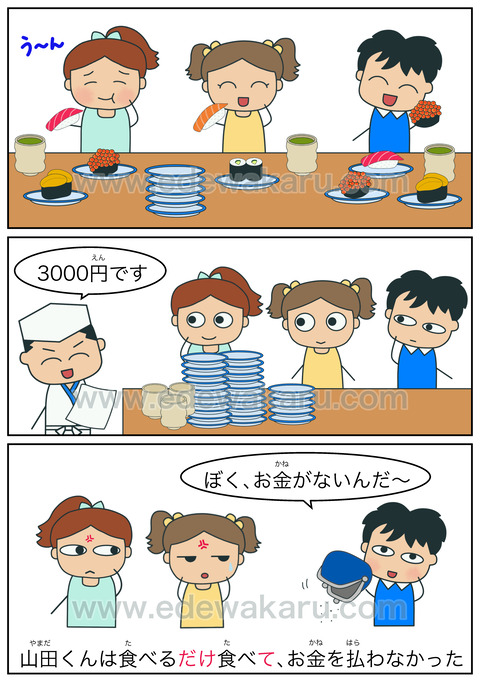
Meaning
〜だけして〜しない
〜以外のことはしない
How to use it
動詞[辞書形]+だけ+動詞[て形]
Explanation
「AだけAてB」は「A以外のことはしない」「しなければいけないBをしないで、Aだけする」という意味の文型です。「A」には同じ動詞が入り、「Aだけして、しなければいけないBをしない」「Aだけして、するべきことであるBをしない」と言いたい時に使われます。
[例]
①山田くんは食べる
だけ
食べ
て、お金を払わなかった
【A】食べる
【B】お金を払う
→食べて、お金を払わなかった
②彼は文句を言う
だけ
言っ
て
帰ってしまった
【A】文句を言う
【B】ちゃんと話し合う
→文句を言う以外のことはしないで帰った
③娘たちは、いつも遊ぶ
だけ
遊ん
で
片付けをしない
【A】遊ぶ
【B】片付けをする
→遊んで、片付けをしない
④父は言いたいことを言う
だけ
言っ
て、部屋から出ていった
【A】言いたいことを言う
【B】ちゃんと話し合う
→言いたいことを言う以外のことはしないで、部屋から出ていった
⑤彼女は、いつも計画を立てる
だけ
立て
て
実行しない
【A】計画を立てる
【B】計画を実行する
→計画を立てて、実行しない
「だけ」がつく文型はたくさんありますので、復習をしておきましょう😊
In context 5 examples
山田くんは食べるだけ食べて、お金を払わなかった
彼は文句を言うだけ言って帰ってしまった
娘(ムスメ)たちは、いつも遊ぶだけ遊んで片付けをしない
父は言いたいことを言うだけ言って、部屋から出ていった
彼女は、いつも計画を立てるだけ立てて実行しない
どんなときどう使う 日本語表現文型辞典
Usage 1
Meaning
for; because
How to use it
Vて/イAくて/ナAで/Nで
Explanation
て〈理由・原因〉
1)理由・原因の意味を表す。「から・ので」よりその意味は弱い。
2)後の文には「困る・大変だ・疲れた」などの心的、身体的な状態や不可能を表す表現を使うことが多い。
3)文末に話す人の意志や相手への働きかけを表す文は来ない。
◆ × 暑くて、窓をあけましょう。
→○暑いから、窓をあけましょう。
4) ❷ ❸ のように、あいさつとして慣用的に使う。
5)この使い方の場合、否定の形は「なくて」である。
2)Clause following often contains 困る, 大変だ, and 疲れた, or other expressions of emotional or physical conditions or impossibility.
1)Reason or cause. Weak connection.
3)Expressions of speaker's volition or appeal to listener do not appear at end of sentence.
In context 7 examples
用事があって会には参加できません。
遅くなって、すみません。
手伝ってくれて、ありがとう。
田中さんの声は小さくてよく聞こえません。
母のことが心配で眠れなかった。
台風で木が倒れた。
歯が痛かったので、ご飯が食べられなくて困った。
Usage 2
Meaning
then
How to use it
Vて
Explanation
て〈順次・前段階〉
1)動詞の「て形」(Vて)を使って、前と後を緩やかに結びつけている。 ❶ ~ ❸ では動作の順番を表している。
2) ❹ ❺ は後の動作のために必要な前段階である。
3) ❷ のように「Vて」を二つ使うこともできる。
4)前後関係をはっきり言うときは「Vてから」を使う。
5)この使い方の否定形は「Vないで・Vずに」である。
1)Loosely links clauses preceding or following Vて. In sentences ❶ to ❸ , action is listed in sequence.
2)Vて in sentences ❹ and ❺ are prerequisites for action following.
3)Two Vて patterns can be used, as in sentence ❷ .
4)To express sequence relations more definitively, use Vてから.
5)Negative is Vないで or Vずに.
In context 5 examples
電気を消して、部屋を出ます。
A駅まで電車で行って、B駅で乗りかえて、C駅で降ります。
すみませんが、コピーを10枚取って、木村さんのところへ持っていってください。
スーパーへ行って、たまごを買った。
田中君はいつもノックしないでわたしの部屋に入る。
Usage 3
Meaning
both; and
How to use it
イAくて/ナAで/Nで
Explanation
て〈緩い連結〉
1)イ形容詞、ナ形容詞、名詞の「て」の形、「で」の形によって、緩やかにつながれた文である。
2)前後の言葉によっていろいろな意味になる。 ❶ ❷ ❹ は重ね、 ❸ ❺ は意味の弱い原因、 ❻ は対比になっている。
1)Loosely connects イ-adjectives or ナ-adjectives and nouns.
2)Meaning differs depending on what precedes or follows. Sentences ❶ , ❷ , and ❹ are in tandem; sentences ❸ and ❺ show weak cause; sentence ❻ shows contrast.
In context 6 examples
新幹線は速くて、安全です。
この部屋は広くて、明るい。
昨夜は暑くて、寝られなかった。
山崎さんは親切で、やさしい人です。
(10年ぶりに会った人に)あなたが元気で、ほんとうによかった。
林さんは中国人で、林さんは日本人です。
Usage 4
Meaning
then
How to use it
Vて
Explanation
て〈並列・対比〉
動詞の「て形」(Vて)を使って、前の文と後ろの文を緩やかに結びつけている。 ❶ ❷ は並列、 ❸ ❹ は対比の意味になっている。
Loosely connects what precedes てform of verb to what follows. In sentences ❶ and ❷ the two clauses are in parallel. Sentences ❸ and ❹ stand in contrast.
In context 4 examples
朝はパンを食べて、コーヒーを飲みます。
3時にヤンさんが来て、4時にカンさんが来ました。
毎日、7時にうちを出て、6時ごろうちへ帰ります。
わたしは昼は学校で勉強して、夜は英語学校で英語を教えています。
Usage 5
Meaning
by; while
How to use it
Vて
Explanation
て〈方法・状態〉
1)動詞の「て形」(Vて)によって、前後を緩やかに結びつけている。
2) ❶ は方法・手段を表し、 ❸ はどんな状態で動作をするか、どんなことが起こるかを表している。
3)この意味での否定は「Vないで・Vずに」である。
3) Negative is Vないで or Vずに.
1)Loosely connects what precedes and follows it.
2)Sentence ❶ describes method and means; sentence ❸ describes what happens or what action occurs in what state.
In context 4 examples
CDを聞いて発音の練習をします。
女の子たちは芝生にすわって、話しています。
暑いので、子どもたちはふとんをかけないで寝ています
こちらの名前と住所を書かないで手紙を出した。
日本語NET JLPT文法解説まとめ
Meaning
理由や原因を表す。
How to use it
V(て形)
イAくて
ナAで
Nで (Nは地震や台風、火事などのよくない単語が来る)
Explanation
because
後ろには感情を表す言葉が来ることが多い。
後ろに意志を表す動詞は来ない。
In context 14 examples
遅れて、ごめん。
JLPTに合格できて、本当に嬉しいです。
今朝のニュースを見て、びっくりしました。
長い間、家族に会えなくて、寂しいです。
財布を失くして、困りました。
昨日のテストは問題が難しくて、全然わからなかった。
眠くて、授業に集中できません。
給料が少なくて、悲しいです。
明日の試験が心配で、寝られません。
トムさんのプレゼンテーションが上手で、びっくりしました。
台風で大きな木がたくさん倒れた。
地震で街はめちゃくちゃになりました。
津波で多くの人が亡くなった。
昨日は風邪で休みました。
日本語文型辞典 英語版
Usage 1
Meaning
【て】[N/Na で][A-くて][V-て]で is attached to nouns and na-adjectives. In the case of i-adjectives, it takes the form くて. ない has two forms: なくて and ないで. In the case of verbs, で is used for those whose dictionary form ends in グ, ヌ, ブ and ム, while all others take て.
Used for loosely linking two clauses. ...て can be used twice, as in
(3)
and
(4)
.
By linking sentences which express actions, this describes matters that take place in sequence, as in
(1)
and
(2)
. Also used to express contrast, a possible reason, a means of action, or circumstances related to such, depending on the context.
In sentences expressing an attribute or state by the use of adjectives, this is sometimes used to list two attributes or to mention a possible reason. When an adjectival clause or description of a characteristic follows an expression of activity, as in
(10)
, it often expresses a possible reason for something.
When several actions or situations alternate, or when one is describing something unrelated to a time sequence, たりis used instead of て.
In context 10 examples
朝ご飯を作って、子供を起こした。
I cooked breakfast and then woke my children up.
しっかり安全を点検して、それからかぎをかけた。
I checked that everything was safe and then locked up.
まず、買い物をして、それから、映画を見て、帰って来た。
I went shopping first, then watched a film, and then came home.
電話をかけて、面会の約束をとりつけて、会いに行った。
I called them, made an appointment for an interview, and then went to see them.
山田さんがやめて、高田さんが入った。
Yamada-san quit, and then Takada-san joined.
びっくりして、口もきけなかった。
I was so surprised that I couldn’t speak.
着物を着て、出掛けた。
I put on a kimono and went out.
地下鉄ははやくて安全だ。
The subway is fast and safe.
外が真っ暗でこわかった。
Outside was dark and scary.
めずらしい人から手紙をもらってうれしかった。
I was happy to receive a letter from someone who rarely writes me.
Usage 2
Meaning
【て...て】[Na で Na で][A-くて A-くて][V-て V-て]
Used for emphasizing degree by repeating the same verb or adjective. Usually used in conversation.
In context 5 examples
連絡がいつまで待っても来ないので、不安で不安で仕方がなかった。
Because no contact came no matter how long I waited, I was beside myself with worries.
お土産を買い過ぎたので、トランクが重くて重くて腕がしびれそうだった。
I bought too many gifts, so the suitcase was so heavy that my arm nearly become numb.
はじめて着物を着たら、帯がきつくてきつくて何も食べられなかった。
I wore a kimono for the first time, and I couldn’t eat anything because the obi sash was so tight.
走って走ってやっと間に合った。
I ran and ran and managed to get there in time.
一晩中飲んで飲んで、飲みまくった。
I drank and drank all night.
AIUEO JLPT Grammar
Meaning
「て・で」are conjunctive particles used to link actions or states, or to express causes or reasons.
How to use it
動詞て形形容詞て形形容動詞+で名詞+で
Explanation · 日本語
「て・で」は、動作や状態を並列したり、原因や理由を表すときに使われる接続助詞です。
In context 5 examples
彼は優しくて、面白い人です。
He is kind and funny.
この商品は人気で、すぐに売り切れました。
This product is popular, so it sold out quickly.
宿題が多くて、大変です。
There is a lot of homework, so it’s tough.
今日は寒くて、外に出たくありません。
It’s cold today, so I don’t want to go outside.
練習不足で、失敗しました。
I failed due to lack of practice.
文法
Meaning
理由や原因を表す。
How to use it
V(て形)
イAくて
ナAで
Nで (Nは地震や台風、火事などのよくない単語が来る)
Notes
後ろには感情を表す言葉が来ることが多い。
後ろに意志を表す動詞は来ない。
In context 14 examples
遅れて、ごめん。
JLPTに合格できて、本当に嬉しいです。
今朝のニュースを見て、びっくりしました。
長い間、家族に会えなくて、寂しいです。
財布を失くして、困りました。
昨日のテストは問題が難しくて、全然わからなかった。
眠くて、授業に集中できません。
給料が少なくて、悲しいです。
明日の試験が心配で、寝られません。
トムさんのプレゼンテーションが上手で、びっくりしました。
台風で大きな木がたくさん倒れた。
地震で街はめちゃくちゃになりました。
津波で多くの人が亡くなった。
昨日は風邪で休みました。
Yokubi — The Common Grammar Guide (https://yoku.bi)
Usage 1
Explanation
Don't worry if this lesson seems hard. We're just covering fundamentals, you're not expected to internalize the ideas here yet.
There is a verb form that ends in て. This verb form is used in two main ways:
- to chain actions or statements together;
- to provide additional nuance to an action or statement.
The て form is made by replacing the past tense た with て. Keep in mind that this isn't some kind of secondary past tense. The て form does not encode any notion of "tense" in its form. It doesn't tell us anything about the sentence being past or present.
Adjectives can also have a て form. This is done by turning the い into くて.
| | |
|---------------|----------------|
| 赤い | 赤くて |
| 怖い | 怖くて |
| 面白い | 面白くて|
| いい | よくて |
This also works for negative conjugations, which is also how we apply て form to negative verbs.
| | |
|----------|------------|
| 赤くない | 赤くなくて |
| 食べない | 食べなくて |
We saw "A is B" and "A does B" type of sentences. With the introduction of the て form we will see our first example of "A does B, and then D does C" type of sentences. At the very basic syntax level, AてB means "A happens, and then B". It can mark either a temporal sequence, or a cause \-\> consequence relationship. It allows us to make longer sentences with multiple verbs in sequence. Note that the subject on both sides does not have to be the same.
Note: whether or not you use a comma after て does not matter. Commas in general have no grammatical role in Japanese, but they can make things easier to parse.
The statement 察しがよくて is followed by the statement 助かる. 助かる is not modifying よくて. Instead, the first statement is setting up the context for the second statement. It is common in Japanese to build an initial statement, followed by a て conjugation, and then an additional statement that describes your subjective feeling or emotion about that first statement. You feel relieved (助かる) because the other person has the quality of 察しがいい.
In the common collocation 〜てすみません, the part before the て shows the cause of the apology.
In this example, て just strings the statements together as a simple sequence of actions. As mentioned earlier, the て form does not provide any notion of past or present tense. The tense is instead conveyed by the last verb in the sequence. 頷いた is in past form, so we can assume that the entire statement is in past tense.
Sometimes the て form lets a verb act as a topic. In this way, it can look like a noun. It's not really a noun, it just looks like one in situations like this. In this usage it is often followed by the は particle.
The て form of ない, なくて, often carries a "didn't X, so Y" nuance. But this is just a nuance. It's just one of the possible uses of it.
In context 6 examples
殺して 切って 買って 死んで 食べて
察しがよくて助かる
It is a relief that you have good intuition. (lit. you have good intuition and that helps me)
遅くなってすみません
I'm sorry for being late (lit. "I am late and I am sorry")
彼女の目を見て、頷いた
I looked her in the eyes and I nodded
腹が減っては戦はできない
It is impossible to go to war when you are hungry.
早く起きなくて仕事に遅れた
I didn't get up early, and I was late for work. (reason)
Usage 2
Explanation
On top of just connecting two statements into a single sentence, the て form can also act as an auxiliary. When \<verb1\>て\<verb2\> is used this way, the second verb modifies the core meaning of the first. Usually the second verb has an abstract and often purely grammatical meaning.
In this example, the verb あげる attaches to the て form of 殺す. あげる has a few meanings, two of them being "to raise (something)" and "to give (something to someone)". Because it is used in this pattern, it assumes the meaning of "giving" the action 殺す to someone else. It can have the nuance of doing it as some kind of favor, sometimes ironically or sarcastically (as in the example above).
Here, the "receive" word, もらう, attaches to 助ける. This addition of てもらう can have a nuance of gratefulness as the subject receives some kind of favor. However, this is not only what is happening here. The phrase 私が助ける means that subject 私 is the one that performs the action of "saving/helping" (someone else). However, the phrase 私が助けてもらう marks the subject 私 as the one that receives the action of being helped. The **XてY** pattern isn't just attaching the verb Y to an earlier statement, it can make a whole new verb phrase, with different grammar and meaning.
This usage of て auxiliary can be very powerful, and it is at the core of what makes some of these grammatical structures so typically Japanese that are often hard to translate into English.
On top of てあげる and てもらう there is also a third verb, てくれる which completes the giving/receiving "circle":
It is important to keep in mind the difference between the "outside" group and the "inside" group, but it is too complicated to go over it right now. Just remember that てもらう is almost always used with **you** as the subject, and you receive a favor from **someone else**. Likewise, in the opposite direction, てくれる has **someone else** as subject and they do a favor **towards you** the recipient. Note the particles in the following examples:
The parts in parenthesis are often dropped or removed because just by using てくれる and てもらう, Japanese can imply a "direction" of the verb which makes it obvious whether the action is towards you or not. In English we say "He taught **me**" but in Japanese we say "彼が教えてくれた". The "me" part is implied in てくれる.
We will later see other usages of て auxiliary to add a sense of directionality to phrases like ていく and てくる.
For verbs and adjectives in ない form, there is another version of the て form that is often used with an "auxiliary" nuance. In this form, rather than なくて, it becomes ないで instead.
Here, 食べないで is the て auxiliary of 食べない and can be used to describe the following verb (待つ). It acts somewhat adverbially to add additional meaning and context to the last verb in the chain. We will see more examples of ないで in later lessons, just be aware it exists for now.
In context 4 examples
殺してあげる
I'll do you the favor of killing you
助けてもらう
To receive help (directed towards yourself)
(私が)父に教えてもらった
(I) was taught by my father.
父が(私に)教えてくれた
My father taught (me)
NINJAL 日本語文型データベース
Usage 1
Meaning
[1] 2つの動作を連続して順に行うこと、または、2つの出来事が順に起こることを表します。
[2] 2つの動作、出来事や物事の状態を並列的に表すとき、または対比的に表すときに使います。「〜」が動詞・イ形容詞の場合の形です。
[3] ある動作を行うときの状態を表します。
[4] ある動作を行うときの手段・方法を表します。
[5] 物事の原因・理由を表します。直感的、感覚的に判断した因果関係を示すときに使います。「〜」が動詞・イ形容詞の場合の形です。
How to use it
Notes
[1] 3つ以上の動作や出来事をつなぐこともできます。
[2] 「〜て」の前後の文の主語が違う場合は、対比的な関係を表します。
3つ以上の動作、出来事や状態をつなぐこともできます。
[3] 「〜て」の前後の文の主語は同じです。
「〜」は、「着る・立つ・目をつぶる」など、瞬間的な動作を表す動詞です。
[4] 「〜て」の前後の文の主語は同じです。
「〜」は、「見る・使う・書く」など、意志的な行為を表す動詞です。
[5] 「〜て」の後には、感情・感謝・謝罪・不可能・体の状態・意図せず起こった結果などを表す文がきます。話し手の意向・希望を表す文や、相手への働きかけの文はきません。
「〜て」の前後の文の主語は、同じでも同じでなくてもいいです。
In context 42 examples
毎朝8時に家を出て、駅へ向かう。
「これ、切手を貼ってポストに入れてね」
野菜を切って鍋に入れて火にかけてください。
会社に着いたら、まずメールをチェックして、返信して、それから書類の作成にとりかかります。
お金を入れて、食べたいメニューのボタンを押すと、食券が出てきます。
空が暗くなって、大雨が降り出した。
トントンとノックの音がして、リーさんが部屋に入ってきた。
太陽は東から出て、西に沈む。
月は地球を回って、地球は太陽を回ります。
私はたいてい朝はパンを食べて、昼と夜はご飯を食べます。
店を開ける前に店内を掃除して、店を閉めた後で売り上げをチェックして……。店が開いていないときにもいろいろな仕事がある。
試験をあと3つ受けて、レポートを2つ書いて、発表をして……学期末の課題が重なって大変だ。
子どものための、安くておいしいおやつはありませんか。
こんなに庭が広くて花がいっぱいのお宅は、このあたりでは珍しいです。
西野さんは声が大きくて話し方も速いから、怒っているように聞こえる。
京都は、冬はとても寒くて、夏はとても暑いです。
昨年の6月はビールの売れ行きがよくて、今年の6月は日本酒の売れ行きがよかった。どうしてだろう。
この温泉の色は白くて、山の向こうの温泉の色はうす茶色だ。成分の違いだろう。
祖父はソファに寝転んでテレビを見るのが好きです。
子どもたちがかわいい水着を着てプールで遊んでいる。
花火大会の会場は混んでいたが、座って見られたからよかった。
母「日差しが強いから、帽子をかぶって出かけなさいよ」
雨の日には、みんな色とりどりの傘をさして歩く。
迷惑をかけた叔父に手をついて謝ったが、許してもらえなかった。
私は単語アプリを使って単語を覚えました。
味噌汁に牛乳を加えて、いつもとは違う味にしてみました。
指を折って数を数える習慣は世界中にある。
私は毎晩、子守歌を歌って子どもを寝かしつけています。
職人の技術は、親方の仕事を見て学ぶという形で伝承されてきた。
「仕事が早く終わってよかったね」
お父様のご退院の話を聞いて、ほっとしています。
山田さんは、転んで腰の骨を折ってしまった。
お手紙を読んでびっくりしました。赤ちゃんが生まれたんですね。
疲れていて何をする気力もない。
この間は私の結婚パーティーに来てくれて、ありがとう。
ご迷惑をおかけして、申し訳ありませんでした。
この参考書は、字が小さくて読みにくい。
昨日の講演会は会場の周りが騒がしくて、落ち着かなかった。
合格の知らせがうれしくて、涙が出てしまった。
子どものころ、怖くて夜一人でトイレに行けなかった。
昨日はおなかが痛くて起き上がることもできなかった。
「すみません、子どもたちがうるさくて」「大丈夫、大丈夫。元気があっていいわよ」
Usage 2
Meaning
話し手が聞き手に〜することを頼んだり、指示したり、勧めたりするときに使います。聞き手の意向を尋ねないで要求する言い方です。
「〜てください」の「ください」を省略した形です。
友達・家族など心理的に近い人や立場が下の人に言うときに使います。
How to use it
Vて
In context 5 examples
子「お母さん、電話が鳴ってる」母「今手が離せないから、代わりに出て」
「村岡くん、先に会議室に行って準備しておいて」「はい。わかりました」
「見て、あそこ! きれいな鳥がいる」
「もうすぐ入学試験だね。体に気をつけて頑張ってね」
先生「先に掃除が終わったグループは、ほかのグループを手伝ってあげて」
IMABI
The Conjunctive Particle て I: The Affirmative
Read this IMABI lesson ↗Explanation
The Conjunctive Particle て I: The Affirmative
The particle て is the most important conjunctive particle in Japanese, and the resulting conjugation known as the “te-form” (て形), is arguably the most important grammar structure in Japanese.
A conjunctive particle (接続助詞) is a particle that connects two clauses together. In the case of ~て, it most closely relates to “and/then” in sentences like:
i. I ate at a restaurant, and I thought to myself how expensive that place was.
ii. I studied Japanese for two hours, then I went to work.
iii. The cat scratched me, and I cried.
iv. I ate and swam.
v. The shirt was red, long, and had stains on the sleeves.
vi. The dog was a chihuahua and it was a tiny one at that.
The parts in bold correlate to how the particle ~て functions in compound sentences. It is never “and” between two nouns. That role is handled by parallel particles such as と and や. Rather, it connects clauses created with conjugatable parts of speech, such as verbs, adjectives, adjectival nouns, and the copula.
To make learning this particle easier, we will be learning the basics in the span of three lessons. In this first installment, we will learn how ~て is used in affirmative sentences. Next, we will learn about the two negative “te forms” that exist. Then, to conclude we will look more closely at how て ought to be interpreted.
Conjugating with the Particle て in the Affirmative
Conjugating with the particle ~て in the affirmative (a positive sentence) is actually really easy because you have learned about all the sound changes and exceptions made with it when you learned about the auxiliary verb ~た (past tense marker). This is because the two words are closely related.
To make things easier, we will study how the て形 is made with the various parts of speech it attaches to separately.
With Verbs: ~て・で
The particle て follows the continuative form (連用形) of verbs. To recap, this form is as follows for the four verb classes:
Ichidan (Stem + Ø)Godan (Stem + /i/)SahenKahen
Ex. Miru (to see): Mi–Ex. Kaku (to write): Kak– + /i/ → kaki– Shi–Ki–
Linguistic Note: Ø stands for naught, indicating that you do not place anything after the stem of ichidan verbs to create the continuative form (連用形). Some might argue, though, that /i/ does attach itself to them—as it does with the other verb classes—but because all ichidan verb stems end in either /i/ or /e/, it would naturally become absorbed by the stem, making this unclear.
To streamline the learning process, each verb class’ て形 will be studied separately. Every section will have its own set of verbs showcased with a sentence or two showing them in action. Because the て形 is best understood in context, we will shift to learning how to interpret it properly once we are done learning how to conjugate with it.
■Ichidan Verb + て
To conjugate an ichidan verb into the て形, all you have to do is drop the final /ru/ and add ~て. This line of thought does not contradict with using the “continuative form” (連用形) as all you are doing is swapping one affix (ending) for another.
In reality, Japanese grammar builds verb phrases from the stem onwards, but it is okay to dissect things from the end and go backwards if that makes it easier to remember how to conjugate.
Without further ado, let’s see the て形 of several useful ichidan verbs.
Basic Form Conjugation Processて形
見る (to see)Miru + -te → Mite見て
食べる (to eat)Taberu + -te → Tabete食べて
開ける (to open)Akeru + -te → Akete開けて
1. テレビを見て食事をする。
To watch TV and eat dinner.
2. ご飯を食べてすぐ寝ました。
I ate my meal, then went straight to bed.
3. ドアを開けて部屋を出て行った。
I opened the door, then left the room.
■Godan Verbs + て
The godan verb class is particularly harder to conjugate because of how the stem sometimes undergoes sound changes. Luckily, the same rules we learned for ~た apply to ~て.
Sub-TypeRule
K-TypeDrop the /k/ in the stem, attach /i/, then add て.
G-TypeDrop the /g/ in the stem, attach /i/, then add で.
※て becomes voiced to compensate for /g/ being voiced.
S-TypeConjugate to the continuative form, then add て.
N/B/M-TypeChange the /n/, /b/, or /m/ in the stem to [n], delete the /i/ in the base, then add で.
※て becomes voiced to compensate for /n/, /b/, /m/ being voiced.
T/R/W-TypeChange the /t/, /r/, or /w/ in the stem to a っ, delete the /i/ in the base, then add て.
To put this into perspective, we will look at these conjugation processes in action with several useful godan verbs.
TypeBasic FormConjugation Processて形
K聞く (to hear)Kik- + /i/ → Kiki → Kii- + /-te/聞いて
G泳ぐ (to swim)Oyog– + /i/ → Oyogi– → Oyoi– + /-te/ → [-de]泳いで
S話す (to talk)Hanas– /i/ → Hanashi– + /-te/話して
N死ぬ (to die)Shin– + /i/ → Shini + /-te/ → [-de]死んで
B呼ぶ (to call)Yob– + /i/ → Yoni + /-te/ → [-de]呼んで
M読む (to read)Yom– + /i/ → Yoni + /-te/ → [-de]読んで
T勝つ (to win)Kat– + /i/ → Kachi– → Kat– + /-te/勝って
R帰る (to return)Kaer– + /i/ → Kaeri– → Kaet– + /-te/帰って
W買う (to buy)Kaw– + /i/ → Kawi– → Kat– + /-te/買って
K※行く (to go)Ik– + /i/ → Iki– → It– + /-te/行って
W※言う (to say)Iw– + /i/ → Iwi– → It-/Yut– + /-te/言って
※The verb 行く is irregular and conjugates like a t/r/w-type godan verb with the particle て.
※The verb 言う is irregular not because of how て combines with it, but because of how the initial mora may be pronounced as /yu/ in casual speech.
4. わたしは昼ご飯を食べて、テレビを見て、音楽を聞いて、帰りました。
I ate lunch, watched TV, listened to music, and came home.
5. 試合に勝って勝負に負けた。
I won the match, then I lost the battle.
6. 野菜を買ってスープを作った。
I bought vegetables and made a soup.
7. 公園に行って遊びました。
I went to the park and had fun.
8. すぐに駅員さんに言って戻りました。
I immediately told the station staff, then I returned.
9. 自分だけが死んで、ほかの者はすべて生き残る。
Only you die, and all the others survive.
10. パパと話して決めた。
I talked to my dad and made the decision.
■Sahen & Kahen Verbs
Conjugating sahen and kahen verbs, a.k.a, する and 来る, is a matter of matching their continuative form (連用形) with the conjunctive particle て.
Basic Form Conjugation Process て形
するSuru → Shi-/ + –teして
来るKuru → Ki-/ + –teきて
11. 話を終えた後、1人の生徒が来て質問をした。
After finishing the talk, one student came and asked a question.
12. きょうは図書館で勉強してピザ屋さんで美味しいピザを食べました。
Today, I studied at the library and ate delicious pizza at a pizza place.
With Adjectives: ~くて
In Lesson 14, we learned that adjectives have two continuative forms (連用形). The basic one is formed by adding –ku to the stem. When the conjunctive particle て attaches to adjectives, it does so by following its ku-type continuative form1.
Basic FormKu-Type Continuative Formて形
新しい (new)新しく新しくて
“it’s new and…”
赤い (red)赤く赤くて
“it’s red and…”
大きい (big)大きく大きくて
“it’s big and…”
美しい (beautiful)美しく美しくて
“it’s beautiful and…”
13. そのリンゴは赤くて、大きいです。
The apple is red and big.
14. あの人は優しくて頭がいいです。
That person is kind and smart.
15. 世界は美しくて、面白い。
The world is beautiful and interesting.
16. 新しくて便利です。
It’s new and convenient.
With Adjectival Nouns/Copula
Knowing how to create the て形 of an adjectival noun is the same thing as knowing how to create the て形 of the copula because you need the copula to conjugate adjectival nouns in the first place. The continuative form of the copula だ is で, with ~て being voiced for the same principle that is for certain godan verbs.
Part of SpeechTerminal Formて形
Adjectival Noun簡単だ (it’s easy)簡単で (it’s easy and…)
Noun犬だ (it’s a dog)犬で・・・(it’s a dog and…)
17. 山田さんはきれいで優しいです。
Ms. Yamada is pretty and nice.
18. 日本語は簡単で、面白いです。
Japanese is easy and interesting.
19. あっちは犬でそっちは猫だよ。
That over there is a dog, and that there is a cat.
Meanings of ~て When Connecting Clauses
As stated in the introduction, the primary function of the conjunctive particle て is to connect two clauses to create a compound sentence. When it does so, the relationship between the two clauses can vary depending on the circumstances.
i. When ~て lists actions, actions occur in chronological order. This is why it may translate as “and (then).” However, tense is not inherent to ~て; thus, whether the sentence is in the present, past, or future tense is determined by the main clause.
20. スーパーで買い物をして料理を作りました。
I shopped at the supermarket, then I made food.
21. 魚を釣って食べた。
I caught a fish and ate it.
22. 銀座へ行って友達に会います。
I will go to Ginza and meet a friend.
If the agents (doers) of said actions are not the same in each ~て clause, then the actions are happening in tandem with each other.
23. 僕がポケモンをやってテイラー君がフォートナイトをやった。
I played Pokémon and Taylor played Fortnite.
ii. Oftentimes, there is a causal relationship between the two clauses. Meaning, the second clause happened consequently because of the first clause. In such situations, it is very similar to “and (so).”
24. ニュースを聞いて、びっくりした。
I was surprised by what I heard in the news.
25. 立ち止まって辺りを見回す。
To stop and look around.
26. この日本語の文章が複雑で、よく分かりませんでした。
This Japanese passage was complicated, and so I didn’t understand it well.
27. 彼は彼女の家に寄って、手紙を届けた。
He stopped by her house and delivered a letter.
In these situations, the causation is borne out by the sentence as a whole. To prove this, consider ニュースを聞いて in Ex. 24. Up to this point, the listener only knows that the speaker is talking about watching the news, and it is only once the speaker says that they are surprised that the relationship becomes clear: the news must have been noteworthy to cause such a reaction. This, though, is not the same thing, per se, as saying “I was surprised because I saw the news.”
28a. 健太君が猫に引っ掻かれて泣いた。
28b. 健太君が猫に引っ掻かれたので泣いた。
28a. Kenta-kun got scratched by a/the cat and cried.
28b. Kenta-kun cried because he got scratched by a/the cat.
iii. When the second clause is made possible by the actions of the first clause, the particle ~て can be viewed as showing method. The means, though, is not rendered as a noun like it would be with the case particle で2.
29. 物に火をつけて燃やす。
To light something on fire and burn it.
30. 魔法のメガネをかけて読んだ。
I read it by putting on magic glasses.
31. 皿洗い機に塩を入れてタコのぬめりを取りました。
I put salt in the dishwasher and removed the sliminess from the octopus.
iv. Especially with adjectives and adjectival nouns, ~て may list qualities. This usage is often used in tandem with the other usages, sometimes even in the same sentence. It is also possible for an infinitely long ~て description to modify a noun, as the final attributive form (連体形) is what glues it all to the noun.
32. 川田さんの家は新しくて、きれいですね。
Mrs. Kawada’s house is new and pretty, isn’t it?
33. 東京は賑やかで面白い。
Tokyo is lively and interesting.
34. このクラスは宿題が多くて、試験も難しかったです。
The class had a lot of homework, and the exams were difficult.
35. 風が強くて寒い日
A cold day in which the wind is strong
36. 太陽の光に反射して本当にきれいでした。
It was reflected by the sun’s light and was really pretty.
37. 軽くて{かっこいい・スマートな}ケータイがほしいです。
I want a light and stylish cell phone.
38. あれ、あの人は[札幌で女性を殺して海外に逃亡した]容疑者ではないか。
Huh, isn’t that person the suspect [who killed a woman in Sapporo and escaped overseas]?
v. An offshoot of ii., sometimes the second clause conflicts with the first clause to create a contradictory statement. This translates to “and (yet).” This usage is notably not the same as contradictory statements made with conjunctions like “but/yet” without an intervening “and,” which is to say that both actions are true and concurrent. In these contexts, the chronological effect て would normally have when connecting two clauses is not so much subsequential as the clauses are incidentally contrastive in nature.
39. 同じ状況でも男はわかっていて答えない。
Even in the same situation, men will know and yet won’t answer.
40. 見て見ぬふりをする。
To turn a blind eye.
Phrase Note: This set phrase is the best example of v. “Seeing” and yet “pretending not to see” is the literal meaning. The ~ぬ in this phrase is an older form of ~ない.
One could theoretically rewrite ~て out of these examples to be left with two (or more) independent clauses. Indeed, some meanings are lost if you do this. For instance…
41a. 母は手袋をはめて食器を洗い始めました。
My mother put on gloves and began washing the dishes.
41b. 母は手袋をはめました。そして、食器を洗い始めました。
My mother put on gloves. And, she began washing the dishes.
42a. 母はあとで手袋をはめて食器を洗います。
My mother will later wash the dishes wearing gloves.
42b. 母はあとで手袋をはめます。それから、食器を洗います。
My mother will put on gloves later. Then, she will wash the dishes.
If you were to take out ~て from these sentences and rewrite them into two separate sentences, you could not get the meaning of “method” from the context. The actions would be chronological, subsequential at best.
Yet, there is an array of sentences in which ~て attaches to what is inexplicably a dependent clause. In doing so, it usually marks the condition in which something occurs.
43. 投票は議会において行われました。
The vote was held in the Diet.
44. 「て形」の使い方について教えました。
I taught about the usages of the “te-form.”
In these situations, the verbs used with ~て often have lost their literal meanings to serve a more grammatical role. These usages will be studied individually from time to time as we progress.
Similarly, it is also possible to see the first verb conjugated with ~て joined to the next verb in a compound verb expression in which the first verb sets the tone and the second hits the nail on the head.
45. 真意を見て取る。
To grasp the real sense.
46. 選挙に打って出る。
To make one’s debut in an election.
47. 急いで取って返す。
To hurry and return.
The Polite ~まして & ~でして
In very polite speech, largely in the spoken language, it is possible to see ~て attached to the auxiliary verbs ~ます and ~です.
Part of Speech + ~まして/~でして
Ichidan Verbs見る (to see) → 見まして
Godan Verbs行く (to go) → 行きまして
Sahenする (to do) → しまして
Kahen来る (to come) → 来まして
Adjectives新しい (to be new) → 新しゅうございまして※
Adjectival Nouns簡単だ (to be easy) → 簡単でして
Nouns + Copula事故だ (to be an accident) → 事故でして
※Forcing this grammar onto adjectives is possible, but it requires more advanced grammar that has only been hinted at so far. So for now, we will not be looking at any example sentences utilizing it.
These politer て形 do not have the same versatility in usages as the standard て形. They cannot appear in set phrases (like in Ex. 40), situations in which ~て fuses two verbs (like in Exs. 45-47), or before a noun within a complex modifier (like in Exs. 35, 38).
48. アメリカのシアトルに引っ越してまいりまして早1か月!
It’s been a quick first month since I’ve moved to Seattle, U.S.A!
Grammar Note: 引っ越してまいる serves as the humble version of 引っ越してくる, which means “to move,” which is another example of ~て creating a compound verb.
49. 事故で電車が遅れまして10分遅刻します。
The train was late due to an accident, and (so) I’ll be 10 minutes late.
50. ただいま品切れでしてすみません。
I’m sorry, it’s out of stock right now.
51. 状況を見ましてご連絡いたします。
I’ll look over the matter and get back to you.
The copula です, whether it be as a standalone verb or an auxiliary verb, has other politer forms3 that can also be conjugated into the て形. So as not to delve into too much honorific speech, we will leave off with just these two examples.
52. 本日は休みでございまして申し訳ございません。(Humble)
I am so sorry; I/we are off today.
53. 中村先生は、皆さんがよく御存知の、大変ご高名な先生でありまして、私も尊敬する獣医さんであります。(Quite Honorific)
Nakamura Sensei is a renowned doctor whom everyone knows well and a veterinarian whom I also respect.
Verb Deletion
One final grammatical feature of the conjunctive particle て that we will touch on is what happens when the same verb is being repeated over. Of course, there is nothing wrong with listing out separate iterations of the same kind of action with it, but Japanese actually allows you to drop the ~て and its verb altogether, leaving only the final iteration for the end of the sentence.
54a. ランス君はフランスへ行って、セス君は日本へ行って、サム君は中国へ行きました。
54b. ランス君はフランスへ、セス君は日本へ、サム君は中国へ行きました。
54c. ランス君はフランス、 セス君は日本、サム君は中国へ行きました。
Lance went to France, Seth went to Japan, and Sam went to China.
As this example demonstrates, even the preceding case particle can be omitted. The prerequisite for this, of course, is that everything is internally phrased and structured the same way.
Previous Lesson
Next Lesson
In literary language, you may see the kari-type continuative form for adjectives, albeit uncontracted, creating ~くあって. ↩︎
Etymologically, this is the usage of て via にて which gave rise to the particle で to indicate means. ↩︎
These forms are most appropriate in the spoken language, as they are avoided in careful writing due to a rule of thumb that politeness marking in the form of auxiliary verbs need only be done once in the main clause. ↩︎
In context 59 examples
テレビを見て食事をする。
To watch TV and eat dinner.
ご飯を食べてすぐ寝ました。
I ate my meal, then went straight to bed.
ドアを開けて部屋を出て行った。
I opened the door, then left the room.
わたしは昼ご飯を食べて、テレビを見て、音楽を聞いて、帰りました。
I ate lunch, watched TV, listened to music, and came home.
試合に勝って勝負に負けた。
I won the match, then I lost the battle.
野菜を買ってスープを作った。
I bought vegetables and made a soup.
公園に行って遊びました。
I went to the park and had fun.
すぐに駅員さんに言って戻りました。
I immediately told the station staff, then I returned.
自分だけが死んで、ほかの者はすべて生き残る。
Only you die, and all the others survive.
パパと話して決めた。
I talked to my dad and made the decision.
話を終えた後、1人の生徒が来て質問をした。
After finishing the talk, one student came and asked a question.
きょうは図書館で勉強してピザ屋さんで美味しいピザを食べました。
Today, I studied at the library and ate delicious pizza at a pizza place.
そのリンゴは赤くて、大きいです。
The apple is red and big.
あの人は優しくて頭がいいです。
That person is kind and smart.
世界は美しくて、面白い。
The world is beautiful and interesting.
新しくて便利です。
It’s new and convenient.
山田さんはきれいで優しいです。
Ms. Yamada is pretty and nice.
日本語は簡単で、面白いです。
Japanese is easy and interesting.
あっちは犬でそっちは猫だよ。
That over there is a dog, and that there is a cat.
スーパーで買い物をして料理を作りました。
I shopped at the supermarket, then I made food.
魚を釣って食べた。
I caught a fish and ate it.
銀座へ行って友達に会います。
I will go to Ginza and meet a friend.
僕がポケモンをやってテイラー君がフォートナイトをやった。
I played Pokémon and Taylor played Fortnite.
ニュースを聞いて、びっくりした。
I was surprised by what I heard in the news.
立ち止まって辺りを見回す。
To stop and look around.
この日本語の文章が複雑で、よく分かりませんでした。
This Japanese passage was complicated, and so I didn’t understand it well.
彼は彼女の家に寄って、手紙を届けた。
He stopped by her house and delivered a letter.
健太君が猫に引っ掻かれて泣いた。
28a. Kenta-kun got scratched by a/the cat and cried.
健太君が猫に引っ掻かれたので泣いた。
28a. Kenta-kun got scratched by a/the cat and cried.
物に火をつけて燃やす。
To light something on fire and burn it.
魔法のメガネをかけて読んだ。
I read it by putting on magic glasses.
皿洗い機に塩を入れてタコのぬめりを取りました。
I put salt in the dishwasher and removed the sliminess from the octopus.
川田さんの家は新しくて、きれいですね。
Mrs. Kawada’s house is new and pretty, isn’t it?
東京は賑やかで面白い。
Tokyo is lively and interesting.
このクラスは宿題が多くて、試験も難しかったです。
The class had a lot of homework, and the exams were difficult.
風が強くて寒い日
A cold day in which the wind is strong
太陽の光に反射して本当にきれいでした。
It was reflected by the sun’s light and was really pretty.
軽くて{かっこいい・スマートな}ケータイがほしいです。
I want a light and stylish cell phone.
あれ、あの人は[札幌で女性を殺して海外に逃亡した]容疑者ではないか。
Huh, isn’t that person the suspect [who killed a woman in Sapporo and escaped overseas]?
同じ状況でも男はわかっていて答えない。
Even in the same situation, men will know and yet won’t answer.
見て見ぬふりをする。
To turn a blind eye.
母は手袋をはめて食器を洗い始めました。
My mother put on gloves and began washing the dishes.
母は手袋をはめました。そして、食器を洗い始めました。
My mother put on gloves. And, she began washing the dishes.
母はあとで手袋をはめて食器を洗います。
My mother will later wash the dishes wearing gloves.
母はあとで手袋をはめます。それから、食器を洗います。
My mother will put on gloves later. Then, she will wash the dishes.
投票は議会において行われました。
The vote was held in the Diet.
「て形」の使い方について教えました。
I taught about the usages of the “te-form.”
真意を見て取る。
To grasp the real sense.
選挙に打って出る。
To make one’s debut in an election.
急いで取って返す。
To hurry and return.
アメリカのシアトルに引っ越してまいりまして早1か月!
It’s been a quick first month since I’ve moved to Seattle, U.S.A!
事故で電車が遅れまして10分遅刻します。
The train was late due to an accident, and (so) I’ll be 10 minutes late.
ただいま品切れでしてすみません。
I’m sorry, it’s out of stock right now.
状況を見ましてご連絡いたします。
I’ll look over the matter and get back to you.
本日は休みでございまして申し訳ございません。(Humble)
I am so sorry; I/we are off today.
中村先生は、皆さんがよく御存知の、大変ご高名な先生でありまして、私も尊敬する獣医さんであります。(Quite Honorific)
Nakamura Sensei is a renowned doctor whom everyone knows well and a veterinarian whom I also respect.
ランス君はフランスへ行って、セス君は日本へ行って、サム君は中国へ行きました。
Lance went to France, Seth went to Japan, and Sam went to China.
ランス君はフランスへ、セス君は日本へ、サム君は中国へ行きました。
Lance went to France, Seth went to Japan, and Sam went to China.
ランス君はフランス、 セス君は日本、サム君は中国へ行きました。
Lance went to France, Seth went to Japan, and Sam went to China.
The Final Particle て
Read this IMABI lesson ↗Explanation
The Final Particle て
Particle classification is very important to keep in mind as you learn more about particles. The particle て discussed in this lesson is a final particle, meaning that it serves some emotional directive at the end of a sentence. This て should not be confused with the conjunctive particle て.
The Final Particle て: Light Commands
Making light commands, whether they are in the affirmative or negative sense, utilizes the particle て with the option of there being a supplementary verb for “to give (from the perspective of the giver)” following after it to indicate that the command is for a favor.
Speech RegisterAffirmativeNegative
Honorific ~てくださいませんか ~ないでくださいませんか
Very Formal ~てくださいませ ~ないでくださいませ
Polite~てくれませんか
~てくれますか
~てください~ないでくれませんか
~ないでくれますか
~ないでください
Plain Speech~て ~ないで
Vulgar Speech~てくれ ~ないでくれ
Learning the exact implications of these endings based on the speech register does take time, but forming a question out of a request naturally makes the sentence politer. Note that this list is not exhaustive as you can also use the verb くれる to change a light command into a gentle request in plain speech (ex. やってくれない? = “could you do this (for me)?”)
As for how the definition of “final particle” applies to this, when used without a verb for “to give,” it falls into this category.
1. ちょっと待って。(Casual)
Hold on.
2. 払い戻しをしてください。
Please refund this.
3. 助けて!
Help!
4. 教科書を{閉じて・しまって}テストを受けてください。
Please do your test by closing your textbooks.
5. やめてくれ!
Quit it!
6. これを見てくれない?
Look at this.
7. タクシーを呼んでください。
Please call a taxi (for me).
8. はやく急いで!
Hurry quickly!
9. もっとゆっくりと話してくれませんか。
Could you please speak more slowly?
10. 速くしてよ!
(Do it) faster!
11. まっすぐ行ってください。
Please go straight.
12. 座布団を敷いてください。
Please sit on a cushion.
Culture Note: 座布団 are floor cushions used instead of chairs in traditional Japanese rooms.
13a. 見ていて!
13b. 見てて!
Be watching!
Contraction Note: ~てて is the contraction of ~ていて.
14. ごゆっくり召し上がってくださいませ。(Very Formal)
Please take your time when eating.
15. 見つめないで!
Don’t stare (at me)!
16. 気にしないでください。
Please don’t worry (about it).
17. お気になさらないでください(ませ)。(Very Formal)
Please don’t worry (about it).
Emphasizing a Light Command
The final particles よ and や are often seen after the final particle て to emphasize the command with their respective emotional flares. よ adds a bit of urgency to the matter, whereas や often gives off a scolding tone.
18. じゃあ、私に服を買ってこないでよ。
Well then, don’t be coming (here to me) with clothes you’ve bought me!
19. もう勘弁してくださいよ。
Ugh, give me a break already, please.
20. なんとかしてや。
Do somethin’ about it.
The Copula + Final Particle て
The final particle て may also follow plain forms of the copula to tell someone to do something or to give some sort of instruction/warning. This, though, is uncommon and is considered dialectal.
21. 大変なことじゃて。(Dialectal)
That’s a horrible thing!
Previous Lesson
Next Lesson
In context 22 examples
ちょっと待って。(Casual)
Hold on.
払い戻しをしてください。
Please refund this.
助けて!
Help!
教科書を{閉じて・しまって}テストを受けてください。
Please do your test by closing your textbooks.
やめてくれ!
Quit it!
これを見てくれない?
Look at this.
タクシーを呼んでください。
Please call a taxi (for me).
はやく急いで!
Hurry quickly!
もっとゆっくりと話してくれませんか。
Could you please speak more slowly?
速くしてよ!
(Do it) faster!
まっすぐ行ってください。
Please go straight.
座布団を敷いてください。
Please sit on a cushion.
見ていて!
Be watching!
見てて!
Be watching!
ごゆっくり召し上がってくださいませ。(Very Formal)
Please take your time when eating.
見つめないで!
Don’t stare (at me)!
気にしないでください。
Please don’t worry (about it).
お気になさらないでください(ませ)。(Very Formal)
Please don’t worry (about it).
じゃあ、私に服を買ってこないでよ。
Well then, don’t be coming (here to me) with clothes you’ve bought me!
もう勘弁してくださいよ。
Ugh, give me a break already, please.
なんとかしてや。
Do somethin’ about it.
大変なことじゃて。(Dialectal)
That’s a horrible thing!
The Particle て III
Read this IMABI lesson ↗Explanation
The Particle て III
The conjunctive particle て is by far the most important conjunctive particle in Japanese. By the end of this lesson, you should feel more comfortable in your ability to use and understand this fascinating particle.
The Particle て
て connects two or more phrases, sometimes implicitly indicating reason. However, the action in the latter clause(s) can’t contain volition. It may also list actions or qualities or even indicate a method for action.
Though some call the て形 the Japanese “gerund”, it can’t be used as a nominal phrase, though ~ての might make one rethink this. Even so, ~ての is either a case of ellipsis (の is in place of something) or an alternative 連体形 (Ex. 事実に基づいての論文 VS 事実に基づいた論文). As other names cause problems, we’ll continue to call it a conjunctive particle.
Similar to ~た, the same sound changes mentioned above apply to ~て. It’s important to note that て is generally thought to have come from the 連用形 of the perfective auxiliary つ, which is now obsolete. Some dispute this, however, and claim it has always existed. This will become important to keep in mind when tense in relation to て is addressed.
At times, て creates adverbial-like expressions that don’t have subjects or objects. Since the meanings of these expressions can’t simply be understood from the verbs they come from, you have to treat them as separate words. Examples include 改める (to revise) VS 改めて (anew), 強いる(to coerce) VS 強いて (boldly). These phrases, though, will also not be the focus of this lesson.
Examples
1. 従って、出航は中止となりました。
Therefore, leaving port is suspended.
2. 生まれて初めてアメリカを離れた。
I left America for the first time in my life.
3. 改めてやりなおす。
To start afresh.
4. 強いて{いうなら・いえば}
If I must say so…
Word Note: 強いる = To compel.
There are other times when an auxiliary/supplementary verb of some kind comes after て to create a complex predicate phrase (Ex. ~ている and ~てある). Transitivity is a huge issue with these two endings. The first could result in a transitive or intransitive expression whereas the latter only results in an intransitive expression despite the verbs that it attaches to are all transitive. Essentially, the semantic issues are in large part determined by the latter element.
5. そのままにしてある。
It was left as is (by someone).
State: Something has been left as is until someone else changes the fact.
6. 彼は悲しげな顔をしている。
He’s having a sad face.
The next usage is when it connects two or more phrases. There are numerous purposes for this. You already know some usages. It can implicitly show reason, show sequence of events, indicate action or means, concession, etc. It can also be contrastive at times.
7. 花子さんは合格して、弘さんは不合格でした。
Hanako passed, and Hiroshi failed.
8. 友達を苛めて、先生に叱られました。
I was scolded by teacher for scolding my friend.
9. 酔って道に迷う。
To get drunk and lost.
10. 彼は知っていて実行しない。
Although he knows, he won’t perform/realize it.
11. コーヒーに砂糖とミルクを入れてかき混ぜて飲んだ。
I drank my coffee by mixing in sugar and milk.
12. 一斑いっぱんを見て全豹ぜんぴょうを卜ぼくす。
Seeing one spot, you can predict the whole leopard.
Proverb Note: This proverb shows how one can predict the whole thing of something by merely seeing one part.
As there are so many possible semantic relations that て can have, it is often thought to have no actual meaning itself, As far as this third broad usage goes, it does help to think of it as “and”, but not in the sense of coordination.
13. 久実は明日名古屋へ行って、光平は明後日土佐から帰ってきます。
Kumi will go to Nagoya tomorrow, and Kohei will return from Tosa the day after tomorrow.
In this sentence the first part is not complementing or modifying the second part in any way. There are several other similar expressions in Japan with this same apparent discrepancy with the grammar and the meaning of the actual phrases.
At times it appears that て is holding down the fort in a long continuous phrase where then the tense is decided at the end. However, depending on the speech modal, the tense of a て clause and the final clause don’t have to match. Consider the following.
14. 鈴木さんは地元の木を使って家を建てるそうです。 (Only one interpretation)
I hear that Mr. Suzuki will build a house using local lumber.
15. 円子は昨日出国して、 誉は明日帰国してくるそうです。
I heard that Maruko left the country yesterday and that Homare will return tomorrow.
Maruko left the country yesterday, and I hear that Homare will return tomorrow. ??
16. ご主人が亡くなって奥様は保険金を請求するそうです。
I heard that the husband died and the wife will claim the insurance money.
The husband died, and I heard that the wife will claim the insurance money.
Consider the following sentence where tense is all over the place, but due to the context, the sentence is completely fine. However, just as in English, it makes the sentence potentially unnatural. With verb deletion, however, the unnaturalness that would be expected in the sentence below doesn’t exist.
17. 伸三は明後日(払って)、美登里は先日(払って)、セスは昨日払った。
Shinzo will pay the day after tomorrow, Midori paid the other day, and Seth paid yesterday.
Intonation can also change things up substantially. Just as in English, a misplaced comma and cause huge changes in meaning. This is especially so when the complex predicate phrases mentioned above get split up, and it sounds as if the final verb is part of an independent clause away from て.
18. 彼氏の日記を読んで、仕舞った。
I read my boyfriend’s diary and put it away.
19. 彼氏の日記を読んでしまった。
I accidentally read my boyfriend’s diary.
What you can’t do is conjoin things into one question that are not of a cause relationship. Otherwise, you would have to split up the questions.
20. 誰が京都へ行って畑中さんが奈良へ行ったんですか。X
Who went to Kyoto, and Hatanaka went to Nara? (Intended)
21. 誰が来てパーティーが台無しになったのか。〇
Who came and the party was ruined (as an effect)?
22. ランスが来て、何が台無しになったの?〇
Lance came, and what got ruined?
There has to be a cause relation involved. If it is just additive, then て is not applicable. This misunderstanding is the cause a lot of mistakes.
In some ways, it might actually be smart to view て as syntactically just an “and”, and other implications are added through context. One way to find out whether these added features are from context or a part of it is to see if you can have one of these so-called features cancelled out in discourse.
23. 風邪を引いて頭が痛いです。頭が痛いのはいつものことですけど。
I got a cold and my head hurts, but my head always hurts.
It appears that the speaker is trying to negate the cold as being the reason for his headache because it’s an everyday thing for the poor person.
24. 久実は名古屋へ行って、光平は土佐から帰ってくる。光平が帰ってくるのが先だけど。
Kumi will go to Nagoya, and Kohei will return to from Tosa. Kohei’s return will come first, though.
This sentence shows that even a temporal sequence of actions can also be negated in context. It’s starting to appear that these added situations are applied to て in context. But, does this mean that it’s truly meaningless itself? This is challenged by the fact that there are restrictions to using て. After all, if it were truly meaningless, it wouldn’t have them.
One interesting restriction is that it cannot make a mere incidental temporal action.
25. 僕はアパートを出て、雨が降ってきた。X → 僕はアパートを出{ると・たら}、雨が降ってきた。〇
When I left my apartment, it began raining.
Consider the following bad sentences and what they would have to be to work with the given meaning or changed to keep the same structure but give a different sentence.
26a. 日本列島に初めて独自の文化を生み出した縄文人は狩人であって、漁夫だった。X
26b. 日本列島に初めて独自の文化を生み出した縄文人は狩人であり、漁夫だった。〇
The Jomon people who were the first in the Japanese islands to first form their own culture were farmers and fishermen.
To preserve であって, the latter part should be negative because the sentence sounds contrastive.
27a. 息子がもうすぐ学校に入ってジムをやめなければならなかった。X
27b. 息子がもうすぐ学校に入るので、ジムをやめなければならなかった。〇
My son will start school soon, so I had to quit the gym.
There are a few problems with using て. One, although tense was shown above to not necessarily be temporally sequential with て, in this case it sounds as if the “starting school” is already a past event, which is not true. Other cause relations are also out of the question for similar tense reasons.
28. パソコンを買った。嬉しい。 〇
I bought a PC. I’m happy.
29a. パソコンを買って嬉しい。X
29b. パソコンを買って嬉しかった。〇
I bought a PC and was happy.
Perhaps a more natural way to say this in English would be “I was happy that I bought a PC”. From this data, one can surmise that in order for て to show cause, the past tense must be used. However, with that being said, it causes a problem that the following are OK.
30. 試験に受かって嬉しい。〇
I am glad that I passed the exam.
31. 弟が来て嬉しい。〇
I am glad that my younger brother came.
If the speaker is not the primary causer of the action, this cause relation is fine. This just goes to show that although one constraint may be important, other factors are important too.
~ないで VS ~なくて
Although etymologically the same, these two variations of the negative て form have developed in quite different ways in usage.
32a. 仕事をしないでいる。〇
32b. 仕事をしなくている。X
I’m not working.
The latter cannot be used because it does not subordinate the nucleus of the phrase. You are in state of being of not working. This sense of without is carried out by ~ないで.
33. 山下さんはお金を貯めなくて車を買った。 (変な日本語)
Mr. Yamashita bought a car, having not saved up money.
34. 山田さんはお金を貯めないで車を買った。
Mr. Yamada bought a car without saving money.
Notice the difference in translation. The first sounds like a sequential ordering of events while the latter is ambiguous. It doesn’t have a sense of time as to whether this is a given point of time then or a sequence of events of having not saved up money and then buying a car.
~ないで can also be used to show by means of not doing something.
35. ご飯を食べないで、学校に行った。
(He) went to school without eating.
In context 39 examples
従って、出航は中止となりました。
Therefore, leaving port is suspended.
生まれて初めてアメリカを離れた。
I left America for the first time in my life.
改めてやりなおす。
To start afresh.
強いて{いうなら・いえば}
If I must say so…
そのままにしてある。
It was left as is (by someone).
彼は悲しげな顔をしている。
He’s having a sad face.
花子さんは合格して、弘さんは不合格でした。
Hanako passed, and Hiroshi failed.
友達を苛めて、先生に叱られました。
I was scolded by teacher for scolding my friend.
酔って道に迷う。
To get drunk and lost.
彼は知っていて実行しない。
Although he knows, he won’t perform/realize it.
コーヒーに砂糖とミルクを入れてかき混ぜて飲んだ。
I drank my coffee by mixing in sugar and milk.
一斑いっぱんを見て全豹ぜんぴょうを卜ぼくす。
Seeing one spot, you can predict the whole leopard.
久実は明日名古屋へ行って、光平は明後日土佐から帰ってきます。
Kumi will go to Nagoya tomorrow, and Kohei will return from Tosa the day after tomorrow.
鈴木さんは地元の木を使って家を建てるそうです。 (Only one interpretation)
I hear that Mr. Suzuki will build a house using local lumber.
円子は昨日出国して、 誉は明日帰国してくるそうです。
I heard that Maruko left the country yesterday and that Homare will return tomorrow.
ご主人が亡くなって奥様は保険金を請求するそうです。
I heard that the husband died and the wife will claim the insurance money.
伸三は明後日(払って)、美登里は先日(払って)、セスは昨日払った。
Shinzo will pay the day after tomorrow, Midori paid the other day, and Seth paid yesterday.
彼氏の日記を読んで、仕舞った。
I read my boyfriend’s diary and put it away.
彼氏の日記を読んでしまった。
I accidentally read my boyfriend’s diary.
誰が京都へ行って畑中さんが奈良へ行ったんですか。X
Who went to Kyoto, and Hatanaka went to Nara? (Intended)
誰が来てパーティーが台無しになったのか。〇
Who came and the party was ruined (as an effect)?
ランスが来て、何が台無しになったの?〇
Lance came, and what got ruined?
風邪を引いて頭が痛いです。頭が痛いのはいつものことですけど。
I got a cold and my head hurts, but my head always hurts.
久実は名古屋へ行って、光平は土佐から帰ってくる。光平が帰ってくるのが先だけど。
Kumi will go to Nagoya, and Kohei will return to from Tosa. Kohei’s return will come first, though.
僕はアパートを出て、雨が降ってきた。X → 僕はアパートを出{ると・たら}、雨が降ってきた。〇
When I left my apartment, it began raining.
日本列島に初めて独自の文化を生み出した縄文人は狩人であって、漁夫だった。X
The Jomon people who were the first in the Japanese islands to first form their own culture were farmers and fishermen.
日本列島に初めて独自の文化を生み出した縄文人は狩人であり、漁夫だった。〇
The Jomon people who were the first in the Japanese islands to first form their own culture were farmers and fishermen.
息子がもうすぐ学校に入ってジムをやめなければならなかった。X
My son will start school soon, so I had to quit the gym.
息子がもうすぐ学校に入るので、ジムをやめなければならなかった。〇
My son will start school soon, so I had to quit the gym.
パソコンを買った。嬉しい。 〇
I bought a PC. I’m happy.
パソコンを買って嬉しい。X
I bought a PC and was happy.
パソコンを買って嬉しかった。〇
I bought a PC and was happy.
試験に受かって嬉しい。〇
I am glad that I passed the exam.
弟が来て嬉しい。〇
I am glad that my younger brother came.
仕事をしないでいる。〇
I’m not working.
仕事をしなくている。X
I’m not working.
山下さんはお金を貯めなくて車を買った。 (変な日本語)
Mr. Yamashita bought a car, having not saved up money.
山田さんはお金を貯めないで車を買った。
Mr. Yamada bought a car without saving money.
ご飯を食べないで、学校に行った。
(He) went to school without eating.
The Particles て, して, & で
Read this IMABI lesson ↗Explanation
第026課: The Particles て, して, & で
This lesson is about three important conjunctive particles in Classical Japanese. Be cautious of what they follow and how they are used because everything is not like now.
て, して, & で
Both てand してfollow the 連用形. して is often seen after ず and auxiliaries and so is て. They can show sequential ordering and imply reasoning in a causal relationship. In Modern Japanese して can still show an existing condition–の状況で. This is often seen with adjectives. て had this function too. Just as in Modern Japanese, て can be seen in the middle of the 連用形 and a supplementary verb to connect the two together.
1. 珠匣 見諸戸山矣 行之鹿齒 面白四手 古昔所念 (原文)
玉櫛笥たまくしげ見諸戸山みもろとやまを行きしかばおもしろくしていにしへ思ほゆ
When you go through Mimoroto Mountain, it seems to be like the mystic, distant ages of the gods.
From the 万葉集.
Word Note: 玉櫛笥 is an epithet attached to Mimoroto Mountain, which is in 奈良県 with the modern spelling of 御室処山.
2. 住まずして誰たれかさとらむ。
Without living there, who would understand?
From the 方丈記.
3. 老いらくの命のあまり長くして君にふたたび別れぬるかな。
In my old age that has become too long, it seems that I have parted from your majesty again.
From the 千載集.
4. 或は露落ちて花殘れり。
Sometimes, the dew falls and the flowers remain.
From the 方丈記.
5. あはずして今宵こよひ明けなば春の日の長くや人をつらしと思はん。
If we don’t meet and this evening turns to dawn, I’ll probably think of you as a cold person for a long time, as long as a spring day.
From the 古今和歌集.
6. 六月みなづきのころ、あやしき家に夕顔ゆふがほの白く見えて、蚊遣火ふすぶるもあわれなり。
About the sixth month, the yugao (flower) appears white in poor residences and the smoldering of the mosquito burners is also very moving.
From the 徒然草.
7. 目二破見而 手二破不所取 月内之 楓如 妹乎奈何責 (原文)
目には見て手には取らえぬ月の内の桂のごとき妹をいかにせむ
What ever shall you do, you who can’t hold onto and draw near like the katsura trees on the moon that one can see yet can’t obtain.
From the 万葉集.
8.中将ちうじやう病いと重くしてわづらひける。
The middle captain was in pain being severely ill.
From the 大和物語.
9. 春過而 夏来良之 白妙能 衣乾有 天之香来山 (原文)
春過ぎて夏来るらし白しろたへの衣乾したり天の香具山
It appears that spring has passed and summer has come because Mount Kaguyama is said to dry pure white clothing in summer.
From the 万葉集.
10. 説法せつぽふいみじくして、みな人なみだを流しけり。
Since the sermon was so powerful, everyone shed tears.
From the 徒然草.
11. これを皇子聞きて、「ここらの日ごろ思ひわび侍る心は、今日なん落ちゐぬる」とのたまひて、返し、わが袂今日乾ければわびしさのちぐさの数も忘られぬべしとのたまふ。
The prince upon hearing this said, “for a long time my heart has been bitter, and today it is at rest”, and in ode to this he said, “and (the feelings towards Princess Kaguya and my wet sleeves from the sea), it has dried today, so the endless number of pain I have naturally forgotten”.
From the 竹取物語.
Translation Note: Always remember that things are deleted out because of the context of the overall piece. It is reiterated in translation as to not make the sentence sound disjoint.
When used with the negative or a sentence with negative implication, て and して may show a concession, which is only an application of the reasoning function stated above.
12. 都の人は、ことうけのみよくて、實まことなし。
Though the people of the capital are good at just accepting things, they don’t have sincerity.
From the 徒然草.
奈良時代: A Case Particle て?
The ancient dialects of 東国方言 in the 奈良時代 did noticeably use て as a case particle with the same function(s) of と and can be found extremely rarely in the 万葉集. This, though, is a matter of regional vowel sound changes in words and not suggestive of the origins of the conjunctive particle て begin discussed here. The one example in question comes from it being used after the 命令形 of a verb used with the citation function.
13. 知々波々我 可之良加伎奈弖 佐久安<例弖> 伊比之氣等<婆>是 和須礼加祢<豆>流 (原文)
父母が頭かき撫なで幸さくあれて言ひし言葉けとばぜ忘れかねつる
My parents caressed my head and told me to be able-bodied, and that I just cannot forget.
From the 万葉集. This is evidence that during the 奈良時代 in 東国, o-sounds often changed to e-sounds. Thus, this explains ぜ being used rather than ぞ・そ and why 言葉 was けとば instead of ことば. Therefore, we can assume with certainty that this is the reason why と → て in this example. Try not to think of the Modern Japanese contraction of という → (っ)て as the contraction of this for much of Classical Japanese was actually てふ, which would have eventually become pronounced as ちょう by no later than the 1700s.
It is also important to note that we would not have such examples of these ancient dialects had it not been for 防人(さきもり) existing from this region. Thus, the poet was actually being stationed as a protector and he is referring to his parents telling him to be safe and strong in order for him to eventually come safely home.
~ずて
~ずて = ~ないで. The grammar is quite parallel. ~ずて can be then contracted to the conjunctive particle で. Therefore, don’t mistake it for something is.
14. 君ならで誰にか見せん。
If not to you, to whom would I show?
From the 古今和歌集.
15. 老いもせず死にもせずして
Without knowing aging or death
From the 難波の浦島五郎の物語.
16. 麻都我延乃 都知尓都久麻弖 布流由伎乎 美受弖也伊毛我 許母里乎流良牟 (原文)
松が枝の土に着くまで降る雪を見ずてや妹が隠こもり居をるらむ。
Dear, how could you not see the snow that has reached the pine branches and be indoors?
From the 万葉集.
17. さらに潮に濡れたる衣をだに脱ぎかへなでなん、こちまうで来つる。
Without even changing his clothes completely soaked in sea water, he visited here.
From the 竹取物語.
18. 橘之 蔭履路乃 八衢尓 物乎曽念 妹尓不相而 三方沙弥 (原文)
橘たちばなの蔭かげ踏む路みちの八衢やちまたに物をぞ念おもふ妹いもにあはずて
Not meeting you, I worry as if I were going back and forth on a fork in the road covered by tachibana.
From the 万葉集.
19. 丹生乃河 瀬者不渡而 由久遊久登 戀痛吾弟 乞通來祢 (原文)
丹生の河瀬は渡らずてゆくゆくと恋痛し吾が背いで通ひ來ね
Oh brother, I have an earnest yearning; come here hastily without crossing the Nyuu Rapids.
From the 万葉集.
20. 難波潟みじかき葦のふしのまも逢はでこの世をすぐしてよとや
Just a node length of a Naniwa reed away would be fine, yet you say you’ll spend this life without me?
From the 新古今和歌集.
~ては
Similar to its usage in ~てはいけない in Standard Japanese, ~ては was used to make a conditional statement under preceding conditions. Aside from this, it is used in the pattern XてはYては in which X and Y stand for verbs meaning “constantly…and…”.
21. さりともうち捨ててはえ行きやらじ。
Even so, if you abandon me, you will not probably be able to go (to the other world).
From the 源氏物語.
22. 月満ちては欠け、物盛りにしては衰ふ。
The moon constantly becomes full and fades, and as such things constantly flourish and deteriorate.
From the 徒然草.
23. これぞ求め得てさうらふ。
I sought and found this.
From the 徒然草.
History
て comes from the 連用形 of the perfective つ. When this function was lost, て was then able to show connection between phrases. て, as would be expected due to its origin, is thought to establish that in a sequence that the continuative statement it modifies is completed.
24. もろとんにしもわらいてき。
We laughed together (about it).
From the 蜻蛉日記.
25. はや船出してこの浦を去りね。
Hurry and take out your boat and leave this shore!
From the 源氏物語.
What all can て follow?
In looking at the various usages of て, it’s hard to say that all of its usages truly come from the auxiliary つ and that all of them truly are conjunctive particle usages. For instance, what do you call it when it attaches to adverbs such as かくて (このように), などて (なぜ), and さて.
Word Note: なぜ is the result of a contraction of などて.
This leads to the question of what does て actually attach to. For the て that attaches to the 連用形 of a conjugatable part of speech (verbs, adjectives, auxiliaries), it not only attaches to just these things but it can subsequently follow something with continuative modifying words. This is what leads to the problem of going so far as to say that there are indeed usages that can’t be called conjunctive anymore. It is suffice to say that the course of modernization of these various usages is remarkable.
Examples
26. 乎等賣良我 多麻毛須蘇婢久 許能尓波尓 安伎可是不吉弖 波奈波知里都々 (原文)
をてめらが裳裾もすそびくこの庭に秋風吹きて花は散りつつ
The flowers scatter constantly by the blowing autumn wind in this yard in which young women play as they hold up the hems of their skirts.
From the 万葉集.
27. 池めいて窪くぼまり水漬ける所あり。
There is a place where like a lake the earth sinks and water soaks in.
From the 土佐日記.
28. やまとうたは人の心を種としてよろづのことのはとぞなれりける。
Waka is akin to the source of a person’s heart and thence from it is an endless amount of words.
From the 古今和歌集.
In the first two examples, it is without a doubt that we are dealing with the conjunctive て. Although it is not necessarily wrong to say the same for として, the verbal quality of し from す essentially gets fossilized and the whole expression is best thought of as a separate particle of its own. This is why we treat it as a compound particle expression today.
て VS して
When following adjectives as well as the particles と and に, て was used and is still used a lot. However, して was far more prevalent in 漢文・訓読 styled writing. The fact that these expressions still exist with huge overlap with just differences on when and why they’re used today is still evidence of how they were so interchangeable in Classical Japanese.
Sound Changes
Sound changes become more common as time progresses and first show up in the 平安時代. When followed by マ行バ行四段動詞, it would get voiced and be preceded by the 撥音, ん. Ex. 飛ぶ → 飛びて → 飛んで. This sound change would eventually extend to ナ変動詞 in the 室町時代.
活用 時代 音便現象
マ行四段動詞 平安時代~現代日本語 読む + て → 読みて → 読んで
バ行四段動詞 平安時代~現代日本語 喜ぶ + て → 喜びて → 喜んで
ナ変動詞 室町時代~現代日本語 死ぬ + て → 死にて → 死んで
往ぬ + て → 往にて → 往んで
Grammar Notes:
1. In the 江戸時代, くて begins to sometime take the form くって, and this is still occasionally done in Modern Japanese.
2. て would follow the k-drop changes of the 連用形 for adjectives but not for the かり-stem bases!
活用 時代 音便現象
ク形容詞 平安時代~現代日本語(方言のみ) 固く + て → 固くて → 固うて
シク形容詞 平安時代~現代日本語(方言のみ) 新しい + て → 新しくて → 新しうて
形容詞 江戸時代~現代日本語 新しい + て → 新しくて → 新しく(つ・っ)て
Pronunciation Notes:
1. The resultant combination of あう → おー even today in certain dialects, and likewise いう sounds as ゆう.
2. Remember that the 促音 spelling wasn’t standardized until Modern times.
Examples
29. その返事かへりごとはなくて、屋の上に飛ぶ車を寄せて
Having no response, he approached the cart flying to the top of the building…
From the 竹取物語.
30. 三寸さんずんばかりなる人、いとうつくしうてゐたり
A percent of just three sun was sitting in a very cute figure.
From the 竹取物語.
31. 内輪の茶書こそ。。。。おもしろくッていいけれど
Our tea ceremony book is certainly…….interesting, but…
From 滑・ハ笑人
形容動詞: に+て & と+して
Also note that the combination に+て, with this に being the 連用形 of the copula なり, would give rise to the case particle で with the same functions it has today. You also see this for ナル形容動詞. For タル形容動詞, though, you must use として–と being the 連用形 of the copula たり–instead of とて.
32. 殿とのも渡り給へる程にて、「かくなむ」と女別当御覧ぜさす。
Genji too when he came, saying “in these circumstances”, met with the head lady.
From the 源氏物語.
33. 南を望めば、海漫々かいまんまんとして、雲の波、煙けぶりの浪深く、北をかへりみれば、また山岳の峨々ががたるより、
百尺の瀧水りうすいみなぎり落ちたり。
When you gaze to the south, the sea spans endlessly, the clouds undulate, the (volcano) smoke deeply heaves, and when you look back to the north, again from the steep mountain you can see water flowing down from a big waterfall.
From the 平家物語.
Historical Note: At the end of the 室町時代, にて began being contracted to で, and にても would become でも, and just like today, では would become じゃ. The original forms from then on became part of the literary language. The conjunctive で that arose in phrases like それで (thereupon) was here to stay by the 江戸時代.
と+て
34. 「のたまひしに違はましかば」とて、この花ををりてまうできたるなり。
Thinking that it was contrary to what (Princess Kaguya) had said, he dressed up and came to her.
From the 竹取物語.
In context 38 examples
珠匣 見諸戸山矣 行之鹿齒 面白四手 古昔所念 (原文)
住まずして誰たれかさとらむ。
Without living there, who would understand?
老いらくの命のあまり長くして君にふたたび別れぬるかな。
In my old age that has become too long, it seems that I have parted from your majesty again.
或は露落ちて花殘れり。
Sometimes, the dew falls and the flowers remain.
あはずして今宵こよひ明けなば春の日の長くや人をつらしと思はん。
If we don’t meet and this evening turns to dawn, I’ll probably think of you as a cold person for a long time, as long as a spring day.
六月みなづきのころ、あやしき家に夕顔ゆふがほの白く見えて、蚊遣火ふすぶるもあわれなり。
About the sixth month, the yugao (flower) appears white in poor residences and the smoldering of the mosquito burners is also very moving.
目二破見而 手二破不所取 月内之 楓如 妹乎奈何責 (原文)
中将ちうじやう病いと重くしてわづらひける。
The middle captain was in pain being severely ill.
春過而 夏来良之 白妙能 衣乾有 天之香来山 (原文)
説法せつぽふいみじくして、みな人なみだを流しけり。
Since the sermon was so powerful, everyone shed tears.
これを皇子聞きて、「ここらの日ごろ思ひわび侍る心は、今日なん落ちゐぬる」とのたまひて、返し、わが袂今日乾ければわびしさのちぐさの数も忘られぬべしとのたまふ。
The prince upon hearing this said, “for a long time my heart has been bitter, and today it is at rest”, and in ode to this he said, “and (the feelings towards Princess Kaguya and my wet sleeves from the sea), it has dried today, so the endless number of pain I have naturally forgotten”.
都の人は、ことうけのみよくて、實まことなし。
Though the people of the capital are good at just accepting things, they don’t have sincerity.
知々波々我 可之良加伎奈弖 佐久安<例弖> 伊比之氣等<婆>是 和須礼加祢<豆>流 (原文)
君ならで誰にか見せん。
If not to you, to whom would I show?
老いもせず死にもせずして
Without knowing aging or death
麻都我延乃 都知尓都久麻弖 布流由伎乎 美受弖也伊毛我 許母里乎流良牟 (原文)
さらに潮に濡れたる衣をだに脱ぎかへなでなん、こちまうで来つる。
Without even changing his clothes completely soaked in sea water, he visited here.
橘之 蔭履路乃 八衢尓 物乎曽念 妹尓不相而 三方沙弥 (原文)
丹生乃河 瀬者不渡而 由久遊久登 戀痛吾弟 乞通來祢 (原文)
難波潟みじかき葦のふしのまも逢はでこの世をすぐしてよとや
Just a node length of a Naniwa reed away would be fine, yet you say you’ll spend this life without me?
さりともうち捨ててはえ行きやらじ。
Even so, if you abandon me, you will not probably be able to go (to the other world).
月満ちては欠け、物盛りにしては衰ふ。
The moon constantly becomes full and fades, and as such things constantly flourish and deteriorate.
これぞ求め得てさうらふ。
I sought and found this.
もろとんにしもわらいてき。
We laughed together (about it).
はや船出してこの浦を去りね。
Hurry and take out your boat and leave this shore!
乎等賣良我 多麻毛須蘇婢久 許能尓波尓 安伎可是不吉弖 波奈波知里都々 (原文)
池めいて窪くぼまり水漬ける所あり。
There is a place where like a lake the earth sinks and water soaks in.
やまとうたは人の心を種としてよろづのことのはとぞなれりける。
Waka is akin to the source of a person’s heart and thence from it is an endless amount of words.
In the 江戸時代, くて begins to sometime take the form くって, and this is still occasionally done in Modern Japanese.
て would follow the k-drop changes of the 連用形 for adjectives but not for the かり-stem bases!
The resultant combination of あう → おー even today in certain dialects, and likewise いう sounds as ゆう.
Examples
Remember that the 促音 spelling wasn’t standardized until Modern times.
Examples
その返事かへりごとはなくて、屋の上に飛ぶ車を寄せて
Having no response, he approached the cart flying to the top of the building…
三寸さんずんばかりなる人、いとうつくしうてゐたり
A percent of just three sun was sitting in a very cute figure.
内輪の茶書こそ。。。。おもしろくッていいけれど
Our tea ceremony book is certainly…….interesting, but…
殿とのも渡り給へる程にて、「かくなむ」と女別当御覧ぜさす。
Genji too when he came, saying “in these circumstances”, met with the head lady.
南を望めば、海漫々かいまんまんとして、雲の波、煙けぶりの浪深く、北をかへりみれば、また山岳の峨々ががたるより、
「のたまひしに違はましかば」とて、この花ををりてまうできたるなり。
Thinking that it was contrary to what (Princess Kaguya) had said, he dressed up and came to her.
The Particle して
Read this IMABI lesson ↗Explanation
The Particle して
The particle して has lost its steam, but it is still important to know how to use it.
The Case Particle して
1. Shows that everyone is doing/being something.
1. みなして考えよう。
Let’s all think together.
2. 二人して行事を阻止した。
The two together obstructed the event.
3. 親子四人して出かけてハワイに行った。
The family of four left and went to Hawaii.
4. 兄弟二人して天才だよ。
The two siblings are geniuses.
2. Used with the causative to mark the performer of the action. It is frequently used with the auxiliary verb -しめる. It may be used with を.
5. 私をして言わしめれば
If you ask me
6. 師匠を(して)降参させたとは大した腕前だ。
Making the master surrender is a considerable ability.
3. Shows the method by which something is done “with”.
7a. 薬して治す。(Classical)
7b. 薬で治す。(Modern)
Heal with medicine.
8a. 御衣して耳を塞ぎ給ひつ (Classical)
8b. 彼女は職服で耳を覆った。(Modern)
She covered her ears with the robe.
From the 源氏物語
The Conjunctive Particle して
1. Following the 連用形 of an adjective or ~ず, the conjunctive particle して, while affirmative, raises something similar or opposite.
9. 荘厳にして優美な曲ですね。
It’s a song that is solemn at the same time it is elegant isn’t it?
10. 簡にして要を得る。
To be brief and to the point.
2. After the 連用形 of an adjective or ~ず, it is equivalent to “being”.
11. 若くして名を成した。
I made a name for myself being young.
12. 彼女なくしては生きられない。
I can’t live without her.
13. 努力せずして成功はないぞ。
There is no success without putting effort.
にして
にして is equivalent to で or なのに meaning “while”. にしては is slightly more emphatic. にしても is like “even if (you) were to”. にしても may also be seen in more forceful contexts as にしろ・せよ. In casual speech, it may be にしたって.
14. 一瞬にして燃え尽きた。
It burned away at an instant.
15. いずれにしろ、すぐ戻ってくる。
I’ll be back soon whether or not.
16. 食べないにしても、もっとやせるようになるというわけではない。
Even if you were to not eat, that doesn’t mean you’ll be able to get thinner.
17. 夏にしては、よく雨が降りました。
It’s rained often for summer.
18. リーダーにしてからがこの始末だ。
Even if you’re the leader, this is the end result.
Grammar Note: にしてからが is a slightly more contrasting variant of にして.
からして
1. Strengthens the meaning of a starting point.
19. 彼は子供の時分からして優しかった。
He was nice since he was a child.
20. 若者の時からして
Since the time…was a youth
21. こんな初歩的なことからして理解できない。
You can’t even understand (from) such an elementary thing.
22. 言うことからして生意気だよ。
You saying, for starters, is impudent.
Grammar Note: よりして may also be used in this way.
2. Shows continued basis of a decision and is equivalent to からみて and からいって–“based on/seeing from”.
23. 彼女は顔つきからして、本当に美しいですね。
Starting with her look, she’s really beautiful, isn’t she?
24. 状況から見て、経済危機けいざいききだ。
Seeing from the situation, it’s an economic crisis.
25. 今の状況からして節電の必要がない。
Based on the current situation, it is not necessary to have brown-outs.
26. あなたの口ぶりからして諦める気があるようだ。
It appears you have intentions of giving up judging from your talk.
27. 彼はひらがなからして読めない。
He can’t even read Hiragana.
28. 態度たいどからして、あいつは失敗しっぱいしたのだろう。
Based on his attitude, he probably failed.
29. どの点てんからみても天才てんさいだよ。
No matter what you look at, he’s a genius.
30. 私見しけんから言って
From my personal opinion
3. Frequently followed by して, から may also strengthen the sense of “much less” when raising the most fundamental thing. In other words, it emphasizes the “not to mention” aspect of something.
31. 先生から(して)そんな服装ふくそうでは困こまります。
Even for a teacher, that kind of attire is bothersome.
32. 学生からそんな姿勢しせいはだめだよ。
That kind of attitude is bad even from students.
なくして
なくして means “if it wasn’t for” and is seen after nouns.
33. 愛なくして、人間は存在できないだろう。
If it wasn’t for love, humans would probably not exist.
34. 苦労なくして儲けなし。
No pain no gain.
In context 41 examples
みなして考えよう。
Let’s all think together.
二人して行事を阻止した。
The two together obstructed the event.
親子四人して出かけてハワイに行った。
The family of four left and went to Hawaii.
兄弟二人して天才だよ。
The two siblings are geniuses.
Used with the causative to mark the performer of the action. It is frequently used with the auxiliary verb -しめる. It may be used with を.
If you ask me
私をして言わしめれば
If you ask me
師匠を(して)降参させたとは大した腕前だ。
Making the master surrender is a considerable ability.
薬して治す。(Classical)
Heal with medicine.
薬で治す。(Modern)
Heal with medicine.
御衣して耳を塞ぎ給ひつ (Classical)
She covered her ears with the robe.
彼女は職服で耳を覆った。(Modern)
She covered her ears with the robe.
Following the 連用形 of an adjective or ~ず, the conjunctive particle して, while affirmative, raises something similar or opposite.
It’s a song that is solemn at the same time it is elegant isn’t it?
荘厳にして優美な曲ですね。
It’s a song that is solemn at the same time it is elegant isn’t it?
簡にして要を得る。
To be brief and to the point.
After the 連用形 of an adjective or ~ず, it is equivalent to “being”.
I made a name for myself being young.
若くして名を成した。
I made a name for myself being young.
彼女なくしては生きられない。
I can’t live without her.
努力せずして成功はないぞ。
There is no success without putting effort.
一瞬にして燃え尽きた。
It burned away at an instant.
いずれにしろ、すぐ戻ってくる。
I’ll be back soon whether or not.
食べないにしても、もっとやせるようになるというわけではない。
Even if you were to not eat, that doesn’t mean you’ll be able to get thinner.
夏にしては、よく雨が降りました。
It’s rained often for summer.
リーダーにしてからがこの始末だ。
Even if you’re the leader, this is the end result.
彼は子供の時分からして優しかった。
He was nice since he was a child.
若者の時からして
Since the time…was a youth
こんな初歩的なことからして理解できない。
You can’t even understand (from) such an elementary thing.
言うことからして生意気だよ。
You saying, for starters, is impudent.
Shows continued basis of a decision and is equivalent to からみて and からいって–“based on/seeing from”.
Starting with her look, she’s really beautiful, isn’t she?
彼女は顔つきからして、本当に美しいですね。
Starting with her look, she’s really beautiful, isn’t she?
状況から見て、経済危機けいざいききだ。
Seeing from the situation, it’s an economic crisis.
今の状況からして節電の必要がない。
Based on the current situation, it is not necessary to have brown-outs.
あなたの口ぶりからして諦める気があるようだ。
It appears you have intentions of giving up judging from your talk.
彼はひらがなからして読めない。
He can’t even read Hiragana.
態度たいどからして、あいつは失敗しっぱいしたのだろう。
Based on his attitude, he probably failed.
どの点てんからみても天才てんさいだよ。
No matter what you look at, he’s a genius.
私見しけんから言って
From my personal opinion
Frequently followed by して, から may also strengthen the sense of “much less” when raising the most fundamental thing. In other words, it emphasizes the “not to mention” aspect of something.
Even for a teacher, that kind of attire is bothersome.
先生から(して)そんな服装ふくそうでは困こまります。
Even for a teacher, that kind of attire is bothersome.
学生からそんな姿勢しせいはだめだよ。
That kind of attitude is bad even from students.
愛なくして、人間は存在できないだろう。
If it wasn’t for love, humans would probably not exist.
苦労なくして儲けなし。
No pain no gain.
Bunpro Grammar Reference
Usage 1
Meaning
Please do for me (Casual request)
How to use it
Verb[て]。
Nuance
A casual, simple conjunctive form used as an abbreviated way of saying please do (A).
Explanation
In casual speech, てください is often shortened to て. This usually comes across as being a friendly way to say 'please do (A)', but may sound like a very soft order, so is best used with friends/toward people of lower status.
This nuance of て is usually able to be identified by appearing at the end of a sentence.
午後からお客さんが来るから部屋を片付けて。
We have guests coming over during the afternoon so please clean up your room. (Said by a parent to a child)
ペン貸して。
Can you please lend me a pen?
Caution
Sometimes, other forms of て may appear at the end of a sentence. This happens most often when the speaker has not actually finished speaking, but is thinking about what they want to say next. In these cases, the pronunciation of て will usually be extended (to highlight that the person is thinking).
駅まで走っていって...
I ran to the station and…
When emphasizing an apology, て may also be used. For this nuance to be conveyed, て will be attached to the 'reason' that the person is apologizing, and may be either positive or negative.
約束を守れなくてすみません。
I am sorry that I wasn't able to keep my promise.
タケシのジャケットに水をこぼしちゃってごめん。
Takeshi, I am sorry that I spilled water on your jacket.
Nuance · 日本語
(A)を誰かにして欲しいときに、カジュアルに使われる飾らない短い活用。
In context 17 examples
- 「頼むよ。落ち着いて。」
'I beg you! (Please) calm down!'
- ペン貸して。
Can you please lend me a pen?
- 午後からお客さんが来るから部屋を片付けて。
We have guests coming over during the afternoon so please clean up your room. (Said by a parent to a child)
- 「こしょうを取って。」
'(Please) pass me the pepper.'
- 「誰か助けて!」
'(Please) somebody help me!'
- 母親:「部屋を片付けてね。」
子供:「うん。」Mother: '(Please) tidy up your room, okay?' Child: 'Okay.'
- 「このポスターを貼っておいて。」
'(Please) put up this poster.'
- 「デニムかな。触ってみてよ。」
'I wonder if it's denim. (Please) try touching it.'
- 「ちょっと待って。まだ聞きたいことがあるよ。」
'(Please) wait a second. I still have questions!'
- 「これ、美味しいよ!食べてみて。」
'It is delicious! (Please) try (eating) it!
- 「そこで少し待ってて。すぐに戻るから。」
'(Please) wait for me there. I will be back soon.'
- 友達にからかわれたとき:「もうやめて。やめて!…やめろ!」
When being teased by a friend: 'Could you (please) stop already? Stop! STOP!'
- 父親:「高すぎるから買えないんだ。わかってね。」
子供、泣きながら言う:「わかった。」Father: 'It is too expensive, I can't buy it. (Please) understand, okay?' Child, speaking while crying: 'Okay.'
- 先生が生徒に言う:「この宿題、明日までに提出して。」
A teacher speaks to students: '(Please) submit the homework by tomorrow.'
- 駅まで走っていって...
I ran to the station and…
- 約束を守れなくてすみません。
I am sorry that I wasn't able to keep my promise.
- タケシのジャケットに水をこぼしちゃってごめん。
Takeshi, I am sorry that I spilled water on your jacket.
Usage 2
Meaning
And・and so, Due to, Because of, Since, Conjunctive
How to use it
Verb[て]+ Phrase
[い]Adjective[て]+ Phrase
[な]Adjective + で + Phrase
Noun + で + Phrase
Exceptions:
いい → よくて + B
Nuance
A casual, simple conjunctive form indicating (A) as being the reason or cause of (B).
Explanation
One of the functions that the conjunction particle て performs in Japanese is very similar to 'since', or 'due to', in English. Phrases that use this particular (A) て (B) nuance of the て-form primarily express something that is beyond the control of the speaker in the (B) statement.
To use this grammar construction, pair the て-form of a verb or い-Adjective with the (B) phrase. In the case of nouns and な-Adjectives, で (the particle) will be used instead.
犯人が捕まって安心です。
I feel safe because the criminal got caught.
今日は宿題が多くて行けなかった。
I couldn't go today because I had a lot of homework.
田舎は静かで落ち着きます。
I can relax in the countryside because it is quiet.
虫歯で歯が痛い。
My tooth hurts because of a cavity.
Fun Fact
The 'because' nuance of て (or で) in this grammar construction is primarily influenced by the (B) phrase being something that is uncontrollable, rather than being a different meaning of the particles て, or で themselves. Literally the meaning is closer to the following:
(A) て 困る - Being troubled cannot be controlled, so (A) must have caused it.
(A) て 嬉しい - Being happy cannot be controlled, so (A) must have caused it.
(A) て 大変 - Having a problem cannot be controlled, so (A) must have caused it.
(A) て びっくり - Being surprised cannot be controlled, so (A) must have caused it.
(A) て 疲れている - Being worn-out cannot be controlled, so (A) must have caused it.
(A) て 心配 - Feeling anxiety cannot be controlled, so (A) must have caused it.
Many other words, such as the ones listed above will cause て (or で) to have a similar nuance. てすみません also uses this meaning of て, as すみません is a feeling that the speaker cannot control, relating to the situation being left unfinished.
Nuance · 日本語
(A)が(B)の理由、又は原因だということを示すときに使われるカジュアルな動詞の活用。
In context 16 examples
- 文字も小さすぎて読めないよ。
The characters are too small and I cannot read them. (I cannot read the characters because they are too small)
- 今日は宿題が多くて行けなかった。
I couldn't go today because I had a lot of homework.
- 虫歯で歯が痛い。
My tooth hurts because of a cavity.
- 犯人が捕まって安心です。
I feel safe because the criminal got caught.
- 田舎は静かで落ち着きます。
I can relax in the countryside because it is quiet.
- 部屋が綺麗でのんびりできます。
I can relax because the room is clean. (The room is clean and I can relax)
- メアリーがアメリカに帰って悲しいです。
Mary returned to the USA and I am sad. (I am sad because Mary returned to the USA)
- おとなしさんは病気で参加できませんでした。
Mr. Otonashi was sick and could not participate. (Mr. Otonashi was unable to participate due to being ill)
- おっちゃんのコンサートは雨で中止になった。
O-chan's concert has been canceled due to the rain.
- ルームメートがうるさくて全然勉強できない。
I cannot study at all because my roommate is noisy. (My roommate is noisy and I cannot study at all)
- たなかさんはベジタリアンだと聞いてびっくりしました。
I heard that Mr. Tanaka is vegetarian and it surprised me. (I was surprised because I heard that Mr. Tanaka is a vegetarian)
- 「お菓子をたくさん食べてお腹が痛いよ。」
'I ate many sweets and I have an upset stomach!' ('I have an upset stomach because I ate many sweets')
- 寝る前にブラックコーヒーを飲んで寝られないんだ。
I cannot sleep because I drank black coffee before going to bed. (I drank black coffee before going to bed, and cannot sleep)
- 勇者さまは5年前に、交通事故で死んだ。
The hero died due to a car accident 5 years ago. (The hero got into a car accident 5 years ago and died)
- 日本語能力試験に合格して嬉しかったです。
I passed the Japanese Language Proficiency Test, so I was glad.
- 先週、インフルエンザにかかって、仕事を休んだのです。
I was absent from work because I caught the flu last week. (I caught the flu last week and was absent from work)
Usage 3
Meaning
By, With, On, By means of, ~ing with
How to use it
Verb[て]+ Phrase
Noun + で + Phrase
Nuance
A casual, simple conjunctive form showing that (B) was done in the way of (A).
Explanation
The conjunction particle て, or the case marking particle で are often used to highlight when something is being 'used'. The thing being used does not necessarily need to indicate a tool, but can also indicate a circumstance/situation. In these cases, '(A) で (B)' translates as 'with/by means of (A), (B)'.
寝坊をしたので慌てて準備をした。
Since I overslept, I got ready in a flurry.
毎日泳いでトレーニングをしています。
I train by swimming every day.
父は車で仕事に行く。
My father goes to work by car.
私はハサミで野菜を切ります。
I cut my vegetables using scissors.
Fun Fact
With て (and で), the nuance is quite often that '(A) allowed/led to (B)'. This may be a simple sequence of events, or may be through the direct use of a tool/situation. The nuance that is being highlighted will always depend on the (B) phrase. Due to this, it is important to always read the (B) clause, before deciding what the speaker is trying to convey.
Nuance · 日本語
(B)が(A)のやり方で行われた、と言うことを示すカジュアルな活用。
In context 16 examples
- フライパンを使って、料理をします。
I am making a meal with a frying pan.
- 毎日泳いでトレーニングをしています。
I train by swimming every day.
- 父は車で仕事に行く。
My father goes to work by car.
- 私はハサミで野菜を切ります。
I cut my vegetables using scissors.
- 寝坊をしたので慌てて準備をした。
Since I overslept, I got ready in a flurry.
- 歩いて帰るつもりだよ。
I plan to come home on (by) foot.
- けいまくんは自転車に乗って学校に行っています。
Keima goes to school by (riding a) bike.
- 総理大臣は新幹線を利用して東京に戻りました。
The prime minister returned to Tokyo by (using the) shinkansen.
- 彼はあの船に乗ってアメリカに来た。
He came to the USA on that/by riding that ship.
- 「あのすみません、駅までどのくらいありますか。」
「駅はここから徒歩で5分くらいです。」'Excuse me, how far is the railway station?' 'The station is about 5 minutes on (by) foot from here.'
- 「毎日NHK(エヌエイチケー)ニュースを読んで日本語を勉強しています。」
'I study Japanese by reading NHK news every day.'
- 洗っていない手で目や鼻などを触ってはいけません。
You must not touch things like your eyes and nose with unwashed hands.
- 現代人は絵文字を使ってSNSやメールなどで感情を表すことができる。
Modern people can express emotions via social networking, mail, etc. by using emoji. (with)
- チャイムの音が聞こえた時、急いで服を着て下まで走った。
When I heard the sound of the door chime, I put clothes on in a hurry (with haste), and ran down the (stairs).
- 水と石鹸で手を丁寧に洗いましょう。
Let's wash hands carefully (thoroughly) with soap and water.
- お祖母さん:「はるこちゃん、どうやってスマホで写真をとるの?」
孫、はるこ:「こうやって。(撮り方を示す)」Grandmother: 'Haruko, how do I take photos with my smartphone?' Granddaughter, Haruko: 'Like this.' (Showing how to take photos)
Usage 4
Meaning
Non-sequence, And, But (Contrast), Parallel action/state
How to use it
Verb[て]+ Phrase
Nuance
A casual, simple conjunctive form highlighting non-sequence, but contrasting states.
Explanation
One of the common functions that the conjunction particle て has, is that it can contrast things that share some sort of relationship. This is similar to the contrastive use of は. In order to identify this nuance of て, we will need to think about whether the things being described are happening one after the other, or are simply describing '(A), and then (B)'. Let's look at some examples.
お姉ちゃんは毎晩勉強をして弟は毎晩ゲームをしている。
My older sister studies every night, and my younger brother plays games.
妻は買い物に行って、私はごみを捨てに行った。
My wife went shopping, while I went to throw away the trash.
タケルはご飯を食べてナオミはパンを食べる。
Takeru eats rice, and Naomi eats bread.
Due to this 'contrast' that is shown with て, sometimes it is translated as 'while (A), also (B)'. The primary difference between this nuance of て, and other 'while' or 'but' grammar points, is that (A) and (B) will always have equal weight/importance in a て sentence. Comparatively, structures like けど, のに, だが and similar points will usually imply that either (A) or (B) is more important in some way.
朝は雨が降って夕方は晴れた。
It rained this morning, and then it cleared up in the afternoon. (There is no particular emphasis on either event)
朝は雨が降ったけど夕方は晴れた。
It rained this morning, but then it cleared up in the afternoon. (There is emphasis on that it stopped raining)
Nuance · 日本語
順番は関係ないが、話題に上がっているものが対照的だということを強調するシンプルでカジュアルな活用。
In context 18 examples
- 昨日は曇っていて寒かった。
Yesterday was cloudy and cold.
- 朝は雨が降って夕方は晴れた。
It rained this morning, and then it cleared up in the afternoon. (There is no particular emphasis on either event)
- お姉ちゃんは毎晩勉強をして弟は毎晩ゲームをしている。
My older sister studies every night, and my younger brother plays games.
- 朝は雨が降ったけど夕方は晴れた。
It rained this morning, but then it cleared up in the afternoon. (There is emphasis on that it stopped raining)
- タケルはご飯を食べてナオミはパンを食べる。
Takeru eats rice, and Naomi eats bread.
- 妻は買い物に行って、私はごみを捨てに行った。
My wife went shopping, while I went to throw away the trash.
- チトゲさんは歌ってオノデラさんは踊っている。
Chitoge is singing and Onodera is dancing. (but・contrast)
- 雨が降って雷が鳴る。
It rains and thunders.
- おばあさんはいつもラジオを聴いておじいさんはいつもテレビを観る。
My grandma always listens to the radio, and my grandfather always watches tv. (but・contrast)
- 彼女はピアノを弾けてドラムも上手に叩ける。
She can play the piano, and also she can play drums well.
- うちの猫はちょっと太っていて、小さくてとーってもかわいいよ。
Our cat is a bit plump and small, it's super cute!
- 妹はカナダに行って、弟はイギリスに行った。
My younger sister went to Canada, and my younger brother went to the United Kingdom. (but・contrast)
- 彼は日本語が話せて漢字も書けます。
He can speak Japanese, and also write kanji.
- ボブさん:「太陽が輝いていて天気が良い。」
Bob-san: 'The sun is shining, and the weather is nice.'
- この水筒は折りたためて、ポケットやバックパックで持ち運びやすい。
This water bottle is foldable, and is easy to carry in a pocket, backpack, etc.
- 僕はジャガイモの皮をむいて姉さんは油で魚を焼いた。
I peeled the potatoes and my elder sister fried the fish in oil.
- テキストメッセージの打ち合い:「あんたたち、何してるの?」
「オレはうんこしてて、トムは洗い物をしてる。」Via text message: 'What are you guys doing?' 'I am pooping, and Tom is washing dishes.'
- かみねさんは東京に行って京都に行った。京都に行ったのが先だったけど。
Kamine went to Tokyo and Kyoto. She went to Kyoto first though.
Usage 5
Meaning
And, Then (Linking events)
How to use it
Examples:
[る1]Verb → 見る̶ + て
[る5]Verb → 座る̶ + って
[う]Verb → 歌う̶ + って
[つ]Verb → 打つ̶ + って
[く]Verb → 歩く̶ + いて
[ぐ]Verb → 泳ぐ̶ + いで
[ぬ]Verb → 死ぬ̶ + んで
[ぶ]Verb → 飛ぶ̶ + んで
[む]Verb → 休む̶ + んで
[す]Verb → 話す̶ + して
Exceptions:
行く → 行って
する → して
くる → きて
問う → 問うて
請う → 請うて
Nuance
A conjunctive verb pattern that lists events in a similar way to and in English.
Explanation
In Japanese, て is a very important conjunction particle that can be used with many different structures. When it is partnered with a verb, it has special conjugation rules, depending on whether it is being added to a る-Verb or a う-Verb. In the case of う-Verbs, it also depends on what the preceding kana is.
The most common translation in any situation is just 'and' or 'then', due to (B) being highlighted as something that happens/happened after (A).
山を登って休む。
To climb a mountain, then rest. (To climb a mountain, and rest)
食べて寝る。
To eat, then sleep. (To eat, and sleep)
In these examples, we can see that て basically means '(A) て (B)' = '(A) happened, then (B)'. However, this is only when it is linked to another verb.
Sometimes the て form appears as で. This is a change that happened throughout the course of history, in order to make sentences flow more smoothly. Despite this, there is no difference in meaning between て and で as a vocal change.
本を読んで返す。
To read a book, then return it. (て appearing as で)
遊んで帰る。
To play, then go home. (て appearing as で)
The easiest way to identify whether to use て or で is by looking at the preceding kana. If the plain (dictionary) form of the verb finishes in ぐ, ぬ, ぶ, or む, then で will be used. る-Verbs never use で.
Caution
There are several irregular verbs when it comes to て form conjugation. Let's look at an example of each one.
学校に行って勉強をする。
I go to school, then study.
ダイエットをして痩せる。
To go on a diet, then lose weight.
公園に来て遊ぶ。
To come to the park, then play.
答えを問うて書く。
To enquire about the answer, then write it down.
許可を請うて実行する。
To get permission, then act out.
Apart from these 5 verbs, the rules for て form conjugation are 100% consistent.
Nuance · 日本語
英語のandのように出来事を列挙するときに使われる接続詞。
In context 22 examples
- (食べる)→ 食べて
To eat → To eat and then.
- 山を登って休む。
To climb a mountain, then rest. (To climb a mountain, and rest)
- 本を読んで返す。
To read a book, then return it. (て appearing as で)
- 食べて寝る。
To eat, then sleep. (To eat, and sleep)
- 遊んで帰る。
To play, then go home. (て appearing as で)
- (洗う)→ 洗って
To wash → To wash and then.
- (返す)→ 返して
To return (an object) → To return (an object) and then.
- (歩く)→ 歩いて
To walk → To walk and then.
- (泳ぐ)→ 泳いで
To swim → To swim and then.
- (待つ)→ 待って
To wait → To wait and then.
- (読む)→ 読んで
To read → To read and then.
- (呼ぶ) → 呼んで
To call upon → To call upon and then.
- (行く) → 行って
To go → To go and then.
- (する) → して
To do → To do and then.
- (覚える)→ 覚えて
To memorize → To memorize and then.
- (聞く)→ 聞いて
To hear → To hear and then.
- (来る) → 来て
To come
- 学校に行って勉強をする。
I go to school, then study.
- ダイエットをして痩せる。
To go on a diet, then lose weight.
- 公園に来て遊ぶ。
To come to the park, then play.
- 答えを問うて書く。
To enquire about the answer, then write it down.
- 許可を請うて実行する。
To get permission, then act out.
Usage 6
Meaning
And, And then, After that (sequence)
How to use it
Verb[て]+ (Action) Phrase
Nuance
A casual, simple conjunctive form highlighting things that happen in sequence, one after the other.
Explanation
The て form of a verb, followed by another verb phrase is often translated to 'then', or 'and then', and is how Japanese lists sequences of events that happen one after another.
ショッピングセンターに行って、買い物をします。
To go to the mall and then shop.
パンを買って、食べた。
I bought some bread, (and) then ate it.
Caution
This grammar construction is used for listing things that happen in order, for example 'I did (A), then (B), then (C)'. Other grammar structures will need to be used if you would like to talk about things that happen/happened in no particular order. For example たり~たりする, which will appear in a sentence like 'I did things like (C), and (A), oh, and (B)!'
Nuance · 日本語
順番に起こっていたり、何かのすぐ後に起こったりすることを表すために使われるカジュアルで単純な活用。
In context 14 examples
- 晩ご飯を食べて歯を磨いた。
I ate dinner and brushed my teeth.
- パンを買って、食べた。
I bought some bread, (and) then ate it.
- ショッピングセンターに行って、買い物をします。
To go to the mall and then shop.
- ともこは鍵をかけて出かけました。
Tomoko locked up the house and left.
- 明日は9時に起きて、朝ごはんを食べて買い物に行きます。
Tomorrow I will wake up at 9 (and), eat breakfast, and go shopping.
- 「東京に行って何をしたの?」
'What did you do after you went to Tokyo?' ('You went to Tokyo, and then what did you do?')
- ひとみさんのお母さんに会って一緒に戻りました。
I met Hitomi's mother, and we went back together.
- パスタを買いに行って、スパゲッティを作ります。
I will go buy pasta and then I will make spaghetti.
- 父さんは座ってテレビを点けた。
Dad sat down and turned on the TV.
- 「うちに帰って昼寝をしたい。」
'I want to go home and take a nap.'
- 顔を洗って仕事に行ったんですよ。
I washed my face and went to work.
- 「昨日は朝起きて何をしたんですか。」
'What did you do after you woke up yesterday morning?' (You woke up yesterday morning and what did you do?)
- 「テレビを見てシャワーを浴びて寝たんだ。」
'I watched TV (and), took a shower, and slept.'
- 「はるとらさんは東京に行って、なつめさんに会いました。」
'Harutora went to Tokyo and met with Natsume.'