AIUEO JLPT Grammar
Meaning
This sentence pattern describes something possessing a particular atmosphere or quality.
How to use it
名詞+めく
Explanation · 日本語
この文型は、あるものが何か特定の雰囲気や様子を帯びていることを表現する表現です。
In context 5 examples
彼女は謎めいた笑みを浮かべた。
She gave a mysterious smile.
春めいてきたこの季節が大好きだ。
I love this season when it starts to feel like spring.
彼の言葉は皮肉めいて聞こえた。
His words sounded somewhat sarcastic.
秋めく風が心地よい。
The autumn-like breeze feels pleasant.
最近、彼の態度が謎めいてきた。
His attitude has become more mysterious lately.
文法
Meaning
完全に〜とは言えないが、〜ように感じられる
How to use it
N + めく
Notes
春、冗談、皮肉、謎、説教、秘密などの接続される単語は限定される。
In context 5 examples
だんだん春めいて来ましたが、いかがお過ごしでしょうか。
トムさんって謎めいているよね。プライベートが全然見えないよ。
僕の上司はよく冗談めいた言い方で怖いことを言う。
この本は皮肉めいた冗談がたくさんあって面白いよ!
さっき先輩から皮肉めいたことを言われて、すごいムカついている。
Bunpro Grammar Reference
Meaning
Like, To show signs of, To have the appearance of, To come to a (state) similar to, Somewhat, An air of, Feels almost like
How to use it
Noun + めいて
Noun + めいている
Noun[Season] + めいてきた
Noun + めいた + Noun
Noun + めいて
Noun + めいています
Noun[Season] + めいてきました
Noun + めいた + Noun
Nuance
A suffix showing that something is giving off the signs of (A). Very often used about natural states, such as seasons, colors, lights, or movements.
Explanation
めく is a fairly unique う-Verb in Japanese in that it will only be used as a suffix. This is due to its meaning of 'to show signs of (A)', or 'to have the appearance of (A)'. It will be attached to nouns that the speaker experiences to be the case.
As めく itself is a verb, it may appear in several different conjugation forms depending on how it is describing the rest of the sentence. When connected directly to a second noun, the past-tense form めいた is most common.
昨日までは嘘みたいに暑かったのに、やっと春めいてきた!
It has been hot until yesterday, but it's finally starting to become spring-like!
冗談めいて言ったが、多分冗談だったということは気づいていないと思う。
I said it like a joke, but I don't think they understood it as a joke.
皮肉めいたことを言ってしまって、相手が黙り込んでしまった。
I said something which sounded like sarcasm and the other person fell silent.
彼女はなんか謎めいた雰囲気があるよね。
She has a somewhat mysterious vibe, doesn't she?
This 'that the speaker experiences to be the case' part is important, as めく will almost always highlight the speaker's own personal feelings in regard to (A), and how they perceive it. The thing being described as (A) will usually not actually be (A), and the speaker is often aware of this fact.
Caution
めく is mostly used with set nouns, so it is best to only use it with expressions that you have already heard. Some examples are 謎めく 'to appear to be a riddle', 皮肉めく 'to appear to be sarcastic', 言い訳めく 'to appear to be an excuse', 作り物めく 'to appear to be fictitious', and seasons of the year.
Nuance · 日本語
何かが(A)の雰囲気を出しているということを示す接尾辞。色、季節、光、動きなど、自然な状態を表す時に使われることが多い。
Explanation · 日本語
「めく」は、「(A) のように見える」や「(A) の兆候を示す」といった意味を持つ五段動詞です。この動詞は日本語では珍しく、単独では使われず、接尾語としてのみ機能します。話し手が「(A) のようだ」「(A) っぽい」と感じる名詞に付いて使われます。
「めく」は動詞なので、文の中でさまざまな形に活用します。特に、後ろに名詞が来るときには、過去形の「めいた」が最もよく使われます。
昨日までは嘘みたいに暑かったのに、やっと春めいてきた!
It has been hot until yesterday, but it's finally starting to become spring-like!
冗談めいて言ったが、多分冗談だったということは気づいていないと思う。
I said it like a joke, but I don't think they understood it as a joke.
皮肉めいたことを言ってしまって、相手が黙り込んでしまった。
I said something which sounded like sarcasm and the other person fell silent.
彼女はなんか謎めいた雰囲気があるよね。
She has a somewhat mysterious vibe, doesn't she?
この表現で重要なのは、「話し手がどう感じているか」という点です。そのため、「めく」が使われるとき、その (A) は実際に (A) であるとは限らず、話し手もそれを理解した上で、あくまでそう「見える」「思える」という感覚を表します。
注意点
「めく」と一緒に使われる名詞は、だいたい決まっています。そのため、これまでに学んだことのある表現だけを使うのが安全です。よく使われる例としては、「謎めく」(意味:謎のように見える)、「皮肉めく」(意味:皮肉のように感じられる)、「言い訳めく」(意味:言い訳のように聞こえる)、「作り物めく」(意味:偽物のように見える)、それから季節の単語などがあります。
In context 16 examples
- 脅迫めいたメールが役所に届いたそうだ。
It seems a threatening sounding email was delivered to the city office.
- 昨日までは嘘みたいに暑かったのに、やっと春めいてきた!
It has been hot until yesterday, but it's finally starting to become spring-like!
- 冗談めいて言ったが、多分冗談だったということは気づいていないと思う。
I said it like a joke, but I don't think they understood it as a joke.
- 皮肉めいたことを言ってしまって、相手が黙り込んでしまった。
I said something which sounded like sarcasm and the other person fell silent.
- 彼女はなんか謎めいた雰囲気があるよね。
She has a somewhat mysterious vibe, doesn't she?
- 桜も咲いてすっかり春めいてきました。
The cherry blossoms are blooming, and it starting to thoroughly show signs of being spring.
- 作り物めいて見えるほど、平穏で美しい景色だった。
It was calm and beautiful scenery, to the point of looking man-made.
- 色めいた彼女の表情に、思わずドキッとしました。
My heart skipped a beat when her expression showed signs of being amorous.
- 芝居めいた彼のプレゼンには、あまり魅力を感じません。
I don’t feel any allure toward his presentation that feels almost like an act.
- 母が「宿題しなさい」と言うときは、決まって説教めいた口調になる。
Whenever my mom tells me to do my homework, she always uses a lecture-like tone.
- 小説:「いつのまにか冬は去り、かなり春めいていた。」
Novel: 'Before I knew it, it had already gotten quite spring-like.'
- 小説:「ともこの皮肉めいて聞こえた言葉に、ともきが黙り込んだ。」
Novel: 'Tomoki fell silent on the words of Tomoko, which sounded like irony.'
- 彼女の気分を上げるため、何か冗談めいた、とるに足りない話をしようとした。
In order to improve her mood, I tried to tell a joke-like, non-serious story.
- 会社の後輩から言い訳めいた報告を長々と聞かされる、金曜日の午後6時。
It's 6 p.m. on a Friday, and I'm being made to listen to a drawn-out report from a junior colleague that sounds like an excuse.
- 小説:「その知らせを聞いて彼女の顔には謎めいた微笑が浮かんでいた。」
Novel: 'Hearing the news, a somewhat mysterious smile appeared on her face.'
- 手紙の挨拶:「九月になると空も風もだいぶ秋めいてまいりました。お変わりありませんか。」
Greetings in letter:In September, the sky and wind start to get quite autumn-like. How have you been?
どんなときどう使う 日本語表現文型辞典
Meaning
take on the air of
How to use it
N+めく
Explanation
~らしくなる/~らしく感じられる
1)「十分に~ではないが、~の感じがする」と言いたいときに使う。名詞に接続して動詞のように使う。活用は動詞Ⅰと同じ。
2)ほかに、「言い訳めく・儀式めいたこと・非難めいた言い方」など。
2)Other expressions with めく: 言い訳めく (has the feel of an excuse), 儀式めいたこと (takes on the air of a ceremony), and 非難めいた言い方 (sound critical), etc.
1)Something isn't completely a certain way, but has feel of it. Appends to noun and acts like verb. Conjugation is as for -u verbs.
In context 3 examples
(手紙文)日ごとに春めいてまいりました。その後、お元気でいらっしゃいますか。
冗談めいた言い方だったが、中村君は離婚したことをわたしに話した。
まゆみはいつも謎めいたことを言って周りの人を困らせる。
絵でわかる日本語
Meaning
〜のような感じが出てきた
完全に〜とは言えないが、〜だと感じる
How to use it
名詞[辞書形]+めく
Explanation
「〜めく」は「〜の要素を持っている」「〜のような感じが出ている」という意味で使われるN1の文型です。「
春めく・皮肉めく・謎めく・冗談めく・説教めく・他人めく
…」というように、この文型は使われる単語がほとんど決まっています😌テストを受ける人はある程度覚えてしまった方が早いかもしれませんね😉「春めく」と「謎めく」は慣用表現ですので、そのまま単語として暗記しましょう😀
春めく
→春らしい気候になる
謎めく
→謎のようにわかりにくい
N1の文型は難しそうな感じがしますが、N2やN3に比べて類似文型が少なく、暗記してしまえばOKなものもたくさんあります。テスト用としてがんばって覚えてくださいね😊
In context 3 examples
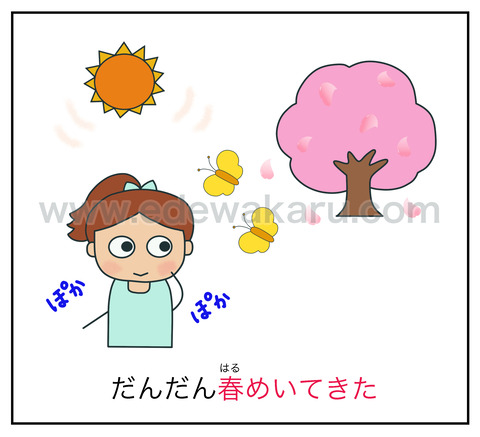
だんだん春めいてきた
→だんだん春のような感じになってきた彼の言い方は皮肉めいていた
→彼の言い方は皮肉な感じだと思った山田くんって(口語形「〜って」)謎めいているよね
→山田くんって不思議な感じがするよね
日本語文型辞典
Meaning
基本情報Nめく説明名詞に付いて、それが表す要素をもっている、という意味を表す。例えば①は少しずつ春のようになってきたということで、冬の終わりごろに使う。使用する名詞は限られている。名詞を修飾する場合は③④のように「NめいたN」という形になる。例文① 少しずつ春めいてきた。② どことなく謎めいた女性がホールの入り口に立っていた。③ 彼は、皮肉めいた言い方をした。④ 彼の作り物めいた笑いが、気になった。
日本語文型辞典 英語版
Meaning
【めく】[Nめく]
Attached to a noun, this expresses that “(something) has that element to (it).” For example, in
(1)
it is used around the end of winter to express that the weather is gradually becoming more like spring. The nouns which can be used with this are restricted. When it is used to modify a noun it is used in the form NめいたN, as in examples
(3)
and
(4)
.
In context 4 examples
少しずつ春めいてきた。
Little by little it became spring-like.
どことなく謎めいた女性がホールの入り口に立っていた。
A woman with something of a mysterious air was standing in the entrance of the hall.
彼は、皮肉めいた言い方をした。
He spoke cynically.
彼の作り物めいた笑いが、気になった。
I was worried by his forced smile.
くらべてわかる日本語表現文型辞典
Meaning
意味1:Aのように感じられる。
意味2:(擬態語につけて)その様子になるという意味。
How to use it
Aめく(AめいたB/AめいてB)
接続1:
[名詞-∅]めく
接続2:
[擬態語]めく
Notes
【注意2】
・「Aめく」のAはきらきら、ざわざわなど同じ音をくり返す擬態語の前の「きら」や「ざわ」などの部分。
In context 8 examples
声だけでだれも姿を見た者がいないなんて、話が謎めくな。
彼の話は冗談めいて聞こえたが、目は真剣だった。
あの事件以来、脅迫めいた電話までかかってくるんですよ。
山里の景色もすっかり春めいてきました。
最近の彼女はスター女優としてきらめいている。
群集がざわめく中、首相は演説を始めた。
馬は足を引きずって、よろめきながら歩いている。
今年の秋の口紅はつやめいた色合いが人気だ。
日本語NET JLPT文法解説まとめ
Meaning
完全に〜とは言えないが、〜ように感じられる
How to use it
N + めく
Explanation
"having the appearance of / beginning to look like"
Used to describe something that has the quality or appearance of a particular characteristic or thing.
春、冗談、皮肉、謎、説教、秘密などの接続される単語は限定される。
In context 2 examples
この本は皮肉めいた冗談がたくさんあって面白いよ!
さっき先輩から皮肉めいたことを言われて、すごいムカついている。
毎日のんびり日本語教師
How to use it
名詞+めく
名詞+めいて~
名詞+めいた+名詞
Explanation
「~のような感じがする」という意味の表現です。
「春めく」は「春のような感じがする」とほぼ同義なので完全に春であるときには使えません。例えば冬の終わりかけで暖かくなり春っぽさが表れてきたときなどなら大丈夫です。
春、謎、冗談、皮肉、説教などの特定の単語にのみ接続されます。
Notes
特になし
In context 8 examples
季節はようやく春めいてきた。
彼はどこか謎めいた雰囲気があり女性に人気がある。
先輩から説教めいたことを言われた。
彼の妙に皮肉めいた言い方に腹が立つ。
冗談めいた言葉を言われて雰囲気が台無しになった。
風鈴に蚊取り線香、部屋がすっかり夏めいてきました。
トイレはクーラーがないから暑くて地獄めいている。
ゲームのプレイ時間3000時間。狂気めいている。
IMABI
Native Suffixes IV
Read this IMABI lesson ↗Explanation
Native Verbal Affixes 大和言葉における動詞化接尾辞
This lesson examines 16 verbal affixes which all relate to describing appearance, demeanor, or behavior. Although the productivity of these affixes are not equal, many of the words formed from there are quintessential to the Japanese lexicon, whereas others are dying remnants of a once more morphologically diverse past.
~がかる
Deriving from the standalone verb かかる, the five-grade conjugating verbal affix ~がかる attaches to nouns for one of two meanings.
①To resemble/-looking
②To be tinged with (color)
As can be gleamed from the definitions, the latter is used with typical nouns in the same way “-looking” is used in English. However, unlike the English equivalent, ~がかる is not entirely productive. Rather, you will have to unfortunately learn which phrases are made with it on a case-by-case basis. However, as for the second meaning, it can be used with any color.
Grammatically, phrases made with either meaning are limited in their conjugational capacity. In the predicate, it must be used in the progressive tense, and when used as an attribute, it must obligatorily be used with the auxiliary ~た.
使用例 意味 使用例 意味
神がかる To be possessed by the supernatural 芝居がかる To be theatrical
時代がかるTo be antique-looking 詩がかる To be poetic
黄(色)がかる To be yellow-tinged 緑(色)がかる To be green-tinged
赤(み)がかる To be red-tinged 黒(み)がかる To be tinged with black
1. 古代の中国では、亀の甲羅を割って、神がかった人に占ってもらう儀式があった。
In ancient China, there were ceremonies in which (people) would break open turtle shells and have their fortunes told by a god-like figure.
2. 意図的なのか、それとも芝居がかっているからそうみえるのか。
Whether it’s intentional or theatrical, is that why it appears so?
3. 少し詩がかった野蛮人になると、アキリスがヘクトーの死骸を引きずって、トロイの城壁を三匝(さんそう)したとか、燕人張飛が長坂橋に丈八の蛇矛を横たえて、曹操の軍百万人を睨め返したとか大袈裟な事ばかり連想する。
When it comes to somewhat poetic barbarians, one associates really grandiose events such as how Achilles dragged Hector’s corpse and circled the walls of Troy thrice, or how Chang Fei laid down his serpent-shaped lance at Changban and looked back at Cao Cao’s force of a million men, and what not.
夏目漱石著の『吾輩は猫である』より
4. 蛍光増白剤自体は黄(色)がかった色をしているが、紫外線によって青がかった光を放射する。
Fluorescent whitening agent itself is yellow-tinged in color, but it emits blue-tinged light due to ultraviolet rays.
Orthography Note: This ending may occasionally be spelled with the Ateji ~掛かる, but this is seldom the case in modern writing.
~ぐむ
~ぐむ is a five-grade verbal affix which attaches to a handful of nouns to mark the start of a phenomenon. In the non-past tense, it captures the moment immediately before the start of the phenomenon, but when it is used in the progressive tense, it is describing the now ongoing phenomenon.
Being synonymous with ~始める and ~出す, one would think it would be used more widely, but it is, in fact, limited to set phrases which must be learned individually. However, it is thought to have originally been a transitive verb meaning “to include” which then fused with direct objects to then describe when something became apparent to the outside. So, the nouns it is seen used with today would be the ones it fused to at that time.
使用例 意味 使用例 意味
涙ぐむ To bring to tears 芽ぐむ To bud
角ぐむ To sprout (like thorns) 汗ぐむ (archaic) To begin to sweat
皺ぐむ To start to wrinkle 水ぐむ (archaic) To contain too much water
Word Notes:
① 芽吹く is the generic word for trees/plants to “sprout” shoots. 芽ぐむ implies that the “sprouting” is just beginning. 角ぐむ is synonymous with 芽ぐむ, but it is more literary and has the sprouts akin to horns growing. When used, it is usually in reference to things like reeds and 芒(ススキ) (Japanese pampas grass).
②汗ぐむ has since been replaced by phrases such as 汗ばむ (see below) and 汗が滲む.
5.柳の木々が【芽ぐみ・芽吹き】、降り積もった雪が解けてきた。
The willows and all the trees (began to) sprout as the snow piles melted.
6. 氷解け去り葦は角ぐむ。
Ice melts as the reeds begin to sprout forth.
作詞、吉丸一昌『早春賦』
7. 嘲笑われて涙ぐんだ。
I was brought to tears from being scorned at.
8. 犬の目が涙ぐんでいる場合は、流涙症という病気にかかっている可能性がある。
In the event a dog’s eyes are teared up, there is the possibility it is suffering from a condition called epiphora.
9. 瓜を取り出でたりけるが、わろくなりて水ぐみたりければ…
(I) had brought out the gourds, but since they had gone bad and had too much moisture (become too ripe)…
『著聞集・一八』より
~さびる
~さびる is a first-grade conjugating verbal affix whose Classical Japanese form was a upper two-grade conjugating affix in the form of ~さぶ. Either way, this ending attaches to nouns to describe behavior attributed to said noun.
In Modern Japanese, it is incredibly rare and is usually restricted to the noun 神 (god/deity). Even in Classical Japanese, it was only most prominent in Old Japanese, afterward becoming limited to three extant examples that may still be found in literature.
使用例 意味
神(かみ・かん)さびる ① To behave divinely②To have a divine presence③Antiquated
翁さびる To behave like an old man
秋さびる To become autumn-like
Word Notes:
①In Old Japanese, 神さぶ is thought to have actually been pronounced as かむさぶ.
②Being homophonous to them, it would appear that ~さびる shares the same origin as the verbs 寂びる (to become antiquated) and 錆びる (to rust). The latter is thought to stem from the former, but as the former refers to something aging and taking on a particular characteristic, that would semantically be in line with how the only words ~さびる is used with are ones which involve antiquity or an extensive period of time.
10.
懸けまくはあやに恐(かしこ)し
足日女(たらしひめ)神の命(みこと)韓国(からくに)を向け平らげて
御心を鎮め給ふとい取らして斎(いわ)ひ給ひし
ま玉なす二つの石を世の人に示し給ひて萬代に言ひ継ぐがねと
海(わた)の底、沖つ深江の海上(うなかみ)の子負(こう)の原に
み手づから置かし給ひて神(かむ)ながら神(かむ)さびいます
奇(く)しみ魂(たま)、今の現(をつつ)に尊(たふと)きろかむ
I am greatly humbled to speak openly of this:
back when Empress Jinguu had gone to Silla and subjugated it,
she preciously held two stones resembling brilliant orbs to calm her mind,
which she then showed to the world and asked that they be passed down generations,
after which she herself placed it near the village of Fukae along the shore plain of Kou.
Ever since, they are still priceless stones are so sublime and filled with divine power.
『万葉集・八一三』より
11. いや、翁さびた事を言う。
Ugh, what an old man thing to say.
『鏡花・歌行燈』より
12. 夕日さす外山の梢秋さびて麓の小田も色づきにけり
The top of the foliage of Toyama lit by the setting sun resembles autumn as Oda at the foot of the mountain has also changed colored.
『風雅和歌集・ 藤原公蔭作』
~染みる
The upper first-grade conjugating verb 染(し)みる means “to soak in/stain.” You may also see the spelling 沁みる when it is used in the emotional sense of “to make a deep impression.” Other spellings for the literal sense of “to soak/penetrate/stain/permeate” include 浸みる, 滲みる, and 泌みる, but these are all exceptionally rare as only 染みる is treated as a standardized spelling.
13. 背中を流しているつもりだが、石鹸が目に染みて、前が見えない。
Though I’d intended for it to go down my back, soap got in my eyes, and I can’t see in front of me.
In addition to being a standalone verb, it also gained the function of being a compound ending in which it is used as a verbal affix in the form ~じみる that attaches to nominal phrases to either describe how something has stained something or to describe that something feels like it’s taken on a certain condition/state. In either situation, it is mostly used with a negative connotation.
When used before nouns, it is used in the form ~じみた, but when used as the predicate, it is obligatorily seen in the progressive tense as ~じみている. It is also possible to see it used in the gerund combined with verbs like “to appear,” giving ~じみて見える. However, it is seldom used beyond a few more forms such as the negative ~じみていない (see Ex. 10).
使用例 意味 使用例 意味
世帯じみる To be fond of home 年寄りじみる To sound old
油じみる To be oil-stained 子供じみる To act child-like
狂気じみる To be crazed 言い訳じみる Excuse-like
Word Notes:
①世帯 is officially read as せたい, although in everyday language, it is usually read as しょたい. This is because the word is thought to have originated from 所帯. Thus, in everyday writing, 世帯 and 所帯 are seen interchangeably.
②~じみる is become less common. For instance, 言い訳じみる has become mostly replaced with the synonymous phrase 言い訳がましい, but some phrases like 世帯じみる and 子供じみる still remain common, at least in the written language. When referring to stains from liquid-like substances, ~まみれ(の) is the most common affix.
14. 最近では、「所帯じみた妻」は嫌われるようになり、「所帯じみていない妻」が増えているらしい。
Nowadays, it seems that “domestic wives” are becoming dislikes and that “wives who aren’t so stuck in the home” are on the rise.
15. 油じみた男が手を振った。
An old-stained man waved his hand.
16. 子供じみた真似をするな。
Don’t act childish.
17. 彼の顔は何となく標本じみて見えた。
His face for some reason or another appeared exemplary.
18. 若い癖に言うことは年寄りじみてるな。
(You/that person) sure sounds like an old man/woman despite being so young.
19. 二階が診察室に待合室、下は技工室のあの金槌や、金をのばすローラーや、ガラスの炎や、エンジンなんかの、神経質な工場じみた音に加えて、小さい子供が四人もあり、おまけに電車通りだった。
To the second floor there was an examination room and a waiting room, and below, in addition to the iron hammer, metal roller, glass fire, engine, and what not neurotic factory-like noises, there were four small kids, and to make matters worse, it was a street with a tram.
川端康成著の『死体紹介人』より
Orthography Note: Although it is not incorrect to spell it in Kanji, the Kana spelling ~じみる is the predominant spelling in today’s writing.
~立つ
The affix ~だつ follows either nominals or the stem of adjectives/adjectival nouns to create a four-grade conjugating verb, and its purpose is to note some characteristic. Although it is similar in meaning to ~のようだ, it is still verbal in nature. After all, it does come from the verb 立つ’s nuance of “to manifest.”
This ending was far more productive throughout Old and Middle Japanese, but its use today can still be seen in a handful of phrases. Below, the vocabulary chart is split into two columns, one with examples still prevalent in Modern Japanese and the other with some of the most common examples in Classical Japanese.
使用例(現代語) 意味 使用例(古語) 意味
殺気立つTo be frenzied/murderous 大人立つ To act adult-like
浮足立つ To be in a fidget/prepared to flee忠実(まめ)立つ To act serious
主(おも)立つTo be main/prominent 情け立つ①To act like one is full of affection②To act refined
気色立つ ①To show signs of②To become animated③To show one’s feelings④To put on airs聖(ひじり)立つ To look like a monk/saint
際立つ To be prominent 紫立つ To be purplish
Word Notes:
①主(おも)立つ is used exclusively as a 連体詞 in the attributive form of 主立った.
②気色立つ is for the most part archaic, having been more prevalent in Classical Japanese. However, it is still occasionally used in literature to this day.
③Oddly enough, the phrase 浮足立つ didn’t appear in this form until Early Modern Japanese, making it an exceptional case of an old grammar point seeing some new light.
20. 八百長レースだと観衆が殺気立っていた。
The spectators seethed in rage that it was a rigged race.
21. 壁越しに人々の気色だつのが聞こえた。
I could hear the animated voices of people on the other side of the wall.
22. 心恥づかしうおぼさるれば、気色だちたまふことなし。
Since (Genji) cannot help but feel ashamed (for leaving behind Murasaki-no-Ue), he doesn’t dare show his emotions to (Akashi-no-Kimi).
『源氏物語・明石』より
23. 倒産の噂に社員が浮足立っている。
The company employees are becoming restless at the rumors (that the company might go) bankrupt.
24. あまりの恐ろしさに【鳥肌立っていた △・鳥肌が立っていた】。
To have goose bumps from the extreme fright.
Word Note: The form 鳥肌立つ has faded out of use, being replaced by 鳥肌が立つ. Both utilize the literal interpretation of 立つ as “to emerge/manifest (=現象の兆しが見える).” In today’s speech, the phrase 鳥肌が立つ can refer to having “goose bumps” from any sort of emotional stimulus, but in the past, the phenomenon was just associated with fright, severe cold, or other similar negative stimuli.
25. まめだちたる人には物言ひにくし。
It’s rather hard to say to people who act so serious.
『大鏡・道長下』より
26. 受領など、大人だちぬるも、脹らかなるぞよき。
It’s nice for individuals like a provincial governor to be all adult and plump.
27. 野中に岡だちたる所にただ木ぞ三つたてる。
Only three trees stood on a hill-like area in the middle of the field.
『更級日記』より
28. 暮れぬれば、御台参りなどして、帯刀あるじだちて、しあるく。
When it became dusk, he had supper and such, and then he strutted around like the head of the household.
『落窪物語』より
~つく
The affix ~つく attaches to onomatopoeic roots to create a five-grade conjugating verb. Though some pairs will differ somewhat in meaning, all examples of “onomatopoeic root + ~つく” have an alternative form created by doubling the onomatopoeic root.
動詞の種類 意味 意味 動詞の種類 使用例 意味
非対格動詞 いらつく To get irritated非対格動詞 ぎらつくTo dazzle
非対格動詞ちらつく ①To flicker②To fall lightly①非能格動詞②非対格動詞 ざわつく①To be noisy (from people talking)②To be discomposed
① 非対格動詞
②非能格動詞 べたつく①To be sticky②To be close together (with someone’s body)非対格動詞 びくつく To be scared
非対格動詞ねばつく To be sticky非対格動詞 まごつく To be at a loss
非対格動詞 むかつく①To get pissed off②To feel nauseous 非対格動詞 ざらつく To be sandy/gritty
他動詞 ぱくつくTo gulp down food他動詞 がっつく To devour greedily
非能格動詞 うろつく To loiter 非能格動詞 いちゃつく To flirt
Syntactically, there are three groups of these so-called “つく-onomatopoeic verbs.” The resulting verb may be an unergative (intransitive) verb, an unaccusative (intransitive) verb, or a transitive verb. First, let’s understand what these three terms mean.
Unergative Verb (= 非能格動詞): An intransitive verb that only has a semantic agent.
Unaccusative Verb (= 非対格動詞): An intransitive verb whose grammatical subject is not a semantic agent. Meaning, the subject neither ‘actively initiates’ nor is willfully responsible for the action of the verb.
Transitive Verb (= 他動詞): A verb with an active agent and an object which receives the action.
The majority of つく-onomatopoeic verbs are unaccusative verbs. Meaning, their grammatical subjects differ from verbs like “to run.” “To run” along with its Japanese equivalent 走る are examples of unergative verbs as their subjects are willful agents of the action they describe, but they don’t possess an object. On the other hand, unaccusative verbs are more similar to the objects of transitive sentences in the sense that they don’t act upon anything, but the action can be described as something happening to the subject.
As for what ~つく means in relation to onomatopoeia, it appears to have two separate meanings. The first meaning is to mark a “change described by the onomatopoeia” and the second meaning is to mark “the action described by the onomatopoeia.” The first meaning is fitting for the unaccusative examples whereas the second meaning is fitting for the transitive and unergative examples. Let’s look at some sentences for comparison.
非対格動詞をつくる「~つく」→ オノマトペで表される状態移行を描写する
29. 外国でまごついたことがある?
Have you gotten confused at a foreign country?
30. 仕事で上司にむかついた。
I got ticked off at my boss at work.
31. iOSの不具合が原因で、iPhoneの画面がちらついてしまうことがある。
There are times in which an iPhone’s screen may flicker with an iOS bug being the cause.
32. 俺の決心がぐらついちまった。
My determination has wavered.
33. 小雨がまだぱらついているが、空はだいぶ明るくなってきた。
Although it is still sprinkling, the sky has gotten quite brighter.
34. ただおかしいのはこの閑人がよると障ると多忙だ多忙だと触れ回るのみならず、その顔色がいかにも多忙らしい、悪くすると多忙に食い殺されはしまいかと思われる程こせ付いて居る。
The one thing that’s so strange is that these humans of leisure not only go about screaming that they’re busy-busy whenever they come together, their very complexations look terribly busy, or worse, they’re so restless it’s as if they’re going to be devoured by their busyness.
『吾輩は猫である』より
非能格動詞・他動詞をつくる「~つく」= オノマトペで表される意図的・意志的な活動・動作をする
35. ここでなにぶらついてるんだ?
What are you doing hanging around here?
36. 外でいちゃついているカップルがいる。
There is a couple making out outside.
37. 毎日家でごろついてばかりいないでいい加減仕事でもしてみたらどうだ?
Quit with just wandering about the house every day and try getting a job, won’t you?
38. クマがこの辺をうろついているらしい。
It seems that a bear is on the prowl around here.
Orthography Note: ~つく is believed to ultimately derive from 付く, although the literal meaning of this source verb have long since disappeared. Nonetheless, you will occasionally see writers use 付く as in 当て字 spelling. Generally speaking, however, the Kana spelling is predominant for all words in which it used.
~づく
The intransitive five-grade conjugating (五段活用) affix ~づく is the result of 付く attaching to nominal phrases to express a condition intensifying ( ~ような様子が強くなる ) or that something has become a certain way (~ような状態になる) . Although it would seem like this affix should be productive, it has become limited to set phrases. Some words are used heavily whereas some are hardly used, but you will notice from the words below that many have quite specialized meanings.
使用例意味 使用例意味
色づく To change color
To turn crimson 愛嬌づく To become charming
調子づく To warm up to 元気づく To become encouraged
秋づく To become fall-like根づく To take root
怖気づく To be seized with fear 気色づく To show signs of
毒づく To speak bitterly 基づく To be based on
Word Note: The examples above that have become archaic are 秋づく and 気色づく.
39. 褪せたものが色づいていくのが分かった。
I knew that what had faded would return to being full of color.
40. 彼が、自分にヤジを飛ばしたファンに毒づく様子がメディアに報じられた。
His cursing a fan who had heckled him was reported by the media.
41. 怖気づいて逃げるのはまだ早い。
It’s still too early to get cold feet and run away.
42. 北陸地方では真宗の教えが強く根付いている。
Shin Buddhist teachings are strongly rooted in the Hokuriku Region.
Orthography Note: For the most part, ~づく is not written in Kanji, but the choice to do so is up to personal choice. However, it is notably common to see 根付く written as such rather than as 根づく.
Not all examples of ~づく are derived from 付く. Another verbal affix, ~尽く, existed in Classical Japanese and was equivalent to ~を尽くす. Oddly enough, although it exhibited four-grade conjugation in the classical eras, it has survived in Japanese it nominalized (or adjectival noun) set phrases (see also Lesson 327).
43. なぜ日本が力づくで北方領土を取り戻そうとしないのか
Why won’t Japan ever attempt to take back the Northern Territories by force?
44. 計算づくでやっている人間でもなければ、自分を省みて恥ずかしくないのかな?
If one weren’t a person doing it premeditated, would it not be embarrassing upon looking back on oneself?
~づける
This lower two-grade (下二段) verbal affix ~づける, derived from the verb 付ける, attaches to nominal phrases to create transitive verbs while contributing the meaning of “to add/give (a characteristic to something).” Verbs made with this ending, though limited in number, tend to be very common words.
使用例 意味 使用例 意味
関係づける To relate to 元気づける To cheer up
位置づける To position/locate 力づける To empower
意味づける To give meaning to 名づける To name
45. 納税者に義務付ける。
To obligate the taxpayers.
46. もう一度やってみろと力づけました。
I encouraged him to try it again.
47. 我々は基準として位置づけております。
We are ranking it as standard.
48. 友達のケイトさんが飼い始めた雄のフェレットを「パンケーキ」と名付けました。
My friend Kate named the male ferret she began raising “Pancake.”
49. その経験をどう意味づけていくのかが重要になってくる。
How to add meaning to the experience will become crucial.
~ばむ
The intransitive five-grade conjugating verbal affix ~ばむ indicates taking on a particular quality. This affix is only seen in less than a handful of verbs.
使用例 意味 使用例 意味
汗ばむ To be sweaty黄ばむ To become tinged yellow
気色ばむ To display one’s anger 由ばむ※ To put on airs
Word Notes:
①気色ばむ is notably not used in the spoken language, but it remains used on occasion in the written language.
②由ばむ is an archaism that has since been replaced by other phrases such as 気取る. It must be noted, though, that in Classical Japanese, ~ばむ possessed a slightly larger realm of usage including attaching to the roots of adjectives and verbs, which can be seen in words such as おかしばむ (to appear interesting) 老いばむ (to seem old). However, even these examples were limited.
50. この黄ばんだ紙は本当に古くなってきたな。
This yellowed paper has really become old, hasn’t it?
51. 議員の発言に対して市長が気色ばむ一幕があった。
There was a scene in which the mayor displayed [his/her] anger towards an assembly member’s remark.
52. 観客たちは扇風機がすべて故障してしまったため、ひどく汗ばんでいた。
The audience were terribly sweaty because all the fans had broken down.
~張る
The five-grade conjugating verbal affix ~張(ば)る derives from the verb 張る (to affix), and with that it gives the meaning of “to be prominently/persistently…” The tendency described is one that is striking and remarkable.
derives from the persists something and shows that a tendency is even more remarkable. All examples with it can be viewed as set phrases, but perhaps the most famous example would be 頑張る (to do one’s best/persevere), a word that is often taught on day one of Japanese 101. Although most other examples aren’t nearly as common as this one, this ending remains persistent in both the spoken and the written language.
使用例 意味 使用例 意味
頑張る To keep at it 角張る①To be angular/jagged②To be stiff/ceremonious
格式張る To adhere to formality 気張るTo exert oneself
欲張る To covet威張る To swagger
意地張る To be obstinate 見栄張る To be ostentatious
Word Notes:
①角張る may be read as かどばる or かくばる. Both readings are readily understood and used interchangeably.
②意地を張る is actually far more predominant than 意地張る, but there is no difference in meaning. The same goes for 見栄張る meaning “to be ostentatious.” However, the nominal forms 意地っ張り (obstinate person) and 見栄っ張り (ostentatious person) exist, which involves the sound change /b/ to /:p/ to make the words sound more emphatic.
53. あまり欲張らないで。
Don’t be so greedy.
54. そんなに角張っては窮屈だよ。
Being so ceremonious is so uncomfortable.
55. 昔、知識人たちは、四角張った文字を用いて翻訳していたものだった。
In the past, intellectuals would translate using highly formal Kanji.
56. 武士らしく格式張った語り方をする。
To tell a story in a formal style like that of a samurai.
57. あまり気張るな。
Don’t strain yourself.
~びる
The affix ~びる started out in Classical Japanese as ~ぶ. This form possessed two separate conjugation classes depending on what it followed. First, it must be understood that this affix indicates “exhibiting the quality of (said noun, adjective, adjective noun, etc.).” This meaning remains consistent in all the roots it followed.
The affix ~ぶ attached to nouns, onomatopoeic roots, as well as the roots of adjectives and adjectival nouns. However, the conjugation class divide appears to be a semantic one not based on the part of speech of which it attaches to. The two conjugation classes it possessed were upper two-grade and four-grade.
The Upper Two-Grade ~ぶ → The Upper One-Grade ~びる
The upper two-grade examples are compromised of words which are unrelated to human emotion. These words largely reflect physical appearance or a description of demeanor, but words such as “sad” or “happy” were not used with the upper two-grade ~ぶ as those words are directly related to human emotion. In Modern Japanese, these verbs transformed into upper one-grade verbs with the transformed 終止形・連体形 of ~びる. All of these verbs are intransitive.
Grammatically, all of the verbs listed below with exception to 滅びる and 荒びる are heavily restricted as to which structures they’re used with. The rest are not used in the non-past in predicative sentences. Instead, the progressive form ~びている is used, which may then be conjugated further. Due to the overall decline of ~びる, however, with exception to 滅びる and 荒びる, these words are mostly restricted to being used as attributes, in which case they are obligatorily used with ~た, producing examples such as 古びた, etc.
使用例 意味 使用例 意味
大人びる To look/behave adult-like 鄙びるTo be(come) very rustic/hick
古びる To be worn-out雅びる To be refined
荒びる To behave wild田舎びる To become countrified
幼びる To look/behave childish 滅びる To perish/become ruined
綻びる To come apart at the seams
Word Notes:
①荒びる is marked as archaic in some dictionary resources. Although this is true in standard speech, there are parts of Japan where this word is still in common use. For instance, in Nagano it is still used with the meaning “to rage” and in Ehime it is especially used in the sense of “to rough-house.” Where this word is still commonly used, it demonstrates no restrictions to its conjugational capacity.
②鄙 is an out-of-date noun meaning, “land far removed from the city.” As a standalone noun, it may still be found in the expression 鄙には稀な meaning, “rare even in the middle of nowhere.” This makes it synonymous with 田舎. There is a decent percentage of people who misunderstand this word as meaning “to be sophisticated,” perhaps due to the nostalgic ring this word has as opposed to the synonymous 田舎びる. However, this is not a valid use of the word as it is used throughout Japan with its original meaning as can be gleamed from the dialectal sentence in Ex. 56.
③雅びる is the antonym of 鄙びる, which is ironic considering how the latter is misused with a similar meaning to that of 雅びる. The みや in this word is likely the same /miya/ as in the words 宮 (palace) and 都(みやこ) (capital). In this word, it would seem /miya/ has the literal meaning of “city.” Thus, 雅びる more literally means “behaving city-like.” In Modern Japanese, although 雅びる is defunct and limited to literature, the noun 雅(みや)び is still widely known in the sense of “elegance” as well as a personal name. 雅び can also be used as an adjectival noun with the meaning of “elegant.”
④Though common in Classical Japanese as 幼(をさな)ぶ, the modern form 幼びる has mostly been replaced by the paraphrased equivalent 幼く見える.
⑤The /horo/ in 滅びる is thought to be onomatopoeic in nature. Although ほろほろ has several nonrelated meanings in Modern Japanese, it does have the meaning of “breaking into pieces (with little effort).” Although 滅びる is the proper form, the five-grade form 滅ぶ has existed for centuries. Both 滅びる and 滅ぶ are still used.
⑥The etymology of 綻びる is unclear. In addition to the meaning listed above, it may also be “to begin to bloom” and ‘to break into a smile.” Similarly to 滅びる, it also has the four-grade form 綻ぶ. Both forms are in use.
58. 古びた鞘を獲得した!
Obtained the Ancient Sheath!
59. 大人びて見えるね。
You look mature for your age.
60. ありゃ鄙びた湯治場や。
That there’s a beat-down hot-spring resort.
61. 寺の北は大都会だが、南はガクッと風景が変わり、田舎びている。
The north of the temple is the big city, but to the south the scenery changes, rustic in appearance.
川崎ゆきお作の『消える村』より
The Four-Grade ~ぶ → The Five-Grade ~ぶ・む
The four-grade conjugating affix ~ぶ attached to words related to human emotion. In Modern Japanese, these verbs became five-grade conjugating verbs ending in ~む, but it must be noted that the consonant in Classical Japanese would have been /mb/, which was transcribed as either ~ぶ or ~む throughout antiquity.
※Dictionaries will list 緩む as having the alternate classical forms 緩ぶ and 緩ふ, but the latter form was limited to Old Japanese and is likely a reflection of how /mb/ was realized during that time period.
Generally speaking, verbs created in this way were transitive and synonymous with ~く思う. Examples of this include 悲しむ (→ 悲しく思う). Some examples, however, were intransitive such as 緩む, which had transitive forms that conjugated as lower two-grade verbs (now ending in ~める in Modern Japanese).
使用例 意味 使用例 意味
緩む(自)
緩める(他)To relax (intr.)To relax (trans.)嬉しむ(他・自) To think happily of (trans.)To become happy (intr.)
儚む(他) To despair of 悲しむ(他・自) To mourn of (trans.)To be sad (intr.)
弛む(自)
弛める(他)To loosen (intr.)To loosen up (trans.) 倦む(自) To be(come) bored/tired
①緩む and 弛む may mean “to become loose” in a physical sense, but they are a part of this word group because of their emotional connotation.
②The ~む found in other verbs such as 親しむ, 楽しむ, etc. is the same as the ~む in these verbs.
③The modern iteration of 弛む is たるむ, but in Classical Japanese and set expressions, its traditional pronunciation is たゆむ.
④嬉しむ is now archaic in standard speech.
62. 連休前で気が緩んでいます。
It’s right before consecutive holidays, and (so) I’m not as focused.
63. 人柄も良かったのに、何故、世を儚んで自殺してしまったのだろうか。
There character was so good, yet why did they despair of the world so badly and end up committing suicide?
64. 倦(う)まず弛(たゆ)まず努力をした結果、入学試験に合格した。
As a result of striving tirelessly without ever letting up, I passed the entrance exam.
Transitive Upper Two-Grade ~ぶ → Transitive Five-Grade ~ぶ
There are four examples of transitive verbs created with ~ぶ that started out as upper-two grade verbs but evolved into transitive five-grade verbs into Modern Japanese※.
使用例意味 使用例 意味
真似ぶ※ To mimic/learn 学ぶ To learn
喜ぶ To rejoice 否む To refuse/deny
※Although Modern Japanese possesses the verb forms 真似(を)する and 真似る for “to mimic,” the traditional form was 真似ぶ. Indeed, “to exhibit mimicry” is by all means equivalent to “to mimic,” making this a perfect example of how ~ぶ produced transitive verbs. Although this form has disappeared, it also had the meaning of “to learn,” which was inherited by the slightly altered form まなぶ → 学ぶ.
65. 新人が経験不足であることは否めない。
One cannot deny that newcomers lack experience.
~ぶる
~ぶる is a five-grade conjugating ending which attaches to nouns or to the stem of adjectives/adjectival nouns to indicate that someone is “pretending/acting as…” This ending is very common and can be used after any noun regarding people; however, it is only used with a handful of adjectives/adjectival nouns. This ending gives off a negative connotation. Thus, a word like 善人ぶる shouldn’t be viewed as “to act like a good person” but more like “to pretend to be a good person.”
All verbs made with this affix are intransitive and they all tend to be restricted grammatically to predicates utilizing the progressive and in attributes made with ~ている or ~た.
使用例 意味 使用例 意味
偉ぶる To put on airs 親ぶる To act like a parent
上品ぶる To be prudish 聖人ぶるTo pretend to be a saint
学者ぶる To be pedantic 勿体ぶる To assume importance
空(から)ぶる To swing and miss 荒ぶる To act all savage
Grammar Note: It is also possible to see ぶる used as a standalone verb with the meaning of “to be self-important.” Usually, though, it is used as a suffix.
Word Note: 荒ぶる is often confused with the classical 連体形 of 荒びる. 荒ぶる remains as a 連体詞 most commonly seen in the expression 荒ぶる神 (raging god) when derived from the 連体形 of 荒びる , but when it is derived from 荒 + ~ぶる, the proper attributive form would be 荒ぶった. For example, 荒ぶった態度 (attitude acting all savage).
66. 偉ぶってる人は大嫌い。
I hate people who think they’re all that.
67. そうもったいぶるなよ。
Stop acting so important.
68. ちょっと学者ぶった言い方じゃない?
Isn’t that a little pedantic way of saying it?
69. あの師匠はいやに上品ぶって自分だけ人間らしい顔をしている、馬鹿野郎です。
That gives off the face that only they’re human, acting all too prudish; quite the stupid bastard.
夏目漱石著の『吾輩は猫である』より
Orthography Note: This affix may be spelled as ~振る, but it is seldom spelled this way. ~ぶる is most certainly etymologically related to 振る舞う (to behave), but the exact meaning of both /furu/ and /mau/ in this compound verb remains a mystery. What is certain is that the Kanji chosen are merely Ateji and that neither word is related to the standalone verb 振る “to shake/sprinkle.”
Etymology Note: Meaning-wise, ~ぶる seems strikingly similar to ~ぶ. Both exhibit ~ぶる as a possible form, although for the latter this would be archaic. However, ~ぶる is seen with the same exact meaning of “to pretend to be…” even in Classical Japanese and with the same conjugation class. Although ~ぶ does mark behavior, this is often in association with ‘change’ in appearance/demeanor which is not implied by ~ぶる. Thus, the etymology of ~ぶる remains in mystery.
~めく
The verbal affix ~めく attaches to nouns, onomatopoeic roots, as well as the stems of adjectives or adjectival nouns to indicate “signs of.” Its productivity is restricted to set phrases when combined with adjectival and onomatopoeic roots, but it still enjoys a certain degree of personal creativity when combined with nouns relating to people, in which case it is like a refined way of saying “-like.” For instance, 才人めいた (talented-like).
Grammatically speaking, it must also be noted that ~めく is most frequently used in the attributive sense with the auxiliary ~た, and when it is used in the predicative sense, it is usually paired with the progressive tense. However, many examples created from onomatopoeic roots are more likely to be used with varied syntax such as 蠢(うごめ)く (to squirm).
使用例 意味 使用例 意味
騒(ざわ)めく To be noisy/rustle 閃(ひらめ)くTo flash
仄(ほの)めく To glimmer 色めくTo be tinged/grow lively
謎めく To be mysterious 春めく To be spring-like
時めくTo flourish 学者めく To be scholar-like
70. 庭の楓かえでが色めくのは本当に美しいですよね。
The changing in colors of the maple trees in the garden is really beautiful, isn’t it?
71. {うわぁ・ああ}、蠢めいてる虫だ!
Ah, a wriggling worm!
72. 彼は今を時めく歌手・有名人です。
He is one of the most touted singers of today.
73. 謎めいた様相を呈する。(Rigid/literary)
To display a mysterious condition.
74. 陽光に川面が煌めく。
The river surface glistens in the sunlight.
75. どよめいて、人々が飛びのく。一人の背中が飛鳥にぶつかった。はね飛ばされて、壁に肩をぶつける。さらにはね返ってよろめき、あやうく転びかけたときだった。
People jumped back in a stir. One person’s back hit Asuka. This sent her flying, resulting in her shoulder hitting a wall. It was then that she bounced back while staggering, narrowly almost dangerously tumbling over.
From 野生の風 by 村山由佳.
~めかす
The standalone verb めかす (粧す) means “to make one’s appearance stand out.” As an affix, it attaches to nouns or adjectival nouns to mean “to make something out to be.” The standalone verb and affix both derive from the transitive form of the similar verbal affix ~めく which attaches to a variety of words with the meaning of “to show signs of.”
The words that ~めかす attaches to is limited to set-phrases. Additionally, words made with it are seldom used with two exceptions being the verb 仄めかす (to suggest) and the phrase 冗談めかして (half-jokingly). Otherwise, the other example words shown in the chart below are quite rare.
使用例 意味 使用例 意味
仄めかす To suggest/imply冗談めかす To joke
秘密めかす To pose as a secret親切めかす To be sleek
学者めかす To pose as a scholar風流めかす To pose as elegant
Semantically, we can see that there is a lot in common between ~めかす and ~ぶる from earlier. Although dictionaries do not state any grammatical constraints on the practical use of words made with ~めかす, aside from 仄めかす (which happens to be a commonly used word), the rest are restricted to being used in adverbial gerunds with the particle て or as attributes with the auxiliary ~た.
It would also appear to be the case that aside from 仄めかす and 冗談めかす, most examples can be viewed as conceptions on the part of the speaker to create a unique remark. There is a heightened literary sense made when employing this ending which would otherwise not be had if a more standard phrasing were used.
76. 「いや、毎日、お前と一緒にいたいのだ、」と夫は冗談めかして言った。
“No, I want to be with you every day,” my husband said (half-)jokingly.
77. 仄めかしただけだ。
I only suggested.
~やく
~やく is yet another affix which indicates behavior, but it is limited to a very small number of onomatopoeic roots. Interestingly enough, it would seem that the behavior in question is limited to words related to murmuring or similarly sounding vocalizations as there are only three extant words made with it that all share this theme.
使用例 意味 使用例 意味 使用例 意味
囁くTo whisper/rumor 呟く To mutter/tweet ぼやく To grumble/complain
78. 耳元で囁やく。
To whisper in the ears.
79. 僕は彼にそっと呟やいた。
I gently muttered it to him.
~やぐ
The affix ~やぐ attaches to nouns and the stems of adjectives to show that something takes on or behaves to fit a certain appearance. This affix is the verbal equivalent of ~やか and may also be seen as ~らぐ in some instances. For more coverage, see the lesson on the affix /-gu/, which is actually embedded in this ending.
使用例意味 使用例 意味
和らぐ To soften/calm down 若やぐ To act/look young
80. 華やいだ雰囲気が漂っている。
There is a cheerful atmosphere in the air.
81. なんと若やいだ声だな。
What a youthful voice.
In context 80 examples
古代の中国では、亀の甲羅を割って、神がかった人に占ってもらう儀式があった。
In ancient China, there were ceremonies in which (people) would break open turtle shells and have their fortunes told by a god-like figure.
意図的なのか、それとも芝居がかっているからそうみえるのか。
Whether it’s intentional or theatrical, is that why it appears so?
少し詩がかった野蛮人になると、アキリスがヘクトーの死骸を引きずって、トロイの城壁を三匝(さんそう)したとか、燕人張飛が長坂橋に丈八の蛇矛を横たえて、曹操の軍百万人を睨め返したとか大袈裟な事ばかり連想する。
When it comes to somewhat poetic barbarians, one associates really grandiose events such as how Achilles dragged Hector’s corpse and circled the walls of Troy thrice, or how Chang Fei laid down his serpent-shaped lance at Changban and looked back at Cao Cao’s force of a million men, and what not.
蛍光増白剤自体は黄(色)がかった色をしているが、紫外線によって青がかった光を放射する。
Fluorescent whitening agent itself is yellow-tinged in color, but it emits blue-tinged light due to ultraviolet rays.
柳の木々が【芽ぐみ・芽吹き】、降り積もった雪が解けてきた。
The willows and all the trees (began to) sprout as the snow piles melted.
氷解け去り葦は角ぐむ。
Ice melts as the reeds begin to sprout forth.
嘲笑われて涙ぐんだ。
I was brought to tears from being scorned at.
犬の目が涙ぐんでいる場合は、流涙症という病気にかかっている可能性がある。
In the event a dog’s eyes are teared up, there is the possibility it is suffering from a condition called epiphora.
瓜を取り出でたりけるが、わろくなりて水ぐみたりければ…
(I) had brought out the gourds, but since they had gone bad and had too much moisture (become too ripe)…
いや、翁さびた事を言う。
Ugh, what an old man thing to say.
夕日さす外山の梢秋さびて麓の小田も色づきにけり
The top of the foliage of Toyama lit by the setting sun resembles autumn as Oda at the foot of the mountain has also changed colored.
背中を流しているつもりだが、石鹸が目に染みて、前が見えない。
Though I’d intended for it to go down my back, soap got in my eyes, and I can’t see in front of me.
最近では、「所帯じみた妻」は嫌われるようになり、「所帯じみていない妻」が増えているらしい。
Nowadays, it seems that “domestic wives” are becoming dislikes and that “wives who aren’t so stuck in the home” are on the rise.
油じみた男が手を振った。
An old-stained man waved his hand.
子供じみた真似をするな。
Don’t act childish.
彼の顔は何となく標本じみて見えた。
His face for some reason or another appeared exemplary.
若い癖に言うことは年寄りじみてるな。
(You/that person) sure sounds like an old man/woman despite being so young.
二階が診察室に待合室、下は技工室のあの金槌や、金をのばすローラーや、ガラスの炎や、エンジンなんかの、神経質な工場じみた音に加えて、小さい子供が四人もあり、おまけに電車通りだった。
To the second floor there was an examination room and a waiting room, and below, in addition to the iron hammer, metal roller, glass fire, engine, and what not neurotic factory-like noises, there were four small kids, and to make matters worse, it was a street with a tram.
八百長レースだと観衆が殺気立っていた。
The spectators seethed in rage that it was a rigged race.
壁越しに人々の気色だつのが聞こえた。
I could hear the animated voices of people on the other side of the wall.
心恥づかしうおぼさるれば、気色だちたまふことなし。
Since (Genji) cannot help but feel ashamed (for leaving behind Murasaki-no-Ue), he doesn’t dare show his emotions to (Akashi-no-Kimi).
倒産の噂に社員が浮足立っている。
The company employees are becoming restless at the rumors (that the company might go) bankrupt.
あまりの恐ろしさに【鳥肌立っていた △・鳥肌が立っていた】。
To have goose bumps from the extreme fright.
まめだちたる人には物言ひにくし。
It’s rather hard to say to people who act so serious.
受領など、大人だちぬるも、脹らかなるぞよき。
It’s nice for individuals like a provincial governor to be all adult and plump.
野中に岡だちたる所にただ木ぞ三つたてる。
Only three trees stood on a hill-like area in the middle of the field.
暮れぬれば、御台参りなどして、帯刀あるじだちて、しあるく。
When it became dusk, he had supper and such, and then he strutted around like the head of the household.
外国でまごついたことがある?
Have you gotten confused at a foreign country?
仕事で上司にむかついた。
I got ticked off at my boss at work.
iOSの不具合が原因で、iPhoneの画面がちらついてしまうことがある。
There are times in which an iPhone’s screen may flicker with an iOS bug being the cause.
俺の決心がぐらついちまった。
My determination has wavered.
小雨がまだぱらついているが、空はだいぶ明るくなってきた。
Although it is still sprinkling, the sky has gotten quite brighter.
ただおかしいのはこの閑人がよると障ると多忙だ多忙だと触れ回るのみならず、その顔色がいかにも多忙らしい、悪くすると多忙に食い殺されはしまいかと思われる程こせ付いて居る。
The one thing that’s so strange is that these humans of leisure not only go about screaming that they’re busy-busy whenever they come together, their very complexations look terribly busy, or worse, they’re so restless it’s as if they’re going to be devoured by their busyness.
ここでなにぶらついてるんだ?
What are you doing hanging around here?
外でいちゃついているカップルがいる。
There is a couple making out outside.
毎日家でごろついてばかりいないでいい加減仕事でもしてみたらどうだ?
Quit with just wandering about the house every day and try getting a job, won’t you?
クマがこの辺をうろついているらしい。
It seems that a bear is on the prowl around here.
褪せたものが色づいていくのが分かった。
I knew that what had faded would return to being full of color.
彼が、自分にヤジを飛ばしたファンに毒づく様子がメディアに報じられた。
His cursing a fan who had heckled him was reported by the media.
怖気づいて逃げるのはまだ早い。
It’s still too early to get cold feet and run away.
北陸地方では真宗の教えが強く根付いている。
Shin Buddhist teachings are strongly rooted in the Hokuriku Region.
なぜ日本が力づくで北方領土を取り戻そうとしないのか
Why won’t Japan ever attempt to take back the Northern Territories by force?
計算づくでやっている人間でもなければ、自分を省みて恥ずかしくないのかな?
If one weren’t a person doing it premeditated, would it not be embarrassing upon looking back on oneself?
納税者に義務付ける。
To obligate the taxpayers.
もう一度やってみろと力づけました。
I encouraged him to try it again.
我々は基準として位置づけております。
We are ranking it as standard.
友達のケイトさんが飼い始めた雄のフェレットを「パンケーキ」と名付けました。
My friend Kate named the male ferret she began raising “Pancake.”
その経験をどう意味づけていくのかが重要になってくる。
How to add meaning to the experience will become crucial.
この黄ばんだ紙は本当に古くなってきたな。
This yellowed paper has really become old, hasn’t it?
議員の発言に対して市長が気色ばむ一幕があった。
There was a scene in which the mayor displayed [his/her] anger towards an assembly member’s remark.
観客たちは扇風機がすべて故障してしまったため、ひどく汗ばんでいた。
The audience were terribly sweaty because all the fans had broken down.
あまり欲張らないで。
Don’t be so greedy.
そんなに角張っては窮屈だよ。
Being so ceremonious is so uncomfortable.
昔、知識人たちは、四角張った文字を用いて翻訳していたものだった。
In the past, intellectuals would translate using highly formal Kanji.
武士らしく格式張った語り方をする。
To tell a story in a formal style like that of a samurai.
あまり気張るな。
Don’t strain yourself.
古びた鞘を獲得した!
Obtained the Ancient Sheath!
大人びて見えるね。
You look mature for your age.
ありゃ鄙びた湯治場や。
That there’s a beat-down hot-spring resort.
寺の北は大都会だが、南はガクッと風景が変わり、田舎びている。
The north of the temple is the big city, but to the south the scenery changes, rustic in appearance.
連休前で気が緩んでいます。
It’s right before consecutive holidays, and (so) I’m not as focused.
人柄も良かったのに、何故、世を儚んで自殺してしまったのだろうか。
There character was so good, yet why did they despair of the world so badly and end up committing suicide?
倦(う)まず弛(たゆ)まず努力をした結果、入学試験に合格した。
As a result of striving tirelessly without ever letting up, I passed the entrance exam.
新人が経験不足であることは否めない。
One cannot deny that newcomers lack experience.
偉ぶってる人は大嫌い。
I hate people who think they’re all that.
そうもったいぶるなよ。
Stop acting so important.
ちょっと学者ぶった言い方じゃない?
Isn’t that a little pedantic way of saying it?
あの師匠はいやに上品ぶって自分だけ人間らしい顔をしている、馬鹿野郎です。
That gives off the face that only they’re human, acting all too prudish; quite the stupid bastard.
庭の楓かえでが色めくのは本当に美しいですよね。
The changing in colors of the maple trees in the garden is really beautiful, isn’t it?
{うわぁ・ああ}、蠢めいてる虫だ!
Ah, a wriggling worm!
彼は今を時めく歌手・有名人です。
He is one of the most touted singers of today.
謎めいた様相を呈する。(Rigid/literary)
To display a mysterious condition.
陽光に川面が煌めく。
The river surface glistens in the sunlight.
どよめいて、人々が飛びのく。一人の背中が飛鳥にぶつかった。はね飛ばされて、壁に肩をぶつける。さらにはね返ってよろめき、あやうく転びかけたときだった。
People jumped back in a stir. One person’s back hit Asuka. This sent her flying, resulting in her shoulder hitting a wall. It was then that she bounced back while staggering, narrowly almost dangerously tumbling over.
「いや、毎日、お前と一緒にいたいのだ、」と夫は冗談めかして言った。
“No, I want to be with you every day,” my husband said (half-)jokingly.
仄めかしただけだ。
I only suggested.
耳元で囁やく。
To whisper in the ears.
僕は彼にそっと呟やいた。
I gently muttered it to him.
華やいだ雰囲気が漂っている。
There is a cheerful atmosphere in the air.
なんと若やいだ声だな。
What a youthful voice.
Appearance
Read this IMABI lesson ↗Explanation
Appearance: ~だらけ, ~まみれ, ~ずくめ, ~めく, ~げ, ~みどろ, & ~気味
There are several suffixes in Japanese that represent states of appearance.
~だらけ
~だらけ attaches to nouns to describe how something is riddled with something. ~だらけ may be used with both physical and psychological items. There is an extent to how you can use this though. Things like 混乱こんらんだらけ would be wrong. This is because it should be used with things that are either physical or dealing with (emotional) phenomenon and not a “state”. Rather than 混乱だらけ, consider phrases like すごく狼狽ろうばいしている or とても動揺どうようしている.
1. 彼女は(口を開けば){不平・不満}{ばっかり言ってる・だらけだ}な。
She’s full of complaints isn’t she?
2. パソコンは埃ほこり{かぶっていた・だらけだった}。
The desktop was covered in dust.
3. 後悔こうかいだらけ
Covered in regret
4. 傷きずだらけ
Covered in injuries
5. 血だらけになった殺人犯さつじんはんは逃にげ場ばがなくなって自殺じさつしたそうだ。
They say that since the murderer covered in blood didn’t have a place to run away, he committed suicide.
~塗れ
~まみれ comes from 塗まみれる which means “to be covered with”. Similar to ~だらけ ~まみれ shows how something is completely covered in something. Unlike ~だらけ, ~まみれ is solely used with physical objects. However, there is a trend to use ~まみれ with things that have a “physical persona”. This, though, is metaphoric. Creating metaphors in any language causes rules to become more flexible.
6. 遺体いたいは血塗れだったということです。
It is said that the corpse was completely covered in blood.
7. メキシコ湾わんは{辺り一面}重油じゅうゆ{埋め尽くされました・まみれになりました}。
The Gulf of Mexico became completely covered in heavy oil.
8. 彼はただの挫折塗ざせつまみれのやつだけだ。
He’s just completely covered in failure.
~尽くめ
~ずくめ shows that something is “completely…”. It is normally either attached to nouns of colors or こと. There is, though, a condition that whatever it attaches to that the context is in relation to human intent.
A similar ending is ~ずくし. It means “all sorts of”. Here, the human intent condition is non-existent. In writing, using づ instead of ず is OK. This is just a conflict between Old and New orthographies that has just been left to the individual to decide.
9. 人が黒尽くめでした。
The person was completely black.
10. いい事づくしの人
A person full of good luck
11a. 白づくめで抗議してる人は窃盗罪せっとうざいで訴うったえられた人達だ。
11b. 抗議をしている、白づくめの人達は、窃盗罪で訴うったえられた。
The people protesting dressed in white were accused of theft.
~めく
~めく shows what something looks like or what condition something becomes, and it may follow nouns, adverbs, or the stem of adjectives and verbs. The closest translation for ~めく is “to show signs of”. Although all tenses are possible, ~めく is normally only used in the non-past or past tense. Depending on the verb, there are may be more options. For instance, うごめく can be seen in things like the progressive.
To be astir ざわめく To flash 閃く To be mysterious 謎めく
To glimmer 仄めく To color 色めく To be spring-like 春めく
To wriggle うごめく To flourish 時めく To be autumn-like 秋めく
Grammar Note: When attached to verbs, the new verb is often seen contracted and then written differently. ~めく is most often used with nouns and 形容動詞.
12. 教室は興奮こうふんで騒ざわめいた。
The classroom stirred with excitement.
13. 庭の楓かえでが色めくのは本当に美しいですよね。
The changing in colors of the maple trees in the garden is really beautiful, isn’t it?
14. {うわぁ・ああ}、{もぞもぞ動いてる・蠢うごめいてる}虫(がいる)!
Ah, a wriggling worm!
15. 彼は今を時めく歌手・有名人です。
He is one of the most prosperous singers/famous people of the time.
16. 謎なぞめいた様子ようすをしている。
To have an air of mystery.
17. 謎めいた様相ようそうを呈ていする。
To be in a situation covered in mystery.
18. 冬めいてきた。
It became winter-like.
19. 陽光に川面が煌めく。
The river surface glistens in the sunlight.
20. どよめいて、人々が飛びのく。一人の背中が飛鳥にぶつかった。はね飛ばされて、壁に肩をぶつける。さらにはね返ってよろめき、あやうく転びかけたときだった。
Making a stir, people jumped back. A person’s back hit Asuka. Being sent flying, she hit her shoulder on the wall. In addition, it was when she had bounced back, staggered, and dangerously started to tumble.
From 野生の風 by 村山由佳.
~みどろ
~みどろ is a less common alternative to the suffix ~まみれ to show things being covered in something.
21. 血みどろの遺体
A bloody corpse
22. 汗みどろの労働者
A sweat covered laborer
~気
~げ conjugates as a 形容動詞けいようどうし. Used to show a sense of true appearance, it describes something with intense fervor and emotion. Lastly, ~げ may be attached to the stem of adjectives and to nouns.
23. 悲しげに泣く。
Cry while being sad all over.
24. 均衡予算を黙殺するのは大人げない。
Ignoring the balanced budget proposal is childish.
25. 彼は何か言いたげな顔をしていた。
He had the face of wanting to say something.
26. 「今も新しい戦争が僕らを追っかけて来ているのかもしれないし、僕らのなかの前の戦争が、亡霊のように僕らを追っかけているかもしれないんです。」と修一は憎さげに、「お父さまこそ、あの娘がちょっと変わっているから、ひそかに魅力を感じて、妙な考えをくどくどもってまわってらっしゃる。女がほかの女とどこかちょっとちがっているだけで、男はつかまるのですからね。」
“A new word may have come its way to chase after us even now, but the war of the past within ourselves may be chasing after us like a departed spirit”, and Shuichi continued odiously with “And you, of course, Father inwardly feel a mystique since she’s changed a little, and you’re going about stuttering long-winded, strange thoughts. That’s man is just something that it’s caught up with the small differences one woman has with other women.”
From 山の音 by 川端康成.
27. 菊子は不審げに信吾を見て、そして顔を赤らめた。
Kikuko looked strangely at Shingo and then blushed.
From 山の音 by 川端康成.
Grammar Note: ~げ is almost never used with verbs. ~げ is closest to ~そうだ, but ~そうだ lacks the emotional emphasis. As emotional emphasis is very important, it is used with nouns that we aspire to be and adjectives that express our emotions.
The reading け and ぎ also exist, and they confusingly are used similarly to the げ reading. Luckily, the latter reading is not written as 気. The reading け is seen a lot in phrases like 飾り気 (affectation), 色気 (sex appeal), and 寒気 (feeling chilly). 人気 has two readings. When it is read as にんき, it means “popularity”, and when it is read as ひとけ, it is the antonym of deserted, but it is usually used in this sense in the phrase 人気がない.
The reading ぎ of 気 is rather restricted to nouns that can have perceptually suitable characteristics. Words such as 商売気 (mercenary mind), 男気 (chivalry), and 女気 (woman care) come to mind, and the only other examples are all literary words unlikely to be used in conversation, or at the very least appear rarely in literature. Examples of such words include 謀反気 (rebelling spirit), 芝居気 (theatrical spirit), 芸気 (theatrical spirit), and 回り気 (worrying and doubtful spirit).
28. お前さんも余程回り気の人だね。
You’re quite the worry wort too, aren’t you.
From 深川女房 by 小栗風葉.
Interestingly enough, the most common examples of ぎ and け are replaced with っけ. Examples of this include人っ気, 飾りっ気, and 商売っ気. Even words that typically only use け such as 真っ黒け and 真っ白け may have っ insertion in actual conversation. Even more interesting is the fact that the phrases 真っ赤っ赤 (bright red) and 真っ黄っ黄 (bright yellow) exist. The first one shows up dictionaries and is used widely, but the latter is rather dialectical. The interesting point here is how the forms seem to mimic the use of っけ for emphasis.
29. 彼は仕事を事もなげにやってのけた。
He pulled the job off as if nothing happened.
~気味
~気味ぎみ is seen after either a noun or the 連用形れんようけい of a verb. It shows a visible indication or slight feeling and is often used in a negative context. Common translations include “sign of,” “on the…side,” and “slight.”
30. 彼は疲れ気味だ。
He has the signs of fatigue.
30. 彼は太り気味だ。
He’s a little on the heavy side.
31. 今朝はちょっと風邪気味だ。
I have a slight feeling of a cold this morning.
Word Note: ~味 comes from 気味, which means “sensation” or “tendency.”
In context 33 examples
彼女は(口を開けば){不平・不満}{ばっかり言ってる・だらけだ}な。
She’s full of complaints isn’t she?
パソコンは埃ほこり{かぶっていた・だらけだった}。
The desktop was covered in dust.
後悔こうかいだらけ
Covered in regret
傷きずだらけ
Covered in injuries
血だらけになった殺人犯さつじんはんは逃にげ場ばがなくなって自殺じさつしたそうだ。
They say that since the murderer covered in blood didn’t have a place to run away, he committed suicide.
遺体いたいは血塗れだったということです。
It is said that the corpse was completely covered in blood.
メキシコ湾わんは{辺り一面}重油じゅうゆ{埋め尽くされました・まみれになりました}。
The Gulf of Mexico became completely covered in heavy oil.
彼はただの挫折塗ざせつまみれのやつだけだ。
He’s just completely covered in failure.
人が黒尽くめでした。
The person was completely black.
いい事づくしの人
A person full of good luck
白づくめで抗議してる人は窃盗罪せっとうざいで訴うったえられた人達だ。
The people protesting dressed in white were accused of theft.
抗議をしている、白づくめの人達は、窃盗罪で訴うったえられた。
The people protesting dressed in white were accused of theft.
教室は興奮こうふんで騒ざわめいた。
The classroom stirred with excitement.
庭の楓かえでが色めくのは本当に美しいですよね。
The changing in colors of the maple trees in the garden is really beautiful, isn’t it?
{うわぁ・ああ}、{もぞもぞ動いてる・蠢うごめいてる}虫(がいる)!
Ah, a wriggling worm!
彼は今を時めく歌手・有名人です。
He is one of the most prosperous singers/famous people of the time.
謎なぞめいた様子ようすをしている。
To have an air of mystery.
謎めいた様相ようそうを呈ていする。
To be in a situation covered in mystery.
冬めいてきた。
It became winter-like.
陽光に川面が煌めく。
The river surface glistens in the sunlight.
どよめいて、人々が飛びのく。一人の背中が飛鳥にぶつかった。はね飛ばされて、壁に肩をぶつける。さらにはね返ってよろめき、あやうく転びかけたときだった。
Making a stir, people jumped back. A person’s back hit Asuka. Being sent flying, she hit her shoulder on the wall. In addition, it was when she had bounced back, staggered, and dangerously started to tumble.
血みどろの遺体
A bloody corpse
汗みどろの労働者
A sweat covered laborer
悲しげに泣く。
Cry while being sad all over.
均衡予算を黙殺するのは大人げない。
Ignoring the balanced budget proposal is childish.
彼は何か言いたげな顔をしていた。
He had the face of wanting to say something.
「今も新しい戦争が僕らを追っかけて来ているのかもしれないし、僕らのなかの前の戦争が、亡霊のように僕らを追っかけているかもしれないんです。」と修一は憎さげに、「お父さまこそ、あの娘がちょっと変わっているから、ひそかに魅力を感じて、妙な考えをくどくどもってまわってらっしゃる。女がほかの女とどこかちょっとちがっているだけで、男はつかまるのですからね。」
“A new word may have come its way to chase after us even now, but the war of the past within ourselves may be chasing after us like a departed spirit”, and Shuichi continued odiously with “And you, of course, Father inwardly feel a mystique since she’s changed a little, and you’re going about stuttering long-winded, strange thoughts. That’s man is just something that it’s caught up with the small differences one woman has with other women.”
菊子は不審げに信吾を見て、そして顔を赤らめた。
Kikuko looked strangely at Shingo and then blushed.
お前さんも余程回り気の人だね。
You’re quite the worry wort too, aren’t you.
彼は仕事を事もなげにやってのけた。
He pulled the job off as if nothing happened.
彼は疲れ気味だ。
He has the signs of fatigue.
彼は太り気味だ。
He’s a little on the heavy side.
今朝はちょっと風邪気味だ。
I have a slight feeling of a cold this morning.