くらべてわかる日本語表現文型辞典
Meaning
意味1:AはBをする目的・目標である。
意味2:AはBの原因・理由である。
意味3:Aにとってプラスになることだと考え、Bをする。BはAの利益になると話し手が思っていることである。
How to use it
AためにB(AためB)
接続1:
[動詞-る形/ない形]ために
[名詞-の]ために
接続2:
[動詞]ために
[イ形-普]ために
[ナ形-な/である/だった/ではない]ために
[名詞-の/ではない/だった]ために
接続3:
[名詞-の]ために
Explanation
【対比1】
「AんがためにB」(意味1 P.347)
「AんがためにB」はAがBの唯一の目標であることを強調した表現で、Bには手段を選ばないこと、普通ではしないことがくることが多い。文によっては、置き換え可能。また、Aは動詞のみである。
○警察の追跡を逃れんがために、犯人は外国に逃亡した。
○警察の追跡を逃れるために、犯人は外国に逃亡した。
○成人式で着物を着るために、美容院を予約した。
×成人式で着物を着んがために、美容院を予約した。
「AようにB」(意味5 P.320)
「Aべきだ」(意味5 P.288)
【対比2】
「AせいでB」(意味1 P.110)
「AせいでB」はBに悪い結果が来て、話し手のAに対する非難やBという結果になった恨めしい気持ちを表す。「Aため(に)B」にはそのような話し手の気持ちは含まれず、Bにはプラス・マイナス両方の結果がくる。
○彼のためにたいへんな目にあった。
○彼のせいでたいへんな目にあった。
×雪のせいで徐行運転を行っております。
○雪のために徐行運転を行っております。
「AがためにB」(意味1 P.56)
「AがためにB」は、Aだけが唯一の原因・理由であることを強調する表現であるが、「AためにB」にはその制約がない。
○梅雨前線が近づいているために、今晩から下り坂になるでしょう。
×梅雨前線が近づいているがために、今晩から下り坂になるでしょう。
Notes
【注意3】
・Aは人、動物、組織など。
In context 12 examples
子どもを産むために、妻は郷里に帰った。
きれいになるためにエステサロンに多額のお金を払う人は多い。
資金繰りのために、いくつも金融機関を尋ね歩いた。
引ったくり被害にあわないために、自転車の前かごにかばんを乗せないほうがいい。
台風のために島に足止めされ、帰ってこられなくなってしまった。
彼が来なかったために、質問がすべて私に集中した。
お互い顔見知りだったため、交渉は和やかに進んだ。
梅雨前線が近づいているため、今晩から天気は下り坂になるでしょう。
子どものために、空気のきれいな郊外に引っ越した。
勉強は先生や親のためにするものではない。自分のためにするものだ。
社長のためにわざわざ海外まで、好みの酒を買いにいった。
飼い猫のために、高価な魚を買う人もいる。
絵でわかる日本語
Usage 1
Read this source entry ↗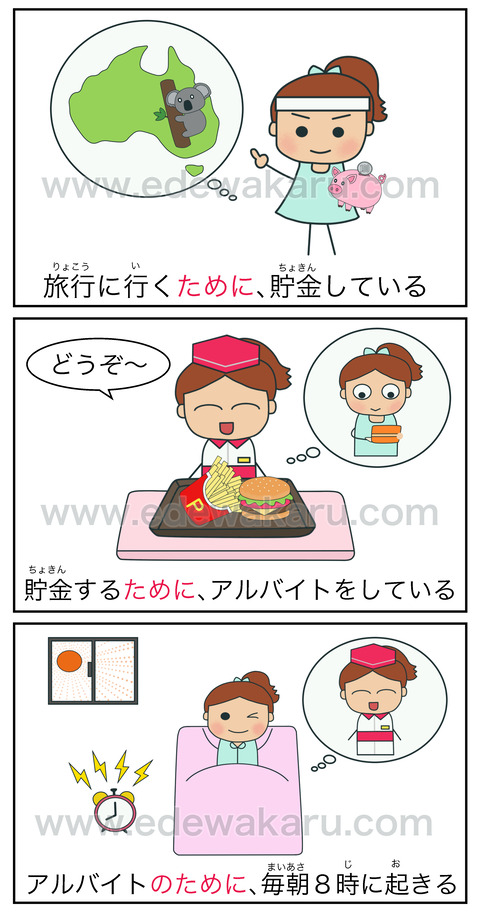
Meaning
目的を表す
How to use it
動詞[辞書形]+ために
名詞[辞書形]+のために
Explanation
「〜ために」は「目的」を表す文型です。
「意志動詞の辞書形」
に使われます。名詞に使う場合は
「名詞+のために」
になります。「AためにB」の形で、「A」には【目的】や【目標】が入り、「B」には「目的を達成しよう!」という意志動作が入ります😊
[例]
①旅行に行く
ために、貯金している
[目的・目標]旅行
[意志動作]貯金する
②お金を貯める
ために、アルバイトをしている
[目的・目標]お金を貯める
[意志動作]アルバイトをする
③アルバイト
のために、毎朝8時に起きる
[目的・目標]アルバイト
[意志動作]毎日5時に起きる
また、目的の「〜ために」は「A(前の文)」と「B(後ろの文)」の主語は同じでなければいけません😨
[例]
①(私は)旅行に行く
ために、貯金している
【Aの主語】
私
【Bの主語】
私
②彼女は留学
のために、がんばって勉強している
【Aの主語】
彼女
【Bの主語】
彼女
③山田くんは、英語の勉強のために辞書を買った
【Aの主語】
山田くん
【Bの主語】
山田くん
【中級以上の人へ】
「〜ために」には「原因」を表すものもあります
ので、しっかりと区別をしておかなければいけません😨
[例]
ダイエットをする
ために、運動をする
【目的】
ダイエットをした
ために、病気になってしまった
【原因】
「〜ために」は初級で勉強する文型ですが、少し複雑です😞また会話でもよく使われますので、しっかりと覚えておきましょう😀
In context 5 examples
旅行に行くために、貯金している(復習:〜ている(繰り返し))
貯金するために、アルバイトをしている
アルバイトのために、毎朝8時に起きる
留学のために、がんばって勉強しなきゃ(復習:〜なきゃ)
日本語を勉強するために、辞書を買った
Usage 2
Read this source entry ↗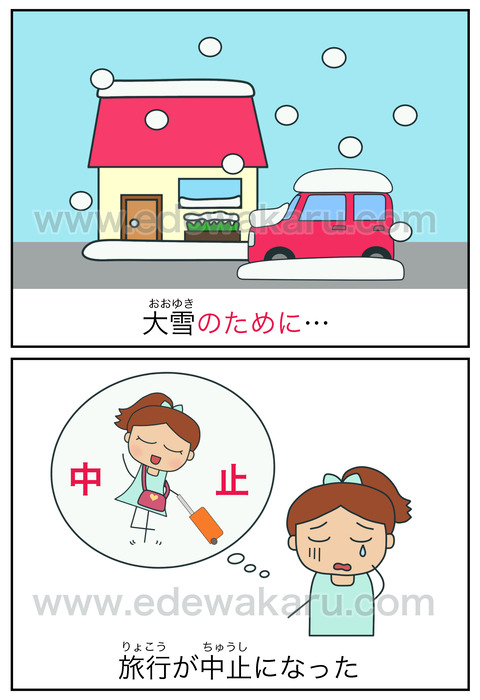
Meaning
〜が原因で
How to use it
動詞[た形・ている形]+ために
形容詞・名詞[普通形]+ために
*な形容詞:「ーなために」名詞:「ーのために」
Explanation
「〜ために」は原因・理由を表す文型で、「〜が原因で」という意味です。「〜ために」の「に」は省略することができます😊
[例]
大雪
のため
旅行が中止になった
事故があった
ため、遅刻してしまった
また「〜おかげで」(復習:〜おかげで)や「〜せいで」(復習:〜せいで)と同じように「〜ためか」という形があり、はっきりと原因・理由がわかっていない時に使います。「たぶん〜が原因で」という意味になります😮
大雪
のために
旅行が中止になった(
原因は「大雪」とはっきりわかっている)
大雪
のためか
旅行が中止になった(
原因は「大雪」かどうかはっきりわからない)
「〜ために」の後ろには【推測】【命令】【依頼】【意志】などは使えませんので注意しましょう
😨
[例]
❌大雪のために、旅行は中止でしょう
❌大雪のために、コートを着なさい
❌大雪のために、学校を休んでもいいですか?
❌大雪のために、旅行に行くのはやめよう
「〜ために・〜ためか」はかたい言い方ですので、会話では「〜ので」や「〜から」を使うのが一般的です😉
「〜ために」には【目的】を表すものもありますので、復習しておきましょう。
In context 3 examples
大雪のために旅行が中止になった
→大雪が原因で、りょこうが中止になった事故があったために、遅刻してしまった
→事故があったのが原因で、遅刻してしまった昨日はとても寒かったために、カゼをひいてしまった
→昨日はとても寒かったのが原因で、カゼをひいてしまった
日本語NET JLPT文法解説まとめ
Usage 1
Read this source entry ↗Meaning
行為の目的を言う言い方。
How to use it
V(辞書形) + ために
Nの + ために
Explanation
"in order to / so that / for"
A way of saying the purpose of an action.
「〜ために」の前は意志動詞が使われる。
In context 13 examples
日本の会社で働くために、今日本語を勉強しています。
将来、自分の家を買うために貯金しています。
彼女を喜ばせるために、プレゼントを買いました。
恋人にプロポーズをするために、指輪を探しています。
会議に出席するために、明日から1週間アメリカに出張に行きます。
お金持ちになるために、自分のビジネスを始めました。
健康のために毎日ジョギングをしています。
来年から家族のために一生懸命働きます。
来週のプレゼンテーションのために、資料を作っています。
人は何のために生きてると思う?
面接のために新しいスーツと靴を買いました。
漢字を覚えるために、毎日ノートに50回書いています。
お金を稼ぐために、副業を始めた。
Usage 2
Read this source entry ↗Meaning
原因 / 理由を表す。
How to use it
V(普通形) + ために
イA(普通形) + ために
ナAな + ために
Nの + ために
この / その + ために
Explanation
because / because of / due to
① 書き言葉でよく使われる。「ので」や「から」に比べフォーマル。
② 後件の文には、判断、命令、依頼、意志などの表現は使えない。
③「ために」の「に」は省略可能。
① It is often used in written language. It is more formal compared to "ので" or "から".
② In the latter part of the sentence, expressions of judgment, commands, requests, or will cannot be used.
③ The "に" in "ために" can be omitted.
In context 13 examples
たくさん雨が降ったために、洪水になりました。
強風のため、乗る予定だった便は欠航になった。
人身事故のため、電車が遅れています。
お金が足りなかったため、欲しかったゲームが買えませんでした。
時間が足りなかったため、全て解くことができませんでした。
お腹を壊したため、遅刻しました。
熱がひどいため、今日は学校を休みます。
道が混んでいるため、少し遅れそうです。
台風が接近しているため、今日は休みにします。
工事中のため、この先通行止めとなっております。
今年は例年よりも気温が低かったために、野菜の値段が高い。
忙しかったために、飲み会に参加できなかった。
泳ぐのが苦手なため、海へ行こうと誘われても断ることが多い。
文法
Usage 1
Meaning
原因 / 理由を表す。
How to use it
V(普通形) + ために
イA(普通形) + ために
ナAな + ために
Nの + ために
この / その + ために
Notes
① 書き言葉でよく使われる。「ので」や「から」に比べフォーマル。
② 後件の文には、判断、命令、依頼、意志などの表現は使えない。
③「ために」の「に」は省略可能。
In context 13 examples
たくさん雨が降ったために、洪水になりました。
強風のため、乗る予定だった便は欠航になった。
人身事故のため、電車が遅れています。
お金が足りなかったため、欲しかったゲームが買えませんでした。
時間が足りなかったため、全て解くことができませんでした。
お腹を壊したため、遅刻しました。
熱がひどいため、今日は学校を休みます。
道が混んでいるため、少し遅れそうです。
台風が接近しているため、今日は休みにします。
工事中のため、この先通行止めとなっております。
今年は例年よりも気温が低かったために、野菜の値段が高い。
忙しかったために、飲み会に参加できなかった。
泳ぐのが苦手なため、海へ行こうと誘われても断ることが多い。
Usage 2
Meaning
行為の目的を言う言い方。
How to use it
V(辞書形) + ために
Nの + ために
Notes
「〜ために」の前は意志動詞が使われる。
In context 13 examples
日本の会社で働くために、今日本語を勉強しています。
将来、自分の家を買うために貯金しています。
彼女を喜ばせるために、プレゼントを買いました。
恋人にプロポーズをするために、指輪を探しています。
会議に出席するために、明日から1週間アメリカに出張に行きます。
お金持ちになるために、自分のビジネスを始めました。
健康のために毎日ジョギングをしています。
来年から家族のために一生懸命働きます。
来週のプレゼンテーションのために、資料を作っています。
人は何のために生きてると思う?
面接のために新しいスーツと靴を買いました。
漢字を覚えるために、毎日ノートに50回書いています。
お金を稼ぐために、副業を始めた。
Bunpro Grammar Reference
Meaning
Due to, Because of, As a result of
How to use it
Verb + ため(に)
[い]Adjective + ため(に)
[な]Adjective + な + ため(に)
Noun + の + ため(に)
Nuance
A somewhat formal way to indicate an event, and then the positive or negative results that occured for that sake.
Explanation
ため (or 為 in its kanji form) is a noun in Japanese that can be translated quite closely to 'sake' in English. However, it is classified as a non-independent word in Japanese, and must always be connected to another word which illustrates the 'sake' that ため is highlighting. The case marking particle に will often be added after ため, to show that (A) is a goal that something will be done to reach.
However, when used with verbs in the past tense, ために more frequently highlights that something happened 'due to (A)', rather than 'for the sake of (A)'. Because of this, a more accurate description of ため in all situations is 'in light of (A)'. This expresses that (A) is the primary or major event/thing that resulted in (B).
To use ために as 'in light of', 'as a result of', or 'because of', attach it to the end of verb in its past form, or a noun follow by の. It may also be used after い-Adjectives or な-Adjectives in their attributive form.
昨日の飲み会でお酒を沢山飲んだために、今日は二日酔いで身体がだるい。
Because I drank a lot of alcohol at the party last night, I am tired today with a hangover.
暑いために、職場で何人かが倒れた。
Due to it being hot, a few people have passed out at work.
このアプリは便利なために、ユーザーがどんどん増えてきた。
Due to this app being useful, the number of users is steadily growing.
大雨のため、サッカーの試合を中止します。
Due to heavy rain, we will be canceling the soccer tournament.
This 'in light of (A)' nuance can be used in reference to things that have already happened (as above), or in reference to something that is considered as the purpose of an action (as in our other ために grammar point).
空手の試合で勝つために、毎日夜遅くまで練習しています。
In order to win the karate tournament, I practice every day until late at night.
昨日は夜遅くまで練習していたため、今日は何もしたくないです。
Due to me practicing until late at night last night, I don't want to do anything today.
Nuance · 日本語
ある出来事を話題にあげ、それを行うのに起こった肯定的、又は消極的な結果を丁寧に示す方法。
Explanation · 日本語
名詞の「ため」(漢字では「為」)は、目的を表すときに使われます。「ため」は、それだけで使うことはできません。必ず目的を表す、ほかの言葉と一緒に使われます。「ため」のあとには、(A) が目的だとはっきりと示すために、格助詞の「に」が付くことも多いです。
しかし、「ために」が動詞の過去形に付くと、原因や理由を表すことが多くなります。この場合、(A) が主な原因・理由となって (B) が起こったことを表します。
この「ために」を使うときは、動詞の過去形、「の」が付いた名詞、または連体形のイ形容詞やナ形容詞のあとに「ために」を続けます。
昨日の飲み会でお酒を沢山飲んだために、今日は二日酔いで身体がだるい。
Because I drank a lot of alcohol at the party last night, I am tired today with a hangover.
暑いために、職場で何人かが倒れた。
Due to it being hot, a few people have passed out at work.
このアプリは便利なために、ユーザーがどんどん増えてきた。
Due to this app being useful, the number of users is steadily growing.
大雨のため、サッカーの試合を中止します。
Due to heavy rain, we will be canceling the soccer tournament.
「ために」は、形は同じでも、文脈や、一緒に使う言葉によって、過去の出来事の原因や理由を表したり、先に学んだように、行動の目的を表したりと、意味が変わります。
空手の試合で勝つために、毎日夜遅くまで練習しています。
In order to win the karate tournament, I practice every day until late at night.
昨日は夜遅くまで練習していたため、今日は何もしたくないです。
Due to me practicing until late at night last night, I don't want to do anything today.
In context 18 examples
- 夜更かしした為朝寝坊してしまった。
I woke up late this morning, due to the fact that I stayed up late last night.
- 暑いために、職場で何人かが倒れた。
Due to it being hot, a few people have passed out at work.
- このアプリは便利なために、ユーザーがどんどん増えてきた。
Due to this app being useful, the number of users is steadily growing.
- 空手の試合で勝つために、毎日夜遅くまで練習しています。
In order to win the karate tournament, I practice every day until late at night.
- 昨日の飲み会でお酒を沢山飲んだために、今日は二日酔いで身体がだるい。
Because I drank a lot of alcohol at the party last night, I am tired today with a hangover.
- 大雨のため、サッカーの試合を中止します。
Due to heavy rain, we will be canceling the soccer tournament.
- 昨日は夜遅くまで練習していたため、今日は何もしたくないです。
Due to me practicing until late at night last night, I don't want to do anything today.
- 台風の為、試合が中止になった。
The game was canceled due to the typhoon.
- お金を使いすぎた為に、貯金がもうほとんどない。
As a result of us having used too much money, we have almost no savings.
- 寒い為に、車が故障してしまった。
My car broke down due to the cold.
- 寒さの為に、車が故障してしまった。
The car broke down due to the cold.
- 風邪の為、今日は休ませていただきます。
Due to a cold, I would like to take a day off.
- コーヒーを飲みすぎた為に眠れない。
I have a hard time getting to sleep due to drinking too much coffee.
- 大雪の為、高速道路が通行止めだ。
The highway is closed due to heavy snow.
- 仕事が忙しすぎる為に、最近実家に帰れていない。
Due to me being too busy at work, I haven't been back to my parents' house in a while.
- 高齢の為に、歩くのも大変になってきた。
It's getting hard even to walk, due to my old age.
- 試験に合格できた為に、一番行きたかった学校に入学できた。
As a result of passing the exam, I was able to go to my first pick school.
- 報告しなかった為に、余分な仕事が増えてしまった。
As a result of not submitting the report, I got extra work.
Yokubi — The Common Grammar Guide (https://yoku.bi)
Explanation
のに is related to ので, but it works in the opposite direction. While ので means "because of X, Y", のに means "despite X, Y". Like ので, this is more "objective" than other adversatives. のに also loves being attached to the end of sentences as an emphasis marker of disappointment or discontentment.
Just like ので, のに needs な after nouns and な adjectives
ように essentially means "so as to", as in "walk so as to keep your back hidden". This treads a fine line between "for the purpose of" and "in such a way as".
If it helps, you can think of ように as a noun (よう = "manner") turned into adverb by に. The clause that qualifies よう becomes "adverbial" to the main verb.
ために literally uses the noun ため "purpose" plus に to make a conjunction.
In many situations, ために and ように are interchangeable with the meaning of "for the purpose of", but not always.
ために can also be used to mean "for the sake of" rather than "for the purpose of". The nuance is different in English but in Japanese it is not always obvious. に can also be dropped.
せい is a noun meaning "fault" used to indicate cause/blame/reason. It usually implies that the effect is undesirable.
The opposite of せいで is おかげで, which implies a thankful feeling.
In context 1 examples
それを確かめるために、彼は走っていた。
He was running, in order to confirm that.
NINJAL 日本語文型データベース
Usage 1
Meaning
物事の原因を表します。因果関係を論理的に説明するときに使います。
How to use it
V普通形+ために
i-A普通形+ために
na-A普通形+ために(ただし、「na-Aだ」→「na-Aな+ために」)
N普通形+ために(ただし、「Nだ」→「Nの+ために」)
その他
Notes
「〜ために」の後には、話し手の意志や希望を表す表現はきません。
あまり日常的ではない、望ましくない事柄に使うことが多いです。
In context 22 examples
各党の意見が違いすぎるために、法案は成立しなかった。
この仕事では、スケジュールが調整できないために、休暇が取れなくなることもあります。
祖父は高齢になって車の運転をやめたために、どこでもバスか電車で行く。
目の前に高いビルが建ったために、この窓から富士山が見えなくなってしまった。
出席日数が足りなかったために、進級できなかった。
家が会社から遠いために、通勤に時間がかかります。
今度のイベントは、会場があまり広くないために、入場者の人数を制限しなければならない。
あの議員は失言が多かったために、辞職に追い込まれた。
今年の冬は寒さがそれほど厳しくなかったために、暖房器具の売り上げは平年を下回った。
この地域は交通が不便なために、自家用車やバイクの利用者が多い。
この町は水がきれいなために、部品の洗浄に水が必要な精密機器の生産が盛んになったのだそうだ。
この商品は実用的ではないために、売れ行きが伸びていない。
生活が不規則だったために、体を壊してしまった。
僕は、子どもの頃、体が丈夫でなかったために、思い切り外遊びすることができなかった。
お客様への対応が適切ではなかったために、上司に怒られた。
日本では少子高齢化のために、労働者不足の問題が起きている。
地球温暖化のために、世界中で異常気象が発生している。
被害者が話ができる状態ではないために、警察はまだ事件当時の状況を聞くことができていない。
父は入院中だったために、今回の選挙では投票所に行けなかった。
かつてこの辺りは沼地だったために、いまだに地盤が安定していない。
学生時代、成績優秀者ではなかったために、奨学金をもらうことができなかった。
立ち上げた事業に失敗してしまった。そのために多額の借金を抱えることになった。
Usage 2
Meaning
[1] 行為の目的を表します。
「念のために」は慣用的な言い方です。
[2] 行為の恩恵を与える対象を表します。
How to use it
Vるために
Nのために
Notes
[1] 「〜」には、「買う・留学する」など、意志的な行為を表す動詞か、「教育・仕事・旅行」など、意志的に行えることを表す名詞がきます。「〜ために」の後にも意志的な行為を表す動詞を使った文がきます。
「〜」が動詞のとき、その主語は「〜ために」の後の文の主語と同じです。
[2] 「〜」には人や団体などを表す名詞がきます。「〜ために」の後には、「作る・買う・働く」など、意志的な行為を表す動詞を使った文がきます。
In context 15 examples
兄は医学を勉強するために、アメリカに留学した。
父の工場を引き継ぐために、今、父から特訓を受けています。
今、子どもたちの未来を守るために、大人がやれることは何だろうか。
レストランを始めるためには、まずお金を貯めないと。
人種差別抗議運動のために、彼は今日も朝からデモに出かけている。
イベント会場に入るとき、本人確認のために身分証明書を提示する必要があります。
人は何のために生きるのか、私にはわからなくなってきた。
これが、来週の旅行のために買ったスーツケースです。
夜は寒くなるかもしれないから、念のために上着を持っていったほうがいいと思う。
「目的のためには手段を選ばない」という言葉がある。賛成できない考え方だ。
山田さんは子どもたちのために毎朝頑張ってお弁当を作っている。
「お母さんのために、かわいいお土産を買ったよ。待っていてね」
このNPO機関のために、田中氏は生涯を尽くしたのです。
会社のために働いているのか、自分のために働いているのか、わからなくなってきた。
私を育ててくれた祖母のためにも、私は社会福祉の仕事をしたい。
IMABI
~ために I: In order to…
Read this IMABI lesson ↗Explanation
~ために I: In order to…
The purpose-marker に attaches to a handful of nouns, creating several important grammar patterns. This is very much the case when it follows the noun 為, which means “objective/benefit” or “result.” Although most typically seen paired with the particle に, 為 can still be used like any other noun with these meanings as demonstrated below.
1. あなたの為ためを思おもって言いうのよ!
I’m saying this for your own good!
2. 世界せかいの為ためなら犠牲ぎせいは仕方しかたない。
If they’re for the sake of the world, sacrifices can’t be helped.
3. 子供こどもの為ためを思おもって言いっているつもりが、逆ぎゃくにストレスを与あたえているかもしれません。
Your intentions of saying that for your child’s benefit may in fact be conversely stressing out your child.
4. 部下ぶかの沈黙ちんもくは上司じょうしのためにならないし、組織そしきにとってもその上司のキャリアにとってもプラスにはならない。
Silence from subordinates is not for the benefit of the boss, nor will it be a plus for the organization or for that boss’ career.
5. 情なさけは人ひとの為ためならず。
Compassion is not for other people’s benefit.
Grammar Note: ならず is the Classical Japanese equivalent of ではない and is commonly seen in proverbs such as Ex. 5.
When the purpose-marker に follows ため, it is used to express an objective/goal to realize something by one’s utmost effort. In doing so, it is often translated as “for” or “(in order) to” as we will soon see. Aside from showing purpose, in concurrence with its second definition, ため may also be used to show cause. This lesson will focus solely on the first meaning, and in the next lesson we’ll focus on the second meaning.
Orthography Note: It is important to note that 為 is typically written as ため , which is how it will be spelled for the remainder of this lesson. Nonetheless, 為 is still a common spelling. Often, it is the writer’s style or the medium that dictates which spelling is used.
Marking an Objective
The primary purpose of ~ために is to express purpose. In doing so, ~ために must be used with verbs of volition. This does not mean that it is limited to transitive verbs. Rather, it is limited to verbs which have an agent who has control over achieving the stated goal.
Although ~ために follows the same grammar as any other instance of a noun following a verb, because the Japanese expression itself is very different in regard to part of speech from its English counterpart “(in order) to,” the chart below illustrates how it combines with all verb classes.
/eru/-一段 Verb食べる + ために →食べるために (In order) to eat
/iru/-一段 Verb見る + ために →見るために (In order) to see
/u/-五段 Verb使う + ために →使うために (In order) to use
/ku/-五段 Verb行く + ために →行くために (In order) to go
/gu/-五段 Verb泳ぐ + ために →泳ぐために (In order) to swim
/su/-五段 Verb話す + ために →話すために (In order) to talk
/tsu/-五段 Verb勝つ + ために →勝つために (In order) to win
/nu/-五段 Verb死ぬ + ために →死ぬために (In order) to die
/mu/-五段 Verb読む + ために →読むために (In order) to read
/ru/-五段 Verb測る + ために →測るために (In order) to measure
サ変(する) する + ために → するために (In order) to do
カ変(来る) 来る + ために → 来るために (In order) to come
This usage of ~ために is usually used with affirmative expressions, and it must be used with the non-past form of a verb.
The Four Scenarios of the Objective-Marking ~(の)ために
Regardless of how ~(の)ために expresses purpose, the agent of both clauses in the sentence are always the same. To visualize this, envision all instances of the purpose-ため as being “AためにB.” The someone doing A and the someone doing B must be the same person. In case you’ve forgotten what “agent” means, the “agent” of a sentence is the “someone doing X.”
Particle Note: Interestingly, the particle に is often dropped in literary settings from these two expressions when in declarative statements, but in interrogative sentences and/or comments directed at others, に is not dropped. Motivation for this is that in literary settings, grammatical connections such as に’s role of marking purpose that are easily deduced from context are dropped out of a necessity to be concise. Questions or statements directed toward others, though, present a need to be explicit, and so omission of latent parts of a sentence becomes out of place.
①: Noun A + の + ため: Thinking about A’s benefit
This interpretation is used with nouns that either concern people or are/made up of people. This usage is usually translated as “for.” Even when the “A” element in the base sentence pattern “AためにB” is a noun, the particle の is conceptualized as being an abbreviation of some verbal expression. For instance, in Ex. 6, a verb that comes to mind that の before ため stands for is 援助えんじょする (to aid).
6. 貧まずしい人々ひとびとのために何百万円なんひゃくまんえんもの慈善寄付金じぜんきふきんを集あつめました。
We have collected millions of yen in charity contributions for the poor.
7. 今いままでで一番国民いちばんこくみんのための政治せいじを行おこなってくれた総理大臣そうりだいじんは誰だれだと思おもいますか?
Of the prime ministers up till now, who do you think has governed for the people the most?
8. 社会貢献活動しゃかいこうけんかつどうを通とおして、安全あんぜん・快適かいてきな社会しゃかいのために、様々さまざまな活動かつどうを行おこなっています。
Through social action programs, we are conducting various operations for a safe and pleasant society.
9. 言葉ことばの壁かべにより、高たかい能力のうりょくを生いかせない外国人生徒がいこくじんせいとのため、取とり出だし授業じゅぎょうや外国人生徒がいこくじんせいとサポーターなどによる教育支援体制きょういくしえんたいせいを整ととのえている。
For foreign students who cannot make the best of their high-level abilities due to language barrier, (they) have arranged an education support structure by means of separate classes and foreign-student supporters.
10. 会社かいしゃのために働はたらいていることが、お客様きゃくさまに喜よろこばれ、それが自分じぶんや家族かぞくのためになるのであればそれでいいし、自分じぶんや家族かぞくのために働はたらくことでお客様きゃくさまから支持しじされ、それが会社かいしゃにとっても有益ゆうえきならそれでいい。また、お客様きゃくさまのために働はたらいていることが、自分じぶんの喜よろこびとなり、それが結果的けっかてきに会社かいしゃの利益りえきに繋つながり、給料きゅうりょうが上あがることで家族かぞくの喜よろこびとなればそれでいい。
Working for the company will delight one’s clientele, which is fine if it becomes beneficial for oneself and one’s family, and if one receives support from one’s clients by working for oneself and one’s family and that is also profitable to the company, then that’s fine. Also, if working for one’s clientele becomes one’s joy, which is then consequently tied to the company’s benefit, and leads to a raise that becomes one’s family’s delight, that too is fine.
②: Noun A + の + ため: Objective to realizing A
In this usage, “Noun A” refers to some entity that can be viewed as a purpose/goal, and what follows is the objective for realizing that said purpose/goal. This usage can also have its parts reversed to have the objective stated first with the sentence ending in ~ためだ (Ex. 11). This usage is also typically translated as “for.”
11. なぜ会社かいしゃのために仕事しごと(を)するかというと、自身じしんの収入しゅうにゅうのためです。
As to why one works for one’s company, it’s for one’s own income.
Grammar Note: Though the first instance of ため is of Usage 1, the sentence-ending instance is of Usage 2. “Working for one’s computer” is the objective for realizing one’s source of income.
12. 安全あんぜんな社会しゃかいの実現じつげんのためには、すべての市民しみんの理解りかいと協力きょうりょくが必要ひつようです。
For the realization of a safe society, understanding and cooperation of all townspeople is necessary.
13. 自分自身じぶんじしんの健康けんこうと幸福こうふくのために敵てきを赦ゆるし、忘わすれましょう。
For one’s own health and happiness, forgive one’s enemies and forget.
14. 何なんのために闘たたかうのか。権力けんりょくのためか。自由じゆうのためか。平和へいわのためか。
What do you fight for? For influence? For freedom? For peace?
15. 責任せきにんある科学者かがくしゃは、科学かがくの健全けんぜんな発展はってんのために、こうした事態じたいに自みずから適切てきせつに対応たいおうしていく必要ひつようがある。
As for the scientists responsible, it is necessary that they themselves adequately handle these situations for the healthy development of science.
念のため、確認したいのですが、上記の認識で大丈夫でしょうか。
I want to make sure just in case. Is my understanding above okay?
③: Verb + ための Noun B: Noun B which realizes stated goal
Although this can also be seen as Noun A + ための Noun B, the point of Usage 3 is that when ~(の)ため is followed directly by another noun, that Noun B is what realizes the stated goal seen before ため. This usage may be translated as “for” or “to.”
16. 住民じゅうみんの福祉ふくしを向上こうじょうさせるための政策せいさくを実施じっしする。
To implement political measures for advancing the welfare of residents.
17. 幸しあわせになるためのたったひとつの道みちとは?
What is the one single path to becoming happy?
18. 場所ばしょによっては、着替きがえるための部屋へやを提供ていきょうしてくれるところもある。
Depending on the location, there are also places that will offer you a room to change.
19. 一人暮ひとりぐらしをするための部屋へやを借かりるときには、部屋へやを貸かしてくれる大家おおやさんと賃貸契約ちんたいけいやくを結むすぶことになります。
When renting a room to live alone, you will sign a lease agreement with the landlord who is renting you the room.
20. 全すべては、家族かぞくにより良よい生活せいかつをもたらすためだ。
It is all [for bringing/to bring] about a better life for (their) families.
漢字 Note: The verb もたらす (to bring about) is only seldom spelled as 齎す.
④: Verb of Volition + ためには + Expression of Obligation
~ためには involves willful action/control by the agent/speaker in question. For verbs that have intransitive-transitive pairs, only the transitive form should be used with this pattern. This is further enforced by the sentences ending in an expression of obligation.
21. 成功せいこうするためには、面倒臭めんどうぐさいことをたくさんしなければなりませんよ。
(In order) to success, you must do lots of tiresome things.
22. 優良ゆうりょうな見込みこみ客きゃくを獲得かくとくするためには、これを見極みきわめなくてはなりません。
(In order) to acquire excellent prospective [customers/clients], you must get to the bottom of this.
23. 大型船舶おおがたせんぱくを運航うんこうするためには海技士かいぎしの免許めんきょが必要ひつようです。
(In order to) operate a large seacraft, [a mariner license is necessary/you must be a licensed mariner].
24. 心臓病しんぞうびょうを予防よぼうするためには、どうすればいいですか。
(In order) to prevent heart disease, what should one do?
25. 英語えいごを習得しゅうとくするためには、あなたの生活せいかつの中なかで英語えいごの優先順位ゆうせんじゅんいを高たかくしましょう。
(In order) to learn English, increase the priority of English in your daily life.
~ないために
As mentioned earlier, ~ないために is seldom used. This is because for it to be grammatical, 100% or near 100% confidence that the agent has control over the non-realization of “A” must be implied. Remember, the base sentence pattern for ~ために is “AためにB.” Just as how ため carries a very affirmative nuance of “A” being realized by a stated objective “B,” when paired with a negative sentence, this becomes a very affirmative statement that “A” won’t realize by means of the stated objective “B.”
26. スズメバチに襲おそわれないためには、どのようなことに気きをつけたらよいのでしょうか。
What sort of things should one be careful of to not be attacked by wasps?
Sentence Note: This question asks about what actions—“B”—can be taken to give the agent control over the non-realization of “A”—being attacked by wasps.
27. 被害ひがいに遭あわないために、様々さまざまな詐欺さぎの手口てぐちについて知しっておきましょう!
Know about the various scam tricks in order not to become victimized!
Sentence Note: The use of ~ために is appropriate so long the speaker implies that “B”—actively finding out and learning about the various scam tricks—brings about person control over not becoming a victim.
28. そうならないためにも専門家以外の人に相談するのはやめましょう。
Refrain from consulting with non-experts to make it so it also doesn’t happen that way.
Grammar Note: Although なる typically doesn’t imply volition, this sentence implies that “B” is the means by which the agent has control over “A” not realizing, thus making the sentence grammatical.
29. 死しなないために生いきるのは御免ごめんだ。
I’ll have nothing to do with living in order not to die.
30. ~パリ協定後きょうていごの投融資とうゆうしを誤あやまらないために~
—In Order not to Make Investment and Lending Mistakes Post-Paris Accords—
Sentence Note: The use of ~ないために is most common in headlines such as this.
In context 30 examples
あなたの為ためを思おもって言いうのよ!
I’m saying this for your own good!
世界せかいの為ためなら犠牲ぎせいは仕方しかたない。
If they’re for the sake of the world, sacrifices can’t be helped.
子供こどもの為ためを思おもって言いっているつもりが、逆ぎゃくにストレスを与あたえているかもしれません。
Your intentions of saying that for your child’s benefit may in fact be conversely stressing out your child.
部下ぶかの沈黙ちんもくは上司じょうしのためにならないし、組織そしきにとってもその上司のキャリアにとってもプラスにはならない。
Silence from subordinates is not for the benefit of the boss, nor will it be a plus for the organization or for that boss’ career.
情なさけは人ひとの為ためならず。
Compassion is not for other people’s benefit.
貧まずしい人々ひとびとのために何百万円なんひゃくまんえんもの慈善寄付金じぜんきふきんを集あつめました。
We have collected millions of yen in charity contributions for the poor.
今いままでで一番国民いちばんこくみんのための政治せいじを行おこなってくれた総理大臣そうりだいじんは誰だれだと思おもいますか?
Of the prime ministers up till now, who do you think has governed for the people the most?
社会貢献活動しゃかいこうけんかつどうを通とおして、安全あんぜん・快適かいてきな社会しゃかいのために、様々さまざまな活動かつどうを行おこなっています。
Through social action programs, we are conducting various operations for a safe and pleasant society.
言葉ことばの壁かべにより、高たかい能力のうりょくを生いかせない外国人生徒がいこくじんせいとのため、取とり出だし授業じゅぎょうや外国人生徒がいこくじんせいとサポーターなどによる教育支援体制きょういくしえんたいせいを整ととのえている。
For foreign students who cannot make the best of their high-level abilities due to language barrier, (they) have arranged an education support structure by means of separate classes and foreign-student supporters.
会社かいしゃのために働はたらいていることが、お客様きゃくさまに喜よろこばれ、それが自分じぶんや家族かぞくのためになるのであればそれでいいし、自分じぶんや家族かぞくのために働はたらくことでお客様きゃくさまから支持しじされ、それが会社かいしゃにとっても有益ゆうえきならそれでいい。また、お客様きゃくさまのために働はたらいていることが、自分じぶんの喜よろこびとなり、それが結果的けっかてきに会社かいしゃの利益りえきに繋つながり、給料きゅうりょうが上あがることで家族かぞくの喜よろこびとなればそれでいい。
Working for the company will delight one’s clientele, which is fine if it becomes beneficial for oneself and one’s family, and if one receives support from one’s clients by working for oneself and one’s family and that is also profitable to the company, then that’s fine. Also, if working for one’s clientele becomes one’s joy, which is then consequently tied to the company’s benefit, and leads to a raise that becomes one’s family’s delight, that too is fine.
なぜ会社かいしゃのために仕事しごと(を)するかというと、自身じしんの収入しゅうにゅうのためです。
As to why one works for one’s company, it’s for one’s own income.
安全あんぜんな社会しゃかいの実現じつげんのためには、すべての市民しみんの理解りかいと協力きょうりょくが必要ひつようです。
For the realization of a safe society, understanding and cooperation of all townspeople is necessary.
自分自身じぶんじしんの健康けんこうと幸福こうふくのために敵てきを赦ゆるし、忘わすれましょう。
For one’s own health and happiness, forgive one’s enemies and forget.
何なんのために闘たたかうのか。権力けんりょくのためか。自由じゆうのためか。平和へいわのためか。
What do you fight for? For influence? For freedom? For peace?
責任せきにんある科学者かがくしゃは、科学かがくの健全けんぜんな発展はってんのために、こうした事態じたいに自みずから適切てきせつに対応たいおうしていく必要ひつようがある。
As for the scientists responsible, it is necessary that they themselves adequately handle these situations for the healthy development of science.
住民じゅうみんの福祉ふくしを向上こうじょうさせるための政策せいさくを実施じっしする。
To implement political measures for advancing the welfare of residents.
幸しあわせになるためのたったひとつの道みちとは?
What is the one single path to becoming happy?
場所ばしょによっては、着替きがえるための部屋へやを提供ていきょうしてくれるところもある。
Depending on the location, there are also places that will offer you a room to change.
一人暮ひとりぐらしをするための部屋へやを借かりるときには、部屋へやを貸かしてくれる大家おおやさんと賃貸契約ちんたいけいやくを結むすぶことになります。
When renting a room to live alone, you will sign a lease agreement with the landlord who is renting you the room.
全すべては、家族かぞくにより良よい生活せいかつをもたらすためだ。
It is all [for bringing/to bring] about a better life for (their) families.
成功せいこうするためには、面倒臭めんどうぐさいことをたくさんしなければなりませんよ。
(In order) to success, you must do lots of tiresome things.
優良ゆうりょうな見込みこみ客きゃくを獲得かくとくするためには、これを見極みきわめなくてはなりません。
(In order) to acquire excellent prospective [customers/clients], you must get to the bottom of this.
大型船舶おおがたせんぱくを運航うんこうするためには海技士かいぎしの免許めんきょが必要ひつようです。
(In order to) operate a large seacraft, [a mariner license is necessary/you must be a licensed mariner].
心臓病しんぞうびょうを予防よぼうするためには、どうすればいいですか。
(In order) to prevent heart disease, what should one do?
英語えいごを習得しゅうとくするためには、あなたの生活せいかつの中なかで英語えいごの優先順位ゆうせんじゅんいを高たかくしましょう。
(In order) to learn English, increase the priority of English in your daily life.
スズメバチに襲おそわれないためには、どのようなことに気きをつけたらよいのでしょうか。
What sort of things should one be careful of to not be attacked by wasps?
被害ひがいに遭あわないために、様々さまざまな詐欺さぎの手口てぐちについて知しっておきましょう!
Know about the various scam tricks in order not to become victimized!
そうならないためにも専門家以外の人に相談するのはやめましょう。
Refrain from consulting with non-experts to make it so it also doesn’t happen that way.
死しなないために生いきるのは御免ごめんだ。
I’ll have nothing to do with living in order not to die.
~パリ協定後きょうていごの投融資とうゆうしを誤あやまらないために~
—In Order not to Make Investment and Lending Mistakes Post-Paris Accords—
Due to
Read this IMABI lesson ↗Explanation
~ために II: Due to…
~ために, as hinted at in the introduction of the previous lesson, is not limited to expressing an objective. Another primary interpretation that may or may not coincide with an objective is expressing a cause. This lesson will help you understand exactly how to use and understand this “cause-marking” ~ために and how it contrasts and coincides with the “objective-marking” ~ために.
Marking a Cause
The cause-marking ~ために is used to express the cause of something in a reserved manner. It is equivalent to the English phrase “due to.” It can be seen after nouns, adjectival nouns, adjectives, and verbs. For conjugatable parts of speech, it can be seen after both the non-past and past tenses.
Part of Speech Non-Past Tense Past Tense
Nouns N + の + ため(に) N + だった + ため(に)
Adjectival Nouns Adj. N + な + ため(に) Adj. N + だった + ため(に)
Adjectives Adj. + ため(に) Adj. + かった + ため(に)
Verbs V + ため(に) V + た + ため(に)
Semantic Restrictions
The cause-marking ~ために is only used in declarative sentences and the questions made from said sentences. The basic sentence pattern with the cause-marking ために is “A + ために + B.” The A expresses cause if B is the result of A having occurred. Generally speaking, when the agent of A and B are the same, then ~ために expresses an objective, but when the agent of A and B differ, it expresses cause. This rule of thumb only works, though, with the non-past tense. When you see ~ため(に) after the past tense or the progressive form (~ている), or whenever both clauses lack a true active agent, then it is always the cause-marking interpretation.
Particle Note: The に in ~ために is frequently omitted, and when the statement is a positive one, it’s most natural to omit it. When に isn’t present, the statement is as neutral as can be. When に is present, the cause stands out more, but there is no emphasis as to whether the cause is good or bad.
Usage Note: This pattern is almost entirely used in the written language and/or in news(-like speech).
1. 現在げんざいは工事こうじのために閉鎖中へいさちゅうです。
(Road) currently closed due to construction.
2. 最もっとも得票とくひょうの多おおい候補者こうほしゃでも当選とうせんに必要ひつような票数ひょうすうに届とどかなかったため、再選挙さいせんきょが行おこなわれることになった。
Due to the fact that not even the candidate who won the most votes reached the necessary count to be elected, a repeat election is to be held.
3. 彼女かのじょは容姿端麗ようしたんれい{な・だった}ため{に X・ø 〇}、数々かずかずの男子学生だんしがくせいの憧あこがれの的まとだった。
She was the object of adoration of numerous male students due to her attractive face and figure.
4. 彼女かのじょは容姿端麗ようしたんれいなために、数々かずかずの男子学生告白だんしがくせいこくはくされたりするのにうんざりしている。
She is fed up with having numerous male students confess their love for her due to her attractive face and figure.
5. このため、フジテレビは今後こんごの放送ほうそうを取とりやめることにした。
Because of this, Fuji Television has decided to call off further broadcast (of the program).
6. 業績ぎょうせきが右肩下みぎかたさがりの時期じきに入社にゅうしゃしたためか、組織変更そしきへんこうの繰り返かえしで人ひとの出入でいりが激はげしい。
Perhaps due to having entered the company at a time when performance was declining, turnover was relentless with repeated structure changes.
Grammar Note: ~ためか is equivalent to “perhaps due to.”
7. 姉あねが結婚けっこんするため、父ちちはアルバイトして、お金かねを貯めている。
My father is working a part-time job and saving money because my older sister is marrying.
Sentence Note: It may also be the case that the father is saving the money so that his daughter may marry, but this would be something one must confirm whether this is true with the father.
8. 姉あねは結婚けっこんするために、アルバイトして、お金かねを貯めている。
My older sister is working a part-time job saving money in order to marry.
Sentence Note: Because the agent is the same in all clauses of the sentence, ために is interpreted here as “in order to.” The same can be said for Ex. 9.
9. 研究者けんきゅうしゃも謎なぞを探さぐるため(に)実験じっけんに乗のり出だした。
Scientist have also set out to experimenting (in order) to probe the mystery.
10. 秋雨前線あきさめぜんせんが近ちかづいているため、曇くもり空ぞらとなりました。
The weather has become cloudy due to an autumnal rain front approaching.
11. 結局けっきょく最終さいしゅうバスに乗のり遅おくれたため、他ほかの友達ともだちと徒歩とほでキャンパスへ帰還きかん。
Returned to campus by foot with other friends due to ultimately missing the final bus.
Sentence Note: This sentence is representative of blog-style writing.
12. 周まわりの人ひとに見みせびらかしたいために、ゲームがしたいために機種きしゅを変かえる、君きみの両親りょうしんはそんな理由りゆうで何万なんまん(円えん)も出だせるわけが無ないでしょう?
Changing devices because you want to show off to people around or because you want to play a game… there’s no way that your parents could dish out tens of thousands of yen for those sort of reasons, no?
13. 夕ゆうべはぐっすり寝ねていたため、地震じしんに気きが付つきませんでした。
As I was fast asleep last night, I did not feel the earthquake.
14. 十分じゅうぶんな情報じょうほうがないため、サーバーを検証けんしょうできません。
Cannot access server due to insufficient information.
15. 濃霧のうむのため、車くるまという車くるまはみなライトをつけて走はしっている。
Due to dense fog, every single car is running with its headlights on.
16. 濃こい霧きりのため、管制塔かんせいとうからの指示しじがあるまで、着陸ちゃくりくを見合みあわせています。
Due to dense fog, landing will be postponed until there are instructions from the control tower.
17. サービスが悪わるかったため(に)、お客きゃくさんが減へった。
Customers have diminished since service was bad.
~ます + ~ため(に)
There are also instances in which you will find the cause-marking ~ため(に) after polite endings such as ~ます, ~ました, and ~ません in attempt to be more formal. This is also almost entirely used in the written language. Some speakers frown on this practice, preferring the plain speech forms; however, it is nonetheless important to know that both ~ますため and ~ませんため are used a lot.
Particle Note: The particle に is seldom seen after ため in this situation.
18. 現時点げんじてんでは、まだ完治かんちに至いたっておりませんため、今後こんごは通院つういんして治療ちりょうを続つづける予定よていです。
Because I have yet to fully recover at this time, I plan on continuing my treatment through outpatient visits going forward.
19. 返品へんぴん・交換こうかんは受うけ付つけておりませんため、予あらかじめご了承下りょうしょうください。
We do not accept returns and/or trades, so please take this into your consideration.
20. ドリンク代だいは含ふくまれておりませんため、現場げんばでお支払しはらいいただきます。
Drink fees are not included, and so you will pay on site.
21. パスワードの再登録さいとうろくが必要ひつようとなりますため大変たいへんお手数てすうをお掛かけし申もうし訳わけございませんが、何卒なにとぞご理解りかいとご協力きょうりょくをお願ねがい致いたします。
As password re-registration is required, we ask for your understanding and cooperation. We apologize for the inconvenience this may cause you.
22. 尚なお、掲載けいさいまでには規約違反きやくいはんがないかの審査しんさをしておりますため、少すこしお時間じかんがかかることをご了承りょうしょうください。
Also, because we are inspecting as to whether they are no TOS violations before publication, please understand that it will take some time.
23. 先さきほど頂いただいた内容ないようで確認点かくにんてんが御座ございました為ため、ご連絡致れんらくいたしました。
I’m contacting because of there being something to confirm in the content we received from you earlier.
Spelling Note: Although ため hasn’t been spelled as 為 elsewhere in this lesson, Ex. 23 particularly exemplifies the style of writing seen in business communications where other phrases that would otherwise not be written in 漢字 are to give off an overall formal feel.
Ambiguity Between Objective/Cause-Marking ~ため(に)
There are some situations in which the agent of A and B are the same. Sometimes this causes ambiguity as to whether ~ために expresses an objective or a cause.
①: When A is a noun, if the noun is one that describes an unrealized thing such as 成功 (success)・健康 (health)・幸福 (happiness), then it expresses an objective.
24. 日々ひびの健康けんこうのためにも、毎日十分まいにちじゅうぶんな睡眠すいみんを取とりましょう。
Get plenty of rest daily for your daily healthy as well.
②: If the noun expresses something that has happened/is happening such as 事故 (accident)・失敗 (failure)・あられ (hail), then it expresses cause.
25. 事故じこのため、電車でんしゃが遅おくれております。
The train has been delayed due to an accident.
26. 雨あめのために試合しあいを延期えんきします。
We will postpone the game due to the rain.
27. ただいま信号待しんごうまちのため(に)、停車ていしゃしております。お急いそぎのところご迷惑めいわくをおかけします。
We’ve now stopped to wait for a traffic light. We apologize for this inconvenience as you’re in a hurry.
Sentence Note: Although the use of “to” as the English translation may suggest that Ex. 27 demonstrates an objective, it is not the case that the vehicle stopped purposely to wait for a light. Although such a scenario is theoretically possible, it is also the case in English that “to” refers to cause. Changing the translation from “to” to “in order to,” for this reason, would be wrong.
③: For nouns—or even verbal expressions—in the middle that are neither positive nor negative things, only context can tell which interpretation is meant. Both interpretations can also be meant, which is also true for the English equivalent “for” and “to.”
28. 再検査さいけんさをするため(に)、先週せんしゅう、一日ついたち、会社かいしゃを休やすみました。
I took a day off last week to get re-examined/for a re-examination.
29. 母ははを迎むかえるために、張はり切きって掃除そうじをした。
I revved up cleaning to welcome my mother (inside my home).
30. それとも利益りえきのためにそうなったのかはわからない。
And it’s not clear if it happened so because of/for profit.
31. 今年ことしの10じゅう月がつの誕生日たんじょうびで、母ははが還暦かんれきを迎むかえるため、家族かぞくみんなで3さん泊ぱくのお泊とまり旅行りょこうに行いってきました。
Our whole family went and came back from going on a three-night trip for my mother turning sixty on her birthday this year in October.
In context 31 examples
現在げんざいは工事こうじのために閉鎖中へいさちゅうです。
(Road) currently closed due to construction.
最もっとも得票とくひょうの多おおい候補者こうほしゃでも当選とうせんに必要ひつような票数ひょうすうに届とどかなかったため、再選挙さいせんきょが行おこなわれることになった。
Due to the fact that not even the candidate who won the most votes reached the necessary count to be elected, a repeat election is to be held.
彼女かのじょは容姿端麗ようしたんれい{な・だった}ため{に X・ø 〇}、数々かずかずの男子学生だんしがくせいの憧あこがれの的まとだった。
She was the object of adoration of numerous male students due to her attractive face and figure.
彼女かのじょは容姿端麗ようしたんれいなために、数々かずかずの男子学生告白だんしがくせいこくはくされたりするのにうんざりしている。
She is fed up with having numerous male students confess their love for her due to her attractive face and figure.
このため、フジテレビは今後こんごの放送ほうそうを取とりやめることにした。
Because of this, Fuji Television has decided to call off further broadcast (of the program).
業績ぎょうせきが右肩下みぎかたさがりの時期じきに入社にゅうしゃしたためか、組織変更そしきへんこうの繰り返かえしで人ひとの出入でいりが激はげしい。
Perhaps due to having entered the company at a time when performance was declining, turnover was relentless with repeated structure changes.
姉あねが結婚けっこんするため、父ちちはアルバイトして、お金かねを貯めている。
My father is working a part-time job and saving money because my older sister is marrying.
姉あねは結婚けっこんするために、アルバイトして、お金かねを貯めている。
My older sister is working a part-time job saving money in order to marry.
研究者けんきゅうしゃも謎なぞを探さぐるため(に)実験じっけんに乗のり出だした。
Scientist have also set out to experimenting (in order) to probe the mystery.
秋雨前線あきさめぜんせんが近ちかづいているため、曇くもり空ぞらとなりました。
The weather has become cloudy due to an autumnal rain front approaching.
結局けっきょく最終さいしゅうバスに乗のり遅おくれたため、他ほかの友達ともだちと徒歩とほでキャンパスへ帰還きかん。
Returned to campus by foot with other friends due to ultimately missing the final bus.
周まわりの人ひとに見みせびらかしたいために、ゲームがしたいために機種きしゅを変かえる、君きみの両親りょうしんはそんな理由りゆうで何万なんまん(円えん)も出だせるわけが無ないでしょう?
Changing devices because you want to show off to people around or because you want to play a game… there’s no way that your parents could dish out tens of thousands of yen for those sort of reasons, no?
夕ゆうべはぐっすり寝ねていたため、地震じしんに気きが付つきませんでした。
As I was fast asleep last night, I did not feel the earthquake.
十分じゅうぶんな情報じょうほうがないため、サーバーを検証けんしょうできません。
Cannot access server due to insufficient information.
濃霧のうむのため、車くるまという車くるまはみなライトをつけて走はしっている。
Due to dense fog, every single car is running with its headlights on.
濃こい霧きりのため、管制塔かんせいとうからの指示しじがあるまで、着陸ちゃくりくを見合みあわせています。
Due to dense fog, landing will be postponed until there are instructions from the control tower.
サービスが悪わるかったため(に)、お客きゃくさんが減へった。
Customers have diminished since service was bad.
現時点げんじてんでは、まだ完治かんちに至いたっておりませんため、今後こんごは通院つういんして治療ちりょうを続つづける予定よていです。
Because I have yet to fully recover at this time, I plan on continuing my treatment through outpatient visits going forward.
返品へんぴん・交換こうかんは受うけ付つけておりませんため、予あらかじめご了承下りょうしょうください。
We do not accept returns and/or trades, so please take this into your consideration.
ドリンク代だいは含ふくまれておりませんため、現場げんばでお支払しはらいいただきます。
Drink fees are not included, and so you will pay on site.
パスワードの再登録さいとうろくが必要ひつようとなりますため大変たいへんお手数てすうをお掛かけし申もうし訳わけございませんが、何卒なにとぞご理解りかいとご協力きょうりょくをお願ねがい致いたします。
As password re-registration is required, we ask for your understanding and cooperation. We apologize for the inconvenience this may cause you.
尚なお、掲載けいさいまでには規約違反きやくいはんがないかの審査しんさをしておりますため、少すこしお時間じかんがかかることをご了承りょうしょうください。
Also, because we are inspecting as to whether they are no TOS violations before publication, please understand that it will take some time.
先さきほど頂いただいた内容ないようで確認点かくにんてんが御座ございました為ため、ご連絡致れんらくいたしました。
I’m contacting because of there being something to confirm in the content we received from you earlier.
日々ひびの健康けんこうのためにも、毎日十分まいにちじゅうぶんな睡眠すいみんを取とりましょう。
Get plenty of rest daily for your daily healthy as well.
事故じこのため、電車でんしゃが遅おくれております。
The train has been delayed due to an accident.
雨あめのために試合しあいを延期えんきします。
We will postpone the game due to the rain.
ただいま信号待しんごうまちのため(に)、停車ていしゃしております。お急いそぎのところご迷惑めいわくをおかけします。
We’ve now stopped to wait for a traffic light. We apologize for this inconvenience as you’re in a hurry.
再検査さいけんさをするため(に)、先週せんしゅう、一日ついたち、会社かいしゃを休やすみました。
I took a day off last week to get re-examined/for a re-examination.
母ははを迎むかえるために、張はり切きって掃除そうじをした。
I revved up cleaning to welcome my mother (inside my home).
それとも利益りえきのためにそうなったのかはわからない。
And it’s not clear if it happened so because of/for profit.
今年ことしの10じゅう月がつの誕生日たんじょうびで、母ははが還暦かんれきを迎むかえるため、家族かぞくみんなで3さん泊ぱくのお泊とまり旅行りょこうに行いってきました。
Our whole family went and came back from going on a three-night trip for my mother turning sixty on her birthday this year in October.