AIUEO JLPT Grammar
Meaning
This sentence pattern expresses strong certainty or a belief that something is obvious. It is mainly used in spoken language to emphasize speculation or judgment.
How to use it
動詞に+決まっている形容詞に+決まっている形容動詞に+決まっている名詞に+決まっている
Explanation · 日本語
この文型は、話し手が強い確信や当然だと思うことを表す表現です。主に話し言葉で使われ、推測や判断を強調するときに用いられます。
In context 5 examples
彼が勝つに決まっている。
He’s definitely going to win.
あの人が犯人に決まっています。
That person must be the culprit.
この料理はおいしいに決まっている。
This dish must be delicious.
そんな簡単な仕事なら、誰でもできるに決まっている。
If it’s such an easy job, anyone can do it.
彼がそんなことを言ったなんて、冗談に決まっている。
If he said something like that, it must have been a joke.
文法
Meaning
きっと〜だ / 絶対に〜だ
話し手が強い確信を持っているときに使う推量表現。
How to use it
V(普通形)+ に決まっている
イA(普通形) + に決まっている
ナA (普通形)+ に決まっている ※ナAだ + に決まっている
N (普通形)+ に決まっている ※Nだ + に決まっている
Notes
カジュアルな言い方は「〜に決まってる」。
In context 11 examples
毎日、ファストフードばかり食べたら病気になるに決まっている。
そんな無理ばかりしてたら、体を壊すに決まっている。
今週中に単語を全部覚えるなんて無理に決まってるよ。
コンビニで買うより、スーパーで買ったほうが安いに決まってる。
そんな話、でたらめに決まってるよ。
いきなり長期で会社を休むなんて、ダメに決まっているよ。
彼女が一生懸命作ってくれたんだから、美味しいに決まっている。
宿題はもちろん少ないほうがいいに決まっている。
「行けたら行きます」って言ってたけど、絶対来ないに決まっている。
毎日、頑張って勉強してきたんだから、絶対合格するに決まっている。
こんな僕でも結婚できたのに、彼は彼女もいないのだから、相当うらやましがっているに決まっている。
Bunpro Grammar Reference
Meaning
Surely, Bound to, Certainly, Be decided
How to use it
Verb + に決まっている
[い]Adjective + に決まっている
[な]Adjective + に決まっている
Noun + に決まっている
Verb + に決まっています
[い]Adjective + に決まっています
[な]Adjective + に決まっています
Noun + に決まっています
Nuance
A strong phrase stating that (A) is certainly or surely true, due to it being decided.
Explanation
に決まっている is a strong expression which indicates that (A) is something that the speaker either strongly believes to be true (but cannot confirm), or that they believe that (A) is only natural. These meanings primarily end up being translated as 'surely (A)', 'bound to be (A)', or 'certainly (A)'. As this structure is a combination of に and the ている-form of the う-Verb 決まる 'to be decided', the closest literal translation is 'for (A) to be decisively the case'.
に決まっている may appear directly following verbs, い-Adjectives, な-Adjectives or nouns.
あの選手は足が速いから勝つに決まっている。
That athlete is fast at running, so they are bound to win.
いくらクリフダイビングのプロでも、あの高さからダイブするのは怖いに決まってる。
Diving off a cliff that high is surely scary, even for a professional cliff diver.
この家はあの有名な建設会社が建てた家だから、丈夫に決まってる。
This house was built by that famous construction company, so it is bound to be sturdy.
あの人はみんなに好かれているからいい人に決まっている。
That person is liked by everyone, so he is bound to be a good person.
に決まっている primarily focuses on the speaker's subjective opinion about (A). This means that it takes into consideration their own preformed opinions or thoughts about (A), regardless of what the actual facts may be.
Nuance · 日本語
(A)が既に確定されているから確かである、又は確実であるということを表す表現。
Explanation · 日本語
「に決まっている」は、確証はなくても (A) だと強く思っているときや、または (A) であることが当然だと信じているときに使われる強い断定の表現です。これは「に」と五段動詞「決まる」のテイル形の組み合わせで、「きっと (A) だ」や「絶対に (A) だ」というような意味で使われます。
「に決まっている」は動詞、イ形容詞、ナ形容詞、または名詞の後に直接付きます。
あの選手は足が速いから勝つに決まっている。
That athlete is fast at running, so they are bound to win.
いくらクリフダイビングのプロでも、あの高さからダイブするのは怖いに決まってる。
Diving off a cliff that high is surely scary, even for a professional cliff diver.
この家はあの有名な建設会社が建てた家だから、丈夫に決まってる。
This house was built by that famous construction company, so it is bound to be sturdy.
あの人はみんなに好かれているからいい人に決まっている。
That person is liked by everyone, so he is bound to be a good person.
「に決まっている」は (A) に関する話し手の主観的な意見を表す表現です。事実かどうかに関わらず、話し手がもともと持っている考えや思い込みに基づいて「(A) に違いない」と一方的に断定するときに使われます。
In context 16 examples
- あの店のトロはどれも脂がのっているに決まっている。
That shop's tuna is bound to be rich in fat.
- この家はあの有名な建設会社が建てた家だから、丈夫に決まってる。
This house was built by that famous construction company, so it is bound to be sturdy.
- あの人はみんなに好かれているからいい人に決まっている。
That person is liked by everyone, so he is bound to be a good person.
- あの選手は足が速いから勝つに決まっている。
That athlete is fast at running, so they are bound to win.
- いくらクリフダイビングのプロでも、あの高さからダイブするのは怖いに決まってる。
Diving off a cliff that high is surely scary, even for a professional cliff diver.
- このセーター、ウール100%(パーセント)でしょ?高いに決まっています。
That sweater is 100% wool, right? That is bound to be expensive.
- 毎日お菓子を食べることはダメに決まっている!
Eating sweets every day is certainly no good!
- 彼のことだから、あいかわらずいい人に決まっている。
Since it is him, he is bound to be a good person.
- かなりひどいことを言ってしまったから、恨んでいるに決まっている。
Since I said a very terrible thing, (they) decidedly feel bitter towards me.
- あんないいプレゼント、誰だって受け取るに決まっています。
Surely anyone would accept such a nice present.
- Linuxオタク:「2018はデスクトップLinuxの年になるに決まっている!」
Linux Nerd: '2018 is bound to be the year of Linux on the desktop.'
- あの社長、社員に対しては威張っているに決まっている。
That company chief is bound to put on airs in front of his employees.
- 「あなたは裏口入学に決まっている」なんてひどいことを言われた。
I was told 'You are bound to bribe your way into school.' What nerve!
- あの息子のお金の使い方からして、甘やかしているに決まっている。
Judging from the way that boy uses money, he is bound to be spoiled.
- 優秀な職人はいつもいい仕事を見つけるに決まっている。
Excellent craftsmen are bound to always find good jobs.
- 妻:「晩御飯、気に入ってくれたの?」
夫:「あなたが作った料理だから、おいしいに決まっているよ。」Wife: 'Did you enjoy the dinner?' Husband: 'Any meal made by you is bound to be delicious.'
DoJG 日本語文法辞典(全集)
Meaning
Surely; be bound to; be a given; of course; must be; we all know that
How to use it
(i) {V/Adjectiveい}informal | に決まっている | |
| {来る/来た}に決まっている | Someone is bound to show up/someone must have come |
| {高い/高かった}に決まっている | Something must be/have been expensive |
(ii) {Adjectiveなstem/ Noun} | {∅/だった}に決まっている | |
| 上手{∅/だった}に決まっている | Someone is/was surely good at it |
| 日本人{∅/だった}に決まっている | Someone must be/have been Japanese |
Explanation
A phrase indicating the speaker’s/writer’s strong conviction or motivation.
In context 8 examples
性格は、いい方がいいに決まっている。
It is a given that a good personality is preferable.
お客さまだって安く買いたいに決まっているじゃないか。
Of course customers want to buy things cheaply.
ただただ漢字を書くなんて、つまらないに決まっている。
To keep writing nothing but Chinese characters is bound to be boring.
すぐ角のタバコ屋に行く程度の用事なら、車より自転車の方が便利に決まっている。
If you're just going on an errand to the tobacco shop around the comer, it's more convenient to go there by bike than by car — no question about it!
立派なX染色体と小さなY染色体をつくづく見ていると、女性の方が丈夫に決まっていると思う。
When I closely observe the magnificent X chromosome and the small Y chromosome, it seems like women are bound to be healthier.
同じ商品なら気持ちのいい店で買うに決まっている。
If the merchandise is the same, people will always buy at a store with a good atmosphere.
子供は、大人が作っている社会の中で育つのだから、子供が変なのは大人のせいに決まっている。
Children grow up in a society that adults create. So, if the children are not normal, it is a given that the adults are at fault.
何しに来たって?飲みに来たに決まっているじゃないか。
(Are you asking me) what I came here for? Of course I came here to drink!
絵でわかる日本語
Meaning
きっと〜だ
〜に違いない
How to use it
動詞・形容詞・名詞[辞書形]+に決まっている
Explanation
「〜に決まっている」は「きっと〜に違いない」という意味で、話し手の確信を表す文型です。「きっと〜だ」というように、高い確信性を持って自分の推測を言う文型です。会話でもよく使われます😊
会話では「〜に決まってる」というように口語形の「〜てる・〜でる」がよく使われますので、一緒に覚えておきましょう😄
【関連文型】
In context 4 examples
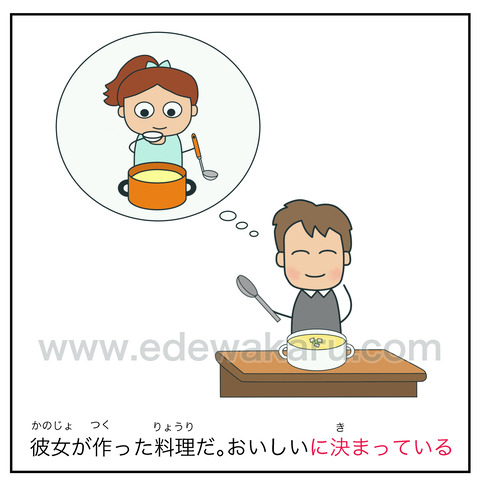
彼女が作った料理だ。おいしいに決まっている!
→彼女が作った料理だ。おいしいに違いない1年間毎日しっかり勉強したんだ。合格するに決まっている
→1年間毎日しっかり勉強したんだ。きっと合格するに違いない妹も新しいスマホを欲しがるに決まっている
→妹もきっと新しいスマホを欲しがるだろう山田くんの言うことなんて、うそに決まっているわ!
→山田くんの言うことなんて、うそに違いない
日本語NET JLPT文法解説まとめ
Meaning
きっと〜だ / 絶対に〜だ
話し手が強い確信を持っているときに使う推量表現。
How to use it
V(普通形)+ に決まっている
イA(普通形) + に決まっている
ナA (普通形)+ に決まっている ※ナAだ + に決まっている
N (普通形)+ に決まっている ※Nだ + に決まっている
Explanation
definite
An expression used for conjecture when the speaker has strong conviction.
カジュアルな言い方は「〜に決まってる」。
In context 1 examples
毎日、ファストフードばかり食べたら病気になるに決まっている。
毎日のんびり日本語教師
How to use it
動詞普通形+に決まっている
い形容詞普通形+に決まっている
な形容詞語幹+に決まっている
名詞+に決まっている
Explanation
話し手の自信に満ちた強めの判断・断定を表します。
Notes
似ている文法「【N2文法】~に違いない」
似ている文法「【N2文法】~に相違ない」
「~に決まっている」「~に違いない」「~に相違ない」はそれぞれ同じ意味ですが、最も柔らかい表現は「~に決まっている」です。「~に相違ない」は主に書き言葉として用いられます。
In context 6 examples
何をするにも楽しいほうがいいに決まっている。
夜の病院ではお化けが出るなんて嘘に決まってる。
サービス業に休みなんかない。土日も仕事に決まっている。
彼はどうせ来ないに決まっている。
理論は間違っていないから、成功するに決まっている。
無理に痩せようとすると、身体に負担がかかるに決まっている。
IMABI
No doubt that
Read this IMABI lesson ↗Explanation
No Doubt that: ~に違いない, ~に相違ない, & ~に決まっている
~に違いない and ~に相違ない are not necessarily difficult, but there are certain problems that students have. The unusual way it connects to adjective/verb expressions, not properly understanding what can follow them, and not understanding formality differences are the main sources of error. The lesson will be ended with the similar ~に決まっている.
~に違いない VS ~に相違ない
First and foremost, these expressions are both translated as “there is without a doubt that…”. This is the immediate source of confusion because you can add phrases like “I think that” or “probably” in English without causing ungrammaticality. However, with these Japanese expressions, doing so does. First, consider the following defining of these terms.
~に違いない: Not from objective proof or logical speculation, but rather from the speaker’s own experience, this phrase shows one’s intuitive speculation/confidence. With such a bold move, it is without surprise that this is quite strong. It is often used in situations where it’s as if one is talking to oneself in attempts to verify one’s own guess or deliberation.
~に相違ない: Like ~に違いない, it shows intuitive speculation/confidence, but it is more stiff and formal. This formality difference is very important to keep in mind. One reason is that speech modals more akin to the spoken language like the final particle から, which is commonly used with ~に違いない, are not typically used with ~相違ない. This also implies that there is no mistake in it; thus, it gives a more confident tone. Thus, although adverbs like きっと are common with ~に違いない, it is not with ~に相違ない due to the tone. Although perhaps of old logic, some speakers feel this is more so indicative of middle-aged/old men as they are more likely to use old-fashioned expressions, which would not be old-fashioned for them, and fits the traditional tone for masculine speech.
These patterns attach to phrases in the following manner.
Nouns N(である)+~に{違い・相違}ない
形容詞 形容詞 + ~に{違い・相違}ない
形容動詞 形容詞(である) + ~に{違い・相違}ない
Verbs Verb + ~に{違い・相違}ない
Notice that it does not say Adj/V + こと + に{違い・相違}ない. It is a set phrase, and like other phrases with に, the reason for why this is allowed stems from a Classical Japanese grammatical maneuver of using conjugational parts of speech as nominal phrases when in the 連体形. As this base has changed appearance for many items, it’s not surprising that in Modern Japanese this technique is limited.
Examples
1. 政府の報道官の応答はどんなに(か)悔しかったに違いない。
The response of the government spokesperson was in no doubt overly regrettable.
Grammar Note: In a more literary sense どんなに(か) may be replaced with いかばかりか. Also note that the use of か with this in the first place is hardly ever heard.
2. 違いない(その通り)、君の言う通りだ。
That’s right. It’s just as you say.
3. この計画の実行は困難に違いない。
It is without a doubt that this plan’s implementation is difficult.
4. 泥棒どろぼうが入ったに違いない。
There is no doubt that a robber came in.
5. 馬鹿者ばかものには違いないが、責任を取らざるをえないだろう。
Although it’s without a doubt that you’re an idiot, there’s no other way but to take responsibility.
By 大仏次郎おさらぎじろう
6. 明日は曇くもるに違いない。
It will definitely be cloudy tomorrow.
7. 社長は天才であることに相違ない。
There’s no doubt that the company president is a genius.
8. 「あの女の人は誰でしょうか」「ケンさんのガールフレンドに違いありません。手を繋つないで一緒に歩いていますから」
“Who is that woman?” “There’s no doubt that she’s Ken’s girlfriend because they’re holding hands walking together”.
9. 「あの人は何語なにごの学生でしょうか」「日本語の学生に違いありません。読んでいるものに「新しい」と書いてありますから」
“What language student is that person? “That person is no doubt a Japanese student because the thing (that person) is reading has “atarashii” written on it”
10. 「あの人は日本に住んでいたんでしょうか」「そうに違いありません。日本の新聞を読んでいますから」
“I wonder if that person lived in Japan” There’s no doubt about it because he’s reading a Japanese newspaper”
11. 「あの女の人は結婚しているんでしょうか」「そうに違いありません。指輪ゆびわを嵌はめていますから」
“I wonder if that woman is married” “There’s no doubt about it because she’s wearing a ring”
~に決まっている
~に決まっている means “it is certainly…” and follows nouns, adjectives, or verbs. This speech modal shows 100% certainty and is reflective of 話し言葉. It shows that the speaker is very confident in labeling something as so. It is also used in chastising.
12. 彼は嘘うそをついているに決まっている。
He’s certainly lying.
13. 夏は暑いに決まっている。
It is certainly hot in summer.
14. 負けるに決まってる。(Casual)
(They) will certainly lose.
In context 14 examples
政府の報道官の応答はどんなに(か)悔しかったに違いない。
The response of the government spokesperson was in no doubt overly regrettable.
違いない(その通り)、君の言う通りだ。
That’s right. It’s just as you say.
この計画の実行は困難に違いない。
It is without a doubt that this plan’s implementation is difficult.
泥棒どろぼうが入ったに違いない。
There is no doubt that a robber came in.
馬鹿者ばかものには違いないが、責任を取らざるをえないだろう。
Although it’s without a doubt that you’re an idiot, there’s no other way but to take responsibility.
明日は曇くもるに違いない。
It will definitely be cloudy tomorrow.
社長は天才であることに相違ない。
There’s no doubt that the company president is a genius.
「あの女の人は誰でしょうか」「ケンさんのガールフレンドに違いありません。手を繋つないで一緒に歩いていますから」
“Who is that woman?” “There’s no doubt that she’s Ken’s girlfriend because they’re holding hands walking together”.
「あの人は何語なにごの学生でしょうか」「日本語の学生に違いありません。読んでいるものに「新しい」と書いてありますから」
“What language student is that person? “That person is no doubt a Japanese student because the thing (that person) is reading has “atarashii” written on it”
「あの人は日本に住んでいたんでしょうか」「そうに違いありません。日本の新聞を読んでいますから」
“I wonder if that person lived in Japan” There’s no doubt about it because he’s reading a Japanese newspaper”
「あの女の人は結婚しているんでしょうか」「そうに違いありません。指輪ゆびわを嵌はめていますから」
“I wonder if that woman is married” “There’s no doubt about it because she’s wearing a ring”
彼は嘘うそをついているに決まっている。
He’s certainly lying.
夏は暑いに決まっている。
It is certainly hot in summer.
負けるに決まってる。(Casual)
(They) will certainly lose.