どんなときどう使う 日本語表現文型辞典
Meaning
even if
How to use it
たとえ+Vても/イAくても/ナAでも/Nでも
Explanation
たとえ~ても
もし~ということになっても
「たとえ~ても、…」の形で、仮に「~」が成立しても、それに関係なく、「…」という状況になると言いたいときの表現。
Even if something does occur, some condition will arise regardless.
In context 4 examples
たとえ雪が降っても、仕事は休めません。
たとえお金がなくても、幸せに暮らせる方法はあるはずだ。
たとえ困難でも、これを一生の仕事と決めたのだから最後までがんばりたい。
たとえそのうわさが事実でも、あの先生に対するわたしの信頼は崩れません。
絵でわかる日本語
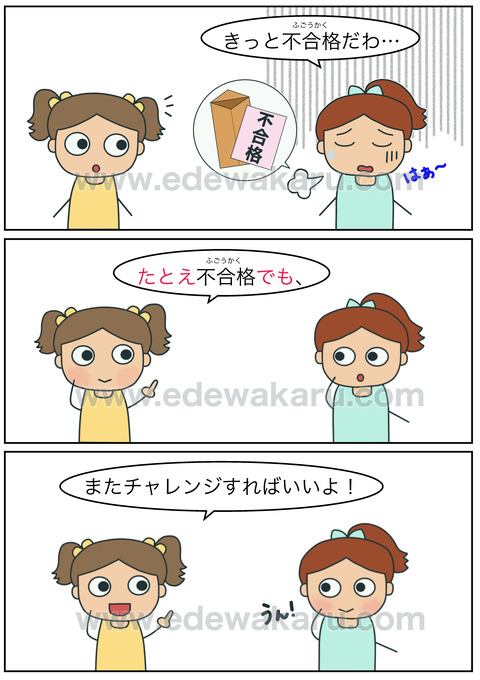
Meaning
もし〜という状況になっても
〜になっても、〜だ
How to use it
たとえ+動詞[て形]+ても
たとえ+い形容詞[ーく]+ても
たとえ+な形容詞[辞書形]+でも
たとえ+名詞[辞書形]+でも・であっても
Explanation
「たとえAてもB」は「もしAという状況になってもBだ」「AだとしてもBだ」という意味の文型です。「Aになる可能性は低いが、もしAでも、変わらずBだ」と言いたい時に使います。
[例]
①
たとえ
不合格
でも、またチャレンジすればいいよ
→もし不合格になっても、またチャレンジすればいいよ
②
たとえ
冗談
でも、友達を傷つけることを言うべきではない
→冗談だとしても、友達を傷つけることを言うべきではない
③
たとえ
お母さんに反対され
ても、アメリカに留学するつもりだ
→もし反対されても、アメリカに留学するつもりだ
④
たとえ
毎日寝ずに勉強し
ても、絶対に合格できないと思うわ
→仮に毎日寝ずに勉強しても、絶対に合格できないと思うわ
⑤もちろん!
たとえ
台風が来
ても、必ず参加するわ!!
→仮に台風が来ても、必ず参加するわ
日本語文法の復習をしておきましょう😉
【日本語文法リスト(あいうえお順)】
In context 2 examples
A:今年はN1を受けるの?B:まさか!たとえ毎日寝ずに勉強しても、絶対に合格できないと思うわ
A:明日のパーティーには参加するの?B:もちろん!たとえ台風が来ても、必ず参加するわ!!
日本語文型辞典
Meaning
基本情報説明「仮に、もし…としても」という意味。「たとえ」のあとに「ても、とも、たところで、としても」などの譲歩の表現が続く。③の「住もうとも」は「住んだとしても」の書きことば的表現。例文① たとえその事実を知っていたところで、私の気持ちは変わらなかっただろう。② たとえ子どもでもやったことの責任はとらなくてはいけない。③ たとえどんなところに住もうとも、家族がいればいい。④ たとえ大金をつまれたとしてもそんな仕事はやりたくない。
日本語文型辞典 英語版
Meaning
Means “even supposing that, even if....” たとえ is followed by expressions of concession, such as ても, とも, たところで and としても. 住もうとも in
(3)
is the written language equivalent of 住んだとしても.
In context 4 examples
たとえその事実を知っていたところで、私の気持ちは変わらなかっただろう。
Even if I’d known the truth, my feelings wouldn’t have changed.
たとえ子どもでもやったことの責任はとらなくてはいけない。
Even a child has to take responsibility for what he or she has done.
たとえどんなところに住もうとも、家族がいればいい。
It doesn’t matter where I live, as long as my family is there.
たとえ大金をつまれたとしてもそんな仕事はやりたくない。
I wouldn’t want to do a job like that for all the money in the world.
くらべてわかる日本語表現文型辞典
Meaning
意味1:実現の可能性のない(少ない)Aの状態になったと仮定してもB。話し手の述べたいことはB。Bを際立たせるためにAを例示することもある。
意味2:Aには事実に反することが来て、仮にAの場合でもBであっただろうとBを推測する言い方。Bは過去のこと。
How to use it
たとえAてもB(たとえAようともB/たとえAとしてもB/たとえAだとしてもB)
たとえ[動詞-て形]も
たとえ[動詞-意向形]とも
たとえ[動詞-ない形]くても/としても
たとえ[動詞]としても
Explanation
【対比1】
「もしAてもB」
置き換えは可能。ただし、「たとえAてもB」は話し手がAを仮定と考えることが強いので、疑問詞を伴った不明確な文にも使えるが、「もしAてもB」では使えない。
○たとえだれに頼まれても、この仕事は引き受けません。
×もしだれに頼まれても、この仕事は引き受けません。
Notes
【注意1】
・「たとえAようともB」はやや硬い表現であり、話し手の感情が強調されるため大げさな表現に聞こえる。
○たとえ大地が裂けようとも、私の決心は変わらない。
In context 8 examples
たとえ死んでも、あなたのことは忘れません。
こんなに難しい問題は、たとえ一生考え続けようとも解けないだろう。
たとえ彼が来なくても、会議は予定どおり行なうつもりだ。
たとえあなたが頼んだとしても、彼は承知しないだろう。
たとえ手術をしても、助からなかったでしょう。
たとえ私が招待しようとも、彼は来なかっただろう。
この仕事はたとえ金を積まれようとも、引き受けなかったに違いない。
たとえ昨日交通ストが解除されていなくても、テストは予定どおり行われただろう。
毎日のんびり日本語教師
How to use it
たとえ+動て形+も
たとえ+い形容詞語幹+く+ても
たとえ+な形容詞語幹+でも
たとえ+名詞+でも
Explanation
前項の条件が仮に成立したとしても、後項で何ら影響はないことを表す文法です。前項ではまだ起こっていないことを条件とします。
「たとえ」も「たとい」も用法は同じですが、「たとい」の方が硬い表現で、話し言葉なら「たとえ」がよく用いられます。
Notes
似ている文法に「【N3文法】どんなに~ても/いくら~ても」があります。
また、程度だけではなく回数が多いことについて述べる用法もありますので、範囲はこちらのほうが広めです。
In context 1 examples
没頭できる趣味があれば、たとえ1人でいても孤独ではない。
IMABI
No Matter If: たとえ・いくら・どれだけ・どんなに
Read this IMABI lesson ↗Explanation
No Matter If: たとえ・いくら・どれだけ・どんなに
The adverb たとえ derives from the verb 例える meaning “to compare/liken/use a metaphor,” and as an adverb, it emphasizes a condition (Situation A) which is deemed a worst-case scenario by the speaker. In the various contrastive conditional patterns that it appears in, it generally translates as “even if/no matter (what).”
This lesson will investigate its use by studying the patterns it appears in as setting the template for its use, and in doing so, we will also investigate synonymous adverbs such as いくら, どれだけ, and どんなに.
Orthography Note: When written kanji, たとえ may be seen as 仮令 or 縦令.
たとえ Situation A + ~ても Situation B
When たとえ is paired with a dependent clause (Situation A) that ends in ~ても—in which all predicate types are possible—the speaker has little to no control over whether Situation A occurs. Yet, “even if” it happens, the speaker intends on carrying out Situation B.
品詞(たとえ+・・・) Example
Verb 連用形+ ても・でもたとえ失敗しても
(Even if you fail)
たとえ死んでも
(Even if you die)
Adjective 連用形(く) + てもたとえ苦しくても
(Even if it’s tough)
Adj. Noun語幹 + でも
であってもたとえ大変で(あっ)ても
(No matter if it’s difficult/challenging)
Noun語幹 + でも
語幹 + であってもたとえ難題で(あっ)ても
(Even if it’s a tough problem)
1. たとえ雨が降っても出かけるぞ。
I’m heading out no matter if it rains.
2. たとえ仕事が忙しくても、毎日サイトの編集をしています。
No matter if I’m busy with work, I am editing the website every day.
3. たとえ面倒でも3か月ごとに健康診断を受けるようにしています。
No matter how much of a pain it is, I make sure to get a health exam every 3 months.
4. 法定労働時間を超える労働は、厳密にはたとえ1分でも割増賃金の支払いを要する。
Work that exceeds statutory working hours, strictly speaking, even if it’s just 1 minute, you are obligated to pay (the employee for that work) at the overtime rate.
5. たとえ殺されても信念は曲げられない。
Even if I were to be killed, my conviction wouldn’t be bent.
6. たとえ相手が無傷であっても、殺人未遂罪が成立するのだ。
No matter if your opponent is unscathed, the crime of attempted murder still holds.
7. たとえ象が踏んでも、 この画面は割れません。
No matter if an elephant steps on it, this screen won’t break.
たとえ Situation A + ~(よ)う[と(も)・が] …
Previously, we learned about the pattern Predicate1 ~まい{が・と} or Predicate2 ~(よ)う{が・と}, in which the dual volitional/suppositional endings ~(う)よう and ~まい are used to create contrastive conditions in the vein of “whether/no matter… or…” With this pattern, the situation stated in the main clause is unperturbed by the contrastive conditions stated.
One particle variation that we have none gone over is ~と vs. ~とも. With the addition of the emphasizer も, the contrastive conditions shown sound more hypothetical in nature, but that still does not deter from the situation of the main clause from holding true.
7. たとえ死のうが輪廻する限り人はまた苦しむ。
No matter if they die, people will suffer once more for as long as they are reincarnated.
8. たとえコロナの第10波が来ようとも、我々は乗り越えて元通りの生活には必ず戻るんだ!
No matter if the tenth wave of COVID strikes, we will overcome it and will positively return to our normal lives!
9. たとえ原発が必要であろうが、必要でなかろうが、とにかく何が何でも動かす。
No matter if nuclear power is necessary or not, they’re going to run (the plants) at any rate regardless.
10. たとえ何をしようとも支持しよう。
I will support you no matter what it is that you do.
11. たとえ何があろうとやります。
I’ll do it no matter what the case might be.
12. たとえ反対されようが、人が離れていこうが、自分が納得できるまで突き進んでいきたい。
No matter how much I’m opposed or how people separate themselves from me, I want to push myself on until I’m satisfied.
たとえ Situation A + ~たとしても Situation B
Even if the speaker supposes that Situation A may possibly occur, the outcome of said situation realizing has no effect on Situation B. This pattern essentially plays the devil’s advocate.
Unlike the other patterns showcased thus far, this pattern is restricted to verbal predicates; however, the copula verb counts in this case, allowing for it to be adapted to nominal and adjectival noun predicates by proxy. Situation A may be stated in the affirmative or negative, but as far as aspect marking, the use of the non-past vs. ~た, the time frame of Situation A envisioned by the speaker is what determines which is used. In practice, however, ~たとしても is far more common.
13. 両者の間には、たとえあったとしてもごく僅わずかしか相違はありません。
Even if there were differences between the two parties, there would hardly be any at whatsoever.
14. たとえあいつと会ったのが1回だけだとしても、とても許せない。
Even if you were to only have met that guy only once, I cannot possibly forgive you for it.
15. たとえ被害者に何等かの落ち度があったとしても、いじめの責任のすべては加害者にある!
No matter if there were any sort of lapse by the victim, full responsible for bullying lies with the offender.
16. たとえ志望校に入学できたとしても、卒業後一番大事な「社会」に出たときに苦労することになる。
No matter if you’re able to get into your dream school, once you enter “society,” the most important thing, after graduating, you will struggle.
17. たとえ世界が滅んだとしても君が死ぬのは一度きり。
No matter if the world were to end, you would only die once.
It is also possible to ~としても used with the the auxiliaries ~(よ)う and ~まい. However, these auxiliaries must be used in their volitional capacities, and thus must be paired with volitional verbs. As such, an agent must be present. Incidentally, personified subjects may count as agents (Ex. 18).
18. たとえ明日世界が終ろうとしても、必ず君を守るから。
No matter if the world were to end tomorrow, I will always protect you.
たとえ Situation A ~に[しろ/せよ] Situation B
~にしろ—also ~にせよ in formal, written language—with たとえ X indicates that regardless if Situation A is true (which there is admission on the part of the speaker that it may be), Situation B is also unequivocally true. In other words, although Situation A is so (as harsh as it may be), Situation B is just as true and often meant to be an important life lesson to the listener.
Situation A may be rendered with any predicate type, attaching to the non-past and past tenses with aspect dynamics being no different than other dependent clause. The only oddity worth noting is that copula ellipsis is limited, in practice, to nominal predicates1.
Predicate Type接続
Adjectival Nouns語幹 + である + に[しろ・せよ]
Nominal語幹 (+ である) + に[しろ・せよ]
19. たとえ冗談(である)にしろ、傷つけるようなことはいうべきではない。
Even if it’s just a joke, you should not say hurtful things.
20. たとえ才能があるにせよ、努力しなければ上手に話せるようにならない。
No matter how much talent you may have, if you do not put in the effort, you will not become able to speak it well.
In the event that more than one contrastive situation is stated, ~に[しろ・せよ] implies that any and all such circumstances do not affect the event of the main clause. In practice, ~にしろ and ~にせよ represent different registers, so it is important to maintain one form if multiple contrasts need to be shown.
21. 明日はたとえ豪雨にしろ吹雪にしろ会社は休めない。
Whether tomorrow is extreme rain or a blizzard, I can’t take the day off from the company.
Related Adverbs
In actuality, たとえ is not obligatory in the contrastive conditional clauses that it emphasizes, as it is its presence that highlights the extreme nature to the situation.
If you see such contrastive clauses without たとえ, Situation A might just not be that extreme or there might be a more fitting adverb – factors such as agency, volition of the agent (≈speaker), etc.
In the case of たとえ, even if the subject manages to accomplish Situation A, you may have noticed that Situation A along with Situation B are beyond the agent’s control. If control is an explicit factor (Ex. 24) or an implicit factor (Ex. 25), another adverb will need to be used for the same emphatic effect.
21. 文法的に主語が必須でなかろうと、主語を補った方が論理的であるのなら補えば良い。
Even if it weren’t grammatically necessary for there to be a subject, if it is more logical to supplement a subject, then it is fine to do so.
22. 独り暮らしをしないにしろ、自分で簡単な料理くらいできたほうがいい。
No matter whether you’re not living alone, it’s best to at least know how to many simple things by yourself.
23. 何度こっちがLINEを終わらせようとしても、向こうがずっと終わらせない。No matter how many times I try ending our LINE, the other person will always not let it end.
24. いくら待っても彼女は来ない。
She won’t come no matter how long I wait.
25. どれだけ社会で成功しようがしまいが、たとえ2億円もの高級マンションにて息を引き取ろうが、道端で野垂れ死にしようが、実際には、何の違いもないことさえ知れば、随分と生きやすくなる。
No matter how much you do or don’t succeed in society, whether you take your last breath in a 200 million-yen luxury apartment or die on the side of the road, once you realize that there is actually no difference at the end of the day, you’ll live far more easily.
いくら・どんなに・どれだけ
The commonality among たとえ, いくら, どんなに, and どれだけ is that “no matter” what Situation X is, there is no change or effect had on Situation Y. It is the nature of the action or state of Situation X that determines which adverb is most natural. There are many times that either of them may be natural, but there will always be a difference in nuance.
使い分け
たとえ Situation A is an extreme supposition. The speaker or another entity may have some level of volition over the situation, but regardless, it is a worst-case scenario that ultimately does not affect Situation B. It is also not certain whether Situation A will even happen or not. In actuality, it most likely won’t.
いくら Situation B does not change no matter how frequent or to what degree Situation A occurs. It best translates as “no matter how much.” In the speaker’s mind, however, there is some level of supposition as to how far in degree Situation A will go.
どんなにThe degree to which Situation A might occur as well as the nature of the situation is up in the air, but even so, Situation B remains unchanged. Other things might come up which could in theory change things, but in your mind, that still won’t happen.
どれだけSynonymous with どんなに多く, no matter how many alternations of Situation A that are experienced, Situation B does not change. In casual speech, it may be heard as どんだけ.
26. この携帯は、いくら落としても画面が割れません。
The screen on this phone won’t crack no matter how many times you drop it.
27. いくら美味しくても、ラーメンを毎日は食べられない。
No matter how delicious it might be, I can’t eat ramen every day.
28. どんなに苦しくてもいつでも支えてくれる人がいるから私は生きていけます。
No matter how tough it might be, I am able to live on because there are always people there to support me.
29. どんなにお酒を飲んでも吐いたことがありません。
No matter how much I drink, I’ve never thrown up.
30.どれだけ世界が変わろうとも、生き抜ける!
No matter how much the world changes, I can live through it!
31. どんな苦しみを味わおうが、自分が決めたことは変えたくない。
No matter the suffering I suffer, I won’t want to change what I’ve decided.
32. どんなに反対されようが、消費税の引き上げが施行される。
No matter how much it’s protested against, the consumer tax hike will be enforced.
In fact, you can actually see たとえ used with these other adverbs. When this happens, たとえ marks extremity and the following adverb describes the nature of Situation X in its own light. However, because of the overlap that exists, many speakers will find it redundant unless there is true reason to be purposefully so emphatic to the point of exaggeration.
33. たとえどんなに願っても君は戻れない。
No matter how much I wish, you can’t come back (to me).
In Ex. 33, no amount or means of hoping will change the situation. By using たとえ, the speaker is also implying that it is pointless to even try.
仮に
The adverb 仮に has two main meanings, one of which overlaps with たとえ.
“Supposing (if)…”
“Temporarily”
The first meaning is only plausible when it is paired with a contrastive conditional phrase. While it may seem to overlap with たとえ in this environment, the layer of nuance it provides is positing the conditional as a suggestion of what might happen, but even so, Situation B would not be changed by it.
34. 仮にその日が満室だった場合、キャンセルのご連絡を事前にいただければ他のお客様をご案内することもできますが・・・
Suppose that on that day we were fully booked, in that case if we were able to receive notification of cancellation prior, we would be able to invite other guests, but…
35. 仮に森が消滅せずに残っていたとしても、80億人もの人口を賄える農耕地を維持できない。
Even if you suppose that the the forests didn’t disappear and were left (in tact), you wouldn’t be able to support enough arable land to maintain a population of 8 billion people.
36. 仮に恐竜の時代に人類が生きていたとしても、生物の覇権を握っていたと思いますか?
Suppose that mankind had been alive during the time of the dinosaurs, do you think that (we) would have still held dominion over living things?
37. 仮に一千ドルあるとしたら何に使うの?
Suppose that you had 1,000 dollars, what would you use it on?
38. 仮にテントを張ったとしましょう。
Let’s suppose that you temporarily made set up a tent.
たとい
たとい is a classical variation of たとえ that can still be seen in literature.
39. たといこの身が滅ぼうとも約束は守る。
Even if I shall perish, I will protect my promise.
40. たとい神が私のそばを通り過ぎても私には見えない。
Even if God were to walk past me, I would not be able to see Him.
よしんば
In older language, you may also encounter the synonymous phrase 縦しんば, which combines the classical adverb よし2, which you may readily recognize as meaning “good,” and ~んば, which denoted a contrastive conditional for certain predicate types, put together. It may also be seen as 縦しや.
While よしんば is more or less equivalent to たとえ, it had its own layer of nuance. With it, Situation A is a condition that the speaker is letting “pass,” but that even upon letting Situation A come to pass, that choice does not affect Situation B.
41. よしんば命を落としたとしても自身の名に恥じるような事はしない。
Even if I were to lose my life, I would never do anything that would tarnish my name.
42. 縦しんば失敗したとしても後悔はせぬ。
Even if I were to end in failure, I shall have no regrets.
43. よしや切ない思いをしても、その思いを我が胸一つに疊んでおこうと決心した。
No matter how painful it might be, I have determined to keep that matter to myself.
From 『諦念』 by 森鷗外.
In our discussion on copula ellipsis, we briefly touched on how ellipsis is less likely in the written language, and given the propensity of both ~にしろ and ~にせよ to be used more often in the written language, that would greatly affect the unlikeliness of copula ellipsis. Furthermore, copula ellipsis hardly ever occurs when the copula manifests as である. This, too, is a feature of its distinct high yet rigid declarative tone, in other words, its modality. ↩︎
The adverb よし does ultimately derive from the adjective 良し, making it a rare instance of a single word form used as both an adjective and an adverb without any marked morphology for the latter. ↩︎
In context 45 examples
たとえ雨が降っても出かけるぞ。
I’m heading out no matter if it rains.
たとえ仕事が忙しくても、毎日サイトの編集をしています。
No matter if I’m busy with work, I am editing the website every day.
たとえ面倒でも3か月ごとに健康診断を受けるようにしています。
No matter how much of a pain it is, I make sure to get a health exam every 3 months.
法定労働時間を超える労働は、厳密にはたとえ1分でも割増賃金の支払いを要する。
Work that exceeds statutory working hours, strictly speaking, even if it’s just 1 minute, you are obligated to pay (the employee for that work) at the overtime rate.
たとえ殺されても信念は曲げられない。
Even if I were to be killed, my conviction wouldn’t be bent.
たとえ相手が無傷であっても、殺人未遂罪が成立するのだ。
No matter if your opponent is unscathed, the crime of attempted murder still holds.
たとえ象が踏んでも、 この画面は割れません。
No matter if an elephant steps on it, this screen won’t break.
たとえ死のうが輪廻する限り人はまた苦しむ。
No matter if they die, people will suffer once more for as long as they are reincarnated.
たとえコロナの第10波が来ようとも、我々は乗り越えて元通りの生活には必ず戻るんだ!
No matter if the tenth wave of COVID strikes, we will overcome it and will positively return to our normal lives!
たとえ原発が必要であろうが、必要でなかろうが、とにかく何が何でも動かす。
No matter if nuclear power is necessary or not, they’re going to run (the plants) at any rate regardless.
たとえ何をしようとも支持しよう。
I will support you no matter what it is that you do.
たとえ何があろうとやります。
I’ll do it no matter what the case might be.
たとえ反対されようが、人が離れていこうが、自分が納得できるまで突き進んでいきたい。
No matter how much I’m opposed or how people separate themselves from me, I want to push myself on until I’m satisfied.
両者の間には、たとえあったとしてもごく僅わずかしか相違はありません。
Even if there were differences between the two parties, there would hardly be any at whatsoever.
たとえあいつと会ったのが1回だけだとしても、とても許せない。
Even if you were to only have met that guy only once, I cannot possibly forgive you for it.
たとえ被害者に何等かの落ち度があったとしても、いじめの責任のすべては加害者にある!
No matter if there were any sort of lapse by the victim, full responsible for bullying lies with the offender.
たとえ志望校に入学できたとしても、卒業後一番大事な「社会」に出たときに苦労することになる。
No matter if you’re able to get into your dream school, once you enter “society,” the most important thing, after graduating, you will struggle.
たとえ世界が滅んだとしても君が死ぬのは一度きり。
No matter if the world were to end, you would only die once.
たとえ明日世界が終ろうとしても、必ず君を守るから。
No matter if the world were to end tomorrow, I will always protect you.
たとえ冗談(である)にしろ、傷つけるようなことはいうべきではない。
Even if it’s just a joke, you should not say hurtful things.
たとえ才能があるにせよ、努力しなければ上手に話せるようにならない。
No matter how much talent you may have, if you do not put in the effort, you will not become able to speak it well.
明日はたとえ豪雨にしろ吹雪にしろ会社は休めない。
Whether tomorrow is extreme rain or a blizzard, I can’t take the day off from the company.
文法的に主語が必須でなかろうと、主語を補った方が論理的であるのなら補えば良い。
Even if it weren’t grammatically necessary for there to be a subject, if it is more logical to supplement a subject, then it is fine to do so.
独り暮らしをしないにしろ、自分で簡単な料理くらいできたほうがいい。
No matter whether you’re not living alone, it’s best to at least know how to many simple things by yourself.
何度こっちがLINEを終わらせようとしても、向こうがずっと終わらせない。No matter how many times I try ending our LINE, the other person will always not let it end.
She won’t come no matter how long I wait.
いくら待っても彼女は来ない。
She won’t come no matter how long I wait.
どれだけ社会で成功しようがしまいが、たとえ2億円もの高級マンションにて息を引き取ろうが、道端で野垂れ死にしようが、実際には、何の違いもないことさえ知れば、随分と生きやすくなる。
No matter how much you do or don’t succeed in society, whether you take your last breath in a 200 million-yen luxury apartment or die on the side of the road, once you realize that there is actually no difference at the end of the day, you’ll live far more easily.
この携帯は、いくら落としても画面が割れません。
The screen on this phone won’t crack no matter how many times you drop it.
いくら美味しくても、ラーメンを毎日は食べられない。
No matter how delicious it might be, I can’t eat ramen every day.
どんなに苦しくてもいつでも支えてくれる人がいるから私は生きていけます。
No matter how tough it might be, I am able to live on because there are always people there to support me.
どんなにお酒を飲んでも吐いたことがありません。
No matter how much I drink, I’ve never thrown up.
どれだけ世界が変わろうとも、生き抜ける!
No matter how much the world changes, I can live through it!
どんな苦しみを味わおうが、自分が決めたことは変えたくない。
No matter the suffering I suffer, I won’t want to change what I’ve decided.
どんなに反対されようが、消費税の引き上げが施行される。
No matter how much it’s protested against, the consumer tax hike will be enforced.
たとえどんなに願っても君は戻れない。
No matter how much I wish, you can’t come back (to me).
仮にその日が満室だった場合、キャンセルのご連絡を事前にいただければ他のお客様をご案内することもできますが・・・
Suppose that on that day we were fully booked, in that case if we were able to receive notification of cancellation prior, we would be able to invite other guests, but…
仮に森が消滅せずに残っていたとしても、80億人もの人口を賄える農耕地を維持できない。
Even if you suppose that the the forests didn’t disappear and were left (in tact), you wouldn’t be able to support enough arable land to maintain a population of 8 billion people.
仮に恐竜の時代に人類が生きていたとしても、生物の覇権を握っていたと思いますか?
Suppose that mankind had been alive during the time of the dinosaurs, do you think that (we) would have still held dominion over living things?
仮に一千ドルあるとしたら何に使うの?
Suppose that you had 1,000 dollars, what would you use it on?
仮にテントを張ったとしましょう。
Let’s suppose that you temporarily made set up a tent.
たといこの身が滅ぼうとも約束は守る。
Even if I shall perish, I will protect my promise.
たとい神が私のそばを通り過ぎても私には見えない。
Even if God were to walk past me, I would not be able to see Him.
よしんば命を落としたとしても自身の名に恥じるような事はしない。
Even if I were to lose my life, I would never do anything that would tarnish my name.
縦しんば失敗したとしても後悔はせぬ。
Even if I were to end in failure, I shall have no regrets.
よしや切ない思いをしても、その思いを我が胸一つに疊んでおこうと決心した。
No matter how painful it might be, I have determined to keep that matter to myself.
AIUEO JLPT Grammar
Meaning
This sentence pattern is used to express that even if something happens, the result or situation will not change. Using “たとえ” implies that the condition is unlikely to occur or is hypothetical.
How to use it
たとえ+動詞て形てもたとえ+形容詞て形てもたとえ+形容動詞でもたとえ+名詞でも
Explanation · 日本語
この文型は、仮に何かが起こったとしても、結果や状況が変わらないことを表すために使われる表現です。「たとえ」を使うことで、その条件が実際に起こる可能性が低い、または想像上のものだというニュアンスを含みます。
In context 5 examples
たとえ雨が降っても、明日はハイキングに行きます。
Even if it rains, I’ll go hiking tomorrow.
たとえ失敗しても、諦めないで頑張ります。
Even if I fail, I won’t give up and will keep trying.
たとえ疲れていても、宿題はやらなければならない。
Even if I’m tired, I still have to do my homework.
たとえお金がなくても、幸せになれる。
Even if you don’t have money, you can still be happy.
たとえ便利でも、そのアプリを使いたくない。
Even if it’s convenient, I don’t want to use that app.
文法
Meaning
"もし仮に〜という状況になったとしても"
前件の状況が成立したとしても 、後件に来る事柄に影響しないことを表す。
How to use it
V(テ形)も
イAくても
ナAでも
Nでも / Nであっても
In context 10 examples
たとえ忙しくても、毎日恋人に連絡するようにしている。
たとえ冗談であったとしても、相手の傷つくことを言ってはいけない。
たとえ手術をしたとしても、助かる見込みはなかったでしょう。
たとえ受かる見込みがなくても、チャレンジすることは大切だ。
たとえ親に反対されても、私たちは結婚するつもりだ。
たとえ余命1年だと言われても、僕は最後まで諦めず、病気と戦うつもりだ。
たとえ生活が苦しくても、僕たちは幸せに暮らしています。
たとえ彼のしたことが事実であったとしても、私が彼を嫌いになることはない。
たとえ5分だけであったとしても、彼と電話ができて嬉しいです。
たとえ誰に頼まれても、絶対にその仕事は引き受けません。
Bunpro Grammar Reference
Meaning
Even if…is the case, Supposing that
How to use it
たとえ + Verb[ても]
たとえ + [い]Adjective[ても]
たとえ + [な]Adjective + でも
たとえ + Noun + でも
Nuance
A phrase that presents that even if one supposed that (A) were true, (B).
Explanation
たとえ, coming from 仮令, an adverb meaning 'supposing that', is a word in Japanese that is often used with ても (or でも), in order to present possible circumstances, and their contradictory and/or (usually) undesirable outcomes. たとえ is primarily seen at the beginning of a sentence, before some kind of possibility, comparison, or supposition will be stated.
空手ではたとえ試合で勝っても、ガッツポーズをしてはいけない。
Even if you win in a karate competition, you should not celebrate visibly.
たとえ暑くても、虫が入ってくるのでこの窓は開けないで下さい。
Even if it is hot, bugs will come in, so please do not open this window.
たとえ好きでも、そんなことをされたら、嫌いになる。
Even if I like them, if someone does such a thing, I will start to dislike them.
たとえ電車でも30分はかかる。
Even by train, it will take at least 30 minutes.
たとえ tends to be used to present situations where 'even if (A) were true, (B) still may/may not happen'. This is called a 'contrastive' example. もし on the other hand tends to be used for examples in which (A) will directly result in (B). This is called a 'resultative' example.
たとえ来年までに完成したとしても、中に入る店が決まっていないから来年中にはオープンされないだろう。
Even if it is completed by next year, the shops that it is going in have not been decided, so it is unlikely that they will open next year.
もし今年中にモールの工事が終わったら、来年の頭にはオープンするはず。
If the construction for the mall finishes within this year, it should open at the beginning of next year.
Nuance · 日本語
(A)が事実であっても、(B)も事実であるということを提示する表現。
Explanation · 日本語
「たとえ」は、「ても」や「でも」と一緒に使われる副詞です。ある状況を仮定して、その状況ではふつう予想される結果とは違ったり、あまりよくない結果になったりするときによく使われます。たいてい、文の始まりに置かれ、そのあとに仮定の内容が続きます。
空手ではたとえ試合で勝っても、ガッツポーズをしてはいけない。
Even if you win in a karate competition, you should not celebrate visibly.
たとえ暑くても、虫が入ってくるのでこの窓は開けないで下さい。
Even if it is hot, bugs will come in, so please do not open this window.
たとえ好きでも、そんなことをされたら、嫌いになる。
Even if I like them, if someone does such a thing, I will start to dislike them.
たとえ電車でも30分はかかる。
Even by train, it will take at least 30 minutes.
「たとえ」は、「仮に (A) でも、(B) は変わらない」のように、(A) と (B) は反対の内容になるような場合によく使われます。それに対して「もし」は「仮に (A) なら、(B) になる」のような、(A) が (B) という結果につながる使い方が多いです。
たとえ来年までに完成したとしても、中に入る店が決まっていないから来年中にはオープンされないだろう。
Even if it is completed by next year, the shops that it is going in have not been decided, so it is unlikely that they will open next year.
もし今年中にモールの工事が終わったら、来年の頭にはオープンするはず。
If the construction for the mall finishes within this year, it should open at the beginning of next year.
In context 18 examples
- 仮令雪が降らなくても、スノーボードをしに行く。
Even if it doesn't snow, I'm going snowboarding.
- たとえ来年までに完成したとしても、中に入る店が決まっていないから来年中にはオープンされないだろう。
Even if it is completed by next year, the shops that it is going in have not been decided, so it is unlikely that they will open next year.
- 空手ではたとえ試合で勝っても、ガッツポーズをしてはいけない。
Even if you win in a karate competition, you should not celebrate visibly.
- たとえ電車でも30分はかかる。
Even by train, it will take at least 30 minutes.
- たとえ暑くても、虫が入ってくるのでこの窓は開けないで下さい。
Even if it is hot, bugs will come in, so please do not open this window.
- たとえ好きでも、そんなことをされたら、嫌いになる。
Even if I like them, if someone does such a thing, I will start to dislike them.
- もし今年中にモールの工事が終わったら、来年の頭にはオープンするはず。
If the construction for the mall finishes within this year, it should open at the beginning of next year.
- 仮令笑われても、正しいことをしたいんだ。
I want to do the right thing, even if they laugh at me.
- 仮令叱られても、譲れないことがある。
Even if (I am) reprimanded, there are things that are non-negotiable.
- 仮令あなたが行かなくても、僕は行きます。
Even if you don't go, I will.
- 仮令嬉しくても、笑ってはいけない時もある。
There are times when you cannot laugh, even if you are happy.
- 仮令忙しくても、責任はちゃんと果たさなければいけない。
Even if you are busy, you will get in trouble if you don't fulfill your responsibilities.
- 仮令最後の一人になっても、僕は諦めない。
I won't give up even if I am the last one standing.
- 仮令あなたが何をしても、僕はあなたのことを嫌いにはならない。
No matter what you do (even if it is something bad), I won't hate you.
- 仮令子供でも、それくらいの仕事なら自分でさせた方がいいと思います。
Even if they are just kids, I think you should make them do that kind of work by themselves.
- 仮令短い時間でも、給料はちゃんと払いますよ。
I will certainly pay you a salary, even if you only worked for a short time.
- 仮令コーヒーを5杯飲んでも、眠気は取れないだろう。
Even if I were to drink 5 cups of coffee, I probably couldn't get rid of this sleepiness.
- 仮令太ったとしても、彼が力士になることはないだろう。彼は相撲向きではないから。
Even if he were to gain weight, he will never become a sumo wrestler. He's just not cut out for it.
日本語NET JLPT文法解説まとめ
Meaning
"もし仮に〜という状況になったとしても"
前件の状況が成立したとしても、後件に来る事柄に影響しないことを表す。
How to use it
V(テ形)も
イAくても
ナAでも
Nでも / Nであっても
In context 10 examples
たとえ忙しくても、毎日恋人に連絡するようにしている。
たとえ冗談であったとしても、相手の傷つくことを言ってはいけない。
たとえ手術をしたとしても、助かる見込みはなかったでしょう。
たとえ受かる見込みがなくても、チャレンジすることは大切だ。
たとえ親に反対されても、私たちは結婚するつもりだ。
たとえ余命1年だと言われても、僕は最後まで諦めず、病気と戦うつもりだ。
たとえ生活が苦しくても、僕たちは幸せに暮らしています。
たとえ彼のしたことが事実であったとしても、私が彼を嫌いになることはない。
たとえ5分だけであったとしても、彼と電話ができて嬉しいです。
たとえ誰に頼まれても、絶対にその仕事は引き受けません。