AIUEO JLPT Grammar
Meaning
This sentence pattern is used to give advice or guidance, encouraging the listener to take a specific action.
How to use it
動詞辞書形+ことだ動詞ない形+ことだ
Explanation · 日本語
この文型は、助言や忠告を表す表現で、相手に対して具体的な行動を取るように促すときに使われます。
In context 5 examples
疲れを取りたければ、早く寝ることだ。
If you want to recover from fatigue, you should go to bed early.
成績を上げたいなら、毎日勉強することだ。
If you want to get good grades, study every day.
痩せたいなら、間食しないことです。
If you want to lose weight, you should not snack between meals.
大事なのはそういうことではない。
That's not what's important.
上司に信頼されたいなら、期日までに報告書を提出することです。
If you want to be trusted by your boss, you should submit the report by the deadline.
文法
Meaning
〜しなさい / 〜したほうがいい
〜するな / 〜しないほうがいい
助言や忠告をする時に使う表現。
How to use it
V(辞書形 / ナイ形) + ことだ
Notes
目上の人に対しては使わない
In context 5 examples
日本語が上手になりたかったら、毎日話すことだ。
悔しかったら、もっと強くなることだね。
痩せたかったら、間食をやめることだ。
壊れて困るのなら、最初から持ってこないことだね。
健康が心配なら、もっと野菜を食べることだね。
Bunpro Grammar Reference
Meaning
Should, Ought
How to use it
Verb[る] + こと + だ
Verb[ない] + こと + だ
Verb[る] + こと + です
Verb[ない] + こと + です
Nuance
A particle construction that is often used for presenting orders or expectations from an authority.
Explanation
As a sentence ending particle, こと has two primary functions. These are as follows:
願望や軽い命令を表す - Highlighting a desire or weak command.
感嘆や疑問を表す - Highlighting astonishment or doubt.
We will focus on the first meaning in this grammar point, as the 'astonishment' nuance is not as commonly used in modern Japanese, and is primarily used only by women.
At the end of a sentence, こと will be paired with the dictionary (or ない) form of a verb, to highlight a particular action that either should, or should not occur. It is usually grouped with the auxiliary verb だ, although this is not always the case. This construction is most often translated as 'should/should not (A)', or 'ought to/not (A)'.
面倒くさくても朝ご飯を食べることだ。
Even though it might be a pain, you should eat breakfast.
明日の朝8時から試験が始まる。何があっても、時間通りに来ることだ。みんな、分かったか。
The exams will begin tomorrow at 8 am. No matter what happens, you should come on time. Understood?
どんなに疲れていても諦めないことだ。
You should not give up, no matter how tired you are.
怪我をしたら、我慢をしないことだ。すぐ責任者に報告するように。
If you get hurt, you shouldn't just suffer in silence. Immediately call your supervisor.
Caution
This use of こと implies a certain level of 'authority', and is therefore regularly used in relation to set rules and expectations (can very frequently be seen on signs in shops/parks, etc). Due to this, it should not be used when giving 'general' advice, especially to people of higher status.
先輩、後輩はもっと大切にすることだ。
Senpai you should treat your kouhai with great care.
Nuance · 日本語
権力者からの命令や期待を提示するときによく使われる助詞。
Explanation · 日本語
終助詞の「こと」には主に二つの使い方があります。
1.願望や軽い命令を表す 。
2.感嘆や疑問を表す。
ここでは、一つ目の使い方を学びましょう。二つ目の「こと」は、主に女性が使う表現で、現代ではあまり使われません。
「こと」は、「(A) するべきだ」や「(A) するべきじゃない」と注意やアドバイスをしたいときに使われます。動詞の辞書形(またはナイ形)のあとに付けて、文の終わりに使います。「こと」のあとには助動詞の「だ」を付けることが多いですが、絶対ではありません。
面倒くさくても朝ご飯を食べることだ。
Even though it might be a pain, you should eat breakfast.
明日の朝8時から試験が始まる。何があっても、時間通りに来ることだ。みんな、分かったか。
The exams will begin tomorrow at 8 am. No matter what happens, you should come on time. Understood?
どんなに疲れていても諦めないことだ。
You should not give up, no matter how tired you are.
怪我をしたら、我慢をしないことだ。すぐ責任者に報告するように。
If you get hurt, you shouldn't just suffer in silence. Immediately call your supervisor.
注意点
この「こと」には軽い命令のニュアンスがあるので、ルールや注意書きなどでよく使われます(お店や公園のポスターなど)。目上の人にアドバイスをするときには使わない方がいいでしょう。
先輩、後輩はもっと大切にすることだ。
Senpai you should treat your kouhai with great care.
In context 17 examples
- 今回は、相手を信じてみる事だ。
I think you ought to trust him/her this time.
- 明日の朝8時から試験が始まる。何があっても、時間通りに来ることだ。みんな、分かったか。
The exams will begin tomorrow at 8 am. No matter what happens, you should come on time. Understood?
- 面倒くさくても朝ご飯を食べることだ。
Even though it might be a pain, you should eat breakfast.
- 怪我をしたら、我慢をしないことだ。すぐ責任者に報告するように。
If you get hurt, you shouldn't just suffer in silence. Immediately call your supervisor.
- どんなに疲れていても諦めないことだ。
You should not give up, no matter how tired you are.
- 生徒は、先生に従う事だ。
Students should obey their teachers.
- 大事なのは医者からもらった薬を飲む事だ。
What is important, is that you should take the medicine the doctor gave you.
- まずはやってみる事だ。改善点が見えてくるから。
You ought to try it first because you'll find out what needs to be improved.
- 覚えたらすぐにしゃべってみる事だ。上達するから。
As soon as you memorize something, you ought to say it out loud. If you do that, you will get better.
- なんでも自分一人で決めないで、社員に相談してみる事だ。
Don't decide everything by yourself, you ought to try to discuss it with the employees. (someone giving advice on how to run a business)
- 成功したいなら、何があってもあきらめない事だ。
If you want to succeed, you should never give up, no matter what.
- 子供たちに与えることのできる一番の贈り物は、いつもそばにいてあげる事だ。
The best gift you can give a child is to always be by their side. (should)
- コツをつかみたいなら、とにかく何回もやってみる事だ。
If you want to get the hang of it (get better), for the time being, you should do it over and over again.
- 分からないことがあれば、先生に聞いてみる事だ。
If there is something you don't understand, you should ask the teacher.
- 僕はいつも物事を忘れてしまうらしい。もっとメモをする事だ。
It seems like I keep forgetting things. I should take memos more often.
- 明日は大切な試合があるから、練習をする事だ。
Because there is an important game tomorrow, you should practice.
- 先輩、後輩はもっと大切にすることだ。
Senpai you should treat your kouhai with great care.
絵でわかる日本語
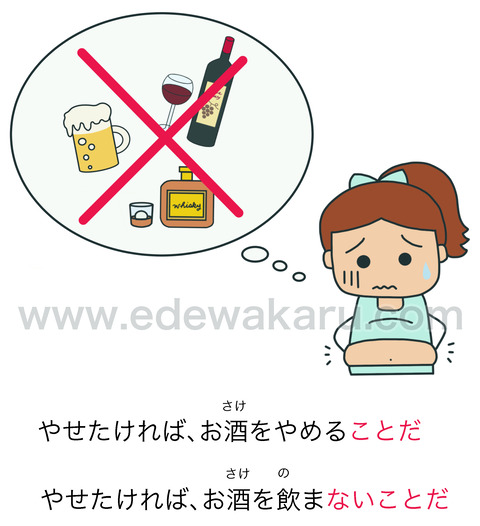
Meaning
〜するのが最善だ / 〜しないのが最善だ
How to use it
動詞[原形・ない形]+ことだ
Explanation
「〜ことだ」「〜ないことだ」は
忠告
や
アドバイス
の意味を込めて「〜する・しないのが一番いい」という意味を表す表現です。断定的で強い言い方ですので、「〜た方がいい」を強調した表現だと覚えるといいですね😊
【「こと」シリーズ】
〜こと(命令)
〜ことか
〜ことから
〜ことがある
〜ことができる(可能)
〜ことができる(能力)
〜ことこの上ない
〜ことだ・〜ないことだ
〜ことだから
〜ことだし
〜ことで(Nのことで)
〜こととて
〜ことなしに
〜ことなく
〜ことに
〜ことにしている
〜ことにする
〜ことになっている
〜ことになる・〜こととなる
〜ことには
〜ことは〜が①(形容詞・名詞)
〜ことは〜が②(動詞)
〜ことはない
〜ことはならない
〜たことがある(経験)
〜だこと!
(〜は)〜てのこと
〜ても〜すぎることはない
〜ということだ
〜とのことだ
〜ないこともない
〜ないことには
〜なかったことがある
In context 4 examples
やせたければ、お酒をやめることだ
→やせたければ、お酒をやめることが最善だやせたければ、お酒を飲まないことだ
→やせたければ、お酒を飲まないことが最善だN1に合格したければ、一生懸命勉強することだ
→N1に合格したければ、一生懸命勉強することが一番大切だN1に合格したければ、あきらめないことだ
→N1に合格したければ、あきらめないことが一番 大切だ
日本語文型辞典
Meaning
その状況でもっとものぞましいこと、もっともよいことを述べて、間接的に忠告や命令の機能をはたすのに用いられる。話しことば。
話し手のおどろき・感動・皮肉・感慨などを表す。用いられる形容詞はかぎられている。
⇾ということ
⇾とは
How to use it
V-る/V-ない ことだ
…ことだ
Naなことだ
A-いことだ
…ということ
…とは…のことだ
In context 8 examples
日本語がうまくなりたければもっと勉強することです。それいがいに方法はありません。
かぜをはやくなおしたいんだったら、あたたかくしてゆっくり寝ることだ。
まあ、ここは相手に花を持たせておくことだね。またチャンスもあるよ。
こどもにさわらせたくないというのなら、最初から手のとどく所におかないことだ。
家族みんな健康で、けっこうなことだ。
いつまでもお若くて、うらやましいことです。
夜はあぶないからって、あのおかあさん、こどもを塾までおくりむかえしてるんだって。ごくろうなことだね。
道路に飛び出した弟を止めようと追いかけていって車にはねられるなんて…。いたましいことだ。
日本語文型辞典 英語版
Meaning
Used to state the best or most desirable thing under a certain condition. Functions indirectly to give a piece of advice or an order. Used in spoken language.
Shows surprise, awe, irony, deep emotion, etc. on the part of the speaker. Used with a limited range of adjectives.
How to use it
1. V-る/V-ない ことだ
2. ...ことだ[Na なことだ][A-いことだ]
3. ...ということ→
4. ...とは...のことだ→
In context 8 examples
日本語がうまくなりたければもっと勉強することです。それいがいに方法はありません。
If you want to be better at Japanese, study harder. There is no other way.
かぜをはやくなおしたいんだったら、あたたかくしてゆっくり寝ることだ。
If you want to get over your cold quickly, stay warm and get lots of sleep.
まあ、ここは相手に花を持たせておくことだね。またチャンスもあるよ。
Well, here it’s better to let the other person have the credit for it. You’ll surely have another chance.
こどもにさわらせたくないというのなら、最初から手のとどく所におかないことだ。
If you don't want the children to touch it, put it somewhere out of reach right from the very beginning.
家族みんな健康で、けっこうなことだ。
I am pleased to see that everyone in the family is well.
いつまでもお若くて、うらやましいことです。
You always look so young; I envy you.
夜はあぶないからって、あのお母さん、こどもを塾まで送り迎えしてるんだって。ごくろうなことだね。
Because she says it’s dangerous at night, that mom takes her children to cram school and then brings them home again. How troublesome for her!
道路に飛び出した弟を止めようと追いかけていって車にはねられるなんて...。いたましいことだ。
She was hit by a car while chasing after and trying to stop her little brother, who had dashed into the street.... What a tragedy!
くらべてわかる日本語表現文型辞典
Meaning
意味1:Aするのが、相手にとって一番いい方法だと、多少突き放して言う表現。
意味2:「Aのことだ。B。」の形で。「AだからBだ」とAの持っているある評価をもとにBを述べる表現。
意味3:「Aこと」の形で。女性の話し手のAに対する感動・詠嘆・あきれなどの感情を表す話し言葉。
意味4:「(Xは)Aことだ」の形で。AがXであることを説明する表現。
How to use it
Aことだ(Aこと/Aのことだ/(Xは)Aことだ)
接続1:
[動詞-る形]ことだ
[動詞-ない形]ないことだ
接続2:
[名詞-の]ことだ
接続3:
[動詞-る形/た形/ている]こと
[イ形-い/かった]こと
[ナ形-な/だった]こと
[名詞-だ/だった]こと
接続4:
[動詞]ことだ
[イ形-い/かった]ことだ
[ナ形-な/だった]ことだ
[名詞-だ/だった]ことだ
Explanation
【対比2】
「AことだからB」(意味1 P.88)
【対比3】
「Aものだ」(意味4 P.309)
Aが動詞の場合は「Aこと」も「Aものだ」も同じように話し手のAに対する感情を表すが、「Aこと」は女性的。
○まあ、上手にできたこと。
○わあ、上手にできたものだ。
Aが名詞の場合は、「Aこと」しか使えない。
○いい人だこと。
×いい人なものだ。
Aがイ・ナ形容詞の場合は、「Aこと」はAと感じたという瞬間的な感情を表し、「Aものだ(ね)」は、心に深く感じたことを説明的に述べる言い方である。
○わあ、この部屋きたないこと。
×わあ、この部屋きたないものだな。
Notes
【注意1】
・会話で使われることが多い。「ル形+ことだ」は命令的、「~てみる+ことだ」はアドバイス的なニュアンスがある。文末が「ル形+こと」で終わる場合は命令の意味でも使うが、規則・約束事などを示し、書き言葉でもよく使われる。
○3時までに提出すること。
○会議には必ず出席すること。
In context 16 examples
悲しみから逃れたいなら、何もかも忘れて仕事に打ち込むことだ。
失敗を恐れないことだ。失敗から多くのことが学べるのだ。
どうしてだめなのか頭を冷やして考えてみることだな。
どんなに苦しくても、ここは一つ待つことだな。
あの会社のことだ。まさか倒産はするまい。
彼が遅刻するのはいつものことだ。心配はいらないよ。
あの政治家のことだ。また失言するに決まっている。
実力のある彼のことだ。合格は間違いないよ。
まあ、きれいな花だこと。
このケーキ、おいしいこと。どこのお店で買ったの。
よく似合うこと。まるであなたのために作ったようだわ。
昨日の夜はよく降ったこと。こわいぐらいだったわ。
大切なのはしっかりした目標を持ち続けていることだ。
気になるのは、健康診断の結果、再検査と言われたことだ。
問題は収入より支出が多いことだ。
外国で暮らす第一ステップは、近所の人と仲良くなることだ。
日本語NET JLPT文法解説まとめ
Meaning
〜しなさい / 〜したほうがいい
〜するな / 〜しないほうがいい
助言や忠告をする時に使う表現。
How to use it
V(辞書形 / ナイ形) + ことだ
Explanation
"should / it's better to..."
An expression used when giving advice or warnings.
目上の人に対しては使わない
In context 5 examples
日本語が上手になりたかったら、毎日話すことだ。
悔しかったら、もっと強くなることだね。
痩せたかったら、間食をやめることだ。
壊れて困るのなら、最初から持ってこないことだね。
健康が心配なら、もっと野菜を食べることだね。
毎日のんびり日本語教師
Meaning
②…啊(感情の強調)
How to use it
①動辞形+ことだ
動ない形+ない+ことだ
②動辞形+ことだ
い形容詞+ことだ
な形容詞+なことだ
Explanation
「ことだ」には接続によって2つの意味があります。
動辞形と動ない形に接続するときは忠告、進言、アドバイスを表し、感情を表す動詞、い形、な形に接続するときはその感情を強調します。感動、皮肉、驚きなど、様々な感情を強調できます。
Notes
似ている文法に「ものだ」があります。
詳しくは「【第63回】「ことだ」と「ものだ」の違い」を参考にしてください。
In context 8 examples
病院では静かにすることだ。(在医院要保持安静。)
せっかく休みをもらったなら、どこにも出掛けないでゆっくり休むことだ。
お世話になった人にはちゃんと感謝を伝えることだ。
バレてまずいと思うなら、最初から秘密など作らないことだ。
自分がされたら嫌なことは、人にはしないことです。
自分の意見を持つのは結構なことだ。(持有自己的意见是件好事。)
子どもたちは冬休みで羨ましいこと。
ダムが決壊して多数の死者が出たことは大変痛ましいことだ。
NINJAL 日本語文型データベース
Meaning
ある目的の達成のため〜することが望ましいという話し手の判断を表します。聞き手に忠告したり助言したりするときに使います。
How to use it
Vることだ/Vないことだ
Notes
立場が上の人に対しては使いません。
「〜」には意志的な行為を表す動詞がきます。
過去形・否定形・疑問の形にはしません。
In context 6 examples
風邪をひいたときは、無理をしないで早く寝ることだ。
「体調が心配だったら、大きい病院で一度ちゃんと診てもらうことですよ」
「友達とけんかしちゃった。たぶん、私の方が悪かったと思う」「自分が悪かったと思うなら、早く謝ることだよ」
スケートが上手になりたいなら、練習を休まないことだ。
「過ぎてしまったことはくよくよ悩まないことですよ」
「マラソンコースは長いけど、最後まで諦めないことだよ」
IMABI
The Final Particle こと
Read this IMABI lesson ↗Explanation
The Final Particle こと
The nominalizer こと may appear at the end of declarative statements, and in doing so, it may emphasize the affirmative tone of the speaker. From this meaning, it has taken on final particle-like usages, and from there, very divergent applications have also come about which bear no resemblance grammatically to the notion of “nominalization.”
~ことだ
While not a final particle, ~ことだ follows predicates to provide a range of emotional reactions depending on tone and sincerity, all which stem from a literal role of emphasizing the speaker’s affirmation of the matter at hand.
For instance, Ex. 2 indicates shock and a strong visceral reaction, Ex. 4 highlights the speaker’s envy, while Ex. 5 is more than likely sarcastic. What is true for all these examples is that the speech register is plain speech across the board, which is what allows for such a wide array of emotions to be conveyed with it.
1. そうか、それはめでたいことだ。
Huh, well, that’s great news.
2. 大きくなりすぎたからとペットを簡単に捨てる人がいる。なんてひどいことだ。
There are people out there that can so easily get rid of their pets when they get too big. How deplorable.
3. 多数の死者が出たことは大変痛ましいことだ。
It’s so tragic that there were so many casualties.
4. 子供たちは夏休みで羨ましいこと(だ)。
I envy the kids for having their summer vacation.
5. まあ、それは大変なこと。
Well, that’s awful.
The predicates shown so far in these examples are all adjectival, and you may have noticed how the copula だ is not actually required, as its deletion in plain speech is commonplace, especially for female speakers. Yet, it is also this small detail that causes this grammar point to sound an awful lot like a final particle.
When following verbal predicates, the implication behind the speaker’s affirmation is often perceived as a “hint, hint” that the listener ought to follow suit. This is frequently used for creating warnings and giving advice, but it is noteworthy that such phrasing is never used toward superiors due to the direct nature of ~ことだ. In fact, it is fairly easy to make snippy remarks with this grammar point.
6. 壊れて困るのなら、わざわざ持ってこないことだな。
If it’s going to be such a problem if you break it, then don’t be going out of your way to bring it with you, y’know.
7. ちゃんと薬を飲んでゆっくり休むことだ。
It’s all about you actually taking your medicine and getting plenty of rest.
8. バレてまずいと思うなら、そもそも秘密など作らないことだ。
If you think it’ll be so bad if everyone finds out, then don’t be making secrets (for yourself) in the first place.
9. 悔しかったら、自分を磨くことだね。
If you’re vexed about it, then work on improving yourself.
10. なら、もっと強くなることだね。
Then become stronger, y’know.
~こと!: Commands
Stemming from its ability to give advance/warnings, as a full-fledged final particle, ~こと can actually create a command. These commands are firm and most notably gender-neutral, meaning that both men and women create commands this way.
Used notably by superiors to those of lower status, ~こと may mark a practical yet firm command. In this scenario, the speaker’s tone is resolute, but the command falls short of being as abrasive and direct as say other patterns like the imperative form (命令形) or even commands made via the te-form.
Something else that is noteworthy is that the final particle ~よ does NOT follow this application of ~こと, as this would actually disrupt the gender neutrality of the expression but also
11. とにかく謝ること!
At any rate, apologize!
12. 借りたお金を返すこと!
Pay back the money I lent you!
13. とにかく謝まること!
Anyhow, apologize!
~こと{だろう・でしょう}
Adding the suppositional auxiliary to the copula, sentences ending in ~こと{だろう・でしょう} express the speaker’s deep movement toward the situation at hand in a “oh how…!” sort of tone. This pattern is frequently paired with expressions like なんと・なんて at the start of the sentence.
14. まあ、IMABIを何年参考にしてきたことだろう!
Oh, how many years I’ve used IMABI as a reference!
15. なんということでしょう、こんなに大きなケーキ!
Oh my goodness, what a big cake!
16. どんなにうれしかったことだろう。
Oh how happy (he) must have been!
17. さぞかし無念だったことだろう。
It was certainly regretful.
18. 覚めれば、全てが変わっていることだろう。
Upon awakening, everything will have surely changed.
This grammar point is also related to ~ことと思う, which can be viewed as cutting out all the heightened emotion while still reflecting the speaker’s hope that the situation at hand is fine for the listener.
19. お気づきのことと思います。
I’m sure you have probably noticed this, but…
~ことか
Exclamatory in a way that is rarely heard in speech but very plausible in writing for its near-exaggerating tone, sentences ending in ~ことか are often paired with adverbial phrases such as どれだけ・どんなに “just how much.”
20. どれだけ雨が降ったことか。
Oh how it rained!
21. どんなに料理がおいしかったことか。
Oh how the dish was delicious!
22. どれだけ私が急いだことか。
Oh how I was in a rush!
23. どれだけ君がよく食べたことか。
Oh how you ate!
One application of ~ことか that is more likely in the spoken language is when it is followed by ~と思った, in which case the exclamation is captured in a thought bubble.
24. なんて不便なことかと思った。
I thought of how inconvenient that really was.
As far as part of speech is concerned, ~こと{だろう・でしょう・か} are still only final particle-like at best, with their exact emotional effects largely due to the additional morphology.
~こと in (Dated) Female Speech
The one adaptation of final ~こと that definitively enters the space of final particles is when it is used to show pure exclamation, much like the particle よ, which has traditionally been viewed as a hallmark of “female speech.”
25. なんと珍しい動物だこと!
My, what a rare animal!
26. まあ、きれいに咲いたこと!
My, they bloomed beautifully!
What makes this usage especially interesting from a grammar perspective is that ~こと can be seen following the 終止形. In fact, it is likely the case that the main reason for why this came about was so that female speakers would not have to end declarative sentences with ~だ or ~よ. Ending declarative sentences with ~だ would be far too direct and potentially masculine in tone, while ending declarative sentences with ~よ possess the added nuance of creating the assumption that the listener is hearing new information.
Back in Early Modern Japanese, the *female speech* final particle ~こと could be seen used in a wider variety of contexts than it does today, ranging from basic exclamation like above to even prompting agreement or oh-so indirectly asking a question (also for affirmation), applications which may still be heard in traditional service industries like ryokan and in film and literature in dated settings.
27. お変わりございませんこと?
I take it no changes with you?
28. そろそろいらっしゃいませんこと・・・
It’s getting right around that time for you to…
(って)ことよ
~ことよ may be used to create euphemized declarative statements, and it is the least dated of the female final particle こと’s usages. Admittedly, though, younger speakers tend to not use it, or not at least without the intervention of って to add an “I’m telling you…” tone.
Ultimately, this grammar point is a feminized version of ~ことだ from the start of this lesson, and as a result, it possesses a similar emotional flare, just what one might expect a housewife might say and why. Rather than being sarcastic or exhibiting some other elevated emotion, ~ことよ declaratives nudge the listener.
29. そんなに気を遣わなくてもいいことよ。
You don’t have to walk on eggshells like that, you know.
Now, in the case of ~ってことよ, which can be heard by younger speakers, the tone of ~って without ~ことよ can help clue us in to how different it is. While the add on of ~ことよ does soften the tone, the speaker is still very much shrugging off something, as is evident from Ex. 30.
30. いいってことよ。
Enough, it’s fine!
In context 30 examples
そうか、それはめでたいことだ。
Huh, well, that’s great news.
大きくなりすぎたからとペットを簡単に捨てる人がいる。なんてひどいことだ。
There are people out there that can so easily get rid of their pets when they get too big. How deplorable.
多数の死者が出たことは大変痛ましいことだ。
It’s so tragic that there were so many casualties.
子供たちは夏休みで羨ましいこと(だ)。
I envy the kids for having their summer vacation.
まあ、それは大変なこと。
Well, that’s awful.
壊れて困るのなら、わざわざ持ってこないことだな。
If it’s going to be such a problem if you break it, then don’t be going out of your way to bring it with you, y’know.
ちゃんと薬を飲んでゆっくり休むことだ。
It’s all about you actually taking your medicine and getting plenty of rest.
バレてまずいと思うなら、そもそも秘密など作らないことだ。
If you think it’ll be so bad if everyone finds out, then don’t be making secrets (for yourself) in the first place.
悔しかったら、自分を磨くことだね。
If you’re vexed about it, then work on improving yourself.
なら、もっと強くなることだね。
Then become stronger, y’know.
とにかく謝ること!
At any rate, apologize!
借りたお金を返すこと!
Pay back the money I lent you!
とにかく謝まること!
Anyhow, apologize!
まあ、IMABIを何年参考にしてきたことだろう!
Oh, how many years I’ve used IMABI as a reference!
なんということでしょう、こんなに大きなケーキ!
Oh my goodness, what a big cake!
どんなにうれしかったことだろう。
Oh how happy (he) must have been!
さぞかし無念だったことだろう。
It was certainly regretful.
覚めれば、全てが変わっていることだろう。
Upon awakening, everything will have surely changed.
お気づきのことと思います。
I’m sure you have probably noticed this, but…
どれだけ雨が降ったことか。
Oh how it rained!
どんなに料理がおいしかったことか。
Oh how the dish was delicious!
どれだけ私が急いだことか。
Oh how I was in a rush!
どれだけ君がよく食べたことか。
Oh how you ate!
なんて不便なことかと思った。
I thought of how inconvenient that really was.
なんと珍しい動物だこと!
My, what a rare animal!
まあ、きれいに咲いたこと!
My, they bloomed beautifully!
お変わりございませんこと?
I take it no changes with you?
そろそろいらっしゃいませんこと・・・
It’s getting right around that time for you to…
そんなに気を遣わなくてもいいことよ。
You don’t have to walk on eggshells like that, you know.
いいってことよ。
Enough, it’s fine!
どんなときどう使う 日本語表現文型辞典
Usage 1
Meaning
(deep emotion) how very…!
How to use it
イAい/ナAな+ことだW
Explanation
ことだ〈感慨〉
非常に~だ
話者がある事実について、感じた驚きや感動などについて感情を込めて言うときの表現。感情を表す形容詞につくことが多い。
Speaker's feelings of surprise or impressions about some fact. Often appends to adjectives that express emotions.
In context 3 examples
弟が東西自動車株式会社に就職が決まった。ほんとうにうれしいことだ。
ここで遊んだのは、もう30年も前のことだ。懐かしいことだ。
昨夜のサッカーの試合では、最後に相手に点を取られてしまった。残念なことだ。
Usage 2
Meaning
(advice, admonition) (you) must…
How to use it
Vる・Vない+ことだ
Explanation
ことだ〈助言・忠告〉
~しなさい
1)上の人が下の人に「した方がいい」または「しない方がいい」と、個人の意見や判断を助言や忠告として言う言い方。
2)目上の人に対しては使わない。
1)Used by social superiors to offer to social inferiors personal opinions or appraisals as advice on what to do or avoid.
2)Not used toward social superiors.
In context 3 examples
ほかの人に頼らないで、とにかく自分でやってみることだ。
あなたは病人なんだから、お酒はいけません。誘われても飲まないことです。
上級の読解力をつけたいのなら、毎日、新聞を読むことだ。