くらべてわかる日本語表現文型辞典
Usage 1
Meaning
Aに対して、驚いたり、感動したりする気持ちを表す。
How to use it
なんてA(なんとA)
なんと[動詞](ことか/のだ)
なんと[イ形-普](ことか/のだ)
なんと[ナ形-な](ことか/のだ)
なんと[名詞-な](のだ)
Notes
【注意1】
・「Aことか」の「こと」の代わりに名詞がつく場合もある。
○なんと見事な(梅か/ことか)。
In context 4 examples
ここからの景色は、なんて美しいんだろう。
私財をすべて人のために使うとは、なんて人なんだ。
産地から食卓までなんと多くの人が流通にかかわっていることか。
今年の新入社員は、みんななんとよく働くことか。
Usage 2
Meaning
意味1:BをAで説明する。AというようなB。
意味2:AというのはBだ。Aに対する判断をBで述べる。
意味3:婉曲表現。話題になっていることをAで示し、Bで意見を述べる。
How to use it
AなんてB
接続1:
[動詞]なんて
[動詞-意向形]なんて
[名詞-∅]なんて
接続2:
[文]なんて
接続3:
[名詞-∅(助詞)]なんて
Explanation
【対比2】
「Aなど」(意味3 P.200)
【対比3】
「Aなど」(意味1,2 P.200)
置き換え可能。ただし、「AなんてB」のほうが口語的。
「AなんかB」(意味2 P.207)
置き換え可能。ただし、「AなんてB」は助詞の前には来ない。
○あなたになんか会いたくない。
○あなたになんて会いたくない。
○あなたなんかに会いたくない。
×あなたなんてに会いたくない。
In context 12 examples
別荘なんてものは、だれにでも縁があるもんじゃないよ。
神山なんて人は知らないなあ。
死のうなんて考えはやめろ。
今日、彼が来るなんて話は聞いていない。
あの俳優が死んだなんて、絶対うそだ。
彼がお金に困っているなんて、信じられない。
夜中の2時に今からすぐ出てこいだなんて無理だ。
知っていたくせに「えっ?」だなんて、白々しい。
東京へなんて、行ってないよ、おれ。
「野球、見る?」「野球なんて、つまらないよ。」
地位や財産なんて、いらないよ。大切なのはやりがいだ。
失敗なんて、彼にかぎってあるわけないだろう。
DoJG 日本語文法辞典(全集)
Usage 1
Meaning
What; how ~!; what a(n) ~!; so
How to use it
(i) なんて | V | Where V=verb of communiation |
| なんて言う | What does someone say? |
| なんて書く | What does someone write? |
(ii) なんていう | Noun | |
| なんていう人ですか。 | What is his/her name? |
| なんていう建物ですか。 | What is the name of the building? |
(iii) なんて | {Adjectiveいinformal/ Adjectiveなstemな/Nounな}んだろう | |
| なんて難しいんだろう。 | How difficult something is! |
| (彼女) なんてきれいなんだろう。 | How pretty (she) is! |
| なんていい天気なんだろう。 | What a beautiful day! |
Explanation
なんて (1) A phrase used as the colloquial version of なんと.
In context 10 examples
レポートのこと、社長はなんて言っていましたか。
What did the president say about the report?
きのう見た映画、なんていう映画だったっけ?
What was the title of the movie we saw yesterday?
これぐらいの宿題、なんて(いう)ことはないよ。
This much homework is nothing / not a big deal!
日本のアニメはなんて面白いんだろう。
How interesting Japanese anime is!
うちにホームステイしている留学生がテレビを観ていると「今なんて言った?」「英語だとなんて言うの?」と質問の連続だ。
When the foreign student staying with us watches TV, he keeps asking questions like ""What did he say?"" or ""What is that in English?
推薦状を書くのを頼まれると、時々なんて書いたらいいのか分からないことがある。
Sometimes I don't know what to say (literally: write) when I get asked to write a letter of recommendation.
なんていう人か名前を忘れたけれど、なかなか魅力的な女性に出会った。
I met a very charming lady, although I've forgotten her name.
彼はつらい目にたくさん遭っているのに、「なんていうことはない」という感じでひょうひょうと生きている。
He's had a rough time, but he lets it all roll off his back as if it were nothing to him.
うさぎをじーと見てると、なんてかわいいんだろう、なんてかわいい仕草をするんだろうって思った。
While staring at a rabbit I admired what a cute creature he was, and how he could make such cute gestures.
自分のことを書くのって、なんて難しいんだろう。
It is so hard to write about myself!
Usage 2
Meaning
That; things like
How to use it
(i) なんて | V | Where V=verb of communiation |
| なんて言う | What does someone say? |
| なんて書く | What does someone write? |
(ii) なんていう | Noun | |
| なんていう人ですか。 | What is his/her name? |
| なんていう建物ですか。 | What is the name of the building? |
(iii) なんて | {Adjectiveいinformal/ Adjectiveなstemな/Nounな}んだろう | |
| なんて難しいんだろう。 | How difficult something is! |
| (彼女) なんてきれいなんだろう。 | How pretty (she) is! |
| なんていい天気なんだろう。 | What a beautiful day! |
Explanation
なんて (2) A colloquial particle used to express a strong feeling such as astonishment, incredulousness, envy, disdain, dislike, happiness, etc.
In context 8 examples
小学校からのいじめが中学まで続くなんてひどい。
It's terrible that bullying continues after grade school into junior high.
最近は電子メールばかり使っていて、手紙なんて滅多に書かない。
Lately I've been using only e-mail, and seldom write (a thing like) a letter.
生演奏で踊れるなんて、うらやましい。
I'm envious that they can dance to live music (literally: a live performance).
大勢の皆さんに家まで来ていただけるなんて、とても嬉しいです。
I'm very happy that so many of you have come to my home.
夏にエアコンをつけすぎて寒いなんて、電力浪費も甚だしい。
It's horrible that they feel cold in summer while overusing their air conditioner and wasting electricity.
あの人がそんなに有名だなんてちっとも知らなかった。
I had no idea he was that famous!
あなたなんて最低よ。
You are contemptible!
納豆なんて嫌いだ。
I hate nattou (fermented soybeans).
日本語文型辞典
Usage 1
Meaning
「馬鹿げたことだ」「くだらないことだ」と軽視する気持ちを伴って主題として取り立てるのに用いる。くだけた話しことば。
後ろに「言う」「思う」「考える」などの動詞やそれに相当する名詞を従えて、発言や思考の内容を表すと共に、その内容を意外に思ったり軽視したりする気持ちを表す。「などと」のくだけた言い方。
後ろに「うらやましい」「ひどい」などの評価を表す表現を用いて、その評価の対象となることがらを表す。意外だと驚く気持ちや「くだらないものだ」「馬鹿げた事だ」と軽視する気持ちを伴うことが多い。くだけた話しことば。
How to use it
Nなんて
…なんて
…なんて
N/Na(だ)なんて
A/V なんて
In context 14 examples
あなたなんて大嫌い。
そんな馬鹿げた話なんて、だれも信じませんよ。
あの人の言うことなんて、嘘に決まっています。
みんなには時間を守れなんて言ったけど、そう言った本人が遅刻してしまった。
息子が大学進学は殊だなんて言い出して困っている。
私が彼をだましたなんて言っているらしいけど、彼のほうこそ嘘をついているんです。
あやまれば許してもらえるなんて甘い考えは捨てなさい。
まさか、親に頼めば借金を払ってもらえるなんて思っているんじゃないでしょうね。
一家そろって海外旅行だなんて、うらやましいですね。
あなたにそんなことを言うなんて、実にひどい男だ。
こんなところであなたに会うなんて、びっくりしましたよ。
こんな安い給料でまじめに働くなんて馬鹿らしい。
あんな怠け者が一生懸命働きたいなんて、嘘にきまっているでしょう。
この吹雪の中を出て行くなんて、命を捨てに行くようなものだ。
Usage 2
Meaning
a. なんてV
後ろに「言う」や「書く」などの動詞を続けて、その内容が不明であるという意味を表す。「なんと」のくだけた言い方。
b. なんて(いう)N
ものや人の名前を聞くのに用いる。「なんというN」のくだけた言い方。
c. なんて(いう)Nだ
「なんというNだ」のくだけた言い方で、程度のすごさに驚いたりあきれたりした気持ちを表す。
d. なんてことない
「大したことではない」という意味を表す。「なんということはない」のくだけた言い方。
驚いたりあきれたりすばらしいと思ったりしたことを、感嘆の気持ちを込めて表現するのに用いる。なんてまあ。「なんと…のだろう」のくだけた言い方。
How to use it
なんて
なんて…んだろう
なんて…Nなんだろう
なんてNaなんだろう
なんてA-いんだろう
In context 18 examples
よく聞こえないのですが、あの人はなんて言っているのですか。
この字は何て書いてあるのか分からない。
このことを知ったら、お母さん何て思うかしら。
さっき来た人はなんていう人ですか。
後藤さんは何ていう会社にお勤めですか。
あの人、なんて名前だったかしら。
彼、なんて町に住んでいるんだっけ。
あなたって人は、なんていう人なの。
あれだけの仕事を1日で片づけてしまうなんて、何ていう早業だろう。
事故で子供を失ってしまうなんて、なんて事だ。
友人を見殺しにするなんて、あなたってなんて人なの。
これくらいのけが、なんて事ないさ。
この程度の仕事は何て事ない。1日で片付くさ。
一見何て事ない仕事のようだけれど、やってみると非常に手がかかる。
ここはなんて寂しいところなんでしょう。
彼の演奏はなんてすばらしいんだろう。
この子は何てかわいげのない子供なんだろう。
家の中に木を植えるとは、何て大胆な発想なんだろう。
絵でわかる日本語
Usage 1
Read this source entry ↗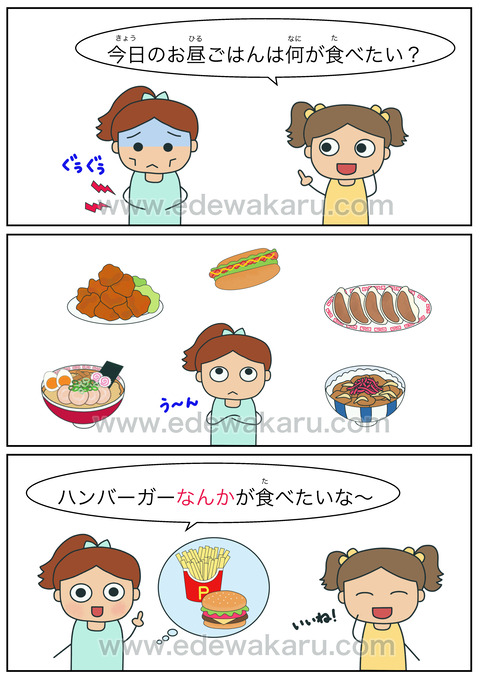
Meaning
例をあげる
How to use it
名詞[辞書形]+など・なんか・なんて
Explanation
「〜など・〜なんか・〜なんて」は、いろいろある中から【例をあげて言う】場合に使われる文型です。「〜なんか・〜なんて」は「〜など」の口語形です。
「〜など・〜なんか・〜なんて」には【軽視・軽蔑】【謙遜】を表す用法もありますので、一緒に覚えておきましょう。また【感情を表す】「〜なんて」は別の文型ですので区別をしておきましょう。
【関連文型】
In context 5 examples
A:今日のお昼ごはんは何が食べたい?B:う〜ん…ハンバーガーなんかが食べたいな〜
→(いろいろ食べたいものがあるが)例えばハンバーガーが食べたい小さい頃は、ピアノや水泳などを習っていました
→(いろいろ習っていたが)例をあげるとピアノや水泳を習っていたA:彼女の誕生日プレゼントは何をあげようかな…B:きれいな花なんかがいいと思うよ
→例えば花がいいと思うよ彼女はケーキやクッキーなどのスイーツが大好きだ
→ケーキやクッキーのようなスイーツが大好きだ店員:いらっしゃいませ。何かお探しですか?客:彼女のプレゼントを…店員:こちらのネックレスなどいかがですか?
→例えば、こちらのネックレスはいかがですか?
Usage 2
Read this source entry ↗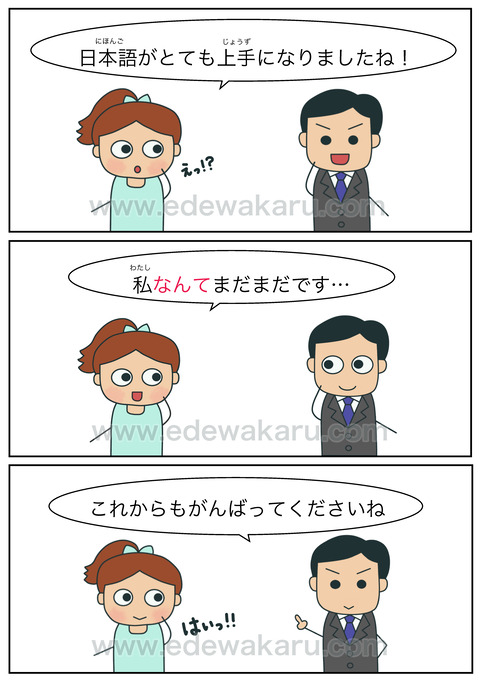
Meaning
謙遜の気持ちを表す
How to use it
名詞[辞書形]+など・なんか・なんて
Explanation
「〜など・〜なんか・〜なんて」を自分や自分に近い人に使うと謙遜していることを表します😊「〜なんか・〜なんて」は「〜など」の口語形です😀
[例]
①A:日本語がとても上手になりましたね
B:私なんてまだまだです
→「私はまだまだ上手ではない」と謙遜している
②彼氏:君は本当に美人だね
彼女:私
なんて
…田中さんの方が美人だと思うわ
→「私は美人ではない」と謙遜している
③A:料理が本当にうまいね!
B:私
なんか
全然上手じゃないよ
→「私は上手ではない」と謙遜している
④上司:今月からリーダーとしてがんばってくれ
部下:私
など
にきちんとできるかわかりませんが、がんばります
→「私にできるかわからない」と謙遜の気持ちを表している
⑤うちの息子
なんて、全然イケメンじゃないわよ〜
→「うちの息子はイケメンじゃない」と、謙遜している
「〜など・〜なんか・〜なんて」には【例をあげる】【軽視・軽蔑を表す】用法もありますので、一緒に覚えておきましょう。また【感情を表す】「〜なんて」は全然違う文型ですので区別しておきましょう😀
【関連文型】
In context 5 examples
A:日本語がとても上手になりましたねB:私なんてまだまだです
彼氏:君は本当に美人だね彼女:私なんて…田中さんの方が美人だと思うわ
A:おいしい〜!料理がうまいね!B:私なんか全然上手じゃないよ
上司:今月からリーダーとしてがんばってくれ部下:私などにきちんとできるかわかりませんが、がんばります
うちの息子なんて、全然イケメンじゃないわよ〜
Usage 3
Read this source entry ↗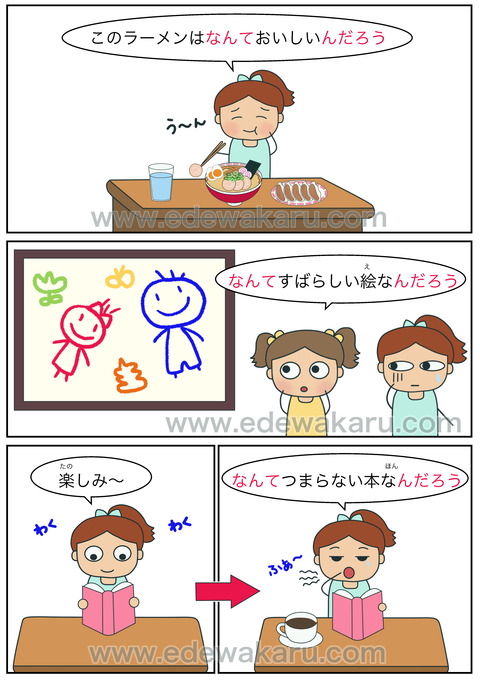
Meaning
とても〜だ
本当に〜だ
How to use it
なんて+名詞[辞書形]+なんだろう
なんて+い形容詞[ーい]+んだろう
なんて+な形容詞[ーな]+んだろう
Explanation
「なんて〜んだろう」は「とても〜だ」「本当に〜だ」と言う意味を表す文型です。この文型は【感動】【驚き】【失望】などの感情を込めて使われます。また「〜んだろう」の丁寧な言い方は
「〜んでしょう」
です😊
[例]
なんておいしい
んだろう
→なんておいしい
んでしょう
「なんて」には色んな意味がありますので、他の文型と混乱しないように区別して覚えておきましょう😉
(復習:〜など・〜なんか・〜なんて)
(復習:〜なんて(感情))
(復習:〜ように(目的))
In context 3 examples
このラーメンはなんておいしいんだろう
日本語の勉強はなんて楽しいんだろう♫
山田くんって、なんてケチなんだろう…(復習:〜って(主題・定義))
Usage 4
Read this source entry ↗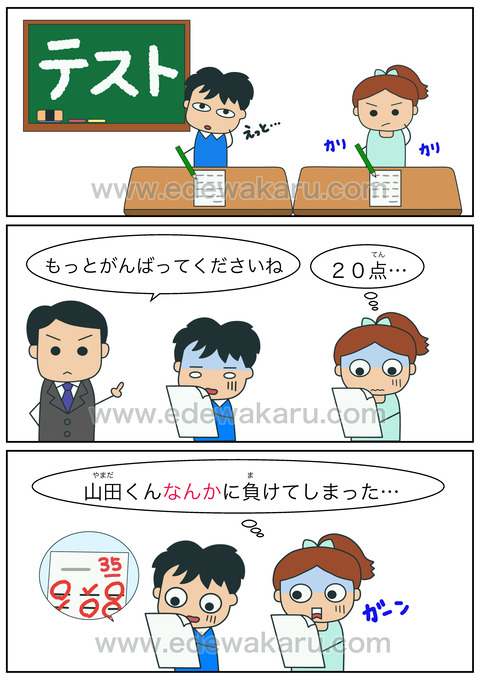
Meaning
軽視・軽蔑を表す
How to use it
名詞[辞書形]+など・なんか・なんて
Explanation
「〜など・〜なんか・〜なんて」を相手(人)や対象(もの・こと・動物)に使うと【軽視・軽蔑】の気持ちを表します。
[比較]
・山田くん
なんか
に負けた
→「自分よりバカな山田くんに負けた」「嫌いな山田くんに負けた」という気持ちを表す。相手の「山田くん」にはいい感情はない
・山田くんに負けた
→ただ「山田くんに負けた」と言っているだけ
軽視・軽蔑を表す「〜など・〜なんか・〜なんて」は相手・対象に使うと、とても失礼になりますので使い方に気をつけなければいけません😣 また「〜など・〜なんか・〜なんて」には【例をあげる】【謙遜】を表す用法もありますので復習しておきましょう。
【関連文型】
In context 6 examples
山田くんなんかに負けてしまった…[軽視する相手]山田くん
A:日本語は難しいな…B:日本語なんて簡単だよ〜[軽視する対象]日本語
あなたなどに私の気持ちはわからないわ![軽視する相手]あなた
A:山田くんはオバケと話したことがあるそうよ!B:そんなバカな話なんか信じたらだめだよ〜[軽視する対象](オバケと話したという)バカな話
母:明日テストがあるんでしょ?遊んでいる時間なんてないはずよ!娘:は〜い[軽視する対象]遊んでいる時間
こんなケガなんて全然痛くないよ[軽視する対象]少しのケガ
どんなときどう使う 日本語表現文型辞典
Meaning
I had no idea!
How to use it
〔普通形〕+なんてS
Explanation
~という事実は/~ということは
1)「~なんて、…」の形で、予想していなかった事実を見たり聞いたりしたときの驚きや感慨を言うときの表現。「~」で知ったことについて言い、「…」で驚きなどを表現する。
2)話し言葉。
3) ❷ は倒置の言い方。 ❸ のように後半を省略した言い方もある。
4)書き言葉では「とは」を使う。
4)In written form, takes とは.
1)Disbelief or deep emotion about unexpected fact seen or heard.Fact precedes pattern; expression of surprise follows.
2)Spoken form.
3)Sentence ❷ is inverted. Sometimes latter half is omitted, as in sentence ❸ .
In context 3 examples
小林さんが竹内さんのお姉さんだなんて! 前から二人とは仲のいい友だちだったのに、知らなかった。
信じられないなあ! わたしがT大学に入学できたなんて。
子どもの遊び相手もロボットがやってくれるなんて!
日本語NET JLPT文法解説まとめ
Meaning
予想していなかった事実を見たり聞いたりした時の驚きや感慨を表す時に使う表現。
話し言葉で使われる。書き言葉では「〜とは」が使われる。
How to use it
普通形 + なんて
Explanation
Disbelief or deep emotion about unexpected fact seen or heard.
This expression is used when you talk. In written form, takes “〜とは”
In context 12 examples
朝は寝ているだけなんて、もったないと思いませんか。
初心者が一人で登山だなんて、無謀すぎるよ。
約束を忘れるなんて、メアリーの彼氏酷すぎだよ。
彼がまさか、大学を辞めていたなんて思っていもいなかった。
この量で1,200円だなんて、信じられない。
まさか、あの人が浮気していたなんて。
プリンターで物を作れる時代がやってくるなんて。
山田はいつも仕事が遅いし上司から怒られてばかりいるのに、先に昇進するなんて何かの間違えだろ。
教師が学生に対して暴力をふるうなんて。
まさかこんな形で再会するなんて思いもしなかった。
今日、テストがあるなんて聞いてないよ。
まさか、あの二人が離婚だなんて。信じられない。
日本語文型辞典 英語版
Meaning
Followed by a verb such as 言う(say) or 書く(write) and means that the content expressed by such a verb is unclear. A casual way of saying なんと.
b. なんて(いう)N
Used to ask for a name of a person or a place. A casual way of saying なんというN.
c. なんて(いう)Nだ
A casual way of saying なんというNだ. Expresses the speaker’s extreme surprise or amazement.
d. なんてことない
Means that something is not so considerable. This is a casual way of saying なんということはない.
なんて...んだろう is used to express the speaker’s surprise or amazement with admiration or explanation. It can be rephrased as なんてまあ. なんて...んだろう is a casual way of saying なんと...のだろう.
Topicalizes something that the speaker thinks ridiculous or stupid. A colloquial expression.
Followed by a verb such as 言う (say), 思う (think), 考える (think about) or a noun corresponding to one of these verbs. Expresses the speaker’s unexpected or scornful feeling towards what is said in the preceding clause along with the content of the speaker’s utterance and thought. This is a casual way of saying などと.
Followed by an expression to show the speaker’s evaluation, such as うらやましい (envious) or ひどい (terrible), and indicates the thing/state/event to be evaluated. Often accompanies the speaker’s surprise, unexpectedness, or scornful feeling to consider a thing/person stupid or ridiculous. Used in casual speech.
How to use it
1. なんてa. なんてV
2. なんて...んだろう[なんて...Nなんだろう][なんてNa なんだろう][なんてA-いんだろう]
1. Nなんて
2. ...なんて
3. ...なんて[N/Na (だ)なんて][A/V なんて]
In context 32 examples
よく聞こえないのですが、あの人はなんて言っているのですか。
I can’t hear him very well—what is that person saying?
この字は何て書いてあるのか分からない。
I don’t know what this character means.
このことを知ったら、お母さん何て思うかしら。
If she gets to know about it, how would my mother feel?
さっき来た人はなんていう人ですか。
What is the name of the person who came here just now?
後藤さんは何ていう会社にお勤めですか。
What is the name of the company where Goto-san works?
あの人、なんて名前だったかしら。
I wonder what the name of that person was.
彼、なんて町に住んでいるんだっけ。
What is the name of the town he lives in again?
あなたって人は、なんていう人なの。
What kind of person are you?
あれだけの仕事を1日で片づけてしまうなんて、何ていう早業だろう。
To finish that whole job in just one day—what a quick worker!
事故で子供を失ってしまうなんて、なんて事だ。
I can’t imagine what it’s like to lose a child in an accident.
友人を見殺しにするなんて、あなたってなんて人なの。
What kind of person are you just to stand by and not help a friend?
これくらいのけが、なんて事ないさ。
Such an injury is nothing to me.
この程度の仕事は何て事ない。1日で片付くさ。
It’s no problem to do such a job. I can finish it in a day.
一見何て事ない仕事のようだけれど、やってみると非常に手がかかる。
This work looks easy at first, but when you actually do it, it’s really time-consuming.
ここはなんて寂しいところなんでしょう。
What a god-forsaken place this is!
彼の演奏はなんてすばらしいんだろう。
How excellent his performance is!
この子は何てかわいげのない子供なんだろう。
What a charmless, unendearing child!
家の中に木を植えるとは、何て大胆な発想なんだろう。
What a bold idea, to plant a tree inside the house!
あなたなんて大嫌い。
I hate you!
そんな馬鹿げた話なんて、だれも信じませんよ。
Nobody believes such a ridiculous story.
あの人の言うことなんて、嘘に決まっています。
Everything that person says has got to be a lie!
みんなには時間を守れなんて言ったけど、そう言った本人が遅刻してしまった。
She had told us all to be on time, but the very person who had said it arrived late.
息子が大学進学は嫌だなんて言い出して困っている。
I’ve been really troubled since my son said he didn’t like the idea of continuing on to a university.
私が彼をだましたなんて言っているらしいけど、彼のほうこそ嘘を付いているんです。
He seems to be saying that I deceived him, but he’s the one who was lying.
あやまれば許してもらえるなんて甘い考えは捨てなさい。
Forget about your wishful thinking that if you apologize, you are forgiven.
まさか、親に頼めば借金を払ってもらえるなんて思っているんじゃないでしょうね。
Surely you’re not thinking that if you ask your parents, they’ll pay your debt.
一家そろって海外旅行だなんて、うらやましいですね。
I envy you for being able to travel abroad with all your family.
あなたにそんなことを言うなんて、実にひどい男だ。
What a truly horrible man he is to say such a thing to you!
こんなところであなたに会うなんて、びっくりしましたよ。
It’s surprising to see you here.
こんな安い給料でまじめに働くなんて馬鹿らしい。
It’s ridiculous to work hard for this low pay.
あんな怠け者が一生懸命働きたいなんて、嘘にきまっているでしょう。
There’s no way such a lazy person like that would want to work hard!
この吹雪の中を出て行くなんて、命を捨てに行くようなものだ。
Venturing out in this blizzard is like throwing your life away.
文法
Meaning
予想していなかった事実を見たり聞いたりした時の驚きや感慨を表す時に使う表現。
話し言葉で使われる。書き言葉では「〜とは」が使われる。
How to use it
普通形 + なんて
In context 12 examples
朝は寝ているだけなんて、もったないと思いませんか。
初心者が一人で登山だなんて、無謀すぎるよ。
約束を忘れるなんて、メアリーの彼氏酷すぎだよ。
彼がまさか、大学を辞めていたなんて思っていもいなかった。
この量で1,200円だなんて、信じられない。
まさか、あの人が浮気していたなんて。
プリンターで物を作れる時代がやってくるなんて。
山田はいつも仕事が遅いし上司から怒られてばかりいるのに、先に昇進するなんて何かの間違えだろ。
教師が学生に対して暴力をふるうなんて。
まさかこんな形で再会するなんて思いもしなかった。
今日、テストがあるなんて聞いてないよ。
まさか、あの二人が離婚だなんて。信じられない。
IMABI
The Particle なんて
Read this IMABI lesson ↗Explanation
The Particle なんて
In this lesson, we will learn about the particle なんて. By understanding the emotional implications made with it, you will also learn more about similar structures, most notably など and なんか, with which interchangeability is possible in certain contexts.
First, we will investigate the individual usages なんて possesses. Its usages do differ in how the particle is classified, so it will be important to pay attention to details like that to get a feel for how it functions grammatically.
Etymology of なんて
First and foremost, なんて is the combination of the interrogative pronoun 何 and the quotative particle と in its colloquial variant って, which is seen truncated as て due to being preceded by the nasal mora ん. This means that, grammatically, it functions a lot like って.
Usage I: As a Quotative Particle
When なんて functions as a quotative particle, it is syntactically equivalent to と, but in practice, it is semantically more equivalent to ~などと. The emotional flare that なんて provides which などと would not are reflective of the speaker’s response to being exposed to information not anticipated – shock, joy, impression, amazement, inspiration, awe, doubt, bewilderment, frustration, distrust, backlash, etc.
1. 誰が「〇〇が馬鹿だ」なんて言った? おかしなやつだな。
So, who called “## stupid?” What a weirdo.
2. タイトルに「手術した~」なんて書いてますが、数分で終わるような簡単なものでした。
The title’s like “I had surgery!” but it was a simple procedure that only took a few minutes.
3. 行いくなんて言いってないよ。
I’m not saying that I’m going.
4. この世よも終おわりだなんて考かんがえるのは愚おろかだ。
Thinking something like the world’s going to end is foolish!
As a quotative particle, なんて appears after predicates. What that predicate can ultimately consists of does depend on the nature of なんて, as its quotative functionality carries over into its other usages. When, however, it is more or less the same as the quotative particle と, it may follow all predicate types after their 終止形1, and the predicates themselves may appear in various tense and aspect forms or even full quotes (indirect or direct) like in Ex. 6.
5. 旦那だんななんて呼よばれる身分みぶんじゃない!
I’m in no position to be called “husband”!
6. 「仕事しごとと私わたし、どっちが大事だいじなの?」なんて絶対ぜったいに言いってはいけない禁句きんくなんですよ。
“Which is more important, work or me?” is a taboo that you should absolutely never utter.
Usage I’: Vague Defining
When used in between two nouns, なんて has Noun A vaguely define Noun A’, and the impression is generally negative by default, possibly to have A sound strange, odd, suspicious, fishy, etc. In this environment, it is syntactically interchangeable with ~という.
7. 池田いけださんなんて人ひとは知しりません。
I don’t know a person by the name of Ikeda-san.
8. カタルーニャなんてとこ聞いたこともないな。
I’ve never heard of this “Catalonia” before.
You may also see NA ~なんていう NA’, in which the insertion of いう helps mitigate the otherwise harsher negative portrayal of the first noun.
9. カタルーニャなんていうとこ聞いたこともないな。
I’ve never heard of “Catalonia” before.
This vague defining quality of なんて can also be extended to predicates, in which case the emotional effect is one of downplaying the purported definition.
10. スイーツでまずいなんてことってあんまりないですよね。
There really aren’t that many times in which something is a sweet but actually tastes bad.
In the following example, while なんて is indeed after an adjective, the adjective is being used in a metalinguistic fashion, which is evident by the use of “” in English. When predicates are used in such fashion, they became nominalized as an effect, which then triggers なんて to act as the glue which defines this new NA as NA’.
11. すごいなんて言葉ことばでは全然足ぜんぜんたりない。
Using a word like “awesome” is totally not good enough.
Usage II: Illustrating by Example
Semantically, なんて is most often treated as a colloquial alternative to など2, adding an emotional flare that may either belittle what is being referenced or humble oneself. Syntactically, なんて also illustrating by example, which is the core function of など. Putting aside its special nuancing, the なんて in the following sentences could be swapped out with など and still be grammatical.
12. 予言なんて信じないよ。
I don’t believe in prophecies.
13. 地位や財産なんて要らないよ。
I don’t need stratus or wealth.
14. 私わたしなんてまだまだです。
I still have a long way to go.
By using なんて instead of など, the speaker has stated example(s) but also implies that listing out more is irrelevant or inapplicable.
15. アライグマなんて怖こわくないよ。
There’s nothing scary about raccoons!
16. ケイトさんは、包丁ほうちょうなんて使つかったことあるのかな。
I wonder if she’s ever used a kitchen knife.
17. バスク語ごなんて簡単かんたんさ。
Basque is just easy!
18. 野球やきゅうなんてちょっとつまらなくない?
Isn’t baseball a little boring?
19. 漢字かんじなんてどうしても書かけないの!
I can’t write kanji no matter what I do!
20. セス先生のことなんて知らないわ。
I don’t know who this Seth-sensei is.
21. なんで試験しけんなんてやるんだろ。
Why is it that we do exams anyway?
22. 無意味むいみな愚痴ぐちなんて聞ききたくもない。
I don’t want to hear your meaningless complaining.
23. もう、健太君けんたくんなんて知しらないわ!
I don’t know you anymore, Kentaro!
In addition to following nouns which may either function as subjects or objects depending on the predicate, Usage II of なんて can find itself wedged inside する verbs. It may even similarly be seen after the 連用形 of adjectives for the same emphatic effect. In both situations, the predicate that accompanies ought to be in the negative.
24. そもそも決闘なんてしませんよ。
We’re not going to be having a duel in the first place.
25. 痛くなんてないよ。
It doesn’t hurt, nothing of the sort!
Interchangeability with なんか
Usage II of なんて is principally interchangeable with the particle なんか with no substantial change in meaning other than a noticeable change in tonality, with なんか being harsher.
15. アライグマ{なんて・なんか}怖こわくないよ。
There’s nothing scary about raccoons!
24. そもそも決闘{なんて・なんか}しませんよ。
We’re not going to be having a duel in the first place.
25. 痛く{なんて・なんか}ないよ。
It doesn’t hurt, nothing of the sort!
Both なんて・なんか may also act as emphasis markers when placed after case particles. It is worth noting that the highlighting effect we are witnessing with Usage II here is a hallmark feature of topicalization, which we are about to delve into. While both particles are possible in this environment, the choice between the two is starkly different in tone, with なんか conveying a far stronger emotional response (heavily leaning toward a strong negative reaction), whereas なんて, while mostly in negative contexts, is more level-headed in comparison.
26. ちょっと旅行に{なんて ・なんか △}家を離れられません。
I really can’t be leaving to go on some vacation.
27. 子供に{なんて・なんか}できるわけないだろう?
There’s no way a kid could do this, yeah?
28. 100歳まで{なんて・なんか}生きるな。
Don’t live to be 100.
Usage III: As a Topicalizer
In Exs. 12-28, なんて may also be viewed as a topicalizer, in which case it has interchangeability with the particle は, but the sticking difference is the emotional effect that なんて has on the sentence.
Next, we will see how なんて may act as a topicalizer in even more environments.
When the particle なんて functions as topicalizer, it can follow an array of things. In addition to nouns as we have seen, it may also follow predicates. While the sentences we saw above involved interchangeability with は, the ones that follow display interchangeability with って, making it clear that its quotative functionality is also at play.
29. 〇〇は冷酷で野心的な政治家だったんだよ。大統領になる人{なんて・って}みんなそうだけど。
## was a ruthless, ambitious politician. Like all presidents.
30. そんな事をする{なんて ◎・って 〇}普通じゃない。
It’s not normal to do something of the sort.
28. 人生じんせいなんてそんな素晴すばらしいものじゃない。
Human life is not such a wonderful thing.
31. 人間にんげんなんて脆もろいものなんでしょうね。
People really are weak things, aren’t they?
32. 男性だんせいじゃあるまいし、鼻下が青あおいなんて洒落しゃれになりません。
It’s not as if I’m a man; my upper-lip being blue is no joking matter.
33. 始はじまりが怖こわいなんて、そんなの当然とうぜんだからね。
That’s ‘cause it’s natural for the start (of something) to be scary.
34. あれほど醜みにくいなんて、本当ほんとうに残念ざんねんなことだ。
It truly is a shame that (he) is so ugly like that.
35. どうしてここに来きたのかなんて、決きまっている。
It’s a given as to why (he) came here.
At times, なんて may also be very similar to ~というのは. In such scenarios, the comment following なんて is a level-headed response.
36. 息子むすこさん早稲田わせだに受かったなんて凄すごいですね。
That’s amazing how your son got accepted to Waseda (University).
37. 正月しょうがつに一度いちども帰かえらないなんて何なにか事情じじょうがあるからだろうしなあ。
There’s probably got to be some reason behind (him) not going home even one on New Year’s.
~などというのは
From a literal standpoint, なんて naturally portrays the topicalized phrase it is paired with as an example, meaning that などというのは can, at times, also be a valid paraphrase. In such cases, the statement is not as emotionally based. As a consequence, you are more likely to see などというのは in the written language. First, let’s consider a sentence that can exhibit either なんて or などというのは leans toward なんて in the spoken language.
38. 重要な会議に遅刻する{なんて ◎・などというのは △}、許せない。
It’s unforgiveable to be late to an important meeting.
Being late to a meeting, and an important one at that, is certainly not allowed in any work place. It is also a great example of what not to do, thus the interchangeability between なんて and などというのは. Yet, the predicate 許せない is not entirely indicative of a written statement. Ex. 39, on the other hand, is indicative of the written language.
39. 慢性的に遅刻するなどというのは、欠点だ。
Being chronically late, and the likes, are flaws.
~のなんて
In addition to all the things that なんて may follow, despite its own nominalizing effect when it functions as a topicalizer, it may also follow nominalized phrases by the use of の. The use of の draws attention to the information stated by the predicate it is nominalizing, which is already a point of discussion. In this light, the use of なんて is far more emphatic than just using は or というのは.
40. 全員ぜんいんに好すかれるのなんて無理むりだよね。
It’s impossible to be liked by everyone, huh.
41. 禿はげるのなんて絶対嫌ぜったいいやだ!
Going bald would just be absolutely awful!
42. タイムマシンが出来できるのなんて不可能ふかのうなんですよね?
Building a time machine is impossible, right?
43. 英語えいごできるのなんて成人せいじんとしては当あたり前まえじゃないか。
Being able to speak English is only natural as an adult, is it not?
Embedded Quote + ~なんて
With the quotative functionality of なんて at play, it may also appear after indirect quotes, which can be full renditions of what someone has said. By using なんて, all the emotional flare – shock, joy, impression, amazement, inspiration, awe, doubt, bewilderment, frustration, distrust, backlash, etc. – is possible within context.
44. 「留学するよ!」なんて超いきなりじゃない?
Being like, “I’m going to study abroad” is pretty too sudden, no?
45. 安全運転に集中しろ、なんて冗談じゃないよ。
I’m not kidding when I say “focus on safe driving.”
Usage III: Embedded Quotes Rendered in Metalinguistic Fashion
As a topicalizer, it fully retains its quotative functionality, so much so that it can even have the embedded quote rendered metalinguistically3, in which case an epenthetic だ may appear to that effect. In these environments, なんて facilitates making a declarative statement without going so far as outright blasting it as one thing or another. Rather, the point trying to made by the past few examples is that the speaker thinks the statements topicalized by なんて would be believed by anyone who heard the claim.
46. 寒いだなんて、冗談だろう?
You’re kidding, right, saying it’s cold?
47. デイビッド君ったら、先生に向かってあんな質問をするなんて、何なんだよ。
Agh, David-kun, what are you thinking, asking a question like that to a teacher?
48. 中国語での日常会話が簡単(だ)なんて嘘だよ!
It’s a complete lie that daily conversation is easy!
49. 体型たいけいが美うつくしいだなんて、照てれるわ。
I get embarrassed when I’m told my figure is beautiful.
50. 必かならずずっと一緒いっしょ(だ)なんて、あり得えないんじゃない?
Always being together forever is impossible, no?
While なんて may be used with the copula だ in metalinguistic fashion as a means of restructuring said predicates, the same phenomenon does not occur with its dialectal variants や or じゃ.
51a. 東京弁とうきょうべん:買かってあげる(だ)なんて言いっていない。〇
51b. 京都弁きょうとべん:買かうたげるなんて言いうてへん。〇
51c. 京都弁きょうとべん:買かうたげるやなんて言いうてへん。X
I’m not saying that I’ll buy it for you (or anything of the such).
なんて → Shock/Surprise
Sometimes, the emotional effect is one of shock/surprise when the circumstance is one that the speaker finds wholly unexpected. This shock/surprise can exhibit all the range of emotions a speaker might have toward such surprise, like we had learned with Usage I, but in this environment, we expect the reaction rendered as a statement rather than a citation verb. In this environment in which なんて follows predicates, it is syntactically interchangeable with とは.
52. ラファエル君がお酒をやめた{だなんて・とは}びっくりした。驚きだね。
I’m surprised that Rafael-kun has quit drinking. That’s surprising, huh.
53. テイラー君にお金を貸した{なんて・とは}捨てたも同然だったな。
Having lent Taylor-kun money was practically like throwing away money.
54. 仏様ほとけさまを焼やき払はらうなんて、人間にんげんの出来できることじゃないと思おもうがね。
Though I’m pretty sure reducing the Buddha into ashes is not something man can do.
55. 我わが国くにの神々かみがみを疑うたがうなんて、とんだ身分みぶんだな。
What unthinkable position you’re in doubting the gods of our country.
56. つい最近さいきんまで高校生こうこうせいだったなんて信しんじられませんね。
I can’t believe that I’ve been a high school student up until just recently.
57. 智美ともみがああいう人ひとだったなんて、知しらなかったです。
I had no idea Tomomi was that kind of a person.
Sometimes the statement that follows なんて is not the expected main predicate that would otherwise follow but an afterthought, in which case the complement marked by なんて is more like a final particle.
58. 雪合戦ゆきがっせんなんて、子供こどもじゃあるまいし。
A snowball fight…it isn’t as if I’m a child.
In Ex. 58, the thought of “a snowball fight” is so unbelievable, that the speaker can hardly believe that the other party has suggested one. If what follows なんて in Ex. 58 were something like 子供っぽい instead, the sentence would behave no differently than the sentences we have seen thus far, but because it is 子供じゃあるまいし we can see how the speaker has switched from discussing their disbelief to relating it back to themselves, just in the same in the breath.
Usage III: As a Final particle
Oftentimes, when describing disbelief, the predicate that would normally follow なんて is ellipsed from the sentence, rendering なんて as a final particle.
59. どうして急きゅうにお酒さけなんて・・・
Why alcohol all so suddenly?
60. まさか、和睦わぼくの道みちを選えらぶなんて・・・
Wow, to think (they’re) choosing the path of reconciliation…
61. お正月しょうがつがこんなに大変たいへん(だ)なんて・・・
To think New Year’s would be this intense…
62. どちらも本物ほんものだなんて。
Both are the real thing?!
63. え、まさかあいつが俺おれのことを好すきだなんて・・・
What? You’re saying that guy likes me!?
64. これからずっと怯おびえて暮くらさなきゃいけないなんて。
The thought of us having to live from here on out in fear….
65. まだまだ4し月がつなのに竜巻たつまきが発生はっせいするなんて・・・
Tornadoes forming even though it’s still only April…
66. 愛あいしてるよなんて。
Huh, I love you…
何て
Incidentally, 何て also exists in contexts in which it is NOT a particle. There are two environments in which this is the case. In these contexts, we see that spelling wise, 何て is often written with なん in kanji, which is not the case for the particle.
何て言う = 何と言う
In colloquial speech, the quotative particle と frequently manifests as って. When combined with 何, one gets 何て.
67. 今いま、何て言いったんだろ・・・
What was it that (he) said now?
68. 名前なまえは何ていうの。
What’s your name?
69. この漢字かんじ、何て読よむの?
How do you read this Kanji?
70. こんな噂うわさが広ひろまってるなんて、上司じょうしが知しったら何なんて言いうかな。
I wonder what the boss would say if he found out this sort of rumor was spreading.
71. 私わたし、なんて事ことを!?
What have I done?!
何て = 何と = “Oh How…”
As an adverb, 何て still remains as a colloquial variant of 何と, but as an adverb which modifies a predicate, it has the emphatic meaning of “oh how…,” which strangely enough resembles the emotional flare that the particle なんて possesses.
72. カナダの冬ふゆって、本当ほんとうになんて美うつくしいんでしょう。
Oh how beautiful winter in Canada truly is!
73. うちのアパートの水道水すいどうすい、なんてまずいんだ。
The tap water at my apartment, it’s just awful.
74. なんてつまらないんだ!
How boring!
75. なんて、(冗談じょうだんで)ね。
Just joking.
参照
「なんて」と「なんか」の分析 by 方韻.
だ ellipsis is possible for nominal and adjectival noun predicates when なんて follows. By dropping だ, the declarative modality of the dependent clause it is a part of is removed, which affects なんて by making the statement sound more level-headed of a response. ↩︎
など and なんて are, in fact, etymologically identical, which is why they have so much in common semantically and syntactically. ↩︎
On the grounds of syntax, by utilizing だ in its metalinguistic capacity, it is able to fill the predicate slot in the dependent clause it occupies, which is what allows it to directly follow verbal/adjectival predicates, as those predicates are trapped inside だ, essentially. ↩︎
In context 81 examples
誰が「〇〇が馬鹿だ」なんて言った? おかしなやつだな。
So, who called “## stupid?” What a weirdo.
タイトルに「手術した~」なんて書いてますが、数分で終わるような簡単なものでした。
The title’s like “I had surgery!” but it was a simple procedure that only took a few minutes.
行いくなんて言いってないよ。
I’m not saying that I’m going.
この世よも終おわりだなんて考かんがえるのは愚おろかだ。
Thinking something like the world’s going to end is foolish!
旦那だんななんて呼よばれる身分みぶんじゃない!
I’m in no position to be called “husband”!
「仕事しごとと私わたし、どっちが大事だいじなの?」なんて絶対ぜったいに言いってはいけない禁句きんくなんですよ。
“Which is more important, work or me?” is a taboo that you should absolutely never utter.
池田いけださんなんて人ひとは知しりません。
I don’t know a person by the name of Ikeda-san.
カタルーニャなんてとこ聞いたこともないな。
I’ve never heard of this “Catalonia” before.
カタルーニャなんていうとこ聞いたこともないな。
I’ve never heard of “Catalonia” before.
スイーツでまずいなんてことってあんまりないですよね。
There really aren’t that many times in which something is a sweet but actually tastes bad.
すごいなんて言葉ことばでは全然足ぜんぜんたりない。
Using a word like “awesome” is totally not good enough.
予言なんて信じないよ。
I don’t believe in prophecies.
地位や財産なんて要らないよ。
I don’t need stratus or wealth.
私わたしなんてまだまだです。
I still have a long way to go.
アライグマなんて怖こわくないよ。
There’s nothing scary about raccoons!
ケイトさんは、包丁ほうちょうなんて使つかったことあるのかな。
I wonder if she’s ever used a kitchen knife.
バスク語ごなんて簡単かんたんさ。
Basque is just easy!
野球やきゅうなんてちょっとつまらなくない?
Isn’t baseball a little boring?
漢字かんじなんてどうしても書かけないの!
I can’t write kanji no matter what I do!
セス先生のことなんて知らないわ。
I don’t know who this Seth-sensei is.
なんで試験しけんなんてやるんだろ。
Why is it that we do exams anyway?
無意味むいみな愚痴ぐちなんて聞ききたくもない。
I don’t want to hear your meaningless complaining.
もう、健太君けんたくんなんて知しらないわ!
I don’t know you anymore, Kentaro!
そもそも決闘なんてしませんよ。
We’re not going to be having a duel in the first place.
痛くなんてないよ。
It doesn’t hurt, nothing of the sort!
アライグマ{なんて・なんか}怖こわくないよ。
There’s nothing scary about raccoons!
そもそも決闘{なんて・なんか}しませんよ。
We’re not going to be having a duel in the first place.
痛く{なんて・なんか}ないよ。
It doesn’t hurt, nothing of the sort!
ちょっと旅行に{なんて ・なんか △}家を離れられません。
I really can’t be leaving to go on some vacation.
子供に{なんて・なんか}できるわけないだろう?
There’s no way a kid could do this, yeah?
100歳まで{なんて・なんか}生きるな。
Don’t live to be 100.
〇〇は冷酷で野心的な政治家だったんだよ。大統領になる人{なんて・って}みんなそうだけど。
## was a ruthless, ambitious politician. Like all presidents.
そんな事をする{なんて ◎・って 〇}普通じゃない。
It’s not normal to do something of the sort.
人生じんせいなんてそんな素晴すばらしいものじゃない。
Human life is not such a wonderful thing.
人間にんげんなんて脆もろいものなんでしょうね。
People really are weak things, aren’t they?
男性だんせいじゃあるまいし、鼻下が青あおいなんて洒落しゃれになりません。
It’s not as if I’m a man; my upper-lip being blue is no joking matter.
始はじまりが怖こわいなんて、そんなの当然とうぜんだからね。
That’s ‘cause it’s natural for the start (of something) to be scary.
あれほど醜みにくいなんて、本当ほんとうに残念ざんねんなことだ。
It truly is a shame that (he) is so ugly like that.
どうしてここに来きたのかなんて、決きまっている。
It’s a given as to why (he) came here.
息子むすこさん早稲田わせだに受かったなんて凄すごいですね。
That’s amazing how your son got accepted to Waseda (University).
正月しょうがつに一度いちども帰かえらないなんて何なにか事情じじょうがあるからだろうしなあ。
There’s probably got to be some reason behind (him) not going home even one on New Year’s.
重要な会議に遅刻する{なんて ◎・などというのは △}、許せない。
It’s unforgiveable to be late to an important meeting.
慢性的に遅刻するなどというのは、欠点だ。
Being chronically late, and the likes, are flaws.
全員ぜんいんに好すかれるのなんて無理むりだよね。
It’s impossible to be liked by everyone, huh.
禿はげるのなんて絶対嫌ぜったいいやだ!
Going bald would just be absolutely awful!
タイムマシンが出来できるのなんて不可能ふかのうなんですよね?
Building a time machine is impossible, right?
英語えいごできるのなんて成人せいじんとしては当あたり前まえじゃないか。
Being able to speak English is only natural as an adult, is it not?
「留学するよ!」なんて超いきなりじゃない?
Being like, “I’m going to study abroad” is pretty too sudden, no?
安全運転に集中しろ、なんて冗談じゃないよ。
I’m not kidding when I say “focus on safe driving.”
寒いだなんて、冗談だろう?
You’re kidding, right, saying it’s cold?
デイビッド君ったら、先生に向かってあんな質問をするなんて、何なんだよ。
Agh, David-kun, what are you thinking, asking a question like that to a teacher?
中国語での日常会話が簡単(だ)なんて嘘だよ!
It’s a complete lie that daily conversation is easy!
体型たいけいが美うつくしいだなんて、照てれるわ。
I get embarrassed when I’m told my figure is beautiful.
必かならずずっと一緒いっしょ(だ)なんて、あり得えないんじゃない?
Always being together forever is impossible, no?
東京弁とうきょうべん:買かってあげる(だ)なんて言いっていない。〇
I’m not saying that I’ll buy it for you (or anything of the such).
京都弁きょうとべん:買かうたげるなんて言いうてへん。〇
I’m not saying that I’ll buy it for you (or anything of the such).
京都弁きょうとべん:買かうたげるやなんて言いうてへん。X
I’m not saying that I’ll buy it for you (or anything of the such).
ラファエル君がお酒をやめた{だなんて・とは}びっくりした。驚きだね。
I’m surprised that Rafael-kun has quit drinking. That’s surprising, huh.
テイラー君にお金を貸した{なんて・とは}捨てたも同然だったな。
Having lent Taylor-kun money was practically like throwing away money.
仏様ほとけさまを焼やき払はらうなんて、人間にんげんの出来できることじゃないと思おもうがね。
Though I’m pretty sure reducing the Buddha into ashes is not something man can do.
我わが国くにの神々かみがみを疑うたがうなんて、とんだ身分みぶんだな。
What unthinkable position you’re in doubting the gods of our country.
つい最近さいきんまで高校生こうこうせいだったなんて信しんじられませんね。
I can’t believe that I’ve been a high school student up until just recently.
智美ともみがああいう人ひとだったなんて、知しらなかったです。
I had no idea Tomomi was that kind of a person.
雪合戦ゆきがっせんなんて、子供こどもじゃあるまいし。
A snowball fight…it isn’t as if I’m a child.
どうして急きゅうにお酒さけなんて・・・
Why alcohol all so suddenly?
まさか、和睦わぼくの道みちを選えらぶなんて・・・
Wow, to think (they’re) choosing the path of reconciliation…
お正月しょうがつがこんなに大変たいへん(だ)なんて・・・
To think New Year’s would be this intense…
どちらも本物ほんものだなんて。
Both are the real thing?!
え、まさかあいつが俺おれのことを好すきだなんて・・・
What? You’re saying that guy likes me!?
これからずっと怯おびえて暮くらさなきゃいけないなんて。
The thought of us having to live from here on out in fear….
まだまだ4し月がつなのに竜巻たつまきが発生はっせいするなんて・・・
Tornadoes forming even though it’s still only April…
愛あいしてるよなんて。
Huh, I love you…
今いま、何て言いったんだろ・・・
What was it that (he) said now?
名前なまえは何ていうの。
What’s your name?
この漢字かんじ、何て読よむの?
How do you read this Kanji?
こんな噂うわさが広ひろまってるなんて、上司じょうしが知しったら何なんて言いうかな。
I wonder what the boss would say if he found out this sort of rumor was spreading.
私わたし、なんて事ことを!?
What have I done?!
カナダの冬ふゆって、本当ほんとうになんて美うつくしいんでしょう。
Oh how beautiful winter in Canada truly is!
うちのアパートの水道水すいどうすい、なんてまずいんだ。
The tap water at my apartment, it’s just awful.
なんてつまらないんだ!
How boring!
なんて、(冗談じょうだんで)ね。
Just joking.