くらべてわかる日本語表現文型辞典
Meaning
意味1:事情・状況から考えると、Aという道理・結果が当然導き出される。
意味2:Aは話を進めるための前提。
意味3:名詞として「理由・事情・意味・内容」などの言葉と言い換えできる。
How to use it
Aわけだ(Aわけ)
[動詞]わけだ
[イ形-普]わけだ
[ナ形-な/である/だった/ではない]わけだ
[名詞-∅/である/ではない/だ/だった]+という+わけだ
Explanation
【対比1】
「Aはず(だ)」
「Aはず(だ)」は話し手の推測・主観が強く出る表現であるため、「たぶん」などと共起する。
○一人1000円だと、5人で5000円になるわけだ。(前件をもとに単純計算して後件となる)
○一人1000円だと、〈たぶん〉5人で5000円になるはずなのに、どうして5800円なの。(前件をもとに推測すると、後件になると考えられるのに…)
「Aわけだ」は事情から導き出される結論Aを示し、「Aはずだ」はまず現状Aがあり、事情を聞くと現状が当然と思えるという意味もある。
○患者:先生、痛いんですよ。医者:痛いはずだ。レントゲン写真を見ると、骨が折れているよ。
○患者:先生、どうして痛みが取れないんでしょうか。医者:骨が折れているから、痛いわけだ。
「Aということだ」(意味2 P.153)
「Aということだ」はAという事柄だけをのべる表現であり、「Aというわけだ」はAという結論に至った事情も含めてのべる表現である。
○この英文の意味は「机の下に猫がいる」ということだ。
×この英文の意味は「机の下に猫がいる」というわけだな。
Notes
【注意1】
・文脈によって、Aは話し手自身の納得や相手に対する確認などの機能を持つ。
In context 12 examples
彼がひどい事を言ったから、彼女が泣いたわけだ。
一人1000円だと、5人で5000円になるわけだ。
「これは本物のダイヤモンドよ。」「それで高いわけね。」
みんな忙しいと言って、結局、だれも私を手伝ってくれないわけね。
私は5歳からピアノを習っているわけだが、一度も楽しいと思ったことはない。
君には15万円の収入しかないわけだ。それで結婚して生活していくのは厳しいことだよ。
夏休みも今日で終わるわけだが、みんな宿題はできたのだろうか。
当店では伝統を重んじた料理を提供しているわけですが、同時に新しい味の追求も続けております。
あなたがなぜそんなことをしたかというわけを聞かせてください。
どんなわけがあっても、やっていいことと悪いことがある。
彼女の家は上流階級だから、私のところとはわけが違う。
あの人は話すたびに言うことが違う。本当にわけのわからない人だ。
DoJG 日本語文法辞典(全集)
Usage 1
Meaning
No wonder; so it means that ~; that's why; should ~; I take it that ~; naturally
How to use it
(i) {V/Adjective い} informal | わけだ | |
| {話す /話した} わけだ | I take it that someone talks/talked |
| {食べる /食べた} わけだ | I take it that someone eats/ate |
| {高い /高かった} わけだ | I take it that something is/was expensive |
(ii) Adjective な stem | {な/だった} わけだ | |
| {静かな/静かだった} わけだ | I take it that something is/was quiet |
(iii) Noun | {という/だった} わけだ | |
| {先生という/先生だった} わけだ | I take it that someone is/was a teacher |
Explanation
The speaker's conclusion obtained through deductive, logical judgment or calculation on the basis of what he has heard or read.
In context 9 examples
毎日三時間も日本語を勉強いるんですか。よく出来るわけですね。
Are you studying Japanese (as long as) three hours every day? No wonder your Japanese is good.
明日試験ですか。じゃあ今晩忙しいわけですね。
Do you have an exam tomorrow? Then, you must be busy tonight.
スミスさんは十年間もテニスをしたのだから上手なわけだ。
Mr. Smith has played tennis for ten years, so he should be good at it.
A:来月から四ヶ月フランスに行きます。 B:すると、六月に帰ってくるわけですね。
A: I'll go to France next month and stay there for four months. B: Then, I take it that you're returning here in June?
毎日プールで泳いでいるんですか。丈夫なわけですね。
Are you swimming in the pool everyday? No wonder you're healthy.
昨日は三時間しか寝ていない。道理で眠いわけだ。
Yesterday I slept only three hours. No wonder I am sleepy.
えっ?足立さんが入院したんですか。パーティーに来なかったわけだ。
What? Was Mr. Adachi hospitalized? No wonder he didn't come to the party.
A:山田さんは英語のことは何でも知っています。 B:生き字引というわけですか。
A: Mr. Yamada knows everything about English. B: You mean he is a living dictionary?
父の言うことが分からないわけではないが、どうしても医者になりたくない。
It is not that I don’t understand what my father is saying; I simply don’t want to become a medical doctor.
Usage 2
Meaning
As you know; the fact is that ~; the truth of the matter is that ~
How to use it
(i) {V/Adjective い} informal | わけだ | |
| {話す /話した} わけだ | I take it that someone talks/talked |
| {食べる /食べた} わけだ | I take it that someone eats/ate |
| {高い /高かった} わけだ | I take it that something is/was expensive |
(ii) Adjective な stem | {な/だった} わけだ | |
| {静かな/静かだった} わけだ | I take it that something is/was quiet |
(iii) Noun | {という/だった} わけだ | |
| {先生という/先生だった} わけだ | I take it that someone is/was a teacher |
Explanation
A phrase which presents a fact or truth known to the hearer as an introduction to a following statement, or which gives emphasis to a fact or truth which the hearer might not know.
In context 9 examples
福田先生の死で私達はリーダーを失ってしまったわけですが、今後は私達自身でこの会を発展させていかなければなりません。
As you know, we lost our leader with Professor Fukuda's death. From now on we have to advance this group by ourselves.
戦争は大きな犠牲を伴うわけで、我々は何としてもこれを避けなければならない。
War is accompanied by great sacrifice, as you know, and we have to avoid it at any cost.
今でこそ地球が丸いことは子共でも知っているが、コロンブス以前は誰もが地球は平らだと思っていたわけだ。
Today, even children know that the earth is round, but the truth of the matter is that before Columbus everybody thought that it was flat.
残念ながら今回の交渉はこういう結果になってしまったわけですが、これからも交渉は続けていくつもりです。
Unfortunately, the negotiation this time, as you know, ended up with a result like this, but we are planning to keep negotiating from now on, too.
我々は多くの技術を日常生活に取り入れてきたわけだが、それらがすべて我々に幸福をもたらしたかどうかは疑問である。
We have incorporated a lot of technology into our everyday life, as you know, but whether or not all of it has brought us happiness is questionable.
私は動物のコミュ二ケーションを研究しているわけですが、この研究から色々面白いことが分かります。
I've been doing research on animal communication, as you know, and various interesting facts have become known from this research.
何事をするにも基本がしっかり出来ているかどうかが進歩の鍵となるわけで、外国語学習についても同じことが言えるわけです。
As you know, whatever you do, whether or not you have built a firm foundation for that is a key to your progress, and in fact, you can say the same thing about foreign language study.
赤ん坊は自分ではものを言わないが、話しかけられている時に言葉を学習しているわけだ。
Babies, themselves, do not talk, but the truth of the matter is that they are learning language when they are spoken to.
我々は今コンピュータを取り上げられるとたちどころに困ってしまうけれども、今から十年程前はコンピュータなしでやっていたわけです。
We would be in trouble immediately if computers were taken away from us now, but the fact is that we were getting by without them a decade ago.
日本語文型辞典
Meaning
a. な/である わけだ
前の発話や文脈が表す事実・状況などから論理的に導き出される結論を述べるのに用いる。話し手・書き手が何かについて説明したり解説したりするような場合に用いられる。
b. …わけだ【結論】
「X。(だから)Yわけだ」の形で、YがXからの自然な成り行き、必然的に導き出される結論であることを表す。「だから」「から」「ので」などと共に用いられることが多い。
c. …わけだ【言いかえ】
「X。(つまり)Yわけだ」の形で、XとYは同じことがらを意味しており、XをYで言いかえられることを表す。「つまり」「言いかえれば」「すなわち」「要するに」などとともに用いられることが多い。
d. …わけだ【理由】
「X。Yわけだ」の形で、YがXの原因であるということを表す。「YだからX」と言いかえることもできる。
e. …わけだ【事実の主張】
自分が述べることは論理的な根拠のある事実だということを主張・強調するのに用いられる。話しことばでの使用が多く、特に論理的な根拠がない場合でも、終助詞的に多用されることもある。自分の考えを述べて相手を説得するときに用いられることが多い。
この用法は②③④のように、聞き手がその事実を知らなくても用いられることがあり、その場合は「あなたも知っているでしょうが」という意味が含まれて押しつけがましく聞こえることもある。
相手の発話を受けて、そこから論理的に導き出される結論を述べるのに用いる。その結論を相手に確認する場合と、その結論がすでに事実で、その論理的な裏付けを相手の発話から得て納得する場合がある。
a. …わけだ【結論】
「それなら/それじゃ/じゃ…わけだ」の形で、相手の発話を受けてそこから必然的に導き出される結論であることを表す。
b. わけだ【言いかえ】
「つまり/要するに…わけだ」の形で相手の直前の発話を別の表現で言いかえるのに用いる。
c. …わけだ【理由】
相手が述べたことの理由や原因を表す。
d. …わけだ【納得】
「だから/それで/なるほど/道理で…わけだ」の形で用いられることが多い。「X。(だから)Yわけだ」などの形で、なぜYなのか不思議に思っていたが、相手の発話を聞いてその原因・理由となる情報が得られたので「そうか。XだからYなのだ」と納得する気持ちを表している。
自分で納得するので、「わけだ」の後に「ね」などを伴う必要はないが「…わけです」という丁寧な形の場合は、必ず「ね」「な」などが付く。
①では「山本さんは最近いつもきげんがいいが、その理由がわからない」という状況で、Aの「結婚したらしい」という情報を得て、「結婚したから最近きげんがいいのだ」と納得したことを表す。④は一人の発話だが、「ドアがどうして開かなし」のかわからない」という状況で、「鍵が違う」ということを発見し、「鍵が違うからドアが開かないのだ」と納得したことを表す。④⑤のように、自分で発見したり他人から聞いたりした情報を自分で述べて、それをすでに知っている事実と結び付けて納得を表すという使い方もある。
a. …わけだから…はとうぜんだ
「XだからYは当然だ」の形で、確実な事実Xを根拠にして、そのXが事実だからYは当然のなりゆきであるということを主張する。
b. …わけだから…てもとうぜんだ
「XわけだからYても当然だ」の形で、確実な事実Xを根拠に考えるとYということがらが事実になってもおかしくないという意味。②③のように、実際にはYと反対の状況が起こっていて予測と食い違っているという場合に使われることも多い。
「わけだ1」や「わけだ2」の【結論】、【言いかえ】、【理由】の用法に「という」が結び付いた形。
How to use it
…わけだ【独話型】
Naなわけだ
A/V わけだ
…わけだ【対話型】
それなら…わけだ
それじや…わけだ
じや…わけだ
つまり…わけだ
ようするに…わけだ
だから…わけだ
それで叶わけだ
なるほと…わけだ
とうりで…わけだ
…わけだから
というわけだ/ってわけだ
In context 39 examples
イギリスとは時差が8時間あるから、日本が11時ならイギリスは3時なわけだ。
体重を測ったら52キロになっていた。先週は49キロだったから、一週間で3キロも太ってしまったわけだ。
最近円高が進んで、輸入品の値段が下がっている。だから洋書も安くなっているわけだ。
彼女は中国で3年間働いていたので、中国の事情にかなり詳しいわけである。
私は昔から機械類をさわるのが苦手です。だから未だにワ-プロも使えないわけです。
彼女の父親は私の母の弟だ。つまり彼女と私はいとこ同士なわけだ。
彼女はフランスの有名なレストランで5年間料理の修行をしたそうだ。つまりプロの料理人であるわけだ。
彼は大学へ行っても部室でギターの練習ばかりしている。要するに講義にはほとんど出ていないわけだが、それでもなぜか単位はきちんと取れているらしい。
父は20年前に運転免許を取っていたが車は持っていなかった。つまり長い間ペーパードライバーだったわけだ。
私はおいしいものを食べている時が一番幸せである。言いかえれば、まずいものを食べることほどいやなことはないわけで、それが強制されたものだとなおさらである。
今年は米のできが良くなかった。冷夏だったわけだ。
彼女は猫を3匹と犬を1匹飼っている。一人暮らしで寂しいわけだ。
姉は休みの度に海外旅行に出かける。日常の空間から脱出したいわけだ。
山田君は就職難を乗り越えて大企業に就職したのに、結局3カ月でやめてしまった。本当にやりたかった音楽関係の仕事をめざすことにしたわけだが、音楽業界も就職はむずかしそうなので、心配している。
4人とも車で来るわけだから、うちの前にずらっと4台路上駐車することになるね。
私は古本屋めぐりが好きで、暇があると古本屋を回っては掘り出し物を探しているわけですが、このごろはいい古本屋が少なくなってきたので残念に思っています。
私、国際交流関係のボランティア活動はすでに10年近くやってきているわけでして、自慢じゃありませんが、みなさんよりもずっと経験はあるわけです。そういう立場の者としてご提案させていただいているわけです。
ねえ、聞いてくれる。昨日駅前に自転車置いて買い物に行ったんだけど、帰ってきたらなくなってるわけ。あちこち見てみたけど見つからなくて、しょうがないから警察に行ったわけよ。そしたら「鍵かけてなかったんじゃないの」なんて言われちゃって…。
A:森さんは8年もフィンランドに留学していたそうですよ。
B:へえ、そうなんですか。それならフィンランド語は得意なわけですね。A:明日から2泊3日で熱海の温泉に行くの。
B:へえ、いいわね。じゃ、その間仕事のストレスからは解放されるわけね。A:この間書いた小説、文学賞がもらえたよ。
B:あなたもようやく実力が認められたわけね。A:田中くん、富士山登山に行くのやめるんだって。帰った次の日がゼミの発表だから準備しなくちゃいけないらしいよ。
B:ふうん。要するに体力に自信がないわけね。A:川本さん、車大きいのに買いかえたらしいよ。
B:へえ。子供が生まれて前のが小さくなったわけだな。
A:いや、そうじゃなくて、単に新車がほしくなっただけのことらしいけど。A:ぼく、今度一軒家に引っ越すことにしたんですよ。
B:いいですね。でも家賃高いんでしょう。つてことは、お給料、けっこうたくさんもらってるわけですね。
A:いや、それほどでもないですけどね。A:山本さん、結婚したらしいですよ。
B:ああ、そうだったんですか。それで最近いつもきげんがいいわけだな。A:彼女は3年もアフリカにフイールドワークに行っていたそうですよ。
B:そうですか。道理で日本の状況がよくわかっていないわけですね。A:隣の鈴木さん、退職したらしいよ。
B:そうか。だから平日の昼間でも家にいるわけだ。あ、鍵が違うじゃないか。なんだ。これじゃ、いくらがんばっても閃かないわけだ。
田中さん、一か月で4キロやせようと思ってるんだって。なるほど、毎日昼ご飯を抜いているわけだわ。
小池さんは何年もインドネシア駐在員だったわけだから、インドネシア語が話せるのは当然です。
あの議員は履歴を偽って国民をだましていたわけだから、辞職は当然のことだ。
A:あの人、クビになったんだってよ。
B:当然よ。会社のお金、何百万も使い込んでるのがばれたわけだから。彼女は大学を出てからもう8年も経っているわけだから、結婚していても当然だろう。
彼は工学部を卒業しているわけだからパソコンが使えても当然なのに、まったく使えないらしい。
これだけ利用者が増えているわけだからもっと安くしても当然なのに、電車やバスの運賃は値上がりする一方だ。
イギリスとは時差が8時間あるから、日本が11時ならイギリスは3時(だ)というわけだ。
彼女の父親は私の母の弟だ。つまり彼女と私はいとこ同士(だ)というわけだ。
A:あしたから温泉に行くんだ。
B:へえ、いいね。じゃ、仕事のことを忘れて命の洗濯ができるというわけだ。A:川本さん、車買いかえたらしいよ。
B:あ、そう。子供が生まれて前のが小さくなったってわけか。
絵でわかる日本語
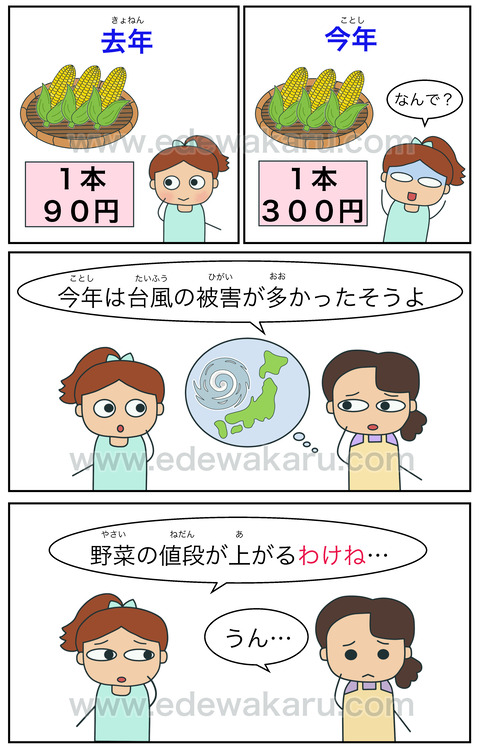
Meaning
だから〜なのだ
なるほど、だから〜なのか
How to use it
動詞・形容詞・名詞[普通形]+わけだ
*な形容詞・名詞の現在肯定形の場合は「ーなわけだ」となる
Explanation
「〜わけだ」は「だから〜なのだ」「なるほど、だから〜のか」と納得した時に使われる文型です。相手から、疑問に思っていたり、不思議だと思っていたことの理由を聞いて、「だから〜だったのか」と納得した時に使います😊一緒によく使われる表現がいくつかありますので覚えておきましょう😉
[「〜わけだ」とよく使われる表現]
・だから〜わけだ
・なるほど〜わけだ
・どうりで〜わけだ
(復習:どうりで)
「わけ」がつく文型はたくさんありますので、区別をして覚えておきましょう😀
【「わけ」シリーズ】
〜ないわけにはいかない
〜わけ(実質名詞)
〜わけがない
〜わけがわからない(実質名詞)
〜わけではない
〜わけない(実質名詞)
〜わけにはいかない
In context 3 examples
A:今年は台風の被害が多かったそうよB:野菜の値段が上がるわけね
→だから野菜の値段が上がったのねA:彼女、大学に合格したんだってB:どうりで嬉しそうだったわけね
→どうりで嬉しそうだったのね(復習:口語形「〜って」)(復習:どうりで)A:今日は全品半額(ぜんぴんはんがく)らしいよB:ああ、だから人が多いわけだ
→ああ、だから人が多いんだね
どんなときどう使う 日本語表現文型辞典
Meaning
it's the case that
How to use it
〔普通形〕(ナAな・ナAである/Nの・Nである)+わけだ
Explanation
~のだ
1)ある事実や状況から、「当然~の結論になる」と言いたいときに使う。「こういう事実があるから」とか「こういう状況だから」と、前に理由表現が来ることが多い。
2) ❸ の「Nのわけだ」は口語では「Nなわけだ」になることもある。
1)Conclusion is natural given facts or circumstances. Clauses indicating precursor conditions or reasons usually precede わけだ.
2)N のわけだ can become N なわけだ in colloquial, as in sentence ❸ .
In context 4 examples
30ページの宿題だから、1日に3ページずつやれば10日で終わるわけです。
夜型の人間が増えてきたために、コンビニエンス・ストアがこれほど広がったわけです。
このスケジュール表を見ると、東京に帰ってくるのは水曜日の午前中のわけだ。
彼に頼まれなかったから、わたしはその仕事をやらなかったわけで、頼んでくればいつでもやってあげるつもりだ。
日本語NET JLPT文法解説まとめ
Meaning
① ・・・なのだから当然~という結果になる。/ だから~になるのか。
ある事実や状況から、当然そうなることを説明したり、説明を聞いてよくわかったときに使う。
② ・・・なので、〜ということだね
相手が言ったことや意見などを反復したり、再度確認するときに使う表現。
How to use it
普通形 + わけだ
Explanation
① that's why / no wonder
This sentence pattern is used to explain or express something that naturally follows from a certain fact or situation, or when it becomes clear after hearing an explanation.
② so you mean
This sentence pattern is used when repeating or confirming what the other person said, such as their statements or opinions.
In context 8 examples
A:カルロスさん、日本に来てもう20年なんだって。
A:田中さんは最近、彼女と別れたらしいですよ。
A:今日、近くで花火大会があるそうだよ。
A:トムさん、第一志望の大学に落ちたらしいよ。
A:アンナさんのお父さん、IT企業の社長らしいですよ。
A:来年度から始業時間が15分早くなるって。
A:就活の時は黒いスーツを着る学生が多いよ。
A:Bさんの終電は大丈夫?
日本語文型辞典 英語版
Meaning
a. ...わけだ〈conclusion〉
Takes the form X。(だから)Yわけだ. Shows that Y is the natural course of development from X, or is an inevitable conclusion. It is often used together with phrases such as だから, から and ので.
b. ...わけだ〈restatement〉
Used in the form X。(つまり)Yわけだ, Shows that X and Y are the same thing and that X can be said in other words as Y.
c. ...わけだ〈reason〉
Takes the form X。Yわけだ. Means that Y is the cause of X.
d. ...わけだ〈claim of fact〉
Used to insist on or emphasize that what one is saying is a fact with a logical foundation. Often used in speech and, especially even in cases where there is no logical basis for what is being said, it is often used as a sentence-ending particle. Frequently used when attempting to persuade another person by telling him what your thinking is.
As in examples
(2)
,
(3)
and
(4)
, used even when the listener does not know the truth, and in such cases can seem pushy, meaning “I think you know it too but....”
a. ...わけだ〈conclusion〉[それなら...わけだ][それじゃ...わけだ][じゃ...わけだ]
B:へえ、そうなんですか。それならフィンランド語は得意なわけですね。
Wow, really? If that’s the case, she must be really good at Finnish.
B:へえ、いいわね。じゃ、その間仕事のストレスからは解放されるわけね。
Wow, that’s great. While you’re there you should get relief from your work stress.
Used in the form それなら/それじゃ/じゃ...わけだ, taking what the other person says, this shows the inevitable conclusion.
b. ...わけだ〈restatement〉[つまり...わけだ][ようするに...わけだ]
B:あなたもようやく実力が認められたわけね。
At last, your real ability has been acknowledged.
B:ふうん。要するに体力に自信がないわけね。
Humph. In other words, he has no confidence in his physical strength.
Takes the form つまり/要するに...わけだ. Used to rephrase something another person has just said.
c. ...わけだ〈reason〉
B:へえ。子供が生まれて前のが小さくなったわけだな。
Really? The one he had before his child was born must have gotten too small.
A:いや、そうじゃなくて、単に新車がほしくなっただけのことらしいけど。
No, that’s not it. It seems he just wanted a new car.
B:いいですね。でも家賃高いんでしょう。ってことは、お給料、けっこうたくさんもらってるわけですね。
That’s good. But the rent must be high. So that means you must get a pretty high salary.
A:いや、それほどでもないですけどね。
No, not so much.
Expresses the reason for or cause of what the other person says.
d. ...わけだ〈understanding〉[だから...わけだ][それで...わけだ][なるほど...わけだ][どうりで...わけだ]
B:ああ、そうだったんですか。それで最近いつもきげんがいいわけだな。
Oh, is that so? So that’s why she’s always in a good mood lately.
B:そうですか。道理で日本の状況がよくわかっていないわけですね。
Really? It’s no wonder that she doesn’t know much about what’s going on in Japan.
B:そうか。だから平日の昼間でも家にいるわけだ。
Oh. So that’s why he’s at home during the day even on weekdays.
Often used in the form だから/それで/なるほど/どうりで...わけだ. Used in the form X。(だから)Yわけだdemonstrates that, although the speaker thought the reason for Y was mysterious, they have accepted that Y is so because of X after hearing information from another person which acts as the cause or reason.
Since the speaker comes to his/her own conclusion about the situation it is not necessary to use such phrases as ね afterwards but, in the polite form ...わけです, phrases such as ね and な are appended.
In example
(1)
, the situation is that Yamamoto-san has always been in a good mood lately but the reason for that is not known. It shows that, on hearing the information from A that “It seems Yamamoto-san has got married,” B comes to understand that as the reason for Yamamoto-san’s being in a good mood of late. The situation in
(4)
is that one person, speaking to him/herself, does not understand why the door will not open and, discovering that he has the wrong key, comes to understand that as the reason for why the door will not open. As in
(4)
and
(5)
, this is used by persons to detail something they have discovered for themselves or information they have heard from another. Combining that with facts already known, it is also used to show the speaker’s understanding of the situation.
B:当然よ。会社のお金、何百万も使い込んでるのがばれたわけだから。
Of course. It’s because he was caught embezzling millions of the company’s money.
In the form XわけだからYは当然だ, takes X, a reliable fact, as the foundation for asserting that, as X is a fact, Y is the natural outcome.
b. ...わけだから...てもとうぜんだ
Takes the form XわけだからYても当然だ. Means “when one accepts X as a reliable fact, it would not be strange if Y were also true.” As in examples
(2)
and
(3)
, it is often used in cases where, in reality, the opposite situation to Y has occurred and runs counter to expectations.
B:へえ、いいね。じゃ、仕事のことを忘れて命の洗濯ができるというわけだ。
Wow, that’s great. It means you can kick back and forget all about work.
B:あ、そう。子供が生まれて前のが小さくなったってわけか。
Oh, really? Had the previous one gotten too small after his child was born?
This form is related to the〈conclusion〉,〈restatement〉and〈reason〉uses of Usage 1 and 2 in わけだ.
How to use it
1. ...わけだ〈monologue-type〉[N な/である わけだ][Na なわけだ][A/V わけだ]States a logically-derived conclusion from a fact or situation showing a previous utterance or context. Used in cases where the speaker or writer is explaining or elucidating something.
2. ...わけだ〈dialogue-type〉Used to state the logical conclusion after accepting another person’s utterance. There are two possible situations for this: one is for the speaker to confirm the conclusion with the other person and the other is for the speaker to accept the conclusion as a fact based on the logical substantiation of the discourse of the other person.
3. ...わけだからa. ...わけだから...はとうぜんだ
4. というわけだ/ってわけだ
In context 39 examples
イギリスとは時差が8時間あるから、日本が 11 時ならイギリスは3時なわけだ。
As there is an eight hour time difference between the United Kingdom and Japan, if it is eleven o’clock in Japan, it will be three o’clock in the United Kingdom.
体重を測ったら 52 キロになっていた。先週は 49 キロだったから、一週間で3キロも太ってしまったわけだ。
When I weighed myself I weighed 52 kilograms. I weighed 49 kilograms last week and so it means that I’ve put on three kilograms in one week.
最近円高が進んで、輸入品の値段が下がっている。だから洋書も安くなっているわけだ。
Recently the value of the yen has been increasing and so the price of imported goods is going down. This means Western books are also getting cheaper.
彼女は中国で3年間働いていたので、中国の事情にかなり詳しいわけである。
She worked in China for three years and so she’s quite knowledgeable about the Chinese situation.
私は昔から機械類をさわるのが苦手です。だから未だにコンピュータも使えないわけです。
I’ve always been bad with machines and so, to this day, I can’t even use a computer.
彼女の父親は私の母の弟だ。つまり彼女と私はいとこ同士なわけだ。
Her father is my mother’s younger brother. That is to say, we are cousins.
彼女はフランスの有名なレストランで5年間料理の修行をしたそうだ。つまりプロの料理人であるわけだ。
I hear that she spent five years training in a famous French restaurant. In other words, she’s a professional chef.
彼は大学へ行っても部室でギターの練習ばかりしている。要するに講義にはほとんど出ていないわけだが、それでもなぜか単位はきちんと取れているらしい。
Even though he goes to school, he just practices his guitar in his room all the time. In other words, he hardly ever goes to his lectures but, even so, somehow he seems to pick up the credits he needs.
父は 20 年前に運転免許を取っていたが車は持っていなかった。つまり長い間ペーパードライバーだったわけだ。
My father got his driver’s license twenty years ago but didn’t have a car. That is, for a long time he was a driver only on paper.
私はおいしいものを食べている時が一番幸せである。言いかえれば、まずいものを食べることほどいやなことはないわけで、それが強制されたものだとなおさらである。
I’m happiest when eating something delicious. In other words, there’s nothing I like less than eating something bad, and if I’m forced to, then it’s even worse.
今年は米のできが良くなかった。冷夏だったわけだ。
The quality of this year’s rice was poor. It’s because it was a cool summer.
彼女は猫を3匹と犬を1匹飼っている。一人暮らしで寂しいわけだ。
She keeps three cats and one dog. It’s because she is living alone and is lonely.
姉は休みの度に海外旅行に出かける。日常の空間から脱出したいわけだ。
When there’s a holiday my older sister goes on a trip abroad. It’s because she wants to escape from her everyday life.
山田君は就職難を乗り越えて大企業に就職したのに、結局3ヶ月でやめてしまった。本当にやりたかった音楽関係の仕事をめざすことにしたわけだが、音楽業界も就職はむずかしそうなので、心配している。
Even though Yamada-kun overcame the job shortage and was employed by a large company, in the end he quit after three months. He did it because he decided to try to find a music-related job he really wants to do, but it seems that finding work is difficult in the music field too and so he’s worried.
4人とも車で来るわけだから、うちの前にずらっと4台路上駐車することになるね。
As four people are arriving by car, I suppose there will be four cars parked in a line on the street in front of my house.
私は古本屋めぐりが好きで、暇があると古本屋を回っては掘り出し物を探しているわけですが、このごろはいい古本屋が少なくなってきたので残念に思っています。
I like to look around second hand bookstores, so when I have free time, I go looking for bargains in them, but unfortunately there are fewer good second hand bookstores nowadays.
私、国際交流関係のボランティア活動はすでに 10 年近くやってきているわけでして、自慢じゃありませんが、みなさんよりもずっと経験はあるわけです。そういう立場の者としてご提案させていただいているわけです。
I have been doing international exchange-related volunteer work for already ten years. I don’t mean to boast, but it’s from that position of being by far the most experienced that I make this proposal.
ねえ、聞いてくれる。昨日駅前に自転車置いて買い物に行ったんだけど、帰ってきたらなくなってるわけ。あちこち見てみたけど見つからなくて、しょうがないから警察に行ったわけよ。そしたら「鍵かけてなかったんじゃないの」なんて言われちゃって...。
Hey, listen to this. Yesterday, I leave my bike in front of the station and go shopping, but when I come back, it’s gone. I look here and there but can’t find it and so the only thing I can do is to go to the police. And then, they tell me something like “Well, you probably didn’t lock it....”
A:森さんは8年もフィンランドに留学していたそうですよ。
I hear that Mori-san has been to Finland to study for eight years.
A:明日から2泊3日で熱海の温泉に行くの。
From tomorrow, I’m going to a hot spring in Atami for two nights, three days.
A:この間書いた小説、文学賞がもらえたよ。
The other day, I received a literary prize for the novel which I wrote.
A:田中くん、富士山登山に行くのやめるんだって。帰った次の日がゼミの発表だから準備しなくちゃいけないらしいよ。
Apparently, Tanaka-kun has decided not to climb Fuji-san (Mount Fuji). It seems that he has to prepare for a seminar presentation the next day.
A:川本さん、車大きいのに買いかえたらしいよ。
Kawamoto-san seems to have bought a new car even though the old one was so big.
A:ぼく、今度一軒家に引っ越すことにしたんですよ。
I’ve decided to move to a detached house this time.
A:山本さん、結婚したらしいですよ。
It seems that Yamamoto-san has gotten married.
A:彼女は3年もアフリカにフィールドワークに行っていたそうですよ。
I hear that she went to do fieldwork in Africa for three years.
A:隣の鈴木さん、退職したらしいよ。
It seems that Suzuki-san from next door has retired.
あ、鍵が違うじゃないか。なんだ。これじゃ、いくらがんばっても開かないわけだ。
Oh! This must be the wrong key. What’s up with it? No wonder I couldn’t open it however much I tried.
田中さん、一か月で4キロやせようと思ってるんだって。なるほど、毎日昼ご飯を抜いているわけだわ。
They say Tanaka-san is trying to lose four kilograms in one month. That’s why he’s skipping lunch every day.
小池さんは何年もインドネシア駐在員だったわけだから、インドネシア語が話せるのは当然です。
As Koike-san was located in Indonesia for some years, he naturally can speak Indonesian.
あの議員は履歴を偽って国民をだましていたわけだから、辞職は当然のことだ。
As that member of the Diet lied about her background and deceived the people, it’s natural that she should resign.
A:あの人、クビになったんだってよ。
I heard that person was fired.
彼女は大学を出てからもう8年も経っているわけだから、結婚していても当然だろう。
As it’s already been eight years since she left university, she’s probably married by now.
彼は大学を卒業しているわけだからパソコンが使えても当然なのに、まったく使えないらしい。
As he graduated from university, you would think he would be able to use a computer, but it seems he can’t use one at all.
これだけ利用者が増えているわけだからもっと安くしても当然なのに、電車やバスの運賃は値上がりする一方だ。
Because the number of users is increasing, bus and train fares should get cheaper, but they just keep rising.
イギリスとは時差が8時間あるから、日本が 11 時ならイギリスは3時(だ)というわけだ。
As there is an eight hour time difference with the United Kingdom, when it is eleven o’clock in Japan, that means it is three o’clock in the United Kingdom.
彼女の父親は私の母の弟だ。つまり彼女と私はいとこ同士(だ)というわけだ。
Her father is my mother’s younger brother. In other words, that means we are cousins.
A:あしたから温泉に行くんだ。
I’m going to a hot spring from tomorrow.
A:川本さん、車買いかえたらしいよ。
It seems that Kawamoto-san has changed his car.
AIUEO JLPT Grammar
Meaning
This sentence pattern is used when explaining the reason or cause and supporting it with a conclusion. The speaker uses it to explain or clarify something they have understood.
How to use it
動詞+わけだ形容詞+わけだ形容動詞な+わけだ名詞な+わけだ名詞の+わけだ
Explanation · 日本語
この文型は、理由や原因を説明し、その結果を納得させるときに使われる表現です。話者が何かを理解したり、説明したりするために使います。
In context 5 examples
彼は毎日勉強している。それで成績がいいわけだ。
He studies every day. That’s why his grades are good.
彼女は家事が得意です。それで家がいつもきれいなわけです。
She is good at housework. That’s why her house is always clean.
このレストランはいつも満席だ。だから予約が必要なわけだ。
This restaurant is always full. That’s why reservations are necessary.
昨日から雨が降り続いている。それで地面が濡れているわけだ。
It has been raining since yesterday. That’s why the ground is wet.
この店はいつも安売りをしています。人気があるわけですね。
This store always has sales. That’s why it’s popular.
Bunpro Grammar Reference
Meaning
For that reason, No wonder, As you'd expect, Naturally, Thus, This is why
How to use it
Verb + (という) + わけだ
[い]Adjective + (という) + わけだ
[な]Adjective + な(1) + わけだ
Noun + の(1) + わけだ
(1) という
Verb + (という) + わけ + です
[い]Adjective + (という) + わけ + です
[な]Adjective + な(1) + わけ + です
Noun + の(1) + わけ + です
(1) という
Nuance
A phrase that strongly presents a logical reason or cause for why (A) is so.
Explanation
One of the most misunderstood words in Japanese is 訳. Of the many ways it can be translated, the most common are 'reason', 'cause', 'meaning', or 'conclusion'. Despite this, it may be beneficial to consider it almost identical to an equally versatile English word 'so'.
In all of its uses, わけ simply highlights the plain existence/determination of something in the same way that 'so' does in English. This can be seen in its most basic form in わけだ. A combination of わけ and the auxiliary verb だ.
わけだ will be used at the end of sentences, and is sometimes preceded by という. This use is often translated as 'for the reason of (A)', 'no wonder its (A)', or 'its (A), as you'd expect'. Realistically though, it just means 'it is so that it's (A)', or 'so it's (A)'.
事故で電車が遅れたの?だから珍しく遅れて来たというわけだ。
The train was late due to an accident? So that's why you came in unusually late.
指の骨が折れていたのですね。だから指を動かしたら痛かったという訳ですね。
You are saying that my finger was broken? So that's why my finger hurt when I moved it.
やっぱり全然練習してないでしょ?どうりで一年たっても下手なわけだ。
As I expected, you didn't practice at all, did you? No wonder you haven't improved even after a year.
今日は休日か。だから定休日のわけだ。
Today is a holiday, isn't it? So that's why they are closed today.
Due to わけ being a noun, it will need to follow the attributive form of whatever word comes before it. As we can see 'so' and わけ have an extremely close pattern of nuances, ranging from 'because', all the way through to simple emphasis (like with 'naturally', and 'as you'd expect').
わけ may also be used in questions, implying that the speaker is trying to determine something that they have heard. わけだね 'so its (A) right?', and わけですか 'so is it that (A)?' are good examples of this.
俺と一緒にいたくないわけだね?分かったよ。
So you are saying that you don't want to be with me, right? I understand.
先輩たちは後から来るというわけですか?
Senpai, so will you be coming later?
Nuance · 日本語
なぜ(A)であるかの論理的な理由や原因を強く提示する表現。
Explanation · 日本語
「訳」は、「原因」「理由」「意味」「結論」など、いろいろな意味を持つ言葉です。
意味はいろいろありますが、どのような場合も、「わけ」は、物事を強く判断したり結論付けたりするときに使われます。この「わけ」を使った最も基本的な文法は「わけだ」です。これは「わけ」と助動詞「だ」からできています。
「わけだ」は、文の終わりで使われます。そして、「(A) だから (B) なのだ」や「(A) だから、当然 (B) だ」などの意味を表します。また、「という」が「わけだ」の前に付くこともあります。
事故で電車が遅れたの?だから珍しく遅れて来たというわけだ。
The train was late due to an accident? So that's why you came in unusually late.
指の骨が折れていたのですね。だから指を動かしたら痛かったという訳ですね。
You are saying that my finger was broken? So that's why my finger hurt when I moved it.
やっぱり全然練習してないでしょ?どうりで一年たっても下手なわけだ。
As I expected, you didn't practice at all, did you? No wonder you haven't improved even after a year.
今日は休日か。だから定休日のわけだ。
Today is a holiday, isn't it? So that's why they are closed today.
「わけ」は名詞なので、その前には連体形の語が置かれます。また、「わけ」はただ理由を示すだけでなく「なるほど」「やっぱり」「当然」のように、納得のニュアンスや、理由を強調するニュアンスを出すこともできます。
「わけ」は、話し手が聞いた内容を確かめたいときに、疑問の形で使われることもあります。このときは、「わけだね」や「わけですか」のような言い方をします。
俺と一緒にいたくないわけだね?分かったよ。
So you are saying that you don't want to be with me, right? I understand.
先輩たちは後から来るというわけですか?
Senpai, so will you be coming later?
In context 18 examples
- 雪が降っていた。寒い訳だ。
It snowed, so as you'd expect, it's cold.
- 事故で電車が遅れたの?だから珍しく遅れて来たというわけだ。
The train was late due to an accident? So that's why you came in unusually late.
- 指の骨が折れていたのですね。だから指を動かしたら痛かったという訳ですね。
You are saying that my finger was broken? So that's why my finger hurt when I moved it.
- 今日は休日か。だから定休日のわけだ。
Today is a holiday, isn't it? So that's why they are closed today.
- 俺と一緒にいたくないわけだね?分かったよ。
So you are saying that you don't want to be with me, right? I understand.
- 先輩たちは後から来るというわけですか?
Senpai, so will you be coming later?
- やっぱり全然練習してないでしょ?どうりで一年たっても下手なわけだ。
As I expected, you didn't practice at all, did you? No wonder you haven't improved even after a year.
- また忘れたの?それで先生に叱られた訳だ。
You forgot again? No wonder you were scolded by the teacher.
- 夜更かししてばかりいるの?それじゃあ遅刻する訳だ。
Why do you keep staying up late? No wonder you are always late.
- お金を無駄に使っている。貯金がない訳です。
You waste your money. No wonder you have no savings.
- 彼女は医者になりたいから、医学の勉強をする訳だ。
Since she wants to be a doctor, this is why she is studying in the medical field. (as you'd expect)
- 道理でうまくいかなかった訳だ。前提がずっと間違っていたのだから。
No wonder it didn't turn out well. The premise was wrong all along.
- 人一倍努力している。彼は成功する訳だ。
He works twice as hard as others. This is why, he is successful. (as you'd expect)
- 違う人にメールを送っていた。どうりで知らない訳だ。
I had sent the email to the wrong person. No wonder you don't know what is going on.
- こんなに高級な素材を使っているの?どうりで高い訳だ。
You are using these high-grade materials? No wonder it is expensive.
- みんな態度が悪すぎる。先生もお手上げだった訳だ。
Everyone has a terrible attitude. No wonder the teacher gave up.
- 道に迷ったの?それで君は交番に行ったという訳だ。
You got lost? Ah, that's why you went to the police station.
- 怒られるのが嫌だから、失敗を隠したって訳だ。
No wonder that you hid your failure, since you didn't want to get in trouble.
文法
Meaning
① ・・・なのだから当然~という結果になる。/ だから~になるのか。
ある事実や状況から、当然そうなることを説明したり、説明を聞いてよくわかったときに使う。
② ・・・なので、〜ということだね
相手が言ったことや意見などを反復したり、再度確認するときに使う表現。
How to use it
普通形 + わけだ
In context 8 examples
A:カルロスさん、日本に来てもう20年なんだって。
B:あ〜、それで日本語がペラペラなわけだ。A:田中さんは最近、彼女と別れたらしいですよ。
B:それで、最近元気が無いわけだ。A:今日、近くで花火大会があるそうだよ。
B:あ~、それでこんなに人が多いわけだ。A:トムさん、第一志望の大学に落ちたらしいよ。
B:あー、それで落ち込んでいたわけだ。A:アンナさんのお父さん、IT企業の社長らしいですよ。
B:だから、彼女は高級ブランド物のアイテムをたくさん持っているわけだ。A:来年度から始業時間が15分早くなるって。
B:じゃあ、今9時だから、8時45分になるというわけですね。A:就活の時は黒いスーツを着る学生が多いよ。
B:じゃあ、黒いスーツが就活の標準のスタイルというわけですね。A:Bさんの終電は大丈夫?
B:終電は11時半なのでまだ大丈夫です。
A:じゃあ、あと1時間ぐらいはいられるというわけですね。
IMABI
わけだ
Read this IMABI lesson ↗Explanation
わけだ
The noun 訳 when read as わけ can be translated as “conclusion from reasoning”, but it is not to be confused with the reading やく, which means “translation.”
1. そのわけは未いまだ解明かいめいされていない。
The reason for that has still yet to be clarified.
2. なるほど、そんなわけで、金子かねこは帰国きこくしたのか。
I see, so that’s why Kaneko returned to Japan.
3. あいつはいつも訳わけの分わからないことばかりやってるよ。
That guy always does a bunch of nonsense.
4. ロケット団だんがピカチュウを追おっている理由りゆうはこういうわけです。
This is the reasoning for Team Rocket chasing Pikachu.
5. てなわけで、ごきげんよう!
With that, have a nice day!
Contraction Note: てなわけで comes from というようなわけで. It is equivalent to “with that being said” and is very fitting in this example sentence in concluding the conversation, but it is rather interchangeable with the phrase ということで. Just as in English, either of these two phrases are used in making transitions.
6. 訳わけもなく、彼かれは机つくえを壊こわした。
Without any reason, he broke the desk.
7. ちゅうわけで、今夜こんやも行いこうぜ~。
With that, let’s go tonight too!
Contraction Note: ちゅう is a contraction of という, and together, ちゅうわけで is yet another means of saying “so with that…”
訳だ, most frequently spelled as わけだ, is multifaceted in meaning, but its fundamental meaning is to express reasoning which has come about from having thought along the logic or reasoning from one certain circumstance which led the speaker to yet another circumstance. Meaning, there is a known fact that leads to a reason or cause for which one draws a conclusion. In doing so, this pattern draws parallels with はずだ andことになる, but as is always the case with interrelated grammar points, it will be necessary for us to delve into when and how these patterns are ever interchangeable.
Affirmation vs. Inference
All three of these patterns demonstrate an inevitable conclusion that the speaker makes after having thought things through logically. However, whereas わけだ and ことになる can be viewed as stating a matter as logically based established fact, はずだ more so states induction with a high degree of confidence—not quite fact.
8. このガス雲うんは、ブラックホールの潮汐力ちょうせきりょくによって破壊はかいされ、降着円盤こうちゃくえんばんに衝突しょうとつするはずです。
This gas cloud should be destroyed by the tidal force of the black hole and collide with the accretion disk.
9. 水蒸気すいじょうきを含ふくんだ空気くうきが上昇じょうしょうし、雪雲ゆきぐもを作つくると、雪ゆきが降ふるわけです。
When air filled with water vapor rises and creates snow clouds, it snows.
10. 乱層雲らんそううんは、横よこに広ひろがっているので、小雨こさめが長ながく降ふり続つづくことになる。
The nimbostratus stretches horizontally, and so the light rain will continue to fall for a long time.
わけだ is at its heart an expression that decisively demonstrates a logical conclusion based on some premise. はずだ, on the other hand, does not assert knowledge of the truth as it only infers a conclusion based on the extent of information at the speaker’s disposal. It is a “should” and nothing more. The predicates before わけだ and はずだ, thus, have a fundamental difference. For the former, the predicate is known as fact and is in response to why it is so. For the latter, the predicate is not known to be fact, but its validation is what is being set in motion. Their focal points may share some similarity in showing a conclusion, but はずだ places emphasis on the speaker’s high confidence about how something ought to be the case while わけだ places emphasis on what has come about from following a logical path of reasoning. Both, however, are used in a very explanatory sense. They simply differ in the nature of the explanation: fact or conjecture.
Conjugation Note: Because わけだ is composed of a noun, there is nothing special about how it attaches to other parts of speech.
Objectiveness or Lack Thereof
Both わけだ and はずだ are actually subjective in nature despite わけだ emphasizing what the speaker feels to be established fact, but this is exactly how both demonstrate subjectivity. Of course, はずだ is by far the most subjective in nature. Even if the statement which the speaker is trying to make with はずだ is based on facts, it is at the very most inference that is hoping to squeeze agreement from the listener. This is so much so that if what ends up being the case is different than what is expected and asserted with はずだ, suspicion as to whether said realization is true is inferred. This never happens with わけだ.
11. 普通ふつうなら固体こたいは液体えきたいに沈しずむんですが、これってなんで浮ういてるの?
Usually, solids sink in liquids, but why is this floating?
12. 氷こおりは水みずより軽かるいので、固体こたいとはいえ水みずに浮うくわけです。
Ice is lighter than water, and so although it’s a solid, that’s why it floats in water.
Where does ことになる fall in all this? It is quite interchangeable with わけだ as it too expresses how an inevitable conclusion is brought about by following logic, fact, and or the course of things, but unlike わけだ, it is extremely objective in nature. In summary, all three patterns show conclusions based on logic, but they differ in objectivity and in the nature of their claims.
13. 形かたちあるものは全すべて壊こわれるわけですよね?
Things with form must all go to pieces, right?
14. アセトアルデヒドは、有害物質ゆうがいぶっしつなので、さらに炭酸たんさんガスと水分すいぶんに分解ぶんかいされることになります。
Because acetaldehyde is a toxic substance, it becomes further decomposed to carbonic acid and water.
As far as わけだ is concerned, its fundamental meaning being to express reasoning, which has come about from having thought along the logic or reasoning from one certain circumstance which led the speaker to yet another circumstance, is not so difficult to comprehend, but there are issues that arise when looking further into the relationship between the two circumstances intrinsically implied with わけだ. At times, what わけだ attaches to shows reason/cause, and at other times it shows result, which at first glance seem to be contradictory. In order to reconcile this, it is necessary to separate the individual functions of わけだ according to the flow of awareness of the speaker as this will help determine the relationship meant by whatever two circumstances are linked with it.
The reason for why all this is necessary is because わけだ is intrinsically subjective to some degree. The subjective nature lies in the fact that although it may be based on established fact/logic, these facts and or logic are being represented with the speaker’s personal point of view. Depending on where one’s flow of thought goes, one’s thoughts may levitate toward to either the reason/cause or the effect of the logical conclusion clause that わけだ attaches to.
Showing Result/Effect
When showing result/effect, わけだ can be associated with claims that refer to an unconfirmed event in the past as well as claims based on established fact and as of yet established ‘fact.’ Choosing はずだ or ことになる instead depends on the objectivity you wish to give to the result, but it is worth noting that ことになる doesn’t work when the result has already happened.
15. フランスはフィンランドと1いち時間じかんの時差じさがあるから、ホテルには日本時間にっぽんじかんの15じゅうご時じごろに着つくわけだ。
Because there is a one-hour time difference between France and Finland, (I) will arrive at the hotel around 3 PM JST.
16. そんなに市場いちばに出回でまわってるんだったら、確たしかに乱獲らんかくとかで5ご年後ねんごに姿すがたを完全かんぜんに消けしてしまうわけですね。
If it’s circulating that much in the markets, then it’ll definitely completely disappear five years from now due to overfishing and what not.
17. 2に時間遅じかんおくれでシアトルを出発しゅっぱつしたので、2に時間遅じかんおくれでハワイに到着とうちゃくしたわけです。
(I/We) departed Seattle with a two-hour delay, which is why we arrived at Hawaii two-hours late.
18. 2に時間遅じかんおくれでシドニーを出発しゅっぱつしたので、およそ2に時間遅じかんおくれでジャカルタに到着とうちゃくしたはずです。
(They) departed Sydney with a two-hour delay, and so they should have arrived at Jakarta approximately two-hours late.
19. 執筆者しっぴつしゃの方かたは、ベンチャーキャピタル出身しゅっしんの公認会計士こうにんかいけいしなので、道理どうりで内部事情ないぶじじょうに詳くわしいわけです。
The author (of this) is a certified public accountant from a venture capital, which is no wonder why he is well-informed about internal state of affairs.
20. 岡田おかださんは韓国かんこくで5ご年ねんくらい働はたらいていたので、そもそも韓国かんこくの内部事情ないぶじじょうに詳くわしいはずです。
Mr. Okada had worked in South Korea for around five years, and so he should know about the internal state of South Korea anyway.
21. ところで、最近農薬さいきんのうやくを使つかい始はじめたよね。で、もう害虫がいちゅうがつかない{わけですか・ことになりますか}。
By the way, you’ve started to use agrochemicals, right? Will the pests no longer stick?
Grammar Note: The question form of はずだ does not exist due to the strong subjective nature it has in expressing the speaker’s thoughts of what something “should” be.
Showing Reason/Cause
If the reason/cause is known from established fact, then はずだ cannot be used, but if the reason/cause deals with something that one hasn’t gone out and confirmed, then either can be used. It’s just that わけだ would be somewhat subjective whilst still presenting the matter as fact.
22. 部屋へやがとっても静しずかですね。あ、みんなが休憩きゅうけいに入はいったわけですね。
The room is very quiet isn’t it? Ah, everyone’s gone on break.
23. 今年ことしは、ブドウの出来できが去年きょねんと比くらべてやや悪わるかったんですけど、ま、冷夏れいかだったわけですね。
This year, the quality of the grapes was bad compared to last year, but, well, it was a cold summer.
24. 今年ことしのトマトの出来できが悪わるかったです。まあ、本来ほんらいこの夏なつも冷夏れいかだったはずなので、仕方しかたがないですね。
This year’s tomato quality was bad. Well, this summer was originally supposed to be a cold summer, so it can’t be helped.
25. 台風たいふうが近ちかづいているわけですが、近所きんじょの周まわりは雨あめが降ふったり、青空あおぞらが見みえたり、嫌いやな雲くもが流ながれてきたりしてて、天気てんきが落おち着きません。
It’s because the typhoon is approaching but, in and around the neighborhood, it rains, lets up to see the blue sky, then awful looking clouds flood in…back and forth. The weather won’t calm down.
Grammar Note:ことになる is incapable of being used to show reason/cause. It is limited to show result/effect in the most objective of situations.
Acknowledgment of Truth
When acknowledging the truth of something, わけだ is interchangeable with はずだ, but the nuance changes to showing what something ought to be, which isn’t surprising. However, for every “ought” you can think of, there are just as many situations that are in fact true which you can then acknowledge with わけだ, and these situations can overlap a lot.
26.「日本にほんにいつ来きたの」「2に歳さいのとき」「はあ?じゃ、日本にほんに住すんで20にじゅう年ねん?道理どうりで日本語にほんごが流暢りゅうちょうなわけだね」
“When did you come to Japan?” “When I was two years old.” “What? Then, you’ve lived in Japan for 20 years? Well no wonder you’re fluent in Japanese.”
27. 開あかないわけだよ。そもそも違ちがう鍵かぎを渡わたしたんだから。
It won’t open. That’s because I handed you the wrong key in the first place.
28. 少子高齢化しょうしこうれいかが進すすんでいる。このため、健康保険料けんこうほけんりょうは高たかくなっているわけだ。
The decreasing birthrate and aging population is advancing. Because of this, health insurance has gone up.
29. 「いくら一生懸命勉強いっしょうけんめいべんきょうしても、まだ英語えいごの能力のうりょくが足たりません」「要ようするに、英語えいごを話はなすのが下手へただというわけでしょう」
“No matter how much I study, my English skills are still lacking.” “In short, you’re not good at speaking English, right?”
はずだ Not Possible
If there is no chance of speculation from not having verified the claim oneself, はずだ cannot be used. It does not make sense to make an inference about something you’ve already observed.
30. 「岸本きしもとさんは会社かいしゃでクビになったらしいよ」「だからずっと家いえに籠こもってるわけね」
“It seems that Mr. Kishimoto was fired at his company. “So that’s why he’s confined himself at home this whole time.”
はずだ would not make sense in this sentence because the second speaker has observed Kishimoto being in his home the whole time.
Restating Fact
Normally, when restating fact, you are already stating something without inferring the details. Now, you might restate this said fact from your point of view, in which case わけだ is most certainly the choice pattern to use. If instead of being from your point of view you are merely (re)stating the natural course of things from an objective stance, ことになる will be your friend.
31. 確(たし)かに、火災(かさい)の後(あと)、目(め)が痛(いた)いと訴(うった)えて出(で)る者(もの)が多(おお)かった。あの、音道(おとみち)としか話(はな)そうとしなかったアルバイトの娘(むすめ)も、目(め)が痛(いた)み、黒(くろ)い煙(けむり)が出(で)たと言(い)っていた。あの時(とき)には、まさかこんな妙(みょう)な事件(じけん)になるなんて、考(かんが)えてもみなかった。それが、男(おとこ)が勝手(かって)に燃(も)え出(だ)したというし、時限装置(じげんそうち)は見(み)つかるし、お陰(かげ)で俺(おれ)は、お嬢様(じょうさま)と楽(たの)しい毎日(まいにち)を過(す)ごすことになっちまったってわけだ。
There were certainly many people who came forward claiming that their eyes hurt after the fire. That girl, who was a part-time worker and only tried to speak Otomichi, also claimed that her eyes hurt and that there was black smoke. At that time, I never even thought that this would become such a strange case. That…a man would just catch himself on fire, that a timing device would be found, and thanks to all this, I’ve ended up spending every pleasant day with the lady (detective).
32. 夫(おっと)と浮気相手(うわきあいて)の会話(かいわ)の録音(ろくおん)は不貞行為(ふていこうい)の存在(そんざい)を示(しめ)す証拠(しょうこ)になります。
Recording of one’s husband and lover becomes proof of the existence of unfaithful acts.
As stated above, if there is no chance of subjective inference, then はずだ is inappropriate. However, if there is room for such inference like in the last sentence, then it is fine using it when restating fact. Normally, when restating fact, you are already stating something without inferring the details. Now, you might restate this said fact from your point of view, in which case わけだ is most certainly the choice pattern to use. If instead of being from your point of view you are merely (re)stating the natural course of things from an objective stance, ことになる will be your friend.
31. 確たしかに、火災かさいの後あと、目めが痛いたいと訴うったえて出でる者ものが多おおかった。あの、音道おとみちとしか話はなそうとしなかったアルバイトの娘むすめも、目めが痛いたみ、黒くろい煙けむりが出でたと言いっていた。あの時ときには、まさかこんな妙みょうな事件じけんになるなんて、考かんがえてもみなかった。それが、男おとこが勝手かってに燃もえ出だしたというし、時限装置じげんそうちは見みつかるし、お陰かげで俺おれは、お嬢様じょうさまと楽たのしい毎日まいにちを過すごすことになっちまったってわけだ。
There were certainly many people who came forward claiming that their eyes hurt after the fire. That girl, who was a part-time worker and only tried to speak Otomichi, also claimed that her eyes hurt and that there was black smoke. At that time, I never even thought that this would become such a strange case. That…a man would just catch himself on fire, that a timing device would be found, and thanks to all this, I’ve ended up spending every pleasant day with the lady (detective).
32. 夫おっとと浮気相手うわきあいての会話かいわの録音ろくおんは不貞行為ふていこういの存在そんざいを示しめす証拠しょうこになります。
Recording of one’s husband and lover becomes proof of the existence of unfaithful acts.
As stated above, if there is no chance of subjective inference, then はずだ is inappropriate. However, if there is room for such inference like in the last sentence, then it is fine using it when restating fact.
Merely Stating What’s What
わけだ also happens to be frequently used with statements that the speaker deems to be common sense/well-known establish fact, so much so that it can viewed as a final particle. In fact, this is so prevalent that わけ by itself at the end of a sentence is almost as common as hearing other final particles like よ or ね.
33. 口くちに入いれた瞬間しゅんかん、もう旨味うまみが口くちに広ひろがるわけ。
The moment you put it in your mouth, the taste spreads through your mouth.
34. そこが男おとこらしいわけよ。
That right there is what’s manly.
35. こうして二人ふたりは結婚けっこんして幸しあわせに暮くらしたわけです。
And so the two married and lived happily.
In context 37 examples
そのわけは未いまだ解明かいめいされていない。
The reason for that has still yet to be clarified.
なるほど、そんなわけで、金子かねこは帰国きこくしたのか。
I see, so that’s why Kaneko returned to Japan.
あいつはいつも訳わけの分わからないことばかりやってるよ。
That guy always does a bunch of nonsense.
ロケット団だんがピカチュウを追おっている理由りゆうはこういうわけです。
This is the reasoning for Team Rocket chasing Pikachu.
てなわけで、ごきげんよう!
With that, have a nice day!
訳わけもなく、彼かれは机つくえを壊こわした。
Without any reason, he broke the desk.
ちゅうわけで、今夜こんやも行いこうぜ~。
With that, let’s go tonight too!
このガス雲うんは、ブラックホールの潮汐力ちょうせきりょくによって破壊はかいされ、降着円盤こうちゃくえんばんに衝突しょうとつするはずです。
This gas cloud should be destroyed by the tidal force of the black hole and collide with the accretion disk.
水蒸気すいじょうきを含ふくんだ空気くうきが上昇じょうしょうし、雪雲ゆきぐもを作つくると、雪ゆきが降ふるわけです。
When air filled with water vapor rises and creates snow clouds, it snows.
乱層雲らんそううんは、横よこに広ひろがっているので、小雨こさめが長ながく降ふり続つづくことになる。
The nimbostratus stretches horizontally, and so the light rain will continue to fall for a long time.
普通ふつうなら固体こたいは液体えきたいに沈しずむんですが、これってなんで浮ういてるの?
Usually, solids sink in liquids, but why is this floating?
氷こおりは水みずより軽かるいので、固体こたいとはいえ水みずに浮うくわけです。
Ice is lighter than water, and so although it’s a solid, that’s why it floats in water.
形かたちあるものは全すべて壊こわれるわけですよね?
Things with form must all go to pieces, right?
アセトアルデヒドは、有害物質ゆうがいぶっしつなので、さらに炭酸たんさんガスと水分すいぶんに分解ぶんかいされることになります。
Because acetaldehyde is a toxic substance, it becomes further decomposed to carbonic acid and water.
フランスはフィンランドと1いち時間じかんの時差じさがあるから、ホテルには日本時間にっぽんじかんの15じゅうご時じごろに着つくわけだ。
Because there is a one-hour time difference between France and Finland, (I) will arrive at the hotel around 3 PM JST.
そんなに市場いちばに出回でまわってるんだったら、確たしかに乱獲らんかくとかで5ご年後ねんごに姿すがたを完全かんぜんに消けしてしまうわけですね。
If it’s circulating that much in the markets, then it’ll definitely completely disappear five years from now due to overfishing and what not.
2に時間遅じかんおくれでシアトルを出発しゅっぱつしたので、2に時間遅じかんおくれでハワイに到着とうちゃくしたわけです。
(I/We) departed Seattle with a two-hour delay, which is why we arrived at Hawaii two-hours late.
2に時間遅じかんおくれでシドニーを出発しゅっぱつしたので、およそ2に時間遅じかんおくれでジャカルタに到着とうちゃくしたはずです。
(They) departed Sydney with a two-hour delay, and so they should have arrived at Jakarta approximately two-hours late.
執筆者しっぴつしゃの方かたは、ベンチャーキャピタル出身しゅっしんの公認会計士こうにんかいけいしなので、道理どうりで内部事情ないぶじじょうに詳くわしいわけです。
The author (of this) is a certified public accountant from a venture capital, which is no wonder why he is well-informed about internal state of affairs.
岡田おかださんは韓国かんこくで5ご年ねんくらい働はたらいていたので、そもそも韓国かんこくの内部事情ないぶじじょうに詳くわしいはずです。
Mr. Okada had worked in South Korea for around five years, and so he should know about the internal state of South Korea anyway.
ところで、最近農薬さいきんのうやくを使つかい始はじめたよね。で、もう害虫がいちゅうがつかない{わけですか・ことになりますか}。
By the way, you’ve started to use agrochemicals, right? Will the pests no longer stick?
部屋へやがとっても静しずかですね。あ、みんなが休憩きゅうけいに入はいったわけですね。
The room is very quiet isn’t it? Ah, everyone’s gone on break.
今年ことしは、ブドウの出来できが去年きょねんと比くらべてやや悪わるかったんですけど、ま、冷夏れいかだったわけですね。
This year, the quality of the grapes was bad compared to last year, but, well, it was a cold summer.
今年ことしのトマトの出来できが悪わるかったです。まあ、本来ほんらいこの夏なつも冷夏れいかだったはずなので、仕方しかたがないですね。
This year’s tomato quality was bad. Well, this summer was originally supposed to be a cold summer, so it can’t be helped.
台風たいふうが近ちかづいているわけですが、近所きんじょの周まわりは雨あめが降ふったり、青空あおぞらが見みえたり、嫌いやな雲くもが流ながれてきたりしてて、天気てんきが落おち着きません。
It’s because the typhoon is approaching but, in and around the neighborhood, it rains, lets up to see the blue sky, then awful looking clouds flood in…back and forth. The weather won’t calm down.
「日本にほんにいつ来きたの」「2に歳さいのとき」「はあ?じゃ、日本にほんに住すんで20にじゅう年ねん?道理どうりで日本語にほんごが流暢りゅうちょうなわけだね」
“When did you come to Japan?” “When I was two years old.” “What? Then, you’ve lived in Japan for 20 years? Well no wonder you’re fluent in Japanese.”
開あかないわけだよ。そもそも違ちがう鍵かぎを渡わたしたんだから。
It won’t open. That’s because I handed you the wrong key in the first place.
少子高齢化しょうしこうれいかが進すすんでいる。このため、健康保険料けんこうほけんりょうは高たかくなっているわけだ。
The decreasing birthrate and aging population is advancing. Because of this, health insurance has gone up.
「いくら一生懸命勉強いっしょうけんめいべんきょうしても、まだ英語えいごの能力のうりょくが足たりません」「要ようするに、英語えいごを話はなすのが下手へただというわけでしょう」
“No matter how much I study, my English skills are still lacking.” “In short, you’re not good at speaking English, right?”
「岸本きしもとさんは会社かいしゃでクビになったらしいよ」「だからずっと家いえに籠こもってるわけね」
“It seems that Mr. Kishimoto was fired at his company. “So that’s why he’s confined himself at home this whole time.”
確(たし)かに、火災(かさい)の後(あと)、目(め)が痛(いた)いと訴(うった)えて出(で)る者(もの)が多(おお)かった。あの、音道(おとみち)としか話(はな)そうとしなかったアルバイトの娘(むすめ)も、目(め)が痛(いた)み、黒(くろ)い煙(けむり)が出(で)たと言(い)っていた。あの時(とき)には、まさかこんな妙(みょう)な事件(じけん)になるなんて、考(かんが)えてもみなかった。それが、男(おとこ)が勝手(かって)に燃(も)え出(だ)したというし、時限装置(じげんそうち)は見(み)つかるし、お陰(かげ)で俺(おれ)は、お嬢様(じょうさま)と楽(たの)しい毎日(まいにち)を過(す)ごすことになっちまったってわけだ。
There were certainly many people who came forward claiming that their eyes hurt after the fire. That girl, who was a part-time worker and only tried to speak Otomichi, also claimed that her eyes hurt and that there was black smoke. At that time, I never even thought that this would become such a strange case. That…a man would just catch himself on fire, that a timing device would be found, and thanks to all this, I’ve ended up spending every pleasant day with the lady (detective).
夫(おっと)と浮気相手(うわきあいて)の会話(かいわ)の録音(ろくおん)は不貞行為(ふていこうい)の存在(そんざい)を示(しめ)す証拠(しょうこ)になります。
Recording of one’s husband and lover becomes proof of the existence of unfaithful acts.
確たしかに、火災かさいの後あと、目めが痛いたいと訴うったえて出でる者ものが多おおかった。あの、音道おとみちとしか話はなそうとしなかったアルバイトの娘むすめも、目めが痛いたみ、黒くろい煙けむりが出でたと言いっていた。あの時ときには、まさかこんな妙みょうな事件じけんになるなんて、考かんがえてもみなかった。それが、男おとこが勝手かってに燃もえ出だしたというし、時限装置じげんそうちは見みつかるし、お陰かげで俺おれは、お嬢様じょうさまと楽たのしい毎日まいにちを過すごすことになっちまったってわけだ。
There were certainly many people who came forward claiming that their eyes hurt after the fire. That girl, who was a part-time worker and only tried to speak Otomichi, also claimed that her eyes hurt and that there was black smoke. At that time, I never even thought that this would become such a strange case. That…a man would just catch himself on fire, that a timing device would be found, and thanks to all this, I’ve ended up spending every pleasant day with the lady (detective).
夫おっとと浮気相手うわきあいての会話かいわの録音ろくおんは不貞行為ふていこういの存在そんざいを示しめす証拠しょうこになります。
Recording of one’s husband and lover becomes proof of the existence of unfaithful acts.
口くちに入いれた瞬間しゅんかん、もう旨味うまみが口くちに広ひろがるわけ。
The moment you put it in your mouth, the taste spreads through your mouth.
そこが男おとこらしいわけよ。
That right there is what’s manly.
こうして二人ふたりは結婚けっこんして幸しあわせに暮くらしたわけです。
And so the two married and lived happily.