くらべてわかる日本語表現文型辞典
Meaning
たとえとしてAやBをあげ、AやBで代表されるどんなもの・場面・状態でもとにかくCであるという意味。
How to use it
AであれBであれC
[名詞-∅]であれ[名詞-∅]であれ
Explanation
【対比1】
「AにしてもBにしても」(意味1 P.239)
「AであれBであれC」は、AやBに名詞がつく。動詞が入る場合は「AにしてもBにしても」の形になる。
○旅行するにしても、酒を飲むにしても、気の置けない友達が一番だ。
×旅行するのであれ、酒を飲むのであれ、気の置けない友達が一番だ。
ニュアンスとしては、「AであれBであれC」があらゆる条件にかなうことに使う場合が多いが「AにしてもBにしても」はAの場合もBの場合もというように、話し手の視点がA・Bに置かれる。
○株にしても、債券にしても、必ず危険性を伴うものだ。(株も危険だし、債券も危険だ)
○株であれ、債券であれ、必ず危険性を伴うものだ。(株や債券で代表される有価証券は危険だ)
したがって、疑問詞に「であれ」「にしても」がつく時は、「どんな~であれ」「どちらにしても/いずれにしても」という組み合わせになることが多い。
○外車もいいし、国産車もいいけど、どんな車であれ、燃費のいいものにしよう。
○外車もいいし、国産車もいいけど、どちらにしても、燃費のいいものにしよう。
「AといいBといいY」(意味1 P.152)
「AといわずBといわずC」(意味1 P.162)
Notes
【注意1】
・「AであってもBであっても」を短くした形である。
In context 4 examples
会議中であれ、食事中であれ、必ず知らせてください。(どんな時でも)
予習であれ、復習であれ、一度もやったことがない。(どんな勉強も)
彼女は身につけるものであれ、何であれ、一流を求める。
陸路であれ空路であれ、この天候では行くのは無理だ。
DoJG 日本語文法辞典(全集)
Usage 1
Meaning
Even; even if; even though; no matter what/who/how/etc.~ may be; whatever/whoever/etc.~ may be
How to use it
(i) Noun | であれ | |
| たとえ病気であれ | Even if someone is ill |
| 誰であれ | No matter who it may be |
| いかに弱いチームであれ | No matter how weak a team it may be |
| いかに静かなアパートであれ | No matter how quiet an apartment it may be |
(ii) Adjective な stem | であれ | |
| たとえ可能であれ | Even if something is possible |
| いかに不便であれ | No matter how inconvenient something may be |
Explanation
A conjunctive phrase that expresses the idea of concession.
In context 10 examples
たとえ社長であれ、そのような行為は許されない。
Even the (company) president shouldn't be allowed to do things like that. (literally: Even if it is the president, such conduct should not be allowed.
どんな問題であれ、必ず私に報告して下さい。
Whatever kind of problem it may be, please report it to me without fail.
通勤がいかに不便であれ、今の家を変わるつもりはない。
No matter how inconvenient my commute is, I do not intend to move (literally: from our current house).
いかに難しい問題であれ、彼ならきっと解決できるはずだ。
No matter how difficult the problem may be, he certainly should be able to solve it.
この練習は、たとえ数分間であれ、毎日することが大切です。
It is important to practice this every day, even if it is only for a few minutes.
彼の提言は、たとえそれが実行不可能であれ、聞くに値する。
His suggestions are worth listening to even if they cannot be carried out.
暗号技術については、たとえ短期間の使用であれ、その輸出入を規制している国があります。
Some countries regulate the export and import of cryptographic technology, even when it is intended for short-term use.
何事であれ、その仕事で生活するとなれば楽なものはない。
Whatever kind it may be, if you make a living from it, there is no such thing as easy work.
どのような理由であれ、著作物を複製する時は、著作権の侵害に注意しなければならない。
Whatever the reason (for making copies) may be, when you duplicate copyrighted materials, you have to be careful not to infringe on the copyright.
当時の軍隊では上官の命令がいかに理不尽であれ、下級兵はそれに従うしかなかったのだ。
In the army in those days, no matter how unreasonable the senior officers' commands, the soldiers under them had no choice but to obey them.
Usage 2
Meaning
Whether X or Y; be it X or Y; or
How to use it
(i) Noun | であれ | |
| たとえ病気であれ | Even if someone is ill |
| 誰であれ | No matter who it may be |
| いかに弱いチームであれ | No matter how weak a team it may be |
| いかに静かなアパートであれ | No matter how quiet an apartment it may be |
(ii) Adjective な stem | であれ | |
| たとえ可能であれ | Even if something is possible |
| いかに不便であれ | No matter how inconvenient something may be |
Explanation
~であれ~であれ A structure that means "no matter which one is the case"
In context 9 examples
男性であれ、女性であれ、人間としての権利は同じはずだ。
Whether one is a man or a woman, one's rights as a human being should be the same.
有名であれ、無名であれ、人生は短い。
No matter if one is famous or nameless, life is short.
ここは春であれ秋であれ美しいから観光に向いている。
Whether spring or fall, this place is beautiful, so it is a good sightseeing spot.
イスラエル人であれ、パレスチナ人であれ、平和を望んでいることでは同じはずだ。
Whether an Israeli or a Palestinian, their hope for peace should be the same.
彼は和食であれ、洋食であれ、何でも食べてしまう。
He eats anything, Japanese- or Western-style food.
あの学者は哲学であれ、言語学であれ、人類学であれ、同じように精通している。
That scholar is well-versed in a number of subjects, whether it be philosophy, linguistics or anthropology.
平日であれ、週末であれ、健太は仕事に追われている。
Whether weekday or weekend, Kenta is always pressed by work.
写真であれ、コンピュータグラフィックスであれ、求められたイメージを表現するのは大変難しい。
Whether in photography or in computer graphics, it is hard to produce an image as requested.
場所が便利であれ、不便であれ、マイホームが持ちたい。
Whether the location is convenient or inconvenient, I'd like to have my own house.
日本語文型辞典
Meaning
基本情報NであれNであれ説明「どちらの場合であっても」の意味。後ろには事態に変わりがないことを示す表現が続くことが多い。「であろうと…であろうと」に言いかえられる。かたい話しことばや、フォーマルな書きことばで使う。主として名詞が用いられるが、ナ形容詞を用いることもある。イ形容詞の場合は、「あつかれ、さむかれ」「よかれ、あしかれ」のように「…かれ…かれ」の形になる。例文① 晴天であれ、雨天であれ、実施計画は変更しない。② 貧乏であれ、金持ちであれ、彼にたいする気持ちは変わらない。③ 試験の時期が春であれ秋であれ、準備の大変さは同じだ。④ アジアであれ、ヨーロッパであれ、戦争を憎む気持ちは同じはずだ。
絵でわかる日本語
Usage 1
Read this source entry ↗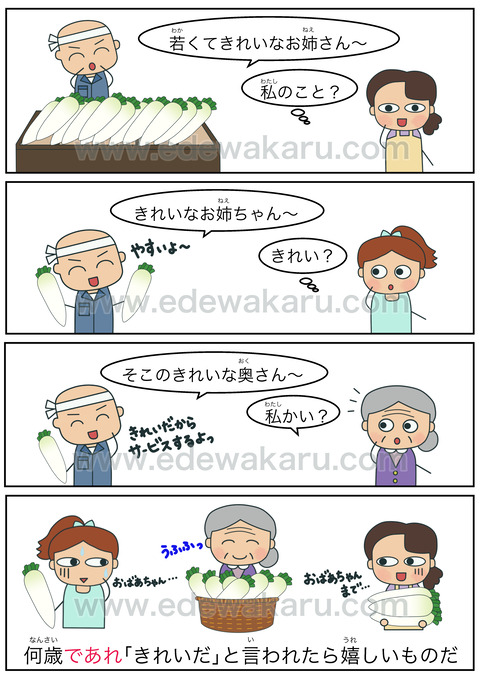
Meaning
〜でも
〜であっても
How to use it
名詞[辞書形]+であれ
名詞[辞書形]+であろうと
Explanation
「〜であれ」は「〜でも」「〜であっても」という意味の文型です。この文型は「どんな」や「たとえ」などとよく一緒に使われ、
話者の意見や判断、推量を言う時
に使われます。「〜であれ」は
「〜であろうと」
にチェンジすることができます。
[例]
何歳
であれ
「きれいだ」と言われたら嬉しいものだ
=何歳
であろうと
「きれいだ」と言われたら嬉しいものだ
関連文型に「〜であれ〜であれ」がありますので、一緒に覚えておきましょう😊
In context 5 examples
何歳であれ「きれいだ」と言われたら嬉しいものだ
→何歳でも「きれいだ」と言われたら嬉しいものだ理由が何であれ、うそをつくのはよくない
→理由が何でも、うそをつくのはよくない誰であれ、人には言えない秘密を持っているだろう
→誰であっても、人には言えない秘密を持っているだろうどんな悪い状況であれ、あきらめないことが大切だ
→どんな悪い状況でも、あきらめないことが大切だたとえ仲がいい友達であれ、お金の貸し借りはしないほうがいい
→たとえ仲がいい友達であっても、お金の貸し借りはしないほうがいい*「貸し借り」とは、お金を貸したり借りたりすることです
Usage 2
Read this source entry ↗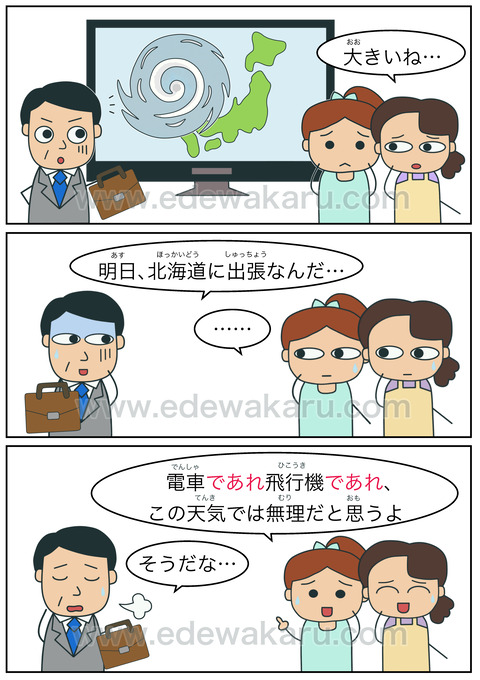
Meaning
〜でも〜でも、どちらの場合でも
How to use it
名詞[辞書形]+であれ+名詞[辞書形]+であれ
名詞[辞書形]+であろうと+名詞[辞書形]+であろうと
Explanation
「AであれBであれC」は「AでもBでも、どちらの場合でもC」という意味の文型です。この文型は
「A・Bどちらの場合でもCなのは変わらない」
と言いたい時に使われます。「〜であれ〜であれ」は
「〜であろうと〜であろうと」
にチェンジすることができます。
[例]
電車
であれ
飛行機
であれ、この天気では無理だと思うよ
=電車
であろうと
飛行機
であろうと、この天気では無理だと思うよ
「〜であれ〜であれ」は、少しかたい言い方ですが会話でも使われますので覚えておきましょう😊
【関連文型】
In context 5 examples
電車であれ飛行機であれ、この天気では無理だと思うよ
→電車でも飛行機でも、どちらの場合でも無理だと思うよ晴れであれ雨であれ、イベントは予定通り行います
→晴れでも雨でも、どちらの場合でも予定通り行います大人であれ子供であれ、人に迷惑をかけてはいけない
→大人も子供も、どちらも人に迷惑をかけてはいけない学生であれ先生であれ、遅刻をするべきではない
→学生も先生も、どちらも遅刻をするべきではない彼女はケーキであれクッキーであれ、甘いものには目がない
→ケーキでもクッキーでも、甘いものには目がない
どんなときどう使う 日本語表現文型辞典
Usage 1
Meaning
whether it is…or…
How to use it
N+であれ+N+であれFW
Explanation
であれ~であれ
~でも~でも
1)「~でも~でも」と例をいくつかあげて「その全部に当てはまる」と言いたいときに使う。
2)同様の意味を持つ「にしても~にしても・にしろ~にしろ・にせよ~にせよ」よりも硬い言い方。
2)More formal than expressions of same meaning, such asにしても~にしても, にしろ~にしろ, and にせよ~にせよ.
1)Judgment applies to all examples listed.
In context 4 examples
着るものであれ食べるものであれ、むだな買い物はやめたいものです。
物理学であれ化学であれ、この国は基礎研究が遅れている。
学校教育であれ家庭教育であれ、長い目で子どもの将来を考えた方がいい。
論文を書くのであれ、研究発表をするのであれ、十分なデータが必要だ。
Usage 2
Meaning
regardless of
How to use it
N+であれFW
Explanation
~でも
1)「~であれ」の形で、「~に関係なく」という意味で使う。後の文には「事態は同じだ」という意味の文が来る。話者の主観的判断や推量を表す文が来ることが多い。
2) ❷ のように「N1であれN2であれ」の形もある。「たとえ~であれ・疑問詞~であれ」の形で使うことが多い。
2)As in sentence ❷ , variation N1 であれ N2 であれ is used. Patterns たとえ~であれ, and interrogative~であれ are also common.
1)"No relationship to." Clause following signifies situation stays same regardless of what is listed in preceding clause. Often speaker's subjective judgment or conjecture follows.
In context 3 examples
命令されたことが何であれ、きちんと最後までやらなければならない。
たとえ相手が大臣であれ、一市民であれ、自分の意見をはっきり言うべきだ。
どんな国であろうと、教育を重視しない国は発展しない。
毎日のんびり日本語教師
How to use it
名詞+であれ(+名詞+であれ)
名詞+であろうと(+名詞+であろうと)
名詞+だろうが(+名詞+だろうが)
名詞+であろうが(+名詞+であろうが)
名詞+であろうとなかろうと
Explanation
2つの代表的なものを挙げて、どのような条件や状況であろうと変わらない、関係ない、影響しないことを表します。
Notes
特になし
In context 8 examples
大人であれ子供であれ、人に迷惑をかけてはいけない。
晴れだろうが、雨だろうが、運動会は決行します。
正社員であろうと、アルバイトであろうと、仕事に対する責任は変わらない。
どんな理由であれ、君に責任があることに変わりはない。
人は男性であろうが女性であろうが、男性ホルモン、女性ホルモンの両方を持っている。
最愛の人を殺されたら、そいつを自分の手で殺してやる。法律だろうが何だろうが関係ない。
宇宙の終わりがあろうとなかろうと、我々人類はそれを見ることはできないだろう。
それが故意であろうとなかろうと、実害が出ている以上許されない。
日本語文型辞典 英語版
Meaning
【であれ】[NであれNであれ]
Means “in either case.” Usually followed by an expression to indicate that either way makes no difference to the matter. Can be replaced by ...であろうと...であろうと. Used in formal spoken language or written language. Nouns are usually used, but occasionally na-adjectives are, too. For i-adjectives, the ...かれ...かれ form, as in あつかれ、さむかれ (whether it’s hot or cold) or よかれ、あしかれ (whether it’s good or bad), is used.
In context 4 examples
晴天であれ、雨天であれ、実施計画は変更しない。
If the weather is sunny or rainy, the plan to be implemented will not change.
貧乏であれ、金持ちであれ、彼にたいする気持ちは変わらない。
Whether he’s rich or poor, I won’t change my feelings towards him.
試験の時期が春であれ秋であれ、準備の大変さは同じだ。
Whether the examination is in the spring or the fall, the hardship of the preparation is the same.
アジアであれ、ヨーロッパであれ、戦争を憎む気持ちは同じはずだ。
Whether Asia or Europe, feelings of hatred toward wars are likely the same.
AIUEO JLPT Grammar
Usage 1
Meaning
This sentence pattern expresses that no matter the situation or condition, one will act without being influenced. It emphasizes strong will or belief, showing that one’s actions or decisions remain unchanged regardless of the other person’s position or situation.
How to use it
名詞で+あれ名詞で+あろうと
Explanation · 日本語
この文型は、たとえどのような状況や条件でも、それに左右されずに何かを行うことを表すときに使われます。強い意志や信念を示す場合が多く、相手の立場や状況に関係なく自分の行動や決意が変わらないことを強調します。
In context 5 examples
どんな困難であろうと、私は諦めない。
No matter what difficulties I face, I won’t give up.
結果がどうであれ、全力を尽くすつもりだ。
No matter the result, I intend to do my best.
理由が何であれ、時間を守るべきだ。
No matter the reason, you should be punctual.
彼が上司であれ、間違ったことには反対するべきだ。
Even if he is the boss, you should oppose what is wrong.
それが法律であろうと、納得できないものには従えない。
Even if it’s the law, I can’t follow something I can’t agree with.
Usage 2
Meaning
This sentence pattern expresses that no matter which of the two matters, the result or situation will be the same. It emphasizes that no matter which option is chosen, some facts or conclusions remain unchanged.
How to use it
名詞であれ+名詞であれ
Explanation · 日本語
この文型は、二つの事柄を並べて、どちらであっても同じ結果や状況が適用されることを示す表現で、どの選択肢であっても、何らかの事実や結論が変わらないことを強調するときに使われます。
In context 5 examples
大人であれ子供であれ、このルールは守らなければならない。
Whether you’re an adult or a child, you must follow this rule.
雨であれ晴れであれ、明日のイベントは予定通り行われる。
Whether it rains or shines, tomorrow’s event will proceed as scheduled.
貧乏であれ金持ちであれ、幸せを感じるかどうかは人それぞれだ。
Whether you’re poor or rich, feeling happy is up to each person.
朝であれ夜であれ、緊急の連絡にはすぐに対応するべきだ。
Whether it’s morning or night, you should respond to urgent messages immediately.
プロであれアマチュアであれ、全力を尽くすことが大切だ。
Whether you’re a professional or an amateur, it’s important to give your best.
Bunpro Grammar Reference
Usage 1
Meaning
Even if, Even, No matter
How to use it
Noun + であれ
[な]Adjective + であれ
WH-Word + であれ
Nuance
A formal, imperative phrase, indicating that whether something exists as (A) or not, nothing will change.
Explanation
Functioning as an extension of である, the formal copula that is a combination of the conjunctive form of the auxiliary verb だ, and the う-Verb ある, であれ or であろうと will be used in order to express strong will or conviction.
あれ is simply the imperative form of ある, while あろうと is the positive volitional form combined with the case-marking particle と. Both structures are usually translated as 'even if (A), (B)', or 'no matter if (A), (B)'. Despite this, the more literal meaning of each is closer to 'so it's (A), (B) still won't be affected'. This just emphasizes the fact that (A) is of no relation to the result, like saying 'so what if it is' in English.
Both であれ and であろうと will primarily attach to nouns in sentences that express some kind of question or assumption through words like どんな or たとえ.
子供であれ、法律は守らなくてはいけない。
Even if you are a child, you still need to obey the law.
理由が何であれ、家族や友達を裏切るのはよくないと思う。
No matter the reason, I don't think it is right to betray your family and friends.
いくらあなたが年上であろうと、ここでは一応私が先輩なので私の言うことに従ってください。
No matter how much older you are, I am your superior here so please do as I say.
上司からのメール:「インフルエンザであろうと、会社には来てください。」
Email from one's boss: 'Even if you have the flu, please come to work.'
As both であれ and であろうと use structures that indicate strong will, these grammar patterns will frequently be used in sentences where the speaker is expressing their opinions or resolutions.
Nuance · 日本語
(A)という形で存在していてもしていなくても、何も変わらないということを強調する丁寧な命令形の表現。
Explanation · 日本語
「であれ」と「であろうと」は、助動詞「だ」の連用形に五段動詞「ある」が組み合わさってできた、硬めの表現です。どちらも、強い意志や確信を表すときに使われます。
「あれ」は「ある」の命令形で、「あろうと」は意向形「あろう」に格助詞「と」が付いた形です。どちらも「たとえ (A) でも (B) だ」といった意味で使われ、(A) がどのようなものであっても、 (B) の結果は変わらないことを強調します。
「であれ」と「であろうと」は名詞に続けて使われます。「どんな」や「たとえ」といった仮定や疑問を表す語句と一緒に使われることが多いです。
子供であれ、法律は守らなくてはいけない。
Even if you are a child, you still need to obey the law.
理由が何であれ、家族や友達を裏切るのはよくないと思う。
No matter the reason, I don't think it is right to betray your family and friends.
いくらあなたが年上であろうと、ここでは一応私が先輩なので私の言うことに従ってください。
No matter how much older you are, I am your superior here so please do as I say.
上司からのメール:「インフルエンザであろうと、会社には来てください。」
Email from one's boss: 'Even if you have the flu, please come to work.'
「であれ」も「であろうと」も強い意志を表すため、話し手が自分の意見や決意を表明するときによく使われます。
In context 16 examples
- 誰であれ全ての人々は同様に死ぬ。
No matter who you are, all people die similarly.
- 子供であれ、法律は守らなくてはいけない。
Even if you are a child, you still need to obey the law.
- 理由が何であれ、家族や友達を裏切るのはよくないと思う。
No matter the reason, I don't think it is right to betray your family and friends.
- いくらあなたが年上であろうと、ここでは一応私が先輩なので私の言うことに従ってください。
No matter how much older you are, I am your superior here so please do as I say.
- 上司からのメール:「インフルエンザであろうと、会社には来てください。」
Email from one's boss: 'Even if you have the flu, please come to work.'
- 小説:「どのような状況であれ、逃げることは許されない。」
Novel: 'No matter the circumstances, running away is unforgivable.'
- 何であれ、両親にとっては我が子はいつも愛する我が子。
No matter what, from a parent's point of view, their child is always their beloved child.
- たとえ小さなものであれ検察官は賄賂を受け取るわけにはいかない。
Even if it is just a small thing, the public prosecutor must not accept a bribe.
- たとえ氷のように純粋であれ、世界の悪からは免れられないだろう。
Even if one is as pure as ice, it seems that one cannot avoid the evil of the world.
- 大人であれ、時にお菓子でお腹を一杯にしたい時もあるものだ。
Even if you're an adult, it's just a fact that you sometimes want to completely stuff yourself with snacks.
- 友人の家であれ、訪問時は靴を脱ぐことが、基本的な礼儀です。
Even if it is a friend's house, taking shoes off when visiting are basic manners.
- 犯人が未成年であれ、そのような凶悪な犯罪を犯したのなら罰するべきです。
No matter whether the perpetrator is underaged, if they committed such a brutal crime, they must be punished.
- どんな理由であれ、大切な人を裏切るような行為をしたのなら許されないと思うべきだ。
No matter what kind of reason there is, if you've been conducting yourself in a way that betrays those important to you, you ought to assume that you won't be forgiven.
- 何歳であれ褒められると嬉しいのは変わらない。だからどんどん僕の事を褒めて欲しい。
No matter what age, that I will be happy upon getting complimented will not change. Because of that, I want you to compliment me more and more.
- どんなに真っ当に生きている人であれ、人に言えない秘密が一つや二つはあるでしょう。
Even if they are a person that lives respectably, they still have one or two secrets that they can't tell anyone, right?
- たとえ十年以上の付き合いであれ、自分以外の人には常に敬意を持って接するべきである。
Even if you were dating for over 10 years, for instance, you must always treat someone other than yourself with respect.
Usage 2
Meaning
Whether or, Or, No matter which, In either case
How to use it
Noun (A) + であれ + Noun (B) + であれ
[な]Adjective (A) + であれ + [な]Adjective (B) + であれ
Nuance
A formal, imperative construction, implying that whether something exists as (A) or whether it exists as (B), nothing will change.
Explanation
Functioning as an extension of である, the formal copula that is a combination of the conjunctive form of the auxiliary verb だ, and the う-Verb ある, であれ or であろうと will be used in order to express strong will or conviction.
あれ is simply the imperative form of ある, while あろうと is the positive volitional form combined with the case marking particle と. Both structures are usually translated as 'even if (A), (B)', or 'no matter if (A), (B)'. Despite this, the more literal meaning of each is closer to 'so it's (A), (B) still won't be affected'. This just emphasizes the fact that (A) is of no relation to the result, like saying 'so what if it is' in English.
When used consecutively, であれ shows that regardless of whether something is (A) or (B), the result of (C), will not change.
Both であれ and であろうと will primarily attach to nouns in sentences that express some kind of question or assumption through words like どんな or たとえ.
子供であれ大人であれ、入場料は4000円です。
Whether you are a child or an adult, the entrance fee is 4000 yen.
日本製であれベトナム製であれ同じ機械でできてるから質に変わりはない。
Whether it is made in Japan or Vietnam, it is made with the same machine, so there is no difference in the quality.
正社員であろうとアルバイトであろうと、客には関係がない話だ。
Whether someone is a full time worker or a part time worker doesn't matter to a customer.
未経験者であろうとベテランであろうと、この現場に入るにはこの講習を受けなくてはいけないです。
Whether you are inexperienced or experienced, you must take this course to enter this work site.
Caution
Although ~であれ~であれ implies 'no matter whether it is (A) or (B)', both (A) and (B) in these types of sentences usually fall under the same category, as (C) needs to be something that links them logically. For example (A) may be 'a plane', and (B) may be 'a submarine', while (C) will be describing something about them both being vehicles.
Nuance · 日本語
たとえ(A)として存在していても(B)として存在していても、何も変わらないということを示す丁寧な表現。
Explanation · 日本語
「であれ」や「であろうと」は、助動詞「だ」の連用形と五段動詞「ある」を組み合わせた「である」からできた、少し硬い表現です。「あれ」は「ある」の命令形で、「あろうと」は「ある」の意向形に格助詞の「と」が付いたものです。
どちらも「たとえ (A) でも (B) だ」といった意味で、(A) という条件は、(B) という結果に何の影響も与えないことを強調するために使われます。また、話し手に強い意志や信念があるときによく使われます。
「であれ」が二回続けて使われる場合は、「たとえ (A) でも (B) でも、(C) だ」という意味になります。
「であれ」と「であろうと」はどちらも名詞に接続します。また、「どんな」や「たとえ」などの語句を伴った、疑問や仮定を表す文の中で使われることが多いです。
子供であれ大人であれ、入場料は4000円です。
Whether you are a child or an adult, the entrance fee is 4000 yen.
日本製であれベトナム製であれ同じ機械でできてるから質に変わりはない。
Whether it is made in Japan or Vietnam, it is made with the same machine, so there is no difference in the quality.
正社員であろうとアルバイトであろうと、客には関係がない話だ。
Whether someone is a full time worker or a part time worker doesn't matter to a customer.
未経験者であろうとベテランであろうと、この現場に入るにはこの講習を受けなくてはいけないです。
Whether you are inexperienced or experienced, you must take this course to enter this work site.
注意点
「~であれ~であれ」が「たとえ (A) でも (B) でも (C) だ」という意味で使われる場合、(A) と (B) には同じカテゴリーに属するものが入り、また (C) にはそれらと論理的に結びつく内容が入る必要があります。例えば、(A) が飛行機で、(B) が潜水艦の場合、(C) の内容はその両方が乗り物であることに関連するものになります。
In context 16 examples
- 近代美術であれ伝統芸能であれ、芸術は芸術だ。
Whether it is modern art or traditional art, art is art.
- 正社員であろうとアルバイトであろうと、客には関係がない話だ。
Whether someone is a full time worker or a part time worker doesn't matter to a customer.
- 未経験者であろうとベテランであろうと、この現場に入るにはこの講習を受けなくてはいけないです。
Whether you are inexperienced or experienced, you must take this course to enter this work site.
- 子供であれ大人であれ、入場料は4000円です。
Whether you are a child or an adult, the entrance fee is 4000 yen.
- 日本製であれベトナム製であれ同じ機械でできてるから質に変わりはない。
Whether it is made in Japan or Vietnam, it is made with the same machine, so there is no difference in the quality.
- 遺伝情報とは、人間であれバナナであれ、すべて同じようにDNA(ディーエヌエー)に組み込まれているものだ。
Whether it is in a human or in a banana, genetic information is something that is similarly encoded in DNA.
- 人は無病息災であれ、病気であれ、常に健康に注意が必要です。
Whether someone is healthy or ill, they should take care of their health.
- 本ウェブサイト、故意に、オンラインであれオフラインであれ、ユーザからの個人情報を収集しません。
Whether online or offline, this website does not knowingly collect personal information from users.
- 勉強であれスポーツであれ何であれ、結果は注いできた努力次第である。
Whether it is studying, sports, or whatever, results depend on the effort one has put in.
- アプリからの通知:「プラスなものであれマイナスなものであれ、あなたのフィードバックが欲しいです!」
App notification: 'Whether it is negative or positive, we want your feedback!'
- 彼がお金持ちであれ貧乏であれ、私の彼に対する気持ちは変わりません。
Whether he is rich or poor, my feelings toward him will not change.
- 雨であれ雪であれ、僕は何としてでも今週末に遊園地に行くつもりだ。
No matter if it is rain or snow, I intend to do whatever it takes to go to the amusement park this weekend.
- 加害者が子供であれ大人であれ、僕はどちらも同じ刑罰を受けるべきだと考えている。
I think that the accused should receive the same penalty, whether they are an adult or a child.
- ゲームであれダジャレであれ、何かに突出した才能があることはとても良い事です。
No matter whether it is gaming or telling dad jokes, having any ability that sticks out is really great!
- ドラマであれ映画であれ、何かスリリングな気持ちを味わえるような作品を教えてくれませんか?
Regardless of whether it is a drama or a movie, would you mind telling me a show where I can taste a bit of a thrill?
- 本であれ漫画であれ、紙媒体で物語や説明文を読む活動は幼少期に欠かせないものである。
Whether it is a novel or manga, the act of reading stories or explanatory books via printed media is crucial in ones younger years.
NINJAL 日本語文型データベース
Usage 1
Meaning
〜の場合もそれに影響されないという話し手の判断や決意を述べるときに使います。「~」に疑問詞(「何・どこ・だれ」など)がくるときは、どのような条件の場合にも同じ結果になることを表します。
How to use it
na-Aであれ
Nであれ
その他
Notes
「〜」には、極端な場合を表す言葉がきます。「~」は事実でも仮定のことでもいいです。「~であれ」の後には話し手の判断、意志などを表す文がきます。
In context 14 examples
難しい病気らしいが、たとえわずかであれ、快復の望みがあるなら私は諦めない。
うちの祖母は、周りの人がどんなに不機嫌であれ少しも気にせず、いつもにこにこしている。
たとえ無意識であれ、国会議員の失言は許されないと思う。
どんなに手軽であれ、私はコンビニやスーパーで売っている総菜は買わない。面倒でも自分で作る。
たとえ大富豪であれ、国の領土をすべて買い取ることはできないだろう。
たとえわずかなことであれ、社会貢献できることは私の喜びです。
どんなブランド品であれ、流行遅れのものに価値があるとは思えない。
たとえ1人であれ、私のことを理解してくれる人がいればうれしい。
どれほど小さな疑問であれ、これからは恥ずかしがらずに質問することにしたい。
山田さんは、いかに難しい課題であれ、前向きに取り組む努力家だ。
理由が何であれ、無断で会議を欠席してはいけないと思う。
この先、社会情勢はかなり厳しいと思う。しかし、たとえそうであれ、希望を失いたくない。
世間体はどうであれ、好きなことをして生きていきたい。
兄は何をするのであれ、周到に準備する。慎重な性格なのだ。
Usage 2
Meaning
結果に違いがあるように思える2つの条件を挙げて、どちらの条件でも同じことが言えると言いたいときに使います。
「〜であれ[疑問詞]+であれ」の形も使い、同じような条件なら全部同じことが言えることを表します。
How to use it
N1であれN2であれ
Notes
2つの「〜」には異なる品詞がくる場合もあります。
「~」には、意味的に関連のある言葉、または対立する意味の言葉がきます。「~であれ~であれ」の後には、「〜」のどちらにも共通する話し手の判断を表す文がきます。
「〜であれ」は1文中にふつう2つですが、3つ以上のこともあります。
In context 8 examples
金持ちであれ貧しい人であれ、人は死からは逃れられない。
大人であれ子どもであれ、嫌なものは嫌だし、やりたくないことはやりたくないのだ。
正社員であれ非正規社員であれ、仕事には責任感を持って取り組まなければならないのは同じだ。
雨であれ雪であれ今日は出かけなければならない。
子どものころは、親の言うことであれ先生の言うことであれ、大人の言うことはすべて正しいと思っていた。
興味がないことであれやる気がしないことであれ、引き受けたのなら最後までやるべきです。
起業するのであれNPOを立ち上げるのであれ、周到な準備が必要だ。
我が社は中国であれアメリカであれどこであれ、利益が期待できる国には支店を作る方向で考えている。
文法
Meaning
〜でも〜でも・・・だ。例を挙げて、「どちらの場合でも・・・だ」と言いたい時に使う。
How to use it
N1 + であれ + N2 + であれ
In context 7 examples
大人であれ子供であれ、ルールを破ってはいけない。
対戦相手がフランスであれスペインであれ、頑張れば勝てる見込みはある。
着るものであれ食べるものであれ無駄にしてはならない。
彼がお金持ちであれ貧乏であれ、私の気持ちが変わることはない。
オクラであれ納豆であれ、ネバネバしたものはとにかく嫌いだ。
ギターであれベースであれ、キムさんは弦楽器であれば何でも上手に弾いてしまう。
車であれ電車であれこの天候では無理だろう。
日本語NET JLPT文法解説まとめ
Meaning
"〜でも〜でも・・・だ。"
例を挙げて、「どちらの場合でも・・・だ」と言いたい時に使う。
"Whether it's A or B, ..."
Used to say "in either case, ..." and is often employed when providing examples to emphasize that the outcome or situation remains the same regardless of the specific conditions.
How to use it
N1 + であれ + N2 + であれ
In context 7 examples
大人であれ子供であれ、ルールを破ってはいけない。
対戦相手がフランスであれスペインであれ、頑張れば勝てる見込みはある。
着るものであれ食べるものであれ無駄にしてはならない。
彼がお金持ちであれ貧乏であれ、私の気持ちが変わることはない。
オクラであれ納豆であれ、ネバネバしたものはとにかく嫌いだ。
ギターであれベースであれ、キムさんは弦楽器であれば何でも上手に弾いてしまう。
車であれ電車であれこの天候では無理だろう。