AIUEO JLPT Grammar
Meaning
This sentence pattern emphasizes the reason or cause, particularly showing that the result is brought about by this reason. It is often used when the speaker is providing a subjective thought or special reason for something.
How to use it
普通文+からこそ
Explanation · 日本語
この文型は、理由や原因を強調して、特にその理由で結果が導かれるということを表す表現です。話し手の主観的な思いや特別な理由を述べるときによく使われます。
In context 5 examples
努力したからこそ、目標を達成できた。
It is exactly because of your hard work that you achieved your goal.
難しかったからこそ、成長できた。
It is precisely because it was difficult that I was able to grow.
信頼しているからこそ、あなたにこの仕事を任せます。
It’s because I trust you that I’m giving you this task.
失敗したからこそ、成功の喜びを感じられる。
It is because of the failure that I can appreciate the joy of success.
この仕事が好きだからこそ、どんな困難にも負けずに頑張れる。
It is exactly because I love this job that I can persevere through any difficulty.
Bunpro Grammar Reference
Meaning
Emphasized because, Precisely because
How to use it
Verb + からこそ + Phrase
Noun + だ + からこそ + Phrase
Nuance
A phrase emphasizing that precisely from (A), (B). In a similar way to capitalizing a word in English.
Explanation
Traditionally, the adverbial particle こそ is used to emphasize whatever noun (or noun phrase) it is attached to. However, when combined with the conjunction particle から, it focuses on emphasizing the 'reason' for something. This structure is very similar to phrases like 'precisely because (A)' in English.
からこそ is an expression that is primarily used after either verbs or nouns. In the case of nouns, the noun will need to be followed by the auxiliary verb だ, before からこそ is added.
俺は努力したからこそ、試験に合格できたんだよ。頭がいいからだけじゃないよ。
I was able to pass the test, precisely because I gave it my all. It's not only because I am smart.
先輩に色々と教えて貰ったからこそ、私はここまでこれたのです。
I was able to get to where I am now because of all the things you, senpai, have taught me.
君だからこそできたんだよ。俺にはまだそんな凄い事は出来ない。
You were able to do it precisely because it was you. I can't do anything that amazing yet.
ここは綺麗な川だからこそ、こんな美味しい魚が釣れるんですよ。
You can catch great fish here precisely because the river is so clean.
With からこそ, there may be several reasons for why something is the way it is, but こそ will show that there is a 'foremost' reason that should be considered before anything else.
タナカ君が休みなのに仕事に来てくれたからこそ、準備が早く終わったり、締め切りまでに仕事を終わらせることができたんです。
We were able to finish with the prep work and finish work by the deadline, precisely because you, Tanaka-kun, came into work even though it was your day off.
Nuance · 日本語
(A)だから(B)であるということを強調する表現。英語で単語を大文字で表すのと似ている。
Explanation · 日本語
「こそ」は、名詞(または名詞句)を強調するために使われる副助詞です。これに接続助詞の「から」が付くと、「理由」を強調するときの表現になります。
「からこそ」は、主に動詞や名詞のあとに付けて使われます。名詞と一緒に使う場合は、名詞のあとに「だ」に付けて、「だからこそ」という形にします。
俺は努力したからこそ、試験に合格できたんだよ。頭がいいからだけじゃないよ。
I was able to pass the test, precisely because I gave it my all. It's not only because I am smart.
先輩に色々と教えて貰ったからこそ、私はここまでこれたのです。
I was able to get to where I am now because of all the things you, senpai, have taught me.
君だからこそできたんだよ。俺にはまだそんな凄い事は出来ない。
You were able to do it precisely because it was you. I can't do anything that amazing yet.
ここは綺麗な川だからこそ、こんな美味しい魚が釣れるんですよ。
You can catch great fish here precisely because the river is so clean.
「からこそ」は、いろいろな理由がある中で、特に大事な理由を強調したいときに使われます。
タナカ君が休みなのに仕事に来てくれたからこそ、準備が早く終わったり、締め切りまでに仕事を終わらせることができたんです。
We were able to finish with the prep work and finish work by the deadline, precisely because you, Tanaka-kun, came into work even though it was your day off.
In context 17 examples
- あなたがいるからこそ、安心できるんです。
Precisely because you're here is why I can relax.
- 先輩に色々と教えて貰ったからこそ、私はここまでこれたのです。
I was able to get to where I am now because of all the things you, senpai, have taught me.
- 俺は努力したからこそ、試験に合格できたんだよ。頭がいいからだけじゃないよ。
I was able to pass the test, precisely because I gave it my all. It's not only because I am smart.
- ここは綺麗な川だからこそ、こんな美味しい魚が釣れるんですよ。
You can catch great fish here precisely because the river is so clean.
- 君だからこそできたんだよ。俺にはまだそんな凄い事は出来ない。
You were able to do it precisely because it was you. I can't do anything that amazing yet.
- タナカ君が休みなのに仕事に来てくれたからこそ、準備が早く終わったり、締め切りまでに仕事を終わらせることができたんです。
We were able to finish with the prep work and finish work by the deadline, precisely because you, Tanaka-kun, came into work even though it was your day off.
- 仲間がいるからこそ、頑張れる。
I can do my best precisely because I have friends.
- 難しい状況だからこそ生まれるアイデアもある。
There are also ideas that are born precisely because of difficult situations.
- 君が励ましてくれたからこそ、ここまでやってこれたんだ。
I could make it this far precisely because you have given me so much support.
- 毎日努力をしたからこそ、一番になれた。
Precisely because I worked hard every day, I was able to become number one.
- 君の手伝いがあったからこそ、大きな石を動かすことができた。
Precisely because you helped, we were able to move the large rock.
- 操作が簡単だからこそ、お年寄りにも人気がある。
That is even popular among the elderly precisely because it is easy to control.
- お父さんが一生懸命働いているからこそ、何不自由なく暮らせている。
We can live in comfort precisely because dad works hard.
- 昨日までの苦労があったからこその達成感だ。
It feels great precisely because I had been putting so much effort into it until yesterday. (emphasis)
- 彼女がいたからこそ、兎を捕まえることができた。
I was able to catch the rabbit precisely because she was there.
- 毎日運動をしているからこそ、健康でいられるのだ。
I can stay healthy precisely because I exercise every day.
- あなたが案内してくれたからこそ、楽しい旅行ができた。
Precisely because you were our guide, we were able to enjoy our trip.
どんなときどう使う 日本語表現文型辞典
Meaning
it is precisely because; that
How to use it
〔普通形〕+からこそ
Explanation
~から
1)二つの使い方がある。 ❶ ~ ❸ のように「~からこそ、…」の形で、「~」がただ一つの理由であり、それを強調したいときに使う。「~からこそ…のだ」の形で使うことが多い。マイナスの意味での強めにはあまり使われない。
2)もう一方は ❹ ❺ のように、常識に反する理由だがその理由を特に言いたいときの使い方。
1)Two uses. One emphasizes reasons solely responsible for something, as in sentences ❶ to ❸ . Often found in pattern ~からこそ…のだ. Not used much to stress negative aspects.
2)Second usage as in sentences ❹ and ❺ , when someone wants to stress reason that goes against common sense.
In context 5 examples
あなただからこそお話しするのです。ほかの人には言いません。
彼は数学や英語の成績がよかったからこそ、合格できたのでしょう。
先生に手術をしていただいたからこそ、再び歩けるようになったのです。
あの子のことをかわいいと思っているからこそ、厳しくしつけるのです。
雨だからこそ、うちにいたくない。雨の日にうちにいるのは寂しすぎる。
絵でわかる日本語
Meaning
〜だから
How to use it
動詞・形容詞・名詞[普通形]+からこそ
*な形容詞・名詞の現在肯定形
な形容詞・名詞[辞書形]+だからこそ
Explanation
「〜からこそ」は「まさに〜だから」という意味で使われます。[理由]を表す「から」と[強調]を表す「こそ」でできていて、[大切な理由][特別な理由]を[強調]したい時に使われます😊後ろには
「〜のだ」「〜んだ」
をよく使います。マイナスのことを強調することはほとんどありません。この文型は話者の意見・考え・判断に使われますので、客観的判断(きゃっかんてきはんだん)や事実に使うことはできません。
❌事故があった
からこそ、電車が遅れた
⭕️事故があった
から、電車が遅れた
❌今、日本は朝の10時だ
からこそ
ニューヨークは夜の8時だ
⭕️今、日本は朝の10時だ
から
ニューヨークは夜の8時だ
[強調]を表す「〜こそ」を復習しておきましょう😀
In context 6 examples
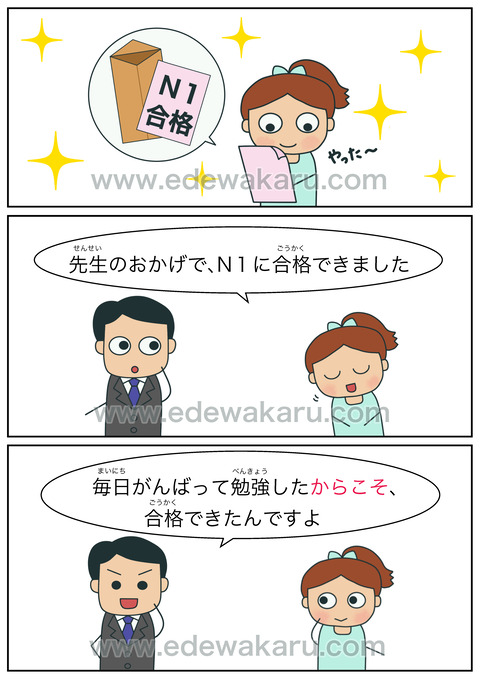
学生:先生のおかげでN1に合格できました先生:毎日がんばって勉強したからこそ、合格できたんですよ
→がんばって勉強したから、合格できたんですよ【「がんばって勉強した」ことを強調】A:そのバッグ、高すぎるよ…本当に買うの?B:毎日使うものだからこそ、いいものを買いたいの
→毎日使うものだから、いいものを買いたいの【「毎日使うものだ」ということを強調】あなたのことを心配しているからこそ、注意しているのよ
→あなたのことを心配しているから、注意しているのよ【「あなたのことを心配している」ということを強調】親友だからこそ、何でも言い合ってケンカもできるんだ
→親友だから、なんでも言い合ってケンカもできるんだ【「親友だ」ということを強調】この仕事は、大変だからこそやりがいがあるんだよ
→大変だから、やりがいがあるんだよ【「この仕事は大変だ」ということを強調】傷付けたくないからこそ、うそをつくこともあるんだよ
→傷つけたくないから、うそをつくこともあるんだよ【「傷付けたくない」ということを強調】
日本語文型辞典
Meaning
基本情報N/Na だからこそA/V からこそ説明理由や原因を取り立てて特に強調する言い方。「のだ」と共に使うことが多い。理由に「こそ」が付くのは「ほかでもないそのことが」という特に強い気持ちがあるときで、因果関係を客観的に示す場合などには使えない。文末が「…のだ」で結ばれることが多い。例文① これは運じゃない。努力したからこそ成功したんだ。② A:君はぼくを正当に評価していない。
B:評価しているからこそ、もっとまじめにやれと言っているんだ。③ 愛が終わったから別れるのではなく、愛するからこそ別れるという場合もあるのだ。④ 忙しくて自分の時間がないという人がいるが、私は忙しいからこそ時間を有効に使って自分のための時間を作っているのだ。例文(誤) 今、東京は朝の9時だからこそ、ロンドンは夜中の12時だ。例文(正) 今、東京は朝の9時だから、ロンドンは夜中の12時だ。
日本語文型辞典 英語版
Meaning
【からこそ】[N/Na だからこそ][A/V からこそ]
B:評価しているからこそ、もっとまじめにやれと言っているんだ。
It’s precisely because I think so much of you that I’m telling you to try even harder.
An expression that focuses on and emphasizes the reason or cause for something. Often used with のだ. Addition of こそ conveys the strong conviction of the speaker with respect to the reason expressed in the preceding phrase, so this pattern cannot be used to express a cause-effect relation objectively. のだis often used to end the sentence.
(×)今、東京は朝の9時だからこそ、ロンドンは夜中の 12 時だ。
Just because it’s nine o’clock in the morning in Tokyo, it’s midnight in London.
(○)今、東京は朝の9時だから、ロンドンは夜中の 12 時だ。
Now it’s nine o’clock in the morning in Tokyo, so it’s midnight in London.
In context 4 examples
これは運じゃない。努力したからこそ成功したんだ。
This wasn’t just luck. It’s because I made an effort that I succeeded.
A:君はぼくを正当に評価していない。
You’re not giving me a fair evaluation.
愛が終わったから別れるのではなく、愛するからこそ別れるという場合もあるのだ。
There are times when a couple breaks up not because their love is gone but because they still do love each other.
忙しくて自分の時間がないという人がいるが、私は忙しいからこそ時間を有効に使って自分のための時間を作っているのだ。
Some people say that they’re too busy and don’t have time for themselves, but it’s just because I am so busy that I make the best use of time and also make time for myself.
毎日のんびり日本語教師
How to use it
名詞+だからこそ
な形容詞語幹+だ/である+からこそ
い形容詞普通形+からこそ
動詞普通形+からこそ
Explanation
理由や原因を強調する文法です。
理由はまさにそれであり、それ以外ではないというニュアンスを持ちます。
主に良い内容に用い、主観的な判断に基づくものです。
Notes
特になし
In context 8 examples
普段こういったことは言わないけど、好きな人だからこそ言っておきたかった。
雨だからこそ、テンション上げて行こう。(正是因为下雨才更要情绪高涨。)
目的があるからこそ、達成や失敗がある。
分かりあってるからこそ言い合える。
非常事態だからこそ力を合わせるべきだ。
能力があるからこそ彼にはリーダーをしてほしいと思っている。
あの時の努力があるからこそ今の結果がある。
気持ちが分かるからこそ、彼女にかける言葉が見つからない。
NINJAL 日本語文型データベース
Meaning
〜だから、後のことが成り立つのだと強調して言いたいときに使います。あることが成り立つ理由を主観的に強調する言い方です。常識的な直接の理由とは考えにくいことをあえて理由として示すことも多いです。
「(〜のは)〜からこそだ。」の形で、文末にも使います。
「〜からこそのN」の形でも使います。
How to use it
V普通形+からこそ
i-A普通形+からこそ
na-A普通形+からこそ(「na-Aだ」→「na-Aである+からこそ」の形になることもある)
N普通形+からこそ(「Nだ」→「Nである+からこそ」の形になることもある)
Notes
「~からこそ」の後には、話し手の判断を表す文がきます。「〜のだ」をよく使います。
In context 23 examples
会社の先輩は、この仕事の大変さを知っているからこそ、的確なアドバイスをくれるのだ。
コンプレックスは誰にでもあります。コンプレックスがあるからこそ、乗り越えようとして頑張るのです。
時間がないからこそ、慌ててはいけない。落ち着いて行動しよう。
留学したからこそ、自分の国のことが客観的に見られるようになったのだと思う。
あのとき無理に山頂を目指さなかったからこそ助かったのだ。無理していたら、おそらく途中で身動きがとれなくなっていただろう。
学生時代、やりたかったことが思いっきりできたのは、両親が見守っていてくれたからこそだ。
被災地の人たちと話す機会があり、震災時の様子や避難先での苦労など、実際に経験したからこその生の声を聴くことができた。
高校生起業アイディアコンテストを開催します。若いからこそ生まれる発想に期待しています。
人間は、弱いからこそお互いに助け合う力を強めることで、生き延びてきたのだと言える。
スピーチの時間は1分。長くないからこそコンパクトにまとめる能力が問われる。
このドラマは特に今人気の俳優が出ているわけでもない。純粋に面白かったからこそ人気が出たのだ。
このチームはまだ結成されたばかりで、周囲の期待が大きくなかったからこそ、試合に勝てたときの選手たちの喜びは格別だった。
あの人はもちろんすばらしい俳優だが、有名人だからではなく、人柄が魅力的だからこそ、周りに人が集まるのだ。
冬は気候が寒冷であるからこそ大根などの農作物は甘みが増し、おいしく育つ。
人の命を預かる医者という仕事は、簡単ではないからこそやりがいがある。
江戸時代は長く平和だったからこそ、豊かな文化が花開いたのだと言われる。
あのころは今ほど便利ではなかったからこそ、人間らしい生活ができていたのかもしれない。
私の仕事は土日休みではないが、休みが平日だからこそできることはいろいろある。
山下動物園は下記の日程で開園時間を延長します。夜だからこそ見られる動物の生態をお楽しみください。
言葉ではなく、歌であるからこそ伝えられるメッセージがある。
日本語の研究をしているのは日本人だけではない。母語ではないからこそ気づくことも多いのだ。
今日の試合は、このメンバーだったからこそ勝てたのだと思う。すばらしいチームワークだった。
我が社の経営は、常に時代の影響を受けてきました。順風満帆な状況ではなかったからこそ我々にできることを考え、強みを見つけて生き残ることができたのだと思っています。
IMABI
The Particle こそ
Read this IMABI lesson ↗Explanation
The Particle こそ
こそ is a rather straightforward particle to understand, but its usage is a little tricky.
The Fundamentals of こそ
The first instances of こそ students learn about are set phrases like こちらこそ (likewise), 今度こそ (surely next time), and 今年こそ (surely next year). However, even these set phrases can get messed up.
1a. 今年こそ危機に瀕する言語の重要性が分かるようになりました。 X
1b. 今年になってはじめて危機に瀕する言語の重要性が分かるようになりました。〇
I’ve finally understood for the first time this year the importance of endangered languages.
2a. 彼こその努力すれば、東大に行けるでしょう。X
2b. 彼ほどの努力をすれば、東大に行けるでしょう。〇
If you strive like him, you’ll be able to go to Tokyo University.
こそ strongly emphasizes what precedes it similarly to the words “certainly” and “indeed.” It can be seen after nouns (especially those concerning people), time phrases, Verb+て, and the 連用形 of verbs.
3. 企業家精神こそ最もリスクが小さな道である。
The entrepreneurial spirit is certainly the least risky road to take.
4. 物腰こそ慇懃いんぎんだが、根は黒い。
His demeanor is indeed courteous, but his true nature is mean.
5. 明日こそ鳥は羽ばたく。
The birds will certainly flap tomorrow.
6. 今こそ始めましょう。
Let’s get started now!
7. 今度こそうまくいきますよう!
You’ll certainly do better next time!
8. まさかの時の友こそ真の友。
A friend in need is a friend indeed.
9. 今年こそ日本へ行ってみよう。
This year, indeed, let’s try going to Japan.
10. このひどい子宮から逃げようと失敗したが、今度こそこの地獄を切り抜けて自由を手に入れよう!
I failed in trying to escape this damned uterus, but next time I will definitely come clear out of this hell and attain freedom!
Sentence Note: Someone like Stewie from Family Guy would say something like this.
11. 健全な国民が存在してこそ国家が成り立つ。
A nation is born with the existence of a healthy citizen body.
12. 喜びこそすれ、怒ることはない。
There’s nothing to be angry about when you’re joyous.
Grammar Note: ~こそすれ・こそなれ・こそであれ involve the 已然形 of the verbal element that follow こそ.
13. 褒めこそすれ、非難することはない。
She does speak highly (of others), but she never criticizes.
13. 愚かな女でこそあれ、良妻賢母だなんて、とんでもない。
So long as the woman is a fool, “good wife, wise mother” means nothing.
14. 毒にこそなれ薬にはならない。
Do more harm than good.
Word Note: When you take out こそ in にこそなれ, you get the archaic copula なり.
Because こそ is so emphatic, sentences with it often end in ~だ, ~(よ)う, ~べきだ, etc. It is used a lot, but it is more common in the written language. Reasons for this include sentences like the last where traditional grammar holds on. In the spoken language, it tends to be used in statements by politicians and what not, and a few of the sentences above could definitely be used as slogans.
The particle こそ can also be paired before or after を, but this is optional and quite uncommon. It may also be paired with the particles に, へ, で, と, から, in which case it will always be preceded by these particles.
15. 山田氏{(を)こそ・こそ(を)}知事に推薦したい。
We want to recommend Mr. Yamada to the governor.
16. 日本にこそおいしい食べ物がありますよ。
There is indeed delicious food in Japan.
17. 今でこそ、嘘がつけるが、あのときは、どうもつけなかった。
Now I can absolutely lie, but at that time, I couldn’t whatsoever.
Unlike using が, which sounds like the speaker is picking one thing as the focus, こそ emphasizes this “focus” as the sole thing fit for the situation. It is often used in sentences where one quality is highlighted in the first clause with こそ, but then it gets negated. When this gets flipped around, the second clause with こそ shows what’s actually the case.
18. 「オバマ大統領の支持率が低いですね。」「いえ、違いますよ。支持率こそ伸び悩んでいますが、何かやってくれそうですよ。」
“President Obama’s approval rating is low, isn’t it?” No, you’re wrong. Though his approval rating may very well be lagging behind, he seems like he’s going to do something for us”.
19. お金は悪の元とは言うが、お金の金銭欲こそ悪の元である。
They say money is the root of evil, but it’s the lust for money that is the root of evil.
Using ~こそが instead of ~こそ can’t be easily explained. If a noun phrase being modified by こそ is the subject of the sentence, grammatically speaking, there is nothing wrong with using ~こそが. If the particle is dropped, it may be because other things in your sentence are just off for the tone to work.
20. 去勢と卵巣除去こそが犬の数の急増を防ぐのです。猫の場合は、毒を加えたミルクで十分なはずでしょう。
Spaying and neutering will definitely prevent the rapid increase of the dog population. As for cats, poison laced milk should do it.
~からこそ & ~ばこそ
“A+からこそ+B” and “A+ばこそ+B” are mostly interchangeable, translating roughly as “indeed it is because.” Both are used when the speaker compares the situation with past experience or knowledge and can’t think of anything but reason A for result B. A statement of reason, with the addition of こそ, becomes a declaration of what the speaker perceives to be fact.
21. だからこそ、強い日本を作るために、憲法をなおそう!
Precisely because of this, in order to create a strong Japan, let us fix the constitution!
22. あなたのことを思って{いるから・いれば}こそ、こう言うのです。It’s precisely because I’m thinking about you that I say this.
23. たとえ過去に犯罪を犯したとしても、人のために全力を{尽くすから・尽くせば}こそ、神様に報われるのです。
Even if you’ve committed a crime in the past, it is precisely because you are giving your all to the better of people that you will be rewarded by God.
24. 愛して{いるから・いれば}こそ、別れなければならないのです。
It is exactly because I love you that we must separate.
25. 気が{短いからこそ・短ければこそ}、喧嘩してはなりません。
It is precisely because of your short temper that you mustn’t get into an argument.
26. 充実した毎日を送れるのは、心身が健康{だから(こそ)・であればこそ}だ。
The reason why I am able to live fulfilled each day is the fact that my mind and body are healthy.
27. その発想があったからこそ、道子は同棲生活をとりあえず清算して山岳拠点に身を投ずることができた。
It was precisely because Michiko had that conception that she was for now able to throw herself to the base in the mountains and end her cohabitation lifestyle.
From 光の雨 by 立松和平.
Word Note: 身を投ずる = 身を投じる.
Grammar Note: ~ばこそ has become more literary, and it is usually not used by the younger generations. Inverting the sentences can cause grammatical problems. When ~からこそだ ends the sentence, it is often the case that こそ just gets dropped. Sometimes, keeping it can make the sentence sound unnatural, especially in the spoken language.
Examples with the format A{から・ば}こそB can be reworded to BのはA{から・ば}こそだ if the context is resultative, but in contradictory contexts, this is not possible. However, when you can reword to BのはAからこそだ, it is because A is expressing a positive cause/reason. Negative situations don’t go.
~ばこそ: 一般条件
~ばこそ may be used in showing a general condition. This is simply based on the fact that you are using the conditional particle ば in the pattern. As stated above, the context does not involve contradictory clauses. ば functions as a general condition, and the situation is in regards to knowledge, morals, or logic of some sort. The pattern becomes unnatural when the situation is already a defined condition of the past.
28. 政府のことを{思ったからこそ 〇・思えばからこそX}、腹を立てたんじゃないか。
It’s surely because you thought about the government that you got mad, no?
29. 政府のことを思えばこそ、腹を立てることも多い。
Of course, when you think about the government, you often get mad.
30. 親友の友だちが励まして{くれるから・くれればこそ}、挫折せずに生きていけるんだ。
Because I certainly have a true friend to encourage me on, I can live on without setbacks.
“A+{から・ば}こそ+B” are used to express personal declaration, but when one is making a statement about objective fact regarding the laws of nature, then they become unnatural.
31. 本当に信じていればこそ、こうして頼んでいるのです。
Because I truly believe in you, I am asking you this.
32. 岡田さんのことを思うからこそ、本当のことを言うべきでしょう?
Because I truly think about Okada-san, should I tell him/her the truth?
33a. 火星にも引力が{あるからこそ・あればこそ}、物体は地表へと落下する。X
33b. 火星にも引力があるから、物体は地表へ(と)落下する。〇
Since there is also gravity on Mars, objects will fall to the surface.
34. 表題作の「光と影」も、まさに医家でなければもてない眼差しと、作家でなければ見抜くことができない眼差しがあったればこそと、私は確信している。
Along with the title work “Light and Shadow”, I’m confident that he had the eye that only a doctor could have and the eye with which he could see through things being a novelist.
From 光と影 by 渡辺淳一 in the 解説 by 小松伸六.
Grammar Note: あったれば = あれば.
~てこそ
AてこそB is used when the speaker is evaluating or persuading the listener based on experience/social wisdom/morals/ethics and a positive B coming about. Because there is a condition A, a positive B naturally/necessarily comes about. B must be some noun (of condition), adjective, potential or passive phrase, all of which are non-volitional. B can’t be a phrase that shows the speaker’s/your volition.
35. 見知らぬ人を快く歓迎してこそ、誰にも熱く歓迎されるのです。
As you cheerfully welcome strangers, you will be warmly welcomed by anyone.
36. 身を捨ててこそ浮ぶ瀬もあれ。(Set Phrase)
Literally: Just as throw your own self away, there are also rapids for your body to float in.
Risk all and gain all.
37. この山中に暮らしをしてこそ、完璧に平等な理想の社会を築くことができるのではないか。人間らしい叫び声を上げることができてこそ、革命家たり得るはずなのだ。
Isn’t it not possible to build a perfectly impartial society by living within the mountains? It should be possible to become a revolutionist by simply giving a human shout.
From 光の雨 by 立松和平.
38. 原因があり条件があってこそ現象としてとらえられるのだが、条件は刻一刻と変化する。
One can grasp things as phenomena so long as there is a cause and condition, but conditions change moment by moment.
From 光の雨 by 立松和平.
Grammar Note: たり得る is a combination of たり (a classical copula) and ~得る (showing potential). It is equivalent to であることができる。
All instances of ~てこそ may be replaced with ~てはじめて, but this doesn’t mean that ~てはじめて is always interchangeable with ~てこそ. Just like ~ばこそ, ~てこそ cannot be used with some past or individual event with a defined condition.
39. 君と会ってはじめて本当の愛の意味が分かった気がする。
Since meeting you, I feel like I’ve understood the meaning of true love for the first time.
AてこそB is interchangeable with A{から・ば}こそB whenever the situation is a defined, resultative condition, the likes of which are seen with から・ので. However, if the situation is hypothetical, you should use ~てからこそ・ばこそ. If it is a situation that could be defined as hypothetical but not necessarily, paraphrasing ~てこそ out with ~てからこそ, ~ばこそ, ~ば, or ~から would be fine.
40a. 全力を尽く{してこそ・せばこそ・してはじめて}、神様に報われるのです。〇
40b. 全力を尽くせば、神様に報われるのです。X
It is precisely because of you giving your all that you will be rewarded by God.
41a. 人々がこの地球を守ってこそ、人類はサバイバルが可能だ。〇
41b. 人々がこの地球を{守ってからこそ・守ればこそ}、人類はサバイバルが可能だ。〇41c. 人々がこの地球を守るから、人類はサバイバルが可能だ。X/△
So long as people protect this earth, humanity has the potential to survive.
42. 一生懸命{頑張ってこそ・頑張るからこそ・頑張ればこそ・頑張るから・頑張れば}、成功するのだ。
You’ll succeed if I try all my might. Of course, by now you should realize that there are minor nuance changes in switching between the options, but at least you know what a situation looks like in which all are fine.
In context 48 examples
今年こそ危機に瀕する言語の重要性が分かるようになりました。 X
I’ve finally understood for the first time this year the importance of endangered languages.
今年になってはじめて危機に瀕する言語の重要性が分かるようになりました。〇
I’ve finally understood for the first time this year the importance of endangered languages.
彼こその努力すれば、東大に行けるでしょう。X
If you strive like him, you’ll be able to go to Tokyo University.
彼ほどの努力をすれば、東大に行けるでしょう。〇
If you strive like him, you’ll be able to go to Tokyo University.
企業家精神こそ最もリスクが小さな道である。
The entrepreneurial spirit is certainly the least risky road to take.
物腰こそ慇懃いんぎんだが、根は黒い。
His demeanor is indeed courteous, but his true nature is mean.
明日こそ鳥は羽ばたく。
The birds will certainly flap tomorrow.
今こそ始めましょう。
Let’s get started now!
今度こそうまくいきますよう!
You’ll certainly do better next time!
まさかの時の友こそ真の友。
A friend in need is a friend indeed.
今年こそ日本へ行ってみよう。
This year, indeed, let’s try going to Japan.
このひどい子宮から逃げようと失敗したが、今度こそこの地獄を切り抜けて自由を手に入れよう!
I failed in trying to escape this damned uterus, but next time I will definitely come clear out of this hell and attain freedom!
健全な国民が存在してこそ国家が成り立つ。
A nation is born with the existence of a healthy citizen body.
喜びこそすれ、怒ることはない。
There’s nothing to be angry about when you’re joyous.
褒めこそすれ、非難することはない。
She does speak highly (of others), but she never criticizes.
愚かな女でこそあれ、良妻賢母だなんて、とんでもない。
So long as the woman is a fool, “good wife, wise mother” means nothing.
毒にこそなれ薬にはならない。
Do more harm than good.
山田氏{(を)こそ・こそ(を)}知事に推薦したい。
We want to recommend Mr. Yamada to the governor.
日本にこそおいしい食べ物がありますよ。
There is indeed delicious food in Japan.
今でこそ、嘘がつけるが、あのときは、どうもつけなかった。
Now I can absolutely lie, but at that time, I couldn’t whatsoever.
「オバマ大統領の支持率が低いですね。」「いえ、違いますよ。支持率こそ伸び悩んでいますが、何かやってくれそうですよ。」
“President Obama’s approval rating is low, isn’t it?” No, you’re wrong. Though his approval rating may very well be lagging behind, he seems like he’s going to do something for us”.
お金は悪の元とは言うが、お金の金銭欲こそ悪の元である。
They say money is the root of evil, but it’s the lust for money that is the root of evil.
去勢と卵巣除去こそが犬の数の急増を防ぐのです。猫の場合は、毒を加えたミルクで十分なはずでしょう。
Spaying and neutering will definitely prevent the rapid increase of the dog population. As for cats, poison laced milk should do it.
だからこそ、強い日本を作るために、憲法をなおそう!
Precisely because of this, in order to create a strong Japan, let us fix the constitution!
あなたのことを思って{いるから・いれば}こそ、こう言うのです。It’s precisely because I’m thinking about you that I say this.
Even if you’ve committed a crime in the past, it is precisely because you are giving your all to the better of people that you will be rewarded by God.
たとえ過去に犯罪を犯したとしても、人のために全力を{尽くすから・尽くせば}こそ、神様に報われるのです。
Even if you’ve committed a crime in the past, it is precisely because you are giving your all to the better of people that you will be rewarded by God.
愛して{いるから・いれば}こそ、別れなければならないのです。
It is exactly because I love you that we must separate.
気が{短いからこそ・短ければこそ}、喧嘩してはなりません。
It is precisely because of your short temper that you mustn’t get into an argument.
充実した毎日を送れるのは、心身が健康{だから(こそ)・であればこそ}だ。
The reason why I am able to live fulfilled each day is the fact that my mind and body are healthy.
その発想があったからこそ、道子は同棲生活をとりあえず清算して山岳拠点に身を投ずることができた。
It was precisely because Michiko had that conception that she was for now able to throw herself to the base in the mountains and end her cohabitation lifestyle.
政府のことを{思ったからこそ 〇・思えばからこそX}、腹を立てたんじゃないか。
It’s surely because you thought about the government that you got mad, no?
政府のことを思えばこそ、腹を立てることも多い。
Of course, when you think about the government, you often get mad.
親友の友だちが励まして{くれるから・くれればこそ}、挫折せずに生きていけるんだ。
Because I certainly have a true friend to encourage me on, I can live on without setbacks.
本当に信じていればこそ、こうして頼んでいるのです。
Because I truly believe in you, I am asking you this.
岡田さんのことを思うからこそ、本当のことを言うべきでしょう?
Because I truly think about Okada-san, should I tell him/her the truth?
火星にも引力が{あるからこそ・あればこそ}、物体は地表へと落下する。X
Since there is also gravity on Mars, objects will fall to the surface.
火星にも引力があるから、物体は地表へ(と)落下する。〇
Since there is also gravity on Mars, objects will fall to the surface.
表題作の「光と影」も、まさに医家でなければもてない眼差しと、作家でなければ見抜くことができない眼差しがあったればこそと、私は確信している。
Along with the title work “Light and Shadow”, I’m confident that he had the eye that only a doctor could have and the eye with which he could see through things being a novelist.
見知らぬ人を快く歓迎してこそ、誰にも熱く歓迎されるのです。
As you cheerfully welcome strangers, you will be warmly welcomed by anyone.
身を捨ててこそ浮ぶ瀬もあれ。(Set Phrase)
Literally: Just as throw your own self away, there are also rapids for your body to float in.
この山中に暮らしをしてこそ、完璧に平等な理想の社会を築くことができるのではないか。人間らしい叫び声を上げることができてこそ、革命家たり得るはずなのだ。
Isn’t it not possible to build a perfectly impartial society by living within the mountains? It should be possible to become a revolutionist by simply giving a human shout.
原因があり条件があってこそ現象としてとらえられるのだが、条件は刻一刻と変化する。
One can grasp things as phenomena so long as there is a cause and condition, but conditions change moment by moment.
君と会ってはじめて本当の愛の意味が分かった気がする。
Since meeting you, I feel like I’ve understood the meaning of true love for the first time.
全力を尽く{してこそ・せばこそ・してはじめて}、神様に報われるのです。〇
It is precisely because of you giving your all that you will be rewarded by God.
全力を尽くせば、神様に報われるのです。X
It is precisely because of you giving your all that you will be rewarded by God.
人々がこの地球を守ってこそ、人類はサバイバルが可能だ。〇
So long as people protect this earth, humanity has the potential to survive.
人々がこの地球を{守ってからこそ・守ればこそ}、人類はサバイバルが可能だ。〇41c. 人々がこの地球を守るから、人類はサバイバルが可能だ。X/△
So long as people protect this earth, humanity has the potential to survive.
一生懸命{頑張ってこそ・頑張るからこそ・頑張ればこそ・頑張るから・頑張れば}、成功するのだ。
You’ll succeed if I try all my might. Of course, by now you should realize that there are minor nuance changes in switching between the options, but at least you know what a situation looks like in which all are fine.