AIUEO JLPT Grammar
Meaning
“〜合う” is a sentence pattern used with the masu-stem of verbs to indicate that two or more people are performing the same action together or influencing each other.
How to use it
動詞ます形+合う
Explanation · 日本語
「〜合う」は、動詞ます形に接続して、二人以上の人が互いに同じ動作をすることや、互いに影響を及ぼすことを表す表現です。
In context 5 examples
彼らはいつも助け合っています。
They always help each other.
私たちはプロジェクトで協力し合う必要があります。
We need to cooperate on the project.
選手たちはお互いに競い合いました。
The players competed against each other.
友達と将来について話し合った。
I discussed the future with my friends.
災害時には助け合いましょう。
Let's help each other in times of disaster.
文法
Meaning
お互いに〜する
How to use it
V(ます形)ます + 合う
In context 6 examples
困った時は助け合いましょう。
隣の人と相談し合って答えを考えてください。
問題が起きたときは、どうすべきかみんなで話し合いましょう。
僕たちは愛し合っています。
テストの結果が返ってきて、点数を見せ合った。
二人はいつも競い合っている。
Bunpro Grammar Reference
Meaning
To do for one another, Mutually, With
How to use it
Verb[stem]+ 合う
Verb[stem]+ 合います
Nuance
A common expression used to highlight when (A) is done mutually among all involved, or for one another.
Explanation
When following the conjunctive form of another verb, the う - Verb 合う means to do that action in concert with another person/group. This is often translated as 'to mutually do (A)', or 'to do (A) for one another'. Realistically, it just means 'to do (A) reciprocally', with involvement from both sides being required. In this usage, 合う is considered to be a suffix.
This construction is often used with expressions like お互いに 'mutually', which simply emphasizes the point.
彼女と将来の事を話し合う。
I am going to talk with my girlfriend about our future.
子供たちがおもちゃを取り合うのを見てお兄ちゃんの事を思い出した。
The kids were fighting with each other over a toy, and that reminded me of my older brother.
友達とポケモンカードを見せ合う。
My friend and I show each other our Pokemon cards.
Fun Fact
While 合う is regularly translated as 'to fit', or 'to meet' in English, its meaning is somewhat broader in Japanese. 合う means to perform an action 'as one', where it is not possible (or would be difficult) to complete the action by oneself. Due to this, it is regularly used to describe ideal situations in which individuals should be doing something together, without thinking about their own personal gain.
こういう時こそ、助け合うのが大切だよ。
At times like this, it is important to help each other out.
私達は夫婦なんだから、どんなことがあっても協力し合わないといけないよ。
We are husband and wife, so no matter what happens, we need to cooperate.
Caution
合う may also be used to in regard to sports/contests. In these cases, it may seem like players are not doing the action 'for' each other, but involvement from both sides is required to make the act possible.
全チームが賞金をかけて競い合う。
Every team competed against each other with the prize money on the line.
Nuance · 日本語
(A)が関係者の間で相互に、又はお互いのために行われているということ強調するために使われる表現。
Explanation · 日本語
五段動詞「合う」が、動詞の連用形に付くと、「同じ動作をほかの人やグループと、相互に行うこと」を表します。この「合う」は接尾語と考えられています。
この文法は、意味を強調するために「お互いに」という表現と一緒によく使われます。
彼女と将来の事を話し合う。
I am going to talk with my girlfriend about our future.
子供たちがおもちゃを取り合うのを見てお兄ちゃんの事を思い出した。
The kids were fighting with each other over a toy, and that reminded me of my older brother.
友達とポケモンカードを見せ合う。
My friend and I show each other our Pokemon cards.
豆知識
「合う」という言葉には、「二つ以上のものがくっついて一つになる」や「一致する」などの意味があります。この文法も、一人ではできない・難しい行動を、誰かと一緒にすることを表します。自分の利益を追うことよりも、誰かと協力して行うことが大切な場面でよく使われます。
こういう時こそ、助け合うのが大切だよ。
At times like this, it is important to help each other out.
私達は夫婦なんだから、どんなことがあっても協力し合わないといけないよ。
We are husband and wife, so no matter what happens, we need to cooperate.
注意点
「合う」は、スポーツや競技の文脈で使われることもあります。この場合、選手たちが動作を「相手のために」行っているとは言えません。しかし、その動作は、どちらか一方だけでは成立しないため、「合う」が使われます。
全チームが賞金をかけて競い合う。
Every team competed against each other with the prize money on the line.
In context 18 examples
- 高校の頃、兄とドッキリをよく仕掛け合った...
During our high school days, my brother and I often pranked one another…
- 彼女と将来の事を話し合う。
I am going to talk with my girlfriend about our future.
- 子供たちがおもちゃを取り合うのを見てお兄ちゃんの事を思い出した。
The kids were fighting with each other over a toy, and that reminded me of my older brother.
- 友達とポケモンカードを見せ合う。
My friend and I show each other our Pokemon cards.
- 協力し合ったりしながら山をゆっくりと登った。
We slowly climbed the mountain while aiding one another (among other things).
- EU(イーユー)で交流し合うことは重要だと考えられている。
In the European Union, (to do) mutual cultural exchange is considered important.
- 「友達が苦しんでる時は、助け合うべきだね。」
'Friends ought to help one another in times of trouble, right?'
- かなださき:「私達、同時に告白し合ったんだよ!」
Saki Kanada: 'We professed our love for one another at the same time!'
- 私達はそのとき協力し合うべきだったのに。
We should have cooperated (with each other) at that time...
- 買い物袋を交代しながら運び合ったので、家に早く帰ることができた。
We came home early because we took turns carrying the groceries (for one another).
- お互いに助け合って、理解できるようになったから、付き合うようになった。
Since we were mutually helping one another and came to be able to understand one another we ended up dating.
- この雑誌によるとプレイヤーが競い合うオンラインゲームは最近なかなか人気になったということだ。
According to this magazine, online games in which players compete with one another have gained a lot of popularity recently.
- 日本は、サラリーマンが儀式的に名刺を交換し合うことで有名である。
Japan is famous for businessmen ceremoniously exchanging business cards with one another.
- よく心が通じ合っていると言っても彼がまだオレをチクったのだ。
Although you might say that we understand (one another), he still told on me.
- 先生:「おい、きみたち、授業中に話し合わないように。」
Teacher: 'Hey, you guys, do not talk with one another during class.'
- こういう時こそ、助け合うのが大切だよ。
At times like this, it is important to help each other out.
- 私達は夫婦なんだから、どんなことがあっても協力し合わないといけないよ。
We are husband and wife, so no matter what happens, we need to cooperate.
- 全チームが賞金をかけて競い合う。
Every team competed against each other with the prize money on the line.
絵でわかる日本語
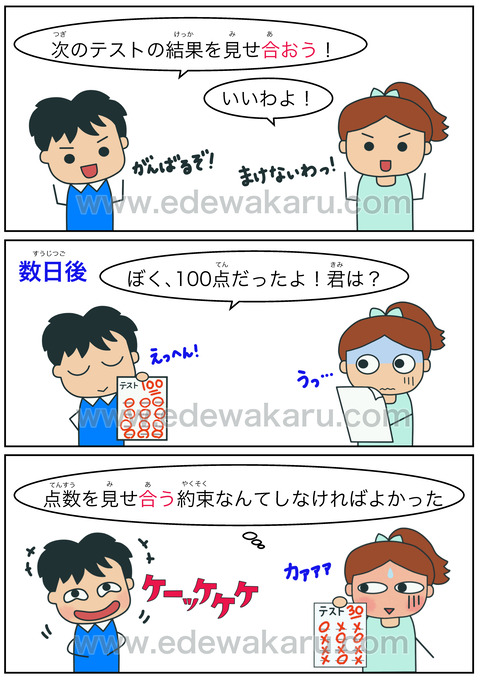
Meaning
お互いに〜する
How to use it
動詞[ます形]+合う
Explanation
「〜合う」は「お互いに〜する」という意味の文型です。[協力する時][相談する時][ケンカをする時][お互いを理解する時]などによく使われます。
[例]
①テストの点数を見せ
合う
約束なんてしなければよかった…
→お互いにテストの点数を見せる約束なんてしなければよかった…
②誰をリーダーにするか、みんなで話し
合いましょう
→みんなで相談しましょう
③友達なんだから、困った時は助け
合わなきゃ
ね!
→困った時は協力しましょう
④冗談を言い
合っていたら、ケンカになった…
→お互いに冗談を言っていたら、ケンカになった
⑤どうすればいいか、みなさんで意見を出し
合って
ください
→みなさんで相談してください
⑥彼とは、絶対にわかり
合えない
と思う
→絶対にお互いを理解することができないと思う
「〜合う」は、会話でもよく使いますので復習しておきましょう😊
In context 6 examples
テストの点数を見せ合う約束なんてしなければよかった…
誰をリーダーにするか、みんなで話し合いましょう
友達なんだから、困った時は助け合わなきゃね!
冗談を言い合っていたら、ケンカになった…
どうすればいいか、みなさんで意見を出し合ってください
彼とは、絶対にわかり合えないと思う
日本語NET JLPT文法解説まとめ
Meaning
お互いに〜する
How to use it
V(ます形)ます + 合う
Explanation
do something each other
In context 6 examples
困った時は助け合いましょう。
隣の人と相談し合って答えを考えてください。
問題が起きたときは、どうすべきかみんなで話し合いましょう。
僕たちは愛し合っています。
テストの結果が返ってきて、点数を見せ合った。
二人はいつも競い合っている。
毎日のんびり日本語教師
How to use it
動ます形+合う
Explanation
動ます形に接続して、2人以上が「お互いに~する」という意味を表します。何かを協力するときや敵対するときに使います。
「言い合う」には口論や口喧嘩するという意味もあります。
Notes
特になし
In context 7 examples
これからどんなことがあっても家族で助け合って生きていく。
サッカーではボールを奪い合う場面でフィジカルの強さが求められる。
この件は3人で話し合って結論をまとめておくように。
状況を理解していない相手と話し合っても何も解決しない。
熱でうなされて、殴り合いの喧嘩をする夢を見た。(因为发烧梦见自己在打架。)
皆さんには今から殺し合いをしていただきます。
外交交渉なんて所詮は騙し合い。
IMABI
Used to/together…
Read this IMABI lesson ↗Explanation
~慣れる, ~合う・合わせる, & ~切る
This lesson continues on with intermediate compound verb endings.
Grammar Note: 来る can only be used with the following patterns: 来慣れる (to be used to coming to) and 来合わせる (to make one’s appearance). If you think about the meanings of these phrases as they are discussed, this will make sense to you.
~慣れる
慣なれる, an 一段 verb, means “to get used to” and may also mean “to domesticate”, which is in essence animals getting used to human control. 慣れる is intransitive and is used as a compound ending to show an inclination to liking or being accustomed to something.
1. この街には住み慣れました。
I got used to living in this town.
2. 彼は都市の生活に慣れることができなかった。
He couldn’t get used to living in the city.
3. 通学に慣れるのは重要じゅうようです。
It is important that you become used to commuting to school.
4. コンピューターは使い慣れるのは時間がかかります。
It takes time to get used to the computer.
5. 彼は旅慣たびなれている。
He’s well-traveled.
6a. 日本料理{は、・を}食べ慣れました。
6b. 日本料理に慣れました。(もっと自然)
I’ve gotten used to eating Japanese food.
7. 私は人前ひとまえで話すことに慣れていません。
I am not used to speaking in front of people.
8. 日本の天候てんこうに慣れる。
To get used to Japanese weather.
9. まだ明るさに慣れてねー。(砕くだけた言い方)
(My eyes) are still not adjusted to the light.
10. 寵愛ちょうあいに慣れるのはだめですよ。
It is no good to be over-familiar with attention.
Orthography Note: なれる may be written as 狎れる when specifically referring to domestication.
~合う・合わせる
合う shows how something “fits”. In compounds it shows “to…with each other”. So, there is someone else with you doing the same action. Essentially, ~合う shows people doing something with each other–reciprocal action. The object(s) of the sentence must be similar.
The causative form 合わせる may show that one makes something into one, looks into differences, reciprocally does, or does something all of a sudden.
11. ロミオとジュリエットは愛し合っていた。
Romeo and Juliet loved each other.
12. 誘さそい合わせる。
To invite each other.
13. 彼らは宿題を手伝てつだい合った。
They helped each other with homework.
14. 犯行現場はんこうげんばに居合わせました。
I was present at the crime scene.
15. 何時に待ち合わせようか?
What time shall we meet?
16. 彼と彼女は君が代よを歌い合っていた。?
彼と彼女は君が代を一緒に歌っていた。〇
He and she sang Kimigayo with each other.
Culture Note: 君きみが代よ is the national anthem (国歌こっか) of Japan.
17. 二人で聖書せいしょを読み上げ合いました。
The two read aloud the bible with each other.
18. 彼らは想おもいを打ち明け合うだろう。
They will probably confide their feelings with each other.
19. ケーキを一緒に{食べましょう 〇・ 食べ合いましょう X}。
Let’s eat cake together.
20. 乗り合わせた乗客
Fellow passengers
21. 計算を読み合わせる。
To read out and compare calculations.
22. このドレスはあたしにぴったり{(と)合いますか・ですか}。 (Feminine)
Does this dress fit perfectly with me?
23. 申し合わせた通りにしましょう。
Let’s do as arranged.
24. お互たがいに引き合わせる。
To introduce to each other.
25. 警察に問い合わせましたか。
Did you check with the police?
26. 書類しょるいを綴とじ合わせましたか。
Have you bound the documents together?
27. 布を縫ぬい合わせる。
To sew together.
28. 傷口きずぐちを縫い合わせてもらった。
I had my wound(s) sewn up.
29. 各種詰づめ合あわせキャンディーを買かいに行いった。
I went to buy mixed candies.
30. それらの糸は縒より合わせ難がたい。
These threads are hard to twist together.
31. 悲しみを分かち合う。
To share in the sadness.
Word Note: 分かち合う is typically interchangeable with 分け合う, but it is generally more 文語的. However, in the case of “sharing” non-physical items such as sadness, you should use 分かち合う.
32. 家族の都合が合うのは今日だけだ。
Today is only when my convenience matches with my family’s.
Word Note: 都合が合う is unavoidable in contexts like these, but it is generally not liked when referring to just one’s convenience. In which case, you should say 都合がいい.
There is also another ending that shows mutual action: ~違える. This sometimes confusingly has a meaning of ~間違える. This is because the verb 違える itself has the following meanings: to not have something be the same; to mess up; to be against a contract; to injure one’s muscles. You have to essentially learn on a case by case basis.
33. 靴を履き違える。
To mix up shoes.
34. 約束を違える。
To break one’s promise.
Reading Note: This 違える may be read as either ちがえる or たがえる.
35. 寝違えて、首筋が痛い。
I got a crick in my neck, and now it hurts.
36. 社長と刺し違える。
To expose the company president and receive repercussions from him/her.
37. 一審を差し違える。
To overturn the first match decision (and give the win to the other opponent).
~切る
切きる means “to cut” and may be used literally and figuratively. ~切る shows that “something is done completely”.
38. 彼は読書に浸ひたり切っていた。
He was completely engrossed in reading.
39. 紙をはさみで切る。
To cut paper with scissors.
漢字 Note: 鋏 is not uncommonly used to spell はさみ.
40. 彼はかの歌手の全ての歌を歌い切った。
He sang all of that singer’s songs completely.
41. いつかは地球に残っている石油は全て使い切ってしまうだろう。
The remaining oil on the earth will probably one day end up completely used.
42. 紐ひもを切る。
To cut a string.
43. 電話を切る。
To hang up the phone.
44. {手・関係}を切る。
To break a relationship.
45. 彼がイギリス海峡かいきょうの距離きょりを泳ぎ切りました。
He completely swam the (entire) distance of the English Channel.
46. 水泳選手は、日本海を一緒に泳ぎきりました。
The swimmers swam across the Sea of Japan together.
47. ジョーンズ先生は来月までに約やく10冊読み切っているでしょう。
Ms. Jones will have probably read around 10 books by next month.
In context 48 examples
この街には住み慣れました。
I got used to living in this town.
彼は都市の生活に慣れることができなかった。
He couldn’t get used to living in the city.
通学に慣れるのは重要じゅうようです。
It is important that you become used to commuting to school.
コンピューターは使い慣れるのは時間がかかります。
It takes time to get used to the computer.
彼は旅慣たびなれている。
He’s well-traveled.
日本料理{は、・を}食べ慣れました。
I’ve gotten used to eating Japanese food.
日本料理に慣れました。(もっと自然)
I’ve gotten used to eating Japanese food.
私は人前ひとまえで話すことに慣れていません。
I am not used to speaking in front of people.
日本の天候てんこうに慣れる。
To get used to Japanese weather.
まだ明るさに慣れてねー。(砕くだけた言い方)
(My eyes) are still not adjusted to the light.
寵愛ちょうあいに慣れるのはだめですよ。
It is no good to be over-familiar with attention.
ロミオとジュリエットは愛し合っていた。
Romeo and Juliet loved each other.
誘さそい合わせる。
To invite each other.
彼らは宿題を手伝てつだい合った。
They helped each other with homework.
犯行現場はんこうげんばに居合わせました。
I was present at the crime scene.
何時に待ち合わせようか?
What time shall we meet?
彼と彼女は君が代よを歌い合っていた。?
二人で聖書せいしょを読み上げ合いました。
The two read aloud the bible with each other.
彼らは想おもいを打ち明け合うだろう。
They will probably confide their feelings with each other.
ケーキを一緒に{食べましょう 〇・ 食べ合いましょう X}。
Let’s eat cake together.
乗り合わせた乗客
Fellow passengers
計算を読み合わせる。
To read out and compare calculations.
このドレスはあたしにぴったり{(と)合いますか・ですか}。 (Feminine)
Does this dress fit perfectly with me?
申し合わせた通りにしましょう。
Let’s do as arranged.
お互たがいに引き合わせる。
To introduce to each other.
警察に問い合わせましたか。
Did you check with the police?
書類しょるいを綴とじ合わせましたか。
Have you bound the documents together?
布を縫ぬい合わせる。
To sew together.
傷口きずぐちを縫い合わせてもらった。
I had my wound(s) sewn up.
各種詰づめ合あわせキャンディーを買かいに行いった。
I went to buy mixed candies.
それらの糸は縒より合わせ難がたい。
These threads are hard to twist together.
悲しみを分かち合う。
To share in the sadness.
家族の都合が合うのは今日だけだ。
Today is only when my convenience matches with my family’s.
靴を履き違える。
To mix up shoes.
約束を違える。
To break one’s promise.
寝違えて、首筋が痛い。
I got a crick in my neck, and now it hurts.
社長と刺し違える。
To expose the company president and receive repercussions from him/her.
一審を差し違える。
To overturn the first match decision (and give the win to the other opponent).
彼は読書に浸ひたり切っていた。
He was completely engrossed in reading.
紙をはさみで切る。
To cut paper with scissors.
彼はかの歌手の全ての歌を歌い切った。
He sang all of that singer’s songs completely.
いつかは地球に残っている石油は全て使い切ってしまうだろう。
The remaining oil on the earth will probably one day end up completely used.
紐ひもを切る。
To cut a string.
電話を切る。
To hang up the phone.
{手・関係}を切る。
To break a relationship.
彼がイギリス海峡かいきょうの距離きょりを泳ぎ切りました。
He completely swam the (entire) distance of the English Channel.
水泳選手は、日本海を一緒に泳ぎきりました。
The swimmers swam across the Sea of Japan together.
ジョーンズ先生は来月までに約やく10冊読み切っているでしょう。
Ms. Jones will have probably read around 10 books by next month.