日本語文型辞典
Meaning
基本情報NaでならないA-くてならないV-てならない説明自然にある感情や感覚が起こってきて自分ではコントロールできない状態を表す。押さえようとしても押さえられない状態で、そのためその感情の程度が非常に高いことを表す場合が多い。「…てならない」の前には感情や感覚や欲求を表す言葉が用いられ、ものの属性や評価についての言葉を用いると、不自然な文になる。例文① 卒業できるかどうか、心配でならない。② 将来がどうなるか、不安でならない。③ 子供のころニンジンを食べるのがいやでならなかった。④ あのコンサートに行き損ねたのが今でも残念でならない。⑤ 住み慣れたこの土地を離れるのがつらくてならない。⑥ だまされてお金をとられたのがくやしくてならない。⑦ 青春時代を過ごした北海道山々が思い出されてならない。⑧ きのうの英語の試験の結果が気になってならない。⑨ 大切な試験に失敗してしまった。なぜもっと早くから勉強しておかなかったのかと悔やまれてならない。例文(誤) この本はつまらなくてならない。例文(正) この本はすごくつまらない。説明「…てしかたがない」とほぼ同義だが、「-てしかたがない」とは違って、感情・感覚・欲求以外の言葉を用いるのは難しい。例文(誤) 赤ちゃんが朝から泣いてならない。例文(正) 赤ちゃんが朝から泣いてしかたがない。説明やや古めかしい言い方で、書きことばに多く用いられる。
IMABI
Can’t Help II
Read this IMABI lesson ↗Explanation
Can’t Help II: ~てならない, ~てやまない, ~てしかたがない, ~にたえない, & ~てたまらない
This lesson will continue coverage on phrases regarding “not being able to restrain” one’s emotions or feeling. The phrases here with exception to ~にたえない, which is brought up because of ~てこたらない, all use the て form to attach to verbs/adjectives, but be careful about what kind of words they can semantically be used with.
~てならない
~てならない is found primarily in the written language, though this doesn’t mean you can’t hear it be used in the spoken language, and its purpose is to show that a certain feeling can’t be helped being felt/thought. If the verb, though, does not refer to emotion or something spontaneous, it cannot be used. This pattern, also, does not attach to the negative form.
1. 不思議に思えてならない。
I can’t help but think it’s strange.
2. 悪化するように思えてならない。
I can’t help but think that it’s going to get worse.
3. もう10年も故郷ふるさとに帰っていないので、両親に会いたくてならない。
Since it’s already been 10 years since I haven’t been home at my hometown, I can’t help but want to meet my parents.
漢字 Note: 故郷 may also be read as こきょう.
4. 肘ひじが痛くてならない。
I can’t help but think about my hurting elbow.
5. 退屈たいくつな日本語の授業に出ていると、眠くてならない。
I can’t help but sleep when I’m at my boring Japanese class.
6. 毎日寂さびしくてならない。
I can’t help but be sad every day.
7. 日本語能力試験が心配でならない。
I can’t help but worry about the JLPT.
8. 失敗するような気がしてなりません。
I can’t help but have the feeling that I’m going to fail.
Warning Note: Do not confuse this with the must/must not pattern ~てはならない.
~てやまない
~てやまない is a somewhat 硬かたい phrase that is used to show that one will continue to be holding a strong feeling. You just won’t stop. It is used with verbs concerning emotion, but it is not used with emotional verbs that describe temporary states. The grammatical person is usually first person. Understandably, it is not appropriate to attach this phrase to the negative form.
9. この写真に写うつっているのは私が愛してやまない犬だ。
The thing in this picture is a dog that I shall always love.
10. 親は子供の将来を期待してやまないものだ。
Parents never stop hoping for their children;s future.
11. 愛犬が死んで悲しくてやまない。
I will continue to be sad over my beloved dog dying.
12. 皆さんの幸せを願ってやみません。
I will continue to wish for everyone’s happiness.
13. ご活躍かつやくを願ってやまない。
I can’t stop wishing for you to flourish.
~てしかたがない
~てしかたがない is very similar to ~てならない, but since it originally referred to there not being a way to withstand or conquer, it gives off a feeling that one can’t stand something while thinking at the same time that there is nothing else that could be done. Therefore, it is also very common in the spoken language. This is unlike ~てならない which is often felt to be quite old-fashioned.
~てならない and ~てしかたがない are different when the verb doesn’t express something spontaneous or emotional, in which case you use ~てしかたがない because nothing is predicated in its definition that it must be used with a verb of emotion. However, this does not mean that ~てしかたがない can’t be used with verbs of spontaneity and or emotion because it still can.
Variant Note: ~しようがない and ~てしょうがない are more casual versions with the latter being the most casual.
Examples
14. もう残念でしかたがない。
It’s no use that it’s already regrettable.
15. いくら着込んでも寒くてしょうねーな。
No matter how much I wear, I’m still cold!
16. 彼が言うと、僕を非難しているように聞こえて{ならない・しかたがない}。
Whenever he says (something), I can’t help but hear it that he’s criticizing me.
17. 朝っぱらからくそ犬めが鳴くんで、うるさくしょうがねーよ。(Vulgar)
Since the damn dog barks from early in the morning, it’s annoying as hell.
18.抽選ちゅうせんにもれたなんて、残念でしかたないね。
It can’t be helped that I’m disappointed that I didn’t get drawn.
~にたえる・~にたえない
耐える means ” to endure”. ~に耐える is seen after nouns and verbs of personal attention to show the worth of something. With する verbs, する is dropped. For example, it is used in contexts such as being worth to read, hear, criticize, applaud, value, etc.
~に耐えない, though, has two usages. When used with the 連体形, it means “cannot stand/endure to…”. When used after a noun, it shows a strong emotional reaction in which one can’t hold back such emotions. This may sound very similar to the first usage, but this usage is strictly used with nouns.
Spelling Note: The phrase can also be spelled as に堪えない.
Style/Word Choice Note: It is somewhat of a stiff phrase and used with a limited number of nouns such as 感謝, 感激, 慙愧ざんき(shame), 等.
Examples
19. 感謝に耐えません。
I can’t help but thank you.
20. 見るに耐えないOLだぞ。
She’s a butt-ugly office lady.
21. 慙愧ざんき(の念)に堪えない。
To be deeply ashamed of oneself.
22. お忙しいところを多くの方にお集まりいただき、感激に堪えません。(謙譲語)
I am overwhelmed with emotion from receiving all of you gathering while you are all busy.
23. 気の毒で同情に堪えない。
I am deeply sorry for you and sympathize with you.
24. 誠まことに慨嘆がいたんに堪えない。
It is truly a matter for great regret.
25. 父は聞くに耐えない歌たいぶりをする。
My dad has an awful manner of singing.
26. 鑑賞に耐えるものだ。
It is something worth appreciating.
Word Note: Again, this phrase is used with limited words such as 見る、聞く、批判、鑑賞かんしょう、議論、etc.
~てたまらない
Although usually left in かな, if you do see this pattern written in 漢字, don’t confuse the reading for the one in ~(に)堪えない. They’re not the same, of course. This is a very common phrase in the spoken language, unlike a lot of the phrases in this lesson, and it is a strong speech style meant to show that one can’t resist a certain emotion, sense, or want.
~てたまらない can’t be used with spontaneous verbs. This is contrast with things like ~てならない and ~てしかたがない. On the other hand, if you are using an adjective that shows an objective degree, ~てたまらない can be used but ~てならない・~てしかたがない can’t.
Examples
26. 日本へ帰りたくてたまらない。
I can’t stand but want to go back home to Japan.
27. 隣の車のマフラー音がうるさくて、たまらないよ。
The muffler of the car next to me is annoying, and I can’t stand it.
28. 隣の駐車場の車の音がうるさくて、たまりません。困ってますよ。
The car noise from the parking lot next to me is annoying, and I can’t stand it. I’m at a loss.
29. お兄さんは毎日退屈で堪らないそうです。
I hear that your older brother can’t stand him being bored every day?
In context 30 examples
不思議に思えてならない。
I can’t help but think it’s strange.
悪化するように思えてならない。
I can’t help but think that it’s going to get worse.
もう10年も故郷ふるさとに帰っていないので、両親に会いたくてならない。
Since it’s already been 10 years since I haven’t been home at my hometown, I can’t help but want to meet my parents.
肘ひじが痛くてならない。
I can’t help but think about my hurting elbow.
退屈たいくつな日本語の授業に出ていると、眠くてならない。
I can’t help but sleep when I’m at my boring Japanese class.
毎日寂さびしくてならない。
I can’t help but be sad every day.
日本語能力試験が心配でならない。
I can’t help but worry about the JLPT.
失敗するような気がしてなりません。
I can’t help but have the feeling that I’m going to fail.
この写真に写うつっているのは私が愛してやまない犬だ。
The thing in this picture is a dog that I shall always love.
親は子供の将来を期待してやまないものだ。
Parents never stop hoping for their children;s future.
愛犬が死んで悲しくてやまない。
I will continue to be sad over my beloved dog dying.
皆さんの幸せを願ってやみません。
I will continue to wish for everyone’s happiness.
ご活躍かつやくを願ってやまない。
I can’t stop wishing for you to flourish.
もう残念でしかたがない。
It’s no use that it’s already regrettable.
いくら着込んでも寒くてしょうねーな。
No matter how much I wear, I’m still cold!
彼が言うと、僕を非難しているように聞こえて{ならない・しかたがない}。
Whenever he says (something), I can’t help but hear it that he’s criticizing me.
朝っぱらからくそ犬めが鳴くんで、うるさくしょうがねーよ。(Vulgar)
Since the damn dog barks from early in the morning, it’s annoying as hell.
抽選ちゅうせんにもれたなんて、残念でしかたないね。
It can’t be helped that I’m disappointed that I didn’t get drawn.
感謝に耐えません。
I can’t help but thank you.
見るに耐えないOLだぞ。
She’s a butt-ugly office lady.
慙愧ざんき(の念)に堪えない。
To be deeply ashamed of oneself.
お忙しいところを多くの方にお集まりいただき、感激に堪えません。(謙譲語)
I am overwhelmed with emotion from receiving all of you gathering while you are all busy.
気の毒で同情に堪えない。
I am deeply sorry for you and sympathize with you.
誠まことに慨嘆がいたんに堪えない。
It is truly a matter for great regret.
父は聞くに耐えない歌たいぶりをする。
My dad has an awful manner of singing.
鑑賞に耐えるものだ。
It is something worth appreciating.
日本へ帰りたくてたまらない。
I can’t stand but want to go back home to Japan.
隣の車のマフラー音がうるさくて、たまらないよ。
The muffler of the car next to me is annoying, and I can’t stand it.
隣の駐車場の車の音がうるさくて、たまりません。困ってますよ。
The car noise from the parking lot next to me is annoying, and I can’t stand it. I’m at a loss.
お兄さんは毎日退屈で堪らないそうです。
I hear that your older brother can’t stand him being bored every day?
AIUEO JLPT Grammar
Meaning
This sentence pattern is used when emotions or sensations naturally intensify and become uncontrollable, often expressing that the speaker did not consciously generate the feeling, but it arose naturally.
How to use it
動詞て形+ならない形容詞て形+ならない形容動詞で+ならない
Explanation · 日本語
この文型は、感情や感覚が自然に強くなり抑えられない状態を表す表現で、話し手が意識的に何かを感じるのではなく、自然にその感情が湧いてくる時に使います。
In context 5 examples
彼女のことが気になってならない。
I can’t stop worrying about her.
試験の結果が心配でならかなかった。
I was extremely worried about the exam results.
彼女が可愛くてならない。
I can't help but find her cute.
その事故が悲しくてなりません。
I can’t stop feeling sad about that accident.
そのニュースが信じられなくてならない。
I can't help but be annoyed with him.
文法
Meaning
"気持ちが抑えられないほど〜だ / ひどく〜だ"
感情や感覚を表す言葉と接続することが多い。
How to use it
V(て形)+ ならない
イAくて + ならない
ナAで + ならない
In context 6 examples
息子は大したスキルもないのに、フリーランスとして生きていくと言っているので、私は心配でなりません。
自分は悪いことをしてないのに、謝らなければいけないなんて、不思議でなりません。
試験の結果が気になってならない。
若い世代が将来ちゃんと年金をもらえるのか、気になってならない。
彼、まだ若いのに癌だなんて、残念でなりません。
プレゼンの時は緊張で足が震えてならなかった。
Bunpro Grammar Reference
Meaning
Very, Extremely, Can't help but do
How to use it
Verb[て]+ ならない
[い]Adjective[て]+ ならない
[な]Adjective + で + ならない
Verb[て]+ ならない
[い]Adjective[て]+ なりません
[な]Adjective + で + なりません
Nuance
A phrase often used in relation to feelings, exclaiming that not becoming that way is unavoidable.
Explanation
てならない is a construction made up of the て-form of a verb or adjective (で for な-Adjectives), and the negated form of the う-Verb なる, 'to become'. This expression describes the word that is attached to it as being 'extremely (A)', or that one 'can't help but do (A)'.
In most cases, てならない will be used when (A) is something that occurs naturally, such as feelings. Due to this, a more literal translation is close to 'to not be able to move on from (A)'. In this way, it just indicates that (A) is so intense that the person affected by it cannot do anything about it.
昨日は徹夜して勉強してたから、眠くてならない。
I was up all night studying yesterday, so I'm extremely sleepy.
愛知県の夏は暑くてならない。
Summer in Aichi prefecture is extremely hot.
ここ五年間娘と連絡がつかないから、心配でならない。
I can't help but to feel worried because I haven't heard from my daughter in 5 years.
Caution
In addition to being spontaneous and uncontrollable, (A) will almost always be something that is ongoing, rather than just being momentary.
彼女はいつも僕に嘘をつくからむかついてならない。
I can't help but be extremely mad at her because she lies to me all the time. (Continuing feeling, natural Japanese)
この漫画はつまらなくてならない。
This manga is extremely boring. (Momentary feeling, unnatural Japanese)
Nuance · 日本語
感情などのことを話している時に、そうならないことが避けられないということを表す表現。
Explanation · 日本語
「てならない」は動詞や形容詞のテ形(ナ形容詞の場合はデ形)に五段動詞「なる」の否定形を組み合わせた表現です。これは、「極めて (A) だ」や「どうしようもないほど (A) だ」といった意味を表します。
多くの場合、「てならない」は、(A) が感情など、自然に生まれるものであるときに使われ、それがあまりに強く、自分ではどうすることもできない状態を表します。
昨日は徹夜して勉強してたから、眠くてならない。
I was up all night studying yesterday, so I'm extremely sleepy.
愛知県の夏は暑くてならない。
Summer in Aichi prefecture is extremely hot.
ここ五年間娘と連絡がつかないから、心配でならない。
I can't help but to feel worried because I haven't heard from my daughter in 5 years.
注意点
(A) に入るのは、自然に発生するもの・自分ではコントロールできないものであるだけでなく、しばらく心や頭の中などに残り続けるような感情や感覚になります。一時的なものに使うと不自然になるので気をつけましょう。
彼女はいつも僕に嘘をつくからむかついてならない。
I can't help but be extremely mad at her because she lies to me all the time. (Continuing feeling, natural Japanese)
この漫画はつまらなくてならない。
This manga is extremely boring. (Momentary feeling, unnatural Japanese)
In context 17 examples
- 詐欺にあった気がしてならない。
I can't help but feel it was a scam.
- ここ五年間娘と連絡がつかないから、心配でならない。
I can't help but to feel worried because I haven't heard from my daughter in 5 years.
- 昨日は徹夜して勉強してたから、眠くてならない。
I was up all night studying yesterday, so I'm extremely sleepy.
- 愛知県の夏は暑くてならない。
Summer in Aichi prefecture is extremely hot.
- あんなコレクションは無駄に思えてならない。
I cannot help but think that that collection is worthless.
- 去年あなたと見た紅葉が思い出されてならない。
I can't help but remember the fall colors I saw with you last year.
- この毛皮は暑くてならない。
This fur is extremely warm. (I can't help but feel...)
- 明日の見学が楽しみでならない。
I can't help but look forward to tomorrow's field trip.
- 血圧が高すぎて不安でならない。
I am extremely worried about my blood pressure being too high. (I can't help but feel...)
- サイレンが鳴り止まないから、心配でならない。
I am extremely worried because that siren won't stop ringing. (I can't help but feel...)
- オリンピックで転んでしまった選手がかわいそうでならない。
I can't help but feel sorry for the athlete who fell during the Olympics.
- 日本に来てから、家族に会えず、寂しくてならない。
Since coming to Japan, I haven't been able to see my family and can't help but feel lonely.
- あのサークルが今や大人気だなんて、不思議でならない。
I can't help but marvel at how popular that (sports) circle is now.
- 壁に小指をぶつけるなんて災難だ。痛くてならない。
Banging your pinky (toe) into the wall is terrible. It is extremely painful. (I can't help but feel...)
- 今週末の同窓会に行けないので、残念でならない。
Since I can't go to my class reunion this weekend I can't help but feel disappointed.
- 彼女はいつも僕に嘘をつくからむかついてならない。
I can't help but be extremely mad at her because she lies to me all the time. (Continuing feeling, natural Japanese)
- この漫画はつまらなくてならない。
This manga is extremely boring. (Momentary feeling, unnatural Japanese)
どんなときどう使う 日本語表現文型辞典
Meaning
can't help but
How to use it
Vて/イAくて/ナAで+ならない
Explanation
抑えられないほど~
1)「自然にある感情や体の感覚が起こってきて抑えられない」というときに使う。
2)話者の感情・体感・欲求を表す言葉であるから、3人称に使うときは ❸ のように文末に「ようだ・らしい・のだ」をつける必要がある。
3)自発を表す言葉「思える・思い出される・泣ける」などとともに使って、マイナスの気持ちを表すことが多い。
2)Expresses speaker's emotions, senses, and demands, so in the third person sentence endings must take ようだ, らしい, or のだ.
3)Used with reflexive verbs such as 思える, 思い出される, or 泣ける. Often expresses negative feelings.
1)Inability to repress emotions or physical sensations that naturally arise.
In context 3 examples
この写真を見ていると故郷の友だちのことが思い出されてなりません。
地球温暖化の問題を考えると、子どもたちの将来のことが気になってならない。
田中さんは今の収入でこれから家族4人が生活していけるのか、心配でならないようだ。
絵でわかる日本語
Meaning
とても〜だ
すごく〜だ
自然に〜という気持ちになる
How to use it
動詞[て形]+てならない
い形容詞[て形]+てならない
な形容詞[て形]+でならない
Explanation
「〜てならない」は「すごく〜だ」「自然に〜という気持ちになる」という意味を表す文型です。この文型は
【感情】や【感覚】が発生し、自分ではその気持ちが抑えられない場合に使います。
[例]
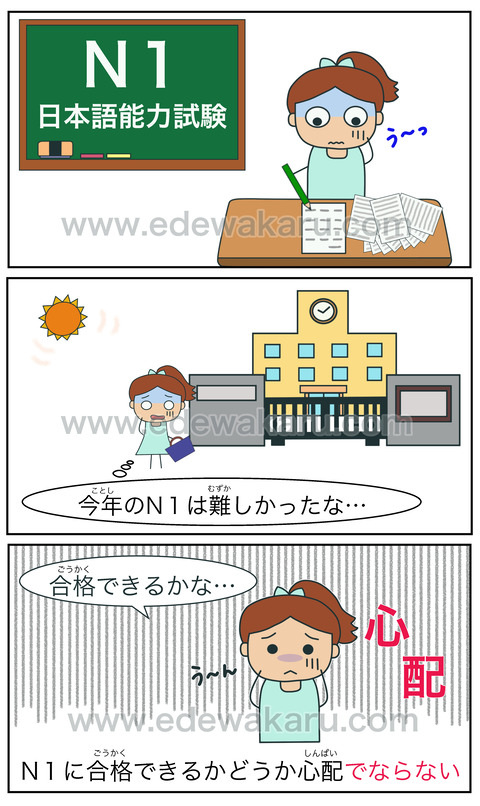
①N1に合格できるかどうか心配
でならない
【感情】心配
→
心配する気持ちが抑えられない
②昨日はカラオケでオールしたので、眠く
てならない
【感覚】眠い
→
眠いという感覚が抑えられない
③日本へ行ったのに、お寿司を食べずじまいだった…残念
でならない
【感情】残念
→残念だと思う気持ちが抑えられない
④山田くんは文句ばっかり言うから、腹が立っ
てならない
【感情】腹が立つ
→
怒りたいという気持ちが抑えられない
⑤あの曲をきくたびに、昔のことが思い出され
てならない
【感覚】思い出す
→
自然に思い出してしまう
(復習:〜てしまう)
【余裕のある人へ】
「〜てならない」は「もの」に対する評価には使うことができませんので気をつけましょう😨
[例]
❌あの映画はつまらなく
てならない
→「つまらない」のは「映画」
→あの映画は
「つまらない」という評価
❌あの本はおもしろく
てならない
→「おもしろい」のは「本」
→あの本は
「おもしろい」という評価
⭕️英語の授業が嫌
でならない
→「嫌」なのは「私」
⭕️試験の結果が心配
でならない
→「心配」なのは「私」
ものを評価したい場合は「とても〜だ」と言えばOKです。
[例]
❌あの映画はつまらなくてならない
⭕️あの映画は
とても
つまらない
❌あの本はおもしろくてならない
⭕️あの本は
とても
おもしろい
「〜てならない」は、かたい言い方ですので書き言葉として使われることがほとんどです。
N2以上を受ける人は、テストのために覚えておくといいと思います😉
(復習:〜として)
(復習:〜ために(目的))
(復習:〜ておく)
In context 5 examples
N1に合格できるかどうか心配でならない
→N1に合格できるかどうか、とても心配だ昨日はカラオケでオールしたので、眠くてならない
→昨日はカラオケでオールしたので、すごく眠い(復習:オールする)日本へ行ったのに、お寿司を食べずじまいだった…残念でならない
→お寿司を食べずじまいだったのでとても残念だ(復習:〜ずじまい)山田くんは文句ばっかり言うから、腹が立ってならない
→山田くんは文句ばっかり言うから、すごく腹が立つ(復習:〜ばっかり・〜ばっか)(復習:腹が立つ)あの曲をきくたびに、昔のことが思い出されてならない
→あの曲をきくたびに、自然に昔のことが思い出される(復習:〜たびに)
日本語文型辞典 英語版
Meaning
【てならない】[Na でならない][A-くてならない][V-てならない]
Expresses a feeling or state of emotion that is the natural outcome of a situation and beyond the control of the speaker. Often used to indicate a state of mind that cannot be suppressed, resulting in a highly emotional condition. てならない is preceded by words denoting emotion or feeling or desire. If words that refer to characteristics or evaluation are used, an awkward construction results.
(×)この本はつまらなくてならない。
This book can’t be anything but boring.
(○)この本はすごくつまらない。
This book is really boring.
Has essentially the same meaning as てしかたがない. One difference is that てならない is difficult to use with words that do not indicate emotion, feeling, or desire.
(×)赤ちゃんが朝から泣いてならない。
The baby has had to be crying since morning.
(○)赤ちゃんが朝から泣いてしかたがない。
The baby has been crying his eyes out since morning.
A somewhat old-fashioned expression that is most often used in written language.
In context 9 examples
卒業できるかどうか、心配でならない。
I am beside myself with worry about whether or not I’ll be able to graduate.
将来がどうなるか、不安でならない。
Thinking about the future gives me great concern.
子供のころニンジンを食べるのがいやでならなかった。
When I was a child, having to eat carrots repulsed me.
あのコンサートに行き損ねたのが今でも残念でならない。
I will never stop regretting that we missed going to that concert.
住み慣れたこの土地を離れるのがつらくてならない。
It is really painful for us to leave this place that has been our home for such a long time.
だまされてお金をとられたのがくやしくてならない。
I am so ticked off at getting cheated out of my money.
青春時代を過ごした北海道の山々が思い出されてならない。
I can’t help recalling the mountains of Hokkaido, where I spent my youth.
きのうの英語の試験の結果が気になってならない。
The results of yesterday’s English exam are really bothering me.
大切な試験に失敗してしまった。なぜもっと早くから勉強しておかなかったのかと悔やまれてならない。
I failed an important exam. I am filled with regret that I didn’t start studying sooner.
くらべてわかる日本語表現文型辞典
Meaning
自然に現れたAという気持ちや感覚が強く、ずっと持続しつづける。
How to use it
Aてならない
[動詞-て形]ならない
[イ形-く]てならない
[ナ形-で]ならない
Explanation
【対比1】
「Aてしょうがない」(意味1,2,3 P.142)
「Aてならない」のAは、感情・感覚を表すものに限られるが、「Aてしょうがない」には、その制限がない。
○この靴は坂道を歩くと、滑ってしょうがない。
×この靴は坂道を歩くと、滑ってならない。
○面接の時は足が震えてしょうがなかった。
○面接の時は足が震えてならなかった。
「Aてやまない」(意味1 P.149)
Notes
【注意1】
・Aは感覚を表す言葉や「思える・感じられる」などの自発形。
In context 4 examples
おじいさんは孫の帰りが遅くて、心配でならないようだ。
親を亡くした子が悲しみに耐えているのを見ると、不憫でならない。
父の体の異変にもっと早く気づけばよかったと悔やまれてならない。
ダイエットしているのに少しも痩せないのが、不思議でならない。
日本語NET JLPT文法解説まとめ
Meaning
"気持ちが抑えられないほど〜だ / ひどく〜だ"
感情や感覚を表す言葉と接続することが多い。
How to use it
V(て形)+ ならない
イAくて + ならない
ナAで + ならない
Explanation
cannot help
This phrase is often connected with words expressing emotions or sensations.
In context 6 examples
息子は大したスキルもないのに、フリーランスとして生きていくと言っているので、私は心配でなりません。
自分は悪いことをしてないのに、謝らなければいけないなんて、不思議でなりません。
試験の結果が気になってならない。
若い世代が将来ちゃんと年金をもらえるのか、気になってならない。
彼、まだ若いのに癌だなんて、残念でなりません。
プレゼンの時は緊張で足が震えてならなかった。
毎日のんびり日本語教師
How to use it
動て形+ならない
い形容詞語幹+くてならない
な形容詞語幹+でならない
Explanation
感情・感覚を表す語につき、感情のコントロールが利かない程度であることを表します。
Notes
似ている文法の比較
In context 8 examples
どうしてこんなことになってしまったのか悔しくてならない。
台風で休みとかいってる学生たちが羨ましくてならない。
いつも他人の悪いところばかりが気になってしまう自分が煩わしくてならない。
どうしてそんなひどい考え方ができるのかと、彼が不思議に思えてならない。
もうすぐ来ると言われてる大地震が恐ろしくてならない。
生まれ育った故郷を離れるのが悲しくてならない。
都市開発で強制退去させられる住民たちが本当に気の毒でならない。
Aちゃんの天然なところが心底愛おしくてならない。(A酱的天然的呆萌让人从心底里觉得很可爱。)