文法
Meaning
〜を受け入れて / 〜合うように
「相手の希望や要求、期待の通りにする、合うようにする」と言いたい時に使う。
How to use it
N +に応えて
In context 5 examples
お客様の意見にお応えして、セール期間を1週間延長することいたしました。
クライアントの要望にお応えして、新しい機能を追加いたしました。
ジョンさんは親の期待に応えるために、日本で一生懸命勉強している。
我が社では消費者のニーズに応えるための新しい商品を開発中です。
皆さんのリクエストに応えて、今回のライブでは新曲を2曲披露します。
どんなときどう使う 日本語表現文型辞典
Meaning
in response to; in accordance with
How to use it
N+に応えて
Explanation
~に沿うように
質問・期待・要望などを表す名詞を受けて、「それに沿うような行為をする」と言いたいときに使う。
Taking action in accordance with nouns expressing questions, expectations, or hopes.
In context 3 examples
参加者の要望に応えて、次回の説明会には会長自身が出席することになった。
聴衆のアンコールに応えて、指揮者は再び舞台に姿を見せた。
内閣には国民の期待に応えるような有効な解決策を出してもらいたい。
絵でわかる日本語
Meaning
〜に合うように〜する
〜の通りに〜する
How to use it
名詞[辞書形]+にこたえて
名詞[辞書形]+にこたえ
名詞[辞書形]+にこたえる+名詞
Explanation
「AにこたえてB」は「Aに合うようにBする」という意味の文型です。「A」には[期待][希望][要望]などが入り、
「相手にお願いされた通りに〜する」
と言いたい時に使います。「〜にこたえて」は漢字で書くと
「〜に応えて」
になります。
「〜にこたえ」は「〜にこたえて」よりもかたい言い方です。
「A」に使われる言葉はほとんど決まっていますので、いくつか覚えておきましょう。
[よく使われる単語]
・
希望
にこたえて〜
・
期待
にこたえて〜
・
要望
にこたえて〜
・
要求
にこたえて〜
・
リクエスト
にこたえて〜
・
アンコール
にこたえて〜
・
声援
にこたえて〜
・
要請
にこたえて〜
・
〇〇の声
にこたえて〜
「〜にこたえて・〜にこたえ」は、ほとんどの場合は書き言葉として使われます。
In context 5 examples
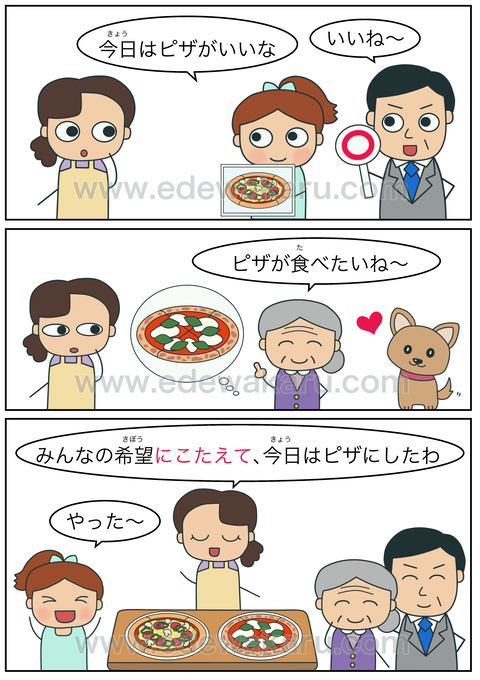
母:みんなの希望にこたえて、今日はピザにしたわ娘:わ〜い
→みんなの希望の通りに、ピザにしたわ彼は両親の期待にこたえて、医者になった
→両親の期待の通りに、医者になったお客さんの要望にこたえて、タイムサービスを行う
→要望の通りに、タイムサービスを行う父:リクエストにこたえて、ケーキを買ってきたぞ〜娘:わ〜、ありがとう
→リクエストの通りに、ケーキを買ってきたぞ〜観客:アンコール!アンコール!!歌手:アンコールにこたえて、もう1曲歌いたいと思います
→アンコールされた通りに、もう1曲歌いたいと思います
日本語文型辞典 英語版
Meaning
【にこたえて】[Nにこたえて]
With a noun expressing “expectation” or “request,” にこたえて expresses the meaning of “to realize something.” Becomes NにこたえるN when modifying a noun. A rather formal, written expression.
In context 5 examples
その選手は両親の期待にこたえてみごとに完走した。
The athlete met the expectations of her parents and reached her goal splendidly.
多数の学生の要望に応えまして、日曜日も図書館を開館することにしました。
In order to fulfill the demand of many students, we have decided to open the library on Sundays, too.
多くの消費者の皆様のご意見にお応えして、この程、より使いやすい製品を発売いたしました。
To satisfy the needs of many customers, we recently launched a new product which is even more user-friendly.
国連からの要請に応えて、政府は救援チームを派遣することにした。
To comply with a request from the United Nations, the government has decided to dispatch a rescue corps there.
多くのファンの声援に応える完璧なプレーをなしとげた。
He finally demonstrated a perfect shot in answer to the cheers of his many fans.
くらべてわかる日本語表現文型辞典
Meaning
Aの要求や期待、反響に対し、それにふさわしい反応をBでする。
How to use it
AにこたえてB(AにこたえるB)
[名詞-∅]にこたえて
Explanation
【対比1】
「AにそってB」(意味2 P.243)
「AにそってB」も「AにこたえてB」も、Aの期待・目的・要求に応えるという意味では同じだが、「AにそってB」には、段階を追って対応していくニュアンスがあり、「AにこたえてB」には、それがない。
○皆さんのご期待にそえず申し訳ございません。
○皆さんのご期待にこたえられず申し訳ございません。
○この計画にそって開発を進めていこう。
×この計画にこたえて進めていこう。
In context 4 examples
市民の要求にこたえて、市長は休日のグラウンドの開放に踏み切った。
学生のリクエストにこたえて、先生は一曲歌いだした。
子どもたちの要望にこたえるかたちで、練習は行われた。
お客様の声にこたえて、送料の無料化を実施いたしております。
IMABI
As (change)
Read this IMABI lesson ↗Explanation
As (change): ~につれて, ~に従って, ~に伴って, ~とともに, ~に応じて, & ~に応えて
~につれて, ~に従って, ~に伴って, and ~とともに all have meanings of showing the transition/change of one situation as another transition/change is under way. We will also see how ~に応じて・応えてrelate to them.
~につれて
~につれて is either after a noun or a verb in the 連体形 to express “as one thing changes, another thing changes as well”. These changes are simultaneous. Although it can be after nouns or verbs, it is after verbs more often. ~につれて is often used in situations where there is a proportional relationship with the two events in the respective clauses.
As such, the first clause acts as the trigger, proportionately raising the degree of the change/transition of the latter clause. Common translations include “as”, “together with”, and “in accordance to/with”.
Variant Note: It can be seen in more formal/written language as ~につれ.
Examples
1. 歌は世につれ世は歌につれ。
Song changes by generation, and generations change by song.
2. 昭和から平成へと時代が変わるにつれて軍歌ぐんかは歌われなくなりました。
With the changing of periods from the Showa to the Heisei, military songs became unsung.
3. 時間が経つにつれて忘れっぽくなる。
As time passes, I become forgetful.
4. 都心化(が進む)につれて自分の地域への関心が薄うすれる。
As urbanization progresses, the concern towards one’s region fades.
5. 夜が更ふけるにつれて嵐あらしは激しくなった。
The storm became fierce as the night grew late.
6. 季節の変化につれて気温が変わる。
The temperatures change in accordance to the seasons. 7. 冬になるにつれて、山が白くなってくる。
The mountains become white as winter depends.
8. イナゴは稲に付く害虫なので駆除しなくてはなりません。昔の人はそこからイナゴを食べることを思いつきました。当時は、食べることを前提に捕まえていたので、殺虫剤は使っていませんでした。しかし戦後、 農薬が普及し、それにつれてイナゴは激減してしまいました。現在では、殺虫剤を使ったイナゴの駆除も行われていますが、安全な無農薬栽培やオーガニック栽培をしている農家では一匹ずつ捕まえているそうです。大変な作業ですね。
Locusts are harmful insects which stick to rice plants and have to be exterminated. People in the past thought of eating locusts from this. At the time, they wouldn’t use pesticides with eating them as a premise. However, after the war, agrochemicals spread, and with this locusts were decreased in number. Presently, there is extermination involving pesticides, but at farms which use safe non-agriculture chemical and organic cultivation, locusts are caught by hand one by one. That’s definitely a tough job.
~に従って
~に従って can be used in a hierarchical sense to mean “according to”. As should be expected, ~に従い is more formal and indicative of the written language. Both に従っての and に従った are appropriate attribute forms.
9. 命令に従って、行動しろ。
Act according to the command.
10. 私の合図に従って行動してください。
Please act in according to my signals.
It may also be used like ~につれて. In the first usage above, it attaches to nouns. As for this usage, it attaches primarily to verbs. It, however, simply states that the two actions described in the respective clauses are happening in parallel.
11. 南に行くに従い、気温がどんどん高くなる。(Somewhat literary)
The temperature gets higher as you go south.
12. 人口が増えるにしたがって、住宅問題が起こってくる。
As the population increases, housing problems will come to occur.
13. 人口が増えるにしたがって、犯罪が多発する。
As the population increases, crime will frequently occur.
The contrast in nuance between ~につれて and ~にしたがって can definitely be seen in the following example.
14. スタジアムで場内の歓声が高まる{につれて・にしたがって}。実況アナウンサーの声も大きくなっていった。
As the cheers in the stadium intensified, the commentator’s voice got ever louder.
With ~につれて, the suspense is captured with the first clause being the trigger for the events of the second. With ~にしたがって, the sentence doesn’t become ungrammatical, but it loses the emotive drive and merely states that the two events described in the respective clauses are happening in parallel.
~に伴って
伴う means “to accompany” and ~に伴って means “associated/accompanied with” or “as”. Just like ~につれて, it may show that something is happening together with a change/transition of a certain situation. There is a temporal context of “taking A as the opportunity, therefore…B”. It is also often the case that it infers that the thing in the second clause continues.
What precedes it is either a noun or verb. In the case of a verb, unlike the other options, the particle の may be optionally used after the verb for nominalization. To be clear, this is not required and is not done in the first place for the other options. Lastly, ~に伴って is more literary.
Variant Note: It may also be seen in writing as ~に伴い.
15. 汚染おせんに伴う問題について話しましょう。
Let’s talk about the problems accompanied with pollution.
16. 人口の増加に伴って、たくさんの住宅が建てられる。
Many houses are constructed in association to the increase in population.
Particle Note: 伴う is used with を when used transitively.
~とともに
~とともに also behaves like ~につれて to show that something happens together with a change/transition of a certain situation. However, unlike ~につれて, the entire sentence doesn’t necessarily have to show a state of progress. In other cases it can have meanings equivalent to 同時に and 一緒に. As for its usage similar to ~につれて, it’s also the case that the words it follows must show change in situation. It cannot be words pertaining to action, which ~につれ and ~にしたがって can be.
17. 人口の増加とともに、犯罪が多発する。
Along with the increase in population, crimes will frequently occur.
18. 子供が卒業するとともに、父母会ふぼかいも解散かいさんしました。
The parents’ association also dissolved at the same time the kids graduated.
19. 皆さんとともに快適かいてきな道づくりを進めます。
With everyone we will go forward with a pleasant road construction.
漢字 Note: This pattern may also be written in 漢字 as ~と共に.
~に応じて
~に応じて means “accordingly” or “as to”. The first meaning is important in this lesson as it ties with the other patterns. When it is used with a verb that shows change, it describes the corresponding/dealing with a certain change. In this instance, it is possible to switch it out with ~につれて, ~にしたがって, ~にともなって, and ~とともに.
In its other meaning, it is equivalent to ~に応えて (as to/to satisfy). Although this, too, sounds like it is of the vein of the other phrases, it’s not. Although in such situations it may seem that ~に従って is possible, it would be considerably more negative.
20a. 住民の要求に応じて、説明会を開くことになりました。〇
20b. 住民の要求に従って、説明会を開くことになりました。△
20c. 住民の要求{にともなって・とともに}、説明会を開くことになりました。?
20d. 住民の要求につれて、説明会を開くことになりました。X
In meeting the wants of the citizens, it has been decided that we open an information seminar.
It has the attribute forms ~に応じての and ~に応じた. When に応じて comes before a noun, の is necessary after 応じて. Or, you can use に応じた. The 一段 conjugating verb 応じる either means “reply” or “to comply”.
21. 質問に応じて、彼女は問題の解答を詳くわしく説明しました。
As to answer the question, she explained the answer to the problem well.
22. 命令に応じた服従。
Obedience in accordance to command.
23. 料金が距離きょりと時間に応じて決まります。
The fee is determined according to distance and time.
24. 「うん」と応じる。
To respond with a “yes”.
25. 相手の依頼いらいに応じましたか。
Have you responded to your partner’s request?
26. 車の速さに応じてガソリンの消費量が変わる。
Fuel use will change depending upon the car’s speed.
~に応えて
The 一段 verb 応える may be used to mean “to come through/satisfy/answer” or “to tell/go to one’s heart”. The latter usage shows some sort of burden.
27. 要求に応こたえて、社員の給料が上がりました。
To meet demand, the employee’s salaries went up.
28. 国民に応えて、法律は廃止はいしされました。
The law was repealed in response to the citizens.
29. 期待に応える。
To come through with expectations.
30. 深酒ふかざけは身体に応えるのです。
Hard drinking takes its toll on the body.
31. その当時供給は需要に{応えて・満たして}いなかった。
In those days, the supply didn’t meet the demand.
In context 33 examples
歌は世につれ世は歌につれ。
Song changes by generation, and generations change by song.
昭和から平成へと時代が変わるにつれて軍歌ぐんかは歌われなくなりました。
With the changing of periods from the Showa to the Heisei, military songs became unsung.
時間が経つにつれて忘れっぽくなる。
As time passes, I become forgetful.
都心化(が進む)につれて自分の地域への関心が薄うすれる。
As urbanization progresses, the concern towards one’s region fades.
夜が更ふけるにつれて嵐あらしは激しくなった。
The storm became fierce as the night grew late.
季節の変化につれて気温が変わる。
イナゴは稲に付く害虫なので駆除しなくてはなりません。昔の人はそこからイナゴを食べることを思いつきました。当時は、食べることを前提に捕まえていたので、殺虫剤は使っていませんでした。しかし戦後、 農薬が普及し、それにつれてイナゴは激減してしまいました。現在では、殺虫剤を使ったイナゴの駆除も行われていますが、安全な無農薬栽培やオーガニック栽培をしている農家では一匹ずつ捕まえているそうです。大変な作業ですね。
Locusts are harmful insects which stick to rice plants and have to be exterminated. People in the past thought of eating locusts from this. At the time, they wouldn’t use pesticides with eating them as a premise. However, after the war, agrochemicals spread, and with this locusts were decreased in number. Presently, there is extermination involving pesticides, but at farms which use safe non-agriculture chemical and organic cultivation, locusts are caught by hand one by one. That’s definitely a tough job.
命令に従って、行動しろ。
Act according to the command.
私の合図に従って行動してください。
Please act in according to my signals.
南に行くに従い、気温がどんどん高くなる。(Somewhat literary)
The temperature gets higher as you go south.
人口が増えるにしたがって、住宅問題が起こってくる。
As the population increases, housing problems will come to occur.
人口が増えるにしたがって、犯罪が多発する。
As the population increases, crime will frequently occur.
スタジアムで場内の歓声が高まる{につれて・にしたがって}。実況アナウンサーの声も大きくなっていった。
As the cheers in the stadium intensified, the commentator’s voice got ever louder.
汚染おせんに伴う問題について話しましょう。
Let’s talk about the problems accompanied with pollution.
人口の増加に伴って、たくさんの住宅が建てられる。
Many houses are constructed in association to the increase in population.
人口の増加とともに、犯罪が多発する。
Along with the increase in population, crimes will frequently occur.
子供が卒業するとともに、父母会ふぼかいも解散かいさんしました。
The parents’ association also dissolved at the same time the kids graduated.
皆さんとともに快適かいてきな道づくりを進めます。
With everyone we will go forward with a pleasant road construction.
住民の要求に応じて、説明会を開くことになりました。〇
In meeting the wants of the citizens, it has been decided that we open an information seminar.
住民の要求に従って、説明会を開くことになりました。△
In meeting the wants of the citizens, it has been decided that we open an information seminar.
住民の要求{にともなって・とともに}、説明会を開くことになりました。?
In meeting the wants of the citizens, it has been decided that we open an information seminar.
住民の要求につれて、説明会を開くことになりました。X
In meeting the wants of the citizens, it has been decided that we open an information seminar.
質問に応じて、彼女は問題の解答を詳くわしく説明しました。
As to answer the question, she explained the answer to the problem well.
命令に応じた服従。
Obedience in accordance to command.
料金が距離きょりと時間に応じて決まります。
The fee is determined according to distance and time.
「うん」と応じる。
To respond with a “yes”.
相手の依頼いらいに応じましたか。
Have you responded to your partner’s request?
車の速さに応じてガソリンの消費量が変わる。
Fuel use will change depending upon the car’s speed.
要求に応こたえて、社員の給料が上がりました。
To meet demand, the employee’s salaries went up.
国民に応えて、法律は廃止はいしされました。
The law was repealed in response to the citizens.
期待に応える。
To come through with expectations.
深酒ふかざけは身体に応えるのです。
Hard drinking takes its toll on the body.
その当時供給は需要に{応えて・満たして}いなかった。
In those days, the supply didn’t meet the demand.
日本語文型辞典
Meaning
基本情報Nにこたえて説明「期待」や「要請」などの名詞に付いて、それがかなうように応じて、という意味を表す。また名詞を修飾する場合は、⑤のように「NにこたえるN」となる。やや書きことば的。例文① その選手は両親の期待にこたえてみごとに完走した。② 多数の学生の要望に応えまして、日曜日も図書館を開館することにしました。③ 多くの消費者の皆様のご意見にお応えして、この程、より使いやすい製品を発売いたしました。④ 国連からの要請に応えて、政府は救援チームを派遣することにした。⑤ 多くのファンの声援に応える完璧なプレーをなしとげた。螳檎挑
毎日のんびり日本語教師
How to use it
名詞+に応えて
Explanation
他からの働きかけに対して反応することを表します。
主に期待、要望、要求、要請、意見などの語に接続します。
動詞「応える」も同様です。
Notes
特になし
In context 8 examples
今日は娘の誕生日なので、リクエストに応えてイタリアンを食べに行った。
こちらの要望に応えていただきありがとうございました。
アンコールに応え、もう1曲歌ってくれた。
A選手が期待に応え、今季初得点を挙げた。
A大学は「クリスマスイブの夜に予定が無く寂しい」という学生の声に応え、24日午後の試験を18時から開始すると決定した。
被災地域の要請に応え、復旧・復興に向けて全力で支援して参ります。
お客様の要望に応え、弊社が最高のプランをご提案致します。
結果は最下位となり、皆さんのご声援に応えられず申し訳ございませんでした。
NINJAL 日本語文型データベース
Usage 1
Meaning
~の意向を理解して、という意味で使います。~に合うように・~に反しないように対処すると言いたいときに使います。
How to use it
Nに応えて
Notes
「~」には「期待・要望・要求・アンコール・声援」など、誰かにある動作を求めることを表す言葉がきます。
In context 5 examples
観客のアンコールに応えて、そのピアニストは優雅な1曲を披露した。
応援席の声援に応えて、選手たちは最後の最後まで戦い抜いた。
地域住民のニーズに応えて、市は図書館のサービスを充実させた。
行政側の対策は遅すぎるという住民の批判に応えて、今度の知事は何事にも敏速に対応している。
幼い子どもを持つ保護者からの要望にこたえて、公園に子ども向けの遊具が設置された。
Usage 2
Meaning
ある物事が、~の意向を理解したもの・~に合うように対処したものであることを表します。
「~に応えて・~に応え」の名詞を説明する形です。
How to use it
N1に応えるN2
In context 4 examples
ただひたすら親の期待に応える進路を選ぶなんて、僕にはできない。僕は僕の道をいく。
市の地域推進課には、住民の要望に応える企画立案を強く望みます。
役所に環境問題の早期解決についての意見書を出したが、回答は我々の要求に応えるものではなかった。
西島選手はインタビューで、「次の試合でもしっかりと皆さんの声援にこたえるプレーを見せたい」と語った。