くらべてわかる日本語表現文型辞典
Meaning
意味1:Aをしようと思えばできるが、難しい。
意味2:簡単にはAできない。
意味3:気持ちのうえで、Aするのが難しい。
意味4:Aをしたときの感覚が心地悪い。満足できない。
How to use it
Aにくい(AにくいB)
[動詞-ます形]にくい
Explanation
【対比1】
「Aがたい」(意味1 P.55)
「Aがたい」はしようと思ってもできないことであり、「Aにくい」はしようと思えばできるが、するのが難しいこと。
○彼はとても読みにくい字を書く。
×彼はとても読みがたい字を書く。
In context 16 examples
あの先生はすぐ怒るので、質問しにくいです。
靴が大きすぎて、とても走りにくかった。
スプーンでうどんは食べにくい。
この条件はわが社に不利な部分があるので、応じにくい。
虫歯になりにくいガムが今、人気だ。
子どもに与えるには、溶けにくいチョコレートがいい。
駅の切符売り場で機械を通りにくい札しかなくて困った。
私は初めての場所では、その場の雰囲気にどうもなじみにくいんです。
前回も断ったので、今回は断りにくい。
申し上げにくいことですが、ご融資できかねます。
あそこは格式の高いレストランなので、入りにくい。
きのう喧嘩したから、彼の家には行きにくい。
この靴はデザインはきれいだが、はきにくいです。
座りにくい椅子に長く座っていると、腰が痛くなってしまう。
この万年筆は書きにくいので、手が疲れる。
この服はシンプルだが、何となく着にくくて肩がこる。
日本語文型辞典
Meaning
基本情報R-にくい説明イ形容詞と同じように活用する。動詞の連用形に付いて、そうすることがむずかしい、簡単にはできないという意を表す。①②のように物理的に困難な場合や③④のように心理的に困難な場合などがある。「分かりにくい」などの例を除いては、「歩く」「話す」など意志的な行為を表す動詞に用いる。例文① あの人の話は発音が不明瞭で分かりにくい。② 砂利道はハイヒールでは歩きにくい。③ 人前ではちょっと話しにくい内容なのです。④ あんなえらい先生のところにはなかなか相談に行きにくい。例文(誤) あの人は喜びにくい人です。例文(正) あの人を喜ばせるのはむずかしい。説明反対の意を表すことばに「R-やすい」がある。
絵でわかる日本語
Usage 2
Read this source entry ↗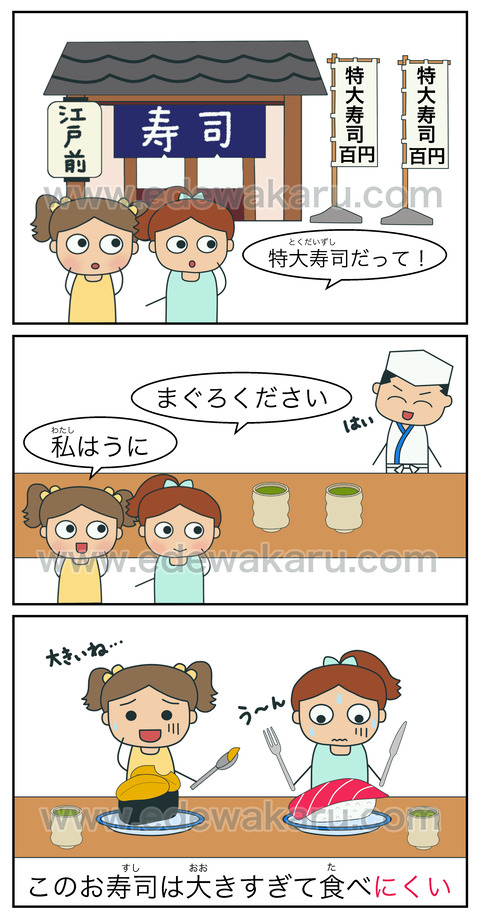
Meaning
〜するのが難しい
簡単に〜できない
簡単に〜の状態にならない
〜という状態になる可能性は低い
How to use it
動詞[ます形]+にくい
Explanation
「〜にくい」は「〜するのが難しい」「簡単に〜の状態にならない」という意味を表す文型です。「意志動詞+にくい」は「〜するのが難しい」という意味になり、「無意志動詞+にくい」は「簡単に〜の状態にならない」という意味になります😊
[例]
①このお寿司はすごく大きくて食べ
にくい
→このお寿司はすごく大きくて食べる
のが難しい
②この靴は歩き
にくい
→この靴は歩く
のが難しい
③先生の字は読み
にくい
→先生の字は読む
のが難しい
④N1の文法は難しくて覚え
にくい
→N1の文法は難しくて覚え
られない
⑤彼女:ケーキを焼いたの
彼氏:ちょっと言い
にくい
んだけど、スイーツは好きじゃないんだ…
→ちょっと言う
のが難しい
んだけど、スイーツは好きじゃないんだ…
⑥このメガネは壊れ
にくい
→このメガネは
簡単に
壊れ
ない
「〜にくい」は形容詞と同じように使われますので、名詞の前に使うこともできます😮
[例]
歩き
にくい
靴
読み
にくい
字
覚え
にくい
文法
【まとめ】
[意志動詞+にくい]
〜するのが難しい
簡単に〜できない
[無意志動詞]
簡単に〜の状態にならない
〜という状態になる可能性は低い
「〜にくい」と反対の意味を表す文型は
「〜やすい」
です。どちらも大切ですので、しっかりと覚えておきましょう😉
【関連記事】
In context 6 examples
このお寿司は大きすぎて食べにくい(復習:〜すぎる)
この靴は歩きにくい
先生の字は読みにくい
N1の文法は難しくて覚えにくい
彼女:ケーキを焼いたの彼氏:ちょっと言いにくいんだけど、スイーツは好きじゃないんだ…(復習:「スイーツ」と「デザート」)
このメガネは壊れにくい
Usage 3
Read this source entry ↗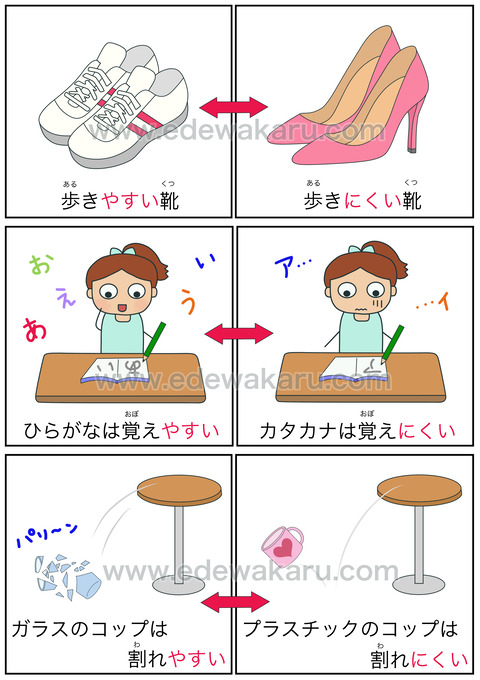
In context 10 examples
歩きやすい靴歩きにくい靴
ひらがなは覚えやすいカタカナは覚えにくい
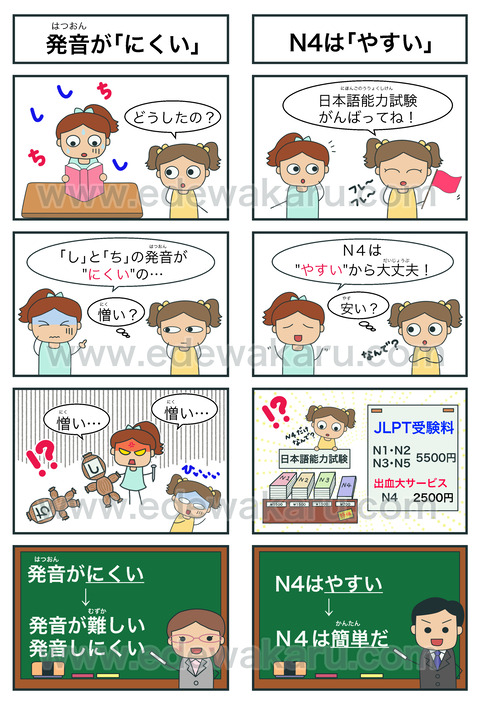
「あ」は発音しやすい「し」と「ち」は発音しにくい
この薬は甘くて飲みやすいこの薬は苦くて飲みにくい
先生の説明はわかりやすい先生の説明はわかりにくい
字がきれいで読みやすい字が汚くて読みにくい
ガラスのコップは割れやすいプラスチックのコップは割れにくい
彼女は太りやすい彼女は太りにくい
このメガネは壊れやすいこのメガネは壊れにくい
カビが生えやすい季節カビが生えにくい季節(復習:髪が伸びるvs髪が生える)「〜やすい」と「〜にくい」は初級で勉強する文型ですが、とても重要で日常会話(にちじょうかいわ)でもよく使います😊上手に使えるようにしっかりと復習をしておきましょう😀(復習:〜ように(目的))【関連記事】
どんなときどう使う 日本語表現文型辞典
Meaning
hard to
How to use it
Vます+にくい
Explanation
「~にくい」の形で「~するのが難しい」「なかなか~しない」という意味。 ❶ ❷ のようにマイナス評価も、 ❸ ❹ のようにプラス評価もある。
Difficult to do or usually isn't done. Can be used for negative evaluations, as in sentences ❶ and ❷ , or for positive ones, as in sentences ❸ and ❹ .
In context 4 examples
このくつは重くて歩きにくいです。
近くに大きいビルがたくさん建って、住みにくくなった。
このコップは丈夫で壊れにくいです。
もっと破れにくい紙をください。
日本語NET JLPT文法解説まとめ
Meaning
①〜するのが難しい
②なかなか〜しない(性質)
How to use it
V(ます形)ます + にくい
Explanation
difficult to do
In context 15 examples
この漢字は覚えにくいです。
焼き魚は骨が多くて食べにくいです。
上司は無口で、顔が怖いので話しかけにくいです。
この靴はデザインはかっこいいんですが、歩きにくいです。
こんなところでハイヒールは歩きにくいですよ。
今日は曇りなので、洗濯物が乾きにくいです。
この本は字が小さくて読みにくいです。
田中先生の授業は説明が難しくて、わかりにくいです。
トムさんの話はいつも長くてわかりにくい。
このあたりは、高いビルが多いし、賑やかだし、住みにくそうです。
この道は狭くて、車も多いので、運転しにくいです。
このカバンは安いですが、丈夫で壊れにくいです。
このコップはプラスチック製なので割れにくいです。
ちょっとここでは話しにくいので、場所を変えませんか。
ちょっと先生には相談しにくいので、トムさん、私の悩みを聞いてくれない?
日本語文型辞典 英語版
Meaning
【にくい】[R-にくい]
Conjugates in the same way as i-adjectives. With the stem of a verb, expresses the meaning that something is hard to do or not easily done. Used when something is physically hard to achieve, as shown in
(1)
and
(2)
, or when it is psychologically hard to accomplish, as shown in
(3)
and
(4)
. Except for examples such as 分かりにくい(difficult to understand), にくい is preceded by a verb of volitional action such as 歩く(walk) or 話す(talk).
(×)あの人は喜びにくい人です。
That person is difficult to please.
(○)あの人を喜ばせるのはむずかしい。
It is difficult to please that person.
There is also an expression which shows the opposite meaning: R-やすい.
In context 4 examples
あの人の話は発音が不明瞭で分かりにくい。
It’s hard to understand what he says because his pronunciation isn’t clear.
砂利道はハイヒールでは歩きにくい。
It’s hard to walk on a gravel path wearing high heels.
人前ではちょっと話しにくい内容なのです。
This matter is a little bit difficult to talk about in public.
あんなえらい先生のところにはなかなか相談に行きにくい。
It’s fairly difficult to go consult with such a high-ranking professor.
AIUEO JLPT Grammar
Meaning
「〜にくい」is used to express that an action is difficult to perform or a certain state is hard to occur. It is used when an action feels difficult or when it is challenging to achieve something.
How to use it
動詞ます形+にくい
Explanation · 日本語
「〜にくい」は、ある行動が実行するのが難しい、または特定の状態が発生しづらいことを表す表現です。行動が難しく感じられるときや、何かを達成するのが困難な場合に使われます。
In context 5 examples
この問題は解きにくいです。
This problem is hard to solve.
この道は歩きにくかった。
This road was hard to walk.
この靴は履きにくいです。
These shoes are hard to wear.
この参考書は理解しにくいです。
This reference book is hard to understand.
このペンは書きにくいでしょう。
This pen will be difficult to write with.
Bunpro Grammar Reference
Meaning
Difficult to, Hard to
How to use it
Verb[stem]+ にくい
Verb[stem]+ にくい + です
Nuance
An expression that focuses on the difficulty created by the speaker's lack of skill, or personal feelings.
Explanation
Like 易い, にくい is an い-Adjective that is regularly attached to the ます stem of verbs. However, instead of meaning 'easy to (A)', it means 'difficult to (A)'. (A) will always represent the verb that comes before にくい.
この駐車場は狭いから止めにくい。
This parking lot is very cramped, so it is difficult to park.
今日は具合が悪いから呼吸がしにくい。
Because I am not feeling well today, it is hard to breathe.
The nuance of にくい is that (A) is a task that is difficult to do, because of the required skill level, or similar factors. This is different from づらい, which focuses more on a task that is difficult due to being unbearable/hard to endure for some reason.
私には英語の「Literally」という単語がとても言いにくい。
For me, the English word 'literally' is very hard to say. (Hard due to the individual's skill level)
お前には本当に言いづらいけど、お前のギターを壊した。ごめん。
This is very difficult for me to say to you, but I broke your guitar. I'm sorry. (Hard because the speaker knows that telling the listener will cause a negative response)
Fun Fact
An easy way to remember the difference in nuance between にくい and づらい, is that にくい comes from the same kanji as 難しい, which usually carries the meaning of 'difficulty' (in relation to skill being required).
Nuance · 日本語
話し手のスキルの欠如、または個人的な感情が何かを難しくしているということを強調する表現。
In context 16 examples
- 甘くないケーキは、食べにくいです。
Cakes that aren't sweet are hard to eat.
- この駐車場は狭いから止めにくい。
This parking lot is very cramped, so it is difficult to park.
- 私には英語の「Literally」という単語がとても言いにくい。
For me, the English word 'literally' is very hard to say. (Hard due to the individual's skill level)
- 今日は具合が悪いから呼吸がしにくい。
Because I am not feeling well today, it is hard to breathe.
- お前には本当に言いづらいけど、お前のギターを壊した。ごめん。
This is very difficult for me to say to you, but I broke your guitar. I'm sorry. (Hard because the speaker knows that telling the listener will cause a negative response)
- アフリカには行きにくいです。
It is hard to go to Africa.
- 怖いことはしにくいです。
It is difficult to do scary things.
- あの人とは話しにくいです。
That person is hard to talk to. (Unapproachable)
- このコップ、形が変だから飲みにくい。
Because this cup has a strange shape, it is hard to drink out of.
- 難しい漢字は覚えにくい。
Tricky Kanji are difficult to memorize.
- この会社は働きにくいけど、働かなくてはいけない。
It is difficult to work at this company, but I have to work.
- 日本語は話しにくいですが、頑張ります。
Japanese is difficult to speak, but I will try my best.
- まだ慣れていないからやりにくい。
Because I am still not used to it, it is hard to do.
- 緊張して声が出にくい。
I'm nervous, making it hard to talk. (Difficult to produce my voice)
- 性格が元彼女に似ているから、話しにくい。
Her personality is like my ex's, so it is hard to talk with her. (Unapproachable)
- 遠いから日本には行きにくいけど、行くつもりだ。
Because it is far Japan is difficult to get to, but I intend to go.
文法
Meaning
①〜するのが難しい
②なかなか〜しない(性質)
How to use it
V(ます形)ます + にくい
In context 15 examples
この漢字は覚えにくいです。
焼き魚は骨が多くて食べにくいです。
上司は無口で、顔が怖いので話しかけにくいです。
この靴はデザインはかっこいいんですが、歩きにくいです。
こんなところでハイヒールは歩きにくいですよ。
今日は曇りなので、洗濯物が乾きにくいです。
この本は字が小さくて読みにくいです。
田中先生の授業は説明が難しくて、わかりにくいです。
トムさんの話はいつも長くてわかりにくい。
このあたりは、高いビルが多いし、賑やかだし、住みにくそうです。
この道は狭くて、車も多いので、運転しにくいです。
このカバンは安いですが、丈夫で壊れにくいです。
このコップはプラスチック製なので割れにくいです。
ちょっとここでは話しにくいので、場所を変えませんか。
ちょっと先生には相談しにくいので、トムさん、私の悩みを聞いてくれない?
NINJAL 日本語文型データベース
Meaning
[1] ~するのが難しいことを表します。悪い意味で使うことが多いです。
[2] なかなか〜しない性質であることを表します。いい意味でも悪い意味でも使います。
How to use it
Notes
[1] 「〜」には、「使う・食べる・説明する」など、主に意志的な行為を表す動詞がきます。
「〜にくくない・〜にくかった・〜にくくて」などのように、イ形容詞と同じ形に変化します。
[2] 「〜」には、「壊れる・見える・滑る」など、主に意志的な行為を表さない動詞がきます。
「〜にくくない・〜にくかった・にくくて」などのように、イ形容詞と同じ形に変化します。
In context 13 examples
この道は狭くて、トラックでは通りにくいです。
あの人は自分勝手なところがあるので、付き合いにくい。
この店は路地裏のとても見つけにくいところにある。
新しく買ったパソコンは、はじめは使いにくかったが、今はすっかり慣れた。
あの事件の真相はメールでは説明しにくいので、今度会ったときにお話しします。
「このサラダ、フォークだと食べにくくないですか。お箸を頼みましょうか」
この靴は、雨の日でも滑りにくい。
野菜は鍋でゆでるより、電子レンジを使って調理したほうがビタミンCが壊れにくいです。
プラスチックは割れにくいので、子ども用の食器によく使われています。
昨日泊まったホテルの部屋からは、スカイツリ―は見えにくかった。
スマートフォンの液晶画面は、ガラスコーティングすると汚れがつきにくくなります。
このカーテンは光や熱を通しにくくて、夏に最適だ。
家を建てるときは、災害の被害を受けにくい場所を選ぶことも大切だ。
IMABI
Difficult I: ~にくい
Read this IMABI lesson ↗Explanation
Difficult I: ~にくい
In the previous lesson, we learned about the various adjectives meaning “easy” as well as the ending ~やすい. Similarly, we’ll be learning about the various ways to say “difficult.” Although ~にくい is by no means the only ending used to mean “difficult to do…”, it’ll be the only ending introduced in this level of いまび.
The Adjective 難しい & Its Variants
The easy thing about saying “difficult” in Japanese is that the similarity between synonyms is not nearly as great as the case with the adjectives meaning “easy.” Meaning, although synonyms certainly exist, they’re different enough that their English equivalents could just as easily be mapped on to them without causing too much confusion. To see this in action, let’s start off by looking at 難しい. This word means “difficult/hard,” and is a vocab word we saw early on in our introduction to adjectives.
Word Form Note: 難しく is the adverb form and is frequently paired with する to mean “to make…hard.”
1. 難しい漢字が出た。
A difficulty Kanji popped up.
2. 今も早期に発見することが難しい病気です。
Even now, it is a disease which is nearly impossible to find at an early stage.
3. 難しい事件をやればそれだけ手間がかかる。
Handling difficult cases involve their degree of work.
4. 生還は難しいですねえ。
Returning alive will be (nearly) impossible.
Word Note: 難しい, along with 厳しい (described below), are go-to euphemisms for saying something that you think are impossible.
5. 新型コロナウイルスという脅威は、医療崩壊や都市封鎖など、人類が経験したことのない世界規模の災害であり、人々の移動が事態を難しくしてしまっている。
The threat known as the novel coronavirus is a disaster of global scale which mankind has never experienced, bringing about healthcare collapse, city lockdowns, etc., and the movement of people has complicated the situation.
6. 君は毎日メイクに難しいよな。
You’re so fussy with your makeup every day.
7. まるで見えない何かと戦っているような難しい顔をしている人はどこに行っても居る。
No matter where you go, there will be people whose expressions are so serious it’s as if they’re fighting something invisible.
8. 難しいお客さんとのトラブルが相次いでいるらしい。
It seems that issues with hard-to-please customers are happening one after another.
The various nuances of “difficult” represented by 難しい are just as varied as the English word. It can be used to describe situations that are difficult to comprehend, hard to solve, nearly impossible to realize, situations that are hard to manage, people that are difficult to handle, being particular with one’s tastes, being hard to please, as well as meaning gloomy.
The most common synonym to 難しい is 厳しい. This word shares the meaning of pointing at situations that are really hard to manage, and it heavily emphasizes severity . As its primary meaning is “to be strict,” when it does mean “hard/tough/difficult” situations, it’s implied that a halfhearted attempt would not be tolerable.
9. 象徴天皇制を支える皇室の前途は非常に厳しい。
The outlook of an Imperial Household, which sustains the symbolic emperor system (of Japan), is very bleak.
10. 光圀は表情を厳しくしてにじり寄った。
Mitsukuni had a grim expression on his face as he inched toward (him).
As is the case with most native vocabulary, 難しい does have a Sino-Japanese equivalent. That equivalent is 困難. This word can be used both as a standalone noun meaning “difficulty/hardship” as well as an adjectival noun meaning “difficult” in the sense of a situation being extremely difficult. Thus, its meaning is quite narrow in comparison to 難しい. Additionally, it has its own synonym, which is 難儀. 難儀 implies a greater degree of emotional trauma surrounding the difficult situation. However, in many areas of Japan, it is often used entirely synonymously with both 難しい and 困難.
11. 困難を乗り越えた経験について教えてください。
Please tell us of an experience where you overcame hardship.
12. 必要な睡眠時間の基準を定めることはデータ不足で困難だ。
Determining a standard for necessary number of hours of sleep is difficult due to lack of data.
13. 難儀やなあ。(関西弁)
This is sure tough.
Phrase Note: Ex. 13 is a very common expression throughout the Kansai Region of Japan, but it has also been popularized throughout the country, especially given that the word 難儀 does, in fact, exist in Standard Japanese.
It’s also intriguing to note that both 困難する and 難儀する mean “to suffer,” in which case both would be more creative/literary ways of saying 苦しみ悩む–excluding the dialectal favoring of 難儀 in some regions.
14. 宿泊業も大変困難しているでしょう。
The hotel industry is also surely suffering terribly.
15. えらい難儀しました。(京都弁)
I had a hard time of things.
Returning our focus to 難しい, it’s important to note two alternative forms of the same word. The first is ムズい, which is a very casual abbreviation largely limited to informal venues such as social media posts/messaging. It is not proper to use in formal writing or honorific speech.
16. マジでムズすぎ草!
It’s way too hard lol!
17. ムズいと思わない?
Don’t you think it’s hard?
The /z/ sound in 難しい is actually dialectal itself, with the original standard form of the word being むつかしい. This can still be seen in older textbooks as well as in the speech and writing of older generations. In novels written in the early to mid-1900s, you could see various Ateji spellings such as 六つかしい. So, if you stumble across this form, know that its meaning is no different than 難しい.
18. 「むつかしい」は伝統的な本来の発音ではあるが、現代では、主に関西地方で使われている。
“Mutsukashii” is the traditional, original pronunciation, but in the present day, it is largely used in the Kansai Region.
The Sino-Japanese 難
The ON reading of 難 is ナン. By itself, it can stand alone as a noun meaning “difficulty/hardship.” Many verbs with meanings regarding overcoming are frequently used with it.
19. 難を転じて福となす。
Turn hardship into a blessing.
20. 彼なら難なくやりそうだ。
He seems like he’d do it without any trouble/difficulty.
21. 不安で難の多い新しい恋のほうに走った。
I ran towards a new love, one with lots of hardship, out of anxiety.
Its most common role, though, is both as a prefix and as a suffix. As a prefix, its meaning remains “difficult/hard,” with the resulting word simply being a more concise Sino-Japanese expression that could still possibly be reworded with 難しい. Then, as a suffix, its meaning is akin to “difficulty in…” To paraphrase this with 難しい, you would need to use its noun form 難しさ, but because that introduces grammar we’ve yet covered, we’ll only be focusing on expressions made with either use of 難 as all the resultant words are, ironically, easily understood nouns/adjectival nouns.
22. この【難問・難しい質問】クイズにチャレンジしてみよう!
Challenge yourself to this difficult question quiz!
23. 【難点・難しい点】が多い。
There are many points of contention.
24. 研究者たちは無数の【難題・難しい問題】に直面している。
Researchers are facing countless difficult problems.
25. 【難読の・読みにくい】漢字が苦手だ。
I’m bad at hard-to-read Kanji.
26. 【難解な・解りにくい】ラノベを読んだことある?
Have you ever read a difficult light novel?
Word Note: 難解な is the Sino-Japanese equivalent of 難しい. It is very common in both the written and spoken languages with the added nuance of “unintelligible.”
Word Note: “Light novels” are young-adult oriented fiction which is also illustrated, a genre that’s in between novel and manga.
~にくい
The ending ~にくい comes from the same source as the word 憎い meaning “to be detestable.” At first, the ending denoted strong resistance to doing something, but over time, its meaning broadened to indicate actions that are difficult to do for both physical and emotional reasons.
There are two primary meanings to ~にくい.
①To indicate that something is hard to do –~するのが難しい.
②To indicate a disposition of not readily behaving as such–なかなか・・・しない.
Just as was the case with ~やすい, the first meaning is used with verbs of volition, in which the speaker has willful participation in the action, but in the case of ~にくい. the person is not having an easy time with it. The second meaning is implied when the verb is non-volitional, meaning there is no active will implied by the doer if there happens to be one in the sentence.
Verb Class 連用形+~にくい
一段 Verbs見にくい (difficult to watch)
食べにくい (difficult to eat)
五段 Verbs飼いにくい (difficult to raise (an animal))
描きにくい (difficult to draw)
泳ぎにくい (difficult to swim)
勝ちにくい (difficult to win)
死ににくい (to not easily die)
読みにくい (difficult to read)
変わりにくい (to not easily change)
するしにくい (hard to do…/to not easily…)
来る来にくい (to be hard to come to)
Particle Note: Particle use with ~にくい mirrors the same situations we saw with ~やすい. When attached to transitive verbs, we find that を appears regardless of whether the agent is willfully acting or not as the subject-transitive predicate still has an object.
27. チワワは飼いにくい。
Chihuahuas are hard to raise.
28. この携帯は落としても壊れにくいよ。
This cellphone doesn’t easily break even if you drop it.
29. 食べにくい!でも美味しい!
It’s so hard to eat! But it’s so good!
30. 知らない人のことをおかしいと思ったなんてこと、言いにくいじゃないですか。
Wouldn’t it be hard to say how you thought someone you didn’t even know was crazy?
31. 死ににくい魚を飼ってみたい。
I want to keep fish that won’t die so easily.
32. 緑茶でうがいをし始めてから風邪を引きにくくなった。
It has become harder for me to get colds since starting to gargle with green tea.
33. 今日は曇りなので、洗濯物が乾きにくいです。
The laundry can’t dry well because it’s cloudy today.
34. 先生の前ではタバコを吸いにくい。
It’s hard to smoke in front of Sensei.
35. この靴は疲れにくくて、おすすめです!
These shoes don’t wear easily and are a must!
見にくい vs 見えにくい
The word for “ugly” is 醜い. Despite its complicated Kanji, it’s still the same word as 見にくい. How this relationship came about is simple. 見にくい refers to “something being hard to see due to some obstacle,” but the obstacle in this case is usually a subjective one.
35. 黒板の文字が小さくて見にくい。
The letters on the blackboard are small and hard to see.
36. 横向きで見にくいです。
It’s hard to look at turned sideways (landscape orientation).
37. インターフェースが見にくいです。
The interface is hard to look at.
38. 醜い人とはできるだけお付き合いしたくない。
I’d like to not associate with ugly people as much as possible.
Then, there’s also the combination 見えにくい. which utilizes 見える (to be visible). This word is used exclusively to refer to literal difficulty in seeing. As opposed to 見にくい, sight itself is being obstructed here in a way that can’t be helped. Whether it’s too dark or your eyes aren’t working, it’s not just a case of being ‘hard to look at.’
39. 暗くて見えにくい。
It’s dark and hard to see.
40. 物が見えにくい子供は目を細める癖がある。
Children that have a hard time seeing things have the habit of squinting their eyes.
Although ~が見える usually follows what would be perceived as the object of the sentence, in the expression, 目が見える, that is not the case. This phrase means that “the eyes can see,” and when 見えにくい is used, you are describing how the eye(s) can’t see well. This mustn’t be confused with 目に見える, which means “to meet one’s eyes/to be evident to one’s eyes,” though there is nothing stopping from someone to use 目に見えにくい to mean “to be intangible.”
41. 片方の目が見えにくい。
I can’t see out of one eye.
42. 理由は目に見えにくい。
The reason is hardly evident to the eye.
~のが難しい vs ~にくい
Just as there is a distinction between “Verb + のが簡単” (doing…is easy) and “Verb~やすい” (easy to…), there is a difference between “Verb + のが難しい” (doing…is difficult) and ” Verb~にくい” (difficult to do…).
Grammar Note: It is a given that both の and こと function as verb nominalizers and that both may appear with 難しい. However, the difference between either nominalizer is not dependent on the use of 難しい but the subjectivity of the opinion stated. Additionally, the choice between が and は is yet another layer of nuancing that you as the speaker are responsible for orchestrating correctly.
First, let’s return to Ex. 2 and compare it with the similar Ex. 2b, both shown below.
2a. 今も早期に発見することが難しい病気です。
Even now, it is a disease which is nearly impossible to find at an early stage.
2b. 今も早期に発見しにくい病気です。
Even now, it’s a disease that is hard to find at an early stage.
We see that 2a. is far more serious in degree than 2b., which is aided in the fact how 難しい is used heavily as a euphemism for “impossible.” The most common reason to use Verb + のが難しい” is when the verb is still being used in the transitive sense with a direct object stated.
2c. この病気を早期に発見することは難しい。
It’s nearly impossible to find this disease at an early stage.
This situation is similar to how non-volitional transitive verbs manage to keep を when paired with ~にくい, but all volitional verbs (non-transitive/transitive alike) can be used with ~するのは難しい and still keep their objects when applicable. Ultimately, ~にくい is overwhelmingly used in simple “Xは・がVerb~にくい” statements, whereas “Verb + のが難しい” will mostly involve nominalizing complex subordinate clauses.
~られにくい
Just as is the case with ~やすい, ~にくい should not be paired with the potential form. However, it can be used with passive structures, which are non-volitional in nature, to show a lack in tendency.
41. セキュリティーの観点から破られにくいパスワードの作り方を解説します。
I’ll explain how to create a password that would be unlikely broken from a security point of view.
42. サングラスは顔を人に覚えられにくくしたいんだろう。
The sunglasses are probably to make one’s face harder to be recognized.
In context 47 examples
難しい漢字が出た。
A difficulty Kanji popped up.
今も早期に発見することが難しい病気です。
Even now, it is a disease which is nearly impossible to find at an early stage.
難しい事件をやればそれだけ手間がかかる。
Handling difficult cases involve their degree of work.
生還は難しいですねえ。
Returning alive will be (nearly) impossible.
新型コロナウイルスという脅威は、医療崩壊や都市封鎖など、人類が経験したことのない世界規模の災害であり、人々の移動が事態を難しくしてしまっている。
The threat known as the novel coronavirus is a disaster of global scale which mankind has never experienced, bringing about healthcare collapse, city lockdowns, etc., and the movement of people has complicated the situation.
君は毎日メイクに難しいよな。
You’re so fussy with your makeup every day.
まるで見えない何かと戦っているような難しい顔をしている人はどこに行っても居る。
No matter where you go, there will be people whose expressions are so serious it’s as if they’re fighting something invisible.
難しいお客さんとのトラブルが相次いでいるらしい。
It seems that issues with hard-to-please customers are happening one after another.
象徴天皇制を支える皇室の前途は非常に厳しい。
The outlook of an Imperial Household, which sustains the symbolic emperor system (of Japan), is very bleak.
光圀は表情を厳しくしてにじり寄った。
Mitsukuni had a grim expression on his face as he inched toward (him).
困難を乗り越えた経験について教えてください。
Please tell us of an experience where you overcame hardship.
必要な睡眠時間の基準を定めることはデータ不足で困難だ。
Determining a standard for necessary number of hours of sleep is difficult due to lack of data.
難儀やなあ。(関西弁)
This is sure tough.
宿泊業も大変困難しているでしょう。
The hotel industry is also surely suffering terribly.
えらい難儀しました。(京都弁)
I had a hard time of things.
マジでムズすぎ草!
It’s way too hard lol!
ムズいと思わない?
Don’t you think it’s hard?
「むつかしい」は伝統的な本来の発音ではあるが、現代では、主に関西地方で使われている。
“Mutsukashii” is the traditional, original pronunciation, but in the present day, it is largely used in the Kansai Region.
難を転じて福となす。
Turn hardship into a blessing.
彼なら難なくやりそうだ。
He seems like he’d do it without any trouble/difficulty.
不安で難の多い新しい恋のほうに走った。
I ran towards a new love, one with lots of hardship, out of anxiety.
この【難問・難しい質問】クイズにチャレンジしてみよう!
Challenge yourself to this difficult question quiz!
【難点・難しい点】が多い。
There are many points of contention.
研究者たちは無数の【難題・難しい問題】に直面している。
Researchers are facing countless difficult problems.
【難読の・読みにくい】漢字が苦手だ。
I’m bad at hard-to-read Kanji.
【難解な・解りにくい】ラノベを読んだことある?
Have you ever read a difficult light novel?
チワワは飼いにくい。
Chihuahuas are hard to raise.
この携帯は落としても壊れにくいよ。
This cellphone doesn’t easily break even if you drop it.
食べにくい!でも美味しい!
It’s so hard to eat! But it’s so good!
知らない人のことをおかしいと思ったなんてこと、言いにくいじゃないですか。
Wouldn’t it be hard to say how you thought someone you didn’t even know was crazy?
死ににくい魚を飼ってみたい。
I want to keep fish that won’t die so easily.
緑茶でうがいをし始めてから風邪を引きにくくなった。
It has become harder for me to get colds since starting to gargle with green tea.
今日は曇りなので、洗濯物が乾きにくいです。
The laundry can’t dry well because it’s cloudy today.
先生の前ではタバコを吸いにくい。
It’s hard to smoke in front of Sensei.
この靴は疲れにくくて、おすすめです!
These shoes don’t wear easily and are a must!
黒板の文字が小さくて見にくい。
The letters on the blackboard are small and hard to see.
横向きで見にくいです。
It’s hard to look at turned sideways (landscape orientation).
インターフェースが見にくいです。
The interface is hard to look at.
醜い人とはできるだけお付き合いしたくない。
I’d like to not associate with ugly people as much as possible.
暗くて見えにくい。
It’s dark and hard to see.
物が見えにくい子供は目を細める癖がある。
Children that have a hard time seeing things have the habit of squinting their eyes.
片方の目が見えにくい。
I can’t see out of one eye.
理由は目に見えにくい。
The reason is hardly evident to the eye.
今も早期に発見しにくい病気です。
Even now, it’s a disease that is hard to find at an early stage.
この病気を早期に発見することは難しい。
It’s nearly impossible to find this disease at an early stage.
セキュリティーの観点から破られにくいパスワードの作り方を解説します。
I’ll explain how to create a password that would be unlikely broken from a security point of view.
サングラスは顔を人に覚えられにくくしたいんだろう。
The sunglasses are probably to make one’s face harder to be recognized.
毎日のんびり日本語教師
How to use it
動ます形+にくい
Explanation
動ます形に接続して、その動作が困難、あるいはその状態が発生する可能性が低いことを表します。
「にくい」は、い形容詞として扱われます。
Notes
関連文法「~易い(~やすい)」
In context 8 examples
先生のはいつも分かりにくい。
このペンは使いにくい。
私は昔から太りにくい体質だ。
育毛剤のおかげで、最近髪の毛が抜けにくくなってきている。
彼女にこの話はしにくい。(很难告诉她。)
この単語は長くて覚えにくい。
燃えにくい建材で家を作る。(用不易燃烧的建材建造房子。)
このコップは頑丈で壊れにくい。