DoJG 日本語文法辞典(全集)
Meaning
Impossible; there is no way for someone to ~; cannot be expected to
How to use it
Vinformal nonpast | べくもない | する→{す/する}べくもない |
| 勝つべくもない | It is impossible to win |
| 否定す(る) べくもない | It is impossible to deny |
Explanation
A phrase meaning "it is impossible to do something"
In context 7 examples
私が一億円の家を買うなど、望むべくもない。
It is impossible for me to hope to buy a hundred million yen house.
十年前に別れた女性の居どころなど知るべくもない。
There is no way for me to know the whereabouts of the woman I split up with 10 years ago.
終戦後は海外旅行など望むべくもなかった。
In the post-war era, one could not even hope to make a trip abroad.
初日は雨で山頂は望むべくもなかったが、翌日はすっかり晴れ、白銀に輝く山は神々しい美しさだった。
On the first day, it was impossible to view the summit because of rain, but on the following day, the weather was perfect, and the mountain was shining silvery white. It was sublimely beautiful.
我々のような弱いチームが優勝候補のTチームに勝つべくもない。
A weak team like ours simply cannot be expected to beat Team T, one of the competitors for the championship.
その事件が起きた時私は海外旅行中で知るべくもなかった。
The incident occurred when I was traveling abroad, so there was no way for me to know about it.
最近は多忙で本を読む時間など期待すべくもない。
Lately I've been so busy that it is impossible to find (literally: to expect to have) time to read books.
絵でわかる日本語
Usage 1
Read this source entry ↗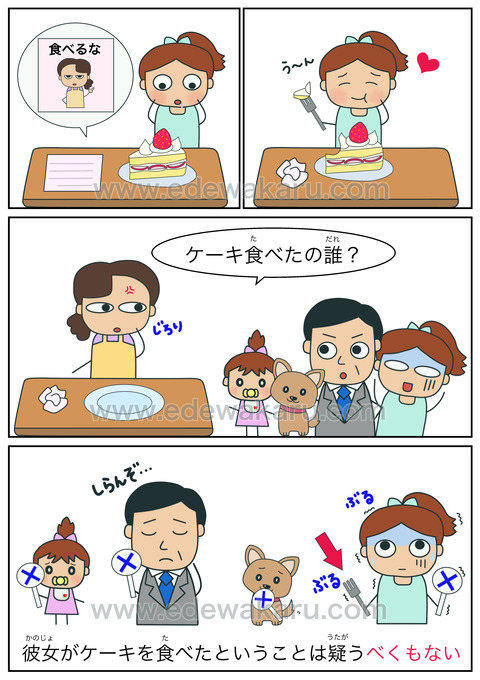
Meaning
とても〜することはできない
〜したくても〜できない
(状況から)〜する必要はない
How to use it
動詞[辞書形]+べくもない
Explanation
「〜べくもない」は「とても〜することはできない」「〜したくても〜できない」という意味で【不可能】を表す文型です。これは「自分の能力では〜できない」という時ではなく、【社会的な理由】や【周りの状況】から
「とても〜することはできない」「状況から考えて、〜する必要がない」
と言いたい場合に使われます😮この文型はとてもかたい言い方で、よく使われる動詞がいくつかありますので覚えておくといいと思います。
[「〜べくもない」とよく一緒に使われる動詞]
・
望む
べくもない→「望みがない・期待できない」という意味
・
知る
べくもない
・
想像する
べくもない
・
疑う
べくもない→「間違えない」という意味
・
考える
べくもない
・
否定する
べくもない など
また
「する」の場合は「するべくもない」の他に、「すべくもない」も使うことができます😊
[例]
想像する
べくもない
=想像す
べくもない
「〜べくもない」は書き言葉ですので、会話で使われることはほとんどありません😅N1を受ける人はテストのためにしっかりと覚えておきましょう😉
(復習:〜ために(目的))
【「べき」がつく文型】
〜べからず・〜べからざる
〜べきだ
〜べきだった・〜べきではなかった
〜べく
〜べくして
〜べくもない
〜べし
In context 5 examples
彼女がケーキを食べたということは疑うべくもない
→彼女がケーキを食べたということは間違いないことだ彼女は勉強をせずに毎日遊んでばかりいた。N1合格は望むべくもない
→N1に合格する望みはない(復習:〜てばかりいる・〜てばかりだ)A:日本とアメリカはどちらが大きいと思う?B:…アメリカが日本より大きいことは比べるべくもないよ
→アメリカが日本より大きいことは比べる必要もないよ子供の時は、両親の大変さなんて知るべくもありませんでした
→両親の大変さなんて、とても知ることができなかった(復習:〜など・〜なんか・〜なんて)日本社会(にほんしゃかい)における少子高齢化(しょうしこうれいか)が大きな問題であることは疑うべくもない
→少子高齢化が大きな問題であることは間違えない(復習:〜において・〜におけるN)
Usage 2
Read this source entry ↗Meaning
とても〜することはできない
〜したくても〜できない
(状況から)〜する必要はない
How to use it
動詞[辞書形]+べくもない
Explanation
「〜べくもない」は「とても〜することはできない」「〜したくても〜できない」という意味で【不可能】を表す文型です。これは「自分の能力では〜できない」という時ではなく、【社会的な理由】や【周りの状況】から
「とても〜することはできない」「状況から考えて、〜する必要がない」
と言いたい場合に使われます😮この文型はとてもかたい言い方で、よく使われる動詞がいくつかありますので覚えておくといいと思います。
[「〜べくもない」とよく一緒に使われる動詞]
・
望む
べくもない→「望みがない・期待できない」という意味
・
知る
べくもない
・
想像する
べくもない
・
疑う
べくもない→「間違えない」という意味
・
考える
べくもない
・
否定する
べくもない など
また
「する」の場合は「するべくもない」の他に、「すべくもない」も使うことができます😊
[例]
想像する
べくもない
=想像す
べくもない
「〜べくもない」は書き言葉ですので、会話で使われることはほとんどありません😅N1を受ける人はテストのためにしっかりと覚えておきましょう😉
(復習:〜ために(目的))
【「べき」がつく文型】
〜べからず・〜べからざる
〜べきだ
〜べきだった・〜べきではなかった
〜べく
〜べくして
〜べくもない
〜べし
毎日のんびり日本語教師
How to use it
動辞形+べくもない
Explanation
不可能を表す文型です。
実際はそうなることを望んでいるが、実際は状況的にできないというニュアンスを持ちます。比較的硬めの表現です。
「する」は「すべくもない」「するべくもない」になる点に注意。
Notes
特になし
In context 8 examples
痩せたいけど、この体重では部分痩せなど望むべくもない。
文化財を後世まで保存する価値があることは疑うべくもない。
家で聴くのと生の演奏では比べるべくもない。(在家里听和现场演奏是不可比拟的。)
素人が何人集まろうとも、プロに適うべくもない。
昔は将来のことを考えるべくもなく、今を精一杯生きるだけだった。
味は本物と比べるべくもないけど、食感はかなり蟹に近いと思った。
裏でどのようなやり取りがされていたかは私たちには知るべくもない。
職員の給料は子供の安全と天秤にかけるべくもない。
AIUEO JLPT Grammar
Meaning
This sentence pattern expresses that, given the circumstances, there is no hope or possibility of something happening. It strongly conveys a sense of denial or resignation, emphasizing the absence of expectations or hopes.
How to use it
動詞辞書形+べくもない
Explanation · 日本語
この文型は、状況や条件から考えて、あることが実現することは全く望めないことを表現する表現です。強い否定や諦めの感情を含み、何かを期待したり、望んだりする余地がないことを強調します。
In context 5 examples
彼の才能を超えることは、私には望むべくもない。
It is impossible for me to hope to surpass his talent.
この複雑な問題を短時間で理解するのは望むべくもない。
It is impossible to hope to understand this complex issue in a short time.
彼に太刀打ちすることなど、私には望むべくもありません。
It is impossible for me to compete with his abilities.
彼の無実を証明することは、今となっては期待すべくもないです。
It is impossible to prove his innocence at this point.
このプロジェクトが失敗することは、予測するべくもなかった。
It was impossible to predict that this project would fail.
Bunpro Grammar Reference
Meaning
No (doubt or hope), There is no way, It is impossible, Not a hope in hell
How to use it
Verb + べくもない
Exceptions:
[する]Verb + す(1) + べくもない
(1) する
Verb + べくもありません
Exceptions:
[する]Verb + す(1) + べくもありません
(1) する
Nuance
A formal construction, indicating that there is no hope of (A). It would not even be permissable that (A).
Explanation
As mentioned in the several other grammar structures that include べく, this structure is the conjunctive form of the classical auxiliary verb べし ‘shall’. It will be attached to the dictionary form of verbs in order to convey the purpose, necessity, or likelihood of an action. When combined with the adverbial particle も, and the い-Adjective ない, it is often translated as ‘it is impossible to (A)’, or ‘there is no way to (A)’.
自分が作ったパスタはあの有名シェフが作るパスタと比べるべくもないが、結構おいしいと思う。
It is impossible to compare the pasta I made with the one made by that famous chef, but I think mine is quite tasty.
あの顔を見てみろ、あいつが彼を殺したという事は疑うべくもない。
Look at that face, there is no doubt that they are the one that killed him.
私自身が先生になるまでは、先生の大変さなど知るべくもなかった。
Until I became a teacher myself, I could never have known how hard it is to be a teacher.
べくもない is a pattern that usually appears with verbs highlighting the thinking or emotions of the speaker, and how that action is impossible or inconceivable for them.
Caution
In the case of する, べく may be connected directly to する, or to the stem, す.
あの中古車販売店が詐欺まがいなことをやっていたということは、否定するべくもない事実だ。
There is no doubt that that used car dealership was doing something that could be considered as a scam.
そんな解決策では問題が解決すべくもない。
There is no way that we can solve the problem with such a solution.
Nuance · 日本語
(A)が起こる希望はないということを示す丁寧な表現。(A)であることが許されないだろう。
Explanation · 日本語
これまでに紹介した「べく」を含むほかの文法でも触れたように、、「べく」は古語の助動詞「べし」の連用形で、動詞の辞書形に付き、行動の目的・必要性・可能性を表します。これに副助詞「も」とイ形容詞「ない」がついた「べくもない」は、「(A) をするのは不可能だ」や「(A) をする方法はない」といった意味で使われます。
自分が作ったパスタはあの有名シェフが作るパスタと比べるべくもないが、結構おいしいと思う。
It is impossible to compare the pasta I made with the one made by that famous chef, but I think mine is quite tasty.
あの顔を見てみろ、あいつが彼を殺したという事は疑うべくもない。
Look at that face, there is no doubt that they are the one that killed him.
私自身が先生になるまでは、先生の大変さなど知るべくもなかった。
Until I became a teacher myself, I could never have known how hard it is to be a teacher.
「べくもない」は、話し手の思考や感情を表す動詞と一緒に使われることが多く、その行動が話し手にとって不可能であったり、到底考えられないことであったりすることを表します。
注意点
「する」と組み合わせる場合、「べく」が「する」そのままの形に付くこともあれば、語幹である「す」に付くこともあります。
あの中古車販売店が詐欺まがいなことをやっていたということは、否定するべくもない事実だ。
There is no doubt that that used car dealership was doing something that could be considered as a scam.
そんな解決策では問題が解決すべくもない。
There is no way that we can solve the problem with such a solution.
In context 17 examples
- 小説:「戦力差は歴然としているゆえ、まともな勝負は望むべくもない。」
Novel: 'Since the difference in strength is clear, there is no hope of a decent match.'
- 自分が作ったパスタはあの有名シェフが作るパスタと比べるべくもないが、結構おいしいと思う。
It is impossible to compare the pasta I made with the one made by that famous chef, but I think mine is quite tasty.
- あの顔を見てみろ、あいつが彼を殺したという事は疑うべくもない。
Look at that face, there is no doubt that they are the one that killed him.
- 私自身が先生になるまでは、先生の大変さなど知るべくもなかった。
Until I became a teacher myself, I could never have known how hard it is to be a teacher.
- いくら頑張ったところで、絵は写真にはおよぶべくもないのである。
No matter how much one tries, a drawing is no match for a photograph.
- 地球温暖化は人間活動と直接関係があるということは疑うべくもない。
There is no doubt that global warming is directly linked to human influence.
- 小説:「今回、彼は危害を免れたにせよ、そのように運転を続けていては将来は彼に何事が起りかねぬかは、知るべくもない。」
Novel: 'Even though he escaped injury this time, there is no way to know what might happen to him in the future if he continues driving like that.'
- 小説:「この真正直な少年に、嘘をつくなど望むべくもない。」
Novel: 'There's not a hope in hell that this honest boy would lie.'
- 田中先生の作品は傑作と比べるべくもないが、それなりに素晴らしいものがある。
It is impossible to compare Tanaka's works to masterpieces, but they are wonderful in their own respect.
- ボーナスの増額なんて、この不況の中では望むべくもない。
Something like an increase in bonuses, in the midst of this sorry state there’s not a hope in hell.
- たった二年くらい一生懸命練習したところで、プロの腕に敵うべくもありません。
There’s not a hope in hell that you’d reach a professional level of skill with just 2 years of practicing your hardest.
- 社長や取締役がどんな話をしていたのかなど、平社員の我々が知るべくもありません。
For run-of-the-mill employees like us, it is impossible to know what kind of conversations the president or board members have.
- 若い頃は貧乏だったので将来を考えるべくもなく必死に生きていたが、今なら少しは考える余裕がある。
I was poor in my youth, so I was flat out staying alive and it was impossible to think about the future, but now I have at least a little bit of room to think.
- 千年以上前に建てられたこの建物を保護する価値があることに対しては、疑うべくもありません。
There is no way that you could doubt the worth of preserving this building that was constructed more than a thousand years ago.
- 広告に反応する:「サプリを飲むだけで体重がガクンと落ちるだって?そんな都合の良過ぎる事、望むべくもないよ。」
Reacting to an ad: ‘By just drinking a supplement your weight can drastically decrease they say? There is not a hope in hell of a situation being so good.’
- あの中古車販売店が詐欺まがいなことをやっていたということは、否定するべくもない事実だ。
There is no doubt that that used car dealership was doing something that could be considered as a scam.
- そんな解決策では問題が解決すべくもない。
There is no way that we can solve the problem with such a solution.
NINJAL 日本語文型データベース
Meaning
その状況では、~することはできない・~するはずはないという意味を表します。
How to use it
Vるべくもない(「する」→「すべくもない」の形になることもある)
Notes
心の動きを表す動詞「望む・知る・疑う」などの動詞と使うことが多いです。
In context 5 examples
彼のような独特の感性を持つ美術家はこれから望むべくもない。
新入社員だった私には、当時、浜田さんが業界では有名人だったということは知るべくもなかった。
新しい歴史史料を見つけても、プロの研究者に素人の見解がかなうべくもない。
そのクーデターが革命の進行に拍車をかけたことは疑うべくもありません。
黒船来航が、日本の近代化を進めたことは否定すべくもない事実であろう。
IMABI
Phrases Made w/ the Bases of ~べきだ
Read this IMABI lesson ↗Explanation
Phrases Made w/ the Bases of ~べきだ: ~べくもない, ~べからず・ざる, ~べく, ~べくして, & ~べし
Back in our first lesson on ~べきだ, we learned how it is an auxiliary verb pertaining to “obligation” but that its scope of use has been diminished substantially in Modern Japanese. Nonetheless, the auxiliary still holds on, with most of its bases still functional despite having become archaic.
In this lesson, we will go over various advanced grammar points which are derived from its other bases, and in doing so, we will view these other bases as being derived from ~べきだ’s predecessor ~べし.
The Extant Bases of ~べし
The auxiliary “verb/adjective” ~べきだ is etymologically1 better viewed as an “auxiliary adjective,” as it is merely slightly corrupted by the addition of the copula verb to its 連体形. While this did give rise to its new, modern 終止形 of ~べきだ, it also rendered certain other bases obsolete, notably its /-kari/ 連用形 and its 已然形, whose functionalities have been taken over by the copula built into ~べきだ.
Nonetheless, this lesson will be more so an introduction to ~べし as it pertains to Modern Japanese than it is a second installment of ~べきだ. As such, without further ado, the bases of ~べし are as follows:
未然形連用形終止形連体形已然形命令形
べから-べく-
(べかり-)べしべき-・
(べかる-) (べけれ- ) 〇
Orthography Note: ~べし can rarely be seen written in kanji as 可し.
While the modern ~べきだ heavily emphasizes duty and what is deemed appropriate, in the past, these usages all stimmed for an overarching notion of latent potential as well as natural course of events, with agency or the lack thereof among other factors dictating the exact nuance of the auxiliary. The loss of nuances attached to latent potential (潜勢), nuances which we will soon touch upon in their individual environments, is likely attributed to the inclusion of the declarative copula だ into the structure.
~べからず・べからざる
The 未然形 of ~べし, べから-, is heavily used in Modern Japanese with the classical negative auxiliary verb ~ず in the context of to-the-point negative imperatives. While not so common in the spoken language, this pattern is great for signage. Think “DO NOT TOUCH” or “KEEP OFF THE GRASS” as perfect environments for this grammar to be employed.
1. 触るべからず!
DO NOT TOUCH!
2. 芝に入るべからず!
KEEP OFF THE GRASS!
3. この橋、渡るべからず
DO NOT CROSS THIS BRIDGE!
4. 関係者以外、敷地内に入るべからず
NO UNAUTHORIZED PERSONS ARE ALLOWED TO ENTER THE PREMISES
5. 働かざる者は食うべからず
Those who do not work shall not eat
The auxiliary ~べし largely revolves around the notion of obligation, which is also anchored in place by the notion of “latent potential.” The things that ought to be the case are the things that one naturally can and should do. As it pertains to negative structures, we see that while still quite archaic, ~べからず can still be used to mean ~することができない, with a heavy emphasis on it naturally being the case that the agent cannot perform X. Moreover, this lack of “latent potential” is more likely to be seen as ~べからざる with X directly modifying a nominal phrase. Note that ざる‐ is simply the 連体形 of the auxiliary ~ず.
6. 予測すべからざる事態
A situation that one cannot predict
7. 許すべからざる罪
An unforgivable sin/crime
8. 現代社会では、スマホやインターネットなどは欠くべからざる存在となっている。
In the modern age, things such as smartphones and the Internet have become indispensable things (in our lives).
9. 遼平君は、我がチームには、欠くべからざる一員である。
Ryohei-kun is an integral member of our team.
10. 羽はねなければ空をも飛ぶべからず。
If one has no wings, one cannot fly through the skies.
Another pattern utilizing ~べからず worth noting is ~ざるべからず, which is akin to the modern ~なければならない to indicate obligation via a double negative construction. Of the two, ~ざるべからず places even heavier emphasis on the duty bore by the agent.
11. 天皇てんのうを重おもんぜざるべからず。
One must honor the emperor.
~べくもない
~べくもない is a combination of the /ku/-type 連用形 of ~べし followed by the adverbial particle も and the negative auxiliary ~ない. Together, the structure translates to “there is no way/it is possible” even if there is intention to make it happen. While we view the modern ~べきだ as pertaining solely to “obligation,” several other usages existed for its predecessor ~べし which have since fallen out of use. Of these, the indication of “potential,” albeit always with negative forms, was one of those now obsolete meanings. Granted, this sense of “potential” does derive from the underlining meaning of “obligation/strong resolve/appropriateness,” with negation facilitating the inability for said impetus to be set in motion.
12. 将来、東京大学の教授になろうなんて望むべくもない。
There’s no way that I could ever become something like a Tokyo University professor in the future.
13. そう聞いても、ザイダさんには想像するべくもない光景だった。
Though Zaida-san was hearing about it, the scene was one that she couldn’t have ever imagined.
14. セスは遼平を死ぬほど愛している、これは疑うべくもない。
Seth loves Ryohei to death; there is no doubt about that.
The closest structure to ~べくもない would be ~できるはずがない, which focuses on there being no means, whereas with ~べくもない, the focus would be on there being no chance of that resolve or circumstance ever coming to pass in a very emotionally charged fashion. One other major difference, however, is that ~べくもない can also be paired with non-volitional verbs to indicate the zero chance of something ever occurring.
15. 季節の推移はやむべくもない。
The changing of the seasons is inevitable.
~べく
The /ku/-type 連用形 of ~べし, ~べく attaches to verbs of volition, which serves as the initiative that the speaker feels determined/obligated to pursuit, with the predicate Y that follows being the means. As such, ~べく is quite similar to ~ために but with added emphasis on duty.
16. 早く帰るべく、準備じゅんびをし始めた。
I’ve become to make preparations so that I may get home early.
17. 我々は、将来を担うべく努力することを誓います。
We vow to endeavor to bear the future.
18. 国民を守るべく、研鑽を欠かさない。
(He) never falls short of improving (himself) so that (he) may protect (his) citizenry.
19. 作文嫌いを克服すべく、毎日、セス先生が掲げてきた「The Document Challenge」に挑むことにしています。
So that I may overcome my dislike of writing, I have decided to take on “The Document Challenge” which Seth-sensei has touted up to this point.
20. 筆者は最近、社長になるべく日夜努力を重ねている。
I (the person writing to you) have been recently working day and night to become a company president.
One set phrase which utilizes ~べく that is of considerable importance in formal settings, is the word しかるべく which roughly translates to “as one sees fit.” It combines しかり―a contraction of しかあり meaning “absolutely the case”―and ~べく.
21. しかるべく対応いたします。
I shall handle the matter as is appropriate.
~べくして
Utilizing the conjunctive particle して, ~べくして is most often used to indicate the necessity behind something that is predicted by the speaker to happen having happened. Incidentally, in this construction, the verb that precedes ~べくして will also be the same verb that follows it, leading to a translation for ~べくして of “it’s only natural that.” This meaning of a “natural course of events” is inherently tied to the latent potential hinted at in other structures (like in ~べくもない in the negative).
While this structure is largely used with intransitive verbs, the commonality behind all examples of this pattern does not lie in transitivity but rather in how “volition” does not play a part in the action occurring.
22. これは勝つべくして勝った試合です。
As for what you see here, this match was one that we were naturally going to win.
23. チャンスを掴める人は、掴むべくして掴んでいる。
Those who snag chances are those who naturally grab them (as they come along).
24. 起こるべくして起こった出来事だ。
What occurred is what would have naturally taken place.
25. 負けるべくして負けた。
It’s only natural that (we) lost.
Though not nearly as common and not touched on at all in the JLPT N1, ~べくして does have a rarely seen 逆接 nuance of “even if one can do X, (outcome Y is unfeasible).” This can also be adapted in a way so that the verb standing in as Y is marked by a negative form of ~べし to capitalize on this unfeasibility, which in the case of Ex. is to indicate a negative command of the vein of “should not.”
26. その教科書を読むべくして理解しがたい。
Even if you can read the textbook, it is difficult to understand.
27. この説せつは言うべくして行うべからず。
Even if you can say the theory, you shouldn’t carry it out.
~べし
Though clearly archaic, from the sense of obligation, the 終止形 ~べし may also indicate a forceful command related to duty. It is the affirmative rendition of ~べからず mentioned earlier.
28. 辞職すべし。
You should resign!
29. 培った力を存分に発揮すべし!
You must make full use of the strength/skills you’ve nurtured!
~ざるべし
When ~べし follows the negative auxiliary verb ~ず, ~べし follows its 連体形2, and in this context, ~べし simply denotes the meaning of “absolute certainty” that the predicates is NOT the case, as it is being paired with the negative.
30. この人々の深き志は、この海にも劣らざるべし。
The deep kindness of those here surely outmatches that of this sea (in its depth).
From the 『土佐日記』.
~べし is believed to be derived from the adjective 宜(うべ)し, with a likely meaning of “to be certain.” ↩︎
The 連体形 is employed instead of the 終止形 with ラ変-type conjugations. ↩︎
In context 30 examples
触るべからず!
DO NOT TOUCH!
芝に入るべからず!
KEEP OFF THE GRASS!
この橋、渡るべからず
DO NOT CROSS THIS BRIDGE!
関係者以外、敷地内に入るべからず
NO UNAUTHORIZED PERSONS ARE ALLOWED TO ENTER THE PREMISES
働かざる者は食うべからず
Those who do not work shall not eat
予測すべからざる事態
A situation that one cannot predict
許すべからざる罪
An unforgivable sin/crime
現代社会では、スマホやインターネットなどは欠くべからざる存在となっている。
In the modern age, things such as smartphones and the Internet have become indispensable things (in our lives).
遼平君は、我がチームには、欠くべからざる一員である。
Ryohei-kun is an integral member of our team.
羽はねなければ空をも飛ぶべからず。
If one has no wings, one cannot fly through the skies.
天皇てんのうを重おもんぜざるべからず。
One must honor the emperor.
将来、東京大学の教授になろうなんて望むべくもない。
There’s no way that I could ever become something like a Tokyo University professor in the future.
そう聞いても、ザイダさんには想像するべくもない光景だった。
Though Zaida-san was hearing about it, the scene was one that she couldn’t have ever imagined.
セスは遼平を死ぬほど愛している、これは疑うべくもない。
Seth loves Ryohei to death; there is no doubt about that.
季節の推移はやむべくもない。
The changing of the seasons is inevitable.
早く帰るべく、準備じゅんびをし始めた。
I’ve become to make preparations so that I may get home early.
我々は、将来を担うべく努力することを誓います。
We vow to endeavor to bear the future.
国民を守るべく、研鑽を欠かさない。
(He) never falls short of improving (himself) so that (he) may protect (his) citizenry.
作文嫌いを克服すべく、毎日、セス先生が掲げてきた「The Document Challenge」に挑むことにしています。
So that I may overcome my dislike of writing, I have decided to take on “The Document Challenge” which Seth-sensei has touted up to this point.
筆者は最近、社長になるべく日夜努力を重ねている。
I (the person writing to you) have been recently working day and night to become a company president.
しかるべく対応いたします。
I shall handle the matter as is appropriate.
これは勝つべくして勝った試合です。
As for what you see here, this match was one that we were naturally going to win.
チャンスを掴める人は、掴むべくして掴んでいる。
Those who snag chances are those who naturally grab them (as they come along).
起こるべくして起こった出来事だ。
What occurred is what would have naturally taken place.
負けるべくして負けた。
It’s only natural that (we) lost.
その教科書を読むべくして理解しがたい。
Even if you can read the textbook, it is difficult to understand.
この説せつは言うべくして行うべからず。
Even if you can say the theory, you shouldn’t carry it out.
辞職すべし。
You should resign!
培った力を存分に発揮すべし!
You must make full use of the strength/skills you’ve nurtured!
この人々の深き志は、この海にも劣らざるべし。
The deep kindness of those here surely outmatches that of this sea (in its depth).