どんなときどう使う 日本語表現文型辞典
Meaning
on account of
How to use it
N/〔普通形〕(ナAな・ナAである/Nの・Nである)+ゆえにFW
Explanation
ゆえ(に)
のために/が原因で
「~ゆえに」の形で、「~が理由で・~のわけで」という意味を表す。古い文語的な、硬い表現。
ヨ行ゆえ
Reason or cause. Formal, old literary term.
In context 3 examples
円高ゆえ、今年の夏休みには海外に出かけた人々が例年より多かった。
新しい仕事は慣れぬことゆえ、失敗ばかりしています。
貧しさのゆえに、子どもが働かなければならない社会もある。
日本語文型辞典
Meaning
基本情報説明古い言い方。書きことば。
わけ、理由という意味。①は文語的な物語のナレーション。②は「理由なく仕事を首になり」、③は「事情がありそうな様子」という意味。「ゆえあって」「ゆえなく」「ゆえありげ」はいずれも慣用的な表現。
「…が原因で/理由で」という意味。…のため。
普通体の節を受けて、「それが原因/理由となって」という意味を表す。
「…するのは…だからだ」という意味。困難な状況の中であえて何かをする場合の理由を述べるのに用いられる。
How to use it
ゆえ
Nのゆえに
…がゆえ
…のはNゆえである
In context 12 examples
ゆえあって故郷を捨て、この極寒の地に参りました。
彼はゆえなく職務を解かれ、失意のうちに亡くなった。
若い女が故ありげな様子で門のそばにたたずんでいた。
貧困のゆえに高等教育を受けられない子供たちがいる。
政府の無策の故に国内は内乱状態に陥った。
女性であるが故に差別されることがある。
事が重大であるが故に、報告の遅れが悔やまれる。
親が放任していたが故に非行に走る若者もいる。
容易に会えぬが故に会いたさがつのる。
若さ(が)故の過ちもあるのだ。
息子は窃盗、万引きで何度つかまったことか。それでも見捨てないのは子供可愛さゆえである。
冬山登山は確かに死と隣り合わせだ。だがそれでも行くのは冬山の魅力ゆえである。
くらべてわかる日本語表現文型辞典
Meaning
意味1:AはBの理由である。
意味2:「Aがゆえ」の形で。Aという理由を強調し、だからBであるという表現。BをAという理由で正当化・特別視しようとする表現。
How to use it
AゆえB(Aゆえ(に・の)B/Aがゆえ(に・の)B)
接続1:
[名詞-∅/である/ではない]ゆえ
接続2:
[動詞]+が+ゆえ
Explanation
【対比2】
「AこそB(AからこそB)」(意味5 P.84)
「AからこそB」のBは、マイナスの事態がつきにくいが、「AがゆえにB」のBには、そのような制限がない。
○長期欠席をしたがゆえに、授業についていけなくなった。
×長期欠席をしたからこそ、授業についていけなくなった。
○君が来なかったがゆえに、楽しくなかった。
×君が来なかったからこそ、楽しくなかった。
Notes
【注意2】
・「から」「ので」に比べ、古めかしい表現であり、日常会話ではあまり使わない。
×おなかが空いたゆえ、ご飯を食べよう。
In context 8 examples
今週は月曜日が休日ゆえ、書籍の返却は火曜日にお願いします。
子どもは純粋だといいますが、あれは無知ゆえの純粋さです。
若さゆえの過ちだ。大目に見よう。
三角形ABC相似、三角形DEF、ゆえにB=E。
母が小言を言うのも、私のことを思うがゆえと有り難く聞いた。
大金を持っているがゆえに、他人を信じられなくなることもある。
彼らは物不足の時代を知らぬがゆえに物を大切にしない。
すべてを知ることがいいとは限らない。知ったがゆえの苦しみもある。
IMABI
~故, 所以, 謂れ, & 由
Read this IMABI lesson ↗Explanation
~故, 所以, 謂れ, & 由
This lesson largely revolves around the word ゆえ1, which is a JLPT N1 vocabulary word which serves a grammatical function of denoting reason, much like other words such as ため but, of course, with its own flare.
While we are at it, we will then divert our attention to the etymologically related ゆえん as well as other seldom used synonyms for denoting reason, those being 謂れ and 由.
The Noun 故
As a standalone noun, the most basic understanding of the word 故 is “reason,” predating the use of the word 理由 as its native equivalent. In Modern Japanese, it is still capable of being used in said capacity, albeit in set phrases.
1. 故あって同行どうこうすることになった。
We are to accompany each other owing to (unavoidable) circumstances.
2. 私だって故ない侮辱ぶじょくは致しませんよ。
I would never make a senseless insult.
3. そう批判ひはんされるのも故無しとしない。
Being criticized in that matter is not without its reason.
4. 地ちは何なんの故ゆえを以って東南とうなんに傾かたむくや。
Wherefore doth the Earth tilteth to the southeast?
5. その故ゆえありげな美うつくしい姿すがた、この世よのものではないようにも思おもえる。
That suggestive, beautiful appearance, it seems as if it’s not of this world.
In addition to meaning “reason,” 故 also has the meaning of “history” as in “having a distinguished background,” which could also be interpreted as reasons for being respected.
6. 故ある家の出
Member of a prestigious family
~(が)ゆえに
Following dependent clauses, ~(が)ゆえに appears almost exclusively in the written language, where it still remains quite old-fashioned yet highly formal, to denote reason much in the same way ~ため does in typical speech.
With ~(が)ゆえに following predicates, how it connects to each kind is fairly straightforward, but there are options.
Nominal Predicates語幹 + ゆえ(に)
語幹 + がゆえに
語幹 + のゆえに
語幹 + である(が)ゆえに
Adjectival Predicates連体形 + (が)ゆえに
Adjectival Noun Predicates語幹 +(が)ゆえに
語幹 + なゆえに
語幹 + である(が)ゆえに
Verbal Predicates連体形 + (が)ゆえに
As is evident from the chart, how the modifying predicate actually attaches to ゆえ itself fluctuates between several competing methods, each with its own degree of “archaic” tonality which the speaker/writer may choose to emulate.
The case particles が and の competed as equally viable attribute markers in Classical Japanese. As the latter won out in Modern Japanese, barring a handful of exceptions such as 我が, the use of ~が故 is deemed more old-fashioned, which ironically makes it the more common option for all predicate types.
The option of attaching 故 directly to the root of nouns/adjectives, bypassing the intervention of the attribute markers が・の as well as the copula な(る2)・である, is also available. This grammar is also quite archaic, but is ironically quite commonly used in modernity when a speaker/writer feels like using it.
Having ~が故に follow the 連体形 of adjectival/verbal predicates is a holdover from 漢文訓読, kanbun directly translated into Japanese. In this style of writing, Chinese syntax was preserved as much as possible, and while the 連体形 alone suffices to denote a modifier, ~が・の were frequently in between adjectival/verbal predicates and the modified noun despite being otherwise ungrammatical in vernacular speech.
While not listed, ~ます(が)ゆえ is also possible for verbal predicates, which, incidentally, is proof of how marking politeness in dependent clauses is far from being a modern neologism.
The dropping of the purpose marker に is limited in practice3 to when ~ゆえ directly attaches to nouns. However, when the nominalizer こと intervenes (see ことゆえ below), the ellipsis of に becomes obligatory.
~(が)ゆえに is possible with dependent clauses in the non-past and past.
As for the unique relationship that ~(が)ゆえに denotes, the resultant scenario detailed in the main clause is one that the speaker deems to be atypical in a negative way, often implying regret, self-derision, contempt, etc., but without lowering its highly formal tone. As such, the speaker still maintains a level-headed approach to the circumstance, nonetheless, which is how it may also be used in objective contexts. In academic settings, for instance, its typical “negative” appeal is largely nonexistent, instead used identically to “therefore.”
7. 未熟者みじゅくものゆえお許ゆるしください。
Please forgive me, for I am a novice.
The inexperience of the speaker has resulted in some unexpected result, a mistake no doubt, which is the reasoning for why the listener ought to forgive them.
8. 女おんなであるがゆえに受うける差別さべつの構造こうぞうを知しれば、もっと楽らくになると思おもい込こんでいる女性じょせいたちがいる。
There are women who are (incorrectly) convinced that things will get easier so long as they know about the framework of discrimination that they receive for being women.
9. 女おんなであるゆえに父親ちちおやの財産ざいさんを相続そうぞくできず貧まずしい暮くらしを強しいられる。
She is compelled to live in poverty, unable to inherit her father’s fortune, for being a woman.
In both Exs. 8 and 9, the writer is lamenting the fact that womanhood brings about the scenarios being described, and more likely than not, the writer is also a woman, in which case her partiality on the matter is felt regarding the unfair outcomes.
10. その美貌びぼうと若わかさのゆえに、誤あやまったイメージをもたれているように思おもわれる。
Because of her youth and beauty, there is an incorrect image of her.
11. 若わかいがゆえに悪性あくせいの病気びょうきであるとは思おもいもよらなかった。
Due to my being young, the thought of having a bad disease was inconceivable.
12. 男おとこゆえに敵てきが多おおい。
My enemies I do have for being a man.
13. 愛あいゆえに人ひとは苦くるしまねばならぬ。
For love people must suffer.
14. こういう静しずかなイケメンは、静しずかであるがゆえに、 多おおくの女性じょせいが見落みおとしている。
It is this kind of quiet good-looking guy that many women overlook due to his being quiet.
15. 生いき急いそぐゆえに”死し“が接近せっきんしていることに気きづかない。
It is because we live fast that we do not notice “death” approaching.
16. アライグマは、野生動物やせいどうぶつであるがゆえに、捕獲ほかくや事故じこを免まぬがれ、成獣せいじゅうになれる確率かくりつは極きわめて低ひくい。
Raccoons, because they are wild animals, have an extremely low probability of evading capture and accidents and becoming adults.
17. 離婚りこんが増ふえたがゆえに再婚さいこんも増ふえているという現実げんじつはあるが、だからといって誰だれもが簡単かんたんに次つぎの結婚けっこんを決きめられるわけではない。
Although there is the reality that remarrying is on the rise due to divorce having risen, it is not the case nonetheless that anyone can easily decide one’s next marriage.
18. それだけに、聡明そうめいなゆえに何なにかしらの違和感いわかんを持もちつつ毎日まいにちを過すごされているのでしょう。
For that reason alone, because you are wise, I’m sure you spend each feeling out of place somehow.
19. 日本にほんは、島国しまぐに(の)ゆえに他ほかから大おおきな侵略しんりゃくも受うけず、従したがって滅ほろびるかどうかという深刻しんこくな試練しれんにも遭あわずに生いきてこられた国こくである。
Japan, as a result of being an island nation, is a country that hasn’t ever sustained a large invasion from the outside, and as a result has lived without facing the serious tribulation of perishing.
20. 受うけ継ついだ罪つみのゆえに人ひとの心こころは弱よわく信仰しんこうが欠かけてしまう。
It is because of the sin man has inherited that the heart is weak and also why one’s faith is lacking.
21. 伝説でんせつの魔獣まじゅう(である)がゆえに、制御せいぎょできぬのである。
One cannot control it for it is a legendary beast.
22. 正義せいぎと愛あいがゆえに闘たたかう。
To fight for justice and love.
23. 糸いとが美うつくしいゆえに、その刺繍ししゅうは美うつくしい。
The embroidery is beautiful by virtue of the thread being beautiful.
24. 美少女びしょうじょは、美うつくしいがゆえに、悲惨ひさんな思おもいをすることがある。
Beautiful girls often experience tragedy owing to their beauty.
25. 美うつくしさゆえに愛あいするのなら、私わたしを愛あいさないでおくれよ。
If you are to love me by reason of my beauty, please do not live me.
As for when に ellipsis does occur with verbal/adjectival predicates, the speaker/writer is attempting to add objectivity to their otherwise subjective summation of the situation at hand.
26. 『日本』出身記者たちが民本主義を支持したのは、陸羯南の、国民の幸福によって日本の独自の文明的利点が保持されることによる世界文明への貢献という究極的な目標の達成ために、国家の独立と国民の統一とその手段としての政党内閣制を説いた国民主義を共有するがゆえ、政治の目的を国民の幸福とし、そのための国民の政治参加を説いた民本主義に共感したためであった。
Journalists from “Japan” supported “Minpon Shugi4,” identifying with the “Minpon Shugi” touted by Kuga Katsunan, which advocated that, to achieve the ultimate goal of contributing to world civilization by the maintaining of Japan’s unique cultural pros through the happiness of its people, since it shared the nationalistic stance of calling for national independence and national unity with a parliamentary cabinet system to that end, the happiness of the people would be the goal of politics and the participation of the people in said politics would achieve that aim.
From『大衆社会化と知識人』by 古川江里子
This objective-like representation of an otherwise subjective statement also affects how それゆえ(に) is used. In either case, それゆえ(に)translates to “therefore,” appearing as a conjunction at the start of a sentence, with それ standing for the aforementioned situation that provides the reason for its main clause. In Ex. 27 is an objective statement of reality, while Exs. 28-31 are technically subjective statements that are being presented in the utmost formal means possible, and it is this appeal to formal, objective-leaning speech that prompts the ellipsis of に.
27. 日本は、島国である。それゆえに、大陸の文化の影響を受けつつも、日本独自の文化が大きく発展していった。
Japan is an island nation. Therefore, Japan’s distinctive culture has developed significantly while also receiving influence from the cultures of mainland (Asia).
28. 人生において、成功するためには、自分がやりたいことをやり続けることが大切です。それゆえ、自分が本当にやりたいことを見つけることが重要です。
To succeed in life, it is important to continue doing what you want to do. Therefore, it is important to find out what it is that you truly want to do.
29. 長期的には、経済を安定させ、復興を果たすことが課題となるでしょう。それゆえ、我々は、長期復興計画には、経済をより耐性があり、包摂的で、低炭素な、持続可能なものとする施策が含まれるべきだと考えます。
In the long term, the challenge will be to stabilize the economy and achieve recovery; therefore, (we) believe that long-term recovery plans should include measures to make the economy more resilient, inclusive, low-carbon, and sustainable.
30. それゆえ、履歴書上りれきしょうえに、これまでの仕事しごとに関係かんけいするとは思おもえない脈絡みゃくらくのない資格しかくや免許めんきょが列挙れっきょされていたら、プラスになるどころか、マイナスにすらなりかねないのです。
Therefore, having a list of qualifications and licenses with seemingly no logical connection to the jobs you’ve had up to that point on your resume is likely to be a negative rather than a positive.
31. それゆえ男おとこはその父母ふぼを離はなれ、妻つまと結むすび合あい、二人ふたりは一体いったいとなるのである。
Therefore, shall a man leave his father and mother, and shall cleave unto his wife: and they shall be one flesh.
Incidentally, when ゆえに without それ begins as a sentence as a conjunction, に ellipsis is not possible. Resultant sentences are highly objective and also methodical, lending to its high frequency in papers.
32. 3角形ABCは2つの辺が等しい。ゆえに二等辺三角形である。
The triangle ABC has two equal sides. Therefore, it is an isosceles triangle.
33. 我思われおもう。故ゆえに、我わがあり。
I think. Therefore, I am.
34. 日本にっぽんの風景ふうけいは美うつくしい。ゆえに、日本にっぽんの歌うたは美うつくしい。
Japanese landscape is beautiful. Therefore, Japanese songs are beautiful.
The impetus to be more formal also explains how に ellipsis is practically obligatory when ~ゆえ follows the politeness marker ~ます, resulting in ~ますゆえ.
35. 以後充分いごじゅうぶんに気きをつけますゆえ、お許ゆるし下くださいまし。(近代日本語)
As I will pay attention moving forward, I ask that you please forgive me.
36. これを機会きかいに、役社員一同新やくしゃいんいちどうあらたな気持きもちで社業発展しゃぎょうはってんに全力ぜんりょくを尽つくす所存しょぞんでございますゆえ、何卒なにとぞご高承こうしょうの上うえ、より一層いっそうのご厚誼こうぎを賜たまわりますようお願ねがい申し上げます。
With this opportunity, we intend to do our utmost in the company’s development with a new sense of unity with all executive staff and works. As such, upon your kind affirmation, we ask that you bestow us with more of your kindness and support.
37. 年々様々ねんねんさまざまな食材しょくざいの値段ねだんが高騰こうとうする状況じょうきょうが続つづいておりますゆえ、全体的ぜんたいてきな価格かかくの見直みなおしをせざるをえない状況じょうきょうとなっております。
Due to the continued state of the prices of various foodstuffs steeply rising year by year, we are compelled to do an overall price revision.
~ことゆえ
Oddly enough, 事故 meaning “incident/accident” has a native equivalent, that being ことゆえ. This word explicitly conjures up the negative, atypical result that is so often the case with ~(が)ゆえに, as we have learned. While no longer used in Modern Japanese, in Classical Japanese it was often seen in the phrase ~ことゆゑなし (without incident).
38. 法師は、あまた所食はれながら、ことゆゑなかりけり。
While the priest was bitten all over, the bites were innocuous.
From the 『徒然草』.
Meanwhile, when ~ことゆえ is instead the nominalizer こと followed by ~ゆえ, how ~ゆえ is interpreted is no different as we have learned already. As for why こと appears, as is evident from the following examples, こと relates itself to circumstances.
39. 慣なれぬことゆえ、お稽古頑張けいこがんばって下ください。
As you are yet accustomed, please do your best in training.
40. 何分子供なにぶんこどものことゆえ、お赦ゆるしください。
Please forgive him as he is but a child.
41. 前世ぜんせに行いった悪しき事ことゆえに、そうした苦難くなんを経験けいけんするに値あたいすることになるのである。
One becomes deserving of experiencing such hardship due to bad deeds one committed in previous lives.
何故
Although no longer used in the spoken language, 何ゆえ is the equivalent of “wherefore.”
42. 世界せかいは何なにゆえ核かくの炎ほのおに包つつまれたのか
Why was it that the world was enveloped in the flames of nuclear weaponry?
43. 何なにゆえ小説しょうせつを書かくのか。
Wherefore does one write novels?
~がために
~がために is very similar to ~(が)ゆえに in that it denotes an atypical reason/cause that brings about an atypical result. This atypical result, unlike ~(が)ゆえに, is painted in a neutral light. Although this ought to make it more objective, because ~ために is already objective, the use of the particle が makes it more emphatic and consequently subjective. With ~がために, it is never the case that the speaker is speaking from experience or sense of sympathy, nor is it used with the first person. Due to its subjectivity, it is also not seen in academic settings.
44. 当選とうせんしたいがために看板かんばんを塗ぬり替かえる人ひとは信用しんようできない。
I cannot credit people who change their policies to get elected.
45. 若わかいがために、社会人しゃかいじんとしての経験けいけんが浅あさくなりがちです。
Because they are young, there is a tendency that their experiences as working adults is shallow.
所以
ゆえん, the contraction of ゆえなり, spelled in kanji as 所以, is a noun meaning “reason” as in “cause.” While not common in the spoken language, you may encounter it in the written language, often accompanied with neo-classical wording.
46. 所以ゆえんなど行方知ゆくえしらず。
Cause is nowhere to be found.
47. 職人しょくにんが「技術ぎじゅつは見みて盗ぬすめ」と言いう所以ゆえんだろう。
The worker would say to look at a technique and steal it.
48. 死しする所以ゆえんは即すなわち生しょうずる所以ゆえんなり。
The reason for dying, in other words, is the reason for living.
49. 人ひとの人ひとたる所以ゆえんを学まなぶ。
To study the reasons for people being people.
Unrelated, 由縁 is a Sino-Japanese word meaning “relation/affinity.”
50. 地名ちめいの由縁ゆえんを尋たずねる。
To ask about what’s related to the place name.
51. 地名ちめいの由縁ゆえんを知しることで、身みを守まもる第一歩だいいっぽになるかもしれない。
By knowing the affinity of place names, we might make the first step to protecting ourselves.
謂れ
謂れ comes from the 未然形 of 言われる, the passive form of the verb 言う. It is used to mean either “reason/cause” or “history/origin.” It is seen frequently in the expression ~いわれはない meaning “there is no reason for.”
52. 誰だれもこんな目めに遭あう謂れはない。
There is no reason for anyone to go through such suffering.
53. 私わたくしには、こんな運命うんめいを引ひき受じゅけなければならないいわれはない。
There is no reason for why I must accept such a fate as this.
54. 謂いわれのない噂うわさや悪質あくしつな書かき込こみによって誹謗中傷ひぼうちゅうしょうされる。
To be slandered by baseless rumors and malicious posts.
55. 周辺しゅうへんに点在てんざいしている史跡しせきや謂れのある土地とちを巡めぐりました。
I went around to see historical landmarks and places with history that dot the area.
由
由 is a multifaceted word whose basic meaning is also “reason/cause.” However, it may also mean “method” or even “piece of information.” In any event, the word is largely relegated to set phrases.
56. 由よしありげな問答もんどうを投なげかける。
To throw meaningful dialogue.
57. この由よし、お伝つたえください。
Please convey this (to the individual).
58. お元気げんきとの由よし、何なによりです。
I am glad to hear that you are doing well.
59. 知しる由よしもない。
There is no way of knowing.
In traditional kana orthography (歴史仮名遣い), 故 is spelled as ゆゑ. ↩︎
The predecessor of the 連体形 な- is なる-. ↩︎
Unlike ~ため, the ellipsis of に with predicates is exceptionally rare, although its ellipsis is possible. ↩︎
民本主義 is a political concept that describes a form of democracy based on monarchical sovereignty. ↩︎
In context 59 examples
故あって同行どうこうすることになった。
We are to accompany each other owing to (unavoidable) circumstances.
私だって故ない侮辱ぶじょくは致しませんよ。
I would never make a senseless insult.
そう批判ひはんされるのも故無しとしない。
Being criticized in that matter is not without its reason.
地ちは何なんの故ゆえを以って東南とうなんに傾かたむくや。
Wherefore doth the Earth tilteth to the southeast?
その故ゆえありげな美うつくしい姿すがた、この世よのものではないようにも思おもえる。
That suggestive, beautiful appearance, it seems as if it’s not of this world.
故ある家の出
Member of a prestigious family
未熟者みじゅくものゆえお許ゆるしください。
Please forgive me, for I am a novice.
女おんなであるがゆえに受うける差別さべつの構造こうぞうを知しれば、もっと楽らくになると思おもい込こんでいる女性じょせいたちがいる。
There are women who are (incorrectly) convinced that things will get easier so long as they know about the framework of discrimination that they receive for being women.
女おんなであるゆえに父親ちちおやの財産ざいさんを相続そうぞくできず貧まずしい暮くらしを強しいられる。
She is compelled to live in poverty, unable to inherit her father’s fortune, for being a woman.
その美貌びぼうと若わかさのゆえに、誤あやまったイメージをもたれているように思おもわれる。
Because of her youth and beauty, there is an incorrect image of her.
若わかいがゆえに悪性あくせいの病気びょうきであるとは思おもいもよらなかった。
Due to my being young, the thought of having a bad disease was inconceivable.
男おとこゆえに敵てきが多おおい。
My enemies I do have for being a man.
愛あいゆえに人ひとは苦くるしまねばならぬ。
For love people must suffer.
こういう静しずかなイケメンは、静しずかであるがゆえに、 多おおくの女性じょせいが見落みおとしている。
It is this kind of quiet good-looking guy that many women overlook due to his being quiet.
生いき急いそぐゆえに”死し“が接近せっきんしていることに気きづかない。
It is because we live fast that we do not notice “death” approaching.
アライグマは、野生動物やせいどうぶつであるがゆえに、捕獲ほかくや事故じこを免まぬがれ、成獣せいじゅうになれる確率かくりつは極きわめて低ひくい。
Raccoons, because they are wild animals, have an extremely low probability of evading capture and accidents and becoming adults.
離婚りこんが増ふえたがゆえに再婚さいこんも増ふえているという現実げんじつはあるが、だからといって誰だれもが簡単かんたんに次つぎの結婚けっこんを決きめられるわけではない。
Although there is the reality that remarrying is on the rise due to divorce having risen, it is not the case nonetheless that anyone can easily decide one’s next marriage.
それだけに、聡明そうめいなゆえに何なにかしらの違和感いわかんを持もちつつ毎日まいにちを過すごされているのでしょう。
For that reason alone, because you are wise, I’m sure you spend each feeling out of place somehow.
日本にほんは、島国しまぐに(の)ゆえに他ほかから大おおきな侵略しんりゃくも受うけず、従したがって滅ほろびるかどうかという深刻しんこくな試練しれんにも遭あわずに生いきてこられた国こくである。
Japan, as a result of being an island nation, is a country that hasn’t ever sustained a large invasion from the outside, and as a result has lived without facing the serious tribulation of perishing.
受うけ継ついだ罪つみのゆえに人ひとの心こころは弱よわく信仰しんこうが欠かけてしまう。
It is because of the sin man has inherited that the heart is weak and also why one’s faith is lacking.
伝説でんせつの魔獣まじゅう(である)がゆえに、制御せいぎょできぬのである。
One cannot control it for it is a legendary beast.
正義せいぎと愛あいがゆえに闘たたかう。
To fight for justice and love.
糸いとが美うつくしいゆえに、その刺繍ししゅうは美うつくしい。
The embroidery is beautiful by virtue of the thread being beautiful.
美少女びしょうじょは、美うつくしいがゆえに、悲惨ひさんな思おもいをすることがある。
Beautiful girls often experience tragedy owing to their beauty.
美うつくしさゆえに愛あいするのなら、私わたしを愛あいさないでおくれよ。
If you are to love me by reason of my beauty, please do not live me.
『日本』出身記者たちが民本主義を支持したのは、陸羯南の、国民の幸福によって日本の独自の文明的利点が保持されることによる世界文明への貢献という究極的な目標の達成ために、国家の独立と国民の統一とその手段としての政党内閣制を説いた国民主義を共有するがゆえ、政治の目的を国民の幸福とし、そのための国民の政治参加を説いた民本主義に共感したためであった。
Journalists from “Japan” supported “Minpon Shugi4,” identifying with the “Minpon Shugi” touted by Kuga Katsunan, which advocated that, to achieve the ultimate goal of contributing to world civilization by the maintaining of Japan’s unique cultural pros through the happiness of its people, since it shared the nationalistic stance of calling for national independence and national unity with a parliamentary cabinet system to that end, the happiness of the people would be the goal of politics and the participation of the people in said politics would achieve that aim.
日本は、島国である。それゆえに、大陸の文化の影響を受けつつも、日本独自の文化が大きく発展していった。
Japan is an island nation. Therefore, Japan’s distinctive culture has developed significantly while also receiving influence from the cultures of mainland (Asia).
人生において、成功するためには、自分がやりたいことをやり続けることが大切です。それゆえ、自分が本当にやりたいことを見つけることが重要です。
To succeed in life, it is important to continue doing what you want to do. Therefore, it is important to find out what it is that you truly want to do.
長期的には、経済を安定させ、復興を果たすことが課題となるでしょう。それゆえ、我々は、長期復興計画には、経済をより耐性があり、包摂的で、低炭素な、持続可能なものとする施策が含まれるべきだと考えます。
In the long term, the challenge will be to stabilize the economy and achieve recovery; therefore, (we) believe that long-term recovery plans should include measures to make the economy more resilient, inclusive, low-carbon, and sustainable.
それゆえ、履歴書上りれきしょうえに、これまでの仕事しごとに関係かんけいするとは思おもえない脈絡みゃくらくのない資格しかくや免許めんきょが列挙れっきょされていたら、プラスになるどころか、マイナスにすらなりかねないのです。
Therefore, having a list of qualifications and licenses with seemingly no logical connection to the jobs you’ve had up to that point on your resume is likely to be a negative rather than a positive.
それゆえ男おとこはその父母ふぼを離はなれ、妻つまと結むすび合あい、二人ふたりは一体いったいとなるのである。
Therefore, shall a man leave his father and mother, and shall cleave unto his wife: and they shall be one flesh.
3角形ABCは2つの辺が等しい。ゆえに二等辺三角形である。
The triangle ABC has two equal sides. Therefore, it is an isosceles triangle.
我思われおもう。故ゆえに、我わがあり。
I think. Therefore, I am.
日本にっぽんの風景ふうけいは美うつくしい。ゆえに、日本にっぽんの歌うたは美うつくしい。
Japanese landscape is beautiful. Therefore, Japanese songs are beautiful.
以後充分いごじゅうぶんに気きをつけますゆえ、お許ゆるし下くださいまし。(近代日本語)
As I will pay attention moving forward, I ask that you please forgive me.
これを機会きかいに、役社員一同新やくしゃいんいちどうあらたな気持きもちで社業発展しゃぎょうはってんに全力ぜんりょくを尽つくす所存しょぞんでございますゆえ、何卒なにとぞご高承こうしょうの上うえ、より一層いっそうのご厚誼こうぎを賜たまわりますようお願ねがい申し上げます。
With this opportunity, we intend to do our utmost in the company’s development with a new sense of unity with all executive staff and works. As such, upon your kind affirmation, we ask that you bestow us with more of your kindness and support.
年々様々ねんねんさまざまな食材しょくざいの値段ねだんが高騰こうとうする状況じょうきょうが続つづいておりますゆえ、全体的ぜんたいてきな価格かかくの見直みなおしをせざるをえない状況じょうきょうとなっております。
Due to the continued state of the prices of various foodstuffs steeply rising year by year, we are compelled to do an overall price revision.
法師は、あまた所食はれながら、ことゆゑなかりけり。
While the priest was bitten all over, the bites were innocuous.
慣なれぬことゆえ、お稽古頑張けいこがんばって下ください。
As you are yet accustomed, please do your best in training.
何分子供なにぶんこどものことゆえ、お赦ゆるしください。
Please forgive him as he is but a child.
前世ぜんせに行いった悪しき事ことゆえに、そうした苦難くなんを経験けいけんするに値あたいすることになるのである。
One becomes deserving of experiencing such hardship due to bad deeds one committed in previous lives.
世界せかいは何なにゆえ核かくの炎ほのおに包つつまれたのか
Why was it that the world was enveloped in the flames of nuclear weaponry?
何なにゆえ小説しょうせつを書かくのか。
Wherefore does one write novels?
当選とうせんしたいがために看板かんばんを塗ぬり替かえる人ひとは信用しんようできない。
I cannot credit people who change their policies to get elected.
若わかいがために、社会人しゃかいじんとしての経験けいけんが浅あさくなりがちです。
Because they are young, there is a tendency that their experiences as working adults is shallow.
所以ゆえんなど行方知ゆくえしらず。
Cause is nowhere to be found.
職人しょくにんが「技術ぎじゅつは見みて盗ぬすめ」と言いう所以ゆえんだろう。
The worker would say to look at a technique and steal it.
死しする所以ゆえんは即すなわち生しょうずる所以ゆえんなり。
The reason for dying, in other words, is the reason for living.
人ひとの人ひとたる所以ゆえんを学まなぶ。
To study the reasons for people being people.
地名ちめいの由縁ゆえんを尋たずねる。
To ask about what’s related to the place name.
地名ちめいの由縁ゆえんを知しることで、身みを守まもる第一歩だいいっぽになるかもしれない。
By knowing the affinity of place names, we might make the first step to protecting ourselves.
誰だれもこんな目めに遭あう謂れはない。
There is no reason for anyone to go through such suffering.
私わたくしには、こんな運命うんめいを引ひき受じゅけなければならないいわれはない。
There is no reason for why I must accept such a fate as this.
謂いわれのない噂うわさや悪質あくしつな書かき込こみによって誹謗中傷ひぼうちゅうしょうされる。
To be slandered by baseless rumors and malicious posts.
周辺しゅうへんに点在てんざいしている史跡しせきや謂れのある土地とちを巡めぐりました。
I went around to see historical landmarks and places with history that dot the area.
由よしありげな問答もんどうを投なげかける。
To throw meaningful dialogue.
この由よし、お伝つたえください。
Please convey this (to the individual).
お元気げんきとの由よし、何なによりです。
I am glad to hear that you are doing well.
知しる由よしもない。
There is no way of knowing.
AIUEO JLPT Grammar
Meaning
This sentence pattern is a formal expression used to explain reasons or causes.
How to use it
動詞or形容詞辞書形or名詞+(が+) ゆえ(に)動詞or形容詞辞書形or名詞+(が+) ゆえの
Explanation · 日本語
この文型は、理由や原因を説明するためのフォーマルな表現です。
In context 5 examples
彼の失敗は準備不足ゆえのことだ。
His failure was due to a lack of preparation.
経験不足ゆえに、私はそのミスを犯してしまった。
I made that mistake due to lack of experience.
彼女は緊張のあまり、言葉が出なかったのだろう。緊張ゆえの沈黙だった。
She was probably so nervous that she couldn’t speak. It was silence due to nervousness.
彼は彼女を愛していたがゆえに、彼女の嘘を許した。
He forgave her lies because he loved her.
責任感が強いがゆえに、彼は自分を追い詰めてしまった。
Due to his strong sense of responsibility, he pushed himself too hard.
絵でわかる日本語
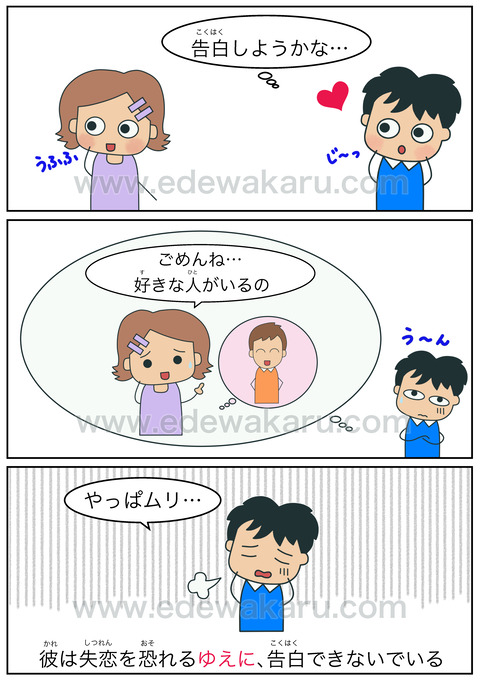
Meaning
〜だから
〜ために
How to use it
動詞・形容詞・名詞[普通形]+ゆえに
Explanation
「AゆえにB」は【原因・理由】を表す文型で、「AだからB」「AためにB」という意味で使われます。「〜。ゆえに〜」のように文頭にくることもあり、「〜。だから〜」という意味でも使用されます。後ろに名詞がくる場合は「〜ゆえの+名詞」になります。
[例]
若さ
ゆえの
過ち
「〜ゆえに」は、かたい書き言葉です。漢字で書くと「〜故に」です。N1を受ける人は、テストのためにしっかりと覚えておきましょう😊
In context 5 examples
彼は失恋を恐れるゆえに、告白できないでいる
→失恋を恐れるために告白できないでいる山田くんはケチゆえにモテないんだと思う…
→ケチなのでモテないんだと思う…十分なお金がなかったゆえに、留学をあきらめなければいけなかった
→十分なお金がなかったために、留学をあきらめなければいけなかった身長が低かったゆえに、CAになることができなかった
→身長が低かったために、CAになることができなかった*「CA」とは、キャビンアテンダントの略で客室乗務員(きゃくしつじょうむいん)のこと今年は台風が多かったゆえに、野菜の値段は上がり続けている
→台風が多かったために、野菜の値段は上がり続けている
日本語文型辞典 英語版
Meaning
【ゆえ】An old-fashioned, written expression.
Means “cause” or “reason.” Example
(1)
is in the style of literary narration. Example
(2)
means “to be dismissed from work for no reason.” Example
(3)
means “as if with some reason.” ゆえあって, ゆえなく, and ゆえありげ are all idiomatic expressions.
This means “with... as the cause/with... as the reason,” “on account of.”
Taking the clause in plain form, means “that is the cause/reason for.” As in
(5)
, can be used with a noun.
Means “the reason (I)... is that....” It is used to elaborate the reason something is done in cases where the situation is one of difficulty.
How to use it
1. ゆえ
2. Nのゆえに
3. ...がゆえ
4. ...のはNゆえである
In context 12 examples
ゆえあって故郷を捨て、この極寒の地に参りました。
Circumstances led me to abandon my hometown and come to this frozen place.
彼はゆえなく職務を解かれ、失意のうちに亡くなった。
He was relieved of his duties without reason and died of despair.
若い女が故ありげな様子で門のそばにたたずんでいた。
The young woman was standing by the gate looking as though there was a reason why she had to be there.
貧困のゆえに高等教育を受けられない子供たちがいる。
There are children who cannot undertake higher education due to poverty.
政府の無策の故に国内は内乱状態に陥った。
Due to the government’s lack of measures, the country descended into civil war.
女性であるが故に差別されることがある。
Sometimes I am discriminated against because I am a woman.
事が重大であるが故に、報告の遅れが悔やまれる。
As the matter is very serious, the delay in reporting it is particularly regrettable.
親が放任していたが故に非行に走る若者もいる。
There are young people who turn towards delinquency because their parents have let them do what they want.
容易に会えぬが故に会いたさがつのる。
The fact that it is not easy for us to meet makes us want to see each other even more.
若さ(が)故の過ちもあるのだ。
They are the foibles of youth.
息子は窃盗、万引で何度つかまったことか。それでも見捨てないのは子供可愛さゆえである。
My son has been caught stealing and shoplifting so many times. Even so, I don’t abandon him because I love him as he is my own flesh and blood.
冬山登山は確かに死と隣り合わせだ。だがそれでも行くのは冬山の魅力ゆえである。
Winter mountain-climbing and death certainly can go together. However, be that as it may, the reason I go is the fascination of the winter mountains.