AIUEO JLPT Grammar
Meaning
This sentence pattern is used to express emotions or actions in response to a situation or event, often used to emphasize that the same emotion or result occurs in any case, even when presenting opposite examples like「〜につけ、〜につけ」.
How to use it
動詞辞書形に+つけorつけてはorつけても名詞に+つけorつけてはorつけても
Explanation · 日本語
この文型は、ある状況や出来事に関連して、それに応じた感情や行動を表す表現です。「~につけ、~につけ」のように正反対の例を挙げて、どの場合でも同じ結果や感情になることを強調するときに使われます。
In context 5 examples
写真を見るにつけ、あの頃を思い出す。
Whenever I look at the photos, I remember those days.
良いにつけ悪いにつけ、結果は受け入れなければならない。
Whether good or bad, we must accept the results.
仕事につけては、彼は真剣に取り組む。
When it comes to work, he always takes it seriously.
この場所に来るにつけ、若い頃の思い出が蘇る。
Whenever I come to this place, memories of my youth come back.
何事につけても、彼女は冷静に対処する。
In any situation, she handles things calmly.
Bunpro Grammar Reference
Meaning
Whenever, Every time something happens
How to use it
Verb[る]+ につけ(て)
Noun + につけ(て)
Nuance
A formal, old-fashioned expression indicating that whenever (A) happens, (B) adheres to that and also happens.
Explanation
In a similar way to につき, につけ implies that there is a something that is 'affixed' to the event or occasion of (A). However, unlike に就き this structure is a combination of に and the conjunctive form of the る-Verb 付ける 'to affix', or 'to adhere'.
When using につけ, the most common translation will be that something is happening 'every (A)', or 'whenever (A)'. In the (B) part of the sentence, the thoughts or feelings of the speaker will often be expressed in relation to (A). Additionally, (B) will always be something that is thought to happen naturally due to (A).
This structure may appear with either verbs or nouns in their dictionary forms.
元カノが写っている写真を見るにつけ、胸が痛くなる。
Every time I see a picture with my ex-girlfriend, my heart aches.
この防波堤で釣りをするにつけ、父親のことを思い出す。
Every time I fish on this breakwater, it reminds me of my father.
彼は何かにつけ文句を言うので、一緒にいるだけで疲れる。
Since he complains whenever anything happens, it's exhausting being around him.
妻は妊娠中なので悲しい思いをしたり嬉しい思いをしたりするにつけ、すぐに泣き出します。
Since my wife is pregnant, she immediately bursts out crying whenever she has sad or happy experiences.
It is also possible to see につけて, but the abbreviated form is far more common.
あの時先輩に言われた事を思い出すにつけて、怒りが込み上がってきます。
Every time I remember what my senpai said to me, I get filled with anger.
彼と一緒に時間を過ごすにつけて、なんでこんな人と付き合っているんだろうと思う。
Every time I spend time with him, I think to myself, 'why am I still dating such a person'.
Caution
This is considered a fairly old-fashioned grammar structure, so will mostly only be seen in literature or shows that are emphasizing a specific time period.
Nuance · 日本語
(A)が起こるたびに、(B)も一緒になって起こるということを示す古くて丁寧な表現。
Explanation · 日本語
「につき」と同じように、「につけ」も (A) という出来事や機会に何かが「付いて離れない」ことを示します。しかし、「に就き」とは異なり、この文型は「に」と一段動詞「付ける」の連用形の組み合わせです。
この「につけ」は主に「(A) の度に」または「(A) のときはいつも」何かが起こるという意味で使われます。文の (B) の部分では、(A) に関する話し手の考えや気持ちが述べられます。また、(B) には常に (A) によって自然に起こると考えられる内容が来ます。
この文法は辞書形の動詞または名詞と一緒に使われます。
元カノが写っている写真を見るにつけ、胸が痛くなる。
Every time I see a picture with my ex-girlfriend, my heart aches.
この防波堤で釣りをするにつけ、父親のことを思い出す。
Every time I fish on this breakwater, it reminds me of my father.
彼は何かにつけ文句を言うので、一緒にいるだけで疲れる。
Since he complains whenever anything happens, it's exhausting being around him.
妻は妊娠中なので悲しい思いをしたり嬉しい思いをしたりするにつけ、すぐに泣き出します。
Since my wife is pregnant, she immediately bursts out crying whenever she has sad or happy experiences.
「につけて」という形もありますが、省略された「につけ」の方がよく使われます
あの時先輩に言われた事を思い出すにつけて、怒りが込み上がってきます。
Every time I remember what my senpai said to me, I get filled with anger.
彼と一緒に時間を過ごすにつけて、なんでこんな人と付き合っているんだろうと思う。
Every time I spend time with him, I think to myself, 'why am I still dating such a person'.
注意点
これはかなり古風な文型なので、特定の時代背景を強調する文学作品やドラマ、映画の中で使われることが多いです。
In context 18 examples
- 話し合いをするに付け、喧嘩ばかりしてしまう。
Whenever we have a discussion, unfortunately we end up only fighting.
- この防波堤で釣りをするにつけ、父親のことを思い出す。
Every time I fish on this breakwater, it reminds me of my father.
- 元カノが写っている写真を見るにつけ、胸が痛くなる。
Every time I see a picture with my ex-girlfriend, my heart aches.
- 彼は何かにつけ文句を言うので、一緒にいるだけで疲れる。
Since he complains whenever anything happens, it's exhausting being around him.
- 彼と一緒に時間を過ごすにつけて、なんでこんな人と付き合っているんだろうと思う。
Every time I spend time with him, I think to myself, 'why am I still dating such a person'.
- 妻は妊娠中なので悲しい思いをしたり嬉しい思いをしたりするにつけ、すぐに泣き出します。
Since my wife is pregnant, she immediately bursts out crying whenever she has sad or happy experiences.
- あの時先輩に言われた事を思い出すにつけて、怒りが込み上がってきます。
Every time I remember what my senpai said to me, I get filled with anger.
- この絵を見るに付け、子供の頃のことを思い出す。
Every time I see this picture, I recall my childhood.
- 悪い噂を聞くに付けて、だんだん不安になってきた。
Every time I hear a bad rumor, I gradually become anxious.
- 雨に付け雪に付け、どうせ仕事には行かなければならない。
Whenever it rains, whenever it snows, I somehow have to go to work.
- 隣の叔父さんは何かに付けて文句を言う人だ。
The old man next door is a person who complains whenever something (anything) happens.
- 何回かサークルに行くに付け、緊張しなくなってきた。
Whenever I go to the (soccer) circle, I start to lose the feeling of nervousness a little more each time.
- 彼と関わるに付けて、彼の本当の姿が見えてきた。
Whenever I associate with him, I start to be able to see his true appearance.
- 高校の時の制服を見るに付け、あの時の楽しさを思い出す。
Every time I see my uniform from my high school days, I suddenly recall how much fun I had at that time.
- アグネスからの茶碗を見るに付けて、一緒に居て、平和な日々を懐かしく感じる。
Whenever I see the teacup from Agness, I feel nostalgic for our peaceful days together.
- 息子からの便りが届くに付け、日々成長しているのがよく分かる。
Whenever news about my son arrives, I fully understand that he is growing day by day.
- 会社の実情を知るに付け、入社したことを後悔する人が続出しています。
Whenever the people who joined the company become aware of the company's circumstances, one after another they regret it.
- 私は昔から古い写真にとても興味があった。写真を見るに付け、撮られた人は誰なのか、後にどんな生活を送っていたのかなど疑問に思う。
Since long ago, I have been interested in old pictures. Whenever I see a photo, I wonder who the people are, what kind of life they led, etc.
DoJG 日本語文法辞典(全集)
Meaning
As; every time; whenever
How to use it
Vinformal nonpast | につけ | Where V=verb of cognition |
| 景色を見るにつけ | As I look at the scenery |
| 日記を読むにつけ | As I read the diary |
| そのことを考えるにつけ | As I think about it |
| 年を感じるにつけ | As I become conscious of my age |
| その香りを嗅ぐにつけ | As I smell the scent |
Explanation
A conjunction indicating that each time someone perceives something he/she feels or thinks something associated with it.
In context 9 examples
ナポリで撮った両親の写真を見るにつけ、あの時の楽しかった旅行を思い出す。
When I see the photo of my parents I took in Naples, I remember what a great time we had on that trip.
新緑の香りを嗅ぐにつけ、「ああ、春なんだなあ」と思わずのほほんとしてしまいます。
As I smell the scent of fresh green foliage, I tell myself it's finally spring and feel really relaxed, almost without realizing it.
そのピアニストの深みのある音楽を聴き、温かい人柄に触れるにつけ、「音楽は人なり」の思いを強くしております。
As I listen to the pianist's deeply-felt music and sense his warm personality, I feel strongly that music is man.
深刻化する年金問題や経済問題に対する政府の無策ぶりを見るにつけ、自分のことは自分で守るしかないと思う。
As I watch the government's inability to deal with the increasingly serious problems related to the pension system and economy, I think that we must (do what we can to) protect ourselves.
二十歳をはるかに過ぎても自立への見通しのつかない若者を見るにつけ、聞くにつけ、やるせない思いがあります。
As I watch or hear about young people who are well over 20 but have no prospects for becoming independent, I feel heavy-hearted.
いじめや虐待、陰惨な事件など、子供を取り巻く不幸な状況を考えるにつけ、この国の行く末を案じずにはいられない。
Whenever I think about the unhappy circumstances surrounding children, with the recent cases of bullying, abuse, and gruesome incidents, it makes me feel concerned about the future of this country.
世界各地での戦いの様子を見るにつけ胸が痛む。
As I watch the wars going on in various places around the world, my heart aches.
最近頻発している医療ミスの記事を読むにつけ、私も被害者になる可能性があったのではと戦慄を覚えてしまう。
Whenever I read articles about all of the medical errors that have been happening (frequently) recently, I shudder at the thought that I could have been a victim.
年末が一気に駆け足でやってくるのを感じるにつけ、自分の年齢を思い知らされます。
As I feel the end of the year coming at a dash, I become aware of my age.
絵でわかる日本語
Meaning
〜と、いつも
How to use it
動詞[辞書形]+につけ
名詞[辞書形]+につけ
Explanation
「〜につけ」は「〜と、いつも」という意味を表す文型です。使う動詞はほとんど決まっていますので、覚えておきましょう😉
[「〜につけ」と使う動詞]
・見るにつけ
・聞くにつけ
・考えるにつけ
・思うにつけ
また、例文①のように慣用的表現(かんようてきひょうげん)もいくつかありますので暗記しておきましょう😀
【
何かにつけ】
[意味]
どんなことにでも・どんな場合でも
【
何事につけ
(なにごとにつけ)】
[意味]
何かのきっかけがあるといつも
「〜につけ」は
後ろには、よく感情や考えを表すものがくる
ということも覚えておきましょう😊
In context 4 examples
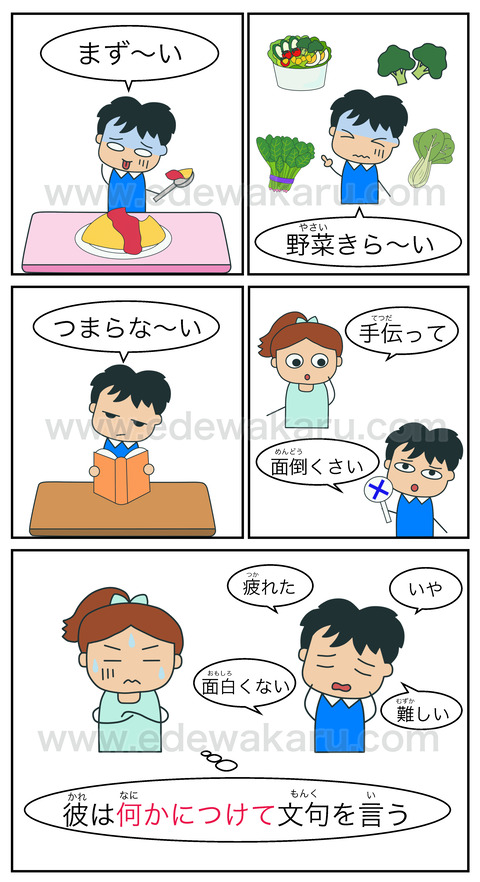
彼は、何かにつけ文句を言う
→彼は、どんなことにでも文句を言うあの写真を見るにつけ、悲しくなる
→あの写真を見ると、いつも悲しくなるこの曲を聞くにつけ、学生だった頃を思い出す
→この曲を聞くと、いつも学生だった頃を思い出す(復習:「思い出す」と「思いつく」)娘のことを考えるにつけ、元気が出る
→娘のことを考えると、いつも元気が出る
日本語文型辞典
Meaning
慣用的に固定した表現で、「何事につけ」「何かにつけ」の形で、それぞれ「どんな場合でも」「何かのきっかけがあるたびに」という意味を表す。
慣用的に固定した表現で、「見る」「思う」「考える」などの動詞に付き、「何かを見たり思ったりするたびにそれに関連して」という意を表す。後ろには「思い出」「後悔」など、感情や思考に関する内容が続く。
慣用的に固定した表現で、二つの対比的な内容を表す語句を並べて、「それらのどちらの場合でも」という意味を表す。
How to use it
Nにつけ
V-るにつけ
…につけ…につけ
AにつけAにつけ
VにつけVにつけ
In context 8 examples
何事につけ我慢が肝心だ。
彼は何かにつけ私のことを目のかたきにする。
山田さんご夫妻には何かにつけ親切にしていただいています。
彼女の姿を見るにつけ、その時のことが思い出される。
そのことを考えるにつけ後悔の念にさいなまれる。
その曲を聞くにつけ、苦しかったあの時代のことが思い出される。
いいにつけ悪いにつけ、あの人達の協力を仰ぐしかない。
話しがまとまるにつけ、まとまらないにつけ、仲介の労を取ってくれた方にはお礼をしなければなりません。
日本語文型辞典 英語版
Meaning
Used in idiomatic expressions such as 何事につけ or 何かにつけ. 何事につけ and 何かにつけ express the meaning “on all occasions” and “whenever there is a chance,” respectively.
An idiomatic expression. With a verb such as 見る(see/look), 思う(think) or 考える(think about), expresses the meaning of “whenever someone sees or thinks about a thing, regarding the thing....” Followed by a clause containing a phrase expressing some feeling or thought, such as 思い出(memories) or 後悔(regrets).
An idiomatic expression to list two contrasting items. Expresses the meaning of “either way.”
How to use it
1. Nにつけ
2. V-るにつけ
3. ...につけ...につけ[AにつけAにつけ][VにつけVにつけ]
In context 8 examples
何事につけ我慢が肝心だ。
Patience is the most important on all occasions.
彼は何かにつけ私のことを目のかたきにする。
Whenever we meet he is always very hostile to me.
山田さんご夫妻には何かにつけ親切にしていただいています。
In so many ways, Mr. and Mrs. Yamada are always kind to me.
彼女の姿を見るにつけ、その時のことが思い出される。
Whenever I see her, I am reminded of the incident.
そのことを考えるにつけ後悔の念にさいなまれる。
Whenever I think about it, I am always full of remorse.
その曲を聞くにつけ、苦しかったあの時代のことが思い出される。
Whenever I listen to the music, it reminds me of those hard times.
いいにつけ悪いにつけ、あの人達の協力を仰ぐしかない。
Whether good or bad, we have no choice but to ask those people for advice.
話しがまとまるにつけ、まとまらないにつけ、仲介の労を取ってくれた方にはお礼をしなければなりません。
Whether we come to an agreement or not, we have to give the person who mediated for us some token of gratitude for her trouble.
くらべてわかる日本語表現文型辞典
Meaning
意味1:Aを繰り返すたびに、自然とB。
意味2:「A₁につけA₂につけB」の形で。A₁の場合もA₂の場合もB。「なにかにつけB」の形で。何か機会があればいつもB。
How to use it
AにつけB(A₁につけA₂につけB/AにつけてもB/それにつけてもB/なにかにつけB)
接続1:
[動詞-る形]につけ
接続2:
[動詞-る形]につけ
[イ形-い]につけ
Explanation
【対比1】
「AたびにB」(意味1 P.124)
【対比2】
「AにしてもB(それにしてもB)」(意味1 P.236)
「それにつけてもB」はそれまでの話をふまえて、いろいろあるがやっぱりB、そうは言ってもやっぱりBの意味で、話し言葉で用いる場合は「それにしてもB」と同じ。
○それにつけても許せないのは、あいつの卑怯なやり方だ。
○それにしても許せないのは、あいつの卑怯なやり方だ。
しかし、「それにしてもB」は話題が変わるときや何かに気が付いたときなどに用いるが、「それにつけてもB」は使えない。
○「外で食事するのって、久しぶりだわ。」
○「ほんとね。…それにしてもおいしいね。」
×「ほんとね。…それにつけてもおいしいね。」
Notes
【注意1】
・「AにつけB」はBで心理状態を強く言い表すときのみ「AにつけてもB」と置き換え可能。
○彼の名前を聞くにつけ腹が立つ。
○彼の名前を聞くにつけても腹が立つ。
【注意2】
・A₁とA₂は対比的な語であるが、どの語でも使えるのではない慣用的表現。
・「AにつけてもB」という表現は、「AにつけB」の強調表現。
○彼は何をするにつけても、上司と相談する。
○彼は何をするにつけ、上司と相談する。
In context 8 examples
彼の話を聞くにつけ、彼が信じられなくなる。
その手紙を読むにつけ、母のことが思い出される。
中学生の非行の記事を読むにつけ、教育のあり方を考えさせられる。
優勝したときのことを思い出すにつけ、自然と笑みが浮かぶ。
いいにつけ、悪いにつけ目立つ存在だ。
彼はなにかにつけ、わたしの邪魔をする。
英語が苦手な私は、手紙を読むにつけ書くにつけ辞書が必要だ。
年をとったからか、嬉しいにつけ悲しいにつけ最近よく涙が出る。
NINJAL 日本語文型データベース
Usage 1
Meaning
ある場面に出会うと、いつも同じ心情が生じると言いたいときに使います。
「折につけ・何かにつけ・何ごとにつけ」は、慣用的な言い方です。
How to use it
Vるにつけ
Nにつけ
その他
Notes
「見る・聞く」など視覚や聴覚に関する言葉や、「読む・知る」など情報を得ることに関する言葉、「想像する・考える」など思考に関する言葉がきます。「〜につけ」の後には、「~」によって自然に生じた話し手の心情を表す文がきます。話し手の希望・意向を表す文や相手への働きかけの文はきません。
In context 9 examples
夕焼けの美しい空を見るにつけ、幼少期に過ごした故郷が恋しくなる。
このピアニストが弾くショパンの曲を聴くにつけ、ヨーロッパで生活した日々が思い出される。
心理学関係の本を読むにつけ、人間というものは本当に不思議な生きものだと思えてくる。
最近のニュースを見聞きするにつけ、この先世界はどうなっていくのだろうと、複雑な気持ちになる。
よいものを作ろうという農家の皆さんのご苦労を知るにつけ、頭が下がる思いがする。
将来のことを考えるにつけ、焦りを感じてしまう。
田中先生は折につけ、「自由」という語を持ち出しては持論を説いた。
私はこのごろ気が弱くなったと思う。何事につけ心配になってしまう。
最近、妹はあるアイドルグループのファンになった。何かにつけ、その話ばかりしている。
Usage 2
Meaning
「~」のどちらの場合にも毎度同じ状況になると言いたいときに使います。
How to use it
V1るにつけV2るにつけ(「VるにつけVないにつけ」の形もある)
i-A1いにつけi-A2いにつけ
N1につけN2につけ
Notes
2つの「~」には、対比的な場合を表す言葉や関連がある場合を表す言葉がきます。
「いいにつけ悪いにつけ・暑いにつけ寒いにつけ」 など、慣用的な言い方が多いです。
In context 9 examples
持論を押すにつけ引くにつけ、山田さんの態度はいつも慎重だ。
被災地の惨状を見るにつけ聞くにつけ、何とか支援の方法はないものかと思う。
社内プレゼンテーションが成功するにつけしないにつけ、我々のチームは反省会を開いている。
うれしいにつけ悲しいにつけ、私はよく酒を飲む。
いいにつけ悪いにつけ、子どもは親の影響を受けるものだ。
暑いにつけ寒いにつけ、エアコンが大活躍する。
大雨につけ大風につけ、遠く離れた実家の老母のことが心配になる。
私は進学につけ就職につけ、人の世話になることが多かった。
勉学につけ遊びにつけ、彼女はパワー全開になる。
IMABI
Whenever II: ~度に, ~都度, & ~につけ
Read this IMABI lesson ↗Explanation
Whenever II: ~度に, ~都度, & ~につけ
This lesson will discuss slightly more advanced phrases that equate to “whenever”.
~度に
~度(毎)に means “whenever”. 度 is the native word/counter for the number of times, making it common in set phrases such as 度を重ねる (to continue repeat itself). Grammatically speaking, it is after either nouns or the non-past form of a verb. What it follows is either a definite integer of place, time, action, or activity. This X is the trigger for Y, which without doubt will occur. Thus, whenever you say “whenever” with ~度に, you are saying that Y will 100% happen.
Now, the ごと is important to keep in mind. In the past, it was not uncommon to see ~ごとに after verbs. Now, it causes the sentence to become unnatural. So, as an effect, ~度毎に is also typically only found with nouns.
Examples
1. 幾度いくども失敗しっぱいを繰くり返すのはつらいですね。
Repeating a failure countless times is painful, isn’t it?
2. 何事なにごとも度たびを重かさねれば必かならずや上達じょうたつする。
If you repeat anything all the time, you will certainly improve.
3. 機会きかいがある度に
Whenever you get a chance
4. 俺おれはやる度に失敗しちまうんだよ。(Casual; masculine)
Whenever I do it, I end up failing (which is why I won’t do it)
Grammar Notes:
1. This makes it very similar to ~につけ, which will be discussed in this lesson. However, if you interchange it for ~度に, you speak objectively and the emotional feel is lost entirely.
2. There is some similarity between ~ごとに and ~たびに. ~ごとに shows that when there is a chance, a habitual action is simply repeated. ~たびに, despite also showing same habitual action, when one encounters a particular opportunity, it gives a sense that it is not incidental. Thus, even if the action is special but the timing is not, you can’t use ~たびに.
~都度
The most appropriate translation of 都度 is “whenever”. Like 度, it must be used with の when with another nominal phrase, and it may also be accompanied by に. What is neat about 都度 is that it is often seen in the pattern その都度.
都度 is less emphatic and less likely to be in more personal situations. It is very similar “each time it happens”.
Examples
5. 取引とりひきのつど残高欄ざんだからんに残高金額きんがくが示されるようにしたものです。
Whenever it is exchanged, the balance amount is made shown in the bank balance column.
6. 彼氏に会うその都度つど、彼女はとても嬉うれしくなるようです。
It seems that she becomes very happy whenever she meets her boyfriend.
7. 夫の両親が来る時はその都度喧嘩けんかが始まる。
Whenever my husband’s parents come, an argument gets started (with them).
~につけ
Following nouns or the 連体形 of verbs or adjectives, ~につけ means “each time when/both…and…”. It is mainly used in the written language, but it is also used in formal speaking situations. What comes before it/what it follows is a constant that causes a change. In other words, if there is a situation X, then no matter what, along with X, Y reflexively occurs, and at the same time, a psychological change is brought about.
In the case that Y describes a past event, X is the trigger in remembering Y, and a sense of emotion suitable to that memory is expressed. This pattern is often after verbs such as 見る, 聞く, and 思う. The pattern is then often followed by phrase that captures the emotion the speaker wishes to portray.
~につけて is naturally more suitable for the spoken language, but when used in examples like the first one and others such as 雨につけ風につけ, ~につけて is impossible. This is due to the antithetical element.
There is also ~につけても. This adds the particle も, which in this situation adds the function of analogy. So, aside from A, it is used to show various changes of B happening.
Examples
8. 喜びにつけ悲しみにつけ
Both in joy and in sorrow
9. あいつを見るにつけ、兄を思い出させる。
Each time I see him, he reminds me of my older brother.
10. 試験をもう一度失敗するにつけ、憂鬱ゆううつが蘇よみがえる。
Each time when I fail the exam once more, my depression comes back.
11. 何事につけても、喜んでお手伝いします。
Whatever you do, we’re ready to gladly help you.
12. 年のせいなんだろう、暑いにつけ、寒いにつけ、よく風邪を引くようになった。
I wonder if it’s because of my age; both when hot and when cold, I have become more prone to having colds.
13. この写真を見るにつけ、いつも思い出すのは、あの決して美しくはなかった青春時代のことである。(Written)
Each time I see this photo, I always remember my completely ugly youth.
In context 15 examples
幾度いくども失敗しっぱいを繰くり返すのはつらいですね。
Repeating a failure countless times is painful, isn’t it?
何事なにごとも度たびを重かさねれば必かならずや上達じょうたつする。
If you repeat anything all the time, you will certainly improve.
機会きかいがある度に
Whenever you get a chance
俺おれはやる度に失敗しちまうんだよ。(Casual; masculine)
Whenever I do it, I end up failing (which is why I won’t do it)
This makes it very similar to ~につけ, which will be discussed in this lesson. However, if you interchange it for ~度に, you speak objectively and the emotional feel is lost entirely.
There is some similarity between ~ごとに and ~たびに. ~ごとに shows that when there is a chance, a habitual action is simply repeated. ~たびに, despite also showing same habitual action, when one encounters a particular opportunity, it gives a sense that it is not incidental. Thus, even if the action is special but the timing is not, you can’t use ~たびに.
取引とりひきのつど残高欄ざんだからんに残高金額きんがくが示されるようにしたものです。
Whenever it is exchanged, the balance amount is made shown in the bank balance column.
彼氏に会うその都度つど、彼女はとても嬉うれしくなるようです。
It seems that she becomes very happy whenever she meets her boyfriend.
夫の両親が来る時はその都度喧嘩けんかが始まる。
Whenever my husband’s parents come, an argument gets started (with them).
喜びにつけ悲しみにつけ
Both in joy and in sorrow
あいつを見るにつけ、兄を思い出させる。
Each time I see him, he reminds me of my older brother.
試験をもう一度失敗するにつけ、憂鬱ゆううつが蘇よみがえる。
Each time when I fail the exam once more, my depression comes back.
何事につけても、喜んでお手伝いします。
Whatever you do, we’re ready to gladly help you.
年のせいなんだろう、暑いにつけ、寒いにつけ、よく風邪を引くようになった。
I wonder if it’s because of my age; both when hot and when cold, I have become more prone to having colds.
この写真を見るにつけ、いつも思い出すのは、あの決して美しくはなかった青春時代のことである。(Written)
Each time I see this photo, I always remember my completely ugly youth.